EP1995915A2 - Bidirektionales drahtloses Kommunikationsverfahren und entsprechendes System, Endgerät und entsprechende Verwendungen - Google Patents
Bidirektionales drahtloses Kommunikationsverfahren und entsprechendes System, Endgerät und entsprechende Verwendungen Download PDFInfo
- Publication number
- EP1995915A2 EP1995915A2 EP08380147A EP08380147A EP1995915A2 EP 1995915 A2 EP1995915 A2 EP 1995915A2 EP 08380147 A EP08380147 A EP 08380147A EP 08380147 A EP08380147 A EP 08380147A EP 1995915 A2 EP1995915 A2 EP 1995915A2
- Authority
- EP
- European Patent Office
- Prior art keywords
- terminal
- packages
- package
- communication
- encoding
- Prior art date
- Legal status (The legal status is an assumption and is not a legal conclusion. Google has not performed a legal analysis and makes no representation as to the accuracy of the status listed.)
- Withdrawn
Links
- 238000004891 communication Methods 0.000 title claims abstract description 90
- 238000000034 method Methods 0.000 title claims abstract description 75
- 238000012790 confirmation Methods 0.000 claims abstract description 14
- 238000005265 energy consumption Methods 0.000 claims description 13
- 238000001228 spectrum Methods 0.000 claims description 3
- 230000005540 biological transmission Effects 0.000 abstract description 8
- 238000010586 diagram Methods 0.000 description 5
- 230000001360 synchronised effect Effects 0.000 description 4
- 230000033764 rhythmic process Effects 0.000 description 3
- 230000006835 compression Effects 0.000 description 2
- 238000007906 compression Methods 0.000 description 2
- 238000005516 engineering process Methods 0.000 description 2
- 108700026140 MAC combination Proteins 0.000 description 1
- 230000003111 delayed effect Effects 0.000 description 1
- 230000010354 integration Effects 0.000 description 1
- 230000007246 mechanism Effects 0.000 description 1
- 230000002618 waking effect Effects 0.000 description 1
Images


Classifications
-
- H—ELECTRICITY
- H04—ELECTRIC COMMUNICATION TECHNIQUE
- H04W—WIRELESS COMMUNICATION NETWORKS
- H04W74/00—Wireless channel access
- H04W74/08—Non-scheduled access, e.g. ALOHA
- H04W74/0808—Non-scheduled access, e.g. ALOHA using carrier sensing, e.g. carrier sense multiple access [CSMA]
-
- H—ELECTRICITY
- H04—ELECTRIC COMMUNICATION TECHNIQUE
- H04L—TRANSMISSION OF DIGITAL INFORMATION, e.g. TELEGRAPHIC COMMUNICATION
- H04L12/00—Data switching networks
- H04L12/54—Store-and-forward switching systems
- H04L12/56—Packet switching systems
-
- H—ELECTRICITY
- H04—ELECTRIC COMMUNICATION TECHNIQUE
- H04W—WIRELESS COMMUNICATION NETWORKS
- H04W12/00—Security arrangements; Authentication; Protecting privacy or anonymity
- H04W12/02—Protecting privacy or anonymity, e.g. protecting personally identifiable information [PII]
-
- H—ELECTRICITY
- H04—ELECTRIC COMMUNICATION TECHNIQUE
- H04W—WIRELESS COMMUNICATION NETWORKS
- H04W28/00—Network traffic management; Network resource management
- H04W28/02—Traffic management, e.g. flow control or congestion control
- H04W28/06—Optimizing the usage of the radio link, e.g. header compression, information sizing, discarding information
-
- Y—GENERAL TAGGING OF NEW TECHNOLOGICAL DEVELOPMENTS; GENERAL TAGGING OF CROSS-SECTIONAL TECHNOLOGIES SPANNING OVER SEVERAL SECTIONS OF THE IPC; TECHNICAL SUBJECTS COVERED BY FORMER USPC CROSS-REFERENCE ART COLLECTIONS [XRACs] AND DIGESTS
- Y02—TECHNOLOGIES OR APPLICATIONS FOR MITIGATION OR ADAPTATION AGAINST CLIMATE CHANGE
- Y02D—CLIMATE CHANGE MITIGATION TECHNOLOGIES IN INFORMATION AND COMMUNICATION TECHNOLOGIES [ICT], I.E. INFORMATION AND COMMUNICATION TECHNOLOGIES AIMING AT THE REDUCTION OF THEIR OWN ENERGY USE
- Y02D30/00—Reducing energy consumption in communication networks
- Y02D30/70—Reducing energy consumption in communication networks in wireless communication networks
Definitions
- the invention relates to a two-directional wireless communication method suitable for transmitting a voice, audio or video message in real time from a first terminal to a second terminal, where the message is divided into a plurality of digitalized packages, and suitable for transmitting a second voice, audio or video message in real time from the second terminal to the first terminal, where the second message, in turn, is divided into a plurality of digitalized second packages.
- the invention also relates to a communication system comprising at least two terminals, where each terminal comprises a device for emitting and receiving radio signals within one of the frequency bandwidths in the group made up of 2'4 GHz, 915 MHz and 868 MHz bands, and a logical circuit comprising a microprocessor, suitable for running the method according to the invention.
- the invention relates to uses of the IEEE 802.15.4 standard and the Zigbee protocol for implementing the method according to the invention as well as the usage of terminals that are compatible with the IEEE 802.15.4 standard and/or with the Zigbee protocol for running the method according to the invention.
- the Bluetooth ® protocol can transmit audio and video messages, and to do so it must operate at high communication speeds (1 Mbps). Consequently, for a low consumption level it has a very low action radius (about 10 m for a radio frequency emission power of 1 mW).
- the DECT and WiFI technologies both used, for example, in wireless telephones, transmit voice messages over larger distances (up to 50 m and 30 m, respectively), but at the cost of a much higher consumption level.
- the purpose of the invention is to overcome these drawbacks.
- This aim is achieved by means of a two-directional wireless communication method of the type indicated at the beginning, characterized in that it comprises the following stages:
- the method according to the invention combines a series of characteristics whereby the above-mentioned drawbacks can be overcome. It is a method that has a low energy consumption level thanks, inter alia, to its low communication speed and its DSSS modulation technique, whereby it is highly sensitive to radio frequency receivers. It is a method that has a large action radius and is simple to implement. In spite of its low communication speed, it can transmit voice, audio and even video messages in real time in two directions between the two terminals.
- Codec is an abbreviation for encoder-decoder, commonly used in this technical sector, and basically it is an information compression algorithm, whereby the codec, on the one hand, can compress the information and, subsequently, decompress it to reconstruct the original information.
- the quality of the reconstructed information will depend on the properties of the codec.
- One of the reasons for compressing the information is to reduce the volume of information to transmit (other reasons could be, for example, for storing or coding the information).
- the codecs are particularly important for transmitting voice, audio, and/or video messages in real time, because in these cases the time used to transmit the various packages of information it clearly shortened.
- codecs on the market that can process voice, audio and even video messages, with a high quality and with bandwidths even lower than 85 kbps.
- Various compression methods and codecs are available on the market, such as for example PCM (Pulse Code Modulation, codec G.711) voice codecs, ADPCM (Adaptative Pulse Code Modulation, codec G.721/6), PureVoice, SmartRate, AMR, Speex, iLBC, GSM, etc.
- the method according to the invention preferably uses the G.723.5 codec, with a bandwidth of 8.5 kbps, to transmit voice and audio, and the H.264 codec (known as MPEG-4 AVC) for transmitting video.
- Other interesting codecs are codecs G.723.1 and G.729. Logically, the method can be compatible with any codec currently used or which may be developed in the future, providing it complies with the maximum bandwidth requirement.
- the communication method does not transmit confirmation messages.
- the receiver emits a confirmation message after receiving a package of information.
- these communication methods have mechanisms whereby the absence of this confirmation message causes the emitter to emit the same package of information again several times. This strategy is aimed at guaranteeing that all the information is transmitted completely and accurately. Nevertheless it has been observed that in the real time transmission of voice, audio and/or video messages it is not particularly serious if a package of information is lost. It is much more important that the continuous flow of the message is not interrupted. In this respect, the transmission of confirmation messages slows down communication to a large degree, since it consumes a non-depreciable bandwidth.
- the method whereby a terminal, before transmitting, listens to see if the frequency at which it is going to transmit is free is a known method.
- a preferred example of this is the CSMA-CA (Carrier Sense Multiple Access with Collision Avoidance) method. Basically it consists in the terminal listening to the medium at the frequency at which it is going to transmit and, if it detects that said frequency is being used for transmission, it waits a random time period before trying the transmission again. This reduces the probability of collisions. Nevertheless, generally, the CSMA-CA method cannot totally remove all risk of collision. In this respect, the method according to the invention improves this situation as it reduces the risk of collision even more.
- the second terminal when starting communication the second terminal does not emit until it has received a package from the first terminal. This avoids a first collision between both terminals. Once a first package has been received from the first terminal, the second terminal can now send its package. Neither in this case can there be any collision since the first terminal will, at this time, be encoding the next package. From then onwards, it will be the encoding time of the first terminal that sets the communication rhythm, thereby establishing a kind of synchronisation between both terminals. The first terminal will send its package when it has encoded it and the second terminal will send a second package each time it receives a package from the first terminal. This way a possible collision between the packages is constantly avoided.
- setting up the communication between both terminals so that it is without confirmation messages setting may have to be done each time a new communication is started between both terminals or, on the contrary, it may only have to be done once, after which time the subsequent communication is without confirmation messages.
- the communication that is established between both terminals is not a two-directional communication in the sense that the packages in one direction cross with the packages in the other direction, along different channels.
- one single channel is being used along which the packages in one and the other direction are alternated.
- it is a two-directional communication from the point of view of the user, as information can be sent from the first terminal to the second terminal and vice versa, simultaneously (from the user's point of view) in real time, although really one single radio frequency channel is used. Therefore, it could be said that it is a semi two-directional or semi-duplex communication.
- the second terminal encodes the second packages at the rhythm marked by the encoding speed of the codec.
- second package n Once one of the second packages has been encoded (called second package n), it is loaded into a memory so that it can be sent in the event a package is received from the first (which is stage e mentioned above). Nevertheless, once the encoding of the next of the second packages has finished (second package n+1), the new second package n+1 is loaded into the memory and the second package n is no longer of interest, as now it will not be sent. Therefore, preferably, the second terminal has loaded in the memory only the last of the second encoded second packages, so that each time it loads a new coded second package, it disregards the former.
- the method according to the invention uses data packages, called data frame, according to IEEE 802.15.4 standard, as approved in 2003.
- data frame data packages
- IEEE 802.15.4 standard each time reference is made to the IEEE 802.15.4 standard, said standard will be referenced as it was approved in 2003.
- the method uses certain characteristics as defined in said standard on said date although, logically, the method can be applicable to any subsequent version of the standard providing that it maintains the same definition of the characteristics in question.
- the method according to the invention can use the said data packages according to IEEE 802.15.4 standard, but with the MAC header reduced.
- the head can be reduced, in particular, the addressing fields can be reduced. This way each data package can include more information thus increasing the available bandwidth for the codec.
- a particularly advantageous way is obtained by reducing the addressing fields field of the MAC head by 16 bytes, since a reduced address of 2 bytes in length is used both for the first terminal and for the second terminal so that the addressing field is reduced from 20 bytes to 4 bytes.
- Another advantageous alternative consists in using data packages in the APL application layer, either in the APS sublayer or in the Application object sublayer, according to the Zigbee protocol as approved in its first version v. 1.0 on 14 December 2004.
- the Zigbee protocol As in the case of the standard, hereinafter, each time reference is made to the Zigbee protocol, said protocol will be referenced in its version 1.0 and as it was approved on 14 December 2004.
- this means that the method uses certain characteristics as defined in said protocol on said date although, logically, the method can be applicable to any subsequent version of the protocol providing that it maintains the same definition of the characteristics in question.
- the MAC head of said data packages has been reduced by 14 bytes in the addressing fields field, using reduced addresses of two bytes in length both for the first terminal and the second terminal, and using 2 bytes for identifying the network, so that the addressing fields field is reduced from 20 bytes to 6 bytes.
- one of the terminals operates as a coordinator, as defined in IEEE 802.15.4 standard.
- the method according to the invention operates in an asynchronous manner. This does not mean that the whole communication method is completely asynchronous. Instead it means that it can be carried out within the framework of a synchronous communication method and that it includes asynchronous time windows between each pair of beacon signals in which the terminals can carry out asynchronous communication.
- a network synchronised according to IEEE 802.15.4 standard has the time between the beacon signals divided into two blocks; a first block, called CAP (Contention Access Period) within which an asynchronous communication can be established (which is, for example, the time lapse that a new terminal wishing to integrate into the network takes to send its network integration request message) and a second CFP (Contention-Free Period) that is divided into GTS (Guaranteed Time Slot) spaces, where each GTS space is assigned to a network terminal.
- CAP Contention Access Period
- GTS Guard Time Slot
- the first terminal numbers the packages and the second terminal controls the number of the received package, disregarding it if the number coincides with the number of an already received package. This avoids problems with duplicated packages, for example due to signal rebounds.
- the communication speed is 250 kbps. In fact, this is the speed that will allow better quality codecs to be used. Additionally is the greatest communication speed envisaged by the IEEE 802.15.4 standard and the Zigbee protocol.
- Another advantageous embodiment of the invention method is obtained when each terminal sets a reception time during which it remains listening to receive the package transmitted by the other terminal, and outside which it disregards any reception considering it to be an interference, where the first terminal starts the reception time from when it has sent the previous package and where the second terminal starts the reception time just before it sends the following second package.
- both terminal listen to the medium during a time period in which, approximately, they should receive the package transmitted by the other terminal and, on the other hand, disregard any signal outside this time period, considering it to be a noise.
- This method allows the communication system to be more robust and less sensitive to interferences. As it can be seen, each terminal locates the reception time in a different way.
- the first terminal is the one that will end up marking the communication rhythm, as it will emit a package each time the codec has encoded a package.
- the second terminal will have encoded its second package approximately simultaneously (preferably beforehand) to the first terminal. Therefore, once the first terminal has sent its package, it starts to count the reception time, as the second terminal already has its second package encoded and, once it has received the first package, it can start to transmit the second package. For its part, the second terminal, when it receives the first package from the first terminal, knows when it will receive the following first packages, and from there, it can calculate the reception time counting backwards. This way external interferences are disregarded, and if one package has a one-off problem the communication between both terminals is prevented from being interrupted.
- stage c comprises, additionally, the following stage before stages c1 and c2:
- various communication methods have defined low energy consumption status or modes, wherein the terminals reduce their energy consumption based on adopting certain configurations.
- these modes or status are called “sleeping state” or the like.
- a terminal in sleeping state wakes up regularly to check whether it should perform any action.
- the terminal that wants to set up communication remains awake and waits for the other terminal to wake up and emits a query as to whether it must perform some action, which is when the first terminal requires it to remain awake as it wants to start communication.
- the encoding sequences in stages c1 and c2 are time shifted so that the second terminal completes the encoding of each of the second packages before receiving the corresponding package.
- the object of the invention is also a communication system comprising at least two terminals, where each terminal comprises a device for emitting and receiving radio signals within one of the frequency bands in the group made up of the bands 2'4 GHz, 915 MHz and 868 MHz, and a logical circuit comprising a microprocessor, suitable for running the method according to the invention.
- these terminals have the radio signal emission and reception device and the logical circuit comprising a microprocessor integrated into a single chip.
- the object of the invention is also each of these terminals.
- a preferable use according to the invention is the use of the IEEE 802.15.4 standard and, preferably, the Zigbee protocol, to implement the method according to the invention.
- the object of the IEEE 802.15.4 standard is, in fact, to set up low consumption and large action radius communication systems. Nevertheless the system is not envisaged to transmit voice, audio and/or video messages in real time.
- the method according to the invention one manages to integrate the advantages of the IEEE 802.15.4 standard (and the Zigbee protocol) in a system for transmitting voice, audio and/or video messages in real time. For this same reason it is an advantage to use a terminal that is compatible with the IEEE 802.15.4 standard, or with the Zigbee protocol, to run the method according to the invention.
- a particularly interesting advantage is that the system (or the terminal) is compatible with the Zigbee protocol because, this way, it is compatible with all the devices that comply with the Zigbee protocol.
- Document EP 1.519.522 A2 describes a voice message communication method using the IEEE 802.15.4 standard.
- this method is very different as it requires using a synchronised communication network that uses a synchronous communication structure (called superframe structure) that is not compatible with the 802.15.4 standard or with the Zigbee protocol either. Consequently, its consumption is not minimised, it does not avail as much as possible of the available bandwidth, it is not flexible in the sense that it cannot use different codecs, and it is not compatible with other devices produced according to the Zigbee protocol.
- superframe structure synchronous communication structure
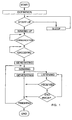
- Figures 1 and 2 show an example of the operation that a first and a second terminal will follow when communication according to the invention.
- the DEFINITION stage in which it is defined what the communication network must be like, in other words, where above-mentioned stages a and b are run. In addition all the actions needed to define and set up the communication network take place.
- Both the first terminal in other words, the terminal that wants to start communication, and the second terminal, are initially in a "sleeping" state. Regularly they wake up and enquire whether they must carry out a conversation. Otherwise the SLEEP instruction is run whereby they remain in the sleeping state for another pre-set time period.
- the first terminal When the first terminal receives an external instruction whereby it must set up communication, in the WAKING UP stage it wakes up and waits for the second terminal, when it wakes up, to enquire whether it must communicate. The first terminal responds in the affirmative to the second terminal so that both remain awake.
- the second terminal picks up the communication, starts its encoding and indicates to the first terminal that it can start its encoding and message transmission.
- the first terminal in the GENERATING stage starts the encoding sequence of the packages of the first message. Each time it finishes encoding a package, it sends it and, simultaneously, it starts encoding the following package. Once the package has been sent, the first terminal starts the LISTENING stage, during which it remains listening for a pre-set reception time to see whether it receives a second package from the second terminal. Both if the first terminal receives a second package from the second terminal and it does not receive it in the pre-set reception time (END RECEP. stage), the first terminal continues with the package generating and dispatch sequence until the message is complete.
- the second terminal starts the encoding sequence of the second packages of the second message (GENERATING stage), and loads them in a memory of an element as it encodes them with just the last encoded package remaining. At the same time, the second terminal remains listening (LISTENING stage) during a pre-set reception time (END RECEP. stage). If a package is received from the first terminal, the second terminal sends the last of the encoded second packages (SENDING stage).
- One way for the second terminal to encode each of the second packages before it receives the corresponding package from the first terminal is to make the second terminal start encoding and the first of the second packages in the same instant as it sends the first terminal the message indicating that it has picked up the communication. This way, since this message requires a certain time period until it is received by the first terminal, the first terminal will start encoding the first of the packages in the first message a little later. This way, the second terminal will always have the second package corresponding to a certain package, encoded before receiving said certain package, and will be able to send it as soon as it receives the corresponding package.
- the method according to the invention can be generalised perfectly for one-way communications, which will enjoy the above-mentioned advantages. Also, in the case of one-way communications, it is possible to envisage that there is a plurality of second terminals, in other words, that the packages sent by the first terminal are directed to a plurality of second terminals, and the permitted bandwidth is doubled, reaching 170 kbps.
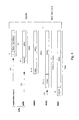
- Figure 3 shows a time diagram of the different stages followed by both terminals.
- terminals 1 and 2 perform a series of stages and communications (not shown in the figure) to set up the communication network.
- a low energy consumption state also known as sleeping or, simple, "asleep”
- each terminal comes out of its low energy consumption state (it “wakes up") and asks the other terminal if it must set up communication. If it does not receive any reply it returns to its low energy consumption state.
- the first terminal receives an external order whereby it must start communication (START UP) with the second terminal (TERMINAL 2).
- the first terminal comes out of its low energy consumption state (WAKE UP) and waits for the second terminal to communicate with it.
- WAKE UP low energy consumption state
- the first terminal which is already awake, replies in the affirmative (YES), after which the second terminal also remains awake and starts the actions to set up communication (RINGING). For example, if the second terminal were a telephone, it would start to ring so that the user picks it up.
- the second terminal tells the first terminal that it is starting to encode the second packages forming the second message (START ENCOD.).
- the first terminal when it receives this message, in turn starts to encode the packages forming the first message.
- it can send a confirmation message (CONFIRMATION) to the second terminal.
- CONFIRMATION confirmation message
- the second terminal has started to encode the first of the second packages after picking up the communication.
- the time it takes to encode each second package (TCODEC) will depend on the codec used, but it will be constant for all the second packages of the second message.
- the first terminal starts encoding the first of the packages when it receives the message from the second terminal telling it that the latter has started encoding. Therefore, the first terminal starts encoding later. Consequently the encoding time (TCODEC) of the first terminal is delayed with respect to the encoding time of the second terminal.
- the first terminal finishes encoding the first of the packages, it transmits it to the second terminal (1).
- the second terminal receives the first of the packages, it has already encoding the first of the second packages, and it has kept it in a memory, starting to encode the next of the second packages.
- the second terminal transmits the first of the second packages to the first terminal (1').
- the first terminal will set the packages it encodes as soon as it finishes encoding each of them (2, 3, 4, 5).
- the second terminal will send the last second package that it has encoded each time it receives a package from the first terminal (2', 4', 5').
- Figure 3 shows possible communication problems that may occur. For example if a package (3) does not reach the second terminal, the second terminal does not transmit any second package. When the second terminal finishes encoding the next second package, it will load it into the memory and will disregard the previous second package.
- the first terminal will sent a package each time it has it encoded (5) irrespective of whether it has received the previous second package (4').
- FIG 3 also shows the time period during which each terminal waits to receive a package from the other terminal, called the reception time (T1).
- T1 the time T1 starts when the first terminal sends its package and is slightly longer than double the transmission time of one package (which corresponds to the time of sending a package and the time when the second terminal sends its package). Outside this time period, the first terminal does not "listen” as it supposes that what it may receive is not a second package but noise.
- the time period T1 is positioned taking into account that the end of said time period must coincide with the moment when the second terminal envisages sending the next of the second packages.
- Figure 4 shows the length of the packages in each of the layers defined both in the IEEE 802.15.4 standard, and in the Zigbee protocol.
- Each layer includes its header with information that is relevant for it.
- the invention allows working both with standard data packages (1), and with data packages (2), and (3) the protocol ones. If working with the standard more useful information can be included in each package (MSDU) than with the Zigbee protocol, regardless of whether it is an APS package or an Application object package.
- the APS packages allow more useful information to be included than the packages in the last application layer, Application object (2 bytes more).
Landscapes
- Engineering & Computer Science (AREA)
- Computer Networks & Wireless Communication (AREA)
- Signal Processing (AREA)
- Computer Security & Cryptography (AREA)
- Mobile Radio Communication Systems (AREA)
- Small-Scale Networks (AREA)
Applications Claiming Priority (1)
| Application Number | Priority Date | Filing Date | Title |
|---|---|---|---|
| ES200701315A ES2284415B1 (es) | 2007-05-16 | 2007-05-16 | "procedimiento de comunicacion inalambrica bidireccional y sistema, terminal y usos correspondientes. |
Publications (2)
| Publication Number | Publication Date |
|---|---|
| EP1995915A2 true EP1995915A2 (de) | 2008-11-26 |
| EP1995915A3 EP1995915A3 (de) | 2013-02-27 |
Family
ID=38651124
Family Applications (1)
| Application Number | Title | Priority Date | Filing Date |
|---|---|---|---|
| EP08380147A Withdrawn EP1995915A3 (de) | 2007-05-16 | 2008-05-12 | Bidirektionales drahtloses Kommunikationsverfahren und entsprechendes System, Endgerät und entsprechende Verwendungen |
Country Status (2)
| Country | Link |
|---|---|
| EP (1) | EP1995915A3 (de) |
| ES (1) | ES2284415B1 (de) |
Cited By (2)
| Publication number | Priority date | Publication date | Assignee | Title |
|---|---|---|---|---|
| US20130135532A1 (en) * | 2011-11-28 | 2013-05-30 | Electronics And Telecommunications Research Institute | Apparatus and method for communicating wireless video based on zigbee network protocol |
| FR3017759A1 (fr) * | 2014-02-19 | 2015-08-21 | Jacques Leneveu | Procede de communication bidirectionnelle et systeme d'interphonie bidirectionnelle mettant en œuvre ledit procede |
Citations (1)
| Publication number | Priority date | Publication date | Assignee | Title |
|---|---|---|---|---|
| EP1519522A2 (de) | 2003-09-23 | 2005-03-30 | Samsung Electronics Co., Ltd. | Schnurloses Kommunikationsgerät und Verfahren für Sprachkommunikationen in einem drahtlosen persönlichen Netzwerk |
Family Cites Families (4)
| Publication number | Priority date | Publication date | Assignee | Title |
|---|---|---|---|---|
| US5086482A (en) * | 1989-01-25 | 1992-02-04 | Ezel, Inc. | Image processing method |
| JP2972765B1 (ja) * | 1998-11-20 | 1999-11-08 | 静岡日本電気株式会社 | 簡易型携帯電話システムの移動局側のキャリアセンス方法及びシステム |
| JP2006050519A (ja) * | 2003-10-24 | 2006-02-16 | Sony Corp | 無線通信システム、無線通信装置及び無線通信方法、並びにコンピュータ・プログラム |
| JP4509822B2 (ja) * | 2005-02-24 | 2010-07-21 | Okiセミコンダクタ株式会社 | 無線集積回路 |
-
2007
- 2007-05-16 ES ES200701315A patent/ES2284415B1/es not_active Expired - Fee Related
-
2008
- 2008-05-12 EP EP08380147A patent/EP1995915A3/de not_active Withdrawn
Patent Citations (1)
| Publication number | Priority date | Publication date | Assignee | Title |
|---|---|---|---|---|
| EP1519522A2 (de) | 2003-09-23 | 2005-03-30 | Samsung Electronics Co., Ltd. | Schnurloses Kommunikationsgerät und Verfahren für Sprachkommunikationen in einem drahtlosen persönlichen Netzwerk |
Cited By (2)
| Publication number | Priority date | Publication date | Assignee | Title |
|---|---|---|---|---|
| US20130135532A1 (en) * | 2011-11-28 | 2013-05-30 | Electronics And Telecommunications Research Institute | Apparatus and method for communicating wireless video based on zigbee network protocol |
| FR3017759A1 (fr) * | 2014-02-19 | 2015-08-21 | Jacques Leneveu | Procede de communication bidirectionnelle et systeme d'interphonie bidirectionnelle mettant en œuvre ledit procede |
Also Published As
| Publication number | Publication date |
|---|---|
| ES2284415B1 (es) | 2008-08-01 |
| EP1995915A3 (de) | 2013-02-27 |
| ES2284415A1 (es) | 2007-11-01 |
Similar Documents
| Publication | Publication Date | Title |
|---|---|---|
| US8451710B2 (en) | Sub-packet pulse-based communications | |
| US6011784A (en) | Communication system and method using asynchronous and isochronous spectrum for voice and data | |
| KR101096407B1 (ko) | 초광대역 통신을 위한 채널 액세스 | |
| EP3211937B1 (de) | Verfahren, vorrichtung und computerprogrammprodukt zur auswahl eines drahtlosnahbereichskommunikationskanals | |
| CN113242546B (zh) | 音频转发方法、设备和存储介质 | |
| US20120196534A1 (en) | Method, apparatus, and computer program product for broadcasting in short-range communication | |
| EP1475924B1 (de) | Drahtlose ad hoc Kommunikation mit unterschiedlicher Sendeleistung für Kopf und Nutzlast der Nachrichten | |
| US20130225068A1 (en) | Method, apparatus, and computer program product for coexistence-aware communication mechanism for multi-radios | |
| US20100177712A1 (en) | Multichannel/multiband operation for wireless device to device communication | |
| US20030125087A1 (en) | Wireless base station device, wireless communication system, and communication control method | |
| WO2013177792A1 (en) | Method, apparatus, and computer program product for adaptive device discovery in wireless networks | |
| US20240357656A1 (en) | Method and apparatus for wireless communication, and communication device | |
| TW200803380A (en) | Media access control for ultra-wide band communication | |
| CN105407538A (zh) | 无线通信装置以及无线通信方法 | |
| EP3854118B1 (de) | Verbindungsloser bluetooth-slave-broadcast-burstmodus | |
| CN104158569B (zh) | 一种基于蓝牙协议使用acl链路承载的语音通信方法 | |
| EP1995915A2 (de) | Bidirektionales drahtloses Kommunikationsverfahren und entsprechendes System, Endgerät und entsprechende Verwendungen | |
| US20030095518A1 (en) | Radio communication apparatus | |
| Matsuo et al. | Performance of simple and Smart PHY/MAC mechanisms for Body Area Networks | |
| KR20170062361A (ko) | 통신 프레임을 생성하거나 처리하는 장치, 시스템, 방법 및 기록 매체에 저장된 프로그램 | |
| KR20200113669A (ko) | 무선 통신 신호 송수신 방법 및 무선 통신 신호 송수신 단말 장치 | |
| KR102522378B1 (ko) | 통신 장치, 통신 시스템, 통신 방법, 및 기록 매체에 저장된 프로그램 | |
| EP1530326B1 (de) | Verfahren zur Verwaltung von einem gemeinsamen Übertragungsmitt | |
| JP2011135398A (ja) | 無線通信システム、干渉防止方法 | |
| US20260089696A1 (en) | Trigger frame with security user info field |
Legal Events
| Date | Code | Title | Description |
|---|---|---|---|
| PUAI | Public reference made under article 153(3) epc to a published international application that has entered the european phase |
Free format text: ORIGINAL CODE: 0009012 |
|
| AK | Designated contracting states |
Kind code of ref document: A2 Designated state(s): AT BE BG CH CY CZ DE DK EE ES FI FR GB GR HR HU IE IS IT LI LT LU LV MC MT NL NO PL PT RO SE SI SK TR |
|
| AX | Request for extension of the european patent |
Extension state: AL BA MK RS |
|
| PUAL | Search report despatched |
Free format text: ORIGINAL CODE: 0009013 |
|
| AK | Designated contracting states |
Kind code of ref document: A3 Designated state(s): AT BE BG CH CY CZ DE DK EE ES FI FR GB GR HR HU IE IS IT LI LT LU LV MC MT NL NO PL PT RO SE SI SK TR |
|
| AX | Request for extension of the european patent |
Extension state: AL BA MK RS |
|
| RIC1 | Information provided on ipc code assigned before grant |
Ipc: H04L 12/70 20130101ALI20130125BHEP Ipc: H04L 12/28 20060101AFI20130125BHEP |
|
| AKY | No designation fees paid | ||
| REG | Reference to a national code |
Ref country code: DE Ref legal event code: R108 |
|
| REG | Reference to a national code |
Ref country code: DE Ref legal event code: R108 Effective date: 20131030 |
|
| STAA | Information on the status of an ep patent application or granted ep patent |
Free format text: STATUS: THE APPLICATION IS DEEMED TO BE WITHDRAWN |
|
| 18D | Application deemed to be withdrawn |
Effective date: 20130828 |