EP1995986B1 - Dispositif sans fil et procédé pour déterminer l'APN à utiliser - Google Patents
Dispositif sans fil et procédé pour déterminer l'APN à utiliser Download PDFInfo
- Publication number
- EP1995986B1 EP1995986B1 EP07110499A EP07110499A EP1995986B1 EP 1995986 B1 EP1995986 B1 EP 1995986B1 EP 07110499 A EP07110499 A EP 07110499A EP 07110499 A EP07110499 A EP 07110499A EP 1995986 B1 EP1995986 B1 EP 1995986B1
- Authority
- EP
- European Patent Office
- Prior art keywords
- apn
- wireless device
- centric
- gsm
- cdma
- Prior art date
- Legal status (The legal status is an assumption and is not a legal conclusion. Google has not performed a legal analysis and makes no representation as to the accuracy of the status listed.)
- Active
Links
Images


Classifications
-
- H—ELECTRICITY
- H04—ELECTRIC COMMUNICATION TECHNIQUE
- H04W—WIRELESS COMMUNICATION NETWORKS
- H04W60/00—Affiliation to network, e.g. registration; Terminating affiliation with the network, e.g. de-registration
- H04W60/001—Registration rejection or failure
-
- H—ELECTRICITY
- H04—ELECTRIC COMMUNICATION TECHNIQUE
- H04W—WIRELESS COMMUNICATION NETWORKS
- H04W60/00—Affiliation to network, e.g. registration; Terminating affiliation with the network, e.g. de-registration
Definitions
- wireless devices are now being implemented with two or more radios that implement respective different radio access technologies (RATs).
- RATs radio access technologies
- a specific combination of radio access technologies that might be included on a wireless device is CDMA (code division multiple access) and GSM (Global System for Mobile communications).
- CDMA code division multiple access
- GSM Global System for Mobile communications
- a wireless device having more than one radio access technology is referred to herein as a multi-RAT wireless device.
- a subscriber with such a device will typically have access to services through one or both of the radio access technologies.
- the particular radio access technologies that will be available vary on a geographical basis, and will be dependent upon the network implementation of a subscriber's home service provider and also on the network implementations of other networks that might provide roaming access.
- the registration process is quite different for CDMA data connectivity vs. GSM data connectivity.
- the current Verizon network provides CDMA coverage in North America, and provides only GSM coverage in Europe through partner carriers there.
- wireless devices typically have identity information stored in ROM (read only memory).
- ROM read only memory
- wireless devices are typically equipped with a SIM (subscriber identity module) card that has identity information stored thereon.
- SIM cards are removable. It is possible for a subscriber to purchase a SIM card from a service provider other than the subscriber's home service provider, and to replace the SIM card provided by the subscriber's home service provider with the purchased SIM card. This can be done for example to allow a subscriber to have a local telephone number or to use local data services. Some users may prefer the convenience of being billed by and using the services of their home CDMA network, while others will prefer to use local services when travelling abroad. This system gives the user that choice by which SIM they place in the device.
- GSM+CDMA-capable wireless devices are configured to use one or more different APNs (access point names) when performing access to a network application service provider that provides services such as push e-mail, weather forecasts, or financial market information.
- APN access point names
- Use of an APN typically involves activating a PDP context with the APN. This information is stored in a database on the device called the registration host routing table.
- the registration host routing table For a device that is a CDMA-centric device, meaning that its nominal operating mode in its home network is CDMA, one APN is an APN that will be referred to as a CDMA-centric APN.
- the CDMA-centric APN is used to obtain access to a network application service provider using CDMA registration procedures. This can be done while obtaining network access through a partner GSM network.
- a wireless device When a wireless device registers with the network application using that APN, it does so using CDMA parameters stored in ROM.
- Another APN will be referred to as a GSM-centric APN.
- the wireless device When the wireless device registers using the GSM-centric APN through a GSM network that is not a partner GSM network, it does so using GSM parameters and protocols.
- the wireless devices have the ability to connect to a network application service provider through different paths.
- the first is to use the CDMA-centric APN that will allow it to communicate directly to the CDMA home network from a network providing roaming access through GSM, and to use CDMA parameters to register with the network application service provider.
- the second is to use the GSM-centric APN to register with the network application service provider using GSM parameters.
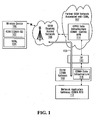
- the first approach is illustrated in Figure 1 .
- a wireless device 100 in communication with a GSM roaming network 106.
- the wireless device 100 is a CDMA-centric device in the sense that it uses CDMA when it accesses its CDMA home network 110.
- the wireless device 100 is also equipped with GSM capability for use when in a location that does not have a CDMA network.
- a partner GSM network 107 Also shown is a partner GSM network 107, an interworking and interoperability function (IIF) 132 connecting the partner GSM network 107 to the device's home CDMA network 110, and a network application gateway 112.
- IIF interworking and interoperability function
- the partner GSM network 107 has GPRS data infrastructure 114, this for example being the GGSN (Gateway GPRS Support Node) of the GSM network 107, that is associated with the CDMA-centric APN.
- the IIF 132 performs signalling and/or protocol conversions between the GSM 107 and the home CDMA network 110. Therefore, during data flow it can be seen that there is GPRS data in the GSM network 107 while there is CDMA data infrastructure 116 in the home CDMA network 110.
- the network application gateway 112 has a CDMA-centric role in dealing with CDMA-centric wireless devices such as wireless device 100.
- the wireless device 100 has a ROM (read only memory) 102 or other storage containing CDMA identification parameters, and has a SIM card SIM A 104 containing GSM identification parameters associated with the partner GSM network 107.
- SIM A is provided to the subscriber by the subscriber's home network provider and is configured to allow the subscriber to be able to use its partner GSM network.
- the partner GSM network 107 may be part of an overall set of networks of the same operator as the home CDMA network 110, or it may be operated by a different operator altogether. In practice, the home network provider usually obtains the SIM A from the partner network and provides this to the subscriber.
- Partner GSM network 107 will recognize registration attempts by the wireless device using the CDMA-centric APN, but will not recognize registration attempts by the wireless device using the GSM-centric APN. More specifically, from the perspective of partner GSM network 107, the wireless device has a subscription to the CDMA-centric APN but not necessarily to the GSM-centric APN.
- the access network 106 that is providing coverage to the wireless device 100 in its current location is a GSM roaming access network, meaning it is a GSM network, but it is not the device's home network, nor is it a partner GSM network to the device's home CDMA network 110.
- the wireless device 100 connects to the partner GSM network 107 through the GSM roaming network 106 using the information stored on the SIM A 104.
- a tunnel 108 from the wireless device 100 is created through the access network 106 and the partner GSM network 107 to the wireless device's CDMA home network 124. This is done using the CDMA-centric APN 114.
- the wireless device 100 From the perspective of the partner GSM network 107, the wireless device 100 has a subscription to the CDMA-centric APN.
- the home network 110 forwards data to and from the network application gateway 112.
- the wireless device 100 performs registration with the network application gateway using CDMA identification parameters which were stored in ROM 102. Note that should the wireless device attempt to register using the GSM-centric APN, the attempt will fail.
- the process of connecting through a GSM access network using CDMA parameters is described in the specification 3GPP2 X.S0034-0).
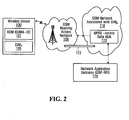
- the second approach is illustrated in Figure 2 .
- Shown is the wireless device 100 (the same device as in Figure 1 ) in communication with a GSM access network 106. Also shown is a GSM network 118 that is not a partner network to the user's home CDMA network 110 of Figure 1 .
- the GSM network 118 is shown in communication with network application gateway 126. It is assumed that network application gateway 126 of Figure 2 and network application gateway 112 of Figure 1 are both being used to connect to the same network application, but the gateway of Figure 1 does so using CDMA parameters, whereas the gateway of Figure 2 does so using GSM parameters. That is to say, for the purpose of interacting with wireless stations performing access through a GSM-centric APN, the network application gateway 126 is assumed to be GSM-centric.
- the wireless device 110 has ROM 102 containing CDMA parameters, and has SIM card SIM B 105 containing GSM parameters that differ from those on SIM card SIM A 104. More specifically, the GSM parameters are associated with the GSM network 118 as opposed to the partner GSM network 107 of Figure 1 . This presupposes that SIM A of Figure 1 has been replaced with SIM B of Figure 2 .
- the GSM network 118 will recognize registration attempts by the wireless device 100 using the GSM-centric APN, but will not recognize registration attempts by the wireless device using the CDMA-centric APN. More specifically, from the perspective of GSM network 118, the wireless device 100 has a subscription to the GSM-centric APN but not to the CDMA-centric APN.
- the access network 106 that is providing coverage to the wireless device 100 in its current location is a GSM roaming access network, meaning it is a GSM network, but it is not the device's home network.
- the wireless device 100 connects to the GSM network 118 using the parameters stored on SIM B 105.
- a tunnel 122 from the wireless device 100 is created through the access network 106 to GSM network 118 using the GSM-centric APN.
- the GSM network 118 recognizes the wireless device has a subscription to the GSM-centric APN.
- the GSM network 118 forwards data to and from the network application gateway 126.
- the wireless device 100 performs registration with the network application gateway 126 using GSM identification parameters stored on SIM card SIM B 105. Note that should the wireless device attempt to register using the CDMA-centric APN, the attempt will fail.
- GB-A-2424543 discloses a telecommunications system comprising a roaming mobile applications server responsive to a register message from a mobile user equipment to determine whether the access point name used to communicate the register message corresponds with a preferred access point name for the mobile user equipment. If the name does not correspond the server sends a re-register message providing the preferred access point name to the mobile user equipment.
- WO02/089508A discloses a communication method and apparatus in which load-related information is transmitted between network entities handling connections or calls to allow load balancing.
- a serving support node selects an alternative APN and sends the selected alternative APN to the mobile station in a message. The mobile station then attempts to register using the alternative APN that it has been sent.
- One broad aspect may provide a method in a wireless device having a plurality of wireless access radios, each associated with a respective radio access technology, the method comprising: attempting to register with a network application service provider using a first APN of a plurality of APNs; in the event of a failure of the attempt to register using the first APN, receiving a critical cause code indicating failure of the attempt; and upon receipt of a critical cause code indicating failure of the attempt to register using the first APN, attempting to register with a network application service provider using another APN of the plurality of APNs; wherein the first APN of the plurality of APNs is one of a CDMA-centric APN, that is an APN that uses CDMA registration procedures, and a GSM-centric APN, that is an APN that uses GSM registration procedures, and the another APN of the plurality of APNs is the other of the CDMA-centric APN and the GSM-centric APN.
- a wireless device comprising: a plurality of wireless access radios each associated with a respective radio access technology; a function performing mobile discovery of an active data subscription and thereby determine an APN to use by: attempting to register with a network application service provider using a first APN of a plurality of APNs; in the event of a failure of the attempt to register using the first APN, receiving a critical cause code indicating failure of the attempt; and upon receipt of a critical cause code indicating failure of the attempt to register using the first APN, attempting to register with a network application service provider using the another of the plurality of APNs; wherein the first APN of the plurality of APNs is one of a CDMA-centric APN, that is an APN that uses CDMA registration procedures, and a GSM-centric APN, that is an APN that uses GSM registration procedures, and the another APN of the plurality of APNs is the other of the CDMA-centric APN and the GSM-centric APN.
- Another broad aspect may provide a computer readable medium storing computer executable instructions executable by a processor of a computing device to clause said device to implement the above method.
- the wireless device When a wireless device is on a partner GSM network, the wireless device will use the CDMA-centric APN since it is a CDMA-centric device. However, when the user of the wireless device purchases another SIM card, for example while traveling, the operator that provided that SIM card can assign the wireless device to the GSM-centric APN. SIM cards do not include a mechanism for specifying what APN the wireless device is subscribed to. When the wireless device sees that it is attached to a GSM network and knows that it is roaming, it does not know whether its home network is a CDMA network or a GSM network. It has two identities, a GSM identity and a CDMA identity. When it registers with the network application gateway it must use the identity which is associated with its home network in order to receive the correct services that have been provisioned based on its identity on its home network.
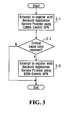
- the method begins at step 3-1 with an attempt by a wireless device to register with a network application service provider using the wireless device's CDMA-centric APN that might for example be stored in the Host Routing Table on the device.
- step 3-2 if no critical cause code is received (for example the context is established successfully, or fails with a non-critical cause code), then the method ends.
- step 3-3 the wireless device attempts to register with the network application service provider using the wireless device's GSM-centric APN.
- critical cause codes that can be used to determine that the attempt to register failed include:
- any feedback from the network that can be used by the wireless device to determine that the attempt failed can be used to trigger the subsequent attempt using the other APN in step 3-3.
- the method of Figure 3 may be implemented when the wireless device is powered on and/or when a new SIM card is installed in the wireless device.
- the Figure 3 embodiment assumes that the first APN that is attempted is the CDMA-centric APN, and this is followed by an attempt using the GSM-centric APN.
- the first APN is one of the CDMA-centric APN and the GSM-centric APN
- the second APN is the other of the CDMA-centric APN and the GSM-centric APN.
- the first APN that is attempted is implementation specific.
- the embodiment of Figure 4 described below is a specific case of this where the first APN attempted is a previously successfully used APN.
- the method begins at step 4-1 with an attempt by a wireless device to register with the network application service provider using the previously successfully used APN.
- the previously successfully used APN may for example be stored in non-volatile memory. This may be the CDMA-centric APN or the GSM-centric APN.
- the wireless device attempts to register with the network application service provider using the APN that is other than the previously successfully used APN. Assuming this is successful, at step 4-4 the wireless device updates the information in non-volatile memory that identifies the previously successfully used APN.
- the method of Figure 4 may be implemented when the wireless device is powered on.
- wireless devices are equipped with the capability to restrict/disable data roaming. This can be used to disable data roaming while in a geographical area associated with very high cost for example. This can take the form of a feature selected through a graphical user interface on a wireless device for example. It can be referred to as a data roaming guard. While the data roaming guard is on, data roaming is disabled, whereas while the data roaming guard is not on, data roaming is enabled. Another embodiment provides a mechanism of maintaining knowledge of the correct APN to use notwithstanding whether the data roaming guard is on. In the event the user turns the data roaming guard off, the wireless device will then immediately know the correct APN to use, and delays in accessing the network may be reduced.
- the method begins at step 5-1 with determining which APN to use while the data roaming is disabled. This can be done, for example using one of the methods of Figure 3 and 4 , but without sending any data, thereby minimizing cost to the subscriber. This may result in the establishment of a PDP context using the APN.
- the PDP context thus established may be torn down.
- the APN thus identified is stored in non-volatile memory. Steps 5-1, 5-2 and 5-3 are repeated each time the wireless device powers up and/or each time the SIM card is changed.
- step 5-4 upon enabling data roaming, registration is attempted using the previously identified APN that is stored in non-volatile memory.
- the embodiments described have focussed on applications where there are two APNs, referred to as so-called the GSM-centric APN and the CDMA-centric APN. Methods and devices have been described for selecting which of these to use. In another embodiment, similar methods and devices are provided that have the more general application of selecting which one of a set of a least two APNs to use, the at least two APNs not necessarily being or including the GSM-centric APN and/or the CDMA-centric APN.
- the method begins at step 8-1 with an attempt by a wireless device to register with a network application service provider using a first APN that might for example be stored in the Host Routing Table on the device.
- step 8-2 if no critical cause code is received (for example the context is established successfully, or fails with a non-critical cause code), then the method ends.
- a critical cause code is received (yes path)
- step 8-3 if there is another APN to try
- the method returns to step 8-1 for the wireless device to attempt to register with the network application service provider using a next APN.
- the loop of steps 8-1,8-2,8-3 is repeated until either success is achieved, or there are no other APNs to try.
- any feedback from the network that can be used by the wireless device to determine that the attempt failed can be used to trigger the subsequent attempt using the other APN.
- FIG. 9 shown is a flowchart of another method of performing mobile discovery of an active data subscription.
- the method begins at step 9-1 with an attempt by a wireless device to register with the network application service provider using the previously successfully used APN.
- the previously successfully used APN may for example be stored in non-volatile memory.
- step 9-2 if no critical cause code (or other implementation specific feedback) is received (no path), then the method ends. On the other hand, if at step 9-2, a critical cause code (or other implementation specific feedback) is received (yes path), then at step 9-3 the wireless device attempts to register with the network application service provider using the APN that is other than the previously successfully used APN.
- step 9-4 the wireless device updates the information in non-volatile memory that identifies the previously successfully used APN. There may be additional iterations of steps 9-2 and 9-3 until success is achieved, or there are no more APNs to try.
- the method of Figure 5 can also be applied in this more general context.
- the so-called "previously identified APN” is simply any one of the multiple APNs available to the wireless device that was previously identified as being appropriate to use.
- the wireless device 10-1 has a CDMA wireless access radio 16-1, a GSM wireless access radio 18-1, a processor 17-1, and a function performing mobile discovery of an active data subscription 15. More generally, the wireless device has a plurality of wireless access radios, each implementing a respective radio access technology. GSM and CDMA are but two specific examples.
- the wireless device 10-1 also has a non-volatile memory, SIM 20, and data roaming enable/disable mechanism 22.
- the wireless device 10-1 may have other components, but they are not shown for sake of simplicity. More generally, in place of SIM 20, any smart card containing a subscriber identity application and/or subscriber identity parameters can be employed.
- the function 15 in the wireless device 10-1 coordinates determination of the active data subscription, by determining a current APN to use for the device. This can be done using any of the methods described above.
- the function 15 may be implemented in software, hardware, firmware, or a combination of software, hardware and firmware.
- Non-volatile memory 19-1 can be used to store CDMA parameters; it can also be used to store a previously successfully used APN.
- SIM 20 stores GSM parameters.
- the data roaming enable/disable mechanism 22 allows a subscriber to selectively enable or disable data roaming. While data roaming is disabled, there is no data communications to/from the device.
- Another broad aspect provides a computer readable medium having instructions stored thereon for implementing function 15, and more generally for implementing any of the methods described herein.
- the computer readable medium may not be capable of completely executing the method on its own, since interaction with other components on the wireless device such as the radios, antenna(s) etc. is necessary. In such a case, the instructions on the computer readable medium are still driving the method.
- FIG. 7 shown is a block diagram of another wireless device 700 that may implement one or more of the previously described methods. It is to be understood that the wireless device 700 is shown with very specific details for example purposes only.
- a processing device (a microprocessor 728) is shown schematically as coupled between a keyboard 714 and a display 726.
- the microprocessor 728 controls operation of the display 726, as well as overall operation of the wireless device 700, in response to actuation of keys on the keyboard 714 by a user.
- the wireless device 700 has a housing that may be elongated vertically, or may take on other sizes and shapes (including clamshell housing structures).
- the keyboard 714 may include a mode selection key, or other hardware or software for switching between text entry and telephony entry.
- a communications subsystem 770 In addition to the microprocessor 728, other parts of the wireless device 700 are shown schematically. These include: a communications subsystem 770; a short-range communications subsystem 702; the keyboard 714 and the display 726, along with other input/output devices including a set of LEDS 704, a set of auxiliary I/O devices 706, a serial port 708, a speaker 711 and a microphone 712; as well as memory devices including a flash memory 716 and a Random Access Memory (RAM) 718; and various other device subsystems 720.
- the wireless device 700 may have a battery 721 to power the active elements of the wireless device 700.
- the wireless device 700 is in some embodiments a two-way radio frequency (RF) communication device having voice and data communication capabilities.
- the wireless device 700 in some embodiments has the capability to communicate with other computer systems via the Internet.
- RF radio frequency
- Operating system software executed by the microprocessor 728 is in some embodiments stored in a persistent store, such as the flash memory 716, but may be stored in other types of memory devices, such as a read only memory (ROM) or similar storage element.
- system software, specific device applications, or parts thereof may be temporarily loaded into a volatile store, such as the RAM 718.
- Communication signals received by the wireless device 700 may also be stored to the RAM 718.
- the microprocessor 728 in addition to its operating system functions, enables execution of software applications on the wireless device 700.
- a predetermined set of software applications that control basic device operations such as a voice communications module 730A and a data communications module 730B, may be installed on the wireless device 700 during manufacture.
- a personal information manager (PIM) application module 730C may also be installed on the wireless device 700 during manufacture.
- the PIM application is in some embodiments capable of organizing and managing data items, such as e-mail, calendar events, voice mails, appointments, and task items.
- the PIM application is also in some embodiments capable of sending and receiving data items via a wireless network 710.
- the data items managed by the PIM application are seamlessly integrated, synchronized and updated via the wireless network 710 with the device user's corresponding data items stored or associated with a host computer system.
- additional software modules illustrated as other software module 730N, may be installed during manufacture.
- the communication subsystem 770 includes a receiver 750, a transmitter 752 and one or more antennas, illustrated as a receive antenna 754 and a transmit antenna 756.
- the communication subsystem 770 also includes a processing module, such as a digital signal processor (DSP) 758, and local oscillators (LOs) 760.
- DSP digital signal processor
- LOs local oscillators
- the communication subsystem 770 of the wireless device 700 may be designed to operate with the Mobitex TM , DataTAC TM or General Packet Radio Service (GPRS) mobile data communication networks and also designed to operate with any of a variety of voice communication networks, such as Advanced Mobile Phone Service (AMPS), Time Division Multiple Access (TDMA), Code Division Multiple Access CDMA, CDMA 1xEuDO, OFDM (orthogonal frequency division multiplexing), Personal Communications Service (PCS), Global System for Mobile Communications (GSM), etc.
- AMPS Advanced Mobile Phone Service
- TDMA Time Division Multiple Access
- CDMA 1xEuDO Code Division Multiple Access
- OFDM orthogonal frequency division multiplexing
- PCS Personal Communications Service
- GSM Global System for Mobile Communications
- Network access may vary depending upon the type of communication system. For example, in the Mobitex TM and DataTAC TM networks, wireless devices are registered on the network using a unique Personal Identification Number (PIN) associated with each device. In GPRS networks, however, network access is typically associated with a subscriber or user of a device. A GPRS device therefore typically has a subscriber identity module, commonly referred to as a Subscriber Identity Module (SIM) card, in order to operate on a GPRS network.
- SIM Subscriber Identity Module
- the wireless device 700 may send and receive communication signals over the communication network 710.
- Signals received from the communication network 710 by the receive antenna 754 are routed to the receiver 750, which provides for signal amplification, frequency down conversion, filtering, channel selection, etc., and may also provide analog to digital conversion. Analog-to-digital conversion of the received signal allows the DSP 758 to perform more complex communication functions, such as demodulation and decoding.
- signals to be transmitted to the network 710 are processed (e.g., modulated and encoded) by the DSP 758 and are then provided to the transmitter 752 for digital to analog conversion, frequency up conversion, filtering, amplification and transmission to the communication network 710 (or networks) via the transmit antenna 756.
- signals to be transmitted to the network 710 are processed (e.g., modulated and encoded) by the DSP 758 and are then provided to the transmitter 752 for digital to analog conversion, frequency up conversion, filtering, amplification and transmission to the communication network 710 (or networks) via the transmit antenna 756.
- the DSP 758 provides for control of the receiver 750 and the transmitter 752. For example, gains applied to communication signals in the receiver 750 and the transmitter 752 may be adaptively controlled through automatic gain control algorithms implemented in the DSP 758.
- a received signal such as a text message or web page download
- the communication subsystem 770 is input to the microprocessor 728.
- the received signal is then further processed by the microprocessor 728 for an output to the display 726, or alternatively to some other auxiliary I/O devices 706.
- a device user may also compose data items, such as e-mail messages, using the keyboard 714 and/or some other auxiliary I/O device 706, such as a touchpad, a rocker switch, a thumb-wheel, or some other type of input device.
- the composed data items may then be transmitted over the communication network 710 via the communication subsystem 770.
- a voice communication mode In a voice communication mode, overall operation of the device is substantially similar to the data communication mode, except that received signals are output to a speaker 711, and signals for transmission are generated by a microphone 712.
- Alternative voice or audio I/O subsystems such as a voice message recording subsystem, may also be implemented on the wireless device 700.
- the display 726 may also be utilized in voice communication mode, for example, to display the identity of a calling party, the duration of a voice call, or other voice call related information.
- the short-range communications subsystem 702 enables communication between the wireless device 700 and other proximate systems or devices, which need not necessarily be similar devices.
- the short-range communications subsystem may include an infrared device and associated circuits and components, or a Bluetooth TM communication module to provide for communication with similarly-enabled systems and devices.
- microprocessor 728 RAM 718, communication sub-system 770, display 726, flash memory 716, voice module and data module can cooperate to implement one or more of the methods described herein. More generally, the implementation particulars will depend on a given wireless device configuration.
Landscapes
- Engineering & Computer Science (AREA)
- Computer Networks & Wireless Communication (AREA)
- Signal Processing (AREA)
- Mobile Radio Communication Systems (AREA)
- Radar Systems Or Details Thereof (AREA)
Claims (19)
- Un procédé dans un dispositif sans fil (100) ayant une pluralité de radios d'accès sans fil, chacune associée à une technologie d'accès radio respective, le procédé comportant :tenter (8-1) de s'enregistrer auprès d'un fournisseur de services d'applications réseau en utilisant un premier nom de d'accès, APN, d'une pluralité d'APN ;dans l'éventualité d'un échec de la tentative de s'enregistrer en utilisant le premier APN, recevoir (8-2) un code de cause critique indiquant l'échec de la tentative ; etcaractérisé en ce qu'à réception d'un code de cause critique indiquant l'échec de la tentative de s'enregistrer en utilisant le premier APN, tenter (8-3) de s'enregistrer auprès d'un fournisseur de services d'applications réseau en utilisant un autre APN de la pluralité d'APN,
où le premier APN de la pluralité d'APN est un APN parmi un APN centré CDMA, c'est-à-dire un APN qui utilise des procédures d'enregistrement CDMA, et un APN centré GSM, c'est-à-dire un APN qui utilise des procédures d'enregistrement GSM, et l'autre APN de la pluralité d'APN est l'autre APN parmi l'APN centré CDMA et l'APN centré GSM. - Le procédé de la revendication 1 où tenter (8-1) de s'enregistrer auprès du fournisseur de services réseau en utilisant le premier APN est toujours réalisé (3-1) en utilisant l'APN centré CDMA.
- Le procédé de la revendication 2 comportant de plus exécuter le procédé chaque fois que le dispositif sans fil (100) est allumé et/ou chaque fois qu'une carte intelligente (104) contenant une application d'identité d'abonné et/ou des paramètres d'identité d'abonné est changée dans le dispositif sans fil (100).
- Le procédé de la revendication 1 comportant de plus :stocker (4-4) des informations identifiant un APN précédemment utilisé avec succès ;où tenter (8-1) de s'enregistrer auprès du fournisseur de services réseau en utilisant le premier APN est toujours réalisé (4-1) en utilisant l'APN précédemment utilisé avec succès.
- Le procédé de la revendication 4 comportant de plus exécuter le procédé chaque fois que le dispositif sans fil (100) est allumé.
- Le procédé de la revendication 1 où recevoir (8-2) le code de cause critique comporte recevoir un élément parmi :27 - APN inconnu ou manquant ;30 - Activation rejetée par le GGSN ; et33 - Non abonné à l'option de service demandée.
- Un procédé comportant :pendant que l'itinérance de données (« data roaming ») est désactivée, réaliser (5-1) le procédé de n'importe quelle revendication précédente ;stocker (5-3) des informations identifiant un APN de la pluralité d'APN comme APN utilisé avec succès dans une mémoire non volatile ; età l'activation de l'itinérance de données, utiliser (5-4) l'APN identifié par les informations stockées.
- Le procédé de la revendication 7 comportant de plus démonter (5-2) un contexte PDP qui a été établi pendant que l'itinérance de données était désactivée.
- Le procédé de la revendication 7 ou de la revendication 8 où pendant que l'itinérance de données est désactivée aucune donnée n'est transmise.
- Un dispositif sans fil (10-1) comportant :une pluralité de radios d'accès sans fil (16-1, 18-1) chacune associée à une technologie d'accès radio respective ;une fonction (15) réalisant une découverte mobile d'un abonnement données actif et déterminant ainsi un APN à utiliser en :caractérisé en ce qu'à réception d'un code de cause critique indiquant l'échec de la tentative de s'enregistrer en utilisant le premier APN, en tentant (8-3) de s'enregistrer auprès d'un fournisseur de services d'applications réseau en utilisant l'autre APN de la pluralité d'APN ;tentant (8-1) de s'enregistrer auprès d'un fournisseur de services d'applications réseau en utilisant un premier APN d'une pluralité d'APN ;dans l'éventualité d'un échec de la tentative de s'enregistrer en utilisant le premier APN, en recevant (8-2) un code de cause critique indiquant l'échec de la tentative ; et
où le premier APN de la pluralité d'APN est un APN parmi un APN centré CDMA, c'est-à-dire un APN qui utilise des procédures d'enregistrement CDMA, et un APN centré GSM, c'est-à-dire un APN qui utilise des procédures d'enregistrement GSM, et l'autre APN de la pluralité d'APN est l'autre APN parmi l'APN centré CDMA et l'APN centré GSM. - Le dispositif sans fil (10-1) de la revendication 10 où la pluralité de radios d'accès sans fil (16-1, 18-1) comporte une radio d'accès sans fil CDMA (16-1) et une radio d'accès sans fil GSM (18-1), le dispositif sans fil (10-1) comportant de plus une carte intelligente (20) contenant une application d'identité d'abonné et/ou des paramètres d'identité d'abonné.
- Le dispositif sans fil (10-1) de la revendication 10 qui détermine un APN à utiliser chaque fois que le dispositif sans fil (10-1) est allumé et/ou chaque fois qu'une carte intelligente (20) contenant une application d'identité d'abonné et/ou des paramètres d'identité d'abonné est changée dans le dispositif sans fil (10-1).
- Le dispositif sans fil (10-1) de la revendication 10 ou de la revendication 11 comportant de plus :une mémoire non volatile (19-1) ;où la fonction (15) réalisant la découverte mobile d'un abonnement données actif stocke des informations identifiant un APN précédemment utilisé avec succès dans la mémoire non volatile (19-1) ;
où la fonction (15) réalisant la découverte mobile de l'abonnement données actif tentant de s'enregistrer auprès du fournisseur de services d'applications réseau est configurée pour toujours utiliser l'APN précédemment utilisé avec succès comme premier APN. - Le dispositif sans fil (10-1) de la revendication 13 qui détermine un APN à utiliser chaque fois que le dispositif sans fil (10-1) est allumé.
- Le dispositif sans fil (10-1) de la revendication 10 où le code de cause critique est un élément parmi :27 - APN inconnu ou manquant ;30 - Activation rejetée par le GGSN ; et33 - Non abonné à l'option de service demandée.
- Le dispositif sans fil (10-1) de n'importe laquelle des revendications 10 à 15 comportant de plus :un mécanisme d'activation/de désactivation d'itinérance de données (22) permettant à un utilisateur d'activer et de désactiver de façon sélective l'itinérance de données ;la fonction (15) réalisant la découverte mobile de l'abonnement données actif déterminant (5-1) l'APN à utiliser pendant que l'itinérance de données est désactivée et stockant (5-3) des informations identifiant un APN de la pluralité d'APN comme APN utilisé avec succès dans la mémoire non volatile (19-1) ;où à l'activation de l'itinérance de données, le dispositif sans fil (10-1) utilise l'APN identifié par la mémoire non volatile (19-1).
- Le dispositif sans fil (10-1) de la revendication 16 où le dispositif sans fil (10-1) démonte (5-2) un contexte PDP qui a été établi pendant que l'itinérance de données était désactivée.
- Le dispositif sans fil (10-1) de la revendication 16 ou de la revendication 17
où pendant que l'itinérance de données est désactivée aucune donnée n'est transmise. - Un support lisible par ordinateur (15) stockant des instructions lisibles par ordinateur exécutables par un processeur d'un dispositif informatique pour amener ledit dispositif à implémenter le procédé de n'importe laquelle des revendications 1 à 9.
Applications Claiming Priority (1)
| Application Number | Priority Date | Filing Date | Title |
|---|---|---|---|
| US11/753,378 US20080293407A1 (en) | 2007-05-24 | 2007-05-24 | Wireless Device and Method for Determining Which APN to Use |
Publications (3)
| Publication Number | Publication Date |
|---|---|
| EP1995986A1 EP1995986A1 (fr) | 2008-11-26 |
| EP1995986B1 true EP1995986B1 (fr) | 2009-09-16 |
| EP1995986B8 EP1995986B8 (fr) | 2010-05-19 |
Family
ID=38668647
Family Applications (1)
| Application Number | Title | Priority Date | Filing Date |
|---|---|---|---|
| EP07110499A Active EP1995986B8 (fr) | 2007-05-24 | 2007-06-18 | Dispositif sans fil et procédé pour déterminer l'APN à utiliser |
Country Status (5)
| Country | Link |
|---|---|
| US (1) | US20080293407A1 (fr) |
| EP (1) | EP1995986B8 (fr) |
| AT (1) | ATE443420T1 (fr) |
| CA (1) | CA2631604C (fr) |
| DE (1) | DE602007002481D1 (fr) |
Families Citing this family (24)
| Publication number | Priority date | Publication date | Assignee | Title |
|---|---|---|---|---|
| EP1800506B1 (fr) * | 2004-10-12 | 2013-03-13 | TELEFONAKTIEBOLAGET LM ERICSSON (publ) | Indication de perte ou de defaillance precoce de services dans un reseau a acces mobile sans licence |
| US8762035B2 (en) | 2008-05-19 | 2014-06-24 | Waze Mobile Ltd. | System and method for realtime community information exchange |
| US8271057B2 (en) * | 2009-03-16 | 2012-09-18 | Waze Mobile Ltd. | Condition-based activation, shut-down and management of applications of mobile devices |
| US8805365B2 (en) * | 2010-01-15 | 2014-08-12 | Apple Inc. | Registration with a mobile telecommunications service provider |
| US8914025B2 (en) | 2010-01-15 | 2014-12-16 | Apple Inc. | Registration with a mobile telecommunications service provider |
| US9854007B2 (en) * | 2010-05-05 | 2017-12-26 | Htc Corporation | Method of controlling packet switched data transmission and related communication device |
| US8983541B2 (en) | 2010-10-20 | 2015-03-17 | Blackberry Limited | Card application toolkit support for IP multimedia subsystem |
| WO2012054030A1 (fr) | 2010-10-20 | 2012-04-26 | Research In Motion Limited | Prise en charge de boîte à outils d'application de carte pour système multimédia ip |
| CN102026152A (zh) * | 2010-11-25 | 2011-04-20 | 中兴通讯股份有限公司 | 一种移动终端及实现接入点名称设置的系统和方法 |
| WO2012085624A1 (fr) | 2010-12-23 | 2012-06-28 | Research In Motion Limited | Prise en charge de boîte à outils de carte pour sous-système multimédia ip |
| WO2012145817A1 (fr) * | 2011-04-26 | 2012-11-01 | Research In Motion Limited | Transmission des codes de cause de refus d'activation de contenu de pdp à une carte de circuit intégré universelle (uicc) |
| CN102625416B (zh) * | 2012-03-28 | 2015-03-18 | 华为技术有限公司 | 多模终端的工作方法和多模终端 |
| CN103581882A (zh) * | 2012-07-24 | 2014-02-12 | 中兴通讯股份有限公司 | 一种数据卡apn锁定状态的控制方法及装置、数据卡 |
| KR101462904B1 (ko) * | 2013-03-22 | 2014-11-19 | 에스케이텔레콤 주식회사 | 패킷 데이터 네트워크 연결 방법, 이를 위한 단말기 및 기록매체 |
| CN104640097B (zh) * | 2015-01-29 | 2019-01-08 | 努比亚技术有限公司 | 终端自适应配置的方法、终端、分组交换设备及系统 |
| CN105338596A (zh) * | 2015-11-17 | 2016-02-17 | 小米科技有限责任公司 | 数据业务的建立方法及装置 |
| US9699716B1 (en) | 2016-03-01 | 2017-07-04 | At&T Mobility Ii Llc | Method and device for managing access point name information |
| US10091705B1 (en) | 2017-05-26 | 2018-10-02 | Apple Inc. | Avoiding denial of service |
| US11375458B2 (en) * | 2018-05-03 | 2022-06-28 | Motorola Solutions, Inc. | Method and device for altitude-based interference mitigation |
| US10834573B2 (en) | 2019-02-15 | 2020-11-10 | At&T Mobility Ii Llc | Systems, devices and methods for managing access point name information by operators and users on the SIM |
| CN112261717B (zh) * | 2020-09-15 | 2024-06-21 | 深圳市广和通无线股份有限公司 | 网络注册方法、装置、用户终端及存储介质 |
| CN112584547B (zh) * | 2020-12-04 | 2023-04-25 | 北京小米移动软件有限公司 | 建立数据连接的方法、装置、存储介质及终端设备 |
| CN113015265B (zh) * | 2021-02-24 | 2023-07-18 | 西安广和通无线软件有限公司 | 网络会话自愈方法、装置、系统、计算机设备和存储介质 |
| CN115278732A (zh) * | 2022-07-20 | 2022-11-01 | 深圳市广和通无线通信软件有限公司 | 接入点名称apn的确定方法及相关装置 |
Family Cites Families (16)
| Publication number | Priority date | Publication date | Assignee | Title |
|---|---|---|---|---|
| EP1246479A1 (fr) * | 2001-03-26 | 2002-10-02 | Lucent Technologies Inc. | GPRS telecommunication system |
| US7076254B2 (en) | 2001-04-25 | 2006-07-11 | Nokia Corporation | Telecommunication network having at least two network entities, and communication method |
| US6970694B2 (en) * | 2002-07-30 | 2005-11-29 | Interdigital Technology Corporation | Method and apparatus for mobile based access point name (APN) selection |
| US7349698B2 (en) * | 2002-10-18 | 2008-03-25 | Kineto Wireless, Inc. | Registration messaging in an unlicensed mobile access telecommunications system |
| US7167707B1 (en) * | 2003-02-12 | 2007-01-23 | Cingular Wireless Ii, L.L.C. | Systems and methods for GSM selection |
| GB2402578A (en) * | 2003-06-04 | 2004-12-08 | Research In Motion Ltd | Selection of message transport in a communication device |
| US20050037753A1 (en) * | 2003-08-12 | 2005-02-17 | Andersen Niels Peter Skov | Method for a communication device to search for an alternate network upon a registration failure |
| CN1283055C (zh) * | 2003-08-15 | 2006-11-01 | 华为技术有限公司 | 一种对创建分组数据协议上下文请求的处理方法 |
| US7197312B2 (en) * | 2003-11-12 | 2007-03-27 | Research In Motion Limited | Data-capable network prioritization with reject code handling |
| US7773554B2 (en) * | 2003-12-03 | 2010-08-10 | John Wallace Nasielski | Methods and apparatus for CDMA2000/GPRS roaming |
| WO2005106624A1 (fr) * | 2004-05-05 | 2005-11-10 | Research In Motion Limited | Systeme et procede pour declencher de maniere sure et pratique la reinitialisation d'un dispositif electronique |
| EP1752012B1 (fr) * | 2004-06-02 | 2010-07-21 | Nokia Corporation | Procede permettant l'itinerance entre des reseaux |
| US7263371B2 (en) * | 2004-09-13 | 2007-08-28 | Lucent Technologies Inc. | Method for controlling paging and registration of a mobile device in a wireless communications system |
| CN100477827C (zh) * | 2005-03-04 | 2009-04-08 | 摩托罗拉公司 | 用于区分pdp环境订制的方法和系统 |
| GB2424543A (en) | 2005-03-22 | 2006-09-27 | Orange Personal Comm Serv Ltd | Telecommunication Apparatus and Method |
| US20070130333A1 (en) * | 2005-12-02 | 2007-06-07 | Sanjeev Bhalla | Wireless application connection auto-detection mechanism |
-
2007
- 2007-05-24 US US11/753,378 patent/US20080293407A1/en not_active Abandoned
- 2007-06-18 DE DE602007002481T patent/DE602007002481D1/de active Active
- 2007-06-18 EP EP07110499A patent/EP1995986B8/fr active Active
- 2007-06-18 AT AT07110499T patent/ATE443420T1/de not_active IP Right Cessation
-
2008
- 2008-05-20 CA CA2631604A patent/CA2631604C/fr active Active
Also Published As
| Publication number | Publication date |
|---|---|
| ATE443420T1 (de) | 2009-10-15 |
| DE602007002481D1 (de) | 2009-10-29 |
| US20080293407A1 (en) | 2008-11-27 |
| EP1995986B8 (fr) | 2010-05-19 |
| CA2631604A1 (fr) | 2008-11-24 |
| EP1995986A1 (fr) | 2008-11-26 |
| CA2631604C (fr) | 2017-02-07 |
Similar Documents
| Publication | Publication Date | Title |
|---|---|---|
| EP1995986B1 (fr) | Dispositif sans fil et procédé pour déterminer l'APN à utiliser | |
| JP4790814B2 (ja) | 移動通信機器から緊急性のショートメッセージを通信する際に用いるための方法および装置 | |
| US8774805B2 (en) | System and method for radio access technology-specific routing for multi-mode mobile devices | |
| US8073447B2 (en) | System and method to identify voice call continuity (VCC) subscriber | |
| CN100397918C (zh) | 用于将消息发送到两个或者多个相关无线通信设备的方法和设备 | |
| US8155645B2 (en) | Bypass routing to a mobile device | |
| TW202005319A (zh) | 多重活躍網路的無線裝置 | |
| MXPA06006684A (es) | Metodo y aparato para entrega independiente y eficiente de servicios a dispositivos inalambricos capaces de soportar infraestructura de red e interfaces de radio multiples. | |
| JP2005209194A (ja) | ユーザプロファイルサービス | |
| AU2002214356A1 (en) | System and method for assigning a mobile IP to a mobile node | |
| WO2002037876A1 (fr) | Systeme et procede d'affectation d'un fai mobile a un noeud mobile | |
| GB2357008A (en) | Method and system for manipulating subscriber data | |
| US20050107100A1 (en) | Method of modifying parameters of user terminal, radio system and user terminal | |
| KR20110044840A (ko) | 이동 통신 장치와 무선 네트워크 사이에서 데이터 접속을 요청하는 애플리케이션들 간의 경쟁을 해결하기 위한 시스템 및 방법 | |
| JP2006270910A (ja) | ソフトウェア無線携帯電話通信システム及びソフトウェア無線携帯電話端末 | |
| US7889731B1 (en) | Method and system for wireless network-based messaging service message delivery | |
| KR101281502B1 (ko) | 이동성 서비스를 제공하는 방법 | |
| US20080108362A1 (en) | Method, system and apparatus for alternate data service provisioning | |
| JP6598629B2 (ja) | メッセージ送信システム | |
| CN115776487A (zh) | 数据分流方法、装置、设备及存储介质 | |
| US20090040951A1 (en) | Systems and Methods for Defining Multi-Domain Wireless Device Behavior for Two or More Calls | |
| WO2011069365A1 (fr) | Procédé, système et registre des abonnés locaux, pour l'établissement d'un traitement de communication mobile | |
| JP5354640B2 (ja) | 構内phsを用いた無線通信システム、その負荷分散方法、phs端末、その動作方法及び動作プログラム | |
| US20260052364A1 (en) | Wifi protected access bypass for emergency voice services | |
| EP2487961B1 (fr) | Système de communications configuré pour corriger une désadaptation d'association et procédés correspondants |
Legal Events
| Date | Code | Title | Description |
|---|---|---|---|
| PUAI | Public reference made under article 153(3) epc to a published international application that has entered the european phase |
Free format text: ORIGINAL CODE: 0009012 |
|
| 17P | Request for examination filed |
Effective date: 20070618 |
|
| AK | Designated contracting states |
Kind code of ref document: A1 Designated state(s): AT BE BG CH CY CZ DE DK EE ES FI FR GB GR HU IE IS IT LI LT LU LV MC MT NL PL PT RO SE SI SK TR |
|
| AX | Request for extension of the european patent |
Extension state: AL BA HR MK RS |
|
| GRAP | Despatch of communication of intention to grant a patent |
Free format text: ORIGINAL CODE: EPIDOSNIGR1 |
|
| RIC1 | Information provided on ipc code assigned before grant |
Ipc: H04W 60/00 20090101AFI20090323BHEP |
|
| AKX | Designation fees paid |
Designated state(s): AT BE BG CH CY CZ DE DK EE ES FI FR GB GR HU IE IS IT LI LT LU LV MC MT NL PL PT RO SE SI SK TR |
|
| AXX | Extension fees paid |
Extension state: RS Payment date: 20070618 Extension state: BA Payment date: 20070618 Extension state: MK Payment date: 20070618 Extension state: AL Payment date: 20070618 Extension state: HR Payment date: 20070618 |
|
| GRAS | Grant fee paid |
Free format text: ORIGINAL CODE: EPIDOSNIGR3 |
|
| GRAA | (expected) grant |
Free format text: ORIGINAL CODE: 0009210 |
|
| AK | Designated contracting states |
Kind code of ref document: B1 Designated state(s): AT BE BG CH CY CZ DE DK EE ES FI FR GB GR HU IE IS IT LI LT LU LV MC MT NL PL PT RO SE SI SK TR |
|
| AX | Request for extension of the european patent |
Extension state: AL BA HR MK RS |
|
| REG | Reference to a national code |
Ref country code: GB Ref legal event code: FG4D |
|
| REG | Reference to a national code |
Ref country code: CH Ref legal event code: EP |
|
| REG | Reference to a national code |
Ref country code: IE Ref legal event code: FG4D |
|
| REF | Corresponds to: |
Ref document number: 602007002481 Country of ref document: DE Date of ref document: 20091029 Kind code of ref document: P |
|
| PG25 | Lapsed in a contracting state [announced via postgrant information from national office to epo] |
Ref country code: LT Free format text: LAPSE BECAUSE OF FAILURE TO SUBMIT A TRANSLATION OF THE DESCRIPTION OR TO PAY THE FEE WITHIN THE PRESCRIBED TIME-LIMIT Effective date: 20090916 Ref country code: FI Free format text: LAPSE BECAUSE OF FAILURE TO SUBMIT A TRANSLATION OF THE DESCRIPTION OR TO PAY THE FEE WITHIN THE PRESCRIBED TIME-LIMIT Effective date: 20090916 Ref country code: SE Free format text: LAPSE BECAUSE OF FAILURE TO SUBMIT A TRANSLATION OF THE DESCRIPTION OR TO PAY THE FEE WITHIN THE PRESCRIBED TIME-LIMIT Effective date: 20090916 |
|
| LTIE | Lt: invalidation of european patent or patent extension |
Effective date: 20090916 |
|
| PG25 | Lapsed in a contracting state [announced via postgrant information from national office to epo] |
Ref country code: SI Free format text: LAPSE BECAUSE OF FAILURE TO SUBMIT A TRANSLATION OF THE DESCRIPTION OR TO PAY THE FEE WITHIN THE PRESCRIBED TIME-LIMIT Effective date: 20090916 Ref country code: LV Free format text: LAPSE BECAUSE OF FAILURE TO SUBMIT A TRANSLATION OF THE DESCRIPTION OR TO PAY THE FEE WITHIN THE PRESCRIBED TIME-LIMIT Effective date: 20090916 Ref country code: NL Free format text: LAPSE BECAUSE OF FAILURE TO SUBMIT A TRANSLATION OF THE DESCRIPTION OR TO PAY THE FEE WITHIN THE PRESCRIBED TIME-LIMIT Effective date: 20090916 Ref country code: PL Free format text: LAPSE BECAUSE OF FAILURE TO SUBMIT A TRANSLATION OF THE DESCRIPTION OR TO PAY THE FEE WITHIN THE PRESCRIBED TIME-LIMIT Effective date: 20090916 |
|
| NLV1 | Nl: lapsed or annulled due to failure to fulfill the requirements of art. 29p and 29m of the patents act | ||
| RIN2 | Information on inventor provided after grant (corrected) |
Inventor name: ISLAM, M. KHALEDUL Inventor name: SIMS, RICHARD Inventor name: HOSSAIN, ASIF Inventor name: PLESTID, TREVOR Inventor name: RAO, PADAKANDLA KRISHNA Inventor name: BALASUBRAMANIAM, BALARAJAN Inventor name: CHAUDRY, SHAHID R. Inventor name: LEPP, JAMES R W. Inventor name: CORMIER, JEAN-PHILIPPE |
|
| REG | Reference to a national code |
Ref country code: FR Ref legal event code: RM |
|
| PG25 | Lapsed in a contracting state [announced via postgrant information from national office to epo] |
Ref country code: CY Free format text: LAPSE BECAUSE OF FAILURE TO SUBMIT A TRANSLATION OF THE DESCRIPTION OR TO PAY THE FEE WITHIN THE PRESCRIBED TIME-LIMIT Effective date: 20090916 |
|
| PG25 | Lapsed in a contracting state [announced via postgrant information from national office to epo] |
Ref country code: PT Free format text: LAPSE BECAUSE OF FAILURE TO SUBMIT A TRANSLATION OF THE DESCRIPTION OR TO PAY THE FEE WITHIN THE PRESCRIBED TIME-LIMIT Effective date: 20100118 Ref country code: EE Free format text: LAPSE BECAUSE OF FAILURE TO SUBMIT A TRANSLATION OF THE DESCRIPTION OR TO PAY THE FEE WITHIN THE PRESCRIBED TIME-LIMIT Effective date: 20090916 Ref country code: RO Free format text: LAPSE BECAUSE OF FAILURE TO SUBMIT A TRANSLATION OF THE DESCRIPTION OR TO PAY THE FEE WITHIN THE PRESCRIBED TIME-LIMIT Effective date: 20090916 Ref country code: IS Free format text: LAPSE BECAUSE OF FAILURE TO SUBMIT A TRANSLATION OF THE DESCRIPTION OR TO PAY THE FEE WITHIN THE PRESCRIBED TIME-LIMIT Effective date: 20100116 Ref country code: ES Free format text: LAPSE BECAUSE OF FAILURE TO SUBMIT A TRANSLATION OF THE DESCRIPTION OR TO PAY THE FEE WITHIN THE PRESCRIBED TIME-LIMIT Effective date: 20091227 Ref country code: CZ Free format text: LAPSE BECAUSE OF FAILURE TO SUBMIT A TRANSLATION OF THE DESCRIPTION OR TO PAY THE FEE WITHIN THE PRESCRIBED TIME-LIMIT Effective date: 20090916 |
|
| PG25 | Lapsed in a contracting state [announced via postgrant information from national office to epo] |
Ref country code: SK Free format text: LAPSE BECAUSE OF FAILURE TO SUBMIT A TRANSLATION OF THE DESCRIPTION OR TO PAY THE FEE WITHIN THE PRESCRIBED TIME-LIMIT Effective date: 20090916 |
|
| PG25 | Lapsed in a contracting state [announced via postgrant information from national office to epo] |
Ref country code: BE Free format text: LAPSE BECAUSE OF FAILURE TO SUBMIT A TRANSLATION OF THE DESCRIPTION OR TO PAY THE FEE WITHIN THE PRESCRIBED TIME-LIMIT Effective date: 20090916 Ref country code: AT Free format text: LAPSE BECAUSE OF FAILURE TO SUBMIT A TRANSLATION OF THE DESCRIPTION OR TO PAY THE FEE WITHIN THE PRESCRIBED TIME-LIMIT Effective date: 20090916 |
|
| PLBE | No opposition filed within time limit |
Free format text: ORIGINAL CODE: 0009261 |
|
| STAA | Information on the status of an ep patent application or granted ep patent |
Free format text: STATUS: NO OPPOSITION FILED WITHIN TIME LIMIT |
|
| PG25 | Lapsed in a contracting state [announced via postgrant information from national office to epo] |
Ref country code: DK Free format text: LAPSE BECAUSE OF FAILURE TO SUBMIT A TRANSLATION OF THE DESCRIPTION OR TO PAY THE FEE WITHIN THE PRESCRIBED TIME-LIMIT Effective date: 20090916 |
|
| 26N | No opposition filed |
Effective date: 20100617 |
|
| PG25 | Lapsed in a contracting state [announced via postgrant information from national office to epo] |
Ref country code: GR Free format text: LAPSE BECAUSE OF FAILURE TO SUBMIT A TRANSLATION OF THE DESCRIPTION OR TO PAY THE FEE WITHIN THE PRESCRIBED TIME-LIMIT Effective date: 20091217 |
|
| PG25 | Lapsed in a contracting state [announced via postgrant information from national office to epo] |
Ref country code: MC Free format text: LAPSE BECAUSE OF NON-PAYMENT OF DUE FEES Effective date: 20100630 |
|
| PG25 | Lapsed in a contracting state [announced via postgrant information from national office to epo] |
Ref country code: IT Free format text: LAPSE BECAUSE OF FAILURE TO SUBMIT A TRANSLATION OF THE DESCRIPTION OR TO PAY THE FEE WITHIN THE PRESCRIBED TIME-LIMIT Effective date: 20090916 |
|
| PG25 | Lapsed in a contracting state [announced via postgrant information from national office to epo] |
Ref country code: MT Free format text: LAPSE BECAUSE OF FAILURE TO SUBMIT A TRANSLATION OF THE DESCRIPTION OR TO PAY THE FEE WITHIN THE PRESCRIBED TIME-LIMIT Effective date: 20090916 Ref country code: IE Free format text: LAPSE BECAUSE OF NON-PAYMENT OF DUE FEES Effective date: 20100618 |
|
| REG | Reference to a national code |
Ref country code: CH Ref legal event code: PL |
|
| PG25 | Lapsed in a contracting state [announced via postgrant information from national office to epo] |
Ref country code: CH Free format text: LAPSE BECAUSE OF NON-PAYMENT OF DUE FEES Effective date: 20110630 Ref country code: LI Free format text: LAPSE BECAUSE OF NON-PAYMENT OF DUE FEES Effective date: 20110630 |
|
| PG25 | Lapsed in a contracting state [announced via postgrant information from national office to epo] |
Ref country code: HU Free format text: LAPSE BECAUSE OF FAILURE TO SUBMIT A TRANSLATION OF THE DESCRIPTION OR TO PAY THE FEE WITHIN THE PRESCRIBED TIME-LIMIT Effective date: 20100317 Ref country code: BG Free format text: LAPSE BECAUSE OF FAILURE TO SUBMIT A TRANSLATION OF THE DESCRIPTION OR TO PAY THE FEE WITHIN THE PRESCRIBED TIME-LIMIT Effective date: 20090916 Ref country code: LU Free format text: LAPSE BECAUSE OF NON-PAYMENT OF DUE FEES Effective date: 20100618 |
|
| PG25 | Lapsed in a contracting state [announced via postgrant information from national office to epo] |
Ref country code: TR Free format text: LAPSE BECAUSE OF FAILURE TO SUBMIT A TRANSLATION OF THE DESCRIPTION OR TO PAY THE FEE WITHIN THE PRESCRIBED TIME-LIMIT Effective date: 20090916 |
|
| REG | Reference to a national code |
Ref country code: DE Ref legal event code: R082 Ref document number: 602007002481 Country of ref document: DE Representative=s name: MERH-IP MATIAS ERNY REICHL HOFFMANN, DE |
|
| REG | Reference to a national code |
Ref country code: DE Ref legal event code: R081 Ref document number: 602007002481 Country of ref document: DE Owner name: BLACKBERRY LIMITED, WATERLOO, CA Free format text: FORMER OWNER: RESEARCH IN MOTION LTD., WATERLOO, ONTARIO, CA Effective date: 20140925 Ref country code: DE Ref legal event code: R082 Ref document number: 602007002481 Country of ref document: DE Representative=s name: MERH-IP MATIAS ERNY REICHL HOFFMANN, DE Effective date: 20140925 Ref country code: DE Ref legal event code: R082 Ref document number: 602007002481 Country of ref document: DE Representative=s name: MERH-IP MATIAS ERNY REICHL HOFFMANN PATENTANWA, DE Effective date: 20140925 |
|
| REG | Reference to a national code |
Ref country code: FR Ref legal event code: PLFP Year of fee payment: 10 |
|
| REG | Reference to a national code |
Ref country code: FR Ref legal event code: PLFP Year of fee payment: 11 |
|
| REG | Reference to a national code |
Ref country code: FR Ref legal event code: PLFP Year of fee payment: 12 |
|
| REG | Reference to a national code |
Ref country code: DE Ref legal event code: R082 Ref document number: 602007002481 Country of ref document: DE Ref country code: DE Ref legal event code: R081 Ref document number: 602007002481 Country of ref document: DE Owner name: MALIKIE INNOVATIONS LTD., IE Free format text: FORMER OWNER: BLACKBERRY LIMITED, WATERLOO, ONTARIO, CA |
|
| PGFP | Annual fee paid to national office [announced via postgrant information from national office to epo] |
Ref country code: DE Payment date: 20250626 Year of fee payment: 19 |
|
| PGFP | Annual fee paid to national office [announced via postgrant information from national office to epo] |
Ref country code: GB Payment date: 20250618 Year of fee payment: 19 |
|
| PGFP | Annual fee paid to national office [announced via postgrant information from national office to epo] |
Ref country code: FR Payment date: 20250624 Year of fee payment: 19 |