EP1995991A2 - Schallübertragungsvorrichtung - Google Patents
Schallübertragungsvorrichtung Download PDFInfo
- Publication number
- EP1995991A2 EP1995991A2 EP08103691A EP08103691A EP1995991A2 EP 1995991 A2 EP1995991 A2 EP 1995991A2 EP 08103691 A EP08103691 A EP 08103691A EP 08103691 A EP08103691 A EP 08103691A EP 1995991 A2 EP1995991 A2 EP 1995991A2
- Authority
- EP
- European Patent Office
- Prior art keywords
- component
- transmission device
- sound transmission
- inner component
- sound
- Prior art date
- Legal status (The legal status is an assumption and is not a legal conclusion. Google has not performed a legal analysis and makes no representation as to the accuracy of the status listed.)
- Withdrawn
Links
Images

Classifications
-
- H—ELECTRICITY
- H04—ELECTRIC COMMUNICATION TECHNIQUE
- H04R—LOUDSPEAKERS, MICROPHONES, GRAMOPHONE PICK-UPS OR LIKE ACOUSTIC ELECTROMECHANICAL TRANSDUCERS; ELECTRIC HEARING AIDS; PUBLIC ADDRESS SYSTEMS
- H04R25/00—Electric hearing aids
- H04R25/65—Housing parts, e.g. shells, tips or moulds, or their manufacture
- H04R25/652—Ear tips; Ear moulds
- H04R25/656—Non-customized, universal ear tips, i.e. ear tips which are not specifically adapted to the size or shape of the ear or ear canal
-
- H—ELECTRICITY
- H04—ELECTRIC COMMUNICATION TECHNIQUE
- H04R—LOUDSPEAKERS, MICROPHONES, GRAMOPHONE PICK-UPS OR LIKE ACOUSTIC ELECTROMECHANICAL TRANSDUCERS; ELECTRIC HEARING AIDS; PUBLIC ADDRESS SYSTEMS
- H04R25/00—Electric hearing aids
- H04R25/60—Mounting or interconnection of hearing aid parts, e.g. inside tips, housings or to ossicles
-
- H—ELECTRICITY
- H04—ELECTRIC COMMUNICATION TECHNIQUE
- H04R—LOUDSPEAKERS, MICROPHONES, GRAMOPHONE PICK-UPS OR LIKE ACOUSTIC ELECTROMECHANICAL TRANSDUCERS; ELECTRIC HEARING AIDS; PUBLIC ADDRESS SYSTEMS
- H04R25/00—Electric hearing aids
- H04R25/65—Housing parts, e.g. shells, tips or moulds, or their manufacture
- H04R25/652—Ear tips; Ear moulds
-
- H—ELECTRICITY
- H04—ELECTRIC COMMUNICATION TECHNIQUE
- H04R—LOUDSPEAKERS, MICROPHONES, GRAMOPHONE PICK-UPS OR LIKE ACOUSTIC ELECTROMECHANICAL TRANSDUCERS; ELECTRIC HEARING AIDS; PUBLIC ADDRESS SYSTEMS
- H04R2225/00—Details of deaf aids covered by H04R25/00, not provided for in any of its subgroups
- H04R2225/021—Behind the ear [BTE] hearing aids
-
- H—ELECTRICITY
- H04—ELECTRIC COMMUNICATION TECHNIQUE
- H04R—LOUDSPEAKERS, MICROPHONES, GRAMOPHONE PICK-UPS OR LIKE ACOUSTIC ELECTROMECHANICAL TRANSDUCERS; ELECTRIC HEARING AIDS; PUBLIC ADDRESS SYSTEMS
- H04R25/00—Electric hearing aids
- H04R25/60—Mounting or interconnection of hearing aid parts, e.g. inside tips, housings or to ossicles
- H04R25/607—Mounting or interconnection of hearing aid parts, e.g. inside tips, housings or to ossicles of earhooks
-
- H—ELECTRICITY
- H04—ELECTRIC COMMUNICATION TECHNIQUE
- H04R—LOUDSPEAKERS, MICROPHONES, GRAMOPHONE PICK-UPS OR LIKE ACOUSTIC ELECTROMECHANICAL TRANSDUCERS; ELECTRIC HEARING AIDS; PUBLIC ADDRESS SYSTEMS
- H04R25/00—Electric hearing aids
- H04R25/65—Housing parts, e.g. shells, tips or moulds, or their manufacture
- H04R25/652—Ear tips; Ear moulds
- H04R25/654—Ear wax retarders
Definitions
- the present invention relates to a sound transmission device, in particular for hearing aids.
- FIG. 1 is a schematic representation of a conventional hearing system 1 shown, which in a known manner substantially a hearing aid or microphone 2 with an on / off switch 5, a sound tube 3, which essentially forms a hearing channel, and a sound transmission device 4 comprises.
- the hearing device 2 can be arranged behind an ear of a user, while the sound transmission device 4 is arranged in the ear canal.
- FIG. 2 a detail view of the sound transmission device 4 is shown in a cross-sectional view.
- the sound transmission device 4 comprises a screen-like outer component 5, the so-called dome, which is adapted to the anatomy of the ear, i. of the ear canal, and an inner component 10, the so-called earpiece protection, which in conjunction with a foil-like element 20 is intended to prevent cerumen from flowing into the sound tube 3 or the hearing aid 2, thus disturbing the sound transmission.
- the outer component 7 is made of silicone TPE
- the inner component 10 and the film-like component 20 are each made of compared to silicone harder polyethylene (PE).
- the film 20 is bonded to the inner component 10 by thermal welding.
- the sound tube 3 is inserted substantially into a passage opening 11 at one end 15 of the outer component 7, wherein the sound tube 3 against one in the passage opening 11 arranged radial projection 12 abuts to take a more or less defined position relative to the sound transmission device, so as to achieve certain acoustic conditions resulting from the shape and arrangement of the sound tube, and to avoid feedback.
- the outer component 7 has openings 20, which on the one hand serve to equalize or pass high tones, and on the other hand to avoid complete obstruction of the ear canal.
- the outer component 7 and the inner component 10 are usually assembled by means of a mounting device, i. the inner component 10 is inserted into the outer component 7.
- the two components must have a relatively high dimensional stability, on the one hand to achieve a required mechanical stability when inserting into the ear and removing it from the ear, and on the other hand to achieve the desired acoustics within the sound transmission device 4.
- the invention proposes a sound transmission device, comprising: an outer component; an inner component, wherein the outer component at least partially surrounds the inner component, and wherein at least the inner Component has a through opening; and a sheet-like component closing the passage opening of the inner component on one side; wherein the outer and the inner components are integrally connected to each other by means of a multi-component injection molding in one step.
- An advantage of the present invention is that due to the nature of the production by means of multi-component injection molding a relatively firm connection between the inner and outer component, so that twisting or tilting of the two components to each other is excluded. Constant relative positions of the two components relative to one another are particularly important because the acoustics in the auditory canal are changed in an undesired manner even with the smallest changes in these relative positions.
- a further advantage is that the production of the sound transmission device is simplified by applying the multi-component injection molding process, since the inner and outer components are manufactured in one work step. Moreover, thus, the sound transmission device can also be made relatively smaller.
- the outer component is made of a material having a lower hardness than the inner component.
- This has the advantage that the outer component can adapt relatively well to the anatomy of the ear of the wearer, and is comfortable to wear for the wearer for a long time. At the same time gives the relatively harder material of the inner component of the sound transmission device as a whole, a good strength.
- the material for the outer component of silicone is preferred, and as the material for the inner component and for the film-like component in each case polyethylene, wherein the film-like component is preferably connected by means of thermal welding to the inner component.
- the passage opening has connecting means which are suitable for connecting the sound transmission device in a defined manner to an external hearing device.
- the connecting means may comprise, for example, at least one thread or a kind of bayonet closure, so as to connect the sound transmission device in a simple and defined manner with the sound tube.
- this prevents the sound tube from being inadvertently separated from the sound transmission device when the sound transmission device is withdrawn from the ear canal of the ear.
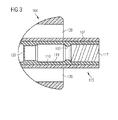
- FIG. 3 shows a sound transmission device 104 according to the present invention.
- the sound transmission device 104 comprises an outer component 107 and an inner component 110, which are produced by a two-component injection molding process in one work step, and thus form a single unit of two different material components.
- the outer component 107 is made of relatively soft silicone
- the inner component 110 is made of relatively hard polyethylene consists.
- the outer component is made of a softer material than the inner component because the outer component should conform well to the ear canal anatomy.
- the outer component 107 completely covers the inner component 110; However, it is also conceivable that the outer component 107, the inner component 110 only partially covered.
- the shape of the sound transmission device 104 substantially corresponds to the shape of the in FIG. 2 illustrated sound transmission device 4, that is, the outer component 107 has openings 120, which serve on the one hand for air equalization or passage of high tones, and on the other hand to avoid complete obstruction of the ear canal.
- the inner component 110 has a passage opening 111, which serves as part of the auditory canal for the transmission of sound, which is emitted by a hearing device via a sound tube (not shown here).
- a suitable sound tube is introduced into the passage opening 111 at one end 115 of the sound transmission device 104, and defined in a defined manner relative to the inner component 110 by means of a thread 117.
- a thread 117 for example, bayonet lock is conceivable to produce a secure and defined connection between a sound tube and the sound transmission device 104.
- a radial projection 112 in the passage opening 111 serves as a stop for a sound tube.
- the passage opening 111 is closed by a foil 120. This should, as described above, avoid that Cerumen penetrates into the auditory canal, and thus affects the function of the entire hearing system.
- the film 120 is integrally formed with the inner component 110 in the illustrated example. However, it is also conceivable that the film is connected to the inner component 110, for example by means of thermal welding, laser welding or gluing.
Landscapes
- Engineering & Computer Science (AREA)
- Health & Medical Sciences (AREA)
- General Health & Medical Sciences (AREA)
- Neurosurgery (AREA)
- Otolaryngology (AREA)
- Physics & Mathematics (AREA)
- Acoustics & Sound (AREA)
- Signal Processing (AREA)
- Manufacturing & Machinery (AREA)
- Injection Moulding Of Plastics Or The Like (AREA)
- Endoscopes (AREA)
- General Details Of Gearings (AREA)
Abstract
Description
- Die vorliegende Erfindung betrifft eine Schallübertragungsvorrichtung, insbesondere für Hörgeräte.
- In
Figur 1 ist in schematischer Darstellung ein herkömmliches Hörsystem 1 abgebildet, welches in bekannter Weise im wesentlichen ein Hörgerät bzw. Mikrophon 2 mit einem Ein-/AusSchalter 5, einen Schallschlauch 3, welcher im wesentlichen einen Hörkanal bildet, und eine Schallübertragungsvorrichtung 4 umfasst. Dabei kann das Hörgerät 2 hinter einem Ohr eines Nutzers angeordnet sein, während die Schallübertragungsvorrichtung 4 im Gehörgang angeordnet ist. - In
Figur 2 ist eine Detailansicht der Schallübertragungsvorrichtung 4 in einer Querschnittsansicht dargestellt. - Die Schallübertragungsvorrichtung 4 umfasst dabei eine schirmartig ausgebildete äußere Komponente 5, den so genannten Dome, welcher sich an die Anatomie des Ohres, d.h. des Gehörgangs, anpassen soll, und eine innere Komponente 10, den so genannten Hörerschutz, welcher in Verbindung mit einem folienartigen Element 20 verhindern soll, dass Cerumen in den Schallschlauch 3 bzw. das Hörgerät 2 fließt, und so die Schallübertragung stört.
- Im dargestellten Beispiel ist die äußere Komponente 7 aus Silikon TPE hergestellt, und die innere Komponente 10 sowie die folienartige Komponente 20 sind jeweils aus im Vergleich zu Silikon härterem Polyethylen (PE) hergestellt. Die Folie 20 ist mittels Thermoschweißen mit der inneren Komponente 10 verbunden.
- Der Schallschlauch 3 ist im wesentlichen in eine Durchgangsöffnung 11 an einem Ende 15 der äußeren Komponente 7 gesteckt, wobei der Schallschlauch 3 gegen einen in der Durchgangsöffnung 11 angeordneten radialen Vorsprung 12 stößt, um eine mehr oder weniger definierte Position gegenüber der Schallübertragungsvorrichtung einzunehmen, um so bestimmte akustische Verhältnisse, die sich aus der Form und der Anordnung des Schallschlauches ergeben, zu erzielen, und Rückkopplungen zu vermeiden.
- Die äußere Komponente 7 weist Öffnungen 20 auf, welche zum einen zum Luftausgleich bzw. Durchlassen von hohen Tönen dienen, und zum anderen eine vollständige Verstopfung des Gehörgangs vermeiden sollen.
- Die äußere Komponente 7 und die innere Komponente 10 werden üblicherweise mittels einer Montagevorrichtung zusammengesetzt, d.h. die innere Komponente 10 wird in die äußere Komponente 7 eingesetzt. Dabei müssen die beiden Komponenten eine relativ hohe Maßhaltigkeit aufweisen, um einerseits eine erforderliche mechanische Stabilität beim Einsetzen in das Ohr und Herausnehmen aus dem Ohr zu erzielen, und um andererseits die gewünschte Akustik innerhalb der Schallübertragungsvorrichtung 4 zu erreichen.
- Bei der herkömmlichen Schallübertragungsvorrichtung wird einerseits die relativ aufwändige Montage als nachteilig empfunden, andererseits ist eine erhöhte mechanische Stabilität wünschenswert.
- Es ist deshalb eine Aufgabe der vorliegenden Erfindung, die Nachteile des Standes der Technik zu umgehen, und eine verbesserte Schallübertragungsvorrichtung bereitzustellen.
- Diese Aufgabe wird durch die Merkmale des Anspruchs 1 abgedeckt.
- Hierzu schlägt die Erfindung eine Schallübertragungsvorrichtung, umfassend: eine äußere Komponente; eine innere Komponente, wobei die äußere Komponente die innere Komponente wenigstens bereichsweise umgibt, und wobei wenigstens die innere Komponente eine Durchgangsöffnung aufweist; und eine folienartige Komponente, welche die Durchgangsöffnung der inneren Komponente auf einer Seite verschließt; wobei die äußere und die innere Komponente mittels eines Mehrkomponenten-Spritzgießverfahren in einem Arbeitsschritt einstückig miteinander verbunden sind.
- Ein Vorteil der vorliegenden Erfindung besteht darin, dass aufgrund der Art der Herstellung mittels Mehrkomponenten-Spritzgießverfahrens eine relativ feste Verbindung zwischen innerer und äußerer Komponente besteht, so dass ein Verdrehen bzw. Verkanten der beiden Komponenten zueinander ausgeschlossen ist. Konstante Relativpositionen der beiden Komponenten zueinander sind insbesondere deshalb wichtig, da schon bei kleinsten Änderungen dieser Relativpositionen die Akustik in dem Hörkanal in unerwünschter Weise verändert ist.
- Ein weiterer Vorteil besteht darin, dass die Herstellung der Schallübertragungsvorrichtung durch das Anwenden des Mehrkomponenten-Spritzgießverfahrens vereinfacht ist, da innere und äußere Komponente in einem Arbeitsschritt hergestellt werden. Überdies kann somit die Schallübertragungsvorrichtung auch relativ kleiner hergestellt werden.
- Vorteilhafterweise besteht die äußere Komponente aus einem Material mit einer geringeren Härte als die innere Komponente. Dies hat den Vorteil, dass sich die äußere Komponente relativ gut an die Anatomie des Ohres des Trägers anpassen kann, und für den Träger auch über längere Zeit angenehm zu tragen ist. Gleichzeitig verleiht das relativ härtere Material der inneren Komponente der Schallübertragungsvorrichtung insgesamt eine gute Festigkeit. Als Material für die äußere Komponente wird Silikon bevorzugt, und als Material für die innere Komponente und für die folienartige Komponente jeweils Polyethylen, wobei die folienartige Komponente bevorzugt mittels Thermoschweißen mit der inneren Komponente verbunden ist.
- Weiterhin wird bevorzugt, dass die Durchgangsöffnung Verbindungsmittel aufweist, welche dazu geeignet sind, die Schallübertragungsvorrichtung in definierter Weise mit einer externen Hörvorrichtung zu verbinden. Dabei können die Verbindungsmittel zum Beispiel wenigstens einen Gewindegang oder eine Art Bajonettverschluss umfassen, um so die Schallübertragungsvorrichtung in einfacher und definierter Weise mit dem Schallschlauch zu verbinden. Zum einen wird dadurch vermieden, dass beim Herausziehen der Schallübertragungsvorrichtung aus dem Gehörgang des Ohres der Schallschlauch unbeabsichtigt von der Schallübertragungsvorrichtung getrennt wird. Zum anderen wird sichergestellt, dass durch die definierte Verbindung von Schallübertragungsvorrichtung und Schallschlauch die Akustik des Hörsystems nicht beeinträchtigt wird.
- Nachfolgend wird die Erfindung anhand von Figuren näher erläutert. Hierbei zeigt:
-
Figur 1 eine schematische Ansicht eines herkömmlichen Hörsystems mit einer Schallübertragungsvorrichtung; -
Figur 2 eine detaillierte Querschnittsansicht der herkömmlichen Schallübertragungsvorrichtung ausFigur 1 ; und -
Figur 3 eine erfindungsgemäße Schallübertragungsvorrichtung. -
Figur 3 zeigt eine Schallübertragungsvorrichtung 104 gemäß der vorliegenden Erfindung. Dabei umfasst die Schallübertragungsvorrichtung 104 eine äußere Komponente 107 und eine innere Komponente 110, die durch ein Zwei-Komponenten-Spritzgießverfahren in einem Arbeitsschritt hergestellt sind, und somit eine einzige Einheit aus zwei unterschiedlichen Materialkomponenten bilden. Im dargestellten Beispiel besteht die äußere Komponente 107 aus relativ weichem Silikon, während die innere Komponente 110 aus relativ hartem Polyethylen besteht. Jedoch sind auch andere geeignete Materialkomponenten denkbar, wobei beachtet werden sollte, dass die äußere Komponente aus einem weicherem Material besteht als die innere Komponente, da sich die äußere Komponente gut an die Gehörgang-Anatomie anpassen sollte. - Im dargestellten Beispiel in
Figur 3 überdeckt die äußere Komponente 107 vollständig die innere Komponente 110; es ist allerdings auch denkbar, dass die äußere Komponente 107 die innere Komponente 110 nur bereichsweise überdeckt. - Die Formgebung der Schallübertragungsvorrichtung 104 entspricht im wesentlichen der Formgebung der in
Figur 2 dargestellten Schallübertragungsvorrichtung 4, d.h. die äußere Komponente 107 weist Öffnungen 120 auf, welche zum einen zum Luftausgleich bzw. Durchlassen von hohen Tönen dienen, und zum anderen eine vollständige Verstopfung des Gehörgangs vermeiden sollen. - Desweiteren weist die innere Komponente 110 eine Durchgangsöffnung 111 auf, welche als Teil des Hörkanals der Übertragung von Schall dient, welcher von einem Hörgerät über einen Schallschlauch ausgestrahlt wird (hier nicht dargestellt). Ein geeigneter Schallschlauch wird an einem Ende 115 der Schallübertragungsvorrichtung 104 in die Durchgangsöffnung 111 eingeführt, und mittels eines Gewindes 117 in definierter Weise relativ zur inneren Komponente 110 festgelegt. Statt eines Gewindes 117 ist zum Beispiel auch Bajonettverschluss denkbar, um eine sichere und definierte Verbindung zwischen einem Schallschlauch und der Schallübertragungsvorrichtung 104 herzustellen. Ein radialer Vorsprung 112 in der Durchgangsöffnung 111 dient dabei als Anschlag für einen Schallschlauch.
- Dem Ende 115 gegenüberliegend ist die Durchgangsöffnung 111 von einer Folie 120 verschlossen. Dies soll, wie oben schon beschrieben, vermeiden, dass Cerumen in den Hörkanal dringt, und so die Funktion des gesamten Hörsystems beeinträchtigt.
- Die Folie 120 ist im dargestellten Beispiel einstückig mit der inneren Komponente 110 ausgebildet. Es ist jedoch auch denkbar, dass die Folie zum Beispiel mittels Thermoschweißen, Laserschweißen oder Kleben mit der inneren Komponente 110 verbunden ist.
Claims (6)
- Schallübertragungsvorrichtung (104), umfassend:- eine äußere Komponente (107);- eine innere Komponente (110), wobei die äußere Komponente (107) die innere Komponente (110) wenigstens bereichsweise umgibt und die äußere und die innere Komponente (107, 110) mittels eines Mehrkomponenten-Spritzgießverfahren in einem Arbeitsschritt einstückig miteinander verbunden sind,- wobei die innere Komponente (110) eine Durchgangsöffnung (111) aufweist und eine folienartige Komponente (120) die Durchgangsöffnung (111) der inneren Komponente (110) auf einer Seite verschließt;dadurch gekennzeichnet, dass
die äußere Komponente (107) mindestens eine Öffnung (120) aufweist. - Schallübertragungsvorrichtung (104) nach Anspruch 1, wobei die äußere Komponente (107) aus einem Material mit einer geringeren Härte hergestellt ist als die innere Komponente (110).
- Schallübertragungsvorrichtung (104) nach Anspruch 1 oder 2, wobei jeweils die äußere Komponente (107) aus Silikon und die innere Komponente (110) aus Polyethylen hergestellt ist.
- Schallübertragungsvorrichtung (104) nach einem der Ansprüche 1 bis 3, wobei die folienartige Komponente (120) aus Polyethylen hergestellt und mittels Thermoschweißen, Laserschweißen oder Kleben mit der inneren Komponente (110) verbunden ist.
- Schallübertragungsvorrichtung (104) nach einem der Ansprüche 1 bis 4, wobei die Durchgangsöffnung (111) Verbindungsmittel aufweist, welche dazu geeignet sind, die Schallübertragungsvorrichtung (104) in definierter Weise mit einer externen Hörvorrichtung zu verbinden.
- Schallübertragungsvorrichtung nach Anspruch 5, wobei die Verbindungsmittel wenigstens einen Gewindegang (117) umfassen.
Applications Claiming Priority (1)
| Application Number | Priority Date | Filing Date | Title |
|---|---|---|---|
| DE102007020056 | 2007-04-27 |
Publications (2)
| Publication Number | Publication Date |
|---|---|
| EP1995991A2 true EP1995991A2 (de) | 2008-11-26 |
| EP1995991A3 EP1995991A3 (de) | 2012-07-25 |
Family
ID=39830033
Family Applications (1)
| Application Number | Title | Priority Date | Filing Date |
|---|---|---|---|
| EP08103691A Withdrawn EP1995991A3 (de) | 2007-04-27 | 2008-04-23 | Schallübertragungsvorrichtung |
Country Status (2)
| Country | Link |
|---|---|
| US (1) | US20080267437A1 (de) |
| EP (1) | EP1995991A3 (de) |
Cited By (2)
| Publication number | Priority date | Publication date | Assignee | Title |
|---|---|---|---|---|
| DE102018107195B3 (de) | 2018-02-05 | 2019-02-14 | Paul Gregor Junke | Universal Silikon-Softadapter für Hörgeräte |
| US20220408176A1 (en) * | 2021-06-17 | 2022-12-22 | Bujeon Co., Ltd. | Ear tip including flange made of silicone foam material |
Families Citing this family (1)
| Publication number | Priority date | Publication date | Assignee | Title |
|---|---|---|---|---|
| JP5627679B2 (ja) | 2009-06-16 | 2014-11-19 | シーメンス メディカル インストゥルメンツ ピーティーイー リミテッド | 補聴器 |
Family Cites Families (18)
| Publication number | Priority date | Publication date | Assignee | Title |
|---|---|---|---|---|
| US4852177A (en) * | 1986-08-28 | 1989-07-25 | Sensesonics, Inc. | High fidelity earphone and hearing aid |
| US5002151A (en) * | 1986-12-05 | 1991-03-26 | Minnesota Mining And Manufacturing Company | Ear piece having disposable, compressible polymeric foam sleeve |
| US5288953A (en) * | 1992-04-29 | 1994-02-22 | Welch Allyn, Inc. | Compressible stethoscope ear tip |
| US5887070A (en) * | 1992-05-08 | 1999-03-23 | Etymotic Research, Inc. | High fidelity insert earphones and methods of making same |
| US5345509A (en) * | 1992-08-04 | 1994-09-06 | Stanton Magnetics, Inc. | Transducer with ear canal pickup |
| SE503791C2 (sv) * | 1994-12-02 | 1996-09-02 | P & B Res Ab | Anordning vid hörapparat |
| US5692059A (en) * | 1995-02-24 | 1997-11-25 | Kruger; Frederick M. | Two active element in-the-ear microphone system |
| US7162039B1 (en) * | 1996-02-23 | 2007-01-09 | Matthew G. Callahan | Noise barrier apparatus having acoustic wave damping cushions |
| US8290034B2 (en) * | 1998-12-21 | 2012-10-16 | Zin Stai Pte. In, Llc | Video transmission and display including bit-wise sub-sampling video compression |
| US20030159878A1 (en) * | 2000-04-06 | 2003-08-28 | Jorgen Hakansson | Earplug |
| US7174028B1 (en) * | 2000-09-07 | 2007-02-06 | Phonak Ag | Method for manufacturing hearing aids, and a hearing aid |
| TW200305346A (en) * | 2002-04-12 | 2003-10-16 | Nap Entpr Co Ltd | Ear pad, and earphone with the pad |
| US7751579B2 (en) * | 2003-06-13 | 2010-07-06 | Etymotic Research, Inc. | Acoustically transparent debris barrier for audio transducers |
| US7697706B2 (en) * | 2003-11-03 | 2010-04-13 | 3M Innovative Properties Company | Low sound attenuating hearing protection device |
| US7349550B2 (en) * | 2004-01-07 | 2008-03-25 | Hearing Components, Inc. | Earbud adapter |
| JP4671442B2 (ja) * | 2005-04-28 | 2011-04-20 | 三菱鉛筆株式会社 | 複合部材の成形方法、及び複合部材 |
| WO2007011806A2 (en) * | 2005-07-18 | 2007-01-25 | Soundquest, Inc. | Behind-the-ear auditory device |
| ES2522316T3 (es) * | 2007-09-24 | 2014-11-14 | Sound Innovations, Llc | Dispositivo intraauricular digital electrónico de cancelación de ruido y comunicación |
-
2008
- 2008-04-23 EP EP08103691A patent/EP1995991A3/de not_active Withdrawn
- 2008-04-24 US US12/150,013 patent/US20080267437A1/en not_active Abandoned
Non-Patent Citations (1)
| Title |
|---|
| None |
Cited By (5)
| Publication number | Priority date | Publication date | Assignee | Title |
|---|---|---|---|---|
| DE102018107195B3 (de) | 2018-02-05 | 2019-02-14 | Paul Gregor Junke | Universal Silikon-Softadapter für Hörgeräte |
| WO2019149947A1 (de) | 2018-02-05 | 2019-08-08 | Paul Gregor Junke | Universal-adapter für hörgeräte und ohrhörer |
| US11218819B2 (en) | 2018-02-05 | 2022-01-04 | Paul Gregor Junke | Universal adapter for hearing aids and earphones |
| US20220408176A1 (en) * | 2021-06-17 | 2022-12-22 | Bujeon Co., Ltd. | Ear tip including flange made of silicone foam material |
| US11601745B2 (en) * | 2021-06-17 | 2023-03-07 | Bujeon Co., Ltd. | Ear tip including flange made of silicone foam material |
Also Published As
| Publication number | Publication date |
|---|---|
| US20080267437A1 (en) | 2008-10-30 |
| EP1995991A3 (de) | 2012-07-25 |
Similar Documents
| Publication | Publication Date | Title |
|---|---|---|
| EP2220873A2 (de) | Hörer | |
| EP3750329B1 (de) | Universal-adapter für hörgeräte und ohrhörer | |
| EP3757987A1 (de) | Audiosystem mit strahlformenden lautsprechern sowie brille mit einem derartigen audiosystem | |
| EP1046943A1 (de) | Hörhilfe | |
| DE202020102274U1 (de) | Hörmuschel | |
| DE102009008376A1 (de) | Hörer | |
| EP1874093A2 (de) | Hörgerät mit einer Befestigung für einen Hörerschlauch | |
| EP1973374A1 (de) | Hörgerät mit einer Befestigung eines Hörerschlauchs | |
| DE69013927T2 (de) | Ohrendstück mit einer abnehmbaren zusammendrückbaren polymeren schaumstoffscheide. | |
| EP1335630A2 (de) | Im Ohr tragbares Hörhilfegerät oder Hörhilfegerät mit im Ohr tragbarer Otoplastik | |
| DE102007038191B3 (de) | Individuell einstellbares Hörgerät und Verfahren zu seinem Betrieb | |
| EP3579580B1 (de) | Verfahren zur herstellung einer komponente eines hörgeräts | |
| EP2509340A1 (de) | Gehörgangseinsatz mit einem Filterelement | |
| EP3939338A1 (de) | Verfahren zur anpassung einer otoplastik eines hörgeräts, hörgerät und hörgerätesystem | |
| DE102011001793A1 (de) | Hörgerät und Verfahren zum Einstellen und Betreiben eines Hörgeräts | |
| DE102016208940A1 (de) | Halte-Schirm für ein Standard-Ohrstück | |
| DE102006042209B3 (de) | Ohrstöpselartiger Ohrhörer mit regulierbarem Volumen einer zwischen Lautsprecher und Gehäuse angeordneten Frontkammer | |
| EP2982135B1 (de) | Ohrkanal-hörer mit ohrpass-einheit | |
| EP3672284A2 (de) | Otoplastik und verwendung einer otoplastik | |
| DE212013000001U1 (de) | Einheit aus einem Stethoskopkopfkörper und einem Befestigungselement | |
| WO2005086524A1 (de) | Hörer | |
| DE102013001920B3 (de) | Lautsprecher-Ohrstück für ein Hörgerät | |
| DE102008049561A1 (de) | Ohradapter und Ohrkanal-Hörer | |
| EP2866473B1 (de) | Otoplastik, Hörsystem sowie Verfahren zur Montage eines Hörsystems | |
| DE10138613B4 (de) | Belüftungssystem für Otoplastiken |
Legal Events
| Date | Code | Title | Description |
|---|---|---|---|
| PUAI | Public reference made under article 153(3) epc to a published international application that has entered the european phase |
Free format text: ORIGINAL CODE: 0009012 |
|
| AK | Designated contracting states |
Kind code of ref document: A2 Designated state(s): AT BE BG CH CY CZ DE DK EE ES FI FR GB GR HR HU IE IS IT LI LT LU LV MC MT NL NO PL PT RO SE SI SK TR |
|
| AX | Request for extension of the european patent |
Extension state: AL BA MK RS |
|
| PUAL | Search report despatched |
Free format text: ORIGINAL CODE: 0009013 |
|
| AK | Designated contracting states |
Kind code of ref document: A3 Designated state(s): AT BE BG CH CY CZ DE DK EE ES FI FR GB GR HR HU IE IS IT LI LT LU LV MC MT NL NO PL PT RO SE SI SK TR |
|
| AX | Request for extension of the european patent |
Extension state: AL BA MK RS |
|
| RIC1 | Information provided on ipc code assigned before grant |
Ipc: H04R 25/00 20060101AFI20120615BHEP |
|
| 17P | Request for examination filed |
Effective date: 20120821 |
|
| AKX | Designation fees paid |
Designated state(s): AT BE BG CH CY CZ DE DK EE ES FI FR GB GR HR HU IE IS IT LI LT LU LV MC MT NL NO PL PT RO SE SI SK TR |
|
| STAA | Information on the status of an ep patent application or granted ep patent |
Free format text: STATUS: THE APPLICATION IS DEEMED TO BE WITHDRAWN |
|
| 18D | Application deemed to be withdrawn |
Effective date: 20131031 |