EP1996548B1 - Ligands du récepteur sigma - Google Patents
Ligands du récepteur sigma Download PDFInfo
- Publication number
- EP1996548B1 EP1996548B1 EP07723020.9A EP07723020A EP1996548B1 EP 1996548 B1 EP1996548 B1 EP 1996548B1 EP 07723020 A EP07723020 A EP 07723020A EP 1996548 B1 EP1996548 B1 EP 1996548B1
- Authority
- EP
- European Patent Office
- Prior art keywords
- mono
- optionally
- group
- substituted
- branched
- Prior art date
- Legal status (The legal status is an assumption and is not a legal conclusion. Google has not performed a legal analysis and makes no representation as to the accuracy of the status listed.)
- Not-in-force
Links
- 0 CN1C=CCC=C*1* Chemical compound CN1C=CCC=C*1* 0.000 description 9
- AUFIRGPROMANKW-UHFFFAOYSA-N CN1CC=CCC1 Chemical compound CN1CC=CCC1 AUFIRGPROMANKW-UHFFFAOYSA-N 0.000 description 2
- AVFZOVWCLRSYKC-UHFFFAOYSA-N CN1CCCC1 Chemical compound CN1CCCC1 AVFZOVWCLRSYKC-UHFFFAOYSA-N 0.000 description 2
- PAMIQIKDUOTOBW-UHFFFAOYSA-N CN1CCCCC1 Chemical compound CN1CCCCC1 PAMIQIKDUOTOBW-UHFFFAOYSA-N 0.000 description 2
- QLCLRUFRPRFTSV-UHFFFAOYSA-N C(C1)COC11CC(C(C2)NCCC22C=CCC2)NCC1 Chemical compound C(C1)COC11CC(C(C2)NCCC22C=CCC2)NCC1 QLCLRUFRPRFTSV-UHFFFAOYSA-N 0.000 description 1
- AXMNGEUJXLXFRY-UHFFFAOYSA-O C(CC1)CC11CC[NH2+]CC1 Chemical compound C(CC1)CC11CC[NH2+]CC1 AXMNGEUJXLXFRY-UHFFFAOYSA-O 0.000 description 1
- YJGWGEFPNWVOJD-UHFFFAOYSA-N C1C2(CCNCC2)C=CC1 Chemical compound C1C2(CCNCC2)C=CC1 YJGWGEFPNWVOJD-UHFFFAOYSA-N 0.000 description 1
- XDTMQSROBMDMFD-UHFFFAOYSA-N C1CCCCC1 Chemical compound C1CCCCC1 XDTMQSROBMDMFD-UHFFFAOYSA-N 0.000 description 1
- NQRYJNQNLNOLGT-UHFFFAOYSA-N C1CCNCC1 Chemical compound C1CCNCC1 NQRYJNQNLNOLGT-UHFFFAOYSA-N 0.000 description 1
- ZMJDNMLWLIQAFG-UHFFFAOYSA-N CC1(C)N(C)CCCCC1 Chemical compound CC1(C)N(C)CCCCC1 ZMJDNMLWLIQAFG-UHFFFAOYSA-N 0.000 description 1
- ODIPBHPDNPYJDT-UHFFFAOYSA-N CCCNCCC1OCCC1 Chemical compound CCCNCCC1OCCC1 ODIPBHPDNPYJDT-UHFFFAOYSA-N 0.000 description 1
- UKPBWLDHWHLVFV-UHFFFAOYSA-N CN1C=CCCC1 Chemical compound CN1C=CCCC1 UKPBWLDHWHLVFV-UHFFFAOYSA-N 0.000 description 1
- BVUXORIUPWFRRJ-NFOMZHRRSA-N C[C@@H]1C2(CCC2)CC(C2C3(CCCC3)CNC2)NC1 Chemical compound C[C@@H]1C2(CCC2)CC(C2C3(CCCC3)CNC2)NC1 BVUXORIUPWFRRJ-NFOMZHRRSA-N 0.000 description 1
- QTULQJAJOWYEFP-VIFPVBQESA-N C[C@@H]1C2(CCCC2)CCNC1 Chemical compound C[C@@H]1C2(CCCC2)CCNC1 QTULQJAJOWYEFP-VIFPVBQESA-N 0.000 description 1
- LZAICLLSHUTKIG-UHFFFAOYSA-N C[n]1c(CCCC2CCN(CC3)CCC3(c(cc3)ccc3Cl)O)c2cc1 Chemical compound C[n]1c(CCCC2CCN(CC3)CCC3(c(cc3)ccc3Cl)O)c2cc1 LZAICLLSHUTKIG-UHFFFAOYSA-N 0.000 description 1
Classifications
-
- C—CHEMISTRY; METALLURGY
- C07—ORGANIC CHEMISTRY
- C07D—HETEROCYCLIC COMPOUNDS
- C07D209/00—Heterocyclic compounds containing five-membered rings, condensed with other rings, with one nitrogen atom as the only ring hetero atom
- C07D209/02—Heterocyclic compounds containing five-membered rings, condensed with other rings, with one nitrogen atom as the only ring hetero atom condensed with one carbocyclic ring
- C07D209/04—Indoles; Hydrogenated indoles
- C07D209/08—Indoles; Hydrogenated indoles with only hydrogen atoms or radicals containing only hydrogen and carbon atoms, directly attached to carbon atoms of the hetero ring
-
- A—HUMAN NECESSITIES
- A61—MEDICAL OR VETERINARY SCIENCE; HYGIENE
- A61P—SPECIFIC THERAPEUTIC ACTIVITY OF CHEMICAL COMPOUNDS OR MEDICINAL PREPARATIONS
- A61P1/00—Drugs for disorders of the alimentary tract or the digestive system
- A61P1/04—Drugs for disorders of the alimentary tract or the digestive system for ulcers, gastritis or reflux esophagitis, e.g. antacids, inhibitors of acid secretion, mucosal protectants
-
- A—HUMAN NECESSITIES
- A61—MEDICAL OR VETERINARY SCIENCE; HYGIENE
- A61P—SPECIFIC THERAPEUTIC ACTIVITY OF CHEMICAL COMPOUNDS OR MEDICINAL PREPARATIONS
- A61P1/00—Drugs for disorders of the alimentary tract or the digestive system
- A61P1/12—Antidiarrhoeals
-
- A—HUMAN NECESSITIES
- A61—MEDICAL OR VETERINARY SCIENCE; HYGIENE
- A61P—SPECIFIC THERAPEUTIC ACTIVITY OF CHEMICAL COMPOUNDS OR MEDICINAL PREPARATIONS
- A61P19/00—Drugs for skeletal disorders
- A61P19/02—Drugs for skeletal disorders for joint disorders, e.g. arthritis, arthrosis
-
- A—HUMAN NECESSITIES
- A61—MEDICAL OR VETERINARY SCIENCE; HYGIENE
- A61P—SPECIFIC THERAPEUTIC ACTIVITY OF CHEMICAL COMPOUNDS OR MEDICINAL PREPARATIONS
- A61P25/00—Drugs for disorders of the nervous system
-
- A—HUMAN NECESSITIES
- A61—MEDICAL OR VETERINARY SCIENCE; HYGIENE
- A61P—SPECIFIC THERAPEUTIC ACTIVITY OF CHEMICAL COMPOUNDS OR MEDICINAL PREPARATIONS
- A61P25/00—Drugs for disorders of the nervous system
- A61P25/02—Drugs for disorders of the nervous system for peripheral neuropathies
-
- A—HUMAN NECESSITIES
- A61—MEDICAL OR VETERINARY SCIENCE; HYGIENE
- A61P—SPECIFIC THERAPEUTIC ACTIVITY OF CHEMICAL COMPOUNDS OR MEDICINAL PREPARATIONS
- A61P25/00—Drugs for disorders of the nervous system
- A61P25/04—Centrally acting analgesics, e.g. opioids
-
- A—HUMAN NECESSITIES
- A61—MEDICAL OR VETERINARY SCIENCE; HYGIENE
- A61P—SPECIFIC THERAPEUTIC ACTIVITY OF CHEMICAL COMPOUNDS OR MEDICINAL PREPARATIONS
- A61P25/00—Drugs for disorders of the nervous system
- A61P25/06—Antimigraine agents
-
- A—HUMAN NECESSITIES
- A61—MEDICAL OR VETERINARY SCIENCE; HYGIENE
- A61P—SPECIFIC THERAPEUTIC ACTIVITY OF CHEMICAL COMPOUNDS OR MEDICINAL PREPARATIONS
- A61P25/00—Drugs for disorders of the nervous system
- A61P25/08—Antiepileptics; Anticonvulsants
-
- A—HUMAN NECESSITIES
- A61—MEDICAL OR VETERINARY SCIENCE; HYGIENE
- A61P—SPECIFIC THERAPEUTIC ACTIVITY OF CHEMICAL COMPOUNDS OR MEDICINAL PREPARATIONS
- A61P25/00—Drugs for disorders of the nervous system
- A61P25/18—Antipsychotics, i.e. neuroleptics; Drugs for mania or schizophrenia
-
- A—HUMAN NECESSITIES
- A61—MEDICAL OR VETERINARY SCIENCE; HYGIENE
- A61P—SPECIFIC THERAPEUTIC ACTIVITY OF CHEMICAL COMPOUNDS OR MEDICINAL PREPARATIONS
- A61P25/00—Drugs for disorders of the nervous system
- A61P25/22—Anxiolytics
-
- A—HUMAN NECESSITIES
- A61—MEDICAL OR VETERINARY SCIENCE; HYGIENE
- A61P—SPECIFIC THERAPEUTIC ACTIVITY OF CHEMICAL COMPOUNDS OR MEDICINAL PREPARATIONS
- A61P25/00—Drugs for disorders of the nervous system
- A61P25/24—Antidepressants
-
- A—HUMAN NECESSITIES
- A61—MEDICAL OR VETERINARY SCIENCE; HYGIENE
- A61P—SPECIFIC THERAPEUTIC ACTIVITY OF CHEMICAL COMPOUNDS OR MEDICINAL PREPARATIONS
- A61P25/00—Drugs for disorders of the nervous system
- A61P25/28—Drugs for disorders of the nervous system for treating neurodegenerative disorders of the central nervous system, e.g. nootropic agents, cognition enhancers, drugs for treating Alzheimer's disease or other forms of dementia
-
- A—HUMAN NECESSITIES
- A61—MEDICAL OR VETERINARY SCIENCE; HYGIENE
- A61P—SPECIFIC THERAPEUTIC ACTIVITY OF CHEMICAL COMPOUNDS OR MEDICINAL PREPARATIONS
- A61P25/00—Drugs for disorders of the nervous system
- A61P25/30—Drugs for disorders of the nervous system for treating abuse or dependence
-
- A—HUMAN NECESSITIES
- A61—MEDICAL OR VETERINARY SCIENCE; HYGIENE
- A61P—SPECIFIC THERAPEUTIC ACTIVITY OF CHEMICAL COMPOUNDS OR MEDICINAL PREPARATIONS
- A61P29/00—Non-central analgesic, antipyretic or antiinflammatory agents, e.g. antirheumatic agents; Non-steroidal antiinflammatory drugs [NSAID]
-
- A—HUMAN NECESSITIES
- A61—MEDICAL OR VETERINARY SCIENCE; HYGIENE
- A61P—SPECIFIC THERAPEUTIC ACTIVITY OF CHEMICAL COMPOUNDS OR MEDICINAL PREPARATIONS
- A61P3/00—Drugs for disorders of the metabolism
- A61P3/04—Anorexiants; Antiobesity agents
-
- A—HUMAN NECESSITIES
- A61—MEDICAL OR VETERINARY SCIENCE; HYGIENE
- A61P—SPECIFIC THERAPEUTIC ACTIVITY OF CHEMICAL COMPOUNDS OR MEDICINAL PREPARATIONS
- A61P3/00—Drugs for disorders of the metabolism
- A61P3/06—Antihyperlipidemics
-
- A—HUMAN NECESSITIES
- A61—MEDICAL OR VETERINARY SCIENCE; HYGIENE
- A61P—SPECIFIC THERAPEUTIC ACTIVITY OF CHEMICAL COMPOUNDS OR MEDICINAL PREPARATIONS
- A61P35/00—Antineoplastic agents
-
- A—HUMAN NECESSITIES
- A61—MEDICAL OR VETERINARY SCIENCE; HYGIENE
- A61P—SPECIFIC THERAPEUTIC ACTIVITY OF CHEMICAL COMPOUNDS OR MEDICINAL PREPARATIONS
- A61P37/00—Drugs for immunological or allergic disorders
- A61P37/02—Immunomodulators
- A61P37/06—Immunosuppressants, e.g. drugs for graft rejection
-
- A—HUMAN NECESSITIES
- A61—MEDICAL OR VETERINARY SCIENCE; HYGIENE
- A61P—SPECIFIC THERAPEUTIC ACTIVITY OF CHEMICAL COMPOUNDS OR MEDICINAL PREPARATIONS
- A61P9/00—Drugs for disorders of the cardiovascular system
- A61P9/06—Antiarrhythmics
-
- A—HUMAN NECESSITIES
- A61—MEDICAL OR VETERINARY SCIENCE; HYGIENE
- A61P—SPECIFIC THERAPEUTIC ACTIVITY OF CHEMICAL COMPOUNDS OR MEDICINAL PREPARATIONS
- A61P9/00—Drugs for disorders of the cardiovascular system
- A61P9/10—Drugs for disorders of the cardiovascular system for treating ischaemic or atherosclerotic diseases, e.g. antianginal drugs, coronary vasodilators, drugs for myocardial infarction, retinopathy, cerebrovascula insufficiency, renal arteriosclerosis
-
- A—HUMAN NECESSITIES
- A61—MEDICAL OR VETERINARY SCIENCE; HYGIENE
- A61P—SPECIFIC THERAPEUTIC ACTIVITY OF CHEMICAL COMPOUNDS OR MEDICINAL PREPARATIONS
- A61P9/00—Drugs for disorders of the cardiovascular system
- A61P9/12—Antihypertensives
-
- C—CHEMISTRY; METALLURGY
- C07—ORGANIC CHEMISTRY
- C07D—HETEROCYCLIC COMPOUNDS
- C07D401/00—Heterocyclic compounds containing two or more hetero rings, having nitrogen atoms as the only ring hetero atoms, at least one ring being a six-membered ring with only one nitrogen atom
- C07D401/02—Heterocyclic compounds containing two or more hetero rings, having nitrogen atoms as the only ring hetero atoms, at least one ring being a six-membered ring with only one nitrogen atom containing two hetero rings
- C07D401/06—Heterocyclic compounds containing two or more hetero rings, having nitrogen atoms as the only ring hetero atoms, at least one ring being a six-membered ring with only one nitrogen atom containing two hetero rings linked by a carbon chain containing only aliphatic carbon atoms
Definitions
- the present invention relates to compounds having pharmacological activity towards the sigma receptor, to processes of preparation of such compounds, to medicaments comprising them, and to compounds for their use in therapy and prophylaxis, in particular for the treatment of psychosis or pain.
- sigma receptor a cell surface receptor of the central nervous system (CNS) which may be related to the dysphoric, hallucinogenic and cardiac stimulant effects of opioids.
- CNS central nervous system
- sigma receptor ligands may be useful in the treatment of psychosis and movement disorders such as dystonia and tardive dyskinesia, and motor disturbances associated with Huntington's chorea or Tourette's syndrome and in Parkinson's disease ( Walker, J.M. et al, Pharmacological Reviews, 1990, 42, 355 ).
- the sigma binding sites have preferential affinity for the dextrorotatory isomers of certain opiate benzomorphans, such as (+)-sky 10047, (+)-cyclazocine, and (+)-pentazocine and also for some narcoleptics such as haloperidol.
- the sigma receptor has at least two subtypes, which may be discriminated by stereoselective isomers of these pharmacoactive drugs.
- SKF 10047 has .nanomolar affinity for the sigma-1 site, and has micromolar affinity for the sigma-2 site. Haloperidol has similar affinities for both subtypes. Endogenous sigma ligands are not known, although progesterone has been suggested to be one of them. Possible sigma-site-mediated drug effects include modulation of glutamate receptor function, neurotransmitter response, neuroprotection, behavior, and cognition ( Quirion, R. et al. Trends Pharmacol. Sci., 1992, 13:85-86 ). Most studies have implied that sigma binding sites (receptors) are plasmalemmal elements of the signal transduction cascade.
- WO 91/09594 generically describes a broad class of sigma receptor ligands some of which are 4-phenylpiperidine, - tetrahydro-pyridine or -piperazine compounds having an optionally substituted aryl or heteroaryl, alkyl, alkenyl, alkynyl, alkoxy or alkoxyalkyl substituent on the ring N-atom.
- aryl and heteroaryl are defined by mention of a number of such substituents.
- European patent publication No. EP 0 414 289 A1 generically discloses a class of 1,2,3,4-tetrahydro-spiro[naphthalene-1,4'-piperidine] and 1,4-dihydro-spiro [naphthalene-1,4'-piperidine] derivatives substituted at the piperidine N-atom with a hydrocarbon group alleged to have selective sigma receptor antagonistic activity.
- hydrocarbon as defined in said patent, covers all possible straight chained, cyclic, heterocyclic, etc. groups.
- European patent publication No. EP 0 445 974 A2 generically describes the corresponding spiro[indane-1,4'-piperidine] and spiro[benzocycloheptene-5,4'-piperidine] derivatives. Again the compounds are only stated to displace tritiated di-tolyl guanidine (DTG) from sigma sites with potencies better than 200 nM
- N-[ ⁇ -(Tetralin-1-yl)alkyl]piperidine derivatives as well as 1-Aryl-4-[(1-tetralin)alkyl]piperazines have been described as new sigma-ligands ( Berardi et al. J Med Chem, 1996, 39, 4255 ; Perrone et al, J Med Chem, 1995, 38, 942 ).
- European patent Application No. EP 0 431 943 A2 relates to a further extremely broad class of spiroplperidine compounds substituted at the piperidine N-atom and claimed to be useful as antiarrhythmics and for impaired cardiac pump function.
- the said application exemplifies several compounds, the majority of which contain an oxo and/or a sulfonylamino substituent in the spiro cyclic ring system. Of the remainder compounds, the main part has another polar substituent attached to the spiro nucleus and/or they have some polar substituents in the substituent on the piperidine N-atom. No suggestion or indication of effect of the compounds on the sigma receptor is given.
- the compounds present a furan and/or a pyrrol ring which is condensed with a cycloalkyl ring having 5, 6 or 7 carbon atoms.
- t is selected from 1, 2 or 3.
- the invention is directed to a compound of general formula (I), wherein A represents an NR 3 group; m is selected from 0, 1, 2; n is selected from 0,1, 2, 3, 4; the dotted line ------ represents either a single or a double bond; R 1 and R 2 , identical or different, represent a hydrogen atom; a linear or branched; saturated or unsaturated, optionally at least mono-substituted aliphatic radical; an optionally at least mono-substituted cycloalkyl group which is optionally condensed to other, at least mono-substituted, mono- or polycyclic ring systems; an optionally at least mono-substituted aryl group which is optionally condensed to other, at least mono-substituted, mono- or polycyclic ring systems; an optionally at least mono-substituted heterocyclyl group which is optionally condensed to other, at least mono-substituted, mono- or polycyclic ring systems
- t is selected from 1, 2 or 3.
- the invention is directed to compounds of general formula (I), wherein A represents an NR 3 group; m is selected from 0, 1, 2; n is selected from 0,1, 2, 3, 4; the dotted line ----- represents either a single or a double bond; R 1 and R 2 , identical or different, represent a hydrogen atom; a linear or branched, saturated or unsaturated, optionally at least mono-substituted aliphatic radical; an optionally at least mono-substituted cycloalkyl group which is optionally condensed to other, at least mono-substituted, mono-or polycyclic ring systems; an optionally at least mono-substituted aryl group which is optionally condensed to other, at least mono-substituted, mono- or polycyclic ring systems; an optionally at least mono-substituted heterocyclyl group which is optionally condensed to other, at least mono-substituted, mono- or polycyclic ring systems; a
- prodrug is used in its broadest sense and encompasses those derivatives that are converted in vivo to the compounds of the invention. Such derivatives would readily occur to those skilled in the art, and include, depending on the functional groups present in the molecule and without limitation, the following derivatives of the present compounds: esters, amino acid esters, phosphate esters, metal salts sulfonate esters, carbamates, and amides. Examples of well known methods of producing a prodrug of a given acting compound are known to those skilled in the art and can be found e.g. in Krogsgaard-Larsen et al. "Textbook of Drug design and Discovery” Taylor & Francis (April 2002 ).
- alkyl radical or group is understood as meaning saturated and unsaturated, linear or branched hydrocarbons, which can be unsubstituted or mono- or polysubstituted.
- saturated alkyl encompasses e.g. -CH 3 and -CH 2 -CH 3 .
- C 1-2 -alkyl represents C1- or C2-alkyl
- C 1-3 -alkyl represents C1-, C2- or C3-alkyl
- C 1-4 -alkyl represents C1-, C2-, C3- or C4-alkyl
- C 1-5 -alkyl represents C1-, C2-, C3-, C4-, or C5-alkyl
- C 1-6 -alkyl represents C1-, C2-, C3-, C4-, C5- or C6-alkyl
- C 1-7 -alkyl represents C1-, C2-, C3-, C4-, C5-, C6- or C7-alkyl
- C 1-8 -alkyl represents C1-, C2-, C3-, C4-, C5-C6-, C7- or C8-alkyl
- C 1-10 -alkyl represents C1-, C2-, C3-, C4-.
- C5-, C6-, C7-, C8-, C9- or C10-alkyl and C 1-8 -alkyl represents C1-, C2-, C3-, C4-, C5-, C6-, C7-, C8-, C9-, C10-, C11-, C12-, C13-, C14-, C15-, C16-, C17- or C18-alkyl.
- the alkyl radicals are preferably methyl, ethyl, vinyl (ethenyl), propyl, allyl (2-propenyl), 1-propinyl, methylethyl, butyl, 1-methylpropyl, 2-methylpropyl, 1,1-dimethylethyl, pentyl, 1,1-dimethylpropyl, 1,2-dimethylpropyl; 2,2-dimethylpropyl, hexyl, 1-methylpentyl, if substituted also CHF 2 , CF 3 or CH 2 OH etc.
- aliphatic group or radical includes alkyl (saturated), alkenyl (unsaturated alkyl) and alkinyl (unsaturated alkyl) and thus is synonymous for: saturated or unsaturated alkyl (see above).
- cycloalkyl radical or group is understood as meaning saturated and unsaturated (but not aromatic) cyclic hydrocarbons (without a heteroatom in the ring), which can be unsubstituted or mono- or polysubstituted.
- C 3-4 -cycloalkyl represents C3- or C4-cycloalkyl
- C 3-5 -cycloalkyl represents C3-, C4- or C5-cycloalkyl
- C 3-6 -cycloalkyl represents C3-, C4-, C5- or C6-cycloalkyl
- C 3-7 -cycloalkyl represents C3-, C4-, C5-, C6- or C7-cycloalkyl
- C 3-8 -cycloalkyl represents C3-, C4-, C5-, C6-, C7- or C8-cycloalkyl
- C 4-5 -cycloalkyl represents C4- or C5-cycloalkyl
- C 4-6 -cycloalkyl represents C4-, C5- or C6-cycloalkyl
- C 4-7 -cycloalkyl represents C4-, C5-, C6- or C7-cycloalkyl, C 5-6
- alkyl and cycloalkyl radicals are preferably methyl, ethyl, vinyl (ethenyl), propyl, allyl (2-propenyl), 1-propinyl, methylethyl, butyl, 1-methylpropyl, 2-methylpropyl, 1,1-dimethylethyl, pentyl, 1,1-dimethylpropyl, 1,2-dimethylpropyl, 2,2-dimethylpropyl, hexyl, 1-methylpentyl, cyclopropyl, 2-methylcyclopropyl, cyclopropylmethyl, cyclobutyl, cyclopentyl, cyclopentylmethyl, cyclohexyl, cycloheptyl, cyclooct
- alkyl-cycloalkyl is understood as meaning a cycloalkyl group (see above) being connected to another atom through an alkyl group (see above), whereas the alkyl is always saturated and linear or branched always refers to the alkyl.
- (CH 2 ) 3-6 is to be understood as meaning -CH 2 -CH 2 -CH 2 -, -CH 2 -CH 2 -CH 2 -, -CH 2 -CH 2 -CH 2 -CH 2 - and -CH 2 -CH 2 -CH 2 -CH 2 -CH 2 -, (CH 2 ) 1-4 is to be understood as meaning -CH 2 -, -CH 2 -CH 2 -, -CH 2 -CH 2 -CH 2 - and -CH 2 -CH 2 -CH 2 -CH 2 -CH 2 -, (CH 2 ) 4-5 is to be understood as meaning -CH 2 -CH 2 -CH 2 -CH 2 - and -CH 2 -CH 2 -CH 2 -CH 2 -CH 2 -, etc.
- aryl radical or group is understood as meaning ring systems with at least one aromatic ring but without heteroatoms even in only one of the rings. Examples are phenyl, naphthyl, fluoranthenyl, fluorenyl, tetralinyl or indanyl, in particular 9H-fluorenyl or anthracenyl radicals, which, can be unsubstituted or monosubstituted or polysubstituted.
- alkyl-aryl is understood as meaning an aryl group (see above) being connected to another atom through an alkyl-group (see above), whereas the alkyl is always saturated and linear or branched always refers to the alkyl.
- a heterocyclyl radical or group is understood as meaning heterocyclic ring systems, saturated or unsaturated ring which contains one or more heteroatoms from the group consisting of nitrogen, oxygen and/or sulfur in the ring and can also be mono- or polysubstituted.
- heteroaryls are furan, benzofuran, thiophene, benzothiophene, pyrrole, pyridine, pyrimidine, pyrazine, quinoline, isoquinoline, phthalazine, benzo-1,2,5-thiadiazole, benzothiazole, indole, benzotriazole, benzodioxolane, benzodioxane, carbazole and quinazoline.
- alkyl-heterocylyl is understood as meaning a heterocyclyl group (see above) being connected to another atom through an alkyl group (see above), whereas the alkyl is always saturated and linear or branched always refers to the alkyl.
- ring system refers to ring sytems comprising saturated or unsaturated or aromatic carbocyclic ring sytems which contain optionally at least one heteroatom selected from N, O or S as ring member and which are optionally at least mono-substituted. Said ring systems may be condensed to other carbocyclic ring systems such as aryl groups, heterocyclyl groups, cycloalkyl groups, etc.
- condensed means that a ring or ring-system is attached to another ring or ring-system, whereby the terms “annulated” or “annelated” are also used by those skilled in the art to designate this kind of attachment.
- bound through a spirocyclic binding to an optionally at least mono-substituted mono- or polycyclic ring system means a binding through one C-Atom between two ring systems, like e.g. in below structure where the spirocyclic binding is marked by an arrow:
- salt is to be understood as meaning any form of the active compound used according to the invention in which it assumes an ionic form or is charged and is coupled with a counter-ion (a cation or anion) or is in solution.
- a counter-ion a cation or anion
- complexes of the active compound with other molecules and ions in particular complexes which are complexed via ionic interactions.
- physiologically acceptable salt means in the context of this invention any salt that is physiologically tolerated (most of the time meaning not being toxic-especially not caused by the counter-ion) if used appropriately for a treatment especially if used on or applied to humans and/or mammals.
- physiologically acceptable salts can be formed with cations or bases and in the context of this invention is understood as meaning salts of at least one of the compounds used according to the invention - usually a (deprotonated) acid - as an anion with at least one, preferably inorganic, cation which is physiologically tolerated - especially if used on humans and/or mammals.
- the salts of the alkali metals and alkaline earth metals are particularly preferred, and also those with NH4, but in particular (mono)- or (di)sodium, (mono)- or (di)potassium, magnesium or calcium salts.
- physiologically acceptable salts can also be formed with anions or acids in the context of this invention is understood as meaning salts of at least one of the compounds used according to the invention - usually protonated, for example on the nitrogen - as the cation with at least one anion which are physiologically tolerated - especially if used on humans and/or mammals.
- the salt formed with a physiologically tolerated acid that is to say salts of the particular active compound with inorganic or organic acids which are physiologically tolerated - especially if used on humans and/or mammals.
- physiologically tolerated salts of particular acids are salts of: hydrochloric acid, hydrobromic acid, sulfuric acid, methanesulfonic acid, formic acid, acetic acid, oxalic acid, succinic acid, malic acid, tartaric acid, mandelic acid, fumaric acid, lactic acid or citric acid.
- the compounds of the invention may be in crystalline form or either as free compounds or as solvates and it is intended that those forms are within the scope of the present invention.
- Methods of solvation are generally known within the art. Suitable solvates are pharmaceutically acceptable solvates.
- the term "solvate" according to this invention is to be understood as meaning any form of the active compound according to the invention in which this compound has attached to it via non-covalent binding another molecule (most likely a polar solvent) especially including hydrates and alcoholates, e.g. methanolate.
- prodrug is used in its broadest sense and encompasses those derivatives that are converted in vivo to the compounds of the invention. Such derivatives would readily occur to those skilled in the art, and include, depending on the functional groups present in the molecule and without limitation, the following derivatives of the present compounds: esters, amino acid esters, phosphate esters, metal salts sulfonate esters, carbamates, and amides. Examples of well known methods of producing a prodrug of a given acting compound are known to those skilled in the art and can be found e.g. in Krogsgaard-Larsen et al. "Textbook of Drug design and Discovery” Taylor & Francis (April 2002 ).
- the compounds of the invention are also meant to include compounds which differ only in the presence of one or more isotopically enriched atoms.
- compounds having the present structures except for the replacement of a hydrogen by a deuterium or tritium, or the replacement of a carbon by 13 C- or 14 C-enriched carbon or 15 N-enriched nitrogen are within the scope of this invention.
- the compounds of formula (I) or their salts or solvates are preferably in pharmaceutically acceptable or substantially pure form.
- pharmaceutically acceptable form is meant, inter alia, having a pharmaceutically acceptable level of purity excluding normal pharmaceutical additives such as diluents and carriers, and including no material considered toxic at normal dosage levels.
- Purity levels for the drug substance are preferably above 50%, more preferably above 70%, most preferably above 90%. In a preferred embodiment it is above 95% of the compound of formula (I) or, or of its salts or solvates.
- the term "pharmacological tool” refers to the property of compounds of the invention through which they are particularly selective ligands for Sigma receptors which implies that compound of formula (I), described in this invention, can be used as a model for testing other compounds as sigma ligands, ex. a radiactive ligands being replaced, and can also be used for modeling physiological actions related to sigma receptors.
- t is selected from 0, 1, 2, or 3;
- A represents an NR 3 group; m is selected from 0, 1, 2; n is selected from 0,1, 2, 3, 4; the dotted line ------ represents either a single or a double bond; R 1 and R 2 , identical or different, represent a hydrogen atom; a linear or branched, saturated or unsaturated, optionally at least mono-substituted aliphatic radical; an optionally at least mono-substituted cycloalkyl group which is optionally condensed to other, at least mono-substituted, mono- or polycyclic ring systems; an optionally at least mono-substituted aryl group which is optionally condensed to other, at least mono-substituted, mono- or polycyclic ring systems; an optionally at least mono-substituted heterocyclyl group which is optionally condensed to other, at least mono-substituted, mono- or polycyclic ring systems; a branched or un
- t is selected from 1, 2, or 3;
- R 1 and R 2 form together with the bridging nitrogen atom an at least mono-cyclic, at least mono-substituted, at least one heteroatom containing heterocyclyl group selected from the group consisting of: and R 9 and R 10 , identical or different, are independently selected from the group consisting of: hydrogen, OH, F, Cl; Br, I, CN, NH 2 , CF 3 , CH 3 , O-Metyl, O-Ethyl, O-propyl, O-butyl, S-Methyl, S-Ethyl, S-propyl, O-CH 3 , C 1-4 -alkyl, (CO)-O-Methyl, CO 2 H, oxo; an optionally at least mono-substituted benzyl group, an optionally at least mono-substituted phenyl group, an optionally at least mono-substituted naphtyl group
- R 9 and R 10 form together with the bridging nitrogen atom an at least mono-substituted, spiro compound, which is optionally oxo-substituted and/or is optionally binding to different neighbouring ring members; form together with these ring members an optionally at least mono-substituted mono- or polycyclic ring system, and R 9 and R 10 are preferably in para-, meta-, or ortho- position.
- R 6 represents a hydrogen atom; F; Cl; Br; I; CF 3 ; OH; CN; methyl, ethyl, propyl, phenyl, benzyl, phenethyl, cyclopentyl, cyclohexyl methoxy, ethoxy, which are optionally at least mono-substituted with substituents independently selected from the group consisting of F, Cl, Br, I, NH 2 , SH, OH or CF 3 ; R 8 represents a hydrogen atom; F; Cl; Br; I; CF 3 ; OH; CN; methyl, ethyl, propyl, phenyl, benzyl, phenethyl, cyclopentyl; cyclohexyl methoxy, ethoxy, which are optionally at least mono-substituted with substituents independently selected from the group consisting of F, Cl, Br, I, NH 2 , SH, OH or
- Another aspect of the present invention relates to a process for the preparation of compounds of general formula (I) as described above.
- the compounds of formula (I) are prepared by coupling of a compound of Formula (II), in which A, R 4 , R 5 , R 6 , m and n are as defined above in formula (I) and X is a leaving group, preferably chlorine or bromine with a compound of formula (III), HNR 1 R 2 , in which R 1 and R 2 are as defined above in formula (I).
- reaction of compounds of formula (II) and (III) is preferably carried out in an aprotic solvent, but not limited to, such as N,N-dimethylformamide (DMF) in the presence of an inorganic base, such as K 2 CO 3 , or an organic base, such as triethylamine or ethyldiisopropylamine, and at an appropriated temperature between room temperature and the reflux temperature of the solvent.
- an aprotic solvent but not limited to, such as N,N-dimethylformamide (DMF) in the presence of an inorganic base, such as K 2 CO 3 , or an organic base, such as triethylamine or ethyldiisopropylamine, and at an appropriated temperature between room temperature and the reflux temperature of the solvent.
- the compounds of formula (V) are prepared from the compounds of formula (IV) by hydrolysis of the ester group with a base such as NaOH, KOH or LiOH in a mixture of water and an alcohol such as methanol or ethanol, and at an appropriated temperature between room temperature and the reflux temperature of the solvent.
- a base such as NaOH, KOH or LiOH
- an alcohol such as methanol or ethanol
- the compounds of formula (VI) are prepared by reaction of the compounds of formula (V) with thionyl chloride and subsequent treatment with amines of formula R 1 R 2 NH (III) in an inert solvent such as methylene chloride at a temperature that can be between 0°C and room temperature.
- the compounds of formula (VI) are prepared by reaction of the compounds of formula (V) with alkyl chloroformate, such as methyl chloroformate, ethyl chloroformate, isoprenyl chloroformate, or isobutyl chloroformate, in the presence of a base such as triethylamine, ethyldiisopropylamine or N-methylmorpholine, and subsequent treatment with amines of the formula R 1 R 2 NH (III), in an inert solvent such as methylene chloride, tetrahydrofuran or N,N-dimethylformamide, and at an appropriated temperature between 0°C and room temperature.
- alkyl chloroformate such as methyl chloroformate, ethyl chloroformate, isoprenyl chloroformate, or isobutyl chloroformate
- a base such as triethylamine, ethyldiisopropylamine or N-methylmorph
- the compounds of formula (VI) can also be prepared from the compounds of formula (V) and the amines of formula R 1 R 2 NH (III) in the presence of reactives which activate carbonyl groups such as N,N'-dicycloohexylcarbodiimide, 1-(3-dimethylaminopropyl)-3-ethylcarbodiimide hydrochloride or diisopropylcarbodiimide. This reaction can also be carried out using the carbodiimides in the presence of 1-benzotriazole or N-hydroxysuccinimide.
- the compounds of formula (VI) can also be prepared from the compounds of formula (V) and the amines of formula R 1 R 2 NH (III) in the presence of N,N'-carbonyldiimidazole.
- the compounds of formula (I) are prepared from the compounds of formula (VI) by reaction with reducing agents such as lithium aluminum hydride.
- the compounds of general formula (I) themselves are obtained in form of a mixture of stereoisomers, particularly enantiomers or diastereomers, said mixtures may be separated by standard procedures known to those skilled in the art, e.g. chromatographic methods or fractionalized crystallization with chiral reagents. If there are chiral centers the compounds may be prepared in racemic form, or individual enantiomers may be prepared either by enantiospecific synthesis or by resolution.
- Solvates preferably hydrates, of the compounds of general formula (I), of corresponding stereoisomers, or of corresponding salts thereof may also be obtained by standard procedures known to those skilled in the art.
- inventive compounds of general formula (I), of a corresponding stereoisomer, or salt, or solvate or any intermediate thereof may, if required, be carried out by conventional methods known to those skilled in the art, e.g. chromatographic methods or recrystallization.
- One preferred pharmaceutically acceptable form is the crystalline form, including such form in pharmaceutical composition.
- the additional ionic and solvent moieties must also be non-toxic.
- the compounds of the invention may present different polymorphic forms, it is intended that the invention encompasses all such forms.
- Another aspect of the present invention relates to a medicament comprising at least one compound of general formula (I) given above, said compound being optionally in form of one of the stereoisomers, preferably enantiomers or diastereomers, a racemate or in form of a mixture of at least two of the stereoisomers, preferably enantiomers and/or diastereomers, in any mixing ratio, or a corresponding salt thereof, or a corresponding solvate thereof.
- the medicament comprises at least one compound of general formula (I), said compound being optionally in form of one of the stereoisomers, preferably enantiomers or diastereomers, a racemate or in form of a mixture of at least two of the stereoisomers, preferably enantiomers and/or diastereomers, in any mixing ratio, or a corresponding salt thereof, or a corresponding solvate thereof.
- Another aspect of the invention is a medicament comprising at least one combination of compounds according to the invention and optionally one or more pharmaceutically acceptable excipients.
- the medicament is for the prophylaxis and/or treatment of one or more disorders selected from the group consisting of diarrhoea, lipoprotein disorders, migraine, obesity, arthritis, hypertension, arrhythmia, ulcer, learning, memory and attention deficits, cognition disorders, neurodegenerative diseases, demyelinating diseases, addiction to drugs and chemical substances including cocaine, amphetamine, ethanol and nicotine; tardive diskinesia, ischemic stroke, epilepsy, stroke, stress, cancer or psychotic conditions, in particular depression, anxiety or schizophrenia; inflammation, or autoimmune diseases.
- disorders selected from the group consisting of diarrhoea, lipoprotein disorders, migraine, obesity, arthritis, hypertension, arrhythmia, ulcer, learning, memory and attention deficits, cognition disorders, neurodegenerative diseases, demyelinating diseases, addiction to drugs and chemical substances including cocaine, amphetamine, ethanol and nicotine; tardive diskinesia, ischemic stroke, epilepsy, stroke, stress, cancer or psychotic conditions, in particular depression, anxiety or schizophrenia
- the medicament is for the prophylaxis and/or treatment of one or more disorders selected from the group consisting of elevated trigyceride levels, chylomicronemia, dysbetalipoproteinemia, hyperlipoproteinemia, hyperlipidemia, mixed hyperlipidemia, hypercholesterolemia, lipoprotein disorders, hypertriglyceridemia, sporadic hypertriglyceridemia, inherited hypertriglyceridemia and/or dysbetalipoproteinemia.
- disorders selected from the group consisting of elevated trigyceride levels, chylomicronemia, dysbetalipoproteinemia, hyperlipoproteinemia, hyperlipidemia, mixed hyperlipidemia, hypercholesterolemia, lipoprotein disorders, hypertriglyceridemia, sporadic hypertriglyceridemia, inherited hypertriglyceridemia and/or dysbetalipoproteinemia.
- the medicament is for the prophylaxis and/or treatment of one or more disorders selected from the group consisting of pain, preferably neuropathic pain, inflammatory pain or other pain conditions involving allodynia and/or hyperalgesia.
- Said medicament may also comprise any combination of one or more of the compounds of general formula (I) given above, stereoisomers thereof, physiologically acceptable salts thereof or physiologically acceptable solvates thereof.
- Another aspect of the present invention is the use of at least one compound of general formula (I) given above as suitable active substances, optionally in form of one of the stereoisomers, preferably enantiomers or diastereomers, a racemate or in form of a mixture of at least two of the stereoisomers, preferably enantiomers and/or diastereomers, in any mixing ratio, or a corresponding salt thereof, or a corresponding solvate thereof, and optionally one or more pharmaceutically acceptable excipients, for the preparation of a medicament for the modulation of sigma receptors, preferably for the prophylaxis and/or treatment of psychosis.
- suitable active substances optionally in form of one of the stereoisomers, preferably enantiomers or diastereomers, a racemate or in form of a mixture of at least two of the stereoisomers, preferably enantiomers and/or diastereomers, in any mixing ratio, or a corresponding salt thereof, or a corresponding
- the medicament according to the present invention may be in any form suitable for the application to humans and/or animals, preferably humans including infants, children and adults and can be produced by standard procedures known to those skilled in the art.
- the composition of the medicament may vary depending on the route of administration.
- the medicament of the present invention may for example be administered parentally in combination with conventional injectable liquid carriers, such as water or suitable alcohols.
- conventional pharmaceutical excipients for injection such as stabilizing agents, solubilizing agents, and buffers, may be included in such injectable compositions.
- These medicaments may for example be injected intramuscularly, intraperitoneally, or intravenously.
- Solid oral compositions (which are preferred as are liquid ones) may be prepared by conventional methods of blending, filling or tabletting. Repeated blending operations may be used to distribute the active agent throughout those compositions employing large quantities of fillers. Such operations are conventional in the art.
- the tablets may for example be prepared by wet or dry granulation and optionally coated according to the methods well known in normal pharmaceutical practice, in particular with an enteric coating.
- Medicaments according to the present invention may also be formulated into orally administrable compositions containing one or more physiologically compatible carriers or excipients, in solid or liquid form. These compositions may contain conventional ingredients such as binding agents, fillers, lubricants, and acceptable wetting agents.
- the compositions may take any convenient form, such as tablets, pellets, capsules, lozenges, aqueous or oily solutions, suspensions, emulsions, or dry powdered forms suitable for reconstitution with water or other suitable liquid medium before use, for immediate or retarded release.
- liquid oral forms for administration may also contain certain additives such as sweeteners, flavoring, preservatives, and emulsifying agents.
- Non-aqueous liquid compositions for oral administration may also be formulated, containing edible oils. Such liquid compositions may be conveniently encapsulated in e.g., gelatin capsules in a unit dosage amount.
- compositions of the present invention may also be administered topically or via a suppository.
- the daily dosage for humans and animals may vary depending on factors that have their basis in the respective species or other factors, such as age, sex, weight or degree of illness and so forth.
- the daily dosage for humans may preferably be in the range from1 to 2000, preferably 1 to 1500, more preferably 1 to 1000 milligrams of active substance to be administered during one or several intakes per day.
- Another aspect of the present invention refers to a method for the prophylaxis and/or treatment of diarrhoea, lipoprotein disorders, migraine, obesity, elevated trigyceride levels, chylomicronemia, dysbetalipoproteinemia, hyperlipoproteinemia, hyperlipidemia, mixed hyperlipidemia, hypercholesterolemia, lipoprotein disorders, hypertriglyceridemia, sporadic hypertriglyceridemia, inherited hypertriglyceridemia and dysbetalipoproteinemia, arthritis, hypertension, arrhythmia, ulcer, learning, memory and attention deficits, cognition disorders, neurodegenerative diseases, demyelinating diseases, addiction to drugs and chemical substances including cocaine, amphetamine, ethanol and nicotine; tardive diskinesia, ischemic stroke, epilepsy, stroke, stress, cancer or psychotic conditions, in particular depression, anxiety or schizophrenia; inflammation, or autoimmune diseases, the method comprising administering to the subject at least one compound of general formula (I) as described above and optionally at least one
- a preferred embodiment of the present invention refers to a method for the prophylaxis and/or treatment of elevated trigyceride levels, chylomicronemia, dysbetalipoproteinemia, hyperlipoproteinemia, hyperlipidemia, mixed hyperlipidemia, hypercholesterolemia, lipoprotein disorders, hypertriglyceridemia, sporadic hypertriglyceridemia, inherited hypertriglyceridemia and/or dysbetalipoproteinemia.
- Step 1 Synthesis of ethyl 2-(1-methyl-4,5,6,7-tetrahydro-1H-indol-4-yl)acetate
- Pd-C (1.3 g, 5%) is added to a solution of amixture of E/Z isomers of ethyl 2-(1-methyl-6,7-dihydro-1H-indol-4(5H)-ylidene)acetate (3.4 g, 15.50 mmoles) in 100 mL de EtOH, and the resulting solution is stirred under hydrogen atmosphere (25 psi/172,4 kPa) in a Parr hydrogenator for 8 hours.
- reaction mixture is purged with nitrogen, filtered through Celite and the solvent is evaporated under reduced pressure to obtain ethyl 2-(1-methyl-4,5,6,7-tetrahydro-1H-indol-4-yl)acetate (3.4 g, 15.36 mmol, 99%, oil).
- Triphenylphosphine (2.46 g, 9.38 mmol) is added to a solution of 2-(1-methyl-4,5,6,7-tetrahydro-1H-indol-4-yl)ethanol (1.68 g, 9.38 mmol) in CCl 4 /Acetonitrile 1:1 (20 mL) at room temperature and the mixture is maintained under stirring for 3 hours monitoring the reaction by TLC.
- the solution is concentrated to half the volume at reduced pressure, CH 2 Cl 2 is added amd washed with water. The organic phase is separated and evaporated to dryness.
- the crude is treated with diethyl ether and the precipitated is filtered.
- Example 5 1-methyl-4-(2-(4-phenylphperidin-1-yl)ethyl)-4,5,6,7-tetrahydro-1H-indole oxalate.
- guinea pig brains are homogenized in 10 vols. (w/v) of Tris-HCl 50 mM 0.32 M sucrose, pH 7.4, with a Kinematica Polytron PT 3000 at 15000 r.p.m. for 30 s. The homogenate is centrifuged at 1000g for 10 min at 4°C and the supernatants collected and centrifuged again at 48000g for 15 min at 4°C.
- the pellet is resuspended in 10 volumes of Tris-HCl buffer (50 mM, pH 7.4), incubated at 37°C for 30 min, and centrifuged at 48000g for 20 min at 4°C. Following this, the pellet is resuspended in fresh Tris-HCl buffer (50 mM, pH 7.4) and stored on ice until use.
- Tris-HCl buffer 50 mM, pH 7.4
- Each assay tube contains 10 ⁇ L of [ 3 H](+)-pentazocine (final concentration of 0.5 nM), 900 ⁇ L of the tissue suspension to a final assay volume of 1 mL and a final tissue concentration of approximately 30 mg tissue net weight/mL. Non-specific binding is defined by addition of a final concentration of 1 ⁇ M haloperidol. All tubes are incubated at 37°C for 150 min before termination of the reaction by rapid filtration over Schleicher & Schuell GF 3362 glass fibre filters [previously soaked in a solution of 0,5% polyethylenimine for at least 1 h]. Filters are then washed four times with 4 mL of cold Tris-HCl buffer (50 mM, pH 7.4).
- Binding studies for ⁇ 2-receptor are performed as described (Radesca et al., 1991) with some modifications.
- brains from sigma receptor type I ( ⁇ 1) knockout mice are homogenized in a volume of 10 mUg tissue net weight of ice-cold 10 mM Tris-HCl, pH 7.4, containing 320 mM sucrose (Tris-sucrose buffer) with a Potter-Elvehjem homogenizer (10 strokes at 500 r.p.m.)
- the homogenates are then centrifuged at 1000g for 10 min at 4°C, and the supernatants are saved.
- the pellets are resuspended by vortexing in 2 mL/g ice-cold Tris-sucrose buffer and centrifuged again at 1000g for 10 min.
- the combined 1000g supernatants are centrifuged at 31000g for 15 min at 4°C.
- the pellets are resuspended by vortexing in 3 mUg 10 mM Tris-HCl, pH 7.4, and the suspension is kept at 25°C for 15 min.
- the pellets are resuspended by gentle Potter Elvehjem homogenization to a volume of 1.53 mUg in 10 mM Tris-HCl pH 7.4.
- the assay tubes contain 10 ⁇ L of [ 3 H]-DTG (final concentration of 3 nM), 400 ⁇ L of the tissue suspension (5.3 mUg in 50 mM Tris-HCl, pH 8.0) to a final assay volume of 0.5 mL.
- Non-specific binding is defined by addition of a final concentration of 1 ⁇ M haloperidol.
- All tubes are incubated at 25°C for 120 min before termination of the reaction by rapid filtration over Schleicher & Schuell GF 3362 glass fibre filters [previously soaked in a solution of 0,5% polyethylenimine for at least 1 h]. Filters are washed three times with 5 mL volumes of cold Tris-HCl buffer (10 mM, pH 8.0).
Landscapes
- Health & Medical Sciences (AREA)
- Chemical & Material Sciences (AREA)
- Organic Chemistry (AREA)
- Engineering & Computer Science (AREA)
- Bioinformatics & Cheminformatics (AREA)
- Chemical Kinetics & Catalysis (AREA)
- Public Health (AREA)
- General Chemical & Material Sciences (AREA)
- Medicinal Chemistry (AREA)
- Nuclear Medicine, Radiotherapy & Molecular Imaging (AREA)
- Veterinary Medicine (AREA)
- Pharmacology & Pharmacy (AREA)
- Life Sciences & Earth Sciences (AREA)
- Animal Behavior & Ethology (AREA)
- General Health & Medical Sciences (AREA)
- Biomedical Technology (AREA)
- Neurosurgery (AREA)
- Neurology (AREA)
- Pain & Pain Management (AREA)
- Immunology (AREA)
- Psychiatry (AREA)
- Cardiology (AREA)
- Heart & Thoracic Surgery (AREA)
- Hematology (AREA)
- Diabetes (AREA)
- Rheumatology (AREA)
- Obesity (AREA)
- Hospice & Palliative Care (AREA)
- Child & Adolescent Psychology (AREA)
- Transplantation (AREA)
- Vascular Medicine (AREA)
- Addiction (AREA)
- Urology & Nephrology (AREA)
- Orthopedic Medicine & Surgery (AREA)
- Physical Education & Sports Medicine (AREA)
- Pharmaceuticals Containing Other Organic And Inorganic Compounds (AREA)
- Indole Compounds (AREA)
- Plural Heterocyclic Compounds (AREA)
Claims (15)
- Composés de formule générale (I),

A représente un groupe NR3 ;
m est sélectionné parmi 0, 1, 2 ;
n est sélectionné parmi 0, 1, 2, 3, 4 ;
la ligne pointillée ------ représente une liaison simple ou une double liaison ;
R1 et R2, identiques ou différents, représentent un atome d'hydrogène ; un radical aliphatique facultativement au moins mono-substitué, saturé ou insaturé, linéaire ou ramifié ; un groupe cycloalkyle facultativement au moins mono-substitué qui est facultativement condensé à d'autres systèmes de cycle mono- ou polycycliques, au moins mono-substitués ; un groupe aryle facultativement au moins mono-substitué qui est facultativement condensé à d'autres systèmes de cycle mono- ou polycycliques, au moins mono-substitués ; un groupe hétérocyclyle facultativement au moins mono-substitué qui est facultativement condensé à d'autres systèmes de cycle mono- ou polycycliques, au moins mono-substitués ; un groupe alkylcycloalkyle facultativement au moins mono-substitué, saturé ou insaturé, ramifié ou non ramifié dans lequel le groupe cycloalkyle peut être facultativement au moins mono-substitué et/ou condensé à un système de cycle mono- ou polycyclique ; un groupe alkylaryle facultativement au moins mono-substitué, saturé, ramifié ou non ramifié dans lequel le groupe aryle peut être facultativement au moins mono-substitué et/ou condensé à un système de cycle mono- ou polycyclique ; un groupe alkylhétérocyclyle facultativement au moins mono-substitué, saturé, ramifié ou non ramifié dans lequel le groupe hétérocyclyle peut être facultativement au moins mono-substitué et/ou condensé à un système de cycle mono- ou polycyclique ; un groupe (C=O)-R7 ; un groupe (C=O)-O-R7 ; un groupe (SOt)-R7 ; un groupe NR7R7a ; un groupe (C=O)-NR7R7a ; un groupe O-R7 ;
ou
forment ensemble avec l'atome d'azote pontant un groupe hétérocyclyle contenant au moins un hétéroatome, facultativement au moins mono-substitué, au moins monocyclique qui est facultativement condensé à un système de cycle mono- ou polycyclique facultativement au moins mono-substitué et/ou lié par le biais de groupes alkylène linéaires et/ou facultativement lié par le biais d'une liaison spirocyclique à un système de cycle mono- ou polycyclique facultativement au moins mono-substitué ; t est sélectionné parmi 0, 1, 2 ou 3 ;
R3 représente un atome d'hydrogène ; un radical aliphatique facultativement au moins mono-substitué, saturé ou insaturé, linéaire ou ramifié ; un groupe cycloalkyle facultativement au moins mono-substitué qui est facultativement condensé à d'autres systèmes de cycle mono- ou polycycliques, au moins mono-substitués ; un groupe aryle facultativement au moins mono-substitué qui est facultativement condensé à d'autres systèmes de cycle mono- ou polycycliques, au moins mono-substitués ; un groupe hétérocyclyle facultativement au moins mono-substitué qui est facultativement condensé à d'autres systèmes de cycle mono- ou polycycliques, au moins mono-substitués ; un groupe alkylcycloalkyle facultativement au moins mono-substitué, saturé ou insaturé, ramifié ou non ramifié dans lequel le groupe cycloalkyle peut être facultativement au moins mono-substitué et/ou condensé à un système de cycle mono- ou polycyclique ; un groupe alkylaryle facultativement au moins mono-substitué, saturé, ramifié ou non ramifié dans lequel le groupe aryle peut être facultativement au moins mono-substitué et/ou condensé à un système de cycle mono- ou polycyclique ; un groupe alkylhétérocyclyle facultativement au moins mono-substitué, saturé, ramifié ou non ramifié dans lequel le groupe hétérocyclyle peut être facultativement au moins mono-substitué et/ou condensé à un système de cycle mono- ou polycyclique ;
R4 et R5, identiques ou différents, représentent un atome d'hydrogène ; F ; Cl ; Br ; I ; CF3 ; OH ; CN ; un radical aliphatique facultativement au moins mono-substitué, saturé ou insaturé, linéaire ou ramifié ; un groupe alcoxy en C1 à C6 facultativement au moins mono-substitué ; un groupe cycloalkyle facultativement au moins mono-substitué ; un groupe aryle facultativement au moins mono-substitué ; un groupe hétérocyclyle facultativement au moins mono-substitué ; un groupe alkylcycloalkyle facultativement au moins mono-substitué, saturé, ramifié ou non ramifié ; un groupe alkylaryle facultativement au moins mono-substitué, saturé, ramifié ou non ramifié ; un groupe alkylhétérocyclyle facultativement au moins mono-substitué, saturé, ramifié ou non ramifié ;
ou
forment ensemble un système de cycle facultativement au moins mono-substitué, de 3 à 6 éléments ;
R6 représente un atome d'hydrogène ; F ; Cl ; Br ; I ; CF3 ; OH ; CN ; un radical aliphatique facultativement au moins mono-substitué, saturé ou insaturé, linéaire ou ramifié ; un groupe alcoxy en C1 à C6 facultativement au moins mono-substitué ; un groupe cycloalkyle facultativement au moins mono-substitué ; un groupe aryle facultativement au moins mono-substitué ; un groupe hétérocyclyle facultativement au moins mono-substitué ; un groupe alkylcycloalkyle facultativement au moins mono-substitué, saturé, ramifié ou non ramifié ; un groupe alkylaryle facultativement au moins mono-substitué, saturé, ramifié ou non ramifié ; un groupe alkylhétérocyclyle facultativement au moins mono-substitué, saturé, ramifié ou non ramifié ;
R7 et R7a, identiques ou différents, représentent un atome d'hydrogène ; F ; Cl ; Br ; I ; CF3 ; OH ; CN ; un radical aliphatique facultativement au moins mono-substitué, saturé ou insaturé, linéaire ou ramifié ; un groupe alcoxy en C1 à C6 facultativement au moins mono-substitué ; un groupe cycloalkyle facultativement au moins mono-substitué ; un groupe aryle facultativement au moins mono-substitué ; un groupe hétérocyclyle facultativement au moins mono-substitué ; un groupe alkylcycloalkyle facultativement au moins mono-substitué, saturé ou insaturé, ramifié ou non ramifié ; un groupe alkylaryle facultativement au moins mono-substitué, saturé, ramifié ou non ramifié ; un groupe alkylhétérocyclyle facultativement au moins mono-substitué, saturé, ramifié ou non ramifié ;
R8 représente un atome d'hydrogène ; F ; Cl ; Br ; I ; CF3 ; OH ; CN ; un radical aliphatique facultativement au moins mono-substitué, saturé ou insaturé, linéaire ou ramifié ; un groupe alcoxy en C1 à C6 facultativement au moins mono-substitué ; un groupe cycloalkyle facultativement au moins mono-substitué ; un groupe aryle facultativement au moins mono-substitué ; un groupe hétérocyclyle facultativement au moins mono-substitué ; un groupe alkylcycloalkyle facultativement au moins mono-substitué, saturé ou insaturé, ramifié ou non ramifié ; un groupe alkylaryle facultativement au moins mono-substitué, saturé, ramifié ou non ramifié ; un groupe alkylhétérocyclyle facultativement au moins mono-substitué, saturé, ramifié ou non ramifié ;
à condition que si R3 est H, m et n sont chacun 1, la ligne pointillée ------ représente une liaison simple, R4, R5 et R6 sont un atome d'hydrogène et R8 est CH2OH, R1 et R2 ne peuvent pas former ensemble avec l'atome d'azote pontant un groupe pyrrolidine non substitué ;
si R3 est H, m et n sont chacun 1, la ligne pointillée ------ représente une liaison simple, et R4, R5, R6 et R8 sont un atome d'hydrogène, R1 et R2 ne peuvent pas former ensemble avec l'atome d'azote pontant un groupe pyrrolidine non substitué ;
si R3 est H, m et n sont chacun 1, R4, R5, R6 sont un atome d'hydrogène, la ligne pointilléereprésente une liaison simple, et R1 et R2 forment ensemble avec l'atome d'azote pontant un groupe pyrrolidine non substitué, R8 ne peut pas être CH=Het, Het étant un groupe 1,3-dihydro-indol-2-one à substitution phényle ;
si R3 est H, m est 1, n est 0, R4, R5, R6 et R8 sont un atome d'hydrogène, et la ligne pointilléereprésente une double liaison, un de R1 ou R2 ne peut pas être un atome d'hydrogène, lorsque l'autre est un groupe C(O)-cyclohexyle ;
facultativement sous la forme d'un des stéréoisomères, de préférences des énantiomères ou des diastéréoisomères, d'un racémate ou sous la forme d'un mélange d'au moins deux des stéréoisomères, de préférence des énantiomères et/ou des diastéréoisomères, selon un rapport de mélange quelconque, ou un sel correspondant de ceux-ci, ou un solvate correspondant de ceux-ci,
dans lesquels un radical ou un groupe cycloalkyle signifie des hydrocarbures cycliques, mais non aromatiques, saturés ou insaturés (sans hétéroatome dans le cycle), qui peuvent être non substitués ou mono- ou polysubstitués,
dans lesquels un radical ou groupe alkyle est des hydrocarbures linéaires ou ramifiés, saturés ou insaturés, qui peuvent être non substitués ou mono- ou polysubstitués,
et
dans lesquels, en relation avec un groupe alkyle ou aliphatique, sauf si indiqué différemment, le terme substitué signifie le remplacement d'au moins un atome d'hydrogène par F, Cl, Br, I, NH2, SH ou OH,
dans lesquels, en relation avec un groupe aryle ou alkylaryle, cycloalkyle ou alkylcycloalkyle, hétérocyclyle ou alkylhétérocyclyle, le terme substitué, sauf si indiqué différemment, signifie une substitution du système de cycle du groupe aryle ou alkylaryle, cycloalkyle ou alkylcycloalkyle, hétérocyclyle ou alkylhétérocyclyle par OH, SH, =O, un atome d'halogène (F, Cl, Br, I), CN, NO2, COOH ; NRxRy, Rx et Ry étant indépendamment H ou un groupe alkyle en C1 à C6 substitué ou non substitué, linéaire ou ramifié, saturé ou insaturé ; un groupe -O-alkyle (alcoxy) en C1 à C6 substitué ou non substitué, linéaire ou ramifié, saturé ou insaturé ; un groupe-S-alkyle en C1 à C6 substitué ou non substitué, linéaire ou ramifié, saturé ou insaturé ; un groupe-C(O)-alkyle en C1 à C6 substitué ou non substitué, linéaire ou ramifié, saturé ou insaturé ; un groupe-C(O)-O-alkyle en C1 à C6 substitué ou non substitué, linéaire ou ramifié, saturé ou insaturé ; un groupe aryle ou alkylaryle substitué ou non substitué ; un groupe cycloalkyle ou alkylcycloalkyle substitué ou non substitué ; un groupe hétérocyclyle ou alkylhétérocyclyle substitué ou non substitué. - Composés selon la revendication 1, caractérisés en ce que
A représente un groupe NR3 ;
m est sélectionné parmi 0, 1, 2 ;
n est sélectionné parmi 0, 1, 2, 3, 4 ;
t est sélectionné parmi 0, 1, 2 ou 3 ;
la ligne pointillée ------ représente une liaison simple ou une double liaison ;
R1 et R2, identiques ou différents, représentent un atome d'hydrogène ; un radical aliphatique facultativement au moins mono-substitué, saturé ou insaturé, linéaire ou ramifié ; un groupe cycloalkyle facultativement au moins mono-substitué qui est facultativement condensé à d'autres systèmes de cycle mono- ou polycycliques, au moins mono-substitués ; un groupe aryle facultativement au moins mono-substitué qui est facultativement condensé à d'autres systèmes de cycle mono- ou polycycliques, au moins mono-substitués ; un groupe hétérocyclyle facultativement au moins mono-substitué qui est facultativement condensé à d'autres systèmes de cycle mono- ou polycycliques, au moins mono-substitués ; un groupe alkylcycloalkyle facultativement au moins mono-substitué, saturé ou insaturé, ramifié ou non ramifié dans lequel le groupe cycloalkyle peut être facultativement au moins mono-substitué et/ou condensé à un système de cycle mono- ou polycyclique ; un groupe alkylaryle facultativement au moins mono-substitué, saturé, ramifié ou non ramifié dans lequel le groupe aryle peut être facultativement au moins mono-substitué et/ou condensé à un système de cycle mono- ou polycyclique ; un groupe alkylhétérocyclyle facultativement au moins mono-substitué, saturé, ramifié ou non ramifié dans lequel le groupe hétérocyclyle peut être facultativement au moins mono-substitué et/ou condensé à un système de cycle mono- ou polycyclique ; un groupe (C=O)-R7 ; un groupe (C=O) -O-R7 ; un groupe (SOt) -R7 ; un groupe NR7R7a ; un groupe (C=O) -NR7R7a ; un groupe O-R7 ;
ou
forment ensemble avec l'atome d'azote pontant un groupe hétérocyclyle contenant au moins un hétéroatome, facultativement au moins mono-substitué, au moins monocyclique qui est condensé et/ou lié par le biais de groupes alkylène linéaires à un système de cycle mono- ou polycyclique facultativement au moins mono-substitué et/ou facultativement lié par le biais d'une liaison spirocyclique à un système de cycle mono- ou polycyclique facultativement au moins mono-substitué ;
R3 représente un atome d'hydrogène ; un radical aliphatique facultativement au moins mono-substitué, saturé ou insaturé, linéaire ou ramifié ; un groupe cycloalkyle facultativement au moins mono-substitué qui est facultativement condensé à d'autres systèmes de cycle mono- ou polycycliques, au moins mono-substitués ; un groupe aryle facultativement au moins mono-substitué qui est facultativement condensé à d'autres systèmes de cycle mono- ou polycycliques, au moins mono-substitués ; un groupe hétérocyclyle facultativement au moins mono-substitué qui est facultativement condensé à d'autres systèmes de cycle mono- ou polycycliques, au moins mono-substitués ; un groupe alkylcycloalkyle facultativement au moins mono-substitué, saturé ou insaturé, ramifié ou non ramifié dans lequel le groupe cycloalkyle peut être facultativement au moins mono-substitué et/ou condensé à un système de cycle mono- ou polycyclique ; un groupe alkylaryle facultativement au moins mono-substitué, saturé, ramifié ou non ramifié dans lequel le groupe aryle peut être facultativement au moins mono-substitué et/ou condensé à un système de cycle mono- ou polycyclique ; un groupe alkylhétérocyclyle facultativement au moins mono-substitué, saturé, ramifié ou non ramifié dans lequel le groupe hétérocyclyle peut être facultativement au moins mono-substitué et/ou condensé à un système de cycle mono- ou polycyclique ;
R4 et R5, identiques ou différents, représentent un atome d'hydrogène ; F ; Cl ; Br ; I ; CF3 ; OH ; CN ; un radical aliphatique facultativement au moins mono-substitué, saturé ou insaturé, linéaire ou ramifié ; un groupe alcoxy en C1 à C6 facultativement au moins mono-substitué ; un groupe cycloalkyle facultativement au moins mono-substitué ; un groupe aryle facultativement au moins mono-substitué ; un groupe hétérocyclyle facultativement au moins mono-substitué ; un groupe alkylcycloalkyle facultativement au moins mono-substitué, saturé, ramifié ou non ramifié ; un groupe alkylaryle facultativement au moins mono-substitué, saturé, ramifié ou non ramifié ; un groupe alkylhétérocyclyle facultativement au moins mono-substitué, saturé, ramifié ou non ramifié ;
R6 représente un atome d' hydrogène ; F ; Cl ; Br ; I ; CF3 ; OH ; CN ; un radical aliphatique facultativement au moins mono-substitué, saturé ou insaturé, linéaire ou ramifié ; un groupe alcoxy en C1 à C6 facultativement au moins mono-substitué ; un groupe cycloalkyle facultativement au moins mono-substitué ; un groupe aryle facultativement au moins mono-substitué ; un groupe hétérocyclyle facultativement au moins mono-substitué ; un groupe alkylcycloalkyle facultativement au moins mono-substitué, saturé, ramifié ou non ramifié ; un groupe alkylaryle facultativement au moins mono-substitué, saturé, ramifié ou non ramifié ; un groupe alkylhétérocyclyle facultativement au moins mono-substitué, saturé, ramifié ou non ramifié ;
R7 et R7a, identiques ou différents, représentent un atome d'hydrogène ; F ; Cl ; Br ; I ; CF3 ; OH ; CN ; un radical aliphatique facultativement au moins mono-substitué, saturé ou insaturé, linéaire ou ramifié ; un groupe alcoxy en C1 à C6 facultativement au moins mono-substitué ; un groupe cycloalkyle facultativement au moins mono-substitué ; un groupe aryle facultativement au moins mono-substitué ; un groupe hétérocyclyle facultativement au moins mono-substitué ; un groupe alkylcycloalkyle facultativement au moins mono-substitué, saturé ou insaturé, ramifié ou non ramifié ; un groupe alkylaryle facultativement au moins mono-substitué, saturé, ramifié ou non ramifié ; un groupe alkylhétérocyclyle facultativement au moins mono-substitué, saturé, ramifié ou non ramifié ;
R8 représente un atome d'hydrogène ; F ; Cl ; Br ; I ; CF3 ; OH ; CN ; un radical aliphatique facultativement au moins mono-substitué, saturé ou insaturé, linéaire ou ramifié ; un groupe alcoxy en C1 à C6 facultativement au moins mono-substitué ; un groupe cycloalkyle facultativement au moins mono-substitué ; un groupe aryle facultativement au moins mono-substitué ; un groupe hétérocyclyle facultativement au moins mono-substitué ; un groupe alkylcycloalkyle facultativement au moins mono-substitué, saturé ou insaturé, ramifié ou non ramifié ; un groupe alkylaryle facultativement au moins mono-substitué, saturé, ramifié ou non ramifié ; un groupe alkylhétérocyclyle facultativement au moins mono-substitué, saturé, ramifié ou non ramifié ;
facultativement sous la forme d'un des stéréoisomères, de préférences des énantiomères ou des diastéréoisomères, d'un racémate ou sous la forme d'un mélange d'au moins deux des stéréoisomères, de préférence des énantiomères et/ou des diastéréoisomères, selon un rapport de mélange quelconque, ou un sel correspondant de ceux-ci, ou un solvate correspondant de ceux-ci. - Composés selon la revendication 1 ou 2, caractérisés en ce que
A représente un groupe NR3 ;
m est sélectionné parmi 0, 1, 2 ;
n est sélectionné parmi 0, 1, 2, 3, 4 ;
la ligne pointillée ------ représente une liaison simple ou une double liaison ;
R1 et R2, identiques ou différents, représentent un atome d'hydrogène ; un groupe alkyle en C1 à C6 non ramifié ou ramifié, substitué avec des substituants indépendamment sélectionnés dans le groupe constitué par F, Cl, Br, I, NH2, SH, OH, ou CF3 ; un groupe cycloalkyle saturé ou insaturé qui est facultativement au moins mono-substitué par des substituants indépendamment sélectionnés dans le groupe constitué par F, Cl, Br, I, NH2, SH, OH, ou CF3 ; un groupe aryle qui est facultativement au moins mono-substitué par des substituants indépendamment sélectionnés dans le groupe constitué par F, Cl, Br, I, NH2, SH, OH, ou CF3 ; un groupe hétérocyclyle qui est facultativement au moins mono-substitué par des substituants indépendamment sélectionnés dans le groupe constitué par F, Cl, Br, I, NH2, SH, OH, ou CF3 ; un groupe alkylcycloalkyle ramifié ou non ramifié dans lequel le groupe cycloalkyle est facultativement au moins mono-substitué par des substituants indépendamment sélectionnés dans le groupe constitué par F, Cl, Br, I, NH2, SH, OH, ou CF3 ; un groupe alkylaryle ramifié ou non ramifié qui est facultativement au moins mono-substitué par des substituants indépendamment sélectionnés dans le groupe constitué par F, Cl, Br, I, NH2, SH, OH, ou CF3 ; un groupe alkylhétérocyclyle ramifié ou non ramifié group qui est facultativement au moins mono-substitué par des substituants indépendamment sélectionnés dans le groupe constitué par F, Cl, Br, I, NH2, SH, OH, ou CF3 ;
ou
forment ensemble avec l'atome d'azote pontant un groupe hétérocyclyle contenant au moins un hétéroatome, au moins mono-substitué, au moins mono-cyclique sélectionné dans le groupe constitué par :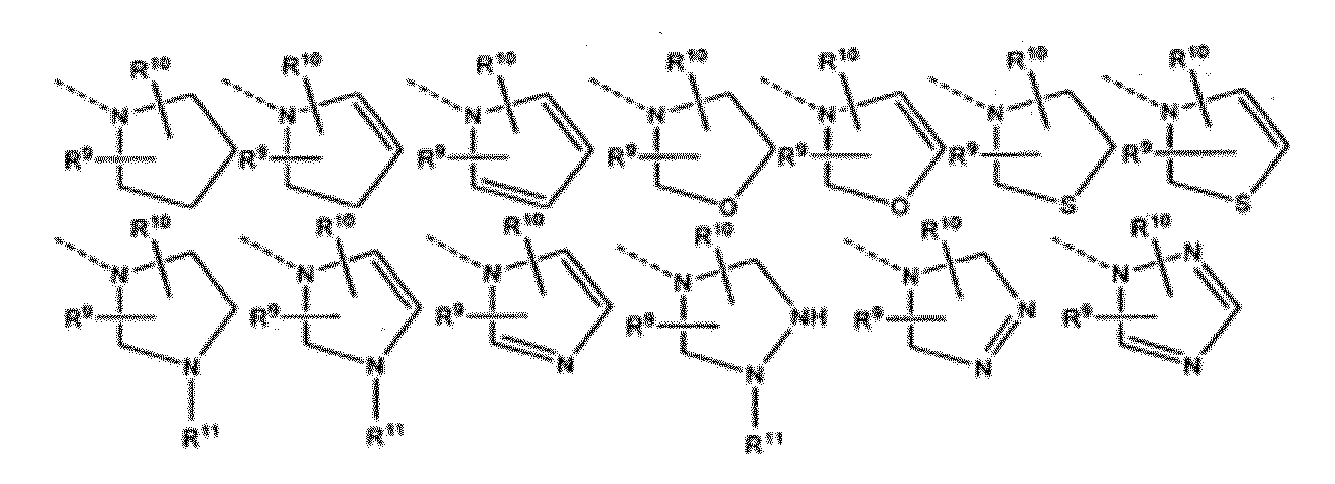


R3 représente un atome d'hydrogène ; un groupe alkyle en C1 à C6 non ramifié ou ramifié, substitué avec des substituants indépendamment sélectionnés dans le groupe constitué par F, Cl, Br, I, NH2, SH, OH, ou CF3 ; un groupe cycloalkyle saturé ou insaturé qui est facultativement au moins mono-substitué par des substituants indépendamment sélectionnés dans le groupe constitué par F, Cl, Br, I, NH2, SH, OH, ou CF3 ; un groupe aryle qui est facultativement au moins mono-substitué par des substituants indépendamment sélectionnés dans le groupe constitué par F, Cl, Br, I, NH2, SH, OH, ou CF3 ; un groupe hétérocyclyle qui est facultativement au moins mono-substitué par des substituants indépendamment sélectionnés dans le groupe constitué par F, Cl, Br, I, NH2, SH, OH, ou CF3 ; un groupe alkylcycloalkyle ramifié ou non ramifié dans lequel le groupe cycloalkyle est facultativement au moins mono-substitué par des substituants indépendamment sélectionnés dans le groupe constitué par F, Cl, Br, I, NH2, SH, OH, ou CF3 ; un groupe alkylaryle ramifié ou non ramifié qui est facultativement au moins mono-substitué par des substituants indépendamment sélectionnés dans le groupe constitué par F, Cl, Br, I, NH2, SH, OH, ou CF3 ; un groupe alkylhétérocyclyle ramifié ou non ramifié group qui est facultativement au moins mono-substitué par des substituants indépendamment sélectionnés dans le groupe constitué par F, Cl, Br, I, NH2, SH, OH, ou CF3 ;
R4 et R5, identiques ou différents, représentent un atome d'hydrogène ; F ; Cl ; Br ; I ; CF3 ; OH ; CN ; un groupe alkyle en C1 à C6 non ramifié ou ramifié, substitué avec des substituants indépendamment sélectionnés dans le groupe constitué par F, Cl, Br, I, NH2, SH, OH, ou CF3 ; un groupe alcoxy en C1 à C6 facultativement au moins mono-substitué ; un groupe cycloalkyle saturé ou insaturé qui est facultativement au moins mono-substitué par des substituants indépendamment sélectionnés dans le groupe constitué par F, Cl, Br, I, NH2, SH, OH, ou CF3 ; un groupe aryle qui est facultativement au moins mono-substitué par des substituants indépendamment sélectionnés dans le groupe constitué par F, Cl, Br, I, NH2, SH, OH, ou CF3 ; un groupe hétérocyclyle qui est facultativement au moins mono-substitué par des substituants indépendamment sélectionnés dans le groupe constitué par F, Cl, Br, I, NH2, SH, OH, ou CF3 ; un groupe alkylcycloalkyle ramifié ou non ramifié dans lequel le groupe cycloalkyle est facultativement au moins mono-substitué par des substituants indépendamment sélectionnés dans le groupe constitué par F, Cl, Br, I, NH2, SH, OH, ou CF3 ; un groupe alkylaryle ramifié ou non ramifié qui est facultativement au moins mono-substitué par des substituants indépendamment sélectionnés dans le groupe constitué par F, Cl, Br, I, NH2, SH, OH, ou CF3 ; un groupe alkylhétérocyclyle ramifié ou non ramifié group qui est facultativement au moins mono-substitué par des substituants indépendamment sélectionnés dans le groupe constitué par F, Cl, Br, I, NH2, SH, OH, ou CF3 ;
R6 représente un atome d'hydrogène ; F ; Cl ; Br ; I ; CF3 ; OH ; CN ; un groupe alkyle en C1 à C6 non ramifié ou ramifié, substitué avec des substituants indépendamment sélectionnés dans le groupe constitué par F, Cl, Br, I, NH2, SH, OH, ou CF3 ; un groupe alcoxy en C1 à C6 facultativement au moins mono-substitué ; un groupe cycloalkyle saturé ou insaturé qui est facultativement au moins mono-substitué par des substituants indépendamment sélectionnés dans le groupe constitué par F, Cl, Br, I, NH2, SH, OH ou CF3 ; un groupe aryle qui est facultativement au moins mono-substitué par des substituants indépendamment sélectionnés dans le groupe constitué par F, Cl, Br, I, NH2, SH, OH ou CF3 ; un groupe hétérocyclyle qui est facultativement au moins mono-substitué par des substituants indépendamment sélectionnés dans le groupe constitué par F, Cl, Br, I, NH2, SH, OH ou CF3 ; un groupe alkylcycloalkyle ramifié ou non ramifié dans lequel le groupe cycloalkyle est facultativement au moins mono-substitué par des substituants indépendamment sélectionnés dans le groupe constitué par F, Cl, Br, I, NH2, SH, OH ou CF3 ; un groupe alkylaryle ramifié ou non ramifié qui est facultativement au moins mono-substitué par des substituants indépendamment sélectionnés dans le groupe constitué par F, Cl, Br, I, NH2, SH, OH ou CF3 ; un groupe alkylhétérocyclyle ramifié ou non ramifié group qui est facultativement au moins mono-substitué par des substituants indépendamment sélectionnés dans le groupe constitué par F, Cl, Br, I, NH2, SH, OH ou CF3 ;
R7 représente un atome d'hydrogène ; F ; Cl ; Br ; I ; CF3 ; OH ; CN ; un radical aliphatique facultativement au moins mono-substitué, saturé ou insaturé, linéaire ou ramifié ; un groupe alcoxy en C1 à C6 facultativement au moins mono-substitué ; un groupe cycloalkyle facultativement au moins mono-substitué ; un groupe aryle facultativement au moins mono-substitué ; un groupe hétérocyclyle facultativement au moins mono-substitué ; un groupe alkylcycloalkyle facultativement au moins mono-substitué, saturé ou insaturé, ramifié ou non ramifié ; un groupe alkylaryle facultativement au moins mono-substitué, saturé, ramifié ou non ramifié ; un groupe alkylhétérocyclyle facultativement au moins mono-substitué, saturé, ramifié ou non ramifié ;
R8 représente un atome d'hydrogène ; F ; Cl ; Br ; I ; CF3 ; OH ; CN ; un radical aliphatique facultativement au moins mono-substitué, saturé ou insaturé, linéaire ou ramifié ; un groupe alcoxy en C1 à C6 facultativement au moins mono-substitué ; un groupe cycloalkyle facultativement au moins mono-substitué ; un groupe aryle facultativement au moins mono-substitué ; un groupe hétérocyclyle facultativement au moins mono-substitué ; un groupe alkylcycloalkyle facultativement au moins mono-substitué, saturé ou insaturé, ramifié ou non ramifié ; un groupe alkylaryle facultativement au moins mono-substitué, saturé, ramifié ou non ramifié ; un groupe alkylhétérocyclyle facultativement au moins mono-substitué, saturé, ramifié ou non ramifié ;
R9 et R10, identiques ou différents, représente un atome d'hydrogène ; un atome d'halogène ; un groupe OR7 ; un radical aliphatique facultativement au moins mono-substitué, saturé ou insaturé, linéaire ou ramifié ; un groupe cycloalkyle facultativement au moins mono-substitué ; un radical aryle facultativement au moins mono-substitué ; un groupe hétérocyclyle facultativement au moins mono-substitué ; un groupe alkylaryle facultativement au moins mono-substitué, linéaire ou ramifié ; un groupe alkylhétérocyclyle facultativement au moins mono-substitué, linéaire ou ramifié ; un groupe alkylcycloalkyle facultativement au moins mono-substitué, linéaire ou ramifié ;
ou
R9 et R10, se liant au même élément du cycle, forment ensemble avec cet élément du cycle un système de cycle mono- ou polycyclique facultativement au moins mono-substitué ;
ou
R9 et R10, se liant à différents éléments du cycle voisins ; forment ensemble avec ces éléments du cycle un système de cycle mono- ou polycyclique facultativement au moins mono-substitué ;
R11 représente un atome d'hydrogène ; un radical aliphatique facultativement au moins mono-substitué, saturé ou insaturé, linéaire ou ramifié ; un groupe cycloalkyle facultativement au moins mono-substitué ; un radical aryle facultativement au moins mono-substitué ; un groupe hétérocyclyle facultativement au moins mono-substitué ; un groupe alkylaryle facultativement au moins mono-substitué, linéaire ou ramifié ; un groupe alkylhétérocyclyle facultativement au moins mono-substitué, linéaire ou ramifié ; un groupe alkylcycloalkyle facultativement au moins mono-substitué, linéaire ou ramifié ;
facultativement sous la forme d'un des stéréoisomères, de préférences des énantiomères ou des diastéréoisomères, d'un racémate ou sous la forme d'un mélange d'au moins deux des stéréoisomères, de préférence des énantiomères et/ou des diastéréoisomères, selon un rapport de mélange quelconque, ou un sel correspondant de ceux-ci, ou un solvate correspondant de ceux-ci. - Composés selon l'une quelconque des revendications 1 à 3, caractérisés en ce que R1 et R2, identiques ou différents, représentent un atome d'hydrogène ; un groupe alkyle en C1 à C6 non ramifié ou ramifié, substitué avec des substituants indépendamment sélectionnés dans le groupe constitué par F, Cl, Br, I, NH2, SH, OH, ou CF3 ; un groupe cycloalkyle saturé ou insaturé qui est facultativement au moins mono-substitué par des substituants indépendamment sélectionnés dans le groupe constitué par F, Cl, Br, I, NH2, SH, OH, ou CF3 ; un groupe aryle qui est facultativement au moins mono-substitué par des substituants indépendamment sélectionnés dans le groupe constitué par F, Cl, Br, I, NH2, SH, OH, ou CF3 ; un groupe hétérocyclyle qui est facultativement au moins mono-substitué par des substituants indépendamment sélectionnés dans le groupe constitué par F, Cl, Br, I, NH2, SH, OH, ou CF3 ; un groupe alkylcycloalkyle ramifié ou non ramifié dans lequel le groupe cycloalkyle est facultativement au moins mono-substitué par des substituants indépendamment sélectionnés dans le groupe constitué par F, Cl, Br, I, NH2, SH, OH, ou CF3 ; un groupe alkylaryle ramifié ou non ramifié qui est facultativement au moins mono-substitué par des substituants indépendamment sélectionnés dans le groupe constitué par F, Cl, Br, I, NH2, SH, OH, ou CF3 ; un groupe alkylhétérocyclyle ramifié ou non ramifié qui est facultativement au moins mono-substitué par des substituants indépendamment sélectionnés dans le groupe constitué par F, Cl, Br, I, NH2, SH, OH, ou CF3 ;
ou
forment ensemble avec l'atome d'azote pontant un groupe hétérocyclyle contenant au moins un hétéroatome, au moins mono-substitué, au moins mono-cyclique, de préférence sélectionné dans le groupe constitué par :
R9 et R10, identiques ou différents, représentent un atome d'hydrogène ; un atome d'halogène ; OR7 ; un radical aliphatique facultativement au moins mono-substitué, saturé ou insaturé, linéaire ou ramifié ; un groupe cycloalkyle facultativement au moins mono-substitué ; un radical aryle facultativement au moins mono-substitué sélectionné dans le groupe constitué par un groupe phényle ou naphtyle ; un groupe hétérocyclyle facultativement au moins mono-substitué de préférence sélectionné dans le groupe constitué par :
ou
R9 et R10, se liant au même élément du cycle, forment ensemble avec cet élément du cycle un système de cycle spiro facultativement au moins mono-substitué qui est de préférence en position méta-, ortho- ou para- ;
ou
R9 et R10, se liant à différents éléments du cycle voisins ; forment ensemble avec ces éléments du cycle un système de cycle mono- ou polycyclique facultativement au moins mono-substitué. - Composés selon l'une quelconque des revendications 1 à 4, caractérisés en ce que R1 et R2 forment ensemble avec l'atome d'azote pontant un groupe hétérocyclyle contenant au moins un hétéroatome, au moins mono-substitué, au moins mono-cyclique sélectionné dans le groupe constitué par :

caractérisés en ce que R9 et R10 forment ensemble avec l'atome d'azote pontant un composé spiro au moins mono-substitué, qui est qui est facultativement oxo-substitué et/ou se lie facultativement à différents éléments du cycle voisins ; forment ensemble avec ces éléments du cycle un système de cycle mono- ou polycyclique facultativement au moins mono-substitué. - Composés selon l'une quelconque des revendications 1 à 5, caractérisés en ce que R9 et R10 sont en position para-, méta- ou ortho-.
- Composés selon l'une quelconque des revendications 1 à 6, caractérisés en ce que m est sélectionné parmi 0 ou 1, de préférence 1.
- Composés selon l'une quelconque des revendications 1 à 4, caractérisés en ce que
A représente un groupe NR3 ;
m est sélectionné parmi 1 ;
n est sélectionné parmi 1, 2 ;
la ligne pointillée ------ représente une liaison simple ;
R1 et R2, identiques ou différents, représentent un atome d'hydrogène ; un groupe alkyle en C1 à C6 substitué, non ramifié ou ramifié sélectionné dans le groupe constitué par le groupes méthyle, éthyle, propyle, butyle, avec des substituants indépendamment sélectionnés dans le groupe constitué par F, Cl, Br, I, NH2, SH, OH ou CF3 ; un groupe alkylaryle ramifié ou non ramifié, de préférence un groupe benzyle ou phénéthyle, qui est facultativement au moins mono-substitué par des substituants indépendamment sélectionnés dans le groupe constitué par F, Cl, Br, I, NH2, SH, OH ou CF3 ;
ou
forment ensemble avec l'atome d'azote pontant un groupe hétérocyclique ou un groupe hétérocyclyle sélectionné dans le groupe constitué par :
R4 et R5, identiques ou différents, représentent un atome d'hydrogène ; F ; Cl ; Br ; I ; CF3 ; OH ; CN ; les groupes méthyle, éthyle, propyle, phényle, benzyle, phénéthyle, cyclopentyle, cyclohexyle, méthoxy, éthoxy, qui sont facultativement au moins mono-substitués par des substituants indépendamment sélectionnés dans le groupe constitué par F, Cl, Br, I, NH2, SH, OH ou CF3 ;
R6 représente un atome d'hydrogène ; F ; Cl ; Br ; I ; CF3 ; OH ; CN ; les groupes méthyle, éthyle, propyle, phényle, benzyle, phénéthyle, cyclopentyle, cyclohexyle, méthoxy, éthoxy, qui sont facultativement au moins mono-substitués par des substituants indépendamment sélectionnés dans le groupe constitué par F, Cl, Br, I, NH2, SH, OH ou CF3 ;
R8 représente un atome d'hydrogène ; F ; Cl ; Br ; I ; CF3 ; OH ; CN ; les groupes méthyle, éthyle, propyle, phényle, benzyle, phénéthyle, cyclopentyle, cyclohexyle, méthoxy, éthoxy, qui sont facultativement au moins mono-substitués par des substituants indépendamment sélectionnés dans le groupe constitué par F, Cl, Br, I, NH2, SH, OH ou CF3 ;
R9 et R10, identiques ou différents, sont indépendamment sélectionnés dans le groupe constitué par : un atome d'hydrogène, OH, F, Cl, Br, I, CN, NH2, CF3, 0-méthyle, 0-éthyle, O-propyle, O-butyle, S-méthyle, S-éthyle, S-propyle, O-CH3, alkyle en C1 à C4, (CO)-O-méthyle, CO2H ; un groupe benzyle facultativement au moins mono-substitué par des substituants en position ortho-, méta- ou para-, indépendamment sélectionnés parmi OH, F, Cl, Br, I, CN, NH2, CF3, 0-méthyle, 0-éthyle, O-propyle, 0-butyle, S-méthyle, S-éthyle, S-propyle, O-CH3, alkyle en C1 à C4, (CO)-O-méthyle, CO2H ; un groupe phényle facultativement au moins mono-substitué par des substituants en position ortho-, méta- ou para-, indépendamment sélectionnés parmi OH, F, Cl, Br, I, CN, NH2, CF3, 0-méthyle, 0-éthyle, O-propyle, 0-butyle, S-méthyle, S-éthyle, S-propyle, O-CH3, alkyle en C1 à C4, (CO)-O-méthyle, CO2H ; un groupe naphtyle ; un groupe benzofurane ; un groupe benzoimidazole ; un groupe indole ; un groupe pyridine ;
facultativement sous la forme d'un des stéréoisomères, de préférences des énantiomères ou des diastéréoisomères, d'un racémate ou sous la forme d'un mélange d'au moins deux des stéréoisomères, de préférence des énantiomères et/ou des diastéréoisomères, selon un rapport de mélange quelconque, ou un sel correspondant de ceux-ci, ou un solvate correspondant de ceux-ci ;
ou caractérisés en ce que
A représente un groupe NR3 ;
m est sélectionné parmi 1 ;
n est sélectionné parmi 1, 2 ;
la ligne pointillée ------ représente une liaison simple ;
R1 et R2, identiques ou différents, représentent un atome d'hydrogène ; un groupe alkyle en C1 à C6 substitué, non ramifié ou ramifié sélectionné dans le groupe constitué par les groupes méthyle, éthyle, propyle, butyle, avec des substituants indépendamment sélectionnés dans le groupe constitué par F, Cl, Br, I, NH2, SH, OH ou CF3 ; un groupe alkylaryle ramifié ou non ramifié, de préférence un groupe benzyle ou phénéthyle, qui est facultativement au moins mono-substitué par des substituants indépendamment sélectionnés dans le groupe constitué par F, Cl, Br, I, NH2, SH, OH ou CF3 ;
ou
forment ensemble avec l'atome d'azote pontant un groupe hétérocyclique de préférence sélectionné dans le groupe constitué par :
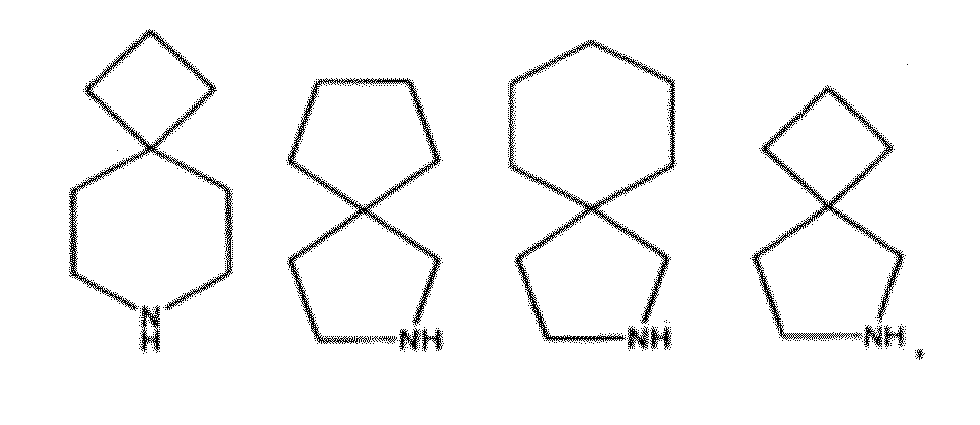
R3 représente un atome d'hydrogène ; les groupes méthyle, éthyle, propyle, phényle, benzyle, phénéthyle, cyclopentyle, cyclohexyle, qui sont facultativement au moins mono-substitués par des substituants indépendamment sélectionnés dans le groupe constitué par F, Cl, Br, I, NH2, SH, OH ou CF3 ;
R4 et R5, identiques ou différents, représentent un atome d'hydrogène ; F ; Cl ; Br ; I ; CF3 ; OH ; CN ; les groupes méthyle, éthyle, propyle, phényle, benzyle, phénéthyle, cyclopentyle, cyclohexyle, méthoxy, éthoxy, qui sont facultativement au moins mono-substitués par des substituants indépendamment sélectionnés dans le groupe constitué par F, Cl, Br, I, NH2, SH, OH ou CF3 ;
R6 représente un atome d'hydrogène ; F ; Cl ; Br ; I ; CF3 ; OH ; CN ; les groupes méthyle, éthyle, propyle, phényle, benzyle, phénéthyle, cyclopentyle, cyclohexyle, méthoxy, éthoxy, qui sont facultativement au moins mono-substitués par des substituants indépendamment sélectionnés dans le groupe constitué par F, Cl, Br, I, NH2, SH, OH ou CF3 ;
R8 représente un atome d'hydrogène ; F ; Cl ; Br ; I ; CF3 ; OH ; CN ; les groupes méthyle, éthyle, propyle, phényle, benzyle, phénéthyle, cyclopentyle, cyclohexyle, méthoxy, éthoxy, qui sont facultativement au moins mono-substitués par des substituants indépendamment sélectionnés dans le groupe constitué par F, Cl, Br, I, NH2, SH, OH ou CF3 ;
R9 et R10, identiques ou différents, sont indépendamment sélectionnés dans le groupe constitué par : un atome d'hydrogène, OH, F, Cl, Br, I, CN, NH2, CF3, 0-méthyle, 0-éthyle, O-propyle, O-butyle, S-méthyle, S-éthyle, S-propyle, O-CH3, alkyle en C1 à C4, (CO)-O-méthyle, CO2H ; un groupe benzyle facultativement au moins mono-substitué par des substituants en position ortho-, méta- ou para-, indépendamment sélectionnés parmi OH, F, Cl, Br, I, CN, NH2, CF3, 0-méthyle, 0-éthyle, O-propyle, 0-butyle, S-méthyle, S-éthyle, S-propyle, O-CH3, alkyle en C1 à C4, (CO)-O-méthyle, CO2H ; un groupe phényle facultativement au moins mono-substitué par des substituants en position ortho-, méta- ou para-, indépendamment sélectionnés parmi OH, F, Cl, Br, I, CN, NH2, CF3, 0-méthyle, 0-éthyle, O-propyle, 0-butyle, S-méthyle, S-éthyle, S-propyle, O-CH3, alkyle en C1 à C4, (CO)-O-méthyle, CO2H ; un groupe naphtyle ; un groupe benzofurane ; un groupe benzoimidazole ; un groupe indole ; un groupe pyridine ;
facultativement sous la forme d'un des stéréoisomères, de préférences des énantiomères ou des diastéréoisomères, d'un racémate ou sous la forme d'un mélange d'au moins deux des stéréoisomères, de préférence des énantiomères et/ou des diastéréoisomères, selon un rapport de mélange quelconque, ou un sel correspondant de ceux-ci, ou un solvate correspondant de ceux-ci. - Composés selon l'une quelconque des revendications 1 à 4, caractérisés en ce que
A représente un groupe NR3 ;
m est sélectionné parmi 1 ;
n est sélectionné parmi 1, 2 ;
la ligne pointillée ------ représente une liaison simple ;
R1 et R2, identiques ou différents, représentent un atome d'hydrogène ; un groupe alkyle en C1 à C6 substitué, non ramifié ou ramifié sélectionné dans le groupe constitué par les groupes méthyle, éthyle, propyle, butyle, avec des substituants indépendamment sélectionnés dans le groupe constitué par F, Cl, Br, I, NH2, SH, OH ou CF3 ; un groupe alkylaryle ramifié ou non ramifié, de préférence un groupe benzyle ou phénéthyle, qui est facultativement au moins mono-substitué par des substituants indépendamment sélectionnés dans le groupe constitué par F, Cl, Br, I, NH2, SH, OH, ou CF3 ;
ou
forment ensemble avec l'atome d'azote pontant un groupe hétérocyclique ou un groupe hétérocyclyle sélectionné dans le groupe constitué par :
R4 et R5, identiques ou différents, représentent un atome d'hydrogène ;
R6 représente un atome d'hydrogène ;
R8 représente un atome d'hydrogène ;
R9 et R10 identiques ou différents, sont indépendamment sélectionnés dans le groupe constitué par : un atome d'hydrogène, OH, F, Cl, Br, I, CN, NH2, CF3, 0-méthyle, 0-éthyle, O-propyle, O-butyle, S-méthyle, S-éthyle, S-propyle, O-CH3, alkyle en C1 à C4, (CO)-O-méthyle, CO2H ; un groupe benzyle facultativement au moins mono-substitué par des substituants en position ortho-, méta- ou para-, indépendamment sélectionnés parmi OH, F, Cl, Br, I, CN, NH2, CF3, 0-méthyle, 0-éthyle, O-propyle, 0-butyle, S-méthyle, S-éthyle, S-propyle, O-CH3, alkyle en C1 à C4, (CO)-O-méthyle, CO2H ; un groupe phényle facultativement au moins mono-substitué par des substituants en position ortho-, méta- ou para-, indépendamment sélectionnés parmi OH, F, Cl, Br, I, CN, NH2, CF3, 0-méthyle, 0-éthyle, O-propyle, 0-butyle, S-méthyle, S-éthyle, S-propyle, O-CH3, alkyle en C1 à C4, (CO)-O-méthyle, CO2H ; un groupe naphtyle ; un groupe benzofurane ; un groupe benzoimidazole ; un groupe indole ; un groupe pyridine ;
facultativement sous la forme d'un des stéréoisomères, de préférences des énantiomères ou des diastéréoisomères, d'un racémate ou sous la forme d'un mélange d'au moins deux des stéréoisomères, de préférence des énantiomères et/ou des diastéréoisomères, selon un rapport de mélange quelconque, ou un sel correspondant de ceux-ci, ou un solvate correspondant de ceux-ci. - Composés selon l'une quelconque des revendications 1 à 4, caractérisés en ce que
A représente un groupe NR3 ;
m est sélectionné parmi 1 ;
n est sélectionné parmi 1, 2 ;
la ligne pointillée ------ représente une liaison simple ;
R1 et R2, identiques ou différents, représentent un atome d'hydrogène ; un groupe alkyle en C1 à C6 substitué, non ramifié ou ramifié sélectionné dans le groupe constitué par les groupes méthyle, éthyle, propyle, butyle, avec des substituants indépendamment sélectionnés dans le groupe constitué par F, Cl, Br, I, NH2, SH, OH ou CF3 ; un groupe alkylaryle ramifié ou non ramifié, de préférence un groupe benzyle ou phénéthyle, qui est facultativement au moins mono-substitué par des substituants indépendamment sélectionnés dans le groupe constitué par F, Cl, Br, I, NH2, SH, OH, ou CF3 ;
ou
forment ensemble avec l'atome d'azote pontant un groupe hétérocyclique ou un groupe hétérocyclyle sélectionné dans le groupe constitué par :
R4 et R5, identiques ou différents, représentent un atome d'hydrogène ;
R6 représente un atome d'hydrogène ;
R8 représente un atome d'hydrogène ;
R9 et R10 identiques ou différents, sont indépendamment sélectionnés dans le groupe constitué par : un atome d'hydrogène, OH, F, Cl, Br, I, CN, NH2, CF3, 0-méthyle, 0-éthyle, O-propyle, O-butyle, S-méthyle, S-éthyle, S-propyle, O-CH3, alkyle en C1 à C4, (CO)-O-méthyle, CO2H ; un groupe benzyle facultativement au moins mono-substitué par des substituants en position ortho-, méta- ou para-, indépendamment sélectionnés parmi OH, F, Cl, Br, I, CN, NH2, CF3, 0-méthyle, 0-éthyle, O-propyle, 0-butyle, S-méthyle, S-éthyle, S-propyle, O-CH3, alkyle en C1 à C4, (CO)-O-méthyle, CO2H ; un groupe phényle facultativement au moins mono-substitué par des substituants en position ortho-, méta- ou para-, indépendamment sélectionnés parmi OH, F, Cl, Br, I, CN, NH2, CF3, 0-méthyle, 0-éthyle, O-propyle, 0-butyle, S-méthyle, S-éthyle, S-propyle, O-CH3, alkyle en C1 à C4, (CO)-O-méthyle, CO2H ; un groupe naphtyle ; un groupe benzofurane ; un groupe benzoimidazole ; un groupe indole ; un groupe pyridine ;
facultativement sous la forme d'un des stéréoisomères, de préférences des énantiomères ou des diastéréoisomères, d'un racémate ou sous la forme d'un mélange d'au moins deux des stéréoisomères, de préférence des énantiomères et/ou des diastéréoisomères, selon un rapport de mélange quelconque, ou un sel correspondant de ceux-ci, ou un solvate correspondant de ceux-ci. - Composés selon l'une quelconque des revendications 1 à 4, caractérisés en ce que les composés sont sélectionnés dans le groupe constitué par :◆ oxalate de N-benzyl-N-méthyl-2-(1-méthyl-4,5,6,7-tétrahydro-1H-indol-4-yl)éthanamine,◆ oxalate de 4-(4-chlorophényl)-1-(2-(1-méthyl-4,5,6,7-tétrahydro-1H-indol-4-yl)éthyl)pipéridin-4-ol,◆ oxalate de 1-méthyl-4-(2-(4-phénylpipéridin-1-yl)éthyl)-4,5,6,7-tétrahydro-1H-indole,◆ N-benzyl-N-méthyl-2-(1-méthyl-4,5,6,7-tétrahydro-1H-indol-4-yl)éthanamine,◆ 4-(4-chlorophényl)-1-(2-(1-méthyl-4,5,6,7-tétrahydro-1H-indol-4-yl)éthyl)pipéridin-4-ol,◆ 1-méthyl-4-(2-(4-phénylpipéridin-1-yl)éthyl)-4,5,6,7-tétrahydro-1H-indole,facultativement sous la forme d'un des stéréoisomères, de préférences des énantiomères ou des diastéréoisomères, d'un racémate ou sous la forme d'un mélange d'au moins deux des stéréoisomères, de préférence des énantiomères et/ou des diastéréoisomères, selon un rapport de mélange quelconque, ou un autre sel correspondant de ceux-ci, ou un solvate correspondant de ceux-ci.
- Procédé de préparation des composés de formule (I) par couplage des composés de formule générale (II),
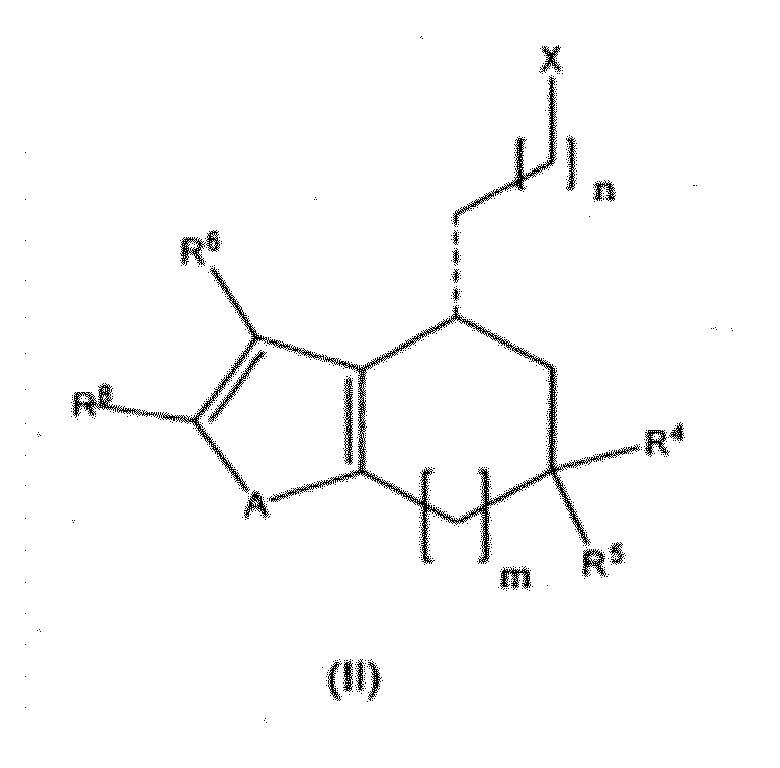
HNR1R2 (III)
dans laquelle R1 et R2 ont la signification selon la revendication 1. - Médicament comprenant au moins un composé de formule générale (I) selon l'une quelconque des revendications 1 à 11, ledit composé étant facultativement sous la forme d'un des stéréoisomères, de préférences des énantiomères ou des diastéréoisomères, d'un racémate ou sous la forme d'un mélange d'au moins deux des stéréoisomères, de préférence des énantiomères et/ou des diastéréoisomères, selon un rapport de mélange quelconque, ou un sel correspondant de celui-ci, ou un solvate correspondant de celui-ci.
- Utilisation d'un composé de formule générale (I) selon l'une quelconque des revendications 1 à 11, dans la fabrication d'un médicament destiné au traitement ou à la prophylaxie d'une maladie ou d'une pathologie médiée par le récepteur sigma.
- Utilisation selon la revendication 14, caractérisée en ce que la maladie comprend la diarrhée, les troubles liés aux lipoprotéines, la migraine, l'obésité, les taux élevés de triglycérides, la chylomicronémie, la dysbêtalipoprotéinémie, l'hyperlipoprotéinémie, l'hyperlipidémie, l'hyperlipidémie mixte, l'hypercholestérolémie, les troubles liés aux lipoprotéines, l'hypertriglycéridémie, l'hypertriglycéridémie sporadique, l'hypertriglycéridémie et la dysbêtalipoprotéinémie héréditaires, l'arthrite, l'hypertension, l'arythmie, l'ulcère, les déficits de l'apprentissage, de la mémoire et de l'attention, les troubles de la cognition, les maladies neurodégénératives, les maladies démyélinisantes, la dépendance aux drogues et aux substances chimiques, y compris la cocaïne, les amphétamines, l'éthanol et la nicotine ; la dyskinésie tardive, l'accident vasculaire cérébral ischémique, l'épilepsie, l'accident vasculaire cérébral, le stress, le cancer ou des pathologies psychotiques, en particulier la dépression, l'anxiété ou la schizophrénie ; une inflammation ou des maladies auto-immunes ; ou caractérisée en ce que la maladie comprend la douleur, de préférence la douleur neuropathique, la douleur inflammatoire ou d'autres douleurs impliquant l'allodynie et/ou l'hyperalgésie.
Priority Applications (1)
| Application Number | Priority Date | Filing Date | Title |
|---|---|---|---|
| EP07723020.9A EP1996548B1 (fr) | 2006-03-02 | 2007-03-02 | Ligands du récepteur sigma |
Applications Claiming Priority (3)
| Application Number | Priority Date | Filing Date | Title |
|---|---|---|---|
| EP06004287A EP1829862A1 (fr) | 2006-03-02 | 2006-03-02 | Ligands du récepteur sigma |
| EP07723020.9A EP1996548B1 (fr) | 2006-03-02 | 2007-03-02 | Ligands du récepteur sigma |
| PCT/EP2007/001825 WO2007098962A1 (fr) | 2006-03-02 | 2007-03-02 | Composes agissant sur le recepteur sigma |
Publications (2)
| Publication Number | Publication Date |
|---|---|
| EP1996548A1 EP1996548A1 (fr) | 2008-12-03 |
| EP1996548B1 true EP1996548B1 (fr) | 2016-01-06 |
Family
ID=36676212
Family Applications (2)
| Application Number | Title | Priority Date | Filing Date |
|---|---|---|---|
| EP06004287A Withdrawn EP1829862A1 (fr) | 2006-03-02 | 2006-03-02 | Ligands du récepteur sigma |
| EP07723020.9A Not-in-force EP1996548B1 (fr) | 2006-03-02 | 2007-03-02 | Ligands du récepteur sigma |
Family Applications Before (1)
| Application Number | Title | Priority Date | Filing Date |
|---|---|---|---|
| EP06004287A Withdrawn EP1829862A1 (fr) | 2006-03-02 | 2006-03-02 | Ligands du récepteur sigma |
Country Status (8)
| Country | Link |
|---|---|
| US (1) | US8481567B2 (fr) |
| EP (2) | EP1829862A1 (fr) |
| JP (1) | JP2009528316A (fr) |
| CN (1) | CN101395133A (fr) |
| CA (1) | CA2641145A1 (fr) |
| ES (1) | ES2564418T3 (fr) |
| MX (1) | MX2008011017A (fr) |
| WO (1) | WO2007098962A1 (fr) |
Families Citing this family (1)
| Publication number | Priority date | Publication date | Assignee | Title |
|---|---|---|---|---|
| CN116323581B (zh) * | 2020-09-22 | 2025-05-30 | 苏州恩华生物医药科技有限公司 | 吲哚衍生物及其应用 |
Family Cites Families (3)
| Publication number | Priority date | Publication date | Assignee | Title |
|---|---|---|---|---|
| DE19943508A1 (de) * | 1999-09-10 | 2001-03-15 | Morphochem Ag | 3-Vinylpyrol-Derivate, Verfahren zu ihrer Herstellung sowie ihre Verwendung als Arzneimittel |
| WO2002055517A2 (fr) * | 2000-12-20 | 2002-07-18 | Jingrong Cui | Indolinones 4-aryl substituees |
| EP1634873A1 (fr) * | 2004-08-27 | 2006-03-15 | Laboratorios Del Dr. Esteve, S.A. | Inhibiteurs des récepteurs sigma |
-
2006
- 2006-03-02 EP EP06004287A patent/EP1829862A1/fr not_active Withdrawn
-
2007
- 2007-03-02 MX MX2008011017A patent/MX2008011017A/es not_active Application Discontinuation
- 2007-03-02 ES ES07723020.9T patent/ES2564418T3/es active Active
- 2007-03-02 JP JP2008556724A patent/JP2009528316A/ja not_active Withdrawn
- 2007-03-02 EP EP07723020.9A patent/EP1996548B1/fr not_active Not-in-force
- 2007-03-02 US US12/281,300 patent/US8481567B2/en not_active Expired - Fee Related
- 2007-03-02 WO PCT/EP2007/001825 patent/WO2007098962A1/fr not_active Ceased
- 2007-03-02 CN CNA2007800074817A patent/CN101395133A/zh active Pending
- 2007-03-02 CA CA002641145A patent/CA2641145A1/fr not_active Abandoned
Also Published As
| Publication number | Publication date |
|---|---|
| JP2009528316A (ja) | 2009-08-06 |
| MX2008011017A (es) | 2008-09-08 |
| US8481567B2 (en) | 2013-07-09 |
| CA2641145A1 (fr) | 2007-09-07 |
| EP1829862A1 (fr) | 2007-09-05 |
| US20090197915A1 (en) | 2009-08-06 |
| EP1996548A1 (fr) | 2008-12-03 |
| WO2007098962A1 (fr) | 2007-09-07 |
| ES2564418T3 (es) | 2016-03-22 |
| CN101395133A (zh) | 2009-03-25 |
Similar Documents
| Publication | Publication Date | Title |
|---|---|---|
| US8492563B2 (en) | 4,5,6,7-tetrahydrobenzo[B]thiophene derivatives and their use as sigma receptor ligands | |
| US20100184759A1 (en) | Pyrano-pyrazole-amines | |
| EP1996580B1 (fr) | Dérivés du pyrazole antagonistes des récepteurs sigma | |
| EP2020414A1 (fr) | Derivés spiro[piperidine-4,4'-thieno[3,2-c]pyran] et composés similaires en tant que inhibiteurs du recepteur sigma pour le traitement de pyschose | |
| EP2941424B1 (fr) | Dérivés de 1,2,3-triazole-4-amine pour le traitement de maladies et de troubles associés au récepteur sigma | |
| US9271959B2 (en) | Bicyclic tetrahydropyrrole compounds | |
| EP2029536B1 (fr) | Composés bicycliques de tétrahydropyrrole | |
| EP1996548B1 (fr) | Ligands du récepteur sigma | |
| US20090306403A1 (en) | Production Process for Bicyclic Tetrahydropyrrole Compounds | |
| EP1829867A1 (fr) | Composés d'imidazole ayant une acitivité pharmaceutique vis-à-vis le recepteur sigma | |
| EP1849771A1 (fr) | Derives bicyclic de Tetrahydopyrrole | |
| HK1216641B (en) | 1,2,3-triazole-4-amine derivatives for the treatment of sigma receptor related diseases and disorders |
Legal Events
| Date | Code | Title | Description |
|---|---|---|---|
| PUAI | Public reference made under article 153(3) epc to a published international application that has entered the european phase |
Free format text: ORIGINAL CODE: 0009012 |
|
| 17P | Request for examination filed |
Effective date: 20080923 |
|
| AK | Designated contracting states |
Kind code of ref document: A1 Designated state(s): AT BE BG CH CY CZ DE DK EE ES FI FR GB GR HU IE IS IT LI LT LU LV MC MT NL PL PT RO SE SI SK TR |
|
| DAX | Request for extension of the european patent (deleted) | ||
| 17Q | First examination report despatched |
Effective date: 20090204 |
|
| REG | Reference to a national code |
Ref country code: HK Ref legal event code: DE Ref document number: 1124053 Country of ref document: HK |
|
| GRAP | Despatch of communication of intention to grant a patent |
Free format text: ORIGINAL CODE: EPIDOSNIGR1 |
|
| INTG | Intention to grant announced |
Effective date: 20150715 |
|
| REG | Reference to a national code |
Ref country code: HK Ref legal event code: WD Ref document number: 1124053 Country of ref document: HK |
|
| GRAS | Grant fee paid |
Free format text: ORIGINAL CODE: EPIDOSNIGR3 |
|
| GRAA | (expected) grant |
Free format text: ORIGINAL CODE: 0009210 |
|
| AK | Designated contracting states |
Kind code of ref document: B1 Designated state(s): AT BE BG CH CY CZ DE DK EE ES FI FR GB GR HU IE IS IT LI LT LU LV MC MT NL PL PT RO SE SI SK TR |
|
| REG | Reference to a national code |
Ref country code: GB Ref legal event code: FG4D |
|
| REG | Reference to a national code |
Ref country code: CH Ref legal event code: EP |
|
| REG | Reference to a national code |
Ref country code: IE Ref legal event code: FG4D |
|
| REG | Reference to a national code |
Ref country code: AT Ref legal event code: REF Ref document number: 768724 Country of ref document: AT Kind code of ref document: T Effective date: 20160215 |
|
| REG | Reference to a national code |
Ref country code: DE Ref legal event code: R096 Ref document number: 602007044451 Country of ref document: DE |
|
| REG | Reference to a national code |
Ref country code: ES Ref legal event code: FG2A Ref document number: 2564418 Country of ref document: ES Kind code of ref document: T3 Effective date: 20160322 Ref country code: FR Ref legal event code: PLFP Year of fee payment: 10 |
|
| REG | Reference to a national code |
Ref country code: LT Ref legal event code: MG4D |
|
| REG | Reference to a national code |
Ref country code: NL Ref legal event code: MP Effective date: 20160106 |
|
| REG | Reference to a national code |
Ref country code: AT Ref legal event code: MK05 Ref document number: 768724 Country of ref document: AT Kind code of ref document: T Effective date: 20160106 |
|
| PG25 | Lapsed in a contracting state [announced via postgrant information from national office to epo] |
Ref country code: NL Free format text: LAPSE BECAUSE OF FAILURE TO SUBMIT A TRANSLATION OF THE DESCRIPTION OR TO PAY THE FEE WITHIN THE PRESCRIBED TIME-LIMIT Effective date: 20160106 |
|
| PG25 | Lapsed in a contracting state [announced via postgrant information from national office to epo] |
Ref country code: GR Free format text: LAPSE BECAUSE OF FAILURE TO SUBMIT A TRANSLATION OF THE DESCRIPTION OR TO PAY THE FEE WITHIN THE PRESCRIBED TIME-LIMIT Effective date: 20160407 Ref country code: FI Free format text: LAPSE BECAUSE OF FAILURE TO SUBMIT A TRANSLATION OF THE DESCRIPTION OR TO PAY THE FEE WITHIN THE PRESCRIBED TIME-LIMIT Effective date: 20160106 |
|
| PG25 | Lapsed in a contracting state [announced via postgrant information from national office to epo] |
Ref country code: BE Free format text: LAPSE BECAUSE OF NON-PAYMENT OF DUE FEES Effective date: 20160331 Ref country code: IS Free format text: LAPSE BECAUSE OF FAILURE TO SUBMIT A TRANSLATION OF THE DESCRIPTION OR TO PAY THE FEE WITHIN THE PRESCRIBED TIME-LIMIT Effective date: 20160506 Ref country code: AT Free format text: LAPSE BECAUSE OF FAILURE TO SUBMIT A TRANSLATION OF THE DESCRIPTION OR TO PAY THE FEE WITHIN THE PRESCRIBED TIME-LIMIT Effective date: 20160106 Ref country code: LV Free format text: LAPSE BECAUSE OF FAILURE TO SUBMIT A TRANSLATION OF THE DESCRIPTION OR TO PAY THE FEE WITHIN THE PRESCRIBED TIME-LIMIT Effective date: 20160106 Ref country code: SE Free format text: LAPSE BECAUSE OF FAILURE TO SUBMIT A TRANSLATION OF THE DESCRIPTION OR TO PAY THE FEE WITHIN THE PRESCRIBED TIME-LIMIT Effective date: 20160106 Ref country code: LT Free format text: LAPSE BECAUSE OF FAILURE TO SUBMIT A TRANSLATION OF THE DESCRIPTION OR TO PAY THE FEE WITHIN THE PRESCRIBED TIME-LIMIT Effective date: 20160106 Ref country code: PT Free format text: LAPSE BECAUSE OF FAILURE TO SUBMIT A TRANSLATION OF THE DESCRIPTION OR TO PAY THE FEE WITHIN THE PRESCRIBED TIME-LIMIT Effective date: 20160506 Ref country code: PL Free format text: LAPSE BECAUSE OF FAILURE TO SUBMIT A TRANSLATION OF THE DESCRIPTION OR TO PAY THE FEE WITHIN THE PRESCRIBED TIME-LIMIT Effective date: 20160106 |
|
| REG | Reference to a national code |
Ref country code: DE Ref legal event code: R097 Ref document number: 602007044451 Country of ref document: DE |
|
| PG25 | Lapsed in a contracting state [announced via postgrant information from national office to epo] |
Ref country code: LU Free format text: LAPSE BECAUSE OF FAILURE TO SUBMIT A TRANSLATION OF THE DESCRIPTION OR TO PAY THE FEE WITHIN THE PRESCRIBED TIME-LIMIT Effective date: 20160302 Ref country code: MC Free format text: LAPSE BECAUSE OF FAILURE TO SUBMIT A TRANSLATION OF THE DESCRIPTION OR TO PAY THE FEE WITHIN THE PRESCRIBED TIME-LIMIT Effective date: 20160106 Ref country code: EE Free format text: LAPSE BECAUSE OF FAILURE TO SUBMIT A TRANSLATION OF THE DESCRIPTION OR TO PAY THE FEE WITHIN THE PRESCRIBED TIME-LIMIT Effective date: 20160106 Ref country code: DK Free format text: LAPSE BECAUSE OF FAILURE TO SUBMIT A TRANSLATION OF THE DESCRIPTION OR TO PAY THE FEE WITHIN THE PRESCRIBED TIME-LIMIT Effective date: 20160106 |
|
| REG | Reference to a national code |
Ref country code: CH Ref legal event code: PL |
|
| PLBE | No opposition filed within time limit |
Free format text: ORIGINAL CODE: 0009261 |
|
| STAA | Information on the status of an ep patent application or granted ep patent |
Free format text: STATUS: NO OPPOSITION FILED WITHIN TIME LIMIT |
|
| PG25 | Lapsed in a contracting state [announced via postgrant information from national office to epo] |
Ref country code: RO Free format text: LAPSE BECAUSE OF FAILURE TO SUBMIT A TRANSLATION OF THE DESCRIPTION OR TO PAY THE FEE WITHIN THE PRESCRIBED TIME-LIMIT Effective date: 20160106 Ref country code: SK Free format text: LAPSE BECAUSE OF FAILURE TO SUBMIT A TRANSLATION OF THE DESCRIPTION OR TO PAY THE FEE WITHIN THE PRESCRIBED TIME-LIMIT Effective date: 20160106 Ref country code: CZ Free format text: LAPSE BECAUSE OF FAILURE TO SUBMIT A TRANSLATION OF THE DESCRIPTION OR TO PAY THE FEE WITHIN THE PRESCRIBED TIME-LIMIT Effective date: 20160106 |
|
| 26N | No opposition filed |
Effective date: 20161007 |
|
| REG | Reference to a national code |
Ref country code: IE Ref legal event code: MM4A |
|
| PG25 | Lapsed in a contracting state [announced via postgrant information from national office to epo] |
Ref country code: BE Free format text: LAPSE BECAUSE OF FAILURE TO SUBMIT A TRANSLATION OF THE DESCRIPTION OR TO PAY THE FEE WITHIN THE PRESCRIBED TIME-LIMIT Effective date: 20160106 |
|
| PG25 | Lapsed in a contracting state [announced via postgrant information from national office to epo] |
Ref country code: CH Free format text: LAPSE BECAUSE OF NON-PAYMENT OF DUE FEES Effective date: 20160331 Ref country code: LI Free format text: LAPSE BECAUSE OF NON-PAYMENT OF DUE FEES Effective date: 20160331 Ref country code: IE Free format text: LAPSE BECAUSE OF NON-PAYMENT OF DUE FEES Effective date: 20160302 |
|
| PG25 | Lapsed in a contracting state [announced via postgrant information from national office to epo] |
Ref country code: SI Free format text: LAPSE BECAUSE OF FAILURE TO SUBMIT A TRANSLATION OF THE DESCRIPTION OR TO PAY THE FEE WITHIN THE PRESCRIBED TIME-LIMIT Effective date: 20160106 Ref country code: BG Free format text: LAPSE BECAUSE OF FAILURE TO SUBMIT A TRANSLATION OF THE DESCRIPTION OR TO PAY THE FEE WITHIN THE PRESCRIBED TIME-LIMIT Effective date: 20160406 |
|
| REG | Reference to a national code |
Ref country code: FR Ref legal event code: PLFP Year of fee payment: 11 |
|
| PG25 | Lapsed in a contracting state [announced via postgrant information from national office to epo] |
Ref country code: MT Free format text: LAPSE BECAUSE OF FAILURE TO SUBMIT A TRANSLATION OF THE DESCRIPTION OR TO PAY THE FEE WITHIN THE PRESCRIBED TIME-LIMIT Effective date: 20160106 |
|
| REG | Reference to a national code |
Ref country code: FR Ref legal event code: PLFP Year of fee payment: 12 |
|
| PGFP | Annual fee paid to national office [announced via postgrant information from national office to epo] |
Ref country code: DE Payment date: 20180326 Year of fee payment: 12 Ref country code: GB Payment date: 20180326 Year of fee payment: 12 |
|
| PG25 | Lapsed in a contracting state [announced via postgrant information from national office to epo] |
Ref country code: CY Free format text: LAPSE BECAUSE OF FAILURE TO SUBMIT A TRANSLATION OF THE DESCRIPTION OR TO PAY THE FEE WITHIN THE PRESCRIBED TIME-LIMIT Effective date: 20160106 Ref country code: HU Free format text: LAPSE BECAUSE OF FAILURE TO SUBMIT A TRANSLATION OF THE DESCRIPTION OR TO PAY THE FEE WITHIN THE PRESCRIBED TIME-LIMIT; INVALID AB INITIO Effective date: 20070302 |
|
| PGFP | Annual fee paid to national office [announced via postgrant information from national office to epo] |
Ref country code: IT Payment date: 20180322 Year of fee payment: 12 Ref country code: FR Payment date: 20180326 Year of fee payment: 12 |
|
| PG25 | Lapsed in a contracting state [announced via postgrant information from national office to epo] |
Ref country code: MT Free format text: LAPSE BECAUSE OF FAILURE TO SUBMIT A TRANSLATION OF THE DESCRIPTION OR TO PAY THE FEE WITHIN THE PRESCRIBED TIME-LIMIT Effective date: 20160331 Ref country code: TR Free format text: LAPSE BECAUSE OF FAILURE TO SUBMIT A TRANSLATION OF THE DESCRIPTION OR TO PAY THE FEE WITHIN THE PRESCRIBED TIME-LIMIT Effective date: 20160106 |
|
| REG | Reference to a national code |
Ref country code: ES Ref legal event code: PC2A Owner name: ESTEVE PHARMACEUTICALS, S.A. Effective date: 20181016 |
|
| REG | Reference to a national code |
Ref country code: DE Ref legal event code: R119 Ref document number: 602007044451 Country of ref document: DE |
|
| GBPC | Gb: european patent ceased through non-payment of renewal fee |
Effective date: 20190302 |
|
| PG25 | Lapsed in a contracting state [announced via postgrant information from national office to epo] |
Ref country code: GB Free format text: LAPSE BECAUSE OF NON-PAYMENT OF DUE FEES Effective date: 20190302 Ref country code: DE Free format text: LAPSE BECAUSE OF NON-PAYMENT OF DUE FEES Effective date: 20191001 |
|
| PG25 | Lapsed in a contracting state [announced via postgrant information from national office to epo] |
Ref country code: IT Free format text: LAPSE BECAUSE OF NON-PAYMENT OF DUE FEES Effective date: 20190302 Ref country code: FR Free format text: LAPSE BECAUSE OF NON-PAYMENT OF DUE FEES Effective date: 20190331 |
|
| PGFP | Annual fee paid to national office [announced via postgrant information from national office to epo] |
Ref country code: ES Payment date: 20200401 Year of fee payment: 14 |
|
| REG | Reference to a national code |
Ref country code: ES Ref legal event code: FD2A Effective date: 20220517 |
|
| PG25 | Lapsed in a contracting state [announced via postgrant information from national office to epo] |
Ref country code: ES Free format text: LAPSE BECAUSE OF NON-PAYMENT OF DUE FEES Effective date: 20210303 |