EP1996907B1 - Balance electronique - Google Patents
Balance electronique Download PDFInfo
- Publication number
- EP1996907B1 EP1996907B1 EP07711856.0A EP07711856A EP1996907B1 EP 1996907 B1 EP1996907 B1 EP 1996907B1 EP 07711856 A EP07711856 A EP 07711856A EP 1996907 B1 EP1996907 B1 EP 1996907B1
- Authority
- EP
- European Patent Office
- Prior art keywords
- parameter
- weighing machine
- parameters
- machine according
- profile
- Prior art date
- Legal status (The legal status is an assumption and is not a legal conclusion. Google has not performed a legal analysis and makes no representation as to the accuracy of the status listed.)
- Active
Links
Images
Classifications
-
- G—PHYSICS
- G01—MEASURING; TESTING
- G01G—WEIGHING
- G01G23/00—Auxiliary devices for weighing apparatus
- G01G23/18—Indicating devices, e.g. for remote indication; Recording devices; Scales, e.g. graduated
- G01G23/36—Indicating the weight by electrical means, e.g. using photoelectric cells
- G01G23/37—Indicating the weight by electrical means, e.g. using photoelectric cells involving digital counting
- G01G23/3707—Indicating the weight by electrical means, e.g. using photoelectric cells involving digital counting using a microprocessor
Definitions
- Electronic scales have an integrated computer that performs various tasks while operating the balance. On the one hand, it performs calculations that are necessary to determine a weighing result. This can be, for example, the application of predetermined rules to acquired measured values and / or compensation calculations, which are required, for example, to take account of environmental influences, such as the temperature.
- Another task of the integrated computer is to specify a schedule according to the desired application. Modern cars are capable of performing various applications, such as backweighing, counting, animal weighing, etc. For this purpose, often a plurality of measured values must be recorded in a predetermined sequence and stored and processed according to certain rules. The specification of such a procedure is carried out after determining the task to be performed by an operator by means of the integrated computer.
- a profile is referred to here as a parameter value set or a list of specific parameter values which can be jointly activated by calling an individual profile identifier, i. All parameter values stored in the profile are assigned to the corresponding parameters.
- Each stored profile comprises one value for each adjustable parameter.
- the storage requirement for storing a plurality of profiles is correspondingly high. This problem is aggravated when, for example, not only a profile is stored for each user of a balance, but each user saves a separate profile for each application he performs on the balance. However, this is necessary for convenient operation of the balance.
- each individual profile contains only those values that are assignable to the parameters of exactly one parameter group, and each parameter group the parameter values at least one profile are assignable.
- An advantageous group classification is, for example, a classification into an application profile, a user profile and a general device settings profile.
- the parameters associated with the application profile may be, for example, those that determine the flow, display, and calculation rules for particular applications, such as counting, back weighing, animal weighing, etc.
- Parameters associated with the user profile may be, for example, those relating to ergonomic settings of the scale, such as opening direction of a door, key assignment, graphic design of a display, etc.
- Parameters associated with the general device settings profile may be, for example, those that include the Affect interaction with a connected peripheral.
- An essential element of the invention is that the different parameter groups do not overlap each other, i. each parameter is uniquely assigned to a group. This makes it possible to define smaller, group-specific profiles. Such a profile according to the invention then only contains values which can only be assigned to one parameter group. On the other hand, the storage of at least one profile is provided according to the invention for each parameter group.
- the present invention also results in a reduction in the susceptibility to profile creation.
- the user is only confronted with those parameters that are related to the problem that is currently relevant to him. He is not in danger of influencing currently non-relevant parameters.
- a correction of a detected error is also greatly simplified by the present invention. Namely, unlike the prior art, a single error need not be corrected in all stored profiles, but only in those corresponding to the parameter group concerned.
- each parameter group typically also be assigned the values of exactly one profile, i.
- a profile must be activated.
- the distribution of the parameter groups is designed such that e.g. certain parameters that are grouped in a separate group are not relevant in certain applications. In such a case, proper operation of the scale would also be possible without activating a profile associated with this parameter group.
- parameters defining weighing applications are combined in a so-called application parameter group. These are such parameters that are application specific Concern information. These can be the selection of specific algorithms, the sequence of method steps of a specific weighing method and / or display specifications for displaying a measurement result.
- parameters defining the mechanical and / or electronic components are preferably additionally grouped in a so-called setting parameter group.
- a parameter group may contain all the parameters relating to the interaction with hardware components. If, as provided in a preferred embodiment of the invention, however, at least one interface is designed as an internal interface for interaction with internal scale, mechanical and / or electronic components and further, as preferably provided alternatively or additionally, at least one interface as an external interface to the interaction is designed with external peripherals, a subdivision of the setting parameter group can be made.
- settings of the scales-internal, mechanical and / or electronic components defining parameters are summarized in a so-called internal setting parameter group and settings of the external peripheral devices defining parameters are summarized in a so-called external setting parameter group.
- parameter group-specific access rights for changing and / or storing profiles can be assigned. This is particularly easy to implement on the basis of the teaching according to the invention, since the access rights to be assigned can be coupled to the parameter groups.
- the rights When assigning rights in systems according to the prior art, however, the rights must be coupled with each of the individual parameters, resulting in considerable effort and susceptibility to errors.
- a dialog-based menu guidance is provided for creating and / or changing profiles, which offers an operator a plurality of parameter value input options in succession.
- appropriate specification of the menu can be prevented in this way that the input of essential parameters is forgotten. This can be achieved, in particular, if a storage of the created or modified profile takes place only after complete execution of the menu navigation.
- a further improvement of this invention is when an offered input option depends on a previously entered parameter value. In this way, contradictory parameter values can be reliably prevented by suitable specification of the menu navigation become. The input options are thus restricted for the user in a contradictory manner.
- one or more further parameter values which are derived from the entered parameter value according to predetermined rules, are set automatically.
- An example of this would be to enter a parameter that defines the Count application, which could result in automatic adjustment of a given algorithm (e.g., billing of readings) and setting of a dial indicator instead of a weight indicator.
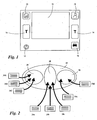
- FIG. 1 shows an example of a user interface of a balance according to the invention.
- a screen display 10 which is preferably designed as a so-called touch screen, in a known manner display areas are context-dependent occupied as switching function areas.
- the touch of such a button is detected by means of suitable and known sensors and interpreted as a selection of the corresponding function.
- buttons implemented in hardware.
- these are an on / off switch 12, two tare keys 14, with which the taring function frequently used in scales can be activated directly, and a printer key 16, by the actuation of which a printing function of a possibly to the balance connected printer can be activated.
- a user menu key 18 and an application menu key 20 are provided.
- identifiers of parameter value records stored as user profiles which contain values for user-specific, eg ergonomic, parameters and which can be selected and activated, for example, by actuating the touch screen, appear on the screen display.
- identifiers of a plurality of executable tasks are displayed on the screen 10, which can be selected and activated, for example, by actuating the touch screen.
- FIG. 2 schematically shows the data structure of a balance according to the invention
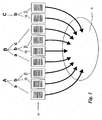
- FIG. 3 the conventional data structure in prior art scales.
- a parameter space 22 which comprises all the adjustable parameters of the balance.
- Each parameter defines a variable function or property of the balance.
- a specific parameter value must be assigned to the parameter.
- An example of an ergonomic parameter would be the property of the scale to open a powered windscreen to the right or left to suit a user's preferences.
- this parameter To activate the "right” or "left” property, this parameter must be given a concrete one of two possible values.
- An example of an application-specific parameter would be, for example, the display of the physical unit of a weighing result. Depending on the specific application, it may be necessary to display a mass (eg mg for normal weighing), a quantity (eg counting applications) or a density (eg g / cm 3 for density measurements). The actual option is activated by assigning a specific parameter value to the display parameter.
- the parameter space 22 contains a wide variety of such and similar parameters.
- Profiles are saved. The differences between the data structure according to the invention and the known data structure are described below using the examples of Figures 2 and 3 be explained.
- the scale is used by three different users A, B and C with different preferences and / or needs. For example, let A be right-handed and normal-sighted and B be left-handed and normal-sighted, and C be left-handed and red / green-blind. This may mean that A wants a windscreen opening to the right and additionally a monochrome screen display. It is further assumed that the balance is placed in a laboratory in which three different weighing applications a, b and c are routinely practiced, such as animal weighing, back weighing and counting. Finally, it is assumed that the back-weighing process can take place under two different protocol conditions ⁇ and ⁇ .
- the parameter space 22 is divided into three different parameter groups 26, 28, 30. These groups each include functionally related parameters and do not overlap each other.
- parameter group 26 contains all user-specific, eg ergonomic parameters
- parameter group 28 all application-specific parameters and parameter group 30 hardware-specific parameters.
- topic-specific profiles can be stored which, compared to the prior art, each have to contain significantly fewer entries than adjustable parameters contained in the parameter space 22.
- user profiles 24A, 24B and 24C only need to contain values for the parameters of the user parameter group 26.
- the application profiles 24a, 24b and 24c contain only values for the parameters summarized in the application parameter group.
- the hardware settings profiles 24 ⁇ and 24 ⁇ contain only values for those summarized in parameter group 30 Parameters for the hardware setting.
- the appendices to the reference numeral 24 for the profile correspond in meaning to the users (A, B, C), tasks (a, b, c) and protocol variants (a, ⁇ )).
- each profile 24 is also significantly smaller than a profile 24 'according to FIG. 3 , Furthermore, all 18 theoretically possible variants can be realized without creating a new profile. For example, by simultaneously activating the profiles 24C and 24A, it is possible to detect a situation in which the user C can perform the application a using his personally preferred user settings. For this purpose, according to the prior art, the creation of a new profile 24 ' would be necessary.
- the data structure according to the invention leads to a significant reduction of the memory requirement and at the same time to an increase of the flexibility.
- the error rate during profiling is also reduced, because in each case only related and therefore manageable profiles have to be created or modified.
- the creation of a new profile is preferably done via the in FIG. 1 illustrated user interface.
- the user on the display 10 successively different input options for Provided, wherein the input of a parameter value limits the selection in a subsequent input step in a reasonably predetermined manner.
- Settings of further parameters which necessarily result from a made input can be made automatically, without the user having to make a new, explicit input for this purpose.
- the embodiments shown in the figures and explained in the specific description represent only illustrative embodiments of the present invention.
- the subdivision of the parameter space 22 into exactly three parameter groups 26, 28, 30 is not relevant to the invention. More or less parameter groups can be realized, whereby the positive effects of the inventive concept increase with the number of selected parameter groups.
- too great a choice of the number of parameter groups can lead to too great a complexity, which then again has a disadvantageous effect on the efficiency of use.
- the rights management can take place in a known manner on the basis of the identification-manually or automatically-of the different users.
Landscapes
- Engineering & Computer Science (AREA)
- Computer Hardware Design (AREA)
- Microelectronics & Electronic Packaging (AREA)
- Physics & Mathematics (AREA)
- General Physics & Mathematics (AREA)
- User Interface Of Digital Computer (AREA)
Claims (12)
- Balance électronique avec un ordinateur intégré, lequel comprend :- une unité d'entrée servant à entrer des données de sélection,- une mémoire servant à enregistrer une multitude de valeurs de paramètre, qui sont attribuées à des paramètres spécifiques à des fonctions selon les données de sélection entrées,- une unité de traitement de données servant à exécuter des applications de balance selon une quantité partielle des paramètres spécifiques à des fonctions,- au moins une interface servant à interagir avec des composants mécaniques et/ou électroniques selon une quantité partielle des paramètres spécifiques à des fonctions,sachant qu'une multitude de différents profils (24 ; 24') sont enregistrés sous la forme de jeux de valeurs de paramètres individuels aux fins de l'adaptation à des spécifications spécifiques à des utilisateurs et/ou à des applications, sachant qu'en sélectionnant un profil (24 ; 24') défini, une attribution commune des valeurs contenues dans ce dernier à des paramètres correspondants est effectuée, caractérisée en ce que les paramètres sont associés à une multitude de groupes de paramètres (26, 28, 30) ne se chevauchant pas, en ce que chaque profil (24') individuel ne contient que des valeurs, qui sont attribuées à des paramètres d'un groupe de paramètres (26, 28, 30) précisément, et en ce que les valeurs de paramètres au moins d'un profil (24) sont attribuées à chaque groupe de paramètres (26, 28, 30).
- Balance selon la revendication 1, caractérisée en ce que les valeurs de paramètre d'un profil précisément doivent être attribuées à chaque groupe de paramètres aux fins du fonctionnement de la balance conforme à son usage.
- Balance selon l'une quelconque des revendications précédentes, caractérisée en ce que des paramètres définissant des applications de balance sont rassemblés dans un groupe de paramètres d'application (28).
- Balance selon l'une quelconque des revendications précédentes, caractérisée en ce que des paramètres définissant des réglages des composants mécaniques et/ou électroniques sont rassemblés dans un groupe de paramètres de réglage (30).
- Balance selon l'une quelconque des revendications précédentes, caractérisée en ce qu'au moins une interface est une interface externe servant à interagir avec des appareils périphériques externes.
- Balance selon la revendication 5, caractérisée en ce que des paramètres définissant des réglages des appareils périphériques externes sont rassemblés dans un groupe de paramètres de réglage (30) externe.
- Balance selon l'une quelconque des revendications précédentes, caractérisée en ce qu'au moins une interface est une interface interne servant à interagir avec des éléments mécaniques et/ou électroniques internes à la balance.
- Balance selon la revendication 7, caractérisée en ce que des paramètres définissant des réglages des éléments mécaniques et/ou électroniques internes à la balance sont rassemblés dans un groupe de paramètres de réglage (26) interne.
- Balance selon l'une quelconque des revendications précédentes, caractérisée en ce que des droits d'accès spécifiques à des groupes de paramètres sont affectés aux fins de la modification et/ou de l'enregistrement de profils (24).
- Balance selon l'une quelconque des revendications précédentes, caractérisée en ce qu'une navigation de menu basée sur des boîtes de dialogue est prévue aux fins de la création et/ou de la modification de profils (24), laquelle offre à un utilisateur successivement dans le temps plusieurs possibilités d'entrée de valeurs de paramètre.
- Balance selon la revendication 10, caractérisée en ce qu'une possibilité d'entrée offerte dépend d'une valeur de paramètre entrée au préalable.
- Balance selon l'une quelconque des revendications 10 ou 11, caractérisée en ce qu'une ou plusieurs valeurs de paramètre supplémentaires, qui découlent, selon des règles spécifiées, de la valeur de paramètre entrée, sont réglées de manière autonome après l'entrée d'une valeur de paramètre.
Applications Claiming Priority (2)
| Application Number | Priority Date | Filing Date | Title |
|---|---|---|---|
| DE102006011791A DE102006011791B4 (de) | 2006-03-15 | 2006-03-15 | Elektronische Waage |
| PCT/EP2007/001998 WO2007104466A1 (fr) | 2006-03-15 | 2007-03-08 | Balance électronique |
Publications (2)
| Publication Number | Publication Date |
|---|---|
| EP1996907A1 EP1996907A1 (fr) | 2008-12-03 |
| EP1996907B1 true EP1996907B1 (fr) | 2015-09-23 |
Family
ID=38016528
Family Applications (1)
| Application Number | Title | Priority Date | Filing Date |
|---|---|---|---|
| EP07711856.0A Active EP1996907B1 (fr) | 2006-03-15 | 2007-03-08 | Balance electronique |
Country Status (6)
| Country | Link |
|---|---|
| US (1) | US7692106B2 (fr) |
| EP (1) | EP1996907B1 (fr) |
| JP (1) | JP4987016B2 (fr) |
| CN (2) | CN101360978B (fr) |
| DE (1) | DE102006011791B4 (fr) |
| WO (1) | WO2007104466A1 (fr) |
Families Citing this family (7)
| Publication number | Priority date | Publication date | Assignee | Title |
|---|---|---|---|---|
| JP4987017B2 (ja) * | 2006-03-15 | 2012-07-25 | ザトーリウス ウェイング テクノロジー ゲーエムベーハー | 電子秤およびその操作方法 |
| DE102008009115A1 (de) * | 2008-02-14 | 2009-08-20 | Bizerba Gmbh & Co Kg | Waage und Verfahren zu deren Konfigurierung |
| US20100084200A1 (en) * | 2008-10-06 | 2010-04-08 | Juan-Castellanos Santos J | Food product pricing scale with automated multi-language interface |
| DE102010011561B4 (de) | 2010-03-16 | 2025-11-06 | Bizerba SE & Co. KG | Wägevorrichtung |
| CN104345641A (zh) * | 2013-08-08 | 2015-02-11 | 李树伟 | 一种仪表参数的快速设定方法 |
| CN104765591A (zh) * | 2014-01-02 | 2015-07-08 | 腾讯科技(深圳)有限公司 | 一种软件配置参数更新的方法、终端服务器及系统 |
| CN111976329B (zh) * | 2020-08-31 | 2022-06-21 | 深圳市月白电子科技有限公司 | 一种乐器弹奏中的五线谱自动跟随方法及自动跟踪系统 |
Citations (2)
| Publication number | Priority date | Publication date | Assignee | Title |
|---|---|---|---|---|
| DE9107757U1 (de) * | 1990-10-05 | 1991-09-26 | Sartorius AG, 3400 Göttingen | Elektronische Waage mit Menüprogramm |
| US20030141116A1 (en) * | 2000-08-14 | 2003-07-31 | Mettler-Toledo Gmbh | Measuring apparatus with user profile |
Family Cites Families (11)
| Publication number | Priority date | Publication date | Assignee | Title |
|---|---|---|---|---|
| DE3631487A1 (de) * | 1986-09-16 | 1988-03-17 | Mettler Instrumente Ag | Geraet, insbesondere waage, mit einer anzeige der resultate von nacheinander erfolgenden ausgewaehlten funktionsablaeufen |
| JPH01265125A (ja) * | 1988-04-18 | 1989-10-23 | Tokyo Electric Co Ltd | 電子料金秤 |
| US5600781A (en) * | 1994-09-30 | 1997-02-04 | Intel Corporation | Method and apparatus for creating a portable personalized operating environment |
| JP2000103124A (ja) * | 1998-09-28 | 2000-04-11 | Toshiba Tec Corp | ラベルプリンタ |
| DE19850416C1 (de) * | 1998-11-02 | 2000-05-11 | Sartorius Gmbh | Waage mit motorisch betätigtem Windschutz |
| JP2001023048A (ja) * | 1999-07-08 | 2001-01-26 | Ishida Co Ltd | 商品処理装置及び商品処理システム |
| US20040006473A1 (en) * | 2002-07-02 | 2004-01-08 | Sbc Technology Resources, Inc. | Method and system for automated categorization of statements |
| DE10040744A1 (de) * | 2000-08-19 | 2002-02-28 | Mettler Toledo Gmbh | Eingabeeinrichtung für eine Waage |
| CN2755680Y (zh) * | 2003-09-23 | 2006-02-01 | 上海宝森达科技有限公司 | 一种智能型交易计价器 |
| FR2863051B1 (fr) * | 2003-12-02 | 2006-01-20 | Seb Sa | Appareil de pesage a clavier de saisie alphanumerique integre |
| JP4987017B2 (ja) * | 2006-03-15 | 2012-07-25 | ザトーリウス ウェイング テクノロジー ゲーエムベーハー | 電子秤およびその操作方法 |
-
2006
- 2006-03-15 DE DE102006011791A patent/DE102006011791B4/de not_active Expired - Lifetime
-
2007
- 2007-03-08 CN CN2007800014943A patent/CN101360978B/zh active Active
- 2007-03-08 WO PCT/EP2007/001998 patent/WO2007104466A1/fr not_active Ceased
- 2007-03-08 JP JP2008558687A patent/JP4987016B2/ja active Active
- 2007-03-08 EP EP07711856.0A patent/EP1996907B1/fr active Active
- 2007-03-09 CN CN200780016827XA patent/CN101443639B/zh active Active
-
2008
- 2008-09-12 US US12/209,627 patent/US7692106B2/en active Active
Patent Citations (2)
| Publication number | Priority date | Publication date | Assignee | Title |
|---|---|---|---|---|
| DE9107757U1 (de) * | 1990-10-05 | 1991-09-26 | Sartorius AG, 3400 Göttingen | Elektronische Waage mit Menüprogramm |
| US20030141116A1 (en) * | 2000-08-14 | 2003-07-31 | Mettler-Toledo Gmbh | Measuring apparatus with user profile |
Also Published As
| Publication number | Publication date |
|---|---|
| US7692106B2 (en) | 2010-04-06 |
| DE102006011791B4 (de) | 2007-10-25 |
| EP1996907A1 (fr) | 2008-12-03 |
| JP4987016B2 (ja) | 2012-07-25 |
| DE102006011791A1 (de) | 2007-09-20 |
| JP2009529685A (ja) | 2009-08-20 |
| WO2007104466A1 (fr) | 2007-09-20 |
| US20090008156A1 (en) | 2009-01-08 |
| CN101443639A (zh) | 2009-05-27 |
| CN101360978A (zh) | 2009-02-04 |
| CN101443639B (zh) | 2010-12-08 |
| CN101360978B (zh) | 2010-06-23 |
Similar Documents
| Publication | Publication Date | Title |
|---|---|---|
| EP1996907B1 (fr) | Balance electronique | |
| DE69312009T2 (de) | Datenverarbeitungssystem | |
| DE1181461B (de) | Adressenaddierwerk einer programm-gesteuerten Rechenmaschine | |
| EP1476803B1 (fr) | Procede permettant d'entrer un texte par selection de caracteres au moyen d'un curseur et dispositif permettant d'executer ce procede | |
| DE102005008520B4 (de) | Verfahren, Computerprogramm-Produkt und Drucksystem zum Sortieren von Druckjobs in eienm solchen Drucksystem | |
| DE19743835C1 (de) | Elektronische Waage mit Recheneinheit | |
| DE102008044332A1 (de) | Bedieneinrichtung und Verfahren zur Bedienung | |
| DE68927988T2 (de) | Graphisches Verfahren zur Verarbeitung von Mehrfachdatenblöcken | |
| DE3134314C2 (de) | Elektronische Registrierkasse | |
| DE202006019840U1 (de) | Elektronische Waage | |
| EP1880366B1 (fr) | Commande d'affichage d'un tachygraphe | |
| EP0230994A2 (fr) | Procédé pour la commande du déroulement du programme pour traitement de formulaire dans un dispositif de traitement de données | |
| EP0612986A1 (fr) | Procédé pour sélectionner et configurer des programmes de pesage dans une balance et une balance électronique | |
| DE102009003995A1 (de) | Verfahren zur Vergrößerung eines Darstellungsbereichs auf einer Darstellungseinrichtung | |
| EP1996908B1 (fr) | Balance electronique et procede pour faire fonctionner cette balance | |
| DE3040032A1 (de) | Rechner mit sprachausgabe | |
| DE102009037165A1 (de) | Vorrichtung zur Steuerung einer Werkzeugmaschine | |
| DE69026134T2 (de) | Ausgabegerät mit anwenderdefinierbarer Beziehung zwischen Zeichenkoden und ausgegebenen Zeichen | |
| DE10040744A1 (de) | Eingabeeinrichtung für eine Waage | |
| DE102007007163B4 (de) | Elektronische Waage | |
| DE102023121430B3 (de) | Verfahren zur Aufstellung eines Menüsystems auf einem Endgerät, Vorrichtung, Computerprogramm und computerlesbares Medium | |
| DE69016651T2 (de) | Benutzerschnittstelle für Datenverarbeitungsanlage und Datenverabeitungsanlage mit einer sochen Schnittstelle. | |
| DE102018213346A1 (de) | System zur Durchführung von mathematischen Berechnungen auf Basis von vorgebbaren Eingabedaten | |
| EP1723440B1 (fr) | Gestion dynamique de memoire de clavier | |
| DE102010012307B4 (de) | Verfahren und Vorrichtung zum Erstellen eines Verfahrensablaufs für eine speicherprogrammierbare Steuerung |
Legal Events
| Date | Code | Title | Description |
|---|---|---|---|
| PUAI | Public reference made under article 153(3) epc to a published international application that has entered the european phase |
Free format text: ORIGINAL CODE: 0009012 |
|
| 17P | Request for examination filed |
Effective date: 20081015 |
|
| AK | Designated contracting states |
Kind code of ref document: A1 Designated state(s): CH FR GB LI |
|
| RIN1 | Information on inventor provided before grant (corrected) |
Inventor name: PERTSCH, THOMAS Inventor name: RINDERMANN, RAINER Inventor name: VON STEUBEN, JAN Inventor name: KORDES, APOLONIJA |
|
| DAX | Request for extension of the european patent (deleted) | ||
| RBV | Designated contracting states (corrected) |
Designated state(s): CH FR GB LI |
|
| RAP1 | Party data changed (applicant data changed or rights of an application transferred) |
Owner name: SARTORIUS WEIGHING TECHNOLOGY GMBH |
|
| RAP1 | Party data changed (applicant data changed or rights of an application transferred) |
Owner name: SARTORIUS LAB INSTRUMENTS GMBH & CO. KG |
|
| GRAP | Despatch of communication of intention to grant a patent |
Free format text: ORIGINAL CODE: EPIDOSNIGR1 |
|
| INTG | Intention to grant announced |
Effective date: 20150706 |
|
| GRAS | Grant fee paid |
Free format text: ORIGINAL CODE: EPIDOSNIGR3 |
|
| GRAA | (expected) grant |
Free format text: ORIGINAL CODE: 0009210 |
|
| AK | Designated contracting states |
Kind code of ref document: B1 Designated state(s): CH FR GB LI |
|
| REG | Reference to a national code |
Ref country code: GB Ref legal event code: FG4D Free format text: NOT ENGLISH |
|
| REG | Reference to a national code |
Ref country code: CH Ref legal event code: NV Representative=s name: BOHEST AG, CH Ref country code: CH Ref legal event code: EP |
|
| REG | Reference to a national code |
Ref country code: FR Ref legal event code: PLFP Year of fee payment: 10 |
|
| REG | Reference to a national code |
Ref country code: CH Ref legal event code: PCOW Free format text: NEW ADDRESS: OTTO-BRENNER-STRASSE 20, 37079 GOETTINGEN (DE) |
|
| PLBE | No opposition filed within time limit |
Free format text: ORIGINAL CODE: 0009261 |
|
| STAA | Information on the status of an ep patent application or granted ep patent |
Free format text: STATUS: NO OPPOSITION FILED WITHIN TIME LIMIT |
|
| 26N | No opposition filed |
Effective date: 20160624 |
|
| REG | Reference to a national code |
Ref country code: FR Ref legal event code: CA Effective date: 20160822 |
|
| REG | Reference to a national code |
Ref country code: FR Ref legal event code: PLFP Year of fee payment: 11 |
|
| REG | Reference to a national code |
Ref country code: FR Ref legal event code: PLFP Year of fee payment: 12 |
|
| P01 | Opt-out of the competence of the unified patent court (upc) registered |
Effective date: 20230526 |
|
| PGFP | Annual fee paid to national office [announced via postgrant information from national office to epo] |
Ref country code: CH Payment date: 20250401 Year of fee payment: 19 |
|
| REG | Reference to a national code |
Ref country code: CH Ref legal event code: U11 Free format text: ST27 STATUS EVENT CODE: U-0-0-U10-U11 (AS PROVIDED BY THE NATIONAL OFFICE) Effective date: 20260401 |
|
| PGFP | Annual fee paid to national office [announced via postgrant information from national office to epo] |
Ref country code: GB Payment date: 20260324 Year of fee payment: 20 |
|
| PGFP | Annual fee paid to national office [announced via postgrant information from national office to epo] |
Ref country code: FR Payment date: 20260325 Year of fee payment: 20 |