EP1997523A2 - Structure de modulation de pression intraoculaire - Google Patents
Structure de modulation de pression intraoculaire Download PDFInfo
- Publication number
- EP1997523A2 EP1997523A2 EP20080157329 EP08157329A EP1997523A2 EP 1997523 A2 EP1997523 A2 EP 1997523A2 EP 20080157329 EP20080157329 EP 20080157329 EP 08157329 A EP08157329 A EP 08157329A EP 1997523 A2 EP1997523 A2 EP 1997523A2
- Authority
- EP
- European Patent Office
- Prior art keywords
- scaffold
- collagen
- minutes
- tissue
- mmhg
- Prior art date
- Legal status (The legal status is an assumption and is not a legal conclusion. Google has not performed a legal analysis and makes no representation as to the accuracy of the status listed.)
- Granted
Links
- 230000004410 intraocular pressure Effects 0.000 title abstract description 41
- 108010035532 Collagen Proteins 0.000 claims abstract description 75
- 102000008186 Collagen Human genes 0.000 claims abstract description 75
- 229920001436 collagen Polymers 0.000 claims abstract description 75
- 239000000203 mixture Substances 0.000 claims abstract description 19
- 229920002683 Glycosaminoglycan Polymers 0.000 claims abstract description 18
- 229920001577 copolymer Polymers 0.000 claims abstract description 11
- -1 for example Polymers 0.000 claims abstract description 3
- 229920006395 saturated elastomer Polymers 0.000 claims description 24
- 229920001287 Chondroitin sulfate Polymers 0.000 claims description 21
- 239000011148 porous material Substances 0.000 claims description 14
- 230000003068 static effect Effects 0.000 claims description 14
- 102000012422 Collagen Type I Human genes 0.000 claims description 9
- 108010022452 Collagen Type I Proteins 0.000 claims description 9
- FAPWRFPIFSIZLT-UHFFFAOYSA-M Sodium chloride Chemical compound [Na+].[Cl-] FAPWRFPIFSIZLT-UHFFFAOYSA-M 0.000 claims description 9
- 239000011780 sodium chloride Substances 0.000 claims description 6
- 108010010803 Gelatin Proteins 0.000 claims description 3
- 239000008273 gelatin Substances 0.000 claims description 3
- 229920000159 gelatin Polymers 0.000 claims description 3
- 235000019322 gelatine Nutrition 0.000 claims description 3
- 235000011852 gelatine desserts Nutrition 0.000 claims description 3
- 229920002101 Chitin Polymers 0.000 claims description 2
- 229920001661 Chitosan Polymers 0.000 claims description 2
- 229920000045 Dermatan sulfate Polymers 0.000 claims description 2
- 229920002971 Heparan sulfate Polymers 0.000 claims description 2
- HTTJABKRGRZYRN-UHFFFAOYSA-N Heparin Chemical compound OC1C(NC(=O)C)C(O)OC(COS(O)(=O)=O)C1OC1C(OS(O)(=O)=O)C(O)C(OC2C(C(OS(O)(=O)=O)C(OC3C(C(O)C(O)C(O3)C(O)=O)OS(O)(=O)=O)C(CO)O2)NS(O)(=O)=O)C(C(O)=O)O1 HTTJABKRGRZYRN-UHFFFAOYSA-N 0.000 claims description 2
- 229920000288 Keratan sulfate Polymers 0.000 claims description 2
- AVJBPWGFOQAPRH-FWMKGIEWSA-L dermatan sulfate Chemical compound CC(=O)N[C@H]1[C@H](O)O[C@H](CO)[C@H](OS([O-])(=O)=O)[C@@H]1O[C@H]1[C@H](O)[C@@H](O)[C@H](O)[C@H](C([O-])=O)O1 AVJBPWGFOQAPRH-FWMKGIEWSA-L 0.000 claims description 2
- 229940051593 dermatan sulfate Drugs 0.000 claims description 2
- 229920000669 heparin Polymers 0.000 claims description 2
- 229960002897 heparin Drugs 0.000 claims description 2
- KXCLCNHUUKTANI-RBIYJLQWSA-N keratan Chemical compound CC(=O)N[C@@H]1[C@@H](O)C[C@@H](COS(O)(=O)=O)O[C@H]1O[C@@H]1[C@@H](O)[C@H](O[C@@H]2[C@H](O[C@@H](O[C@H]3[C@H]([C@@H](COS(O)(=O)=O)O[C@@H](O)[C@@H]3O)O)[C@H](NC(C)=O)[C@H]2O)COS(O)(=O)=O)O[C@H](COS(O)(=O)=O)[C@@H]1O KXCLCNHUUKTANI-RBIYJLQWSA-N 0.000 claims description 2
- 210000001519 tissue Anatomy 0.000 description 43
- 238000001356 surgical procedure Methods 0.000 description 38
- 208000002352 blister Diseases 0.000 description 36
- 206010052428 Wound Diseases 0.000 description 31
- 208000027418 Wounds and injury Diseases 0.000 description 31
- 239000000243 solution Substances 0.000 description 29
- 239000011159 matrix material Substances 0.000 description 21
- LFQSCWFLJHTTHZ-UHFFFAOYSA-N Ethanol Chemical compound CCO LFQSCWFLJHTTHZ-UHFFFAOYSA-N 0.000 description 20
- 208000010412 Glaucoma Diseases 0.000 description 19
- 210000004027 cell Anatomy 0.000 description 19
- 238000002513 implantation Methods 0.000 description 19
- 238000000034 method Methods 0.000 description 19
- LOKCTEFSRHRXRJ-UHFFFAOYSA-I dipotassium trisodium dihydrogen phosphate hydrogen phosphate dichloride Chemical compound P(=O)(O)(O)[O-].[K+].P(=O)(O)([O-])[O-].[Na+].[Na+].[Cl-].[K+].[Cl-].[Na+] LOKCTEFSRHRXRJ-UHFFFAOYSA-I 0.000 description 18
- 238000001914 filtration Methods 0.000 description 18
- 239000007943 implant Substances 0.000 description 18
- 239000002953 phosphate buffered saline Substances 0.000 description 17
- 210000000651 myofibroblast Anatomy 0.000 description 15
- QTBSBXVTEAMEQO-UHFFFAOYSA-N Acetic acid Chemical compound CC(O)=O QTBSBXVTEAMEQO-UHFFFAOYSA-N 0.000 description 14
- 210000002950 fibroblast Anatomy 0.000 description 14
- 230000036573 scar formation Effects 0.000 description 13
- DHRLEVQXOMLTIM-UHFFFAOYSA-N phosphoric acid;trioxomolybdenum Chemical compound O=[Mo](=O)=O.O=[Mo](=O)=O.O=[Mo](=O)=O.O=[Mo](=O)=O.O=[Mo](=O)=O.O=[Mo](=O)=O.O=[Mo](=O)=O.O=[Mo](=O)=O.O=[Mo](=O)=O.O=[Mo](=O)=O.O=[Mo](=O)=O.O=[Mo](=O)=O.OP(O)(O)=O DHRLEVQXOMLTIM-UHFFFAOYSA-N 0.000 description 12
- 239000003814 drug Substances 0.000 description 11
- 239000000835 fiber Substances 0.000 description 11
- 229940079593 drug Drugs 0.000 description 10
- 231100000241 scar Toxicity 0.000 description 10
- XLYOFNOQVPJJNP-UHFFFAOYSA-N water Substances O XLYOFNOQVPJJNP-UHFFFAOYSA-N 0.000 description 10
- WZUVPPKBWHMQCE-UHFFFAOYSA-N Haematoxylin Chemical compound C12=CC(O)=C(O)C=C2CC2(O)C1C1=CC=C(O)C(O)=C1OC2 WZUVPPKBWHMQCE-UHFFFAOYSA-N 0.000 description 8
- 210000001742 aqueous humor Anatomy 0.000 description 8
- 230000000694 effects Effects 0.000 description 8
- 230000008569 process Effects 0.000 description 8
- 210000003786 sclera Anatomy 0.000 description 8
- 230000029663 wound healing Effects 0.000 description 8
- 241000283973 Oryctolagus cuniculus Species 0.000 description 7
- 210000002159 anterior chamber Anatomy 0.000 description 7
- 239000000872 buffer Substances 0.000 description 7
- 210000000795 conjunctiva Anatomy 0.000 description 7
- 238000011161 development Methods 0.000 description 7
- 230000018109 developmental process Effects 0.000 description 7
- 238000002360 preparation method Methods 0.000 description 7
- 238000011282 treatment Methods 0.000 description 7
- 230000003510 anti-fibrotic effect Effects 0.000 description 6
- 230000008901 benefit Effects 0.000 description 6
- 239000003795 chemical substances by application Substances 0.000 description 6
- 239000012153 distilled water Substances 0.000 description 6
- 238000011156 evaluation Methods 0.000 description 6
- 125000002485 formyl group Chemical class [H]C(*)=O 0.000 description 6
- CTQNGGLPUBDAKN-UHFFFAOYSA-N O-Xylene Chemical compound CC1=CC=CC=C1C CTQNGGLPUBDAKN-UHFFFAOYSA-N 0.000 description 5
- 229960000583 acetic acid Drugs 0.000 description 5
- 235000011054 acetic acid Nutrition 0.000 description 5
- 230000008859 change Effects 0.000 description 5
- 230000008602 contraction Effects 0.000 description 5
- 238000005259 measurement Methods 0.000 description 5
- 239000008096 xylene Substances 0.000 description 5
- 206010016717 Fistula Diseases 0.000 description 4
- 206010061218 Inflammation Diseases 0.000 description 4
- KFZMGEQAYNKOFK-UHFFFAOYSA-N Isopropanol Chemical compound CC(C)O KFZMGEQAYNKOFK-UHFFFAOYSA-N 0.000 description 4
- 239000004677 Nylon Substances 0.000 description 4
- 230000015556 catabolic process Effects 0.000 description 4
- 239000000501 collagen implant Substances 0.000 description 4
- 230000007423 decrease Effects 0.000 description 4
- 230000003247 decreasing effect Effects 0.000 description 4
- 238000006731 degradation reaction Methods 0.000 description 4
- 210000000981 epithelium Anatomy 0.000 description 4
- 230000003890 fistula Effects 0.000 description 4
- 238000003365 immunocytochemistry Methods 0.000 description 4
- 230000004054 inflammatory process Effects 0.000 description 4
- 238000003760 magnetic stirring Methods 0.000 description 4
- 230000000877 morphologic effect Effects 0.000 description 4
- 229920001778 nylon Polymers 0.000 description 4
- 239000008188 pellet Substances 0.000 description 4
- 230000002062 proliferating effect Effects 0.000 description 4
- 238000003756 stirring Methods 0.000 description 4
- 239000000126 substance Substances 0.000 description 4
- 239000006228 supernatant Substances 0.000 description 4
- 230000017423 tissue regeneration Effects 0.000 description 4
- WSFSSNUMVMOOMR-UHFFFAOYSA-N Formaldehyde Chemical compound O=C WSFSSNUMVMOOMR-UHFFFAOYSA-N 0.000 description 3
- PEDCQBHIVMGVHV-UHFFFAOYSA-N Glycerine Chemical compound OCC(O)CO PEDCQBHIVMGVHV-UHFFFAOYSA-N 0.000 description 3
- YQEZLKZALYSWHR-UHFFFAOYSA-N Ketamine Chemical compound C=1C=CC=C(Cl)C=1C1(NC)CCCCC1=O YQEZLKZALYSWHR-UHFFFAOYSA-N 0.000 description 3
- 238000013459 approach Methods 0.000 description 3
- 238000006243 chemical reaction Methods 0.000 description 3
- 238000009826 distribution Methods 0.000 description 3
- 239000011888 foil Substances 0.000 description 3
- 230000028993 immune response Effects 0.000 description 3
- 230000002757 inflammatory effect Effects 0.000 description 3
- 229960003299 ketamine Drugs 0.000 description 3
- 230000007774 longterm Effects 0.000 description 3
- 238000000386 microscopy Methods 0.000 description 3
- 230000002085 persistent effect Effects 0.000 description 3
- 229920000642 polymer Polymers 0.000 description 3
- 230000002980 postoperative effect Effects 0.000 description 3
- 230000035755 proliferation Effects 0.000 description 3
- 230000009467 reduction Effects 0.000 description 3
- 230000001172 regenerating effect Effects 0.000 description 3
- BPICBUSOMSTKRF-UHFFFAOYSA-N xylazine Chemical compound CC1=CC=CC(C)=C1NC1=NCCCS1 BPICBUSOMSTKRF-UHFFFAOYSA-N 0.000 description 3
- 229960001600 xylazine Drugs 0.000 description 3
- YBJHBAHKTGYVGT-ZKWXMUAHSA-N (+)-Biotin Chemical compound N1C(=O)N[C@@H]2[C@H](CCCCC(=O)O)SC[C@@H]21 YBJHBAHKTGYVGT-ZKWXMUAHSA-N 0.000 description 2
- QKNYBSVHEMOAJP-UHFFFAOYSA-N 2-amino-2-(hydroxymethyl)propane-1,3-diol;hydron;chloride Chemical compound Cl.OCC(N)(CO)CO QKNYBSVHEMOAJP-UHFFFAOYSA-N 0.000 description 2
- 108091003079 Bovine Serum Albumin Proteins 0.000 description 2
- 241000283707 Capra Species 0.000 description 2
- 206010016654 Fibrosis Diseases 0.000 description 2
- XEEYBQQBJWHFJM-UHFFFAOYSA-N Iron Chemical compound [Fe] XEEYBQQBJWHFJM-UHFFFAOYSA-N 0.000 description 2
- 241001465754 Metazoa Species 0.000 description 2
- NWIBSHFKIJFRCO-WUDYKRTCSA-N Mytomycin Chemical compound C1N2C(C(C(C)=C(N)C3=O)=O)=C3[C@@H](COC(N)=O)[C@@]2(OC)[C@@H]2[C@H]1N2 NWIBSHFKIJFRCO-WUDYKRTCSA-N 0.000 description 2
- 208000037273 Pathologic Processes Diseases 0.000 description 2
- PXIPVTKHYLBLMZ-UHFFFAOYSA-N Sodium azide Chemical compound [Na+].[N-]=[N+]=[N-] PXIPVTKHYLBLMZ-UHFFFAOYSA-N 0.000 description 2
- 208000002847 Surgical Wound Diseases 0.000 description 2
- 230000010398 acute inflammatory response Effects 0.000 description 2
- 230000002776 aggregation Effects 0.000 description 2
- 238000004220 aggregation Methods 0.000 description 2
- 239000000969 carrier Substances 0.000 description 2
- 230000004663 cell proliferation Effects 0.000 description 2
- 230000001276 controlling effect Effects 0.000 description 2
- 230000008021 deposition Effects 0.000 description 2
- 238000010790 dilution Methods 0.000 description 2
- 239000012895 dilution Substances 0.000 description 2
- 230000003292 diminished effect Effects 0.000 description 2
- YQGOJNYOYNNSMM-UHFFFAOYSA-N eosin Chemical compound [Na+].OC(=O)C1=CC=CC=C1C1=C2C=C(Br)C(=O)C(Br)=C2OC2=C(Br)C(O)=C(Br)C=C21 YQGOJNYOYNNSMM-UHFFFAOYSA-N 0.000 description 2
- 210000000744 eyelid Anatomy 0.000 description 2
- 239000012091 fetal bovine serum Substances 0.000 description 2
- 230000004761 fibrosis Effects 0.000 description 2
- 238000011049 filling Methods 0.000 description 2
- 230000004907 flux Effects 0.000 description 2
- 238000010438 heat treatment Methods 0.000 description 2
- 230000001939 inductive effect Effects 0.000 description 2
- 238000010255 intramuscular injection Methods 0.000 description 2
- 239000007927 intramuscular injection Substances 0.000 description 2
- 235000020281 long black Nutrition 0.000 description 2
- 210000004698 lymphocyte Anatomy 0.000 description 2
- 210000002540 macrophage Anatomy 0.000 description 2
- 239000000463 material Substances 0.000 description 2
- 238000012986 modification Methods 0.000 description 2
- 230000004048 modification Effects 0.000 description 2
- 230000009054 pathological process Effects 0.000 description 2
- IYDGMDWEHDFVQI-UHFFFAOYSA-N phosphoric acid;trioxotungsten Chemical compound O=[W](=O)=O.O=[W](=O)=O.O=[W](=O)=O.O=[W](=O)=O.O=[W](=O)=O.O=[W](=O)=O.O=[W](=O)=O.O=[W](=O)=O.O=[W](=O)=O.O=[W](=O)=O.O=[W](=O)=O.O=[W](=O)=O.OP(O)(O)=O IYDGMDWEHDFVQI-UHFFFAOYSA-N 0.000 description 2
- 230000035479 physiological effects, processes and functions Effects 0.000 description 2
- 230000002265 prevention Effects 0.000 description 2
- 239000000047 product Substances 0.000 description 2
- 102000004169 proteins and genes Human genes 0.000 description 2
- 108090000623 proteins and genes Proteins 0.000 description 2
- 238000011555 rabbit model Methods 0.000 description 2
- 230000008707 rearrangement Effects 0.000 description 2
- 230000002829 reductive effect Effects 0.000 description 2
- 230000008521 reorganization Effects 0.000 description 2
- 230000000087 stabilizing effect Effects 0.000 description 2
- 238000006467 substitution reaction Methods 0.000 description 2
- 239000008399 tap water Substances 0.000 description 2
- 235000020679 tap water Nutrition 0.000 description 2
- 210000002435 tendon Anatomy 0.000 description 2
- 230000010388 wound contraction Effects 0.000 description 2
- 102000007469 Actins Human genes 0.000 description 1
- 108010085238 Actins Proteins 0.000 description 1
- 108010006654 Bleomycin Proteins 0.000 description 1
- 201000004569 Blindness Diseases 0.000 description 1
- 241000283690 Bos taurus Species 0.000 description 1
- 239000011547 Bouin solution Substances 0.000 description 1
- 208000003322 Coinfection Diseases 0.000 description 1
- 239000004971 Cross linker Substances 0.000 description 1
- VVNCNSJFMMFHPL-VKHMYHEASA-N D-penicillamine Chemical compound CC(C)(S)[C@@H](N)C(O)=O VVNCNSJFMMFHPL-VKHMYHEASA-N 0.000 description 1
- 206010016760 Flat anterior chamber of eye Diseases 0.000 description 1
- GHASVSINZRGABV-UHFFFAOYSA-N Fluorouracil Chemical compound FC1=CNC(=O)NC1=O GHASVSINZRGABV-UHFFFAOYSA-N 0.000 description 1
- 108010001336 Horseradish Peroxidase Proteins 0.000 description 1
- 108060003951 Immunoglobulin Proteins 0.000 description 1
- 208000028389 Nerve injury Diseases 0.000 description 1
- 102000057297 Pepsin A Human genes 0.000 description 1
- 108090000284 Pepsin A Proteins 0.000 description 1
- 238000000692 Student's t-test Methods 0.000 description 1
- 102000003978 Tissue Plasminogen Activator Human genes 0.000 description 1
- 108090000373 Tissue Plasminogen Activator Proteins 0.000 description 1
- 230000002159 abnormal effect Effects 0.000 description 1
- 150000001243 acetic acids Chemical class 0.000 description 1
- 239000002253 acid Substances 0.000 description 1
- 239000000048 adrenergic agonist Substances 0.000 description 1
- 229940035674 anesthetics Drugs 0.000 description 1
- 238000010171 animal model Methods 0.000 description 1
- 230000001399 anti-metabolic effect Effects 0.000 description 1
- 229940006133 antiglaucoma drug and miotics carbonic anhydrase inhibitors Drugs 0.000 description 1
- 239000004599 antimicrobial Substances 0.000 description 1
- 239000012237 artificial material Substances 0.000 description 1
- 239000002876 beta blocker Substances 0.000 description 1
- 229940097320 beta blocking agent Drugs 0.000 description 1
- AGSPXMVUFBBBMO-UHFFFAOYSA-N beta-aminopropionitrile Chemical compound NCCC#N AGSPXMVUFBBBMO-UHFFFAOYSA-N 0.000 description 1
- 230000027455 binding Effects 0.000 description 1
- 238000009739 binding Methods 0.000 description 1
- 238000006065 biodegradation reaction Methods 0.000 description 1
- 239000012620 biological material Substances 0.000 description 1
- 229960002685 biotin Drugs 0.000 description 1
- 235000020958 biotin Nutrition 0.000 description 1
- 239000011616 biotin Substances 0.000 description 1
- 229960001561 bleomycin Drugs 0.000 description 1
- OYVAGSVQBOHSSS-UAPAGMARSA-O bleomycin A2 Chemical compound N([C@H](C(=O)N[C@H](C)[C@@H](O)[C@H](C)C(=O)N[C@@H]([C@H](O)C)C(=O)NCCC=1SC=C(N=1)C=1SC=C(N=1)C(=O)NCCC[S+](C)C)[C@@H](O[C@H]1[C@H]([C@@H](O)[C@H](O)[C@H](CO)O1)O[C@@H]1[C@H]([C@@H](OC(N)=O)[C@H](O)[C@@H](CO)O1)O)C=1N=CNC=1)C(=O)C1=NC([C@H](CC(N)=O)NC[C@H](N)C(N)=O)=NC(N)=C1C OYVAGSVQBOHSSS-UAPAGMARSA-O 0.000 description 1
- 210000004204 blood vessel Anatomy 0.000 description 1
- 230000003139 buffering effect Effects 0.000 description 1
- 239000003489 carbonate dehydratase inhibitor Substances 0.000 description 1
- 230000001413 cellular effect Effects 0.000 description 1
- 238000005119 centrifugation Methods 0.000 description 1
- 208000037976 chronic inflammation Diseases 0.000 description 1
- 230000006020 chronic inflammation Effects 0.000 description 1
- 108010008495 collagen-glycosaminoglycan copolymer Proteins 0.000 description 1
- 210000002808 connective tissue Anatomy 0.000 description 1
- 239000003246 corticosteroid Substances 0.000 description 1
- 230000007547 defect Effects 0.000 description 1
- 230000000593 degrading effect Effects 0.000 description 1
- 239000003937 drug carrier Substances 0.000 description 1
- 238000002651 drug therapy Methods 0.000 description 1
- 239000012467 final product Substances 0.000 description 1
- 229960002949 fluorouracil Drugs 0.000 description 1
- 230000037406 food intake Effects 0.000 description 1
- 238000004108 freeze drying Methods 0.000 description 1
- 239000000499 gel Substances 0.000 description 1
- 239000003193 general anesthetic agent Substances 0.000 description 1
- 239000012362 glacial acetic acid Substances 0.000 description 1
- 230000012010 growth Effects 0.000 description 1
- 230000035876 healing Effects 0.000 description 1
- 230000002962 histologic effect Effects 0.000 description 1
- 230000002163 immunogen Effects 0.000 description 1
- 102000018358 immunoglobulin Human genes 0.000 description 1
- 229940072221 immunoglobulins Drugs 0.000 description 1
- 238000012744 immunostaining Methods 0.000 description 1
- 208000015181 infectious disease Diseases 0.000 description 1
- 210000004969 inflammatory cell Anatomy 0.000 description 1
- 230000028709 inflammatory response Effects 0.000 description 1
- 239000003112 inhibitor Substances 0.000 description 1
- 230000002401 inhibitory effect Effects 0.000 description 1
- 230000005764 inhibitory process Effects 0.000 description 1
- 230000009545 invasion Effects 0.000 description 1
- 229910052742 iron Inorganic materials 0.000 description 1
- 230000001788 irregular Effects 0.000 description 1
- 238000002430 laser surgery Methods 0.000 description 1
- 238000011068 loading method Methods 0.000 description 1
- 239000003550 marker Substances 0.000 description 1
- 238000001000 micrograph Methods 0.000 description 1
- 230000005012 migration Effects 0.000 description 1
- 238000013508 migration Methods 0.000 description 1
- 230000003278 mimic effect Effects 0.000 description 1
- 230000003547 miosis Effects 0.000 description 1
- 239000003604 miotic agent Substances 0.000 description 1
- 229960004857 mitomycin Drugs 0.000 description 1
- 239000011259 mixed solution Substances 0.000 description 1
- 238000002156 mixing Methods 0.000 description 1
- 210000003205 muscle Anatomy 0.000 description 1
- 230000030248 negative regulation of fibroblast proliferation Effects 0.000 description 1
- 230000008764 nerve damage Effects 0.000 description 1
- 231100000957 no side effect Toxicity 0.000 description 1
- 230000009871 nonspecific binding Effects 0.000 description 1
- 229920002113 octoxynol Polymers 0.000 description 1
- 210000001328 optic nerve Anatomy 0.000 description 1
- 239000012188 paraffin wax Substances 0.000 description 1
- 230000037361 pathway Effects 0.000 description 1
- 229960001639 penicillamine Drugs 0.000 description 1
- 229940111202 pepsin Drugs 0.000 description 1
- 230000000704 physical effect Effects 0.000 description 1
- 230000035790 physiological processes and functions Effects 0.000 description 1
- 238000006116 polymerization reaction Methods 0.000 description 1
- 238000003825 pressing Methods 0.000 description 1
- 230000000750 progressive effect Effects 0.000 description 1
- 230000009103 reabsorption Effects 0.000 description 1
- 230000008929 regeneration Effects 0.000 description 1
- 238000011069 regeneration method Methods 0.000 description 1
- 230000001105 regulatory effect Effects 0.000 description 1
- 238000007634 remodeling Methods 0.000 description 1
- 230000000717 retained effect Effects 0.000 description 1
- 238000004626 scanning electron microscopy Methods 0.000 description 1
- 238000010186 staining Methods 0.000 description 1
- 238000011477 surgical intervention Methods 0.000 description 1
- 208000024891 symptom Diseases 0.000 description 1
- 229920001059 synthetic polymer Polymers 0.000 description 1
- 238000012353 t test Methods 0.000 description 1
- 230000001225 therapeutic effect Effects 0.000 description 1
- 229960000187 tissue plasminogen activator Drugs 0.000 description 1
- 238000012546 transfer Methods 0.000 description 1
- 230000009466 transformation Effects 0.000 description 1
- 230000000007 visual effect Effects 0.000 description 1
- 238000005406 washing Methods 0.000 description 1
- 238000005303 weighing Methods 0.000 description 1
- 230000037314 wound repair Effects 0.000 description 1
Images




Classifications
-
- A—HUMAN NECESSITIES
- A61—MEDICAL OR VETERINARY SCIENCE; HYGIENE
- A61L—METHODS OR APPARATUS FOR STERILISING MATERIALS OR OBJECTS IN GENERAL; DISINFECTION, STERILISATION OR DEODORISATION OF AIR; CHEMICAL ASPECTS OF BANDAGES, DRESSINGS, ABSORBENT PADS OR SURGICAL ARTICLES; MATERIALS FOR BANDAGES, DRESSINGS, ABSORBENT PADS OR SURGICAL ARTICLES
- A61L27/00—Materials for grafts or prostheses or for coating grafts or prostheses
-
- A—HUMAN NECESSITIES
- A61—MEDICAL OR VETERINARY SCIENCE; HYGIENE
- A61L—METHODS OR APPARATUS FOR STERILISING MATERIALS OR OBJECTS IN GENERAL; DISINFECTION, STERILISATION OR DEODORISATION OF AIR; CHEMICAL ASPECTS OF BANDAGES, DRESSINGS, ABSORBENT PADS OR SURGICAL ARTICLES; MATERIALS FOR BANDAGES, DRESSINGS, ABSORBENT PADS OR SURGICAL ARTICLES
- A61L27/00—Materials for grafts or prostheses or for coating grafts or prostheses
- A61L27/14—Macromolecular materials
- A61L27/22—Polypeptides or derivatives thereof, e.g. degradation products
- A61L27/24—Collagen
-
- A—HUMAN NECESSITIES
- A61—MEDICAL OR VETERINARY SCIENCE; HYGIENE
- A61F—FILTERS IMPLANTABLE INTO BLOOD VESSELS; PROSTHESES; DEVICES PROVIDING PATENCY TO, OR PREVENTING COLLAPSING OF, TUBULAR STRUCTURES OF THE BODY, e.g. STENTS; ORTHOPAEDIC, NURSING OR CONTRACEPTIVE DEVICES; FOMENTATION; TREATMENT OR PROTECTION OF EYES OR EARS; BANDAGES, DRESSINGS OR ABSORBENT PADS; FIRST-AID KITS
- A61F2/00—Filters implantable into blood vessels; Prostheses, i.e. artificial substitutes or replacements for parts of the body; Appliances for connecting them with the body; Devices providing patency to, or preventing collapsing of, tubular structures of the body, e.g. stents
- A61F2/02—Prostheses implantable into the body
- A61F2/14—Eye parts, e.g. lenses or corneal implants; Artificial eyes
-
- A—HUMAN NECESSITIES
- A61—MEDICAL OR VETERINARY SCIENCE; HYGIENE
- A61L—METHODS OR APPARATUS FOR STERILISING MATERIALS OR OBJECTS IN GENERAL; DISINFECTION, STERILISATION OR DEODORISATION OF AIR; CHEMICAL ASPECTS OF BANDAGES, DRESSINGS, ABSORBENT PADS OR SURGICAL ARTICLES; MATERIALS FOR BANDAGES, DRESSINGS, ABSORBENT PADS OR SURGICAL ARTICLES
- A61L27/00—Materials for grafts or prostheses or for coating grafts or prostheses
- A61L27/14—Macromolecular materials
- A61L27/20—Polysaccharides
-
- A—HUMAN NECESSITIES
- A61—MEDICAL OR VETERINARY SCIENCE; HYGIENE
- A61L—METHODS OR APPARATUS FOR STERILISING MATERIALS OR OBJECTS IN GENERAL; DISINFECTION, STERILISATION OR DEODORISATION OF AIR; CHEMICAL ASPECTS OF BANDAGES, DRESSINGS, ABSORBENT PADS OR SURGICAL ARTICLES; MATERIALS FOR BANDAGES, DRESSINGS, ABSORBENT PADS OR SURGICAL ARTICLES
- A61L27/00—Materials for grafts or prostheses or for coating grafts or prostheses
- A61L27/14—Macromolecular materials
- A61L27/26—Mixtures of macromolecular compounds
-
- A—HUMAN NECESSITIES
- A61—MEDICAL OR VETERINARY SCIENCE; HYGIENE
- A61P—SPECIFIC THERAPEUTIC ACTIVITY OF CHEMICAL COMPOUNDS OR MEDICINAL PREPARATIONS
- A61P27/00—Drugs for disorders of the senses
- A61P27/02—Ophthalmic agents
-
- A—HUMAN NECESSITIES
- A61—MEDICAL OR VETERINARY SCIENCE; HYGIENE
- A61F—FILTERS IMPLANTABLE INTO BLOOD VESSELS; PROSTHESES; DEVICES PROVIDING PATENCY TO, OR PREVENTING COLLAPSING OF, TUBULAR STRUCTURES OF THE BODY, e.g. STENTS; ORTHOPAEDIC, NURSING OR CONTRACEPTIVE DEVICES; FOMENTATION; TREATMENT OR PROTECTION OF EYES OR EARS; BANDAGES, DRESSINGS OR ABSORBENT PADS; FIRST-AID KITS
- A61F9/00—Methods or devices for treatment of the eyes; Devices for putting in contact-lenses; Devices to correct squinting; Apparatus to guide the blind; Protective devices for the eyes, carried on the body or in the hand
- A61F9/007—Methods or devices for eye surgery
- A61F9/00781—Apparatus for modifying intraocular pressure, e.g. for glaucoma treatment
-
- A—HUMAN NECESSITIES
- A61—MEDICAL OR VETERINARY SCIENCE; HYGIENE
- A61L—METHODS OR APPARATUS FOR STERILISING MATERIALS OR OBJECTS IN GENERAL; DISINFECTION, STERILISATION OR DEODORISATION OF AIR; CHEMICAL ASPECTS OF BANDAGES, DRESSINGS, ABSORBENT PADS OR SURGICAL ARTICLES; MATERIALS FOR BANDAGES, DRESSINGS, ABSORBENT PADS OR SURGICAL ARTICLES
- A61L2430/00—Materials or treatment for tissue regeneration
- A61L2430/16—Materials or treatment for tissue regeneration for reconstruction of eye parts, e.g. intraocular lens, cornea
-
- Y—GENERAL TAGGING OF NEW TECHNOLOGICAL DEVELOPMENTS; GENERAL TAGGING OF CROSS-SECTIONAL TECHNOLOGIES SPANNING OVER SEVERAL SECTIONS OF THE IPC; TECHNICAL SUBJECTS COVERED BY FORMER USPC CROSS-REFERENCE ART COLLECTIONS [XRACs] AND DIGESTS
- Y10—TECHNICAL SUBJECTS COVERED BY FORMER USPC
- Y10S—TECHNICAL SUBJECTS COVERED BY FORMER USPC CROSS-REFERENCE ART COLLECTIONS [XRACs] AND DIGESTS
- Y10S435/00—Chemistry: molecular biology and microbiology
- Y10S435/81—Packaged device or kit
Definitions
- the present invention generally relates to a drug-free biodegradable 3-dimentioned porous collagen-glycosaminoglycan scaffold serving as an implantation device, and in particular to a device designed for preventing scar formation and creating a physiological aqua buffer environment in conjunctival space for modulating the intraocular pressure on glaucoma.
- Glaucoma encompasses serial symptoms such as intraocular pressure elevation, optic nerve damage and progressive visual field loss. Most patients receive medical treatments by oral ingestion or locally applying beta-blockers, miotics, adrenergic agonists or carbonic anhydrase inhibitors to enhance water reabsorption by blood vessels and consequently lower the intraocular pressure. Most of the patients significantly respond to drug therapy at the beginning, but in many cases turn out to be refractory over time. For the individual who fails to quickly respond to drug treatment, surgical intervention is required in order to maintain intraocular pressure.
- Glaucoma filtering surgery is the current operating process for reducing intraocular pressure.
- the processes of glaucoma filtering surgery consists of making an opening through the trabeculum to drain out aqueous humor from the anterior chamber, and building a filtering bleb or drainage fistula between the anterior chamber and the subconjunctival space to reduce intraocular pressure (Bergstrom et al., 1991; Miller et al., 1989). Howev er, the scar development after surgery results in the obstruction of the built filtering bleb or drainage fistula and finally leads to the recurrence of high intraocular pressure (Peiffer el al., 1989). Hence, the prevention of scar formation should be an important consideration for the success of glaucoma surgery.
- U.S. Pat. No. 5,713,844 and U.S. Pat. No. 5,743,868 disclosed pump- or tube-like devices made with artificial materials being implanted into the subconjunctival space or the anterior chamber surroundings as an alternative to the filtering bleb or drainage fistula to lower the intraocular pressure.
- These non-degradable devices function as the fistula and bleb, giving short-term benefits but the procedure eventually fails due to scar formation.
- the devices are not biodegradable, causing incommodity and risk of secondary infection.
- no clinical observation shows significant reduction of scar formation after implanting such devices.
- the regenerative tissue often invades or pinches into the implanted devices, consequently obstructing the outflow pathway. For the most part, it is not a general therapeutic consideration.
- the non-degradable layer composed of synthetic polymers controls moisture flux of the skin; and the degradable layer composed of a three-dimensioned (3D) collagen-mucopolysaccharide or collagen-glycosaminoglycan copolymer directly covers the wound area to support tissue regeneration.
- the 3D collagen-mucopolysaccharide or collagen-glycosaminoglycan copolymers lead a random reorganization of the regenerating fibroblasts and the secreted intercellular matrix, and finally result in a reduction of scar formation.
- U.S. Pat. No. 6,299,895 and U.S. Pat. No. 6,063,116 disclosed implanting devices, which carried different biological active molecules to inhibit cell proliferation, amend tissue regeneration and prevent scar development.
- the building components are not fully biodegradable.
- U.S. Pat. No. 6,013,628 and U.S. Pat. No. 6,218,360 presented a combination of cell proliferating inhibitors and different biodegradable mediators, and the direct application into the intraocular tissue. Although these patents addressed the problem of the non-degradability of the drug mediator, there is still the risk that the drug may leak out from the injecting site. The affected area will be beyond control. Mor eover, such a biodegradable matrix does not function as a pressure regulator capable of modulating the intraocular pressure through a physical means, i.e., to modulate the pressure of the intraocular fluid by establishing a physiological aqua buffer reservoir.
- the present invention provides a 3D porous collagen glucosaminoglycan scaffold, which is fully biodegradable after being implanted into the subconjuctival space.
- the 3D porous structure reduces intraocular pressure, leads a re-arrangement of proliferating cells and matrix, prevents scar formation, and provides a permanent physiological aqua reservoir system after biodegrading.
- An object of the invention in some embodiments, is to provide a new device for glaucoma implantation.
- methods of purifying type I collagen and making a biodegradable 3D porous collagen/glucosaminoglycan scaffold serving as an implanting device.
- the device leads to cell re-organization during regeneration and builds a physiological aqua buffer reservoir for the modulation of intraocular pressure (IOP) after glaucoma surgery.
- IOP intraocular pressure
- no further aldehyde linkage has been conducted during preparation procedures, and consequently reduces the hardness and the risk of chemical remnants.
- a further object of the invention in some embodiments, is to provide a special procedure of implanting the device into animals' subconjunctival space.
- N o drug should be added during and after the implantation.
- the present invention prevents scar development and modulates the intraocular pressure based only on the 3D porous structure and the biodegraded residual space.
- Th e present invention is not used as a drug mediator or drug carrier.
- the intraocular pressure has been measured after implantation.
- different cellular evaluations were also performed on the days 3, 7, 14, 21 and 28 after implantation, so as to monitor the scaffold biodegradation and the tissue regeneration.
- FIG. 1 shows the change of the static pressure of scaffolds in different concentrations of collagen-glycosaminoglycan.
- FIG. 2 shows the morphological-evaluation after scaffold implantation in female New Zealand albino rabbits.
- (a)(c)(e)(g) shows the results from the implanted groups, and (b)(d)(f)(h) from the operating sham groups.
- FIG. 3 indicates the development of the intraocular pressure after scaffold implantation.
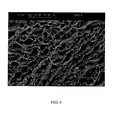
- FIG. 4 shows an electronic microscopy image of collagen matrix.
- FIG. 5 shows an intact implant in the subconjunctival space with cells (white arrow) migrating on its surface.
- the nuclei are stained brown (Masson Trichrome stain, 20x, Day 7).
- FIG. 6 shows a partially degraded implant (white arrow) inside a prominent bleb. Cells are present inside the implant, as opposed to the region where the implant has degraded, in which only collagen remains (black arrow) (Masson Trichrome stain, 20x, Day 14).
- FIG. 7 shows linear collagen (white arrow) deposited inside the collapsed bleb (long black arrow) in a control group, Sclera was seen in this view. 10-0 nylon (20-30um diameter, short black arrow) at right upper corner (Masson Trichrome stain, Day 21).
- FIG. 8 shows randomized collagen (white arrow) deposited in a prominent bleb (long black arrow) in the implanted group (depth indicated by longer black arrow, 16 times the diameter of a 10-0 nylon indicated by shorter black arrow). No sclera was seen in this view. 10-0 nylon (20-30um diameter, black arrow) was located at right upper comer(Masson Trichrome stain, Day 21).
- FIG. 9 shows the morphological evaluation before scaffold implantation.
- FIG. 10 shows the morphological evaluation before scaffold implantation.
- FIG. 11 shows the relationship between anti-compressive pressure and the strain of PBS soaked collagen matrix. The pressure elevated directly with the change of strain up until the point of 0.32 KPa.
- the present invention provides a fully biodegradable 3D porous scaffold, which is comprised of collagen-glucosaminoglycans copolymers.
- the terms "scaffold” or “collagen matrix” shall both mean a matrix comprised of collagen-glucosaminoglycans copolymers, or polymers that function in a similar manner to the polymers described below.
- the present invention sets high temperature (see examples) and UV light as the major energy for polymerization, and non-obviously, no further aldehyde linkage reaction has been done through the preparation. Henc e, there are no aldehyde remnants.
- some embodiments of this invention provide a scaffold having the characteristics of the saturated statistic pressure and stiffness in desired ranges to allow the scaffold to act as 3D physiological aqua buffer reservoir which adjusts the intraocular fluid pressure and further reduces of the chance of adhesion in scleral tunnel before the wound has matured.
- the present invention thus offers a structure of modulating intraocular pressure on glaucoma as the resolution of these issues.
- the scaffold prevents scar formation by directly guiding the proliferating cells and matrix to scattered rearranging in its 3D porous structure. Consequentl y, the residual space after the scaffold being degraded is filled with loose connective tissue, and works as a permanent water reservoir to buffer intraocular pressure.
- the scaffold not only solves the recurrence of abnormal intraocular pressure but also eliminates the risk which might occur during drug loading and its side effects.
- the saturated statistic pressure of the scaffold can increase according to the percentage of the copolymers used in the scaffold. Therefore, in some embodiments, the scaffold has a saturated statistic pressure of about 0.5 mmHg to about 5.5 mmHg. In other embodiments, the saturated static pressure is about 0.5 mmHg to about 5 mmHg, about 0.75 mmHg to about 4.75 mmHg, about 1 mmHg to about 4.5 mmHg, about 1.25 mmHg to about 4.25 mmHg, about 1.5 mmHg to about 4 mmHg, about 1.75 mmHg to about 3.75 mmHg, about 2 mmHg to about 3.5 mmHg, about 2.25 mmHg to about 3.25 mmHg, about 2.5 mmHg to about 3 mmHg or about 2.75 mmHg. As one of skill in the art will appreciate, there are many ways to vary the saturated static pressure of the scaffold, including for example, altering the percentage of collagen in the scaffold.
- the stiffness of the scaffold means the maximum pressure the scaffold can sustain without the occurrence of change in pressure which is of the pattern that a sudden drop of pressure appears and then a sudden elevation of pressure ( Fig. 11 ). In some embodiments, the stiffness is between about 0.1 KPa to about 1.5 KPa: GAGs/Collagen 1/6 1/12 1/24 1/48 1/96 stiffness 0.13KPa 0.51KPa 1.43KPa 0.46KPa 0.21KPa
- the scaffold should has a minimal physical strength in order to maintain its shape without collapsing after being implanting. It is preferred that the scaffold should have the stiffness of at least 0.5 KPa. In the more preferred embodiments, the stiffness is at least about 1 KPa, and, in the most preferred embodiments, the stiffness is at least about 1.4 KPa.
- All above embodiments are made of collagen-glucosaminoglycans, and the scaffold made by gelatin which is similar to collagen, or other polymer or copolymers, should have such characteristics of saturated statistic pressure and stiffness if it is used as an implant for the treatment of glaucoma or as a coverage for the wound on eyes.
- the percentage of collagen-glycosaminoglycan copolymers in solution when producing the scaffold for use as a glaucoma implant ranges from about 0.125% to about 8% in acetic acid solution or water.
- the collagen can be type I collagen in some embodiments of the present invention.
- the glycosaminoglycan can be, but is not limited to, one or more of the following: chondroitin-6-sulfate, chondrotin-4-sulfate, heparin, heparan sulfate, keratan sulfate, dermatan sulfate, chitin, chitosan, and mixtures thereof.
- the collagen can be, but is not limited to, a gelatin which is similar to collagen.
- type I collagen and the glycosaminoglycan can be crosslinked in a ratio of 6:1, 10:1, 12:1, 24:1, 48:1 or 96:1 by weight through high temperature and being thoroughly mixed at a high speed.
- PBS physiological phosphate buffered saline
- the scaffold should be kept dry until it is prepared for implantation.
- the scaffold has pores of a size ranging from about 10 ⁇ m to about 300 ⁇ m.
- the pore size can also be from about 20 ⁇ m to about 200 ⁇ m.
- the pore size is measured after the scaffold has been saturated with saline, while in other embodiments the pore size is measured in a dry scaffold.
- Some embodiments of the present invention apply to methods of using the scaffolds disclosed herein as part of glaucoma surgery.
- collagen/glycosaminoglycan copolymers containing the ratio and size of the disclosed scaffold have been cut and saturated with physiological phosphate buffered saline.
- the surgeon may carefully dissect the conjunctiva from the fornix to the limbus, and expose the sciera.
- the surgeon may make a trabecular channel connecting the subconjunctival space and the anterior chamber.
- the surgeon may implant the PBS saturated scaffold into the subconjuctival space surrounding and above the sclera flap.
- the PBS saturated scaffold provides a static pressure against the intraocular pressure to avoid excessive aqueous humor leaking out from the anterior chamber, and consequently prevents hypotony shortly after glaucoma surgery. Additionally, based on this physical effect and the location of implantation, the contact chance and time between scleral flap and bed can be reduced by the fluctuation of the difference of the pressure between intra-ocular pressure and static pressure. Because of that, the chance of adhesion in scleral tunnel can be reduced efficiently.
- the biodegradable 3D porous structure of the implanted scaffold provides a drug-free and chemical-free environment to lead to the rearrangement of the proliferating cells and matrix, and finally to prevent scar development. It results in a loose tissue structure after fully degrading. The loose structure then offers a permanently physiological aqueous humor buffer reservoir to modulate intraocular pressure.
- kits containing a scaffold described herein are also directed to kits containing a scaffold described herein.
- a kit for the use in laser surgery on the eye may comprise the positioning marker such as the markers as disclosed in, but not limited to, those disclosed in United States Patents 6,607,527 or 5,533,997 .
- the following process can be used to prepare type I collagen.
- Three hundred grams of bovine tendon is chopped into small pieces of about 0.5 cm 3 and mixed with 10 liters of 95% ethanol at 4°C for 24 hours. Transfer the tendon pieces into 10 liters of 0.5 M acetic acid solution and stir the mixture at 4°C for 72 hours.
- Add sodium chloride to the solution and adjust the final concentration to 1.0 M. Mix the solution under magnetic stirring at 4°C for 30 minutes. Centrifu ge the prepared solution at 10,000 g (Beckman Avanti J-20) for 30 minutes and remove the supernatant.
- C-6-S chondroitin-6-sulfate
- the ratio of collagen/glycosamnioglycans in the scaffold can be maintained at 10:1.
- the difference between the embodiments of the present invention described above and those disclosed in the art is that no further aldehyde cross-linkage has been applied during the scaffold preparation. Ther efore, there is no risk of chemical remnants. In addition, the obtained scaffold is much softer, since no secondary chemical cross-linkage has been done during the preparation.
- the saturated static pressure of the scaffold is the maximum anticipating intraocular buffering pressure.
- the data indicates that the greater the concentration of collagen/C-6-S copolymer in the scaffold is, the greater the saturated static pressure increases (see FIG. 1 ). This is because collagen molecules have high affinities of binding with H 2 O.
- the data shows that the scaffold with the same concentration of collagen/C-6-S copolymers but different in size has a property where the saturated static pressure is in direct proportion to the size of the area. The result indicates the stable and homogeneous on nature of collagen/C-6-S copolymers.
- the scaffold with various concentrations of collagen/C-6-S copolymers and different shapes can be prepared in advance upon different demands.
- the structure of modulating intraocular pressure on glaucoma of 0.5% callagen/C-6-S copolymer is cut into several identical small discs of 8-mm in diameter and 2-3 mm in thickness.
- the discs are immersed exhaustively in 0.1 M PBS for 4 to 6 hours to be saturated.
- Sevente en female New Zealand albino rabbits weighing between 2.5 to 3.5 kg are anesthetized by an intramuscular injection of ketamine (35 mg/kg, BW) and xylazine (5 mg/kg, BVW. All the scaffolds are implanted in the animals' right eyes with their left eyes serving as the surgical sham control. Open the eyelids with a speculum.
- a wound of approximately 8-10 mm in length is made by ophthalmic scissors on the right eye.
- the wound is located between the 10 o'clock and 12 o'clock position at a distance of 2 mm away from the corneal-scleral limbus. Separate the conjunctival epithelium and substantia propia to expose the sclera. Build a channel over the trabeculum to connect the anterior chamber and subconjuctival space, wherein implant the scaffold. Seal the wound.
- the same surgical procedures are done on the left eyes without the scaffold implantation.
- ⁇ .-SMA smooth muscle actin
- Deparaffin the tissue sections by heating the slides in 56°C for 10 minutes and immersing in 100% xylene for 3 minutes (repeat 3 times). T ransfer the slides in 100% ethanol for 2 minutes (repeat 3 times) and rehydrate sequentially to 90%, 80%, 70%, and 50% ethanol for 3 minutes each step. Stain the slides in hematoxylin solution for 10 minutes and remove the excessive dye in distilled water for 5 minutes (repeat 2 times). Then place the slides in eosin solution for 20 seconds. Wash the slides in distilled water to remove the excessive dye for 5 minutes (repeat 2 times). The stained tissue is dehydrated by sequential 50%, 70%, 80%, 90%, 100% ethanol for 10 seconds each. After the secondary treatment in 100% ethanol, place the slides in the 100% xylene for 10 seconds (repeat 3 times). Cover the slides with Permount or Polymount, and observe under light microscopy.
- Wound areas of both implanted and un-implanted eyes evidence a typical acute inflammatory response at day 3 and day 7 after surgery.
- a mass of immunogenic cells aggregate, consisting of occasional elongated cells of fibroblasts, macrophages, and different types of lymphocytes. Collagens secreted by fibroblasts are deposited adjacently to the wound. The inflammatory cells and fibroblasts infiltrate into the area of the inner one third to one half of the scaffold adjacent to the sclera ( FIG. 2a, 2b ). Although the implanted scaffold is gradually degraded after 7 days, the remaining portion is visible. The remaining 3D porous structure for the regenerated cells distributes along the irregular pores.
- Fibroblasts predominantly extend beyond the pores and connect directly to the epithelium layer of the sclera.
- the immune responses have decreased gradually from day 14 and subside completely by day 21 after surgery. There is no difference in the immune response and in the subsiding time between the implanted and un-implanted wounds. The result indicates that the scaffold induced no additional immune response.
- a loosely organized network is left with the invasion of scattered regenerated cells and secreted collagens on the implanted areas after the scaffold is degraded.
- the un-implanted surgery areas are occupied by a packed array of collagen fibers, and the conjunctiva of the un-implanted left eye is much thicker.
- the tissue slides are deparaffinized in 100% xylene solution for 5 minutes (repeat 2 times) and rehydrated in 100%, 100%, 95%, 80%, 70% of ethanol in-and-out for 10 to 20 times.
- the tissue slides are mordanted in Bouin's Solution (Sigma M HT10-32) at 56°C for one hour and then at room temperature overnight in a hood. Wash the tissue slides in running tap water to remove yellow color from tissue sections and rinse briefly in distilled water. Stain the tissue sections in Weigert's Iron Hematoxylin Solution (Sigma HT10-79) for 10 minutes. Wash in running tap water for 10 minutes and rinse in distilled water. Plac e the tissue slides in freshly prepared phosphomolybdic/phosphotungstic acid solution for 10-15 minutes.
- the fresh phosphomolybdic/phosphotungstic acid solution can be prepared by mixing phosphomolybdic acid (Sigma HT15-3) and 10% (w/v) phosphorungstic acid (Sigma HT15-2) in a 1:1 ratio by volume. Stain the tissue sections in Aniline Blue Solution for 5 minutes and rinse briefly in distilled water. Place the tissue slides in 1% glacial acetic acid solution for 3-5 minutes and dehydrate by sequential exposure to 70%, 80%, 90%, and 100% of ethanol for 10 seconds separately. A fter the secondary treatment in 100% ethanol, the tissue slides are transferred to 100% xylene solution for 10 seconds (repeat three times). Coverslip the tissue slides with Permount or Polymount, and observe under microscopy.
- tissue slides Incubate the tissue slides with ⁇ -SMA (Neomarkers) monoclonal antibody in a dilution of 1:500 at 4°C overnight. After washing the tissue slides in PBST for 2-3 minutes (repeat 3 times), incubate the tissue slides with biotinylated anti-mouse/rabbit IgG (DAKO LSAB2 R system) in a dilution of 1:400 for 15 minutes at room temperature. Wash the tissue slides in PBST for 2-3 minutes (repeat 3 times). Drop streptavidin-HRP (DAKO LSAB2 R system) onto the tissue sections and incubate at room temperature for 15 minutes. Wash the tissue slides with PBST for 2-3 minutes (repeat 3 times).
- ⁇ -SMA Neomarkers
- DAKO LSAB2 R system Conduct the chromogen (DAKO LSAB2 R system) reaction at room temperature for 10 minutes. Wash the tissue slides with PBST for 2-3 minutes (repeat 3 times). Counterstain with Hematoxylin solution for 30 seconds and wash in PBS for 3 minutes (repeat 3 times), followed by distilled water for 5 minutes (repeat 2 times). Cover the slides with glycerol gel (DAKO) at 56°C, and observe under microscopy.
- the materials in the DAKO LSAB2 R system described above include biotinylated link and streptavidin-HRP.
- the biotinylated link comprises biotin labeled affinity isolated goat anti-rabbit and goat anti-mouse immunoglobulins in phosphate buffered saline (PBS), containing stabilizing protein and 0.015 mol/L sodium azide.
- PBS phosphate buffered saline
- the streptavidin-HRP comprises streptaviin conjugated to horseradish peroxidase in PBS containing stabilizing protein and anti-microbial agents.
- the subepithelial space is consequently smaller or collapsed.
- the larger subepithelial space is due to the random distribution of collagen fibers and myofibroblasts as well as the degradation of collagen/C-6-S copolymers.
- Observation on day 28 after surgery shows that in implanted eyes the number of fibroblasts and myofibroblasts decreased and the stroma was replaced by the collagen fibers at the implanted wound areas. The collagen fibers align in a random orientation. In contrast, an obvious scar formation appears in the un-implanted eyes ( FIG. 2g, 2h ).
- IOP Intraocular Pressure
- IOP In the un-implanted eyes, IOP decreases about 16% immediately after the channel connected to the anterior chamber is built and remains constant until 14 days, and then gradually increases, returning to the value measured before the surgery. In the situation of implanted eyes, IOP decreases about 14% immediately after the channel is built and then further decreases to 33% at day 7 after surgery. During tissue regeneration, the IOP decreases as well, and reaches to about 55% at day 28 after surgery ( FIG. 3 ). The results temporally fit the morphological observation.
- the collagen matrix consisted of a diffusely porous material.
- the pore size of the collagen matrix ranged from 20 ⁇ m to 200 ⁇ m (the percentage of collagen/glycosaminoglycan is about 1%) ( Fig.4 ). Since pore size relates to the percentage of copolymers, the pore size of the scaffold with lower percentage of copolymers is bigger than 200 ⁇ m.
- the collagen matrix provides a physiological structure for tissue regrowth (epithelium, stroma and vessels), inducing a conjunctival wound to heal in a more physiological than pathological process.
- tissue regrowth epidermal growth
- stroma and vessels a physiological structure for tissue regrowth
- a one-month degradation period was sufficient to create a prominent bleb compared with that in the control group.
- the conjunctival stroma after use the scaffold of this invention became one part of the aqueous system with a prominent bleb, and the collagen dispersed inside the aqueous humor is indistinguishable from the surrounding collagen with no scar formation.
- the collagen implant offers a potential alternative to antifibrotic agents, producing more loosely organized bleb tissue than a bleb created without antifibrotic agents and yet more abundant tissue than one created with antifibrotic agents.
- This new approach using a degradable collagen implant to normalizing filtering surgical wound healing offers potential benefits both from the point of physics and of physiology.
- the PBS-soaked scaffold suffers extreme crush in structure which triggering the flow-out of the PBS retained in the scaffold and hence the distorted scaffold can not continue to maintain its 3D structure and the saturated statistic pressure thereof.
- the scaffold can resolve both the problem of applying pressure on the scleral flap and that of maintaining a functional bleb until healing is complete.
- Wound areas of both implanted and control eyes showed a typical acute inflammatory response at days 3 and 7 after surgery. Elongated fibroblasts, macrophages, and different types of lymphocytes aggregated on the surface of implant. The implanted matrix began to degrade after 7 days postoperatively.
- the ingrowing cells distributed throughout the porous pattern of the implant but less densely than on the surface.
- the inflammatory responses decreased gradually from day 14 and subsided completely by day 21 after surgery in the control group and day 28 as the implant degraded completely.
- the current 3-D collagen matrix has been designed to achieve two goals: provide a physiological environment to control cell in growth and provide a physical weight on the scleral flap to prevent shallow anterior chambers.
- Two parameters, concentration and temperature, relate to the inner structure of the matrix.
- a 1% collagen/glycosaminoglycan copolymer is adopted and underwent a freeze-drying process in this example.
- the collagen matrix provides a physiological structure for tissue regrowth (epithelium, stroma and vessels), inducing a conjunctival wound to heal in a more physiological than pathological process.
- tissue regrowth epidermal growth
- stroma and vessels a physiological structure for tissue regrowth
- a one-month degradation period was sufficient to create a prominent bleb compared with that in the control group.
- the conjunctival stroma after use the scaffold of this invention became one part of the aqueous system with a prominent bleb, and the collagen dispersed inside the aqueous humor is indistinguishable from the surrounding collagen with no scar formation.
- the collagen implant offers a potential alternative to antifibrotic agents, producing more loosely organized bleb tissue than a bleb created without antifibrotic agents and yet more abundant tissue than one created with antifibrotic agents.
- This new approach using a degradable collagen implant to normalizing filtering surgical wound healing offers potential benefits both from the point of physics and of physiology.
- the result of this example shows most cells were on the surface of the scaffold without interfere the inner structure of the scaffold (pore size).
- the size of the bleb can be maintained by the scaffold during the period of wound healing without collapse (as show in Fig 7 , there is one interesting find in the histologic picture is one layer of aqueous cover the scaffold make the dense cellularity outside the scaffold which may contribute the maintain of the size of the bleb.
- the wound created during the filtering surgery over conjunctiva is the process of extend of the bleb by scissor and suture of the conjunctival wound.
- the procedure may induce the subconjunctival storma inflammation and transformation of the fibroblasts into myofibroblasts.
- bleb size decreased gradually and may become bleb total gone eventually. This may happen more prominent in the high risk patient who may have longer inflammatory course.
- a successful filtering surgery should have the following attributes: First, the conjunctiva should works functionally with normal structure; Second, the bleb can be maintained with a stable physiologic condition; and Third, the scleral tunnel can still patent after the wound become mature. Therefore a biodegradable scaffold, which can offer the stiffness to prevent the purse effect, can make a for a successful filtering surgery.
- non-biodegradable implant For some non-biodegradable implant, they can supply a persistent size of implant itself with consistent bleb size.
- the reservoir is the implant itself not the bleb.
- the function of the bleb is the outer conjunctiva layer function as a dynamic drainage of aqueous humors.
- the persistent foreign body effect may make the wound become inflammatory even the wound subside for a certain period. Decasualization of the bleb is one of the results of chronic inflammation reaction.
- a safer way for long term effect is to create a new environment of drainage system between anterior camber and conjunctival drainage system without any foreign body as a successful traditional filtering surgery dues. How to improve the results of traditional filtering surgery esp, in the high risk cases is the goals of the present invention.
- a functional conjunctiva can be regenerated by implant a collagen matrix in a conjunctival wound was proved (2000 IOVS Hsu).
- a scaffold which can against the contraction of wound healing and maintain the size of reservoir, offer a better chance of good IOP control and long term effect.
- Tissue engineering can be a next potential method in improving the results of filtering surgery.
Landscapes
- Health & Medical Sciences (AREA)
- Life Sciences & Earth Sciences (AREA)
- Animal Behavior & Ethology (AREA)
- General Health & Medical Sciences (AREA)
- Public Health (AREA)
- Veterinary Medicine (AREA)
- Chemical & Material Sciences (AREA)
- Medicinal Chemistry (AREA)
- Oral & Maxillofacial Surgery (AREA)
- Transplantation (AREA)
- Dermatology (AREA)
- Epidemiology (AREA)
- Biophysics (AREA)
- Ophthalmology & Optometry (AREA)
- Engineering & Computer Science (AREA)
- Bioinformatics & Cheminformatics (AREA)
- Chemical Kinetics & Catalysis (AREA)
- General Chemical & Material Sciences (AREA)
- Nuclear Medicine, Radiotherapy & Molecular Imaging (AREA)
- Organic Chemistry (AREA)
- Pharmacology & Pharmacy (AREA)
- Cardiology (AREA)
- Biomedical Technology (AREA)
- Heart & Thoracic Surgery (AREA)
- Vascular Medicine (AREA)
- Materials For Medical Uses (AREA)
Applications Claiming Priority (1)
| Application Number | Priority Date | Filing Date | Title |
|---|---|---|---|
| US11/806,442 US7544368B2 (en) | 2002-12-20 | 2007-05-31 | Structure for modulating intraocular pressure |
Publications (3)
| Publication Number | Publication Date |
|---|---|
| EP1997523A2 true EP1997523A2 (fr) | 2008-12-03 |
| EP1997523A3 EP1997523A3 (fr) | 2008-12-17 |
| EP1997523B1 EP1997523B1 (fr) | 2015-12-02 |
Family
ID=39646350
Family Applications (1)
| Application Number | Title | Priority Date | Filing Date |
|---|---|---|---|
| EP08157329.7A Not-in-force EP1997523B1 (fr) | 2007-05-31 | 2008-05-30 | Structure de modulation de pression intraoculaire |
Country Status (9)
| Country | Link |
|---|---|
| US (1) | US7544368B2 (fr) |
| EP (1) | EP1997523B1 (fr) |
| JP (1) | JP2008296026A (fr) |
| KR (1) | KR101071355B1 (fr) |
| CN (1) | CN101357242B (fr) |
| AU (1) | AU2008202388C1 (fr) |
| CA (1) | CA2632473A1 (fr) |
| NZ (1) | NZ568733A (fr) |
| TW (1) | TWI463972B (fr) |
Families Citing this family (22)
| Publication number | Priority date | Publication date | Assignee | Title |
|---|---|---|---|---|
| US6464724B1 (en) | 1999-04-26 | 2002-10-15 | Gmp Vision Solutions, Inc. | Stent device and method for treating glaucoma |
| US7867186B2 (en) | 2002-04-08 | 2011-01-11 | Glaukos Corporation | Devices and methods for treatment of ocular disorders |
| US6638239B1 (en) | 2000-04-14 | 2003-10-28 | Glaukos Corporation | Apparatus and method for treating glaucoma |
| WO2002080811A2 (fr) | 2001-04-07 | 2002-10-17 | Glaukos Corporation | Stent de glaucome et procedes destines au traitement d'un glaucome |
| US7431710B2 (en) | 2002-04-08 | 2008-10-07 | Glaukos Corporation | Ocular implants with anchors and methods thereof |
| US7331984B2 (en) | 2001-08-28 | 2008-02-19 | Glaukos Corporation | Glaucoma stent for treating glaucoma and methods of use |
| US9175153B2 (en) | 2011-03-08 | 2015-11-03 | The Johns Hopkins University | Cellulose hydrogel compositions and contact lenses for corneal applications |
| US8871016B2 (en) | 2011-08-03 | 2014-10-28 | The Johns Hopkins University | Cellulose-based hydrogels and methods of making thereof |
| US9211256B2 (en) | 2011-03-08 | 2015-12-15 | The Johns Hopkins University | Wound healing compositions comprising biocompatible cellulose hydrogel membranes and methods of use thereof |
| WO2013011511A1 (fr) * | 2011-07-18 | 2013-01-24 | Mor Research Applications Ltd. | Dispositif pour l'ajustement de la tension intraoculaire |
| EP3342380B1 (fr) | 2012-03-26 | 2024-12-04 | Glaukos Corporation | Système pour delivrer de multiples implants oculaires |
| US10517759B2 (en) | 2013-03-15 | 2019-12-31 | Glaukos Corporation | Glaucoma stent and methods thereof for glaucoma treatment |
| AU2015266850B2 (en) | 2014-05-29 | 2019-12-05 | Glaukos Corporation | Implants with controlled drug delivery features and methods of using same |
| WO2017040853A1 (fr) | 2015-09-02 | 2017-03-09 | Glaukos Corporation | Implants d'administration de médicament présentant capacité d'administration bidirectionnelle |
| CN105288733B (zh) * | 2015-10-19 | 2019-10-11 | 天新福(北京)医疗器材股份有限公司 | 一种生物视膜的新应用及其制备方法 |
| JP2017088541A (ja) * | 2015-11-10 | 2017-05-25 | 小林製薬株式会社 | 異常瘢痕形成抑制剤 |
| CN109260458B (zh) * | 2017-07-18 | 2022-03-18 | 百捷生物科技有限公司 | 胶原蛋白植入物在制备青光眼手术辅助复原物中的用途 |
| US11116625B2 (en) | 2017-09-28 | 2021-09-14 | Glaukos Corporation | Apparatus and method for controlling placement of intraocular implants |
| CN111759582A (zh) * | 2019-04-02 | 2020-10-13 | 巨晰光纤股份有限公司 | 眼球排水的分流支架 |
| CN110314252A (zh) * | 2019-05-22 | 2019-10-11 | 嘉兴市爵拓科技有限公司 | 胶原蛋白植入物在制备青光眼手术辅助复原物中的用途 |
| JP7579594B2 (ja) | 2020-05-15 | 2024-11-08 | アイフロー・インコーポレーテッド | 哺乳類の眼の従来の房水排出路内の移植物のための方法及び装置 |
| US12059430B2 (en) | 2022-09-29 | 2024-08-13 | Adora Animal Health Corporation | Storage stable formulations of sulfated glycosaminoglycans and fragments derived therefrom for the treatment of pain and other medical conditions |
Citations (12)
| Publication number | Priority date | Publication date | Assignee | Title |
|---|---|---|---|---|
| US4060081A (en) | 1975-07-15 | 1977-11-29 | Massachusetts Institute Of Technology | Multilayer membrane useful as synthetic skin |
| US5489304A (en) | 1994-04-19 | 1996-02-06 | Brigham & Women's Hospital | Method of skin regeneration using a collagen-glycosaminoglycan matrix and cultured epithelial autograft |
| US5533997A (en) | 1994-06-29 | 1996-07-09 | Ruiz; Luis A. | Apparatus and method for performing presbyopia corrective surgery |
| US5629191A (en) | 1985-01-03 | 1997-05-13 | Integra Lifesciences Corporation | Method of making a porous matrix particle |
| US5713844A (en) | 1997-01-10 | 1998-02-03 | Peyman; Gholam A. | Device and method for regulating intraocular pressure |
| US5743868A (en) | 1994-02-14 | 1998-04-28 | Brown; Reay H. | Corneal pressure-regulating implant device |
| US6013628A (en) | 1994-02-28 | 2000-01-11 | Regents Of The University Of Minnesota | Method for treating conditions of the eye using polypeptides |
| US6063396A (en) | 1994-10-26 | 2000-05-16 | Houston Biotechnology Incorporated | Methods and compositions for the modulation of cell proliferation and wound healing |
| US6063116A (en) | 1994-10-26 | 2000-05-16 | Medarex, Inc. | Modulation of cell proliferation and wound healing |
| US6218360B1 (en) | 1998-11-19 | 2001-04-17 | The Schepens Eye Research Institute | Collagen based biomaterials and methods of preparation and use |
| US6299895B1 (en) | 1997-03-24 | 2001-10-09 | Neurotech S.A. | Device and method for treating ophthalmic diseases |
| US6607527B1 (en) | 2000-10-17 | 2003-08-19 | Luis Antonio Ruiz | Method and apparatus for precision laser surgery |
Family Cites Families (8)
| Publication number | Priority date | Publication date | Assignee | Title |
|---|---|---|---|---|
| US5273900A (en) | 1987-04-28 | 1993-12-28 | The Regents Of The University Of California | Method and apparatus for preparing composite skin replacement |
| GB9503492D0 (en) | 1995-02-22 | 1995-04-12 | Ed Geistlich S Hne A G F R Che | Chemical product |
| US7691829B2 (en) | 1998-03-24 | 2010-04-06 | Petito George D | Composition and method for healing tissues |
| US6964685B2 (en) | 1999-06-22 | 2005-11-15 | The Brigham And Women's Hospital, Inc. | Biologic replacement for fibrin clot |
| CN1179758C (zh) * | 2002-07-10 | 2004-12-15 | 浙江大学 | 组织工程用胶原/壳聚糖多孔支架的制备方法 |
| TWI238712B (en) * | 2002-08-21 | 2005-09-01 | Life Spring Bioteck Co Ltd | An artificial conjunctiva for modulation of intraocular pressure on glaucoma |
| US20060240073A1 (en) * | 2002-12-20 | 2006-10-26 | Life Spring Biotech Co. Ltd. | Structure of modulating intraocular pressure on glaucoma |
| CN1255479C (zh) * | 2003-09-23 | 2006-05-10 | 中国医学科学院生物医学工程研究所 | 复合骨组织工程支架材料及其制备方法 |
-
2007
- 2007-05-31 US US11/806,442 patent/US7544368B2/en not_active Expired - Lifetime
-
2008
- 2008-05-29 CA CA002632473A patent/CA2632473A1/fr not_active Abandoned
- 2008-05-30 EP EP08157329.7A patent/EP1997523B1/fr not_active Not-in-force
- 2008-05-30 NZ NZ568733A patent/NZ568733A/en unknown
- 2008-05-30 CN CN2008101103211A patent/CN101357242B/zh active Active
- 2008-05-30 TW TW097120312A patent/TWI463972B/zh active
- 2008-05-30 AU AU2008202388A patent/AU2008202388C1/en not_active Ceased
- 2008-05-30 JP JP2008142801A patent/JP2008296026A/ja active Pending
- 2008-06-02 KR KR1020080051713A patent/KR101071355B1/ko not_active Expired - Fee Related
Patent Citations (12)
| Publication number | Priority date | Publication date | Assignee | Title |
|---|---|---|---|---|
| US4060081A (en) | 1975-07-15 | 1977-11-29 | Massachusetts Institute Of Technology | Multilayer membrane useful as synthetic skin |
| US5629191A (en) | 1985-01-03 | 1997-05-13 | Integra Lifesciences Corporation | Method of making a porous matrix particle |
| US5743868A (en) | 1994-02-14 | 1998-04-28 | Brown; Reay H. | Corneal pressure-regulating implant device |
| US6013628A (en) | 1994-02-28 | 2000-01-11 | Regents Of The University Of Minnesota | Method for treating conditions of the eye using polypeptides |
| US5489304A (en) | 1994-04-19 | 1996-02-06 | Brigham & Women's Hospital | Method of skin regeneration using a collagen-glycosaminoglycan matrix and cultured epithelial autograft |
| US5533997A (en) | 1994-06-29 | 1996-07-09 | Ruiz; Luis A. | Apparatus and method for performing presbyopia corrective surgery |
| US6063396A (en) | 1994-10-26 | 2000-05-16 | Houston Biotechnology Incorporated | Methods and compositions for the modulation of cell proliferation and wound healing |
| US6063116A (en) | 1994-10-26 | 2000-05-16 | Medarex, Inc. | Modulation of cell proliferation and wound healing |
| US5713844A (en) | 1997-01-10 | 1998-02-03 | Peyman; Gholam A. | Device and method for regulating intraocular pressure |
| US6299895B1 (en) | 1997-03-24 | 2001-10-09 | Neurotech S.A. | Device and method for treating ophthalmic diseases |
| US6218360B1 (en) | 1998-11-19 | 2001-04-17 | The Schepens Eye Research Institute | Collagen based biomaterials and methods of preparation and use |
| US6607527B1 (en) | 2000-10-17 | 2003-08-19 | Luis Antonio Ruiz | Method and apparatus for precision laser surgery |
Also Published As
| Publication number | Publication date |
|---|---|
| CA2632473A1 (fr) | 2008-11-30 |
| CN101357242A (zh) | 2009-02-04 |
| KR20080106136A (ko) | 2008-12-04 |
| US7544368B2 (en) | 2009-06-09 |
| TWI463972B (zh) | 2014-12-11 |
| AU2008202388C1 (en) | 2011-06-30 |
| AU2008202388A1 (en) | 2008-12-18 |
| NZ568733A (en) | 2010-07-30 |
| AU2008202388B2 (en) | 2010-07-01 |
| EP1997523A3 (fr) | 2008-12-17 |
| JP2008296026A (ja) | 2008-12-11 |
| KR101071355B1 (ko) | 2011-10-10 |
| US20070292474A1 (en) | 2007-12-20 |
| EP1997523B1 (fr) | 2015-12-02 |
| TW200901946A (en) | 2009-01-16 |
| CN101357242B (zh) | 2012-08-29 |
Similar Documents
| Publication | Publication Date | Title |
|---|---|---|
| US7544368B2 (en) | Structure for modulating intraocular pressure | |
| Hsu et al. | Tissue bioengineering for surgical bleb defects: an animal study | |
| Chen et al. | Control of filtering bleb structure through tissue bioengineering: an animal model | |
| Miller et al. | Wound healing in an animal model of glaucoma fistulizing surgery in the rabbit | |
| US5618553A (en) | Methods and compositions for the modulation of cell proliferation and wound healing | |
| AU2018220022B2 (en) | Trans-sclera portal for delivery of therapeutic agents | |
| US11045352B2 (en) | Methods for treatment of dry eye and other acute or chronic inflammatory processes | |
| JP2001517097A (ja) | 眼の眼内圧を低下させるための装置 | |
| WO2011021594A1 (fr) | Système dadministration de médicament à libération prolongée | |
| US10278920B1 (en) | Drug delivery implant and a method using the same | |
| Dahan et al. | Comparison of the efficacy and longevity of nonpenetrating glaucoma surgery with and without a new, nonabsorbable hydrophilic implant | |
| Bae et al. | Comparative study of encapsulated blebs following Ahmed glaucoma valve implantation and trabeculectomy with mitomycin-C | |
| Kosmin et al. | A full-thickness scleral graft for the surgical management of a late filtration bleb leak | |
| US20040121943A1 (en) | Drug-free biodegradable 3D porous collagen-glycosaminoglycan scaffold | |
| Jacob et al. | Slow release of the antimetabolite 5-fluorouracil (5-FU) from modified Baerveldt glaucoma drains to prolong drain function | |
| Mittal et al. | Recent advancemnts in biodegradable ocular implants | |
| Dada et al. | Postoperative intraocular pressure changes with use of different viscoelastics | |
| US20060240073A1 (en) | Structure of modulating intraocular pressure on glaucoma | |
| Suh et al. | Safety of using matrix metalloproteinase inhibitor in experimental glaucoma filtration surgery | |
| Boswell et al. | Evaluation of an aqueous drainage glaucoma device constructed of ePTFE | |
| Tu et al. | Mitomycin C-loaded PTMC15–F127–PTMC15 hydrogel maintained better bleb function after filtering glaucoma surgery in monkeys with intraocular hypertension | |
| Kondo et al. | Synthetic meshwork implant for glaucoma filtering surgery: effect of adjunct heparin and sodium hyaluronate in rabbits | |
| Ayyala et al. | A glaucoma drainage device incorporating a slow-release drug delivery system for the management of fibrosis | |
| Friedrich et al. | Late pigmented-membrane formation on silicone intraocular lenses after phacoemulsification with or without trabeculectomy | |
| Giordano et al. | Biomaterials in ophthalmology |
Legal Events
| Date | Code | Title | Description |
|---|---|---|---|
| PUAI | Public reference made under article 153(3) epc to a published international application that has entered the european phase |
Free format text: ORIGINAL CODE: 0009012 |
|
| PUAL | Search report despatched |
Free format text: ORIGINAL CODE: 0009013 |
|
| AK | Designated contracting states |
Kind code of ref document: A2 Designated state(s): AT BE BG CH CY CZ DE DK EE ES FI FR GB GR HR HU IE IS IT LI LT LU LV MC MT NL NO PL PT RO SE SI SK TR |
|
| AX | Request for extension of the european patent |
Extension state: AL BA MK RS |
|
| AK | Designated contracting states |
Kind code of ref document: A3 Designated state(s): AT BE BG CH CY CZ DE DK EE ES FI FR GB GR HR HU IE IS IT LI LT LU LV MC MT NL NO PL PT RO SE SI SK TR |
|
| AX | Request for extension of the european patent |
Extension state: AL BA MK RS |
|
| RIC1 | Information provided on ipc code assigned before grant |
Ipc: A61L 27/20 20060101ALI20081107BHEP Ipc: A61L 27/24 20060101ALI20081107BHEP Ipc: A61L 27/50 20060101ALI20081107BHEP Ipc: A61L 27/26 20060101AFI20080804BHEP Ipc: A61F 2/14 20060101ALI20081107BHEP Ipc: A61L 27/22 20060101ALI20081107BHEP |
|
| 17P | Request for examination filed |
Effective date: 20090610 |
|
| 17Q | First examination report despatched |
Effective date: 20090728 |
|
| AKX | Designation fees paid |
Designated state(s): AT BE BG CH CY CZ DE DK EE ES FI FR GB GR HR HU IE IS IT LI LT LU LV MC MT NL NO PL PT RO SE SI SK TR |
|
| GRAP | Despatch of communication of intention to grant a patent |
Free format text: ORIGINAL CODE: EPIDOSNIGR1 |
|
| INTG | Intention to grant announced |
Effective date: 20150526 |
|
| RIN1 | Information on inventor provided before grant (corrected) |
Inventor name: HSIAO, JO-YI Inventor name: YEN, HSIAO-CHENG Inventor name: HSU, WEI-CHERNG |
|
| GRAS | Grant fee paid |
Free format text: ORIGINAL CODE: EPIDOSNIGR3 |
|
| GRAR | Information related to intention to grant a patent recorded |
Free format text: ORIGINAL CODE: EPIDOSNIGR71 |
|
| GRAA | (expected) grant |
Free format text: ORIGINAL CODE: 0009210 |
|
| INTG | Intention to grant announced |
Effective date: 20151020 |
|
| AK | Designated contracting states |
Kind code of ref document: B1 Designated state(s): AT BE BG CH CY CZ DE DK EE ES FI FR GB GR HR HU IE IS IT LI LT LU LV MC MT NL NO PL PT RO SE SI SK TR |
|
| REG | Reference to a national code |
Ref country code: GB Ref legal event code: FG4D |
|
| REG | Reference to a national code |
Ref country code: AT Ref legal event code: REF Ref document number: 763324 Country of ref document: AT Kind code of ref document: T Effective date: 20151215 Ref country code: CH Ref legal event code: EP |
|
| REG | Reference to a national code |
Ref country code: IE Ref legal event code: FG4D |
|
| REG | Reference to a national code |
Ref country code: DE Ref legal event code: R096 Ref document number: 602008041363 Country of ref document: DE |
|
| REG | Reference to a national code |
Ref country code: NL Ref legal event code: FP |
|
| REG | Reference to a national code |
Ref country code: LT Ref legal event code: MG4D |
|
| REG | Reference to a national code |
Ref country code: AT Ref legal event code: MK05 Ref document number: 763324 Country of ref document: AT Kind code of ref document: T Effective date: 20151202 |
|
| PG25 | Lapsed in a contracting state [announced via postgrant information from national office to epo] |
Ref country code: HR Free format text: LAPSE BECAUSE OF FAILURE TO SUBMIT A TRANSLATION OF THE DESCRIPTION OR TO PAY THE FEE WITHIN THE PRESCRIBED TIME-LIMIT Effective date: 20151202 Ref country code: NO Free format text: LAPSE BECAUSE OF FAILURE TO SUBMIT A TRANSLATION OF THE DESCRIPTION OR TO PAY THE FEE WITHIN THE PRESCRIBED TIME-LIMIT Effective date: 20160302 Ref country code: ES Free format text: LAPSE BECAUSE OF FAILURE TO SUBMIT A TRANSLATION OF THE DESCRIPTION OR TO PAY THE FEE WITHIN THE PRESCRIBED TIME-LIMIT Effective date: 20151202 Ref country code: LT Free format text: LAPSE BECAUSE OF FAILURE TO SUBMIT A TRANSLATION OF THE DESCRIPTION OR TO PAY THE FEE WITHIN THE PRESCRIBED TIME-LIMIT Effective date: 20151202 |
|
| REG | Reference to a national code |
Ref country code: FR Ref legal event code: PLFP Year of fee payment: 9 |
|
| PG25 | Lapsed in a contracting state [announced via postgrant information from national office to epo] |
Ref country code: AT Free format text: LAPSE BECAUSE OF FAILURE TO SUBMIT A TRANSLATION OF THE DESCRIPTION OR TO PAY THE FEE WITHIN THE PRESCRIBED TIME-LIMIT Effective date: 20151202 Ref country code: FI Free format text: LAPSE BECAUSE OF FAILURE TO SUBMIT A TRANSLATION OF THE DESCRIPTION OR TO PAY THE FEE WITHIN THE PRESCRIBED TIME-LIMIT Effective date: 20151202 Ref country code: PL Free format text: LAPSE BECAUSE OF FAILURE TO SUBMIT A TRANSLATION OF THE DESCRIPTION OR TO PAY THE FEE WITHIN THE PRESCRIBED TIME-LIMIT Effective date: 20151202 Ref country code: GR Free format text: LAPSE BECAUSE OF FAILURE TO SUBMIT A TRANSLATION OF THE DESCRIPTION OR TO PAY THE FEE WITHIN THE PRESCRIBED TIME-LIMIT Effective date: 20160303 Ref country code: LV Free format text: LAPSE BECAUSE OF FAILURE TO SUBMIT A TRANSLATION OF THE DESCRIPTION OR TO PAY THE FEE WITHIN THE PRESCRIBED TIME-LIMIT Effective date: 20151202 Ref country code: SE Free format text: LAPSE BECAUSE OF FAILURE TO SUBMIT A TRANSLATION OF THE DESCRIPTION OR TO PAY THE FEE WITHIN THE PRESCRIBED TIME-LIMIT Effective date: 20151202 |
|
| PG25 | Lapsed in a contracting state [announced via postgrant information from national office to epo] |
Ref country code: IS Free format text: LAPSE BECAUSE OF FAILURE TO SUBMIT A TRANSLATION OF THE DESCRIPTION OR TO PAY THE FEE WITHIN THE PRESCRIBED TIME-LIMIT Effective date: 20151202 |
|
| PG25 | Lapsed in a contracting state [announced via postgrant information from national office to epo] |
Ref country code: IT Free format text: LAPSE BECAUSE OF FAILURE TO SUBMIT A TRANSLATION OF THE DESCRIPTION OR TO PAY THE FEE WITHIN THE PRESCRIBED TIME-LIMIT Effective date: 20151202 Ref country code: CZ Free format text: LAPSE BECAUSE OF FAILURE TO SUBMIT A TRANSLATION OF THE DESCRIPTION OR TO PAY THE FEE WITHIN THE PRESCRIBED TIME-LIMIT Effective date: 20151202 |
|
| PG25 | Lapsed in a contracting state [announced via postgrant information from national office to epo] |
Ref country code: PT Free format text: LAPSE BECAUSE OF FAILURE TO SUBMIT A TRANSLATION OF THE DESCRIPTION OR TO PAY THE FEE WITHIN THE PRESCRIBED TIME-LIMIT Effective date: 20160404 Ref country code: BE Free format text: LAPSE BECAUSE OF NON-PAYMENT OF DUE FEES Effective date: 20160531 Ref country code: IS Free format text: LAPSE BECAUSE OF FAILURE TO SUBMIT A TRANSLATION OF THE DESCRIPTION OR TO PAY THE FEE WITHIN THE PRESCRIBED TIME-LIMIT Effective date: 20160402 Ref country code: SK Free format text: LAPSE BECAUSE OF FAILURE TO SUBMIT A TRANSLATION OF THE DESCRIPTION OR TO PAY THE FEE WITHIN THE PRESCRIBED TIME-LIMIT Effective date: 20151202 Ref country code: EE Free format text: LAPSE BECAUSE OF FAILURE TO SUBMIT A TRANSLATION OF THE DESCRIPTION OR TO PAY THE FEE WITHIN THE PRESCRIBED TIME-LIMIT Effective date: 20151202 Ref country code: RO Free format text: LAPSE BECAUSE OF FAILURE TO SUBMIT A TRANSLATION OF THE DESCRIPTION OR TO PAY THE FEE WITHIN THE PRESCRIBED TIME-LIMIT Effective date: 20151202 |
|
| REG | Reference to a national code |
Ref country code: DE Ref legal event code: R097 Ref document number: 602008041363 Country of ref document: DE |
|
| PLBE | No opposition filed within time limit |
Free format text: ORIGINAL CODE: 0009261 |
|
| STAA | Information on the status of an ep patent application or granted ep patent |
Free format text: STATUS: NO OPPOSITION FILED WITHIN TIME LIMIT |
|
| PG25 | Lapsed in a contracting state [announced via postgrant information from national office to epo] |
Ref country code: DK Free format text: LAPSE BECAUSE OF FAILURE TO SUBMIT A TRANSLATION OF THE DESCRIPTION OR TO PAY THE FEE WITHIN THE PRESCRIBED TIME-LIMIT Effective date: 20151202 |
|
| 26N | No opposition filed |
Effective date: 20160905 |
|
| PG25 | Lapsed in a contracting state [announced via postgrant information from national office to epo] |
Ref country code: SI Free format text: LAPSE BECAUSE OF FAILURE TO SUBMIT A TRANSLATION OF THE DESCRIPTION OR TO PAY THE FEE WITHIN THE PRESCRIBED TIME-LIMIT Effective date: 20151202 |
|
| PG25 | Lapsed in a contracting state [announced via postgrant information from national office to epo] |
Ref country code: LU Free format text: LAPSE BECAUSE OF FAILURE TO SUBMIT A TRANSLATION OF THE DESCRIPTION OR TO PAY THE FEE WITHIN THE PRESCRIBED TIME-LIMIT Effective date: 20160530 Ref country code: BE Free format text: LAPSE BECAUSE OF FAILURE TO SUBMIT A TRANSLATION OF THE DESCRIPTION OR TO PAY THE FEE WITHIN THE PRESCRIBED TIME-LIMIT Effective date: 20151202 |
|
| REG | Reference to a national code |
Ref country code: CH Ref legal event code: PL |
|
| PG25 | Lapsed in a contracting state [announced via postgrant information from national office to epo] |
Ref country code: LI Free format text: LAPSE BECAUSE OF NON-PAYMENT OF DUE FEES Effective date: 20160531 Ref country code: CH Free format text: LAPSE BECAUSE OF NON-PAYMENT OF DUE FEES Effective date: 20160531 |
|
| REG | Reference to a national code |
Ref country code: IE Ref legal event code: MM4A |
|
| REG | Reference to a national code |
Ref country code: FR Ref legal event code: PLFP Year of fee payment: 10 |
|
| PG25 | Lapsed in a contracting state [announced via postgrant information from national office to epo] |
Ref country code: IE Free format text: LAPSE BECAUSE OF NON-PAYMENT OF DUE FEES Effective date: 20160530 |
|
| REG | Reference to a national code |
Ref country code: FR Ref legal event code: PLFP Year of fee payment: 11 |
|
| PG25 | Lapsed in a contracting state [announced via postgrant information from national office to epo] |
Ref country code: HU Free format text: LAPSE BECAUSE OF FAILURE TO SUBMIT A TRANSLATION OF THE DESCRIPTION OR TO PAY THE FEE WITHIN THE PRESCRIBED TIME-LIMIT; INVALID AB INITIO Effective date: 20080530 Ref country code: CY Free format text: LAPSE BECAUSE OF FAILURE TO SUBMIT A TRANSLATION OF THE DESCRIPTION OR TO PAY THE FEE WITHIN THE PRESCRIBED TIME-LIMIT Effective date: 20151202 |
|
| PG25 | Lapsed in a contracting state [announced via postgrant information from national office to epo] |
Ref country code: MC Free format text: LAPSE BECAUSE OF FAILURE TO SUBMIT A TRANSLATION OF THE DESCRIPTION OR TO PAY THE FEE WITHIN THE PRESCRIBED TIME-LIMIT Effective date: 20151202 Ref country code: MT Free format text: LAPSE BECAUSE OF NON-PAYMENT OF DUE FEES Effective date: 20160531 Ref country code: TR Free format text: LAPSE BECAUSE OF FAILURE TO SUBMIT A TRANSLATION OF THE DESCRIPTION OR TO PAY THE FEE WITHIN THE PRESCRIBED TIME-LIMIT Effective date: 20151202 |
|
| PG25 | Lapsed in a contracting state [announced via postgrant information from national office to epo] |
Ref country code: BG Free format text: LAPSE BECAUSE OF FAILURE TO SUBMIT A TRANSLATION OF THE DESCRIPTION OR TO PAY THE FEE WITHIN THE PRESCRIBED TIME-LIMIT Effective date: 20151202 |
|
| PGFP | Annual fee paid to national office [announced via postgrant information from national office to epo] |
Ref country code: NL Payment date: 20190521 Year of fee payment: 12 |
|
| PGFP | Annual fee paid to national office [announced via postgrant information from national office to epo] |
Ref country code: DE Payment date: 20190529 Year of fee payment: 12 |
|
| PGFP | Annual fee paid to national office [announced via postgrant information from national office to epo] |
Ref country code: FR Payment date: 20190521 Year of fee payment: 12 |
|
| PGFP | Annual fee paid to national office [announced via postgrant information from national office to epo] |
Ref country code: GB Payment date: 20190523 Year of fee payment: 12 |
|
| REG | Reference to a national code |
Ref country code: DE Ref legal event code: R119 Ref document number: 602008041363 Country of ref document: DE |
|
| REG | Reference to a national code |
Ref country code: NL Ref legal event code: MM Effective date: 20200601 |
|
| PG25 | Lapsed in a contracting state [announced via postgrant information from national office to epo] |
Ref country code: NL Free format text: LAPSE BECAUSE OF NON-PAYMENT OF DUE FEES Effective date: 20200601 |
|
| GBPC | Gb: european patent ceased through non-payment of renewal fee |
Effective date: 20200530 |
|
| PG25 | Lapsed in a contracting state [announced via postgrant information from national office to epo] |
Ref country code: GB Free format text: LAPSE BECAUSE OF NON-PAYMENT OF DUE FEES Effective date: 20200530 Ref country code: FR Free format text: LAPSE BECAUSE OF NON-PAYMENT OF DUE FEES Effective date: 20200531 |
|
| PG25 | Lapsed in a contracting state [announced via postgrant information from national office to epo] |
Ref country code: DE Free format text: LAPSE BECAUSE OF NON-PAYMENT OF DUE FEES Effective date: 20201201 |