EP1997556A1 - Structure de catalyseur en nid d'abeille - Google Patents
Structure de catalyseur en nid d'abeille Download PDFInfo
- Publication number
- EP1997556A1 EP1997556A1 EP07738472A EP07738472A EP1997556A1 EP 1997556 A1 EP1997556 A1 EP 1997556A1 EP 07738472 A EP07738472 A EP 07738472A EP 07738472 A EP07738472 A EP 07738472A EP 1997556 A1 EP1997556 A1 EP 1997556A1
- Authority
- EP
- European Patent Office
- Prior art keywords
- cells
- catalyst body
- honeycomb catalyst
- plugged
- honeycomb
- Prior art date
- Legal status (The legal status is an assumption and is not a legal conclusion. Google has not performed a legal analysis and makes no representation as to the accuracy of the status listed.)
- Withdrawn
Links
Images




Classifications
-
- F—MECHANICAL ENGINEERING; LIGHTING; HEATING; WEAPONS; BLASTING
- F01—MACHINES OR ENGINES IN GENERAL; ENGINE PLANTS IN GENERAL; STEAM ENGINES
- F01N—GAS-FLOW SILENCERS OR EXHAUST APPARATUS FOR MACHINES OR ENGINES IN GENERAL; GAS-FLOW SILENCERS OR EXHAUST APPARATUS FOR INTERNAL-COMBUSTION ENGINES
- F01N3/00—Exhaust or silencing apparatus having means for purifying, rendering innocuous, or otherwise treating exhaust
- F01N3/02—Exhaust or silencing apparatus having means for purifying, rendering innocuous, or otherwise treating exhaust for cooling, or for removing solid constituents of, exhaust
- F01N3/021—Exhaust or silencing apparatus having means for purifying, rendering innocuous, or otherwise treating exhaust for cooling, or for removing solid constituents of, exhaust by means of filters
- F01N3/022—Exhaust or silencing apparatus having means for purifying, rendering innocuous, or otherwise treating exhaust for cooling, or for removing solid constituents of, exhaust by means of filters characterised by specially adapted filtering structure, e.g. honeycomb, mesh or fibrous
- F01N3/0222—Exhaust or silencing apparatus having means for purifying, rendering innocuous, or otherwise treating exhaust for cooling, or for removing solid constituents of, exhaust by means of filters characterised by specially adapted filtering structure, e.g. honeycomb, mesh or fibrous the structure being monolithic, e.g. honeycombs
-
- B—PERFORMING OPERATIONS; TRANSPORTING
- B01—PHYSICAL OR CHEMICAL PROCESSES OR APPARATUS IN GENERAL
- B01D—SEPARATION
- B01D46/00—Filters or filtering processes specially modified for separating dispersed particles from gases or vapours
- B01D46/24—Particle separators, e.g. dust precipitators, using rigid hollow filter bodies
- B01D46/2403—Particle separators, e.g. dust precipitators, using rigid hollow filter bodies characterised by the physical shape or structure of the filtering element
- B01D46/2418—Honeycomb filters
- B01D46/2425—Honeycomb filters characterized by parameters related to the physical properties of the honeycomb structure material
- B01D46/2429—Honeycomb filters characterized by parameters related to the physical properties of the honeycomb structure material of the honeycomb walls or cells
-
- B—PERFORMING OPERATIONS; TRANSPORTING
- B01—PHYSICAL OR CHEMICAL PROCESSES OR APPARATUS IN GENERAL
- B01D—SEPARATION
- B01D46/00—Filters or filtering processes specially modified for separating dispersed particles from gases or vapours
- B01D46/24—Particle separators, e.g. dust precipitators, using rigid hollow filter bodies
- B01D46/2403—Particle separators, e.g. dust precipitators, using rigid hollow filter bodies characterised by the physical shape or structure of the filtering element
- B01D46/2418—Honeycomb filters
- B01D46/2425—Honeycomb filters characterized by parameters related to the physical properties of the honeycomb structure material
- B01D46/24491—Porosity
-
- B—PERFORMING OPERATIONS; TRANSPORTING
- B01—PHYSICAL OR CHEMICAL PROCESSES OR APPARATUS IN GENERAL
- B01D—SEPARATION
- B01D46/00—Filters or filtering processes specially modified for separating dispersed particles from gases or vapours
- B01D46/24—Particle separators, e.g. dust precipitators, using rigid hollow filter bodies
- B01D46/2403—Particle separators, e.g. dust precipitators, using rigid hollow filter bodies characterised by the physical shape or structure of the filtering element
- B01D46/2418—Honeycomb filters
- B01D46/2451—Honeycomb filters characterized by the geometrical structure, shape, pattern or configuration or parameters related to the geometry of the structure
- B01D46/2455—Honeycomb filters characterized by the geometrical structure, shape, pattern or configuration or parameters related to the geometry of the structure of the whole honeycomb or segments
-
- B—PERFORMING OPERATIONS; TRANSPORTING
- B01—PHYSICAL OR CHEMICAL PROCESSES OR APPARATUS IN GENERAL
- B01D—SEPARATION
- B01D46/00—Filters or filtering processes specially modified for separating dispersed particles from gases or vapours
- B01D46/24—Particle separators, e.g. dust precipitators, using rigid hollow filter bodies
- B01D46/2403—Particle separators, e.g. dust precipitators, using rigid hollow filter bodies characterised by the physical shape or structure of the filtering element
- B01D46/2418—Honeycomb filters
- B01D46/2451—Honeycomb filters characterized by the geometrical structure, shape, pattern or configuration or parameters related to the geometry of the structure
- B01D46/2459—Honeycomb filters characterized by the geometrical structure, shape, pattern or configuration or parameters related to the geometry of the structure of the plugs
-
- B—PERFORMING OPERATIONS; TRANSPORTING
- B01—PHYSICAL OR CHEMICAL PROCESSES OR APPARATUS IN GENERAL
- B01D—SEPARATION
- B01D46/00—Filters or filtering processes specially modified for separating dispersed particles from gases or vapours
- B01D46/24—Particle separators, e.g. dust precipitators, using rigid hollow filter bodies
- B01D46/2403—Particle separators, e.g. dust precipitators, using rigid hollow filter bodies characterised by the physical shape or structure of the filtering element
- B01D46/2418—Honeycomb filters
- B01D46/2451—Honeycomb filters characterized by the geometrical structure, shape, pattern or configuration or parameters related to the geometry of the structure
- B01D46/2474—Honeycomb filters characterized by the geometrical structure, shape, pattern or configuration or parameters related to the geometry of the structure of the walls along the length of the honeycomb
-
- B—PERFORMING OPERATIONS; TRANSPORTING
- B01—PHYSICAL OR CHEMICAL PROCESSES OR APPARATUS IN GENERAL
- B01D—SEPARATION
- B01D46/00—Filters or filtering processes specially modified for separating dispersed particles from gases or vapours
- B01D46/24—Particle separators, e.g. dust precipitators, using rigid hollow filter bodies
- B01D46/2403—Particle separators, e.g. dust precipitators, using rigid hollow filter bodies characterised by the physical shape or structure of the filtering element
- B01D46/2418—Honeycomb filters
- B01D46/2451—Honeycomb filters characterized by the geometrical structure, shape, pattern or configuration or parameters related to the geometry of the structure
- B01D46/2482—Thickness, height, width, length or diameter
-
- B—PERFORMING OPERATIONS; TRANSPORTING
- B01—PHYSICAL OR CHEMICAL PROCESSES OR APPARATUS IN GENERAL
- B01D—SEPARATION
- B01D46/00—Filters or filtering processes specially modified for separating dispersed particles from gases or vapours
- B01D46/24—Particle separators, e.g. dust precipitators, using rigid hollow filter bodies
- B01D46/2403—Particle separators, e.g. dust precipitators, using rigid hollow filter bodies characterised by the physical shape or structure of the filtering element
- B01D46/2418—Honeycomb filters
- B01D46/2498—The honeycomb filter being defined by mathematical relationships
-
- B—PERFORMING OPERATIONS; TRANSPORTING
- B01—PHYSICAL OR CHEMICAL PROCESSES OR APPARATUS IN GENERAL
- B01J—CHEMICAL OR PHYSICAL PROCESSES, e.g. CATALYSIS OR COLLOID CHEMISTRY; THEIR RELEVANT APPARATUS
- B01J23/00—Catalysts comprising metals or metal oxides or hydroxides, not provided for in group B01J21/00
- B01J23/38—Catalysts comprising metals or metal oxides or hydroxides, not provided for in group B01J21/00 of noble metals
- B01J23/40—Catalysts comprising metals or metal oxides or hydroxides, not provided for in group B01J21/00 of noble metals of the platinum group metals
-
- B—PERFORMING OPERATIONS; TRANSPORTING
- B01—PHYSICAL OR CHEMICAL PROCESSES OR APPARATUS IN GENERAL
- B01J—CHEMICAL OR PHYSICAL PROCESSES, e.g. CATALYSIS OR COLLOID CHEMISTRY; THEIR RELEVANT APPARATUS
- B01J23/00—Catalysts comprising metals or metal oxides or hydroxides, not provided for in group B01J21/00
- B01J23/38—Catalysts comprising metals or metal oxides or hydroxides, not provided for in group B01J21/00 of noble metals
- B01J23/54—Catalysts comprising metals or metal oxides or hydroxides, not provided for in group B01J21/00 of noble metals combined with metals, oxides or hydroxides provided for in groups B01J23/02 - B01J23/36
- B01J23/56—Platinum group metals
- B01J23/63—Platinum group metals with rare earths or actinides
-
- B—PERFORMING OPERATIONS; TRANSPORTING
- B01—PHYSICAL OR CHEMICAL PROCESSES OR APPARATUS IN GENERAL
- B01J—CHEMICAL OR PHYSICAL PROCESSES, e.g. CATALYSIS OR COLLOID CHEMISTRY; THEIR RELEVANT APPARATUS
- B01J35/00—Catalysts, in general, characterised by their form or physical properties
- B01J35/50—Catalysts, in general, characterised by their form or physical properties characterised by their shape or configuration
- B01J35/56—Foraminous structures having flow-through passages or channels, e.g. grids or three-dimensional [3D] monoliths
- B01J35/57—Honeycombs
-
- B—PERFORMING OPERATIONS; TRANSPORTING
- B01—PHYSICAL OR CHEMICAL PROCESSES OR APPARATUS IN GENERAL
- B01J—CHEMICAL OR PHYSICAL PROCESSES, e.g. CATALYSIS OR COLLOID CHEMISTRY; THEIR RELEVANT APPARATUS
- B01J37/00—Processes, in general, for preparing catalysts; Processes, in general, for activation of catalysts
- B01J37/02—Impregnation, coating or precipitation
- B01J37/024—Multiple impregnation or coating
- B01J37/0248—Coatings comprising impregnated particles
-
- Y—GENERAL TAGGING OF NEW TECHNOLOGICAL DEVELOPMENTS; GENERAL TAGGING OF CROSS-SECTIONAL TECHNOLOGIES SPANNING OVER SEVERAL SECTIONS OF THE IPC; TECHNICAL SUBJECTS COVERED BY FORMER USPC CROSS-REFERENCE ART COLLECTIONS [XRACs] AND DIGESTS
- Y02—TECHNOLOGIES OR APPLICATIONS FOR MITIGATION OR ADAPTATION AGAINST CLIMATE CHANGE
- Y02T—CLIMATE CHANGE MITIGATION TECHNOLOGIES RELATED TO TRANSPORTATION
- Y02T10/00—Road transport of goods or passengers
- Y02T10/10—Internal combustion engine [ICE] based vehicles
- Y02T10/12—Improving ICE efficiencies
Definitions
- the present invention relates to a honeycomb catalyst body where dispersion of inside stress is attempted and which is hardly damaged and excellent in reliability over the long period.
- Figs. 8 to 10 are views schematically showing an example of a conventional catalyst converter.
- Fig. 8 is a front view (view of an end face), and
- Fig. 9 is a cross-sectional view showing a cross-section in a direction along the cells (axial direction).
- Fig. 10 is a partially enlarged view showing an enlarged partition walls in a cross section in a direction along the cells for explanation to show a catalyst layer.
- a catalyst converter 60 shown in Figs. 8 to 10 is constituted by a honeycomb structure 11 where the outer shape expressed by the outer wall 20 is cylindrical and where the inside structure is a honeycomb structure. Exhaust gas flows in the cells 3 from one end face 2a side of the catalyst converter 60 and flows outside from the other end face 2b side.
- the catalyst layer 15 has a structure where a noble metal is loaded inside fine pores of a coat layer of an oxide (alumina, ceria, zirconia, or the like).
- the catalyst converter 60 has a problem that, since exhaust gas flows in parallel with the catalyst layer 15, diffusion distance in which target components of the exhaust gas has to transfer to reach the catalyst layer 15 is long to make the target components hardly reach the catalyst layer 15, and thereby purification efficiency is low. Therefore, an improvement plan is given to the catalyst converter 60, where a hydraulic diameter of the cells 3 is made small and where surface area of the partition walls 4 is made large to attempt improvement in purification efficiency.
- a hydraulic diameter of the cells 3 is made small and where surface area of the partition walls 4 is made large to attempt improvement in purification efficiency.
- Patent Document 1 JP-A-2003-33664
- Figs. 11 to 13 are views schematically showing an example of a catalyst converter.
- Fig. 11 is a front view (view of an end face), and
- Fig. 12 is a cross-sectional view showing a cross section in a direction along the cells (axial direction).
- Fig. 13 is a partially enlarged view showing an enlarged partition walls in a cross section in a direction along the cells for explanation to show a catalyst layer.
- a catalyst converter 50 shown in Figs. 11 to 13 is constituted by a honeycomb structure 1 (substrate) where the outer shape shown by the outer wall 20 is cylindrical and where the inside structure is a honeycomb structure.
- target components contained in exhaust gas are brought into contact with the catalyst layer 5 (omitted in Figs. 11 and 12 ) provided on a surface forming pores 25 (pore-forming surface) inside the partition walls 4 and decomposed, and thereby the exhaust gas is purified.
- the catalyst layer 5 has a structure where catalytic active components such as noble metals are loaded inside fine pores of a coat layer of an oxide (alumina, ceria, zirconia, zeolite, or the like).
- the main cause of crack generation is that there is a large difference in thermal expansion coefficient between a part of the partition walls 4 in contact with a plugged portion 10 having no pore-forming surface (pore) and less catalyst layers 5 and the other part of the partition walls 4 having many catalyst layers 5 provided on a pore-forming face (pore) near the above part because there is a large difference in thermal expansion coefficient between the catalyst layers 5 and the partition walls 4 (honeycomb structure 1 (substrate)) where the catalyst layers 5 are provided.
- exhaust gas passing through the partition walls 4 is prone to concentrate in the vicinity of the inlet and the outlet of the catalyst converter 50 and that thermal deterioration of the catalyst layer 5 located at the portions is severe.
- the present invention has been made on the basis of the above investigation results in view of the above circumstances and aims to provide a catalyst converter where thermal stress is dispersed to suppress local temperature rise in the vicinity of the inlet and outlet in order to inhibit generation of a crack in a catalyst converter.
- the present invention provides the following means.
- a honeycomb catalyst body comprising: porous partition walls having a large number of pores and disposed so as to form a plurality of cells extending between two end faces, a plurality of plugged portions having a predetermined length and disposed so as to plug the plurality of cells on one of the two end faces or inside the cells, and a catalyst layer containing a catalyst loaded in layers on a surface forming the pores of the partition walls; wherein the honeycomb catalyst body has a deviation in face positions on the inner side of the cells perpendicular to the direction in which the cells extend.
- “Face positions on the inner side of the cells perpendicular to a direction in which the cells extend” means a position of two faces which do not contact with partition walls of a plurality of plugged portions having a predetermined length for plugging cells and a position of faces on the inner side of cells.
- the inner side of the cell means the interior side of the cells viewed from the end face and the side of the center in a direction in which the cells extend.
- “Has a deviation in face positions on the inner side of the cells perpendicular to the direction in which the cells extend” shows a state of having a deviation in face positions on the inner side of the cells between two kinds of face positions which do not contact with partition walls of the plugged portions.
- Has a deviation in face positions means that the face positions of a plurality of plugged portions are different from one another. In many cases, cells are plugged in such a state that the faces on the cell outer side between two faces which do not contact with partition walls of a plurality of plugged portions having a predetermined length are even with the end face of the honeycomb catalyst body. However, in a honeycomb catalyst body of the present invention, there may be present a deviation in face positions on the cell outer side. Incidentally, in the present specification, “has a deviation” means “to deviate” or “to be uneven”. In addition, a deviation in the present invention is in a “not uniform” and “uneven” state and intentionally formed state.
- a cross-sectional shape of a cell plugged with a plugged portion i.e., a shape of a cross-section taken along a plane perpendicular to a direction in which a cell extends is not particularly limited and may be a shape suitable for use. Concretely, there may be employed a circle, an ellipse, an oval, a trapezoid, a quadrangle, a hexagon, or an asymmetric deformed shape.
- the honeycomb catalyst body of the present invention has a deviation in positions where the plurality of plugged portions are disposed.
- a position where plugged portions are disposed is a position of plugged portions in cells extending between two end faces. Since a face position of a plugged portion changes if the position where the plugged portion is disposed is changed, it is possible to give a deviation in face positions on the inner side of the cells perpendicular to a direction in which the cells extend of a plurality of plugged portions having a predetermined length by this mode.
- the honeycomb catalyst body of the present invention has a deviation in length of the plurality of plugged portions.
- a length of a plugged portion means a length of a plugged portion in a direction in which a cell extends. In the case of a plugged portion disposed on one of the two end faces, it corresponds to a depth of the plugged portion toward the inside of the cell from the end face. Since a face position of a plugged portion changes if length of a plugged portion is changed, it is possible to give a deviation in face positions on the inner side of the cells perpendicular to a direction in which the cells extend of a plurality of plugged portions having a predetermined length by this mode. Incidentally, a plurality of plugged portions may have deviations in both disposition and length.
- a difference between the maximum length and the minimum length of the plurality of plugged portions having a deviation in length is preferably 1 mm or more and 10 mm or less.
- the difference is more preferably 1.5 mm or more and 5 mm or less.
- the difference is 1.5 mm or more and 5 mm or less, even in circumstances such as a honeycomb catalyst body is mounted just under an engine where an exhaust gas temperature fluctuates widely, a sufficient inhibitive effect of crack generation can be obtained.
- the deviation (standard deviation ( ⁇ )) in length of the plurality of plugged portions is preferably 0.5 mm or more and 10 mm or less (with the number of data being 20 or more).
- the standard deviation is 0.5 mm or less, an inhibitive effect of crack generation is insufficient.
- the standard deviation is 10 mm or more, stress concentration in maximum and minimum portion becomes rather big, and generation of cracks is prone to cause. And it also causes a problem that engine control becomes difficult because of a deviation of pressure loss.
- the standard deviation is more preferably 1.0 mm or more and 2.0 mm or less. When the standard deviation is 10 mm or more and 2.0 mm or less, even a honeycomb catalyst body has any outer shape, a sufficient inhibitive effect of crack generation can be obtained.
- the number of pairs (set) of plugged cells adjacent to each other is preferably 18 or more on one or both of the two end surfaces.
- gas becomes hard to flow in the adjacent cells in view of total honeycomb catalyst body.
- temperature of the adjacent cell portions hardly rises. Therefore disposing the adjacent plugged portions such as central portions of honeycomb catalyst body where temperature rises easily at the time of practical use, local heat deterioration or melting of catalyst at the positions can be inhibited.
- the number of pairs of plugged cells is 18 or less, an inhibitive effect of temperature rise is insufficient and local deterioration of catalyst can not be inhibited.
- the "adjacent cells" to “adjacent cells” preferablyhave deviations defined by the present invention. But not limited to these, for example, it can be disposed at the same face positions.
- an additional plugging rate defined by the expression (B/A) ⁇ 100: wherein A stands for the number of plugged portions of cells whose every adjacent cell is not plugged in a plane perpendicular to the direction in which the cells extend, and B stands for the number of the additional plugged portions formed in a state when the adjacent cells are additionally plugged so as to make the certain numbers of adjacent cells plugged each other; is preferably 5% or more and less than 30%.
- the additional plugging rate is 5% or less, an inhibitive effect of temperature rise is insufficient and localized deterioration of the catalyst cannot be inhibited.
- the additional plugging rate is more preferably 10% or more and 25% or less.
- purification rate after deteriorated and pressure loss are balanced well.
- the state that plugged portions are composed only of the cells of which every adjacent cell is not plugged in a plane perpendicular to the direction in which the cells extend one may give a state wherein the plugging is made in checker flag pattern.
- the catalyst comprises: a carrier coat of active alumina, one or more noble metals selected from the group consisting of Pt, Rh, and Pd and dispersedly loaded inside the carrier coat, and one or more compounds selected from the group consisting of cerium oxide, zirconium oxide, and silica and contained in the carrier coat.
- the total amount of the noble metals is preferably 0.17g or more and 7.07g or less per volume liter of a honeycomb catalyst body.
- the above catalyst corresponds to a gasoline engine exhaust gas purification three way catalyst.
- a honeycomb catalyst body of the present invention can employ as the catalyst a gasoline engine or diesel engine exhaust gas purification oxidizing catalyst, a NOx selectively reducing SCR catalyst, a NOx adsorbent catalyst, or the like.
- the porous partition walls are formed of a material containing ceramic as a main component and that the ceramic is at least one kind selected form the group consisting of silicon carbide, cordierite, aluminum titanate, sialon, mullite, silicon nitride, zirconium phosphate, zirconia, titania, alumina, and silica.
- ceramic such as silicon carbide, cordierite, mullite, silicon nitride, or alumina is suitable because of high alkali resistance.
- oxide-based ceramics are preferable because it can be produced at low costs.
- the partition walls has a mean maximum image distance of 30 ⁇ m or more and 400 ⁇ m or less and a porosity of 40% or more and 65% or less in a state that the catalyst layer is loaded.
- the mean maximum image distance is 30 ⁇ m or less and/or the porosity is 40% or less, a serious problem in pressure loss occurs.
- the mean maximum image distance is preferably 30 to 150 ⁇ m in view of strength.
- the mean maximum image distance is preferably 100 to 400 ⁇ m in view of pressure loss.
- the mean maximum image distance is preferably 200 ⁇ m or more in view of prevention of pore clogging.
- an exhaust gas purification system using as a catalyst converter any of the above honeycomb catalyst bodies.
- a honeycomb catalyst body of the present invention has a deviation in face positions on the inner side of the cells perpendicular to a direction in which the cells extend of a plurality of plugged portions disposed so as to plug each of the plurality of cells, stress is dispersed without concentrating on one face perpendicular to a direction in which the cells extend. Therefore, a stress value is reduced, and it is possible to lower probability of damage. For example, if the plugged portions have the same disposition and length, the face positions on the inner side of the cells perpendicular to a direction in which the cells extend in a plurality of plugged portions become even.
- a honeycomb catalyst body of the present invention has a deviation in position where a plurality of plugged portions are disposed in a preferable mode, which generates a deviation in face positions on the inner side of the cells perpendicular to a direction in which the cells extend of a plurality of plugged portion.
- face positions on the outer side of the cells perpendicular to a direction in which the cells extend are not even with the end face in the case that length of the plugged portions is almost uniform, pockets are inevitably formed on two end face sides. Since the pockets are parts of the cells each forming a blind alley, when a honeycomb catalyst body of the present invention is used as a catalyst converter, exhaust gas flowing into the pockets from one end face side is not exhausted from the other end face side via the same cells.
- exhaust gas flows in the pockets and collide with the plugged portions to raise pressure inside the pockets.
- exhaust gas passes through the partition walls forming the pockets.
- target components contained in exhaust gas are brought into contact with a catalyst layer provided on a face forming pores (pore-forming face) inside the partition walls and decomposed, and thereby the exhaust gas is purified.
- a flow of exhaust gas is generated in adjacent cells (not pockets) in pockets on the exhaust gas outlet side on the other end face, a pressure gradient is generated inside the cells without a pocket, and pressure in the position on even just a little upstream side (inlet side) from the outlet is higher than that at the outlet.
- the number of pairs of plugged cells adjacent to each other is 18 or more on one or both of the two end surfaces in a preferable mode, it can inhibit a local temperature rise of partition walls.
- the reason is as follows. In the state that one of the adjacent cells is not plugged, exhaust gas flows into the cell without a plugged portion, and a predetermined amount or more of exhaust gas passes through or contact partition walls. However, if both of the adjacent cells are plugged, a mass ratio of partition walls to an amount of exhaust gas can be raised in the portion.
- a honeycomb catalyst body of the present invention since the additional plugging ratio is 5% or more and less than 30% of the number of whole cells in a preferable mode, pressure loss is not increased.
- honeycomb structure 100, 200, 310, 320, 330... honeycomb catalyst body, 2a... end face, 2b... end face, 3... cell, 4... partition wall, 5... catalyst layer, 20... outer wall, 25... pore, 50, 60... catalyst converter.
- Fig. 1 is a view schematically showing an embodiment of a honeycomb catalyst body of the present invention, which is a cross-sectional view showing a cross section in a direction along the cells (axial direction).
- a honeycomb catalyst body 100 shown in Fig. 1 has a constitution of a honeycomb structure (substrate) having a cylindrical outer shape shown by the outer wall and a honeycomb structure on the inner side.
- the honeycomb catalyst body 100 is provided with porous partition walls 4 having a large number of pores and disposed so as to form a plurality of cells 3 extending between two end faces 2a and 2b, a plurality of plugged portions 10 having a predetermined length and disposed so as to plug cells 3 on the two end faces 2a and 2b (Plugged portions 10a to 10g are present in a cross section shown in Fig. 1 ), and a catalyst layer containing a catalyst loaded in layers on a surface forming the pores (pore-forming surface).
- porous partition walls 4 are formed of a material containing cordierite as the main component and have a mean maximum image distance of 40 ⁇ m and a porosity of 50% in a state that a catalyst layer is loaded thereon.
- the honeycomb catalyst body 100 employs a catalyst having a carrier coat of an active alumina, a noble metal, Pt, dispersed and loaded inside the carrier coat, and cerium oxide and zirconium oxide contained in the catalyst coat.
- the honeycomb catalyst body 100 can be used as a catalyst converter for purifying gasoline engine exhaust gas.
- the gasoline engine exhaust gas flows into cells 3 from one end face 2a side, does not flow outside from the other end face 2b side of the same cells 3 because of plugged portions 10 (plugged portions 10a to 10g) present in the cells 3 but passes through the partition walls 4 to flow in the adjacent cells 3, and flows outside from the other end face 2b side as shown by the arrow of Fig. 1 .
- target components contained in the exhaust gas are brought into contact with a catalyst layer provided on a surface forming pores inside the partition walls 4 (pore-forming surface) and decomposed, and thereby the exhaust gas is purified.
- the honeycomb catalyst body 100 has a deviation in length (length in the direction in which the cells 3 extend) of a plurality of plugged portions 10 (plugged portions 10a to 10g), which causes a deviation in face positions on the inner side of the cells 3 perpendicular to a direction in which the cells 3 extends of the plurality of plugged portions 10 (plugged portions 10a to 10g).
- the honeycomb catalyst body 100 is different in this point from the aforementioned catalyst converter 50 (see Fig. 12 ). That is, as shown in Fig. 1 , a plurality of plugged portions 10a to 10g have two faces which do not contact with partition walls 4 of each of the plurality of plugged portions, and positions of faces on the inner side of cells 3 are not the same.
- the positions are not even but deviated.
- the face position on the inner side of the cells 3 perpendicular to the direction in which the cells 3 extend in the plugged portion 10a is present on an X-X cross section.
- the face position on the inner side of the cells 3 perpendicular to the direction in which the cells 3 extend in the plugged portion 10b is present on a Y-Y cross section, which is different from that of the plugged portion 10a.
- the plugged portions 10c to 10g have different face positions on the inner side of the cells 3 perpendicular to the cells 3.
- a plane view showing an enlarged part of an end face of a honeycomb structure shown in Fig. 14 20 visions of SEM photographs were taken with regard to an area of "t ⁇ t" of a partition wall as one observation area (vision), and run to image analysis. Then, as shown in Fig. 15 , a maximum linear distance in each vision was measured and a mean value was calculated. In 20 visions of SEM photographs shown in Fig.
- a maximum linear distance measured from top extreme left to right and from top to down was 387 ⁇ m, 442 ⁇ m, 327 ⁇ m, 179 ⁇ m, 275 ⁇ m, 255 ⁇ m, 303 ⁇ m, 377 ⁇ m, 350 ⁇ m, 185 ⁇ m, 353 ⁇ m, 153 ⁇ m, 332 ⁇ m, 245 ⁇ m, 257 ⁇ m, 302 ⁇ m, 207 ⁇ m, 465 ⁇ m, 320 ⁇ m and 301 ⁇ m.
- a mean maximum image distance was 301 ⁇ m, respectively.
- Fig. 15 The SEM photographs shown in Fig. 15 were taken at 50-fold magnification.
- image analysis software such as Paint Shop Prox (Trade name: manufactured by COREL Corporation) may be used. Any magnification may be adopted as log as clear image can be gained and any magnification between 10 and 1000 may be selected.
- Figs. 5 to 7 are views schematically showing other embodiments of a honeycomb catalyst body of the present invention.
- Fig. 5 is a cross-sectional view showing a cross section in a direction along the cells (axial direction), and Figs. 6 and 7 are cross-sectional views each showing an enlarged part in the vicinity of an end face.
- the honeycomb catalyst body 200 shown in Figs. 5 to 7 is constituted by a honeycomb structure (substrate) where the outer shape shown by the outer wall is cylindrical and where the inside structure is a honeycomb structure like the aforementioned honeycomb catalyst body 100.
- the honeycomb catalyst body 200 is provided with porous partition walls 4 having a large number of pores and disposed so as to form a plurality of cells 3 extending between two end faces 2a and 2b, a plurality of plugged portions 10 (plugged portions 10h to 101 are present in a cross section shown in Fig. 5 ) having a predetermined length and disposed so as to plug the plurality of cells 3 on the two end faces 2a and 2b, and a catalyst layer containing a catalyst loaded in layers on a surface forming pores (pore-forming face) of the partition walls 4.
- porous partition walls 4 are formed of a material containing silicon carbide as the main component and have a mean maximum image distance of 50 ⁇ m and a porosity of 60% in a state that a catalyst layer is loaded thereon.
- the honeycomb catalyst body 200 employs a catalyst having a carrier coat of an active alumina, a noble metal, Pt and Rh, dispersed and loaded inside the carrier coat, and cerium oxide contained in the catalyst coat.
- the honeycomb catalyst body 200 can be used as a catalyst converter for purifying gasoline engine exhaust gas.
- the gasoline engine exhaust gas flows into cells 3 from one end face 2a side, does not flow outside from the other end face 2b side of the same cells 3 because of plugged portions 10 (plugged portions 10h to 101) present in the cells 3 but passes through the partition walls 4 to flow in the adjacent cells 3, and flows outside from the other end face 2b side as shown by the arrow of Fig. 5 .
- target components contained in the exhaust gas are brought into contact with a catalyst layer provided on a surface forming pores inside the partition walls 4 (pore-forming surface) and decomposed, and thereby the exhaust gas is purified.
- the honeycomb catalyst body 200 has a deviation in disposition (position of plugged portions 10 in the cells 3) of a plurality of plugged portions 10 (plugged portions 10a to 10g), which causes a deviation in face positions in the inner side of the cells 3 perpendicular to a direction in which the cells 3 extends of the plurality of plugged portions 10 (plugged portions 10h to 101).
- the honeycomb catalyst body 200 is different in this point from the aforementioned catalyst converter 50 (see Fig. 12 ). That is, as shown in Fig. 5 , a plurality of plugged portions 10h to 101 have two faces which do not contact with partition walls 4 of each of the plurality of plugged portions, and positions of faces on the inner side of cells 3 are not the same.
- positions of faces on the outer side of the cells 3 are not the same. As a whole, the positions are not even but deviated on both sides.
- the face position on the inner side of the cells 3 perpendicular to the direction in which the cell 3 extend of the plugged portion 10h is present on a Q-Q cross section
- the face position on the outer side of the cell 3 is present on a P-P cross section.
- the face position on the inner side of the cells 3 perpendicular to the direction in which the cell 3 extend of the plugged portion 10i is present on a S-S cross section
- the face position on outer side of the cell 3 is present on a R-R cross section. That is, they are different from those of the plugged portion 10h.
- the plugged portions 10j to 101 have different face positions on the inner side of the cells 3 and the outer side of the cell 3 perpendicular to the direction in which the cells 3 extend.
- the honeycomb catalyst body 200 in order to give a deviation in position where a plurality of plugged portions 10 (plugged portions 10h to 101) are disposed, a position where each of the plugged portions 10h to 101 is disposed is inside the cell 3 (interior from the end faces 2a and 2b) and not even with the end faces 2a and 2b. Therefore, in the honeycomb catalyst body 200, inlet side pockets 30 on the end face 2a side and outlet side pockets 40 on the end face 2b are formed unlike the honeycomb catalyst body 100. Each of the pockets 30 and 40 is a part of a blind-alley cell 3 due to a plugged portion 10. Fig.
- FIG. 6 shows the state that exhaust gas flowing into a pocket 30 on the inlet side from an end face 2a side passes through the partition walls 4 forming the pocket 30.
- Fig. 7 shows the state that exhaust gas passes through the partition walls 4 forming the pocket 40 in a pocket 40 on the outlet side on the other end face 2b side.
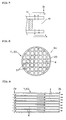
- Figs. 2 to 4 are view schematically showing other embodiments of a honeycomb catalyst body of the present invention, each showing a part of the front view (view of an end face). Specifically, Figs. 2 to 4 show examples of disposition of adjacent cells which are plugged on one plane (end faces) perpendicular to the cell extending direction.
- Each of the honeycomb catalyst bodies 310, 320, and 330 shown in Figs. 2 to 4 is constituted by a honeycomb structure (substrate) where the outer shape shown by the outer wall is cylindrical and where the inside structure is a honeycomb structure like the aforementioned honeycomb catalyst bodies 100 and 200.
- each of the honeycomb catalyst bodies 310, 320, and 330 is provided with porous partition walls 4 having a large number of pores and disposed so as to form a plurality of cells 3 extending between two end faces, a plurality of plugged portions 10 having a predetermined length and disposed so as to plug the plurality of cells 3 on the two end faces, and a catalyst layer containing a catalyst loaded in layers on a surface forming pores (pore-forming face) of the partition walls 4.
- Each of the aforementioned honeycomb catalyst bodies 100 and 200 has a cell density of several tens cells/cm 2 , and the cell density of each of the honeycomb catalyst bodies 310, 320, and 330 is almost the same as those of the aforementioned honeycomb catalyst bodies 100 and 200.
- a part of the cells is shown in Figs. 2 to 4 .
- a cylindrical honeycomb catalyst body having a diameter of 100 mm has several hundreds to several thousands of cells.
- the number of pairs of plugged cells 3 adjacent to each other shown by arrows on the end face shown in Fig. 2 is 20.
- the number of pairs of plugged cells 3 adjacent to each other shown by arrows on the end face shown in Fig. 3 is 18.
- the number of pairs of plugged cells 3 adjacent to each other shown by arrows on the end face shown in Fig. 4 is 67.
- a honeycomb catalyst body of the present invention can be manufactured by preparing a honeycomb structure according to a conventionally known production method of a diesel particulate filter (DPF) and loading a catalyst according to a conventionally known method. Concretely, catalyst slurry containing a catalyst is prepared in the first place, and then the catalyst slurry is coated on pore-forming surfaces of the partition walls of a honeycomb structure by a suction method or the like. Then, they are dried at room temperature or under heating conditions to obtain a honeycomb catalyst body of the present invention.
- DPF diesel particulate filter
- a cordierite-forming raw material prepared at a predetermined ratio of a combination of a plurality of components selected from the group consisting of talc, kaolin, calcined kaolin, alumina, calcium hydroxide, and silica so as to have a chemical composition of 42 to 56% by mass of SiO 2 , 0 to 45% by mass of Al 2 O 3 , and 12 to 16% by mass of MgO, 12 to 25 parts by mass of graphite as a pore former and 5 to 15 parts by mass of synthetic resin were added. Further, a suitable amount of methyl celluloses and surfactant were added, and then water was added. The mixture was kneaded to prepare clay.
- honeycomb formed body After the prepared clay was subjected to vacuum deaeration, it was subjected to extrusion forming to obtain a honeycomb formed body. After the honeycomb formed body was dried, it was fired at a maximum temperature of 1400 to 1430°C to obtain a honeycomb fired body.
- a plugging agent was plugged in the end portions of each of the cells of the honeycomb fired body so as to form a checkerwise pattern, and the honeycomb fired body was fired again to obtain a honeycomb structure having plugged portions plugging cells, the honeycomb structure having a diameter of 105.7 mm, a length of 114.2 mm, a volume of 1 liter, a partition wall thickness of 17 mil (0.432 mm), a cell density of 100 cells/inch 2 (15.5 cells/cm 2 ) according to Examples 1 to 8 and Comparative Example 1.
- the pores of the partition walls were formed by suitably adjusting combination and mixing ratio of a cordierite-forming raw material, a particle size of a cordierite-forming raw material, a particle diameter of the pore former, an amount of the pore former to be added, and the like.
- length of the plugged portions was deviated by adjusting an amount of the plugging agent to plug the cells.
- An each average length of the plugged portions described in Examples 1 to 8 and Comparative Example 1 is 8 mm.
- a length of the plugged portion was set constant (3 mm) and in step of plugging a plugging agent, plugging agent was press fitted toward the inner side of the cells to make face positions on the inner side of the cells to be same position as in Example 1. Therefore, when face positions on the inner side of the cells were located at the 8 mm position from the end face, for example, the cells had 5 mm long pocket from end face.
- a mixture (specific surface area of 50 m 2 /g by BET method, an initially grounded particle diameter of 50 ⁇ m) containing active ( ⁇ ) alumina and ceria as an oxygen adsorbent was subjected to wet grinding using a ball mill to obtain an average ground particle diameter of 5 ⁇ m. Then, Pt and Rh are loaded on fine pores of the wet-ground mixture to obtain catalyst slurry having Pt and Rh loaded thereon, having an average grounded particle diameter of 5 ⁇ m, and containing active ( ⁇ ) alumina. Then, a coat layer of the above-prepared catalyst slurry was formed on the surface of the partition walls and pore-forming surface of the honeycomb structured body obtained above by a suction method.
- a honeycomb catalyst body was manufactured.
- mass of the active ( ⁇ ) alumina and ceria per liter of the honeycomb structure was 100 g
- the amount of Pt per liter of the honeycomb structure was 1 g
- the amount of Rh per liter of the honeycomb structure was 0.2 g.
- honeycomb structures according to Examples 10 to 13 were obtained by adding further plugged portions to the state of a checkerwise pattern and making plugged portions adjacent to the original checkerwise pattern plugged portions to the honeycomb structure according to Examples 1.
- the honeycomb structure according to Examples 14 was obtained by adding plugged portions in the same manner to the honeycomb structure according to Example 9. The additional plugged portions were all disposed over 8 mm long span from end face. Except for thesepoints, a honeycomb catalyst body was manufactured in the same manner as in Examples 1 to 9 and Comparative Example 1.
- a honeycomb catalyst body of each of Examples 1 to 9 has high fracture temperature in comparison with a honeycomb catalyst body of Comparative Example 1 and shows excellent thermal resistance.
- Each of Examples 2 to 6 also achieved low pressure loss, above all Examples 3 to 6 had no pore clogging by particulate matters caused during engine endurance test and maintained low pressure loss after engine endurance test.
- a honeycomb catalyst body of each of Examples 10 and 11 has an excellent purification rate and small pressure loss in comparison with honeycomb catalyst bodies of Example 12 or 13.
- a honeycomb catalyst body of Example 14 also has an improved purification rate in comparison with a honeycomb catalyst body of Example 11.
- [Face position of plugged portion] The face position on the inner side of the cell is measured by inserting narrow round bar to the cell from an end face extending to the target end face (that is the end face located at distant side from the plugged portion).
- narrow round bar which is slightly narrower than cell diameter, is inserted from the end face extending to the inner side of the cell and when a tip of the bar reached to the inner side of the cell of the plugged portion and sopped, a length of the bar inserted in the honeycomb catalyst body is measured as a depth from the end face to the inner side of the cell. Then the depth is subtracted from the whole length of the honeycomb catalyst body and a face position of plugged portion is defined.
- diameter of a roundbar (inserted bar) has 60% length of cell length.
- a tip shape of the round bar (inserted bar) has the same shape of the cell cross-section.
- length of plugged portions is a distance from the end face measured by the above method.
- an each depth from both end faces is measured for one plugged portion and length of the plugged portions is calculated by subtracting the both depths from the whole length of the honeycomb catalyst body.
- Thermal shock test fracture temperature There was carried out a repeated thermal shock test by a method in which combustion gas generated by a propane gas burner and air at ordinary temperature were alternately sent into a honeycomb catalyst body. A test of checking presence or absence of a crack after the above test was carried out. With the heating conditions of a gas flow rate of 1.0 Nm 3 /min for ten minutes and the cooling conditions of a gas flow rate of 0.5 Nm 3 /min for ten minutes, temperature of the central portion of a honeycomb catalyst body was measured with a sheathed thermocouple having a diameter of 0.5 mm, and the temperature at which a crack was first generated was defined as the "thermal shock test fracture temperature".
- Purification rate Combustion gas consisting of 7% by volume of oxygen, 10% by volume of steam, 10% by volume of carbon dioxide, 200ppm of hydrocarbon (number of moles) , and nitrogen as the rest was sent into a honeycomb catalyst body under the conditions of a space velocity (SV) of 100000h -1 and a temperature of 200°C. Purification rate (%) was calculated from the hydrocarbon concentration of the combustion gas before and after flowing in the honeycomb catalyst body.
- SV space velocity
- a relative purification rate of after engine endurance test of each of Example 10 and a relative purification rate of initial and after engine endurance test of Examples 11 to 14 were obtained with defining the initial purification rate of Example 10 as 1.
- Pressure loss was measured with circulating air in a honeycomb catalyst body at a flow rate of 0 . 5m 3 /min under the condition of room temperature. With defining the pressure loss of Example 10 as 1, relative pressure loss of each of Examples 1 to 9, Examples 11 to 14 and Comparative Example 1 was obtained.
- a honeycomb catalyst body of the present invention is used by being incorporated into, for example, an exhaust gas treatment system as a catalyst converter in various kinds of industrial fields where purification of target components contained in exhaust gas. Particularly, it is effectively used in industrial fields such as the automobile industry, the machinery industry, the pottery industry, and the like, where purification of exhaust gas from an internal combustion engine, a combustion instrument, or the like, is required.
Landscapes
- Chemical & Material Sciences (AREA)
- Chemical Kinetics & Catalysis (AREA)
- Physics & Mathematics (AREA)
- Geometry (AREA)
- Engineering & Computer Science (AREA)
- Organic Chemistry (AREA)
- Materials Engineering (AREA)
- Combustion & Propulsion (AREA)
- Mechanical Engineering (AREA)
- General Engineering & Computer Science (AREA)
- Catalysts (AREA)
- Exhaust Gas Treatment By Means Of Catalyst (AREA)
- Exhaust Gas After Treatment (AREA)
Applications Claiming Priority (2)
| Application Number | Priority Date | Filing Date | Title |
|---|---|---|---|
| JP2006067562 | 2006-03-13 | ||
| PCT/JP2007/055001 WO2007105736A1 (fr) | 2006-03-13 | 2007-03-13 | Structure de catalyseur en nid d'abeille |
Publications (2)
| Publication Number | Publication Date |
|---|---|
| EP1997556A1 true EP1997556A1 (fr) | 2008-12-03 |
| EP1997556A4 EP1997556A4 (fr) | 2012-12-19 |
Family
ID=38509555
Family Applications (1)
| Application Number | Title | Priority Date | Filing Date |
|---|---|---|---|
| EP07738472A Withdrawn EP1997556A4 (fr) | 2006-03-13 | 2007-03-13 | Structure de catalyseur en nid d'abeille |
Country Status (4)
| Country | Link |
|---|---|
| US (1) | US20090047188A1 (fr) |
| EP (1) | EP1997556A4 (fr) |
| JP (1) | JP5202298B2 (fr) |
| WO (1) | WO2007105736A1 (fr) |
Cited By (4)
| Publication number | Priority date | Publication date | Assignee | Title |
|---|---|---|---|---|
| CN102574294A (zh) * | 2009-09-29 | 2012-07-11 | 日本碍子株式会社 | 蜂窝状结构体及其制造方法 |
| EP2130573A4 (fr) * | 2007-03-28 | 2013-11-20 | Ngk Insulators Ltd | Structure scellée en nid d'abeilles |
| US9333683B2 (en) | 2009-09-30 | 2016-05-10 | Ngk Insulators, Ltd. | Honeycomb structure and method for manufacturing the same |
| EP3530339A1 (fr) * | 2018-02-23 | 2019-08-28 | Volkswagen Aktiengesellschaft | Filtre à particules pour un moteur à combustion interne ainsi que procédé de fabrication d'un tel filtre à particules |
Families Citing this family (16)
| Publication number | Priority date | Publication date | Assignee | Title |
|---|---|---|---|---|
| DE102006051928A1 (de) * | 2006-11-03 | 2008-05-15 | Robert Bosch Gmbh | Filterelement, insbesondere zur Filterung von Abgasen einer Brennkraftmaschine |
| EP2318673B1 (fr) | 2008-02-05 | 2019-09-18 | BASF Corporation | Systèmes de traitement des émissions de moteur à essence comportant des pièges à particules |
| GB0903642D0 (en) * | 2009-02-27 | 2009-09-30 | Bae Systems Plc | Electroless metal deposition for micron scale structures |
| IT1398464B1 (it) * | 2010-02-02 | 2013-02-22 | Microtec Srl | Tubo radiogeno |
| US8815189B2 (en) | 2010-04-19 | 2014-08-26 | Basf Corporation | Gasoline engine emissions treatment systems having particulate filters |
| JP5601957B2 (ja) * | 2010-10-12 | 2014-10-08 | 住友化学株式会社 | チタン酸アルミニウム質ハニカム構造体 |
| US20130085062A1 (en) * | 2011-09-30 | 2013-04-04 | Uchicago Argonne, Llc | Novel formulation of hexa-aluminates for reforming fuels |
| JP5990092B2 (ja) * | 2012-11-27 | 2016-09-07 | 日本碍子株式会社 | ハニカム触媒体 |
| JP6200212B2 (ja) * | 2012-12-03 | 2017-09-20 | 日本碍子株式会社 | ハニカム触媒体 |
| US9566552B2 (en) | 2014-04-07 | 2017-02-14 | Ford Global Technologies, Llc | Temperature maintenance and regulation of vehicle exhaust catalyst systems with phase change materials |
| US9181838B2 (en) | 2014-04-07 | 2015-11-10 | Ford Global Technologies, Llc | Temperature maintenance and regulation of vehicle exhaust catalyst systems with phase change materials |
| JP6174517B2 (ja) * | 2014-05-02 | 2017-08-02 | 日本碍子株式会社 | ハニカム構造体 |
| JP7217190B2 (ja) * | 2019-03-29 | 2023-02-02 | 日本碍子株式会社 | ハニカムフィルタ |
| GB202002983D0 (en) * | 2020-03-02 | 2020-04-15 | Diesekt3 Ltd | Components and assemblies for treating exhaust emissions |
| JP7332530B2 (ja) * | 2020-04-21 | 2023-08-23 | トヨタ自動車株式会社 | 排ガス浄化装置 |
| WO2025154200A1 (fr) * | 2024-01-17 | 2025-07-24 | 日産自動車株式会社 | Filtre à particules d'échappement de type à chauffage électrique |
Family Cites Families (16)
| Publication number | Priority date | Publication date | Assignee | Title |
|---|---|---|---|---|
| JP3012167B2 (ja) * | 1995-04-12 | 2000-02-21 | 日本碍子株式会社 | 排ガス浄化フィルタおよびそれを用いた排ガス浄化装置 |
| JPH1076141A (ja) * | 1996-09-02 | 1998-03-24 | Toyota Motor Corp | 排気ガス浄化用触媒 |
| JP5189236B2 (ja) | 2001-07-25 | 2013-04-24 | 日本碍子株式会社 | 排ガス浄化用ハニカム構造体及び排ガス浄化用ハニカム触媒体 |
| JP4279497B2 (ja) * | 2002-02-26 | 2009-06-17 | 日本碍子株式会社 | ハニカムフィルタ |
| JP3971215B2 (ja) * | 2002-03-13 | 2007-09-05 | 日本碍子株式会社 | 排ガス浄化用フィルター |
| JP3867976B2 (ja) * | 2002-03-29 | 2007-01-17 | 日立金属株式会社 | セラミックハニカムフィルタ及び排気ガス浄化方法 |
| US7107763B2 (en) * | 2002-03-29 | 2006-09-19 | Hitachi Metals, Ltd. | Ceramic honeycomb filter and exhaust gas-cleaning method |
| JP4285096B2 (ja) * | 2003-06-16 | 2009-06-24 | 株式会社デンソー | 内燃機関の排ガス浄化装置 |
| JPWO2005045207A1 (ja) * | 2003-11-06 | 2007-05-17 | 日立金属株式会社 | セラミックハニカムフィルタ、排気ガス浄化装置及び排気ガス浄化方法 |
| JP2005169308A (ja) * | 2003-12-12 | 2005-06-30 | Ngk Insulators Ltd | ハニカムフィルタ及びその製造方法 |
| JP2005296936A (ja) * | 2004-02-12 | 2005-10-27 | Hitachi Metals Ltd | セラミックハニカムフィルタ及び排気ガス浄化装置 |
| JP4737594B2 (ja) * | 2004-02-18 | 2011-08-03 | 日立金属株式会社 | セラミックハニカムフィルタ |
| JP2005344581A (ja) * | 2004-06-02 | 2005-12-15 | Hino Motors Ltd | パティキュレートフィルタ |
| WO2006068256A1 (fr) * | 2004-12-22 | 2006-06-29 | Hitachi Metals, Ltd. | Procede de fabrication de filtre en nid d’abeille et filtre en nid d’abeille |
| US7867598B2 (en) * | 2005-08-31 | 2011-01-11 | Ngk Insulators, Ltd. | Honeycomb structure and honeycomb catalytic body |
| JPWO2007066671A1 (ja) * | 2005-12-07 | 2009-05-21 | 日本碍子株式会社 | ハニカム構造体及びその製造方法 |
-
2007
- 2007-03-13 JP JP2008505170A patent/JP5202298B2/ja active Active
- 2007-03-13 EP EP07738472A patent/EP1997556A4/fr not_active Withdrawn
- 2007-03-13 WO PCT/JP2007/055001 patent/WO2007105736A1/fr not_active Ceased
-
2008
- 2008-09-08 US US12/206,524 patent/US20090047188A1/en not_active Abandoned
Cited By (7)
| Publication number | Priority date | Publication date | Assignee | Title |
|---|---|---|---|---|
| EP2130573A4 (fr) * | 2007-03-28 | 2013-11-20 | Ngk Insulators Ltd | Structure scellée en nid d'abeilles |
| CN102574294A (zh) * | 2009-09-29 | 2012-07-11 | 日本碍子株式会社 | 蜂窝状结构体及其制造方法 |
| EP2484504A4 (fr) * | 2009-09-29 | 2013-04-17 | Ngk Insulators Ltd | Structure de nid d'abeilles et procédé pour sa fabrication |
| CN102574294B (zh) * | 2009-09-29 | 2014-11-05 | 日本碍子株式会社 | 蜂窝状结构体及其制造方法 |
| US9333683B2 (en) | 2009-09-30 | 2016-05-10 | Ngk Insulators, Ltd. | Honeycomb structure and method for manufacturing the same |
| EP3530339A1 (fr) * | 2018-02-23 | 2019-08-28 | Volkswagen Aktiengesellschaft | Filtre à particules pour un moteur à combustion interne ainsi que procédé de fabrication d'un tel filtre à particules |
| US10918987B2 (en) | 2018-02-23 | 2021-02-16 | Volkswagen Aktiengesellschaft | Particulate filter for an internal combustion engine and method for producing such a particulate filter |
Also Published As
| Publication number | Publication date |
|---|---|
| EP1997556A4 (fr) | 2012-12-19 |
| JP5202298B2 (ja) | 2013-06-05 |
| WO2007105736A1 (fr) | 2007-09-20 |
| JPWO2007105736A1 (ja) | 2009-07-30 |
| US20090047188A1 (en) | 2009-02-19 |
Similar Documents
| Publication | Publication Date | Title |
|---|---|---|
| EP1997556A1 (fr) | Structure de catalyseur en nid d'abeille | |
| US7867598B2 (en) | Honeycomb structure and honeycomb catalytic body | |
| US8283282B2 (en) | Ceramic structure and process for producing the same | |
| US7503957B2 (en) | Honeycomb structure, method of manufacturing the same, die for forming, and discharge fluid purification system | |
| US7695798B2 (en) | Honeycomb structure and honeycomb catalyst | |
| JP4971166B2 (ja) | ハニカム触媒体、ハニカム触媒体製造用のプレコート担体及びハニカム触媒体の製造方法 | |
| EP1839748B1 (fr) | Corps catalytique en nid d'abeille | |
| US8609581B2 (en) | Honeycomb structure and honeycomb catalytic body | |
| US9175587B2 (en) | Substrate with surface-collection-layer and catalyst-carrying substrate with surface-collection-layer | |
| EP2236188B1 (fr) | Corps de catalyseur en nid d'abeille | |
| JPWO2007094379A1 (ja) | ハニカム構造体及びハニカム触媒体 | |
| US7754160B2 (en) | Honeycomb catalytic body and process for manufacturing honeycomb catalytic body | |
| EP2495027A1 (fr) | Structure en nid d'abeille et dispositif de purification de gaz d'échappement | |
| EP2058042B1 (fr) | Filtre céramique en nid d'abeilles | |
| EP2915572A1 (fr) | Structure en nid-d'abeilles et dispositif de traitement de gaz l'utilisant | |
| JP2005144250A (ja) | ハニカム構造体 | |
| JP5452943B2 (ja) | ハニカム構造体、及びハニカム触媒体 | |
| EP2368621B1 (fr) | Structure en nid d'abeille |
Legal Events
| Date | Code | Title | Description |
|---|---|---|---|
| PUAI | Public reference made under article 153(3) epc to a published international application that has entered the european phase |
Free format text: ORIGINAL CODE: 0009012 |
|
| 17P | Request for examination filed |
Effective date: 20081001 |
|
| AK | Designated contracting states |
Kind code of ref document: A1 Designated state(s): DE FR |
|
| DAX | Request for extension of the european patent (deleted) | ||
| RBV | Designated contracting states (corrected) |
Designated state(s): DE FR |
|
| A4 | Supplementary search report drawn up and despatched |
Effective date: 20121121 |
|
| RIC1 | Information provided on ipc code assigned before grant |
Ipc: F01N 3/28 20060101ALI20121115BHEP Ipc: B01D 53/86 20060101ALI20121115BHEP Ipc: B01J 35/04 20060101AFI20121115BHEP |
|
| STAA | Information on the status of an ep patent application or granted ep patent |
Free format text: STATUS: THE APPLICATION IS DEEMED TO BE WITHDRAWN |
|
| 18D | Application deemed to be withdrawn |
Effective date: 20130621 |