EP1998065A2 - Système de couplage de compresseur pour une installation de traitement d'air comprimé - Google Patents
Système de couplage de compresseur pour une installation de traitement d'air comprimé Download PDFInfo
- Publication number
- EP1998065A2 EP1998065A2 EP08009346A EP08009346A EP1998065A2 EP 1998065 A2 EP1998065 A2 EP 1998065A2 EP 08009346 A EP08009346 A EP 08009346A EP 08009346 A EP08009346 A EP 08009346A EP 1998065 A2 EP1998065 A2 EP 1998065A2
- Authority
- EP
- European Patent Office
- Prior art keywords
- clutch
- release
- housing
- status
- compressed air
- Prior art date
- Legal status (The legal status is an assumption and is not a legal conclusion. Google has not performed a legal analysis and makes no representation as to the accuracy of the status listed.)
- Granted
Links
- 230000008878 coupling Effects 0.000 title claims description 33
- 238000010168 coupling process Methods 0.000 title claims description 33
- 238000005859 coupling reaction Methods 0.000 title claims description 33
- 238000000034 method Methods 0.000 claims abstract description 25
- 238000013022 venting Methods 0.000 claims abstract description 7
- 230000005540 biological transmission Effects 0.000 claims description 5
- 238000003825 pressing Methods 0.000 claims description 5
- 238000012544 monitoring process Methods 0.000 claims description 4
- 230000008929 regeneration Effects 0.000 description 21
- 238000011069 regeneration method Methods 0.000 description 21
- 230000007246 mechanism Effects 0.000 description 8
- 230000001276 controlling effect Effects 0.000 description 5
- 230000007547 defect Effects 0.000 description 5
- 239000002274 desiccant Substances 0.000 description 5
- 238000010586 diagram Methods 0.000 description 5
- 239000000725 suspension Substances 0.000 description 4
- 238000002360 preparation method Methods 0.000 description 3
- XLYOFNOQVPJJNP-UHFFFAOYSA-N water Substances O XLYOFNOQVPJJNP-UHFFFAOYSA-N 0.000 description 3
- 241001295925 Gegenes Species 0.000 description 2
- 230000008859 change Effects 0.000 description 2
- 238000002485 combustion reaction Methods 0.000 description 2
- 238000012937 correction Methods 0.000 description 2
- 230000006378 damage Effects 0.000 description 2
- 230000007423 decrease Effects 0.000 description 2
- 238000001514 detection method Methods 0.000 description 2
- 230000000694 effects Effects 0.000 description 2
- 210000003746 feather Anatomy 0.000 description 2
- 230000008014 freezing Effects 0.000 description 2
- 238000007710 freezing Methods 0.000 description 2
- 230000008569 process Effects 0.000 description 2
- 108010053481 Antifreeze Proteins Proteins 0.000 description 1
- 208000027418 Wounds and injury Diseases 0.000 description 1
- 230000002528 anti-freeze Effects 0.000 description 1
- 230000000903 blocking effect Effects 0.000 description 1
- 230000009172 bursting Effects 0.000 description 1
- 238000004140 cleaning Methods 0.000 description 1
- 238000004891 communication Methods 0.000 description 1
- 238000011157 data evaluation Methods 0.000 description 1
- 230000002950 deficient Effects 0.000 description 1
- 230000001419 dependent effect Effects 0.000 description 1
- 230000001066 destructive effect Effects 0.000 description 1
- 238000011161 development Methods 0.000 description 1
- 230000018109 developmental process Effects 0.000 description 1
- 238000011156 evaluation Methods 0.000 description 1
- 230000017525 heat dissipation Effects 0.000 description 1
- 238000010438 heat treatment Methods 0.000 description 1
- 230000000977 initiatory effect Effects 0.000 description 1
- 208000014674 injury Diseases 0.000 description 1
- 239000002655 kraft paper Substances 0.000 description 1
- 238000005457 optimization Methods 0.000 description 1
- 238000012545 processing Methods 0.000 description 1
- 238000010926 purge Methods 0.000 description 1
- 230000009467 reduction Effects 0.000 description 1
- 230000001105 regulatory effect Effects 0.000 description 1
- 230000004044 response Effects 0.000 description 1
- 238000005096 rolling process Methods 0.000 description 1
- 238000003860 storage Methods 0.000 description 1
- 230000001360 synchronised effect Effects 0.000 description 1
Images




Classifications
-
- B—PERFORMING OPERATIONS; TRANSPORTING
- B60—VEHICLES IN GENERAL
- B60T—VEHICLE BRAKE CONTROL SYSTEMS OR PARTS THEREOF; BRAKE CONTROL SYSTEMS OR PARTS THEREOF, IN GENERAL; ARRANGEMENT OF BRAKING ELEMENTS ON VEHICLES IN GENERAL; PORTABLE DEVICES FOR PREVENTING UNWANTED MOVEMENT OF VEHICLES; VEHICLE MODIFICATIONS TO FACILITATE COOLING OF BRAKES
- B60T17/00—Component parts, details, or accessories of power brake systems not covered by groups B60T8/00, B60T13/00 or B60T15/00, or presenting other characteristic features
- B60T17/18—Safety devices; Monitoring
- B60T17/22—Devices for monitoring or checking brake systems; Signal devices
- B60T17/221—Procedure or apparatus for checking or keeping in a correct functioning condition of brake systems
-
- F—MECHANICAL ENGINEERING; LIGHTING; HEATING; WEAPONS; BLASTING
- F16—ENGINEERING ELEMENTS AND UNITS; GENERAL MEASURES FOR PRODUCING AND MAINTAINING EFFECTIVE FUNCTIONING OF MACHINES OR INSTALLATIONS; THERMAL INSULATION IN GENERAL
- F16D—COUPLINGS FOR TRANSMITTING ROTATION; CLUTCHES; BRAKES
- F16D25/00—Fluid-actuated clutches
- F16D25/08—Fluid-actuated clutches with fluid-actuated member not rotating with a clutching member
- F16D25/082—Fluid-actuated clutches with fluid-actuated member not rotating with a clutching member the line of action of the fluid-actuated members co-inciding with the axis of rotation
- F16D25/083—Actuators therefor
-
- F—MECHANICAL ENGINEERING; LIGHTING; HEATING; WEAPONS; BLASTING
- F16—ENGINEERING ELEMENTS AND UNITS; GENERAL MEASURES FOR PRODUCING AND MAINTAINING EFFECTIVE FUNCTIONING OF MACHINES OR INSTALLATIONS; THERMAL INSULATION IN GENERAL
- F16D—COUPLINGS FOR TRANSMITTING ROTATION; CLUTCHES; BRAKES
- F16D48/00—External control of clutches
- F16D48/02—Control by fluid pressure
-
- F—MECHANICAL ENGINEERING; LIGHTING; HEATING; WEAPONS; BLASTING
- F16—ENGINEERING ELEMENTS AND UNITS; GENERAL MEASURES FOR PRODUCING AND MAINTAINING EFFECTIVE FUNCTIONING OF MACHINES OR INSTALLATIONS; THERMAL INSULATION IN GENERAL
- F16D—COUPLINGS FOR TRANSMITTING ROTATION; CLUTCHES; BRAKES
- F16D48/00—External control of clutches
- F16D48/06—Control by electric or electronic means, e.g. of fluid pressure
- F16D48/066—Control of fluid pressure, e.g. using an accumulator
Definitions
- the invention relates to a coupling system for a compressor of a compressed air treatment plant, wherein the clutch system comprises: a clutch housing, a clutch disc for transmitting a torque of a drive side to a pressure plate of a driven side, a release piston for pneumatic disengagement of the clutch, a clutch spring for pressing the clutch disc to the Pressure plate, an electrically actuated clutch switching valve for venting a release piston associated with the working volume, an electronic control unit for controlling the clutch in dependence on various system parameters and a release bearing for supporting a drive shaft and for transmitting the force exerted by the release piston on the clutch disc in the axial direction.
- the invention further relates to a method for controlling a clutch system for a compressor of a compressed air treatment system, wherein the clutch system comprises: a clutch housing, a clutch disc for transmitting a torque of a drive side to a pressure plate of a driven side, a release piston for pneumatic disengagement of the clutch, a clutch spring for Pressing the clutch disc to the pressure plate, an electrically actuated clutch switching valve for venting a release piston associated working volume, an electronic control unit for controlling the clutch as a function of various system parameters and a release bearing for supporting a drive shaft and for transmitting the release piston on the clutch disc in the axial Direction of applied force.
- the clutch system comprises: a clutch housing, a clutch disc for transmitting a torque of a drive side to a pressure plate of a driven side, a release piston for pneumatic disengagement of the clutch, a clutch spring for Pressing the clutch disc to the pressure plate, an electrically actuated clutch switching valve for venting a release piston associated working volume, an electronic control unit for controlling the clutch
- Modern commercial vehicles usually have a compressed air supply system that provides cleaned and dried compressed air for various systems of the commercial vehicle.
- the service brakes and any existing air suspension of the commercial vehicle are supplied by the compressed air treatment plant.
- a control device for controlling the electric solenoid valves and the evaluation of the sensor signals can be integrated.
- the solenoid valves can alternatively be controlled by an external control device according to various system parameters.
- Such controllers receive additional system parameters via a serial communication port, for example the CAN bus.
- data of the service brake and any existing air suspension of the compressed air processing system can be transmitted.
- the compressed air treatment plant itself receives the not yet cleaned and dried compressed air from a connected compressor.
- the energy for operating the compressor can be transmitted in a simple manner via a shaft from the drive motor of the commercial vehicle to the compressor.
- a clutch may be provided between the drive motor and the compressor to permit decoupling of the compressor and the drive. This is desirable because the operation of the compressor consumes energy that can be saved when no compressed air is needed or when the existing compressed air supply can cover the compressed air demand of the consumer for some time.
- Intelligent compressed air preparation systems can optimize the switching losses in city traffic and thereby reduce the overall load on the clutch. In particular, they control an optimization of the regeneration process and a use of passive deceleration phases. At a Passive shear-phase utilization is promoted to a higher pressure in a funding phase, if the commercial vehicle has a positive thrust moment. A typical feature of this is an active retarder consisting of engine brake and possibly active retarder brakes. By contrast, active overrun phases are suppressed by software because they would double the load on the clutch and would therefore have a destructive effect on prior art clutches and thus reduce the life of these systems.
- the dimensions of the installed components should continue to be kept as low as possible, which leads to a reduction of individual components, such as valves and reservoirs. Furthermore, the required pressure level continues to rise as a result of the smaller number of actuators.
- high-performance or high-pressure compressors with increasing transmission ratio that is, increasing number of revolutions, are integrated into the commercial vehicle. As a result, the clutch is also more heavily loaded, as it has to transmit ever greater forces to the compressor.
- Generic couplings usually have two switching states. In the open disengaged state, the release piston lifts the clutch disc from the pressure plate, the position of all components of the clutch is uniquely determined. When closed, the clutch spring presses the clutch disc against the pressure plate and the release piston is vented. The exact position of the release piston is known in the engaged state only to a so-called release bearing clearance, which allows axial movement of the release piston without the clutch opens. However, the bearing clearance in the compressor clutch increases the switching time of the clutch and destroys the release system, especially during frequent load changes. Furthermore, these clutches are subject by their pure pneumatic control of increased load.
- the invention has for its object to suppress the Ausschlagerspiel by simple mechanical elements to the life of the clutch despite frequent switching operations to increase and thus enable energy-saving modes of compressor and compressed air supply device with high air consumption.
- the invention builds on the generic coupling system characterized in that the clutch spring presses the release bearing in the engaged state of the clutch against a housing-side stop, thus preventing a Ausschlagerspiel.
- the clutch spring not only pushes the clutch disc against the pressure plate. It transmits force to the release piston via the clutch mechanism that uses the release piston to disengage the clutch disc. With a suitable dimensioning of the spring, it can press the release piston against a housing-side stop and fix it in a play-free position.
- the invention can be based on the generic coupling in that at least one compensation spring is provided, which prevents a striking of the release bearing on the clutch housing in the engaged state of the clutch. If, instead of a housing-side stop at least one compensation spring is provided, this can also be used in the engaged state of the clutch to a backlash-free fixation of the release piston.
- the release piston is held by the at least one compensation spring and the clutch spring, with the spring forces just compensate.
- Ausschlagerspiels lowers the necessary switching time of the clutch, which among other things causes a lower wear of the clutch disc.
- the release bearing is subjected to less stress each shift of the clutch, whereby an early failure of the clutch is avoided by a knockout release bearing. Due to the improved stability of the clutch, new energy-saving operating modes for the compressed air supply device and the compressor possible, which were previously not feasible because of the additional coupling load occurring.
- a consisting of at least one nose and at least one corresponding recess guide is arranged which prevents rotation of the release piston to the drive axis, said at least one nose in the on and in the disengaged state at least partially remains in the recess.
- the clutch switching valve is supplied redundantly from two independent forward reservoirs of the service brake circuits. Due to the redundant supply of the clutch switching valve, the operation of the clutch is possible in case of failure of one of the two service brake circuits. This is advantageous since the braking power of a service brake circuit can usually provide the necessary auxiliary braking power and no further functional restrictions of the clutch are necessary until the defective service brake circuit is repaired.
- the switching valves of the compressed air supply device can advantageously also be supplied redundantly from one of the non-return valves arranged downstream of the check valves.
- the system pressure required for opening or closing the clutch is measured with a pressure sensor downstream of an overflow valve.
- a pressure sensor downstream of an overflow valve avoids the effects of the compressor, such as pressure peaks that may occur during the promotion of the overflow valves and thus avoids accidental termination of the delivery phase.
- control unit measures an ambient temperature with a temperature sensor or an ambient temperature is transmitted to the control unit.
- the temperature information can be used as an indicator of the risk of freezing the delivery line. If the delivery line freezes, the compressor promotes excessive pressure, which causes the clutch to drag.
- the clutch system is arranged in a commercial vehicle together with a compressor and a compressed air supply device, which enables energy saving and clutch monitoring operation.
- FIG. 1 shows a coupling according to the invention between an engine 10 and a compressor 200 together with an engine control unit 100 to which via electrical connection lines 22, 90 two speed sensors 20, 180 are connected.
- the clutch comprises a clutch housing 30, a clutch plate 242, a pressure plate 240, a clutch spring 210, a clutch mechanism 250, a clutch cover 252, a release bearing 220, which is usually a rolling bearing with a rotating bearing ring and a stationary bearing ring which is equipped with a release piston 40 is coupled, a guide 34, an arranged on the clutch housing 30 electrically actuated clutch switching valve 70, a working volume 60 and arranged in the working volume 60 compensation spring 50.
- the clutch housing 30 may also be at least partially integrated into the compressor housing.
- the release bearing 220 optionally comprises an intermediate element or an intermediate disc between the stationary bearing ring and the release piston 40 and forms together with the release piston a so-called release system which is axially displaceable.
- the illustrated coupling can assume two defined states, namely on or disengaged, closed or opened.
- the engine control unit 100 can control the electrically switched clutch switching valve 70 via an electrical line 80 and thus the clutch between convict both states.
- FIG. 1 shown is the engaged state, wherein the working volume 60 of the release piston 40 is vented.
- the release piston 40 via the release bearing 220 and the clutch mechanism 250 exerts no force on the clutch plate 242, which is frictionally pressed by the clutch spring 210 against the pressure plate 240.
- a torque transmitted from the engine 10 via the drive shaft 232 to the clutch disk 242 is absorbed by the pressure plate 240 and transmitted via the output shaft 230 to the compressor 200.
- the clutch switching valve 70 is advantageously arranged directly on the clutch housing 30, in order to be able to use these by a rapid venting of the working volume 60 when a short thrust phase occurs.
- the arrangement of the electric clutch switching valve 70 on the clutch housing thus reduces the switching time of the clutch. In addition, this positioning decreases the likelihood of leakage, as the line between the clutch switching valve 70 and working volume 60 is reduced.
- the clutch housing 30 is also cooler than the cylinder head of the compressor 200.
- the clutch housing may also be the crankcase of the compressor 200 for better heat dissipation.
- the use of an eletrically actuated clutch switching valve 70 allows by its fast switching time only the clutch-friendly energy-saving modes and safety functions, which will be described in more detail below.
- the engine control unit 100 energizes the clutch switching valve 70 and via a pressure supply line, not shown, the working volume 60 of the working piston 40 is pressurized. Thereby, the working piston 40 is moved together with the release bearing 220 in the axial direction along the drive shaft 232 to the clutch disc 242.
- the clutch mechanism 250 redirects the resulting forces and the clutch disc 242 is disengaged against the contact force of the clutch spring 210.
- the contact between clutch disk 242 and pressure plate 240 ends and the torque applied by the engine 10 is no longer transmitted to the compressor 200.
- the pressure needed to disengage the clutch system is less than the cutoff pressure to protect the components, eg the seal between release piston and compressor.
- a guide 34 consisting of a nose and a recess between the release bearing 220 and the housing stop 32.
- This guide allows only an axial movement of the release piston 40, so in particular avoids a seal between the release piston 40 and the clutch housing 30 wear-rotating rotational movement of the release piston 40 which would permanently lead to a leakage of the working volume 60.
- the nose of the guide 34 in the axial direction of the release bearing 220 may be facing away from the clutch disc and are received by the provided in the region of the housing stop 32 in the clutch housing 30 corresponding recess. Nose and recess are matched to one another such that the nose at least partially remains in the recess in the open and closed state of the clutch.
- the lugs and the associated recesses can be distributed uniformly around the release bearing 220. It is also possible to attach the nose or tabs to the housing 30 and the associated recesses on one of the axially movable disengagement elements, i. Release bearing 220 or release piston 40 to arrange.
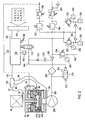
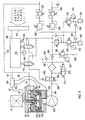
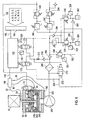
- FIGS. 2 to 7 each show a compressed air supply device in various embodiments together with in FIG. 1 described assembly of engine 10, compressor 200 and clutch.
- the compressed air supply device comprises a control unit 130 which is connected to the engine control unit 100 via a serial line 110, a data filter 160 which transmits the data received from the CAN bus filtered via a data bus 150 to the control unit 130, a temperature sensor 140, a multi-circuit protection valve for secure supply consisting of several consumer groups Overflow valves 330, 332, 334, 336, 338, 340, 342 and 344, pressure sensors 320, 322 and 324, reservoirs 350, 352 and check valves 390, 392.
- the compressed air supply device comprises a plurality of solenoid valves, an air filter cartridge 280, a plurality of check valves and a throttle 312, wherein the exact arrangement or number may vary depending on the embodiment.
- the engine control unit 100 may alternatively be integrated in the control unit 130 of the compressed air supply device, which saves the serial line 110. Therefore, the distinction between engine controller 100 and controller 130 for switching the clutch switching valve 70 is not always met.
- FIG. 2 illustrated embodiment has a check valve 290, which prevents backflow of the cleaned and dried air through the feed cartridge 280.
- a solenoid valve 170 is provided as a regeneration valve, which is switched by the controller 130 and which allows a bypass of the check valve 290, wherein a throttle 312 and another check valve 310 is provided in the bypass.
- a discharge valve 270 is controlled synchronously via a pneumatic control line 300 during the switching of the solenoid valve 170.
- the discharge valve 270 is closed in the pressureless state by a spring 272 and can act through the pilot line 274 as overpressure protection of the delivery line 260.
- the switching valves 170 and 172 can advantageously also be supplied redundantly from a line downstream of the check valves 390, 392 on the output side.
- the compressed air treatment system comprises a further solenoid valve 172, which is switched by the control unit 130 and the drain valve 270 via a pneumatic control line 300 switches.
- the drain valve 270 and the regeneration valve 170 may be independently switched in this embodiment.
- FIG. 4 includes in addition to the valves already mentioned a so-called TCO valve 362.
- the TCO valve 372 which is capable of blocking the delivery line 260.
- the TCO valve 362 In the depressurized state, the TCO valve 362 is held open by a spring 366.
- the drain valve 270 analogous to FIG. 2 , switched in synchronism with the regeneration valve 170. If the TCO valve 362 is closed simultaneously with the initiation of the regeneration cycle of the air filter cartridge 280, the pressure in the delivery line 260 can be maintained and less compressed air is lost.
- the compressor 200 is also disengaged and / or unloaded, since no delivery of compressed air can take place.
- the TCO valve 362 acts through a pilot line 364 as a pressure relief valve for the closed conveyor line 260th
- FIG. 5 shows a further embodiment of a compressed air supply device initially identical to the in FIG. 3 shown embodiment.
- the solenoid valve 170 controls a further solenoid valve 370, which controls a so-called ESS booster valve 372 via a control line 374 to relieve the compressor 200.
- ESS booster valve 372 controls a so-called ESS booster valve 372 via a control line 374 to relieve the compressor 200.
- a large amount of air should be allowed to pass through the air dryer cartridge 280 during a short regeneration cycle.
- an ESS switching system with a 2/2-way booster valve in the compressor 200 should be implemented to achieve the required short response times of the energy saving system
- FIGS. 6 and 7 show embodiments of a compressed air treatment plant, which again largely with the in FIG. 3 illustrated embodiment are identical. Unlike the in FIG. 3 However, the drain valve 270 is switched synchronously with the solenoid valve 170 in the illustrated embodiment. However, in the FIGS. 6 and 7 a control line 368 is shown, which controls the drain valve 270 and realized in two different ways of a pressure relief and a priority circuit.
- the received data is filtered by the data filter 160 and transmitted via the data bus 150 to the controller 130 to control the further operation of the compressed air supply device and the clutch based on the received and determined data.
- the pressure will increase or an increasing pressure gradient is expected. This is monitored during an adjustable time interval, taking into account system air withdrawals as far as they are displayed via the CAN bus, for example from the air suspension or the brake. If the check is positive, the clutch switching valve 70 is vented and the status of the clutch switching valve 70 is communicated to other control devices, for example via the CAN bus.
- the clutch closes and the system begins to deliver.
- the clutch switching valve 70 is vented and the solenoid valve 170 and the drain valve 270 is closed.
- the coupling status is displayed.
- the system data indicates, for example, a container change operation of the vehicle or a concrete mixer cleaning operation.
- the controller 130 will cause an increase in the speed of the engine 10. If the desiccant limit is reached, an intermediate regeneration may be initiated if necessary.
- a method for reducing wear of the clutch linings comprises as input a detected over an adjustable time interval permanent engagement and disengagement of the clutch.
- the high fretting wear would destroy the clutch linings early in case of ongoing switching operations.
- the controller 130 will disable the clutch operation via the clutch shift valve 70, ie, vent the clutch shift valve 70 and permanently close the clutch, and make the system pressure control via the dump valve 270.
- the number limits the switching operations of the coupling system and thus increases the overall service life.
- the clutch switching valve 70 is initially driven multiple times to ensure that the release piston 40 is stuck. If this is the case, the clutch switching valve 70 is deactivated, d. H. vented and the clutch permanently closed, and pressure control of the system pressure via the drain valve 270 made. Furthermore, a warning information is output, for example by a warning lamp, and special functions of the clutch, for example an active overrun control, are switched off.
- the clutch switching valve 70 is detected upon detection of a line break or seal leakage between the clutch switching valve 70 and the clutch switched off, ie vented and the clutch permanently closed.
- the control unit 130 takes the pressure sensors 320, 322, 324 to the aid, wherein the clutch switching valve 70 is switched several times to ensure that the error is at the connection between the clutch switching valve 70 and the working volume 60 or a leakage of the working volume 60 itself.
- the leakage increases the number of load cycles between conveying and not conveying and the coupling is permanently destroyed. Compare to this the error mode with increased leakage.
- the clutch switching valve 70 is switched off, ie vented and the clutch permanently closed, and the pressure regulated by a pressure regulator or the drain valve 270. Furthermore, a warning information is output, for example by a warning lamp, and special functions, for example an active overrun control, are switched off.
- Engine speed and compressor speed are compared. If both variables deviate from each other in the closed state of the clutch, the cut-off pressure is gradually reduced until no noticeable slip occurs in the clutch, that is, the engine speed coincides with the compressor speed. Furthermore, a warning information is output, for example by a warning lamp.
- the lowering of the compressor shut-off pressure level can be done to the auxiliary brake pressure level if necessary. Without this function, the clutch would have to be permanently disconnected in order to prevent the coupling from being destroyed, with the result that there would be no further delivery and only the compressed air stored in the storage containers would be available. The vehicle would then, in Result of greatly reduced braking effect due to lack of pressure, pulled out of traffic or ensured.
- the compressor is turned on during the shutdown phase for intermediate delivery to prevent icing of the supply line 260.
- the dump valve 270 With simultaneous opening of the drain valve 270 while the system pressure does not increase. It is also possible to parameterize a further cutoff pressure level for this condition, the dump valve 270 then remains closed.
- the system determines an average temperature from the measured temperatures of the heat sources, which may affect the temperature of the delivery line 260.
- the system learns the course of the relationship between the duty cycle of the engine and the duty cycle of the compressor and the outside temperature and compares the determined size with the measured internal temperature of the air dryer, which is measured by the temperature sensor 140, which also for the control of a not shown Heating is responsible.
- a possibly present TCO valve 362 is first opened together with the discharge valve 270 in order to blow out water 260 which may be present in the delivery line.
- the drain valve 270 is opened cyclically for purging the delivery line 260.
- compressed air 200 can additionally be conveyed through the compressor 200 during the blow-out, in order not only to use the compressed air stored in the delivery line 260 for rinsing. If the vehicle has been switched off and the engine switched off, then the overrun regeneration for the anti-freeze function is also evaluated. The duration of the shutdown is included. The fact that the delivery line is under pressure, more water drops during TCO operation during the idle phase.
- the drain valve 270 takes over the pressure control of the system.
- One method for increased system leakage fault operation includes the duty cycle of the compressor as an input.
- a leakage in one of the circuits causes a permanent opening and closing of the clutch, which would permanently destroy the clutch.
- a warning information is output, for example by a warning lamp.
- the time correction factor can be parameterised, depending on the remaining service life of the desiccant, and it depends on the total amount of filtered and dried air.
- the delivered air quantity can be determined via the compressor 200, wherein the volume of the delivery line 260 is withdrawn since the air in the delivery line 260 has not yet been dried.
- the aim of the optimized regeneration operation is an additional energy saving and at the same time avoiding unnecessary load changes of the coupling system to extend the overall service life.
- the clutch is always disconnected when the cut-off pressure is reached.
- the drain valve 270 is opened only when regeneration of the filter cartridge 280 is absolutely necessary. In particular, the drain valve is thus not opened in each idling phase, whereby switching losses are reduced.
- the drain valve 270 and the clutch switching valve 70 are thus switched asynchronous.
- controller 130 may calculate the moisture content of the desiccant and the required amount of regeneration air as a function of temperature from the amount of air delivered. If the moisture content of the drying agent is too large, the regeneration is initiated.
- the shut-off pressure of the system and thus the time to open the clutch and the stored air volume is increased up to the adjustable maximum allowable shear-phase system pressure.
- the possibly present TCO valve 362 is kept open and the drain valve 270 remains closed.
- the system is switched to a delivery phase, wherein the TCO valve 362 is opened and the clutch is closed.
- an increase of the shutdown or system pressure can take place, for example by means of GPS altitude data evaluation.
- the opening of the clutch takes place again when the adjustable maximum allowable shear phase shutdown pressure is reached.
- the main difference of the active overrun control to a passive overrun phase control is that, in the pre-existing booster mode, the system delivers to a higher pressure level and does not additionally switch to the booster mode when air demand is indicated and the vehicle is in an engine braking phase.
Landscapes
- Engineering & Computer Science (AREA)
- General Engineering & Computer Science (AREA)
- Mechanical Engineering (AREA)
- Physics & Mathematics (AREA)
- Fluid Mechanics (AREA)
- Transportation (AREA)
- Hydraulic Clutches, Magnetic Clutches, Fluid Clutches, And Fluid Joints (AREA)
Applications Claiming Priority (2)
| Application Number | Priority Date | Filing Date | Title |
|---|---|---|---|
| DE102007025864 | 2007-06-01 | ||
| DE102008003957A DE102008003957A1 (de) | 2007-06-01 | 2008-01-11 | Kompressorkupplungssystem für eine Druckluftaufbereitungsanlage |
Publications (3)
| Publication Number | Publication Date |
|---|---|
| EP1998065A2 true EP1998065A2 (fr) | 2008-12-03 |
| EP1998065A3 EP1998065A3 (fr) | 2012-05-09 |
| EP1998065B1 EP1998065B1 (fr) | 2013-07-17 |
Family
ID=39546179
Family Applications (1)
| Application Number | Title | Priority Date | Filing Date |
|---|---|---|---|
| EP08009346.1A Not-in-force EP1998065B1 (fr) | 2007-06-01 | 2008-05-21 | Système de couplage de compresseur pour une installation de traitement d'air comprimé |
Country Status (1)
| Country | Link |
|---|---|
| EP (1) | EP1998065B1 (fr) |
Cited By (3)
| Publication number | Priority date | Publication date | Assignee | Title |
|---|---|---|---|---|
| WO2015172858A3 (fr) * | 2014-05-14 | 2016-01-07 | Wabco Gmbh | Procédé pour faire fonctionner un système à air comprimé d'un véhicule |
| CN114684097A (zh) * | 2022-04-29 | 2022-07-01 | 东风柳州汽车有限公司 | 一种车气制动干燥罐的控制方法及装置 |
| CN115848444A (zh) * | 2022-12-20 | 2023-03-28 | 广东标顶技术股份有限公司 | 一种风源系统的动力系统及其控制方法 |
Family Cites Families (3)
| Publication number | Priority date | Publication date | Assignee | Title |
|---|---|---|---|---|
| US3893556A (en) * | 1974-05-02 | 1975-07-08 | Dana Corp | Fluid released clutch |
| DE3476244D1 (en) * | 1983-03-12 | 1989-02-23 | Grau Girling Limited | Air compressor |
| US4657127A (en) * | 1984-06-19 | 1987-04-14 | Baruffaldi Frizioni Spa | Clutch for linking a compressor with a drive means therefor |
-
2008
- 2008-05-21 EP EP08009346.1A patent/EP1998065B1/fr not_active Not-in-force
Non-Patent Citations (1)
| Title |
|---|
| None |
Cited By (6)
| Publication number | Priority date | Publication date | Assignee | Title |
|---|---|---|---|---|
| WO2015172858A3 (fr) * | 2014-05-14 | 2016-01-07 | Wabco Gmbh | Procédé pour faire fonctionner un système à air comprimé d'un véhicule |
| US10611354B2 (en) | 2014-05-14 | 2020-04-07 | Wabco Gmbh | Method for operating a pneumatic system of a vehicle |
| CN114684097A (zh) * | 2022-04-29 | 2022-07-01 | 东风柳州汽车有限公司 | 一种车气制动干燥罐的控制方法及装置 |
| CN114684097B (zh) * | 2022-04-29 | 2023-03-10 | 东风柳州汽车有限公司 | 一种车气制动干燥罐的控制方法及装置 |
| CN115848444A (zh) * | 2022-12-20 | 2023-03-28 | 广东标顶技术股份有限公司 | 一种风源系统的动力系统及其控制方法 |
| CN115848444B (zh) * | 2022-12-20 | 2023-08-15 | 广东标顶技术股份有限公司 | 一种风源系统的动力系统及其控制方法 |
Also Published As
| Publication number | Publication date |
|---|---|
| EP1998065B1 (fr) | 2013-07-17 |
| EP1998065A3 (fr) | 2012-05-09 |
Similar Documents
| Publication | Publication Date | Title |
|---|---|---|
| DE102008003957A1 (de) | Kompressorkupplungssystem für eine Druckluftaufbereitungsanlage | |
| DE102008004807B4 (de) | Druckluftversorgungsanlage und Verfahren zum Betreiben einer Druckluftversorgungsanlage | |
| EP2234855B1 (fr) | Compresseur et procédé de régulation d'un compresseur pour alimenter un véhicule utilitaire en air comprimé | |
| EP1957335B1 (fr) | Dispositif pour traiter de l'air comprime, et procede pour le faire fonctionner | |
| EP2024213B1 (fr) | Système d'alimentation en air comprimé pour un véhicule utilitaire | |
| EP2245327B1 (fr) | Système de commande d'embrayage et procédé pour faire fonctionner un tel système | |
| EP2164734A2 (fr) | Système de freinage pour un véhicule utilitaire pouvant être accouplé pneumatiquement à une remorque et procédé pour faire fonctionner un tel système de freinage en cas de défaut | |
| EP2047133A1 (fr) | Système d'accouplement | |
| EP3142907B1 (fr) | Methode pour employer un systeme pneumatique d'un vehicule | |
| EP2108557B1 (fr) | Procédé et dispositif de réglage d'une pression d'un système de frein EBS en cas de panne d'un circuit de réglage | |
| DE4322210B4 (de) | Einrichtung zum Erzeugen von Druckgas | |
| EP1998065B1 (fr) | Système de couplage de compresseur pour une installation de traitement d'air comprimé | |
| DE102008031327A1 (de) | Elektromechanisches Bremssystem | |
| EP2117898A1 (fr) | Ensemble soupape pour un dispositif de fourniture d'air comprimé et système de fourniture d'air comprimé associé | |
| WO2016087543A1 (fr) | Dispositif de commande de puissance pour un consommateur dans un véhicule | |
| EP2098429B1 (fr) | Purgeur de securité pour un système d'alimentation en air comprimé pour véhicules et méthode de commande de tel système | |
| EP1485644B1 (fr) | Boite de vitesses a double embrayage et procede de commande d'au moins deux embrayages dans la boite de vitesses a double embrayage d'un vehicule a moteur | |
| DE102020202907B4 (de) | Verfahren zum Betreiben eines Kupplungsbetätigungssystems | |
| DE102018204443A1 (de) | Verfahren zur Regelung der Antriebsleistung eines elektronisch ansteuerbaren Motors zum Antrieb eines Druckerzeugers einer schlupfregelbaren Fremdkraftbremsanlage eines Kraftfahrzeugs | |
| DE102008002017A1 (de) | Verfahren zum Betreiben einer Kompressorkupplung in einem Fahrzeug | |
| DE102022107374A1 (de) | Kompressorsystem für ein Schienenfahrzeug und Verfahren zur Ansteuerung eines solchen Kompressorsystems | |
| DE102010021404A1 (de) | Verfahren zum Betrieb eines automatischen Start-Stopp-Systems für ein Kraftfahrzeug | |
| WO2023078908A1 (fr) | Système de pile à combustible pour l'entraînement d'un véhicule, véhicule équipé de celui-ci et procédé pour le faire fonctionner | |
| EP4719845A1 (fr) | Système d'alimentation en air comprimé d'un véhicule | |
| EP2785554A1 (fr) | Système comportant une unité et procédé pour faire fonctionner un système comportant une unité |
Legal Events
| Date | Code | Title | Description |
|---|---|---|---|
| PUAI | Public reference made under article 153(3) epc to a published international application that has entered the european phase |
Free format text: ORIGINAL CODE: 0009012 |
|
| AK | Designated contracting states |
Kind code of ref document: A2 Designated state(s): AT BE BG CH CY CZ DE DK EE ES FI FR GB GR HR HU IE IS IT LI LT LU LV MC MT NL NO PL PT RO SE SI SK TR |
|
| AX | Request for extension of the european patent |
Extension state: AL BA MK RS |
|
| PUAL | Search report despatched |
Free format text: ORIGINAL CODE: 0009013 |
|
| AK | Designated contracting states |
Kind code of ref document: A3 Designated state(s): AT BE BG CH CY CZ DE DK EE ES FI FR GB GR HR HU IE IS IT LI LT LU LV MC MT NL NO PL PT RO SE SI SK TR |
|
| AX | Request for extension of the european patent |
Extension state: AL BA MK RS |
|
| RIC1 | Information provided on ipc code assigned before grant |
Ipc: B60T 17/22 20060101ALI20120403BHEP Ipc: F16D 25/08 20060101ALI20120403BHEP Ipc: F16D 25/0635 20060101ALI20120403BHEP Ipc: F16D 13/40 20060101ALI20120403BHEP Ipc: F16D 48/06 20060101AFI20120403BHEP |
|
| 17P | Request for examination filed |
Effective date: 20121109 |
|
| RIC1 | Information provided on ipc code assigned before grant |
Ipc: F16D 48/06 20060101AFI20121121BHEP Ipc: F16D 25/0635 20060101ALI20121121BHEP Ipc: F16D 13/40 20060101ALI20121121BHEP Ipc: F16D 25/08 20060101ALI20121121BHEP Ipc: B60T 17/22 20060101ALI20121121BHEP |
|
| AKX | Designation fees paid |
Designated state(s): AT BE BG CH CY CZ DE DK EE ES FI FR GB GR HR HU IE IS IT LI LT LU LV MC MT NL NO PL PT RO SE SI SK TR |
|
| GRAP | Despatch of communication of intention to grant a patent |
Free format text: ORIGINAL CODE: EPIDOSNIGR1 |
|
| GRAS | Grant fee paid |
Free format text: ORIGINAL CODE: EPIDOSNIGR3 |
|
| GRAA | (expected) grant |
Free format text: ORIGINAL CODE: 0009210 |
|
| AK | Designated contracting states |
Kind code of ref document: B1 Designated state(s): AT BE BG CH CY CZ DE DK EE ES FI FR GB GR HR HU IE IS IT LI LT LU LV MC MT NL NO PL PT RO SE SI SK TR |
|
| REG | Reference to a national code |
Ref country code: GB Ref legal event code: FG4D Free format text: NOT ENGLISH |
|
| REG | Reference to a national code |
Ref country code: CH Ref legal event code: EP |
|
| REG | Reference to a national code |
Ref country code: IE Ref legal event code: FG4D Free format text: LANGUAGE OF EP DOCUMENT: GERMAN |
|
| REG | Reference to a national code |
Ref country code: AT Ref legal event code: REF Ref document number: 622406 Country of ref document: AT Kind code of ref document: T Effective date: 20130815 |
|
| REG | Reference to a national code |
Ref country code: DE Ref legal event code: R096 Ref document number: 502008010305 Country of ref document: DE Effective date: 20130912 |
|
| REG | Reference to a national code |
Ref country code: SE Ref legal event code: TRGR |
|
| REG | Reference to a national code |
Ref country code: NL Ref legal event code: T3 |
|
| REG | Reference to a national code |
Ref country code: LT Ref legal event code: MG4D |
|
| PG25 | Lapsed in a contracting state [announced via postgrant information from national office to epo] |
Ref country code: LT Free format text: LAPSE BECAUSE OF FAILURE TO SUBMIT A TRANSLATION OF THE DESCRIPTION OR TO PAY THE FEE WITHIN THE PRESCRIBED TIME-LIMIT Effective date: 20130717 Ref country code: HR Free format text: LAPSE BECAUSE OF FAILURE TO SUBMIT A TRANSLATION OF THE DESCRIPTION OR TO PAY THE FEE WITHIN THE PRESCRIBED TIME-LIMIT Effective date: 20130717 Ref country code: IS Free format text: LAPSE BECAUSE OF FAILURE TO SUBMIT A TRANSLATION OF THE DESCRIPTION OR TO PAY THE FEE WITHIN THE PRESCRIBED TIME-LIMIT Effective date: 20131117 Ref country code: PT Free format text: LAPSE BECAUSE OF FAILURE TO SUBMIT A TRANSLATION OF THE DESCRIPTION OR TO PAY THE FEE WITHIN THE PRESCRIBED TIME-LIMIT Effective date: 20131118 Ref country code: CY Free format text: LAPSE BECAUSE OF FAILURE TO SUBMIT A TRANSLATION OF THE DESCRIPTION OR TO PAY THE FEE WITHIN THE PRESCRIBED TIME-LIMIT Effective date: 20130619 Ref country code: NO Free format text: LAPSE BECAUSE OF FAILURE TO SUBMIT A TRANSLATION OF THE DESCRIPTION OR TO PAY THE FEE WITHIN THE PRESCRIBED TIME-LIMIT Effective date: 20131017 |
|
| PG25 | Lapsed in a contracting state [announced via postgrant information from national office to epo] |
Ref country code: SI Free format text: LAPSE BECAUSE OF FAILURE TO SUBMIT A TRANSLATION OF THE DESCRIPTION OR TO PAY THE FEE WITHIN THE PRESCRIBED TIME-LIMIT Effective date: 20130717 Ref country code: PL Free format text: LAPSE BECAUSE OF FAILURE TO SUBMIT A TRANSLATION OF THE DESCRIPTION OR TO PAY THE FEE WITHIN THE PRESCRIBED TIME-LIMIT Effective date: 20130717 Ref country code: ES Free format text: LAPSE BECAUSE OF FAILURE TO SUBMIT A TRANSLATION OF THE DESCRIPTION OR TO PAY THE FEE WITHIN THE PRESCRIBED TIME-LIMIT Effective date: 20131028 Ref country code: GR Free format text: LAPSE BECAUSE OF FAILURE TO SUBMIT A TRANSLATION OF THE DESCRIPTION OR TO PAY THE FEE WITHIN THE PRESCRIBED TIME-LIMIT Effective date: 20131018 Ref country code: LV Free format text: LAPSE BECAUSE OF FAILURE TO SUBMIT A TRANSLATION OF THE DESCRIPTION OR TO PAY THE FEE WITHIN THE PRESCRIBED TIME-LIMIT Effective date: 20130717 Ref country code: FI Free format text: LAPSE BECAUSE OF FAILURE TO SUBMIT A TRANSLATION OF THE DESCRIPTION OR TO PAY THE FEE WITHIN THE PRESCRIBED TIME-LIMIT Effective date: 20130717 |
|
| PG25 | Lapsed in a contracting state [announced via postgrant information from national office to epo] |
Ref country code: CY Free format text: LAPSE BECAUSE OF FAILURE TO SUBMIT A TRANSLATION OF THE DESCRIPTION OR TO PAY THE FEE WITHIN THE PRESCRIBED TIME-LIMIT Effective date: 20130717 |
|
| PG25 | Lapsed in a contracting state [announced via postgrant information from national office to epo] |
Ref country code: CZ Free format text: LAPSE BECAUSE OF FAILURE TO SUBMIT A TRANSLATION OF THE DESCRIPTION OR TO PAY THE FEE WITHIN THE PRESCRIBED TIME-LIMIT Effective date: 20130717 Ref country code: RO Free format text: LAPSE BECAUSE OF FAILURE TO SUBMIT A TRANSLATION OF THE DESCRIPTION OR TO PAY THE FEE WITHIN THE PRESCRIBED TIME-LIMIT Effective date: 20130717 Ref country code: SK Free format text: LAPSE BECAUSE OF FAILURE TO SUBMIT A TRANSLATION OF THE DESCRIPTION OR TO PAY THE FEE WITHIN THE PRESCRIBED TIME-LIMIT Effective date: 20130717 Ref country code: EE Free format text: LAPSE BECAUSE OF FAILURE TO SUBMIT A TRANSLATION OF THE DESCRIPTION OR TO PAY THE FEE WITHIN THE PRESCRIBED TIME-LIMIT Effective date: 20130717 Ref country code: DK Free format text: LAPSE BECAUSE OF FAILURE TO SUBMIT A TRANSLATION OF THE DESCRIPTION OR TO PAY THE FEE WITHIN THE PRESCRIBED TIME-LIMIT Effective date: 20130717 |
|
| PLBE | No opposition filed within time limit |
Free format text: ORIGINAL CODE: 0009261 |
|
| STAA | Information on the status of an ep patent application or granted ep patent |
Free format text: STATUS: NO OPPOSITION FILED WITHIN TIME LIMIT |
|
| 26N | No opposition filed |
Effective date: 20140422 |
|
| REG | Reference to a national code |
Ref country code: DE Ref legal event code: R097 Ref document number: 502008010305 Country of ref document: DE Effective date: 20140422 |
|
| PG25 | Lapsed in a contracting state [announced via postgrant information from national office to epo] |
Ref country code: LU Free format text: LAPSE BECAUSE OF FAILURE TO SUBMIT A TRANSLATION OF THE DESCRIPTION OR TO PAY THE FEE WITHIN THE PRESCRIBED TIME-LIMIT Effective date: 20140521 |
|
| REG | Reference to a national code |
Ref country code: CH Ref legal event code: PL |
|
| PG25 | Lapsed in a contracting state [announced via postgrant information from national office to epo] |
Ref country code: CH Free format text: LAPSE BECAUSE OF NON-PAYMENT OF DUE FEES Effective date: 20140531 Ref country code: MC Free format text: LAPSE BECAUSE OF FAILURE TO SUBMIT A TRANSLATION OF THE DESCRIPTION OR TO PAY THE FEE WITHIN THE PRESCRIBED TIME-LIMIT Effective date: 20130717 Ref country code: LI Free format text: LAPSE BECAUSE OF NON-PAYMENT OF DUE FEES Effective date: 20140531 |
|
| REG | Reference to a national code |
Ref country code: IE Ref legal event code: MM4A |
|
| PG25 | Lapsed in a contracting state [announced via postgrant information from national office to epo] |
Ref country code: IE Free format text: LAPSE BECAUSE OF NON-PAYMENT OF DUE FEES Effective date: 20140521 |
|
| REG | Reference to a national code |
Ref country code: AT Ref legal event code: MM01 Ref document number: 622406 Country of ref document: AT Kind code of ref document: T Effective date: 20140521 |
|
| PG25 | Lapsed in a contracting state [announced via postgrant information from national office to epo] |
Ref country code: AT Free format text: LAPSE BECAUSE OF NON-PAYMENT OF DUE FEES Effective date: 20140521 |
|
| PG25 | Lapsed in a contracting state [announced via postgrant information from national office to epo] |
Ref country code: MT Free format text: LAPSE BECAUSE OF FAILURE TO SUBMIT A TRANSLATION OF THE DESCRIPTION OR TO PAY THE FEE WITHIN THE PRESCRIBED TIME-LIMIT Effective date: 20130717 |
|
| REG | Reference to a national code |
Ref country code: FR Ref legal event code: PLFP Year of fee payment: 9 |
|
| PG25 | Lapsed in a contracting state [announced via postgrant information from national office to epo] |
Ref country code: BG Free format text: LAPSE BECAUSE OF FAILURE TO SUBMIT A TRANSLATION OF THE DESCRIPTION OR TO PAY THE FEE WITHIN THE PRESCRIBED TIME-LIMIT Effective date: 20130717 |
|
| PGFP | Annual fee paid to national office [announced via postgrant information from national office to epo] |
Ref country code: NL Payment date: 20160523 Year of fee payment: 9 |
|
| PG25 | Lapsed in a contracting state [announced via postgrant information from national office to epo] |
Ref country code: BE Free format text: LAPSE BECAUSE OF FAILURE TO SUBMIT A TRANSLATION OF THE DESCRIPTION OR TO PAY THE FEE WITHIN THE PRESCRIBED TIME-LIMIT Effective date: 20140531 Ref country code: HU Free format text: LAPSE BECAUSE OF FAILURE TO SUBMIT A TRANSLATION OF THE DESCRIPTION OR TO PAY THE FEE WITHIN THE PRESCRIBED TIME-LIMIT; INVALID AB INITIO Effective date: 20080521 |
|
| PGFP | Annual fee paid to national office [announced via postgrant information from national office to epo] |
Ref country code: FR Payment date: 20160523 Year of fee payment: 9 Ref country code: TR Payment date: 20160512 Year of fee payment: 9 Ref country code: IT Payment date: 20160524 Year of fee payment: 9 |
|
| REG | Reference to a national code |
Ref country code: NL Ref legal event code: MM Effective date: 20170601 |
|
| REG | Reference to a national code |
Ref country code: FR Ref legal event code: ST Effective date: 20180131 |
|
| PG25 | Lapsed in a contracting state [announced via postgrant information from national office to epo] |
Ref country code: NL Free format text: LAPSE BECAUSE OF NON-PAYMENT OF DUE FEES Effective date: 20170601 |
|
| PG25 | Lapsed in a contracting state [announced via postgrant information from national office to epo] |
Ref country code: FR Free format text: LAPSE BECAUSE OF NON-PAYMENT OF DUE FEES Effective date: 20170531 Ref country code: IT Free format text: LAPSE BECAUSE OF NON-PAYMENT OF DUE FEES Effective date: 20170521 |
|
| PGFP | Annual fee paid to national office [announced via postgrant information from national office to epo] |
Ref country code: GB Payment date: 20200522 Year of fee payment: 13 |
|
| PGFP | Annual fee paid to national office [announced via postgrant information from national office to epo] |
Ref country code: SE Payment date: 20210521 Year of fee payment: 14 |
|
| GBPC | Gb: european patent ceased through non-payment of renewal fee |
Effective date: 20210521 |
|
| PG25 | Lapsed in a contracting state [announced via postgrant information from national office to epo] |
Ref country code: GB Free format text: LAPSE BECAUSE OF NON-PAYMENT OF DUE FEES Effective date: 20210521 |
|
| PG25 | Lapsed in a contracting state [announced via postgrant information from national office to epo] |
Ref country code: TR Free format text: LAPSE BECAUSE OF NON-PAYMENT OF DUE FEES Effective date: 20170521 |
|
| REG | Reference to a national code |
Ref country code: SE Ref legal event code: EUG |
|
| PG25 | Lapsed in a contracting state [announced via postgrant information from national office to epo] |
Ref country code: SE Free format text: LAPSE BECAUSE OF NON-PAYMENT OF DUE FEES Effective date: 20220522 |
|
| P01 | Opt-out of the competence of the unified patent court (upc) registered |
Effective date: 20230508 |
|
| PGFP | Annual fee paid to national office [announced via postgrant information from national office to epo] |
Ref country code: DE Payment date: 20230519 Year of fee payment: 16 |
|
| REG | Reference to a national code |
Ref country code: DE Ref legal event code: R119 Ref document number: 502008010305 Country of ref document: DE |
|
| PG25 | Lapsed in a contracting state [announced via postgrant information from national office to epo] |
Ref country code: DE Free format text: LAPSE BECAUSE OF NON-PAYMENT OF DUE FEES Effective date: 20241203 |