EP1999405B1 - Beleuchtungsvorrichtung mit einem automatischen zielsystem - Google Patents
Beleuchtungsvorrichtung mit einem automatischen zielsystem Download PDFInfo
- Publication number
- EP1999405B1 EP1999405B1 EP07736734A EP07736734A EP1999405B1 EP 1999405 B1 EP1999405 B1 EP 1999405B1 EP 07736734 A EP07736734 A EP 07736734A EP 07736734 A EP07736734 A EP 07736734A EP 1999405 B1 EP1999405 B1 EP 1999405B1
- Authority
- EP
- European Patent Office
- Prior art keywords
- holder
- lamp
- driving means
- gear wheel
- movable lamp
- Prior art date
- Legal status (The legal status is an assumption and is not a legal conclusion. Google has not performed a legal analysis and makes no representation as to the accuracy of the status listed.)
- Not-in-force
Links
Images



Classifications
-
- F—MECHANICAL ENGINEERING; LIGHTING; HEATING; WEAPONS; BLASTING
- F21—LIGHTING
- F21V—FUNCTIONAL FEATURES OR DETAILS OF LIGHTING DEVICES OR SYSTEMS THEREOF; STRUCTURAL COMBINATIONS OF LIGHTING DEVICES WITH OTHER ARTICLES, NOT OTHERWISE PROVIDED FOR
- F21V21/00—Supporting, suspending, or attaching arrangements for lighting devices; Hand grips
- F21V21/14—Adjustable mountings
- F21V21/15—Adjustable mountings specially adapted for power operation, e.g. by remote control
-
- A—HUMAN NECESSITIES
- A61—MEDICAL OR VETERINARY SCIENCE; HYGIENE
- A61B—DIAGNOSIS; SURGERY; IDENTIFICATION
- A61B90/00—Instruments, implements or accessories specially adapted for surgery or diagnosis and not covered by any of the groups A61B1/00 - A61B50/00, e.g. for luxation treatment or for protecting wound edges
- A61B90/30—Devices for illuminating a surgical field, the devices having an interrelation with other surgical devices or with a surgical procedure
- A61B90/35—Supports therefor
-
- A—HUMAN NECESSITIES
- A61—MEDICAL OR VETERINARY SCIENCE; HYGIENE
- A61B—DIAGNOSIS; SURGERY; IDENTIFICATION
- A61B90/00—Instruments, implements or accessories specially adapted for surgery or diagnosis and not covered by any of the groups A61B1/00 - A61B50/00, e.g. for luxation treatment or for protecting wound edges
- A61B90/30—Devices for illuminating a surgical field, the devices having an interrelation with other surgical devices or with a surgical procedure
-
- A—HUMAN NECESSITIES
- A61—MEDICAL OR VETERINARY SCIENCE; HYGIENE
- A61B—DIAGNOSIS; SURGERY; IDENTIFICATION
- A61B90/00—Instruments, implements or accessories specially adapted for surgery or diagnosis and not covered by any of the groups A61B1/00 - A61B50/00, e.g. for luxation treatment or for protecting wound edges
- A61B90/30—Devices for illuminating a surgical field, the devices having an interrelation with other surgical devices or with a surgical procedure
- A61B2090/308—Lamp handles
-
- F—MECHANICAL ENGINEERING; LIGHTING; HEATING; WEAPONS; BLASTING
- F21—LIGHTING
- F21V—FUNCTIONAL FEATURES OR DETAILS OF LIGHTING DEVICES OR SYSTEMS THEREOF; STRUCTURAL COMBINATIONS OF LIGHTING DEVICES WITH OTHER ARTICLES, NOT OTHERWISE PROVIDED FOR
- F21V23/00—Arrangement of electric circuit elements in or on lighting devices
- F21V23/04—Arrangement of electric circuit elements in or on lighting devices the elements being switches
- F21V23/0442—Arrangement of electric circuit elements in or on lighting devices the elements being switches activated by means of a sensor, e.g. motion or photodetectors
-
- F—MECHANICAL ENGINEERING; LIGHTING; HEATING; WEAPONS; BLASTING
- F21—LIGHTING
- F21W—INDEXING SCHEME ASSOCIATED WITH SUBCLASSES F21K, F21L, F21S and F21V, RELATING TO USES OR APPLICATIONS OF LIGHTING DEVICES OR SYSTEMS
- F21W2131/00—Use or application of lighting devices or systems not provided for in codes F21W2102/00-F21W2121/00
- F21W2131/20—Lighting for medical use
- F21W2131/205—Lighting for medical use for operating theatres
-
- G—PHYSICS
- G01—MEASURING; TESTING
- G01S—RADIO DIRECTION-FINDING; RADIO NAVIGATION; DETERMINING DISTANCE OR VELOCITY BY USE OF RADIO WAVES; LOCATING OR PRESENCE-DETECTING BY USE OF THE REFLECTION OR RERADIATION OF RADIO WAVES; ANALOGOUS ARRANGEMENTS USING OTHER WAVES
- G01S3/00—Direction-finders for determining the direction from which infrasonic, sonic, ultrasonic or electromagnetic waves, or particle emission, not having a directional significance, are being received
- G01S3/78—Direction-finders for determining the direction from which infrasonic, sonic, ultrasonic or electromagnetic waves, or particle emission, not having a directional significance, are being received using electromagnetic waves other than radio waves
- G01S3/782—Systems for determining direction or deviation from predetermined direction
- G01S3/785—Systems for determining direction or deviation from predetermined direction using adjustment of orientation of directivity characteristics of a detector or detector system to give a desired condition of signal derived from that detector or detector system
- G01S3/786—Systems for determining direction or deviation from predetermined direction using adjustment of orientation of directivity characteristics of a detector or detector system to give a desired condition of signal derived from that detector or detector system the desired condition being maintained automatically
Definitions
- the present invention relates to a lighting device provided with automatic aiming system.
- the lighting device concerns a scialytic lamp, i.e. a lamp that is used in surgery for the illumination of an operating field.
- US Patent No. 4,884,008 to Bossler et al. discloses an auto-adjustment illumination for an operating room in accordance with a manual positioning of the light, wherein a feedback-loop servo- mechanism positions light sources or mirrors which are contained in a lamp-holder to illuminate a given field in a given plane.
- the distance of the lamp from the given field is determined by an ultrasonic distance sensor to provide an input to the feedback loop, for comparison of the positioning of the light source to illuminate the field. If the distance of the illuminated field increases, the angular position of the light sources is automatically adjusted. If the distance decreases, no adjustment is carried out unless an operator touches the lamp. This is transformed into a new signal of manual adjustment which releases the servo system to then readjust the position of the light sources.
- US Patent No. 5,383,105 to Agut discloses a lamp for surgical illumination able to automatically adjust the concentration of the light rays on an operating field, that are provided by at least a reflector and at least a light source.
- the automatic adjustment is performed by a relative movement between reflector and lamp as a function of the outcome of comparison between the current algebraic value of the measurement of the luminous intensity of the light reflected by the operating field, with that of a previously performed measurement.
- the light intensity is measured with a device which is sensitive to the light and is accommodated in a lamp gripping handle. Touching of a sensor on the handle actuates a cycle of adjustment, in the course of which a plurality of measurements of the luminous intensity and displacements of the light source are performed jointly with the displacement of the light source, to arrive at the optimal optical concentration.
- the above mentioned lighting devices are designed to adjust the concentration of the light rays depending on the distance between the lighting devices and the operating field, and the lighting devices are aimed manually.
- a device that is disclosed in US Patent No. 5,038,261 , has a cardanic mounting connected to an overhead beam by joints which rotate about horizontal and vertical axes. After setting of the optimal illumination zone into the operating plane, that zone's co-ordinates, and the associated co-ordinates of the lamp housing, are stored as values in a computer.
- US Patent No. 5,038,261 discloses the use of an ultrasound sensor.
- US Patent No. 5,068,767 discloses an automatic focus position adjusting unit using an optical sensor.
- the present invention can be considered close to US Patent No. 5,038,261 since, as in the latter, the invention has a fixed supporting element, at least a sensor, a computer that receives data from the sensor and uses it to control the operation of positioning motors for the aiming onto the operating field.
- this invention is enhanced by technical features that have their base in the neuroanatomical and functional organisation of the structures designed to spatial conjugate ocular vision.
- the orientation of a living creature eye in the vision mechanism is adjusted by functional systems which are provided by such a synergism that the fixation of "target” objects is assured, also when the latter are moving in the space.
- the complex system of the ocular pursuit movement has a primary function of maintaining constantly the fovea, i.e. the sensitive retinal part, collimated onto a target, upon the localisation thereof.
- the eye as a receptor, is subjected to continuous and automatic small movements, which are both slow and fast, also during the fixation of static targets.
- continuous and automatic small movements which are both slow and fast, also during the fixation of static targets.
- the retinal cell is the first sensorial receptor
- the optic nerve is a conduction beam of afferent signal
- the superior quadrigeminal colliculi act as a kind of sorting centres
- the cerebral cortex is the "smart" integration centre and the oculomotor nucleuses function as efferent centres for the ocular motricity.
- the Applicant of this invention has gained from the natural operation of the eye a mechanism suitable to collimate a light beam to an aim or target positioned in a defined receiving field.
- An object of the invention is to overcome the drawbacks of the prior art that are, on one hand, the difficulty of achieving the above mentioned requirements for a scialytic lamp, and, on the other hand, the complexity of the existing lighting devices for operating-rooms.
- a lighting device provided with automatic aiming system, comprising a fixed supporting element and a movable lamp-holder holding light sources that are fixed thereto, driving means adapted to move the movable lamp-holder with respect to the fixed supporting element, a sensor and a micro-controller which receives data from the sensor and uses it to control the operation of said driving means in order to modify the position of the movable lamp-holder and then the orientation of light beams thereof in the space, characterised in that said sensor is an optical sensor adapted to detect a reflectance factor of the light from an illuminated field for each position of the lamp-holder, the lighting device also including an optical encoder able to provide the position of the movable lamp-holder in every moment, the micro-controller receiving from the optical sensor data relevant to such a reflectance factor, and from the optical encoder data relevant to the position of the movable lamp-holder, to control the operation of driving means for the constant aiming of a zone of the illuminated field which has a maximum reflectance factor.
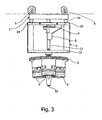
- Figures 1 to 3 are orthogonal views of an embodiment of the lighting device according to the invention, being an integral part of a scialytic lamp for operating-room.
- a fixed support element is indicated as 1
- a frame as 2 and a movable lamp-holder denoted by 3 is in the form of a disk on which three lamps with reflectors and indicated generally as 4 are mounted at the same angular distance.
- the fixed support element 1 is designed to be applied to a ceiling, as shown in Figure 3 , by means of screws indicated as 5.
- the frame 2 is designed to sustain an aiming mechanism for the movable lamp-holder 3.
- Driving means for moving the lamp-holder 3 with respect to the fixed support element 1 is part of the aiming mechanism.
- the driving means comprises an electric motor 6 having a shaft to which a driving gear wheel 7, being meshed with a first driven gear wheel 8, is keyed.
- the gear wheels 7 and 8 have the same number of teeth and the same pitch.
- a second driven gear wheel 9, having the same number of teeth and the same pitch of the first two gear wheels, is meshed with the first driven gear wheel 8 so that the second driven gear wheel 9 rotates at the same speed and in the same direction of the driving gear wheel 7.
- the above described driving means are mounted to an upper plate 10 of the frame 2.
- the frame 2 is shown as an open parallelepipedal construction, but obviously it is closed by suitable panels on its lateral surface.
- Eccentrically pivoted to the first driven gear wheel 8 is an end of a rod 11, whose opposite end is pivoted to the lamp-holder disk 3 by means of a ball joint.
- the rod 11 is constrained to rotate, in a position between its ends, on a lower plate 12 of the frame 2.
- An optical encoder 13 which is adapted to give the position of the movable lamp-holder, is mounted to the second driven gear wheel 9.
- the frame 2 is mounted to the supporting element 1 through its upper frame plate 10 by interposed vibration-damping pads, which are generally indicated as 14 and serve to damp vibrations generated by the motor and permit more accuracy of the light beam while it is moving.
- centrally mounted to the lamp-holder disk is an optical sensor 15, whose function will be evident from the following of the description.
- FIG. 4 there is shown a block diagram of the aiming system, which the lighting device according to the present invention is provided with.
- Blocks are denoted by some of the reference numerals above cited, such as the motor 6, the optical encoder 13 and the optical sensor 15.
- a micro-controller which is indicated as 16, is connected to the motor 6 by a power amplifier 17 and to the optical sensor 15 by an amplifier 18.
- a power source 19 is provided.
- driving means operates as follows.
- the driving gear wheel 7, through the motion given by the motor 6 whose shaft supports keyed the driving gear wheel 7, begins to move transmitting the movement to the driven gear wheel 8, that in turn will give the rotary movement also to the rod 11, which has one end pivoted to the lamp-holder disk 3 and the other end pivoted to the driven gear wheel 8.
- the rod 11, being connected to the lamp-holder disk 3, will transmit this kind of movement also to the latter.
- the first driven gear wheel 8 has a double purpose: besides generating a conic-rotary movement, it transmits its rotation also to the second driven gear wheel 9, which in turn is connected to the optical encoder 13.
- the three gear wheels 7, 8, and 9 has the same number of teeth and the same pitch, then their rotation speed is the same, whereas the direction of rotation is the same for the driving gear wheel 7 and the second driven gear wheel 9 for the encoder 13.
- the shaft of the motor 6 and the encoder 13 there is a biunivoc correspondence between the shaft of the motor 6 and the encoder 13, as they move always at the same rotation time and at the same speed.
- three 50 W halogen lamps 4 are mounted to the lamp-holder disk 3 according to the invention. These lamps project a spot onto a work plane situated at a distance of about two meters, the spot having such an intensity that it assures a brightness prescribed for a micro-precision operation.
- the lamps are mounted to the lamp-holder disk 3 with a determined angle toward the central axis of the lamp-holder disk 3 so that beams of the three lamps converge to a same point from a distance of two meters.
- the angle chosen is about 2 degrees, more precisely 1 degree 51 min 36 sec (0,0264 radian).
- the mechanical design of the lamp-holder disk forces the spot being projected by the lamps to move along an elliptic trajectory, permitting to aim the light beam onto any point inside the ellipse by rotating the axis of the lamp-holder disk.
- the device In order to keep the aiming onto a target movable on a plane that is at a predetermined distance, the device must be interlocked to an automatic system able to locate the point in question and orient the lamps so that they illuminate it.
- the interlocking system of the device is schematised in Figure 4 .
- the micro-controller 16 i.e. a microprocessor that is specialised to control systems and is provided, on one chip, with all necessary resources as well as a real processing unit.
- the microprocessor 16 controls the position of the lamp-holder disk until it optimises the illumination of a concerned zone that must have a reflectance or reflection factor greater with respect to the rest of the scenery. Such a restraint is necessary since the system must distinguish the concerned zone from the rest of the scenery on the base of some parameter.
- the value of the light reflection factor has been chosen as a distinguishing parameter. In practice, it is sufficient that the working field is clearer than the contour, that must have a darker colour. This parameter is usual in the operating rooms, where sheets are chosen of a dark colour, and also gloves of the operating surgeons are opaque.
- the aiming system will search for the point with greater reflection factor on the working plane, and it will be a task of the user to make so that this condition is respected.
- a brightness feedback is furnished by the accurate optical sensor 15, which is housed in the centre of the lamp-holder disk 3 and has a visual field that through a small-diameter eyepiece is reduced to a portion of the illuminated zone of about 15 cm in diameter, this portion being also centred with respect to the axis of the lamp-holder disk 3.
- An analog signal from the optical sensor 15 is amplified in situ to limit electric noises and delivered through a shielded wire to an analog-digital converter inside the micro-controller.
- Such a converter serves to transform the brightness data item into a number, which is stored in an internal memory of the micro-controller.
- the axis of the lamp-holder disk which is keyed with the optical encoder with a mechanical ratio 1:1, allows the micro-controller to know the position of the rod in every moment. In this way, the micro-controller can store in its internal memory brightness data bound to the angular position of the lamp-holder disk 3, position that is related univocally to an exact point of the working plane. This will permit the maximum brightness position to be found.
- the suitable power source 19 which furnishes voltages required by electronics and lamps, from the main voltage.
- the micro-controller 16 After initial set-up in a start step 20, reset of the internal variables 21, IN/OUT setting 22, and interrupt activation 23, the micro-controller 16 begins an acquisition procedure consisting of making a complete turn of the lamp-holder disk 3 (step 24) as well as acquiring brightness data of the framed scenery, which is divided into 256 sections. Brightness data item of every section is related to its angular position, by virtue of information provided by the optical encoder 13.
- the micro-controller searches, in a string of data stored inside, the maximum brightness value (step 25), together with its angular position.
- the micro-controller detects the abnormal condition since, beside the maximum brightness value, it calculates also the minimum one, and if the difference does not exceed a pre-set value, the measure is deemed invalid and after 2 seconds it will be repeated (step 27).
- the system gets into stand-by and performs periodically brightness measures in the point in order to verify the continue centring of the target in a two second waiting step 29, to go to a decision step 30 where the question is if the target is centred, to a step 31 for performing a local research and to a decision step 32.
- the program implements a kind of "memory of the displacement". I.e. normally the system tries first clockwise and then counter-clockwise, but the priority is decided by experience, since the micro-controller remembers the previous displacement of the target.
- the micro-processor card is feed by the same voltage of the lamps (12V) and is provided with filters to suppress noises in the line.
- the motor is controlled by a power transistor (solid state device in order to prevent sparks) whereas the polarity inversion relay is activated always some tenth of second before starting the motor in order to prevent the formation of voltaic arches and the consequent wear of contacts, as well as for the compatibility of the operating-room, the compatibility being in any case assured as such a relay is sealed.
Landscapes
- Health & Medical Sciences (AREA)
- Surgery (AREA)
- Life Sciences & Earth Sciences (AREA)
- Engineering & Computer Science (AREA)
- Heart & Thoracic Surgery (AREA)
- Animal Behavior & Ethology (AREA)
- Oral & Maxillofacial Surgery (AREA)
- Biomedical Technology (AREA)
- Nuclear Medicine, Radiotherapy & Molecular Imaging (AREA)
- Medical Informatics (AREA)
- Molecular Biology (AREA)
- Pathology (AREA)
- General Health & Medical Sciences (AREA)
- Public Health (AREA)
- Veterinary Medicine (AREA)
- General Engineering & Computer Science (AREA)
- Non-Portable Lighting Devices Or Systems Thereof (AREA)
- Lighting Device Outwards From Vehicle And Optical Signal (AREA)
- Circuit Arrangement For Electric Light Sources In General (AREA)
Claims (4)
- Beleuchtungsvorrichtung mit einem automatischen Zielsystem, einschließlich eines fixen Stützelements (1) und eines beweglichen Lampenhalters (3) der Lichtquellen (4) trägt, die darauf befestigt sind, Antriebsmittel um den beweglichen Lampenhalter (3) gegenüber dem fixen Stützelement (1) zu bewegen, einen Sensor und einen MikroKontroller (16) welcher vom Sensor (15) Daten erhält und sie benutzt um den Betrieb der genannten Antriebsmittel zu befehlen um die Lage des beweglichen Lampenhalters (3) und somit die Orientierung seiner Leuchtstrahlen im Raum zu ändern, mit der Eigenschaft dass der genannte Sensor ein optischer Sensor (15) ist, der die Fähigkeit hat, einen Reflexkoeffizient des Lichts vom beleuchteten Feld in jeder Position des Lampenhalters (3) zu bestimmen, die Beleuchtungsvorrichtung schließt auch einen optischen Encoder (13) ein, der in der Lage ist, in jedem Moment die Position des beweglichen Lampenhalters (3) zu geben, der Mikrokontroller (16), der vom optischen Sensor (15) Daten bezüglich diesem Reflektionskoeffizient und vom optischen Encoder (13) Daten bezüglich der Position des beweglichen Lampenhalters (3) erhält um den Betrieb der Antriebsmittel zur konstanten Richtung eines Teils des Beleuchtungsfeldes zu befehlen um einen höchsten Reflektionskoeffizient vorzuweisen, mit der Eigenschaft, dass die genannten Antriebsmittel einen Motor (6) einbeziehen auf dessen Antriebswelle ein Antriebszahnrad (7) im Eingriff mit einem ersten getriebenen Zahnrad (8), einem zweiten getriebenen Zahnrad (9) befestigt und so verzahnt ist, dass es mit derselben Geschwindigkeit und in die selbe Richtung des Antriebszahnrads (7) dreht.
- Die Vorrichtung gemäß Patentanspruch 1, charakterisiert sich dadurch, dass die genannten Antriebsmittel des beweglichen Lampenhalters (3) einen Schaft (11) mit einschließen, welcher an einem Ende am Lampenhalter (3) und, an seinem anderen Ende exzentrisch auf das genannte erste getriebene Zahnrad (8) verzapft ist und gezwungen ist, in einer Stellung zwischen dessen genannten Enden, auf einer unteren Platte (12) eines Rahmens (2) verbunden mit dem genannten fixen Stützelement (1) zu drehen.
- Die Vorrichtung gemäß Patentanspruch 2, charakterisiert sich dadurch, dass die genannten Antriebsmittel auf einer oberen Platte (10) des genannten Rahmens (2) montiert sind.
- Die Vorrichtung gemäß Patentanspruch 3, charakterisiert sich dadurch, dass der genannte Rahmen (2) am genannten fixen Stützelement (1) mit der Zwischenschiebung von vibrations-dämpfenden Kissen (14), die an der genannten oberen Platte (10) angebracht sind, befestigt ist.
Applications Claiming Priority (2)
| Application Number | Priority Date | Filing Date | Title |
|---|---|---|---|
| IT000039A ITNA20060039A1 (it) | 2006-03-29 | 2006-03-29 | Apparecchio di illuminazione dotato di un sistema di puntamento automatico |
| PCT/IT2007/000230 WO2007110895A1 (en) | 2006-03-29 | 2007-03-28 | Lighting device provided with automatic aiming system |
Publications (2)
| Publication Number | Publication Date |
|---|---|
| EP1999405A1 EP1999405A1 (de) | 2008-12-10 |
| EP1999405B1 true EP1999405B1 (de) | 2009-07-22 |
Family
ID=38236517
Family Applications (1)
| Application Number | Title | Priority Date | Filing Date |
|---|---|---|---|
| EP07736734A Not-in-force EP1999405B1 (de) | 2006-03-29 | 2007-03-28 | Beleuchtungsvorrichtung mit einem automatischen zielsystem |
Country Status (5)
| Country | Link |
|---|---|
| EP (1) | EP1999405B1 (de) |
| AT (1) | ATE437334T1 (de) |
| DE (1) | DE602007001687D1 (de) |
| IT (1) | ITNA20060039A1 (de) |
| WO (1) | WO2007110895A1 (de) |
Families Citing this family (3)
| Publication number | Priority date | Publication date | Assignee | Title |
|---|---|---|---|---|
| EP2017526A1 (de) * | 2007-06-13 | 2009-01-21 | Royal College Of Art | Lenkbares Licht |
| US20110089841A1 (en) | 2008-05-29 | 2011-04-21 | Koninklijke Philips Electronics N.V. | Control information for controlling light-system |
| FR3052536B1 (fr) | 2016-06-08 | 2018-06-01 | Maquet Sas | Dispositif d'eclairage medical avec un systeme d'aide au bon positionnement |
Family Cites Families (3)
| Publication number | Priority date | Publication date | Assignee | Title |
|---|---|---|---|---|
| DE3933596A1 (de) * | 1989-10-07 | 1991-04-18 | Heraeus Instr Gmbh | Operationsleuchte mit verstellbarer halterung |
| JP2506820Y2 (ja) * | 1990-10-01 | 1996-08-14 | 山田医療照明株式会社 | 医療用無影照明装置における自動焦点位置調節装置 |
| DE20316756U1 (de) * | 2003-10-31 | 2005-03-17 | Leibinger Medizintech | Helligkeitsregulierte medizinische Beleuchtungsvorrichtung |
-
2006
- 2006-03-29 IT IT000039A patent/ITNA20060039A1/it unknown
-
2007
- 2007-03-28 WO PCT/IT2007/000230 patent/WO2007110895A1/en not_active Ceased
- 2007-03-28 EP EP07736734A patent/EP1999405B1/de not_active Not-in-force
- 2007-03-28 DE DE602007001687T patent/DE602007001687D1/de not_active Expired - Fee Related
- 2007-03-28 AT AT07736734T patent/ATE437334T1/de not_active IP Right Cessation
Also Published As
| Publication number | Publication date |
|---|---|
| EP1999405A1 (de) | 2008-12-10 |
| ITNA20060039A1 (it) | 2007-09-30 |
| WO2007110895A1 (en) | 2007-10-04 |
| ATE437334T1 (de) | 2009-08-15 |
| DE602007001687D1 (de) | 2009-09-03 |
Similar Documents
| Publication | Publication Date | Title |
|---|---|---|
| US12201383B2 (en) | Bone and tool tracking in robotized computer-assisted surgery | |
| DK2434202T3 (en) | Operating lamp with sterile control device | |
| US9119668B2 (en) | Surgical lamps and methods for illuminating operating sites | |
| US8221399B2 (en) | Ophthalmic apparatus | |
| EP1316287B1 (de) | Ophthalmische Vorrichtung | |
| JPH03134901A (ja) | 手術用照明具を操作する方法並びに調節可能な保持具を備えた手術用照明具 | |
| US7275829B2 (en) | Ophthalmic laser irradiation apparatus | |
| WO2016114834A2 (en) | Actively controlled optical tracker with a robot | |
| US6803727B2 (en) | Light system for use especially by operating theatre | |
| JPH038221B2 (de) | ||
| CN112423941B (zh) | 电动工具、特别是无绳钻或无绳螺丝刀 | |
| JP6648353B2 (ja) | 正確な位置決めを支援するシステムを備えた医療照明装置 | |
| CA2899550A1 (en) | Lighting arrangement of operating theatre | |
| KR20160148889A (ko) | 수술 부위의 자동 위치 확인 장치 및 그에 의한 자동 조명 제어 방법 | |
| EP1999405A1 (de) | Beleuchtungsvorrichtung mit einem automatischen zielsystem | |
| EP3906753B1 (de) | Steuerung für adaptive beleuchtungsanordnung | |
| US7497019B2 (en) | Laser reference device | |
| KR20150111589A (ko) | 보조 조명 장치 일체형 세극등 현미경 | |
| EP2760257A1 (de) | Beleuchtungsanordnung | |
| JP3889997B2 (ja) | 検眼装置 | |
| KR101435435B1 (ko) | 컨택트 렌즈 및 이를 갖는 안과용 치료장치 | |
| JP3057553U (ja) | 医療用無影灯 | |
| KR20100026431A (ko) | 레이저 치료기용 캘리브레이션장치 | |
| JP2642702B2 (ja) | 注視方向検出装置 | |
| RU98110987A (ru) | Устройство для лазерной терапии в офтальмологии (варианты) |
Legal Events
| Date | Code | Title | Description |
|---|---|---|---|
| PUAI | Public reference made under article 153(3) epc to a published international application that has entered the european phase |
Free format text: ORIGINAL CODE: 0009012 |
|
| 17P | Request for examination filed |
Effective date: 20080630 |
|
| AK | Designated contracting states |
Kind code of ref document: A1 Designated state(s): AT BE BG CH CY CZ DE DK EE ES FI FR GB GR HU IE IS IT LI LT LU LV MC MT NL PL PT RO SE SI SK TR |
|
| GRAP | Despatch of communication of intention to grant a patent |
Free format text: ORIGINAL CODE: EPIDOSNIGR1 |
|
| DAX | Request for extension of the european patent (deleted) | ||
| GRAS | Grant fee paid |
Free format text: ORIGINAL CODE: EPIDOSNIGR3 |
|
| GRAA | (expected) grant |
Free format text: ORIGINAL CODE: 0009210 |
|
| AK | Designated contracting states |
Kind code of ref document: B1 Designated state(s): AT BE BG CH CY CZ DE DK EE ES FI FR GB GR HU IE IS IT LI LT LU LV MC MT NL PL PT RO SE SI SK TR |
|
| REG | Reference to a national code |
Ref country code: GB Ref legal event code: FG4D |
|
| REG | Reference to a national code |
Ref country code: CH Ref legal event code: EP |
|
| REG | Reference to a national code |
Ref country code: IE Ref legal event code: FG4D |
|
| REF | Corresponds to: |
Ref document number: 602007001687 Country of ref document: DE Date of ref document: 20090903 Kind code of ref document: P |
|
| NLV1 | Nl: lapsed or annulled due to failure to fulfill the requirements of art. 29p and 29m of the patents act | ||
| PG25 | Lapsed in a contracting state [announced via postgrant information from national office to epo] |
Ref country code: LT Free format text: LAPSE BECAUSE OF FAILURE TO SUBMIT A TRANSLATION OF THE DESCRIPTION OR TO PAY THE FEE WITHIN THE PRESCRIBED TIME-LIMIT Effective date: 20090722 Ref country code: AT Free format text: LAPSE BECAUSE OF FAILURE TO SUBMIT A TRANSLATION OF THE DESCRIPTION OR TO PAY THE FEE WITHIN THE PRESCRIBED TIME-LIMIT Effective date: 20090722 Ref country code: SE Free format text: LAPSE BECAUSE OF FAILURE TO SUBMIT A TRANSLATION OF THE DESCRIPTION OR TO PAY THE FEE WITHIN THE PRESCRIBED TIME-LIMIT Effective date: 20090722 Ref country code: FI Free format text: LAPSE BECAUSE OF FAILURE TO SUBMIT A TRANSLATION OF THE DESCRIPTION OR TO PAY THE FEE WITHIN THE PRESCRIBED TIME-LIMIT Effective date: 20090722 Ref country code: IS Free format text: LAPSE BECAUSE OF FAILURE TO SUBMIT A TRANSLATION OF THE DESCRIPTION OR TO PAY THE FEE WITHIN THE PRESCRIBED TIME-LIMIT Effective date: 20091122 Ref country code: ES Free format text: LAPSE BECAUSE OF FAILURE TO SUBMIT A TRANSLATION OF THE DESCRIPTION OR TO PAY THE FEE WITHIN THE PRESCRIBED TIME-LIMIT Effective date: 20091102 |
|
| PG25 | Lapsed in a contracting state [announced via postgrant information from national office to epo] |
Ref country code: SI Free format text: LAPSE BECAUSE OF FAILURE TO SUBMIT A TRANSLATION OF THE DESCRIPTION OR TO PAY THE FEE WITHIN THE PRESCRIBED TIME-LIMIT Effective date: 20090722 Ref country code: PL Free format text: LAPSE BECAUSE OF FAILURE TO SUBMIT A TRANSLATION OF THE DESCRIPTION OR TO PAY THE FEE WITHIN THE PRESCRIBED TIME-LIMIT Effective date: 20090722 Ref country code: NL Free format text: LAPSE BECAUSE OF FAILURE TO SUBMIT A TRANSLATION OF THE DESCRIPTION OR TO PAY THE FEE WITHIN THE PRESCRIBED TIME-LIMIT Effective date: 20090722 Ref country code: LV Free format text: LAPSE BECAUSE OF FAILURE TO SUBMIT A TRANSLATION OF THE DESCRIPTION OR TO PAY THE FEE WITHIN THE PRESCRIBED TIME-LIMIT Effective date: 20090722 |
|
| PG25 | Lapsed in a contracting state [announced via postgrant information from national office to epo] |
Ref country code: PT Free format text: LAPSE BECAUSE OF FAILURE TO SUBMIT A TRANSLATION OF THE DESCRIPTION OR TO PAY THE FEE WITHIN THE PRESCRIBED TIME-LIMIT Effective date: 20091122 Ref country code: BG Free format text: LAPSE BECAUSE OF FAILURE TO SUBMIT A TRANSLATION OF THE DESCRIPTION OR TO PAY THE FEE WITHIN THE PRESCRIBED TIME-LIMIT Effective date: 20091022 |
|
| PG25 | Lapsed in a contracting state [announced via postgrant information from national office to epo] |
Ref country code: CZ Free format text: LAPSE BECAUSE OF FAILURE TO SUBMIT A TRANSLATION OF THE DESCRIPTION OR TO PAY THE FEE WITHIN THE PRESCRIBED TIME-LIMIT Effective date: 20090722 Ref country code: EE Free format text: LAPSE BECAUSE OF FAILURE TO SUBMIT A TRANSLATION OF THE DESCRIPTION OR TO PAY THE FEE WITHIN THE PRESCRIBED TIME-LIMIT Effective date: 20090722 Ref country code: RO Free format text: LAPSE BECAUSE OF FAILURE TO SUBMIT A TRANSLATION OF THE DESCRIPTION OR TO PAY THE FEE WITHIN THE PRESCRIBED TIME-LIMIT Effective date: 20090722 Ref country code: DK Free format text: LAPSE BECAUSE OF FAILURE TO SUBMIT A TRANSLATION OF THE DESCRIPTION OR TO PAY THE FEE WITHIN THE PRESCRIBED TIME-LIMIT Effective date: 20090722 |
|
| PLBE | No opposition filed within time limit |
Free format text: ORIGINAL CODE: 0009261 |
|
| STAA | Information on the status of an ep patent application or granted ep patent |
Free format text: STATUS: NO OPPOSITION FILED WITHIN TIME LIMIT |
|
| PG25 | Lapsed in a contracting state [announced via postgrant information from national office to epo] |
Ref country code: SK Free format text: LAPSE BECAUSE OF FAILURE TO SUBMIT A TRANSLATION OF THE DESCRIPTION OR TO PAY THE FEE WITHIN THE PRESCRIBED TIME-LIMIT Effective date: 20090722 Ref country code: BE Free format text: LAPSE BECAUSE OF FAILURE TO SUBMIT A TRANSLATION OF THE DESCRIPTION OR TO PAY THE FEE WITHIN THE PRESCRIBED TIME-LIMIT Effective date: 20090722 |
|
| 26N | No opposition filed |
Effective date: 20100423 |
|
| PG25 | Lapsed in a contracting state [announced via postgrant information from national office to epo] |
Ref country code: MC Free format text: LAPSE BECAUSE OF NON-PAYMENT OF DUE FEES Effective date: 20100331 Ref country code: GR Free format text: LAPSE BECAUSE OF FAILURE TO SUBMIT A TRANSLATION OF THE DESCRIPTION OR TO PAY THE FEE WITHIN THE PRESCRIBED TIME-LIMIT Effective date: 20091023 |
|
| REG | Reference to a national code |
Ref country code: FR Ref legal event code: ST Effective date: 20101130 |
|
| PG25 | Lapsed in a contracting state [announced via postgrant information from national office to epo] |
Ref country code: FR Free format text: LAPSE BECAUSE OF NON-PAYMENT OF DUE FEES Effective date: 20100331 Ref country code: IE Free format text: LAPSE BECAUSE OF NON-PAYMENT OF DUE FEES Effective date: 20100328 |
|
| PG25 | Lapsed in a contracting state [announced via postgrant information from national office to epo] |
Ref country code: DE Free format text: LAPSE BECAUSE OF NON-PAYMENT OF DUE FEES Effective date: 20101001 |
|
| PG25 | Lapsed in a contracting state [announced via postgrant information from national office to epo] |
Ref country code: IT Free format text: LAPSE BECAUSE OF FAILURE TO SUBMIT A TRANSLATION OF THE DESCRIPTION OR TO PAY THE FEE WITHIN THE PRESCRIBED TIME-LIMIT Effective date: 20090722 |
|
| PG25 | Lapsed in a contracting state [announced via postgrant information from national office to epo] |
Ref country code: MT Free format text: LAPSE BECAUSE OF FAILURE TO SUBMIT A TRANSLATION OF THE DESCRIPTION OR TO PAY THE FEE WITHIN THE PRESCRIBED TIME-LIMIT Effective date: 20090722 |
|
| REG | Reference to a national code |
Ref country code: GB Ref legal event code: 732E Free format text: REGISTERED BETWEEN 20110704 AND 20110706 |
|
| PGFP | Annual fee paid to national office [announced via postgrant information from national office to epo] |
Ref country code: GB Payment date: 20110513 Year of fee payment: 5 |
|
| REG | Reference to a national code |
Ref country code: CH Ref legal event code: PL |
|
| REG | Reference to a national code |
Ref country code: CH Ref legal event code: AEN Free format text: DAS PATENT IST AUFGRUND DES WEITERBEHANDLUNGSANTRAGS VOM 22.11.2011 REAKTIVIERT WORDEN. |
|
| PGFP | Annual fee paid to national office [announced via postgrant information from national office to epo] |
Ref country code: CH Payment date: 20111122 Year of fee payment: 5 |
|
| PG25 | Lapsed in a contracting state [announced via postgrant information from national office to epo] |
Ref country code: CY Free format text: LAPSE BECAUSE OF FAILURE TO SUBMIT A TRANSLATION OF THE DESCRIPTION OR TO PAY THE FEE WITHIN THE PRESCRIBED TIME-LIMIT Effective date: 20090722 |
|
| PG25 | Lapsed in a contracting state [announced via postgrant information from national office to epo] |
Ref country code: HU Free format text: LAPSE BECAUSE OF FAILURE TO SUBMIT A TRANSLATION OF THE DESCRIPTION OR TO PAY THE FEE WITHIN THE PRESCRIBED TIME-LIMIT Effective date: 20100123 Ref country code: LU Free format text: LAPSE BECAUSE OF NON-PAYMENT OF DUE FEES Effective date: 20100328 |
|
| PG25 | Lapsed in a contracting state [announced via postgrant information from national office to epo] |
Ref country code: TR Free format text: LAPSE BECAUSE OF FAILURE TO SUBMIT A TRANSLATION OF THE DESCRIPTION OR TO PAY THE FEE WITHIN THE PRESCRIBED TIME-LIMIT Effective date: 20090722 |
|
| REG | Reference to a national code |
Ref country code: CH Ref legal event code: PL |
|
| GBPC | Gb: european patent ceased through non-payment of renewal fee |
Effective date: 20120328 |
|
| PG25 | Lapsed in a contracting state [announced via postgrant information from national office to epo] |
Ref country code: GB Free format text: LAPSE BECAUSE OF NON-PAYMENT OF DUE FEES Effective date: 20120328 Ref country code: CH Free format text: LAPSE BECAUSE OF NON-PAYMENT OF DUE FEES Effective date: 20120331 Ref country code: LI Free format text: LAPSE BECAUSE OF NON-PAYMENT OF DUE FEES Effective date: 20120331 |