EP1999862B1 - Récepteur mimi et procédé de formation de faisceau avec des opérations cordic - Google Patents
Récepteur mimi et procédé de formation de faisceau avec des opérations cordic Download PDFInfo
- Publication number
- EP1999862B1 EP1999862B1 EP07758782.2A EP07758782A EP1999862B1 EP 1999862 B1 EP1999862 B1 EP 1999862B1 EP 07758782 A EP07758782 A EP 07758782A EP 1999862 B1 EP1999862 B1 EP 1999862B1
- Authority
- EP
- European Patent Office
- Prior art keywords
- cordic
- operations
- matrix
- vector
- codewords
- Prior art date
- Legal status (The legal status is an assumption and is not a legal conclusion. Google has not performed a legal analysis and makes no representation as to the accuracy of the status listed.)
- Not-in-force
Links
Images
Classifications
-
- G—PHYSICS
- G06—COMPUTING OR CALCULATING; COUNTING
- G06F—ELECTRIC DIGITAL DATA PROCESSING
- G06F7/00—Methods or arrangements for processing data by operating upon the order or content of the data handled
- G06F7/38—Methods or arrangements for performing computations using exclusively denominational number representation, e.g. using binary, ternary, decimal representation
- G06F7/48—Methods or arrangements for performing computations using exclusively denominational number representation, e.g. using binary, ternary, decimal representation using non-contact-making devices, e.g. tube, solid state device; using unspecified devices
- G06F7/4806—Computations with complex numbers
- G06F7/4818—Computations with complex numbers using coordinate rotation digital computer [CORDIC]
-
- G—PHYSICS
- G06—COMPUTING OR CALCULATING; COUNTING
- G06F—ELECTRIC DIGITAL DATA PROCESSING
- G06F17/00—Digital computing or data processing equipment or methods, specially adapted for specific functions
- G06F17/10—Complex mathematical operations
- G06F17/16—Matrix or vector computation, e.g. matrix-matrix or matrix-vector multiplication, matrix factorization
-
- H—ELECTRICITY
- H04—ELECTRIC COMMUNICATION TECHNIQUE
- H04B—TRANSMISSION
- H04B7/00—Radio transmission systems, i.e. using radiation field
- H04B7/02—Diversity systems; Multi-antenna system, i.e. transmission or reception using multiple antennas
- H04B7/04—Diversity systems; Multi-antenna system, i.e. transmission or reception using multiple antennas using two or more spaced independent antennas
- H04B7/0413—MIMO systems
- H04B7/0456—Selection of precoding matrices or codebooks, e.g. using matrices antenna weighting
- H04B7/0478—Special codebook structures directed to feedback optimisation
-
- H—ELECTRICITY
- H04—ELECTRIC COMMUNICATION TECHNIQUE
- H04B—TRANSMISSION
- H04B7/00—Radio transmission systems, i.e. using radiation field
- H04B7/02—Diversity systems; Multi-antenna system, i.e. transmission or reception using multiple antennas
- H04B7/04—Diversity systems; Multi-antenna system, i.e. transmission or reception using multiple antennas using two or more spaced independent antennas
- H04B7/06—Diversity systems; Multi-antenna system, i.e. transmission or reception using multiple antennas using two or more spaced independent antennas at the transmitting station
- H04B7/0613—Diversity systems; Multi-antenna system, i.e. transmission or reception using multiple antennas using two or more spaced independent antennas at the transmitting station using simultaneous transmission
- H04B7/0615—Diversity systems; Multi-antenna system, i.e. transmission or reception using multiple antennas using two or more spaced independent antennas at the transmitting station using simultaneous transmission of weighted versions of same signal
- H04B7/0619—Diversity systems; Multi-antenna system, i.e. transmission or reception using multiple antennas using two or more spaced independent antennas at the transmitting station using simultaneous transmission of weighted versions of same signal using feedback from receiving side
- H04B7/0658—Feedback reduction
- H04B7/0663—Feedback reduction using vector or matrix manipulations
-
- H—ELECTRICITY
- H04—ELECTRIC COMMUNICATION TECHNIQUE
- H04L—TRANSMISSION OF DIGITAL INFORMATION, e.g. TELEGRAPHIC COMMUNICATION
- H04L25/00—Baseband systems
- H04L25/02—Details ; arrangements for supplying electrical power along data transmission lines
- H04L25/0202—Channel estimation
- H04L25/024—Channel estimation channel estimation algorithms
- H04L25/0242—Channel estimation channel estimation algorithms using matrix methods
- H04L25/0248—Eigen-space methods
Definitions
- Some embodiments of the present invention pertain to wireless communication systems. Some embodiments pertain to beamforming using codebooks in closed- loop multiple-input multiple-output (MIMO) systems. Some embodiments relate to orthogonal frequency division multiplexed (OFDM) communications. Some embodiments relate to Coordinate Rotation Digital Computer (CORDIC) algorithms for calculating trigonometric functions using additions and shift operations.
- MIMO closed- loop multiple-input multiple-output
- OFDM orthogonal frequency division multiplexed
- CORDIC Coordinate Rotation Digital Computer
- Closed- loop MIMO systems typically transmit channel state information from a receiver to a transmitter over a feedback path.
- the channel state information may be used to employ beamforming to compensate for the current channel conditions increasing signal-to-noise (SNR) levels at the receiver.
- SNR signal-to-noise
- a beamforming matrix may be generated at the receiver based on the channel conditions.
- Codewords of the codebook may be provided to the transmitter as feedback. The codewords may indicate which beamforming matrix is to be used by the transmitter.
- INTEL CORPORATION "Performance and complexity of scaleable pre-coded MIMO (LLS & SLS)", 3GPP DRAFT; R1-060868, 3RD GENERATION PARTNERSHIP PROJECT (3GPP), MOBILE COMPETENCE CENTRE; 650, ROUTE DES LUCIOLES; F-06921 SOPHIA-ANTIPOLIS CEDEX; FRANCE, vol. RAN WG1, no. Athens, Greece; 20060321, 21 March 2006 (2006-03-21 ), XP050101778 is a discussion paper outlining evaluation results for a proposed precoding system for improving MIMO performance. The provided evaluation results include channel estimation, receiver complexity estimates, and system level performance.
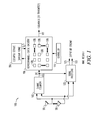
- FIG. 1 is a functional block diagram of a MIMO receiver in accordance with some embodiments of the present invention.
- MIMO receiver 100 comprises two or more receive signal paths to receive signals through two or more antennas 101 and channel estimator 102 to generate channel matrix H 103 from the training portions of the received signals.
- MIMO receiver 100 may also include signal processing circuitry 112 to generate output bit streams 113 from data portions of the received signals. Output bit streams 113 may comprise separate bit streams for each data stream transmitted by a transmitting station, although the scope of the invention is not limited in this respect.
- MIMO receiver 100 may also include reprogrammable CORDIC circuitry 106 to generate quantized codewords 107, which may be provided back to the transmitting station as feedback for use in beamforming. In some embodiments, quantized codewords 107 may comprise codeword indices, although the scope of the invention is not limited in this respect.
- reprogrammable CORDIC circuitry 106 may comprise a plurality of CORDIC elements 108 which may be reconfigured and/or reprogrammed by controller 110 to perform various CORDIC operations to generate quantized codewords 107.
- reprogrammable CORDIC circuitry 106 may perform CORDIC operations using additions and shift operations instead of using multiplication operations.
- reprogrammable CORDIC circuitry 106 may be configured to perform complex singular value decomposition (SVD) operations on channel matrix H 103 using CORDIC operations to generate the vector elements of a beamforming matrix V.
- SMD complex singular value decomposition
- Reprogrammable CORDIC circuitry 106 may also be configured to compute an inner product of a first of the vector elements and each of a plurality of codewords C k using CORDIC operations to provide a quantized first vector element.
- Reprogrammable CORDIC circuitry 106 may also be configured to perform a recursive dimensional reduction on the beamforming matrix V based on the quantized first vector element using CORDIC operations to quantize remaining vector elements of the beamforming matrix as codewords.
- MIMO receiver 100 may include codeword storage element 104 to store the codewords C k in a non-vector form.
- the codewords in non-vector form may be used to compute the inner products using CORDIC operations.
- the non-vector form may comprise a series of rotation angles allowing the CORDIC operations to be performed during the inner product computations.
- the codewords C k may be stored in the non-vector form as a series of complex phase rotations and Given's rotations.
- the codewords may be stored in the non-vector form prior to the inner product computations.
- MIMO receiver 100 is illustrated as having several separate functional elements, one or more of the functional elements may be combined and may be implemented by combinations of software-configured elements, such as processing elements including digital signal processors (DSPs), and/or other hardware elements.
- processing elements including digital signal processors (DSPs), and/or other hardware elements.
- DSPs digital signal processors
- some elements may comprise one or more microprocessors, DSPs, application specific integrated circuits (ASICs), and combinations of various hardware and logic circuitry for performing at least the functions described herein.
- the functional elements of MIMO receiver 100 may refer to one or more processes operating on one or more processing elements.
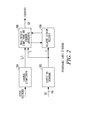
- FIG. 2 is a functional block diagram illustrating reprogrammable CORDIC operations in accordance with some embodiments of the present invention.
- the reprogrammable CORDIC operations illustrated in FIG. 2 may be performed by reprogrammable CORDIC circuitry 106 ( FIG. 1 ).
- controller 110 FIG. 1
- controller 110 may reconfigure and/or reprogram reprogrammable CORDIC circuitry 106 ( FIG. 1 ) to perform the various CORDIC operations illustrated in FIG. 2 .
- reprogrammable CORDIC circuitry 106 may be reconfigured to perform codeword decompositions 204 using CORDIC operations to store codewords C k in non-vector form as a series of complex phase rotations and Given's rotations.
- Reprogrammable CORDIC circuitry 106 may be reconfigured to perform complex SVD operations 202 on channel matrix H 103 using CORDIC operations to generate vector elements of a beamforming matrix V.
- Reprogrammable CORDIC circuitry 106 may be reconfigured to perform inner product computations and codeword quantizations 206 using CORDIC operations.
- the inner product of a first vector element V 1 and each of the stored codewords C k may be computed using CORDIC operations to provide a quantized first vector element.
- Reprogrammable CORDIC circuitry 106 may be also be reconfigured to perform recursive dimensional reduction 208 on the beamforming matrix V based on the quantized first vector element using CORDIC operations.
- reprogrammable CORDIC circuitry 106 may be used generate quantized codewords for beamforming in a MIMO wireless communication system.
- complex SVD operations may be performed on channel matrix H 103 using CORDIC operations to generate vector elements (i.e., 4x1 column vectors V 1 , V 2 , V 3 and V 4 ) of beamforming matrix V.
- a recursive dimensional reduction may be performed on the beamforming matrix V based on the quantized first vector element V 1 using CORDIC operations to quantize remaining vector elements of the beamforming matrix as codewords.
- the codewords C k used to compute the inner products are in a non-vector form comprising a series of rotation angles. This allows the CORDIC operations to be performed during the inner product computations rather than complex vector multiplication operations. This may result in a significant reduction in processing by reducing and/or eliminating most complex multiplication operations.
- the vector elements (V 1 , V 2 , V 3 , and V 4 ) of the beamforming matrix V may comprise column vectors, although the scope of the invention is not limited in this respect.
- the complex SVD operations are performed by the one or more CORDIC elements 108
- the inner product may be computed by the one or more CORDIC elements 108
- the recursive dimensional reduction may be performed by the one or more CORDIC elements 108.
- the CORDIC operations may comprise complex phase rotations and Given's rotations. These embodiments are discussed in more detail below.
- each of a plurality of vector codewords of a vector codebook may be decomposed into the series of complex phase rotations and Given's rotations using CORDIC operations performed by one or more of the CORDIC elements 108.
- the codewords may be dynamically generated by parameters stored in codeword storage element 104 using CORDIC operations to represent each codeword by angles instead of vectors.
- the first vector element V 1 may be quantized with a codeword, and a recursive dimensional reduction may be performed on the beamform matrix V which may include performing a unitary operation with the quantized vector element V 1 using CORDIC operations and a recursive quantization in a lower dimension.
- the CORDIC operations performed for computing the inner products comprises an identification of one or more of the codewords for use in generation of beamforming coefficients at a transmitting station, although the scope of the invention is not limited in this respect.
- the complex SVD operations may comprise zeroing-out off-diagonal elements of the channel matrix H in an iterative manner by performing CORDIC operations to generate the beamforming matrix V.
- the channel matrix H is a square matrix for symmetric MIMO configurations where the number of transmit antennas is the same as the number of receive antennas.
- the zeroing-out the off-diagonal elements may comprise zeroing-out off-diagonal elements of 2x2 submatrices of the channel matrix in an iterative manner.
- the complex SVD operations may include performing a QR decomposition on channel matrix H + by applying complex phase rotations and Given's rotations using CORDIC operations to zero-out preselected elements of the channel matrix to generate an R matrix. SVD operations are then performed on the R matrix to determine the beamforming matrix V.
- the channel matrix H is a non-square matrix for asymmetric MIMO configurations where the number of transmit antennas is not the same as the number of receive antennas.
- the QR decomposition of a matrix is a decomposition of the matrix into an orthogonal matrix Q and an upper triangular matrix R. QR decomposition may be referred to as orthogonal matrix triangularization.
- a CORDIC operation that may be performed by any one or more of CORDIC elements 108 may be described by the following equation as rotations in real space.
- x 2 y 2 cos ⁇ sin ⁇ - sin ⁇ cos ⁇ ⁇ x 1 y 1
- V ⁇ 1 arg max C k ⁇ abs ⁇ V 1 , C k > , C k ⁇ C
- codeword C k (a codebook entry) may be a unit norm vector.
- codeword C k (a codebook entry) may be a unit norm vector.
- four complex multiplications, two more real multiplications, and a square root would be performed to calculate the inner product. Since each complex multiplication may be realized by three real multiplications, the total complexity is 14 real multiplications and one square root.
- reprogrammable CORDIC circuitry 106 may be reconfigured to calculate the inner product and perform SVD computations.
- the reuse of the existing circuits (i.e., CORDIC elements 108) within reprogrammable CORDIC circuitry 106 may reduce the circuit area needed.
- each unitary codeword C k may be expressed as a series of Given's rotations as shown below:
- Each complex phase rotation ⁇ ( n , ⁇ ) on a complex value is one CORDIC.
- the absolute value (ABS) function takes one more CORDIC operations. For three-dimensional and two-dimensional inner products, there are seven and four CORDIC operations respectively.
- V ⁇ 1 C K
- 160 CORDIC operations may be performed to select twelve codewords out of 16 four-dimensional codewords.
- a similar process may be used to perform matrix inner products which may be useful for matrix codebooks based one quantization.
- Given's angles may also be extracted from a unitary/orthogonal matrix for efficient storage and/or compressed feedback, as described below.
- reprogrammable CORDIC circuitry 106 may be reconfigured to perform a complex SVD operation using CORDIC operations.
- This operation may utilize two CORDIC operations, 10 addition operations, and four scaling by 1 ⁇ 2 operations.
- matrix A may be diagonalized and the corresponding rotation angles ⁇ 1 and ⁇ 2 may be calculated by two CORDIC operations, eight addition operations and four scaling by 1 ⁇ 2 operations.
- a complex rotation may be performed as follows to make second column real.
- e - j ⁇ 12 e - j ⁇ 22 ⁇ A a 11 ⁇ e j ⁇ ⁇ 11 - ⁇ 12 a 12 a 21 ⁇ e j ⁇ ⁇ 21 - ⁇ 22 a 22
- the complex rotation may utilize two addition operations.
- a conversion back to Cartesian coordinate may be performed as follows, which may utilize two CORDIC operations.
- ⁇ and d 22 may be obtained with one CORDIC operation.
- an additional addition operation may be performed to compute the U matrix, which is discussed below.
- U and V matrixes may be stored in the form illustrated above.
- the numerical value of the elements of the V matrix may be calculated utilizing two CORDIC operations, and the U matrix may utilize 10 CORDIC operations.
- reprogrammable CORDIC circuitry 106 may be configured to compute the SVD of any n x n complex matrix utilizing the 2x2 method discussed above by zeroing out the off-diagonal elements one by one. Iterations are performed so that the solution converges.
- U 12 B utilizes 7( n - 2) CORDIC operations
- CV 12 + utilizes 3( n - 2) CORDIC operations.
- the total operations for one Jacoby may comprise 13 + 10( n - 2) CORDIC operations.
- reprogrammable CORDIC circuitry 106 may utilize n ( n - 1) / 2 2-sided Jacoby operations. If three iterations are performed for good convergence, the estimate of CORDIC operations to calculate the singular values of an n x n complex matrix may be shown as follows: 3 ⁇ n ⁇ n - 1 2 ⁇ 13 + 10 ⁇ n - 2
- n ( n -1) / 2 terms of e - j ⁇ 21 1 ⁇ R ⁇ 1 ⁇ R may be applied with each term operating on row i and column j with 0 ⁇ i ⁇ j ⁇ n .
- the total number of operations may comprise:
- some embodiments of the present invention may perform SVD by implementing a QR decomposition for complexity reduction.
- reprogrammable CORDIC circuitry 106 may utilize a channel matrix in the form H + .
- reprogrammable CORDIC circuitry 106 may begin the QR decomposition by using a Given's rotation to zero out the 41 element of the matrix, which takes one CORDIC operation to extract the phase, and two CORDIC operations to rotate the 42 and 43 elements of the matrix.
- H 4 ⁇ 3 + 1 1 1 e j ⁇ ⁇ 41 - ⁇ 31 ⁇ G ⁇ 3 , 4 , tan - 1 a 41 / a 31 ⁇ ⁇ ⁇ ⁇ ⁇ ⁇ ⁇ ⁇ ⁇ ⁇ ⁇ 0 ⁇ ⁇
- zeroing out elements 13 and 12 of the matrix may unitize 16 CORDIC operations plus one additional CORDIC operation for extracting the angles of element 11. Repeating this for 2 nd and 3 rd columns of the matrix utilizes another 11 CORDIC operations and three CORDIC operations, respectively.
- the SVD computation of a 3x3 matrix may utilize 207 CORDIC operations.
- the beam forming matrix V for the transmitter may be equivalent to Q U 0 , which may utilize 54 CORDIC operations.
- the extraction of the U matrix from the SVD may utilize 189 CORDIC operations.
- the quantization of 4x3 V matrix by a 654 codebook may be the same as the 4x4 V matrix quantization.
- reprogrammable CORDIC circuitry 106 is configured to perform QR decompositions as part of the SVD computations.
- MIMO receiver 100 may communicate orthogonal frequency division multiplexed (OFDM) communication signals over a multicarrier communication channel.
- the multicarrier communication channel may be within a predetermined frequency spectrum and may comprise a plurality of orthogonal subcarriers.
- the multicarrier signals may be defined by closely spaced OFDM subcarriers.
- MIMO receiver 100 may communicate in accordance with a multiple access technique, such as orthogonal frequency division multiple access (OFDMA), although the scope of the invention is not limited in this respect.
- OFDM orthogonal frequency division multiple access
- MIMO receiver 100 may be part of a broadband wireless access (BWA) network communication station, such as a Worldwide Interoperability for Microwave Access (WiMax) communication station, although the scope of the invention is not limited in this respect as MIMO receiver 100 may be part of almost any wireless communication device.
- BWA broadband wireless access
- WiMax Worldwide Interoperability for Microwave Access
- MIMO receiver 100 may be part of a portable wireless communication device, such as a personal digital assistant (PDA), a laptop or portable computer with wireless communication capability, a web tablet, a wireless telephone, a wireless headset, a pager, an instant messaging device, a digital camera, an access point, a television, a medical device (e.g., a heart rate monitor, a blood pressure monitor, etc.), or other device that may receive and/or transmit information wirelessly.
- PDA personal digital assistant
- laptop or portable computer with wireless communication capability such as a personal digital assistant (PDA), a laptop or portable computer with wireless communication capability, a web tablet, a wireless telephone, a wireless headset, a pager, an instant messaging device, a digital camera, an access point, a television, a medical device (e.g., a heart rate monitor, a blood pressure monitor, etc.), or other device that may receive and/or transmit information wirelessly.
- a portable wireless communication device such as a personal digital assistant (PDA), a laptop or portable
- the frequency spectrums for the communication signals received by MIMO receiver 100 may comprise either a 5 gigahertz (GHz) frequency spectrum or a 2.4 GHz frequency spectrum.
- the 5 GHz frequency spectrum may include frequencies ranging from approximately 4.9 to 5.9 GHz
- the 2.4 GHz spectrum may include frequencies ranging from approximately 2.3 to 2.5 GHz, although the scope of the invention is not limited in this respect, as other frequency spectrums are also equally suitable.
- the frequency spectrum for the communication signals may comprise frequencies between 2 and 11 GHz, although the scope of the invention is not limited in this respect.
- MIMO receiver 100 may receive signals in accordance with specific communication standards, such as the Institute of Electrical and Electronics Engineers (IEEE) 802.16-2004 and the IEEE 802.16(e) standards for wireless metropolitan area networks (WMANs) including variations and evolutions thereof, although the scope of the invention is not limited in this respect as they may also be suitable to transmit and/or receive communications in accordance with other techniques and standards.
- IEEE 802.16 standards please refer to "IEEE Standards for Information Technology -- Telecommunications and Information Exchange between Systems" - Metropolitan Area Networks - Specific Requirements - Part 16: "Air Interface for Fixed Broadband Wireless Access Systems," May 2005 and related amendments/versions.
- Antennas 101 may comprise one or more directional or omnidirectional antennas, including, for example, dipole antennas, monopole antennas, patch antennas, loop antennas, microstrip antennas or other types of antennas suitable for transmission of RF signals.
- MIMO multiple-input, multiple-output
- two or more antennas may be used.
- a single antenna with multiple apertures may be used.
- each aperture may be considered a separate antenna.
- each antenna may be effectively separated to take advantage of spatial diversity.
- MIMO receiver 100 may communicate in accordance with standards such as the Pan-European mobile system standard referred to as the Global System for Mobile Communications (GSM), including communication techniques in accordance with 2.5G and 3G wireless standards (See 3GPP Technical Specification, Version 3.2.0, March 2000).
- GSM Global System for Mobile Communications
- MIMO receiver 100 may communicate in accordance with other standards or other air-interfaces including interfaces compatible with the enhanced data for GSM evolution (EDGE) standards (see 3GPP Technical Specification, Version 3.2.0, March 2000), although the scope of the invention is not limited in this respect.
- GSM Global System for Mobile Communications
- EDGE enhanced data for GSM evolution
- a computing device includes one or more processing elements coupled with computer-readable memory that may be volatile or non-volatile memory or a combination thereof.
- Embodiments of the invention may be implemented in one or a combination of hardware, firmware, and software. Embodiments of the invention may also be implemented as instructions stored on a machine-readable medium, which may be read and executed by at least one processor to perform the operations described herein.
- a machine-readable medium may include any mechanism for storing or transmitting information in a form readable by a machine (e.g., a computer).
- a machine-readable medium may include read-only memory (ROM), random-access memory (RAM), magnetic disk storage media, optical storage media, flash-memory devices, and others.
Landscapes
- Engineering & Computer Science (AREA)
- Physics & Mathematics (AREA)
- General Physics & Mathematics (AREA)
- Mathematical Optimization (AREA)
- Pure & Applied Mathematics (AREA)
- Computational Mathematics (AREA)
- Mathematical Analysis (AREA)
- Mathematical Physics (AREA)
- Theoretical Computer Science (AREA)
- Computing Systems (AREA)
- General Engineering & Computer Science (AREA)
- Signal Processing (AREA)
- Computer Networks & Wireless Communication (AREA)
- Data Mining & Analysis (AREA)
- Algebra (AREA)
- Databases & Information Systems (AREA)
- Software Systems (AREA)
- Radio Transmission System (AREA)
- Variable-Direction Aerials And Aerial Arrays (AREA)
Claims (13)
- Procédé de formation de faisceau dans un système de communication sans fil à entrées multiples et sorties multiples (MIMO), consistant à :décomposer chacun de plusieurs mots de code de vecteurs d'un livre de code de vecteur en une série de rotations de phase complexes et rotations de Given en utilisant des opérations CORDIC effectuées par un ou plusieurs éléments CORDIC (108) ;stocker les mots de code sous forme de non-vecteurs comme la série de rotations de phase complexes et de rotations de Given ;effectuer des opérations de décomposition de valeurs singulières complexes (SVD) sur une matrice de canaux en utilisant des opérations CORDIC afin de générer des éléments vecteurs d'une matrice de formation de faisceau ;calculer un produit interne d'un premier des éléments vecteurs et de chacun des mots de code stockés en utilisant des opérations CORDIC afin de fournir un premier élément vecteur quantifié ; eteffectuer une réduction dimensionnelle récursive sur la matrice de formation de faisceau en fonction du premier élément vecteur quantifié en utilisant des opérations CORDIC afin de quantifier les éléments vecteurs restants de la matrice de formation de faisceau en qualité de mots de code ;dans lequel les mots de code utilisés pour calculer les produits internes sont stockés sous forme de non-vecteurs avant d'effectuer les calculs de produit interne.
- Procédé selon la revendication 1, dans lequel les opérations SVD complexes sont effectuées par un ou plusieurs éléments CORDIC (108),
dans lequel le produit interne est calculé par le ou les éléments CORDIC (108),
dans lequel la réduction dimensionnelle récursive est effectuée par le ou les éléments CORDIC (108), et
dans lequel les opérations CORDIC comprennent des rotations de phase complexes et des rotations de Given. - Procédé selon la revendication 1, consistant en outre à quantifier le premier élément vecteur avec un des mots de code, et
dans lequel la réduction dimensionnelle récursive effectuée sur la matrice de formation de faisceau consiste à effectuer une opération unitaire avec le premier élément vecteur quantifié en utilisant des opérations CORDIC et une quantification récursive dans une dimension inférieure. - Procédé selon la revendication 1, dans lequel les opérations CORDIC effectuées pour calculer les produits internes comprennent une identification d'un ou de plusieurs des mots de code que l'on utilise dans la génération de coefficients de formation de faisceau au niveau d'une station de transmission.
- Procédé selon la revendication 1, dans lequel la réalisation des opérations complexes SDV consiste à mettre à zéro les éléments hors diagonale de la matrice de canaux de manière itérative en effectuant des opérations CORDIC afin de générer la matrice de formation de faisceau,
dans lequel la mise à zéro des éléments hors diagonale consiste à mettre à zéro des éléments hors diagonale de 2x2 sous-matrices de la matrice de canaux de manière itérative. - Procédé selon la revendication 1, dans lequel la matrice de canaux est une matrice non carrée, et
dans lequel les opérations SVD complexes consistent à effectuer une décomposition QR sur la matrice de canaux en appliquant des rotations de phase complexes et des rotations de Given en utilisant des opérations CORDIC afin de mettre à zéro des éléments prédéterminés de la matrice de canaux afin de générer une matrice R et d'effectuer des opérations SVD sur la matrice R afin de déterminer la matrice de formation de faisceau. - Récepteur à entrées multiples et sorties multiples (MIMO) (100) comprenant un circuit CORDIC reprogrammable (106) comportant plusieurs éléments CORDIC (108) afin de :décomposer chacun de plusieurs mots de code de vecteurs d'un livre de code de vecteur en une série de rotations de phase complexes et rotations de Given en utilisant des opérations CORDIC, stocker les mots de code sous forme de non-vecteurs comme la série de rotations de phase complexes et de rotations de Given, effectuer des opérations de décomposition de valeurs singulières complexes (SVD) sur une matrice de canaux en utilisant des opérations CORDIC afin de générer des éléments vecteurs d'une matrice de formation de faisceau, calculer un produit interne d'un premier des éléments vecteurs et de chacun des mots de code stockés en utilisant des opérations CORDIC afin de fournir un premier élément vecteur quantifié, et effectuer une réduction dimensionnelle récursive sur la matrice de formation de faisceau en fonction du premier élément vecteur quantifié en utilisant des opérations CORDIC afin de quantifier les éléments vecteurs restants de la matrice de formation de faisceau en qualité de mots de code,dans lequel les mots de code utilisés pour calculer les produits internes sont stockés sous forme de non-vecteurs avant d'effectuer les calculs de produit interne.
- Récepteur MIMO (100) selon la revendication 7, dans lequel les opérations CORDIC effectuées par le circuit CORDIC reprogrammable (106) comprennent des rotations de phase complexes et des rotations de Given,
et
lequel récepteur MIMO (100) comprend en outre une unité de commande afin de :reconfigurer le circuit CORDIC (106) pour générer initialement les mots de code représentés comme une série de rotations de phase complexes et de rotations de Given ; etreconfigurer le circuit CORDIC (106) afin d'effectuer les opérations SVD complexes, de calculer le produit interne et d'effectuer la réduction dimensionnelle récursive,dans lequel le circuit CORDIC reprogrammable (106) est reconfiguré afin de décomposer chacun de plusieurs mots de code de vecteurs d'un livre de code de vecteur en une série de rotations de phase complexes et de rotations de Given en utilisant des opérations CORDIC effectuées par un ou plusieurs des éléments CORDIC (108). - Récepteur MIMO (100) selon la revendication 7, dans lequel le circuit CORDIC reprogrammable (106) est reconfiguré pour quantifier un premier élément vecteur avec un des mots de code,
dans lequel la réduction dimensionnelle récursive effectuée sur la matrice de formation de faisceau consiste à reconfigurer le circuit CORDIC reprogrammable (106) pour effectuer une opération unitaire avec le premier élément vecteur quantifié en utilisant des opérations CORDIC et une quantification récursive dans une dimension inférieure, ou
dans lequel le circuit CORDIC reprogrammable (106) est reconfiguré pour calculer les produits internes en utilisant des opérations CORDIC afin d'identifier un ou plusieurs des mots de code que l'on utilise dans la génération de coefficients de formation de faisceau au niveau d'une station de transmission, ou
dans lequel le circuit CORDIC reprogrammable (106) est reconfiguré pour mettre à zéro des éléments hors diagonale de la matrice de canaux de manière itérative en effectuant des opérations CORDIC afin de générer la matrice de formation de faisceau. - Récepteur MIMO (100) selon la revendication 7, dans lequel la matrice de canaux est une matrice non carrée, et
dans lequel le circuit CORDIC reprogrammable (106) est reconfiguré pour effectuer les opérations SVD complexes en effectuant une décomposition QR sur la matrice de canaux en appliquant des rotations de phase complexes et des rotations de Given en utilisant des opérations CORDIC afin de mettre à zéro des éléments prédéterminés de la matrice de canaux afin de générer une matrice R et d'effectuer des opérations SVD sur la matrice R afin de déterminer la matrice de formation de faisceau. - Système récepteur comprenant :deux trajets de signaux de réception ou plus afin de recevoir des signaux via deux antennes ou plus (101) ;un estimateur de canal (102) afin de générer une matrice de canaux à partir des signaux reçus ; et le récepteur MIMO (100) selon la revendication 7.
- Système récepteur selon la revendication 11, dans lequel les opérations CORDIC effectuées par le circuit CORDIC reprogrammable (106) comprennent des rotations de phase complexes et des rotations de Given, et
lequel système récepteur comprend en outre une unité de commande afin de :reconfigurer le circuit CORDIC reprogrammable (106) afin de générer initialement les mots de codes représentés comme une série de rotations de phase complexes et de rotations de Given ; etreconfigurer le circuit CORDIC reprogrammable (106) afin d'effectuer les opérations SVD complexes, de calculer le produit interne, et d'effectuer la réduction dimensionnelle récursive. - Système récepteur selon la revendication 12, dans lequel le circuit CORDIC reprogrammable (106) est reconfiguré afin de décomposer chacun desdits plusieurs mots de code de vecteurs d'un livre de code de vecteur en la série de rotations de phase complexes et de rotations de Given en utilisant des opérations CORDIC effectuées par un ou plusieurs des éléments CORDIC (108).
Applications Claiming Priority (3)
| Application Number | Priority Date | Filing Date | Title |
|---|---|---|---|
| US78569406P | 2006-03-24 | 2006-03-24 | |
| US11/618,122 US7649955B2 (en) | 2006-03-24 | 2006-12-29 | MIMO receiver and method for beamforming using CORDIC operations |
| PCT/US2007/064269 WO2007112225A1 (fr) | 2006-03-24 | 2007-03-19 | Récepteur mimi et procédé de formation de faisceau avec des opérations cordic |
Publications (3)
| Publication Number | Publication Date |
|---|---|
| EP1999862A1 EP1999862A1 (fr) | 2008-12-10 |
| EP1999862A4 EP1999862A4 (fr) | 2013-08-14 |
| EP1999862B1 true EP1999862B1 (fr) | 2014-12-10 |
Family
ID=38534854
Family Applications (1)
| Application Number | Title | Priority Date | Filing Date |
|---|---|---|---|
| EP07758782.2A Not-in-force EP1999862B1 (fr) | 2006-03-24 | 2007-03-19 | Récepteur mimi et procédé de formation de faisceau avec des opérations cordic |
Country Status (5)
| Country | Link |
|---|---|
| US (1) | US7649955B2 (fr) |
| EP (1) | EP1999862B1 (fr) |
| CN (1) | CN101405955B (fr) |
| TW (1) | TWI340563B (fr) |
| WO (1) | WO2007112225A1 (fr) |
Families Citing this family (44)
| Publication number | Priority date | Publication date | Assignee | Title |
|---|---|---|---|---|
| GB0307471D0 (en) * | 2003-04-01 | 2003-05-07 | Qinetiq Ltd | Signal Processing apparatus and method |
| US7937425B2 (en) * | 2005-01-28 | 2011-05-03 | Frantorf Investments Gmbh, Llc | Scalable 2×2 rotation processor for singular value decomposition |
| US7649955B2 (en) | 2006-03-24 | 2010-01-19 | Intel Corporation | MIMO receiver and method for beamforming using CORDIC operations |
| US8494084B1 (en) | 2006-05-02 | 2013-07-23 | Marvell International Ltd. | Reuse of a matrix equalizer for the purpose of transmit beamforming in a wireless MIMO communication system |
| US8233556B2 (en) * | 2006-07-19 | 2012-07-31 | Texas Instruments Incorporated | Reduced feedback transmit beamforming |
| KR100795562B1 (ko) * | 2006-11-08 | 2008-01-21 | 한국전자통신연구원 | 분할 검출 방식을 적용한 송신신호 검출 방법 및 그 장치 |
| US8374273B1 (en) | 2007-03-30 | 2013-02-12 | Marvell International Ltd. | Method and apparatus for transmit beamforming |
| US8223872B1 (en) | 2007-04-04 | 2012-07-17 | Marvell International Ltd. | Reuse of a matrix equalizer for the purpose of transmit beamforming in a wireless MIMO communication system |
| US8199841B1 (en) | 2007-04-26 | 2012-06-12 | Marvell International Ltd. | Channel tracking in a wireless multiple-input multiple-output (MIMO) communication system |
| US8135083B2 (en) * | 2007-05-01 | 2012-03-13 | Nec Laboratories America, Inc. | Codebook method for a multiple input multiple output wireless system |
| GB2456319B (en) * | 2008-01-10 | 2010-06-30 | Toshiba Res Europ Ltd | A data processing device and method |
| US8959137B1 (en) | 2008-02-20 | 2015-02-17 | Altera Corporation | Implementing large multipliers in a programmable integrated circuit device |
| US8638875B1 (en) | 2008-04-15 | 2014-01-28 | Marvell International Ltd. | Transmit beamforming systems and methods |
| US9300371B1 (en) | 2008-03-07 | 2016-03-29 | Marvell International Ltd. | Beamforming systems and methods |
| CN102124683B (zh) * | 2008-07-02 | 2014-04-30 | 华为技术有限公司 | 用于量化信道状态信息的系统和方法 |
| US8743985B2 (en) * | 2009-01-05 | 2014-06-03 | Intel Corporation | Method and apparatus using a base codebook structure for beamforming |
| US9318813B2 (en) | 2009-05-22 | 2016-04-19 | Maxlinear, Inc. | Signal processing block for a receiver in wireless communication |
| US8848818B2 (en) * | 2009-08-19 | 2014-09-30 | Lg Electronics Inc. | Apparatus and method for generating codebook in wireless communication system |
| US8396914B1 (en) * | 2009-09-11 | 2013-03-12 | Altera Corporation | Matrix decomposition in an integrated circuit device |
| US8539016B1 (en) | 2010-02-09 | 2013-09-17 | Altera Corporation | QR decomposition in an integrated circuit device |
| US8539014B2 (en) | 2010-03-25 | 2013-09-17 | Altera Corporation | Solving linear matrices in an integrated circuit device |
| US8670508B2 (en) | 2010-05-28 | 2014-03-11 | Maxlinear, Inc. | Method and system for a low-complexity soft-output MIMO detection |
| US8577951B1 (en) | 2010-08-19 | 2013-11-05 | Altera Corporation | Matrix operations in an integrated circuit device |
| WO2012051058A1 (fr) * | 2010-10-11 | 2012-04-19 | Media Tek Singapore Pte. Ltd. | Rétroaction de matrice de canal mimo dans systèmes ofdm |
| US8812576B1 (en) | 2011-09-12 | 2014-08-19 | Altera Corporation | QR decomposition in an integrated circuit device |
| US8949298B1 (en) | 2011-09-16 | 2015-02-03 | Altera Corporation | Computing floating-point polynomials in an integrated circuit device |
| US9053045B1 (en) | 2011-09-16 | 2015-06-09 | Altera Corporation | Computing floating-point polynomials in an integrated circuit device |
| US8762443B1 (en) | 2011-11-15 | 2014-06-24 | Altera Corporation | Matrix operations in an integrated circuit device |
| US8996600B1 (en) | 2012-08-03 | 2015-03-31 | Altera Corporation | Specialized processing block for implementing floating-point multiplier with subnormal operation support |
| US9207909B1 (en) | 2012-11-26 | 2015-12-08 | Altera Corporation | Polynomial calculations optimized for programmable integrated circuit device structures |
| US9189200B1 (en) | 2013-03-14 | 2015-11-17 | Altera Corporation | Multiple-precision processing block in a programmable integrated circuit device |
| US9348795B1 (en) | 2013-07-03 | 2016-05-24 | Altera Corporation | Programmable device using fixed and configurable logic to implement floating-point rounding |
| US10439701B2 (en) * | 2016-12-16 | 2019-10-08 | Marvell World Trade Ltd. | Low complexity beamforming with compressed feedback |
| CN108228536B (zh) * | 2018-02-07 | 2021-03-23 | 成都航天通信设备有限责任公司 | 使用FPGA实现Hermitian矩阵分解的方法 |
| US10484063B1 (en) | 2018-05-04 | 2019-11-19 | At&T Intellectual Property I, L.P. | Transmission of beamforming weight coefficients from digital baseband unit to remote radio unit |
| US10771139B2 (en) * | 2018-06-01 | 2020-09-08 | Samsung Electronics Co., Ltd | Apparatus and method for providing efficient beamforming feedback |
| US10644771B2 (en) * | 2018-06-08 | 2020-05-05 | University Of South Florida | Using artificial signals to maximize capacity and secrecy of multiple-input multiple-output (MIMO) communication |
| US10516452B1 (en) * | 2018-06-08 | 2019-12-24 | University Of South Florida | Using artificial signals to maximize capacity and secrecy of multiple-input multiple-output (MIMO) communication |
| US10367568B1 (en) | 2018-08-08 | 2019-07-30 | At&T Intellectual Property I, L.P. | Determining precoding coefficients for fronthaul links in a cloud radio access network |
| US10826649B1 (en) | 2018-12-19 | 2020-11-03 | Marvell Asia Pte, Ltd. | WiFi receiver architecture |
| JP7762357B2 (ja) * | 2021-09-03 | 2025-10-30 | 日本電気株式会社 | 無線受信装置及びその方法 |
| US12009891B2 (en) * | 2021-09-22 | 2024-06-11 | Nec Corporation | Codebook design for composite beamforming in next-generation mmWave systems |
| CN115242274B (zh) * | 2022-06-23 | 2024-05-14 | 中国电信股份有限公司 | 波束搜索方法、装置,以及,电子设备 |
| CN117158940A (zh) * | 2022-09-01 | 2023-12-05 | 亿慧云智能科技(深圳)股份有限公司 | 一种采用毫米波雷达的心率数据监测方法、检测系统及可穿戴装置 |
Family Cites Families (13)
| Publication number | Priority date | Publication date | Assignee | Title |
|---|---|---|---|---|
| US5630154A (en) * | 1994-10-11 | 1997-05-13 | Hughes Aircraft Company | Programmable systolic array system arranged in a found arrangement for passing data through programmable number of cells in a time interleaved manner |
| US6952454B1 (en) * | 2000-03-22 | 2005-10-04 | Qualcomm, Incorporated | Multiplexing of real time services and non-real time services for OFDM systems |
| KR100909203B1 (ko) * | 2000-07-12 | 2009-07-23 | 퀄컴 인코포레이티드 | Ofdm 시스템의 실시간 서비스 및 비-실시간 서비스의멀티플렉싱 |
| US6859503B2 (en) * | 2001-04-07 | 2005-02-22 | Motorola, Inc. | Method and system in a transceiver for controlling a multiple-input, multiple-output communications channel |
| US6785341B2 (en) * | 2001-05-11 | 2004-08-31 | Qualcomm Incorporated | Method and apparatus for processing data in a multiple-input multiple-output (MIMO) communication system utilizing channel state information |
| US6760388B2 (en) * | 2001-12-07 | 2004-07-06 | Qualcomm Incorporated | Time-domain transmit and receive processing with channel eigen-mode decomposition for MIMO systems |
| US6940917B2 (en) * | 2002-08-27 | 2005-09-06 | Qualcomm, Incorporated | Beam-steering and beam-forming for wideband MIMO/MISO systems |
| EP3313001A1 (fr) * | 2004-06-22 | 2018-04-25 | Apple Inc. | Systèmes et procédés mimo en boucle fermée |
| US7362822B2 (en) * | 2004-09-08 | 2008-04-22 | Intel Corporation | Recursive reduction of channel state feedback |
| US7711762B2 (en) * | 2004-11-15 | 2010-05-04 | Qualcomm Incorporated | Efficient computation for eigenvalue decomposition and singular value decomposition of matrices |
| US7778826B2 (en) * | 2005-01-13 | 2010-08-17 | Intel Corporation | Beamforming codebook generation system and associated methods |
| WO2007037716A1 (fr) * | 2005-09-30 | 2007-04-05 | Intel Corporation | Systeme et technique de communication utilisant la decomposition qr avec un reseau systolique triangulaire |
| US7649955B2 (en) | 2006-03-24 | 2010-01-19 | Intel Corporation | MIMO receiver and method for beamforming using CORDIC operations |
-
2006
- 2006-12-29 US US11/618,122 patent/US7649955B2/en active Active
-
2007
- 2007-03-19 CN CN200780009980XA patent/CN101405955B/zh active Active
- 2007-03-19 EP EP07758782.2A patent/EP1999862B1/fr not_active Not-in-force
- 2007-03-19 WO PCT/US2007/064269 patent/WO2007112225A1/fr not_active Ceased
- 2007-03-20 TW TW096109575A patent/TWI340563B/zh not_active IP Right Cessation
Also Published As
| Publication number | Publication date |
|---|---|
| TW200814594A (en) | 2008-03-16 |
| EP1999862A1 (fr) | 2008-12-10 |
| US7649955B2 (en) | 2010-01-19 |
| CN101405955A (zh) | 2009-04-08 |
| WO2007112225A1 (fr) | 2007-10-04 |
| EP1999862A4 (fr) | 2013-08-14 |
| CN101405955B (zh) | 2012-08-15 |
| TWI340563B (en) | 2011-04-11 |
| US20070226287A1 (en) | 2007-09-27 |
Similar Documents
| Publication | Publication Date | Title |
|---|---|---|
| EP1999862B1 (fr) | Récepteur mimi et procédé de formation de faisceau avec des opérations cordic | |
| Chen | Hybrid beamforming with discrete phase shifters for millimeter-wave massive MIMO systems | |
| US7289770B2 (en) | Compact feedback for closed loop MIMO | |
| EP3518434B1 (fr) | Procédé et dispositif de rétroaction d'informations d'état de canal à base de livre de codes | |
| Jiang et al. | The geometric mean decomposition | |
| CN108199753B (zh) | 一种毫米波通信中基于迭代最小的预编码方法 | |
| EP2911318A1 (fr) | Procédé de formation de faisceaux mimo et procédé de construction d'un livre de codes différentiels pour un réseau sans fil | |
| US12381605B2 (en) | Information transmission method and apparatus | |
| US20090143017A1 (en) | Method and device for wireless communication using mimo techniques | |
| Lin | On the quantization of phase shifters for hybrid precoding systems | |
| CN110622434A (zh) | 接收机、通信系统及在通信系统中支持模拟和数字波束成形二者的由计算机实现的方法 | |
| Dsouza et al. | Hybrid precoding with partially connected structure for millimeter wave massive MIMO OFDM: A parallel framework and feasibility analysis | |
| US10886994B2 (en) | Low complexity beamforming with compressed feedback | |
| CN110557176B (zh) | 信息反馈方法、终端、基站、存储介质、电子设备 | |
| Xia et al. | Multi-stage iterative antenna training for millimeter wave communications | |
| Zhang et al. | Multi-layer sparse Bayesian learning for mmWave channel estimation | |
| Gomes et al. | Joint DL and UL channel estimation for millimeter wave MIMO systems using tensor modeling | |
| EP4415275A1 (fr) | Systèmes et procédés de formation de faisceau basée sur une méta-surface | |
| Jiang et al. | Hybrid precoding with compressive sensing based limited feedback in massive MIMO systems | |
| US20220374500A1 (en) | Finite resolution decomposition of a matrix and matrix-vector multiplication | |
| Park et al. | Spatial channel covariance estimation for the hybrid architecture at a base station: A tensor-decomposition-based approach | |
| Feng et al. | A universal hybrid precoding scheme for massive MIMO communications | |
| Mohammed et al. | Stochastic gradient descent for reducing complexity in millimeter wave hybrid precoding design | |
| Ibrahim et al. | Vandermonde constrained tensor decomposition for hybrid beamforming in multi-carrier MIMO systems | |
| Chiew et al. | Low-complexity successive decision-aided estimation for hybrid mmWave systems |
Legal Events
| Date | Code | Title | Description |
|---|---|---|---|
| PUAI | Public reference made under article 153(3) epc to a published international application that has entered the european phase |
Free format text: ORIGINAL CODE: 0009012 |
|
| 17P | Request for examination filed |
Effective date: 20080822 |
|
| AK | Designated contracting states |
Kind code of ref document: A1 Designated state(s): AT BE BG CH CY CZ DE DK EE ES FI FR GB GR HU IE IS IT LI LT LU LV MC MT NL PL PT RO SE SI SK TR |
|
| DAX | Request for extension of the european patent (deleted) | ||
| A4 | Supplementary search report drawn up and despatched |
Effective date: 20130717 |
|
| RIC1 | Information provided on ipc code assigned before grant |
Ipc: G06F 17/16 20060101ALI20130711BHEP Ipc: G06F 7/48 20060101ALI20130711BHEP Ipc: H04J 11/00 20060101ALI20130711BHEP Ipc: H04B 7/08 20060101ALI20130711BHEP Ipc: H04L 27/26 20060101ALI20130711BHEP Ipc: H04B 7/04 20060101AFI20130711BHEP |
|
| GRAP | Despatch of communication of intention to grant a patent |
Free format text: ORIGINAL CODE: EPIDOSNIGR1 |
|
| INTG | Intention to grant announced |
Effective date: 20140619 |
|
| GRAS | Grant fee paid |
Free format text: ORIGINAL CODE: EPIDOSNIGR3 |
|
| GRAA | (expected) grant |
Free format text: ORIGINAL CODE: 0009210 |
|
| AK | Designated contracting states |
Kind code of ref document: B1 Designated state(s): AT BE BG CH CY CZ DE DK EE ES FI FR GB GR HU IE IS IT LI LT LU LV MC MT NL PL PT RO SE SI SK TR |
|
| REG | Reference to a national code |
Ref country code: GB Ref legal event code: FG4D |
|
| REG | Reference to a national code |
Ref country code: CH Ref legal event code: EP |
|
| REG | Reference to a national code |
Ref country code: IE Ref legal event code: FG4D |
|
| REG | Reference to a national code |
Ref country code: AT Ref legal event code: REF Ref document number: 701103 Country of ref document: AT Kind code of ref document: T Effective date: 20150115 |
|
| REG | Reference to a national code |
Ref country code: DE Ref legal event code: R096 Ref document number: 602007039624 Country of ref document: DE Effective date: 20150122 |
|
| REG | Reference to a national code |
Ref country code: AT Ref legal event code: MK05 Ref document number: 701103 Country of ref document: AT Kind code of ref document: T Effective date: 20141210 Ref country code: NL Ref legal event code: VDEP Effective date: 20141210 |
|
| REG | Reference to a national code |
Ref country code: NL Ref legal event code: VDEP Effective date: 20141210 |
|
| PG25 | Lapsed in a contracting state [announced via postgrant information from national office to epo] |
Ref country code: LT Free format text: LAPSE BECAUSE OF FAILURE TO SUBMIT A TRANSLATION OF THE DESCRIPTION OR TO PAY THE FEE WITHIN THE PRESCRIBED TIME-LIMIT Effective date: 20141210 Ref country code: FI Free format text: LAPSE BECAUSE OF FAILURE TO SUBMIT A TRANSLATION OF THE DESCRIPTION OR TO PAY THE FEE WITHIN THE PRESCRIBED TIME-LIMIT Effective date: 20141210 Ref country code: ES Free format text: LAPSE BECAUSE OF FAILURE TO SUBMIT A TRANSLATION OF THE DESCRIPTION OR TO PAY THE FEE WITHIN THE PRESCRIBED TIME-LIMIT Effective date: 20141210 |
|
| REG | Reference to a national code |
Ref country code: LT Ref legal event code: MG4D |
|
| PG25 | Lapsed in a contracting state [announced via postgrant information from national office to epo] |
Ref country code: SE Free format text: LAPSE BECAUSE OF FAILURE TO SUBMIT A TRANSLATION OF THE DESCRIPTION OR TO PAY THE FEE WITHIN THE PRESCRIBED TIME-LIMIT Effective date: 20141210 Ref country code: GR Free format text: LAPSE BECAUSE OF FAILURE TO SUBMIT A TRANSLATION OF THE DESCRIPTION OR TO PAY THE FEE WITHIN THE PRESCRIBED TIME-LIMIT Effective date: 20150311 Ref country code: LV Free format text: LAPSE BECAUSE OF FAILURE TO SUBMIT A TRANSLATION OF THE DESCRIPTION OR TO PAY THE FEE WITHIN THE PRESCRIBED TIME-LIMIT Effective date: 20141210 Ref country code: AT Free format text: LAPSE BECAUSE OF FAILURE TO SUBMIT A TRANSLATION OF THE DESCRIPTION OR TO PAY THE FEE WITHIN THE PRESCRIBED TIME-LIMIT Effective date: 20141210 |
|
| PG25 | Lapsed in a contracting state [announced via postgrant information from national office to epo] |
Ref country code: NL Free format text: LAPSE BECAUSE OF FAILURE TO SUBMIT A TRANSLATION OF THE DESCRIPTION OR TO PAY THE FEE WITHIN THE PRESCRIBED TIME-LIMIT Effective date: 20141210 |
|
| PG25 | Lapsed in a contracting state [announced via postgrant information from national office to epo] |
Ref country code: CZ Free format text: LAPSE BECAUSE OF FAILURE TO SUBMIT A TRANSLATION OF THE DESCRIPTION OR TO PAY THE FEE WITHIN THE PRESCRIBED TIME-LIMIT Effective date: 20141210 Ref country code: PT Free format text: LAPSE BECAUSE OF FAILURE TO SUBMIT A TRANSLATION OF THE DESCRIPTION OR TO PAY THE FEE WITHIN THE PRESCRIBED TIME-LIMIT Effective date: 20150410 Ref country code: SK Free format text: LAPSE BECAUSE OF FAILURE TO SUBMIT A TRANSLATION OF THE DESCRIPTION OR TO PAY THE FEE WITHIN THE PRESCRIBED TIME-LIMIT Effective date: 20141210 Ref country code: EE Free format text: LAPSE BECAUSE OF FAILURE TO SUBMIT A TRANSLATION OF THE DESCRIPTION OR TO PAY THE FEE WITHIN THE PRESCRIBED TIME-LIMIT Effective date: 20141210 Ref country code: RO Free format text: LAPSE BECAUSE OF FAILURE TO SUBMIT A TRANSLATION OF THE DESCRIPTION OR TO PAY THE FEE WITHIN THE PRESCRIBED TIME-LIMIT Effective date: 20141210 |
|
| PG25 | Lapsed in a contracting state [announced via postgrant information from national office to epo] |
Ref country code: IS Free format text: LAPSE BECAUSE OF FAILURE TO SUBMIT A TRANSLATION OF THE DESCRIPTION OR TO PAY THE FEE WITHIN THE PRESCRIBED TIME-LIMIT Effective date: 20150410 Ref country code: PL Free format text: LAPSE BECAUSE OF FAILURE TO SUBMIT A TRANSLATION OF THE DESCRIPTION OR TO PAY THE FEE WITHIN THE PRESCRIBED TIME-LIMIT Effective date: 20141210 |
|
| REG | Reference to a national code |
Ref country code: DE Ref legal event code: R097 Ref document number: 602007039624 Country of ref document: DE |
|
| PLBE | No opposition filed within time limit |
Free format text: ORIGINAL CODE: 0009261 |
|
| STAA | Information on the status of an ep patent application or granted ep patent |
Free format text: STATUS: NO OPPOSITION FILED WITHIN TIME LIMIT |
|
| PG25 | Lapsed in a contracting state [announced via postgrant information from national office to epo] |
Ref country code: DK Free format text: LAPSE BECAUSE OF FAILURE TO SUBMIT A TRANSLATION OF THE DESCRIPTION OR TO PAY THE FEE WITHIN THE PRESCRIBED TIME-LIMIT Effective date: 20141210 Ref country code: MC Free format text: LAPSE BECAUSE OF FAILURE TO SUBMIT A TRANSLATION OF THE DESCRIPTION OR TO PAY THE FEE WITHIN THE PRESCRIBED TIME-LIMIT Effective date: 20141210 Ref country code: LU Free format text: LAPSE BECAUSE OF FAILURE TO SUBMIT A TRANSLATION OF THE DESCRIPTION OR TO PAY THE FEE WITHIN THE PRESCRIBED TIME-LIMIT Effective date: 20150319 |
|
| REG | Reference to a national code |
Ref country code: CH Ref legal event code: PL |
|
| 26N | No opposition filed |
Effective date: 20150911 |
|
| PG25 | Lapsed in a contracting state [announced via postgrant information from national office to epo] |
Ref country code: IT Free format text: LAPSE BECAUSE OF FAILURE TO SUBMIT A TRANSLATION OF THE DESCRIPTION OR TO PAY THE FEE WITHIN THE PRESCRIBED TIME-LIMIT Effective date: 20141210 |
|
| REG | Reference to a national code |
Ref country code: FR Ref legal event code: ST Effective date: 20151130 |
|
| REG | Reference to a national code |
Ref country code: IE Ref legal event code: MM4A |
|
| PG25 | Lapsed in a contracting state [announced via postgrant information from national office to epo] |
Ref country code: LI Free format text: LAPSE BECAUSE OF NON-PAYMENT OF DUE FEES Effective date: 20150331 Ref country code: IE Free format text: LAPSE BECAUSE OF NON-PAYMENT OF DUE FEES Effective date: 20150319 Ref country code: CH Free format text: LAPSE BECAUSE OF NON-PAYMENT OF DUE FEES Effective date: 20150331 |
|
| PG25 | Lapsed in a contracting state [announced via postgrant information from national office to epo] |
Ref country code: SI Free format text: LAPSE BECAUSE OF FAILURE TO SUBMIT A TRANSLATION OF THE DESCRIPTION OR TO PAY THE FEE WITHIN THE PRESCRIBED TIME-LIMIT Effective date: 20141210 Ref country code: FR Free format text: LAPSE BECAUSE OF NON-PAYMENT OF DUE FEES Effective date: 20150331 |
|
| PG25 | Lapsed in a contracting state [announced via postgrant information from national office to epo] |
Ref country code: BE Free format text: LAPSE BECAUSE OF FAILURE TO SUBMIT A TRANSLATION OF THE DESCRIPTION OR TO PAY THE FEE WITHIN THE PRESCRIBED TIME-LIMIT Effective date: 20141210 |
|
| PG25 | Lapsed in a contracting state [announced via postgrant information from national office to epo] |
Ref country code: MT Free format text: LAPSE BECAUSE OF FAILURE TO SUBMIT A TRANSLATION OF THE DESCRIPTION OR TO PAY THE FEE WITHIN THE PRESCRIBED TIME-LIMIT Effective date: 20141210 |
|
| PGFP | Annual fee paid to national office [announced via postgrant information from national office to epo] |
Ref country code: DE Payment date: 20170314 Year of fee payment: 11 |
|
| PG25 | Lapsed in a contracting state [announced via postgrant information from national office to epo] |
Ref country code: HU Free format text: LAPSE BECAUSE OF FAILURE TO SUBMIT A TRANSLATION OF THE DESCRIPTION OR TO PAY THE FEE WITHIN THE PRESCRIBED TIME-LIMIT; INVALID AB INITIO Effective date: 20070319 Ref country code: BG Free format text: LAPSE BECAUSE OF FAILURE TO SUBMIT A TRANSLATION OF THE DESCRIPTION OR TO PAY THE FEE WITHIN THE PRESCRIBED TIME-LIMIT Effective date: 20141210 |
|
| PGFP | Annual fee paid to national office [announced via postgrant information from national office to epo] |
Ref country code: GB Payment date: 20170315 Year of fee payment: 11 |
|
| PG25 | Lapsed in a contracting state [announced via postgrant information from national office to epo] |
Ref country code: CY Free format text: LAPSE BECAUSE OF FAILURE TO SUBMIT A TRANSLATION OF THE DESCRIPTION OR TO PAY THE FEE WITHIN THE PRESCRIBED TIME-LIMIT Effective date: 20141210 |
|
| PG25 | Lapsed in a contracting state [announced via postgrant information from national office to epo] |
Ref country code: TR Free format text: LAPSE BECAUSE OF FAILURE TO SUBMIT A TRANSLATION OF THE DESCRIPTION OR TO PAY THE FEE WITHIN THE PRESCRIBED TIME-LIMIT Effective date: 20141210 |
|
| REG | Reference to a national code |
Ref country code: DE Ref legal event code: R119 Ref document number: 602007039624 Country of ref document: DE |
|
| GBPC | Gb: european patent ceased through non-payment of renewal fee |
Effective date: 20180319 |
|
| PG25 | Lapsed in a contracting state [announced via postgrant information from national office to epo] |
Ref country code: DE Free format text: LAPSE BECAUSE OF NON-PAYMENT OF DUE FEES Effective date: 20181002 |
|
| PG25 | Lapsed in a contracting state [announced via postgrant information from national office to epo] |
Ref country code: GB Free format text: LAPSE BECAUSE OF NON-PAYMENT OF DUE FEES Effective date: 20180319 |