EP2000881A1 - Appareil électronique comprenant un dispositif de gestion de l'énergie, système informatique, procédé d'économie d'énergie et produit de programme informatique - Google Patents
Appareil électronique comprenant un dispositif de gestion de l'énergie, système informatique, procédé d'économie d'énergie et produit de programme informatique Download PDFInfo
- Publication number
- EP2000881A1 EP2000881A1 EP07119971A EP07119971A EP2000881A1 EP 2000881 A1 EP2000881 A1 EP 2000881A1 EP 07119971 A EP07119971 A EP 07119971A EP 07119971 A EP07119971 A EP 07119971A EP 2000881 A1 EP2000881 A1 EP 2000881A1
- Authority
- EP
- European Patent Office
- Prior art keywords
- computer system
- electronic device
- user
- sensor
- control signal
- Prior art date
- Legal status (The legal status is an assumption and is not a legal conclusion. Google has not performed a legal analysis and makes no representation as to the accuracy of the status listed.)
- Withdrawn
Links
Images

Classifications
-
- G—PHYSICS
- G06—COMPUTING OR CALCULATING; COUNTING
- G06F—ELECTRIC DIGITAL DATA PROCESSING
- G06F1/00—Details not covered by groups G06F3/00 - G06F13/00 and G06F21/00
- G06F1/26—Power supply means, e.g. regulation thereof
- G06F1/32—Means for saving power
- G06F1/3203—Power management, i.e. event-based initiation of a power-saving mode
-
- G—PHYSICS
- G06—COMPUTING OR CALCULATING; COUNTING
- G06F—ELECTRIC DIGITAL DATA PROCESSING
- G06F1/00—Details not covered by groups G06F3/00 - G06F13/00 and G06F21/00
- G06F1/26—Power supply means, e.g. regulation thereof
- G06F1/32—Means for saving power
- G06F1/3203—Power management, i.e. event-based initiation of a power-saving mode
- G06F1/3206—Monitoring of events, devices or parameters that trigger a change in power modality
- G06F1/3231—Monitoring the presence, absence or movement of users
-
- Y—GENERAL TAGGING OF NEW TECHNOLOGICAL DEVELOPMENTS; GENERAL TAGGING OF CROSS-SECTIONAL TECHNOLOGIES SPANNING OVER SEVERAL SECTIONS OF THE IPC; TECHNICAL SUBJECTS COVERED BY FORMER USPC CROSS-REFERENCE ART COLLECTIONS [XRACs] AND DIGESTS
- Y02—TECHNOLOGIES OR APPLICATIONS FOR MITIGATION OR ADAPTATION AGAINST CLIMATE CHANGE
- Y02D—CLIMATE CHANGE MITIGATION TECHNOLOGIES IN INFORMATION AND COMMUNICATION TECHNOLOGIES [ICT], I.E. INFORMATION AND COMMUNICATION TECHNOLOGIES AIMING AT THE REDUCTION OF THEIR OWN ENERGY USE
- Y02D10/00—Energy efficient computing, e.g. low power processors, power management or thermal management
Definitions
- the invention relates to an electronic device comprising a power management device that is configured to activate a power-saving state of the electronic device after a predetermined period of non-use.
- the invention also relates to a computer system, a power saving method and a computer program product.
- electronic devices often have one or more so-called energy-saving states in which at least parts of the device are shut down when not in use or operated at reduced power.
- energy-saving states in which at least parts of the device are shut down when not in use or operated at reduced power.
- the object of the present invention is to describe an electronic device and a computer system which allows effective energy saving without sustainably reducing user comfort.
- an electronic device of the type mentioned above which is characterized by a sensor and a control device, wherein the sensor is adapted to provide a control signal indicating whether a user is present in front of the electronic device, and the control device is arranged to suppress the activation of the power-saving state when the control signal indicates that a user is present in front of the electronic device.
- an unnecessary activation of the Energy-saving state prevents.
- an electronic device does not turn off as long as a user of the electronic device is in front of it.
- control device is further configured to activate the energy-saving state even before the predetermined duration has expired if the control signal indicates that no user is present in front of the electronic device.
- the senor monitors a near zone and a far zone in front of the electronic device and provides a first control signal in the presence of a person in the near zone and a second control signal in the presence of a person in the far zone.
- the underlying object is also solved by a computer system comprising a power management module configured to enable a power-saving state of the computer system after a predetermined period of time without user input.
- the computer system is characterized by a sensor and a control module, the sensor configured to provide a control signal indicating whether a user is present in front of the computer system and the control module thereto is arranged to suppress the activation of the power-saving state when the control signal indicates that a user is present in front of the computer system.
- a power-saving state of a computer system is activated only when there is no user in front of the computer system. An unnecessary activation of the energy-saving state by a power management module is thus avoided.
- the computer system is characterized by an access protection module, which is set up to block access to the computer system after activation of the energy-saving state. By activating the access protection a spying out of data at an abandoned workstation is prevented.
- the senor is configured to detect at least one biometric feature
- the control module or the access protection module is configured to compare the at least one biometric feature to at least one stored access profile and to enable access to the computer, if any Matching of the detected feature with the stored access profile is detected.
- FIG. 1 shows an electronic device 1.
- the electronic device 1 is, for example, an ATM or another device with input and output options.
- the electronic device 1 includes a display 2 and an input device 3.
- the display 2 may be, for example, a CRT display or a liquid crystal display.
- the input device 3 may be, for example, a keyboard, individual keys or a pointing device, for example a mouse or a so-called trackball. However, it can also be arranged as a touch-sensitive layer over the display 2.
- the input device 3 provides an input signal k .
- the electronic device 1 further comprises a power management device 4 and a timer 5.
- the power management device 4 is configured to put the electronic device 1 in a power saving state E after a predetermined period of non-use T. In the power-saving state E , parts of the electronic device 1 are turned off.
- the power management device 4 monitors inputs of a user via the input device 3 as well as a time t provided by the timer 5. If a user does not make an input within the predetermined time period T , the power management device 4 deactivates the display 2. For example, a backlight of a LCD display or a deflection electronics of a CRT screen can be deactivated.
- the electronic device 1 further comprises a sensor 6.
- the sensor 6 is an infrared motion sensor in the exemplary embodiment.
- the sensor 6 generates a control signal s and makes it available a built-in power management device 4 control device.
- the control signal s indicates whether a person is in front of the electronic device 1. As long as the control signal s indicates that a person is staying in front of the electronic device 1, the power management device 4 does not activate the energy-saving state E described above.
- the activation of the energy-saving state E of the electronic device 1 is prevented in the case where no input is made via the input device 3, but a user is still in front of the electronic device 1.
- This may be the case, for example, when a user of the electronic device 1 searches for required inputs, such as a secret number or account number.
- required inputs such as a secret number or account number.
- a started transaction of the user is not interrupted even if the retrieval of the required information takes longer than the predetermined period of time T.
- the power management device 4 activates the energy-saving state E immediately when the control signal s indicates that no person is staying in front of the electronic device 1.
- the timing of the predetermined time period T does not become Waiting for a non-use. Since the electronic device 1 is switched to the energy-saving state E faster in this case, more energy is saved.
- this approach is particularly in the case of the described application as an ATM an additional security feature. Personal and financially significant information is thus no longer displayed on the display 2 when a user aborts or terminates a transaction by leaving the electronic device 1.
- FIG. 2A shows a screen workstation 7 with a computer system 8.
- the computer system 8 is a portable computer, also known as a laptop or notebook.
- the computer system 8 comprises a display 9, a built-in keyboard and a built-in CCD camera 10.
- the camera 10 monitors a user area 11 which is subdivided into a near area 12 and a far area 13.
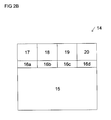
- FIG. 2B shows an architecture of a computer program 14 suitable for implementing a power saving method.
- the computer program product 14 comprises an operating system 15 with four interfaces 16a, 16b, 16c and 16d.
- Energy management functions of the computer system 8 can be activated via the first interface 16a.
- an access protection mechanism of the computer system 8 can be controlled.
- Inputs and outputs to and from the computer system 8 may be provided via the third interface 16c.
- Functions of the operating system 8 can be controlled via the fourth interface 16d.
- the computer program 14 further comprises a power management module 17, an access protection module 18, an evaluation module 19 and a control module 20.
- the modules 17, 18, 19 and 20 are for example software component of the operating system 15, additional driver software or a combination of hardware and software. For example, BIOS settings and routines or so-called firmware modules can be used. Of course, the individual modules can be combined or further divided.
- the power management module 17 controls the power supply or an energy saving state E of the computer system 8.
- it serves in the embodiment for activating or deactivating the display 9 and throttling a processor of the computer system 8.
- it may be a software driver for controlling the so-called Advanced Configuration and Power Interface (ACPI) act.
- ACPI Advanced Configuration and Power Interface
- the access protection module 18 monitors access to the computer system 8. For example, the access protection module 18 may enable access protection Z to the computer system 8 when a power-saving state E has been activated by the power management module 17. The type and frequency of a required user authentication is determined by settings of the access protection module 18.
- the evaluation module 19 is adapted to inputs to the computer system, for example via a built-in keyboard or other input device connected thereto monitor and provide a corresponding input signal k .
- the evaluation module 19 monitors in an advantageous embodiment, the image information provided by the camera 10 on movements and gestures of a user.
- the control module 20 monitors and links the various information and decides whether or not to activate the power save state E.
- the control module 20 functions similarly to the control device of the power management device 4 described above. Specifically, the control module 20 takes into account inputs made to the computer system 8 and image information provided by the camera 10. The image information provided by the camera 10 may be evaluated by either the camera itself or additional hardware or software to detect movement or the presence of an object in the user area 11 and provide an appropriate control signal s to the control module 20.
- the camera 10 can distinguish between the near area 12 and the far area 13.
- a first control signal is provided to the control module 20.
- a second control signal is provided to the power management module when a user is in the remote area 13 of the computer system 8. If no user stops in the user area 11, no control signal or another control signal is transmitted to the control module 20.
- the control module 20 takes into account the input signal k of the evaluation module 19 of the computer system 8. In addition, it takes into account the image provided by the camera 10, the control signal s. Finally, it takes into account a time t provided either by the control module 20 itself, the operating system 15, or by an external timer. As long as a user is in the vicinity 12, the activation of the energy-saving state E by the control module 20 is prevented in any case. So, if a user is sitting directly in front of the computer system 8, but does not make any input, for example because he is leafing through a file, the display 9 will always remain on.
- the display 9 remains first turned on. After expiration of a predetermined period of time T without input or return of the user in the near area 12, the blocking is canceled by the control module 20 and a predetermined energy saving state E is activated by the power management module 17. In this way, the power consumption of the computer system 8 can be reduced during longer work breaks.
- the power management module when a user completely leaves the user area 11 by leaving the screen workstation 7, the power management module also switches the computer system 8 into a power-saving state. This may be the same or a different energy-saving state as described above. In this case, for example, depending on a predetermined configuration, the computer system 8 is completely turned off, or at least one Switched operating mode in which an access protection Z of the computer system 8 is activated. A re-working with the computer system 8 is only possible if a user to the computer system 8 again authenticates.
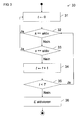
- FIG. 3 shows a flowchart of a power saving method 30.
- the energy saving method 30 is suitable for example for execution by the power management device 4 or by the control module 20 according to the embodiments described above. The following is with reference to that in the FIG. 1 illustrated system described.
- a timer 5 is initialized. For example, a register containing a current time t is reset to the value 0.
- a step 32 it is checked whether an input has been made by an input device 3. If an input signal k is detected, the timer 5 is reinitialized in the subsequent step 31.
- step 33 If no input signal k was detected, it is checked in step 33 whether a control signal s indicates that a user is staying in front of the electronic device 1. If a user stops in front of the electronic device 1, the sensor 6 generates a suitable control signal s . Also in this case, the process is continued in step 31 with the initialization of the timer 5.
- step 34 If neither an input signal k nor a control signal s is detected, the value of the time t is increased by the timer 5. This takes place in step 34.
- step 35 it is checked whether the current time t is smaller than a predetermined period of time T. If the predetermined period of time T has not yet been reached, the method is continued in step 32.
- an energy-saving state E of the electronic device 1 is activated in step.
- a display 2 may be deactivated.
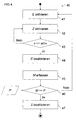
- FIG. 4 shows an advantageous embodiment of an energy saving method 40 with additional access protection mechanism. It is particularly suitable for execution on the computer system 8.
- the individual process steps for activating the energy-saving state E are not shown.
- the energy saving method 30 described above is used to activate the energy saving state E.
- step 41 the energy-saving state E is first activated.
- a display 9 of the computer system 8 can be switched off and at the same time the working clock of a processor can be reduced.
- an access protection Z of the computer system 8 is activated.
- the access protection Z can be activated, for example, by the software module 18 or by another software component of the operating system 15 become. It may also be an access protection system comprising a combination of hardware and software. By activating the access protection Z, the display of information on the display 9 of the computer system 8 is prevented. A reuse of the computer system 8 is possible only after successful authentication of a user. For this purpose, for example, built into an operating system authentication mechanisms, such as a password input, are used.
- a step 43 it is checked whether a control signal s indicates that a person is staying in front of the computer system 8. If this is not the case, the access protection Z remains active and the method is continued in step 42.
- the power-saving state E is deactivated in step 44.
- a processor may be awakened from a so-called sleep state to evaluate the control signal s or other data acquired by the camera 10.
- biometric data is acquired by the camera 10 or other suitable sensor.
- biometric features M of a face detected by the camera 10 can be analyzed.
- a step 46 the acquired biometric features M are compared with a stored access profile P.
- a stored access profile P can be stored, for example, in a central authentication server or locally on a storage medium of the computer system 8.
- step 46 If, in step 46, a sufficiently large match between the acquired biometric features M and the stored access profile P is detected, the access protection Z is deactivated in a step 47.
- the detection of biometric characteristics M serves as a password replacement.
- the computer system 8 can be woken up by approaching a registered user in the user area 11 from the power saving state E and an authentication of the user against the access protection module 18 are made. A manual wake-up and authentication by entering a password is thus not required, which further increases the user comfort.
- step 46 If a sufficiently large correspondence between the recognized biometric feature and the access profile P has not been detected in step 46, the method is continued in step 41, in which the energy-saving state E is reactivated.
- the use of the computer system 8 can be made more comfortable.
- the data provided by the camera 10 may also be used to provide other convenience features. For example, it is possible to detect simple gestures of a user by tracking objects or persons. This way a can Control of the computer system 8 can be further simplified in which to forego mouse or keyboard input in certain situations.
- the devices and methods described above can be used in a variety of applications. For example, they are suitable for devices of digital consumer electronics, which should also provide a comfortable user interface and efficient energy saving mechanisms. For example, a television can be turned off when a person the room where the TV is set up leaves, and does not enter it for a predetermined period of time T again. Alternatively or additionally, the playback of a film by a video recorder or DVD player can be interrupted.
- a sensor providing a control signal s regarding the presence of a user in front of an electronic device. Also a control of the devices by gestures is possible with a camera surveillance of the user.
- RFID Radio Frequency Identification
Landscapes
- Engineering & Computer Science (AREA)
- Theoretical Computer Science (AREA)
- Physics & Mathematics (AREA)
- General Engineering & Computer Science (AREA)
- General Physics & Mathematics (AREA)
- Controls And Circuits For Display Device (AREA)
- Power Sources (AREA)
Applications Claiming Priority (1)
| Application Number | Priority Date | Filing Date | Title |
|---|---|---|---|
| DE102007025991A DE102007025991B4 (de) | 2007-06-04 | 2007-06-04 | Anordnung zum Überwachen einer Umgebungsbedingung und Verfahren zum automatischen Einstellen einer Anzeigeeinheit |
Publications (1)
| Publication Number | Publication Date |
|---|---|
| EP2000881A1 true EP2000881A1 (fr) | 2008-12-10 |
Family
ID=39651384
Family Applications (2)
| Application Number | Title | Priority Date | Filing Date |
|---|---|---|---|
| EP07119971A Withdrawn EP2000881A1 (fr) | 2007-06-04 | 2007-11-05 | Appareil électronique comprenant un dispositif de gestion de l'énergie, système informatique, procédé d'économie d'énergie et produit de programme informatique |
| EP08009343A Withdrawn EP2000882A1 (fr) | 2007-06-04 | 2008-05-21 | Installation destinée à la surveillance d'une condition environnementale et procédé de réglage automatique d'une unité d'affichage |
Family Applications After (1)
| Application Number | Title | Priority Date | Filing Date |
|---|---|---|---|
| EP08009343A Withdrawn EP2000882A1 (fr) | 2007-06-04 | 2008-05-21 | Installation destinée à la surveillance d'une condition environnementale et procédé de réglage automatique d'une unité d'affichage |
Country Status (2)
| Country | Link |
|---|---|
| EP (2) | EP2000881A1 (fr) |
| DE (1) | DE102007025991B4 (fr) |
Cited By (6)
| Publication number | Priority date | Publication date | Assignee | Title |
|---|---|---|---|---|
| CN102197643A (zh) * | 2009-09-07 | 2011-09-21 | 索尼公司 | 显示设备和其控制方法 |
| WO2013127659A1 (fr) * | 2012-03-01 | 2013-09-06 | Siemens Aktiengesellschaft | Procédé et système de commande d'un processus |
| US8581821B2 (en) | 2008-03-24 | 2013-11-12 | Sony Corporation | Liquid crystal display device, liquid crystal display method, display control device, and display control method |
| WO2014206675A1 (fr) * | 2013-06-26 | 2014-12-31 | Fujitsu Technology Solutions Intellectual Property Gmbh | Système informatique doté d'un mode absence |
| WO2015117648A1 (fr) | 2014-02-05 | 2015-08-13 | Fujitsu Technology Solutions Intellectual Property Gmbh | Dispositif d'affichage, système informatique et procédé de gestion des états de fonctionnement d'un système informatique |
| CN109445563A (zh) * | 2018-10-19 | 2019-03-08 | 合肥享淘科技有限公司 | 一种计算机系统的节能方法及计算机系统 |
Families Citing this family (1)
| Publication number | Priority date | Publication date | Assignee | Title |
|---|---|---|---|---|
| EP2901175B1 (fr) | 2012-12-10 | 2018-01-24 | Fujitsu Technology Solutions Intellectual Property GmbH | Dispositif electronique, procede de fonctionnement pour un dispositif electronique et utilisation d'un dispositif electronique |
Citations (7)
| Publication number | Priority date | Publication date | Assignee | Title |
|---|---|---|---|---|
| EP0810512A1 (fr) * | 1996-05-30 | 1997-12-03 | Sun Microsystems, Inc. | Dispositif d'illumination et d'affichage d'informations actionné par les mouvements des yeux |
| US6665805B1 (en) * | 1999-12-27 | 2003-12-16 | Intel Corporation | Method and apparatus for real time monitoring of user presence to prolong a portable computer battery operation time |
| US20040081337A1 (en) * | 2002-10-23 | 2004-04-29 | Tsirkel Aaron M. | Method and apparatus for adaptive realtime system power state control |
| US20050282561A1 (en) * | 2004-06-21 | 2005-12-22 | Inventec Corporation | Interactive method for electronic equipment |
| US20050289363A1 (en) * | 2004-06-28 | 2005-12-29 | Tsirkel Aaron M | Method and apparatus for automatic realtime power management |
| EP1672460A1 (fr) * | 2004-12-15 | 2006-06-21 | STMicroelectronics (Research & Development) Limited | Dispositif de détection d'utilisateur d'ordinateur |
| US20060204085A1 (en) * | 1999-10-29 | 2006-09-14 | Cooper Frederick J | Controlling processor-based systems using a digital camera |
Family Cites Families (6)
| Publication number | Priority date | Publication date | Assignee | Title |
|---|---|---|---|---|
| US6384852B1 (en) * | 1999-06-09 | 2002-05-07 | International Business Machines Corporation | Intelligent screen saver using image difference |
| JP2001134256A (ja) * | 1999-11-05 | 2001-05-18 | Sony Corp | ディスプレイ装置の利用者検出回路 |
| DE10203157A1 (de) | 2002-01-28 | 2003-08-07 | Lite On Technology Co | LCD-Monitor mit Lichtdetektionsfunktion und ein Verfahren zum Steuern des LCD-Monitors |
| US20050182962A1 (en) * | 2004-02-17 | 2005-08-18 | Paul Given | Computer security peripheral |
| US20060190750A1 (en) * | 2005-02-22 | 2006-08-24 | Logitech Europe S.A. | System power management based on motion detection |
| US20060192775A1 (en) * | 2005-02-25 | 2006-08-31 | Microsoft Corporation | Using detected visual cues to change computer system operating states |
-
2007
- 2007-06-04 DE DE102007025991A patent/DE102007025991B4/de not_active Expired - Fee Related
- 2007-11-05 EP EP07119971A patent/EP2000881A1/fr not_active Withdrawn
-
2008
- 2008-05-21 EP EP08009343A patent/EP2000882A1/fr not_active Withdrawn
Patent Citations (7)
| Publication number | Priority date | Publication date | Assignee | Title |
|---|---|---|---|---|
| EP0810512A1 (fr) * | 1996-05-30 | 1997-12-03 | Sun Microsystems, Inc. | Dispositif d'illumination et d'affichage d'informations actionné par les mouvements des yeux |
| US20060204085A1 (en) * | 1999-10-29 | 2006-09-14 | Cooper Frederick J | Controlling processor-based systems using a digital camera |
| US6665805B1 (en) * | 1999-12-27 | 2003-12-16 | Intel Corporation | Method and apparatus for real time monitoring of user presence to prolong a portable computer battery operation time |
| US20040081337A1 (en) * | 2002-10-23 | 2004-04-29 | Tsirkel Aaron M. | Method and apparatus for adaptive realtime system power state control |
| US20050282561A1 (en) * | 2004-06-21 | 2005-12-22 | Inventec Corporation | Interactive method for electronic equipment |
| US20050289363A1 (en) * | 2004-06-28 | 2005-12-29 | Tsirkel Aaron M | Method and apparatus for automatic realtime power management |
| EP1672460A1 (fr) * | 2004-12-15 | 2006-06-21 | STMicroelectronics (Research & Development) Limited | Dispositif de détection d'utilisateur d'ordinateur |
Cited By (13)
| Publication number | Priority date | Publication date | Assignee | Title |
|---|---|---|---|---|
| US8581821B2 (en) | 2008-03-24 | 2013-11-12 | Sony Corporation | Liquid crystal display device, liquid crystal display method, display control device, and display control method |
| US10290281B2 (en) | 2009-09-07 | 2019-05-14 | Saturn Licensing Llc | Display device and control method |
| EP2339837A4 (fr) * | 2009-09-07 | 2011-11-02 | Sony Corp | Dispositif d'affichage et procédé de commande de ce dispositif |
| CN102197643A (zh) * | 2009-09-07 | 2011-09-21 | 索尼公司 | 显示设备和其控制方法 |
| US9426406B2 (en) | 2009-09-07 | 2016-08-23 | Sony Corporation | Display device and control method |
| WO2013127659A1 (fr) * | 2012-03-01 | 2013-09-06 | Siemens Aktiengesellschaft | Procédé et système de commande d'un processus |
| CN104205005A (zh) * | 2012-03-01 | 2014-12-10 | 西门子公司 | 用于过程控制的方法和系统 |
| WO2014206675A1 (fr) * | 2013-06-26 | 2014-12-31 | Fujitsu Technology Solutions Intellectual Property Gmbh | Système informatique doté d'un mode absence |
| WO2015117648A1 (fr) | 2014-02-05 | 2015-08-13 | Fujitsu Technology Solutions Intellectual Property Gmbh | Dispositif d'affichage, système informatique et procédé de gestion des états de fonctionnement d'un système informatique |
| US10234928B2 (en) | 2014-02-05 | 2019-03-19 | Fujitsu Technology Solutions Intellectual Property Gmbh | Display device, computer system and method of managing the operating states of a computer system |
| US10884479B2 (en) | 2014-02-05 | 2021-01-05 | Fujitsu Client Computing Limited | Display device, computer system and method of managing the operating states of a computer system |
| EP3779642A1 (fr) | 2014-02-05 | 2021-02-17 | Fujitsu Client Computing Limited | Dispositif d'affichage, système informatique et procédé de gestion des états de fonctionnement d'un système informatique |
| CN109445563A (zh) * | 2018-10-19 | 2019-03-08 | 合肥享淘科技有限公司 | 一种计算机系统的节能方法及计算机系统 |
Also Published As
| Publication number | Publication date |
|---|---|
| DE102007025991A1 (de) | 2008-12-11 |
| DE102007025991B4 (de) | 2009-04-02 |
| EP2000882A1 (fr) | 2008-12-10 |
Similar Documents
| Publication | Publication Date | Title |
|---|---|---|
| DE102012214945A1 (de) | Verfahren und Vorrichtung zum Optimieren von Systembatterielebensdauer für statische oder halbstatische Bildbetrachtungsnutzungsmodelle | |
| DE69333442T2 (de) | Bereitschaftssystem mit geringem Energieverbrauch für einen Monitor | |
| EP2281223B1 (fr) | Procédé d utilisation d un équipement technique commandable électriquement et dispositif de commande correspondant | |
| US10607097B2 (en) | Method and device for guiding fingerprint recognition | |
| DE202008001341U1 (de) | Bestimmungssystem eines Stromsparmodus einer Multimediaanwendung | |
| US6516421B1 (en) | Method and means for adjusting the timing of user-activity-dependent changes of operational state of an apparatus | |
| DE112012006090T5 (de) | Verfahren und Vorrichtung zum Energiesparen | |
| WO2009030446A2 (fr) | Appareil médical à consommation d'énergie réduite | |
| DE19704597C2 (de) | Monitor-Stromversorgungs-Stellschaltung für Computersysteme | |
| DE102015119592A1 (de) | Durch einen Blick veranlasste Spracherkennung | |
| EP0810512A1 (fr) | Dispositif d'illumination et d'affichage d'informations actionné par les mouvements des yeux | |
| CN111665938B (zh) | 应用启动方法及电子设备 | |
| DE112011105171T5 (de) | Blockieren von Benutzerinhalten basierend auf der Position | |
| US9038164B2 (en) | Electronic device, electronic device controlling method, and computer program product | |
| DE102011014681A1 (de) | Power-Management basierend auf automatischer Arbeitslasterkennung | |
| DE112013000535T5 (de) | Verfahren und Vorrichtung zum Aktivieren elektronischer Vorrichtungen mit Gesten | |
| EP1855180A2 (fr) | Ecran de visualisation et dispositif de commande d'un écran de visualisation en état d'économie d'énergie | |
| US20190087609A1 (en) | Method and system for controlling power key of terminal | |
| DE112005002626B4 (de) | Computer und Verfahren zum Realisieren einer Anwendung eines Haushaltsgeräts mit niedrigem Energie-bzw. Stromverbrauch | |
| DE10350174A1 (de) | Verfahren zum Anmelden von Nutzern an Datenverarbeitungseinrichtungen | |
| DE102013106360A1 (de) | Betriebssteuerverfahren und elektronische vorrichtung | |
| DE102018105287A1 (de) | Verfahren und Vorrichtung zum Ermöglichen kontextbasierter Stimmantworten auf Always-on-Display-Benachrichtigungen | |
| DE69320417T2 (de) | Verfahren und Gerät zur Änderung der Taktfrequenz eines Prozessors | |
| DE20004448U1 (de) | Vorrichtung zum Sichern von Aufweckfunktionen eines Computersystems nach einem Stromausfall | |
| EP2745503B1 (fr) | Dispositif de projection laser et procédé |
Legal Events
| Date | Code | Title | Description |
|---|---|---|---|
| PUAI | Public reference made under article 153(3) epc to a published international application that has entered the european phase |
Free format text: ORIGINAL CODE: 0009012 |
|
| AK | Designated contracting states |
Kind code of ref document: A1 Designated state(s): AT BE BG CH CY CZ DE DK EE ES FI FR GB GR HU IE IS IT LI LT LU LV MC MT NL PL PT RO SE SI SK TR |
|
| AX | Request for extension of the european patent |
Extension state: AL BA HR MK RS |
|
| AKX | Designation fees paid | ||
| STAA | Information on the status of an ep patent application or granted ep patent |
Free format text: STATUS: THE APPLICATION IS DEEMED TO BE WITHDRAWN |
|
| 18D | Application deemed to be withdrawn |
Effective date: 20090611 |
|
| REG | Reference to a national code |
Ref country code: DE Ref legal event code: 8566 |