EP2000997A1 - Procédé pour le contrôle d'un affichage d'écran tactile et système de jeu pour un jeu multi-joueurs - Google Patents
Procédé pour le contrôle d'un affichage d'écran tactile et système de jeu pour un jeu multi-joueurs Download PDFInfo
- Publication number
- EP2000997A1 EP2000997A1 EP08157458A EP08157458A EP2000997A1 EP 2000997 A1 EP2000997 A1 EP 2000997A1 EP 08157458 A EP08157458 A EP 08157458A EP 08157458 A EP08157458 A EP 08157458A EP 2000997 A1 EP2000997 A1 EP 2000997A1
- Authority
- EP
- European Patent Office
- Prior art keywords
- player
- interface
- game
- display
- gaming system
- Prior art date
- Legal status (The legal status is an assumption and is not a legal conclusion. Google has not performed a legal analysis and makes no representation as to the accuracy of the status listed.)
- Withdrawn
Links
- 238000000034 method Methods 0.000 title claims abstract description 49
- 238000004590 computer program Methods 0.000 claims description 8
- 230000004044 response Effects 0.000 claims description 3
- 230000008569 process Effects 0.000 description 5
- 230000006870 function Effects 0.000 description 4
- 230000007246 mechanism Effects 0.000 description 4
- 238000010586 diagram Methods 0.000 description 3
- 238000013459 approach Methods 0.000 description 2
- 230000008901 benefit Effects 0.000 description 1
- 239000000969 carrier Substances 0.000 description 1
- 230000002860 competitive effect Effects 0.000 description 1
- 230000001771 impaired effect Effects 0.000 description 1
- 239000000463 material Substances 0.000 description 1
- 238000012986 modification Methods 0.000 description 1
- 230000004048 modification Effects 0.000 description 1
- 230000008450 motivation Effects 0.000 description 1
- 230000001737 promoting effect Effects 0.000 description 1
- 238000009987 spinning Methods 0.000 description 1
Images



Classifications
-
- G—PHYSICS
- G07—CHECKING-DEVICES
- G07F—COIN-FREED OR LIKE APPARATUS
- G07F17/00—Coin-freed apparatus for hiring articles; Coin-freed facilities or services
- G07F17/32—Coin-freed apparatus for hiring articles; Coin-freed facilities or services for games, toys, sports, or amusements
Definitions
- the present invention relates to a method of controlling a touch screen display of a multi-player game and a gaming system for a multi-player game.
- the invention provides a method of controlling a touch screen display of a multi-player game comprising:
- the method comprises determining that an additional player interface is required comprises determining that a new player is to participate in the game.
- the method comprises determining that an additional player interface is required comprises determining that an existing player requires an additional interface.
- the method comprises adjusting at least one existing player interface in response to addition of a new player.
- the method comprises adjusting at least one existing player interface by moving an existing player interface.
- the method comprises adjusting at least one existing player interface by changing the size of an existing player interface.
- the method comprises determining a position for the new player interface based on the position of at least one existing player interface.
- the method comprises obtaining position information indicative of a player's position relative to the display and determining a position on the player interface at which to add the new player interface based on the position information.
- the invention provides a gaming system for a multi-player game comprising:
- the new interface determiner is arranged to determine that an additional player interface is required by determining that a new player is to participate in the game.
- the new interface determiner is arranged to determine that an additional player interface is required by determining that an existing player requires an additional interface.
- the gaming system further comprises an interface adjuster arranged to adjust at least one existing player interface in response to addition of a new player.
- the interface adjuster is arranged to adjust at least one existing player interface by moving an existing player interface.
- the interface adjuster is arranged to adjust at least one existing player interface by changing the size of an existing player interface.
- the gaming system comprises a position acquirer arranged to obtain position information indicative of the player's position relative to the display and a position determiner arranged to determine a position on the player interface at which the player interface adder adds the new player interface based on the position information.
- the position acquirer comprises at least one sensor for sensing a player position.
- the position acquirer comprises at least one identification reader for reading an identification device carried by the player.
- the gaming system comprises a plurality of identification readers arranged to enable the player's position to be determined.
- the display is mounted so that an upper surface thereof is substantially horizontal such that the display provides a virtual table.
- the display comprises a plurality of display sub-units.
- the invention provides computer program code which when executed by a computer causes the computer to implement the above method.
- the invention provides a computer readable medium comprising the above computer program code.
- the invention provides a data signal comprising the above computer program code.
- the invention provides transmitting or receiving the above computer program code.
- a gaming system arranged to implement a virtual gaming table, where a horizontally oriented touch screen display is used by players to participate in a game.
- the gaming system can take a number of different forms.
- a stand alone gaming table wherein all or most components required for implementing the game are present or located next to a player operable virtual gaming table.
- a distributed architecture wherein some of the components required for implementing the game are present located with the gaming table player operable gaming machine and some of the components are located remotely relative to the gaming table.
- a "thick client” architecture may be used wherein part of the game is executed locally by the player operable gaming table and part of the game is executed remotely, such as by a gaming server; or a "thin client” architecture may be used wherein most of the game is executed remotely such as by a gaming server and a player operable gaming table is used only to display audible and/or visible gaming information to the player and receive gaming inputs from the player.
- an architecture may be provided wherein a gaming table is networked to a gaming server and the respective functions of the gaming table and the gaming server are selectively modifiable.
- the gaming system may operate in stand alone gaming table mode, "thick client” mode or “thin client” mode depending on the game being played, operating conditions, and so on.
- Other variations will be apparent to persons skilled in the art.
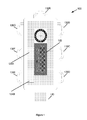
- Figure 1 is a plan view of a virtual gaming table 100 having a horizontally oriented display 120 and a log-on terminal 140. As can been from figure 1 , the gaming table is surrounded by seven chairs 130 indicating seven possible player positions. Two player interfaces 124a, 124b are active on the display 120. A central area 122 of the display is used to display information common to all players; in the example shown in Figure 1 a display of a roulette game.
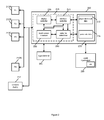
- a virtual table 200 comprises a game controller 220, a common display 212 and a variable number of player interfaces 210.
- the number of player interfaces depends on the number of players playing the game. In some embodiments there may be a single player interface for each player so that each time a player enters the game an interface is added. In other embodiments, a minimum number of player interfaces may always be displayed even though it is possible they are not all being used and additional player interfaces added as necessary when the minimum is exceeded; unused interfaces may function in an attract mode. In further embodiments, a player may request an additional player interface. For example, some players may wish to play two hands of cards simultaneously where the gaming table implements a card game.
- a number of the modules are implemented by a processor 215.
- a person skilled in the art will appreciate that dedicated hardware could be used instead of program code running on a processor 215 to implement the required functions.
- the game controller's processor 215 typically processes the game play instructions in accordance with game play rules and outputs game play outcomes to the display.
- the game play instructions are stored as program code in a memory.
- processor is used to refer generically to any device that can process game play instructions in accordance with game play rules and may include: a microprocessor, microcontroller, programmable logic device or other computational device, a general purpose computer (e.g. a PC) or a server.
- the game controller 220 has a display controller 230 for controlling what is displayed both in the common display area 212 of a gaming table 212 and on each of the player interfaces 210.
- the display 120 incorporates a touch screen.
- touch screen display Such a display is referred to as "touch screen display”.
- the player interfaces share a common display 120.
- the "touch screen” sensor need not cover the entire display.
- central area 122 as shown in Figure 1 need not necessarily have a touch screen capability.
- the touch screen is a multi-touch screen capable of processing simultaneous or near simultaneous instructions from a number of different players.
- the display 120 itself is typically a wide screen, large format display such as a plasma or LCD display of a size in the order of 80-120 inches across the diagonal.
- the display could be formed a plurality of display sub-units located adjacent to one another under the control of the display controller 230 to display both the player interfaces 210 and the common display area 212.
- the display controller 230 controls the display to display the individual player interfaces based on data provided by the interface controller 240 and the outcome determiner.
- the interface controller also provides data to the touch screen processor 250 to enable it to interpret touches on the touch screen display in order to associate them with individual player interfaces 210 and to provide this data to the outcome determiner 260.
- individual player instructions can be correctly provided to the outcome determiner 260 so that the outcome determiner 266 can determine the result of the game based on the game rule data 274 for each player.
- the outcome determiner 260 provides data to the display controller 230 regarding the game outcomes for individual players. This may be displayed in a display region of the player interface 210 on the common display or both.
- the outcome determiner 260 may determine independent results for each player such as in a game like roulette or results that depend on the game play of other players such as in a competitive game like poker.
- Credit data 272 is maintained separately for each player interface in memory 270. That data may be associated with a specific player and the players identity captured either via the log-on terminal 280 or in some other manner as will be described in further detail.
- the log-on terminal 280 will typically include a touch screen display allowing a player to enter their name and assigned to themselves a player position number. Alternatively the player position maybe assigned by the game. In alternative embodiments, players may be assigned positions anonymously by providing them with a temporary access code, printed by the log-on terminal on a voucher.
- a credit input/output mechanism 290 can either be provided centrally, for example in association with the log-on terminals so that the player enters credit when they log-on to the game.
- a credit mechanism can also be provided at each player position. For example, by a bill acceptor located under the table.
- the credit input/output mechanism includes a voucher printer 295.
- a player provides credit to the credit input/output 290 using a bill or coin acceptor.
- the credit mechanism 290 creates a record in credit data 272 having an access code.
- a voucher is printed by a voucher printer 295.
- the voucher has the code on it so that the player can enter at the player interface 210 using a virtual key pad.
- the game controller 220 processes the input code and verifies it against records stored as credit data 272. If the code is verified, the amount of credit is associated with the player interface used to enter the code.
- FIG. 3 there is shown more detail of the interface controller 240 as well as an alternative technique for determining where to add a new player interface.
- a single player interface 210 is shown. However it will be appreciated from the above that there are a plurality of player interfaces 210 provided by the virtual table.
- a player approaches log-on terminal 280 and request a player interface for the game either manually, or by swiping or otherwise providing a player tracking device to the log-on terminal 280. That is the log-on terminal may read magnetic cards, smart cards, RFID tags or other suitable data carriers.
- the log-on processor 247 determines that a new player is to be added and requests that the position determiner 246 determine a position.
- the log-on processor 247 and position determiner 246 provide a new interface determiner 249.
- there a series of predetermined positions that are available to players and the position determiner selects one of these predetermined positions.
- the positions data is provided to the interface adder 243 which updates the interface data 241.
- the interface adjuster 248 determines whether any of the existing player interfaces specified by the interface data 241 need to be adjusted in order to accommodate the new player interface.
- the interface data is used by the display controller 230 to display additional player interface 210 for the new player.
- the player interface may initially show, for example, tokens for use in the game corresponding to a player's entered credit and/or a player hand in the case of a card game.
- the touch screen processor 240 then is able to determine from interface data 241 which portions of the touch screen 214 it needs to process in respect of this player such that data from the touch screen processor 240 represents player instructions for that player when it is subsequently passed to the outcome determiner 260.
- Interface remover 242 then removes the player interface from the interface data 241 and the interface adjuster 248 may adjust one or more other players interfaces as extra space is made available by the removed interface.
- the player is not required to use the log-on terminal and simply approaches and sits at the table, whereafter their position at the table is identified in some manner.
- the player carries a player tracking device in the form of a RFID tag.
- reader 285 which may include plural tag readers for triangulation
- the position determiner 246 determines a new position for the player either from a set of available positions or by defining a position relative to the players current location.
- the new position interface determiner 249 includes the position acquirer 245. It will thus be appreciated that embodiments where players are assigned interfaces solely by this technique, the logon processor 247 is not needed.
- Various techniques can be used to capture a player's position, for example, camera footage of the gaming table can be processed to determine that a new player has sat down at the table.
- a player may be asked to confirm by means of a virtual keypad provided by the touch screen 214 of the player interface 210 that they wish to play. For example by entering a personal code linked to their identification means.
- a card reader could be provided at a player position in order for them to swipe a magnetic card.
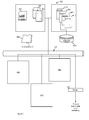
- FIG. 4 shows a gaming system 400 in accordance with an alternative embodiment.
- the gaming system 400 includes a network 401, which for example may be an Ethernet network.
- Gaming tables 403, are connected to the network 401.
- the gaming tables 202 provide a player operable interface for the gaming system 400.
- One or more displays 404 may also be connected to the network 401.
- the displays 404 may, for example, be associated with one or more gaming tables 203.
- the displays 404 may be used to display representations associated with game play on the gaming tables 402, and/or used to display other representations, for example promotional or informational material.
- game server 405 implements part of the game played by a players using a gaming table 403 and the gaming machine 403 implements part of the game.
- the gaming machine 403 implements part of the game.
- a database management server 406 may manage storage of game programs and associated data for downloading or access by the gaming devices 402 in a database 406A.
- Jackpot server 407 will be provided to monitor and carry out the Jackpot game.
- game server 405 implements most or all of the game played by a player using a gaming table 403 and the gaming table 403 essentially provides only the player interface. With this embodiment, the game server 405 provides the game controller. The gaming table 403 will receive player instructions, pass these to the game server 405 which will process them and return game play outcomes to the gaming table 403 for display.
- a loyalty program server 412 may implement a loyalty system.
- Servers are also typically provided to assist in the administration of the gaming network 400, including for example a gaming floor management server 408, and a licensing server 409 to monitor the use of licenses relating to particular games.
- An administrator terminal 410 is provided to allow an administrator to run the network 401 and the devices connected to the network.
- the gaming network 400 may communicate with other gaming systems, other local networks, for example a corporate network, and/or a wide area network such as the Internet, for example through a firewall 411.
- other local networks for example a corporate network
- a wide area network such as the Internet
- functionality at the server side of the network may be distributed over a plurality of different computers.
- elements may be run as a single "engine" on one server or a separate server may be provided.
- the game server 405 could run a random generator engine.
- a separate random number generator server could be provided.
- a plurality of games servers could be provided to run different games or a single game server may run a plurality of different games as required by the tables 403.
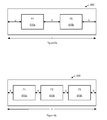
- Figure 5a shows one manner in which the display 120 may be adjusted in order to accommodate a new player interface.
- the interfaces 510 initially comprise three player interfaces of a first size 510a, 510b and 510c and two larger player interfaces 510d, 510e.
- the larger player interfaces 510d, 510e are provided because there are only two player interfaces on their side of the table, and hence more space is available for the players. whereas the three player interfaces on the other side of the table.
- Figure 5b shows player interface 510f added to the table.
- player interfaces 510d and 510e have been resized in order to accommodate the additional player interface 510, so that each player interface 510 is the same size.
- Figure 6a shows an alternative technique in which a player interface can be added.
- the size of any individual player interface 610 is always the same however the spacing a in Figure 6a is larger than the spacing b in Figure 6b while the table length x is maintained. Accordingly, the player interfaces 610 are always displayed so that they are evenly spaced across the entire length x of the table.
- the two techniques and other techniques can be employed to adjust the size, position or both the player interfaces.
- Figure 7 shows the method of the embodiment.
- the virtual gaming table is initially awaiting a potential additional player 710 if there is no additional player the game enters the wait state 715.
- the position information is obtained 720 alternatively, or subsequently, the method proceeds to determining a new location 730 corresponding to the additional player interface.
- step 740 it is determined whether an adjustment is needed to the current player interface positions, if the answer is "yes", at least one current interface is adjusted 750 when the new interface is added 760. (Such an adjustment may be accompanied by a warning to the players that an adjustment is occurring.)
- step 770 it is determined whether there are the maximum number of players playing with game.
- the method involves waiting for additional players 710, 715. If the answer is yes the method involves waiting until a player is removed 780, 785. When a player is removed the game can accommodate an additional player and accordingly moves to a wait state 710, 715. In other embodiments, players may be able to queue for the game using the logon terminal. In such embodiments, the method involves checking the queue when a player is removed from a full table.
- each player interface can be dynamically sized to reflect extra players being "squeezed" onto a table.
- Different configurations of player interfaces can be provided. For example, if the player table 100 is positioned against a wall, the common game area 122 can be moved to one side of the display. Such an arrangement would be typical for a blackjack game.
- the appearance of the table can be adjusted and the gaming positions can be adjusted based on the game that is being played.
- an individual player interface can be resized depending on a particular characteristic associated with a player. For example, a player who is sight impaired may have a larger area than other players.
Landscapes
- Physics & Mathematics (AREA)
- General Physics & Mathematics (AREA)
- User Interface Of Digital Computer (AREA)
Applications Claiming Priority (1)
| Application Number | Priority Date | Filing Date | Title |
|---|---|---|---|
| AU2007903067A AU2007903067A0 (en) | 2007-06-07 | Method of controlling a touch screen display and a gaming system for a multi-player game |
Publications (1)
| Publication Number | Publication Date |
|---|---|
| EP2000997A1 true EP2000997A1 (fr) | 2008-12-10 |
Family
ID=39720098
Family Applications (1)
| Application Number | Title | Priority Date | Filing Date |
|---|---|---|---|
| EP08157458A Withdrawn EP2000997A1 (fr) | 2007-06-07 | 2008-06-03 | Procédé pour le contrôle d'un affichage d'écran tactile et système de jeu pour un jeu multi-joueurs |
Country Status (3)
| Country | Link |
|---|---|
| US (1) | US20090093306A1 (fr) |
| EP (1) | EP2000997A1 (fr) |
| AU (1) | AU2008202091A1 (fr) |
Cited By (3)
| Publication number | Priority date | Publication date | Assignee | Title |
|---|---|---|---|---|
| WO2011066593A1 (fr) | 2009-12-04 | 2011-06-09 | Michael Leczek | Dispositif de jeu électronique et appareil d'identification associé |
| WO2013133528A1 (fr) * | 2012-03-06 | 2013-09-12 | Samsung Electronics Co., Ltd. | Appareil client, procédé de commande de client, serveur et procédé de fourniture d'image au moyen du serveur |
| EP2439625A4 (fr) * | 2009-06-05 | 2013-10-09 | Samsung Electronics Co Ltd | Procédé pour fournir des interfaces utilisateurs par un utilisateur et dispositif mettant en oeuvre ce procédé |
Families Citing this family (5)
| Publication number | Priority date | Publication date | Assignee | Title |
|---|---|---|---|---|
| US20100285881A1 (en) * | 2009-05-07 | 2010-11-11 | Microsoft Corporation | Touch gesturing on multi-player game space |
| US8118680B2 (en) * | 2010-01-08 | 2012-02-21 | Ami Entertainment Network, Inc. | Multi-touchscreen module for amusement device |
| US9390578B2 (en) | 2010-01-08 | 2016-07-12 | Ami Entertainment Network, Llc | Multi-touchscreen module for amusement device |
| US8924432B2 (en) | 2011-09-26 | 2014-12-30 | Ami Entertainment Network, Llc | Portable hand held controller for amusement device |
| US20140371875A1 (en) * | 2013-06-12 | 2014-12-18 | Tecbak | System and method for controlling joint access to an apparatus |
Citations (5)
| Publication number | Priority date | Publication date | Assignee | Title |
|---|---|---|---|---|
| EP1566729A2 (fr) * | 2004-02-23 | 2005-08-24 | Aruze Corp. | Dispositif d'entrée d'informations |
| US20050215311A1 (en) | 2003-05-01 | 2005-09-29 | Wms Gaming | Gaming machine having enhanced bonus game play schemes |
| WO2006078219A1 (fr) | 2005-01-24 | 2006-07-27 | Touchtable Ab | Table de jeu electronique |
| WO2007032949A1 (fr) * | 2005-09-09 | 2007-03-22 | Wms Gaming Inc. | Interface dynamique utilisateur d'un systeme de jeu |
| WO2008045464A2 (fr) * | 2006-10-10 | 2008-04-17 | Wms Gaming Inc. | Table à joueurs multiples et à points tactiles multiples destinée à des systèmes de jeu de mises |
Family Cites Families (5)
| Publication number | Priority date | Publication date | Assignee | Title |
|---|---|---|---|---|
| US8430749B2 (en) * | 2001-08-10 | 2013-04-30 | Igt | Dynamic casino tracking and optimization |
| US20060058082A1 (en) * | 2004-09-13 | 2006-03-16 | Pokertek, Inc. | System and method for providing a card tournament using one or more electronic card table |
| US20060184800A1 (en) * | 2005-02-16 | 2006-08-17 | Outland Research, Llc | Method and apparatus for using age and/or gender recognition techniques to customize a user interface |
| KR100727954B1 (ko) * | 2005-07-27 | 2007-06-14 | 삼성전자주식회사 | 사용자 인터페이스 표시장치 및 방법 |
| US8930834B2 (en) * | 2006-03-20 | 2015-01-06 | Microsoft Corporation | Variable orientation user interface |
-
2008
- 2008-05-12 AU AU2008202091A patent/AU2008202091A1/en not_active Abandoned
- 2008-06-03 EP EP08157458A patent/EP2000997A1/fr not_active Withdrawn
- 2008-06-05 US US12/134,139 patent/US20090093306A1/en not_active Abandoned
Patent Citations (5)
| Publication number | Priority date | Publication date | Assignee | Title |
|---|---|---|---|---|
| US20050215311A1 (en) | 2003-05-01 | 2005-09-29 | Wms Gaming | Gaming machine having enhanced bonus game play schemes |
| EP1566729A2 (fr) * | 2004-02-23 | 2005-08-24 | Aruze Corp. | Dispositif d'entrée d'informations |
| WO2006078219A1 (fr) | 2005-01-24 | 2006-07-27 | Touchtable Ab | Table de jeu electronique |
| WO2007032949A1 (fr) * | 2005-09-09 | 2007-03-22 | Wms Gaming Inc. | Interface dynamique utilisateur d'un systeme de jeu |
| WO2008045464A2 (fr) * | 2006-10-10 | 2008-04-17 | Wms Gaming Inc. | Table à joueurs multiples et à points tactiles multiples destinée à des systèmes de jeu de mises |
Non-Patent Citations (3)
| Title |
|---|
| DIETZ P. ET AL: "DiamondTouch: A Multi-User Touch Technology", UIST 01. PROCEEDINGS OF THE 14TH. ANNUAL ACM SYMPOSIUM ON USER INTERFACE SOFTWARE AND TECHNOLOGY. ORLANDO, FL, NOV. 11 - 14, 2001; [ACM SYMPOSIUM ON USER INTERFACE SOFTWARE AND TECHNOLOGY], NEW YORK, NY : ACM, US, 1 January 2001 (2001-01-01), pages 219 - 226, XP002553203, ISBN: 978-1-58113-438-4 * |
| MEREDITH RINGEL ET AL: "Release, relocate, reorient, resize: fluid techniques for document sharing on multi-user interactive tables", CONFERENCE ON HUMAN FACTORS IN COMPUTING SYSTEMS, 2004, NEW YORK, pages 1441 - 1444, ISBN: 1-58113-703-6 * |
| RINGEL M. ET AL: "Release, Relocate, Reorient, Resize: Fluid Techniques for Document Sharing on Multi-User Interactive Tables", 1 April 2004, CHI 2004. CONFERENCE PROCEEDINGS, ACM, NEW YORK, NY ; US, XP007911328 * |
Cited By (10)
| Publication number | Priority date | Publication date | Assignee | Title |
|---|---|---|---|---|
| EP2439625A4 (fr) * | 2009-06-05 | 2013-10-09 | Samsung Electronics Co Ltd | Procédé pour fournir des interfaces utilisateurs par un utilisateur et dispositif mettant en oeuvre ce procédé |
| US8898588B2 (en) | 2009-06-05 | 2014-11-25 | Samsung Electronics Co., Ltd | Method for providing user interface for each user and device applying the same |
| US9063652B2 (en) | 2009-06-05 | 2015-06-23 | Samsung Electronics Co., Ltd | Method for providing user interface for each user, method for performing service, and device applying the same |
| US9438593B2 (en) | 2009-06-05 | 2016-09-06 | Samsung Electronics Co., Ltd | Method for providing user interface for each user and device applying the same |
| US9548980B2 (en) | 2009-06-05 | 2017-01-17 | Samsung Electronics Co., Ltd | Method for providing user interface for each user, method for performing service, and device applying the same |
| US10462133B2 (en) | 2009-06-05 | 2019-10-29 | Samsung Electronics Co., Ltd | Method for providing user interface for each user, method for performing service, and device applying the same |
| WO2011066593A1 (fr) | 2009-12-04 | 2011-06-09 | Michael Leczek | Dispositif de jeu électronique et appareil d'identification associé |
| EP2333734A1 (fr) | 2009-12-04 | 2011-06-15 | Michael Leczek | Dispositif de jeu électronique et appareil d'identification correspondant |
| US8870664B2 (en) | 2009-12-04 | 2014-10-28 | Michael Leczek | Electronic gaming device and associated identification unit |
| WO2013133528A1 (fr) * | 2012-03-06 | 2013-09-12 | Samsung Electronics Co., Ltd. | Appareil client, procédé de commande de client, serveur et procédé de fourniture d'image au moyen du serveur |
Also Published As
| Publication number | Publication date |
|---|---|
| US20090093306A1 (en) | 2009-04-09 |
| AU2008202091A1 (en) | 2009-01-08 |
Similar Documents
| Publication | Publication Date | Title |
|---|---|---|
| US11514753B2 (en) | Distributed side wagering methods and systems | |
| US9299223B2 (en) | Controlling bingo game interactivity | |
| US20180130308A1 (en) | Systems and methods for enhancing gaming payouts using grid interactions | |
| US7892085B2 (en) | Devices and methods for playing electronic bingo game | |
| US11232678B2 (en) | Systems, apparatuses and methods for facilitating enhancement of gaming payout modifiers | |
| US20090093306A1 (en) | Method of controlling a touch screen display and a gaming system for a multi-player game | |
| US8328628B2 (en) | Gaming system and a method of gaming | |
| US20210390822A1 (en) | Systems and methods providing a spinning reel indicator symbol trigger mechanism associated with a display position | |
| US10713896B2 (en) | Gaming devices with choice of collecting or surrendering award | |
| US20080113814A1 (en) | Bar-coded player tracking equipment set up system and method | |
| US20090124337A1 (en) | Method of controlling a gaming system, a player interface for a gaming system and a method of gaming | |
| US12347275B2 (en) | Gaming devices and methods for enhancing future gaming events | |
| US20130012298A1 (en) | Gaming system and a method of gaming | |
| AU2011202440B2 (en) | Method of credit input and a gaming system | |
| US9022849B2 (en) | Method of gaming, a gaming system, and a game controller | |
| AU2011213830B2 (en) | Method of controlling a touch screen display and a gaming system for a multi-player game. | |
| US20130244754A1 (en) | Method of gaming, a game controller and a gaming system | |
| AU2016213782B2 (en) | Method of credit input and a gaming system | |
| US20090137308A1 (en) | Method of gaming and a gaming system | |
| AU2018202739A1 (en) | Method of controlling a gaming system, a player interface for a gaming system and a method of gaming. | |
| AU2014200341A1 (en) | Method of credit input and a gaming system | |
| AU2013263821A1 (en) | Method of controlling a gaming system, a player interface for a gaming system and a method of gaming |
Legal Events
| Date | Code | Title | Description |
|---|---|---|---|
| PUAI | Public reference made under article 153(3) epc to a published international application that has entered the european phase |
Free format text: ORIGINAL CODE: 0009012 |
|
| AK | Designated contracting states |
Kind code of ref document: A1 Designated state(s): AT BE BG CH CY CZ DE DK EE ES FI FR GB GR HR HU IE IS IT LI LT LU LV MC MT NL NO PL PT RO SE SI SK TR |
|
| AX | Request for extension of the european patent |
Extension state: AL BA MK RS |
|
| 17P | Request for examination filed |
Effective date: 20090610 |
|
| AKX | Designation fees paid |
Designated state(s): AT BE BG CH CY CZ DE DK EE ES FI FR GB GR HR HU IE IS IT LI LT LU LV MC MT NL NO PL PT RO SE SI SK TR |
|
| 17Q | First examination report despatched |
Effective date: 20100208 |
|
| STAA | Information on the status of an ep patent application or granted ep patent |
Free format text: STATUS: THE APPLICATION IS DEEMED TO BE WITHDRAWN |
|
| 18D | Application deemed to be withdrawn |
Effective date: 20100621 |