EP2001000A2 - Sorties d'utilitaires en tant que répétiteurs de commande à distance - Google Patents
Sorties d'utilitaires en tant que répétiteurs de commande à distance Download PDFInfo
- Publication number
- EP2001000A2 EP2001000A2 EP08251815A EP08251815A EP2001000A2 EP 2001000 A2 EP2001000 A2 EP 2001000A2 EP 08251815 A EP08251815 A EP 08251815A EP 08251815 A EP08251815 A EP 08251815A EP 2001000 A2 EP2001000 A2 EP 2001000A2
- Authority
- EP
- European Patent Office
- Prior art keywords
- utility
- remote control
- outlet
- peer
- control signal
- Prior art date
- Legal status (The legal status is an assumption and is not a legal conclusion. Google has not performed a legal analysis and makes no representation as to the accuracy of the status listed.)
- Withdrawn
Links
Images



Classifications
-
- H—ELECTRICITY
- H04—ELECTRIC COMMUNICATION TECHNIQUE
- H04Q—SELECTING
- H04Q9/00—Arrangements in telecontrol or telemetry systems for selectively calling a substation from a main station, in which substation desired apparatus is selected for applying a control signal thereto or for obtaining measured values therefrom
- H04Q9/04—Arrangements for synchronous operation
-
- G—PHYSICS
- G08—SIGNALLING
- G08C—TRANSMISSION SYSTEMS FOR MEASURED VALUES, CONTROL OR SIMILAR SIGNALS
- G08C23/00—Non-electrical signal transmission systems, e.g. optical systems
- G08C23/04—Non-electrical signal transmission systems, e.g. optical systems using light waves, e.g. infrared
-
- H—ELECTRICITY
- H04—ELECTRIC COMMUNICATION TECHNIQUE
- H04B—TRANSMISSION
- H04B1/00—Details of transmission systems, not covered by a single one of groups H04B3/00 - H04B13/00; Details of transmission systems not characterised by the medium used for transmission
- H04B1/59—Responders; Transponders
-
- G—PHYSICS
- G08—SIGNALLING
- G08C—TRANSMISSION SYSTEMS FOR MEASURED VALUES, CONTROL OR SIMILAR SIGNALS
- G08C2201/00—Transmission systems of control signals via wireless link
- G08C2201/40—Remote control systems using repeaters, converters, gateways
Definitions
- Patent Application No. 11/683,327 entitled “SYSTEM AND METHOD FOR INFRASTRUCTURE REPORTING;” U.S. Patent Application No. 11/683,298 , entitled “LIGHT SWITCH USED AS A COMMUNICATION DEVICE;” U.S. Patent Application No. 11/683,308 , entitled “SYSTEM AND METHOD FOR PREMISES MONITORING USING WEIGHT DETECTION;” U.S. Patent Application No. 11/123,176 , entitled “SELF LEARNING AUTOMATION SYSTEM;” U.S. Patent Application No. 11/683,326 , entitled “ANTICIPATORY UTILITY CONTROL DEVICE;” U.S. Patent Application No.
- the current invention relates to utility outlets and specifically to the use of utility outlets as repeaters for remote control signals.
- a remote controller can control most devices used in premises. Most of these remote controllers emit infrared signals or radio waves to control the target device. Typically, however, the remote controller has to be in close proximity to the device being controlled or at least be able to "see" the device being controlled i.e. there are no objects in the transmission space between the remote controller and the device being controlled. Consequently, typical remote controllers become ineffective when the device to be controlled is in a different room, from the room in which the user with a remote controller is located.
- the present invention is directed to devices, systems and methods of improving the effectiveness of the use of remote controllers in premises in situations where the remote controller is not in proximity to the device being controlled.
- the present invention takes advantage of utility outlets that are present in most premises rather than using devices with the sole function of operating as a repeater.
- the use of utility outlets takes advantage of the fact that utility outlets are invariably installed in every room of premises. Further, the utility outlets are connected within the premises by a wire network that serves to deliver power to the premises, and the wire network then can also serve as a conduit for the transmission of signals from one utility outlet to the other.
- the use of utility outlets therefore, obviates the cost and the inconvenience of having several stand-alone repeaters plugged into power sockets within premises.
- the utility outlet in proximity to the remote controller functions as a receiver of control signals from a remote controller.
- Other utility outlets may function as a repeater of a remote control signal by sending received signals from one utility outlet to another by the electrical wiring network of the premises.
- the utility outlet in proximity to the device to be controlled upon receiving a signal from another utility outlet, transmits a control signal to the device to be controlled. Because the signals are transmitted from utility outlet to utility outlet by wire, the problems of too much distance from the remote controller to the device and interferences between the remote controller and the device are avoided.
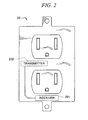
- FIGURES 1 AND 2 illustrate a utility outlet as one embodiment of the current invention
- FIGURE 3 illustrates a plurality of utility outlets being used to remotely control devices
- FIGURE 4 is a flow diagram illustrating one embodiment of a process involved in using utility outlets as remote control repeaters to control a device.
- FIGURE 1 illustrates one embodiment 10 of the current invention.
- Utility outlet 10 is a power socket used in a premise to allow devices to connect to electrical power.
- utility outlet 10 also includes receiver 101 for detecting control signals from a remote control device, for example, infrared (IR) sender 11.
- Utility outlet 10 also includes communicator 102 for sending a peer-to-peer signal via wire to another utility outlet.
- Peer-to-peer in the current application, means a signal from one utility outlet to another and is transmitted, preferably, by the electrical wire network in the premises, such as wire 12. However, the peer-to-peer signal could also be transmitted wirelessly or by a wire separate from wire 12 connected to terminals (not shown) on device 10.
- Utility outlet 10 may also be capable of receiving a peer-to-peer signal from another utility outlet via receiver 103 (which could be, if desired, combined with receiver 101).
- receiver 103 In response to the receipt of the remote control signal, receiver 103 communicates with remote control transmitter 104.
- Remote control transmitter 104 in response to the communication from receiver 103, sends a remote control signal to a device, such as device 13, to be controlled.
- utility outlet 10 may be equipped with a processor such as processor 105.
- Processor 105 is capable, if desired, of allowing a user to preprogram utility outlet 10 to determine whether a received peer-to-peer signal should be retransmitted to another utility outlet or should be converted to a remote control signal that is transmitted to a device in proximity to the utility outlet. Similarly, where utility outlet 10 receives a remote control signal from a remote controller, processor 105 determines whether a peer-to-peer signal should be transmitted in response to the remote control signal or whether nothing should be done. Processor 105 determines whether and which signal is to be transmitted based on user preprogramming of remote control signal codes of the remotely controlled devices in the presence of the utility outlet.
- FIGURE 2 illustrates utility outlet 20 where the utility outlet 20 is an electrical socket.
- the utility outlet 20 has receiver 201 to receive a peer-to-peer signal and transmitter 202 to transmit received peer-to-peer signals to another utility outlet.
- utility outlet 20 functions as a repeater of peer-to-peer signals and does not receive or emit remote control signals from or to local devices.
- the utility devices shown are power sockets, any utility device, such as a switch, light fixture, or socket can be used.
- FIGURE 3 illustrates an example of how a plurality of utility outlets may be used as repeater stations to remotely control a premises' devices.
- Building 30 has several rooms, including bedroom 301, family room 302 and garage 303.
- Television (TV) 307 is controllable by a remote controller. Even though TV 307 is capable of responding to a remote control signal from a remote controller, such as from device 304, a user in bedroom 301 may not be able to control TV 307 from bedroom 301 directly from the hand-held device.
- the inability of device 304 to control TV 307 may be due to the distance from bedroom 301 to family room 302 or because of the walls within building 30 preventing signals, such as IR signals, from device 304 in bedroom 301 from reaching TV 307 in family room 302.
- the invention solves the problem of not being able to control TV 307 from bedroom 301 by allowing utility outlet 305 in bedroom 301 to receive the signal from remote controller 304.
- Utility outlet 305 then transmits a signal over the premises' wiring to utility outlet 306 inside room 302.
- utility outlet 306 being in proximity to TV 307, sends a remote control signal, IR or otherwise, to control TV 307. This obviates the need for the user to enter family room 302 to remotely control TV 307.
- the user may want to close garage door 309 without having to leave bedroom 301.
- the bedroom is far from the garage and there are intervening walls preventing a signal from remote control 304 from directly controlling the garage door.
- the current invention allows the user to close the garage door by a series of utility outlets operating as either a signal receiver, signal repeater, or signal transmitter, or a combination thereof.
- Utility outlet 305 detects this code and determines that it does not control a device in room 301.
- Device 305 then sends a peer-to-peer signal to utility outlet 306.
- Utility outlet 306 receives this peer-to-peer signal, detects that the control of a device in room 302 is not intended and transmits another peer-to-peer signal to utility outlet 308.
- Utility outlet 308 receives the peer-to-peer signal, detects that it is for controlling garage door 309 and converts it to a remote control signal with a code to control the closing of garage door 309. Note that a look-up table (not shown) in device 305 (or in a device accessible by device 305) could have been used to route the control signal instead of relaying the signal through device 306.
- any household device or personal device on the premise may be controlled by this invention.
- a user may wish, from his or her bedroom to send a signal to open a garage door and then send another signal to start the car to warm up.
- FIGURE 4 shows flow diagram 40 illustrating the processes involved in one example of the invention.
- This example begins with process 401 where the utility outlet determines whether a signal has been received from a remote controller.
- process 402 running, for example, in a utility device local to where the signal is sent from, determines if the received signal is intended for controlling a device in the proximity of the remote controller. If the received signal is for controlling a device in the proximity of the receiving utility outlet, then the utility outlet does nothing. If the received signal is for controlling a device not in the proximity of said utility outlet, process 403 sends a signal to another utility outlet.
- Process 404 determines whether the utility outlet receiving the signal from the sending outlet is in proximity to the device to be controlled. If the receiving utility outlet is not in proximity with the device to be controlled then the process of peer-to-peer signals will be repeated until a receiving utility outlet is in proximity to the device to be controlled. If process 404 determines that the receiving utility outlet is in proximity to the device to be controlled then this example concludes when process 405 emits a remote control signal to control the device.
Landscapes
- Engineering & Computer Science (AREA)
- Computer Networks & Wireless Communication (AREA)
- Signal Processing (AREA)
- Physics & Mathematics (AREA)
- General Physics & Mathematics (AREA)
- Selective Calling Equipment (AREA)
- Alarm Systems (AREA)
- Remote Monitoring And Control Of Power-Distribution Networks (AREA)
Applications Claiming Priority (1)
| Application Number | Priority Date | Filing Date | Title |
|---|---|---|---|
| US94001507P | 2007-05-24 | 2007-05-24 |
Publications (2)
| Publication Number | Publication Date |
|---|---|
| EP2001000A2 true EP2001000A2 (fr) | 2008-12-10 |
| EP2001000A3 EP2001000A3 (fr) | 2009-01-21 |
Family
ID=39843113
Family Applications (1)
| Application Number | Title | Priority Date | Filing Date |
|---|---|---|---|
| EP08251815A Withdrawn EP2001000A3 (fr) | 2007-05-24 | 2008-05-23 | Sorties d'utilitaires en tant que répétiteurs de commande à distance |
Country Status (8)
| Country | Link |
|---|---|
| EP (1) | EP2001000A3 (fr) |
| JP (1) | JP2008312202A (fr) |
| KR (1) | KR20080103465A (fr) |
| CN (1) | CN101320867A (fr) |
| AU (1) | AU2008202243A1 (fr) |
| CA (1) | CA2632069A1 (fr) |
| IL (1) | IL191642A0 (fr) |
| ZA (1) | ZA200804514B (fr) |
Cited By (3)
| Publication number | Priority date | Publication date | Assignee | Title |
|---|---|---|---|---|
| CN102468559A (zh) * | 2010-11-15 | 2012-05-23 | 戴万谋 | 一种可遥控插线板及其遥控方法 |
| EP2991242A1 (fr) * | 2014-08-27 | 2016-03-02 | Fraunhofer-Gesellschaft zur Förderung der angewandten Forschung e.V. | Contrôleur pour système SUDA |
| CN106384920A (zh) * | 2016-10-25 | 2017-02-08 | 国网江苏省电力公司电力科学研究院 | 一种固定式智能插座 |
Families Citing this family (1)
| Publication number | Priority date | Publication date | Assignee | Title |
|---|---|---|---|---|
| CN106415687B (zh) * | 2014-01-24 | 2019-12-17 | L & P 产权管理公司 | 用于自动家居配件整合的无线双向通信协议 |
Family Cites Families (2)
| Publication number | Priority date | Publication date | Assignee | Title |
|---|---|---|---|---|
| US6400968B1 (en) * | 1998-05-04 | 2002-06-04 | Conexant Systems, Inc. | System and method for extending the range of a base unit |
| US7079808B2 (en) * | 2002-04-18 | 2006-07-18 | International Business Machines Corporation | Light socket wireless repeater and controller |
-
2008
- 2008-05-21 AU AU2008202243A patent/AU2008202243A1/en not_active Abandoned
- 2008-05-22 IL IL191642A patent/IL191642A0/en unknown
- 2008-05-23 JP JP2008135066A patent/JP2008312202A/ja active Pending
- 2008-05-23 ZA ZA200804514A patent/ZA200804514B/en unknown
- 2008-05-23 CA CA002632069A patent/CA2632069A1/fr not_active Abandoned
- 2008-05-23 KR KR1020080048116A patent/KR20080103465A/ko not_active Withdrawn
- 2008-05-23 EP EP08251815A patent/EP2001000A3/fr not_active Withdrawn
- 2008-05-26 CN CNA200810098176XA patent/CN101320867A/zh active Pending
Cited By (14)
| Publication number | Priority date | Publication date | Assignee | Title |
|---|---|---|---|---|
| CN102468559A (zh) * | 2010-11-15 | 2012-05-23 | 戴万谋 | 一种可遥控插线板及其遥控方法 |
| CN102468559B (zh) * | 2010-11-15 | 2014-01-15 | 戴万谋 | 一种可遥控插线板及其遥控方法 |
| CN107148759A (zh) * | 2014-08-27 | 2017-09-08 | 弗劳恩霍夫应用研究促进协会 | 用于suda系统的控制器 |
| WO2016030300A1 (fr) * | 2014-08-27 | 2016-03-03 | Fraunhofer-Gesellschaft zur Förderung der angewandten Forschung e.V. | Contrôleur pour un système suda |
| KR20170047320A (ko) * | 2014-08-27 | 2017-05-04 | 프라운호퍼 게젤샤프트 쭈르 푀르데룽 데어 안겐반텐 포르슝 에. 베. | SUDA(Shared User Equipment-side Distributed Antenna, 사용자 단말기 측 공유 분산 안테나) 시스템 제어장치 |
| EP2991242A1 (fr) * | 2014-08-27 | 2016-03-02 | Fraunhofer-Gesellschaft zur Förderung der angewandten Forschung e.V. | Contrôleur pour système SUDA |
| RU2649902C1 (ru) * | 2014-08-27 | 2018-04-05 | Фраунхофер-Гезелльшафт Цур Фердерунг Дер Ангевандтен Форшунг Е.Ф. | Контроллер для suda-системы |
| KR20190035950A (ko) * | 2014-08-27 | 2019-04-03 | 프라운호퍼 게젤샤프트 쭈르 푀르데룽 데어 안겐반텐 포르슝 에. 베. | SUDA(Shared User Equipment-side Distributed Antenna, 사용자 단말기 측 공유 분산 안테나) 시스템 제어장치 |
| KR20190060873A (ko) * | 2014-08-27 | 2019-06-03 | 프라운호퍼 게젤샤프트 쭈르 푀르데룽 데어 안겐반텐 포르슝 에. 베. | SUDA(Shared User Equipment-side Distributed Antenna, 사용자 단말기 측 공유 분산 안테나) 시스템 제어장치 |
| US10374689B2 (en) | 2014-08-27 | 2019-08-06 | Fraunhofer-Gesellschaft Zur Foerderung Der Angewandten Forschung E.V. | Controller for a SUDA system |
| CN107148759B (zh) * | 2014-08-27 | 2021-06-01 | 弗劳恩霍夫应用研究促进协会 | Suda系统控制器、系统及控制方法、用户设备、sudac系统、可读存储介质 |
| CN113300758A (zh) * | 2014-08-27 | 2021-08-24 | 弗劳恩霍夫应用研究促进协会 | 用于suda系统的控制器 |
| CN113300759A (zh) * | 2014-08-27 | 2021-08-24 | 弗劳恩霍夫应用研究促进协会 | 用于suda系统的控制器 |
| CN106384920A (zh) * | 2016-10-25 | 2017-02-08 | 国网江苏省电力公司电力科学研究院 | 一种固定式智能插座 |
Also Published As
| Publication number | Publication date |
|---|---|
| ZA200804514B (en) | 2009-02-25 |
| KR20080103465A (ko) | 2008-11-27 |
| AU2008202243A1 (en) | 2008-12-11 |
| JP2008312202A (ja) | 2008-12-25 |
| CN101320867A (zh) | 2008-12-10 |
| EP2001000A3 (fr) | 2009-01-21 |
| IL191642A0 (en) | 2008-12-29 |
| CA2632069A1 (fr) | 2008-11-24 |
Similar Documents
| Publication | Publication Date | Title |
|---|---|---|
| US11894943B2 (en) | Method and apparatus for network device detection | |
| US12088423B2 (en) | Method and apparatus for network device registration | |
| US9438443B2 (en) | Method and apparatus for registering remote network devices with a control device | |
| JP5507856B2 (ja) | 無線通信システム | |
| US20050220004A1 (en) | Repeater for power line communication system | |
| EP2001000A2 (fr) | Sorties d'utilitaires en tant que répétiteurs de commande à distance | |
| CN105472041B (zh) | 一种基于无线通信的控制系统及方法 | |
| US20200044888A1 (en) | Smart home system | |
| KR20120105614A (ko) | 스마트-키를 이용한 홈 네트워크 연동 도어-락 시스템 및 그의 제어방법 | |
| CN106679062A (zh) | 一种红外双向通讯智能空调及其系统 | |
| JP2014195227A (ja) | 電気機器の遠隔操作システム | |
| CN106678063A (zh) | 一种红外双向通讯智能电风扇及其系统 | |
| US20090274087A1 (en) | Utility outlets as remote control repeaters | |
| CN102566532B (zh) | 一种基于knx总线设备的控制系统 | |
| CN106611492A (zh) | 一种红外双向通讯智能灯及其系统 | |
| KR20060096558A (ko) | 홈 네트워크 시스템에서의 도어락 제어방법 | |
| CN201655009U (zh) | 电器遥控系统 | |
| KR102335420B1 (ko) | 허브 장치 및 이를 이용한 댁내 기기 제어 시스템 | |
| CN201345160Y (zh) | 基于Zigbee协议的遥控系统 | |
| CN113382054A (zh) | 基于物联网小家电数据通信系统 | |
| CN101719855A (zh) | 通过互联网或短消息进行远程控制的智能系统 | |
| CN101682477A (zh) | 选择性通信网络功能 | |
| CN106667234A (zh) | 一种红外双向通讯智能电饭煲及其系统 | |
| CN205423257U (zh) | 红外双向通讯智能电风扇及其系统 | |
| CN106611918A (zh) | 一种红外双向通讯智能插座及其系统 |
Legal Events
| Date | Code | Title | Description |
|---|---|---|---|
| PUAI | Public reference made under article 153(3) epc to a published international application that has entered the european phase |
Free format text: ORIGINAL CODE: 0009012 |
|
| AK | Designated contracting states |
Kind code of ref document: A2 Designated state(s): AT BE BG CH CY CZ DE DK EE ES FI FR GB GR HR HU IE IS IT LI LT LU LV MC MT NL NO PL PT RO SE SI SK TR |
|
| AX | Request for extension of the european patent |
Extension state: AL BA MK RS |
|
| PUAL | Search report despatched |
Free format text: ORIGINAL CODE: 0009013 |
|
| AK | Designated contracting states |
Kind code of ref document: A3 Designated state(s): AT BE BG CH CY CZ DE DK EE ES FI FR GB GR HR HU IE IS IT LI LT LU LV MC MT NL NO PL PT RO SE SI SK TR |
|
| AX | Request for extension of the european patent |
Extension state: AL BA MK RS |
|
| 17P | Request for examination filed |
Effective date: 20090629 |
|
| 17Q | First examination report despatched |
Effective date: 20090820 |
|
| AKX | Designation fees paid |
Designated state(s): AT BE BG CH CY CZ DE DK EE ES FI FR GB GR HR HU IE IS IT LI LT LU LV MC MT NL NO PL PT RO SE SI SK TR |
|
| STAA | Information on the status of an ep patent application or granted ep patent |
Free format text: STATUS: THE APPLICATION IS DEEMED TO BE WITHDRAWN |
|
| 18D | Application deemed to be withdrawn |
Effective date: 20100303 |