EP2001662B1 - Procede de regulation de l'accumulation d'adhesif sur un secheur frictionneur - Google Patents
Procede de regulation de l'accumulation d'adhesif sur un secheur frictionneur Download PDFInfo
- Publication number
- EP2001662B1 EP2001662B1 EP07757507.4A EP07757507A EP2001662B1 EP 2001662 B1 EP2001662 B1 EP 2001662B1 EP 07757507 A EP07757507 A EP 07757507A EP 2001662 B1 EP2001662 B1 EP 2001662B1
- Authority
- EP
- European Patent Office
- Prior art keywords
- absorbent sheet
- web
- drying cylinder
- rate
- continuous process
- Prior art date
- Legal status (The legal status is an assumption and is not a legal conclusion. Google has not performed a legal analysis and makes no representation as to the accuracy of the status listed.)
- Active
Links
Images


Classifications
-
- D—TEXTILES; PAPER
- D21—PAPER-MAKING; PRODUCTION OF CELLULOSE
- D21F—PAPER-MAKING MACHINES; METHODS OF PRODUCING PAPER THEREON
- D21F9/00—Complete machines for making continuous webs of paper
- D21F9/003—Complete machines for making continuous webs of paper of the twin-wire type
-
- D—TEXTILES; PAPER
- D21—PAPER-MAKING; PRODUCTION OF CELLULOSE
- D21F—PAPER-MAKING MACHINES; METHODS OF PRODUCING PAPER THEREON
- D21F11/00—Processes for making continuous lengths of paper, or of cardboard, or of wet web for fibre board production, on paper-making machines
- D21F11/14—Making cellulose wadding, filter or blotting paper
-
- D—TEXTILES; PAPER
- D21—PAPER-MAKING; PRODUCTION OF CELLULOSE
- D21F—PAPER-MAKING MACHINES; METHODS OF PRODUCING PAPER THEREON
- D21F5/00—Dryer section of machines for making continuous webs of paper
- D21F5/18—Drying webs by hot air
- D21F5/181—Drying webs by hot air on Yankee cylinder
-
- D—TEXTILES; PAPER
- D21—PAPER-MAKING; PRODUCTION OF CELLULOSE
- D21G—CALENDERS; ACCESSORIES FOR PAPER-MAKING MACHINES
- D21G3/00—Doctors
- D21G3/04—Doctors for drying cylinders
Definitions
- the present invention relates to a continuous process of manufacturing absorbent sheet.
- Methods of making paper tissue, towel, and the like are well known, including various features such as Yankee drying, throughdrying, fabric creping, dry creping, wet creping and so forth.
- Conventional wet pressing/dry creping processes have certain advantages over conventional through-air drying processes including: (1) lower energy costs associated with the mechanical removal of water rather than transpiration drying with hot air; and (2) higher production speeds which are more readily achieved with processes which utilize wet pressing to form a web.
- through-air drying processing has been widely adopted for new capital investment, particularly for the production of soft, bulky, premium quality tissue and towel products.
- TAD Throughdried, creped products and processes (TAD) products and processes) are disclosed in the following patents: United States Patent No. 3,994,771 to Morgan, Jr. et al. ; United States Patent No. 4,102,737 to Morton ; and United States Patent No. 4,529,480 to Trokhan .
- the processes described in these patents comprise, very generally, forming a web on a foraminous support, thermally pre-drying the web, applying the web to a Yankee dryer with a nip defined, in part, by an impression fabric, and creping the product from the Yankee dryer.
- a relatively permeable web is typically required, making it difficult to employ recycle furnish at levels which may be desired. Transfer to the Yankee typically takes place at web consistencies of from about 60% to about 70%.
- a wet web may also be dried or initially dewatered by thermal means by way of impingement air drying.
- Suitable rotary impingement air drying equipment is described in United States Patent No. 6,432,267 to Watson and United States Patent No. 6,447,640 to Watson et al.
- Fabric creping has been employed in connection with papermaking processes which include mechanical or compactive dewatering of the paper web as a means to influence product properties. See United States Patent Nos. 4,689,119 and 4,551,199 of Weldon ; 4,849,054 and 4,834,838 of Klowak ; and 6,287,426 of Edwards et al. Operation of fabric creping processes has been hampered by the difficulty of effectively transferring a web of high or intermediate consistency to a dryer. Note also United States Patent No. 6,350,349 to Hermans et al. which discloses wet transfer of a web from a rotating transfer surface to a fabric.
- Papermaking processes utilizing creping adhesive are thus well known in the art. It is well-known, for example, that a portion of the bulk of a tissue paper web made by way of conventional wet pressing is usually imparted by creping wherein creping adhesive plays an important role.
- the level of adhesion of the papermaking web to a dryer cylinder is also of importance as it relates to transfer of the web to a drying cylinder as well as control of the web in between the dryer and the reel upon which a roll of the paper is being formed. Webs which are insufficiently adhered may blister or, even worse, become disengaged from a drying cylinder and cause a hood fire.
- insufficient wet-tack may lead to a transfer failure wherein the web fails to transfer to a drying cylinder and remains imbedded in a fabric causing shutdowns and waste of material and energy.
- the level of adhesion of the papermaking web to the dryer is of importance as it relates to the drying of the web. Higher levels of adhesion reduce the impedance to heat transfer and cause the web to dry faster, enabling more energy efficient, higher speed operation; provided excessive build-up of adhesive is avoided. Note, however that some build-up is desirable inasmuch as adhesion of the sheet to the dryer occurs largely by means of creping adhesive deposited in previous passes.
- Thickness of a coating layer on a Yankee drying cylinder typically increases with time, insulating a wet web from the Yankee surface.
- the adhesive coating build-up on the Yankee reduces heat transfer from the Yankee surface.
- the Yankee hood temperature is increased accordingly. After two to three hours the hood temperature reaches its upper ceiling and the coating layer needs to be stripped off to reduce the hood temperature to a normal operating window. A new cleaning doctor is typically used to strip off the old coating build-up.
- a molding box may be set to a maximum level that results in lower contact areas between the sheet and the Yankee surface when the web is applied to the Yankee surface. Consequently, the sheet develops less adhesion with the Yankee at a constant level of coating application. In addition to this issue, the heat transfer of the Yankee improves significantly immediately after the new cleaning doctor strips off excess coating. This results in a very hot surface and sheet blistering is more severe as the moisture is evaporated.
- An approach to achieve base sheet caliper with lower basis weight is to reduce wet pressing pressure, which results in a wetter web entering the pressure roll nip and reduces durability of the coating. Consequently less Yankee adhesion and more sheet blistering issues occur.
- an improved method to control adhesive build-up which includes intermittently increasing the amount of adhesive supplied to a drying cylinder concurrently with stripping excess adhesive build-up.
- the method of controlling adhesive build-up is advantageously practiced in connection with a wet press/fabric crepe process where the web is peeled from a Yankee cylinder described in connection with the Figures in the discussion which follows. Intermittently, the reel is slowed down and the sheet dropped to engage a creping blade such that the product is creped from a Yankee and fed to a broke chute for recycle while the hood temperature is also reduced. The add-on of adhesive is increased and excess coating is stripped from the Yankee while the product is being creped from the cylinder. Steady-state conditions and peeling from the Yankee are resumed after stripping, suitably within minutes.
- the resinous adhesive comprises a PVOH (polyvinyl alcohol) resin and a polyamide-epihalohydrin resin in substantially fixed proportion during steady-state operation and the increase of resinous adhesive add-on rate to the drying cylinder above the steady-state add-on rate is achieved by increasing the add-on rate of PVOH resin above a steady-state add-on rate of PVOH resin while maintaining the add-on rate of polyamide-epihalohydrin resin substantially at its rate of addition during steady-state operation.
- a major portion of the coating is stripped from the drying cylinder, typically at least about 85% of the coating thickness is stripped from the drying cylinder.
- the steady-state add-on rate of adhesive is increased at least about 25% above the steady-state add-on rate before cleaning the cylinder.
- the resinous adhesive may be rewettable and include polyvinyl alcohol and a polyamide-epichlorohydrin resin.
- the weight ratio of polyvinyl alcohol resin to polyamide-epichlorohydrin resin is typically from about 2 to about 4.
- the add-on rate of polyvinyl alcohol in such systems is increased by at least about 50% with respect to a steady-state add-on rate of polyvinyl alcohol when the drying cylinder is being cleaned.
- the add-on rate of polyvinyl alcohol is increased by at least about 100% during stripping excess coating from the drying cylinder.
- the dryer is provided with a dryer hood capable of variable temperature; and the temperature of the drying hood is lowered during the step of stripping resinous adhesive from the drying cylinder.
- the hood temperature at a dry-end is lowered by at least about 25°F (13,8°C) concurrently with the step of stripping resinous adhesive from the drying cylinder, and the hood temperature at a wet end is lowered by at least about 25°F (13,8°C).
- the hood temperature at a dry-end is lowered by at least about 50°F (13,8°C) during the step of stripping resinous adhesive from the drying cylinder, and the hood temperature at a wet end is lowered by at least about 50°F (13,8°C).
- the hood temperature at a dry-end is lowered by at least about 100°F (13,8°C) during the step of stripping resinous adhesive from the drying cylinder, and the hood temperature at a wet end is lowered by at least about 100°F (13,8°C).
- the dry end temperature in commercial embodiments will cascade from the wet end temperature under feedback control in order to control moisture in the product prior to winding on the reel.
- a resinous adhesive add-on rate of from about 15 mg/m 2 to about 60 mg/m 2 during steady-state operation of known paper making processes with the improved method of the invention.
- add-on rates of less than about 40 mg/m 2 , or less than about 35 mg/m 2 or even less than about 30 mg/m 2 are typical for steady-state operation.
- the process according to the present teaching is advantageously practiced when the absorbent sheet.has a basis weight of from about 10 lbs/3000 ft 2 (4,53 kg / 278,7 m 2 ) to about 25 lbs/3000 ft 2 (11,3 kg / 278,7 m 2 ).
- the process is particularly advantageous when the absorbent sheet has a basis weight of from about 15 lbs/3000 ft 2 (6,80 kg / 278,7 m 2 ) to about 21 lbs/3000 ft 2 (9,52 kg / 278,7 m 2 ).
- the resin adhesive composition will typically include a creping modifier.
- Creping modifiers may include a quaternary ammonium complex with a noncyclic amide functionality as is described in co-pending United States Patent Application No. 10/409,042 (Publication No. US 2005-0006040), filed April 9, 2003 , entitled “Creping Adhesive Modifier and Process for Producing Paper Products”.
- At least a portion of the segregated absorbent sheet product is recycled to the process, for example, fed to a broke chute for repulping.
- the improvement includes controlling build-up of an adhesive coating on the drying cylinder by way of intermittently: (a) increasing the add-on rate of polyvinyl alcohol adhesive resin to the drying cylinder above the steady-state add-on rate; and (b) while the add-on rate of polyvinyl alcohol adhesive resin to the drying cylinder is increased above the steady-state add-on rate, stripping at least a portion of the adhesive coating from the drying cylinder with a cleaning doctor.
- a continuous process of manufacturing absorbent sheet of the class including forming a wet cellulosic web, applying the web onto a drying cylinder of a dryer, which drying cylinder is provided with a resinous adhesive at a substantially constant add-on rate during steady-state operation, wherein the resin adhesive consists substantially of a PVOH resin and an epihalohydrin resin in substantially fixed proportion in steady-state operation and the dryer is further provided with a dryer hood capable of variable temperature is improved by controlling adhesive build-up.
- the improvement includes controlling build-up of an adhesive coating on the drying cylinder by way of stripping at least a portion of the adhesive coating from the drying cylinder with a cleaning doctor while controlling wet-tack to the drying cylinder by way of stripping at least a portion of the adhesive coating from the drying cylinder with a cleaning doctor while controlling wet-tack to the drying cylinder by way of a technique selected from the group consisting of:
- wet-tack to the drying cylinder is controlled by combinations of techniques (a) and (b).
- the resinous adhesive composition may be from about 60% by weight to about 70% by weight PVOH resin during steady rate operation depending upon conditions or the resinous adhesive composition may be from about 75% by weight to about 90% by weight PVOH resin during steady rate operation.
- the Yankee dryer is provided with a dryer hood capable of variable temperature; controlling build-up of an adhesive coating on the drying cylinder is accomplished by way of intermittently: (a) stripping at least a portion of the adhesive coating from the drying cylinder with a cleaning doctor; and (b) while stripping at least a portion of the adhesive coating from the drying cylinder, controlling the temperature of the dryer such that the temperature of the adhesive coating (measured just above the creping blade, see Figures 1 , 2 , 3 ) does not exceed about 300°F (148,8°C) contemporaneously with stripping.
- the temperature of the dryer is controlled such that the temperature of the adhesive coating temperature does not exceed about 280°F contemporaneously with stripping.
- Maintaining the temperature of the adhesive coating below about 275°F (135,0°C) or 270°F (132,2°C) contemporaneously with stripping is even more preferred. In any case, it is advantageous to lower the temperature of the dryer hood prior to initiating the stripping procedure.
- a continuous process for producing absorbent sheet includes:
- the process preferably includes reducing the steady-state tension on the web concurrently with the steps of increasing the resinous adhesive and stripping at least a portion of the coating build-up from the drying cylinder with a cleaning doctor. Immediately after the excess coating is stripped, adhesion of the web to the dryer is visually evaluated (or may be evaluated by other means) prior to increasing the tension to a take up reel and resuming steady-state operation wherein the web is peeled from the drying cylinder.
- the web may be at least partially dewatered by way of wet pressing with a felt prior to adhering the web to the drying cylinder or the web may be at least partially dewatered by way of thermal means such as through-drying or impingement air drying prior to adhering the web to a drying cylinder.
- initial dewatering can be carried out by pneumatic means as noted in co-pending United States Patent Application Serial No. 11/167,348 (Publication No. US 2006-0000567), filed on June 27, 2005 entitled “Low Compaction, Pneumatic Dewatering Process for Producing Absorbent Sheet" (Attorney Docket No. 12616; GP-03-34).
- Another aspect includes a continuous process for producing absorbent sheet including a) forming a wet cellulosic web; b) at least partially dewatering the wet web; c) transferring the partially dewatered web to a textured fabric, such as an impression or throughdrying fabric or a drying fabric; d) texturing the wet web by conforming the web to the textured fabric; e) transferring the wet web to a drying cylinder; f) adhering the web to a drying cylinder with a resinous adhesive coating composition applied to the drying cylinder at a steady-state add-on rate wherein the build-up of adhesive on the drying cylinder is controlled by intermittently cleaning the drying cylinder as noted above.
- the present invention is useful in connection with CWP processes, through-drying processes, as well as in a variety of processes where the web is initially compactively dewatered prior to applying the web to the Yankee cylinder.
- Still yet another aspect is directed to an improved process of the class including forming a wet cellulosic web, applying the web onto a drying cylinder of a dryer, which drying cylinder is provided with a resinous adhesive at a substantially constant add-on rate during steady-state operation and accumulating the absorbent sheet on a reel, wherein the improvement comprises controlling build-up of an adhesive coating on the drying cylinder by way of intermittently:
- the creping adhesive "add-on" rate is calculated by dividing the rate of application of adhesive (mg/min) by surface area of the drying cylinder passing under a spray applicator boom (m 2 /min).
- the resinous adhesive composition most preferably consists essentially of a polyvinyl alcohol resin and a polyamide-epichlorohydrin resin wherein the weight ratio of polyvinyl alcohol resin to polyamide-epichlorohydrin resin is from about 2 to about 4.
- the creping adhesive may also include modifier sufficient to maintain good transfer between the creping fabric and the Yankee cylinder; generally less than 5% by weight modifier and more preferably less than about 2% by weight modifier.
- Basis weight refers to the weight of a 3000 square foot (278,7 m 2 ) ream of product. Consistency refers to percent solids of a nascent web, for example, calculated on a bone dry basis. "Air dry” means including residual moisture, by convention up to about 10 percent moisture for pulp and up to about 6% for paper. A nascent web having 50 percent water and 50 percent bone dry pulp has a consistency of 50 percent.
- cellulosic cellulosic sheet
- papermaking fibers include virgin pulps or recycle (secondary) cellulosic fibers or fiber mixes comprising cellulosic fibers.
- Fibers suitable for making the webs of this teaching include: nonwood fibers, such as cotton fibers or cotton derivatives, abaca, kenaf, sabai grass, flax, esparto grass, straw, jute hemp, bagasse, milkweed floss fibers, and pineapple leaf fibers; and wood fibers such as those obtained from deciduous and coniferous trees, including softwood fibers, such as northern and southern softwood kraft fibers; hardwood fibers, such as eucalyptus, maple, birch, aspen, or the like.
- Papermaking fibers can be liberated from their source material by any one of a number of chemical pulping processes familiar to one experienced in the art including sulfate, sulfite, polysulfide, soda pulping, etc.
- the pulp can be bleached if desired by chemical means including the use of chlorine, chlorine dioxide, oxygen, alkaline peroxide and so forth.
- the products of the present teaching may comprise a blend of conventional fibers (whether derived from virgin pulp or recycle sources) and high coarseness lignin-rich tubular fibers, such as bleached chemical thermomechanical pulp (BCTMP).
- BCTMP bleached chemical thermomechanical pulp
- "Furnishes" and like terminology refers to aqueous compositions including papermaking fibers, optionally wet strength resins, debonders and the like for making paper products.
- compactively dewatering the web or furnish refers to mechanical dewatering by wet pressing on a dewatering felt, for example, in some embodiments by use of mechanical pressure applied continuously over the web surface as in a nip between a press roll and a press shoe wherein the web is in contact with a papermaking felt.
- the terminology "compactively dewatering" is used to distinguish processes wherein the initial dewatering of the web is carried out largely by thermal means as is the case, for example, in United States Patent No. 4,529,480 to Trokhan and United States Patent No. 5,607,551 to Farrington et al. .
- Compactively dewatering a web thus refers, for example, to removing water from a nascent wcb having a consistency of less than 30 percent or so by application of pressure thereto and/or increasing the consistency of the web by about 15 percent or more by application of pressure thereto.
- Creping fabric and like terminology refers to a fabric or belt which bears a pattern suitable for practicing the process of the present invention and preferably is permeable enough such that the web may be dried while it is held in the creping fabric. In cases where the web is transferred to another fabric or surface (other than the creping fabric) for drying, the creping fabric may have lower permeability.
- Fabric side and like terminology refers to the side of the web which is in contact with the creping fabric.
- Dryer side or “Yankee side” is the side of the web in contact with the drying cylinder, typically opposite the fabric side of the web.
- Fpm refers to feet per minute; while fps refers to feet per second.
- MD machine direction
- CD cross-machine direction
- Nip parameters include, without limitation, nip pressure, nip length, backing roll hardness, fabric approach angle, fabric takeaway angle, uniformity, and velocity delta between surfaces of the nip.
- Nip length means the length over which the nip surfaces are in contact.
- Removal of an adhesive coating from a drying cylinder is referred to quantitatively here in terms of coating thickness.
- removal of a "major portion" of a coating refers to reducing its thickness on the dryer by more than 50%.
- the adhesive coating temperature we are referring to the coating temperature on the Yankee dryer at its downstream portion, typically at a location just above the creping blade shown on Figures 1 , 2 and 3 unless otherwise indicated. This temperature is conveniently measured with an infra-red probe and is roughly equal to the temperature of the Yankee cylinder surface at the point where the product is removed therefrom.
- a translating transfer surface refers to the surface from which the web is creped into the creping fabric.
- the translating transfer surface may be the surface of a rotating drum as described hereafter, or may be the surface of a continuous smooth moving belt or another moving fabric which may have surface texture and so forth.
- the translating transfer surface needs to support the web and facilitate the high solids creping as will be appreciated from the discussion which follows.
- Weight-tack refers generally to the ability of an adhesive coating on a drying cylinder to adhere a wet web to the cylinder for purposes of drying the web.
- Calipers and or bulk reported herein may be measured at 8 or 16 sheet calipers as specified.
- the sheets are stacked and the caliper measurement taken about the central portion of the stack.
- the test samples are conditioned in an atmosphere of 23° ⁇ 1.0°C (73.4° ⁇ 1.8°F) at 50% relative humidity for at least about 2 hours and then measured with a Thwing-Albert Model 89-II-JR or Progage Electronic Thickness Tester with 2-in (50.8-mm) diameter anvils, 539 ⁇ 10 grams dead weight load, and 0.231 in./sec (5,56 mm/sec) descent rate.
- each sheet of product to be tested must have the same number of plies as the product is sold.
- each sheet to be tested must have the same number of plies as produced off the winder.
- basesheet testing off of the papermachine reel single plies must be used. Sheets are stacked together aligned in the MD. On custom embossed or printed product, try to avoid taking measurements in these areas if at all possible. Bulk may also be expressed in units of volume/weight by dividing caliper by basis weight.
- Bending length (cm) is determined in accordance with ASTM test method D 1388-96, cantilever option.
- Water absorbency rate or WAR is measured in seconds and is the time it takes for a sample to absorb a 0.1 gram droplet of water disposed on its surface by way of an automated syringe.
- the test specimens are preferably conditioned at 23° C ⁇ 1° C (73.4 ⁇ 1.8°F) at 50 % relative humidity.
- 4 3x3 inch test specimens are prepared. Each specimen is placed in a sample holder such that a high intensity lamp is directed toward the specimen. 0.1 ml of water is deposited on the specimen surface and a stop watch is started. When the water is absorbed, as indicated by lack of further reflection of light from the drop, the stopwatch is stopped and the time recorded to the nearest 0.1 seconds. The procedure is repeated for each specimen and the results averaged for the sample.
- WAR is measured in accordance with TAPPI method T-432 cm-99.
- Dry tensile strengths (MD and CD), stretch, ratios thereof, modulus, break modulus, stress and strain are measured with a standard Instron test device or other suitable elongation tensile tester which may be configured in various ways, typically using 3 or 1 inch (76,2 or 25,4 mm) wide strips of tissue or towel, conditioned in an atmosphere of 23° ⁇ 1 °C (73.4° ⁇ 1°F) at 50% relative humidity for 2 hours. The tensile test is run at a crosshead speed of 2 in/min (50,8 m/min). Break modulus is expressed in grams/3 inches (76,2 mm)/ %strain. % strain is dimensionless and need not be specified.
- Tensile ratios are simply ratios of the values determined by way of the foregoing methods. Unless otherwise specified, a tensile property is a dry sheet property.
- the wet tensile of the tissue of the present invention is measured using a three-inch wide strip of tissue that is folded into a loop, clamped in a special fixture termed a Finch Cup, then immersed in a water.
- the Finch Cup which is available from the Thwing-Albert Instrument Company of Philadelphia, Pa., is mounted onto a tensile tester equipped with a 2.0 pound load cell with the flange of the Finch Cup clamped by the tester's lower jaw and the ends of tissue loop clamped into the upper jaw of the tensile tester.
- the sample is immersed in water that has been adjusted to a pH of 7.0+- 0.1 and the tensile is tested after a 5 second immersion time.
- the results are expressed in g/3" (g/76,2mm), dividing by two to account for the loop as appropriate.
- Fabric crepe ratio is an expression of the speed differential between the creping fabric and the forming wire and typically calculated as the ratio of the web speed immediately before fabric creping and the web speed immediately following fabric creping, the forming wire and transfer surface being typically, but not necessarily, operated at the same speed:
- a web creped from a transfer cylinder with a surface speed of 750 fpm (228,6 m/min) to a fabric with a velocity of 500 fpm (152,4 m/min) has a fabric crepe ratio of 1.5 and a fabric crepe of 50%.
- a process with a forming wire speed of 2000 fpm (609,8 m/min) and a reel speed of 1000 fpm (304,8 m/min) has a line or total crepe ratio of 2 and a total crepe of 100%.
- PLI or pli means pounds force per linear inch.
- Pusey and Jones (P&J) hardness is measured in accordance with ASTM D 531, and refers to the indentation number (standard specimen and conditions).
- a "steady-state" parameter is preferably relatively constant during a manufacturing campaign and refers to the value of the parameter between (and exclusive of) operations where build-up of adhesive is removed from a drying cylinder in accordance with the present teaching . If add-on, tensions and so forth vary during operation between cleaning operations, the time averaged value between (and exclusive of) cleaning operations is used as the steady-state value.
- Velocity delta means a difference in linear speed
- the creping adhesive used to secure the web to the Yankee drying cylinder is preferably a hygroscopic, re-wettable, substantially non-crosslinking adhesive.
- preferred adhesives are those which include poly(vinyl alcohol) of the general class described in United States Patent No. 4,528,316 to Soerens et al.
- Other suitable adhesives are disclosed in co-pending United States Provisional Patent Application Serial No. 60/372,255, filed April 12, 2002 , entitled "Improved Creping Adhesive Modifier and Process for Producing Paper Products" (Attorney Docket No. 2394).
- Suitable adhesives are optionally provided with modifiers and so forth. It is preferred to use crosslinker and/or modifier sparingly or not at all in the adhesive.
- Creping adhesives may comprise a thermosetting or non-thermosetting resin, a film-forming semi-crystalline polymer and optionally an inorganic cross-linking agent as well as modifiers.
- the creping adhesive of the present invention may also include other components, including, but not limited to, hydrocarbons oils, surfactants, or plasticizers.
- Creping modifiers which may be used in limited amounts include a quaternary ammonium complex comprising at least one non-cyclic amide.
- the quaternary ammonium complex may also contain one or several nitrogen atoms (or other atoms) that are capable of reacting with alkylating or quaternizing agents.
- These alkylating or quaternizing agents may contain zero, one, two, three or four non-cyclic amide containing groups.
- An amide containing group is represented by the following formula structure: where R 7 and R 8 are non-cyclic molecular chains of organic or inorganic atoms.
- Preferred non-cyclic bis-amide quaternary ammonium complexes with non-cyclic amide functionality can be of the formula: where R 1 and R 2 can be long chain non-cyclic saturated or unsaturated aliphatic groups; R 3 and R 4 can be long chain non-cyclic saturated or unsaturated aliphatic groups, a halogen, a hydroxide, an alkoxylated fatty acid, an alkoxylated fatty alcohol, a polyethylene oxide group, or an organic alcohol group; and R 5 and R 6 can be long chain non-cyclic saturated or unsaturated aliphatic groups.
- the modifier is optionally present in the creping adhesive in an amount of from about 0.05% to about 25%, more preferably from about 0.25% to about 10%, and most preferably from about 0.5% to about 5% based on the total solids of the creping adhesive composition.
- Modifiers include those obtainable from Goldschmidt Corporation of Essen/Germany or Process Application Corporation based in Washington Crossing, PA.
- Appropriate creping modifiers from Goldschmidt Corporation include, but are not limited to, VARISOFT ® 222LM, VARISOFT ® 222, VARISOFT ® 110, VARISOFT ® 222LT, VARISOFT ® 110 DEG, and VARISOFT ® 238.
- Appropriate creping modifiers from Process Application Corporation include, but are not limited to, PALSOFT 580 FDA or PALSOFT 580C.
- creping modifiers for use in the present invention include, but are not limited to, those compounds as described in WO/01/85109 .
- Creping adhesives for use in connection with to the present teaching may include any suitable thermosetting or non-thermosetting resin.
- Resins according to the present teaching are preferably chosen from thermosetting and non-thermosetting polyamide resins or glyoxylated polyacrylamide resins.
- Polyamides for use in the present invention can be branched or unbranched, saturated or unsaturated.
- Polyamide resins for use in the present teaching may include polyamide-epihalohydrin resins such as polyaminoamide-epichlorohydrin (PAE) resins of the same general type employed as wet strength resins.
- PAE resins are described, for example, in "Wet-Strength Resins and Their Applications," Ch. 2, H. Epsy entitled Alkaline-Curing Polymeric Amine-Epichlorohydrin Resins, .
- Preferred PAE resins for use according to the present teaching include a water-soluble polymeric reaction product of an epihalohydrin, preferably epichlorohydrin, and a water-soluble polyamide having secondary amine groups derived from a polyalkylene polyamine and a saturated aliphatic dibasic carboxylic acid containing from about 3 to about 10 carbon atoms.
- non-thermosetting cationic polyamide resins can be found in United States Patent No. 5,338,807, issued to Espy et al. .
- the non-thermosetting resin may be synthesized by directly reacting the polyamides of a dicarboxylic acid and methyl bis(3-aminopropyl)amine in an aqueous solution, with epichlorohydrin.
- the carboxylic acids can include saturated and unsaturated dicarboxylic acids having from about 2 to 12 carbon atoms, including for example, oxalic, malonic, succinic, glutaric, adipic, pilemic, suberic, azelaic, sebacic, maleic, itaconic, phthalic, and terephthalic acids. Adipic and glutaric acids are preferred, with adipic acid being the most preferred.
- the esters of the aliphatic dicarboxylic acids and aromatic dicarboxylic acids, such as the phathalic acid, may be used, as well as combinations of such dicarboxylic acids or esters.
- the preparation of water soluble, thermosetting polyamide-epihalohydrin resin is described in United States Patents Nos. 2,926,116 ; 3,058,873 ; and 3,772,076 issued to Kiem , .
- the polyamide resin may be based on DETA instead of a generalized polyamine.
- Two examples of structures of such a polyamide resin are given below.
- Structure 1 shows two types of end groups: a di-acid and a mono-acid based group:
- Structure 2 shows a polymer with one end-group based on a di-acid group and the other end-group based on a nitrogen group:
- the polyamide resin has a viscosity of from about 80 to about 800 centipoise and a total solids of from about 5% to about 40%.
- the polyamide resin is present in the creping adhesive according to the present teaching in an amount of from about 0% to about 99.5%.
- the polyamide resin is present in the creping adhesive in an amount of from about 20% to about 80%.
- the polyamide resin is present in the creping adhesive in an amount of from about 40% to about 60% based on the total solids of the creping adhesive composition.
- Polyamide resins for use according to the present teaching can be obtained from Ondeo-Nalco Corporation, based in Naperville, Illinois, and Hercules Corporation, based in Wilmington, Delaware.
- Creping adhesive resins for use according to the present teaching from Ondeo-Nalco Corporation include, but are not limited to, CREPECCEL ® 675NT, CREPECCEL ® 675P and CREPECCEL ® 690HA.
- Appropriate creping adhesive resins available from Hercules Corporation include, but are not limited to, HERCULES 82-176, HERCULES 1145, Unisoft 805 and CREPETROL A-6115.
- Other polyamide resins for use according to the present invention include, for example, those described in United States Patent Nos. 5,961,782 and 6,133,405 .
- the creping adhesive also includes a film-forming semi-crystalline polymer.
- Film-forming semi-crystalline polymers for use in the present teaching can be selected from, for example, hemicellulose, carboxymethyl cellulose, and most preferably includes polyvinyl alcohol (PVOH).
- Polyvinyl alcohols used in the creping adhesive can have an average molecular weight of about 13,000 to about 124,000 daltons. According to one embodiment, the polyvinyl alcohols have a degree of hydrolysis of from about 80% to about 99.9%. According to another embodiment, polyvinyl alcohols have a degree of hydrolysis of from about 85% to about 95%. In yet another embodiment, polyvinyl alcohols have a degrees of hydrolysis of from about 86% to about 90%.
- polyvinyl alcohols preferably have a viscosity, measured at 20 degree centigrade using a 4% aqueous solution, of from about 2 to about 100 centipoise. According to another embodiment, polyvinyl alcohols have a viscosity of from about 10 to about 70 centipoise. In yet another embodiment, polyvinyl alcohols have a viscosity of from about 20 to about 50 centipoise.
- the polyvinyl alcohol is present in the creping adhesive in an amount of from about 10% to 90% or 20% to about 80% or more. In some embodiments, the polyvinyl alcohol is present in the creping adhesive in an amount of from about 40% to about 60%, by weight, based on the total solids of the creping adhesive composition.
- Polyvinyl alcohols for use according to the present teaching include those obtainable from Monsanto Chemical Co. and Celanese Chemical. Appropriate polyvinyl alcohols from Monsanto Chemical Co. include Gelvatols, including, but not limited to, GELVATOL 1-90, GELVATOL 3-60, GELVATOL 20-30, GELVATOL 1-30, GELVATOL 20-90, and GELVATOL 20-60. Regarding the Gelvatols, the first number indicates the percentage residual polyvinyl acetate and the next series of digits when'multiplied by 1,000 gives the number corresponding to the average molecular weight.
- polyvinyl alcohol or PVOH resins consist mostly of hydrolyzed polyvinyl acetate repeat units (more than 50 mole %), but may include monomers other than polyvinyl acetate in amounts up to about 10 mole % or so in typical commercial resins.
- the creping adhesive may also comprise one or more inorganic cross-linking salts or agents.
- Such additives are believed best used sparingly or not at all in connection with the present teaching .
- a non-exhaustive list of multivalent metal ions includes calcium, barium, titanium, chromium, manganese, iron, cobalt, nickel, zinc, molybdenium, tin, antimony, niobium, vanadium, tungsten, selenium, and zirconium. Mixtures of metal ions can be used.
- Preferred anions include acetate, formate, hydroxide, carbonate, chloride, bromide, iodide, sulfate, tartrate, and phosphate.
- zirconium salt for use according to one embodiment of the present teaching can be chosen from one or more zirconium compounds having a valence of plus four, such as ammonium zirconium carbonate, zirconium acetylacetonate, zirconium acetate, zirconium carbonate, zirconium sulfate, zirconium phosphate, potassium zirconium carbonate, zirconium sodium phosphate, and sodium zirconium tartrate.
- Appropriate zirconium compounds include, for example, those described in United States Patent No. 6,207,011 .
- the inorganic cross-linking salt can be present in the creping adhesive in an amount of from about 0% to about 30%. In another embodiment, the inorganic cross-linking agent can be present in the creping adhesive in an amount of from about 1% to about 20%. In yet another embodiment, the inorganic cross-linking salt can be present in the creping adhesive in an amount of from about 1% to about 10% by weight based on the total solids of the creping adhesive composition.
- Zirconium compounds for use according to the present teaching include those obtainable from EKA Chemicals Co. (previously Hopton Industries) and Magnesium Elektron, Inc. Appropriate commercial zirconium compounds from EKA Chemicals Co. are AZCOTE 5800M and KZCOTE 5000 and from Magnesium Elektron, Inc. are AZC or KZC.
- the creping adhesive can include any other components, including, but not limited to, organic cross-linkers, hydrocarbon oils, surfactants, amphoterics, humectants, plasticizers, or other surface treatment agents.
- organic cross-linkers includes glyoxal, maleic anhydride, bismaleimide, bis acrylamide, and epihalohydrin.
- the organic cross-linkers can be cyclic or non-cyclic compounds.
- Plastizers for use in the present invention can include propylene glycol, diethylene glycol, triethylene glycol, dipropylene glycol, and glycerol.
- the creping adhesive may be applied as a single composition or may be applied in its component parts. More particularly, the polyamide resin may be applied separately from the polyvinyl alcohol (PVOH) and the modifier.
- PVOH polyvinyl alcohol
- a normal coating package is applied at a total coating rate (add-on as calculated above) of 54 mg/m 2 with 32 mg/m 2 of PVOH (Celvol 523)/ 11.3 mg/m 2 of PAE (Hercules 1145) and 10.5 mg/m 2 of modifier (Hercules 4609VF).
- a preferred coating for a peeling process may be applied at a rate of 20 mg/m 2 with 14.52 mg/m 2 of PVOH (Celvol 523)/ 5.10 mg/m 2 of PAE (Hercules 1145) and 0.38 mg/m 2 of modifier (Hercules 4609VF).
- an absorbent paper web is made by dispersing papermaking fibers into aqueous furnish (slurry) and depositing the aqueous furnish onto the forming wire of a papermaking machine.
- Any suitable forming scheme might be used.
- an extensive but non-exhaustive list in addition to Fourdrinier formers includes a crescent former, a C-wrap twin wire former, an S-wrap twin wire former, or a suction breast roll former.
- the forming fabric can be any suitable foraminous member including single layer fabrics, double layer fabrics, triple layer fabrics, photopolymer fabrics, and the like.
- Non-exhaustive background art in the forming fabric area includes United States Patent Nos.
- Foam-forming of the aqueous furnish on a forming wire or fabric may be employed as a means for controlling the permeability or void volume of the sheet upon fabric-creping. Foam-forming techniques are disclosed in United States Patent No. 4,543,156 and Canadian Patent No. 2,053,505 .
- the foamed fiber furnish is made up from an aqueous slurry of fibers mixed with a foamed liquid carrier just prior to its introduction to the headbox.
- the pulp slurry supplied to the system has a consistency in the range of from about 0.5 to about 7 weight percent fibers, preferably in the range of from about 2.5 to about 4.5 weight percent.
- the pulp slurry is added to a foamed liquid comprising water, air and surfactant containing 50 to 80 percent air by volume forming a foamed fiber furnish having a consistency in the range of from about 0.1 to about 3 weight percent fiber by simple mixing from natural turbulence and mixing inherent in the process elements.
- the addition of the pulp as a low consistency slurry results in excess foamed liquid recovered from the forming wires.
- the excess foamed liquid is discharged from the system and may be used elsewhere or treated for recovery of surfactant therefrom.
- the furnish may contain chemical additives to alter the physical properties of the paper produced. These chemistries are well understood by the skilled artisan and may be used in any known combination. Such additives may be surface modifiers, softeners, debonders, strength aids, latexes, opacifiers, optical brighteners, dyes, pigments, sizing agents, barrier chemicals, retention aids, insolubilizers, organic or inorganic crosslinkers, or combinations thereof; said chemicals optionally comprising polyols, starches, PPG esters, PEG esters, phospholipids, surfactants, polyamines, HMCP (Hydrophobically Modified Cationic Polymers), HMAP (Hydrophobically Modified Anionic Polymers) or the like.
- additives may be surface modifiers, softeners, debonders, strength aids, latexes, opacifiers, optical brighteners, dyes, pigments, sizing agents, barrier chemicals, retention aids, insolubilizers, organic
- the pulp can be mixed with strength adjusting agents such as wet strength agents, dry strength agents and debonders/softeners and so forth. Suitable wet strength agents are known to the skilled artisan.
- strength adjusting agents such as wet strength agents, dry strength agents and debonders/softeners and so forth.
- Suitable wet strength agents are known to the skilled artisan.
- a comprehensive but non-exhaustive list of useful strength aids include urea-formaldehyde resins, melamine formaldehyde resins, glyoxylated polyacrylamide resins, polyamide-epichlorohydrin resins and the like.
- Thermosetting polyacrylamides are produced by reacting acrylamide with diallyl dimethyl ammonium chloride (DADMAC) to produce a cationic polyacrylamide copolymer which is ultimately reacted with glyoxal to produce a cationic cross-linking wet strength resin, glyoxylated polyacrylamide.
- DMDMAC diallyl dimethyl ammonium chloride
- a cationic polyacrylamide copolymer which is ultimately reacted with glyoxal to produce a cationic cross-linking wet strength resin, glyoxylated polyacrylamide.
- Resins of this type are commercially available under the trade name of PAREZ 631NC by Bayer Corporation.
- acrylamide/-DADMAC/glyoxal can be used to produce cross-linking resins, which are useful as wet strength agents.
- other dialdehydes can be substituted for glyoxal to produce thermosetting wet strength characteristics.
- polyamide-epichlorohydrin wet strength resins an example of which is sold under the trade names Kymene 557LX and Kymene 557H by Hercules Incorporated of Wilmington, Delaware and Amres® from Georgia-Pacific Resins, Inc. These resins and the process for making the resins are described in United States Patent No. 3,700,623 and United States Patent No. 3,772,076 .
- Suitable temporary wet strength agents may likewise be included, particularly in special applications where disposable towel with permanent wet strength resin is to be avoided.
- a comprehensive but non-exhaustive list of useful temporary wet strength agents includes aliphatic arid aromatic aldehydes including glyoxal, malonic dialdehyde, succinic dialdehyde, glutaraldehyde and dialdehyde starches, as well as substituted or reacted starches, disaccharides, polysaccharides, chitosan, or other reacted polymeric reaction products of monomers or polymers having aldehyde groups, and optionally, nitrogen groups.
- Representative nitrogen containing polymers which can suitably be reacted with the aldehyde containing monomers or polymers, includes vinyl-amides, acrylamides and related nitrogen containing polymers. These polymers impart a positive charge to the aldehyde containing reaction product.
- other commercially available temporary wet strength agents such as, PAREZ 745, manufactured by Bayer can be used, along with those disclosed, for example in United States Patent No. 4,605,702 .
- the temporary wet strength resin may be any one of a variety of water-soluble organic polymers comprising aldehydic units and cationic units used to increase dry and wet tensile strength of a paper product. Such resins are described in United States Patent Nos. 4,675,394 ; 5,240,562 ; 5,138,002 ; 5,085,736 ; 4,981,557 ; 5,008,344 ; 4,603,176 ; 4,983,748 ; 4,866,151 ; 4,804,769 and 5,217,576 . Modified starches sold under the trademarks CO-BOND® 1000 and CO-BOND® 1000 Plus, by National Starch and Chemical Company of Bridgewater, N.J. may be used.
- the cationic aldehydic water soluble polymer can be prepared by preheating an aqueous slurry of approximately 5% solids maintained at a temperature of approximately 240° Fahrenheit (115,5°C) and a pH of about 2.7 for approximately 3.5 minutes. Finally, the slurry can be quenched and diluted by adding water to produce a mixture of approximately 1.0% solids at less than about 130° Fahrenheit (54,4°C).
- Temporary wet strength agents such as glyoxylated polyacrylamide can be used.
- Temporary wet strength agents such glyoxylated polyacrylamide resins are produced by reacting acrylamide with diallyl dimethyl ammonium chloride (DADMAC) to produce a cationic polyacrylamide copolymer which is ultimately reacted with glyoxal to produce a cationic cross-linking temporary or semi-permanent wet strength resin, glyoxylated polyacrylamide.
- DADMAC diallyl dimethyl ammonium chloride
- Resins of this type are commercially available under the trade name of PAREZ 631NC, by Bayer Industries. Different mole ratios of acrylamide/DADMAC/glyoxal can be used to produce cross-linking resins, which are useful as wet strength agents. Furthermore, other dialdehydes can be substituted for glyoxal to produce wet strength characteristics.
- Suitable dry strength agents include starch, guar gum, polyacrylamides, carboxymethyl cellulose and the like. Of particular utility is carboxymethyl cellulose, an example of which is sold under the trade name Hercules CMC, by Hercules Incorporated of Wilmington, Delaware.
- the pulp may contain from about 0 to about 15 lb/ton (0-7,5 kg/1000kg) of dry strength agent.
- the pulp may contain from about 1 to about 5 lbs/ton (0,5-2,5 kg/1000kg) of dry strength agent.
- Suitable debonders are likewise known to the skilled artisan. Debonders or softeners may also be incorporated into the pulp or sprayed upon the web after its formation. The present teaching may also be used with softener materials including but not limited to the class of amido amine salts derived from partially acid neutralized amines. Such materials are disclosed in United States Patent No. 4,720,383 . Evans, Chemistry and Industry, 5 July 1969, pp. 893-903 ; Egan, J.Am. Oil Chemist's Soc., Vol. 55 (1978), pp. 118-121 ; and Trivedi et al., J.Am.Oil Chemist's Soc., June 1981, pp. 754-756 , indicate that softeners are often available commercially only as complex mixtures rather than as single compounds: While the following discussion will focus on the predominant species, it should be understood that commercially available mixtures would generally be used in practice.
- Quasoft 202-JR is a suitable softener material, which may be derived by alkylating a condensation product of oleic acid and diethylenetriamine. Synthesis conditions using a deficiency of alkylation agent (e.g., diethyl sulfate) and only one alkylating step, followed by pH adjustment to protonate the non-ethylated species, result in a mixture consisting of cationic ethylated and cationic non-ethylated species. A minor proportion (e.g., about 10%) of the resulting amido amine cyclize to imidazoline compounds.
- alkylation agent e.g., diethyl sulfate
- the compositions as a whole are pH-sensitive. Therefore, in the practice of the present teaching with this class of chemicals, the pH in the head box should be approximately 6 to 8, more preferably 6 to 7 and most preferably 6.5 to 7.
- Quaternary ammonium compounds such as dialkyl dimethyl quaternary ammonium salts are also suitable particularly when the alkyl groups contain from about 10 to 24 carbon atoms. These compounds have the advantage of being relatively insensitive to pH.
- Biodegradable softeners can be utilized. Representative biodegradable cationic softeners/debonders are disclosed in United States Patent Nos. 5,312,522 ; 5,415,737 ; 5,262,007 ; 5,264,082 ; and 5,223,096 .
- the compounds are biodegradable diesters of quaternary ammonia compounds, quaternized amine-esters, and biodegradable vegetable oil based esters functional with quaternary ammonium chloride and diester dierucyldimethyl ammonium chloride and are representative biodegradable softeners.
- a particularly preferred debonder composition includes a quaternary amine component as well as a nonionic surfactant.
- the nascent web may be compactively dewatered on a papermaking felt.
- Any suitable felt may be used.
- felts can have double-layer base weaves, triple-layer base weaves, or laminated base weaves.
- Preferred felts are those having the laminated base weave design.
- a wet-press-felt which may be particularly useful with the present teaching is Vector 3 made by Voith Fabric. Background art in the press felt area includes United States Patent Nos. 5,657,797 ; 5,368,696 ; 4,973,512 ; 5,023,132 ; 5,225,269 ; 5,182,164 ; 5,372,876 ; and 5,618,612 .
- a differential pressing felt as is disclosed in United States Patent No. 4,533,437 to Curran et al. may likewise be utilized.
- Suitable creping or textured fabrics include single layer, multi-layer, or composite preferably open meshed structures. Fabrics may have at least one of the following characteristics: (1) on the side of the creping fabric that is in contact with the wet web (the "top" side), the number of machine direction (MD) strands per inch (mesh) is from 10 to 200 (3,94-78,7 strands per cm) and the number of cross-direction (CD) strands per inch (count) is also from 10 to 200 (3,94-78,7 strands per cm); (2) the strand diameter is typically smaller than 0.050 inch (1,27 mm); (3) on the top side, the distance between the highest point of the MD knuckles and the highest point on the CD knuckles is from about 0.001 (0,0244 mm) to about 0.02 or 0.03 inch (0,508 or 0,762 mm); (4) in between these two levels there can be knuckles formed either by MD or CD strands that give the topography a three dimensional hill/
- the creping fabric may thus be of the class described in United States Patent No. 5,607,551 to Farrington et al. , Cols. 7-8 thereof, as well as the fabrics described in United States Patent No. 4,239,065 to Trokhan and United States Patent No. 3,974,025 to Ayers .
- Such fabrics may have about 20 to about 60 filaments per inch (7,87-23,6 filaments per cm) and are formed from monofilament polymeric fibers having diameters typically ranging from about 0.008 to about 0.025 inches (0,2032-0,635 mm). Both warp and weft monofilaments may, but need not necessarily be of the same diameter.
- the filaments are so woven and complimentarily serpentinely configured in at least the Z-direction (the thickness of the fabric) to provide a first grouping or array of coplanar top-surface-plane crossovers of both sets of filaments; and a predetermined second grouping or array of sub-top-surface crossovers.
- the arrays are interspersed so that portions of the top-surface-plane crossovers define an array of wicker-basket-like cavities in the top surface of the fabric which cavities are disposed in staggered relation in both the machine direction (MD) and the cross-machine direction (CD), and so that each cavity spans at least one sub-top-surface crossover.
- the cavities are discretely perimetrically enclosed in the plan view by a picket-like-lineament comprising portions of a plurality of the top-surface plane crossovers.
- the loop of fabric may comprise heat set monofilaments of thermoplastic material; the top surfaces of the coplanar top-surface-plane crossovers may be monoplanar flat surfaces.
- Specific embodiments of the invention include satin weaves as well as hybrid weaves of three or greater sheds, and mesh counts of from about 10 X 10 to about 120 X 120 filaments per inch (4 X 4 to about 47 X 47 per centimeter), although the preferred range of mesh counts is from about 18 by 16 to about 55 by 48 filaments per inch (9 X 8 to about 22 X 19 per centimeter).
- a dryer fabric may be used as a textured creping fabric if so desired.
- Suitable fabrics are described in United States Patent Nos. 5,449,026 ( woven style) and 5,690,149 (stacked MD tape yarn style) to Lee as well as United States Patent No. 4,490,925 to Smith (spiral style).
- a wet web is applied to a textured fabric and conformed to the textured fabric, by vacuum, for example.
- the web may have partially dried prior to conforming it to an impression fabric by way of wet pressing or thermal means.
- the nascent web may be conditioned with vacuum boxes and a steam shroud until it reaches a solids content suitable for transferring to a dewatering felt.
- the nascent web may be transferred with vacuum assistance to the felt.
- use of vacuum assist is unnecessary as the nascent web is formed between the forming fabric and the felt.
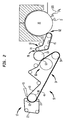
- Figure 1 is a schematic diagram of a papermachine 10 having a conventional twin wire forming section 12, a felt run 14, a shoe press section 16, a creping fabric 18 and a Yankee dryer 20 suitable for practicing the present invention.
- Forming section 12 includes a pair of forming fabrics 22, 24 supported by a plurality of rolls 26, 28, 30, 32, 34, 36 and a forming roll 38.
- a headbox 40 provides papermaking furnish issuing therefrom as a jet in the machine direction to a nip 42 between forming roll 38 and roll 26 and the fabrics.
- the furnish forms a nascent web 44 which is dewatered on the fabrics with the assistance of vacuum, for example, by way of vacuum box 46.
- the nascent web is advanced to a papermaking felt 48 which is supported by a plurality of rolls 50, 52, 54, 55 and the felt is in contact with a shoe press roll 56.
- the web is of low consistency as it is transferred to the felt. Transfer may be assisted by vacuum; for example roll 50 may be a vacuum roll if so desired or a pickup or vacuum shoe as is known in the art.
- As the web reaches the shoe press roll it may have a consistency of 10-25 percent, preferably 20 to 25 percent or so as it enters nip 58 between shoe press roll 56 and transfer roll 60.
- Transfer roll 60 may be a heated roll if so desired. It has been found that increasing steam pressure to roll 60 helps lengthen the time between required stripping of excess adhesive from the cylinder of Yankee dryer 20.
- Suitable steam pressure may be about 95 psig or so, bearing in mind that roll 60 is a crowned roll and roll 70 has a negative crown to match such that the contact area between the rolls is influenced by the pressure in roll 60. Thus, care must be exercised to maintain matching contact between rolls 60, 70 when elevated pressure is employed.
- roll 56 could be a conventional suction pressure roll. If a shoc press is employed, it is desirable and preferred that roll 54 is a vacuum roll effective to remove water from the felt prior to the felt entering the shoe press nip since water from the furnish will be pressed into the felt in the shoe press nip. In any case, using a vacuum roll at 54 is typically desirable to ensure the web remains in contact with the felt during the direction change as one of skill in the art will appreciate from the diagram.
- Web 44 is wet-pressed on the felt in nip 58 with the assistance of pressure shoe 62.
- the web is thus compactively dewatered at 58, typically by increasing the consistency by 15 or more points at this stage of the process.
- the configuration shown at 58 is generally termed a shoe press; in connection with the present invention, cylinder 60 is operative as a transfer cylinder which operates to convey web 44 at high speed, typically 1000 fpm-6000 fpm (304,8-1828,8 m/min) , to the creping fabric.
- Cylinder 60 has a smooth surface 64 which may be provided with adhesive (the same as the creping adhesive used on the Yankee cylinder) and/or release agents if needed. Web 44 is adhered to transfer surface 64 of cylinder 60 which is rotating at a high angular velocity as the web continues to advance in the machine-direction indicated by arrows 66 . On the cylinder, web 44 has a generally random apparent distribution of fiber.
- Direction 66 is referred to as the machine-direction (MD) of the web as well as that of papermachine 10 ; whereas the cross-machine-direction (CD) is the direction in the plane of the web perpendicular to the MD.
- MD machine-direction
- CD cross-machine-direction
- Web 44 enters nip 58 typically at consistencies of 10-25 percent or so and is dewatered and dried to consistencies of from about 25 to about 70 by the time it is transferred to creping fabric 18 as shown in the diagram.
- Fabric 18 is supported on a plurality of rolls 68, 70, 72 and a press nip roll 74 and forms a fabric crepe nip 76 with transfer cylinder 60 as shown.
- the creping fabric defines a creping nip over the distance in which creping fabric 18 is adapted to contact roll 60 ; that is, applies significant pressure to the web against the transfer cylinder.
- backing (or creping) roll 70 may be provided with a soft deformable surface which will increase the length of the creping nip and increase the fabric creping angle between the fabric and the sheet and the point of contact or a shoe press roll could be used as roll 70 to increase effective contact with the web in high impact fabric creping nip 76 where web 44 is transferred to fabric 18 and advanced in the machine-direction.
- Creping nip 76 generally extends over a fabric creping nip distance of anywhere from about 1/8" to about 2" (3,17-50,8 mm), typically 1 ⁇ 2" to 2" (12,7-50,8 mm). For a creping fabric with 32 CD strands per inch (2,59 CD strands per cm), web 44 thus will encounter anywhere from about 4 to 64 weft filaments in the nip.
- nip pressure in nip 76 that is, the loading between backing roll 70 and transfer roll 60 is suitably 20-200 (3,57-35,7 kg/cm), preferably 40-70 pounds per linear inch (PLI) (7,14-12,5 kg/cm).
- the web continues to advance along MD 66 where it is wet-pressed onto Yankee cylinder 80 in transfer nip 82.
- the web is vacuum molded by way of a vacuum box 45.
- Transfer at nip 82 occurs at a web consistency of generally from about 25 to about 70 percent. At these consistencies, it is difficult to adhere the web to surface 84 of cylinder 80 firmly enough to remove the web from the fabric thoroughly. This aspect of the process is important, particularly when it is desired to use a high velocity drying hood.
- a poly(vinyl alcohol)/polyamide adhesive composition as noted above is applied at 86 as needed, preferably at a rate of less than about 40mg/m 2 of sheet. Build-up is controlled as hereinafter described.
- the web is dried on Yankee cylinder 80 which is a heated cylinder and by high jet velocity impingement air in Yankee hood 88.
- Hood 88 is capable of variable temperature. During operation, temperature may be monitored at wet end A of the Hood and dry end B of the hood using an infra-red detector or any other suitable means if so desired. As the cylinder rotates, web 44 is peeled from the cylinder at 89 and wound on a take-up reel 90.
- Reel 90 may be operated 5-30 fpm (1,524-9,144 m/min) (preferably 10-20 fpm (3,048-6,096 m/min) ) faster than the Yankee cylinder at steady-state when the line speed is 2100 fpm (640,08 m/min), for example.
- a creping doctor C is normally used and a cleaning doctor D mounted for intermittent engagement is used to control build up.
- the web is typically segregated from the product on reel 90, preferably being fed to a broke chute at 100 for recycle to the production process.
- the web may be creped from dryer cylinder 80 using a creping doctor such as creping doctor C, if so desired.
- Papermachine 10 is a three fabric loop machine having a forming section 12 generally referred to in the art as a crescent former.
- Forming section 12 includes a forming wire 22 supported by a plurality of rolls such as rolls 32, 35.
- the forming section also includes a forming roll 38 which supports paper making felt 48 such that web 44 is formed directly on felt 48.
- Felt run 14 extends to a shoe press section 16 wherein the moist web is deposited on a transfer roll 60 as described above. Thereafter web 44 is creped onto fabric in fabric crepe nip between rolls 60, 70 before being deposited on Yankee dryer 20 in another press nip 82.
- Vacuum is optionally applied by vacuum box 45 as the web is held in fabric in order to conform the web to the textured fabric.
- Headbox 40 and press shoe 62 operate as noted above in connection with Figure 1 .
- the system includes a vacuum turning roll 54, in some embodiments; however, the three loop system may be configured in a variety of ways wherein a turning roll is not necessary.
- Any suitable line arrangement may be used downstream of Yankee dryer 20 between the Yankee dryer and take up reel 90.
- One preferred layout is shown schematically in Figure 3 .
- a Yankee cylinder 80 upon which the sheet is dried and in proximity therewith a first foil 130 which has a rounded edge 132 adjacent the Yankee dryer.
- the rounded edge of the foil is in close proximity with the surface of cylinder 80.
- any open draw is provided with some form of stabilizing airfoil and there are provided tensioners so as to prevent wrinkling of the sheet.
- Second and third airfoils 134, 138 stabilize the web over open draw along the production line. Thereafter a spreader bar or bow roll 136 may be used to apply tension to the web in order to prevent wrinkling as the web progresses to an optional calendar stack 142.
- Stack 142 may be used to calender the web especially if it is desired to reduce sidedness. While any suitable calender load may be employed, it is preferred that the calender load be between about 15 and about 25 pli.
- calender stack 142 Between calender stack 142 and reel 90 there is provided a Measurex® control instrument 150 to measure consistency and basis weight in order to provide data for feedback control of the papermachine. Fourth and fifth airfoils 144,148 stabilize the web on either side of the Measurex® instrument. Another spreader bar or bow roll 146 is provided in front of reel 90 in order to tension the web.
- calender stack 142 be synchronized with reel 90 prior to loading the calender stack. After loading, reel 90 can be speeded up to be slightly faster than calendar stack 142 (3-10 fpm faster) to promote good winding.
- Papermaking processes as described immediately above place difficult demands on adhesive compositions used in connection with the process in that the adhesive coating is relatively "hot” in the dryer as compared with a conventional CWP process because the web is typically shaped or textured before application to the Yankee cylinder, reducing surface area available for bonding and heat transfer between the sheet and cylinder.
- the Yankee cleaning process and associated steps (a-f) above are advantageously carried out over an elapsed time of 5- 20 minutes.
- the entire process and associated steps are completed in 7-15 minutes, so that even less material needs to be recycled from the segregated material.
- the above procedure for controlling build-up may be adapted to any conventional paper making process or processes hereafter developed utilizing a creping adhesive and drying cylinder as will be appreciated by one of skill in the art.
- the invention is especially useful in connection with papermaking processes wherein the adhesive coating temperature on a drying cylinder is higher than in conventional processes such as conventional CWP processes.
Landscapes
- Paper (AREA)
- Coating Apparatus (AREA)
- Application Of Or Painting With Fluid Materials (AREA)
Claims (19)
- Procédé continu de fabrication d'une feuille absorbante comprenant la formation d'une nappe cellulosique humide (44), l'application de la nappe (44) sur un cylindre de séchage (80) d'un sécheur (20), lequel cylindre de séchage (80) est pourvu d'un adhésif résineux à débit d'addition constant au cours d'un fonctionnement en régime permanent, dans lequel l'adhésif résineux est constitué essentiellement d'une résine d'alcool polyvinylique et d'une résine d'épihalohydrine en proportion sensiblement fixe en fonctionnement en régime permanent et le sécheur (20) est en outre pourvu d'une hotte de sécheur capable de présenter une température variable, l'amélioration comprenant le réglage de l'accumulation d'un revêtement adhésif sur le cylindre de séchage (80) en retirant au moins une partie du revêtement adhésif du cylindre de séchage (80) avec une raclette de nettoyage (D) tout en réglant l'adhérence à l'état humide du cylindre de séchage (80) au moyen d'une technique choisie dans le groupe constitué des suivantes :(a) l'abaissement de la température de la hotte avant de retirer le revêtement ;(b) le changement de la composition adhésive résineuse avant de retirer le revêtement ; et(c) l'augmentation du débit d'addition de l'adhésif résineux au-dessus du débit d'addition en régime permanent avant de retirer le revêtement.
- Procédé continu de fabrication d'une feuille absorbante selon la revendication 1, dans lequel l'adhérence à l'état humide au cylindre de séchage (80) est réglée par des combinaisons de deux ou plus des techniques (a), (b) et (c).
- Procédé continu de fabrication d'une feuille absorbante selon la revendication 1, dans lequel la composition adhésive résineuse est présente à raison d'environ 60 % en poids à environ 70 % en poids de résine d'alcool polyvinylique au cours d'un fonctionnement en régime permanent.
- Procédé continu de fabrication d'une feuille absorbante selon la revendication 1, dans lequel la composition adhésive résineuse est présente à raison d'environ 75 % à environ 90 % en poids de résine d'alcool polyvinylique au cours d'un fonctionnement en régime permanent.
- Procédé continu de fabrication d'une feuille absorbante selon la revendication 1, dans lequel le sécheur (20) est un sécheur frictionneur et la température du sécheur (20) est réglée de sorte que la température du revêtement d'adhésif ne dépasse pas environ 148,8 °C (300 °F) au cours de l'étape de retrait d'adhésif du cylindre de séchage (80).
- Procédé continu de fabrication d'une feuille absorbante selon la revendication 1, dans lequel le débit d'addition d'alcool polyvinylique est accru d'au moins environ 50 % par rapport à un débit d'addition d'alcool polyvinylique en régime permanent.
- Procédé continu de fabrication d'une feuille absorbante selon la revendication 1, dans lequel le sécheur (20) est pourvu d'une hotte de sécheur (20) qui est à même de faire varier sa température et la température de la hotte du sécheur (20) est abaissée au cours de l'étape de retrait de l'adhésif résineux du cylindre de séchage (80) d'au moins environ 13,8 °C (25 °F) au cours de l'étape de retrait de l'adhésif résineux du cylindre de séchage (80) et la température de la hotte à une extrémité humide (A) est abaissée d'au moins environ 13,8 °C (25 °F).
- Procédé continu de fabrication d'une feuille absorbante selon la revendication 1, dans lequel la nappe (44) est détachée du cylindre de séchage (80) au cours d'un fonctionnement en régime permanent du procédé.
- Procédé continu de fabrication d'une feuille absorbante selon la revendication 8, comprenant l'étape de prolongement du détachement de la nappe (44) du cylindre de séchage (80) au cours de l'opération de retrait tout en réduisant la tension sur la nappe (44) simultanément avec le détachement au moyen de la réduction du débit en régime permanent de la bobine (90).
- Procédé continu de fabrication d'une feuille absorbante selon la revendication 1, dans lequel la nappe (44) est crêpée à partir du cylindre de séchage (80) avec une raclette de crêpage (c) au cours d'un fonctionnement en régime permanent du procédé.
- Procédé continu de fabrication d'une feuille absorbante selon l'une quelconque des revendications 1 à 10, comprenant en outre la séparation du produit élaboré simultanément avec le retrait d'une partie du revêtement du cylindre de séchage (80) du produit obtenu au cours d'un fonctionnement en régime permanent.
- Procédé continu de fabrication d'une feuille absorbante selon la revendication 11, dans lequel l'adhésif résineux comprend un modificateur de crêpage.
- Procédé continu de fabrication d'une feuille absorbante selon la revendication 12, dans lequel le modificateur de crêpage comprend un complexe d'ammonium quaternaire.
- Amélioration selon la revendication 12, dans laquelle le modificateur de crêpage comprend un complexe d'ammonium quaternaire et une fonctionnalité d'amide non cyclique.
- Procédé continu de fabrication d'une feuille absorbante selon la revendication 1, comprenant l'autre étape de séparation d'au moins une partie du produit en feuille absorbant fabriqué tandis que l'opération de retrait est en cours sur le produit en feuille absorbant accumulé sur la bobine (90) au cours d'un fonctionnement en régime permanent ; et le recyclage d'au moins une partie du produit en feuille absorbant séparé au processus.
- Procédé continu de fabrication d'une feuille absorbante selon la revendication 15, dans lequel le produit en feuille absorbant séparé est envoyé à une goulotte de débris.
- Procédé continu de fabrication d'une feuille absorbante selon l'une quelconque des revendications 1 à 16, dans lequel la température du sécheur est réglée en faisant varier la température de la hotte.
- Procédé continu de fabrication d'une feuille absorbante selon l'une quelconque des revendications 1 à 16, dans lequel la température du sécheur est réglée en faisant varier la pression de la vapeur d'eau du cylindre de séchage (80).
- Procédé continu de fabrication d'une feuille absorbante selon la revendication 15, dans lequel l'adhésif résineux comprend une résine d'alcool polyvinylique et une résine de polyamide-épihalohydrine en proportions sensiblement fixes au cours d'un fonctionnement en régime permanent et l'augmentation du débit d'addition d'adhésif résineux au cylindre de séchage (80) au-dessus du débit d'addition en régime permanent est obtenue en augmentant le débit d'addition de résine d'alcool polyvinylique au-dessus d'un débit d'addition en régime permanent de la résine d'alcool polyvinylique tout en maintenant le débit d'addition de résine de polyamide-épihalohydrine sensiblement à son débit d'addition au cours du fonctionnement en régime permanent.
Priority Applications (2)
| Application Number | Priority Date | Filing Date | Title |
|---|---|---|---|
| SI200731799A SI2001662T1 (sl) | 2006-03-06 | 2007-02-27 | Metoda za nadzor nabiranja lepila v yankee sušilniku |
| PL07757507T PL2001662T3 (pl) | 2006-03-06 | 2007-02-27 | Sposób kontrolowania gromadzenia się kleju na suszarce yankee |
Applications Claiming Priority (3)
| Application Number | Priority Date | Filing Date | Title |
|---|---|---|---|
| US77961406P | 2006-03-06 | 2006-03-06 | |
| US11/678,669 US7850823B2 (en) | 2006-03-06 | 2007-02-26 | Method of controlling adhesive build-up on a yankee dryer |
| PCT/US2007/062836 WO2007103652A2 (fr) | 2006-03-06 | 2007-02-27 | Procede de regulation de l'accumulation d'adhesif sur un secheur frictionneur |
Publications (3)
| Publication Number | Publication Date |
|---|---|
| EP2001662A2 EP2001662A2 (fr) | 2008-12-17 |
| EP2001662A4 EP2001662A4 (fr) | 2012-05-02 |
| EP2001662B1 true EP2001662B1 (fr) | 2016-06-01 |
Family
ID=38470486
Family Applications (1)
| Application Number | Title | Priority Date | Filing Date |
|---|---|---|---|
| EP07757507.4A Active EP2001662B1 (fr) | 2006-03-06 | 2007-02-27 | Procede de regulation de l'accumulation d'adhesif sur un secheur frictionneur |
Country Status (12)
| Country | Link |
|---|---|
| US (1) | US7850823B2 (fr) |
| EP (1) | EP2001662B1 (fr) |
| CA (1) | CA2644640C (fr) |
| CY (1) | CY1117811T1 (fr) |
| DK (1) | DK2001662T3 (fr) |
| ES (1) | ES2582651T3 (fr) |
| HU (1) | HUE027859T2 (fr) |
| PL (1) | PL2001662T3 (fr) |
| PT (1) | PT2001662T (fr) |
| RU (1) | RU2419547C2 (fr) |
| SI (1) | SI2001662T1 (fr) |
| WO (1) | WO2007103652A2 (fr) |
Cited By (4)
| Publication number | Priority date | Publication date | Assignee | Title |
|---|---|---|---|---|
| US11255051B2 (en) | 2017-11-29 | 2022-02-22 | Kimberly-Clark Worldwide, Inc. | Fibrous sheet with improved properties |
| US11313061B2 (en) | 2018-07-25 | 2022-04-26 | Kimberly-Clark Worldwide, Inc. | Process for making three-dimensional foam-laid nonwovens |
| US11591755B2 (en) | 2015-11-03 | 2023-02-28 | Kimberly-Clark Worldwide, Inc. | Paper tissue with high bulk and low lint |
| US12331465B2 (en) | 2017-04-28 | 2025-06-17 | Kimberly-Clark Worldwide, Inc. | Foam-formed fibrous sheets with crimped staple fibers |
Families Citing this family (40)
| Publication number | Priority date | Publication date | Assignee | Title |
|---|---|---|---|---|
| US7494563B2 (en) | 2002-10-07 | 2009-02-24 | Georgia-Pacific Consumer Products Lp | Fabric creped absorbent sheet with variable local basis weight |
| US7789995B2 (en) | 2002-10-07 | 2010-09-07 | Georgia-Pacific Consumer Products, LP | Fabric crepe/draw process for producing absorbent sheet |
| US7662257B2 (en) | 2005-04-21 | 2010-02-16 | Georgia-Pacific Consumer Products Llc | Multi-ply paper towel with absorbent core |
| US8673115B2 (en) | 2002-10-07 | 2014-03-18 | Georgia-Pacific Consumer Products Lp | Method of making a fabric-creped absorbent cellulosic sheet |
| US7442278B2 (en) | 2002-10-07 | 2008-10-28 | Georgia-Pacific Consumer Products Lp | Fabric crepe and in fabric drying process for producing absorbent sheet |
| DE60324829D1 (de) | 2002-10-07 | 2009-01-02 | Georgia Pacific Consumer Prod | Verfahren zum herstellen einer gekreppten zellstoffbahn |
| US8293072B2 (en) | 2009-01-28 | 2012-10-23 | Georgia-Pacific Consumer Products Lp | Belt-creped, variable local basis weight absorbent sheet prepared with perforated polymeric belt |
| US7503998B2 (en) * | 2004-06-18 | 2009-03-17 | Georgia-Pacific Consumer Products Lp | High solids fabric crepe process for producing absorbent sheet with in-fabric drying |
| US8187421B2 (en) | 2006-03-21 | 2012-05-29 | Georgia-Pacific Consumer Products Lp | Absorbent sheet incorporating regenerated cellulose microfiber |
| US8187422B2 (en) | 2006-03-21 | 2012-05-29 | Georgia-Pacific Consumer Products Lp | Disposable cellulosic wiper |
| US8540846B2 (en) | 2009-01-28 | 2013-09-24 | Georgia-Pacific Consumer Products Lp | Belt-creped, variable local basis weight multi-ply sheet with cellulose microfiber prepared with perforated polymeric belt |
| US7718036B2 (en) | 2006-03-21 | 2010-05-18 | Georgia Pacific Consumer Products Lp | Absorbent sheet having regenerated cellulose microfiber network |
| US8388992B2 (en) | 2006-03-28 | 2013-03-05 | Georgia-Pacific Consumer Products Lp | Anti-microbial hand towel with time-delay chromatic transfer indicator and absorbency rate delay |
| US7744722B1 (en) * | 2006-06-15 | 2010-06-29 | Clearwater Specialties, LLC | Methods for creping paper |
| LT2057016T (lt) | 2006-08-30 | 2017-07-25 | Georgia-Pacific Consumer Products Lp | Daugiasluoksnis popierinis rankšluostis |
| US7585392B2 (en) * | 2006-10-10 | 2009-09-08 | Georgia-Pacific Consumer Products Lp | Method of producing absorbent sheet with increased wet/dry CD tensile ratio |
| US8021518B2 (en) * | 2006-11-30 | 2011-09-20 | Nalco Company | Method of applying a super-absorbent composition to tissue or towel substrates |
| US7951264B2 (en) | 2007-01-19 | 2011-05-31 | Georgia-Pacific Consumer Products Lp | Absorbent cellulosic products with regenerated cellulose formed in-situ |
| US7608164B2 (en) * | 2007-02-27 | 2009-10-27 | Georgia-Pacific Consumer Products Lp | Fabric-crepe process with prolonged production cycle and improved drying |
| US8066849B2 (en) * | 2008-06-11 | 2011-11-29 | Georgia-Pacific Consumer Products Lp | Absorbent sheet prepared with papermaking fiber and synthetic fiber exhibiting improved wet strength |
| CA2735867C (fr) | 2008-09-16 | 2017-12-05 | Dixie Consumer Products Llc | Feuille de base d'emballage alimentaire a microfibre de cellulose regeneree |
| CA2722650C (fr) | 2009-12-07 | 2018-05-01 | Georgia-Pacific Consumer Products Lp | Procede de fabrication d'une feuille a base de papier crete absorbant l'humidite |
| US9309627B2 (en) | 2011-07-28 | 2016-04-12 | Georgia-Pacific Consumer Products Lp | High softness, high durability bath tissues with temporary wet strength |
| US9267240B2 (en) | 2011-07-28 | 2016-02-23 | Georgia-Pacific Products LP | High softness, high durability bath tissue incorporating high lignin eucalyptus fiber |
| US9404895B2 (en) * | 2011-10-20 | 2016-08-02 | Nalco Company | Method for early warning chatter detection and asset protection management |
| US8958898B2 (en) | 2011-11-07 | 2015-02-17 | Nalco Company | Method and apparatus to monitor and control sheet characteristics on a creping process |
| US9822285B2 (en) | 2015-01-28 | 2017-11-21 | Gpcp Ip Holdings Llc | Glue-bonded multi-ply absorbent sheet |
| US10774476B2 (en) | 2016-01-19 | 2020-09-15 | Gpcp Ip Holdings Llc | Absorbent sheet tail-sealed with nanofibrillated cellulose-containing tail-seal adhesives |
| WO2017152082A1 (fr) | 2016-03-04 | 2017-09-08 | Georgia-Pacific Consumer Products Lp | Lingette dispersible |
| US10697123B2 (en) | 2017-01-17 | 2020-06-30 | Gpcp Ip Holdings Llc | Zwitterionic imidazolinium surfactant and use in the manufacture of absorbent paper |
| US10895038B2 (en) | 2017-05-31 | 2021-01-19 | Gpcp Ip Holdings Llc | High consistency re-pulping method, apparatus and absorbent products incorporating recycled fiber |
| US10329715B2 (en) | 2017-07-20 | 2019-06-25 | Buckman Laboratories International, Inc. | Real time regulation of yankee dryer coating based on predicted natural coating transfer |
| CN111295477B (zh) | 2017-10-24 | 2022-05-06 | 埃科莱布美国股份有限公司 | 经由振动分析在造纸系统中的沉积物检测 |
| SE1950671A1 (en) * | 2019-06-05 | 2020-12-06 | Valmet Oy | A machine and a method for making tissue paper |
| US11560443B2 (en) | 2019-09-11 | 2023-01-24 | Buckman Laboratories International, Inc. | Grafted polyvinyl alcohol polymer, formulations containing the same, and creping methods |
| US11124920B2 (en) | 2019-09-16 | 2021-09-21 | Gpcp Ip Holdings Llc | Tissue with nanofibrillar cellulose surface layer |
| US11707906B2 (en) | 2020-08-27 | 2023-07-25 | Buckman Laboratories International, Inc. | Predictive control of Yankee dryer chemistry and creped product quality |
| JP2024511702A (ja) | 2021-02-16 | 2024-03-15 | エコラボ ユーエスエー インコーポレイティド | クレープ加工プロセス性能の追跡及び制御 |
| JP2022185815A (ja) * | 2021-06-03 | 2022-12-15 | 大王製紙株式会社 | ティシューペーパー及びティシューペーパーの製造方法 |
| CN118974672A (zh) | 2022-03-24 | 2024-11-15 | 巴克曼实验室国际公司 | 用于关于在线传感器的追溯和自动验证或校正动作的系统和方法 |
Family Cites Families (66)
| Publication number | Priority date | Publication date | Assignee | Title |
|---|---|---|---|---|
| NL110447C (fr) | 1957-09-05 | |||
| US3058873A (en) | 1958-09-10 | 1962-10-16 | Hercules Powder Co Ltd | Manufacture of paper having improved wet strength |
| US3556932A (en) | 1965-07-12 | 1971-01-19 | American Cyanamid Co | Water-soluble,ionic,glyoxylated,vinylamide,wet-strength resin and paper made therewith |
| US3556933A (en) | 1969-04-02 | 1971-01-19 | American Cyanamid Co | Regeneration of aged-deteriorated wet strength resins |
| US3772076A (en) | 1970-01-26 | 1973-11-13 | Hercules Inc | Reaction products of epihalohydrin and polymers of diallylamine and their use in paper |
| US3980605A (en) * | 1972-09-13 | 1976-09-14 | Standard Oil Company | Semi-permeable membrane compositions based on blends of polyamides and polyvinyl alcohols |
| US3974025A (en) | 1974-04-01 | 1976-08-10 | The Procter & Gamble Company | Absorbent paper having imprinted thereon a semi-twill, fabric knuckle pattern prior to final drying |
| US3994771A (en) | 1975-05-30 | 1976-11-30 | The Procter & Gamble Company | Process for forming a layered paper web having improved bulk, tactile impression and absorbency and paper thereof |
| US4064213A (en) * | 1976-02-09 | 1977-12-20 | Scott Paper Company | Creping process using two-position adhesive application |
| US4102737A (en) | 1977-05-16 | 1978-07-25 | The Procter & Gamble Company | Process and apparatus for forming a paper web having improved bulk and absorptive capacity |
| US4239065A (en) | 1979-03-09 | 1980-12-16 | The Procter & Gamble Company | Papermachine clothing having a surface comprising a bilaterally staggered array of wicker-basket-like cavities |
| WO1982000485A1 (en) * | 1980-08-07 | 1982-02-18 | Y Lim | Method for producing a high quality,water absorbent,cellulosic sheet having high surface-perceived softness |
| US4543156A (en) | 1982-05-19 | 1985-09-24 | James River-Norwalk, Inc. | Method for manufacture of a non-woven fibrous web |
| US4689119A (en) | 1982-07-01 | 1987-08-25 | James River Corporation Of Nevada | Apparatus for treating web material |
| US4551199A (en) | 1982-07-01 | 1985-11-05 | Crown Zellerbach Corporation | Apparatus and process for treating web material |
| PH25720A (en) * | 1982-09-30 | 1991-09-18 | Beloit Corp | Method, apparatus for controlling the moisture profile of a paper web in paper-making machine |
| US4533437A (en) | 1982-11-16 | 1985-08-06 | Scott Paper Company | Papermaking machine |
| US4490925A (en) | 1983-06-08 | 1985-01-01 | Wangner Systems Corporation | Low permeability spiral fabric and method |
| US4529480A (en) | 1983-08-23 | 1985-07-16 | The Procter & Gamble Company | Tissue paper |
| US4528316A (en) | 1983-10-18 | 1985-07-09 | Kimberly-Clark Corporation | Creping adhesives containing polyvinyl alcohol and cationic polyamide resins |
| US4605702A (en) | 1984-06-27 | 1986-08-12 | American Cyanamid Company | Temporary wet strength resin |
| US4703116A (en) | 1984-08-17 | 1987-10-27 | National Starch And Chemical Corporation | Polysaccharide derivatives containing aldehyde groups, their preparation from the corresponding acetals and use as paper additives |
| US4983748A (en) | 1984-08-17 | 1991-01-08 | National Starch And Chemical Investment Holding Corporation | Acetals useful for the preparation of polysaccharide derivatives |
| US4675394A (en) | 1984-08-17 | 1987-06-23 | National Starch And Chemical Corporation | Polysaccharide derivatives containing aldehyde groups, their preparation from the corresponding acetals and use as paper additives |
| US4603176A (en) | 1985-06-25 | 1986-07-29 | The Procter & Gamble Company | Temporary wet strength resins |
| US4795530A (en) | 1985-11-05 | 1989-01-03 | Kimberly-Clark Corporation | Process for making soft, strong cellulosic sheet and products made thereby |
| US4849054A (en) | 1985-12-04 | 1989-07-18 | James River-Norwalk, Inc. | High bulk, embossed fiber sheet material and apparatus and method of manufacturing the same |
| US4720383A (en) | 1986-05-16 | 1988-01-19 | Quaker Chemical Corporation | Softening and conditioning fibers with imidazolinium compounds |
| AT386427B (de) * | 1986-05-30 | 1988-08-25 | Albert Hans | Verfahren und einrichtung zur steuerung der belag-dicke an einem yankee-zylinder |
| US4834838A (en) | 1987-02-20 | 1989-05-30 | James River Corporation | Fibrous tape base material |
| US4866151A (en) | 1987-03-25 | 1989-09-12 | National Starch And Chemical Corporation | Polysaccharide graft polymers containing acetal groups and their conversion to aldehyde groups |
| US5048589A (en) * | 1988-05-18 | 1991-09-17 | Kimberly-Clark Corporation | Non-creped hand or wiper towel |
| US5008344A (en) | 1988-07-05 | 1991-04-16 | The Procter & Gamble Company | Temporary wet strength resins and paper products containing same |
| US4981557A (en) | 1988-07-05 | 1991-01-01 | The Procter & Gamble Company | Temporary wet strength resins with nitrogen heterocyclic nonnucleophilic functionalities and paper products containing same |
| US5138002A (en) | 1988-07-05 | 1992-08-11 | The Procter & Gamble Company | Temporary wet strength resins with nitrogen heterocyclic nonnucleophilic functionalities and paper products containing same |
| US5085736A (en) | 1988-07-05 | 1992-02-04 | The Procter & Gamble Company | Temporary wet strength resins and paper products containing same |
| US5199467A (en) | 1990-06-06 | 1993-04-06 | Asten Group, Inc. | Papermakers fabric with stacked machine direction yarns |
| CA2053505C (fr) | 1990-10-17 | 1999-04-13 | John Henry Dwiggins | Methode et appareil de production de mousse |
| US5217576A (en) | 1991-11-01 | 1993-06-08 | Dean Van Phan | Soft absorbent tissue paper with high temporary wet strength |
| US5338807A (en) | 1991-12-23 | 1994-08-16 | Hercules Incorporated | Synthesis of creping aids based on polyamides containing methyl bis(3-aminopropylamine) |
| US5240562A (en) | 1992-10-27 | 1993-08-31 | Procter & Gamble Company | Paper products containing a chemical softening composition |
| US5607551A (en) | 1993-06-24 | 1997-03-04 | Kimberly-Clark Corporation | Soft tissue |
| ES2135849T3 (es) | 1995-05-18 | 1999-11-01 | Fort James Corp | Nuevas formulaciones de adhesivo de crespado, metodo de crespado y banda fibrosa crespada. |
| US6350349B1 (en) | 1996-05-10 | 2002-02-26 | Kimberly-Clark Worldwide, Inc. | Method for making high bulk wet-pressed tissue |
| US6133405A (en) | 1997-07-10 | 2000-10-17 | Hercules Incorporated | Polyalkanolamide tackifying resins for creping adhesives |
| US6946117B1 (en) * | 1997-09-29 | 2005-09-20 | Nektar Therapeutics | Stabilized preparations for use in nebulizers |
| US6187137B1 (en) | 1997-10-31 | 2001-02-13 | Kimberly-Clark Worldwide, Inc. | Method of producing low density resilient webs |
| US7012116B1 (en) | 1998-06-01 | 2006-03-14 | Kimberly-Clark Worldwide, Inc. | Blend compositions of an unmodified poly vinyl alcohol and a thermoplastic elastomer |
| US6248210B1 (en) | 1998-11-13 | 2001-06-19 | Fort James Corporation | Method for maximizing water removal in a press nip |
| US6458343B1 (en) | 1999-05-07 | 2002-10-01 | Goldschmidt Chemical Corporation | Quaternary compounds, compositions containing them, and uses thereof |
| US6432267B1 (en) | 1999-12-16 | 2002-08-13 | Georgia-Pacific Corporation | Wet crepe, impingement-air dry process for making absorbent sheet |
| US6447640B1 (en) | 2000-04-24 | 2002-09-10 | Georgia-Pacific Corporation | Impingement air dry process for making absorbent sheet |
| US6749721B2 (en) | 2000-12-22 | 2004-06-15 | Kimberly-Clark Worldwide, Inc. | Process for incorporating poorly substantive paper modifying agents into a paper sheet via wet end addition |
| US7122235B2 (en) | 2001-06-11 | 2006-10-17 | Eastman Kodak Company | Tack free cauterized edge for pressure sensitive adhesive web |
| US7959761B2 (en) * | 2002-04-12 | 2011-06-14 | Georgia-Pacific Consumer Products Lp | Creping adhesive modifier and process for producing paper products |
| US7662257B2 (en) | 2005-04-21 | 2010-02-16 | Georgia-Pacific Consumer Products Llc | Multi-ply paper towel with absorbent core |
| DE60324829D1 (de) | 2002-10-07 | 2009-01-02 | Georgia Pacific Consumer Prod | Verfahren zum herstellen einer gekreppten zellstoffbahn |
| US7588660B2 (en) | 2002-10-07 | 2009-09-15 | Georgia-Pacific Consumer Products Lp | Wet-pressed tissue and towel products with elevated CD stretch and low tensile ratios made with a high solids fabric crepe process |
| US7789995B2 (en) | 2002-10-07 | 2010-09-07 | Georgia-Pacific Consumer Products, LP | Fabric crepe/draw process for producing absorbent sheet |
| US7442278B2 (en) | 2002-10-07 | 2008-10-28 | Georgia-Pacific Consumer Products Lp | Fabric crepe and in fabric drying process for producing absorbent sheet |
| US6964117B2 (en) | 2002-12-20 | 2005-11-15 | Metso Paper Usa, Inc. | Method and apparatus for adjusting a moisture profile in a web |
| US20040211534A1 (en) * | 2003-04-24 | 2004-10-28 | Clungeon Nancy S. | Creping additives for paper webs |
| US7503998B2 (en) | 2004-06-18 | 2009-03-17 | Georgia-Pacific Consumer Products Lp | High solids fabric crepe process for producing absorbent sheet with in-fabric drying |
| US7416637B2 (en) | 2004-07-01 | 2008-08-26 | Georgia-Pacific Consumer Products Lp | Low compaction, pneumatic dewatering process for producing absorbent sheet |
| US7585388B2 (en) | 2005-06-24 | 2009-09-08 | Georgia-Pacific Consumer Products Lp | Fabric-creped sheet for dispensers |
| US7608164B2 (en) * | 2007-02-27 | 2009-10-27 | Georgia-Pacific Consumer Products Lp | Fabric-crepe process with prolonged production cycle and improved drying |
-
2007
- 2007-02-26 US US11/678,669 patent/US7850823B2/en active Active
- 2007-02-27 EP EP07757507.4A patent/EP2001662B1/fr active Active
- 2007-02-27 PL PL07757507T patent/PL2001662T3/pl unknown
- 2007-02-27 DK DK07757507.4T patent/DK2001662T3/en active
- 2007-02-27 SI SI200731799A patent/SI2001662T1/sl unknown
- 2007-02-27 HU HUE07757507A patent/HUE027859T2/en unknown
- 2007-02-27 WO PCT/US2007/062836 patent/WO2007103652A2/fr not_active Ceased
- 2007-02-27 ES ES07757507.4T patent/ES2582651T3/es active Active
- 2007-02-27 CA CA2644640A patent/CA2644640C/fr active Active
- 2007-02-27 PT PT77575074T patent/PT2001662T/pt unknown
- 2007-02-27 RU RU2008139410/12A patent/RU2419547C2/ru active
-
2016
- 2016-07-14 CY CY20161100676T patent/CY1117811T1/el unknown
Non-Patent Citations (1)
| Title |
|---|
| None * |
Cited By (7)
| Publication number | Priority date | Publication date | Assignee | Title |
|---|---|---|---|---|
| US11591755B2 (en) | 2015-11-03 | 2023-02-28 | Kimberly-Clark Worldwide, Inc. | Paper tissue with high bulk and low lint |
| US12331465B2 (en) | 2017-04-28 | 2025-06-17 | Kimberly-Clark Worldwide, Inc. | Foam-formed fibrous sheets with crimped staple fibers |
| US11255051B2 (en) | 2017-11-29 | 2022-02-22 | Kimberly-Clark Worldwide, Inc. | Fibrous sheet with improved properties |
| US12043963B2 (en) | 2017-11-29 | 2024-07-23 | Kimberly-Clark Worldwide, Inc. | Fibrous sheet with improved properties |
| US11313061B2 (en) | 2018-07-25 | 2022-04-26 | Kimberly-Clark Worldwide, Inc. | Process for making three-dimensional foam-laid nonwovens |
| US11788221B2 (en) | 2018-07-25 | 2023-10-17 | Kimberly-Clark Worldwide, Inc. | Process for making three-dimensional foam-laid nonwovens |
| US12116706B2 (en) | 2018-07-25 | 2024-10-15 | Kimberly-Clark Worldwide, Inc. | Process for making three-dimensional foam-laid nonwovens |
Also Published As
| Publication number | Publication date |
|---|---|
| EP2001662A2 (fr) | 2008-12-17 |
| RU2008139410A (ru) | 2010-04-20 |
| US7850823B2 (en) | 2010-12-14 |
| HUE027859T2 (en) | 2016-11-28 |
| US20070204966A1 (en) | 2007-09-06 |
| CY1117811T1 (el) | 2017-05-17 |
| CA2644640C (fr) | 2014-12-09 |
| DK2001662T3 (en) | 2016-08-01 |
| ES2582651T3 (es) | 2016-09-14 |
| RU2419547C2 (ru) | 2011-05-27 |
| PL2001662T3 (pl) | 2017-04-28 |
| PT2001662T (pt) | 2016-07-26 |
| EP2001662A4 (fr) | 2012-05-02 |
| WO2007103652A2 (fr) | 2007-09-13 |
| CA2644640A1 (fr) | 2007-09-13 |
| SI2001662T1 (sl) | 2016-08-31 |
| WO2007103652A3 (fr) | 2007-12-13 |
Similar Documents
| Publication | Publication Date | Title |
|---|---|---|
| EP2001662B1 (fr) | Procede de regulation de l'accumulation d'adhesif sur un secheur frictionneur | |
| US7585389B2 (en) | Method of making fabric-creped sheet for dispensers | |
| EP1756359B1 (fr) | Procede de fabrication de crepe a haute teneur en solides pour la production de couche absorbante avec sechage de tissu | |
| EP2132380B9 (fr) | Procédé de crêpage de tissu avec cycle de production prolongé et séchage amélioré | |
| WO2006007517A2 (fr) | Procede d'egouttage pneumatique faiblement compactant pour la production de voiles absorbant | |
| EP1907625B1 (fr) | Feuille en toile crepee pour distributeurs | |
| HK1099058B (en) | High solids fabric crepe process for producing absorbent sheet with in-fabric drying | |
| HK1114579B (en) | Fabric-creped sheet for dispensers | |
| HK1160192A (en) | Fabric-creped absorbent cellulosic sheet |
Legal Events
| Date | Code | Title | Description |
|---|---|---|---|
| PUAI | Public reference made under article 153(3) epc to a published international application that has entered the european phase |
Free format text: ORIGINAL CODE: 0009012 |
|
| 17P | Request for examination filed |
Effective date: 20081006 |
|
| AK | Designated contracting states |
Kind code of ref document: A2 Designated state(s): AT BE BG CH CY CZ DE DK EE ES FI FR GB GR HU IE IS IT LI LT LU LV MC NL PL PT RO SE SI SK TR |
|
| A4 | Supplementary search report drawn up and despatched |
Effective date: 20120329 |
|
| RIC1 | Information provided on ipc code assigned before grant |
Ipc: D21F 9/00 20060101ALI20120323BHEP Ipc: B31F 1/12 20060101AFI20120323BHEP Ipc: D21F 5/18 20060101ALI20120323BHEP Ipc: D21G 3/00 20060101ALI20120323BHEP Ipc: D21F 11/14 20060101ALI20120323BHEP Ipc: D21G 3/04 20060101ALI20120323BHEP |
|
| DAX | Request for extension of the european patent (deleted) | ||
| 17Q | First examination report despatched |
Effective date: 20131111 |
|
| GRAP | Despatch of communication of intention to grant a patent |
Free format text: ORIGINAL CODE: EPIDOSNIGR1 |
|
| INTG | Intention to grant announced |
Effective date: 20160203 |
|
| GRAS | Grant fee paid |
Free format text: ORIGINAL CODE: EPIDOSNIGR3 |
|
| GRAA | (expected) grant |
Free format text: ORIGINAL CODE: 0009210 |
|
| AK | Designated contracting states |
Kind code of ref document: B1 Designated state(s): AT BE BG CH CY CZ DE DK EE ES FI FR GB GR HU IE IS IT LI LT LU LV MC NL PL PT RO SE SI SK TR |
|
| REG | Reference to a national code |
Ref country code: GB Ref legal event code: FG4D |
|
| REG | Reference to a national code |
Ref country code: CH Ref legal event code: EP Ref country code: AT Ref legal event code: REF Ref document number: 803620 Country of ref document: AT Kind code of ref document: T Effective date: 20160615 |
|
| REG | Reference to a national code |
Ref country code: IE Ref legal event code: FG4D |
|
| REG | Reference to a national code |
Ref country code: DE Ref legal event code: R096 Ref document number: 602007046513 Country of ref document: DE |
|
| REG | Reference to a national code |
Ref country code: RO Ref legal event code: EPE |
|
| REG | Reference to a national code |
Ref country code: PT Ref legal event code: SC4A Ref document number: 2001662 Country of ref document: PT Date of ref document: 20160726 Kind code of ref document: T Free format text: AVAILABILITY OF NATIONAL TRANSLATION Effective date: 20160714 |
|
| REG | Reference to a national code |
Ref country code: DK Ref legal event code: T3 Effective date: 20160722 |
|
| REG | Reference to a national code |
Ref country code: SE Ref legal event code: TRGR |
|
| REG | Reference to a national code |
Ref country code: NL Ref legal event code: FP |
|
| REG | Reference to a national code |
Ref country code: ES Ref legal event code: FG2A Ref document number: 2582651 Country of ref document: ES Kind code of ref document: T3 Effective date: 20160914 |
|
| REG | Reference to a national code |
Ref country code: EE Ref legal event code: FG4A Ref document number: E012176 Country of ref document: EE Effective date: 20160718 |
|
| REG | Reference to a national code |
Ref country code: HU Ref legal event code: AG4A Ref document number: E027859 Country of ref document: HU |
|
| REG | Reference to a national code |
Ref country code: SK Ref legal event code: T3 Ref document number: E 21619 Country of ref document: SK |
|
| REG | Reference to a national code |
Ref country code: FR Ref legal event code: PLFP Year of fee payment: 11 |
|
| REG | Reference to a national code |
Ref country code: GR Ref legal event code: EP Ref document number: 20160401585 Country of ref document: GR Effective date: 20161020 |
|
| REG | Reference to a national code |
Ref country code: DE Ref legal event code: R097 Ref document number: 602007046513 Country of ref document: DE |
|
| PLBE | No opposition filed within time limit |
Free format text: ORIGINAL CODE: 0009261 |
|
| STAA | Information on the status of an ep patent application or granted ep patent |
Free format text: STATUS: NO OPPOSITION FILED WITHIN TIME LIMIT |
|
| 26N | No opposition filed |
Effective date: 20170302 |
|
| REG | Reference to a national code |
Ref country code: FR Ref legal event code: PLFP Year of fee payment: 12 |
|
| REG | Reference to a national code |
Ref country code: CH Ref legal event code: NV Representative=s name: SCHNEIDER FELDMANN AG PATENT- UND MARKENANWAEL, CH Ref country code: CH Ref legal event code: PUE Owner name: GPCP IP HOLDINGS LLC, US Free format text: FORMER OWNER: GEORGIA-PACIFIC CONSUMER PRODUCTS LP, US |
|
| PGFP | Annual fee paid to national office [announced via postgrant information from national office to epo] |
Ref country code: BE Payment date: 20171228 Year of fee payment: 12 |
|
| REG | Reference to a national code |
Ref country code: NL Ref legal event code: PD Owner name: GPCP IP HOLDINGS LLC; US Free format text: DETAILS ASSIGNMENT: CHANGE OF OWNER(S), ASSIGNMENT; FORMER OWNER NAME: GEORGIA-PACIFIC CONSUMER PRODUCTS LP Effective date: 20180123 |
|
| REG | Reference to a national code |
Ref country code: EE Ref legal event code: GB1A Ref document number: E012176 Country of ref document: EE |
|
| REG | Reference to a national code |
Ref country code: LU Ref legal event code: PD Owner name: GPCP IP HOLDINGS LLC; US Free format text: FORMER OWNER: GEORGIA-PACIFIC CONSUMER PRODUCTS LP Effective date: 20180220 |
|
| REG | Reference to a national code |
Ref country code: HU Ref legal event code: FH1C Free format text: FORMER REPRESENTATIVE(S): SBGK SZABADALMI UEGYVIVOEI IRODA, HU Representative=s name: DR. KOCSOMBA NELLI UEGYVEDI IRODA, HU Ref country code: HU Ref legal event code: GB9C Owner name: GPCP IP HOLDINGS LLC, US Free format text: FORMER OWNER(S): GEORGIA-PACIFIC CONSUMER PRODUCTS LP, US |
|
| PGFP | Annual fee paid to national office [announced via postgrant information from national office to epo] |
Ref country code: LU Payment date: 20180208 Year of fee payment: 12 |
|
| REG | Reference to a national code |
Ref country code: SI Ref legal event code: SP73 Owner name: GPCP IP HOLDINGS LLC; US Effective date: 20180206 |
|
| REG | Reference to a national code |
Ref country code: SK Ref legal event code: PC4A Ref document number: E 21619 Country of ref document: SK Owner name: GPCP IP HOLDINGS LLC, ATLANTA, GEORGIA, US Free format text: FORMER OWNER: GEORGIA-PACIFIC CONSUMER PRODUCTS LP, ATLANTA GA, US Effective date: 20180313 |
|
| REG | Reference to a national code |
Ref country code: ES Ref legal event code: PC2A Owner name: GPCP IP HOLDINGS LLC Effective date: 20180403 Ref country code: ES Ref legal event code: PC2A Owner name: GPCP IP HOLDINGS LLC Effective date: 20180417 Ref country code: BE Ref legal event code: FP Effective date: 20160714 Ref country code: BE Ref legal event code: PD Owner name: GPCP IP HOLDINGS LLC; US Free format text: DETAILS ASSIGNMENT: CHANGE OF OWNER(S), CESSION; FORMER OWNER NAME: GEORGIA-PACIFIC CONSUMER PRODUCTS LP Effective date: 20180314 |
|
| REG | Reference to a national code |
Ref country code: AT Ref legal event code: PC Ref document number: 803620 Country of ref document: AT Kind code of ref document: T Owner name: GPCP IP HOLDINGS LLC, US Effective date: 20180314 |
|
| PGFP | Annual fee paid to national office [announced via postgrant information from national office to epo] |
Ref country code: CH Payment date: 20180213 Year of fee payment: 12 Ref country code: LT Payment date: 20180119 Year of fee payment: 12 Ref country code: DK Payment date: 20180212 Year of fee payment: 12 Ref country code: RO Payment date: 20180129 Year of fee payment: 12 |
|
| REG | Reference to a national code |
Ref country code: GB Ref legal event code: 732E Free format text: REGISTERED BETWEEN 20180503 AND 20180509 |
|
| PGFP | Annual fee paid to national office [announced via postgrant information from national office to epo] |
Ref country code: SI Payment date: 20180112 Year of fee payment: 12 Ref country code: SK Payment date: 20180115 Year of fee payment: 12 Ref country code: IS Payment date: 20180108 Year of fee payment: 12 Ref country code: PT Payment date: 20180226 Year of fee payment: 12 Ref country code: MC Payment date: 20180130 Year of fee payment: 12 Ref country code: LV Payment date: 20180126 Year of fee payment: 12 Ref country code: BG Payment date: 20171229 Year of fee payment: 12 Ref country code: EE Payment date: 20180126 Year of fee payment: 12 Ref country code: IE Payment date: 20180212 Year of fee payment: 12 Ref country code: GR Payment date: 20180116 Year of fee payment: 12 |
|
| REG | Reference to a national code |
Ref country code: FR Ref legal event code: TP Owner name: GPCP IP HOLDINGS LLC, US Effective date: 20180611 |
|
| PGFP | Annual fee paid to national office [announced via postgrant information from national office to epo] |
Ref country code: CY Payment date: 20180109 Year of fee payment: 12 |
|
| REG | Reference to a national code |
Ref country code: DE Ref legal event code: R081 Ref document number: 602007046513 Country of ref document: DE Owner name: GPCP IP HOLDINGS LLC, ATLANTA, US Free format text: FORMER OWNER: GEORGIA-PACIFIC CONSUMER PRODUCTS LP, ATLANTA, GA., US |
|
| REG | Reference to a national code |
Ref country code: AT Ref legal event code: UEP Ref document number: 803620 Country of ref document: AT Kind code of ref document: T Effective date: 20160601 |
|
| REG | Reference to a national code |
Ref country code: LT Ref legal event code: MM4D Effective date: 20190227 |
|
| REG | Reference to a national code |
Ref country code: EE Ref legal event code: MM4A Ref document number: E012176 Country of ref document: EE Effective date: 20190228 |
|
| REG | Reference to a national code |
Ref country code: DK Ref legal event code: EBP Effective date: 20190228 |
|
| REG | Reference to a national code |
Ref country code: CH Ref legal event code: PL |
|
| PG25 | Lapsed in a contracting state [announced via postgrant information from national office to epo] |
Ref country code: LT Free format text: LAPSE BECAUSE OF NON-PAYMENT OF DUE FEES Effective date: 20190227 Ref country code: CY Free format text: LAPSE BECAUSE OF NON-PAYMENT OF DUE FEES Effective date: 20190227 Ref country code: EE Free format text: LAPSE BECAUSE OF NON-PAYMENT OF DUE FEES Effective date: 20190228 Ref country code: SI Free format text: LAPSE BECAUSE OF NON-PAYMENT OF DUE FEES Effective date: 20190228 Ref country code: RO Free format text: LAPSE BECAUSE OF NON-PAYMENT OF DUE FEES Effective date: 20190227 Ref country code: PT Free format text: LAPSE BECAUSE OF NON-PAYMENT OF DUE FEES Effective date: 20190827 Ref country code: LU Free format text: LAPSE BECAUSE OF NON-PAYMENT OF DUE FEES Effective date: 20190227 Ref country code: MC Free format text: LAPSE BECAUSE OF NON-PAYMENT OF DUE FEES Effective date: 20190228 Ref country code: SK Free format text: LAPSE BECAUSE OF NON-PAYMENT OF DUE FEES Effective date: 20190227 |
|
| REG | Reference to a national code |
Ref country code: SK Ref legal event code: MM4A Ref document number: E 21619 Country of ref document: SK Effective date: 20190227 |
|
| REG | Reference to a national code |
Ref country code: BE Ref legal event code: MM Effective date: 20190228 |
|
| REG | Reference to a national code |
Ref country code: IE Ref legal event code: MM4A |
|
| PG25 | Lapsed in a contracting state [announced via postgrant information from national office to epo] |
Ref country code: BG Free format text: LAPSE BECAUSE OF NON-PAYMENT OF DUE FEES Effective date: 20190831 Ref country code: LV Free format text: LAPSE BECAUSE OF NON-PAYMENT OF DUE FEES Effective date: 20190227 Ref country code: GR Free format text: LAPSE BECAUSE OF NON-PAYMENT OF DUE FEES Effective date: 20190904 |
|
| REG | Reference to a national code |
Ref country code: SI Ref legal event code: KO00 Effective date: 20191007 |
|
| PG25 | Lapsed in a contracting state [announced via postgrant information from national office to epo] |
Ref country code: LI Free format text: LAPSE BECAUSE OF NON-PAYMENT OF DUE FEES Effective date: 20190228 Ref country code: CH Free format text: LAPSE BECAUSE OF NON-PAYMENT OF DUE FEES Effective date: 20190228 Ref country code: IS Free format text: LAPSE BECAUSE OF FAILURE TO SUBMIT A TRANSLATION OF THE DESCRIPTION OR TO PAY THE FEE WITHIN THE PRESCRIBED TIME-LIMIT Effective date: 20190829 |
|
| PG25 | Lapsed in a contracting state [announced via postgrant information from national office to epo] |
Ref country code: DK Free format text: LAPSE BECAUSE OF NON-PAYMENT OF DUE FEES Effective date: 20190228 Ref country code: IE Free format text: LAPSE BECAUSE OF NON-PAYMENT OF DUE FEES Effective date: 20190227 |
|
| PG25 | Lapsed in a contracting state [announced via postgrant information from national office to epo] |
Ref country code: BE Free format text: LAPSE BECAUSE OF NON-PAYMENT OF DUE FEES Effective date: 20190228 |
|
| REG | Reference to a national code |
Ref country code: HU Ref legal event code: HC9C Owner name: GPCP IP HOLDINGS LLC, US Free format text: FORMER OWNER(S): GEORGIA-PACIFIC CONSUMER PRODUCTS LP, US |
|
| REG | Reference to a national code |
Ref country code: HU Ref legal event code: HC9C Owner name: GPCP IP HOLDINGS LLC, US Free format text: FORMER OWNER(S): GEORGIA-PACIFIC CONSUMER PRODUCTS LP, US |
|
| P01 | Opt-out of the competence of the unified patent court (upc) registered |
Effective date: 20230528 |
|
| PGFP | Annual fee paid to national office [announced via postgrant information from national office to epo] |
Ref country code: NL Payment date: 20260121 Year of fee payment: 20 |
|
| PGFP | Annual fee paid to national office [announced via postgrant information from national office to epo] |
Ref country code: HU Payment date: 20260223 Year of fee payment: 20 |
|
| PGFP | Annual fee paid to national office [announced via postgrant information from national office to epo] |
Ref country code: SE Payment date: 20260121 Year of fee payment: 20 |
|
| PGFP | Annual fee paid to national office [announced via postgrant information from national office to epo] |
Ref country code: GB Payment date: 20260122 Year of fee payment: 20 |
|
| PGFP | Annual fee paid to national office [announced via postgrant information from national office to epo] |
Ref country code: ES Payment date: 20260302 Year of fee payment: 20 |
|
| PGFP | Annual fee paid to national office [announced via postgrant information from national office to epo] |
Ref country code: DE Payment date: 20260121 Year of fee payment: 20 |
|
| PGFP | Annual fee paid to national office [announced via postgrant information from national office to epo] |
Ref country code: AT Payment date: 20260123 Year of fee payment: 20 |
|
| PGFP | Annual fee paid to national office [announced via postgrant information from national office to epo] |
Ref country code: FI Payment date: 20260121 Year of fee payment: 20 Ref country code: IT Payment date: 20260121 Year of fee payment: 20 |
|
| PGFP | Annual fee paid to national office [announced via postgrant information from national office to epo] |
Ref country code: FR Payment date: 20260121 Year of fee payment: 20 |
|
| PGFP | Annual fee paid to national office [announced via postgrant information from national office to epo] |
Ref country code: TR Payment date: 20260127 Year of fee payment: 20 |
|
| PGFP | Annual fee paid to national office [announced via postgrant information from national office to epo] |
Ref country code: CZ Payment date: 20260211 Year of fee payment: 20 |
|
| PGFP | Annual fee paid to national office [announced via postgrant information from national office to epo] |
Ref country code: PL Payment date: 20260123 Year of fee payment: 20 |