EP2002382B1 - Procédé et dispositif d'obtention d'informations d'article à l'aide d'étiquettes rfid - Google Patents
Procédé et dispositif d'obtention d'informations d'article à l'aide d'étiquettes rfid Download PDFInfo
- Publication number
- EP2002382B1 EP2002382B1 EP07712888A EP07712888A EP2002382B1 EP 2002382 B1 EP2002382 B1 EP 2002382B1 EP 07712888 A EP07712888 A EP 07712888A EP 07712888 A EP07712888 A EP 07712888A EP 2002382 B1 EP2002382 B1 EP 2002382B1
- Authority
- EP
- European Patent Office
- Prior art keywords
- item
- rfid
- predetermined
- trigger signal
- rfid response
- Prior art date
- Legal status (The legal status is an assumption and is not a legal conclusion. Google has not performed a legal analysis and makes no representation as to the accuracy of the status listed.)
- Active
Links
Images


Classifications
-
- G—PHYSICS
- G06—COMPUTING OR CALCULATING; COUNTING
- G06K—GRAPHICAL DATA READING; PRESENTATION OF DATA; RECORD CARRIERS; HANDLING RECORD CARRIERS
- G06K19/00—Record carriers for use with machines and with at least a part designed to carry digital markings
- G06K19/06—Record carriers for use with machines and with at least a part designed to carry digital markings characterised by the kind of the digital marking, e.g. shape, nature, code
- G06K19/067—Record carriers with conductive marks, printed circuits or semiconductor circuit elements, e.g. credit or identity cards also with resonating or responding marks without active components
- G06K19/07—Record carriers with conductive marks, printed circuits or semiconductor circuit elements, e.g. credit or identity cards also with resonating or responding marks without active components with integrated circuit chips
-
- G—PHYSICS
- G06—COMPUTING OR CALCULATING; COUNTING
- G06K—GRAPHICAL DATA READING; PRESENTATION OF DATA; RECORD CARRIERS; HANDLING RECORD CARRIERS
- G06K19/00—Record carriers for use with machines and with at least a part designed to carry digital markings
- G06K19/06—Record carriers for use with machines and with at least a part designed to carry digital markings characterised by the kind of the digital marking, e.g. shape, nature, code
- G06K19/067—Record carriers with conductive marks, printed circuits or semiconductor circuit elements, e.g. credit or identity cards also with resonating or responding marks without active components
- G06K19/07—Record carriers with conductive marks, printed circuits or semiconductor circuit elements, e.g. credit or identity cards also with resonating or responding marks without active components with integrated circuit chips
- G06K19/0723—Record carriers with conductive marks, printed circuits or semiconductor circuit elements, e.g. credit or identity cards also with resonating or responding marks without active components with integrated circuit chips the record carrier comprising an arrangement for non-contact communication, e.g. wireless communication circuits on transponder cards, non-contact smart cards or RFIDs
-
- G—PHYSICS
- G06—COMPUTING OR CALCULATING; COUNTING
- G06K—GRAPHICAL DATA READING; PRESENTATION OF DATA; RECORD CARRIERS; HANDLING RECORD CARRIERS
- G06K17/00—Methods or arrangements for effecting co-operative working between equipments covered by two or more of main groups G06K1/00 - G06K15/00, e.g. automatic card files incorporating conveying and reading operations
Definitions
- the present invention relates to methods and systems for obtaining information about items, such as commercial products, from item information sources, such as product information databases. More specifically, the present invention relates to methods and systems for obtaining item information from an item information source by virtue of an item identification means, such as a visually readable label providing item identification information, and an RFID response means, such as an RFID tag, arranged to provide a predetermined response on being subjected to a currently applicable trigger signal.
- an item identification means such as a visually readable label providing item identification information
- RFID response means such as an RFID tag
- Radio Frequency Identification is an identification technology which relies on storing and retrieving data using devices called RFID tags.
- An RFID tag is in general a small object capable of functioning as a label, that can be attached to or incorporated into an item such as a commercial product, an animal, or a person.
- an RFID tag consists of a small integrated circuit with a small storage capability and a radio antenna.
- tags referred to as “active tags” have an internal power source which is generally used to power any processing circuitry and to generate outgoing signals.
- tags referred to as “passive tags” do not have any internal power source. Passive tags generally obtain the energy required for responding to incoming signals and generating outgoing signals by collecting power from an electromagnetic field generated by a reader.
- tags there exist tags known as “semi-active" (or sometimes “semi-passive") tags, which generally have a small power source in order to enable the tag's processing circuitry to be powered constantly. These tags therefore do not need to collect power from incoming signals before commencing any processing, allowing them generally to provide faster responses than passive tags, but active and semi-active tags are generally more expensive than passive tags.
- An RFID tag generally holds identity information at least relating to an item with which it is associated.
- Current RFID tags typically offer a 96-bit identifier number that can be globally unique and addressable.
- identity information may point to a unique location in a database in which detailed information about the item may be stored. This may include product characteristics, data about the origin of the item, the identity of a manufacturer and other manufacturing details, pricing information, any appropriate expiry dates, etc.
- RFID technology is thought to be a possible at least partial replacement for barcode technology, for which there exists a standard called the Universal Product Code (UPC).
- UPC Universal Product Code
- An RFID tag can provide an identification number, as can a barcode, but unlike barcodes, RFID tags can be read at a distance without a line-of-sight requirement, and without human intervention. Due to this and due to their small size, RFID tags can be placed in boxes with, or even inside consumer items, can be attached to clothes, and can be used in a wide variety of other applications.
- RFID tag technologies have been in use for many years but major technology development has happened in the last few years in particular through the Auto-ID Center in collaboration with the MIT.
- An aim was to make RFID tag as simple as possible, with very small chips and a cost per tag of less than 0.1 US$.
- RFID tags will realistically start to replace the barcodes presently used in relation to many consumer products, and economies of scale will then enable research into new applications. It is likely that the first tags of a sufficiently small size and having a low-enough cost for the above will be passive tags.
- RFID technology can immediately improve on barcode technology and other labelling systems based purely on visible markings, thus helping to eliminate illegal markets based on fake goods such as counterfeit pharmaceutical products; pharmaceutical products and other perishable items that should have been taken off the market due to their age or "sell by" date; counterfeit fashion items such as clothing and jewellery; consumer electronics devices; and many other goods.
- barcodes can essentially be simply photocopied, such that on being read or “scanned”, the copy will provide the same data as the original, RFID tags cannot be so easily copied. They cannot generally even be "scanned” without the correct hardware, and various levels and types of encoding and authentication techniques can be used to protect data stored on or associated with them.
- This feature coupled with the unique product codes that can be associated with products by means of RFID tags, and electronic "pedigrees" that can be provided by distributed databases, generally makes it harder and more expensive to convincingly label counterfeit goods as if they are genuine.
- the first approach depends on authenticating a specific product through a label or a hologram that cannot be easily copied.
- the prevention of counterfeiting of items such as currencies, passports, cheques, bank cards, credit cards, optical disks and the like can be addressed by associating the item with a label that has optical security properties, and encoding optical data decipherable only by optical means therein.
- the label can be manufactured with different optical properties.
- the label film can comprise multiple substrates, the different substrates having different colours and different optical properties.
- the image produced by the label can change depending on the viewing angle.
- the labels may be human-readable or readable only using a specific optical reader.
- a similar approach is to create labels that reflect light in different ways.
- a reflective label can be designed to reflect light radiation of predetermined wavelengths while substantially absorbing or transmitting light radiation of other predetermined wavelengths irradiating the same location on the label surface.
- the main idea is to use a unique ID number to authenticate a product.
- the unique ID can be used to create an electronic pedigree system that allows for an end-to-end view of the product life cycle.
- a pharmaceutical bottle or package may contain an RFID tag that generates a unique identifier.
- the identifier can be a number in plain text or may be encrypted.
- a solution proposed by VeriSign is based on a tag that incorporates a 1024-bit encryption key and uses the same encryption technology proposed by smart card solutions.
- cloning of RFID tags is generally harder and more expensive than the copying of barcodes and other labels according to systems based on visible markings, but it is not impossible.
- cloning a standard tag for example an EPC Generation 2 tag
- the reader simply reads the original tag then writes the collected information to a blank tag.
- a final class of attack is hardware reverse-engineering. In this case an attacker physically probes the tag using microscopes or radio emissions from the tag circuit.
- Passive tags generally are more likely to be susceptible to the risks of cloning than active tags because in the absence of an internal power supply, their circuitry is generally less complex than that on active tags. This can result in them being easier to probe using microscopes, radio emissions or otherwise. It can also mean that any access control provided through a reading protocol is likely to be less secure than mechanisms such as "RSA" or elliptic curve cryptography used on active tags.
- a method for obtaining from an item information source item information relating to an item said item having associated therewith an item identification means providing item identification information and an RFID response means arranged to provide a predetermined response on being subjected to a currently applicable trigger signal; said method comprising the steps of:
- a device for enabling a user to obtain from an item information source item information relating to an item comprising an item identification means for providing item identification information, and an RFID response means, wherein:
- the RFID response means and the information source may thus act independently of each other in generating the same new currently applicable trigger signal and predetermined response following the subjecting of the RFID response means to the currently applicable trigger signal. It will also be understood that this differs from prior art such as Weis et al and Henrici et al above, in which the fundamental process is (a) read; (b) update tag. Embodiments of the present invention use a process in which the order of events can be summarised as (a) trigger; (b) read and update. This is made possible by the RFID response means essentially updating itself, rather than relying on receiving a further communication from the information source with updated information.
- the RFID response means may independently compute or select a new read key simultaneously with, or at the same process stage as, a back-end system, and a successful update to the item identification information may thus be guaranteed on both sides if the RFID response means is successfully read.
- Embodiments of the present invention present methods and systems allowing a user to obtain assurance, indirectly at least, that an item such as a product is original, authentic, genuine, or otherwise "valid", and is not a "pirated” copy, for example.
- embodiments of the invention allow a user to verify that a label, a tag or another such marking or information means attached to or otherwise associated with the item and having an RFID component is original, authentic, genuine, or otherwise valid, and in particular that the RFID component itself is not a copy or clone, and by virtue of such verification, to obtain assurance relating to the origin and/or authenticity of the item itself.
- the item identification information which may be provided by means of a barcode printed on the item or on a label associated with the item, may effectively reference restricted-access password information available from the item information source which will be required, at a later stage in the authentication procedure, to access restricted-access unique identity information stored using an RFID component of the label, such as an RFID tag.
- the initial item identification information may however be visible to the naked eye, and may even be provided in a form understandable to any user, but if additional security or privacy is required at this stage, the item identification information may itself be hidden, encoded or encrypted. It may provided by the same or a different RFID component, for example.
- Preferred embodiments may be used for checking product authenticity with reference to a secure database, provided by a trusted "third party" for example.
- a secure database provided by a trusted "third party" for example.
- This may be an on-line database openly accessible to the public or with restricted access. This may be achieved by password-protection or otherwise. Further flexibility in the level of security required may be provided by means of access controls to this item information source whenever it is to be consulted.
- the currently-applicable trigger signal for the RFID response means may be used to cause the RFID component to provide the predetermined response to that trigger signal. It is at this stage in the procedure that there is a danger of the trigger and response signals being detected or recorded by "eavesdroppers", but embodiments of the invention are arranged to make any successfully "eavesdropped” information immediately useless to the eavesdropper by virtue of the fact that the currently applicable trigger signal and the predetermined response will have been changed before the eavesdropper has the opportunity to subject the RFID response means to the eavesdropped trigger signal.
- Preferred embodiments of the invention make use of a cryptographic scheme that uses one-way or hash functions to enable the generation of one-time access passwords and authentication codes in the tag in such a way that even an eavesdropper who has successfully eavesdropped a sequence of passwords and/or authentication codes over a period of time will find it very difficult or impossible to deduce further passwords and/or authentication codes that may still be applicable.
- some embodiments enable the tracking of items along a supply-chain from a manufacturing facility to a wholesaler and then to a retailer, and can be used to support secure "pedigree” solutions such as those applicable in the case of pharmaceutical items, for example.
- Embodiments of the invention allow for various other improvements over prior systems, including the following:
- preferred embodiments of the present invention may enable or contribute towards any or all of the purposes outlined below, for example:
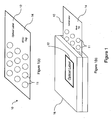
- Figures 1 (a) and 1 (b) represent two ways in which a pharmaceutical product may be packaged and labelled.
- a "blister-pack" 10 of pills 11 is shown having attached thereto an optical label 12, which may be a barcode, a 2-D code, a matrix-code, or a label with an item identification number printed thereon for example, and an RFID tag 14.
- an optical label 12 is printed on an outer packet 16 associated with the blister-pack 10.
- the optical label 12 is also shown printed on the blister-pack 10, but Fig.
- FIG. 1(b) illustrates the point that while an optical label generally needs to be visible to be read, an RFID tag may be readable when located within a pack, or even within an object itself. It will also be noted that neither the optical label nor the RFID tag need to be physically attached to the item in question. Either may be associated in some other manner, as indicated by Fig. 1 (b) .
- FIG. 2 this shows a combined label associated with an item 10, the label having a barcode 12 (serving as an optical item identification component) and an RFID tag 14; a verifier 20, which in this figure is shown as a combined information transfer device having functionality as a barcode reader and an RFID reader; and a trusted third-party database 30.
- a complete "authentication" operation involves the following steps, which are indicated in boxes on Figure 2 , and which correspond to those shown in the flow-chart of Figure 3 :
- authentication of the verifier and secure communication between the verifier and the trusted third party may take advantage of existing internet security technologies.
- the internal logic of the RFID tag replaces now-used READ password and unique identifier with a new READ password and unique identifier. If subjected again to the previous READ password, by a malicious user who has obtained it by eavesdropping, for example, the RFID tag 14 will not respond.
- This cryptographic scheme is an encoding scheme in which a different cipher text is generated each time the correct READ password is provided to the tag, arranged in such a way that it is difficult or impossible for a malicious party to generate the correct cipher text without knowing a secret contained in the tag.
- the tag initially contains a local secret "S" (a 128-bit number, for example), part of which is used as the READ password "RS" (the first 48 bits, for example).
- RS the READ password
- the local secret "S” is updated.
- the local secret "S” is provided as an input to a hash function H and the memory register in the tag containing "S” is updated to the resulting output "S 1 ".
- the READ password is hence updated to "RS 1 " (i.e. the first 48 bits of "S 1 ").
- the output of the tag is generated by providing secret "S 1 ' as the input to a function G, which may also be a one-way or hash function.
- the output value "O 1 " is transmitted to the reader and it is this value that can be used to verify the authenticity of the product.
- provision of the correct READ password "RS 1 " would result in the local secret being updated to "S 2 ", and the output value "O 2 " being transmitted to the reader.
- the values of the outputs "O", the local secrets “S” and the reading passwords "RS” are different and unlinkable to one another. Since the function is one-way it is not possible (i.e. it is computationally unfeasible) to retrieve the input and the reading password information from the output. The only attack that is realistically possible is tampering with the information of the tag. In this case, an attacker may manage to access the secret within the tag.
- the above scheme provides a property of forward security thanks to the hash chain characteristics (in particular, the one-way property) or similar characteristics of other one-way functions. The information that the tag has emitted at previous steps can still not be replicated. This feature thus provides security of pedigree information.
- the reader can pass the secret to the trusted third party for verification in order to determine if the product is original or not.
- the status of the product may then be returned to the user via the verifier 20 or otherwise. It is important to notice that the trusted third party generally remains synchronized with the tag.
- the trusted third party may be the only entity in the system that has a complete view of the READ password and the output of the tag. It can resolve a request from a reader with a complexity o(1), but we can say that the retrieval processing time is negligible.
- the trusted third party "generally" remains synchronized with the tag. It will be noticed that a possible lack of synchronization can be caused if, for example, a user (honestly or maliciously) carries out a successful READ operation of the tag, thus causing the tag to update the READ password, but does not then complete the authentication procedure by passing the output or unique identifier to the trusted third party. It will be understood, however, that the system could be set up in such a way as to ensure that this would only allow a lack of synchronization of one READ password in the sequence, since subsequent attempts to carry out a complete authentication procedure will fail.
- the tag will be set to operate only when subjected to a READ password one ahead (in the sequence) of that which will be provided by the trusted third party, so the READ attempt will fail, and the tag will not update itself further.
- the system may thus be set up in such a way as to allow re-synchronization or re-setting, via the third party or the tag, without any substantial decrease in the level of security of the system.
- the approach of using an online trusted third party may be regarded in some ways as a disadvantage because it requires users to perform an online "look-up" operation, which may need to be performed each time a product needs to be verified. This also provides possible advantages, however. In the case of some pharmaceuticals and other perishable items, for example, items from a genuine source may become ineffective or even dangerous if they are too old, and should therefore be treated as "invalid" once a predetermined "sell by" date has passed.
- a trusted third party may delegate access to certain items to specific verifier authorities.
- the verifier authorities can then select the appropriate read password to access a tag and verify a tag with an offline operation.
- a method to synchronize the trusted verifier and the trusted third party may still be required, however. This means that if the reader is trusted, a proxy for the authentication service can be operated on the reader for selected tags (i.e. releasing certain secrets to the reader so that it can determine a passcode and verify the tag response).
- an appropriate label with an RFID tag may be applied to each packet or bottle.
- An outer box may also have an appropriate label with an RFID tag, allowing a wholesaler to check that the box is original and contains authorised products. Once the box has been verified and unpacked, each single product may be verified before being put on sale and distributed to retailers. After that, the individual products are distributed to pharmaceutical retailers before being sold to the final users.
- the products may be verified and the pedigree information may be updated. It will be noticed that at each step a verifier may obtain access to the pedigree information of the product and receive an assurance that the product is original.
Landscapes
- Engineering & Computer Science (AREA)
- Physics & Mathematics (AREA)
- Theoretical Computer Science (AREA)
- General Physics & Mathematics (AREA)
- Microelectronics & Electronic Packaging (AREA)
- Computer Hardware Design (AREA)
- Computer Networks & Wireless Communication (AREA)
- Storage Device Security (AREA)
- Warehouses Or Storage Devices (AREA)
- Radar Systems Or Details Thereof (AREA)
- Mobile Radio Communication Systems (AREA)
- Geophysics And Detection Of Objects (AREA)
- Near-Field Transmission Systems (AREA)
Claims (29)
- Procédé permettant d'obtenir, à partir d'une source (30) d'information sur un article, des informations concernant un article (10), ledit article étant associé à un moyen d'identification d'article (12) fournissant de l'information d'identification d'article ainsi qu'un moyen de réponse RFID (14) agencé pour fournir une réponse prédéterminée après avoir été soumis à un signal de déclenchement actuellement applicable ; ledit procédé comprenant les étapes consistant à:établir, à partir dudit moyen d'identification d'article (12), de l'information d'identification d'article ;utiliser ladite information d'identification d'article pour déterminer, à partir de ladite source (30) d'information d'article, un signal de déclenchement actuellement applicable pour ledit moyen de réponse RFID (14) ;soumettre ledit moyen de réponse RFID audit signal de déclenchement actuellement applicable ;recevoir une réponse prédéterminée à partir dudit moyen de réponse RFID (14) ; etutiliser ladite réponse prédéterminée pour obtenir de l'information d'article à partir de ladite source (30) d'information d'article ;caractérisé en ce que le moyen de réponse RFID (14) est agencé pour engendrer, de façon indépendante, un nouveau signal de déclenchement actuellement applicable ainsi qu'une nouvelle réponse prédéterminée qui y est associée, après avoir soumis ledit moyen de réponse RFID (14) audit signal de déclenchement actuellement applicable d'une façon prédéterminée.
- Procédé selon la revendication 1, dans lequel le moyen de réponse RFID (14) ainsi que la source (30) d'information d'article sont chacun agencés pour engendrer le nouveau signal de déclenchement actuellement applicable ainsi qu'une réponse prédéterminée qui y est associée.
- Procédé selon la revendication 1 ou 2, dans lequel ladite source (30) d'information d'article comprend au moins une base de données en ligne.
- Procédé selon l'une quelconque des revendications précédentes, dans lequel ladite source (30) d'information d'article comprend une source d'information d'article à accès restreint.
- Procédé selon l'une quelconque des revendications précédentes, dans lequel ladite source (30) d'information d'article contient des signaux de déclenchement à accès restreint.
- Procédé selon l'une quelconque des revendications précédentes, dans lequel ladite source (30) d'information d'article contient de l'information d'article à accès restreint.
- Procédé selon l'une quelconque des revendications précédentes dans lequel ledit moyen d'identification d'article (12) ainsi que ledit moyen de réponse RFID (14) sont prévus sur une étiquette d'article, associés à un emballage (16) d'article, ou associés à l'article (10) lui-même.
- Procédé selon l'une quelconque des revendications précédentes, dans lequel ledit moyen d'identification d'article (12) fournit de l'information d'identification d'article susceptible d'être observée visuellement.
- Procédé selon l'une quelconque des revendications précédentes, dans lequel ledit moyen d'identification d'article (12) fournit de l'information d'identification d'article susceptible d'être lue électroniquement.
- Procédé selon la revendication 9, dans lequel ladite information d'identification d'article susceptible d'être lue électroniquement est fournie au moyen dudit moyen de réponse RFID (14) ou un deuxième moyen de réponse RFID.
- Procédé selon l'une quelconque des revendications précédentes, dans lequel ledit moyen d'identification d'article (12) fournit ladite information d'identification d'article au moyen d'un code à barres, d'un code bidimensionnel, ou d'un code matriciel.
- Procédé selon l'une quelconque des revendications précédentes, dans lequel ledit moyen de réponse RFID (14) est une étiquette d'identification RFID passive.
- Procédé selon l'une quelconque des revendications précédentes, dans lequel ladite réponse prédéterminée est fournie par ledit moyen de réponse RFID (14) uniquement dans le cas où ledit moyen de réponse RFID (14) est soumis à un signal de déclenchement actuellement applicable.
- Procédé selon l'une quelconque des revendications précédentes, dans lequel ladite étape selon laquelle le moyen de réponse RFID (14) engendre un nouveau signal de déclenchement actuellement applicable comprend la réalisation par le moyen de réponse RFID (14) d'au moins une parmi les opérations suivantes :- la sélection et l'utilisation d'un élément suivant d'une séquence prédéterminée de signaux de déclenchement actuellement applicables ;- l'application d'une fonction à sens unique ou une fonction de hachage prédéterminée au signal de déclenchement actuellement applicable ;- l'application d'une fonction pseudo-aléatoire au signal de déclenchement actuellement applicable.
- Procédé selon l'une quelconque des revendications précédentes, dans lequel ladite étape selon laquelle ledit moyen de réponse RFID (14) engendre une nouvelle réponse prédéterminée comprend la réalisation par le moyen de réponse RFID (14) d'au moins une parmi les opérations suivantes :- la sélection et l'utilisation d'un élément suivant d'une séquence prédéterminée de réponses prédéterminées ;- l'application d'une fonction à sens unique ou une fonction de hachage prédéterminée à une réponse existante prédéterminée ;- l'application d'une fonction pseudo-aléatoire à une réponse existante prédéterminée.
- Dispositif permettant à un utilisateur d'obtenir, à partir d'une source (30) d'information d'article, de l'information d'article concernant un article (10), ledit dispositif comprenant un moyen d'identification d'article (12) pour fournir de l'information d'identification d'article, ainsi qu'un moyen de réponse RFID (14), dans lequel :ledit moyen d'identification d'article (12) comprend des moyens à partir desquels peut être établie de l'information d'identification d'article en fonction de laquelle puisse être déterminé un signal de déclenchement actuellement applicable pour ledit moyen de réponse RFID (14) à partir de ladite source d'information d'article (30) ; etledit moyen de réponse RFID (14) comprend des moyens agencés pour fournir une réponse prédéterminée après avoir été soumis audit signal de déclenchement actuellement applicable, en fonction de laquelle une réponse prédéterminée d'information d'article leur peut être obtenue à partir de ladite source d'information d'article (30) ;caractérisé en ce que ledit moyen de réponse RFID (14) comprend en outre des moyens agencés pour engendrer, de façon indépendante, un nouveau signal de déclenchement actuellement applicable ainsi qu'une nouvelle réponse qui est associée après que ledit moyen de réponse RFID (14) a été soumis audit signal de déclenchement actuellement applicable d'une façon prédéterminée.
- Dispositif selon la revendication 16, dans lequel ladite source (30) d'information d'article comprend au moins une base de données en ligne.
- Dispositif selon la revendication 16 ou 17, dans lequel ladite source (30) d'information d'article comprend une source d'information d'article à accès restreint.
- Dispositif selon l'une quelconque des revendications 16 à 18, dans lequel ladite source (30) d'information d'article contient des signaux de déclenchement à accès restreint.
- Dispositif selon l'une quelconque des revendications 16 à 19, dans lequel ladite source (30) d'information d'article contient de l'information d'article à accès restreint.
- Dispositif selon l'une quelconque des revendications 16 à 20, dans lequel ledit moyen d'identification d'article (12) ainsi que ledit moyen de réponse RFID (14) sont prévus sur une étiquette d'article, associés à un emballage (16) d'article, ou associés à l'article (10) lui-même.
- Dispositif selon l'une quelconque des revendications 16 à 21, dans lequel ledit moyen d'identification d'article (12) fournit de l'information d'identification d'article susceptible d'être observée visuellement.
- Dispositif selon l'une quelconque des revendications 16 à 22, dans lequel ledit moyen d'identification d'article (12) fournit de l'information d'identification d'article susceptible d'être lue électroniquement.
- Procédé selon la revendication 23, dans lequel ladite information d'identification d'article susceptible d'être lue électroniquement est fournie au moyen dudit moyen de réponse RFID (14) ou d'un deuxième moyen de réponse RFID.
- Dispositif selon l'une quelconque des revendications 16 à 24, dans lequel ledit moyen d'identification d'article (12) comprend un code à barres, un code bidimensionnel, ou un code matriciel.
- Dispositif selon l'une quelconque des revendications 16 à 25, dans lequel ledit moyen de réponse RFID (14) est une étiquette d'identification RFID passive.
- Dispositif selon l'une quelconque des revendications 16 à 26, dans lequel ledit moyen de réponse RFID (14) est agencé pour fournir ladite réponse prédéterminée uniquement dans le cas où ledit moyen de réponse RFID (14) est soumis à un signal de déclenchement actuellement applicable.
- Dispositif selon l'une quelconque des revendications 16 à 27, dans lequel ledit moyen de réponse RFID (14) comprend des moyens agencés pour réaliser au moins une parmi les opérations suivantes :- la sélection et l'utilisation d'un élément suivant d'une séquence prédéterminée de signaux de déclenchement actuellement applicables ;- l'application d'une fonction à sens unique ou une fonction de hachage prédéterminée au signal de déclenchement actuellement applicable ;- l'application d'une fonction pseudo-aléatoire au signal de déclenchement actuellement applicable.
- Dispositif selon l'une quelconque des revendications 16 à 28, dans lequel ledit moyen de réponse RFID (14) comprend des moyens agencés pour réaliser au moins une parmi les opérations suivantes :- la sélection et l'utilisation d'un élément suivant d'une séquence prédéterminée de réponses prédéterminées ;- l'application d'une fonction à sens unique ou une fonction de hachage prédéterminée à une réponse existante prédéterminée ;- l'application d'une fonction pseudo-aléatoire à une réponse existante prédéterminée.
Priority Applications (1)
| Application Number | Priority Date | Filing Date | Title |
|---|---|---|---|
| EP07712888A EP2002382B1 (fr) | 2006-03-31 | 2007-03-12 | Procédé et dispositif d'obtention d'informations d'article à l'aide d'étiquettes rfid |
Applications Claiming Priority (3)
| Application Number | Priority Date | Filing Date | Title |
|---|---|---|---|
| EP06251855 | 2006-03-31 | ||
| EP07712888A EP2002382B1 (fr) | 2006-03-31 | 2007-03-12 | Procédé et dispositif d'obtention d'informations d'article à l'aide d'étiquettes rfid |
| PCT/GB2007/000851 WO2007113464A1 (fr) | 2006-03-31 | 2007-03-12 | Procédé et dispositif d'obtention d'informations d'article à l'aide d'étiquettes rfid |
Publications (2)
| Publication Number | Publication Date |
|---|---|
| EP2002382A1 EP2002382A1 (fr) | 2008-12-17 |
| EP2002382B1 true EP2002382B1 (fr) | 2010-08-25 |
Family
ID=36922158
Family Applications (1)
| Application Number | Title | Priority Date | Filing Date |
|---|---|---|---|
| EP07712888A Active EP2002382B1 (fr) | 2006-03-31 | 2007-03-12 | Procédé et dispositif d'obtention d'informations d'article à l'aide d'étiquettes rfid |
Country Status (9)
| Country | Link |
|---|---|
| US (1) | US8791794B2 (fr) |
| EP (1) | EP2002382B1 (fr) |
| JP (1) | JP5139415B2 (fr) |
| KR (1) | KR101276902B1 (fr) |
| CN (1) | CN101410853B (fr) |
| AT (1) | ATE479163T1 (fr) |
| CA (1) | CA2644320A1 (fr) |
| DE (1) | DE602007008702D1 (fr) |
| WO (1) | WO2007113464A1 (fr) |
Families Citing this family (45)
| Publication number | Priority date | Publication date | Assignee | Title |
|---|---|---|---|---|
| US7162035B1 (en) | 2000-05-24 | 2007-01-09 | Tracer Detection Technology Corp. | Authentication method and system |
| US8171567B1 (en) | 2002-09-04 | 2012-05-01 | Tracer Detection Technology Corp. | Authentication method and system |
| US8820639B2 (en) * | 2006-11-03 | 2014-09-02 | Assa Abloy Ab | Security feature RFID card |
| US7995196B1 (en) | 2008-04-23 | 2011-08-09 | Tracer Detection Technology Corp. | Authentication method and system |
| FR2933216B1 (fr) * | 2008-06-27 | 2012-12-21 | Nicolas Reffe | Procede et systeme de validation d'une succession d'evenements vecus par un dispositif |
| US8607057B2 (en) * | 2009-05-15 | 2013-12-10 | Microsoft Corporation | Secure outsourced aggregation with one-way chains |
| DE102009022233A1 (de) * | 2009-05-20 | 2010-11-25 | Feustel, Dietmar | Verwendung einer Zeichenkette in Sytemen der Kryptographie, der Statistik, der Simulation, der Randomisierung, von Spielautomaten und dgl. |
| WO2011153419A2 (fr) | 2010-06-03 | 2011-12-08 | Midtronics, Inc. | Maintenance de bloc-batterie d'accumulateurs pour véhicule électrique |
| US11740294B2 (en) | 2010-06-03 | 2023-08-29 | Midtronics, Inc. | High use battery pack maintenance |
| US10046649B2 (en) | 2012-06-28 | 2018-08-14 | Midtronics, Inc. | Hybrid and electric vehicle battery pack maintenance device |
| CA2726748A1 (fr) * | 2010-12-16 | 2012-06-16 | Evgeny Lishak | Methode permettant de fournir l'assurance de la marque et l'authentcite de l 'article en utilisant l'infrastructure de l'industrie de la carte de paiement |
| DK2715616T3 (en) * | 2011-05-31 | 2015-01-19 | Copy Stop Systems Aps | Communication device verification system and security communication device |
| TW201234294A (en) * | 2011-07-22 | 2012-08-16 | Yue Jie Technology Co Ltd | Product counterfeit-proof system |
| US9747600B2 (en) * | 2012-03-30 | 2017-08-29 | United State Poastal Service | Item status tracking |
| CN104145278B (zh) * | 2012-05-07 | 2017-12-12 | 北京谱福溯码信息技术开发有限公司 | 正品认证用标签、该标签的认证代码生成方法、该标签的认证方法及系统、用于认证该标签的便携终端及用于该标签的认证的计算机可读性记录介质 |
| US11325479B2 (en) | 2012-06-28 | 2022-05-10 | Midtronics, Inc. | Hybrid and electric vehicle battery maintenance device |
| US9659177B1 (en) * | 2012-09-24 | 2017-05-23 | EMC IP Holding Company LLC | Authentication token with controlled release of authentication information based on client attestation |
| US10843574B2 (en) * | 2013-12-12 | 2020-11-24 | Midtronics, Inc. | Calibration and programming of in-vehicle battery sensors |
| US20150195274A1 (en) * | 2014-01-06 | 2015-07-09 | Semisysco Co., Ltd. | System and method of certificating a genuine article |
| CH709353A2 (fr) * | 2014-03-12 | 2015-09-15 | Eric Bauer | Procédé de contrôle de l'authenticité d'un objet. |
| CN103996059A (zh) * | 2014-05-27 | 2014-08-20 | 翟冬青 | 一种用于物品标签的信息化系统和方法 |
| US20150347712A1 (en) * | 2014-05-27 | 2015-12-03 | Amerisourcebergen Specialty Group, Inc. | System and method for product distribution and tracking |
| CN104261032B (zh) * | 2014-08-04 | 2016-09-14 | 珠海格力电器股份有限公司 | 全自动扫描码垛装置及方法 |
| CN107851260A (zh) * | 2015-03-06 | 2018-03-27 | 斯泰瓦纳托集团股份有限公司 | 向目标人群选择性提供信息的方法和系统 |
| JP2017059970A (ja) * | 2015-09-16 | 2017-03-23 | 株式会社サードプラステクノロジー | 真贋判定システム及びサーバ |
| CA3017354C (fr) * | 2016-03-11 | 2025-05-13 | Tracktech Solutions Corp. | Emballage de produit antidétournement et anticontrefaçon |
| WO2018011536A1 (fr) * | 2016-07-13 | 2018-01-18 | Botosoft Technologies Ltd | Système d'authentification de documents |
| CN106529895A (zh) * | 2016-09-23 | 2017-03-22 | 中国农业科学院农业信息研究所 | 基于二维码的科技项目信息管理方法 |
| US12056691B2 (en) * | 2016-09-30 | 2024-08-06 | Cable Television Laboratories, Inc. | Systems and methods for securely tracking consumable goods using a distributed ledger |
| US11054480B2 (en) | 2016-10-25 | 2021-07-06 | Midtronics, Inc. | Electrical load for electronic battery tester and electronic battery tester including such electrical load |
| US12320857B2 (en) | 2016-10-25 | 2025-06-03 | Midtronics, Inc. | Electrical load for electronic battery tester and electronic battery tester including such electrical load |
| JP2018129103A (ja) * | 2017-02-06 | 2018-08-16 | 富士フイルム株式会社 | 記録システム及び記録方法 |
| US11213773B2 (en) | 2017-03-06 | 2022-01-04 | Cummins Filtration Ip, Inc. | Genuine filter recognition with filter monitoring system |
| US11513160B2 (en) | 2018-11-29 | 2022-11-29 | Midtronics, Inc. | Vehicle battery maintenance device |
| US11566972B2 (en) | 2019-07-31 | 2023-01-31 | Midtronics, Inc. | Tire tread gauge using visual indicator |
| US11545839B2 (en) | 2019-11-05 | 2023-01-03 | Midtronics, Inc. | System for charging a series of connected batteries |
| US11668779B2 (en) | 2019-11-11 | 2023-06-06 | Midtronics, Inc. | Hybrid and electric vehicle battery pack maintenance device |
| US11474153B2 (en) | 2019-11-12 | 2022-10-18 | Midtronics, Inc. | Battery pack maintenance system |
| DE102020216599A1 (de) | 2019-12-31 | 2021-07-01 | Midtronics, Inc. | Intelligente Modulschnittstelle für eine Batteriewartungsvorrichtung |
| US11973202B2 (en) | 2019-12-31 | 2024-04-30 | Midtronics, Inc. | Intelligent module interface for battery maintenance device |
| US11486930B2 (en) | 2020-01-23 | 2022-11-01 | Midtronics, Inc. | Electronic battery tester with battery clamp storage holsters |
| US12517178B2 (en) | 2021-05-27 | 2026-01-06 | Midtronics, Inc. | Battery monitoring system |
| US12555965B2 (en) | 2021-08-24 | 2026-02-17 | Midtronics, Inc. | Power adapter for automotive vehicle maintenance device |
| US12330513B2 (en) | 2022-02-14 | 2025-06-17 | Midtronics, Inc. | Battery maintenance device with high voltage connector |
| US12392833B2 (en) | 2022-05-09 | 2025-08-19 | Midtronics, Inc. | Electronic battery tester |
Family Cites Families (37)
| Publication number | Priority date | Publication date | Assignee | Title |
|---|---|---|---|---|
| BR9509046A (pt) * | 1994-09-27 | 1998-07-14 | Novo Nordisk As | Processo para oxidar um composto com uma enzima oxidante de fenol e aditivo e composição detergente |
| US6130623A (en) * | 1996-12-31 | 2000-10-10 | Lucent Technologies Inc. | Encryption for modulated backscatter systems |
| GB9724183D0 (en) * | 1997-11-14 | 1998-01-14 | British Tech Group | Identification system |
| CN1293507C (zh) * | 1998-08-14 | 2007-01-03 | 3M创新有限公司 | 射频识别系统的应用 |
| JP2000339420A (ja) * | 1999-05-26 | 2000-12-08 | Matsushita Electric Works Ltd | Id情報非接触通信システム |
| US7204652B2 (en) * | 1999-06-16 | 2007-04-17 | Vanguard Identification Systems, Inc. | Printed planar radio frequency identification elements |
| US6994262B1 (en) * | 1999-06-16 | 2006-02-07 | Vanguard Identification Systems, Inc. | Printed sheet products with integral, removable, radio frequency identification elements |
| KR20010068679A (ko) * | 2000-01-07 | 2001-07-23 | 박상관 | 고주파 방식의 보안용 전자 인식표 및 전자 인식표와고주파 신호로 데이터를 송수신하여 외부장치의접근여부를 결정하는 방법 |
| CA2399092A1 (fr) * | 2000-02-04 | 2001-08-09 | 3M Innovative Properties Company | Procede d'authentification d'une etiquette |
| JP4536876B2 (ja) * | 2000-06-13 | 2010-09-01 | 株式会社カイ | 偽造商品流通防止システム |
| EP1339015A1 (fr) * | 2002-02-20 | 2003-08-27 | Carolyn Marie Winter | Système de localisation d'étiquettes d'identification radiofréquence |
| JP4434549B2 (ja) * | 2002-03-07 | 2010-03-17 | 株式会社日立製作所 | 管理装置および管理方法 |
| US6747560B2 (en) * | 2002-06-27 | 2004-06-08 | Ncr Corporation | System and method of detecting movement of an item |
| US7071043B2 (en) * | 2002-08-15 | 2006-07-04 | Micron Technology, Inc. | Methods of forming a field effect transistor having source/drain material over insulative material |
| US7650364B2 (en) * | 2002-10-09 | 2010-01-19 | Hewlett-Packard Development Company, L.P. | Portable database system |
| JP2004246887A (ja) * | 2003-01-24 | 2004-09-02 | Sougoushouken Inc | 商品識別システム |
| CN1751326A (zh) * | 2003-01-29 | 2006-03-22 | 诺基亚有限公司 | 外盖中有射频识别模块的电子装置 |
| US7606557B2 (en) * | 2003-04-01 | 2009-10-20 | Mi Kyoung Park | Mobile communication terminal having a function of reading out information from contactless type communication tag and method for providing information of whether an article is genuine or not |
| KR100497630B1 (ko) * | 2003-05-01 | 2005-07-07 | (주)브랜드인칩 | 제품의 진품 여부를 확인하기 위한 휴대형 알에프 태그판독기 |
| CA2503407A1 (fr) * | 2003-08-29 | 2005-03-10 | Symbol Technologies, Inc. | Systeme d'identification par radio-frequence avec parametres selectionnables de retrodiffusion |
| JP3909848B2 (ja) * | 2003-09-19 | 2007-04-25 | 本田技研工業株式会社 | 製品ライフサイクル情報管理システム |
| US7026935B2 (en) * | 2003-11-10 | 2006-04-11 | Impinj, Inc. | Method and apparatus to configure an RFID system to be adaptable to a plurality of environmental conditions |
| US7176784B2 (en) * | 2004-01-21 | 2007-02-13 | Battelle Memorial Institute K1-53 | Multi-mode radio frequency device |
| KR100603203B1 (ko) * | 2004-05-25 | 2006-07-24 | 삼성전자주식회사 | 무선인식 기능을 가진 화상형성장치와 화상형성장치의사용방법 |
| JP4445331B2 (ja) * | 2004-05-27 | 2010-04-07 | 日本電信電話株式会社 | データベース装置、システム及びプログラム |
| US7118036B1 (en) * | 2004-06-22 | 2006-10-10 | Ncr Corporation | Mobile inventory management system |
| US7284704B2 (en) * | 2004-06-28 | 2007-10-23 | International Barcode Corporation | Combined electromagnetic and optical communication system |
| JP2006065538A (ja) | 2004-08-26 | 2006-03-09 | Fujitsu Ltd | 無線タグシステム、無線タグアクセス制御装置、無線タグアクセス制御方法、無線タグアクセス制御プログラム、及び無線タグ |
| US20060158308A1 (en) * | 2005-01-06 | 2006-07-20 | Mcmullen Benjamin C A | System and method for automatically generating, collecting, monitoring and acting on information in an institutional setting |
| US7591422B2 (en) * | 2005-02-10 | 2009-09-22 | Sensormatic Electronic Corporation | Techniques to reduce false alarms, invalid security deactivation, and internal theft |
| JP4490321B2 (ja) * | 2005-04-06 | 2010-06-23 | ローム株式会社 | サーマルプリントヘッド、およびこれを用いた無線通信機能付プリンタ |
| KR100739709B1 (ko) * | 2005-06-10 | 2007-07-13 | 삼성전자주식회사 | Rfid 태그의 정보를 이용하여 데이터를 출력하는 방법및 장치 |
| US7275690B1 (en) * | 2005-07-01 | 2007-10-02 | Ncr Corporation | System and method of determining unprocessed items |
| AU2006274486B2 (en) * | 2005-07-25 | 2009-09-17 | Silverbrook Research Pty Ltd | Product item having coded data identifying a layout |
| JP4289338B2 (ja) * | 2005-09-29 | 2009-07-01 | 沖電気工業株式会社 | Rfidタグ通信システム、rfidタグ及び誘導アンテナ装置 |
| US20070141997A1 (en) * | 2005-12-15 | 2007-06-21 | Symbol Technologies, Inc. | Radio frequency identification (RFID) antenna integration techniques in mobile devices |
| US7970357B2 (en) * | 2007-07-30 | 2011-06-28 | Bae Systems Information And Electronic Systems Integration Inc. | Transponder with stabilized oscillator |
-
2007
- 2007-03-12 EP EP07712888A patent/EP2002382B1/fr active Active
- 2007-03-12 CN CN2007800109036A patent/CN101410853B/zh active Active
- 2007-03-12 DE DE602007008702T patent/DE602007008702D1/de active Active
- 2007-03-12 CA CA002644320A patent/CA2644320A1/fr not_active Abandoned
- 2007-03-12 KR KR1020087022405A patent/KR101276902B1/ko active Active
- 2007-03-12 AT AT07712888T patent/ATE479163T1/de not_active IP Right Cessation
- 2007-03-12 WO PCT/GB2007/000851 patent/WO2007113464A1/fr not_active Ceased
- 2007-03-12 JP JP2009502183A patent/JP5139415B2/ja active Active
- 2007-03-12 US US12/295,057 patent/US8791794B2/en active Active
Also Published As
| Publication number | Publication date |
|---|---|
| CA2644320A1 (fr) | 2007-10-11 |
| KR101276902B1 (ko) | 2013-06-19 |
| EP2002382A1 (fr) | 2008-12-17 |
| KR20080108241A (ko) | 2008-12-12 |
| ATE479163T1 (de) | 2010-09-15 |
| DE602007008702D1 (de) | 2010-10-07 |
| US20090273451A1 (en) | 2009-11-05 |
| JP2009531251A (ja) | 2009-09-03 |
| CN101410853B (zh) | 2011-07-20 |
| WO2007113464A1 (fr) | 2007-10-11 |
| CN101410853A (zh) | 2009-04-15 |
| JP5139415B2 (ja) | 2013-02-06 |
| US8791794B2 (en) | 2014-07-29 |
Similar Documents
| Publication | Publication Date | Title |
|---|---|---|
| EP2002382B1 (fr) | Procédé et dispositif d'obtention d'informations d'article à l'aide d'étiquettes rfid | |
| EP2100263B1 (fr) | Contrôle de l'accès à des données vers et à partir d'un dispositif rfid | |
| CN100375111C (zh) | 一种基于射频识别技术的防伪验证方法及防伪系统 | |
| Juels | Strengthening EPC tags against cloning | |
| US8917159B2 (en) | Fully secure item-level tagging | |
| US8421593B2 (en) | Apparatus, systems and methods for authentication of objects having multiple components | |
| KR100969730B1 (ko) | 무선 주파수 식별 시스템 및 방법과, 복수의 무선 주파수식별 태그를 포함한 멀티코어 태그 | |
| CN102831529B (zh) | 一种基于射频的商品信息识别方法及系统 | |
| US20080001752A1 (en) | System and method for securing rfid tags | |
| WO2017116303A1 (fr) | Méthodologie et système d'authentification de produit propre à décourager la contrefaçon bimode sécurisée | |
| KR100512064B1 (ko) | 제품의 진품 여부를 확인하기 위한 비접촉식 통신 태그 및 휴대형 태그 판독기 | |
| CN110310130A (zh) | 一种防伪方法及系统 | |
| US20090040023A1 (en) | RF Transponder for Off-Line Authentication of a Source of a Product Carrying the Transponder | |
| CN115511019A (zh) | 绑定rfid标签和物品条码的防伪验证方法 | |
| Lehtonen et al. | Features, identity, tracing, and cryptography in product authentication | |
| CN114565393B (zh) | 一种基于区块链技术的全产业链产品溯源认证方法及系统 | |
| US20250133067A1 (en) | Product Authentication and Theft Detection System and Method using Encrypted Radio Frequency Devices | |
| Tan et al. | A robust and secure RFID-based pedigree system (short paper) | |
| RU2814089C2 (ru) | Способы и системы для автоматического распознавания объектов и проверки подлинности | |
| Balinsky et al. | Anti-counterfeiting using memory spots | |
| Soppera et al. | RFID Security and Privacy—Issues, Standards, and Solutions | |
| Choi et al. | An RFID-based Track-and-trace Anti-counterfeiting System. | |
| Smith et al. | Analogue fingerprinting for passive RFID tags | |
| HK1106313A1 (en) | Radio frequency identification system and method | |
| HK1106313B (en) | Radio frequency identification system and method |
Legal Events
| Date | Code | Title | Description |
|---|---|---|---|
| PUAI | Public reference made under article 153(3) epc to a published international application that has entered the european phase |
Free format text: ORIGINAL CODE: 0009012 |
|
| 17P | Request for examination filed |
Effective date: 20080825 |
|
| AK | Designated contracting states |
Kind code of ref document: A1 Designated state(s): AT BE BG CH CY CZ DE DK EE ES FI FR GB GR HU IE IS IT LI LT LU LV MC MT NL PL PT RO SE SI SK TR |
|
| 17Q | First examination report despatched |
Effective date: 20090204 |
|
| GRAP | Despatch of communication of intention to grant a patent |
Free format text: ORIGINAL CODE: EPIDOSNIGR1 |
|
| DAX | Request for extension of the european patent (deleted) | ||
| GRAS | Grant fee paid |
Free format text: ORIGINAL CODE: EPIDOSNIGR3 |
|
| GRAA | (expected) grant |
Free format text: ORIGINAL CODE: 0009210 |
|
| AK | Designated contracting states |
Kind code of ref document: B1 Designated state(s): AT BE BG CH CY CZ DE DK EE ES FI FR GB GR HU IE IS IT LI LT LU LV MC MT NL PL PT RO SE SI SK TR |
|
| REG | Reference to a national code |
Ref country code: GB Ref legal event code: FG4D |
|
| REG | Reference to a national code |
Ref country code: CH Ref legal event code: EP |
|
| REG | Reference to a national code |
Ref country code: IE Ref legal event code: FG4D |
|
| REF | Corresponds to: |
Ref document number: 602007008702 Country of ref document: DE Date of ref document: 20101007 Kind code of ref document: P |
|
| REG | Reference to a national code |
Ref country code: NL Ref legal event code: VDEP Effective date: 20100825 |
|
| LTIE | Lt: invalidation of european patent or patent extension |
Effective date: 20100825 |
|
| PG25 | Lapsed in a contracting state [announced via postgrant information from national office to epo] |
Ref country code: LT Free format text: LAPSE BECAUSE OF FAILURE TO SUBMIT A TRANSLATION OF THE DESCRIPTION OR TO PAY THE FEE WITHIN THE PRESCRIBED TIME-LIMIT Effective date: 20100825 Ref country code: AT Free format text: LAPSE BECAUSE OF FAILURE TO SUBMIT A TRANSLATION OF THE DESCRIPTION OR TO PAY THE FEE WITHIN THE PRESCRIBED TIME-LIMIT Effective date: 20100825 Ref country code: FI Free format text: LAPSE BECAUSE OF FAILURE TO SUBMIT A TRANSLATION OF THE DESCRIPTION OR TO PAY THE FEE WITHIN THE PRESCRIBED TIME-LIMIT Effective date: 20100825 |
|
| PG25 | Lapsed in a contracting state [announced via postgrant information from national office to epo] |
Ref country code: IS Free format text: LAPSE BECAUSE OF FAILURE TO SUBMIT A TRANSLATION OF THE DESCRIPTION OR TO PAY THE FEE WITHIN THE PRESCRIBED TIME-LIMIT Effective date: 20101225 Ref country code: PL Free format text: LAPSE BECAUSE OF FAILURE TO SUBMIT A TRANSLATION OF THE DESCRIPTION OR TO PAY THE FEE WITHIN THE PRESCRIBED TIME-LIMIT Effective date: 20100825 Ref country code: PT Free format text: LAPSE BECAUSE OF FAILURE TO SUBMIT A TRANSLATION OF THE DESCRIPTION OR TO PAY THE FEE WITHIN THE PRESCRIBED TIME-LIMIT Effective date: 20101227 Ref country code: SI Free format text: LAPSE BECAUSE OF FAILURE TO SUBMIT A TRANSLATION OF THE DESCRIPTION OR TO PAY THE FEE WITHIN THE PRESCRIBED TIME-LIMIT Effective date: 20100825 Ref country code: BG Free format text: LAPSE BECAUSE OF FAILURE TO SUBMIT A TRANSLATION OF THE DESCRIPTION OR TO PAY THE FEE WITHIN THE PRESCRIBED TIME-LIMIT Effective date: 20101125 Ref country code: CY Free format text: LAPSE BECAUSE OF FAILURE TO SUBMIT A TRANSLATION OF THE DESCRIPTION OR TO PAY THE FEE WITHIN THE PRESCRIBED TIME-LIMIT Effective date: 20100825 |
|
| PG25 | Lapsed in a contracting state [announced via postgrant information from national office to epo] |
Ref country code: SE Free format text: LAPSE BECAUSE OF FAILURE TO SUBMIT A TRANSLATION OF THE DESCRIPTION OR TO PAY THE FEE WITHIN THE PRESCRIBED TIME-LIMIT Effective date: 20100825 Ref country code: LV Free format text: LAPSE BECAUSE OF FAILURE TO SUBMIT A TRANSLATION OF THE DESCRIPTION OR TO PAY THE FEE WITHIN THE PRESCRIBED TIME-LIMIT Effective date: 20100825 Ref country code: GR Free format text: LAPSE BECAUSE OF FAILURE TO SUBMIT A TRANSLATION OF THE DESCRIPTION OR TO PAY THE FEE WITHIN THE PRESCRIBED TIME-LIMIT Effective date: 20101126 Ref country code: NL Free format text: LAPSE BECAUSE OF FAILURE TO SUBMIT A TRANSLATION OF THE DESCRIPTION OR TO PAY THE FEE WITHIN THE PRESCRIBED TIME-LIMIT Effective date: 20100825 Ref country code: BE Free format text: LAPSE BECAUSE OF FAILURE TO SUBMIT A TRANSLATION OF THE DESCRIPTION OR TO PAY THE FEE WITHIN THE PRESCRIBED TIME-LIMIT Effective date: 20100825 |
|
| PG25 | Lapsed in a contracting state [announced via postgrant information from national office to epo] |
Ref country code: DK Free format text: LAPSE BECAUSE OF FAILURE TO SUBMIT A TRANSLATION OF THE DESCRIPTION OR TO PAY THE FEE WITHIN THE PRESCRIBED TIME-LIMIT Effective date: 20100825 |
|
| PG25 | Lapsed in a contracting state [announced via postgrant information from national office to epo] |
Ref country code: CZ Free format text: LAPSE BECAUSE OF FAILURE TO SUBMIT A TRANSLATION OF THE DESCRIPTION OR TO PAY THE FEE WITHIN THE PRESCRIBED TIME-LIMIT Effective date: 20100825 Ref country code: RO Free format text: LAPSE BECAUSE OF FAILURE TO SUBMIT A TRANSLATION OF THE DESCRIPTION OR TO PAY THE FEE WITHIN THE PRESCRIBED TIME-LIMIT Effective date: 20100825 Ref country code: EE Free format text: LAPSE BECAUSE OF FAILURE TO SUBMIT A TRANSLATION OF THE DESCRIPTION OR TO PAY THE FEE WITHIN THE PRESCRIBED TIME-LIMIT Effective date: 20100825 Ref country code: IT Free format text: LAPSE BECAUSE OF FAILURE TO SUBMIT A TRANSLATION OF THE DESCRIPTION OR TO PAY THE FEE WITHIN THE PRESCRIBED TIME-LIMIT Effective date: 20100825 Ref country code: SK Free format text: LAPSE BECAUSE OF FAILURE TO SUBMIT A TRANSLATION OF THE DESCRIPTION OR TO PAY THE FEE WITHIN THE PRESCRIBED TIME-LIMIT Effective date: 20100825 |
|
| PG25 | Lapsed in a contracting state [announced via postgrant information from national office to epo] |
Ref country code: ES Free format text: LAPSE BECAUSE OF FAILURE TO SUBMIT A TRANSLATION OF THE DESCRIPTION OR TO PAY THE FEE WITHIN THE PRESCRIBED TIME-LIMIT Effective date: 20101206 |
|
| PLBE | No opposition filed within time limit |
Free format text: ORIGINAL CODE: 0009261 |
|
| STAA | Information on the status of an ep patent application or granted ep patent |
Free format text: STATUS: NO OPPOSITION FILED WITHIN TIME LIMIT |
|
| 26N | No opposition filed |
Effective date: 20110526 |
|
| REG | Reference to a national code |
Ref country code: DE Ref legal event code: R097 Ref document number: 602007008702 Country of ref document: DE Effective date: 20110526 |
|
| PG25 | Lapsed in a contracting state [announced via postgrant information from national office to epo] |
Ref country code: MC Free format text: LAPSE BECAUSE OF NON-PAYMENT OF DUE FEES Effective date: 20110331 |
|
| REG | Reference to a national code |
Ref country code: CH Ref legal event code: PL |
|
| PG25 | Lapsed in a contracting state [announced via postgrant information from national office to epo] |
Ref country code: MT Free format text: LAPSE BECAUSE OF FAILURE TO SUBMIT A TRANSLATION OF THE DESCRIPTION OR TO PAY THE FEE WITHIN THE PRESCRIBED TIME-LIMIT Effective date: 20100825 |
|
| REG | Reference to a national code |
Ref country code: IE Ref legal event code: MM4A |
|
| PG25 | Lapsed in a contracting state [announced via postgrant information from national office to epo] |
Ref country code: IE Free format text: LAPSE BECAUSE OF NON-PAYMENT OF DUE FEES Effective date: 20110312 Ref country code: CH Free format text: LAPSE BECAUSE OF NON-PAYMENT OF DUE FEES Effective date: 20110331 Ref country code: LI Free format text: LAPSE BECAUSE OF NON-PAYMENT OF DUE FEES Effective date: 20110331 |
|
| PG25 | Lapsed in a contracting state [announced via postgrant information from national office to epo] |
Ref country code: LU Free format text: LAPSE BECAUSE OF NON-PAYMENT OF DUE FEES Effective date: 20110312 |
|
| PG25 | Lapsed in a contracting state [announced via postgrant information from national office to epo] |
Ref country code: TR Free format text: LAPSE BECAUSE OF FAILURE TO SUBMIT A TRANSLATION OF THE DESCRIPTION OR TO PAY THE FEE WITHIN THE PRESCRIBED TIME-LIMIT Effective date: 20100825 |
|
| PG25 | Lapsed in a contracting state [announced via postgrant information from national office to epo] |
Ref country code: HU Free format text: LAPSE BECAUSE OF FAILURE TO SUBMIT A TRANSLATION OF THE DESCRIPTION OR TO PAY THE FEE WITHIN THE PRESCRIBED TIME-LIMIT Effective date: 20100825 |
|
| REG | Reference to a national code |
Ref country code: FR Ref legal event code: PLFP Year of fee payment: 10 |
|
| REG | Reference to a national code |
Ref country code: FR Ref legal event code: PLFP Year of fee payment: 11 |
|
| REG | Reference to a national code |
Ref country code: FR Ref legal event code: PLFP Year of fee payment: 12 |
|
| P01 | Opt-out of the competence of the unified patent court (upc) registered |
Effective date: 20230623 |
|
| PGFP | Annual fee paid to national office [announced via postgrant information from national office to epo] |
Ref country code: GB Payment date: 20260219 Year of fee payment: 20 |
|
| PGFP | Annual fee paid to national office [announced via postgrant information from national office to epo] |
Ref country code: DE Payment date: 20260219 Year of fee payment: 20 |
|
| PGFP | Annual fee paid to national office [announced via postgrant information from national office to epo] |
Ref country code: FR Payment date: 20260219 Year of fee payment: 20 |