EP2003132A1 - Hetero compound - Google Patents
Hetero compound Download PDFInfo
- Publication number
- EP2003132A1 EP2003132A1 EP07740850A EP07740850A EP2003132A1 EP 2003132 A1 EP2003132 A1 EP 2003132A1 EP 07740850 A EP07740850 A EP 07740850A EP 07740850 A EP07740850 A EP 07740850A EP 2003132 A1 EP2003132 A1 EP 2003132A1
- Authority
- EP
- European Patent Office
- Prior art keywords
- oxadiazol
- phenyl
- trifluoro
- methylethoxy
- alkyl
- Prior art date
- Legal status (The legal status is an assumption and is not a legal conclusion. Google has not performed a legal analysis and makes no representation as to the accuracy of the status listed.)
- Granted
Links
- 0 Cc1cc(*)c(C)cc1 Chemical compound Cc1cc(*)c(C)cc1 0.000 description 33
- UBYUOVLTUMBIRL-NUDFZHEQSA-O CCC(C)O/C(/c1ccc(C(C)C2CCCCC2)c(C(F)(F)F)c1)=[NH+]\C(C)c1ccc2[nH]cnc2c1 Chemical compound CCC(C)O/C(/c1ccc(C(C)C2CCCCC2)c(C(F)(F)F)c1)=[NH+]\C(C)c1ccc2[nH]cnc2c1 UBYUOVLTUMBIRL-NUDFZHEQSA-O 0.000 description 1
- IOCKQIIBRAIRIS-UHFFFAOYSA-N CCCS(CCC(Nc(ccc(C#N)c1)c1[N+]([O-])=O)=O)=C Chemical compound CCCS(CCC(Nc(ccc(C#N)c1)c1[N+]([O-])=O)=O)=C IOCKQIIBRAIRIS-UHFFFAOYSA-N 0.000 description 1
- XGDBAFFLDQBHBJ-UHFFFAOYSA-O CCc1c(-c2c(cc[n]3CC(N)=O)c3ccc2)nc(-c(cc2[ClH+])ccc2OCC(F)(F)F)[o]1 Chemical compound CCc1c(-c2c(cc[n]3CC(N)=O)c3ccc2)nc(-c(cc2[ClH+])ccc2OCC(F)(F)F)[o]1 XGDBAFFLDQBHBJ-UHFFFAOYSA-O 0.000 description 1
- WZNXVNXXBCEADB-ZCFIWIBFSA-N C[C@H](C(F)(F)F)Oc(ccc(C(O)=O)c1)c1OC Chemical compound C[C@H](C(F)(F)F)Oc(ccc(C(O)=O)c1)c1OC WZNXVNXXBCEADB-ZCFIWIBFSA-N 0.000 description 1
Classifications
-
- C—CHEMISTRY; METALLURGY
- C07—ORGANIC CHEMISTRY
- C07D—HETEROCYCLIC COMPOUNDS
- C07D413/00—Heterocyclic compounds containing two or more hetero rings, at least one ring having nitrogen and oxygen atoms as the only ring hetero atoms
- C07D413/02—Heterocyclic compounds containing two or more hetero rings, at least one ring having nitrogen and oxygen atoms as the only ring hetero atoms containing two hetero rings
- C07D413/04—Heterocyclic compounds containing two or more hetero rings, at least one ring having nitrogen and oxygen atoms as the only ring hetero atoms containing two hetero rings directly linked by a ring-member-to-ring-member bond
-
- A—HUMAN NECESSITIES
- A61—MEDICAL OR VETERINARY SCIENCE; HYGIENE
- A61K—PREPARATIONS FOR MEDICAL, DENTAL OR TOILETRY PURPOSES
- A61K31/00—Medicinal preparations containing organic active ingredients
- A61K31/33—Heterocyclic compounds
- A61K31/395—Heterocyclic compounds having nitrogen as a ring hetero atom, e.g. guanethidine or rifamycins
- A61K31/41—Heterocyclic compounds having nitrogen as a ring hetero atom, e.g. guanethidine or rifamycins having five-membered rings with two or more ring hetero atoms, at least one of which being nitrogen, e.g. tetrazole
- A61K31/4245—Oxadiazoles
-
- A—HUMAN NECESSITIES
- A61—MEDICAL OR VETERINARY SCIENCE; HYGIENE
- A61P—SPECIFIC THERAPEUTIC ACTIVITY OF CHEMICAL COMPOUNDS OR MEDICINAL PREPARATIONS
- A61P1/00—Drugs for disorders of the alimentary tract or the digestive system
-
- A—HUMAN NECESSITIES
- A61—MEDICAL OR VETERINARY SCIENCE; HYGIENE
- A61P—SPECIFIC THERAPEUTIC ACTIVITY OF CHEMICAL COMPOUNDS OR MEDICINAL PREPARATIONS
- A61P1/00—Drugs for disorders of the alimentary tract or the digestive system
- A61P1/16—Drugs for disorders of the alimentary tract or the digestive system for liver or gallbladder disorders, e.g. hepatoprotective agents, cholagogues, litholytics
-
- A—HUMAN NECESSITIES
- A61—MEDICAL OR VETERINARY SCIENCE; HYGIENE
- A61P—SPECIFIC THERAPEUTIC ACTIVITY OF CHEMICAL COMPOUNDS OR MEDICINAL PREPARATIONS
- A61P1/00—Drugs for disorders of the alimentary tract or the digestive system
- A61P1/18—Drugs for disorders of the alimentary tract or the digestive system for pancreatic disorders, e.g. pancreatic enzymes
-
- A—HUMAN NECESSITIES
- A61—MEDICAL OR VETERINARY SCIENCE; HYGIENE
- A61P—SPECIFIC THERAPEUTIC ACTIVITY OF CHEMICAL COMPOUNDS OR MEDICINAL PREPARATIONS
- A61P11/00—Drugs for disorders of the respiratory system
- A61P11/06—Antiasthmatics
-
- A—HUMAN NECESSITIES
- A61—MEDICAL OR VETERINARY SCIENCE; HYGIENE
- A61P—SPECIFIC THERAPEUTIC ACTIVITY OF CHEMICAL COMPOUNDS OR MEDICINAL PREPARATIONS
- A61P13/00—Drugs for disorders of the urinary system
- A61P13/12—Drugs for disorders of the urinary system of the kidneys
-
- A—HUMAN NECESSITIES
- A61—MEDICAL OR VETERINARY SCIENCE; HYGIENE
- A61P—SPECIFIC THERAPEUTIC ACTIVITY OF CHEMICAL COMPOUNDS OR MEDICINAL PREPARATIONS
- A61P17/00—Drugs for dermatological disorders
-
- A—HUMAN NECESSITIES
- A61—MEDICAL OR VETERINARY SCIENCE; HYGIENE
- A61P—SPECIFIC THERAPEUTIC ACTIVITY OF CHEMICAL COMPOUNDS OR MEDICINAL PREPARATIONS
- A61P17/00—Drugs for dermatological disorders
- A61P17/06—Antipsoriatics
-
- A—HUMAN NECESSITIES
- A61—MEDICAL OR VETERINARY SCIENCE; HYGIENE
- A61P—SPECIFIC THERAPEUTIC ACTIVITY OF CHEMICAL COMPOUNDS OR MEDICINAL PREPARATIONS
- A61P19/00—Drugs for skeletal disorders
- A61P19/02—Drugs for skeletal disorders for joint disorders, e.g. arthritis, arthrosis
-
- A—HUMAN NECESSITIES
- A61—MEDICAL OR VETERINARY SCIENCE; HYGIENE
- A61P—SPECIFIC THERAPEUTIC ACTIVITY OF CHEMICAL COMPOUNDS OR MEDICINAL PREPARATIONS
- A61P21/00—Drugs for disorders of the muscular or neuromuscular system
- A61P21/04—Drugs for disorders of the muscular or neuromuscular system for myasthenia gravis
-
- A—HUMAN NECESSITIES
- A61—MEDICAL OR VETERINARY SCIENCE; HYGIENE
- A61P—SPECIFIC THERAPEUTIC ACTIVITY OF CHEMICAL COMPOUNDS OR MEDICINAL PREPARATIONS
- A61P25/00—Drugs for disorders of the nervous system
-
- A—HUMAN NECESSITIES
- A61—MEDICAL OR VETERINARY SCIENCE; HYGIENE
- A61P—SPECIFIC THERAPEUTIC ACTIVITY OF CHEMICAL COMPOUNDS OR MEDICINAL PREPARATIONS
- A61P25/00—Drugs for disorders of the nervous system
- A61P25/18—Antipsychotics, i.e. neuroleptics; Drugs for mania or schizophrenia
-
- A—HUMAN NECESSITIES
- A61—MEDICAL OR VETERINARY SCIENCE; HYGIENE
- A61P—SPECIFIC THERAPEUTIC ACTIVITY OF CHEMICAL COMPOUNDS OR MEDICINAL PREPARATIONS
- A61P29/00—Non-central analgesic, antipyretic or antiinflammatory agents, e.g. antirheumatic agents; Non-steroidal antiinflammatory drugs [NSAID]
-
- A—HUMAN NECESSITIES
- A61—MEDICAL OR VETERINARY SCIENCE; HYGIENE
- A61P—SPECIFIC THERAPEUTIC ACTIVITY OF CHEMICAL COMPOUNDS OR MEDICINAL PREPARATIONS
- A61P3/00—Drugs for disorders of the metabolism
- A61P3/08—Drugs for disorders of the metabolism for glucose homeostasis
- A61P3/10—Drugs for disorders of the metabolism for glucose homeostasis for hyperglycaemia, e.g. antidiabetics
-
- A—HUMAN NECESSITIES
- A61—MEDICAL OR VETERINARY SCIENCE; HYGIENE
- A61P—SPECIFIC THERAPEUTIC ACTIVITY OF CHEMICAL COMPOUNDS OR MEDICINAL PREPARATIONS
- A61P35/00—Antineoplastic agents
-
- A—HUMAN NECESSITIES
- A61—MEDICAL OR VETERINARY SCIENCE; HYGIENE
- A61P—SPECIFIC THERAPEUTIC ACTIVITY OF CHEMICAL COMPOUNDS OR MEDICINAL PREPARATIONS
- A61P35/00—Antineoplastic agents
- A61P35/02—Antineoplastic agents specific for leukemia
-
- A—HUMAN NECESSITIES
- A61—MEDICAL OR VETERINARY SCIENCE; HYGIENE
- A61P—SPECIFIC THERAPEUTIC ACTIVITY OF CHEMICAL COMPOUNDS OR MEDICINAL PREPARATIONS
- A61P37/00—Drugs for immunological or allergic disorders
- A61P37/02—Immunomodulators
-
- A—HUMAN NECESSITIES
- A61—MEDICAL OR VETERINARY SCIENCE; HYGIENE
- A61P—SPECIFIC THERAPEUTIC ACTIVITY OF CHEMICAL COMPOUNDS OR MEDICINAL PREPARATIONS
- A61P37/00—Drugs for immunological or allergic disorders
- A61P37/02—Immunomodulators
- A61P37/06—Immunosuppressants, e.g. drugs for graft rejection
-
- A—HUMAN NECESSITIES
- A61—MEDICAL OR VETERINARY SCIENCE; HYGIENE
- A61P—SPECIFIC THERAPEUTIC ACTIVITY OF CHEMICAL COMPOUNDS OR MEDICINAL PREPARATIONS
- A61P43/00—Drugs for specific purposes, not provided for in groups A61P1/00-A61P41/00
-
- A—HUMAN NECESSITIES
- A61—MEDICAL OR VETERINARY SCIENCE; HYGIENE
- A61P—SPECIFIC THERAPEUTIC ACTIVITY OF CHEMICAL COMPOUNDS OR MEDICINAL PREPARATIONS
- A61P9/00—Drugs for disorders of the cardiovascular system
- A61P9/10—Drugs for disorders of the cardiovascular system for treating ischaemic or atherosclerotic diseases, e.g. antianginal drugs, coronary vasodilators, drugs for myocardial infarction, retinopathy, cerebrovascula insufficiency, renal arteriosclerosis
-
- C—CHEMISTRY; METALLURGY
- C07—ORGANIC CHEMISTRY
- C07D—HETEROCYCLIC COMPOUNDS
- C07D417/00—Heterocyclic compounds containing two or more hetero rings, at least one ring having nitrogen and sulfur atoms as the only ring hetero atoms, not provided for by group C07D415/00
- C07D417/02—Heterocyclic compounds containing two or more hetero rings, at least one ring having nitrogen and sulfur atoms as the only ring hetero atoms, not provided for by group C07D415/00 containing two hetero rings
- C07D417/04—Heterocyclic compounds containing two or more hetero rings, at least one ring having nitrogen and sulfur atoms as the only ring hetero atoms, not provided for by group C07D415/00 containing two hetero rings directly linked by a ring-member-to-ring-member bond
-
- C—CHEMISTRY; METALLURGY
- C07—ORGANIC CHEMISTRY
- C07D—HETEROCYCLIC COMPOUNDS
- C07D471/00—Heterocyclic compounds containing nitrogen atoms as the only ring hetero atoms in the condensed system, at least one ring being a six-membered ring with one nitrogen atom, not provided for by groups C07D451/00 - C07D463/00
- C07D471/02—Heterocyclic compounds containing nitrogen atoms as the only ring hetero atoms in the condensed system, at least one ring being a six-membered ring with one nitrogen atom, not provided for by groups C07D451/00 - C07D463/00 in which the condensed system contains two hetero rings
- C07D471/04—Ortho-condensed systems
Definitions
- the present invention relates to a novel hetero compound and a medicine containing the same as an active ingredient, particularly an agent for treating immunological diseases.
- Sphingosine-1-phosphate is a metabolite of sphingolipid which is a physiologically active substance secreted from an activated platelet (Non-Patent Document 1).
- the sphingosine-1-phosphate receptor is a G protein-binding type, and belongs to an Edg-family which is the endothelial differentiation gene.
- Edg1 S1P 1
- S1P 2 S1P 2
- Edg3 S1P 3
- S1P 4 Edg6
- S1P 5 Edg8
- S1P 1 , S1P 3 and S1P 4 are predominantly expressed in lymphocyte and endothelial cell
- S1P 2 is predominantly expressed in vascular smooth muscle cell
- S1P 5 is predominantly expressed in brain and spleen, and amino acid sequences thereof are well-conserved in human and rodent (Non-Patent Document 1).
- Many receptors bind to G proteins by stimulation of sphingosine-1-phosphate.
- S1P 1 bind to G i/0
- S1P 2 and S1P 3 bind to G i/0
- S1P 4 binds to G i/0
- S1P 5 is coupled to G i/0 and G 12/13 , and cell growth caused by activation of MAPK, change of cytoskeletal system and cell infiltration caused by activation of Rac (and/or Rho), and generation of cytokine and mediator caused by activation of PLC and calcium influx into cell, and the like (Non-Patent Document 1) are induced.
- Non-Patent Document 2 It has been known that by the stimulating action of S1P 1 of sphingosine-1-phosphate, migration of lymphocyte, inhibition of apoptosis, generation of cytokine, sequestering lymphocyte in thymus and other secondary lymphoid tissues are induced, and angioplasty in vascular endothelial cell is promoted (Non-Patent Document 2).
- Non-Patent Document 3 expression of S1P 3 is also found on cardiomyocyte, and transiently-decrease in heart rate (infrequent pulse) or in blood pressure by stimulation of sphingosine-1-phosphate is observed (Non-Patent Document 3) while infrequent pulse is not observed by stimulation of sphingosine-1-phosphate in a knockout mouse wherein S1P 3 is genetically deleted (Non-Patent Document 4).
- Non-Patent Document 5 FTY720 phosphate ester which is an active body of FTY720 currently in a clinical trial has non-selective agonist activity for S1P 1 , S1P 3 , S1P 4 and S1P 5
- Non-Patent Document 6 infrequent pulse induced by the stimulation effect through S1P 3 is frequently expressed as an undesirable side effect in clinical trial
- Non-Patent Document 7 the stimulation from S1P 1 is essential (Non-Patent Document 7), while the stimulation from S1P 3 is not essential which is rather considered to be related to the induction of undesirable side effect.
- Patent Document 1 a carboxylic acid derivative represented by the following formula has been known.
- Patent Document 2 As a compound having S1P 1 agonist activity, an indane derivative represented by the following formula has been known (Patent Document 2).
- Patent Document 7 As a compound having S1P 1 agonist activity, a derivative represented as follows has been known (following figure, Patent Document 7).
- Inventors of the present inventors have carried out research in order to provide a compound useful for preventing and/or treating rejection in transplantation of organ/bone marrow/tissue or for autoimmune diseases, based on S1P 1 agonist activity, and furthermore to provide a medicine containing the same.
- Inventors of the present invention have made extensive studies about a compound having S1P 1 agonist activity, and as a result, they found that a novel hetero compound is useful as S1P 1 agonist, thus completing the present invention.
- a novel hetero compound represented by following the general formula (I) or a pharmaceutically acceptable salt thereof can be provided.
- -X- in the formula (I) preferred is a single bond or -O-, and more preferred is -O-.
- R 1 preferred is (C 1 -C 4 )alkyl or (C 2 -C 4 )alkenyl, each of which may be substituted with halogen or (C 3 -C 6 )cyloalkyl, and further more preferred is (C 1 -C 4 )alkyl which may be substituted with F.
- R 2 preferred is halogen, -CN, (C 1 -C 4 )alkyl which may be substituted with halogen, and more preferred is -Cl, -CF 3 .
- a compound of the present invention represented by the formula (I) is characterized in a chemical structure from the point that a bicyclic nitrogen-containing unsaturated hetero ring or a bicyclic nitrogen-containing partially unsaturated hetero ring is bound to 3-position of oxadiazole, and has pharmacological characteristics from the point that the compound has SlP 1 agonist activity.
- the compound of the invention has an S1P 1 agonist activity, it is useful as an active ingredient of an agent for treating or an agent for preventing a disease caused by unfavorable lymphocytic infiltration, for example, graft rejection in the transplantation of an organ, bone marrow, or tissue or graft-versus-host disease, an autoimmune disease or an inflammatory disease such as rheumatic arthritis, multiple sclerosis, systemic lupus erythematosus, nephrotic syndrome, encephalomeningitis, myasthenia gravis, pancreatitis, hepatitis, nephritis, diabetes, pulmonary disorder, asthma, atopic dermatitis, inflammatory bowel disease, atherosclerosis, or ischemia-reperfusion injury, and further, a disease caused by the abnormal growth or accumulation of cells such as cancer or leukemia.
- a disease caused by unfavorable lymphocytic infiltration for example, graft rejection in the transplantation
- alkyl means a linear or branched mono-valent group.
- C 1 -C 6 alkyl means a C 1 -C 6 linear or branched alkyl, and specific examples thereof include methyl, ethyl, n-propyl, isopropyl, n-butyl, isobutyl, t-butyl, n-propyl, and n-hexyl, preferably C 1 -C 4 alkyl, and particularly preferably, methyl, ethyl, n-propyl, and isopropyl.
- halogen represents F, Cl, Br, and I, and preferable examples thereof include F or Cl.
- C 2 -C 6 alkenyl means C 2 -C 6 linear or branched alkenyl which has a double bond in a given site, and specific examples thereof include ethenyl (vinyl), 1-propenyl, 2-propenyl, 1-methylethen-1-yl, 1-buten-1-yl, 2-buten-1-yl, 3-buten-1-yl, 1-methyl-1-propen-1-yl, 2-methyl-1-propen-1-yl, 1-methyl-2-propen-1-yl, and 2-methyl-2-propen-1-yl, and preferably, 1-methyl-2-propen-1-yl or 1-pentenyl.
- C 3 -C 8 cycloalkyl means a mono-valent group of a non-aromatic carbon ring having a reduction number of 3 to 8, which may have partially unsaturated bonds.
- specific examples thereof include cyclopropyl, cyclobutyl, cyclopentyl, and cyclohexyl.
- C 3 -C 8 heterocycloalkyl means a mono-valent group of a non-aromatic carbon ring having a reduction number of 4 to 9, containing one or more heteroatoms that are the same as or different from each other, selected from the group consisting of nitrogen, oxygen, and optionally oxidized sulfur, which may have partial unsaturations.
- Specific examples thereof include aziridinyl, azetidinyl, pyrrolidinyl, piperidinyl, homopiperidinyl, morpholyl, thiomorpholyl, tetrahydropyranyl, and tetrahydrothiopyranyl.
- aryl means an aromatic hydrocarbon group, but preferred is an aryl group having 6 to 14 carbon atoms. Specific examples thereof include phenyl, naphthyl, and anthryl, and more preferred is phenyl.
- heteroaryl means a 5- or 6-membered ring aromatic heterocycle, containing one or more heteroatoms that are the same as or different from each other, selected from the group consisting of nitrogen, oxygen, and sulfur.
- heteroatoms include pyridyl, pyrazyl, pyrimidinyl, pyridazinyl, pyrrolyl, pyrazolyl, imidazolyl, oxazolyl, thiazolyl, thienyl, furyl, oxadiazolyl, and thiadiazolyl.
- Preferred is a 6-membered heteroaryl, and particularly preferred is pyridyl.
- the compound of the present invention may exist in the form of a geometrical isomer or a tautomer in some cases depending on the kind of the substituents. Further the compound of the present invention may have asymmetric carbons.
- the present invention includes either of the isolated counterparts of these isomers, and a mixture thereof.
- the labeled compounds that is, the compounds having at least one element in the compounds of the present invention substituted with radioactive isotopes or non-radioactive isotopes are also included in the present invention.
- the pharmaceutically acceptable, so-called prodrugs of the compounds of the present invention are also included in the present invention.
- the pharmaceutically acceptable prodrug is a compound having a group which can be converted into an amino group, a hydroxyl group, a carboxylic group, or the like of the compound of the present invention, by solvolysis or under a physiological condition.
- Examples of the group capable of forming a prodrug include the groups as described in " Prog. Med., vol. 5, 2157-2161 (1985 ), and " Iyakuhin no Kaihatsu (Development of Medicines) (Hirokawa Shoten, 1990), vol. 7, Bunshi Sekkei (Molecular Design)", 163-198 .
- the compound represented by the formula (I) may form salts with acids or bases.
- These salts can be any one that are pharmaceutically acceptable, and specific examples thereof include acid addition salts with inorganic acids such as hydrochloric acid, hydrobromic acid, hydroiodic acid, sulfuric acid, nitric acid, and phosphoric acid, and with organic acids such as formic acid, acetic acid, propionic acid, oxalic acid, malonic acid, succinic acid, fumaric acid, maleic acid, lactic acid, malic acid, tartaric acid, citric acid, methanesulfonic acid, ethanesulfonic acid, aspartic acid, and glutamic acid, and salts with inorganic bases such as sodium, potassium, magnesium, calcium, and aluminum, and with organic bases such as methylamine, ethylamine, ethanolamine, lysine, and ornithine, and ammonium salts.
- inorganic acids such as hydrochloric acid, hydrobromic acid,
- Pr preparation method
- AcOH acetic acid
- n-BuLi normal butyl lithium
- tBuOH tertiary butanol
- n-BuOH normal butanol
- BrCN cyanogen bromide
- CDI 1,1'-carbonyl bis-1H-imidazole
- DBU 1,8-diazabicyclo[5.4.0]undeca-7-ene
- DMAP 4-(N,N-dimethylamino)pyridine
- DIC N,N'-diisopropylcarbodimide
- DMF N,N'-dimethylformamide
- DCC dicyclohexylcarbodimide
- DMA N,N-dimethylacetamide
- DMSO dimethylsulfoxide
- DPPA diphenylphosphorylazide
- Et ethyl
- EDCI/HCl N-[3-(dimethylamino)prop
- the compound (I) of the present invention and a pharmaceutically acceptable salt thereof may be prepared by applying various known synthetic methods, taking advantages of the characteristics based on their basic backbones or the kind of the substituents.
- it is in some cases effective from the viewpoint of the preparation techniques to protect the functional group with an appropriate protecting group, or to replace it by a group which may be easily converted into the functional group, during the steps of from starting materials to intermediates.
- Examples of such a functional group include an amino group, a hydroxyl group, and a carboxyl group
- examples of a protecting group thereof include the protecting groups as described in "Protective Groups in Organic Synthesis", edited by T.W. Greene and P.G.M.
- the desired compound can be obtained by introducing a protecting group to carry out the reaction, and then, if desired, removing the protecting group or converting it into a desired group.
- a prodrug of the compound (I) of the present invention can be prepared by introducing a specific group during the steps of from starting materials to intermediates, similar to the aforementioned protecting groups, or by carrying out the reaction using the obtained compound (I) of the present invention.
- the reaction may be carried out by employing common esterification, amidation, dehydration, or a method conventionally known to a person skilled in the art.
- This preparation method is a method for preparing a benzimidazole compound represented by the formula (1-c) by allowing an aldehyde compound to undergo the reaction with a 1,2-diaminobenzene compound represented by the formula (1-b) that can be obtained by reduction of a compound represented by the formula (1-a).
- the step represented by Step 1-1 is a step for reducing a nitro group of the compound represented by the formula (1-a) to an amino group, that can be carried out at normal pressure or under elevated pressure, in a solvent inert to the reaction.
- an imidazole ring can be constructed, for example, by allowing an orthoformic ester such as ethyl orthoformate to undergo the reaction with the compound represented by the formula (1-b) in the presence of an acid catalyst.
- Step 1-2 wherein R' is not H
- a method in which an amino group of the compound represented by the formula (1-a) is preliminarily acylated using a carboxylic acid, an acid chloride, a carboxylic acid anhydride, or the like, and cyclized under heating or in the presence of an acid a method in which tetraalkyl orthocarbonate, CDI, or BrCN is used instead of an orthoformic ester, or other methods can be exemplified.
- a method in which a nitrobenzene compound of the formula, (1-a) is subject to carbamoylation of its amine moiety, induced into an acylamine compound (1-e), subject to reduction of its nitro group, and cyclized with heat can also be exemplified (Step 1-3, Step 1-4). All of these reactions can be carried out in a solvent inert to the reaction, or without a solvent, from at room temperature to under heating, or from under heating or under reflux.
- This preparation method is a method for preparing an imidazo[1,2-a]pyridine substituted with a nitrile group represented by the formula (2-b), by using a 2-aminopyridine compound represented by the formula (2-a) as a starting material.
- the step represented by Step 2-1 is a reaction for constructing an imidazo[1,2-a]pyridine ring by allowing a chloroacetaldehyde or ⁇ -chloroketone to undergo the reaction with the compound represented by the formula (2-a).
- a base it is preferably carried out in the presence of a base, and specific examples of the base include alkali carbonates such as Na 2 CO 3 and K 2 CO 3 ; alkali hydrogen carbonates such as NaHCO 3 and KHCO 3 ; alkoxides such as NaOMe, NaOEt, and KO t Bu; tertiary amines such as Et 3 N and DIPEA; and organic amines such as DBU, pyridine, and lutidine. All of these reactions can be carried out in a solvent inert to the reaction, or without a solvent, from at room temperature to under heating, or under heating with reflux.
- alkali carbonates such as Na 2 CO 3 and K 2 CO 3
- alkali hydrogen carbonates such as NaHCO 3 and KHCO 3
- alkoxides such as NaOMe, NaOEt, and KO t Bu
- tertiary amines such as Et 3 N and DIPEA
- organic amines such as DBU, pyridine,
- This preparation method is a method for preparing an indazole compound represented by the formula (3-c) by allowing a hydrazine hydrate with a nitrile group to undergo the reaction with a cyanobenzene compound represented by the formula (3-b) obtained by substituting a halogen group of a compound represented by the formula (3-a).
- the step represented by Step 3-1 is a reaction for substituting a halogen bonding with an aromatic ring with a nitrile group.
- the compound represented by the formula (3-b) can be obtained by reacting the compound represented by the formula (3-a) with tris(dibenzylideneacetone)dipalladium (0), 1'-bis(diphenylphosphino)ferrocene, and Zn(CN) 2 .
- examples of the leaving group include halogen such as Br and Cl; methanesulfonyloxy, ethanesulfonyloxy, benzenesulfonyloxy, p-toluenesulfonyloxy, and trifluoromethanesulfonyloxy.
- the step represented by Step 3-2 is a reaction for constructing an indazole ring from a cyanobenzaldehyde compound represented by the formula (3-b).
- a hydrazine hydrate is used in this reaction, which can be carried out without a solvent, or in a solvent inert to the reaction such as MeOH and toluene, from at room temperature to under heating, or under heating with reflux.
- a method using copper cyanide can also be exemplified, and a base such as pyridine may be added.
- this reaction is preferably carried out under a nitrogen atmosphere.
- This preparation method is a method for preparing a benzotriazole or benzimidazole compound represented by the formula (4-c) by dehydrating an acid amide compound represented by the formula (4-b), obtained using a carboxylic acid compound represented by the formula (4-a) as a starting material.
- the step represented by Step 4-1 is a reaction for condensing a carboxylic acid compound with ammonia represented by the formula (4-a), and constructing an acid amide group represented by the formula (4-b).
- the compound represented by the formula (4-a) can be used in the reaction as free acid, but a reactive derivative thereof may also be used in the reaction.
- Examples of the reactive derivative induced from the compound represented by the formula (4-b) include acid halides such as acid chloride and acid bromide; common esters such as methyl ester, ethyl ester, and benzyl ester; acid azides; active esters such as HOBt, p-nitrophenol, and N-hydroxysuccinimide; symmetrical acid anhydrates; a mixed acid anhydrate of a halocarboxylic acid alkyl ester such as an alkyl carbonic acid halide, a pivaloyl halide, and p-toluene sulfonic acid chloride; and a mixed acid anhydrate such as a mixed phosphoric mixed acid anhydrate, such as those obtained by the reaction of diphenylphosphoryl chloride with N-methyl morpholine.
- acid halides such as acid chloride and acid bromide
- common esters such as methyl ester, ethyl ester, and benzyl ester
- acid azides
- a condensing agent such as DCC, CDI, DPPA, diethylphosphoryl cyanide, and EDCI/HCl is preferably used.
- the reaction solvent varies depending on a reactive derivative or a condensing agent to be used, but the reaction is carried out in an organic solvent inert to the reaction such as hydrocarbon halides, aromatic hydrocarbons, ethers, esters such as EtOAc, acetonitrile, DMF, and DMSO, or a mixed solvent thereof. Also, the reaction is carried out under cooling, from under cooling to at room temperature, or from at room temperature to under heating.
- Step 4-2 is dehydration, for which a base may or may not exist, and a dehydrating agent such as trifluoroacetic anhydrate, POCl 3 , and P 2 O 5 may be used.
- a base such as N-methylmorpholine, trimethylamine, Et 3 N, DIPEA, N,N-dimethylaniline, pyridine, DMAP, picoline, and lutidine.
- Pyridine may be used in combination with the solvent.
- the step represented by Step 4-2 is dehydration, for which a base may or may not exist, and a dehydrating agent such as trifluoroacetic anhydrate, POCl 3 , and P 2 O 5 may be used.
- a carboxylic acid represented by the formula (5-c), (5-d), and (5-g) can be purchased as a commercially available product, or prepared to a commercially available product].
- This preparation method is a method for preparing the compound of the present invention represented by the formula (I) by reacting a hydroxyamidine represented by the formula (5-b) obtained by allowing hydroxylamine to undergo the reaction with an aromatic nitrile compound represented by the formula (5-a), with a carboxylic acid represented by the formula (5-c).
- the hydroxyamidine represented by the formula (5-b) can be prepared by allowing a free hydroxylamine or hydroxylamine hydrochloride to undergo the reaction in the presence of a base. This reaction can be carried out in a solvent inert to the reaction.
- the solvent include alcohols such as MeOH, EtOH, and i-PrOH; aromatic hydrocarbons such as toluene and xylene; ethers such as ether, THF, dioxane, and diethoxyethane; halogenated hydrocarbons such as dichloromethane, 1,2-dichloroethane, chloroform, and carbon tetrachloride; acetonitriles; aprotic polar solvents such as DMF, 1,3-dimethyl-2-imidazolidinone, and DMSO; water; or a mixed solvent thereof.
- alcohols are used in the reaction.
- the reaction is preferably used in the presence of a base, and specific examples of the base include alkali carbonates such as Na 2 CO 3 and K 2 CO 3 ; alkali hydrogen carbonates such as NaHCO 3 and KHCO 3 ; alkoxides such as NaOMe, NaOEt, and KO t Bu; tertiary amines such as Et 3 N and DIPEA; and organic amines such as DBU, pyridine, and lutidine.
- the reaction temperature varies depending on the kinds of the starting material compounds, the reaction conditions, or the like, but the reaction can be carried out usually from at room temperature to at about a reflux temperature of the solvent.
- the reaction can be carried out in an organic solvent inert to the reaction, such as MeOH, from at room temperature to under heating.
- the step represented by Step 5-2 consists of two steps, i.e., a step of acylation of a hydroxyamidine product, and a step of a cyclization reaction in this order.
- the acylation step can be carried out in the following manner.
- the compound represented by the formula (5-c) can be used in the reaction as a free acid, but a reactive derivative thereof may also be used in the reaction.
- the reactive derivative examples include acid halides such as acid chloride and acid bromide; common esters such as methyl ester, ethyl ester, and benzyl ester; acid azides; active esters such as HOBt, p-nitrophenol, and N-hydroxysuccinimide; symmetrical acid anhydrates; a mixed acid anhydrate of a halocarboxylic acid alkyl ester such as an alkyl carbonic acid halide, a pivaloyl halide, and p-toluene sulfonic acid chloride; and a mixed acid anhydrate such as a mixed phosphoric mixed acid anhydrate, such as those obtained by the reaction of diphenylphosphoryl chloride with N-methyl morpholine.
- acid halides such as acid chloride and acid bromide
- common esters such as methyl ester, ethyl ester, and benzyl ester
- acid azides such as HOBt, p-nitrophenol, and N
- a condensing agent such as DCC, CDI, DPPA, diethylphosphoryl cyanide, and EDCI/HCl is preferably used.
- the reaction solvent varies depending on a reactive derivative or a condensing agent to be used, but the reaction is carried out in an organic solvent inert to the reaction such as hydrocarbon halides, aromatic hydrocarbons, ethers, esters such as EtOAc, acetonitrile, DMF, and DMSO, or a mixed solvent thereof, under cooling, from under cooling to at room temperature, or from at room temperature to under heating.
- the reaction may be smoothly advanced in some cases to carry out the reaction in the presence of a base such as N-methylmorpholine, trimethylamine, Et 3 N, DIPEA, N,N-dimethylaniline, pyridine, DMAP, picoline, and lutidine.
- a base such as N-methylmorpholine, trimethylamine, Et 3 N, DIPEA, N,N-dimethylaniline, pyridine, DMAP, picoline, and lutidine.
- pyridine may be used in combination with the solvent.
- An acylated product as an intermediate can be purified by isolation, and heated in an organic solvent inert to the reaction, such as EtOH, dioxane, toluene, and water.
- this two-step reaction can be carried out in one operation, by heating or microwave-radiating the product as it is or as a reaction mixture, after acylation.
- the solvent include aromatics such as toluene, xylene, and pyridine; ethers such as diethyl ether, THF, dioxane, and diethoxyethane; halogenated hydrocarbons such as dichloromethane, 1,2-dichloroethane, chloroform, and carbon tetrachloride; acetonitriles; aprotic polar solvents such as DMF, DMA, 1,3-dimethyl-2-imidazolidinone, NMP, and DMSO; water; or a mixed solvent thereof.
- the reaction temperature varies depending on the kinds of the starting material compounds, the reaction conditions, or the like, but the reaction can be carried out usually from at room temperature to under heating.
- synthesis can be made by the following preparation method.
- the steps represented by Step 5-3 and Step 5-5 can be carried out in the same manner as the step represented by Step 5-2.
- the steps represented by Step 5-4 and Step 5-6 are steps for preparing the compound of the present invention represented by the formula (I) by allowing phenol, aniline, alcohol, or amine represented by the formula (5-e) or the formula (5-i) to undergo the reaction with a compound having a leaving group, represented by the formula (5-f) or the formula (5-h).
- examples of the leaving group include halogens such as chlorine and bromine; and sulfonyloxy such as methanesulfonyloxy, ethanesulfonyloxy, benzenesulfonyloxy, p-toluenesulfonyloxy, p-nitrobenzenesulfonyloxy, and trifluoromethanesulfonyloxy.
- the reaction is carried out at normal pressure or under elevated pressure, without a solvent or in an appropriate solvent.
- the solvent include aromatic hydrocarbons such as toluene and xylene; ketones such as acetone and methylethylketone; ethers such as ether, THF, dioxane, and diethoxyethane; alcohols such as MeOH, EtOH, i-PrOH, and n-BuOH; halogenated hydrocarbons such as dichloromethane, 1,2-dichloroethane, chloroform, and carbon tetrachloride; acetonitriles; aprotic polar solvents such as DMF, 1,3-dimethyl-2-imidazolidinone, NMP, and DMSO; water; or a mixed solvent thereof.
- aromatic hydrocarbons such as toluene and xylene
- ketones such as acetone and methylethylketone
- ethers such as ether, THF, dioxane, and diethoxyethane
- alcohols such as MeOH, EtOH, i
- This reaction is preferably used in the presence of a base, and specific examples of the base include NaH; alkali carbonates such as Na 2 CO 3 and K 2 CO 3 ; alkali hydrogen carbonates such as NaHCO 3 and KHCO 3 ; alkoxides such as NaOMe, NaOEt, and KO t Bu; tertiary amines such as Et 3 N, tributylamine, and DIPEA; and organic amines such as DBU, pyridine, and lutidine, but an excessive amount can be combined in an amine represented by the formula (5-e) or the formula (5-i).
- the base include NaH; alkali carbonates such as Na 2 CO 3 and K 2 CO 3 ; alkali hydrogen carbonates such as NaHCO 3 and KHCO 3 ; alkoxides such as NaOMe, NaOEt, and KO t Bu; tertiary amines such as Et 3 N, tributylamine, and DIPEA; and organic amines such
- the reaction temperature varies depending on the kinds of the starting material compounds, the reaction conditions, or the like, but the reaction can be carried out usually from at room temperature to at about a reflux temperature of the solvent. Usually, the reaction can be carried out in the presence of a base such as NaH and Na 2 CO 3 , in an organic solvent inert to the reaction, such as DMF and DMA, from at -10°C to under heating. Also, the amine represented by the formula (5-e) or the formula (5-i) can be provided for the reaction as a salt thereof. In addition, a microwave may be radiated under heating for the preparation.
- the alkylation reaction that can be usually used by a person skilled in the art can be employed, which can be carried out in an organic solvent inert to the reaction, such as ethers; aromatic hydrocarbons; halogenated hydrocarbons such as dichloroethane, dichloroethane, and chloroform; DMF, acetonitriles; and aprotic polar solvents, under cooling, from under cooling to at room temperature, or from at room temperature to under heating, in the presence of a base such as NaH; alkali carbonates; alkali hydrogen carbonates; alkoxides; tertiary amines; and organic bases.
- an organic solvent inert to the reaction such as ethers; aromatic hydrocarbons; halogenated hydrocarbons such as dichloroethane, dichloroethane, and chloroform; DMF, acetonitriles; and aprotic polar solvents, under cooling, from under cooling to at room temperature, or from at room temperature to under heating, in
- the acylation reaction that can be usually used by a person skilled in the art can be employed, which can be particularly carried out in the presence of HOBt, in a solvent varying depending on a condensing agent such as EDCI/HCl or CDI, and diphenylphosphorylcyanide, in a solvent varying depending on the reaction condition, but usually in an organic, inert solvent such as ethers; aromatic hydrocarbons; halogenated hydrogen such as dichloromethane, dichloroethane, and chloroform; esters such as EtOAc; acetonitriles; and aprotic solvents, under cooling, from under cooling to at room temperature, or from at room temperature to under heating.
- a condensing agent such as EDCI/HCl or CDI
- diphenylphosphorylcyanide in a solvent varying depending on the reaction condition, but usually in an organic, inert solvent such as ethers; aromatic hydrocarbons; halogenated hydrogen such as dichloromethane, dichloro
- the purification by isolation is carried out by applying common chemical operations such as extraction, concentration, removal by distillation, crystallization, filtration, recrystallization, and various types of chromatography.
- Various types of the isomers can be isolated by a conventional method, taking advantage of the difference in the physiochemical properties among the isomers.
- a racemic mixture can be induced into optically pure isomers, for example, by a general resolution method for racemic products, such as an optical resolution method for inducing diastereomer salts with general, optically active acids such as tartaric acid.
- the diastereomer mixture can be separated, for example, by fractional crystallization, or various types of chromatography.
- the optically active compounds can also be prepared by using the corresponding, optically active starting materials.
- the in vitro S1P 1 agonist activity of the compound of the present invention was evaluated by the increase in the functional bonding activity into the G-Protein of a GTP[ ⁇ - 35 S] using the membrane of a human S1P 1 expressing cell.
- a cDNA encoding a human S1P 1 was cloned from a human colorectal cDNA library, and introduced to an expression vector pcDNA3.1 to construct a S1P 1 -pcDNA3.1.
- the S1P 1 -pcDNA3.1 was transfected into a CHO cell, and cultured in a Ham's F-12 culture medium containing 10% fetal bovine serum, 100 U/mL Penicillin, 100 ⁇ g/mL Streptomycin, and 1 mg/mL G418 disulfate, to obtain a stable, G418-resistant strain.
- the cultured human S1P 1 expressing cells were isolated in a 1 mM EDTA/2Na-containing PBS, and disrupted under ice-cooling by a homogenizer made of glass in a 1 mM Tris HCl (pH 7.4) buffer solution containing 0.1 mM EDTA and a protein inhibitor.
- the obtained membrane (0.13 mg/mL) and 50 pM GTP[ ⁇ - 35 S] (NEN; inactive 1250 Ci/mmol) were reacted in a 20 mM HEPES (pH 7.0) buffer solution (total amount: 150 ⁇ L) containing 100 mM NaCl, 10 mM MgCl 2 , 0.1% fatty acid-free BSA, and 5 ⁇ M GDP for 1 hour together with the compound of the present invention (10 -12 to 10 -5 M), and then a membrane was recovered on a GF-C plate with a Cell Harvester (Packard, FilterMate).
- the FilterMate was dried at 50°C for 60 min, and Microscinti-o (Packard) was added thereto for measurement by a liquids scintillation counter for a microplate (Packard, TOP count).
- a liquids scintillation counter for a microplate Packard, TOP count.
- the compound of the present invention has an S1P 1 agonist activity.
- the peripheral blood lymphopenia in rat was measured at 24 hours after oral administration in the following manner.
- 0.2 ml of blood was collected from ocular fundus.
- To the blood sample were immediately added EDTA/4K and heparin to prevent clotting, and the number of the lymphocytes in blood was measured with an automatic haematology analyzer (Sysmex Corp.; XT-2000i).
- the percentage with the number of the lymphocytes in groups administered with 0.5% methyl cellulose-containing distilled water being set at 100%, as performed at the same time was used, and the dose to cause 50% reduction of the number of the lymphocytes in peripheral blood by administration of the compound of the present invention was defined an ED 50 value (mg/kg).
- the ED 50 values at 24 hours after administration were compared for the reduction of the number of the lymphocytes in peripheral blood in rat.
- Example 119 shows a high ED 50 value even after 24 hours, indicating persistence.
- the compound of the present invention has an SlP 1 agonist effect, it is useful as an active ingredient of an agent for treating or an agent for preventing a disease caused by unfavorable lymphocytic infiltration, for example, an autoimmune disease such as graft rejection in the transplantation of an organ, bone marrow, or a tissue or a graft-versus-host disease, rheumatic arthritis, multiple sclerosis, systemic lupus erythematosus, nephrotic syndrome, encephalomeningitis, myasthenia gravis, pancreatitis, hepatitis, nephritis, diabetes, pulmonary disorder, asthma, atopic dermatitis, inflammatory bowel disease, atherosclerosis, or ischemia-reperfusion injury or an inflammatory disease, and further, a disease caused by the abnormal growth or accumulation of cells, such as cancer and leukemia.
- an autoimmune disease such as graft rejection in the transplantation of an organ, bone marrow
- the compound of the present invention is useful to treat and/or prevent the following diseases, based on the agonist activity against an SlP 1. It is useful to treat and/or prevent inflammatory or hyperplastic skin diseases such as psoriasis, contact dermiatitis, eczematoid dermatitis, seborrheic dermatitis, lichen planus, pemphigus, pemphigoid, epidermolysis bullosa, hives, vascular edema, obliterans, erythema, eosinophilia of skin, lupus erythematosus, acne, and alopecia areata, or expression of skin diseases through an immune system; autoimmune diseases or allergic diseases of eyes, such as keratoconjunctivitis, vernal conjunctitis, allergic conjunctivitis, uveitis associated with Behcet disease, keratitis, Herpesviral keratitis, Kera
- the compound of the present invention is also useful to treat and/or prevent liver diseases (for example, immunogenic diseases (for example, autoimmune lever diseases, chronic autoimmune lever diseases such as primary biliary cirrhosis., sclerosing cholangitis, and the like), partial hepatic dissection, acute hepatic necrosis (for example, necrosis caused by toxin, viral hepatitis, shock, anoxia, or the like), Type B hepatitis, non-Type A hepatitis, cirrhosis, heptatic failure (for example, fulminant hepatitis, late-onset hepatitis, hepatic failure (acute hepatic failure or chronic hepatic disease)), and the like.
- liver diseases for example, immunogenic diseases (for example, autoimmune lever diseases, chronic autoimmune lever diseases such as primary biliary cirrhosis., sclerosing cholangitis, and the like), partial hepatic dissection, acute
- compound of the present invention can be administered as an S1P 1 agonist alone, or in combination with at least one agent, in the same dose or different doses, through the same or different administration routes.
- agent that can be combined include, but not limited thereto, cyclosporin A, tacrolimus, sirolimus, everolimus, mycophenolate, azathioprine, brequinar, Leflunomide, fingolimod, an anti-IL-2 receptor antibody (for example, daclizumab), an anti-CD3 antibody (for example, OKT3), anti-T cell immunoglobulin (for example, AtGam), belatacept, abatacept, cyclophosphamide, ⁇ -interferon, aspirine, acetaminophen, ibuprofen, naproxen, piroxicam, and anti-inflammatory steroid (for example, prednisolone, and dexamethasone).
- cyclosporin A tacrolimus, sirolimus
- a preparation containing the compound represented by the formula (I), or one, or two or more kinds of the salts thereof as effective ingredients are prepared by using a carrier, an excipient or other additives that are usually used in the preparation of medicines.
- Administration may be made in any one form for either oral administration by tablets, pills, capsules, granules, powders, and solutions, or for parenteral administration by injections for intravenous injection, and intramuscular injection, suppositories, percutaneous preparations, transnasal preparations, inhalations or the like.
- the dose is appropriately decided in response to an individual case by taking the symptoms, age and sex of the subject and the like into consideration, but is usually from about 0.001 mg/kg to about 100 mg/kg per day per adult in the case of oral administration, and this is administered in one portion or dividing it into 2 to 4 portions.
- intravenous administration according to the symptoms, it is administered usually within the range of from 0.0001 mg/kg to 10 mg/kg per day per adult, once a day or two or more times a day.
- inhalation it is administered generally within the range of from 0.0001 mg/kg to 1 mg/kg per adult, once a day or two or more times a day.
- the solid composition of the present invention for oral administration, tablets, powders, granules, or the like are used.
- one or more active substances are mixed with at least one inactive excipient such as lactose, mannitol, glucose, hydroxypropylcellulose, microcrystalline cellulose, starch, polyvinyl pyrrolidone, and aluminum magnesium silicate.
- the composition may contain inactive additives, for example, a lubricant such as magnesium stearate, a disintegrator such as carboxymethylstarch sodium, or a solubilizing agent.
- tablets or pills may be coated with a sugar coating, or a gastric or enteric coating agent.
- the liquid composition for oral administration include pharmaceutically acceptable emulsions, solutions, suspensions, syrups, elixirs, and the like, and contains generally used inert solvents such as purified water and ethanol.
- this composition may contain an auxiliary agent such as a solubilizing agent, a moistening agent, and a suspending agent, a sweetener, a corrective, an aromatic, and an antiseptic.
- Injections for parenteral administration include sterile aqueous or non-aqueous solutions, suspensions and emulsions. Examples of the aqueous solvent include distilled water for injection and physiological saline.
- non-aqueous solvent examples include propylene glycol, polyethylene glycol, plant oils such as olive oil, alcohols such as ethanol, and Polysorbate 80 (Pharmacopeia).
- a composition may further contain a tonicity agent, an antiseptic, a moistening agent, an emulsifying agent, a dispersing agent, a stabilizing agent, and a solubilizing agent. These are sterilized, for example, by filtration through bacteria retaining filter, blending of bactericides, or irradiation.
- these can also be used by producing a sterile solid composition, and dissolving or suspending it in sterile water or a sterile solvent for injection prior to its use.
- transmucosal agent such as an inhalations and a transnasal agent
- those in a solid, liquid or semi-solid state are used, and may be produced in accordance with a conventionally known method.
- an excipient such as lactose and starch, and also a pH adjusting agent, an antiseptic, a surfactant, a lubricant, a stabilizer, a thickener, and the like may be optionally added thereto.
- an appropriate device for inhalation or blowing may be used.
- a compound may be administered alone or as a powder of formulated mixture, or as a solution or suspension by combining it with a pharmaceutically acceptable carrier, using a conventionally known device or sprayer, such as a measured administration inhalation device.
- a conventionally known device or sprayer such as a measured administration inhalation device.
- the dry powder inhaler or the like may be for single or multiple administration use, and a dry powder or a powder-containing capsule may be used.
- this may be in a form such as a high pressure aerosol spray which uses an appropriate propellant, for example, a suitable gas such as chlorofluoroalkane, hydrofluoroalkane, and carbon dioxide.
- the external agent includes ointments, plasters, creams, jellies, paps, sprays, lotions, eye drops, eye ointments, and the like.
- the external agent contains ointment bases, lotion bases, aqueous and non-aqueous liquids, suspensions, emulsions, and the like, for general use.
- examples of the ointment or lotion bases include polyethylene glycol, propylene glycol, white Vaseline, white beeswax, polyoxyethylene hardened castor oil, glycerin monostearate, stearyl alcohol, cetyl alcohol, lauromacrogol, and sorbitan sesquioleate.
- N 2 - ⁇ [(5,6-Dichloropyridin-3-yl)carbonyl]oxy ⁇ -1H-indole-4-carboxamidine (1.91 g) was added to dioxane (40 ml), followed by heating under reflux for 5 hours. It was concentrated under reduced pressure, and then purified by silica gel column chromatography (EtOAc). To the obtained solid was added acetone, followed by suspension under heating. After being left to be cooled, the insolubles was collected by filtration to obtain 4-[5-(5,6-dichloropyridin-3-yl)-1,2,4-oxadiazol-3-yl]-1H-indole (1.44 g) as pale yellow powders.
- Pr 28-1 was prepared in the same manner as in Preparation Example 28.
- Pr 30-1 through Pr 30-7 were prepared in the same manner as in Preparation Example 30. They were also prepared by the method as in Preparation Example 29.
- Pr 31-1 through Pr 31-3 were prepared in the same manner as in Preparation Example 31.
- Pr 33-1 through Pr 33-2 were prepared in the same manner as in Preparation Example 33.
- Pr 34-1 through Pr 34-6 were prepared in the same manner as in Preparation Example 34.
- Pr NMR 34 1.48(3H,d),5.53(1H,m),7.57(1H,d),7.87(1H,dd),8.09(1H,d) 34-1 1.47(3H,d),5.50(1H,m),7.59(1H,t),7.74(1H,dm),7.95(1H,dd) 34-4 1.47(3H,d),5.48(1 H,m),7.46(1 H,d),7.90(1H,dd),8.08(1H,d)
- reaction solution was extracted with EtOAc (100 ml), and the organic layer was dried over anhydrous MgSO 4 , and then filtered, and the filtrate was concentrated under reduced pressure.
- Pr 39-1 was prepared in the same manner as in Preparation Example 39.
- Pr 40-1 was prepared in the same manner as in Preparation Example 40.
- Pr 41-1 through Pr 41-10 were prepared in the same manner as in Example 2.
- Pr 42-1 through Pr 42-3 were prepared in the same manner as in Example 5.
- Pr 47-1 through Pr 47-13 were prepared in the same manner as in Preparation Example 47.
- POCl 3 (158.4 ⁇ l) was added dropwise to a DMF solution (4 ml) at 0°C. After warming to room temperature, it was stirred for 0.5 hour. Then, a solution of 4- ⁇ 5-[3-(trifluoromethyl)-4-(2,2,2-trifluoro-1-methylethoxy)phenyl]-1,2,4-oxadiazol-3-yl ⁇ -1H-indole (500.0 mg) in DMF (1 ml) was added thereto at 0°C, followed by stirring at room temperature for 15 hours. After cooling to 0°C, to the reaction solution was added a 1M aqueous NaOH solution for adjustment of its pH to 9 to 10. This solution was stirred at 100°C for 1 hour.
- the compound of the present invention is useful as a medicament, and in particular, for prevention and/or treatment of rejection in the transplantation of an organ, bone marrow, or tissue, an autoimmune disease, or the like, since it has S1P 1 agonist activity.
Landscapes
- Health & Medical Sciences (AREA)
- Chemical & Material Sciences (AREA)
- Organic Chemistry (AREA)
- Veterinary Medicine (AREA)
- Medicinal Chemistry (AREA)
- Pharmacology & Pharmacy (AREA)
- Life Sciences & Earth Sciences (AREA)
- Animal Behavior & Ethology (AREA)
- General Health & Medical Sciences (AREA)
- Public Health (AREA)
- Engineering & Computer Science (AREA)
- Chemical Kinetics & Catalysis (AREA)
- General Chemical & Material Sciences (AREA)
- Nuclear Medicine, Radiotherapy & Molecular Imaging (AREA)
- Bioinformatics & Cheminformatics (AREA)
- Immunology (AREA)
- Neurology (AREA)
- Diabetes (AREA)
- Dermatology (AREA)
- Pulmonology (AREA)
- Epidemiology (AREA)
- Biomedical Technology (AREA)
- Urology & Nephrology (AREA)
- Neurosurgery (AREA)
- Hematology (AREA)
- Rheumatology (AREA)
- Orthopedic Medicine & Surgery (AREA)
- Physical Education & Sports Medicine (AREA)
- Psychiatry (AREA)
- Endocrinology (AREA)
- Oncology (AREA)
- Heart & Thoracic Surgery (AREA)
- Cardiology (AREA)
- Vascular Medicine (AREA)
- Emergency Medicine (AREA)
- Pain & Pain Management (AREA)
- Obesity (AREA)
- Gastroenterology & Hepatology (AREA)
- Transplantation (AREA)
- Pharmaceuticals Containing Other Organic And Inorganic Compounds (AREA)
Abstract
Description
- The present invention relates to a novel hetero compound and a medicine containing the same as an active ingredient, particularly an agent for treating immunological diseases.
- Sphingosine-1-phosphate is a metabolite of sphingolipid which is a physiologically active substance secreted from an activated platelet (Non-Patent Document 1). The sphingosine-1-phosphate receptor is a G protein-binding type, and belongs to an Edg-family which is the endothelial differentiation gene. Up to now, five receptors of S1P1(Edg1), S1P2(Edg5), S1P3(Edg3), S1P4(Edg6) and S1P5(Edg8) have been found. All of these receptors are broadly distributed in cells and tissues throughout the body, but S1P1, S1P3 and S1P4 are predominantly expressed in lymphocyte and endothelial cell, S1P2 is predominantly expressed in vascular smooth muscle cell, and S1P5 is predominantly expressed in brain and spleen, and amino acid sequences thereof are well-conserved in human and rodent (Non-Patent Document 1). Many receptors bind to G proteins by stimulation of sphingosine-1-phosphate. S1P1 bind to Gi/0, S1P2 and S1P3 bind to Gi/0, Gq, G12/13 and Gs, S1P4 binds to Gi/0, G12/13 and Gs, S1P5 is coupled to Gi/0 and G12/13, and cell growth caused by activation of MAPK, change of cytoskeletal system and cell infiltration caused by activation of Rac (and/or Rho), and generation of cytokine and mediator caused by activation of PLC and calcium influx into cell, and the like (Non-Patent Document 1) are induced. It has been known that by the stimulating action of S1P1 of sphingosine-1-phosphate, migration of lymphocyte, inhibition of apoptosis, generation of cytokine, sequestering lymphocyte in thymus and other secondary lymphoid tissues are induced, and angioplasty in vascular endothelial cell is promoted (Non-Patent Document 2). On the other hand, expression of S1P3 is also found on cardiomyocyte, and transiently-decrease in heart rate (infrequent pulse) or in blood pressure by stimulation of sphingosine-1-phosphate is observed (Non-Patent Document 3) while infrequent pulse is not observed by stimulation of sphingosine-1-phosphate in a knockout mouse wherein S1P3 is genetically deleted (Non-Patent Document 4). It has been reported that FTY720 phosphate ester which is an active body of FTY720 currently in a clinical trial has non-selective agonist activity for S1P1, S1P3, S1P4 and S1P5 (Non-Patent Document 5), and especially infrequent pulse induced by the stimulation effect through S1P3 is frequently expressed as an undesirable side effect in clinical trial (Non-Patent Document 6). Accordingly, it is considered that for sequestering lymphocyte through a sphingosine-1-phosphate receptor, the stimulation from S1P1 is essential (Non-Patent Document 7), while the stimulation from S1P3 is not essential which is rather considered to be related to the induction of undesirable side effect. Thus, for the development of immunosuppressive agent with few side effects, development of agonist having weak effect on S1P3 and selectively effecting on S1P1 is desired.
- For example, as a compound having S1P1 agonist activity, a carboxylic acid derivative represented by the following formula has been known (Patent Document 1).

- As a compound having S1P1 agonist activity, an indane derivative represented by the following formula has been known (Patent Document 2).

- As a compound having S1P1 agonist activity, an oxadiazole derivative represented as follows has been known (following figure, Patent Documents 3, 4, 5, and 6).

- As a compound having S1P1 agonist activity, a derivative represented as follows has been known (following figure, Patent Document 7).
-

- However, the compound of the present invention has not been disclosed in any document.
-
- Non-Patent Document 1: Annual Review Biochemistry, 2004, 73, 321-354
- Non-Patent Document 2: Nature Review Immunology, 2005, 5, 560-570
- Non-Patent Document 3: Japanese Journal of Pharmacology, 2000, 82, 338-342
- Non-Patent Document 4: Journal of Pharmacology and Experimental Therapeutics, 2004, 309, 758-768
- Non-Patent Document 5: Science, 2002, 296, 346-349
- Non-Patent Document 6: Journal of American Society of Nephrology, 2002, 13, 1073-1083
- Non-Patent Document 7: Nature, 2004, 427, 355-360
- Patent Document 1: International Publication
WO 2005/058848 brochure - Patent Document 2: International Publication
WO 2004/058149 brochure - Patent Document 3: International Publication
WO 2003/105771 brochure - Patent Document 4: International Publication
WO 2004/103279 brochure - Patent Document 5: International Publication
WO 2005/032465 brochure - Patent Document 6: International Publication
WO 2006/047195 brochure - Patent Document 7: International Publication
WO 2006/001463 brochure - Inventors of the present inventors have carried out research in order to provide a compound useful for preventing and/or treating rejection in transplantation of organ/bone marrow/tissue or for autoimmune diseases, based on S1P1 agonist activity, and furthermore to provide a medicine containing the same.
- Inventors of the present invention have made extensive studies about a compound having S1P1 agonist activity, and as a result, they found that a novel hetero compound is useful as S1P1 agonist, thus completing the present invention. In the other words, according to the present invention, a novel hetero compound represented by following the general formula (I) or a pharmaceutically acceptable salt thereof can be provided.
- A compound represented by the formula (I):

[In the formula, the symbols mean as follows;
the ring A is:
R1 is -H; halogen; aryl; heteroaryl; (C3-C8)cycloalkyl; (C3-C8)cycloalkenyl; (C3-C8)heterocycloalkyl; or (C1-C6)alkyl or (C2-C6)alkenyl, each of which may contain halogen, -CONH2, aryl, or (C3-C8)cycloalkyl, as a substituent,
R2 is -CN, -O-(C1-C6)alkyl, -C(=O)H, halogen; or (C1-C6)alkyl which may be substituted with halogen or -OH,
R3 is -H; wherein R3 may form morpholino, 1-pyrrolidinyl or 3,4-dehydropipelidin-1-yl, together with R1 and nitrogen,
wherein, when -X- is a single bond, R1 and R2 may in combination form a 5-membered ring and further contain (C1-C6)alkyl, as a substituent,
R4 is a following ring:
wherein any one of a bond from the ring is bound to an oxadiazole ring,
RX and RY may be the same with or different from each other, and is -H; or (C1-C6)alkyl which may be substituted with -OH, -NH2 which may be protected with a protecting group, or heteroaryl, wherein RX and RY may form (C3-C8)heterocycloalkyl, together with nitrogen. - As -X- in the formula (I), preferred is a single bond or -O-, and more preferred is -O-. As R1, preferred is (C1-C4)alkyl or (C2-C4)alkenyl, each of which may be substituted with halogen or (C3-C6)cyloalkyl, and further more preferred is (C1-C4)alkyl which may be substituted with F. As the ring A, preferred is:


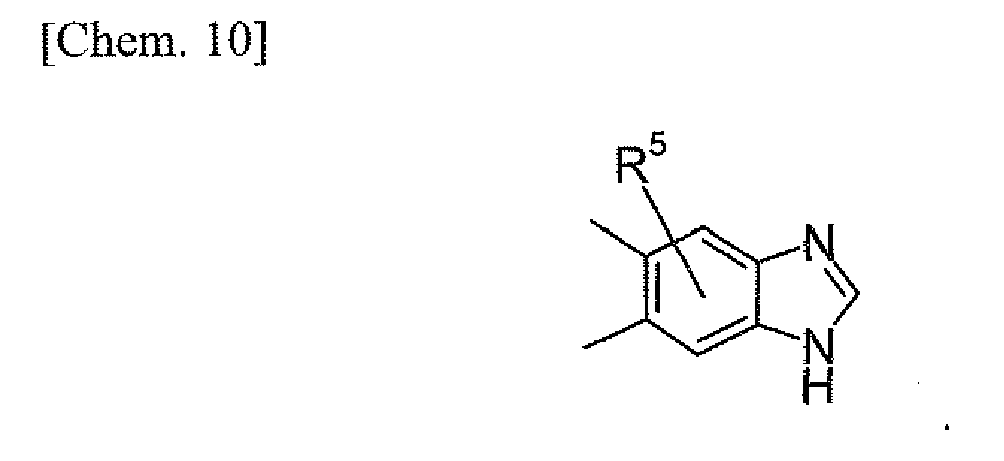
- A compound of the present invention represented by the formula (I) is characterized in a chemical structure from the point that a bicyclic nitrogen-containing unsaturated hetero ring or a bicyclic nitrogen-containing partially unsaturated hetero ring is bound to 3-position of oxadiazole, and has pharmacological characteristics from the point that the compound has SlP1 agonist activity.
- Since the compound of the invention has an S1P1 agonist activity, it is useful as an active ingredient of an agent for treating or an agent for preventing a disease caused by unfavorable lymphocytic infiltration, for example, graft rejection in the transplantation of an organ, bone marrow, or tissue or graft-versus-host disease, an autoimmune disease or an inflammatory disease such as rheumatic arthritis, multiple sclerosis, systemic lupus erythematosus, nephrotic syndrome, encephalomeningitis, myasthenia gravis, pancreatitis, hepatitis, nephritis, diabetes, pulmonary disorder, asthma, atopic dermatitis, inflammatory bowel disease, atherosclerosis, or ischemia-reperfusion injury, and further, a disease caused by the abnormal growth or accumulation of cells such as cancer or leukemia.
- Hereinafter, the present invention will be described in more detail.
In the specification, "alkyl" means a linear or branched mono-valent group. "C1-C6 alkyl" means a C1-C6 linear or branched alkyl, and specific examples thereof include methyl, ethyl, n-propyl, isopropyl, n-butyl, isobutyl, t-butyl, n-propyl, and n-hexyl, preferably C1-C4 alkyl, and particularly preferably, methyl, ethyl, n-propyl, and isopropyl. - In the specification, "halogen" represents F, Cl, Br, and I, and preferable examples thereof include F or Cl.
- In the specification, "C2-C6 alkenyl" means C2-C6 linear or branched alkenyl which has a double bond in a given site, and specific examples thereof include ethenyl (vinyl), 1-propenyl, 2-propenyl, 1-methylethen-1-yl, 1-buten-1-yl, 2-buten-1-yl, 3-buten-1-yl, 1-methyl-1-propen-1-yl, 2-methyl-1-propen-1-yl, 1-methyl-2-propen-1-yl, and 2-methyl-2-propen-1-yl, and preferably, 1-methyl-2-propen-1-yl or 1-pentenyl.
- In the specification, "C3-C8 cycloalkyl" means a mono-valent group of a non-aromatic carbon ring having a reduction number of 3 to 8, which may have partially unsaturated bonds. Thus, specific examples thereof include cyclopropyl, cyclobutyl, cyclopentyl, and cyclohexyl.
- In the specification, "C3-C8 heterocycloalkyl" means a mono-valent group of a non-aromatic carbon ring having a reduction number of 4 to 9, containing one or more heteroatoms that are the same as or different from each other, selected from the group consisting of nitrogen, oxygen, and optionally oxidized sulfur, which may have partial unsaturations. Specific examples thereof include aziridinyl, azetidinyl, pyrrolidinyl, piperidinyl, homopiperidinyl, morpholyl, thiomorpholyl, tetrahydropyranyl, and tetrahydrothiopyranyl.
- In the specification, "aryl" means an aromatic hydrocarbon group, but preferred is an aryl group having 6 to 14 carbon atoms. Specific examples thereof include phenyl, naphthyl, and anthryl, and more preferred is phenyl.
- In the specification, "heteroaryl" means a 5- or 6-membered ring aromatic heterocycle, containing one or more heteroatoms that are the same as or different from each other, selected from the group consisting of nitrogen, oxygen, and sulfur. Specific examples thereof include pyridyl, pyrazyl, pyrimidinyl, pyridazinyl, pyrrolyl, pyrazolyl, imidazolyl, oxazolyl, thiazolyl, thienyl, furyl, oxadiazolyl, and thiadiazolyl. Preferred is a 6-membered heteroaryl, and particularly preferred is pyridyl.
- The compound of the present invention may exist in the form of a geometrical isomer or a tautomer in some cases depending on the kind of the substituents. Further the compound of the present invention may have asymmetric carbons. The present invention includes either of the isolated counterparts of these isomers, and a mixture thereof. Also, the labeled compounds, that is, the compounds having at least one element in the compounds of the present invention substituted with radioactive isotopes or non-radioactive isotopes are also included in the present invention.
Furthermore, the pharmaceutically acceptable, so-called prodrugs of the compounds of the present invention are also included in the present invention. The pharmaceutically acceptable prodrug is a compound having a group which can be converted into an amino group, a hydroxyl group, a carboxylic group, or the like of the compound of the present invention, by solvolysis or under a physiological condition. Examples of the group capable of forming a prodrug include the groups as described in "Prog. Med., vol. 5, 2157-2161 (1985), and "Iyakuhin no Kaihatsu (Development of Medicines) (Hirokawa Shoten, 1990), vol. 7, Bunshi Sekkei (Molecular Design)", 163-198. - The compound represented by the formula (I) may form salts with acids or bases. These salts can be any one that are pharmaceutically acceptable, and specific examples thereof include acid addition salts with inorganic acids such as hydrochloric acid, hydrobromic acid, hydroiodic acid, sulfuric acid, nitric acid, and phosphoric acid, and with organic acids such as formic acid, acetic acid, propionic acid, oxalic acid, malonic acid, succinic acid, fumaric acid, maleic acid, lactic acid, malic acid, tartaric acid, citric acid, methanesulfonic acid, ethanesulfonic acid, aspartic acid, and glutamic acid, and salts with inorganic bases such as sodium, potassium, magnesium, calcium, and aluminum, and with organic bases such as methylamine, ethylamine, ethanolamine, lysine, and ornithine, and ammonium salts.
In addition, of the present invention also includes various hydrates and solvates, and polymorphic substances of the compound represented by the formula (I) and a salt thereof. - In the specification, the following abbreviations were used.
Pr: preparation method, AcOH: acetic acid, n-BuLi: normal butyl lithium, tBuOH: tertiary butanol, n-BuOH: normal butanol, BrCN: cyanogen bromide, CDI: 1,1'-carbonyl bis-1H-imidazole, DBU: 1,8-diazabicyclo[5.4.0]undeca-7-ene, DMAP: 4-(N,N-dimethylamino)pyridine, DIC: N,N'-diisopropylcarbodimide, DMF: N,N'-dimethylformamide, DCC: dicyclohexylcarbodimide, DMA: N,N-dimethylacetamide, DMSO: dimethylsulfoxide, DPPA: diphenylphosphorylazide, Et: ethyl, EDCI/HCl: N-[3-(dimethylamino)propyl]-N'-ethylcarboxamide hydrochloride, EtOH: ethanol, Et3N: triethylamine, EtOAc: ethyl acetate, HOBt: 1-hydroxy-1H-benzotriazole, HPLC: high performance liquid chromatography, IPE: diisopropyl ether, i-PrOH: 2-propanol, K2CO3: potassium carbonate, KCN: potassium cyanide, KHCO3: potassium hydrogen carbonate, KOtBu: potassium tertiary butoxide, LC-MS: liquid chromatography-mass spectroscopy, LiH: lithium hydride, MeOH: methanol, NaH: sodium hydride, NaOH: sodium hydroxide, NaBH4: sodium borohydride, NaCN: sodium cyanide, NaHCO3: sodium hydrogen carbonate, Na2CO3: sodium carbonate, NaOMe: sodium methoxide, NaOEt: sodium ethoxide, NCS: N-chlorosuccinimide, NH4Cl: ammonium chloride, NMP: N-methylpyrrolidone, POCl3: phorphorous oxychloride, P2O5: phorphorous pentaoxide, THF: tetrahydrofuran, TLC: thin layer chromatography, TMEDA: N,N,N'N'-tetramethylethylenediamine, Zn(CN)2: zinc cyanide - The compound (I) of the present invention and a pharmaceutically acceptable salt thereof may be prepared by applying various known synthetic methods, taking advantages of the characteristics based on their basic backbones or the kind of the substituents. Here, depending on the kind of the functional groups, it is in some cases effective from the viewpoint of the preparation techniques to protect the functional group with an appropriate protecting group, or to replace it by a group which may be easily converted into the functional group, during the steps of from starting materials to intermediates. Examples of such a functional group include an amino group, a hydroxyl group, and a carboxyl group, and examples of a protecting group thereof include the protecting groups as described in "Protective Groups in Organic Synthesis", edited by T.W. Greene and P.G.M. Wuts, (USA) (3rd edition, 1999), which may be optionally selected and used in response to the reaction conditions. By such a method, the desired compound can be obtained by introducing a protecting group to carry out the reaction, and then, if desired, removing the protecting group or converting it into a desired group.
In addition, a prodrug of the compound (I) of the present invention can be prepared by introducing a specific group during the steps of from starting materials to intermediates, similar to the aforementioned protecting groups, or by carrying out the reaction using the obtained compound (I) of the present invention. The reaction may be carried out by employing common esterification, amidation, dehydration, or a method conventionally known to a person skilled in the art. -

RX and RY are the same as or different from each other, and each mean -H; (C1-C6)alkyl that may be substituted with -OH or pyridyl. Also, RX may be bonded with RY and a nitrogen atom to form (C3-C8)heterocycloalkyl. - This preparation method is a method for preparing a benzimidazole compound represented by the formula (1-c) by allowing an aldehyde compound to undergo the reaction with a 1,2-diaminobenzene compound represented by the formula (1-b) that can be obtained by reduction of a compound represented by the formula (1-a).
- The step represented by Step 1-1 is a step for reducing a nitro group of the compound represented by the formula (1-a) to an amino group, that can be carried out at normal pressure or under elevated pressure, in a solvent inert to the reaction.
In the step represented by Step 1-2 wherein R' is H, an imidazole ring can be constructed, for example, by allowing an orthoformic ester such as ethyl orthoformate to undergo the reaction with the compound represented by the formula (1-b) in the presence of an acid catalyst.
Furthermore, in the step represented by Step 1-2 wherein R' is not H, for example, a method in which an amino group of the compound represented by the formula (1-a) is preliminarily acylated using a carboxylic acid, an acid chloride, a carboxylic acid anhydride, or the like, and cyclized under heating or in the presence of an acid, a method in which tetraalkyl orthocarbonate, CDI, or BrCN is used instead of an orthoformic ester, or other methods can be exemplified.
Furthermore, as other methods, a method in which a nitrobenzene compound of the formula, (1-a) is subject to carbamoylation of its amine moiety, induced into an acylamine compound (1-e), subject to reduction of its nitro group, and cyclized with heat can also be exemplified (Step 1-3, Step 1-4).
All of these reactions can be carried out in a solvent inert to the reaction, or without a solvent, from at room temperature to under heating, or from under heating or under reflux. -

This preparation method is a method for preparing an imidazo[1,2-a]pyridine substituted with a nitrile group represented by the formula (2-b), by using a 2-aminopyridine compound represented by the formula (2-a) as a starting material.
The step represented by Step 2-1 is a reaction for constructing an imidazo[1,2-a]pyridine ring by allowing a chloroacetaldehyde or α-chloroketone to undergo the reaction with the compound represented by the formula (2-a).
It is preferably carried out in the presence of a base, and specific examples of the base include alkali carbonates such as Na2CO3 and K2CO3; alkali hydrogen carbonates such as NaHCO3 and KHCO3; alkoxides such as NaOMe, NaOEt, and KOtBu; tertiary amines such as Et3N and DIPEA; and organic amines such as DBU, pyridine, and lutidine.
All of these reactions can be carried out in a solvent inert to the reaction, or without a solvent, from at room temperature to under heating, or under heating with reflux. -

This preparation method is a method for preparing an indazole compound represented by the formula (3-c) by allowing a hydrazine hydrate with a nitrile group to undergo the reaction with a cyanobenzene compound represented by the formula (3-b) obtained by substituting a halogen group of a compound represented by the formula (3-a).
The step represented by Step 3-1 is a reaction for substituting a halogen bonding with an aromatic ring with a nitrile group. It is exemplified by a method for reaction of Zn (CN)2 in the presence of tetrakistriphenylphosphine palladium (0), a method for allowing TMEDA and Pd catalysts to undergo the reaction in the presence of Na2CO3 in DMA, and a method for allowing KCN, NaCN, or the like to undergo the reaction instead of Zn(CN)2. Usually, the compound represented by the formula (3-b) can be obtained by reacting the compound represented by the formula (3-a) with tris(dibenzylideneacetone)dipalladium (0), 1'-bis(diphenylphosphino)ferrocene, and Zn(CN)2.
Here, examples of the leaving group include halogen such as Br and Cl; methanesulfonyloxy, ethanesulfonyloxy, benzenesulfonyloxy, p-toluenesulfonyloxy, and trifluoromethanesulfonyloxy. - The step represented by Step 3-2 is a reaction for constructing an indazole ring from a cyanobenzaldehyde compound represented by the formula (3-b). Usually, a hydrazine hydrate is used in this reaction, which can be carried out without a solvent, or in a solvent inert to the reaction such as MeOH and toluene, from at room temperature to under heating, or under heating with reflux. In addition, a method using copper cyanide can also be exemplified, and a base such as pyridine may be added. Also, this reaction is preferably carried out under a nitrogen atmosphere.
-
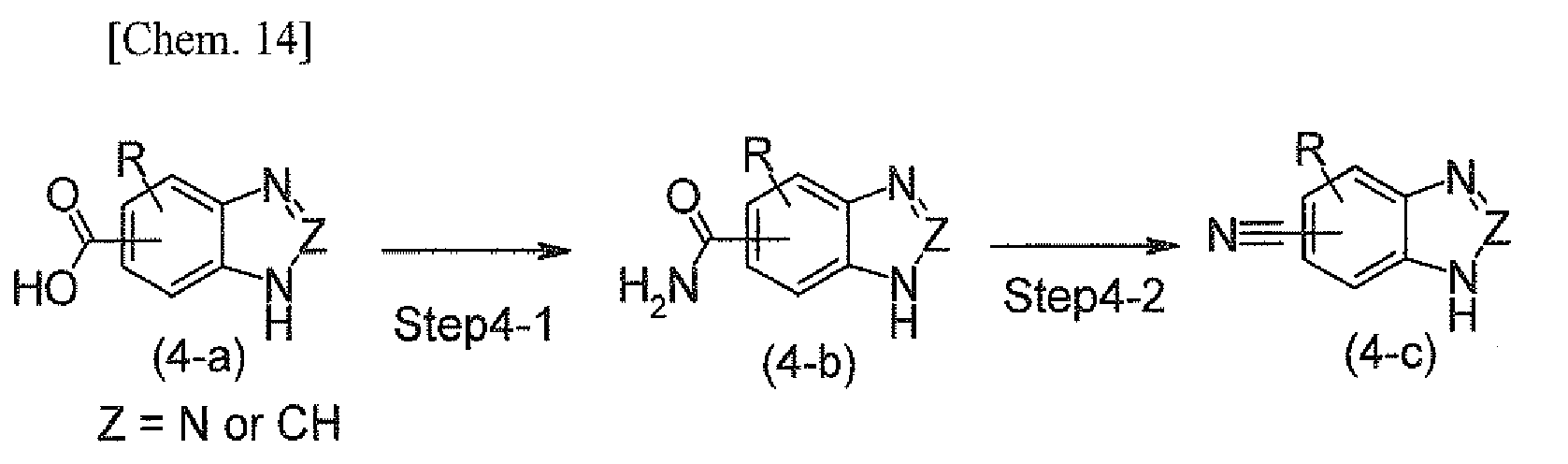
This preparation method is a method for preparing a benzotriazole or benzimidazole compound represented by the formula (4-c) by dehydrating an acid amide compound represented by the formula (4-b), obtained using a carboxylic acid compound represented by the formula (4-a) as a starting material.
The step represented by Step 4-1 is a reaction for condensing a carboxylic acid compound with ammonia represented by the formula (4-a), and constructing an acid amide group represented by the formula (4-b). The compound represented by the formula (4-a) can be used in the reaction as free acid, but a reactive derivative thereof may also be used in the reaction. Examples of the reactive derivative induced from the compound represented by the formula (4-b) include acid halides such as acid chloride and acid bromide; common esters such as methyl ester, ethyl ester, and benzyl ester; acid azides; active esters such as HOBt, p-nitrophenol, and N-hydroxysuccinimide; symmetrical acid anhydrates; a mixed acid anhydrate of a halocarboxylic acid alkyl ester such as an alkyl carbonic acid halide, a pivaloyl halide, and p-toluene sulfonic acid chloride; and a mixed acid anhydrate such as a mixed phosphoric mixed acid anhydrate, such as those obtained by the reaction of diphenylphosphoryl chloride with N-methyl morpholine.
In a case where the compound represented by the formula (4-a) is reacted as a free acid, or without isolation to an active ester, or the like, a condensing agent such as DCC, CDI, DPPA, diethylphosphoryl cyanide, and EDCI/HCl is preferably used.
The reaction solvent varies depending on a reactive derivative or a condensing agent to be used, but the reaction is carried out in an organic solvent inert to the reaction such as hydrocarbon halides, aromatic hydrocarbons, ethers, esters such as EtOAc, acetonitrile, DMF, and DMSO, or a mixed solvent thereof. Also, the reaction is carried out under cooling, from under cooling to at room temperature, or from at room temperature to under heating.
Furthermore, in the reaction, it is in some cases advantageous in advancing the reaction smoothly to carry out the reaction with an excessive amount of ammonia or in the presence of a base such as N-methylmorpholine, trimethylamine, Et3N, DIPEA, N,N-dimethylaniline, pyridine, DMAP, picoline, and lutidine. Pyridine may be used in combination with the solvent. The step represented by Step 4-2 is dehydration, for which a base may or may not exist, and a dehydrating agent such as trifluoroacetic anhydrate, POCl3, and P2O5 may be used.
Furthermore, in a case for synthesizing a condensed, intermediate heterocycle other than those described in the above-described intermediate preparation methods, the methods described in Reference Examples or Examples in the present specification, or equivalent methods may be employed, or additionally, well-known methods or methods apparent to a person skilled in the art can also be used for the preparation. -

This preparation method is a method for preparing the compound of the present invention represented by the formula (I) by reacting a hydroxyamidine represented by the formula (5-b) obtained by allowing hydroxylamine to undergo the reaction with an aromatic nitrile compound represented by the formula (5-a), with a carboxylic acid represented by the formula (5-c).
In a step represented by Step 5-1, the hydroxyamidine represented by the formula (5-b) can be prepared by allowing a free hydroxylamine or hydroxylamine hydrochloride to undergo the reaction in the presence of a base.
This reaction can be carried out in a solvent inert to the reaction. Specific examples of the solvent include alcohols such as MeOH, EtOH, and i-PrOH; aromatic hydrocarbons such as toluene and xylene; ethers such as ether, THF, dioxane, and diethoxyethane; halogenated hydrocarbons such as dichloromethane, 1,2-dichloroethane, chloroform, and carbon tetrachloride; acetonitriles; aprotic polar solvents such as DMF, 1,3-dimethyl-2-imidazolidinone, and DMSO; water; or a mixed solvent thereof. Usually, alcohols are used in the reaction. As described above, in a case where hydroxylamine hydrochloride is used in this reaction, the reaction is preferably used in the presence of a base, and specific examples of the base include alkali carbonates such as Na2CO3 and K2CO3; alkali hydrogen carbonates such as NaHCO3 and KHCO3; alkoxides such as NaOMe, NaOEt, and KOtBu; tertiary amines such as Et3N and DIPEA; and organic amines such as DBU, pyridine, and lutidine.
The reaction temperature varies depending on the kinds of the starting material compounds, the reaction conditions, or the like, but the reaction can be carried out usually from at room temperature to at about a reflux temperature of the solvent. Typically, in the presence of a base such as Na2CO3, the reaction can be carried out in an organic solvent inert to the reaction, such as MeOH, from at room temperature to under heating.
The step represented by Step 5-2 consists of two steps, i.e., a step of acylation of a hydroxyamidine product, and a step of a cyclization reaction in this order. The acylation step can be carried out in the following manner. The compound represented by the formula (5-c) can be used in the reaction as a free acid, but a reactive derivative thereof may also be used in the reaction. Examples of the reactive derivative include acid halides such as acid chloride and acid bromide; common esters such as methyl ester, ethyl ester, and benzyl ester; acid azides; active esters such as HOBt, p-nitrophenol, and N-hydroxysuccinimide; symmetrical acid anhydrates; a mixed acid anhydrate of a halocarboxylic acid alkyl ester such as an alkyl carbonic acid halide, a pivaloyl halide, and p-toluene sulfonic acid chloride; and a mixed acid anhydrate such as a mixed phosphoric mixed acid anhydrate, such as those obtained by the reaction of diphenylphosphoryl chloride with N-methyl morpholine.
In a case where the compound represented by the formula (5-c) is reacted as a free acid, or without isolation to an active ester, or the like, a condensing agent such as DCC, CDI, DPPA, diethylphosphoryl cyanide, and EDCI/HCl is preferably used.
The reaction solvent varies depending on a reactive derivative or a condensing agent to be used, but the reaction is carried out in an organic solvent inert to the reaction such as hydrocarbon halides, aromatic hydrocarbons, ethers, esters such as EtOAc, acetonitrile, DMF, and DMSO, or a mixed solvent thereof, under cooling, from under cooling to at room temperature, or from at room temperature to under heating.
In the reaction, the reaction may be smoothly advanced in some cases to carry out the reaction in the presence of a base such as N-methylmorpholine, trimethylamine, Et3N, DIPEA, N,N-dimethylaniline, pyridine, DMAP, picoline, and lutidine. Also, pyridine may be used in combination with the solvent. An acylated product as an intermediate can be purified by isolation, and heated in an organic solvent inert to the reaction, such as EtOH, dioxane, toluene, and water. Usually, this two-step reaction can be carried out in one operation, by heating or microwave-radiating the product as it is or as a reaction mixture, after acylation.
Specific examples of the solvent include aromatics such as toluene, xylene, and pyridine; ethers such as diethyl ether, THF, dioxane, and diethoxyethane; halogenated hydrocarbons such as dichloromethane, 1,2-dichloroethane, chloroform, and carbon tetrachloride; acetonitriles; aprotic polar solvents such as DMF, DMA, 1,3-dimethyl-2-imidazolidinone, NMP, and DMSO; water; or a mixed solvent thereof. The reaction temperature varies depending on the kinds of the starting material compounds, the reaction conditions, or the like, but the reaction can be carried out usually from at room temperature to under heating. - In a case where X represents -O- or -NH-, synthesis can be made by the following preparation method.
The steps represented by Step 5-3 and Step 5-5 can be carried out in the same manner as the step represented by Step 5-2.
The steps represented by Step 5-4 and Step 5-6 are steps for preparing the compound of the present invention represented by the formula (I) by allowing phenol, aniline, alcohol, or amine represented by the formula (5-e) or the formula (5-i) to undergo the reaction with a compound having a leaving group, represented by the formula (5-f) or the formula (5-h). Here, examples of the leaving group include halogens such as chlorine and bromine; and sulfonyloxy such as methanesulfonyloxy, ethanesulfonyloxy, benzenesulfonyloxy, p-toluenesulfonyloxy, p-nitrobenzenesulfonyloxy, and trifluoromethanesulfonyloxy.
The reaction is carried out at normal pressure or under elevated pressure, without a solvent or in an appropriate solvent.
Specific examples of the solvent include aromatic hydrocarbons such as toluene and xylene; ketones such as acetone and methylethylketone; ethers such as ether, THF, dioxane, and diethoxyethane; alcohols such as MeOH, EtOH, i-PrOH, and n-BuOH; halogenated hydrocarbons such as dichloromethane, 1,2-dichloroethane, chloroform, and carbon tetrachloride; acetonitriles; aprotic polar solvents such as DMF, 1,3-dimethyl-2-imidazolidinone, NMP, and DMSO; water; or a mixed solvent thereof. This reaction is preferably used in the presence of a base, and specific examples of the base include NaH; alkali carbonates such as Na2CO3 and K2CO3; alkali hydrogen carbonates such as NaHCO3 and KHCO3; alkoxides such as NaOMe, NaOEt, and KOtBu; tertiary amines such as Et3N, tributylamine, and DIPEA; and organic amines such as DBU, pyridine, and lutidine, but an excessive amount can be combined in an amine represented by the formula (5-e) or the formula (5-i). The reaction temperature varies depending on the kinds of the starting material compounds, the reaction conditions, or the like, but the reaction can be carried out usually from at room temperature to at about a reflux temperature of the solvent. Usually, the reaction can be carried out in the presence of a base such as NaH and Na2CO3, in an organic solvent inert to the reaction, such as DMF and DMA, from at -10°C to under heating. Also, the amine represented by the formula (5-e) or the formula (5-i) can be provided for the reaction as a salt thereof. In addition, a microwave may be radiated under heating for the preparation. - Moreover, several compounds represented by the formula (I) can be prepared by any combination of well-known processes that can be usually employed by a person skilled in the art, such as well-known alkylation, acylation, substitution reaction, oxidation, reduction, hydrolysis, deprotection, and halogenation from the compound of the present invention as prepared in the above-described manner.
For example, for alkylation, the alkylation reaction that can be usually used by a person skilled in the art can be employed, which can be carried out in an organic solvent inert to the reaction, such as ethers; aromatic hydrocarbons; halogenated hydrocarbons such as dichloroethane, dichloroethane, and chloroform; DMF, acetonitriles; and aprotic polar solvents, under cooling, from under cooling to at room temperature, or from at room temperature to under heating, in the presence of a base such as NaH; alkali carbonates; alkali hydrogen carbonates; alkoxides; tertiary amines; and organic bases.
Furthermore, for example, for acylation, the acylation reaction that can be usually used by a person skilled in the art can be employed, which can be particularly carried out in the presence of HOBt, in a solvent varying depending on a condensing agent such as EDCI/HCl or CDI, and diphenylphosphorylcyanide, in a solvent varying depending on the reaction condition, but usually in an organic, inert solvent such as ethers; aromatic hydrocarbons; halogenated hydrogen such as dichloromethane, dichloroethane, and chloroform; esters such as EtOAc; acetonitriles; and aprotic solvents, under cooling, from under cooling to at room temperature, or from at room temperature to under heating. - Thus prepared compound is purified by isolation, as it is, or as a salt thereof after a salt-forming treatment by a conventional method. The purification by isolation is carried out by applying common chemical operations such as extraction, concentration, removal by distillation, crystallization, filtration, recrystallization, and various types of chromatography.
Various types of the isomers can be isolated by a conventional method, taking advantage of the difference in the physiochemical properties among the isomers. For example, a racemic mixture can be induced into optically pure isomers, for example, by a general resolution method for racemic products, such as an optical resolution method for inducing diastereomer salts with general, optically active acids such as tartaric acid. Also, the diastereomer mixture can be separated, for example, by fractional crystallization, or various types of chromatography. Furthermore, the optically active compounds can also be prepared by using the corresponding, optically active starting materials. - The actions of the compounds of the present invention were confirmed by the following pharmacological tests.
- Experimental Example 1: Test for confirming an S1P1 agonist activity
- The in vitro S1P1 agonist activity of the compound of the present invention was evaluated by the increase in the functional bonding activity into the G-Protein of a GTP[γ-35S] using the membrane of a human S1P1 expressing cell. A cDNA encoding a human S1P1 was cloned from a human colorectal cDNA library, and introduced to an expression vector pcDNA3.1 to construct a S1P1-pcDNA3.1. Then, by Lipofectamine 2000 (GIBCO), the S1P1-pcDNA3.1 was transfected into a CHO cell, and cultured in a Ham's F-12 culture medium containing 10% fetal bovine serum, 100 U/mL Penicillin, 100 µg/mL Streptomycin, and 1 mg/mL G418 disulfate, to obtain a stable, G418-resistant strain. The cultured human S1P1 expressing cells were isolated in a 1 mM EDTA/2Na-containing PBS, and disrupted under ice-cooling by a homogenizer made of glass in a 1 mM Tris HCl (pH 7.4) buffer solution containing 0.1 mM EDTA and a protein inhibitor. It was centrifuged at 1,400×10 min, and a supernatant was further centrifuged at 4°C for 60 min at 100,000×g, and suspended in a 10 mM Tris HCl (pH 7.4) buffer solution containing 1 mM EDTA. The obtained membrane (0.13 mg/mL) and 50 pM GTP[γ-35S] (NEN; inactive 1250 Ci/mmol) were reacted in a 20 mM HEPES (pH 7.0) buffer solution (total amount: 150 µL) containing 100 mM NaCl, 10 mM MgCl2, 0.1% fatty acid-free BSA, and 5 µM GDP for 1 hour together with the compound of the present invention (10-12 to 10-5 M), and then a membrane was recovered on a GF-C plate with a Cell Harvester (Packard, FilterMate). The FilterMate was dried at 50°C for 60 min, and Microscinti-o (Packard) was added thereto for measurement by a liquids scintillation counter for a microplate (Packard, TOP count). For evaluation of the human S1P1 agonist activity of the compound of the present invention and the comparative compound, the percentages with the rate of a maximum reaction to make the GTP[γ-35S] bonds saturated in the presence of the compound being set at 100%, and the rate of the reaction of the GTP[γ-35S] bonds in the absence of the compound being set at 0% was used, a non-linear regression curve was plotted, and a concentration to cause an agonist activity operating 50% of the maximum reaction was defined as an EC50 value (nM).
-
[Table 1] Ex S1P1 EC50 Ex S1P1 EC50 Ex S1P1 EC50 2 13 60 2.1 151 11 5 5.5 64 5.7 152 7.6 6 1.2 65 4.0 158 1.8 8 5.4 67 3.7 163 1.9 12 4.7 81 5.9 164 2.8 15 2.1 87 3.7 173 4.3 23 6.8 106 8.7 181 4.7 26 4.7 110 6.2 182 4.2 37 5.4 119 4.3 193 6.8 48 6.5 120 4.6 194 2.0 51 13 121 12 196 5.3 54 2.3 143 5.4 197 3.3 59 3.8 147 3.2 - As a result, it can be confirmed that the compound of the present invention has an S1P1 agonist activity.
- The peripheral blood lymphopenia in rat was measured at 24 hours after oral administration in the following manner. Six- to ten-week-old male Lewis rats (Japan Charles river laboratories) were randomly divided into the groups (n=3), and the compound of the present invention was suspended in 0.5% methyl cellulose-containing distilled water, and orally administered with a sonde. At 24 hours after administration, under ether anesthesia, 0.2 ml of blood was collected from ocular fundus. To the blood sample were immediately added EDTA/4K and heparin to prevent clotting, and the number of the lymphocytes in blood was measured with an automatic haematology analyzer (Sysmex Corp.; XT-2000i). For the reduction of the number of the lymphocytes in peripheral blood by the compound of the present invention, the percentage with the number of the lymphocytes in groups administered with 0.5% methyl cellulose-containing distilled water being set at 100%, as performed at the same time was used, and the dose to cause 50% reduction of the number of the lymphocytes in peripheral blood by administration of the compound of the present invention was defined an ED50 value (mg/kg).
- For the comparative compounds 1 and 2 as described in the pamphlet of International Publication No.
WO2004/103279 , the comparative compound 3 as described in the pamphlet of International Publication No.WO2005/032465 and the compound of Example 119, the ED50 values at 24 hours after administration were compared for the reduction of the number of the lymphocytes in peripheral blood in rat. -
[Table 2] Compound Structure ED50 value after 24 hours Ex 119 
0.071 mg/kg Comparative Compound 1 
1.4 mg/kg Comparative Compound 2 
8.8 mg/kg Comparative Compound 3 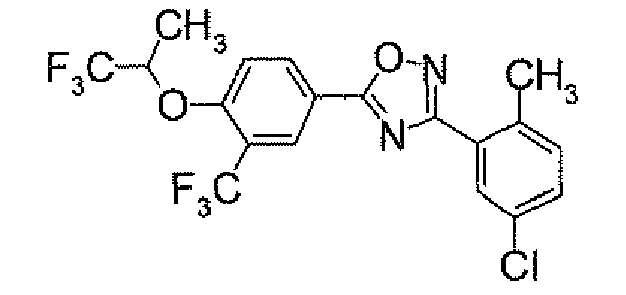
3.7 mg/kg - As a result, it was demonstrated that the compound of Example 119 shows a high ED50 value even after 24 hours, indicating persistence.
- Since the compound of the present invention has an SlP1 agonist effect, it is useful as an active ingredient of an agent for treating or an agent for preventing a disease caused by unfavorable lymphocytic infiltration, for example, an autoimmune disease such as graft rejection in the transplantation of an organ, bone marrow, or a tissue or a graft-versus-host disease, rheumatic arthritis, multiple sclerosis, systemic lupus erythematosus, nephrotic syndrome, encephalomeningitis, myasthenia gravis, pancreatitis, hepatitis, nephritis, diabetes, pulmonary disorder, asthma, atopic dermatitis, inflammatory bowel disease, atherosclerosis, or ischemia-reperfusion injury or an inflammatory disease, and further, a disease caused by the abnormal growth or accumulation of cells, such as cancer and leukemia.
Furthermore, the compound of the present invention is useful to treat and/or prevent the following diseases, based on the agonist activity against an SlP1.
It is useful to treat and/or prevent inflammatory or hyperplastic skin diseases such as psoriasis, contact dermiatitis, eczematoid dermatitis, seborrheic dermatitis, lichen planus, pemphigus, pemphigoid, epidermolysis bullosa, hives, vascular edema, obliterans, erythema, eosinophilia of skin, lupus erythematosus, acne, and alopecia areata, or expression of skin diseases through an immune system; autoimmune diseases or allergic diseases of eyes, such as keratoconjunctivitis, vernal conjunctitis, allergic conjunctivitis, uveitis associated with Behcet disease, keratitis, Herpesviral keratitis, Keratoconus keratitis, cornea epithelial dystrophies, corneal leukoma, ocular pemphigus, Mooren's ulcer, scleritis, Graves' ophthalmopathy, Vogt-Koyanagi-Harada disease, leratoconjunctivitis sicca (dry eye), vesicle, iridocyclitis, sarcoidosis, and ophthalmic diseases inendocrine glands; reversible obstructive lung diseases (asthma (for example, bronchial asthma, allergic asthma, intrinsic asthma, extrinsic asthma, and dirt asthma), in particular, chronic or difficult asthma (for example, late-onset asthma, and airway diseases); mucous or angiitis (for example, gastric ulcers, ischemic or thrombotic Vascular Injuries, age-related maculopath, diabetic maculopath, ischemic bowel disease, bowel disease, necrotizing enteritis, intestinal tract lesion by heat burn, and diseases by a transmitter of a Leukotriene B4); inflammatory intestine or allergic diseases of intestine, including, for example, proctitis, eosinophilic enteritis, mastocytosis, celiac disease, Crohn's disease, and ulcerative colitis; food-related allergic diseases expressing the conditions on a site that is remote from the gastro-intestinal tract including, for example, migraine, rhinitis, and eczema; autoimmune diseases or inflammatory diseases including, for example, primary mucous edema, autoimmune atrophic gastritis, precocious climacteric period, juvenile diabetes, pemphigus vulgaris, pemphigoid, sympathetic ophtalmolima, lens-induced uveitis, paroxysmal Leukopenia, chronic active hepatitis, paroxysmal liver cirrhosis, discoid lupus erythematosus, Sjoegren syndrome, autoimmune orchitis, arthritis (for example, modified arthritis), and polychondritis; renal diseases including, for example, membranous nephrophathy, membranoproliferative nephritis, focal global glomerulosclerosis, crescent nephritis, glomerular nephritis, IgA nephropathy, tubulopathy interstitial nephritis, and diabetic nephropathy. Furthermore, the compound of the present invention is also useful to treat and/or prevent liver diseases (for example, immunogenic diseases (for example, autoimmune lever diseases, chronic autoimmune lever diseases such as primary biliary cirrhosis., sclerosing cholangitis, and the like), partial hepatic dissection, acute hepatic necrosis (for example, necrosis caused by toxin, viral hepatitis, shock, anoxia, or the like), Type B hepatitis, non-Type A hepatitis, cirrhosis, heptatic failure (for example, fulminant hepatitis, late-onset hepatitis, hepatic failure (acute hepatic failure or chronic hepatic disease)), and the like.
In addition, compound of the present invention can be administered as an S1P1 agonist alone, or in combination with at least one agent, in the same dose or different doses, through the same or different administration routes. Examples of the agent that can be combined include, but not limited thereto, cyclosporin A, tacrolimus, sirolimus, everolimus, mycophenolate, azathioprine, brequinar, Leflunomide, fingolimod, an anti-IL-2 receptor antibody (for example, daclizumab), an anti-CD3 antibody (for example, OKT3), anti-T cell immunoglobulin (for example, AtGam), belatacept, abatacept, cyclophosphamide, β-interferon, aspirine, acetaminophen, ibuprofen, naproxen, piroxicam, and anti-inflammatory steroid (for example, prednisolone, and dexamethasone). - A preparation containing the compound represented by the formula (I), or one, or two or more kinds of the salts thereof as effective ingredients are prepared by using a carrier, an excipient or other additives that are usually used in the preparation of medicines.
Administration may be made in any one form for either oral administration by tablets, pills, capsules, granules, powders, and solutions, or for parenteral administration by injections for intravenous injection, and intramuscular injection, suppositories, percutaneous preparations, transnasal preparations, inhalations or the like. The dose is appropriately decided in response to an individual case by taking the symptoms, age and sex of the subject and the like into consideration, but is usually from about 0.001 mg/kg to about 100 mg/kg per day per adult in the case of oral administration, and this is administered in one portion or dividing it into 2 to 4 portions. Also, in the case of intravenous administration according to the symptoms, it is administered usually within the range of from 0.0001 mg/kg to 10 mg/kg per day per adult, once a day or two or more times a day. In addition, in the case of inhalation, it is administered generally within the range of from 0.0001 mg/kg to 1 mg/kg per adult, once a day or two or more times a day.
Regarding the solid composition of the present invention for oral administration, tablets, powders, granules, or the like are used. In such a solid composition, one or more active substances are mixed with at least one inactive excipient such as lactose, mannitol, glucose, hydroxypropylcellulose, microcrystalline cellulose, starch, polyvinyl pyrrolidone, and aluminum magnesium silicate. In a conventional method, the composition may contain inactive additives, for example, a lubricant such as magnesium stearate, a disintegrator such as carboxymethylstarch sodium, or a solubilizing agent. As occasion demands, tablets or pills may be coated with a sugar coating, or a gastric or enteric coating agent. - The liquid composition for oral administration include pharmaceutically acceptable emulsions, solutions, suspensions, syrups, elixirs, and the like, and contains generally used inert solvents such as purified water and ethanol. In addition to the inert solvent, this composition may contain an auxiliary agent such as a solubilizing agent, a moistening agent, and a suspending agent, a sweetener, a corrective, an aromatic, and an antiseptic.
Injections for parenteral administration include sterile aqueous or non-aqueous solutions, suspensions and emulsions. Examples of the aqueous solvent include distilled water for injection and physiological saline. Examples of the non-aqueous solvent include propylene glycol, polyethylene glycol, plant oils such as olive oil, alcohols such as ethanol, and Polysorbate 80 (Pharmacopeia). Such a composition may further contain a tonicity agent, an antiseptic, a moistening agent, an emulsifying agent, a dispersing agent, a stabilizing agent, and a solubilizing agent. These are sterilized, for example, by filtration through bacteria retaining filter, blending of bactericides, or irradiation. In addition, these can also be used by producing a sterile solid composition, and dissolving or suspending it in sterile water or a sterile solvent for injection prior to its use.
Regarding a transmucosal agent such as an inhalations and a transnasal agent, those in a solid, liquid or semi-solid state are used, and may be produced in accordance with a conventionally known method. For example, an excipient such as lactose and starch, and also a pH adjusting agent, an antiseptic, a surfactant, a lubricant, a stabilizer, a thickener, and the like may be optionally added thereto. For their administration, an appropriate device for inhalation or blowing may be used. For example, a compound may be administered alone or as a powder of formulated mixture, or as a solution or suspension by combining it with a pharmaceutically acceptable carrier, using a conventionally known device or sprayer, such as a measured administration inhalation device. The dry powder inhaler or the like may be for single or multiple administration use, and a dry powder or a powder-containing capsule may be used. Alternatively, this may be in a form such as a high pressure aerosol spray which uses an appropriate propellant, for example, a suitable gas such as chlorofluoroalkane, hydrofluoroalkane, and carbon dioxide.
The external agent includes ointments, plasters, creams, jellies, paps, sprays, lotions, eye drops, eye ointments, and the like. The external agent contains ointment bases, lotion bases, aqueous and non-aqueous liquids, suspensions, emulsions, and the like, for general use. Examples of the ointment or lotion bases include polyethylene glycol, propylene glycol, white Vaseline, white beeswax, polyoxyethylene hardened castor oil, glycerin monostearate, stearyl alcohol, cetyl alcohol, lauromacrogol, and sorbitan sesquioleate.
Example - Hereinafter, the compounds of the present invention will be described in more detail with reference to Examples. The present invention is not limited to the inventions as described in the following Examples. The preparation methods of the starting material compounds are shown in Preparation Examples.
[In the following tables, Pr represents Preparation Example No., and Structure represents a structural formula. As the abbreviation symbols in the structural formulae, Me represents a methyl group, and Et represents an ethyl group. Criss-cross double bond represents a cis/trans mixture, and if the section of Data describes only the numbers, it shows MS data. MS represents mass spectrometry data. In the tables, RT refers to a retention time in high performance liquid chromatography (HPLC), and M represents minutes. The condition for HPLC is as follows: column: Intertsil ODS-34.6×150 mm, eluent 0.01M KH2PO4 aq./MeCN(3:7), flow rate: 1.0 ml/min, detection wavelength: 254 nm. If 1H-NMR data are described in the tables, tetramethylsilane is used as an internal standard, and unless otherwise specifically mentioned, δ (ppm) (integrated values, variation patterns) of the signals in 1H-NMR using DMSO-d6 as a measurement solvent is shown. Abbreviation symbols have the same meanings as follows. S: singlet, d: doublet, t: triplet q: quartet dd: double doublet, ddd: double double doublet, dt: double triplet, dm: double multiplet, br: broad, brs: broad singlet, Hz: Hertz, CDCl3: deuterated chloroform, DMSO-d6: dimethylsulfoxide-d6, and in the present specification, NMR represents 1H-NMR: proton nuclear magnetic resonance. The same shall apply hereinafter]. - Imidazo[1,2-a]pyridine-7-carbonitrile hydrochloride (1.50 g), hydroxylamine hydrochloride (301 mg), and Na2CO3 (3.50 g) were stirred at 60°C for 6 hours in CH3OH (57 ml). The reaction solution was cooled and concentrated, and completion of the reaction was confirmed by LC-MS. To the residue was added water, followed by extraction twice with EtOAc. The organic layer was washed with water and saturated brine, dried over anhydrous MgSO4 and then filtered, and the filtrate was concentrated to obtain N'-hydroxyimidazo[1,2-a]pyridine-7-carboxamide (850 mg) as a white solid.
- The compounds shown in Pr 1-1 through Pr 1-17 were prepared in the same manner as in Preparation Example 1.
-
[Table 3] Pr Structure MS Pr Structure Data 1 
177 1-1 
191 1-2 
191 1-3 
205 1-4 
263 1-5 
177 1-6 
191 1-7 
RT: 1.79 M 1-8 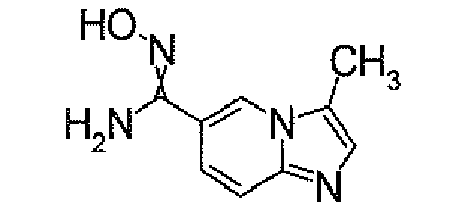
191 1-9 
177 1-10 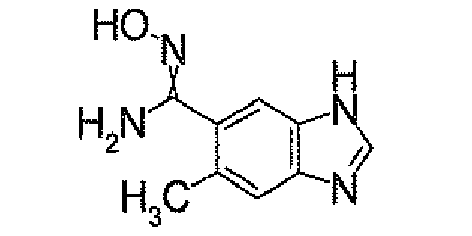
191 1-11 
RT: 1.64 M 1-12 
RT: 1.60 M 1-13 
192 1-14 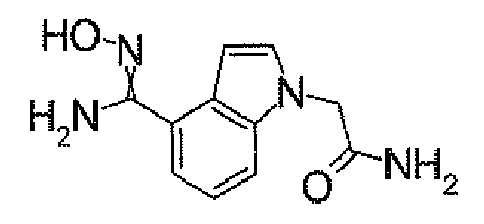
233 1-15 
231 1-16 
391 1-17 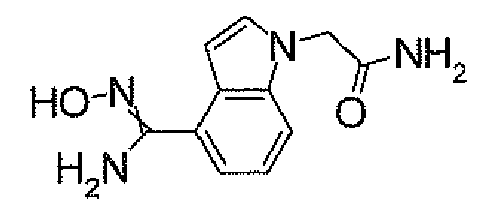
- In a 50 ml reaction vessel, to a solution of 1H-indole-4-carbonitrile (5.00 g) in CH3OH (100 ml) was added hydroxylamine (50% aqueous solution) at room temperature, followed by refluxing for 15 hours (completion of the reaction was confirmed by TLC). The reaction solution was concentrated under reduced pressure, and azeotroped with toluene three times. The obtained solid was washed with IPE. N'-Hydroxy-1H-indole-4-carboximidamide (6.12 g) was obtained as a white solid.
- The compounds shown in Pr 2-1 through Pr 2-26 were prepared in the same manner as in Preparation Example 2.
-
[Table 4] Pr Structure MS Pr Structure MS 2 
176 2-1 
191 2-2 
205 2-3 
263 2-4 
177 2-5 
191 2-6 
191 2-7 
221 2-8 
192 2-9 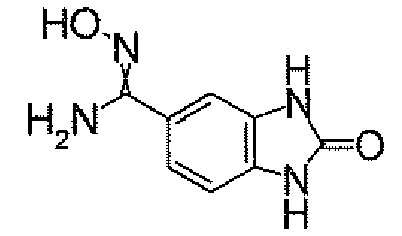
193 2-10 
191 2-11 
188 -
[Table 5] Pr Structure MS Pr Structure MS 2-12 
202 2-13 
2-14 
RT: 1.68 M 2-15 
177 2-16 
NMR below 2-17 
2-18 
RT: 1.62 M 2-19 
200 2-20 
RT: 1.69 M 2-21 
RT: 1.62 M 2-22 
RT: 1.62 M 2-23 
177 2-24 
225 2-25 
177 2-26 
177 -
[Table 6] Pr NMR 2-16 5.71(2H,s),6.47(1H,d),7.50(1H,d),7.61(1H,d) ,7.93(1H,d),9.78(1H,s),11.70(1H,s) - A suspension of N2-hydroxy-1H-indole-4-carboxamide (1.00 g), 4-fluoro-3-(trifluoromethyl)benzoic acid (1.19 g), and EDCI/HCl (1.32 g) in dioxane (30 ml) was stirred at room temperature for 1 hour, and further heated under reflux for 18 hours. The reaction mixture was concentrated under reduced pressure, chloroform and water were added thereto, followed by stirring. The insolubles were collected by filtration. The organic layer of the mother liquor was washed with water, dried over anhydrous MgSO4 and then filtered, and the filtrate was concentrated under reduced pressure. The insolubles collected by filtration, together with the mother liquor, was purified by silica gel chromatography (n-hexane:EtOAc=80:20). To the objective substance was added acetone, followed by dissolving under heating, and addition with n-hexane, and the precipitated solid was collected by filtration to obtain 4-{5-[4-fluoro-3-(trifluoromethyl)phenyl]-1,2,4-oxadiazol-3-yl}-1H-indole (391 mg) as a white solid.
-
[Table 7] Pr Structure MS 3 
346 - N2-{[(5,6-Dichloropyridin-3-yl)carbonyl]oxy}-1H-indole-4-carboxamidine (1.91 g) was added to dioxane (40 ml), followed by heating under reflux for 5 hours. It was concentrated under reduced pressure, and then purified by silica gel column chromatography (EtOAc). To the obtained solid was added acetone, followed by suspension under heating. After being left to be cooled, the insolubles was collected by filtration to obtain 4-[5-(5,6-dichloropyridin-3-yl)-1,2,4-oxadiazol-3-yl]-1H-indole (1.44 g) as pale yellow powders.
-
[Table 8] Pr Structure MS 4 
331, 329 - A solution of N2-hydroxy-1H-indole-4-carboxamide (3.42 g) and 4-fluoro-3-(trifluoromethyl)benzoic acid (4.07 g) in THF (70 ml) was cooled to -10°C or lower, and added with DIC (3.7 ml). After stirring at -15 to -5°C for 3 hours, the reaction mixture was concentrated under reduced pressure. The residue was suspended in chloroform, and then the insolubles were collected by filtration. The obtained powders were purified by silica gel chromatography (n-hexane:EtOAc=50:50) to obtain N2-{[4-fluoro-3-(trifluoromethyl)benzoyl]oxy}-1H-indole-4-carboxamide (8.40 g) as a white solid.
- The compound shown in Pr 5-1 was prepared in the same manner as in Preparation Example 5.
-
[Table 9] Pr Structure MS Pr Structure MS 5 
388, 366 5-1 
- - To a solution of 6-amino-2-methylnicotinonitrile (960 mg) in ethanol (34 ml) was added a 40% aqueous chloroacetaldehyde solution (2.36 ml) at 60°C. The reaction mixture was refluxed for 8 hours. The resulting precipitates were collected by filtration to obtain 5-methylimidazo[1,2'-a]pyridine-6-carbonitrile hydrochloride (580 mg) as a white solid.
- The compounds shown in Pr 6-1 through Pr 6-11 were prepared in the same manner as in Preparation Example 6.
-
[Table 10] Pr Structure MS Pr Structure MS 6 
158 6-1 
158 6-2 
158 6-3 
252 6-4 
144 6-5 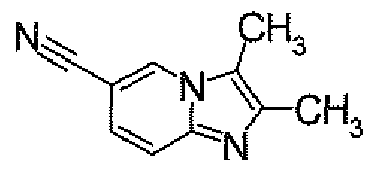
172 6-6 
NMR below 6-7 
252 6-8 
172 6-9 
NMR below 6-10 
158 6-11 
158 -
[Table 11] Pr NMR 6-6 2.39(3H,s),7.14(2H,m),7.92(1H,s),8.18(1H,s),8.62(1H,d) 6-9 7.48(1H,dd,J=1.6,9.3Hz),7.74(1H,d,J=9.3Hz),7.76(1H,d,J=1.6Hz), 8.06(1H,s),9.37(1H,s) - To a solution of 3,4-diaminobenzonitrile (500 mg) in AcOH (10 ml) was added Ac2O (372 µl) at room temperature. The reaction mixture was refluxed for 15 hours (oil bath at 150°C). It was cooled to room temperature, and concentrated until the amount of AcOH was reduced to a half. It was neutralized with an aqueous Na2CO3 solution, and extracted with EtOAc. The organic layer was washed with a saturated aqueous NaHCO3 solution and saturated brine, dried over anhydrous MgSO4, and then filtered, and the filtrate was concentrated. The residue was purified by silica gel column chromatography to obtain 2-methyl-1H-benzimidazole-5-carbonitrile (390 mg) as a pale red one.
-
[Table 12] Pr Structure MS 7 
158 - A reaction mixture of 4,5-diamino-2-methylbenzonitrile (20 mg) and formic acid (6 ml) was refluxed for 3 hours. The reaction solution was cooled and concentrated. To the residue was added a 1M aqueous NaOH solution, and extracted with EtOAc. The organic layer was dried over anhydrous MgSO4 and then filtered, and the filtrate was concentrated to obtain 5-methyl-1H-benzimidazole-6-carbonitrile as colorless powders.
- The compound shown in Pr 8-1 was prepared in the same manner as in Preparation Example 8.
-
[Table 13] Pr Structure MS Pr Structure MS 8 
158 8-1 
211, 213 - A solution of 3,4-diaminobenzonitrile (400 mg) in ethyl orthoformate (6.48 ml) was added AcOH (238 mg), followed by stirring at 80°C for 2 hours. The reaction solution was cooled to room temperature, and partitioned between EtOAc and a 1M aqueous NaOH solution. The organic layer was washed with saturated brine, dried over anhydrous Na2SO3, and then collected by filtration, and the filtrate was concentrated, and purified by silica gel chromatography to obtain 2-ethoxy-1H-benzimidazole-6-carbonitrile (164 mg) as colorless powders.
-
[Table 14] Pr Structure MS 9 
210 - To a suspension of 3,4-diaminobenzonitrile (400 mg) in CH3OH (4 ml) was added BrCN (477 mg), followed by stirring at 20°C for 14 hours. To the reaction mixture was added a 1M aqueous NaOH solution (0.117 ml), followed by concentration. To the residue was added chloroform:CH3OH=10:1 (10 ml), and the resulting insolubles were removed by filtration. The filtrate was concentrated, and the obtained residue was purified by silica gel column chromatography to obtain 2-amino-1H-benzimidazole-6-carbonitrile (311 mg) as pale orange color powders.
-
[Table 15] Pr Structure MS 10 
159 - To a solution of 3,4-diaminobenzonitrile (350 mg) in toluene (5.5 ml) was added CDI (554 mg), followed by stirring at 125°C for 2 hours. To the reaction mixture was added a 1 M aqueous NaOH solution (0.117 ml), followed by extraction with EtOAc. The organic layer was dried over anhydrous MgsO4, and then filtered, and the filtrate was concentrated. It was powdered/washed with IPE/IPA to obtain 2-oxo-2,3-dihydro-1H-benzimidazole-5-carbonitrile (423 mg) as colorless powders.
-
[Table 16] Pr Structure NMR 11 
7.07(1 H,d,J=8.2Hz), 7.31(1H,d,J=1.6Hz), 7.39(1H,dd,J=1.6, 8.2Hz),11.12(2H,br) - To a mixed solution of N-(4-cyano-2-nitrophenyl)penta-4-enamide (1.0 g) in AcOH/ethanol (1:1,20 ml) was added iron powders (710 mg). The reaction solution was heated at 110°C for 3 hours, and then concentrated. To the residue was added chloroform, followed by neutralization with a saturated aqueous NaHCO3 solution. The organic layer was dried over anhydrous MgSO4, and then filtered to remove a desiccant, and the solvent was concentrated under reduced pressure. The residue was purified by silica gel column chromatography to obtain 3-butenyl-1H-benzimidazole-5-carbonitrile (405 mg) as a colorless liquid.
- The compounds shown in Pr 12-1 through Pr 12-2 were prepared in the same manner as in Preparation Example 12.
-
[Table 17] Pr Structure MS Pr Structure MS 12 
220 12-1 
266 12-2 
218 - To a solution of 2-fluoroterephthalonitrile (500 mg) and Et3N (572 µl) in EtOH (20 ml) was added hydrazine (monohydrate), followed by reaction at 60°C for 16 hours, and concentrated. The residue was washed with diethyl ether to obtain 3-amino-1H-indazole-6-carbonitrile (488 mg) as a yellow solid.
- The compound shown in Pr 13-1 was prepared in the same manner as in Preparation Example 13.
-
[Table 18] Pr Structure MS Pr Structure MS 13 
157 13-1 
- To a suspension of 3-amino-1H-indazole-6-carbonitrile (345 mg) in AcOH was slowly added an aqueous NaNO2 solution (301 mg) at 0°C. It was stirred at room temperature for 2.5 days, and the residue was collected by filtration, and washed with cool water. To the residue were added 0.1M HCl and DME, followed by stirring at 80°C for 2 hours. The reaction mixture was neutralized with a saturated aqueous NaHCO3 solution, and extracted with EtOAc. The organic layer was dried over anhydrous MgSO4 and concentrated. The residue was purified by silica gel column chromatography (n-hexane:EtOAc=80:20 to 50:50) to obtain 1H-indazole-6-carbonitrile (175 mg) as a yellow solid.
-
[Table 19] Pr Structure MS 14 
142 - Methyl (4-cyano-2-nitrophenyl)acetate (128 mg) was dissolved in AcOH (3.0 ml), followed by addition of iron powders (129 mg), and the reaction solution was stirred in an oil bath at 100°C for 1.5 hours. It was concentrated to remove AcOH, followed by addition of EtOAc. The brown solid was separated by filtration, and the organic layer was washed with a 1M HCl solution and saturated brine, dried over anhydrous MgSO4, and concentrated. The residue was purified by silica gel column chromatography (chloroform:CH3OH=99:1 to 95:5) to obtain to obtain 2-oxoindoline-6-carbonitrile (52.0 mg) as a pale yellow solid.
-
[Table 20] Pr Structure MS 15 
157 - To a solution of 6-bromo-2,2-dimethylindanemethylindan-1-one (124 mg) in TFA (4.44 g, 3.0 ml) was added triethylsilane (150 mg, 207 µl) at room temperature. After stirring at room temperature for 2.5 days, to the reaction solution was added water to stop the reaction, followed by washing with water and a saturated aqueous NaHCO3 solution. The reaction mixture was extracted with EtOAc. The organic layer was dried over anhydrous MgSO4, and then filtered, and the filtrate was concentrated. The residue was purified by silica gel column chromatography (n-hexane only) to obtain 5-bromo-2,2-dimethylindane (114 mg) as a colorless oil.
-
[Table 21] Rf Struture NMR 16 
1.09(6H,s),2.63(2H,s ),2.68(2H,s),713(1H, d),7.27(1H,dm),7.36 (1 H,m) - In THF (30 ml), to a mixture of 6-bromo-1-indanone (300 mg) and diazomethane (504 mg, 221 µl) was added 60% NaH (125 mg) at 0°C. It was stirred at room temperature for 3.5 hours, and washed with a saturated NH4Cl solution. The mixture was extracted with EtOAc, and the organic layer was dried over anhydrous MgSO4 and then filtered, and the filtrate was concentrated. The residue was purified by silica gel column chromatography (n-hexane:EtOAc=100:0 to 80:20) to obtain 6-bromo-2, 2-dimethyl-1-indanone (158 mg) as a pale yellow oil.
-
[Table 22] Pr Structure MS 17 
261, 263 - To a solution of 3-amino-4-hydroxybenzonitrile (730 mg) in DMF (10 ml) was added CDI (1.06 g) at 0°C, followed by stirring at room temperature for 3.5 hours. The reaction solution was diluted with water (10 ml), and extracted with EtOAc (200 ml). The organic layer was dried over anhydrous MgSO4, and then filtered, and the filtrate was concentrated under reduced pressure. The residue was purified by silica gel column chromatography (chloroform:CH3OH=98:2 to 93:7) to obtain 2-oxo-2,3-dihydro-1,3-benzoxazole-5-carbonitrile (647 mg) as a pale yellow solid.
- The compound shown in Pr 18-1 was prepared in the same manner as in Preparation Example 18.
-
[Table 23] Pr Structure MS Pr Structure MS 18 
159 18-1 
183 - To a solution of 60% NaH (12.38 g) in DMF (480 ml) was added a solution of 1H-indole-4-carbonitrile (40.0 g) in DMF (80 ml) at 0°C. After stirring at 0°C for 30 min, it was stirred at room temperature for 0.5 hour. Thereafter, a solution of 2-bromoacetamide (40.76 g) in DMF (80 ml) was added dropwise thereto at 0°C. The solution was warmed from 0°C to room temperature, and stirred for 12 hours. To the reaction solution was added water (1200 ml), and the precipitated white solid was collected by filtration. The solution was washed with hot water (300 ml) and diisopropyl ether (200 ml) to obtain 2-(4-cyano-1H-indol-1-yl)acetamide (52.1 g) as a white solid.
-
[Table 24] Pr Structure MS 19 
222 - To a solution of 3-chloro-4-(2,2,2-trifluoro-1-methylethoxy)benzonitrile (430 mg) in IPA (3 ml) was added a 5M aqueous NaOH solution (1.37 ml), followed by stirring at 80°C for 24 hours, and a 5M aqueous NaOH solution (1.37 ml) was further added thereto, followed by stirring at 95°C for 24 hours. The reaction solution was concentrated until the amount was reduced to a half. To the residue was added 12M HCl, and the resulting precipitate was collected by filtration, and then dried to obtain 3-chloro-4-(2,2,2-trifluoro-1-methylethoxy)benzoic acid as a yellow solid.
- The compounds shown in Pr 20-1 through Pr 20-3 were prepared in the same manner as in Preparation Example 20.
-
[Table 25] Pr Structure MS Pr Structure MS 20 
267 20-1 
251 20-2 
247 20-3 
263 - To 3-(difluoromethyl)-4-(2,2,2-trifluoro-1-methylethoxy)benzonitrile (234 mg) were added water (2 ml) and sulfuric acid (2 ml), followed by reflux for 24 hours. After cooling to room temperature, the reaction solution was alkalified with a 5M aqueous NaOH solution, and extracted with diethyl ether (30 ml). The aqueous layer was acidified by 1M HCl, and extracted with EtOAc. The organic layer was dried over anhydrous MgSO4, and then filtered, and the filtrate was concentrated under reduced pressure. The residue was purified by silica gel column chromatography (chloroform:CH3OH=97:3 to 90:10) to obtain 3-formyl-4-(2,2,2-trifluoro-1-methylethoxy)benzoic acid (151 mg) as a white solid.
- The compounds shown in Pr 21-1 through Pr 21-6 were prepared in the same manner as in Preparation Example 21.
-
[Table 26] Pr Structure MS Pr Structure MS 21 
261 21-1 
315 21-2 
245 21-3 
257 21-4 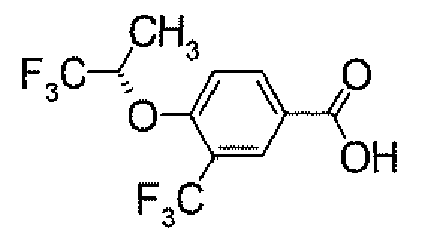
301 21-5 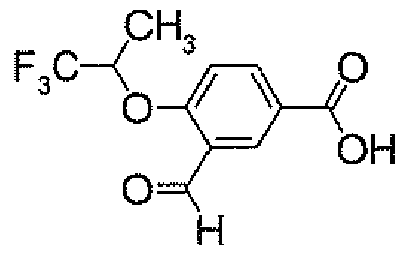
261 21-6 
311, 313 - To 5-bromo-2-(2,2,2-trifluoro-1-methylethoxy)benzonitrile in a mixed solvent of toluene/THF (4:1) was added a solution of n-BuLi in n-hexane at -78°C. With passing a CO2 gas therethrough, the solution was stirred for 0.5 hour. To the reaction solution was added a 1M aqueous NaOH solution to complete the reaction, and followed by extraction with diethyl ether. The organic layer was acidified by adding 1M HCl, extracted with EtOAc, dried over anhydrous MgSO4, and concentrated. The residue was purified by silica gel chromatography (chloroform:CH3OH=97:3 to 90:10) to obtain 3-cyano-4-(2,2,2-trifluoro-1-methylethoxy)benzoic acid as a white solid.
- The compound shown in Pr 22-1 was prepared in the same manner as in Preparation Example 22.
-
[Table 27] Pr Structure MS Pr Structure MS 22 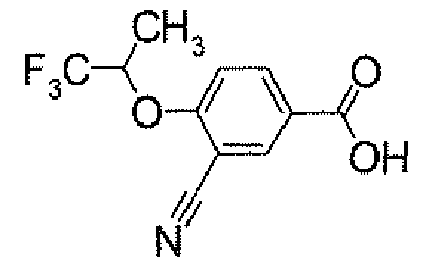
258 22-1 
189 - To a mixed solution was added a 1M aqueous NaOH solution (4.1 ml) of methyl 1-isobutyl-2-oxo-1,2-dihydropyridine-4-carboxylate (430 mg) in CH3OH-THF (4 ml - 3 ml). The solution was stirred at room temperature for 10 hours, and then concentrated under reduced pressure, and water (10 ml) was added, and subsequently 1M HCl was added thereto until pH becomes 3. The resulting solid was collected by filtration, washed with water, and dried under reduced pressure to obtain 1-isobutyl-2-oxo-1,2-dihydropyridine-4-carboxylic acid (325 mg) as white powders.
-
[Table 28] Pr Structure MS 23 
194 - A solution of 1H-benzimidazole-5-carboxylic acid (75.0 g) in dichloromethane (750 ml) was allowed to be reacted with oxalyl chloride (76.3 g, 52.4 ml) at room temperature for 1 hour, and then the reaction solution was concentrated. To a solution of the residue in THF (750 ml) was added a 28% aqueous NH3 solution (5 ml) under ice-cooling. This reaction mixture was stirred at the same temperature, and the reaction solution was concentrated. The purple residue was powdered/washed with IPE/IPA, and then collected by filtration to obtain 1H-benzimidazole-6-carboxamide (129 g) (including inorganic salts).
- The compound shown in Pr 24-1 was prepared in the same manner as in Preparation Example 24.
-
[Table 29] Pr Structure MS Pr Structure MS 24 
162 24-1 
184 - To a solution of 1H-1,2,3-benzotriazole-5-carboxylic acid (2 g), EDCI/HCl (2.82 g), and HOBt in DMF (70 ml) was added an aqueous NH3 solution (5.1 ml), followed by reaction at room temperature for 2 hours. It was concentrated, and the residue was washed with a saturated NaHCO3 solution, collected by filtration, and dried to obtain 1H-1,2,3-henzotriazole-5-carboxamide (1.98 g) as a black solid.
Preparation Example 25-3
In a 50 ml reaction vessel, to a solution of methyl 4-chloro-2-methyl-1H-benzimidazole-6-carboxylate ester (300 mg) in formamide (2.65 ml) was added NaOCH3 (288 mg) at room temperature. The solution was stirred at 80°C for 3 hours. Completion of the reaction was confirmed by TLC and LC, and then the reaction solution was concentrated, and added with water to complete the reaction. It was extracted with EtOAc. The organic layer was washed with saturated brine, dried over anhydrous MgSO4, and then filtered, and the filtrate was concentrated. It was purified by silica gel column chromatography (automatic purifier, chloroform:CH3OH=100:0 to 90:10) to obtain 4-chloro-2-methyl-1H-benzimidazole-6-carboxamide (257 mg) as a white solid. - The compound shown in Pr 25-2 was prepared in the same manner as in Preparation Example 25-1.
-
[Table 30] Pr Structure MS Pr Structure MS 25-1 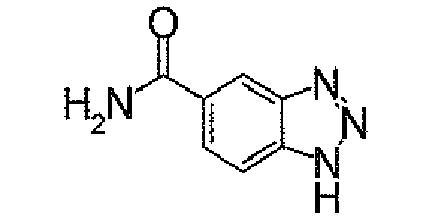
185 25-2 
201 25-3 
232, 234 - To a solution of 3-formyl-4-(2,2,2-trifluoro-1-methylethoxy)benzoic acid (490 mg) and K2CO3 (387 mg) in acetone (10 ml) was added iodomethane (350 µl) at room temperature, followed by stirring for 2 hours. The reaction mixture was diluted with water (15 ml), and extracted with EtOAc (30 ml). The organic layer was dried over anhydrous MgSO4, and filtered to remove the desiccant, and the solvent was concentrated. The residue was purified by silica gel column chromatography (n-hexane:EtOAc=95:5 to 80:20) to obtain methyl 3-formyl-4-(2,2,2-trifluoro-1-methylethoxy)benzoate (122 mg) as a white solid.
-
[Table 31] Pr Structure MS 26 
275 - Under ice-cooling, to DMF (30 ml) was slowly added dropwise POCl3 (6.68 g, 4.06 ml), followed by reaction at room temperature for 2 hours, and then a solution of 1H-benzimidazole-6-carboxamide (2.38 g) in DMF (47.6 ml) was added thereto, followed by stirring at room temperature for 2 hours. To the solution was added a 1M aqueous NaOH solution (pH 6 to 7), followed by stirring at room temperature for 0.5 hour. The solution was extracted with EtOAc, and the organic layer was combined, washed with saturated brine, dried over anhydrous MgSO4, and then filtered, and the filtrate was concentrated. The residue was purified by silica gel chromatography, and powdered/washed with IPE to obtain 1H-benzimidazole-6-carbonitrile (0.58 g) as a pale red crystal.
- The compounds shown in Pr 27-1 through Pr 27-2 were prepared in the same manner as in Preparation Example 27.
-
[Table 32] Pr Structure MS Pr Structure MS 27 
144 27-1 
192 27-2 
144 - A solution of 1,3-benzothiazole-6-carboxamide (1.96 g) in POCl3 (10 ml) was refluxed for 4 hours. The reaction solution was concentrated, and water was slowly added thereto at 0°C. It was extracted with EtOAc, and the organic layer was dried over anhydrous MgSO4, and then filtered, and the filtrate was concentrated. The residue was purified by silica gel column chromatography (n-hexane:EtOAc=80:20 to 60:40) to obtain 1,3-benzothiazole-6-carbonitrile as a pale yellow solid.
- The following Pr 28-1 was prepared in the same manner as in Preparation Example 28.
-
[Table 33] Pr Structure MS Pr Structure MS 28 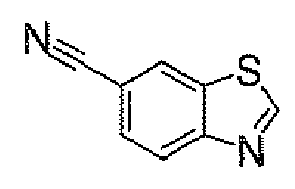
183 28-1 
143 - To a solution of 6-bromo[1,2,4]triazolo[1,5-a]pyridine (400 mg) in DMF were added tris(dibenzylideneacetone)dipalladium (0), 1'-bis(diphenylphosphino)ferrocene, and Zn(CN)2 under a nitrogen atmosphere, followed by stirring at 110°C for 23 hours. It was cooled to room temperature, and saturated NH4Cl (12 ml), a saturated NH3 solution (6 ml), and H2O (12 ml) were added thereto. The reaction mixture was extracted three times with EtOAc. The organic layer was washed with saturated brine, dried over anhydrous MgSO4, and then filtered, and the filtrate was concentrated. The residue was purified by silica gel column chromatography (0 to 5% CH3OH/chloroform)[1,2,4]triazolo[1,5-a]pyridine-6-carbonitrile as a dark red solid.
- In a 100 ml reaction vessel, to a solution of 6-bromo-7-methyl-1H-benzimidazole (500 mg) in DMF were added Zu(CN)2 (834 mg) and Pd (PPh)4 (547 mg) at room temperature, followed by stirring at 150°C for 5 hours. The reaction solution was poured into a 1:1 mixed solvent of a saturated NaHCO3 solution and EtOAc, followed by stirring for 1 hour. The organic layer was washed with saturated brine, dried over anhydrous MgSO4, and then filtered, and the filtrate was concentrated. It was purified by silica gel column chromatography (automatic purifier, chloroform:CH3OH=98:2 to 90:10) to obtain 7-methyl-1H-benzimidazole-6-carbonitrile (161.8 mg) as a brown solid.
- The following Pr 30-1 through Pr 30-7 were prepared in the same manner as in Preparation Example 30. They were also prepared by the method as in Preparation Example 29.
-
[Table 34] Pr Structure Data Pr Structure Data 29 
NMR:7.98 (1H,d),8.04 (1H,d),8.74 (1H,s),9.90-9.87(1H,m) 30 
MS:158 30-1 
NMR:7.67 (1H,dd),8.25 (1H,ddd), 8.34(1H,dd), 10.17(1H,s) 30-2 
MS:158 30-3 
MS:144 30-4 
MS:176 30-5 
NMR:10.17 (1H,s),8.34 (1H,dd),8.25 (1H,ddd), 7.67(1H,dd) 30-6 
NMR: 7.95(1 H, dd),8.19 (1H,dd), 8.23(1H,dd) 30-7 
MS:157 - To a mixed solution of 4-hydroxy-3-nitrobenzonitrile (1 g) and NH4Cl (163 mg) in ethanol (20 ml), THF (10 ml), and water (10 ml) were added Celite (5 g) and reduced iron (1.7 g), followed by heating under reflux at 70°C for 30 min. The reaction solution was cooled to room temperature, diluted with EtOAc (200 ml), and then filtered through celite. The solution was washed with saturated brine, the organic layer was dried over anhydrous MgSO4, and filtered, and the filtrate was concentrated under reduced pressure to obtain 3-amino-4-hydroxybenzonitrile (740 mg) as a pale brown solid.
- The following Pr 31-1 through Pr 31-3 were prepared in the same manner as in Preparation Example 31.
-
[Table 35] Pr Structure MS Pr Structure MS 31 
133 31-1 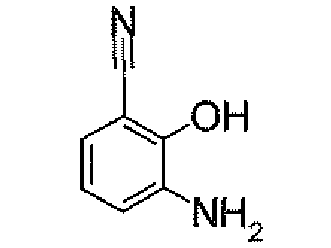
157 31-2 
225, 227 31-3 
170 - To a mixed solution of 4-amino-3-nitrobenzonitrile (8 g) in EtOH/THF (40 ml)/40 ml) was added Pd-C(50%wet) (0.8 g), followed by stirring under an H2 atmosphere for 12 hours. The reaction solution was filtered through celite, and concentrated. The residue was powdered/washed with a mixed solvent of IPE and IPA, and collected by filtration to obtain 3,4-diaminobenzonitrile (6.3 g) as orange powders.
-
[Table 36] Pr Structure MS 32 
156 - To a solution of 2-amino-3-nitrobenzonitrile (2 g) in THF (30 ml) were added 4-pentenoyl chloride (2.90 g) and diisopropylethylamine (4.27 ml), followed by stirring at 80°C for 12 hours. The reaction solution was poured into water, and extracted with EtOAc. The organic layer was dried over anhydrous MgSO4, and then filtered, and the filtrate was concentrated under reduced pressure. The residue was purified by silica gel column chromatography (chloroform:CH3OH) to obtain N-(4-cyano-2-nitrophenyl)pent-4-enamide (174 mg) as a colorless liquid.
- The following Pr 33-1 through Pr 33-2 were prepared in the same manner as in Preparation Example 33.
-
[Table 37] Pr Structure MS Pr Structure MS 33 
244 33-1 
290 33-2 
264 - To a solution of 3-chloro-4-fluorobenzonitrile (300 mg) and 1,1,1-trifluoro-2-propanol (263 mg) in THF (15 ml) was added 60% NaH (92.5 mg) at 5°C, followed by stirring at room temperature for 2 hours, addition of a saturated NH4Cl solution to complete the reaction, and extraction with EtOAc. The obtained organic layer was dried over anhydrous MgSO4, and concentrated. The residue was purified by silica gel chromatography (n-hexane:EtOAc=97:3 to 85:15) to obtain 3-chloro-4-(2,2,2-trifluoro-1-methylethoxy)benzonitrile (435 mg) as a colorless oily substance.
- The following Pr 34-1 through Pr 34-6 were prepared in the same manner as in Preparation Example 34.
-
[Table 38] Pr Structure Data Pr Structure Data 34 
NMR below 34-1 
NMR below 34-2 
MS: 252 34-3 
MS: 268 34-4 
NMR below 34-5 
MS: 316, 318 34-6 
MS: 242 -
[Table 39] Pr NMR 34 1.48(3H,d),5.53(1H,m),7.57(1H,d),7.87(1H,dd),8.09(1H,d) 34-1 1.47(3H,d),5.50(1H,m),7.59(1H,t),7.74(1H,dm),7.95(1H,dd) 34-4 1.47(3H,d),5.48(1 H,m),7.46(1 H,d),7.90(1H,dd),8.08(1H,d) - In a 50 ml reaction vessel, to a solution of 4-{5-[3-(trifluoromethyl)-4-(2,2,2-trifluoro-1-methylethoxy)phenyl]-1,2,4-oxadiazol-3-yl}-1H-indole (100 mg) in DMF (1 ml) was added 60% NaH (10.9 mg) at 0°C. The solution was warmed to room temperature, followed by stirring for 0.5 hour. Further, tertiary-butyl (2-iodoethoxy)dimethylsilane was added thereto at 0°C, followed by stirring at room temperature for 15 hours. Completion of the reaction was confirmed by LC-MS, and then the reaction solution was added with water (30 ml). It was extracted three times with EtOAc (20 ml). The organic layer was washed with saturated brine, dried over anhydrous MgSO4, and concentrated under reduced pressure. It was purified by silica gel column chromatography (automatic purifier, n-hexane:EtOAc=100:0 to 90:10) to obtain 1-(2-{[tertiary-butyl (dimethyl)silyl]oxy}ethyl)-4-{5-[3-(trifluoromethyl)-4-2,2,2-trifluoro-1-anethylethoxy)phenyl]-1,2,4-oxadiazol-3-yl}-1H-indole (86.4 mg) as a white solid.
-
[Table 40] Pr Structure MS 35 
622 - LiH (78 mg) was suspended in DMF (5 ml), and a suspension of methyl-2-oxo-1,2-dihydropyridine-4-carboxylate (500 mg) in DMF (5 ml) was added dropwise thereto at room temperature. The suspension was stirred as it was, and a solution of 1-indo-2-methylpropane (506 µl) in DMF (5 ml) was added dropwise thereto over 10 min, followed by stirring at 50°C for 15 hours. To the reaction solution was added 1M HCl at 0°C, followed by extraction with EtOAc, and the organic layer was washed with saturated brine, dried over anhydrous MgSO4, and filtered, and the solvent was evaporated under reduced pressure. The residue was purified by silica gel chromatography (n-hexane:EtOAc=90:10 to 50:50) to obtain methyl-1-isobutyl-2-oxo-1,2-dihydropyridine-4-carboxylate (440 mg) as white powders.
-
[Table 41] Pr Structure MS 36 
210 - To a solution of 4-fluoro-3-nitrobenzonitrile (300 mg) and dimethyl malonate (286 mg) in DMF was added 60% NaH at 0°C, followed by reaction at room temperature to obtain dimethyl (4-cyano-2-nitrophenyl)malonate (198 mg).
-
[Table 42] Pr Structure MS 37 
301 - To a solution of dimethyl (4-cyano-2-nitrophenyl) malonate (198 mg) in DMSO (5 ml) were added LiCl (60.3 mg) and H2O (12 µl), followed by stirring at 100°C for 3 hours. The reaction solution was cooled to room temperature, and poured into EtOAc and saturated brine for partition. The organic layer was washed with saturated brine, dried over anhydrous MgSO4, and then filtered, and the filtrate was concentrated. The residue was purified by silica gel column chromatography (n-hexane:EtOAc=90:10 to 75:25) to obtain methyl (4-cyano-2-nitrophenyl)acetate (128 mg) as a yellow oil.
-
[Table 43] Pr Structure MS 38 
219 - To a solution of 4-chloro-3-(trifluoromethyl)benzonitrile (1 g) and iron(3+) tris[(2Z)-4-oxopent-2-ene-2-oleate] (86 mg), and 1-methylpyrrolidin-2-one (2.8 ml) in THF (30 ml) was added a solution of 2M bromo(isobutyl)magnesium in diethyl ether (2.9 ml) under ice-cooling. The solution was stirred at room temperature for 30 minutes, and diluted with diethyl ether (30 ml), and then 1M HCl was carefully added thereto to complete the reaction. The reaction solution was extracted with EtOAc (100 ml), and the organic layer was dried over anhydrous MgSO4, and then filtered, and the filtrate was concentrated under reduced pressure. The residue was purified by silica gel column chromatography (n-hexane:EtOAc==100:0 to 95:5) to obtain 4-isobutyl-3-(trifluoromethyl)benzonitrile (320 mg) as a pale yellow liquid.
- The following Pr 39-1 was prepared in the same manner as in Preparation Example 39.
-
[Table 44] Pr Structure Data 39 
NMR:0.89(6H,d),1.91-2.03(1H,m),2.70(2H,dm), 7.70(1H,d),8.09(1H,dd), 8.21(1H,d) 39-1 
MS:262 - To a solution of 4-fluoro-3-formylbenzonitrile (300 mg) in dichloromethane (7 ml) was added 2-methoxy-N-(2-methoxyethyl)-N-(trifluoro-λ4-sulfanyl)ethanamine (757 mg) at room temperature, followed by stirring for 6 hours, and addition of a saturated aqueous NaHCO3 solution (15 ml). After extraction with chloroform (30 ml), the organic layer was dried over anhydrous MgSO4, filtered, and concentrated. The residue was purified by silica gel column chromatography (n-hexane:EtOAc=95:5 to 80:20) to obtain 3-(difluoromethyl)-4-fluorobenzonitrile (174 mg) as a colorless liquid.
- The following Pr 40-1 was prepared in the same manner as in Preparation Example 40.
-
[Table 45] Pr Structure Data Pr Structure Data 40 
NMR:7.25(1H, t),7.66(1H,dd), 8.14-8.20(1H,m),8.2 2(1H, dm) 40 -1 
MS: 321 - The following Pr 41-1 through Pr 41-10 were prepared in the same manner as in Example 2.
-
[Table 46] Pr Structure MS Pr Structure MS 41 -1 
427 41 -2 
393 41 -3 
373 41 -4 
585 41 -5 
349 41 -6 
437 41 -7 
362 41 -8 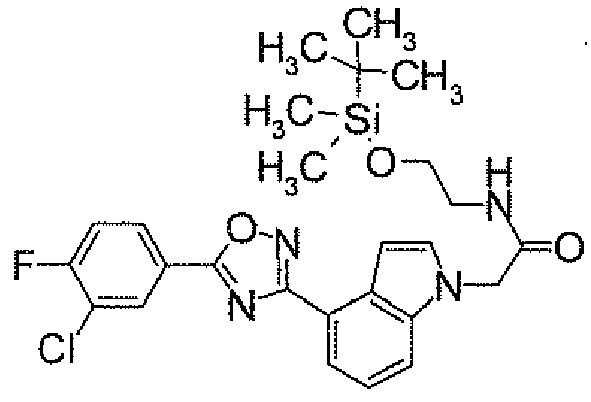
551 41 -9 
405 41 10 
410 - The following Pr 42-1 through Pr 42-3 were prepared in the same manner as in Example 5.
-
[Table 47] Pr Structure Data 42-1 
NMR:1.67(6H,s), 7.71(1H,d),8.12 (1H,dd),8.26(1H,d) 42-2 
MS:282 42-3 
NMR:1.67(6H,s), 7.71(1H,d),8.12 (1H,dd),8.26(1H,d) MS:288 - The following Pr 43 was prepared in the same manner as in Example 6.
-
[Table 48] Pr Structure MS 43 
627 - The following Pr 44-1 and Pr 44-2 were prepared in the same manner as in Example 12.
-
[Table 49] Pr Structure MS 44-1 
536 44-2 
222 - The following Pr 45 was prepared in the same manner as in Preparation Example 47.
-
[Table 50] Pr Structure NMR 45 
1.47(3H,d),5.49-5.60(1H,m),7.09 (1H,t),7.50(1H,d), 8.07-8.13(2H,m) - The following Pr 46-1 through Pr 46-5 were prepared in the same manner as in Example 19.
-
[Table 51] Ex Structure MS 46-1 
625 46-2 
661 46-3 
657 46-4 
751 46-5 
380 - To a solution of ethyl (7-{5-[3-(trifluoromethyl)-4-(2,2,2-trifluoro-1-methylethoxy)phenyl]-1,2,4-oxadiazol-3-yl}imidazo[1,2-a]pyridin-2-yl)acetate (230 mg) in THF (2.0 ml) was added a 1M aqueous NaOH solution (1.0 ml), followed by stirring at 80°C for 2 hours. After cooling to room temperature, a 1 M HCl aqueous solution (1.0 ml) was added thereto, followed by extraction with chloroform. The organic layer was dried over anhydrous MgSO4, and then filtered, and the filtrate was concentrated. The residue was purified by silica gel column chromatography (chloroform:CH3OH=10:1 to 5:1) to obtain colorless powders. To a solution of this colorless powder in EtOAc was added a 4M HCl/EtOAc solution, followed by concentration. The resulting colorless powder was powdered/washed with IPE to obtain (7-{5-[3-(trifluoromethyl)-4-(2,2,2-trifluoro-1-methylethoxy)phenyl]-1,2,4-oxadiazol-3-yl}imidazo[1,2-a]pyridin-2-yl)acetic acid hydrochloride (180.4 mg) as colorless powders.
- The following Pr 47-1 through Pr 47-13 were prepared in the same manner as in Preparation Example 47.
-
[Table 52] Pr Structure Pr Structure 47 
47 -1 
47 -2 
47 -3 
47 -4 
47 -5 
47 -6 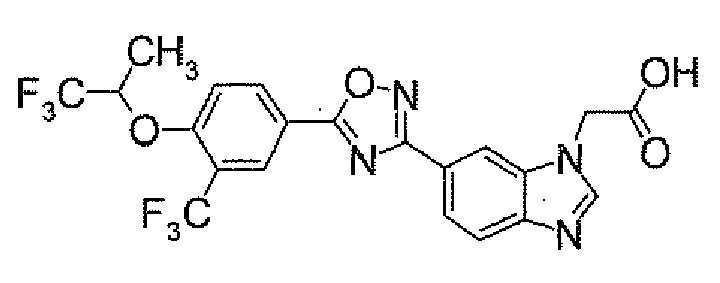
47 -7 
47 -8 
47 -9 
47 -10 
47 -11 
47 -12 
47 -13 
-
[Table 53] Pr MS Pr MS Pr MS Pr MS 47 501 47-1 515 47-2 501 47-3 499 47-4 522 47-5 514 47-6 499 47-7 530 47-8 500 47-9 468 47-10 504 47-11 555 47-12 498 47-13 585 - A solution of 3-(trifluoromethyl)-4-(2,2,2-trifluoro-1-methylethoxy)benzoic acid (810 mg), EDCI/HCl (616 mg), and N'-hydroxy-7-methylimidazo[1,2-a]pyridine-6-carboxamide (510 mg) in dioxane was stirred at 115°C for 60 hours. The reaction solution was concentrated, and the residue was partitioned between water and chloroform. The organic layer was dried over anhydrous MgSO4, and then filtered, and the filtrate was concentrated. The residue was purified by silica gel column chromatography (CH3OH/chloroform=0 to 5%), and recrystallized with EtOH to obtain 7-methyl-6-{5-[3-(trifluoromethyl)-4-(2,2,2-trifluoro-1-methylethoxy)phenyl]-1,2,4-oxadiazol-3-yl}imidazo[1,2-a]pyridine (60 mg) as a white solid.
- To a solution of 3-(trifluoromethyl)-4-(2,2,2-trifluoro-1-methylethoxy)benzoic acid (349 mg) in dichloromethane (6 ml) were added oxalyl chloride (333 mg) and a catalytic amount of DMF under ice-cooling, followed by stirring at room temperature for 1 hour. The reaction solution was concentrated, and azeotroped with toluene. To a solution of the residue in THF were added N'-hydroxy-2-methyl-1H-benzimidazole-6-carboxyimidamide (200 mg) and N-ethyl-N-isopropyl-2-propaneamine (543 mg). The reaction mixture was stirred at room temperature for 2 hours. To the reaction solution was added water, followed by three times extractions with EtOAc. The organic layer was combined, dried over anhydrous MgSO4, and then filtered, and the filtrate was concentrated. The residue was dissolved in dioxane, followed by stirring at 100°C for 3 hours. After cooling to room temperature, it was concentrated under reduced pressure to remove the solvent, and purified by silica gel column chromatography to obtain a colorless oily substance. To a solution of this oily substance in EtOAc was added a 4M HCl/EtOAc solution, followed by stirring for a few minutes, and then the reaction mixture was concentrated to obtain 2-methyl-5-{5-[3-(trifluoromethyl)-4-(2,2,2-trifluoro-1-methylethoxy)phenyl]-1,2,4-oxadiazol-3-yl}-1H-benzimidazole hydrochloride (239 mg) as a colorless crystal.
- To a solution of 4-(2,2,2-trifluoro-1,1-dimethylethoxy)-3-(trifluoromethyl)benzoic acid (118 mg) and 2-{4-[ammo(hydroxyimino)methyl]-1H-indol-1-yl}acetamide (104 mg) in dioxane (5 ml) was added DIC(69 µl), followed by stirring at room temperature for 3 hours, and then heating under reflux for 20 hours. The reaction solution was concentrated, and then to the residue was added water (15 ml), followed by extraction with chloroform (15 ml). The organic layer was washed with a saturated aqueous NaHCO3 solution and saturated brine, dried over anhydrous MgSO4, filtered, and the filtrate was concentrated under reduced pressure. The residue was purified by preparative HPLC (column: CAPCEL PAK, C18, MG, S-5, 30×50 mm; solvent: 50-90% acetonitrile/10 mM ammonium carbonate-ammonia (pH 9.2); 40 ml/min), and crystallized with diisopropyl ether to obtain 2-(4{5-[4-(2,2,2-trifluoro-1,1-dimethylethoxy)-3-(trifluoromethyl)phenyl]-1,2,4-oxadiazol-3-yl}-1H-indol-1-yl)acetamide (40 mg) as a white solid.
- To a suspension of 60% NaH (68.0 mg) in DMF was added cyclopropylmethanol (99 mg) at 0°C, followed by stirring at the same temperature for 15 min, and then 5-{5-[4-fluoro-3-(trifluoromethyl)phenyl]-1,2,4-oxadiazol-3-yl}-1H-benzimidazole (120 mg) was added thereto. The reaction mixture was stirred at room temperature for 2 hours, and then added with water. It was extracted with EtOAc, and the organic layer was concentrated. The residue was purified by silica gel column chromatography (CH3OH/chloroform=0 to 5%) to obtain an oily substance. A solution of the oily substance in chloroform-CH3OH was added with a 4M HCl/dioxane solution (0.5 ml), and concentrated to obtain 5-{5-[4-(cyclopropylmethoxy)-3-(trifluoromethyl)phenyl]-1,2,4-oxadiazol-3-yl}-1H-benzimidazole hydrochloride (20 mg) as a white solid.
HPLC analysis: Condition (TSK-GEL (TOSOH) ODS-80TM 4.6×150 mm, MeCN: 0.01M KH2PO4(7:3), 1.0 ml/min, 254 nm)[RT: 7.90 min] - To a solution of 2-(4-{5-[4-fluoro-3-(trifluoromethyl)phenyl]-1,2,4-oxadiazol-3-yl}-1H-indol-1-yl)acetamide (100 mg) and 2-propanol (35 µl) in DMF (3 ml) was added 60% NaH (12 mg) at 0°C, followed by stirring at room temperature for 9 hours. The reaction solution was added with water (5 ml) to complete the reaction, and extracted with as a mixed solvent of chloroform:CH3OH (8:2). The organic layer was washed with saturated brine, dried over anhydrous MgSO4, and then filtered, and the filtrate was concentrated under reduced pressure. The residue was purified by silica gel column chromatography (chloroform:CH3OH=98:2 to 93:7), and crystallized with diethyl ether to obtain 2-(4-{5-[4-isopropoxy-3-(trifluoromethyl)phenyl]-1,2,4-oxadiazol-3-yl}-1H-indol-1-yl)acetamide (25 mg) as a pale yellow solid.
- To a solution of 1,3-difluoropropanol (62 mg) in DMF (2.4 ml) was added 60% NaH (19 mg) at -10°C, followed by stirring at -10°C for 0.5 hour. To this reaction mixture was added 2-{4-[5-(3-chloro-4-fluorophenyl)-1,2,4-oxadiazol-3-yl]-1H-indol-1-yl}acetamide (120 mg) at -10°C, followed by stirring at -10°C for 3 hours. After adding water to the reaction solution, the reaction mixture was extracted with EtOAc, the organic layer was washed with saturated brine, dried over anhydrous MgSO4, and then filtered, and the filtrate was concentrated under reduced pressure. The residue was purified by silica gel column chromatography (chloroform:CH3OH=100:0 to 95:5) to obtain 2-[4-(5-{3-chloro-4-[2-fluoro-1-(fluoromethyl)ethoxy]phenyl}-1,2,4-oxadiazol-3-yl)-1H-indol-1-yl]acetamide (76.9 mg) as a white solid.
- To a solution of 2-{4-[5-(4-fluoro-3-methylphenyl)-1,2,4-oxadiazol-3-yl]-1H-indol-1-yl}acetamide (100 mg) and (2R)-1,1,1-trifluoropropane-2-ol (109 mg) in DMF (3 ml) was added 60% NaH (17 mg) at 0°C, followed by stirring at 80°C for 4 hours. The reaction solution was added with water (15 ml) to complete the reaction, filtered, and then dried. The obtained powder was purified by silica gel column chromatography (chloroform:CH3OH=100:0 to 95:5), and crystallized with diisopropyl ether to obtain 2-[4-(5-{3-methyl-4-[(1R)-2,2,2-trifluoro-1-methylethoxy]phenyl}-1,2,4-oxadiazol-3-yl)-1H-indol-1-yl]acetamide (70 mg) as a pale yellow solid.
- To a suspension of 60% NaH (43 mg) in DMF (4 ml) was added 2-propanol (65 mg) at 0°C, followed by stirring at room temperature for 20 min. After cooling to 0°C again, 2-{4-[5-(3-chloro-4-fluorophenyl)-1,2,4-oxadiazol-3-yl]-1H-indol-1-yl-acetamide (200 mg) was added thereto. The reaction mixture was radiated with a microwave at 60°C for 50 min. The reaction solution was added to an aqueous NH4Cl solution, followed by stirring, and then the solvent was evaporated. After adding a mixed solvent (4:1) of chloroform-CH3OH, and suspending, the solid was removed, silica gel was added thereto, and the solvent was evaporated. The residue was purified by silica gel column chromatography (chloroform:CH3OH=100:0 to 98:2; n-hexane:EtOAc=0:100) to obtain 2-{4-[5-(3-chloro-4-isopropylphenyl)-1,2,4-oxadiazol-3-yl]-1H-indol-1-yl}acetamide (17.5 mg) as a white solid.
- To a solution of 4-{5-[4-fluoro-3-(trifluoromethyl)phenyl]-1,2,4-oxadiazol-3-yl}-1H-indole (300 mg) in THF (1.5 ml) was added, propane-2-amine (0.75 ml), and after sealing the tube, the solution was stirred at 50 to 55°C for 40 hours. It was concentrated under reduced pressure, and then purified by silica gel chromatography (n-hexane:EtOAc). The obtained solid was dissolved in acetone under heating, and added with n-hexane, and the precipitate was filtered to obtain 4-[3-(1H-indol-4-yl)-1,2,4-oxadiazol-5-yl]-N-isopropyl-2-(trifluoromethyl)aniline (295 mg).
- To a mixed solution of 2-{4-[5-(5,6-dichloropyridin-3-yl)-1,2,4-oxadiazol-3-yl]-1H-indol-1-yl}acetamide (100 mg) in dioxane (2 ml) and NMP (2 ml) was added isopropylamine (220 µl), followed by stirring at 150°C for 1 hour in a microwave reaction vessel. The reaction mixture was concentrated under reduced pressure, and then the residue was purified by silica gel chromatography (n-hexane:EtOAc=40:60 to 0:100), and the obtained residue was suspended in diisopropyl ether under heating, and collected by filtration to obtain 2-(4-{5-[5-chloro-6-(isopropylamino)pyridin-3-yl]-1,2,4-oxadiazol-3-yl}-1H-indol-1-yl)acetamide (62 mg) as white powders.
- To a solution of 5-{5-[3-(trifluoromethyl)-4-(2,2,2-trifluoro-1-methylethoxy)phenyl]-1,2,4-oxadiazol-3-yl}-1H-benzimidazole (105 mg) in DMF (3.15 ml) was added 60% NaH (31 mg) under ice-cooling, followed by stirring at the same temperature for 15 min, and methyl iodide (0.22 ml) was added thereto, followed by stirring at room temperature for 5 hours. To the reaction was added water, followed by extraction with EtOAc, the organic layer was washed with saturated brine, dried over anhydrous MgSO4, and then filtered, and the filtrate was concentrated. The residue was purified by silica gel column chromatography (automatic producer, chloroform:CH3OH=10:1). The objective substance was dissolved in EtOAc (5 ml), added with a 4M HCl/EtOAc solution (5 ml), and concentrated to produce about 1:1 two regioisomers. The mixture was crystallized with acetonitrile to obtain 1-methyl-5-{5-[3-(trifluoromethyl)-4-(2,2,2-trifluoro-1-methylethoxy)phenyl]-1,2,4-oxadiazol-3-yl}-1H-benzimidazole hydrochloride (12.1 mg). The mother liquor was concentrated to obtain 1-methyl-5-{5-[3-(trifluoromethyl)-4-(2,2,2-trifluoro-1-methylethoxy)phenyl]-1,2,4-oxadiazol-3-yl}-1H-benzimidazole hydrochloride and 1-methyl-6-{5-[3-(trifluoromethyl)-4-(2,2,2-trifluoro-1-methylethoxy)phenyl]-1,2,4-oxadiazol-3-yl}-1H-benzimidazole hydrochloride (70.2 mg) as colorless powders.
- To a solution 4-(5-{3-(trifluoromethyl)-4-[(1S)-2,2,2-trifluoro-1-methylethoxy]phenyl}-1,2,4-oxadiazol-3-yl)-1H-indole (150 mg) in DMF (1.5 ml) was added 60% NaH (16 mg) at 0°C, followed by stirring at room temperature for 0.5 hour. Then, to the reaction mixture was added 2-bromoacetamide (70 mg) again at 0°C, followed by stirring at room temperature for 3 hours. To the reaction was added with water, followed by extraction with EtOAc, the organic layer was washed with saturated brine, dried over anhydrous MgSO4, and then filtered, and the filtrate was concentrated under reduced pressure. The residue was purified by silica gel column chromatography (chloroform: CH3OH=100:0 to 90:10) to obtain 2-[4-(5-{3-(trifluoromethyl)-4-[(1S)-2,2,2-trifluoro-1-methylethoxy]phenyl}-oxadiazol-3-yl)-1H-indol-1-yl]acetamide (145 mg) as a white solid.
- To a solution of 4-{5-[3-(trifluoromethyl)-4-(2,2,2-trifluoro-1-methylethoxy]phenyl]-1,2,4-oxadiazol-3-yl)indoline (100 mg) in acetonitrile (2.5 ml) was added K2CO3 (46 mg) and 3-iodopropanamide (124 mg) at room temperature, followed by stirring at 80°C for 15 hours. To the reaction solution was added an NaHCO3 aqueous saturated solution, followed by extraction with EtOAc. The organic layer was washed with saturated brine, dried over anhydrous MgSO4, and then filtered, and the filtrate was concentrated under reduced pressure. The residue was purified by silica gel column chromatography (chloroform:CH3OH=100:0 to 90:10) to obtain 3-(4-{5-[3-(trifluoromethyl)-4-(2,2,2-trifluoro-1-methylethoxy)phenyl]-1,2,4-oxadiazol-3-yl}-2, 3-dihydro-1H-indol-1-yl)propanamide (23.6 mg) as a white solid.
- To a solution of 4-{5-[3-(trifluoromethyl)-4-(2,2,2-trifluoro-1-methylethoxy)phenyl]-1,2,4-oxadiazol-3-yl}-1H-indole-3-carboaldehyde (150.0 mg) in CH3OH (1.5 ml) was added a 40% CH3OH solution of CH3NH2 (74.5 mg) at 0°C. After warming to room temperature, the solution was stirred at room temperature for 3 hours. After confirming the production of an iminium salt, the organic solvent was evaporated under reduced pressure. The residue was dissolved in EtOH (1.5 ml). To this was added NaBH4 (12.09 mg) at 0°C. After warming to room temperature, the solution was stirred at room temperature for 15 hours. To the reaction solution was added water (30 ml), followed by extraction three times with EtOAc (20 ml). The organic layer was combined, washed with saturated brine, dried over anhydrous MgSO4, and then filtered, and the filtrate was concentrated. The residue was purified by silica gel column chromatography (automatic purifier, chloroform:CH3OH=100:0 to 90:10) to obtain N-methyl-1-(4-{5-[3-(trifluoromethyl)-4-(2,2,2-trifluoro-1-methylethoxy)phenyl]-1,2,4-oxadiazol-3-yl}-1H-indol-3-yl)methanamine (87.4 mg) as a white solid.
- To a solution of 4-{5-[3-(trifluoromethyl)-4-(2,2,2-trifluoro-1-methylethoxy)phenyl]-1,2,4-oxadiazol-3-yl}indoline (100 mg) in DMF (1.0 ml) was added 60% NaH (10.9 mg) at 0°C, followed by stirring at room temperature for 0.5 hour. Acetyl chloride (24.1 µl) was added thereto at 0°C, followed by stirring at room temperature for 3 hours. To the reaction solution was added water (30 ml), followed by extraction three times with EtOAc (20 ml). The organic layer was washed with saturated brine, dried over anhydrous MSO4, and then filtered, and the filtrate was concentrated. The residue was purified by silica gel column chromatography (automatic purifier, n-hexane:EtOAc-90:10 to 60:40) to obtain 1-acetyl-4-{5-[3-(trifluoromethyl)-4-(2,2,2-trifluoro-1-methylethoxy)phenyl]-1,2,4-oxadiazol-3-yl}indoline (56.8 mg) as a white crystal.
- To a solution of 4-{5-[3-(trifluoromethyl)-4-(2,2,2-trifluoro-1-methylethoxy)phenyl]-1,2,4-oxadiazol-3-yl}-1H-indole (80 mg) in DMF (0.80 ml) was added 60% NaH (8.7 mg) at 0°C, followed by stirring at room temperature for 0.5 hour. Methanesulfonyl chloride (21.1 µl) was added thereto at 0°C, followed by stirring at room temperature for 3 hours. To the reaction solution was added water (30 ml), followed by extraction three times with EtOAc (20 ml). The organic layer was combined, washed with saturated brine, dried over anhydrous MgSO4, and then filtered, and the filtrate was concentrated. The filtrate was purified by silica gel column chromatography (automatic purifier, chloroform:CH3OH=100:0 to 98:2) to obtain 1-(methylsulfonyl)-4-{5-[3-(trifluoromethyl)-4-(2,2,2-trifluoro-1-methylethoxy)phenyl]-1,2,4-oxadiazol-3-yl}-1H-indole (15.6 mg) as a white solid.
- 4- {5-[3-(Trifluoromethyl)-4-(2,2,2-trifluoro-1-methylethoxy)phenyl]-1,2,4-oxadiazol-3-yl}-1H-indole (100 mg) was dissolved in DMF (1.0 ml), followed by addition of 60% NaH (10.9 mg) at 0°C, and stirring at room temperature for 0.5 hour. Methyl chloride carbonate (26.3 µl) was added thereto at 0°C, followed by stirring at room temperature for 3 hours. To the reaction solution was added water (30 ml), followed by extraction three times with EtOAc (20 ml), the organic layer was combined, washed with saturated brine, dried over anhydrous MgSO4, and then filtered, and the filtrate was concentrated. The residue was purified by silica gel column chromatography (automatic purifier, chloroform:CH3OH=100:0 to 98:2) to obtain methyl 4-{5-[3-(trifluoromethyl)-4-(2,2,2-trifluoro-1-methylethoxy)phenyl]-1,2,4-oxadiazol-3-yl}-1H-indole-1-carboxylate (98.6 mg) as a white solid.
- To a solution of 3-(5-{5-[3-(trifluoromethyl)-4-(2,2,2-trifluoro-1-methylethoxy)phenyl]-1,2,4-oxadiazol-3-yl}-1H-benzimidazol-2-yl)propanoic acid (23.5 mg) in dichloromethane (0.7 ml) were added oxalyl chloride (0.01 ml) and a few drops of DMF, followed by stirring at room temperature for 1 hour. The reaction mixture was concentrated to remove the solvent and the reagent. To a solution of the residue in THF was added NH4OH, followed by further stirring for 1 hour. To the reaction solution was added a saturated aqueous NH4Cl solution, followed by extraction with EtOAc. The organic layer was dried over anhydrous MSO4, and the filtrate was concentrated. The residue was purified by silica gel column chromatography (chloroform:CH3OH=10.1) to obtain colorless powders. To a solution of the colorless powders in EtOAc was added a solution of 4N-HCl in EtOAc. The reaction mixture was concentrated, and the residue was powdered and washed with IPE to obtain 3-(5-{5-[3-(trifluoromethyl)-4-(2,2,2-trifluoro-1-methylethoxy)phenyl]-1,2,4-oxadiazol-3-yl}-1H-benzimidazol-2-yl)propanamide hydrochloride as pale yellow powders.
- To a solution of (4-{5-[3-(trifluoromethyl)-4-(2,2,2-trifluoro-1-methylethoxy)phenyl]-1,2,4-oxadiazol-3-yl}-1H-indol-1-yl)acetic acid (150 mg) and HOBt(65 mg) in DMF (1.5 ml) was added EDCI/HCl (69 mg) at 0°C, followed by stirring at room temperature for 1 hour. After cooling to 0°C again, 1-pyridin-2-ylmethanamine (39 mg) was added thereto, followed by stirring at room temperature for 15 hours. To the reaction solution was added a saturated aqueous NaHCO3 solution to complete the reaction. It was extracted with EtOAc, the organic layer was washed with saturated brine, dried over anhydrous MgSO4, and then filtered, and the filtrate was concentrated under reduced pressure. The residue was purified by silica gel column chromatography (chloroform:CH3OH=100:0 to 95:5) to obtain N-(pyridin-2-ylmethyl)-2-(4-{5-[3-(trifluoromethyl)-4-(2,2,2-trifluoro-1-methylethoxy)phenyl]-1,2,4-oxadiazol-3-yl}-1H-indol-1-yl)acetamide (157.8 mg) as a white solid. To a solution ofN-(pyridin-2-ylmethyl)-2-(4-{5-[3-(trifluoromethyl)-4-(2,2,2-trifluoro-1-methylethoxy)phenyl]-1,2,4-oxadiazol-3-yl}-1H-indol-1-yl)acetamide (120 mg) in methylene chloride (2.4 ml) was added dropwise 10 equivalents of 4M HCl/dioxane, followed by stirring for 1 hour. The reaction mixture was concentrated under reduced pressure, and powdered/washed with IPE. The obtained solid was collected by filtration, and dried to obtain N-(pyridin-2-ylmethyl)-2-(4-{5-[3-(trifluoromethyl)-4-(2,2,2-trifluoro-1-methylethoxy)phenyl]-1,2,4-oxadiazol-3-yl}-1H-indol-1-yl)acetamide hydrochloride (126 mg) as a white solid.
- To a solution of [4-(5-{3-(trifluoromethyl)-4-[(1S)-2,2,2-trifluoro-1-methylethoxy]phenyl}-1,2,4-oxadiazol-3-yl)-1H-indol-1-yl]acetic acid (100 mg) in DMF (1 ml) was added CDI (39 mg), and after 30 min, methanesulfonamide (23 mg) and 2,3,4,6,7,8,9,10-octahydropyrimide[1,2-a]azepine (37 mg) were added thereto, followed by stirring at room temperature for 15 hours. The reaction mixture was added with water to complete the reaction. It was extracted with EtOAc, the obtained organic layer was washed with saturated brine, dried over anhydrous MSO4, and then filtered, and the filtrate was concentrated. The residue was purified by silica gel column chromatography (chloroform:CH3OH=100:0 to 90:10) to obtain N-(methylsulfonyl)-2-[4-(5-{3-(trifluoromethyl)-4-[(1S)-2,2,2-trifluoro-1-methylethoxy]phenyl}-1,2,4-oxadiazol-3-yl)-1H-indol-1-yl]acetamide (56.4 mg) as a white solid.
- POCl3(158.4 µl) was added dropwise to a DMF solution (4 ml) at 0°C. After warming to room temperature, it was stirred for 0.5 hour. Then, a solution of 4-{5-[3-(trifluoromethyl)-4-(2,2,2-trifluoro-1-methylethoxy)phenyl]-1,2,4-oxadiazol-3-yl}-1H-indole (500.0 mg) in DMF (1 ml) was added thereto at 0°C, followed by stirring at room temperature for 15 hours. After cooling to 0°C, to the reaction solution was added a 1M aqueous NaOH solution for adjustment of its pH to 9 to 10. This solution was stirred at 100°C for 1 hour. After being left to be cooled, to the reaction solution was added water (30 ml), followed by extraction three times with EtOAc (20 ml). The organic layer was combined, washed with saturated brine, dried over anhydrous MSO4, and then filtered, and the filtrate was concentrated. The residue was purified by silica gel column chromatography (automatic purifier, n-hexane, EtOAc=90:10 to 70:30) to obtain 4-{5-[3-(trifluoromethyl)-4-(2,2,2-trifluoro-1-methylethoxy)phenyl]-1,2,4-oxadiazol-3-yl}-1H-indole-3-carboaldehyde (456.7 mg) as a white solid.
- To a mixed solution of 5-[3-(1H-benzimidazol-6-yl)-1,2,4-oxadiazol-5-yl]-2-(2,2,2-trifluoro-1-methylethoxy)benzaldehyde (83 mg), potassium dihydrogen phosphate (421 mg), and 2-methyl-2-butene (0.5 ml) in tBuOH (2 ml) and water (0.5 ml) was added sodium chlorite (187 mg) at room temperature. The mixed reaction solution was stirred at room temperature for 3 hours, followed by dilution with water (10 ml), and extraction with EtOAc (20 ml). The organic layer was washed with saturated brine, dried over anhydrous MgSO4, and then filtered, and the filtrate was concentrated. To a solution of the residue in dioxane was added a 4 N HCl-dioxane solution, followed by concentration. The resulting powder was recrystallized with IPA (10 ml) to obtain 5-[3-(1H-benzimidazol-5-yl)-1,2,4-oxadiazol-5-yl]-2-(2,2,2-trifluoro-1-methylethoxy)benzoic acid hydrochloride (80 mg) as white powders.
- To a solution of 2-[2-(methylthio)ethyl]-5-{5-[3-(trifluoromethyl)-4-(2,2,2-trifluoro-1-methylethoxy)phenyl]-1,2,4-oxadiazol-3-yl}-1H-benzimidazole (400 mg) in dichloromethane (8.0 ml) was added mCPBA (534 mg), followed by stirring at room temperature for 3 hours. To the reaction mixture was added a Na2S2O4 aqueous solution, followed by stirring for 1 hour. The reaction solution was extracted three times with EtOAc, and the organic layer was combined, dried over anhydrous MgSO4, filtered, and then concentrated. The residue was purified by silica gel chromatography (chloroform:CH3OH=10:1) to obtain a yellow oily substance. This was dissolved in EtOAc, and a 4M-HCl/EtOAc solution was added thereto, followed by concentration. The residue was washed with IPE to obtain 2-[2-(methylsulfonyl)ethyl]-5-{5-[3-(trifluoromethyl)-4-(2,2,2-trifluoro-1-methylethoxy)phenyl]-1,2,4-oxadiazol-3-yl}-1H-benzimidazole hydrochloride (146 mg) as pale yellow powders.
- To a reaction mixture of 2-but-3-en-1-yl-5-{5-[3-(trifluoromethyl)-4-(2,2,2-trifluoro-1-methylethoxy)phenyl]-1,2,4-oxadiazol-3-yl}-1H-benzimidazole (200 mg) in acetone (4 ml) and water (1 ml) were added tetraoxoosmium (51 mg) and 4-methylmorpholine 4-oxide (94 mg), followed by stirring overnight. The reaction mixture was filtered, and to the filtrate was added an aqueous sodium thiosulfate solution, followed by stirring for 1 hour. The solution was extracted with chloroform, and the organic layer was concentrated. The residue was purified by silica gel column chromatography (chloroform-CH3OH), and concentrated, and the obtained colorless powder was added with a solution of HCl in ethanol, and dissolved therein, followed by concentration. The residue was powdered/washed with diisopropyl ether to obtain 4-(5- {5-[3-(trifluoromethyl)-4-(2,2,2-trifluoro-1-methylethoxy)phenyl]-1,2,4-oxadiazol-3-yl}-1H-benzimidazol-2-yl)butane-1,2-diol hydrochloride (102.3 mg).
- To a solution of 3-(4-{5-[3-(trifluoromethyl)-4-(2,2,2-trifluoro-1-methylethoxy)phenyl]-1,2,4-oxadiazol-3-yl}-2,3-dihydro-1H-indol-1-yl)propanamide (100 mg) in chloroform (1 ml) was added manganese dioxide (67.6 mg), followed by reflux for 15 hours. The reaction solution was left to be cooled to room temperature, and filtered through Celite to remove manganese dioxide. The filtrate was concentrated under reduced pressure. The residue was purified by silica gel column chromatography (chloroform:CH3OH=100:0 to 90:10) to obtain 3-(4-{5-[3-(trifluoromethyl)-4-(2,2,2-trufluoro-1-methylethoxy)phenyl]-1,2,4-oxadiazol-3-yl}-1H-indol-1-yl) propanamide (46.3 mg).
- To a solution 4-{5-[3-(trifluoromethyl)-4-(2,2,2-trifluoro-1-methylethoxy)phenyl]-1,2,4-oxadiazol-3-yl}-1H-indole (100 mg) in AcOH (3 ml) was added portionwise sodium cyanoboroate (29 mg). The reaction mixture was stirred at room temperature for 2 hours. The reaction mixture was diluted with water, alkalified with a 1M aqueous NaOH solution, and extracted with EtOAc. The organic layer was washed with saturated brine, dried over anhydrous MgSO4, and then filtered, the filtrate was concentrated, and the residue was purified by silica gel column chromatography (n-hexane:EtOAc=90:10 to 75:25), and washed with n-hexane to obtain 4-{5-[3-(trifluoromethyl)-4-(2,2,2-trifluoro-1-methylethoxy)phenyl]-1,2,4-oxadiazol-3-yl}indoline (90 mg) as a pale yellow solid.
- To a solution of 5-[3-(1H-benzimidazol-6-yl)-1,2,4-oxadiazol-5-yl]-2-(2,2,2-trifluoro-1-methylethoxy)benzaldehyde (80 mg) in ethanol (3 ml) was added NaBH4 (9 mg) at 0°C. After stirring at room temperature for 0.5 hour, a saturated NH4Cl solution (10 ml) was added thereto, followed by extraction with EtOAc (20 ml). The organic layer was washed with saturated brine, dried over anhydrous MgSO4, and then filtered, and the filtrate was concentrated. To a solution of the residue (78 mg) in dioxane was added a 4M HCl/dioxane solution, followed by concentration. The resulting powder was recrystallized with IPA (10 ml) to obtain [5-[3-(1H-benzimidazol-5-yl)-1,2,4-oxadiazol-5-yl]-2-(2,2,2-trifluoro-1-methylethoxy)phenyl]methanol hydrochloride (70 mg) as white powders.
- A solution of 5-methyl-6-{5-[3-trifluoro)-4-(2,2,2-trifluoro-1-methylethoxy)phenyl]-1,2,4-oxadiazol-3-yl}imidazo[1,2-a]pyridine (120 mg) and NCS in THF/EtOH (1/1) was stirred at 80°C for overnight. It was concentrated, and the obtained residue was purified by silica gel column chromatography (CH3OH/chloroform 0 to 5%) to obtain 3-chloro-5-methyl-6-{5-[3-(trifluoromethyl)-4-(2,2,2-trifluoro-1-methylethoxy)phenyl]-1,2,4-oxadiazol-3-yl}imidazo[1,2-a]pyridine (45 mg) as a pale yellow solid.
- To a solution of 5-{5-[3-(trifluoromethyl)-4-(2,2,2-trifluoro-1-methylethoxy)phenyl]-1,2,4-oxadiazol-3-yl}imidazo[1,2-a]pyridine (150 mg) in ethanol was added NCS(67 mg) at room temperature, followed by stirring at 80°C for 15 hours. To the reaction solution was added water, followed by extraction with EtOAc. The organic layer was washed with saturated brine, dried over anhydrous MgSO4, and then filtered, and the filtrate was concentrated. It was purified by silica gel column chromatography (n-hexane:EtOAc=90:10 to 75:25) to obtain 3-chloro-5-{5-[3-(trifluoromethyl)-4-(2,2,2-trifluoro-1-methylethoxy)phenyl]-1,2,4-oxadiazol-3-yl}imidazo[1,2-a]pyridine (110.4 mg) as a white solid. To a solution of 3-chloro-5-{5-[3-(trifluoromethyl)-4-(2,2,2-trifluoro-1-methylethoxy)phenyl]-1,2,4-oxadiazol-3-yl}imidazo[1,2-a]pyridine (100 mg) in methylene chloride (2 ml) was added dropwise 10 equivalents of 4M HCl/dioxane at room temperature. After stirring at room temperature as it was for 1 hour, it was concentrated under reduced pressure. It was powdered/washed with diisopropyl ether, and then collected by filtration to obtain 3-chloro-5-{5-[3-(trifluoromethyl)-4-(2,2,2-trifluoro-1-methylethoxy)phenyl]-1,2,4-oxadiazol-3-yl}imidazo[1,2-a]pyridine hydrochloride (102.6 mg) as a white solid.
- 1-(2-{[Tertiary-butyldimethylsilyl]oxyl}ethyl)-4-{5-[3-(trifluoromethyl)-4-(2,2,2-trifluoro-1-methylethoxy)phenyl]-1,2,4-oxadiazol-3-yl}-1H-indole (60 mg) was dissolved in THF (1.2 ml), and TBAF (150 µl) was added thereto at 0°C, followed by stirring at room temperature for 3.0 hours. To the reaction solution was added water (30 ml), followed by extraction three times with EtOAc (20 ml). The organic layer was combined, washed with saturated brine, dried over anhydrous MgSO4, and then filtered, and the filtrate was concentrated. The residue was purified by silica gel column chromatography (automatic purifier, chloroform:CH3OH=100:0 to 90:10) to obtain 2-(4-{5-[3-(trifluoromethyl)-4-(2,2,2-trifluoro-1-methylethoxy)phenyl]-1,2,4-oxadiazol-3-yl/1H-indol-1-yl)ethanol (36.5 mg) as a white solid.
- To a solution of tertiary-butyl 4-{[4-(5-{3-(trifluoromethyl)-4-[(1S)-2,2,2-trifluoro-1-methylethoxy]phenyl}-1,2,4-oxadiazol-3-yl)-1H-indol-1-yl]acetyl}piperazine-1-carboxylate (70.7 mg) in methylene chloride (1 ml) was added dropwise 10 equivalents of 4M HCl/dioxane, followed by stirring at room temperature for 3 hours. After 5 hours, the reaction solution was concentrated. With addition of diisopropyl ether, a white solid was precipitated. The white solid was washed with IPE to obtain 1-(2-oxo-2-piperazin-1-ylethyl)-4-(5-{3-(trifluoromethyl)-4-[(1S)-2,2,2-trifluoro-1-methylethoxy]phenyl}-1,2,4-oxadiazol-3-yl)-1H-indole hydrochloride (58.9 mg) as a pale red solid.
- In following tables, the structural formulae of the Example compounds are shown. Ex: Example No.
-
[Table 54] Ex Structure Ex Structure 1 
2 
3 
4 
5 
6 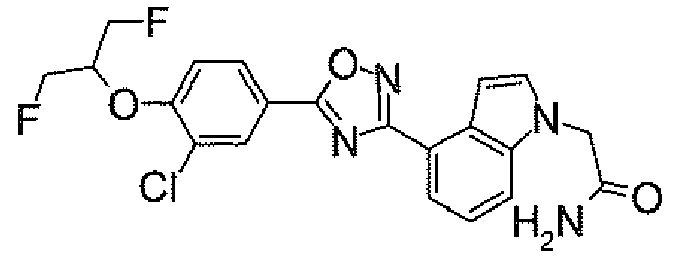
7 
8 
9 
10 
11 /1 
11 /2 
12 
13 
14 
15 
-
[Table 55] Ex Structure Ex Structure 16 
17 
18 
19 
20 
21 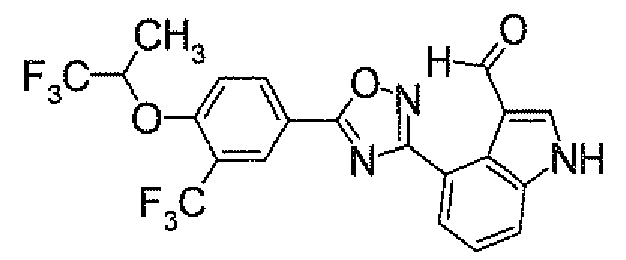
22 
23 
24 
25 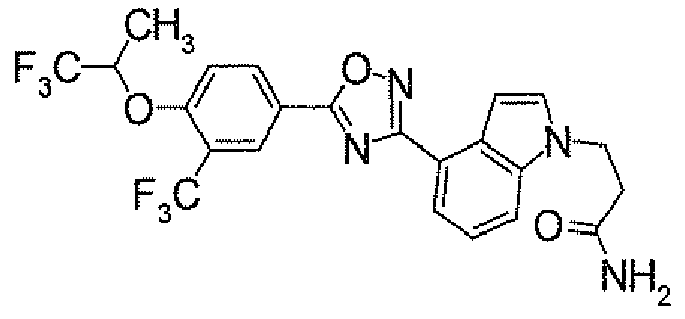
26 
27 
-
[Table 56] Ex Structure Ex Structure 28 
29 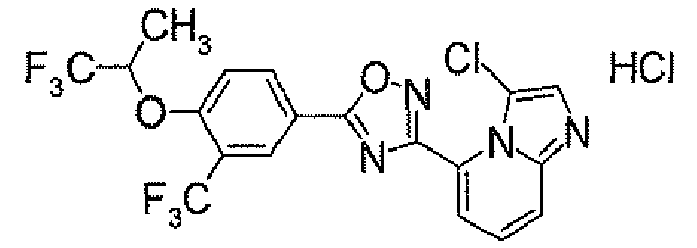
30 
31 
32 
33 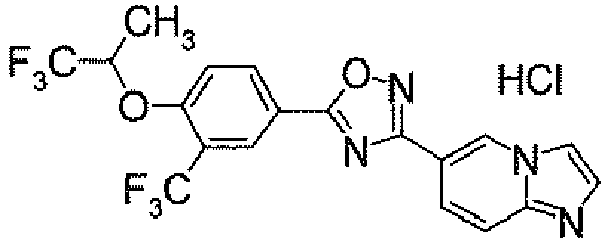
34 
35 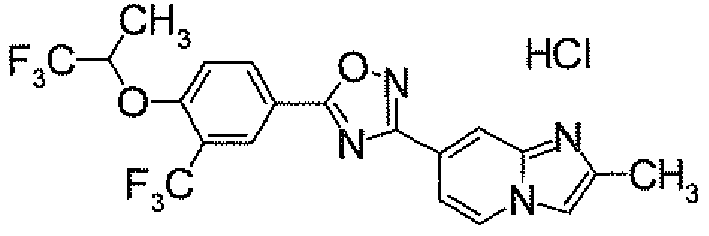
36 
37 
38 
39 
40 
41 
-
[Table 57] Ex Structure Ex Structure 42 
43 
44 
45 
46 
47 
48 
49 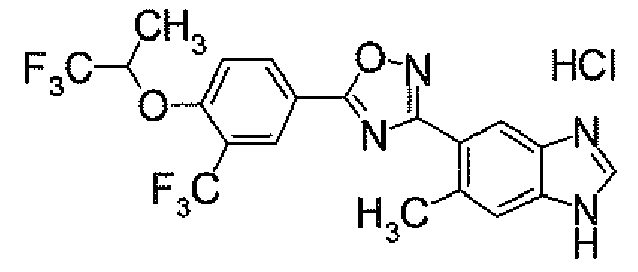
50 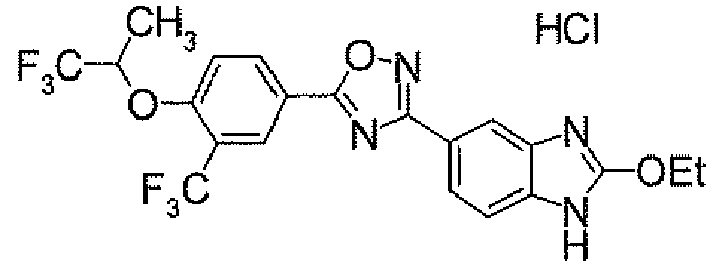
51 
52 
53 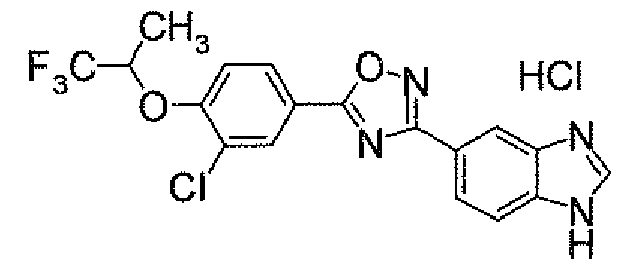
54 
55 
-
[Table 58] Ex Structure Ex Structure 56 
57 
58 
59 
60 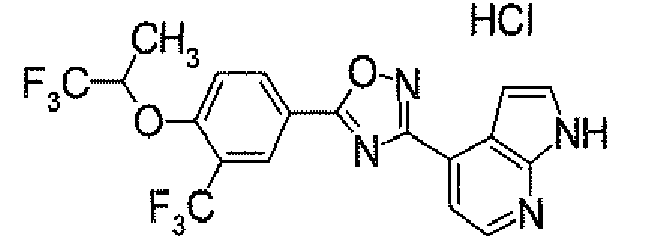
61 
62 
63 
64 
65 
66 
67 
68 
69 
70 
71 
-
[Table 59] Ex Structure Ex Structure 72 
73 
74 
75 
76 
77 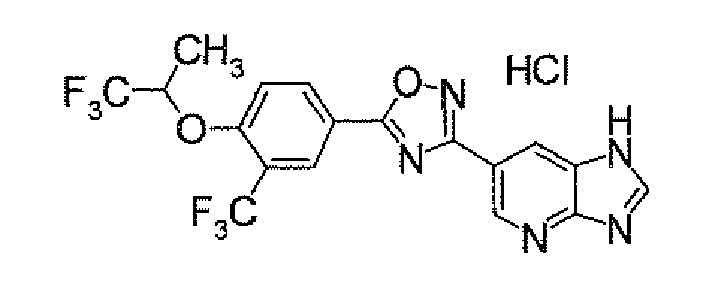
78 
79 
80 
81 
82 
83 
84 
85 
86 
87 
-
[Table 60] Ex Structure Ex Structure 88 
89 
90 
91 
92 
93 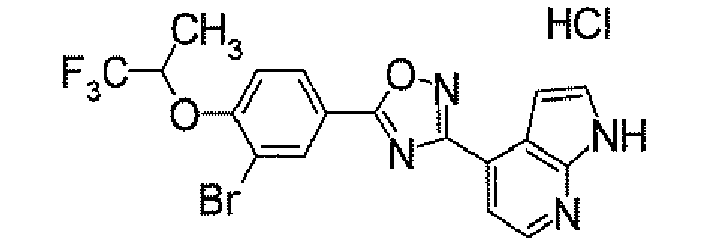
94 
95 
96 
97 
98 
99 
100 
101 
102 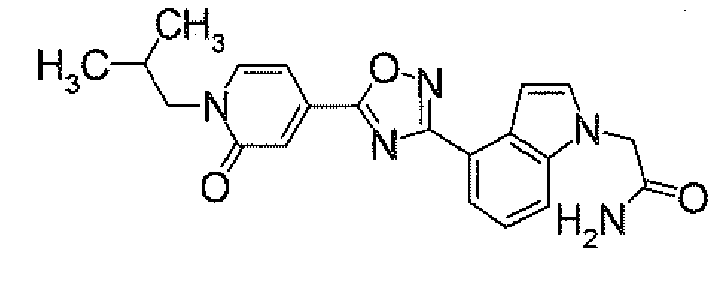
103 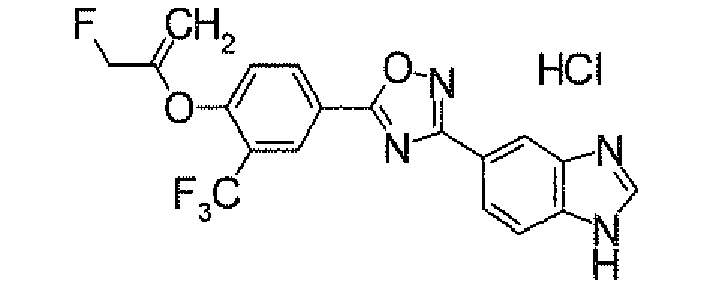
-
[Table 61] Ex Structure Ex Structure 104 
105 
106 
107 
108 
109 
110 
111 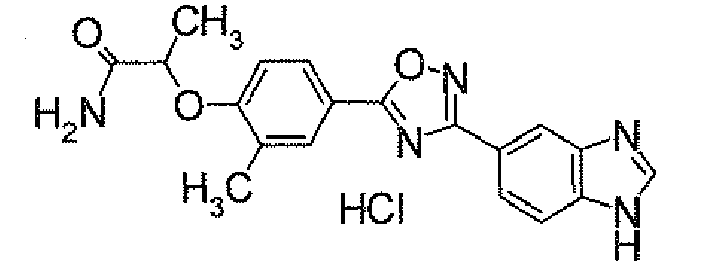
112 
113 
114 
115 
116 
117 
-
[Table 62] Ex Structure Ex Structure 118 
119 
120 
121 
122 
123 
124 
125 
126 
127 
128 
129 
130 
131 
132 
133 
-
[Table 63] Ex Structure Ex Structure 134 
135 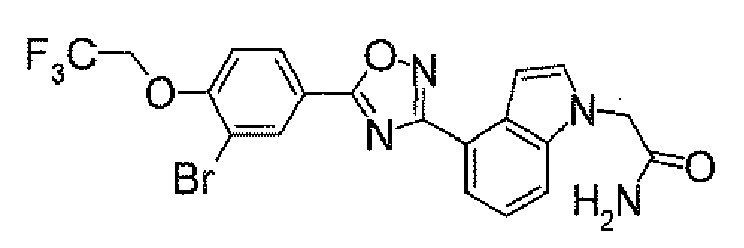
136 
137 
138 
139 
140 
141 
142 
143 
144 
145 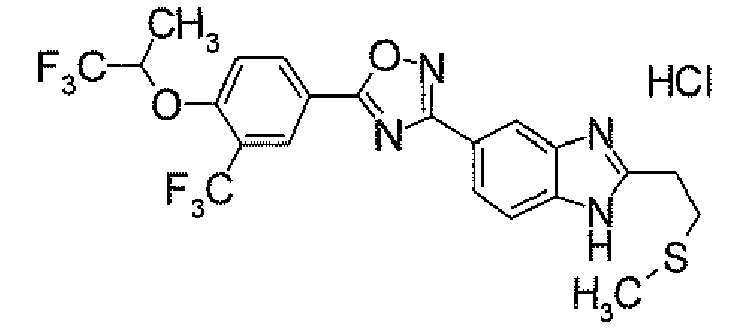
146 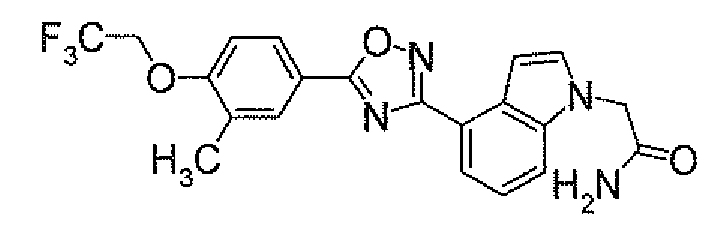
147 
-
[Table 64] Ex Structure Ex Structure 148 
149 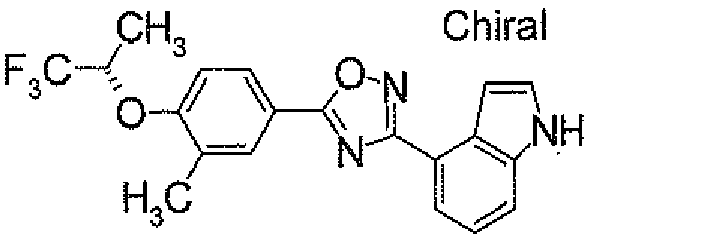
150 
151 
152 
153 
154 
155 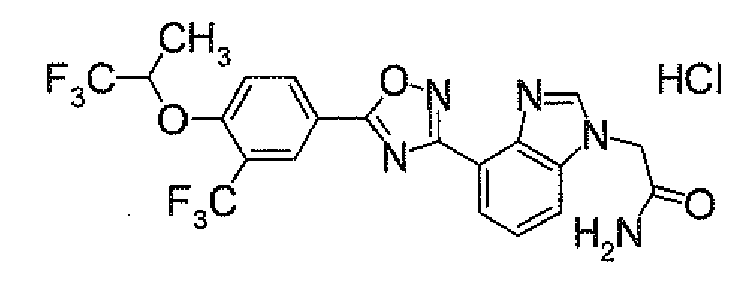
156 
157 
158 
159 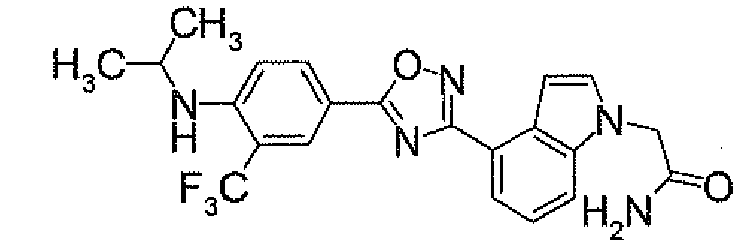
160 
161 
-
[Table 65] Ex Structure Ex Structure 162 
163 
164 
165 
166 
167 
168 
169 
170 
171 
172 
173 
174 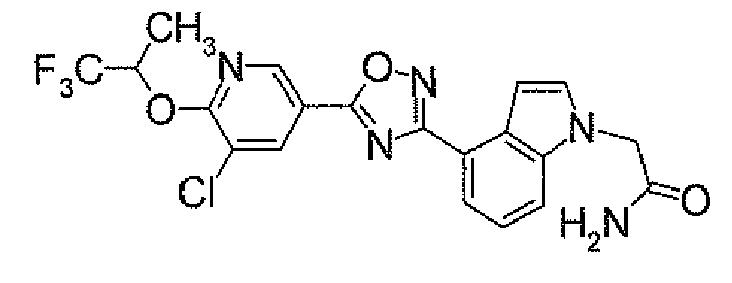
175 
-
[Table 66] Ex Structure Ex Structure 176 
177 
178 
179 
180 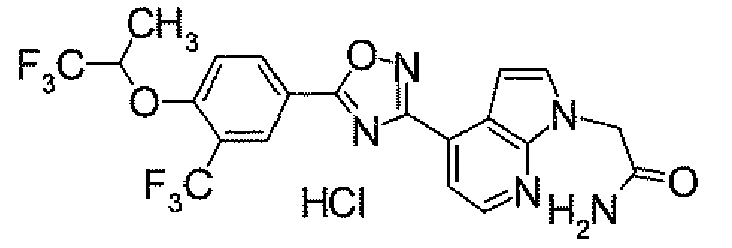
181 
182 
183 
184 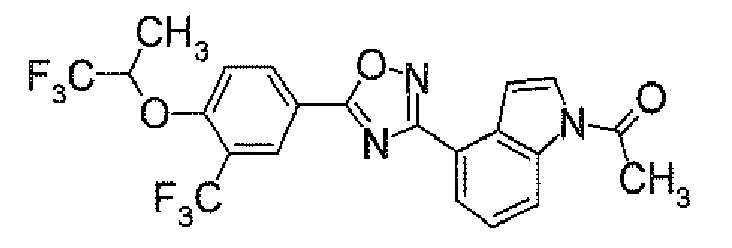
185 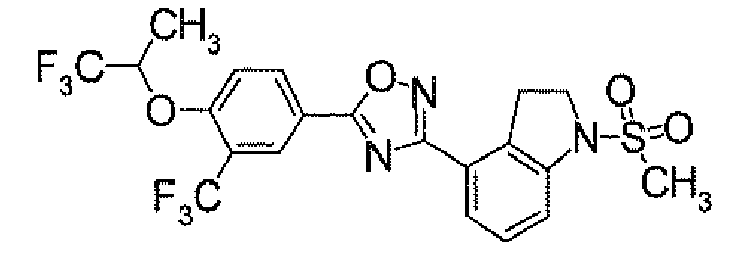
186 
87 
188 
189 
-
[Table 67] Ex Structure Ex Structure 190 
191 
192 
193 
194 
195 
196 
197 
198 
- In following tables, the NMR data of the compounds of Examples are shown. Tetramethylsilane is used as an internal standard, and unless otherwise specifically mentioned, δ (ppm) of the signals in 1H-NMR using DMSO-d6 as a measurement solvent is shown. Ref-Ex represents Example No. (Ex), which can be referred to for the preparation.
-
[Table 68] Ex Data MS Ref -Ex 1 1.52(3H,d),2.65(3H,s),5.73(1H,m),7.60(1H,m),7.62(1H, d),7.82(1H,d),8.11(1H,s),8.40(1H,d),8.49(1H,dd),9.39 (1 H,s) 457 - 2 1.53(3H,d),2.83(3H,s),3.42(2H,br),5.75(1H,m),7.82(1H, d),7.95(1H,d),8.21(1H,dd),8.38-8.43(2H,m),8.52(1H,dd) 457 - 3 1.72(6H,s),4.92(2H,s),7.08(1H,dd),7.29(1H,brs),7.35(1H, dd),7.56(1H,d),7.63(1H,brs),7.64(1H,dm),7.83(1H,d), 7.97(1 H,dd),8.41-8.46(2H,m) 535 - 4 0.37-0.44(2H,m),0.58-0.64(2H,m),1.23-1.35(1H,m),4.17 (2H,d),7.54(1H,d),7.92(1H,d),8.14(1H,dd),8.35(1H,d), 8.41-8.47(2H,m),9.07(1H,s) 401 - 5 1.36(6H,d),4.91(2H,s),4.95-5.03(1H,m),7,08(1H,dm) 7.28(1 H,brs),7.34(1H,dd),7.55(1H,d),7.58-7.65(3H,m), 7.96(1 H,dm),8.36(1H,d),8.45(1H,dd) 467 - 6 4.64-4.93(4H,m),4.91(2H,s),5.20-5.38(1H,m),7.09(1H,d),7.28(1H,bs),7.34(1H,dd),7.55(1H ,d),7.57-7.64(3H,m), 7.95(1 H,d),8.18(1H,dd),8.28(1H,d) 469 - 7 1.50(3H,d),2.30(3H,s),4.91(2H,s),5.42-5.52(1H,m),7.09 (1H,dd),7.29(1H,brs),7.34(1H,dd),7.45(1H,d),7.54(1H,d), 7.80-7.65(2H,m),7.95(1H,dd),8.06-8.12(2H,m) 467 - 8 1.46(6H,d),4.70-4.76(1 H,m),4.90(2H,s),5.27(1H,bs),5.36(1H,bs),7.08(1H, d),7.28(1 H,d),7.41-7.45(3H,m),8.10-8.13(2H,m),8.30(1H,d) 433 - 9 1.26(6H,d,J=6.3Hz),3.88-3.98(1H,m),5.56(1H,d,J=7.9Hz),7.08(1H,brs),7.13(1H,d, J=9.6Hz),7.29(1H,t,J=7.8Hz), 7.56(1H,t,J=2.7Hz),7.66(1H,d,J=8.1Hz),7.91(1H,d. J=7.6Hz),8.18-8.21(2H,m),11.51(1H,brs) 409, 387 - 10 1.25(6H,d),4.39-4.47(1H,m),4.90(2H,s),7.07-7.12(2H,m),7.28(1H,br),7.33(1H,dd),7.53(1H,d),7.61-7.63(2H,m), 7.93(1H,d),8.26(1H,d),8.84(1H,d) 433 - 11/1 (CDCl3)1.62(3H,d),3.92(3H,s),4.91(1H,m),7.21(1H,d), 7.52(1H,d),7.98(1H,d),8.16(1H,dd),8.40(1H,dd),8.52(1H,d),8.64(1H,s) 457 - 11/2 (CDCl3)1.63(3H,d),3.99(3H,s),4.93(1H,m),7.23(1H,dd), 7.93(1H,d),8.06(1H,d),8.15(1H,d),8.28(1H,d),8.41(1H,d), 8.54(1H,d) Not found - -
[Table 69] Ex Data MS Ref-Ex 12 1.53(3H,d),4.92(2H,s),5.65-5.79(1H,m),7.09(1 H,d),7.28 (1H,bs),7.35(1H,dd),7.55(1H,d),7.52(1H,bs),7.54(1H,d), 7.81(1H,d),7-97(1H,d),8.42(1H,d),8.52(1H,dd) [α]D 23=+11.20(c=0.0025, CH3OH) 521 - 13 1.52(3H,d),2.36(2H,t),3.27(2H,t),3.37(2H,t),3.46(2H,t), 5.54-5.78(1H,m),5.71(1H,d),6.86(1H,bs),7.21(1H,dd), 7.33(1H,d),7.41(1H,bs),7.79(1H,d),8.35(1H,d),8.46 (1H,dd) 515 - 14 1.52(3H,d),2.09(3H,s),3.77(2H,s),5.65-5.78(1H,m),7.23 (1H,dd),7.42(1H,d),7.45(1H,d),7.52(1H,d),7.81(1N,d), 8.40(1 H,d),8.51 (1 H,dd),11.32(1 H,s) 485 - 15 1.52(3H,d),2.20(3H,s),3.50(2H,t),4.21(2H,t),5.68-5.77 (1H,m),7.40(1H,t),7.78(1H,d),7.80(1H,d),8.29(1H,d),8.37 (1H,d),8.48(1H,dd) 486 - 16 (CDCl3)1.63(3H,d),3.17(3H,s),4.89-4.94(1H,m),7.23(1H,d),7.54(1H,dd),7.58(1H,d),7.63(1H, d),8.13(1H,d),8.23 (1H,d),8.41(1H,dd),8.53(1H,d) 542 - 17 1.53(3H,d),4.05(3H,s),5.70-5.78(1H,m),7.38(1H,d),7.58 (1H,dd),7.81(1H,d),7.95(1H,d),8.12(1H,d),8.39(1H,d), 8.41(1H,s),8.53(1H,dd) Not found - 18 1.52(3H,d),2.81(2H,t),3.27(2H,t),3.49(2H,br),5.74(1H,m), 7.01(1H,s),7.55(1H,s),7.82(1H,d),7.92(1H,d),8.17(1H,d), 8.39(2H,d),8.51(1H,dd) 514 - 19 1.53(3H,d),4.61(2H,d),5.14(2H,s),5.67-5.78(1H,m),7.11 (1H,d),7.36(1H,dd),7.51(1H,d),7.65-7.76(3H,m),7.82 (1H,d),7-97(1H,d),8.27(1H,dd),8.41(1H,d),8.52(1H,dd), 8.73(1H,d),9.04(1H,t) 590 - 20 1,53(3H,d),3.05(3H,s),4.97(2H,s),5.66-5.78(1H,m),7.08 (1H,d),7.33(1H,dd),7.55(1H,d),7.65(1H,d),7.81(1H,d), 7.96(1H,d),8.42(1H,d),8.53(1H,dd),12.31(1H,bs) 599 - 21 1.52(3H,d),5.65-5.78(1H,m),7.43(1H,dd),7.63(1H,d),7.78(1H,d),7.81(1H, d),8.34(1H,d),8.38(1H,s),8.47(1H,dd), 10.06(1H,s),12.57(1H,bs) 470 - 22 1.50(3H,d),5.55(1H,m),7.64(1H,d),7.98(1H,d),8.20(1H, dd),8.35(1H,dd),8.46-8.50(2H,m),9.29(1H,s),13.31(1H, brs) 419 - -
[Table 70] Ex Data MS Ref -Ex 23 1.53(3H,d),3.14(3H,s),3.60(2H,t),3.83(2H,d),5.74(1H,m), 7.82(1 H,d),7.93(1H,d),8.16(1H,d),8.38-8.44(2H,m),8.52 (1H,dd) 549 - 24 1.52(3H,d),1.84-1.89(1H,m),2.12-2.16(1H,m),3.20-3.60 (6H,m),5.72-5.76(1H,m),7.82(1H,d),7.95(1H,d),8.21 (1 H,dd),8.40(2H,s ),8.52(1H,dd) 531 - 25 1.52(3H,d),2.61(2H,t),4.49(2H,t),5.68-5.78(1H,m,6.91 (1H,bs),7.06(1H,d),7.36(1H,dd),7.37(1H,bs),7.55(1H,d), 7.78-7.83(2H,m),7.96(1 H,d),8.41(1 H,d),8.52(1 H,dd) 535 - 26 1.52(3H,d),3.30(2H,t),3.53(2H,t),5.71(1H,m),5.83(1H,brs ),8.69(1H,d),7.12(1H,t),7.29(1H,d),7.79(1H,d),8.35(1H,d) ,8.47(1 H,dd) 444 - 27 1,49(3H,d),4.57(1H,d),4.62(1 H,d),5,50(1H,m),7.47(1H,d) ,7.98(1H,d),8.13(1H,dd),8.20(1H,dd),8.31(1H,m),8.47 (1H,m),9.29(1H,s) 405 - 28 1.52(3H,d),3.19(3H,s),5.71(1H,m),7.47(1H,d),7.61(1H,d), 7.66(1H,d),7.75(1H,s),7.79(1H,s),8.37(1H,d),8.50(1H,dd) 491 - 29 1.52(3H,d),5.69-5.82(1H,m),7.49(1H,d),7.56(1H,dd),7.83(1H.d),7.92(1H,s ),8.00(1H,d),8.38(1H,d),8.53(1H,dd) 477 - 30 1.53(3H,d),3.76(2H,t),4.32(2H,t),4.93(1H,s),5.65-5.76(1 H,m),7.07(1H,d),7.34(1 H,t),7.59(1 H,d),7.79(1H,d). 7.81(1H,d),7.96(1H,dd),8.42(1H,s),8,52(1H,dd) 508 - 31 1.53(3H,d),3.02-3.30(4H,m),3.63-3.90(4H,m),5.37(2H,s),5.68-5.80(1H,m),7.11 (1H,d),7,33(1H,dd),7.47(1H,d),7.70(1H,d ),7.82(1H,d),7.96(1H,d),8.42(1H,d),8.52(1H,dd), 9.26(1H,bs) 568 - 32 1.52(3H,d),5.73(1H,m),7.13(1H,t),7.72(1H,d),7.81(1H,d), 8.11(1H,dd),8.14(1H,d),8.40(1H,d),8.51(1H,dd),8.82 (1H,dd) 443 1 33 1.53(3H,d),5.75(1H,m),7.84(1H,d),8.10(1H,d),8.22(1H,d) ,8.38(1H,dd),8.41(1H,d),8.50(1H,d),8.51(1H,dd),9.76 (1H,s) 443 1 34 1.52(3H,d),3.03(3H,s),5.73(1H,m),7.68(1H,d),7.77(1H,d). 7.79(1H,s),7.82(1H,s),8.09(1H,s),8.38(1H,d),8.51(1H,dd) 457 1 -
[Table 71] Ex Data MS Ref -Ex 35 1.52(3H,d),2.55(3H,s),5.74(1H,m),7.83(1H,d),7.98(1 H, dd),8.24(1H,s),8.42(1H,d),8.46(1H,s),8.54(1H,dd),9.00 (1H,d) 457 1 36 2.81(3H,d),2.37(3H,s),2.47(3H,s),5.73(1H,m),7.47(1H, dd),7.80(1H,d),8.15(1H,s),8.37(1H,d),8.38(1H,d),8.50 (1 H,dd) 470 1 37 1.53(3H,d)2.92(3H,s),3.46(2H,br),5.74(1H,m),7.80(1H, d),7.82(1H,d),8.14(1H,d),8.38-8.40(1H,m),8.51(1H,dd), 9.37(1H,br) 457 1 38 7.78(1H,d),7.85(1H,t),7.96(1H,dd),8.34(1H,d)8.38(1H,s) ,8.50(1 H,dd),8.56-8.62(1 H,m) 349 1 39 1.53(3H,d),5.73(1H,m),7.74(1H,d),7.81(1H,d),8.06(1H, dd),8.28(1H,d),8.39(1H,d),8.49(1H,dd),8.61(1H,m),13.42 (1H,brs) 443 1 40 1.57(3H,d),2.27(2H,m),3.00(2H,t),4.22(2H,t),4.85(1H,m), 7.02-7.19(4H,m),8.48(1H,dd),8.62(1H,d) 480 1 41 1.53(3H,d),5.75(1H,m),7.84(1H,d),8.00(1H,dd),8.26(1H, dd),8.42(1H,d),8.48(1H,d),8.54(1H,dd),8.56(1H,m),9.05 (1H,dd) 443 2 42 1.22(3H,t),1.52(3H,d),3.87(2H,s),4.13(2H,q),5.74(1H,m), 7.50(1H,dd),7.82(1H,d),8.06(1H,s),8.21(1H,s),8.40(1H,d ),8.52(1H,dd),8.72(1H,d) 529 2 43 1.53(3H,d),2.70(3H,s),5.75(1H,m),7.85(1 H,d),8.07(1 H,d) ,8.14(1H,d),8.43(1H,dd),8.45(1H,d),8.55(1H,dd),9.27 (1 H,d) 457 2 44 1.53(3H,d),2.72(3H,s),3.49(1H,brs),5.76(1H,m),7.74(1 H, d),7.84(1H,d),8.23(1H,brs),8.25(1H,brs),8.46(1H,s),8.57 (1H,dd),8.94(1H,d) 457 2 45 1.53(3H,d),2.64(3H,s),3.48(1H,brs),5.76(1 H,m),7.84(1H, d),8.04(1H,dd),8.15(1H,s),8.42(1H,d),8.55(1H,dd),8.60 (1H,d),8.92(1H,d) 457 2 46 1.53(3H,d),1.91(3H,s),2.64(3H,s),5.75(1H,m),7.84(1H,d) ,8.06(1H,d),8.38(1H,dd),8.45(1H,d).8.54(1H,d),9.20(1H, s) 470 2 47 1.21(3H,t),1.53(3H,d),3.84(2H,s),4.12(2H,q),5.73(1H,m), 7.68(1H,d)7.76-7.85(2H,m),8.09(1H,s),8.40(1H,m),8.49 (1 H,dd),9.46(1 H,s) 529 2 48 1.53(3H,d),3.62(2H,brs),5.74(1H,m),7.82(1H,d),8.02(1H, d),8.23(1H,dd),8.40(1H,d),8.49-8.54(2H,m),9.45(1H,s) 443 2 -
[Table 72] Ex Data MS Ref -Ex 49 1.52(3H,d),2.76(3H,s),3.40(2H,brs),5.74(1H,m),7.82(1 H, d),7.86(1H,d),8.40(1H,d),8.45(1H,s),8.52(1H,dd),9.37 (1H,s) 457 2 50 1.43(3H,t),1.52(3H,d),3.90(2H,br),4.58(2H,q),5.73(1H,m) 7.53(1H,d),7.81(1H,d),7.89(1H,dd),8.03(1H,brs),8.38 (1H,d),8.49(1H,dd) 487 2 51 1.52(3H,d),3.37(3H,br),5.73(1H,m),7.56(1 H,d),7.82(1H, d),7.99(1H,d),8.07(1H,m),8.37(1H,d),8,49(1H,dd),8.78 (2H,brs) 458 2 52 1.52(3H,d),5.72(1H,m),7.10(1H,d),7.60(1H,d),7.73(1H, dd),7.79(1H,d),8.35(1H,d),8.47(1H,dd),10.89(2H,br) 481 2 53 1.53(3H,d),5.60(1H,m),7.59(1H,d),8.01 (1H,d),8.23-8.17 (2H,m),8.29(1H,d),8.48(1H,m),9.39(1H,s) 409 2 54 1.56(3H,d),5.74(1H,m),7.80(1H,d),8.03(1H,d),8.22(1H, dd),8.49(1H,m),8.53(1H,dd),8.64(1 H,d),9.46(1H,s) 400 2 55 1.58(3H,d),5.71 (1H,m),7.85-7.71(2H,m),7.96(1H,dd), 8.27-8.42(2H,m),8.47-8-51 (2H,m),10.39(1H,s),12.78(1H,d) 403 2 56 1.15(6H,s),2.81(2H,s),2.83(2H,s),7.48(1H,d),7.98-8.04 (3H,m),8.21(1H,dd),8.48(1H,m),9.43(1H,s) 331 2 57 1.52(3H,d),2.74(3H,s),5.67-5.82(1H,m),7.81(1H,d),8.08 (1H,d),8.26(1H,d),8.38(1H,d),8.50(1H,dd) 491 2 58 1.52(3H,d),3.60(2H,s),5.73(1H,m),7.43(1H,d),7.50(1H, m),7.72(1H,dd),7.80(1H,d),8.36(1H,m),8.48(1H,dd), 10.59(1H,s) 480 2 59 1.53(3H,d),5.73-5.83(1H,m),7.87(1H,d),8.05(1H,dd), 8.26(1H,d),8.39(1H,d),8.40(1H,d),8.47(1H,d),8.59(1H, dd),9.00(1 H,d) 443 2 60 1.53(3H,d),5.75(1H,m),7.05(1H,dd),7.76(1H,dd),7.83 (1 H,d),7.86(1H,d),8.42(1H,d),8.47(1H,d),8.54(1H,dd), 12.20(1H,br) 443 2 61 1.54(3H,d),5.70-5.82(1H,m),7.74(1H,dd),7.86(1H,d), 8.11 (1 H,d),8.29(1H,d),8.56(1H,d),8.68(1H,dd),9.53(1H, s) 443 2 62 1.52(3H,d),5.67-5.77(1H,m),6.65(1H,dd),7.64(1H,dd), 7.82(1H,d),8.40(1H,d),8.50(1H,dd),8.68(1H,d),8.95(1H, d),12.10(1H,s) 443 2 63 1.53(3H,d),5.54(1H,m),7.70(1H,t),8.02(1H,d),8.08(1H, dm),8.1 (1H,dd),8.21(1H,dd),8.48(1H,m)9.45(1H,s) 393 2 -
[Table 73] Ex Data MS Ref -Ex 64 1.53(3H,d),5.60(1H,m),7.65(1H,d),7.99(1H,d),8.20(1H, dd),8.24(1H,dd),8.42(1 H,m),8.48(1 H,m),9.35(1H,s) 453, 455 2 65 1.53(3H,d),5.74(1H,m),7.82(1H,t),7.83(1H,dd),7.98(1H, d),8.22(1H,s),8.31 (1 H,s),8.40(1H,d),8.52(1H,dd),13.42 (1H,s) 443 2 66 1.53(3H,d),5.73(1H,m),7.81(1H,d),8.10(1H,d),8.15(1H, dd),8.39(1H,d),8.51 (1H,dd),8.66(1H,s),16.07(1 H,brs) 466 2 67 1.53(3H,d),5.72(1H,m),7.19(1H,d),7.31(1H,t),7.59(1 H,d), 7.68(1H,d),7.80(1H,d),7.95(1H,d),8.41(1H,d),8.59(1H, dd),11.5(1H,brs) 464 2 68 1.50(3H,d),2.29(3H,s),5.48(1H,m),7.45(1H,d),8.09-8.01 (3H,m),8.24(1H,dd),8.49(1H,m),9.61(1H,s) 389 2 69 1.48(3H,d),3.96(3H,s),5.35(1H,m),7.45(1 H,d),7.76(1 H,d) ,7.83(1H,dd),8.03(1H,d),8.24(1H,dd),8.50(1H,m),9.53 (1H,s) 405 2 70 1.53(3H,d),5.70(1H,m),6.62(1H,s),7.48(1H,t),7.57(1H,d), 7.80(1H,d),7.833(1H,dd),8.36-8.39(2H,m),8.49(1H,dd), 11.47(1H,s) 464 2 71 (CDCl3)1.65(3H,d),3.39(3H,s),4.92-5.02(1H,m),7.28(1H,d),7.72(0.25H,t),7.78(0.25H,t),7.98( 0.75H,t),8.12(0.75H, t),8.44(1H,d),8.46(1H,d),8.52(1H,s),8.91(1H,d),9.79(1H, s) 468 2 72 1.17(3H,t),1.52(3H,d),2.91(2H,t),3.09-3.18(2H,m),4.07 (2H,q),5.72(1H,m),7.59-7.72(1H,m),7.80(1H,d),7.90(1H,dd),8.13-8.28(1 H,m),8.38(1H,d),8.50(1H,d),12.58(1H,s) 543 2 73 1.52(3H,d),2.72(3H,s),5.70-5.78(1H,m),7.82(1H,d),8.05 (1H,s),8.32(1H,s),8.38(1H,d),8.50(1H,dd),9.51 1H,s) 457 2 74 1.53(3H,d),5.58-5.80(1H,m),6.60(1H,d),7.72(1H,d),7.81 (1H,d),7.93(1H,d),8.18(1H,d),8.40(1H,d),8.51 (1 H,dd),12. 10(1H,s) 465 2 75 1.51(3H,d),5.73(1H,m),7.82(1H,d),8.08(1H,d),8.24(1H, dd),8.42(1H,d),8.52(1H,dd),8.68(1H,s),9.64(1H,m) 442 2 76 1.53(3H,d),5.51 (2H,brs),5.72(1 H,m),7.62(1 H,dd),7.80 (1H,d),7.89(1H,d),8.01(1H,s),8.39(1H,d),8.50(1H,dd), 11.73(1 H,brs) 480 2 77 1.53(3H,d),5.67-5.76(1H,m),7.82(1H,d),8.41(1H,d),8.52 (1H,dd),8.69(1H,d),8.85(1H,s),9.14(1H,d) 466 2 -
[Table 74] Ex Data MS Ref -Ex 78 1.51 (3H,d),5.69(1H,m),6.55(1H,d),7.56(1H,d),7.72-7.75 (2H,m),7.80(1H,d),8.20(1H,s),8.38(1H,d),8.49(1H,dd), 11.47(1H,s) 464 2 79 1.53(3H,d),5.73(1H,m),7.81 (1 H,d),8.24(1H,dd),8.28(1H, d),8.39(1H,d),8.49(1H,dd),8.98(1H,m),9.57(1H,s) 460 2 80 1.53(3H,d),5.70-5.79(1H,m),7.84(1H,d),7.91(1H,dd),8.39(1H,d),8.41(1H, d),8.51(1H,dd),8.55(1H,dd),8.99(1H,d), 9.01 (1 H,s),9.20(1H,dd) 454 2 81 1.04-1.79(4H,m),1.84-1.96(2H,m),2.04-2.14(2H,m),4.92 (2H,s),7.09(1H,d),7.28(1H,brs),7.35(1H,dd),7.56(1H,d), 7.62(1H,brs),7.65(1H,d),7.94-7.99(2H,m),8.40(1H,d), 8.45(1H,dd) 477 2 82 1.50(3H,d,J=6.3Hz),2.30(3H,s),5.43-5,49(1H,m),7.08-7.09(1H,m),7.27-7.31(1H,m),7.43-7.45(1H,m),7.56-7.57 (1H,m),7.65-7.67(1H,m),7.91-7.93(1H,m),8.06-8.09(2H,m),11.52(1H,s) 388 2 83 1.51(3H,d,J=6.3Hz),5.55-5.61(1H,m),7.08-7.09(1H,m), 7.28-7.31(1H,m),7.57-7.68(3H,m),7.92-7.94(1H,m),8.22-8.25(1H,m),8.42-8.43(1H,m),11.54(1H,s) 453 2 84 1.52(3H,d,J=4.7Hz),5.68-5.75(1H,m),7.21-7.28(2H,m), 7.52-7.54(1H,m),7.79-7.81 (1H,m),8.08-8.49(4H,m), 11.93(1H,s) 442 2 85 1.40(3H,t,J=6.8Hz),2.28(3H,s),4.18(2H,q,J=6.8Hz),4.09 (2H,s),7.08-7.35(4H,m),7.53-7.63(3H,m),7.93-8.07(3H, m) 399 2 86 1.34(6H,m,J=2.1Hz),2.25(3H,s),4.75-4.81(1H,m),4.91 (2H,s),7.092-7.093(1H,m),7.21-7.35(3H,m),7.53-7.63 (3H,m),7.93-8.05(3H,m) 391 2 87 1.52(3H,d),5.60-5.72(1H,m),7.19(1H,t),7.71(1H,d),8.03 (1H,dd),8.24(1H,dd),8.33-8.36(1H,m),8.41(1H,dd),8.50-8.52(1H,m),9.49(1H,s) 425 2 88 1.52(3H,d),3.79(2H,s),5.67-5.78(1H,m),7.05(1H,d),7.42 (1H,t),7.72(1H,dm),7.80(1H,d),8.37-8.40(1H,m),8.50(1H,dd),10.65(1H,s) 456 2 89 1.52(3H,d),5.67-5.78(1H,m),7.46(1H,d),7.69(1H,d),7.80 (1H,d),7.84(1H,dd),8.38(1H,d),8.48(1H,dd) 482 2 -
[Table 75] Ex Data MS Ref -Ex 90 1.52(3H,d),5.68-5.78(1H,m),7.31-7.38(2H,m),7.79(1H, dd),7.81(1H,d),8.39(1H,d),8.51(1H,dd),12.00(1H,brs) 482 2 91 0.94(6H,d),1.96-2.06(1H,m),2.76(2H,d),4.92(2H,s),7.10 (1H,dd),7.29(1H,brs),7.35(1H,dd),7.56(1H,d),7.63(1H, brs),7.65(1H,dm),7.81(1H,d),7.97(1H,dd),8.41-8.46(2H,m) 465 2 92 1.53(3H,d),5.54-5.79(1H,m),7.09(1H,d),7.30(1H,dd),7.58(1H,d),7.88(1H, d),7.81(1H,d),7,94(1H,d),8.41(1H,d),8.52(1H,dd),11.53(1 H,bs) 442 2 93 1.53(3H,d),5.57-5.63(1H,m),7.04(1H,dd),7.65(1H,d),7.73(1H,dd),7.83(1H ,d),8.26(1H,dd),8.45-8.46(2H,m),12.14 (1H,s) 453 2 94 1.53(3H,d),5.57-5.63(1H,m),7.03(1H,dd),7.70(1H,d),7.74(1H,dd),7.83(1H ,d),8.23(1H,d),8.32(1H,d),8.46(1H,d), 12.12(1H,s) 409 2 95 1.50(3H,d),2.30(3H,s),5.45-5.51(1H,m),7.03(1H,dd),7.46(1H,d)7.73(1H,dd),7.82(1H ,d).8.09-8.11(2H,dd),8.45 (1H,d),12.12(1H,s) 389 2 96 1.56(3H,d),5.71-5.78(1H,m),7.06(1H,dd),7.75(1H,dd), 7.80(1H,d),7.83(1H,d),8.47(1H,d),8.56(1H,dd),8.69(1H, d),12.16(1H,s) 398 2 97 1.53(3H,d),5.71-5.77(1H,m),7.04(1H,dd),7.75(1H,dd), 7.83(1H,d),7.86(1H,d),8.43(1H,d),8.47(1H,d),8.54(1H, dd),12.19(1H,s) Not found 2 98 1.52(3H,d),2.58(2H,dd),2.97(2H,dd),5.00(1H,d),5.11(1H, d),5.67-5.78(1H,m),5.83-5.98(1H.m),7.61(1H,d),7.70(1H.d),780(1H,d),7.90(1H,t), 8.19(1H,d),8.38(1H,s),8.50(1H,dd),12.55(1H,d) 497 2 99 1.57(3H.d),5.58(1H,m),7.08(1H,m),7.29(1H.t),7.58(1H, m),7.65-7.72(2H,m),7.93(1H,d),8.20(1H,dd),8.29(1H,d). 408 2 100 1.56(3H,d),5.72(1H,m),7.10(1H,m),7.30(1H,t),7.58(1H, m),7.67(1H,d),7.78(1H,d),7.93(1H,d),8.53(1H,dd),8.64 (1H,d). 421 2 101 0.90(6H,d),2.12(1H,m),3.82(2H,d),6.89(1H,dd),7.07(1H, m),7.18(1H,d),7.31(1H,dd),7.59(1H,dd),7.67-7.70(1 H,m),7.91(1H,dd),7.96(1H,d),11,56(1H,s) 335 2 -
[Table 76] Ex Data MS Ref -Ex 102 0.90(6H,d),2.09-2.15(1H,m),3.82(2H,d),4.91(2H,s),6.90 (1H,dd),7.08(1H,d),7.19(1H,d),7.29(1H,br),7.35(1H,dd), 7.56(1H,d),7.62(1H,br),7.65(1H,d),7.95(2H,dd) 414 2 103 4.82(1H,d),5.08(2H,d),5.22(1H,t),7.64(1H,d),7.99(1H,d), 8.21(1H,dd),8.46-8.50(2H,m),8.53(1H,dd),9.33(1H,s) 405 4 104 1.35(6H,d),4.98(1H,m),7.60(1H,d),7.99(1H,d),8.20(1H, dd).8.34(1H.d),8.43(1H,dd),8.48(1H,d),9.32(1H,s) 389 4 105 1.70(1 H,m),1.87(1H,m),2.04-2.16(2H,m),2.45-2.59(2H, m),5.03(1H,m),7.40(1H,d),7.94(1H,d),8.16(1H,dd),8.35 (1H,d),8.42(1H,dd),8.45(1H,d),9.16(1H,s) 401 4 106 4.87-4.92(2H,m),5.34(1H,dd),5.46(1H,dd),6.02-6.12(1H,m),7.57(1H,d),7.99(1H,d),8.21(1H,dd),8.36(1H, d),8.44-8.49(2H,m),9.48(1H,s) 387 4 107 5.16(2H,q),7.69(1H,d),8.01(1H,d),8.23(1H,dd),8.40(1H, d),8.50(1H,d),8.54(1H,dd),9.49(1H,s) 429 4 108 5.45(2H,s),7.36-7.51(5H,m),7.66(1H,d),8.00(1H,d),8.22 (1H,dd),8.37(1H,d),8.47(1H,d),8.49(1H,d),9.42(1H,s) 437 4 109 7.32(1H,d),7.96(1H,d),8.17(1H,dd),8.27-8.33(2H,m),8.45(1H,d),11.90(1H,s) 347 4 110 4.68(2H,dt),6.84(1H,tt),7.85(1H,d),8.01(1H,d),8.23(1H, dd),8.38(1H,d),8.47-8.52(2H,m),9.45(1H,s) 411 4 111 1.39(3H,d),4.29(1H,q),7.94(1H,d),8.15(1H,dd),8.43-8.47 (3H,m),8.51-8.55(1H,m),8.58-8.62(1H,m),9.09(1H,brs), 9.71(1H,s) 418 4 112 7.32(1H,d),7.81(1H,dd),7.79(1H,ddd),8.04(1H,d),8.26 (1H,dd),8.47(1H,dd),8.52(2H,brs),8.58(1H,dd),8.61(1H, d),9.54(1H,s) 424 4 113 0,96(3H,t),1.32(3H,d),1.67-1.76(2H,m),4.75-4.85(1H,m)7.59(1H,d),7.99(1H,d),8.21(1H,dd),8.34(1H, d),8.43(1H, dd),8.49(1H,m),9.38(1H,s) 403 4 114 1.81(3H,s),4.80(2H,s),5.04(1H,s),5.13(1H,s),7.56(1H,d), 7.97(1H,d),8.19(1H,dd),8.37(1H,d),8.44-8.48(2H,m),9.27(1H,s) 401 4 115 1.46(3H,t),5.23-5.26(1 H,m),5.33-5.40(2H,m),5.95(1H,dq),7.56(1H,d),7.98(1H,d),8.19(1H, dd),8.35(1 H,d),8.42(1H,dd),8.47(1H,s),9.29(1H,s) 401 4 -
[Table 77] Ex Data MS Ref-Ex 116 1.76(3H,s),1.77(3H,s),4.89(2H,d),5.48-5.49(1H,m),7.57 (1H,d),8.01(1H,d),8.22(1H,dd),8.34(1H,d),8.45(1H,dd), 8.45(1H,d),9.44(1H,s) 415 4 117 3.02-4.13(8H,m),7.73(1H,d),8.00(1H,d),8.22(1H,dd), 8.39(1 H,d),8.44(1H,dd),8.49(1H,m),9.38(1H,s) 414 4 118 1.00(3H,t),1.35(3H,d),1.59-1.78(2H,m),3.72-3.85(1H,m),7.96(1H,d),8.02(1H,d),8.23(1H,d),8.36(1H,d) ,8.38(1H,s),8.51(1H,s),9.48(1H,s) 419 4 119 1.53(3H,d),5.70-5,80(1H,m),7.83(1H,d),8.03(1H,d),8.25 (1H,dd),8.40(1H,d),8.49-8.54(2H,m),9.50(1H,s), [α]D 25= +10.2(c=0.20, MeOH) 443 4 120 1.53(3H,d),5.70-5.79(1H,m),7.82(1H,d),8.00(1H,d),8.26 (1H,dd),8.40(1H,d),8.49-8.54(2H,m),9.35(1H,s). [α]D 23=-9,61(c=0.21, MeOH) 443 4 121 7.18(1H,d),7.23-7.27(2H,m),7.35(1H,t),7.51-7.58(2H,m),7.98(1H,d),8.18(1H,dd),8.42-8.53(3H,m),9.26(1H,s) 423 4 122 4.98(2H,t),6.59(1H,tt),7.71(1H,d),8.00(1H.d),8.21(1H,dd) ,8.40(1H,d),8.49(1H,d),8.52(1H,d),9.33(1H,s) 461 4 123 4.65-4.95(4H,m),5.30-5.52(1H,m),7.75(1H,d),8-02(1H,d),8.24(1H,dd),8.38(1H, d),8.47(1H,dd),8.51(1H,s),9.48(1H,s) 425 4 124 1.59(3H,d),5.04(1H,d),5.10(1H,d),5.84(1H,q),6.51(1H,dd ),7.23(1H,d),8.00(1H,d),8.21(1H,dd),8.42-8.50(3H,m), 9.35(1H,s) 413 5 125 1.06-1.96(10H,m),4.77-4.85(1H,m),7.07-7.10(1H,m), 7.30(1H,t,J=7.7Hz),7.56-7.62(2H,m),7.67(1H,d,J=8.0Hz),7.93(1H,d,J=7.4Hz),8.3 5(1H,d,J=2.1Hz),8.42(1H,dd, J=2.1,8.8Hz),11.53(1H,brs) 466, 450, 428 5 126 4.91(2H,s),7.09(1H,dd),7.19(1H,d),7.22-7.27(2H,m),7.28((1H,brs),7.32-7.38(2H,m),7.51-7.57(3H,m),7.61(1H,brs),7.64(1H,dm),7.96(1H,dd),8.45( 501 5 127 1.53(3H,d),4.92(2H,s),5.55-5.79(1H,m),7.09(1H,d),7.28 (1H,bs),7.35(1H,dd),7.55(1H,d),7.62(1H,bs),7.64(1H,d). 7.81(1H,d),7.97(1H,d),8.42(1H,d),8.52(1H,dd) 521 5 128 4.91(2H,s),5.08(2H,q),7.09(1H,d),7.28(1H,bs),7.35(1H, dd),7.55(1H,d),7.57(1H,d),7.61(1H,bs),7.64(1H,d),7.95 (1H,d),8.24(1H,dd),8.31(1H,d) 473 5 -
[Table 78] Ex Data MS Ref -Ex 129 1.53(3H,d),5.71-5.77(1H,m),7.03(1H,dd),7.744(1H,dd), 7.82-7.86(2H,m),8.43(1H,d),8.46(1H,d),8.55(1H,dd), 12.15(1H,s) Not found 5 130 5.13-5.20(2H,dd),7.04(1H,dd),7.70(1H,d),7.75(1H,dd), 7.85(1H,d),8.43(1H,d),8.45(1H,d),8.57(1H,dd),12.15(1H, s) 429 5 131 4.69(2H,ddd),6.33-6.62(1H,m),7.04(1H,dd),7.66(1H,d), 7.75(1H,dd),7.85(1H,d),8.41(1H,d),8.45(1H,dd),8.53(1H, dd),12.14(1H,s) 409 5 132 7.03(1H,dd),7.20(1H,d)7.24-7.27(2H,m),7.34-7.38(1H, m),7.52-7.57(2H,m),7.75(1H,dd),7.84(1H,d),8.45(1H,d), 8.47(1H,dd),8.52(1H,d),12.14(1H,s) 421 5 133 4.92(2H,s),5.28(2H,dd),7.11(1H,d),7.29(1H,br),7,35(1H, dd),7.55(1H,d),7.63-7.68(3H,m),7.96(1H,d),8.56(1H,dd),8.66(1H,d) 440 5 134 1.64-2.16(6H,m),4.91(2H,s),5.26(1H,br),5.90(1H,d),6.04-6.08(1H,m),7.08(1H,d),7.28(1H,br),7.34(1H,dd),7.55(1H, d),7.62-7.68(3H,m),7.96(1H,d),8.36(1H,d),8.44(1H,dd) 481 5 135 4.91(2H,s),5.07(2H,q),7.09(1H,dd),7.28(1H,bs),7.34(1H, dd),7.52(1H,d),7.55(1H,d),7.62-7.65(2H,m),7.96(1H,dd),8.27(1H,dd),8.44(1H,d) 495 5 136 1.57(3H,d,J=6.5Hz),6.01-6.10(1H,m),7.09(1 H,d,J=2.7Hz),7.30(1 H,t,J=7.8Hz),7.58 (1H,brs),7.68(1H,d,J=8.1Hz), 7.93(1H,d,J=6.6Hz),8.71(1H,d,J=2.0Hz),9.00(1H,d, J=2.0Hz),11.55(1H,brs) 411, 409 5 137 4.92(2H,s),5.24(2H,q),7.10(1H,dm)7.29(1H,brs),7.35(1 H,dd),7.55(1H,d),7.62(1H,brs),7.65(1H,dm),7.96(1H,dm) ,8.75(1H,d),9.02(1H,d) 474 6 138 4.82(2H,ddd),4.92(2H,s),6.50(1H,m),7.10(1H,dd),7.29 (1H,br),7.35(1H,dd),7.56(1H,d),7.63-7.65(2H,m),7.96 (1H,dd),8.71(1H,d),9.01(1H,d) 456 5 139 5.15(2H,q,J=8.6Hz),7.09(1H,brs),7.30(1H,d,J=7.7Hz), 7.58(1 H,brs),7.66-7.69(2H,m),7.94(1H,d,J=6.7Hz),8.41 (1H,brs),8.54(1H,d,J=8.7Hz),11.54(1H,brs) 450, 428, 426 6 -
[Table 79] Ex Data MS Ref -Ex 140 4.67(2H,dt,J=3.4,14.5Hz),6.47(1H,tt,J=3.3,54.0Hz),7.09 (1H,d,J=2.8Hz),7.30(1H,t,J=7.8Hz),7.58(1H,brs),7.57-7.69(2H,m),7.94(1H,d,J=7.4Hz),8.39(1H,d,J=2.0Hz), 8.50(1H,dd,J=2.0,8.7Hz),11.54(1H,brs) 432, 410 6 141 4.67-4.94(4H,m),5.32-5.49(1H,m),7.09(1H,brs),7.30(1H, t,J=7.7Hz),7.58(1H,brs),7.68(1H,d,J=8.2Hz),7.74(1H,d, J=8.9Hz),7.94(1H,d,J=7.3Hz),8.39(1H,s),8.47(1H,d,J= 8.8Hz),11.54(1H,brs) 446, 424 6 142 4.47-4.93(4H,m),5.38-5.49(1H,m),7.03(1H,dd),7.74-7.77(2H,m),7.85(1H,d),8.40(1H,d),8.46(1H,d),8.50(1H,d d), 12.13(1H,s) 423 6 143 4.72-4.84(2H,m),4.85-4.96(2H,m),4.92(2H,s),5.75-5.97 (1H,m),7.10(1H,d),7.29(1H,bs),7.35(1H,dd),7.56(1H,d), 7.61-7.67(2H,m),7.96(1H,d),8.69(1H,d),8.98(1H,d) 470 7 144 1.94-2.00(4H,m),3.45-3.54(4H,m),7.17(1H,d)7.94(1H,d),8.15(2H,dd),8.32(1H, d),8.44(1H,brs),9.18(1H,s) 400 7 145 1.53(3H,d),2.15(3H,s),3.07(2H,t),3.43(2H,t),5.74(1H,m), 7.82(1H,d),7.96(1H,d),8.19(1H,d),8.39-8.44(2H,m),8.52 (1H,dd) 517 7 146 2.32(3H,s),4.91(2H,s),4.96(2H,q),7.09(1H,dd),7.29(1 H, brs),7.32-7.37(2H,m),7.54(1H,d),7.60-7.65(2H,m),7.95 (1H,dd),8.09-8.13(2H,m) 453 7 147 1.50(3H,d),2.30(3H,s),4.91(2H,s),5.42-5.52(1H,m),7.10 (1H,dd),7.29(1H,brs),7.34(1H,dd),7.45(1H,d),7.54(1H,d), 7.60-7.65(2H,m),7.95(1H,dd),8.06-8.11(2H,m) 467 7 148 2.23-2.30(2H,m),3.24(2H,t),3.62-3.67(2H,m),4.91(2H,s),5.80-5.93(2H,m),7.09(1H,dd),7.29(1H,brs),7.35(1H,dd), 7.55(1H,d),7.60-7.66(2H,m)7.69(1H,d)7.96(1H,dd), 8.38-8.43(2H,m) 490 7 149 1.51(3H,d),2.30(3H,s),5.38-5.52(1H,m),7.09(1H,d),7.29 (1H,dd),7.44(1H,d),7.56(1H,d),7.66(1H,d)7.92(1H,d), 8.05-8.11(2H,m),11.49(1H,bs) 410 11 150 1.40(6H,d),4.91(2H,s),5.43-5.50(1H,m),7.10(1H,d),7.28 (1H,bs),7.35(1H,dd),7.55(1H,d),7.61(1H,bs),7.64(1H,d), 7.95(1H,d),8.60(1H,d),8.98(1H,d) 434 8 -
[Table 80] Ex Data MS Ref -Ex 151 1.52(3H,d),3.89(3H,s),5.72(1H,m),7.06(1H,d),7.36(1H, dd),7.56(1H,d),7.74(1H,d),7.80(1H,d),7.97(1H,d),8,40 (1H,d),8.51(1H,dd) 456 11 152 1.51(3H,d),2.77(3H,s),3.27(2H,t),3.39(2H,t),5.67-5.75 (1H,m),6.70(1H.d),7.23(1H,t),7.35(1H,d),7.79(1H,d),8.35 (1H,d),8.47(1H,dd) 458 11 153 1.53(3H,d),3.70(3H,s),5.28(2H,s),5.67-5.78(1H,m),7.13 (1H,d),7.35(1H,dd),7.58(1H,d),7.72(1H,d),7.81(1H,d), 7.97(1H,d),8.41(1H,d),8.52(1H,dd) 514 11 154 1.24(3H,t),1.53(3H,d),4.20(2H,q),5.35(2H,s),5.73(1H,m), 7.76-7.83(2H,m),8.02(1H,dd),5.37(1H,s),8.38-8.42(2H, m),8.51(1H,m) 529 11 155 1.54(3H,d),5.31(2H,s),570-5.81(1H,m),7.61(1H,bs),7.78 (1H,dd),7.85(1H,d),8.04(1H,bs),8.12(1H,d),8.30(1H,d), 8.53(1H,d),8.65(1H,dd),9.58(1H,s) 522 12 156 1.52(3H,d),5.19(2H,s),5.65-5.72(1H,m),6.96(1H,bs), 7.38-7.43(2H,m),7.70(1H,d),7.81(1H,d),7.93(1H,d),8.30 (1H,s),8.39(1H,d),8.50(1H,dd) 522 11 157 4.92(2H,s),5.21-5.19(2H,m),7.09(1H,d,J=3.1Hz),7.29 (1H,brs),7.35(1H,t,J=7.8Hz),7.55(1H,d,J=3.1Hz),7.63-7.70(3H,m),7.97(1H,d,J=6.6Hz),8.42(1H,d,J=2.0Hz), 8.55(1H,dd,J=2.0,8.8Hz) 507, 485 12 158 4.66-4.92(4H,m),4.32(2H,s),5.32-5.48(1H,m),7.09(1H,d,J=3.1Hz),7.29(1H,brs),7.35(1H,t,J =7.8Hz),7.54-7.56(1H,m),7.62(1H,brs),7.64(1H,d,J=8.4Hz),7.74(1H,d, J=9.1Hz),7.97(1H,d,J=7.4Hz),8.39(1H,d,J=2.1Hz),8.48(1 H,dd,J= 2.1,8.8Hz) 503, 481 12 159 1.26(6H,d,J=6.3Hz),3.87-3.99(1H,m),4.91(2H,s),5.56 (1H,d,J=7.8Hz),7.08(1H,d,J=3.0Hz),7.13(1H,d,J=9.4Hz), 7.28(1H,brs),7.33(1H,t,J=7.8Hz),7.53(1H,d,J=3.0Hz), 7.59-7.64(2H,m),7.93(1H,d,J=7.4Hz),8.18-8.21(2H,m) 466, 444 12 160 4.67(2H,dt,J=3.3,14.5Hz),4.92(2H,s),6.47(1H,tt,J=3.3,54 .0Hz),7.09(1H,d,J=3.0Hz),7.29(1H,brs),7.35(1H,d,J=7.8 Hz),7.55(1H,d,J=3.1Hz),7.62-7.66(3H,m),7.99(1H,d,J= 6.9Hz),8.39(1H,d,J=1.9Hz),8.51 (1 H,dd,J=1.9,8.8Hz) 489, 467 12 -
[Table 81] Ex Data MS Ref -Ex 161 1.50(3H,d,J=6.2Hz),2.30(3H,s),4.91(2H,s),5.43-5.49(1H,m),7.09-8.09(10H,m) 445 12 162 1.32-1.96(10H,m),4.77-4.85(1H,m),4.91(2H,s),7.08(1H, d,J=3.1Hz),7.28(1H,brs),7.34(1H,t,J=7.8Hz),7.55(1H,d, J=3.0Hz),7.58-7.65(3H,m),7.96(1H,d,J=6.7Hz),8.35(1H,d,J=2.1Hz),8.4 2(1H,dd,J=2.2,8.8Hz) 507, 483 12 163 1.56(3H,d,J=6.3Hz),4.91(2H,s),5.69-5.70(1H,m),7.10-7.11(1H,m),7.29-7.36(2H,m),7.55-7.65(3H,m),7.77-7.79 (1H,m),7.94-7.96(1H,m),8.51-8.54(1H,m),8.642-8.647 (1 H,m) 456 12 164 1.53(3H,d,J=6.3Hz),4.91(2H,s),5.56-5.62(1H,m),7.08-7.10(1H,m),J.29-7.36(2H,m),7.54-7.69(4H,m),7.94-7.96 (1H,m),8.19-8.22(1H,m),8.29-8.30(1H,m) 465 12 165 3.70(3H,s),4.83-4.95(4H,m),5.28(2H,s),5.30-5.49(1H,m),7.12(1H,d),7.35(1H,dd),7.58(1H,d),7.69-7.78(2H,m), 7.97(1H,d),8.40(1 H,d),8.48(1H,dd) 518 12 166 1.53(1H,d,J=6.3Hz),4.91(1H,s),5.55-5.62(1H,m),7.08-7.10(1H,m),7.29-7.36(2H,m),7.54-7.65(4H,m),7.94-7.96 (1H,m),8.23-8.25(1H,m),8.42-8.43(1H,m) 509 12 167 1.53(3H,d),5.67(2H,s),5.70-5.77(1H,m),7.20(1H,d),7.48 (1H,dd),7.69(1H,d),7.82(1H,d),7.90(1H,d),8.05(1H,d), 8.42(1H,d),8.53(1H,dd) 479 12 168 1.50(3H,d),2.30(3H,s),3.69(3H,s),5.27(2H,s),5.42-5.53 (1H,m),7.13(1H,d),7.35(1H,dd),7.45(1H,d)7.57(1H,d), 7.70(1H,d),7.95(1H,d),8.06-8.11(2H,m) 482 12 169 1.53(3H,d),2.63(3H,d),4.93(2H,s),5.70-5.76(1H,m),7.10 (1H,dd),7.35(1H,dd),7.56(1H,d),765(1H,d),7.81(1H,d), 7.97(1H,dd),8.09-8.20(1H,m),8.42(1H,d),8.53(1H,dd) 535 12 170 1.53(3H,d),3.70(3H,s),5.28(2H,s),5.70-5.76(1H,m),7.13 (1H,dd),7.36(1H,dd),7.59(1H,d),7.72(1H,d),7.82(1H,d),7. 98(1H,dd),8.42(1H,d),8.53(1H,dd) 536 12 171 1.53(3H,d),5.00(2H,s),5.67-5.80(1H,m),7.04(1H,d),7.24 (1H,br),7.68(1H,br),7.77(1H,d),7.83(1H,d),7.88(1H,d),8.4 3(1H,dd),8.46(1H,d),8.55(1H,m) 500 12 172 1.53(3H,d),2.87(3H,s),3.14(3H,s),5.27(2H,s),5.68-5.76 (1H,m),7.09(1H,dd),7.32(1H,dd),7.48(1H.d),7.65(1H,d), 7.81(1H,d),7.95(1H,dd),8.42(1H,d),8.52(1H,dd) 527 12 -
[Table 821 Ex Data MS Ref -Ex 173 1.57(3H,d,J=6.5Hz),4.92(2H,s),6.01-6.12(1H,m),7.10 (1H,d,J=3.0Hz),7.29(1H,brs),7.35(1H,t,J=7.8Hz),7.55 (1H,d,J=3.1Hz),7.63(1H,brs),7.64(1H,d,J=8.3Hz),7.96 (1H,d,J=6.9Hz),8.73(1H,d,J=2.1Hz),9.01(1H,d,J=2.1Hz) 417, 415, 395, 393 13 174 1.57(3H,d,J=6.5Hz),4.92(2H,s),6.01-6.12(1H,m),7.10 (1H,d,J=3.8Hz),7.29(1H,brs),7.35(1H,t,J=7.9Hz),7.55 (1H,d,J=3.2Hz),7.63(1H,brs),7.64(1H,d,J=8.2Hz),7.96 (1 H,d,J=6.6Hz),8.73(1H,d,J=2.0Hz),9.01(1H,d,J=2.0Hz) 490, 488 12 175 1.18(3H,t),1.52(3H,d),2.61(2H,t),3.30(2H,t),3.40-3.50 (4H,m),4.08(2H,q),5.65-5.77(1H,m),6.72(1H,d),7.22(1H,dd),7.34(1H,d),7.79(1H, d),8.35(1H,d),8.47(1H,dd) Not found 13 176 1.20(3H,t),1.52(3H,d),3.34(2H,t),3.60(2H,t),4.08-4.19 (4H,m),5.67-5.80(1H,m),6.66(1H,d),7.19(1H,dd),7.35 (1H,d),7.80(1H,d),8.36(1H,d),8.47(1H,dd) 552 13 177 1.52(3H,d),1.78-1.87(2H,m),2.42(2H,t),3.14(2H,t),3.31 (2H,t),3.45(2H,t),3.59(3H,s),5.56-5.75(1H,m),6.68(1H,d),7.21(1H,dd),7.32(1H,d),7.79(1H, d),8.35(1H,d),8.47(1H, dd) 566 13 178 1.52(3H,d),2.83(3H,s),3.02(3H,s),3.34(2H,t),3.58(2H,t), 4.11(2H,s),5.65-5.76(1H,m),6.60(1H,d),715(1H,dd),7.29 (1H,d),7.79(1H,d),8.36(1H,d),8.48(1H,dd) 551 13 179 1.52(3H,d),3.32(2H,t),3.58(2H,t),3.74(2H,s),5.69-5.78 (1H,m),6.62(1H,d),7.14(1H,bs),7-20(1H,dd),7.34(1H,d), 7.48(1 H,bs),7.79(1H,d),8.36(1H,d),8.47(1H,dd) 523 13 180 1.53(3H,d),5.00(2H,s),5.67-5.80(1H,m),7.04(1H,d),7.24 (1H,br),7.68(1H,br),7.77(1H,d),7.83(1H,d),7.88(1H,d), 8.43(1 H,dd),846(1H,d),8.55(1 H,m) 500 15 181 1.53(3H,d),4.92(2H,s),5.65-5.80(1H,m),7.09(1H,d),7.29 (1H,bs),7.35(1H,dd),7.55(1H,d),7.61(1H,bs),7.64(1H,d), 7.81 (1 H,d),7.97(1H,d),8.42(1H,s),8.52(1H,dd) 497 13 182 1.53(3H,d),3.47(3H,s),4.83(2H,d),5.70-5.77(1H,m),7.38 (1H,d),7.58(1H,dd),7.82(1H,d),8.01(1H,d),8.13(1H,d), 8.41(1H,d),8.52(1H,dd),8.61(1H,d) 536 15 -
[Table 831 Ex Data MS Ref-Ex 183 1.52(3H,d),3.34(2H,d),3.60(2H,d),3.65(3H,s),4.14(2H,s), 5.69-5.80(1H,m),6.66(1H,d),7.19(1H,t),7.35(1H,d),7.80 (1H,d),8.36(1 H,d),8.47(1H,dd) 516 16 184 1.53(3H,d),2.72(3H,s),5.70-5.79(1H,m),7.37(1H,d),7.55 (1H,t),7.81(1H,d),8.10(1H,d),8.12(1H,dd),8.41(1H,d), 8.52(1H,dd),8.61(1H,d) 442 (M-Ac+2 H)+ 15 185 1.52(3H,d),3.06(3H,s),3.50(2H,t),4.07(2H,t),5.67-5.80 (1H,m),7.42-7.55(2H,m),7.81(1H,d),7.83(1H,d),8.38(1H,d),8.49(1H,d d) 544 19 186 1.43(9H,s),1.53(3H,d),3.29-3.66(8H,m),5.32(2H,s),5.66-5.78(1H,m),7.09(1H,d),7.32(1H,dd),7.50(1H,d),7.66(1H, d)7.82(1H,d),7.96(1H,d),8.42(1H,d),8.53(1H,dd) Not found 19 187 1.39(9H,s),1.53(3H,d),2.93-3.18(4H,m),4.92(2H,s),5.65-5.78(1H,m),6.85(1H,t),7.10(1H,d),7.34(1H,dd),7.55(1H, d),7.66(1H,d),7.81(1H,d),7.97(1H,d),8.25(1H,t),8.42(1H, d),8.53(1H,dd) 664 19 188 1.53(3H,d),3.44-3.48(2H,m),3.58-3.63(4H,m),3.68-3.72 (2H,m),5.31(2H,s),5.70-5.76(1H,m),7.09(1H,dd),7.33 (1H,dd),7.50(1H,d),7.66(1H,d)7.81(1H,d),7.96(1H,dd), 8.42(1 H,d),8.53(1H,dd) 569 19 189 1.53(3H,d),3.63(3H,s),3.92(2H,d),5.03(2H,s),5.70-5.74 (1H,m),7.10-7.11(1H,m),7.36(1H,dd),7.57(1H,d),7.65 (1H,d),7.81(1H,d),7.98(1H,dd),8.42(1H,d),8.53(1H,dd), 8.65(1H,t) 593 19 190 1.53(3H,d),3.38(2H,t),3.50(2H,dt),3.60(2H,t),3.70(2H,dt), 4.69(1H,t),5.15(1H,t),5.35(2H,s),5.69-5.76(1H,m),7.08 (1H,d),7.31(1H,dd),7.48(1H,d),7.59(1H,d).7.82(1H,d), 7.95(1 H,d),8.42(1 H,d),8.53(1H,dd) 609 19 191 1.53(3H,d),2.98-3.05(1H,m),3.25-3.38(3H,m),3.48-3.54 (1H,m),4.55(1H,t),4.83(1H,d),4.97(2H,s),5.70-5.77(1H, m),7.09(1H,dd),7.35(1H,dd)7.56(1H,d),7.67(1H,d),7.82 (1H,d),7.97(1H,dd),8.17-8.22(1H,m),8.42(1H,d),8.53(1H, dd) 595 30 192 3.13-3.22(2H,m),3.38-3.43(2H,m),4.64-4.96(5H,m),4.94 (2H,s),5.31-5.50(1H,m),7.09(1H,d),7.34(1H,dd),7.56(1H,d),7.66(1H, d),7.74(1H,d),7.96(1H,d),8.25(1H,t),8.38(1H,d),8.48(1H, dd) 547 30 -
[Table 84] Ex Data MS Ref -Ex 193 1.50(3H,d),2.30(3H,s),3.19(2H,dt),3.44(2H,dt),4.74(1H,t) ,4.94(2H,s),5.38-5.54(1H,m),7.10(1H,d),7.34(1H,dd), 7.44(1H,d)7.55(1H,d),7.65(1H,d),7.95(1H,d),8.05-8.12 (2H,m),8.25(1H,t) 511 30 194 1.53(3H,d),3.18(2H,dt),3.42-3.46(2H,m),4.72-4.76(1 H,m),4.95(2H,s),5.70-5.76(1H,m),7.09(1H,d),7.35(1H,dd), 7.56(1H,d),7.66(1H,d),7.81(1H,d),7.97(1H,d),8.26(1H,t), 8.42(1H,d),8.53(1H,dd) 541 30 195 1.17(3H,t),1.53(3H,d),3.64-3.69(1H,m),3.74-3.79(1H,m),4.09(2H,q),4.35-4.39(1H,m),5.05-5.06(2H,m),5.17(1H,t),5.70-5.76(1H,m),7.09(1H,dd),7.34(1H,dd),7.57(1H,d), 7.67(1H,d),7.81(1H,d),7.97(1H,dd),8.42(1H,d),8.53(1H, dd),8.69(1H,d) 637 30 196 1.36(6H,d),3.18(2H,dt),3.44(2H,dt),4.72(1H,t),4.94(2H,s) ,4.94-5.01(1H,m),7.09(1H,d),7.34(1H,dd),7.55(1H,d), 7.59(1H,d)7.65(1H,d)7.96(1H,d),8.23(1H,t),8.35(1H,d), 8.44(1H,dd) 511 30 197 3.18(2H,dt),3.44(2H,dt),4.68-4.73(2H,m),4.76-4.85(2H, m),4.88-4.92(1H,m),4.94(2H,s),5.21-5.35(1H,m),7.09 (1H,dd)7.34(1H,dd)7.55(1H,d),7.61(1H,d),7.65(1H,d), 7.95(1H,dd),8.18(1H,dd),8.23(1H,t),8.27(1H,d) 513 30 198 1.53(3H,d),2.82-2.96(2H,m),3.31-3.40(2H,m),5.00(2H,s),5.66-5.80(1H,m),7.11(1H,d),7.35(1H,dd),7.59(1H,d),7.73(1H, d),7.82(1H,d),7.97(1H,d),8.01(2H,bs),8.42(1H,d), 8.52(1H,dd),8.54(1H,t) 542 31 - The compound of the present invention is useful as a medicament, and in particular, for prevention and/or treatment of rejection in the transplantation of an organ, bone marrow, or tissue, an autoimmune disease, or the like, since it has S1P1 agonist activity.
Claims (17)
- A compound represented by the formula (I):

wherein the symbols mean as follows;
the ring A is
R1 is -H; halogen; aryl; heteroaryl; (C3-C8)cycloalkyl; (C3-C8)cycloalkenyl; (C3-C8)heterocycloalkyl; or (C1-C6)alkyl or (C2-C8)alkenyl, each of which may contain halogen, -CONH2, aryl, or (C3-C8)cycloalkyl, as a substituent,
R2 is -CN, -O-(C1-C6)alkyl, -C(=O)H, halogen; or (C1-C6)alkyl which may be substituted with halogen or -OH,
R3 is -H; wherein R3 may form morpholino, 1-pyrrolidinyl or 3,4-dehydropipelidin-1-yl, together with R1 and nitrogen,
wherein, when -X- is a single bond, R1 and R2 may in combination form a 5-membered ring and further contain (C1-C6)alkyl, as a substituent,
R4 is a following ring;
R5 is -H; (C1-C6)alkyl which may be substituted with at least one group selected from the group consisting of -CN, -C(=O)NRXRY, -NHRX, -SRX, -S(=O)2RX, and -ORX, (this is defined as R0-(C1-C6)alkyl); R0-(C1-C6)alkyl-O-; R0-(C1-C6)alkyl-C(=O)-; R0-(C1-C6)alkyl-S(=O)2-; R0-C-(C1-C6)alkyl-; R0-C(=O)-(C1-C6)alkyl-; R0-S(=O)2-(C1-C6)alkyl-; (C2-C6)alkenyl-; -C(=O)H; -ORX; -S(=O)2RX; halogen; =O; -NRXRY; -C(=O)NRXRY;
RX and RY may be the same with or different from each other, and is -H; or (C1-C6)alkyl which may be substituted with -OH, -NH2 which may be protected with a protecting group or heteroaryl, wherein RX may form (C3-C8)heterocycloalkyl, together with RY or nitrogen. - The compound according to claim 1, which is represented by the formula (II):

- The compound according to claim 2, or a pharmaceutically acceptable salt thereof, wherein R1 is (C1-C6)alkyl which may contain halogen as a substituent.
- The compound according to claim 2, or a pharmaceutically acceptable salt thereof, wherein R2 is -CN, halogen; or (C1-C6)alkyl which may be substituted with halogen or -OH.
- The compound according to claim 2, or a pharmaceutically acceptable salt thereof, wherein R5 is -H; or (C1-C6)alkyl which may be substituted with at least one -C(=O)NRXRY.
- The compound according to claim 2, or a pharmaceutically acceptable salt thereof, wherein X is a single bond, -CH2- or -O-.
- The compound according to claim 2, or a pharmaceutically acceptable salt thereof, wherein R4 is a following ring;

- A compound selected from the following:
5-(5-[3-(trifluoromethyl)-4-[(1S)-2,2,2-trifluoro-1-methylethoxy]phenyl)-1,2,4-oxadiazol-3-yl)-1H-benzimidazole hydrochloride;
5-(5-[3-(trifluoromethyl)-4-[(1R)-2,2,2-trifluoro-1-methylethoxy]phenyl)-1,2,4-oxadiazol-3-yl)-1H-benzimidazole hydrochloride;
6-{5-[3-bromo-4-(2,2,2-trifluoro-1-methylethoxy]phenyl)-1,2,4-oxadiazol-3-yl}-1H-benzimidazole hydrochloride;
5-(5-[4-phenoxy-3-(trifluoromethyl)phenyl]-1,2,4-oxadiazol-3-yl)-1H-benzimidazole hydrochloride;
2-(4-{5-[3-(trifluoromethyl)-4-(2,2,2-trifluoro-1-methylethoxy)phenyl)-1,2,4-oxadiazol-3-yl}-1H-indole-1-yl)acetamide;
4-{5-[3-(trifluoromethyl)-4-(2,2,2-trifluoro-1-methylethoxy]phenyl)-1,2,4-oxadiazol-3-yl)-1H-pyrrolo[2,3-b]pyridine hydrochloride;
6- {5-[3-(difluoromethyl)-4-(2,2,2-trifluoro-1-methylethoxy]phenyl)-1,2,4-oxadiazol-3-yl)-1H-benzimidazole hydrochloride;
2-(4-{5-[3-chloro-4-(2,2,2-trifluoro-1-methylethoxy)phenyl)-1,2,4-oxadiazol-3-yl}-1H-indol-1-yl)acetamide;
2-(4-{5-[4-cyclopentyl-3-(trifluoromethyl)phenyl]-1,2,4-oxadiazol-3-yl)-1H-indol-1-yl)acetamide;
2-[4-(5-{3-(trifluoromethyl)-4-[(1S)-2,2,2-trifluoro-1-methylethoxy]phenyl)-1,2,4-oxadiazol-3-yl)-1H-indol-1-yl)acetamide;
2-[4-(5-{4-[2-fluoro-1-(fluoromethyl)ethoxy]-3-(trifluoromethyl)phenyl)-1,2,4-oxadiazol-3-yl)-1H-indol-1-yl)acetamide;
2-(4-{5-[3-cyano-4-(2,2,2-trifluoro-1-methylethoxy)phenyl]-1,2,4-oxadiazol-3-yl}-1H-mdol-1-yl)acetamide;
N-(2-hydroxyethyl)-2-[4-(5-{3-(trifluoromethyl)-4-[(1S)-2,2,2-trifluoro-1-methylethoxy]phenyl}-1,2,4-oxadiazol-3-yl)-1H-indol-1-yl)acetamide;
2-[4-(5-{5-chloro-6-[(1S)-2,2,2-trifluoro-1-methylethoxy]pyridine-3-yl]-1,2,4-oxadiazol-3-yl)-1H-indol-1-yl)acetamide;
2-[4-(5-{5-chloro-6-[2-fluoro-1-(fluoromethyl)ethoxy]pyridin-3-yl}-1,2,4-oxadiazol-3-yl)-1H-indol-1-yl)acetamide;
2-[4-(5-{3-chloro-4-[2-fluoro-1-(fluoromethyl)ethoxy]phenyl}-1,2,4-oxadiazol-3-yl)-1H-indol-1-yl)acetamide;
2-[4-(5-{3-methyl-4-[(1S)-2,2,2-trifluoro-1-methylethoxy]phenyl}-1,2,4-oxadiazol-3-yl)-1H-indol-1-yl)acetamide;
2-(4-{5-[4-isopropyl-3-(trifluoromethyl)phenyl]-1,2,4-oxadiazol-3-yl)-1H-indol-1-yl)acetamide;
2-{4-[5-(3-chloro-4-isopropoxyphenyl)-1,2,4-oxadiazol-3-yl]-1H-indol-1-yl)acetamide;
N-(2-hydroxyethyl)-2-[4-(5-{3-methyl-4-[(1S)-2,2,2-trifluoro-1-methylethoxy]phenyl }-1,2,4-oxadiazol-3-yl)-1H-indol-1-yl)acetamide;
N-(2-hydroxyethyl)-2-(4- {5-[4-isopropoxy-3-(trifluoromethyl)phenyl]-1,2,4-oxadiazol-3-yl)-1H-indol-1-yl)acetamide; and
2-[4-(5- {3-chloro-4-[2-fluoro-1-(fluoromethyl)ethoxy]phenyl}-1,2,4-oxadiazol-3-yl)-1H-indol-1-yl]-N-(2-hydroxyethyl)acetamide. - A pharmaceutical composition comprising a compound according to any one of claims 1 to 8, as an active ingredient.
- The compound according to any one of claim 1 to 8, used for treatment and/or prevention of rejection in transplantation of organ/tissue in human or animal, autoimmune disease, multiple sclerosis, rheumatism, psoriasis, asthma, atopy, Alzheimer's disease, tumor, or leukemia.
- An agent comprising the compound according to any one of claims 1 to 8 as an active ingredient.
- An agent comprising the compound according to any one of claims 1 to 8 as an active ingredient, and a pharmaceutically acceptable carrier or excipient.
- A pharmaceutical composition comprising the compound according to any one of claims 1 to 8, which is S1P1 agonist.
- A method for treating and/or preventing rejection in transplantation of organ/ bone marrow / tissue in human or animal, graft-versus-host disease rheumatoid arthritis, multiple sclerosis, systemic lupus erythematosus, nephrotic syndrome, encephalomeningitis, myasthenia gravis, pancreatitis, hepatitis, nephritis, diabetes, asthma, atopic dermatitis, inflammatory bowel disease, atherosclerosis, ischemia-reperfusion injury, cancer, or leukemia, said method comprising administeration of the compound according to any one of claims 1 to 8, to a subject suffering from aforementioned disease.
- Use of the compound according to any one of claims 1 to 8, for the manufacture of an agent for treating and/or preventing rejection in transplantation of organ/ bone marrow/tissue in human or animal, graft-versus-host disease, rheumatoid arthritis, multiple sclerosis, systemic lupus erythematosus, nephrotic syndrome, encephalomeningitis, myasthenia gravis, pancreatitis, hepatitis, nephritis, diabetes, asthma, atopic dermatitis, inflammatory bowel disease, atherosclerosis, ischemia-reperfusion injury, cancer, or leukemia.
- Use of the compound according to any one of claims 1 to 8, for treatment and/or prevention of rejection in transplantation of an organ/bone marrow/tissue in human or animal, graft-versus-host disease, rheumatoid arthritis, multiple sclerosis, systemic lupus erythematosus, nephrotic syndrome, encephalomeningitis, myasthenia gravis, pancreatitis, hepatitis, nephritis, diabetes, asthma, atopic dermatitis, inflammatory bowel disease, atherosclerosis, ischemia-reperfusion injury, cancer, or leukemia.
- A pharmaceutical composition comprising the compound according to any one of claims 1 to 8, for the use for treating and/or preventing rejection in transplantation of an organ / bone marrow / tissue in human or animal, or graft-versus-host disease, rheumatoid arthritis, multiple sclerosis, systemic lupus erythematosus, nephrotic syndrome, encephalomeningitis, myasthenia gravis, pancreatitis, hepatitis, nephritis, diabetes, asthma, atopic dermatitis, inflammatory bowel disease, atherosclerosis, ischemia-reperfusion injury, cancer, or leukemia.
Priority Applications (1)
| Application Number | Priority Date | Filing Date | Title |
|---|---|---|---|
| PL07740850T PL2003132T3 (en) | 2006-04-03 | 2007-04-02 | Oxadiazole derivatives as S1P1 agonists |
Applications Claiming Priority (4)
| Application Number | Priority Date | Filing Date | Title |
|---|---|---|---|
| JP2006102544 | 2006-04-03 | ||
| JP2006276693 | 2006-10-10 | ||
| JP2006279227 | 2006-10-12 | ||
| PCT/JP2007/057414 WO2007116866A1 (en) | 2006-04-03 | 2007-04-02 | Hetero compound |
Publications (3)
| Publication Number | Publication Date |
|---|---|
| EP2003132A1 true EP2003132A1 (en) | 2008-12-17 |
| EP2003132A4 EP2003132A4 (en) | 2010-05-12 |
| EP2003132B1 EP2003132B1 (en) | 2014-03-05 |
Family
ID=38581156
Family Applications (1)
| Application Number | Title | Priority Date | Filing Date |
|---|---|---|---|
| EP07740850.8A Active EP2003132B1 (en) | 2006-04-03 | 2007-04-02 | Oxadiazole derivatives as S1P1 agonists |
Country Status (15)
| Country | Link |
|---|---|
| US (2) | US7678820B2 (en) |
| EP (1) | EP2003132B1 (en) |
| JP (1) | JP5099005B2 (en) |
| KR (1) | KR101345473B1 (en) |
| AU (1) | AU2007236707C1 (en) |
| BR (1) | BRPI0709866B8 (en) |
| CA (1) | CA2648303C (en) |
| ES (1) | ES2453372T3 (en) |
| IL (1) | IL194354A0 (en) |
| MX (2) | MX2008012738A (en) |
| NO (1) | NO342171B1 (en) |
| PL (1) | PL2003132T3 (en) |
| PT (1) | PT2003132E (en) |
| TW (1) | TWI382984B (en) |
| WO (1) | WO2007116866A1 (en) |
Cited By (38)
| Publication number | Priority date | Publication date | Assignee | Title |
|---|---|---|---|---|
| WO2009080725A1 (en) * | 2007-12-21 | 2009-07-02 | Glaxo Group Limited | Oxadiazole derivatives active on sphingosine-1-phosphate (sip) |
| WO2009080724A1 (en) * | 2007-12-21 | 2009-07-02 | Glaxo Group Limited | Oxadiazole derivatives active on sphingosine-1-phosphate (s1p) |
| WO2009080730A1 (en) * | 2007-12-21 | 2009-07-02 | Glaxo Group Limited | 1, 2, 4 -oxadiazole compounds for the treatment of autoimmune diseases |
| WO2009080728A1 (en) * | 2007-12-21 | 2009-07-02 | Glaxo Group Limited | Oxadiazole derivatives active on sphingosine-1-phosphate (sip) |
| WO2009151626A1 (en) * | 2008-06-13 | 2009-12-17 | Arena Pharmaceuticals, Inc. | Substituted (1, 2, 4-0xadiaz0l-3-yl) indolin-1-yl carboxylic acid derivatives useful as s1p1 agonists |
| WO2009151621A1 (en) * | 2008-06-13 | 2009-12-17 | Arena Pharmaceuticals, Inc. | Substituted (1, 2, 4-0xadiaz0l-3-yl) indolin-1-yl carboxylic acid derivatives useful as s1p1 agonists |
| WO2009153307A1 (en) * | 2008-06-20 | 2009-12-23 | Glaxo Group Limited | Compounds |
| WO2010002820A1 (en) * | 2008-06-30 | 2010-01-07 | Allergan, Inc. | Aza-indoles and related compounds having sphingosine-1-phosphate (s1p) receptor antagonist biological activity |
| WO2010065760A1 (en) * | 2008-12-04 | 2010-06-10 | Exelixis, Inc. | Imidazo [1,2a] pyridine derivatives, their use as s1p1 agonists and methods for their production |
| WO2010069949A1 (en) * | 2008-12-18 | 2010-06-24 | Merck Serono S.A. | Oxadiazole fused heterocyclic derivatives useful for the treatment of multiple sclerosis |
| EP2202232A1 (en) * | 2008-12-26 | 2010-06-30 | Laboratorios Almirall, S.A. | 1,2,4-oxadiazole derivatives and their therapeutic use |
| WO2010146105A1 (en) * | 2009-06-19 | 2010-12-23 | Glaxo Group Limited | S1p1 agonists comprising a bicyclic n-containing ring |
| WO2010146104A1 (en) * | 2009-06-19 | 2010-12-23 | Glaxo Group Limited | Thiadiazole derivatives and their use for the treatment of disorders mediated by slpl receptors |
| WO2011005290A1 (en) * | 2009-06-23 | 2011-01-13 | Arena Pharmaceuticals, Inc. | Disubstituted oxadiazole derivatives useful in the treatment of autoimmune and inflammatory disorders |
| WO2011069647A1 (en) * | 2009-12-10 | 2011-06-16 | Almirall, S.A. | New 2-aminothiadiazole derivatives |
| EP2366702A1 (en) * | 2010-03-18 | 2011-09-21 | Almirall, S.A. | New oxadiazole derivatives |
| EP2443115A4 (en) * | 2009-06-19 | 2012-10-24 | Glaxo Group Ltd | Compounds |
| EP2443111A4 (en) * | 2009-06-19 | 2012-10-24 | Glaxo Group Ltd | 1,2,4-oxadiazol derivatives, their pharmaceutical compositions and their use as sphingosine 1-phosphate 1 receptor agonists |
| US8329730B2 (en) | 2008-04-30 | 2012-12-11 | Glaxo Group Limited | Compounds |
| US8415484B2 (en) | 2008-08-27 | 2013-04-09 | Arena Pharmaceuticals, Inc. | Substituted tricyclic acid derivatives as S1P1 receptor agonists useful in the treatment of autoimmune and inflammatory disorders |
| US8466183B2 (en) | 2008-05-14 | 2013-06-18 | The Scripps Research Institute | Modulators of sphingosine phosphate receptors |
| US8580841B2 (en) | 2008-07-23 | 2013-11-12 | Arena Pharmaceuticals, Inc. | Substituted 1,2,3,4-tetrahydrocyclopenta[b]indol-3-yl)acetic acid derivatives useful in the treatment of autoimmune and inflammatory disorders |
| US8853419B2 (en) | 2010-01-27 | 2014-10-07 | Arena Pharmaceuticals, Inc. | Processes for the preparation of (R)-2-(7-(4-cyclopentyl-3-(trifluoromethyl)benzyloxy)-1,2,3,4-tetrahydrocyclopenta[b]indol-3-yl)acetic acid and salts thereof |
| US9085581B2 (en) | 2010-03-03 | 2015-07-21 | Arena Pharmaceuticals, Inc. | Processes for the preparation of S1P1 receptor modulators and crystalline forms thereof |
| EP2966073A1 (en) * | 2014-07-07 | 2016-01-13 | Council of Scientific & Industrial Research | Derivatives of 1-(benzimidazol-2-yl)-4-(5-phenyl-1,2,4-oxadiazol-3-yl)-benzene useful as anticancer agents and process for the preparation thereof |
| EP2927229A4 (en) * | 2012-10-16 | 2016-08-31 | Takeda Pharmaceutical | HETEROCYCLIC COMPOUND |
| US10301262B2 (en) | 2015-06-22 | 2019-05-28 | Arena Pharmaceuticals, Inc. | Crystalline L-arginine salt of (R)-2-(7-(4-cyclopentyl-3-(trifluoromethyl)benzyloxy)-1,2,3,4-tetrahydrocyclo-penta [b]indol-3-yl)acetic acid(Compund1) for use in SIPI receptor-associated disorders |
| WO2019232083A1 (en) * | 2018-05-29 | 2019-12-05 | New York University | Compounds and methods for treating bacterial infections |
| WO2020208510A1 (en) * | 2019-04-08 | 2020-10-15 | Pi Industries Limited | Novel oxadiazole compounds for controlling or preventing phytopathogenic fungi |
| US11007175B2 (en) | 2015-01-06 | 2021-05-18 | Arena Pharmaceuticals, Inc. | Methods of treating conditions related to the S1P1 receptor |
| EP3747471A4 (en) * | 2018-02-02 | 2021-10-27 | Kyoto University | MEDICINAL PRODUCTS FOR THE PREVENTION OR TREATMENT OF EYE DISEASES ASSOCIATED WITH INCREASED INTRAOCULAR NEOVASCULARIZATION AND / OR INTRAOCULAR VASCULAR PERMEABILITY |
| WO2021257614A1 (en) * | 2020-06-16 | 2021-12-23 | Volastra Therapeutics, Inc. | Heterocyclic inhibitors of enpp1 |
| US11478448B2 (en) | 2017-02-16 | 2022-10-25 | Arena Pharmaceuticals, Inc. | Compounds and methods for treatment of inflammatory bowel disease with extra-intestinal manifestations |
| US11534424B2 (en) | 2017-02-16 | 2022-12-27 | Arena Pharmaceuticals, Inc. | Compounds and methods for treatment of primary biliary cholangitis |
| US11780849B2 (en) | 2020-05-04 | 2023-10-10 | Volastra Therapeutics, Inc. | Imino sulfanone inhibitors of ENPP1 |
| US11884655B2 (en) | 2019-11-19 | 2024-01-30 | Trevena, Inc. | Compounds and methods of preparing compounds S1P1 modulators |
| US11912693B2 (en) | 2017-06-14 | 2024-02-27 | Trevena, Inc. | Compounds for modulating S1P1 activity and methods of using the same |
| US12156866B2 (en) | 2018-06-06 | 2024-12-03 | Arena Pharmaceuticals, Inc. | Methods of treating conditions related to the S1P1 receptor |
Families Citing this family (55)
| Publication number | Priority date | Publication date | Assignee | Title |
|---|---|---|---|---|
| EP2455382B1 (en) | 2005-12-13 | 2016-10-26 | Incyte Holdings Corporation | Heteroaryl substituted pyrrolo[2,3-b]pyridines and pyrrolo[2,3-b]pyrimidines as Janus kinase inhibitors |
| JO2701B1 (en) | 2006-12-21 | 2013-03-03 | جلاكسو جروب ليميتد | Compounds |
| KR20090130062A (en) * | 2007-04-19 | 2009-12-17 | 글락소 그룹 리미티드 | Oxadiazole substituted indazole derivatives for use as sphingosine 1-phosphate (S1P) agonists |
| EP3070090B1 (en) | 2007-06-13 | 2018-12-12 | Incyte Holdings Corporation | Use of salts of the janus kinase inhibitor (r)-3-(4-(7h-pyrrolo[2,3-d]pyrimidin-4-yl)-1h- pyrazol-1-yl)-3- cyclopentylpropanenitrile |
| EP2222668B1 (en) * | 2007-12-18 | 2011-11-02 | Arena Pharmaceuticals, Inc. | Tetrahydrocyclopenta[b]indol-3-yl carboxylic acid derivatives useful in the treatment of autoimmune and inflammatory disorders |
| BRPI0912545B1 (en) * | 2008-05-14 | 2022-02-01 | The Scripps Research Institute | Sphingosine phosphate receptor modulating compounds, use thereof and pharmaceutical composition and combination comprising said compounds |
| US20110293520A1 (en) * | 2008-06-09 | 2011-12-01 | Max-Planck-Gesellschaft Zur Forderung Der Wissenschaften E.V. | New drug for inhibiting aggregation of proteins involved in diseases linked to protein aggregation and/or neurodegenerative diseases |
| CL2009001884A1 (en) * | 2008-10-02 | 2010-05-14 | Incyte Holdings Corp | Use of 3-cyclopentyl-3- [4- (7h-pyrrolo [2,3-d] pyrimidin-4-yl) -1h-pyrazol-1-yl) propanonitrile, janus kinase inhibitor, and use of a composition that understands it for the treatment of dry eye. |
| NZ592748A (en) * | 2008-10-17 | 2013-01-25 | Akaal Pharma Pty Ltd | 2-Amino-(oxadiazol-3-yl)-benzofuran derivatives and their use as S1P receptor modulators |
| ES2405054T3 (en) | 2009-01-23 | 2013-05-30 | Bristol-Myers Squibb Company | Pyrazole-1,2,4-oxadiazole derivatives as sphingosine-1-phosphate agonists |
| EP2389377B1 (en) | 2009-01-23 | 2014-07-16 | Bristol-Myers Squibb Company | Substituted oxadiazole derivatives as s1p agonists in the treatment of autoimmune and inflammatory diseases |
| JP2012515787A (en) | 2009-01-23 | 2012-07-12 | ブリストル−マイヤーズ スクイブ カンパニー | Substituted oxadiazole derivatives as S1P agonists in the treatment of autoimmune and inflammatory diseases |
| JP5775070B2 (en) * | 2009-05-22 | 2015-09-09 | インサイト・コーポレイションIncyte Corporation | N- (hetero) aryl-pyrrolidine derivatives of pyrazol-4-yl-pyrrolo [2,3-d] pyrimidine and pyrrol-3-yl-pyrrolo [2,3-d] pyrimidine as Janus kinase inhibitors |
| SG176111A1 (en) * | 2009-05-22 | 2011-12-29 | Incyte Corp | 3-[4-(7h-pyrrolo[2,3-d]pyrimidin-4-yl)-1h-pyrazol-1-yl]octane- or heptane-nitrile as jak inhibitors |
| US8399451B2 (en) | 2009-08-07 | 2013-03-19 | Bristol-Myers Squibb Company | Heterocyclic compounds |
| AR078012A1 (en) * | 2009-09-01 | 2011-10-05 | Incyte Corp | HETEROCICLIC DERIVATIVES OF PIRAZOL-4-IL-PIRROLO (2,3-D) PYRIMIDINS AS INHIBITORS OF THE QUANASA JANUS |
| JP5728487B2 (en) | 2009-10-29 | 2015-06-03 | ブリストル−マイヤーズ スクイブ カンパニーBristol−Myers Squibb Company | Tricyclic heterocyclic compounds |
| EP2513095A4 (en) * | 2009-12-18 | 2013-05-15 | Glaxo Group Ltd | Oxadiazole substituted indazole derivatives for use as sphingosine 1-phosphate 1 (s1p1) receptor agonists |
| PT3354652T (en) | 2010-03-10 | 2020-07-20 | Incyte Holdings Corp | Piperidin-4-yl azetidine derivatives as jak1 inhibitors |
| WO2011133734A1 (en) | 2010-04-23 | 2011-10-27 | Bristol-Myers Squibb Company | 4 - (5 - isoxazolyl or 5 - pyrrazolyl -1,2,4- oxadiazol - 3 - yl) -mandelic acid amides as sphingosin- 1 - phosphate 1 rreceptor agonists |
| RS54824B1 (en) | 2010-05-21 | 2016-10-31 | Incyte Holdings Corp | TOPICAL FORMULATION FOR JAK INHIBITION |
| JP5788507B2 (en) | 2010-07-20 | 2015-09-30 | ブリストル−マイヤーズ スクイブ カンパニーBristol−Myers Squibb Company | Substituted 3-phenyl-1,2,4-oxadiazole compounds |
| EP2619190B1 (en) | 2010-09-24 | 2015-08-12 | Bristol-Myers Squibb Company | Substituted oxadiazole compounds and their use as s1p1 agonists |
| WO2012061459A1 (en) | 2010-11-03 | 2012-05-10 | Bristol-Myers Squibb Company | Heterocyclic compounds as s1p1 agonists for the treatment of autoimmune and vascular diseases |
| CA2818542A1 (en) | 2010-11-19 | 2012-05-24 | Incyte Corporation | Cyclobutyl substituted pyrrolopyridine and pyrrolopyrimidine derivatives as jak inhibitors |
| WO2012068440A1 (en) | 2010-11-19 | 2012-05-24 | Incyte Corporation | Heterocyclic-substituted pyrrolopyridines and pyrrolopyrimidines as jak inhibitors |
| MY165963A (en) | 2011-06-20 | 2018-05-18 | Incyte Holdings Corp | Azetidinyl phenyl, pyridyl or pyrazinyl carboxamide derivatives as jak inhibitors |
| TW201313721A (en) | 2011-08-18 | 2013-04-01 | Incyte Corp | Cyclohexyl azetidine derivatives as JAK inhibitors |
| UA111854C2 (en) | 2011-09-07 | 2016-06-24 | Інсайт Холдінгс Корпорейшн | METHODS AND INTERMEDIATE COMPOUNDS FOR JAK INHIBITORS |
| TW201406761A (en) | 2012-05-18 | 2014-02-16 | Incyte Corp | Piperidinylcyclobutyl substituted pyrrolopyridine and pyrrolopyrimidine derivatives as JAK inhibitors |
| CN104619707A (en) * | 2012-07-31 | 2015-05-13 | 协和发酵麒麟株式会社 | Condensed ring heterocyclic compound |
| CN113384546A (en) | 2012-11-15 | 2021-09-14 | 因赛特公司 | Sustained release dosage forms of ruxolitinib |
| TWI613182B (en) | 2013-02-21 | 2018-02-01 | 必治妥美雅史谷比公司 | Bicyclic compound |
| WO2014138168A1 (en) | 2013-03-06 | 2014-09-12 | Incyte Corporation | Processes and intermediates for making a jak inhibitor |
| JP6294872B2 (en) * | 2013-04-26 | 2018-03-14 | 国立大学法人京都大学 | Pharmaceutical composition for inhibiting or reducing the formation and / or increase of cerebral aneurysms |
| SG10201801069QA (en) | 2013-08-07 | 2018-03-28 | Incyte Corp | Sustained release dosage forms for a jak1 inhibitor |
| US9498467B2 (en) | 2014-05-30 | 2016-11-22 | Incyte Corporation | Treatment of chronic neutrophilic leukemia (CNL) and atypical chronic myeloid leukemia (aCML) by inhibitors of JAK1 |
| TWI689487B (en) | 2014-08-20 | 2020-04-01 | 美商必治妥美雅史谷比公司 | Substituted bicyclic compounds |
| JP2018052817A (en) * | 2015-01-21 | 2018-04-05 | 大日本住友製薬株式会社 | Novel benzimidazole derivatives and their pharmaceutical use |
| EP3386951B1 (en) | 2015-12-09 | 2020-02-26 | H. Hoffnabb-La Roche Ag | Phenyl derivatives as cannabinoid receptor 2 agonists |
| ES2859478T3 (en) | 2016-09-02 | 2021-10-04 | Bristol Myers Squibb Co | Substituted tricyclic heterocyclic compounds |
| AU2018287777B2 (en) * | 2017-06-20 | 2020-05-21 | Shandong Danhong Pharmaceutical Co., Ltd. | SSAO inhibitor |
| US11046646B2 (en) | 2017-08-09 | 2021-06-29 | Bristol-Myers Squibb Company | Alkylphenyl compounds |
| WO2019032631A1 (en) | 2017-08-09 | 2019-02-14 | Bristol-Myers Squibb Company | OXIME ETHER COMPOUNDS |
| AR113922A1 (en) | 2017-12-08 | 2020-07-01 | Incyte Corp | LOW DOSE COMBINATION THERAPY FOR THE TREATMENT OF MYELOPROLIFERATIVE NEOPLASMS |
| EA202091830A1 (en) | 2018-01-30 | 2020-12-29 | Инсайт Корпорейшн | METHODS AND INTERMEDIATE COMPOUNDS FOR OBTAINING JAK INHIBITOR |
| MD3773593T2 (en) | 2018-03-30 | 2024-10-31 | Incyte Corp | Treatment of hidradenitis suppurativa using JAK inhibitors |
| CN110627778B (en) * | 2018-06-25 | 2023-01-24 | 中国科学院上海药物研究所 | Compound containing 1,2,4-oxadiazole ring, preparation method thereof and application thereof in immunosuppressive drugs |
| CN112955431A (en) | 2018-09-06 | 2021-06-11 | 艾尼纳制药公司 | Compounds useful for the treatment of autoimmune and inflammatory disorders |
| BR112022010761A2 (en) | 2019-12-03 | 2022-08-23 | Lg Chemical Ltd | SPHINGOSINE-1-PHOSPHATE RECEPTOR AGONIST, METHOD OF PREPARING IT AND PHARMACEUTICAL COMPOSITION CONTAINING IT AS ACTIVE INGREDIENT |
| IL296954A (en) * | 2020-04-02 | 2022-12-01 | Horizon Therapeutics Ireland Dac | Methods for treating systemic sclerosis |
| US11833155B2 (en) | 2020-06-03 | 2023-12-05 | Incyte Corporation | Combination therapy for treatment of myeloproliferative neoplasms |
| AU2023228095A1 (en) | 2022-03-02 | 2024-08-15 | Horizon Therapeutics Ireland Dac | Process of making a crystalline edg-2 receptor antagonist |
| WO2025083549A1 (en) | 2023-10-16 | 2025-04-24 | Sun Pharma Advanced Research Company Limited | Methods and combinations of inhibitors of il-23 pathway and modulators of s1p signaling pathway for the treatment of autoimmune disorders |
| WO2026071094A1 (en) * | 2024-09-30 | 2026-04-02 | Alivexis, Inc. | Kit inhibitors, compounds, pharmaceutical compositions, and methods of use thereof |
Family Cites Families (19)
| Publication number | Priority date | Publication date | Assignee | Title |
|---|---|---|---|---|
| JPH11279176A (en) * | 1998-03-30 | 1999-10-12 | Dainippon Pharmaceut Co Ltd | 1,2,4-oxadiazolylquinolone derivative |
| NZ517221A (en) * | 1999-08-19 | 2004-01-30 | Nps Pharma Inc | Heteropolycyclic compounds and their use as metabotropic glutamate receptor antagonists |
| AU2002352868A1 (en) * | 2001-11-27 | 2003-06-10 | Merck & Co., Inc. | 4-aminoquinoline compounds |
| US20050070506A1 (en) | 2002-01-18 | 2005-03-31 | Doherty George A. | Selective s1p1/edg1 receptor agonists |
| JP2005533058A (en) | 2002-06-17 | 2005-11-04 | メルク エンド カムパニー インコーポレーテッド | 1-((5-Aryl-1,2,4-oxadiazol-3-yl) benzyl) azetidine-3-carboxylate and 1-((5-aryl-1,2,4) as EDG receptor agonists -Oxadiazol-3-yl) benzyl) pyrrolidine-3-carboxylate |
| AU2003264018A1 (en) * | 2002-08-09 | 2004-02-25 | Astrazeneca Ab | Compounds having an activity at metabotropic glutamate receptors |
| JP4516430B2 (en) * | 2002-12-20 | 2010-08-04 | メルク・シャープ・エンド・ドーム・コーポレイション | 1- (Amino) indane and (1,2-dihydro-3-amino) -benzofuran, benzothiophene and indole |
| US20060252741A1 (en) | 2003-05-15 | 2006-11-09 | Colandrea Vincent J | 3-(2-amino-1-azacyclyl)-5-aryl-1,2,4-oxadiazoles as s1p receptor agonists |
| ES2558761T3 (en) | 2003-05-19 | 2016-02-08 | Novartis Ag | Immunosuppressive compounds and compositions |
| CN1859908A (en) | 2003-10-01 | 2006-11-08 | 默克公司 | 3,5-aryl, heteroaryl or cycloalkyl substituted-1,2,4-oxadiazoles as S1P receptor agonists |
| US7605171B2 (en) * | 2003-12-17 | 2009-10-20 | Merck & Co., Inc. | (3,4-disubstituted)propanoic carboxylates as S1P (Edg) receptor agonists |
| EP1760071A4 (en) * | 2004-06-23 | 2008-03-05 | Ono Pharmaceutical Co | Compound having s1p receptor binding potency and use thereof |
| AU2005299851B2 (en) | 2004-10-22 | 2011-03-17 | Merck Sharp & Dohme Corp. | 2-(aryl)azacyclylmethyl carboxylates, sulfonates, phosphonates, phosphinates and heterocycles as S1P receptor agonists |
| EP2592066B1 (en) * | 2004-12-13 | 2014-12-03 | Ono Pharmaceutical Co., Ltd. | Aminocarboxylic acid derivative and medical use thereof |
| BRPI0609668A2 (en) * | 2005-03-23 | 2011-10-18 | Actelion Pharmaceuticals Ltd | compound, pharmaceutical composition, and use of a compound |
| CN102206216B (en) * | 2005-06-22 | 2014-11-12 | 普莱希科公司 | Pyrrolo[2,3-B] pyridine derivatives as protein kinase inhibitors |
| EP2455382B1 (en) * | 2005-12-13 | 2016-10-26 | Incyte Holdings Corporation | Heteroaryl substituted pyrrolo[2,3-b]pyridines and pyrrolo[2,3-b]pyrimidines as Janus kinase inhibitors |
| JO2701B1 (en) | 2006-12-21 | 2013-03-03 | جلاكسو جروب ليميتد | Compounds |
| KR20090130062A (en) | 2007-04-19 | 2009-12-17 | 글락소 그룹 리미티드 | Oxadiazole substituted indazole derivatives for use as sphingosine 1-phosphate (S1P) agonists |
-
2007
- 2007-04-02 MX MX2008012738A patent/MX2008012738A/en active IP Right Grant
- 2007-04-02 PL PL07740850T patent/PL2003132T3/en unknown
- 2007-04-02 WO PCT/JP2007/057414 patent/WO2007116866A1/en not_active Ceased
- 2007-04-02 JP JP2008509839A patent/JP5099005B2/en not_active Expired - Fee Related
- 2007-04-02 AU AU2007236707A patent/AU2007236707C1/en not_active Ceased
- 2007-04-02 CA CA2648303A patent/CA2648303C/en active Active
- 2007-04-02 ES ES07740850.8T patent/ES2453372T3/en active Active
- 2007-04-02 MX MX2010012076A patent/MX356221B/en unknown
- 2007-04-02 BR BRPI0709866A patent/BRPI0709866B8/en not_active IP Right Cessation
- 2007-04-02 PT PT77408508T patent/PT2003132E/en unknown
- 2007-04-02 EP EP07740850.8A patent/EP2003132B1/en active Active
- 2007-04-02 TW TW096111662A patent/TWI382984B/en not_active IP Right Cessation
-
2008
- 2008-09-25 IL IL194354A patent/IL194354A0/en active IP Right Grant
- 2008-10-02 US US12/244,102 patent/US7678820B2/en active Active
- 2008-10-31 KR KR1020087026792A patent/KR101345473B1/en not_active Expired - Fee Related
- 2008-10-31 NO NO20084618A patent/NO342171B1/en unknown
-
2010
- 2010-01-29 US US12/696,327 patent/US7951825B2/en active Active
Cited By (74)
| Publication number | Priority date | Publication date | Assignee | Title |
|---|---|---|---|---|
| WO2009080725A1 (en) * | 2007-12-21 | 2009-07-02 | Glaxo Group Limited | Oxadiazole derivatives active on sphingosine-1-phosphate (sip) |
| WO2009080724A1 (en) * | 2007-12-21 | 2009-07-02 | Glaxo Group Limited | Oxadiazole derivatives active on sphingosine-1-phosphate (s1p) |
| WO2009080730A1 (en) * | 2007-12-21 | 2009-07-02 | Glaxo Group Limited | 1, 2, 4 -oxadiazole compounds for the treatment of autoimmune diseases |
| WO2009080728A1 (en) * | 2007-12-21 | 2009-07-02 | Glaxo Group Limited | Oxadiazole derivatives active on sphingosine-1-phosphate (sip) |
| EA017691B1 (en) * | 2007-12-21 | 2013-02-28 | Глэксо Груп Лимитед | Oxadiazole derivatives active on sphingosine-1-phosphate (s1p) |
| US8278324B2 (en) | 2007-12-21 | 2012-10-02 | Glaxo Group Limited | Oxadiazole derivatives active on sphingosine-1-phosphate (S1P) |
| US8263620B2 (en) | 2007-12-21 | 2012-09-11 | Glaxo Group Limited | Oxadiazole derivatives active on sphingosine-1-phosphate (SIP) |
| US8222245B2 (en) | 2007-12-21 | 2012-07-17 | Glaxo Group Limited | Oxadiazole derivatives active on sphingosine-1-phosphate (S1P) |
| US8329730B2 (en) | 2008-04-30 | 2012-12-11 | Glaxo Group Limited | Compounds |
| US8796318B2 (en) | 2008-05-14 | 2014-08-05 | The Scripps Research Institute | Modulators of sphingosine phosphate receptors |
| EP2291080A4 (en) * | 2008-05-14 | 2013-09-11 | Scripps Research Inst | NEW MODULATORS OF SPHINGOSINE PHOSPHATE RECEPTORS |
| US9975863B2 (en) | 2008-05-14 | 2018-05-22 | The Scripps Research Institute | Modulators of sphingosine phosphate receptors |
| US8530503B2 (en) | 2008-05-14 | 2013-09-10 | The Scripps Research Institute | Modulators of sphingosine phosphate receptors |
| EP3782991A1 (en) * | 2008-05-14 | 2021-02-24 | The Scripps Research Institute | Novel modulators of sphingosine phosphate receptors |
| US9382217B2 (en) | 2008-05-14 | 2016-07-05 | The Scripps Research Institute | Modulators of sphingosine phosphate receptors |
| US8481573B2 (en) | 2008-05-14 | 2013-07-09 | The Scripps Research Institute | Modulators of sphingosine phosphate receptors |
| US8466183B2 (en) | 2008-05-14 | 2013-06-18 | The Scripps Research Institute | Modulators of sphingosine phosphate receptors |
| EP2913326A1 (en) * | 2008-05-14 | 2015-09-02 | The Scripps Research Institute | Novel modulators of sphingosine phosphate receptors |
| US10544136B2 (en) | 2008-05-14 | 2020-01-28 | The Scripps Research Institute | Modulators of sphingosine phosphate receptors |
| WO2009151621A1 (en) * | 2008-06-13 | 2009-12-17 | Arena Pharmaceuticals, Inc. | Substituted (1, 2, 4-0xadiaz0l-3-yl) indolin-1-yl carboxylic acid derivatives useful as s1p1 agonists |
| WO2009151626A1 (en) * | 2008-06-13 | 2009-12-17 | Arena Pharmaceuticals, Inc. | Substituted (1, 2, 4-0xadiaz0l-3-yl) indolin-1-yl carboxylic acid derivatives useful as s1p1 agonists |
| WO2009153307A1 (en) * | 2008-06-20 | 2009-12-23 | Glaxo Group Limited | Compounds |
| US8217028B2 (en) | 2008-06-20 | 2012-07-10 | Glaxo Group Limited | 1,2,4-oxadiazole indole compounds |
| US8536339B2 (en) | 2008-06-30 | 2013-09-17 | Allergan, Inc. | AZA-indoles and related compounds having sphingosine-1-phosphate (S1P) receptor antagonist biological activity |
| US8263767B2 (en) | 2008-06-30 | 2012-09-11 | Allergan, Inc. | AZA-indoles and related compounds having sphingosine-1-phosphate (S1P) receptor antagonist biological activity |
| US8012992B2 (en) | 2008-06-30 | 2011-09-06 | Allergan, Inc. | Aza-indoles and related compounds having sphingosine-1-phosphate (S1P) receptor antagonist biological activity |
| WO2010002820A1 (en) * | 2008-06-30 | 2010-01-07 | Allergan, Inc. | Aza-indoles and related compounds having sphingosine-1-phosphate (s1p) receptor antagonist biological activity |
| US9522133B2 (en) | 2008-07-23 | 2016-12-20 | Arena Pharmaceuticals, Inc. | Substituted 1,2,3,4-tetrahydrocyclopenta[b]indol-3-yl)acetic acid derivatives useful in the treatment of autoimmune and inflammatory disorders |
| US8580841B2 (en) | 2008-07-23 | 2013-11-12 | Arena Pharmaceuticals, Inc. | Substituted 1,2,3,4-tetrahydrocyclopenta[b]indol-3-yl)acetic acid derivatives useful in the treatment of autoimmune and inflammatory disorders |
| US9126932B2 (en) | 2008-07-23 | 2015-09-08 | Arena Pharmaceuticals, Inc. | Substituted 1,2,3,4-tetrahydrocyclopenta[b]indol-3-yl)acetic acid derivatives useful in the treatment of autoimmune and inflammatory disorders |
| US9108969B2 (en) | 2008-08-27 | 2015-08-18 | Arena Pharmaceuticals, Inc. | Substituted tricyclic acid derivatives as S1P1 receptor agonists useful in the treatment of autoimmune and inflammatory disorders |
| US8415484B2 (en) | 2008-08-27 | 2013-04-09 | Arena Pharmaceuticals, Inc. | Substituted tricyclic acid derivatives as S1P1 receptor agonists useful in the treatment of autoimmune and inflammatory disorders |
| WO2010065760A1 (en) * | 2008-12-04 | 2010-06-10 | Exelixis, Inc. | Imidazo [1,2a] pyridine derivatives, their use as s1p1 agonists and methods for their production |
| AU2009327133B2 (en) * | 2008-12-18 | 2016-04-14 | Merck Serono S.A. | Oxadiazole fused heterocyclic derivatives useful for the treatment of multiple sclerosis |
| WO2010069949A1 (en) * | 2008-12-18 | 2010-06-24 | Merck Serono S.A. | Oxadiazole fused heterocyclic derivatives useful for the treatment of multiple sclerosis |
| US8741923B2 (en) | 2008-12-18 | 2014-06-03 | Merck Serono Sa | Oxadiazole fused heterocyclic derivatives useful for the treatment of multiple sclerosis |
| CN102245602B (en) * | 2008-12-18 | 2014-09-10 | 默克雪兰诺有限公司 | Oxadiazole fused heterocyclic derivatives useful for the treatment of multiple sclerosis |
| WO2010072352A1 (en) * | 2008-12-26 | 2010-07-01 | Almirall S.A. | 1, 2, 4 -oxadiazole derivatives and their therapeutic use |
| EP2202232A1 (en) * | 2008-12-26 | 2010-06-30 | Laboratorios Almirall, S.A. | 1,2,4-oxadiazole derivatives and their therapeutic use |
| EP2443115A4 (en) * | 2009-06-19 | 2012-10-24 | Glaxo Group Ltd | Compounds |
| EP2443111A4 (en) * | 2009-06-19 | 2012-10-24 | Glaxo Group Ltd | 1,2,4-oxadiazol derivatives, their pharmaceutical compositions and their use as sphingosine 1-phosphate 1 receptor agonists |
| WO2010146104A1 (en) * | 2009-06-19 | 2010-12-23 | Glaxo Group Limited | Thiadiazole derivatives and their use for the treatment of disorders mediated by slpl receptors |
| WO2010146105A1 (en) * | 2009-06-19 | 2010-12-23 | Glaxo Group Limited | S1p1 agonists comprising a bicyclic n-containing ring |
| WO2011005290A1 (en) * | 2009-06-23 | 2011-01-13 | Arena Pharmaceuticals, Inc. | Disubstituted oxadiazole derivatives useful in the treatment of autoimmune and inflammatory disorders |
| EP2343287A1 (en) * | 2009-12-10 | 2011-07-13 | Almirall, S.A. | New 2-aminothiadiazole derivatives |
| WO2011069647A1 (en) * | 2009-12-10 | 2011-06-16 | Almirall, S.A. | New 2-aminothiadiazole derivatives |
| US8853419B2 (en) | 2010-01-27 | 2014-10-07 | Arena Pharmaceuticals, Inc. | Processes for the preparation of (R)-2-(7-(4-cyclopentyl-3-(trifluoromethyl)benzyloxy)-1,2,3,4-tetrahydrocyclopenta[b]indol-3-yl)acetic acid and salts thereof |
| US11674163B2 (en) | 2010-01-27 | 2023-06-13 | Arena Pharmaceuticals, Inc. | Processes for the preparation of (R)-2-(7-(4-cyclopentyl-3-(trifluoromethyl)benzyloxy)-1,2,3,4-tetrahydrocyclopenta[b]indol-3-yl)acetic acid and salts thereof |
| US9175320B2 (en) | 2010-01-27 | 2015-11-03 | Arena Pharmaceuticals, Inc. | Processes for the preparation of (R)-2-(7-4-cyclopentyl-3-(trifluoromethyl)benzyloxy)-1,2,3,4-tetrahydrocyclopenta[B]indol-3-yl)acetic acid and salts thereof |
| US11149292B2 (en) | 2010-01-27 | 2021-10-19 | Arena Pharmaceuticals, Inc. | Processes for the preparation of (R)-2-(7-(4-cyclopentyl-3-(trifluoromethyl)benzyloxy)-1,2,3,4-tetrahydrocyclopenta[B]indol-3-yl)acetic acid and salts thereof |
| US9447041B2 (en) | 2010-01-27 | 2016-09-20 | Arena Pharmaceuticals, Inc. | Processes for the preparation of (R)-2-(7-4-cyclopentyl-3-(trifluoromethyl)benzyloxy)-1,2,3,4-tetrahydrocyclopenta[B]indol-3-yl)acetic acid and salts thereof |
| US9085581B2 (en) | 2010-03-03 | 2015-07-21 | Arena Pharmaceuticals, Inc. | Processes for the preparation of S1P1 receptor modulators and crystalline forms thereof |
| EP2366702A1 (en) * | 2010-03-18 | 2011-09-21 | Almirall, S.A. | New oxadiazole derivatives |
| WO2011113578A1 (en) * | 2010-03-18 | 2011-09-22 | Almirall, S.A. | New oxadiazole derivatives |
| EP2927229A4 (en) * | 2012-10-16 | 2016-08-31 | Takeda Pharmaceutical | HETEROCYCLIC COMPOUND |
| EP2966073A1 (en) * | 2014-07-07 | 2016-01-13 | Council of Scientific & Industrial Research | Derivatives of 1-(benzimidazol-2-yl)-4-(5-phenyl-1,2,4-oxadiazol-3-yl)-benzene useful as anticancer agents and process for the preparation thereof |
| US11896578B2 (en) | 2015-01-06 | 2024-02-13 | Arena Pharmaceuticals, Inc. | Methods of treating conditions related to the S1P1 receptor |
| US11007175B2 (en) | 2015-01-06 | 2021-05-18 | Arena Pharmaceuticals, Inc. | Methods of treating conditions related to the S1P1 receptor |
| US10301262B2 (en) | 2015-06-22 | 2019-05-28 | Arena Pharmaceuticals, Inc. | Crystalline L-arginine salt of (R)-2-(7-(4-cyclopentyl-3-(trifluoromethyl)benzyloxy)-1,2,3,4-tetrahydrocyclo-penta [b]indol-3-yl)acetic acid(Compund1) for use in SIPI receptor-associated disorders |
| US10676435B2 (en) | 2015-06-22 | 2020-06-09 | Arena Pharmaceuticals, Inc. | Crystalline L-arginine salt of (R)-2-(7-(4-cyclopentyl-3-(trifluoromethyl)benzyloxy)-1,2,3,4-tetrahydrocyclo-penta [b]indol-3-yl)acetic acid(Compound 1) for use in SIPI receptor-associated disorders |
| US11091435B2 (en) | 2015-06-22 | 2021-08-17 | Arena Pharmaceuticals, Inc. | Crystalline L-arginine salt of (R)-2-(7-(4-cyclopentyl-3-(trifluoromethyl)benzyloxy)-1,2,3, 4-tetrahydrocyclo-penta [b]indol-3-yl)acetic acid(compound1) for use in S1P1 receptor-associated disorders |
| US11884626B2 (en) | 2015-06-22 | 2024-01-30 | Arena Pharmaceuticals, Inc. | Crystalline L-arginine salt of (R)-2-(7-(4-cyclopentyl-3-(trifluoromethyl)benzyloxy)-1,2,3,4-tetrahydrocyclo-penta [b]indol-3-yl)acetic acid(Compound1) for use in S1P1 receptor-associated disorders |
| US11478448B2 (en) | 2017-02-16 | 2022-10-25 | Arena Pharmaceuticals, Inc. | Compounds and methods for treatment of inflammatory bowel disease with extra-intestinal manifestations |
| US11534424B2 (en) | 2017-02-16 | 2022-12-27 | Arena Pharmaceuticals, Inc. | Compounds and methods for treatment of primary biliary cholangitis |
| US12097182B2 (en) | 2017-02-16 | 2024-09-24 | Arena Pharmaceuticals, Inc. | Compounds and methods for treatment of inflammatory bowel disease with extra-intestinal manifestations |
| US11912693B2 (en) | 2017-06-14 | 2024-02-27 | Trevena, Inc. | Compounds for modulating S1P1 activity and methods of using the same |
| EP3747471A4 (en) * | 2018-02-02 | 2021-10-27 | Kyoto University | MEDICINAL PRODUCTS FOR THE PREVENTION OR TREATMENT OF EYE DISEASES ASSOCIATED WITH INCREASED INTRAOCULAR NEOVASCULARIZATION AND / OR INTRAOCULAR VASCULAR PERMEABILITY |
| WO2019232083A1 (en) * | 2018-05-29 | 2019-12-05 | New York University | Compounds and methods for treating bacterial infections |
| US12156866B2 (en) | 2018-06-06 | 2024-12-03 | Arena Pharmaceuticals, Inc. | Methods of treating conditions related to the S1P1 receptor |
| WO2020208510A1 (en) * | 2019-04-08 | 2020-10-15 | Pi Industries Limited | Novel oxadiazole compounds for controlling or preventing phytopathogenic fungi |
| US11884655B2 (en) | 2019-11-19 | 2024-01-30 | Trevena, Inc. | Compounds and methods of preparing compounds S1P1 modulators |
| US11780849B2 (en) | 2020-05-04 | 2023-10-10 | Volastra Therapeutics, Inc. | Imino sulfanone inhibitors of ENPP1 |
| WO2021257614A1 (en) * | 2020-06-16 | 2021-12-23 | Volastra Therapeutics, Inc. | Heterocyclic inhibitors of enpp1 |
| US12091412B2 (en) | 2020-06-16 | 2024-09-17 | Volastra Therapeutics, Inc. | Heterocyclic inhibitors of ENPP1 |
Also Published As
| Publication number | Publication date |
|---|---|
| AU2007236707B2 (en) | 2011-11-17 |
| KR20090007740A (en) | 2009-01-20 |
| BRPI0709866A2 (en) | 2011-07-26 |
| BRPI0709866B8 (en) | 2021-05-25 |
| WO2007116866A1 (en) | 2007-10-18 |
| NO342171B1 (en) | 2018-04-09 |
| AU2007236707A1 (en) | 2007-10-18 |
| CA2648303C (en) | 2014-07-15 |
| KR101345473B1 (en) | 2013-12-27 |
| PL2003132T3 (en) | 2014-10-31 |
| AU2007236707C1 (en) | 2012-05-24 |
| TW200815423A (en) | 2008-04-01 |
| NO20084618L (en) | 2008-12-17 |
| IL194354A0 (en) | 2009-08-03 |
| JPWO2007116866A1 (en) | 2009-08-20 |
| US7678820B2 (en) | 2010-03-16 |
| BRPI0709866B1 (en) | 2020-09-15 |
| EP2003132A4 (en) | 2010-05-12 |
| JP5099005B2 (en) | 2012-12-12 |
| TWI382984B (en) | 2013-01-21 |
| MX2008012738A (en) | 2009-02-06 |
| EP2003132B1 (en) | 2014-03-05 |
| US7951825B2 (en) | 2011-05-31 |
| US20100168159A1 (en) | 2010-07-01 |
| PT2003132E (en) | 2014-05-26 |
| US20090076070A1 (en) | 2009-03-19 |
| ES2453372T3 (en) | 2014-04-07 |
| MX356221B (en) | 2018-05-18 |
| CA2648303A1 (en) | 2007-10-18 |
Similar Documents
| Publication | Publication Date | Title |
|---|---|---|
| EP2003132B1 (en) | Oxadiazole derivatives as S1P1 agonists | |
| JP7212693B2 (en) | Bridged Bicyclic Compounds as Farnesoid X Receptor Modulators | |
| JP6545199B2 (en) | 3-Amino-1,5,6,7-tetrahydro-4H-indol-4-ones | |
| AU2020257055A1 (en) | Cot modulators and methods of use thereof | |
| JP6964576B2 (en) | Substitution 4-azaindole and their use as GLUN2B receptor regulator | |
| JP6308504B2 (en) | Protein kinase inhibitors | |
| BR112015012571A2 (en) | Imidazopyridine compound | |
| IL229872A (en) | Trpv4 antagonists | |
| EP2410857A1 (en) | P2x3, receptor antagonists for treatment of pain | |
| WO2019101086A1 (en) | Halo-allylamine ssao/vap-1 inhibitor and use thereof | |
| CN101415702B (en) | Heterocyclic compound | |
| EP4232431B1 (en) | Compounds and compositions for treating conditions associated with lpa receptor activity | |
| CN116981665A (en) | new compounds | |
| CN121889385A (en) | 2- (1H-indol-4-yl) methyl) 2H-indazole derivatives as factor B inhibitors | |
| RU2425832C2 (en) | Heterocompound | |
| CA3105558A1 (en) | Pyrrolo[1,2-b]pyridazine derivatives as irak4 inhibitors | |
| HK40101053B (en) | Compounds and compositions for treating conditions associated with lpa receptor activity | |
| HK40101053A (en) | Compounds and compositions for treating conditions associated with lpa receptor activity |
Legal Events
| Date | Code | Title | Description |
|---|---|---|---|
| PUAI | Public reference made under article 153(3) epc to a published international application that has entered the european phase |
Free format text: ORIGINAL CODE: 0009012 |
|
| 17P | Request for examination filed |
Effective date: 20080930 |
|
| AK | Designated contracting states |
Kind code of ref document: A1 Designated state(s): AT BE BG CH CY CZ DE DK EE ES FI FR GB GR HU IE IS IT LI LT LU LV MC MT NL PL PT RO SE SI SK TR |
|
| A4 | Supplementary search report drawn up and despatched |
Effective date: 20100412 |
|
| 17Q | First examination report despatched |
Effective date: 20101123 |
|
| DAX | Request for extension of the european patent (deleted) | ||
| GRAP | Despatch of communication of intention to grant a patent |
Free format text: ORIGINAL CODE: EPIDOSNIGR1 |
|
| INTG | Intention to grant announced |
Effective date: 20130425 |
|
| GRAP | Despatch of communication of intention to grant a patent |
Free format text: ORIGINAL CODE: EPIDOSNIGR1 |
|
| INTG | Intention to grant announced |
Effective date: 20130926 |
|
| GRAS | Grant fee paid |
Free format text: ORIGINAL CODE: EPIDOSNIGR3 |
|
| GRAA | (expected) grant |
Free format text: ORIGINAL CODE: 0009210 |
|
| AK | Designated contracting states |
Kind code of ref document: B1 Designated state(s): AT BE BG CH CY CZ DE DK EE ES FI FR GB GR HU IE IS IT LI LT LU LV MC MT NL PL PT RO SE SI SK TR |
|
| REG | Reference to a national code |
Ref country code: GB Ref legal event code: FG4D |
|
| REG | Reference to a national code |
Ref country code: CH Ref legal event code: NV Representative=s name: BOVARD AG, CH Ref country code: CH Ref legal event code: EP |
|
| REG | Reference to a national code |
Ref country code: AT Ref legal event code: REF Ref document number: 654803 Country of ref document: AT Kind code of ref document: T Effective date: 20140315 |
|
| REG | Reference to a national code |
Ref country code: ES Ref legal event code: FG2A Ref document number: 2453372 Country of ref document: ES Kind code of ref document: T3 Effective date: 20140407 |
|
| REG | Reference to a national code |
Ref country code: SE Ref legal event code: TRGR |
|
| REG | Reference to a national code |
Ref country code: IE Ref legal event code: FG4D |
|
| REG | Reference to a national code |
Ref country code: DE Ref legal event code: R096 Ref document number: 602007035355 Country of ref document: DE Effective date: 20140417 |
|
| REG | Reference to a national code |
Ref country code: NL Ref legal event code: T3 |
|
| REG | Reference to a national code |
Ref country code: PT Ref legal event code: SC4A Free format text: AVAILABILITY OF NATIONAL TRANSLATION Effective date: 20140514 |
|
| PG25 | Lapsed in a contracting state [announced via postgrant information from national office to epo] |
Ref country code: LT Free format text: LAPSE BECAUSE OF FAILURE TO SUBMIT A TRANSLATION OF THE DESCRIPTION OR TO PAY THE FEE WITHIN THE PRESCRIBED TIME-LIMIT Effective date: 20140305 |
|
| REG | Reference to a national code |
Ref country code: GR Ref legal event code: EP Ref document number: 20140400828 Country of ref document: GR Effective date: 20140625 |
|
| REG | Reference to a national code |
Ref country code: LT Ref legal event code: MG4D |
|
| PG25 | Lapsed in a contracting state [announced via postgrant information from national office to epo] |
Ref country code: FI Free format text: LAPSE BECAUSE OF FAILURE TO SUBMIT A TRANSLATION OF THE DESCRIPTION OR TO PAY THE FEE WITHIN THE PRESCRIBED TIME-LIMIT Effective date: 20140305 Ref country code: CY Free format text: LAPSE BECAUSE OF FAILURE TO SUBMIT A TRANSLATION OF THE DESCRIPTION OR TO PAY THE FEE WITHIN THE PRESCRIBED TIME-LIMIT Effective date: 20140305 |
|
| PG25 | Lapsed in a contracting state [announced via postgrant information from national office to epo] |
Ref country code: LV Free format text: LAPSE BECAUSE OF FAILURE TO SUBMIT A TRANSLATION OF THE DESCRIPTION OR TO PAY THE FEE WITHIN THE PRESCRIBED TIME-LIMIT Effective date: 20140305 |
|
| PG25 | Lapsed in a contracting state [announced via postgrant information from national office to epo] |
Ref country code: BG Free format text: LAPSE BECAUSE OF FAILURE TO SUBMIT A TRANSLATION OF THE DESCRIPTION OR TO PAY THE FEE WITHIN THE PRESCRIBED TIME-LIMIT Effective date: 20140605 Ref country code: IS Free format text: LAPSE BECAUSE OF FAILURE TO SUBMIT A TRANSLATION OF THE DESCRIPTION OR TO PAY THE FEE WITHIN THE PRESCRIBED TIME-LIMIT Effective date: 20140705 Ref country code: CZ Free format text: LAPSE BECAUSE OF FAILURE TO SUBMIT A TRANSLATION OF THE DESCRIPTION OR TO PAY THE FEE WITHIN THE PRESCRIBED TIME-LIMIT Effective date: 20140305 Ref country code: EE Free format text: LAPSE BECAUSE OF FAILURE TO SUBMIT A TRANSLATION OF THE DESCRIPTION OR TO PAY THE FEE WITHIN THE PRESCRIBED TIME-LIMIT Effective date: 20140305 Ref country code: RO Free format text: LAPSE BECAUSE OF FAILURE TO SUBMIT A TRANSLATION OF THE DESCRIPTION OR TO PAY THE FEE WITHIN THE PRESCRIBED TIME-LIMIT Effective date: 20140305 |
|
| REG | Reference to a national code |
Ref country code: PL Ref legal event code: T3 |
|
| PG25 | Lapsed in a contracting state [announced via postgrant information from national office to epo] |
Ref country code: MC Free format text: LAPSE BECAUSE OF FAILURE TO SUBMIT A TRANSLATION OF THE DESCRIPTION OR TO PAY THE FEE WITHIN THE PRESCRIBED TIME-LIMIT Effective date: 20140305 Ref country code: SK Free format text: LAPSE BECAUSE OF FAILURE TO SUBMIT A TRANSLATION OF THE DESCRIPTION OR TO PAY THE FEE WITHIN THE PRESCRIBED TIME-LIMIT Effective date: 20140305 |
|
| REG | Reference to a national code |
Ref country code: DE Ref legal event code: R097 Ref document number: 602007035355 Country of ref document: DE |
|
| PLBE | No opposition filed within time limit |
Free format text: ORIGINAL CODE: 0009261 |
|
| STAA | Information on the status of an ep patent application or granted ep patent |
Free format text: STATUS: NO OPPOSITION FILED WITHIN TIME LIMIT |
|
| PG25 | Lapsed in a contracting state [announced via postgrant information from national office to epo] |
Ref country code: DK Free format text: LAPSE BECAUSE OF FAILURE TO SUBMIT A TRANSLATION OF THE DESCRIPTION OR TO PAY THE FEE WITHIN THE PRESCRIBED TIME-LIMIT Effective date: 20140305 |
|
| 26N | No opposition filed |
Effective date: 20141208 |
|
| REG | Reference to a national code |
Ref country code: DE Ref legal event code: R097 Ref document number: 602007035355 Country of ref document: DE Effective date: 20141208 |
|
| PG25 | Lapsed in a contracting state [announced via postgrant information from national office to epo] |
Ref country code: SI Free format text: LAPSE BECAUSE OF FAILURE TO SUBMIT A TRANSLATION OF THE DESCRIPTION OR TO PAY THE FEE WITHIN THE PRESCRIBED TIME-LIMIT Effective date: 20140305 |
|
| REG | Reference to a national code |
Ref country code: FR Ref legal event code: PLFP Year of fee payment: 10 |
|
| PG25 | Lapsed in a contracting state [announced via postgrant information from national office to epo] |
Ref country code: MT Free format text: LAPSE BECAUSE OF FAILURE TO SUBMIT A TRANSLATION OF THE DESCRIPTION OR TO PAY THE FEE WITHIN THE PRESCRIBED TIME-LIMIT Effective date: 20140305 |
|
| PG25 | Lapsed in a contracting state [announced via postgrant information from national office to epo] |
Ref country code: LU Free format text: LAPSE BECAUSE OF NON-PAYMENT OF DUE FEES Effective date: 20140402 Ref country code: HU Free format text: LAPSE BECAUSE OF FAILURE TO SUBMIT A TRANSLATION OF THE DESCRIPTION OR TO PAY THE FEE WITHIN THE PRESCRIBED TIME-LIMIT; INVALID AB INITIO Effective date: 20070402 |
|
| REG | Reference to a national code |
Ref country code: FR Ref legal event code: PLFP Year of fee payment: 11 |
|
| REG | Reference to a national code |
Ref country code: FR Ref legal event code: PLFP Year of fee payment: 12 |
|
| PGFP | Annual fee paid to national office [announced via postgrant information from national office to epo] |
Ref country code: TR Payment date: 20230322 Year of fee payment: 17 Ref country code: PT Payment date: 20230319 Year of fee payment: 17 Ref country code: PL Payment date: 20230321 Year of fee payment: 17 |
|
| PGFP | Annual fee paid to national office [announced via postgrant information from national office to epo] |
Ref country code: NL Payment date: 20230426 Year of fee payment: 17 |
|
| PGFP | Annual fee paid to national office [announced via postgrant information from national office to epo] |
Ref country code: IT Payment date: 20230419 Year of fee payment: 17 Ref country code: IE Payment date: 20230427 Year of fee payment: 17 Ref country code: FR Payment date: 20230425 Year of fee payment: 17 Ref country code: ES Payment date: 20230503 Year of fee payment: 17 Ref country code: DE Payment date: 20230427 Year of fee payment: 17 Ref country code: CH Payment date: 20230502 Year of fee payment: 17 |
|
| PGFP | Annual fee paid to national office [announced via postgrant information from national office to epo] |
Ref country code: SE Payment date: 20230427 Year of fee payment: 17 Ref country code: GR Payment date: 20230428 Year of fee payment: 17 Ref country code: AT Payment date: 20230321 Year of fee payment: 17 |
|
| PGFP | Annual fee paid to national office [announced via postgrant information from national office to epo] |
Ref country code: BE Payment date: 20230427 Year of fee payment: 17 |
|
| PGFP | Annual fee paid to national office [announced via postgrant information from national office to epo] |
Ref country code: GB Payment date: 20230427 Year of fee payment: 17 |
|
| REG | Reference to a national code |
Ref country code: DE Ref legal event code: R119 Ref document number: 602007035355 Country of ref document: DE |
|
| REG | Reference to a national code |
Ref country code: CH Ref legal event code: PL |
|
| REG | Reference to a national code |
Ref country code: SE Ref legal event code: EUG |
|
| REG | Reference to a national code |
Ref country code: NL Ref legal event code: MM Effective date: 20240501 |
|
| PG25 | Lapsed in a contracting state [announced via postgrant information from national office to epo] |
Ref country code: PT Free format text: LAPSE BECAUSE OF NON-PAYMENT OF DUE FEES Effective date: 20241002 |
|
| REG | Reference to a national code |
Ref country code: AT Ref legal event code: MM01 Ref document number: 654803 Country of ref document: AT Kind code of ref document: T Effective date: 20240402 |
|
| GBPC | Gb: european patent ceased through non-payment of renewal fee |
Effective date: 20240402 |
|
| REG | Reference to a national code |
Ref country code: BE Ref legal event code: MM Effective date: 20240430 |
|
| PG25 | Lapsed in a contracting state [announced via postgrant information from national office to epo] |
Ref country code: PT Free format text: LAPSE BECAUSE OF NON-PAYMENT OF DUE FEES Effective date: 20241002 |
|
| PG25 | Lapsed in a contracting state [announced via postgrant information from national office to epo] |
Ref country code: DE Free format text: LAPSE BECAUSE OF NON-PAYMENT OF DUE FEES Effective date: 20241105 |
|
| PG25 | Lapsed in a contracting state [announced via postgrant information from national office to epo] |
Ref country code: GR Free format text: LAPSE BECAUSE OF NON-PAYMENT OF DUE FEES Effective date: 20241104 Ref country code: BE Free format text: LAPSE BECAUSE OF NON-PAYMENT OF DUE FEES Effective date: 20240430 Ref country code: NL Free format text: LAPSE BECAUSE OF NON-PAYMENT OF DUE FEES Effective date: 20240501 |
|
| PG25 | Lapsed in a contracting state [announced via postgrant information from national office to epo] |
Ref country code: GB Free format text: LAPSE BECAUSE OF NON-PAYMENT OF DUE FEES Effective date: 20240402 |
|
| PG25 | Lapsed in a contracting state [announced via postgrant information from national office to epo] |
Ref country code: FR Free format text: LAPSE BECAUSE OF NON-PAYMENT OF DUE FEES Effective date: 20240430 |
|
| PG25 | Lapsed in a contracting state [announced via postgrant information from national office to epo] |
Ref country code: AT Free format text: LAPSE BECAUSE OF NON-PAYMENT OF DUE FEES Effective date: 20240402 |
|
| PG25 | Lapsed in a contracting state [announced via postgrant information from national office to epo] |
Ref country code: NL Free format text: LAPSE BECAUSE OF NON-PAYMENT OF DUE FEES Effective date: 20240501 Ref country code: GR Free format text: LAPSE BECAUSE OF NON-PAYMENT OF DUE FEES Effective date: 20241104 Ref country code: GB Free format text: LAPSE BECAUSE OF NON-PAYMENT OF DUE FEES Effective date: 20240402 Ref country code: FR Free format text: LAPSE BECAUSE OF NON-PAYMENT OF DUE FEES Effective date: 20240430 Ref country code: DE Free format text: LAPSE BECAUSE OF NON-PAYMENT OF DUE FEES Effective date: 20241105 Ref country code: BE Free format text: LAPSE BECAUSE OF NON-PAYMENT OF DUE FEES Effective date: 20240430 Ref country code: AT Free format text: LAPSE BECAUSE OF NON-PAYMENT OF DUE FEES Effective date: 20240402 Ref country code: CH Free format text: LAPSE BECAUSE OF NON-PAYMENT OF DUE FEES Effective date: 20240430 |
|
| PG25 | Lapsed in a contracting state [announced via postgrant information from national office to epo] |
Ref country code: IE Free format text: LAPSE BECAUSE OF NON-PAYMENT OF DUE FEES Effective date: 20240402 |
|
| PG25 | Lapsed in a contracting state [announced via postgrant information from national office to epo] |
Ref country code: PL Free format text: LAPSE BECAUSE OF NON-PAYMENT OF DUE FEES Effective date: 20240402 |
|
| PG25 | Lapsed in a contracting state [announced via postgrant information from national office to epo] |
Ref country code: IT Free format text: LAPSE BECAUSE OF NON-PAYMENT OF DUE FEES Effective date: 20240402 |
|
| REG | Reference to a national code |
Ref country code: ES Ref legal event code: FD2A Effective date: 20250526 |
|
| PG25 | Lapsed in a contracting state [announced via postgrant information from national office to epo] |
Ref country code: ES Free format text: LAPSE BECAUSE OF NON-PAYMENT OF DUE FEES Effective date: 20240403 |
|
| PG25 | Lapsed in a contracting state [announced via postgrant information from national office to epo] |
Ref country code: SE Free format text: LAPSE BECAUSE OF NON-PAYMENT OF DUE FEES Effective date: 20240403 |