EP2003546B1 - Geschlossene Galois-Körper-Kombination - Google Patents
Geschlossene Galois-Körper-Kombination Download PDFInfo
- Publication number
- EP2003546B1 EP2003546B1 EP08009745A EP08009745A EP2003546B1 EP 2003546 B1 EP2003546 B1 EP 2003546B1 EP 08009745 A EP08009745 A EP 08009745A EP 08009745 A EP08009745 A EP 08009745A EP 2003546 B1 EP2003546 B1 EP 2003546B1
- Authority
- EP
- European Patent Office
- Prior art keywords
- number sequence
- sequence
- galois field
- galois
- field
- Prior art date
- Legal status (The legal status is an assumption and is not a legal conclusion. Google has not performed a legal analysis and makes no representation as to the accuracy of the status listed.)
- Not-in-force
Links
Images


Classifications
-
- G—PHYSICS
- G06—COMPUTING OR CALCULATING; COUNTING
- G06F—ELECTRIC DIGITAL DATA PROCESSING
- G06F7/00—Methods or arrangements for processing data by operating upon the order or content of the data handled
- G06F7/60—Methods or arrangements for performing computations using a digital non-denominational number representation, i.e. number representation without radix; Computing devices using combinations of denominational and non-denominational quantity representations, e.g. using difunction pulse trains, STEELE computers, phase computers
- G06F7/72—Methods or arrangements for performing computations using a digital non-denominational number representation, i.e. number representation without radix; Computing devices using combinations of denominational and non-denominational quantity representations, e.g. using difunction pulse trains, STEELE computers, phase computers using residue arithmetic
- G06F7/724—Finite field arithmetic
- G06F7/725—Finite field arithmetic over elliptic curves
Definitions
- the inventive arrangements relate to efficient implementations of Galois field multiplication in signal processing, error correction codes, pseudo-random number generation, and encryption systems. More particularly, the inventive arrangements relate to an efficient and invertible closed Galois field combination (CGFC) process for combining two or more input sequences.
- CGFC Galois field combination
- Sequence generators are used in applications ranging from signal processing, error correction codes, pseudo-random number generation, and encryption systems.
- the underlying mechanism in each of these applications is a sequence that is finite in nature, with the smaller the repetition period of the sequence, the easier it is for an outsider to determine or predict the future values of the sequence.
- To increase the repetition period of a sequence most applications increase the length of the generating polynomial, use some type of nonlinear combination technique with multiple orthogonal sequences, or otherwise increase the length of the sequence.
- the Reed Solomon error correction code computes an output value based on Galois extension field multiplications using a primitive element and a fixed irreducible polynomial.
- the article A Proposal for a New Block Encryption Standard discloses a cipher for encryption using modulo operations.
- the invention concerns a method for combining at least two input sequences in a communications system to increase a repetition period of the input sequences in a resource-efficient manner.
- the method includes a receiving step, a mapping step, and a generating step.
- the receiving step involves receiving a first number sequence and a second number sequence.
- the first and second number sequences are expressed in a Galois field GF[p k ].
- the mapping step involves mapping the first and second number sequences to a Galois extension field GF[p k+1 ].
- the generating step involves generating an output sequence by combining the first number sequence with the second number sequence utilizing a Galois field multiplication operation in the Galois extension field GF[p k+1 ].
- p is a prime number.
- k is an integer.
- p k+1 defines a finite field size of the Galois extension field GF[p k+1 ]. It should be noted that the generating step is performed to guarantee invertible reconstruction of the first and second number
- the method includes selecting p k to be a number defining a finite field size of the Galois field GF[p k ].
- the method can also include expressing the first and second number sequences in a p-adic number system representation or a mixed radix number system representation prior to the receiving step.
- each of the first and second number sequences is comprised of two or more digits expressed in a weighted number system.
- the method includes combining the first and second number sequences by selectively performing Galois field multiplication operations using a distinct subset of digits from each of the first and second number sequences.
- the method includes selecting the first number sequence to be payload data or a random number sequence.
- the method also includes selecting the second number sequence to be a pseudo random number sequence.
- the method includes selecting one or more input sequences to be random number sequences having a known mathematical relationship and combining the same with the first number sequence.
- the mapping step includes performing an Affine transformation of the first and second number sequences.
- the method also includes selecting the Affine transformation to be a function of time.
- a closed Galois field cryptographic (CGFC) system is also provided.
- the CGFC system is comprised of a receiving means, a mapping means, and a generating means.
- the receiving means is configured to receive a first number sequence and a second number sequence.
- the first number sequence and the second number sequence are expressed in a Galois field GF[p k ].
- the mapping means is configured for mapping the first and second number sequences to a Galois extension field GF[p k+1 ].
- the generating means is configured to generate an output sequence by combining the first number sequence with the second number sequence utilizing a Galois field multiplication operation in the Galois extension field GF[p k+1 ].
- p is a prime number.
- k is an integer.
- p k+1 defines a finite field size of the Galois extension field GF[p k+1 ].
- p k is a number defining a finite field size of the Galois field GF[p k ].
- the first and second number sequences are expressed in a p-adic number system representation or a mixed-radix number system representation.
- each of the first and second number sequences is comprised of two or more digits expressed in a weighted number system.
- the generating means is further configured to combine the first number sequence and the second number sequence by selectively performing Galois field multiplication operations using a distinct subset of digits from each of the first and second number sequences.
- the first number sequence is payload data or a random number sequence.
- the second number sequence is a pseudo random number sequence.
- the generating means is further configured to combine two or more input sequences with the first number sequence.
- the input sequences are random number sequences having a known mathematical relationship.
- the mapping means is further configured to perform an Affine transformation of the first and second number sequences.
- the Affine transformation can be a function of time.
- the present invention can be embodied as a method, a data processing system, or a computer program product. Accordingly, the present invention can take the form as an entirely hardware embodiment, an entirely software embodiment, or a hardware/software embodiment.
- Such communications system applications include a random number generation application, an error coding application, an encryption application, a modulation application, and the like.
- error coding and encryption applications the combining process is performed for masking an input data stream by some invertible operation using a number stream produced to deny determination of its generating characteristics.
- invertible refers to the existence of a method for undoing the masking operation.
- some embodiments of the present invention provide a method and apparatus for efficiently combining two (2) data inputs via multiplication in a Galois extension field. Such an embodiment satisfies efficiency in both time and hardware design. Such an embodiment further provides a simple nearly symmetric inverse operator.
- inventions of the present invention provide a method for efficiently masking data in digital hardware while making unintended decoding difficult.
- a method can be used in a variety of communications system applications.
- Such a method can be combined with other nonlinear processing techniques to induce chosen statistical characteristics.
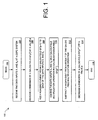
- FIG. 1 there is provided a flow chart of a closed Galois field combination (CGFC) method 100 for combining two (2) data inputs.
- CGFC closed Galois field combination
- a Galois field GF[p k ] is a cyclic finite structure created on a discrete collection of elements ⁇ 0, 1, 2, ..., p k -1 ⁇ .
- a Galois field GF[2 3 ] is a cyclic finite structure containing elements ⁇ 0, 1, 2, 3, 4, 5, 6, 7 ⁇ .
- the Galois field GF[p k ] has certain analytical properties that allow arithmetic operations to be performed within the Galois field GF[p k ]. Such arithmetic operations include an addition operation, a subtraction operation, and a multiplication operation.
- the Galois field GF[p k ] is often referred to as a closed structure since results of said arithmetic operations equal another element in the same Galois field.
- the arithmetic operation of division in the Galois field GF[p k ] is only valid for nonzero elements in said Galois field GF[p k ].
- the Galois field GF[p k ] is selected as a Galois field GF[2 3 ]
- X is any element of Galois field GF[2 3 ]. In such a scenario, there does not exist a multiplicative inverse of zero within the Galois field GF[2 3 ].
- a multiplication of element zero (0) times another element of Galois field GF[2 3 ] can not be inverted to obtain one (1) of the two (2) elements multiplied together.
- the present invention provides a CGFC method 100 for bypassing the above-described shortcomings of Galois field multiplication.
- the present invention also provides a CGFC method 100 which ensures that a multiplicative inverse exists for elements in a Galois field GF[p].
- the method involves performing an Affine transformation on any plurality of k-bit data streams.
- the resulting data streams can be efficiently and invertibly combined by a means of Galois field multiplication in a Galois field GF[p k+1 ].
- the Affine transformation yields additional degrees of freedom which expands the variability of output values and thereby makes reverse engineering of the k-bit data streams more difficult.
- Affine transformations generally involve appending a one (1) to the end of a digital word or removing a one (1) from the end of a digital word.
- a simple Affine transformation from a Galois field GF[8] to a Galois field GF[16] is performed by appending a one (1) behind a least significant bit (LSB) of each three (3) bit representation of numbers in the Galois field GF[8].
- the Affine transformation yields 0 ⁇ 1, 1 ⁇ 3, 2 ⁇ 5, 3 ⁇ 7, 4 ⁇ 9, 5 ⁇ 11, 6 ⁇ 13, and 7 ⁇ 15.
- Each number in the extended Galois field has a unique multiplicative inverse.
- y-1 is always even.
- the Affine transformation from the Galois field GF[2 k+1 ] to the Galois field GF[2 k ] is simply accomplished by dropping the least significant bit (LSB) from y and keeping the k most significant bits.
- LSB least significant bit
- the CGFC method 100 begins at step 102 and continues with step 104.
- step 104 two data inputs X 1 and X 2 are received at a closed Galois field combination system.
- the closed Galois field combination system can be, but is not limited to, a closed Galois field encryption system such as that described below in relation to FIG. 5 .
- step 106 is performed where a dimension of a Galois field GF[p k ] is increased by a value p.
- step 108 is performed where a nonzero element from a Galois field GF[p-1] is added to each of the data inputs X 1 and X 2 .
- steps 106 and 108 collectively provide an Affine transformation between an original number range to a number range of a Galois extension field.
- the Affine transformation can be selected as a constant function or a function of time.
- Affine transformations are well known to persons skilled in the art, and therefore will not be described in great detail herein.
- an Affine transformation may be considered a bijective mapping. Bijective, injective, and surjective mappings are also well known to persons skilled in the art, and therefore will not be described herein.
- step 110 the two data inputs are combined via a Galois field multiplication operation in a Galois extension field GF[p k+1 ].
- the Galois field multiplication operation is performed to guarantee invertible reconstruction of the data inputs X 1 and X 2 . This invertible operation is desirable such that a first data input X 1 can be obtained via a pre-defined mathematical process and a priori knowledge of a second data input X 2 .
- step 110 the CGFC method 100 continues with a step 112.
- step 112 a known digit is subtracted from a result of said Galois field multiplication operation.
- step 114 a dimension of a Galois field GF[p k+1 ] is decreased by a value p.
- step 116 is performed where the CGFC method 100 ends.
- multiplication of two (2) numbers in a Galois field results in another number within the same Galois field.
- the multiplication process may not be invertible, even given knowledge of one of the original numbers since the other number may not have a multiplicative inverse.
- the solution to guaranteed invertible multiplication is to restrict the numbers being multiplied to those which have multiplicative inverses in a given Galois field. This restriction places additional requirements on the random number generator to either produce acceptable numbers or else to map outputs to acceptable numbers.
- One method of implementing a structure such that all elements have unique inverses is to increase the dimension of the original Galois field, mapping the initial number set to a distinct invertible subset of the extended Galois field.
- the Galois field having an increased dimension is referred to herein as a Galois extension field. It can be shown that there exists an injective mapping between the elements in the original Galois field and those in the Galois extension field that possess multiplicative inverses. This invertability allows a unique multiplication of numbers in the original Galois field through the injective mapping, implementing an effective bijective mapping.
- Galois field multiplication is more computationally efficient than the equivalent multiplication in a weighted number system since the number of output values is restricted to a finite set.
- weighted number system refers to a number system other than a residue number system.
- Galois field multiplication in binary number systems such as a Galois field GF[2 k ] are useful in practice due to the structure of digital logic. Computational savings for Galois field multiplication in digital hardware as compared to conventional multiplications exceed fifty percent (50%). Algorithms for effecting the Galois field multiplication operation are well known to those skilled in the art, and therefore will not be described herein. In general, the multiplication result in a Galois field may be obtained more efficiently since only partial information of the intermediate arithmetic steps is required to determine the unique output value.
- the above described CGFC method 100 can be further defined by a CGFC arithmetic process 200.
- the CGFC arithmetic process 200 begins with data inputs X 1 and X 2 .
- the data input X 1 can be payload data or a random number of a random number sequence.
- the data input X 2 can be a pseudo-random number of a pseudo-random number sequence or a pseudo-chaotic random number of a pseudo-chaotic random number sequence.
- payload data refers to data that is a numerical equivalent to a written symbol of a natural language, such as a letter or a punctuation mark. For example, if a number three (3) is an numerical equivalent to a letter C, then the data input X 1 has a value of three (3).
- the data input can also be the numerical equivalent for data of any type using a predefined coding process.
- the data inputs X 1 , X 2 are expressed as a member of the Galois field GF[p k ] of dimension p k .
- p k is a prime number defining a finite field size of the Galois field GF[p k ].
- the data inputs X 1 , X 2 are expressed in a Galois field with a power of two (2) dimension, i.e., a Galois field GF[2 k ] representation. In such a scenario, the manipulation of elements of the Galois field GF[2 k ] in binary arithmetic is trivial.
- the data inputs X 1 , X 2 are expressed in a p-adic number system representation or a mixed-radix number system representation.
- the p-adic number system and the mixed-radix number system are well known to persons skilled in the art, and therefore will not be described in great detail herein.
- a p-adic number is an element of an extension of the field of natural numbers based on the divisibility of integers by a given relatively prime number p.
- the extension of the field of natural numbers results in a p-adic number sequence.
- the p-adic number sequence is comprised of k elements (x 0 , x 1 , ..., X k-1 ) of residue x k modulo p.
- the initial multiplication operations 202, 204 and addition operations 206, 208 are performed using the data inputs X 1 , X 2 .
- These operations 202, 204, 206, 208 are performed to increase a size of the finite or Galois field GF[p k ] from p k to p k+1 via an Affine transformation.
- p is taken to be an arbitrary prime number.
- the invention is not limited in this regard.
- p can be extended to composite numbers through processes like the Chinese Remainder Theorem.
- the products of the multiplication operations 202, 204 are herein after referred to as Y 1 and Y 2 .
- the products Y 1 , Y 2 are defined by mathematical Equations (1-2).
- Y 1 X 1 ⁇ p 1
- Y 2 X 2 ⁇ p 1 where Y 1 and Y 2 are products obtained via a multiplication operation 202, 204.
- addition operations 206, 208 are performed to add a non-zero constant C 1 , C 2 from a finite or Galois field GF[p 1 ] to each product Y 1 , Y 2 .
- the non-zero constants C 1 , C 2 have a value of 1, 2, ..., or p-1.
- the Affine transformation is a simple appending of a binary one (1) to the right of a least significant bit (LSB) of the data input X 1 , X 2 thus implementing 2X+1 as one (1) is the only nonzero element in a Galois field GF[2].
- the results of the addition operations 206, 208 are hereinafter referred to as Z 1 and Z 2 .
- the results Z 1 , Z 2 are defined by mathematical Equations (3-4).
- Z 1 and Z 2 are results of addition operations.
- Y 1 and Y 2 are products obtained via multiplication operations 202, 204.
- C 1 and C 2 are nonzero constants selected from a finite or Galois field GF[p].
- X 1 and X 2 are data inputs expressed as RNS residue values, p-adic number system representations, or mixed-radix number system representations.
- p is a prime number constant defining a finite field size of a Galois field GF[p].
- a Galois field multiplication 210 is performed using the results Z 1 , Z 2 .
- This Galois field multiplication 210 is performed to combine the data inputs X 1 , X 2 in an expanded Galois field GF[p k+1 ].
- the result of the Galois field multiplication 210 is defined by mathematical Equation (5).
- RV 1 is a result of the Galois field multiplication 210.
- p k+1 is a modulus having a value defined by the size of the extended Galois field GF[p k+1 ].
- the nonzero constants C 1 , C 2 are combined together via Galois field multiplication 212.
- This Galois field GF[p 1 ] multiplication 212 is performed to combine the nonzero constants C 1 , C 2 in Galois field GF[p 1 ].
- the result of the Galois field multiplication 212 can be defined by mathematical Equation (6).
- R ⁇ V 2 - C 1 ⁇ C 2 mod p
- RV 2 is a value representing the nonzero constants C 1 , C 2 .
- p is a modulus having a prime number value defining a finite field size of a Galois field GF[p 1 ].
- (RV 1 - RV 2 ) ⁇ p -1 is computed to perform an Affine transformation 214 from a Galois field GF[p k+1 ] to a Galois field GF[p k ].
- the Affine transformation 214 includes subtracting RV 2 from RV 1 to obtain a result Q.
- the result Q can be defined by a mathematical Equation (7).
- Q R ⁇ V 1 - R ⁇ V 2
- CO Q ⁇ p - 1
- Q is a result obtained from subtracting RV 2 from RV 1 .
- p -1 is the multiplicative inverse of the prime p.
- the overall CGFC arithmetic process 200 can be generally defined by a mathematical Equation (9).
- CO [ p ⁇ X 1 + C 1 ⁇ p ⁇ X 2 + C 2 ⁇ mod p k + 1 - C 1 ⁇ C 2 mod p p
- p is a prime number constant defining a finite field size of a Galois field GF[p m ].
- X 1 and X 2 are data inputs expressed as values in a p-adic number system representation or a mixed-radix number system representation.
- C 1 and C 2 are nonzero values selected from a Galois field GF[p].
- MSBs most significant bits
- a method of extending the repetition period of a random number sequence can be easily constructed. Given two (2) random number sequences as inputs X 1 and X 2 that come from pseudo-random number generators with mutually prime repetition periods, the output numerical sequence will be a nonlinear combination that yields another pseudo-random number sequence with a repetition period equal to the product of the input repetition periods.
- the method described in this paragraph extends trivially to the combination of larger numbers of random number generators since multiplication inside a Galois field is associative.
- the "associative" property refers to the ability to reorder inputs to an arithmetic process in any combination, resulting in the same output. Note that the CGFC arithmetic process 200 (described above in relation to FIG. 2 ) as a whole is associative.
- the CGFC arithmetic process 200 can be modified in accordance with an encoding process.
- the data input X 1 can be a number from a numerical sequence representing data.
- X 2 can be a number from a coding sequence.
- the coding sequence can be, but is not limited to, a pseudo-random number sequence or a pseudo-chaotic random number sequence.
- An example of such a modified CGFC arithmetic process 200 is provided in FIG. 3 .
- FIG. 3 a block diagram of a CGFC arithmetic process 300 for encoding data is provided. It should be understood that the CGFC arithmetic process 300 may be used in conjunction with other processes to create stream ciphers or other coding algorithms. Such structures include, but are not limited to, feedback loops, scrambling, and mixed-radix operations.
- each value of a data sequence 302 is combined with a value of a code sequence 304 through a Galois extension field multiplication 314 (described above in relation to FIG. 1 and FIG. 2 ).
- the data sequence 302 and/or the code sequence 304 can be selected to have a known mathematical relationship.
- the data sequence 302 and the code sequence 304 can also be comprised of two or more digits expressed in a weighted number system. In such a scenario, the data sequence 302 and the code sequence 304 can be combined by selectively performing a Galois extension field multiplication 314 using a distinct subset of digits from each sequence 302, 304.
- dynamic range refers to the number of possible values for a number or a measurement.
- the dynamic range is equivalent to a cardinality of a set of possible input values.
- the code sequence 304 may be formed from a truncated or random selection of values generated by one or more random number generators. Random number generators are well known to persons skilled in the art, and therefore will not be described in great detail herein.
- the coded data output sequence 320 of the encoding process 300 represents a block of encoding or encryption cipher on the data sequence 302 values using the coded sequence 304 values.
- a decoding process can be performed to obtain the data sequence 302 from the combined output coded data sequence 320.
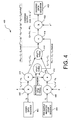
- Such an inverse CGFC arithmetic process is described below in FIG. 4 .
- a first input sequence 402 is the coded data output sequence 320 developed in the encoding process 300 (described above in relation to FIG. 3 .).
- a second input sequence 404 is an inverted code sequence based on the code sequence 304 utilized in the encoding process 300.
- the "inverse" operation on this code sequence 304 refers to an injective mapping from the original code sequence 304 values that represent the unique multiplicative inverse of the code sequence 304 values inside the same Galois extension field that is used for the combination step. This inverse operation is calculated on a value by value basis.
- the inverse operation may be implemented using any combination of arithmetic processes, digital logic, lookup tables, or software.
- the decoding process 400 follows the identical combination technique of the CGFC arithmetic process 200 (described above in relation to FIG. 2 ).
- the decoding process 400 includes multiplications operations 406, 408 and addition operations 410, 412.
- the decoding process 400 also includes a Galois extension field multiplication operation 414 and a Galois field multiplication operation 416.
- the decoding process further includes an addition operation 418 and a multiplication operation 422.
- the output sequence 420 of the decoding process 400 is identical to original data sequence 302 of FIG. 3 .
- Table 3 presents all of the encoded and decoded values possible from the data and code sequences if the Galois field GF[8] follows the flows shown in FIG. 3 and FIG. 4 .
- Data Sequence from a First Data Source refers to values of the Data Sequence 302 of FIG. 3 .
- code Sequence from a Second Data Source refers to values of the Code Sequence 304 of FIG. 3 .
- the table heading "First Data Source Affine Transformation” refers to the value of Z 1 produced by the multiplication and addition operations 306, 310 of FIG. 3 .
- the table heading "Second Data Source Affine Transformation” refers to the value of Z 2 produced by the multiplication and addition operations 308, 312 of FIG. 3 .
- the table heading "GF[16] Result” refers to the intermediate result RV 1 of FIG. 3 .
- the table heading "GF[8] Result” refers to the intermediate result CO of FIG. 3 .
- the table heading "1/Data Source 2 in GF[16]” refers to the intermediate result Z 4 of FIG. 4 .
- asymmetric processing refers to a significant difference in time, processing structure, or computational resources required to perform associated operations.
- This asymmetric encryption or decryption processing technique can limit many ciphers functionality and applicability.
- an RSA algorithm involves selecting public and private keys for encrypting data. This selection typically makes decrypting a message by an intended user far easier than an encryption step by a messenger.
- the digital hardware typically includes a relatively large number of digital logic gates. As such, the conventional cryptographic systems have a relatively high power consumption and relatively long data processing time. Encryption methods that permit symmetric processing permit design re-use of hardware as well as more flexibility in function and applicability.
- Embodiments of a closed Galois field (CGF) cryptographic system provides a symmetric encryption and decryption processing technique implemented in digital hardware.
- the phrase "symmetric processing" as used herein refers to an ability to both encrypt and decrypt a message using a significantly similar processing structure, time, and resources.
- the embodiment of the CGF cryptographic system has a relatively short data processing time as compared to conventional cryptographic systems.
- the embodiments of the CGF cryptographic system also have a relatively low power consumption as compared to conventional cryptographic systems due to the efficient combination means.
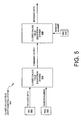
- the CGF cryptographic system 500 is comprised of a message generator 502 and random number generators (RNGs) 504, 510.
- the CGF cryptographic system 500 is also comprised of a closed Galois field (CGF) encryption system 506 and a closed Galois field (CGF) decryption system 508.
- the message generator 502 is comprised of hardware and software configured to generate payload data.
- the message generator 502 is also comprised of hardware and software configured to perform operations for expressing payload data in a block format.
- the message generator 502 is further comprised of hardware and software configured to communicate payload data to the CGF encryption system 506.
- the RNG 504 is comprised of hardware and software configured to generate an encryption sequence.
- the encryption sequence can be comprised of linearly or nonlinearly generated pseudo-random numbers or pseudo-chaotic random numbers.
- the RNG 504 is also comprised of hardware and software configured to communicate a random number sequence to the CGF encryption system 506.
- the CGF encryption system 506 is comprised of hardware and software configured to receive payload data from the message generator 502 and an encryption sequence from the RNG 504.
- the CGF encryption system 506 is also comprised of hardware and software configured to implement and perform a CGFC method 100 (described above in relation to FIG. 1 ) and a CGFC arithmetic process 300 (described above in relation to FIG. 3 ) for encrypting payload data using the random number sequence.
- the CGF encryption system 506 is further comprised of hardware and software configured to communicate a combined output to the CGF decryption system 508.
- the RNG 510 is comprised of hardware and software configured to generate a decryption sequence.
- the decryption sequence can be comprised of linearly or nonlinearly generated pseudo-random numbers or pseudo-chaotic random numbers.
- the decryption sequence can be the same as the encryption sequence generated by the RNG 504.
- the RNG 510 is also comprised of hardware and software configured to perform data block formatting.
- the RNG 510 is further comprised of hardware and software configured to communicate a decryption sequence to the CGF decryption system 508.
- the CGF decryption system 508 is comprised of hardware and software configured to receive a combined output from the CGF encryption system 506 and a decryption sequence from the RNG 510.
- the CGF decryption system 508 is also comprised of hardware and software configured to implement and perform an inverse CGFC arithmetic process 400 (described above in relation to FIG. 4 ) for decrypting payload data.
- the CGF decryption system 508 is further comprised of hardware and software configured to communicate message data to an external device (not shown).
- the present invention can be realized in hardware, software, or a combination of hardware and software. Any kind of computer system, or other apparatus adapted for carrying out the methods described herein, is suited.
- a typical combination of hardware and software could be a general purpose computer processor, with a computer program that, when being loaded and executed, controls the computer processor such that it carries out the methods described herein.
- an application specific integrated circuit (ASIC) and/or an FPGA could also be used to achieve a similar result.
- the present invention can also be embedded in a computer program product, which comprises all the features enabling the implementation of the methods described herein, and which, when loaded in a computer system, is able to carry out these methods.
- Computer program or application in the present context means any expression, in any language, code or notation, of a set of instructions intended to cause a system having an information processing capability to perform a particular function either directly or after either or both of the following a) conversion to another language, code or notation; b) reproduction in a different material form.
Landscapes
- Physics & Mathematics (AREA)
- Engineering & Computer Science (AREA)
- General Physics & Mathematics (AREA)
- Mathematical Analysis (AREA)
- Mathematical Optimization (AREA)
- Pure & Applied Mathematics (AREA)
- Computational Mathematics (AREA)
- Theoretical Computer Science (AREA)
- Computing Systems (AREA)
- Mathematical Physics (AREA)
- General Engineering & Computer Science (AREA)
- Error Detection And Correction (AREA)
- Detection And Correction Of Errors (AREA)
Claims (7)
- Verfahren, das unter Verwendung eines Computersystems zur Verschlüsselung implementiert ist, aufweisend ein Kombinieren zumindest zweier Eingabefolgen in einem Kommunikationssystem, um eine Wiederholungsperiode der zumindest zwei Eingabefolgen auf eine ressourceneffiziente Weise zu erhöhen, wobei das Verfahren aufweist:Empfangen einer ersten Zahlenfolge und einer zweiten Zahlenfolge, wobei jede in einem Galois-Feld GF[pk] ausgedrückt wird;Abbilden der ersten Zahlenfolge und der zweiten Zahlenfolge auf ein Galois-Erweiterungsfeld GF[pk+1] mittels Durchführens einer affinen Transformation der ersten Zahlenfolge und der zweiten Zahlenfolge; undErzeugen einer Ausgabefolge mittels Kombinierens der ersten Zahlenfolge und der zweiten Zahlenfolge unter Verwendung einer Galois-Feld-Multiplikationsoperation in dem Galois-Erweiterungsfeld GF[pk+1], wobei p eine Primzahl ist, k ein ganzzahliger Wert ist und pk+1 eine finite Feldgröße des Galois-Erweiterungsfelds GF[pk+1] definiert.
- Verfahren nach Anspruch 1, ferner aufweisend ein Auswählen von pk so, dass es eine Zahl ist, die eine finite Feldgröße des Galois-Felds GF[pk] definiert.
- Verfahren nach Anspruch 1, bei dem der Schritt des Erzeugens ferner ein Kombinieren der ersten Zahlenfolge und der zweiten Zahlenfolge aufweist, und zwar mittels selektiven Durchführens einer Vielzahl von Galois-Feld-Multiplikationsoperationen unter Verwendung einer jeweils verschiedenen Teilmenge von Ziffern aus der ersten Zahlenfolge und der zweiten Zahlenfolge.
- Verfahren nach Anspruch 1, ferner aufweisend ein Auswählen der ersten Zahlenfolge so, dass sie Nutzlastdaten oder eine zufällige Zahlenfolge ist.
- Verfahren nach Anspruch 1, ferner aufweisend ein Auswählen der zweiten Zahlenfolge so, dass sie eine pseudo-zufällige Zahlenfolge ist.
- Verfahren nach Anspruch 1, bei dem ein Durchführen einer affinen Transformation der ersten Zahlenfolge und der zweiten Zahlenfolge ein Anhängen eines konstanten Werts an jede Zahlendarstellung in der ersten und der zweiten Zahlenfolge aufweist.
- Geschlossenes kryptografisches Galois-Feld-, CGFC-, System zum Bereitstellen einer Verschlüsselung unter Verwendung eines Computersystems, aufweisend:ein Empfangsmittel, das zum Empfangen einer ersten Zahlenfolge und einer zweiten Zahlenfolge ausgestaltet ist, wobei jede in einem Galois-Feld GF[pk] ausgedrückt wird;ein Abbildungsmittel, das zum Abbilden der ersten Zahlenfolge und der zweiten Zahlenfolge auf ein Galois-Erweiterungsfeld GF[pk+1] ausgestaltet ist, und zwar mittels Durchführens einer affinen Transformation der ersten Zahlenfolge und der zweiten Zahlenfolge; undein Erzeugungsmittel, das zum Erzeugen einer Ausgabefolge ausgestaltet ist, und zwar mittels Kombinierens der ersten Zahlenfolge und der zweiten Zahlenfolge unter Verwendung einer Galois-Feld-Multiplikationsoperation in dem Galois-Erweiterungsfeld GF[pk+1], wobei p eine Primzahl ist, k ein ganzzahliger Wert ist und pk+1 eine finite Feldgröße des Galois-Erweiterungsfelds GF[pk+1] definiert.
Applications Claiming Priority (1)
| Application Number | Priority Date | Filing Date | Title |
|---|---|---|---|
| US11/756,086 US7995757B2 (en) | 2007-05-31 | 2007-05-31 | Closed galois field combination |
Publications (3)
| Publication Number | Publication Date |
|---|---|
| EP2003546A2 EP2003546A2 (de) | 2008-12-17 |
| EP2003546A3 EP2003546A3 (de) | 2010-04-07 |
| EP2003546B1 true EP2003546B1 (de) | 2011-04-20 |
Family
ID=39874881
Family Applications (1)
| Application Number | Title | Priority Date | Filing Date |
|---|---|---|---|
| EP08009745A Not-in-force EP2003546B1 (de) | 2007-05-31 | 2008-05-28 | Geschlossene Galois-Körper-Kombination |
Country Status (5)
| Country | Link |
|---|---|
| US (1) | US7995757B2 (de) |
| EP (1) | EP2003546B1 (de) |
| JP (1) | JP4866389B2 (de) |
| CA (1) | CA2632857C (de) |
| DE (1) | DE602008006296D1 (de) |
Families Citing this family (45)
| Publication number | Priority date | Publication date | Assignee | Title |
|---|---|---|---|---|
| US8312551B2 (en) * | 2007-02-15 | 2012-11-13 | Harris Corporation | Low level sequence as an anti-tamper Mechanism |
| US7937427B2 (en) * | 2007-04-19 | 2011-05-03 | Harris Corporation | Digital generation of a chaotic numerical sequence |
| US8611530B2 (en) * | 2007-05-22 | 2013-12-17 | Harris Corporation | Encryption via induced unweighted errors |
| US7921145B2 (en) * | 2007-05-22 | 2011-04-05 | Harris Corporation | Extending a repetition period of a random sequence |
| US7995757B2 (en) | 2007-05-31 | 2011-08-09 | Harris Corporation | Closed galois field combination |
| US7974413B2 (en) * | 2007-06-07 | 2011-07-05 | Harris Corporation | Spread spectrum communications system and method utilizing chaotic sequence |
| US7970809B2 (en) * | 2007-06-07 | 2011-06-28 | Harris Corporation | Mixed radix conversion with a priori defined statistical artifacts |
| US7962540B2 (en) * | 2007-06-07 | 2011-06-14 | Harris Corporation | Mixed radix number generator with chosen statistical artifacts |
| US8250129B2 (en) | 2007-06-22 | 2012-08-21 | Lsi Corporation | Cryptographic random number generator using finite field operations |
| US8005221B2 (en) * | 2007-08-01 | 2011-08-23 | Harris Corporation | Chaotic spread spectrum communications system receiver |
| US7995749B2 (en) * | 2007-10-30 | 2011-08-09 | Harris Corporation | Cryptographic system configured for extending a repetition period of a random sequence |
| US8180055B2 (en) * | 2008-02-05 | 2012-05-15 | Harris Corporation | Cryptographic system incorporating a digitally generated chaotic numerical sequence |
| US8363830B2 (en) | 2008-02-07 | 2013-01-29 | Harris Corporation | Cryptographic system configured to perform a mixed radix conversion with a priori defined statistical artifacts |
| US8040937B2 (en) * | 2008-03-26 | 2011-10-18 | Harris Corporation | Selective noise cancellation of a spread spectrum signal |
| US8139764B2 (en) | 2008-05-06 | 2012-03-20 | Harris Corporation | Closed galois field cryptographic system |
| US8320557B2 (en) | 2008-05-08 | 2012-11-27 | Harris Corporation | Cryptographic system including a mixed radix number generator with chosen statistical artifacts |
| US8200728B2 (en) * | 2008-05-29 | 2012-06-12 | Harris Corporation | Sine/cosine generator |
| US8145692B2 (en) * | 2008-05-29 | 2012-03-27 | Harris Corporation | Digital generation of an accelerated or decelerated chaotic numerical sequence |
| US8064552B2 (en) * | 2008-06-02 | 2011-11-22 | Harris Corporation | Adaptive correlation |
| US8068571B2 (en) * | 2008-06-12 | 2011-11-29 | Harris Corporation | Featureless coherent chaotic amplitude modulation |
| US8325702B2 (en) * | 2008-08-29 | 2012-12-04 | Harris Corporation | Multi-tier ad-hoc network in which at least two types of non-interfering waveforms are communicated during a timeslot |
| US8165065B2 (en) | 2008-10-09 | 2012-04-24 | Harris Corporation | Ad-hoc network acquisition using chaotic sequence spread waveform |
| US8351484B2 (en) * | 2008-12-29 | 2013-01-08 | Harris Corporation | Communications system employing chaotic spreading codes with static offsets |
| US8406276B2 (en) * | 2008-12-29 | 2013-03-26 | Harris Corporation | Communications system employing orthogonal chaotic spreading codes |
| US8457077B2 (en) * | 2009-03-03 | 2013-06-04 | Harris Corporation | Communications system employing orthogonal chaotic spreading codes |
| US8428102B2 (en) * | 2009-06-08 | 2013-04-23 | Harris Corporation | Continuous time chaos dithering |
| US8509284B2 (en) * | 2009-06-08 | 2013-08-13 | Harris Corporation | Symbol duration dithering for secured chaotic communications |
| US8428103B2 (en) * | 2009-06-10 | 2013-04-23 | Harris Corporation | Discrete time chaos dithering |
| US8428104B2 (en) | 2009-07-01 | 2013-04-23 | Harris Corporation | Permission-based multiple access communications systems |
| US8363700B2 (en) | 2009-07-01 | 2013-01-29 | Harris Corporation | Rake receiver for spread spectrum chaotic communications systems |
| US8369376B2 (en) * | 2009-07-01 | 2013-02-05 | Harris Corporation | Bit error rate reduction in chaotic communications |
| US8385385B2 (en) | 2009-07-01 | 2013-02-26 | Harris Corporation | Permission-based secure multiple access communication systems |
| US8340295B2 (en) * | 2009-07-01 | 2012-12-25 | Harris Corporation | High-speed cryptographic system using chaotic sequences |
| US8406352B2 (en) | 2009-07-01 | 2013-03-26 | Harris Corporation | Symbol estimation for chaotic spread spectrum signal |
| US8379689B2 (en) * | 2009-07-01 | 2013-02-19 | Harris Corporation | Anti-jam communications having selectively variable peak-to-average power ratio including a chaotic constant amplitude zero autocorrelation waveform |
| US8848909B2 (en) * | 2009-07-22 | 2014-09-30 | Harris Corporation | Permission-based TDMA chaotic communication systems |
| US8369377B2 (en) | 2009-07-22 | 2013-02-05 | Harris Corporation | Adaptive link communications using adaptive chaotic spread waveform |
| US8345725B2 (en) | 2010-03-11 | 2013-01-01 | Harris Corporation | Hidden Markov Model detection for spread spectrum waveforms |
| US8654819B2 (en) | 2011-06-22 | 2014-02-18 | Harris Corporation | Systems and methods for pulse rotation modulation encoding and decoding |
| AU2014101337B4 (en) * | 2014-11-08 | 2015-09-10 | Smic Australasia Pty Ltd | Smic |
| WO2018135511A1 (ja) * | 2017-01-18 | 2018-07-26 | 日本電信電話株式会社 | 秘密計算方法、秘密計算システム、秘密計算装置、およびプログラム |
| US10649841B2 (en) * | 2018-03-05 | 2020-05-12 | Alibaba Group Holding Limited | Supporting multiple page lengths with unique error correction coding via galois field dimension folding |
| US11032061B2 (en) * | 2018-04-27 | 2021-06-08 | Microsoft Technology Licensing, Llc | Enabling constant plaintext space in bootstrapping in fully homomorphic encryption |
| US11438013B2 (en) * | 2020-07-15 | 2022-09-06 | Samsung Electronics Co., Ltd. | Low-power error correction code computation in GF (2R) |
| US12524578B2 (en) * | 2021-12-22 | 2026-01-13 | Jonetix Corporation | Processor architecture and related techniques |
Family Cites Families (109)
| Publication number | Priority date | Publication date | Assignee | Title |
|---|---|---|---|---|
| FR1501059A (fr) | 1966-09-26 | 1967-11-10 | Csf | Nouveau générateur de clé |
| GB1198263A (en) | 1967-06-06 | 1970-07-08 | Nat Res Dev | Improvements in or relating to Digital Differential Analysers |
| JPS508907B1 (de) * | 1970-07-08 | 1975-04-08 | ||
| US4646326A (en) | 1983-10-20 | 1987-02-24 | Motorola Inc. | QAM modulator circuit |
| US4703507A (en) | 1984-04-05 | 1987-10-27 | Holden Thomas W | Noise reduction system |
| ATE116081T1 (de) | 1989-08-24 | 1995-01-15 | Philips Nv | Verfahren und einrichtung zur decodierung von wortgeschützten codewörtern durch einen nichtbinären bch-code gegen mindestens einen symbolfehler. |
| US5077793A (en) | 1989-09-29 | 1991-12-31 | The Boeing Company | Residue number encryption and decryption system |
| US5007087A (en) | 1990-04-16 | 1991-04-09 | Loral Aerospace Corp. | Method and apparatus for generating secure random numbers using chaos |
| US5048086A (en) | 1990-07-16 | 1991-09-10 | Hughes Aircraft Company | Encryption system based on chaos theory |
| US5319735A (en) | 1991-12-17 | 1994-06-07 | Bolt Beranek And Newman Inc. | Embedded signalling |
| US5297206A (en) | 1992-03-19 | 1994-03-22 | Orton Glenn A | Cryptographic method for communication and electronic signatures |
| US5276633A (en) | 1992-08-14 | 1994-01-04 | Harris Corporation | Sine/cosine generator and method |
| US5811998A (en) | 1993-01-28 | 1998-09-22 | Digital Equipment Corporation | State machine phase lock loop |
| US5412687A (en) | 1993-10-15 | 1995-05-02 | Proxim Incorporated | Digital communications equipment using differential quaternary frequency shift keying |
| US6614914B1 (en) | 1995-05-08 | 2003-09-02 | Digimarc Corporation | Watermark embedder and reader |
| US6014446A (en) | 1995-02-24 | 2000-01-11 | Motorola, Inc. | Apparatus for providing improved encryption protection in a communication system |
| US5598476A (en) | 1995-04-20 | 1997-01-28 | United Technologies Automotive, Inc. | Random clock composition-based cryptographic authentication process and locking system |
| US5937000A (en) | 1995-09-06 | 1999-08-10 | Solana Technology Development Corporation | Method and apparatus for embedding auxiliary data in a primary data signal |
| US5757923A (en) | 1995-09-22 | 1998-05-26 | Ut Automotive Dearborn, Inc. | Method of generating secret identification numbers |
| WO1997044935A1 (en) | 1996-05-20 | 1997-11-27 | Philips Electronics N.V. | Cryptographic method and apparatus for non-linearly merging a data block and a key |
| US6078222A (en) | 1996-07-05 | 2000-06-20 | Thomcast Communications, Inc. | Controller-based radio frequency amplifier module and method |
| US7190681B1 (en) | 1996-07-10 | 2007-03-13 | Wu William W | Error coding in asynchronous transfer mode, internet and satellites |
| US5963460A (en) | 1996-12-17 | 1999-10-05 | Metaflow Technologies, Inc. | Apparatus for computing transcendental functions quickly |
| AU8261298A (en) | 1997-06-23 | 1999-01-04 | Regents Of The University Of California, The | Chaotic digital code-division multiple access (cdma) communication systems |
| US5852630A (en) | 1997-07-17 | 1998-12-22 | Globespan Semiconductor, Inc. | Method and apparatus for a RADSL transceiver warm start activation procedure with precoding |
| US6633226B1 (en) | 1997-08-18 | 2003-10-14 | X-Cyte, Inc. | Frequency hopping spread spectrum passive acoustic wave identification device |
| US6078611A (en) | 1997-09-16 | 2000-06-20 | Motorola, Inc. | Rake receiver and finger management method for spread spectrum communication |
| US6038317A (en) | 1997-12-24 | 2000-03-14 | Magliveras; Spyros S. | Secret key cryptosystem and method utilizing factorizations of permutation groups of arbitrary order 2l |
| US6285761B1 (en) | 1998-03-04 | 2001-09-04 | Lucent Technologies, Inc. | Method for generating pseudo-random numbers |
| US6754251B1 (en) | 1998-03-09 | 2004-06-22 | Texas Instruments Incorporated | Spread-spectrum telephony with accelerated code acquisition |
| US5924980A (en) | 1998-03-11 | 1999-07-20 | Siemens Corporate Research, Inc. | Method and apparatus for adaptively reducing the level of noise in an acquired signal |
| US5900835A (en) | 1998-07-09 | 1999-05-04 | The United States Of America As Represented By The Secretary Of The Navy | Coherent hidden markov model |
| US6980656B1 (en) | 1998-07-17 | 2005-12-27 | Science Applications International Corporation | Chaotic communication system and method using modulation of nonreactive circuit elements |
| US6304556B1 (en) * | 1998-08-24 | 2001-10-16 | Cornell Research Foundation, Inc. | Routing and mobility management protocols for ad-hoc networks |
| US6363104B1 (en) | 1998-10-02 | 2002-03-26 | Ericsson Inc. | Method and apparatus for interference cancellation in a rake receiver |
| US7277540B1 (en) | 1999-01-20 | 2007-10-02 | Kabushiki Kaisha Toshiba | Arithmetic method and apparatus and crypto processing apparatus for performing multiple types of cryptography |
| US6823068B1 (en) | 1999-02-01 | 2004-11-23 | Gideon Samid | Denial cryptography based on graph theory |
| US6377782B1 (en) | 1999-03-01 | 2002-04-23 | Mediacell, Inc. | Method and apparatus for communicating between a client device and a linear broadband network |
| US6304216B1 (en) | 1999-03-30 | 2001-10-16 | Conexant Systems, Inc. | Signal detector employing correlation analysis of non-uniform and disjoint sample segments |
| FI107094B (fi) * | 1999-05-10 | 2001-05-31 | Nokia Mobile Phones Ltd | Menetelmä päivittää koodigeneraattorin lineaarinen palautesiirtorekisteri |
| US6570909B1 (en) | 1999-07-09 | 2003-05-27 | Nokia Mobile Phones | Interference suppression in a CDMA receiver |
| US20020099746A1 (en) | 1999-07-26 | 2002-07-25 | Tie Teck Sing | T-sequence apparatus and method for general deterministic polynomial-time primality testing and composite factoring |
| US6744893B1 (en) | 1999-08-25 | 2004-06-01 | Southwest Research Institute | Receiver estimation engine for a chaotic system |
| US7200225B1 (en) | 1999-11-12 | 2007-04-03 | Richard Schroeppel | Elliptic curve point ambiguity resolution apparatus and method |
| US7596170B2 (en) | 2000-02-28 | 2009-09-29 | Aeroastro, Inc. | Coherent detection without transmission preamble |
| US6993016B1 (en) * | 2000-11-16 | 2006-01-31 | Juniper Networks, Inc. | Methods and apparatus for transmission of analog channels over digital packet networks |
| US7010559B2 (en) | 2000-11-14 | 2006-03-07 | Parkervision, Inc. | Method and apparatus for a parallel correlator and applications thereof |
| US7170997B2 (en) | 2000-12-07 | 2007-01-30 | Cryptico A/S | Method of generating pseudo-random numbers in an electronic device, and a method of encrypting and decrypting electronic data |
| JP4188571B2 (ja) | 2001-03-30 | 2008-11-26 | 株式会社日立製作所 | 情報処理装置の演算方法および耐タンパ演算攪乱実装方式 |
| GB2374258B (en) | 2001-04-05 | 2004-03-31 | Ibm | Method and apparatus for encryption of data |
| US7218734B2 (en) | 2001-05-02 | 2007-05-15 | Nciper Corporation Limited | Ring arithmetic method, system, and apparatus |
| US7233970B2 (en) | 2001-05-02 | 2007-06-19 | Cipher Corporation Limited | Computational method, system, and apparatus |
| US7076065B2 (en) | 2001-05-11 | 2006-07-11 | Lockheed Martin Corporation | Chaotic privacy system and method |
| US7027598B1 (en) | 2001-09-19 | 2006-04-11 | Cisco Technology, Inc. | Residue number system based pre-computation and dual-pass arithmetic modular operation approach to implement encryption protocols efficiently in electronic integrated circuits |
| US6456648B1 (en) | 2001-10-01 | 2002-09-24 | Interdigital Technology Corporation | Code tracking loop with automatic power normalization |
| JP4112494B2 (ja) | 2001-10-25 | 2008-07-02 | 富士通株式会社 | 表示制御装置 |
| JP2003216037A (ja) | 2001-11-16 | 2003-07-30 | Yazaki Corp | 暗号キー、暗号化装置、暗号化復号化装置、暗号キー管理装置及び復号化装置 |
| US7269198B1 (en) | 2001-11-19 | 2007-09-11 | Bbn Technologies Corp. | Systems and methods for beaconing in wireless networks with low probability of detection |
| US6766345B2 (en) * | 2001-11-30 | 2004-07-20 | Analog Devices, Inc. | Galois field multiplier system |
| JP2003218835A (ja) | 2002-01-18 | 2003-07-31 | Mitsubishi Electric Corp | スペクトル拡散送信装置及びスペクトル拡散受信装置 |
| FR2837331B1 (fr) | 2002-03-13 | 2004-06-18 | Canon Kk | Procede d'entrelacement d'une sequence binaire |
| US7010055B2 (en) | 2002-06-27 | 2006-03-07 | Motorola, Inc. | System implementing closed loop transmit diversity and method thereof |
| WO2004014016A1 (en) * | 2002-08-06 | 2004-02-12 | Discretix Technologies Ltd. | Method and device of manipulating data in finite fields |
| FR2844891A1 (fr) | 2002-09-20 | 2004-03-26 | St Microelectronics Sa | Masquage de donnees decomposees dans un systeme de residus |
| EP1420542A1 (de) | 2002-11-12 | 2004-05-19 | STMicroelectronics S.r.l. | Verfahren und Vorrichtung zur chaotischen Erzeugung einer Pseudozufallsfolge |
| WO2004070510A2 (en) * | 2003-02-06 | 2004-08-19 | Discretix Technologies Ltd. | Device and method of manipulating masked data |
| JP2004279784A (ja) * | 2003-03-17 | 2004-10-07 | Nippon Telegr & Teleph Corp <Ntt> | 有限体上演算装置、及び有限体上演算プログラム |
| US7272168B2 (en) | 2003-04-01 | 2007-09-18 | Nokia Siemens Networks Oy | Determining the correlation between received samples and available replica samples |
| US7328228B2 (en) | 2003-09-02 | 2008-02-05 | Sap Aktiengesellschaft | Mapping pseudo-random numbers to predefined number ranges |
| KR100543101B1 (ko) | 2003-10-23 | 2006-01-20 | 학교법인 배재학당 | 시간지연가변 되먹임 혼돈시스템을 이용한 암호화 및 통신 장치와 그 방법 |
| RU2276458C2 (ru) * | 2003-11-26 | 2006-05-10 | Институт радиотехники и электроники Российской Академии Наук | Способ прямохаотической передачи информации с заданной спектральной маской |
| US7512645B2 (en) | 2004-03-19 | 2009-03-31 | Texas Instruments Incorporated | System and method for generating pseudorandom numbers |
| US7150399B2 (en) | 2004-06-09 | 2006-12-19 | Ricoh Co., Ltd. | Embedding barcode data in an auxiliary field of an image file |
| US7078981B2 (en) | 2004-07-27 | 2006-07-18 | Lucent Technologies Inc. | 16 QAM modulator and method of 16 QAM modulation |
| US7512647B2 (en) | 2004-11-22 | 2009-03-31 | Analog Devices, Inc. | Condensed Galois field computing system |
| US20060209932A1 (en) | 2005-03-18 | 2006-09-21 | Qualcomm Incorporated | Channel estimation for single-carrier systems |
| ITVA20050027A1 (it) | 2005-05-03 | 2006-11-04 | St Microelectronics Srl | Metodo di generazione di successioni di numeri o bit pseudo casuali |
| US7830214B2 (en) | 2005-11-29 | 2010-11-09 | Samsung Electronics Co., Ltd. | Adjustable chaotic signal generator using pulse modulation for ultra wideband (UWB) communications and chaotic signal generating method thereof |
| EP1959581B1 (de) | 2005-12-07 | 2019-04-17 | ZTE Corporation | Verfahren und einrichtung zum entfernen von schmalbandigen störungen in einem spreizfrequenzsystem |
| US7688878B2 (en) | 2006-03-16 | 2010-03-30 | The Boeing Company | Method and device of peak detection in preamble synchronization for direct sequence spread spectrum communication |
| KR100723222B1 (ko) | 2006-03-28 | 2007-05-29 | 삼성전기주식회사 | 펄스 세이핑 기법을 이용한 카오스 신호 송신장치 |
| FR2903200B1 (fr) | 2006-06-29 | 2008-12-19 | Thales Sa | Stabilisation hybride d'images pour camera video |
| US9203438B2 (en) | 2006-07-12 | 2015-12-01 | Ternarylogic Llc | Error correction by symbol reconstruction in binary and multi-valued cyclic codes |
| US7643537B1 (en) | 2007-01-23 | 2010-01-05 | L-3 Communications, Corp. | Spread spectrum signal detection with inhibiting for known sidelobe locations |
| US8233505B2 (en) | 2007-02-15 | 2012-07-31 | Koninklijke Philips Electronics N.V. | Coordination in wireless networks having devices with different physical layer transmission schemes |
| US8312551B2 (en) | 2007-02-15 | 2012-11-13 | Harris Corporation | Low level sequence as an anti-tamper Mechanism |
| US7797060B2 (en) * | 2007-02-27 | 2010-09-14 | Rockwell Automation Technologies, Inc. | Prioritization associated with controller engine instances |
| US7937427B2 (en) | 2007-04-19 | 2011-05-03 | Harris Corporation | Digital generation of a chaotic numerical sequence |
| US7921145B2 (en) | 2007-05-22 | 2011-04-05 | Harris Corporation | Extending a repetition period of a random sequence |
| US8611530B2 (en) | 2007-05-22 | 2013-12-17 | Harris Corporation | Encryption via induced unweighted errors |
| US7995757B2 (en) | 2007-05-31 | 2011-08-09 | Harris Corporation | Closed galois field combination |
| US7970809B2 (en) | 2007-06-07 | 2011-06-28 | Harris Corporation | Mixed radix conversion with a priori defined statistical artifacts |
| US7962540B2 (en) | 2007-06-07 | 2011-06-14 | Harris Corporation | Mixed radix number generator with chosen statistical artifacts |
| US7974413B2 (en) | 2007-06-07 | 2011-07-05 | Harris Corporation | Spread spectrum communications system and method utilizing chaotic sequence |
| US8005221B2 (en) | 2007-08-01 | 2011-08-23 | Harris Corporation | Chaotic spread spectrum communications system receiver |
| US7995749B2 (en) | 2007-10-30 | 2011-08-09 | Harris Corporation | Cryptographic system configured for extending a repetition period of a random sequence |
| US20090122926A1 (en) | 2007-11-13 | 2009-05-14 | Texas Instruments Incorporated | Data throughput in an interference-rich wireless environment |
| US8180055B2 (en) | 2008-02-05 | 2012-05-15 | Harris Corporation | Cryptographic system incorporating a digitally generated chaotic numerical sequence |
| US8363830B2 (en) | 2008-02-07 | 2013-01-29 | Harris Corporation | Cryptographic system configured to perform a mixed radix conversion with a priori defined statistical artifacts |
| US8040937B2 (en) | 2008-03-26 | 2011-10-18 | Harris Corporation | Selective noise cancellation of a spread spectrum signal |
| US8139764B2 (en) | 2008-05-06 | 2012-03-20 | Harris Corporation | Closed galois field cryptographic system |
| US8320557B2 (en) | 2008-05-08 | 2012-11-27 | Harris Corporation | Cryptographic system including a mixed radix number generator with chosen statistical artifacts |
| US8145692B2 (en) | 2008-05-29 | 2012-03-27 | Harris Corporation | Digital generation of an accelerated or decelerated chaotic numerical sequence |
| US8200728B2 (en) | 2008-05-29 | 2012-06-12 | Harris Corporation | Sine/cosine generator |
| US8064552B2 (en) | 2008-06-02 | 2011-11-22 | Harris Corporation | Adaptive correlation |
| US8068571B2 (en) | 2008-06-12 | 2011-11-29 | Harris Corporation | Featureless coherent chaotic amplitude modulation |
| US8159938B2 (en) * | 2008-06-23 | 2012-04-17 | C.H.E.S.S. Embedded Technology B.V. | Broadcast-only distributed wireless network |
| US8891756B2 (en) | 2008-10-30 | 2014-11-18 | Certicom Corp. | Collision-resistant elliptic curve hash functions |
| US7974146B2 (en) * | 2008-12-19 | 2011-07-05 | Micron Technology, Inc. | Wordline temperature compensation |
-
2007
- 2007-05-31 US US11/756,086 patent/US7995757B2/en active Active
-
2008
- 2008-05-28 DE DE602008006296T patent/DE602008006296D1/de active Active
- 2008-05-28 JP JP2008139004A patent/JP4866389B2/ja not_active Expired - Fee Related
- 2008-05-28 EP EP08009745A patent/EP2003546B1/de not_active Not-in-force
- 2008-05-30 CA CA2632857A patent/CA2632857C/en not_active Expired - Fee Related
Also Published As
| Publication number | Publication date |
|---|---|
| DE602008006296D1 (de) | 2011-06-01 |
| US20090044080A1 (en) | 2009-02-12 |
| JP4866389B2 (ja) | 2012-02-01 |
| EP2003546A3 (de) | 2010-04-07 |
| CA2632857A1 (en) | 2008-11-30 |
| CA2632857C (en) | 2012-11-27 |
| EP2003546A2 (de) | 2008-12-17 |
| JP2008299330A (ja) | 2008-12-11 |
| US7995757B2 (en) | 2011-08-09 |
Similar Documents
| Publication | Publication Date | Title |
|---|---|---|
| EP2279579B1 (de) | Kryptographiesystem mit geschlossenem galoisfeld | |
| US7995757B2 (en) | Closed galois field combination | |
| US8320557B2 (en) | Cryptographic system including a mixed radix number generator with chosen statistical artifacts | |
| CA2633923C (en) | Mixed radix number generator with chosen statistical artifacts | |
| KR100800468B1 (ko) | 저전력 고속 동작을 위한 하드웨어 암호화/복호화 장치 및그 방법 | |
| GB2549981A (en) | A public key cryptosystem based on the partitioning of elements of vectors | |
| EP1583278B1 (de) | Entwurf eines Schlüsselstromes mit drehenden Zwischenspeichern | |
| Mohammed et al. | Cryptosystems using an improving hiding technique based on latin square and magic square | |
| Ahmed et al. | Strongest aes with s-boxes bank and dynamic key mds matrix (sdk-aes) | |
| US10917232B1 (en) | Data enciphering or deciphering using a hierarchical assignment system | |
| Wahba | Memristive Coupled Neural Network Based Audio Signal Encryption | |
| Alshekly et al. | Code-Based Cryptography and Chaotic Maps as Pseudo-Random Bit Generator | |
| RYU | INTRODUCTION TO NUMBER THEORY AND CRYPTOGRAPHY | |
| Abdulwahed et al. | Construct a New System as a Combining Function for the LFSR in the Stream Cipher Systems Using Multiplicative Cyclic Group | |
| Amounas | Secure encryption scheme of amazigh alphabet based ECC using finite state machine | |
| Hussein | Cryptosystem Key Generator With Mixed Operations And Dynamic Shift Registers | |
| Majhi | Modified Hill-Cipher and CRT Methods in Galois Field GF (2^ M) for Cryptography | |
| Klapper | Pseudorandom sequences and stream ciphers | |
| Atallah et al. | Pseudorandom Sequences and Stream Ciphers | |
| Senthilkumar et al. | Novel Memory Efficient Key Expansion-Inversion Technique for Cryptography Applications using Extended Hamming Code |
Legal Events
| Date | Code | Title | Description |
|---|---|---|---|
| PUAI | Public reference made under article 153(3) epc to a published international application that has entered the european phase |
Free format text: ORIGINAL CODE: 0009012 |
|
| 17P | Request for examination filed |
Effective date: 20080528 |
|
| AK | Designated contracting states |
Kind code of ref document: A2 Designated state(s): AT BE BG CH CY CZ DE DK EE ES FI FR GB GR HR HU IE IS IT LI LT LU LV MC MT NL NO PL PT RO SE SI SK TR |
|
| AX | Request for extension of the european patent |
Extension state: AL BA MK RS |
|
| PUAL | Search report despatched |
Free format text: ORIGINAL CODE: 0009013 |
|
| AK | Designated contracting states |
Kind code of ref document: A3 Designated state(s): AT BE BG CH CY CZ DE DK EE ES FI FR GB GR HR HU IE IS IT LI LT LU LV MC MT NL NO PL PT RO SE SI SK TR |
|
| AX | Request for extension of the european patent |
Extension state: AL BA MK RS |
|
| GRAP | Despatch of communication of intention to grant a patent |
Free format text: ORIGINAL CODE: EPIDOSNIGR1 |
|
| RIC1 | Information provided on ipc code assigned before grant |
Ipc: G06F 7/72 20060101AFI20100908BHEP |
|
| GRAC | Information related to communication of intention to grant a patent modified |
Free format text: ORIGINAL CODE: EPIDOSCIGR1 |
|
| AKX | Designation fees paid |
Designated state(s): DE FI FR GB SE |
|
| GRAS | Grant fee paid |
Free format text: ORIGINAL CODE: EPIDOSNIGR3 |
|
| GRAA | (expected) grant |
Free format text: ORIGINAL CODE: 0009210 |
|
| AK | Designated contracting states |
Kind code of ref document: B1 Designated state(s): DE FI FR GB SE |
|
| REG | Reference to a national code |
Ref country code: GB Ref legal event code: FG4D |
|
| REF | Corresponds to: |
Ref document number: 602008006296 Country of ref document: DE Date of ref document: 20110601 Kind code of ref document: P |
|
| REG | Reference to a national code |
Ref country code: DE Ref legal event code: R096 Ref document number: 602008006296 Country of ref document: DE Effective date: 20110601 |
|
| REG | Reference to a national code |
Ref country code: SE Ref legal event code: TRGR |
|
| PLBE | No opposition filed within time limit |
Free format text: ORIGINAL CODE: 0009261 |
|
| STAA | Information on the status of an ep patent application or granted ep patent |
Free format text: STATUS: NO OPPOSITION FILED WITHIN TIME LIMIT |
|
| 26N | No opposition filed |
Effective date: 20120123 |
|
| REG | Reference to a national code |
Ref country code: DE Ref legal event code: R097 Ref document number: 602008006296 Country of ref document: DE Effective date: 20120123 |
|
| PGFP | Annual fee paid to national office [announced via postgrant information from national office to epo] |
Ref country code: FI Payment date: 20120529 Year of fee payment: 5 Ref country code: SE Payment date: 20120529 Year of fee payment: 5 |
|
| REG | Reference to a national code |
Ref country code: SE Ref legal event code: EUG |
|
| PG25 | Lapsed in a contracting state [announced via postgrant information from national office to epo] |
Ref country code: SE Free format text: LAPSE BECAUSE OF NON-PAYMENT OF DUE FEES Effective date: 20130529 |
|
| PG25 | Lapsed in a contracting state [announced via postgrant information from national office to epo] |
Ref country code: FI Free format text: LAPSE BECAUSE OF NON-PAYMENT OF DUE FEES Effective date: 20130528 |
|
| REG | Reference to a national code |
Ref country code: FR Ref legal event code: PLFP Year of fee payment: 9 |
|
| REG | Reference to a national code |
Ref country code: FR Ref legal event code: PLFP Year of fee payment: 10 |
|
| REG | Reference to a national code |
Ref country code: FR Ref legal event code: PLFP Year of fee payment: 11 |
|
| P01 | Opt-out of the competence of the unified patent court (upc) registered |
Effective date: 20230530 |
|
| PGFP | Annual fee paid to national office [announced via postgrant information from national office to epo] |
Ref country code: GB Payment date: 20240527 Year of fee payment: 17 |
|
| PGFP | Annual fee paid to national office [announced via postgrant information from national office to epo] |
Ref country code: DE Payment date: 20240530 Year of fee payment: 17 |
|
| PGFP | Annual fee paid to national office [announced via postgrant information from national office to epo] |
Ref country code: FR Payment date: 20240527 Year of fee payment: 17 |
|
| REG | Reference to a national code |
Ref country code: DE Ref legal event code: R119 Ref document number: 602008006296 Country of ref document: DE |
|
| GBPC | Gb: european patent ceased through non-payment of renewal fee |
Effective date: 20250528 |
|
| PG25 | Lapsed in a contracting state [announced via postgrant information from national office to epo] |
Ref country code: GB Free format text: LAPSE BECAUSE OF NON-PAYMENT OF DUE FEES Effective date: 20250528 |
|
| PG25 | Lapsed in a contracting state [announced via postgrant information from national office to epo] |
Ref country code: DE Free format text: LAPSE BECAUSE OF NON-PAYMENT OF DUE FEES Effective date: 20251202 |
|
| PG25 | Lapsed in a contracting state [announced via postgrant information from national office to epo] |
Ref country code: FR Free format text: LAPSE BECAUSE OF NON-PAYMENT OF DUE FEES Effective date: 20250531 |