EP2003582A2 - Systèmes et procédés de télésurveillance - Google Patents
Systèmes et procédés de télésurveillance Download PDFInfo
- Publication number
- EP2003582A2 EP2003582A2 EP08157869A EP08157869A EP2003582A2 EP 2003582 A2 EP2003582 A2 EP 2003582A2 EP 08157869 A EP08157869 A EP 08157869A EP 08157869 A EP08157869 A EP 08157869A EP 2003582 A2 EP2003582 A2 EP 2003582A2
- Authority
- EP
- European Patent Office
- Prior art keywords
- exercise
- interface
- control circuits
- coupled
- person
- Prior art date
- Legal status (The legal status is an assumption and is not a legal conclusion. Google has not performed a legal analysis and makes no representation as to the accuracy of the status listed.)
- Withdrawn
Links
- 238000000034 method Methods 0.000 title description 4
- 238000012544 monitoring process Methods 0.000 claims abstract description 16
- 238000001356 surgical procedure Methods 0.000 claims description 12
- 238000004891 communication Methods 0.000 claims description 5
- 230000001755 vocal effect Effects 0.000 claims description 5
- 230000000694 effects Effects 0.000 claims description 4
- 238000012546 transfer Methods 0.000 claims description 3
- 230000003287 optical effect Effects 0.000 claims 1
- 238000011282 treatment Methods 0.000 description 11
- 210000003127 knee Anatomy 0.000 description 8
- 230000008439 repair process Effects 0.000 description 6
- 230000004044 response Effects 0.000 description 6
- 238000013150 knee replacement Methods 0.000 description 4
- 238000000554 physical therapy Methods 0.000 description 4
- 238000012360 testing method Methods 0.000 description 3
- 238000002560 therapeutic procedure Methods 0.000 description 3
- 208000031074 Reinjury Diseases 0.000 description 2
- 230000009471 action Effects 0.000 description 2
- 210000003423 ankle Anatomy 0.000 description 2
- 210000001188 articular cartilage Anatomy 0.000 description 2
- 239000003086 colorant Substances 0.000 description 2
- 238000010586 diagram Methods 0.000 description 2
- 210000003041 ligament Anatomy 0.000 description 2
- 230000005499 meniscus Effects 0.000 description 2
- 238000012986 modification Methods 0.000 description 2
- 230000004048 modification Effects 0.000 description 2
- 230000007658 neurological function Effects 0.000 description 2
- 230000002250 progressing effect Effects 0.000 description 2
- 210000002435 tendon Anatomy 0.000 description 2
- 230000009286 beneficial effect Effects 0.000 description 1
- 210000001513 elbow Anatomy 0.000 description 1
- 238000011156 evaluation Methods 0.000 description 1
- 238000009207 exercise therapy Methods 0.000 description 1
- 210000002414 leg Anatomy 0.000 description 1
- 238000012423 maintenance Methods 0.000 description 1
- 230000000926 neurological effect Effects 0.000 description 1
- 230000000474 nursing effect Effects 0.000 description 1
- 230000002980 postoperative effect Effects 0.000 description 1
- 210000002832 shoulder Anatomy 0.000 description 1
- 230000007704 transition Effects 0.000 description 1
- 230000000007 visual effect Effects 0.000 description 1
- 210000000707 wrist Anatomy 0.000 description 1
Images




Classifications
-
- G—PHYSICS
- G16—INFORMATION AND COMMUNICATION TECHNOLOGY [ICT] SPECIALLY ADAPTED FOR SPECIFIC APPLICATION FIELDS
- G16H—HEALTHCARE INFORMATICS, i.e. INFORMATION AND COMMUNICATION TECHNOLOGY [ICT] SPECIALLY ADAPTED FOR THE HANDLING OR PROCESSING OF MEDICAL OR HEALTHCARE DATA
- G16H20/00—ICT specially adapted for therapies or health-improving plans, e.g. for handling prescriptions, for steering therapy or for monitoring patient compliance
- G16H20/30—ICT specially adapted for therapies or health-improving plans, e.g. for handling prescriptions, for steering therapy or for monitoring patient compliance relating to physical therapies or activities, e.g. physiotherapy, acupressure or exercising
-
- G—PHYSICS
- G16—INFORMATION AND COMMUNICATION TECHNOLOGY [ICT] SPECIALLY ADAPTED FOR SPECIFIC APPLICATION FIELDS
- G16H—HEALTHCARE INFORMATICS, i.e. INFORMATION AND COMMUNICATION TECHNOLOGY [ICT] SPECIALLY ADAPTED FOR THE HANDLING OR PROCESSING OF MEDICAL OR HEALTHCARE DATA
- G16H40/00—ICT specially adapted for the management or administration of healthcare resources or facilities; ICT specially adapted for the management or operation of medical equipment or devices
- G16H40/60—ICT specially adapted for the management or administration of healthcare resources or facilities; ICT specially adapted for the management or operation of medical equipment or devices for the operation of medical equipment or devices
- G16H40/63—ICT specially adapted for the management or administration of healthcare resources or facilities; ICT specially adapted for the management or operation of medical equipment or devices for the operation of medical equipment or devices for local operation
-
- G—PHYSICS
- G16—INFORMATION AND COMMUNICATION TECHNOLOGY [ICT] SPECIALLY ADAPTED FOR SPECIFIC APPLICATION FIELDS
- G16H—HEALTHCARE INFORMATICS, i.e. INFORMATION AND COMMUNICATION TECHNOLOGY [ICT] SPECIALLY ADAPTED FOR THE HANDLING OR PROCESSING OF MEDICAL OR HEALTHCARE DATA
- G16H40/00—ICT specially adapted for the management or administration of healthcare resources or facilities; ICT specially adapted for the management or operation of medical equipment or devices
- G16H40/60—ICT specially adapted for the management or administration of healthcare resources or facilities; ICT specially adapted for the management or operation of medical equipment or devices for the operation of medical equipment or devices
- G16H40/67—ICT specially adapted for the management or administration of healthcare resources or facilities; ICT specially adapted for the management or operation of medical equipment or devices for the operation of medical equipment or devices for remote operation
Definitions
- the invention pertains to systems and methods for monitoring patients from remote locations. More particularly, the invention pertains to such systems and methods where patient related information can be transferred to/from a displaced monitoring site to reduce needs for medical professionals to physically visit patients.
- Fig. 1 is a block diagram illustrating one embodiment of the present invention
- Fig. 3 illustrates exemplary contact pads usable with another embodiment of the invention.
- Embodiments of the invention incorporate continuous Passive Motion (CPM) machines used to rehabilitate physical therapy (PT) knee surgery patients to wirelessly transfer degrees, duration, and descriptions of their pain to displaced monitoring sites.
- CPM Continuous Passive Motion
- Such embodiments can be expected to result in a need for fewer nurses, fewer patient visits, and fewer reinjuries by monitoring compliance remotely on a regular basis. Fewer in-patient visits enables both more PT to be provided as well as fewer visits and more time for therapists to assist other patients.
- CPM machines could be linked to a telemonitoring system that sends the data to the PTs to track progress while reducing visits.
- a wireless interface modem or pager could be installed in the CPM machine to enable it to send information to a central monitoring system on a scheduled basis.
- Embodiments of the invention can be expected to decrease the amount of time for postoperative care by being able to work with the patient to be sure he/she is doing the exercises correctly.
- the interface can be loaded at the time of post-surgery discharge with discharge instructions, the configuration needed on the monitor, and the limits that need to be set for repetitions, duration, degrees, schedules, etc. Compliance can be validated by checking how the patient is progressing (trending) relative to degrees, repetitions, and schedules. The success factors include shorter treatment duration, a decrease in the cost to insurance companies; less time needed to be spent by nurses or therapists as fewer patients' visits are needed and less reinjury.
- Embodiments of the invention can be used for post-op back surgery, post-op knee surgery, post-op shoulder surgery treatments. Additionally, the location of the equipment can be tracked.
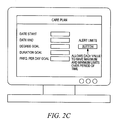
- a care plan entry screen could include dates for start and end of the time on the machine, the degree target, the frequency per day target, limits that alert if the target degree is exceeded, or not reached in a specific time period. If the number of repetitions or frequency per day is exceeded or not reached during a specific time frame, an alert can be sent to the Central Monitoring Station.
- the care plan can also be changed remotely or physically at the device.
- a request can be sent via the wireless interface.
- a user can use a help button on the interface to contact a person at the central monitoring location. It could also provide additional independence for the person in the home.
- Automated voice instructions can be provided on how to set up the exercise machine.
- the instructions are verbal and can be presented to the patient in his/her primary language.
- the therapist can setup changes in the care plan remotely as well.
- Embodiments of the invention enable a patient to improve faster and spend less time going for PT where he/she has to travel with a potential to re-injure themselves due to limited mobility. This feature should also reduce the cost of treatment.
- alternate embodiments of the invention can receive inputs from an exercise sequence when a person uses a sensor or a mat. Such information could be captured and put into a packet of data to be sent to their caregiver, for example, a neurologist. It could used to evaluate how they are or are not progressing.
- a game could be setup to test specific neurological functions - like how long it takes before they do what they are shown on the screen, or how fast they are able to go from one item to another, or if they are able to see an act on specific color first and/or if their transitions between on color and another are faster or slower than other combinations.
- Voice activated questions are available that can ask the patient to perform an action on the mat. This will test their auditory skills or their ability to hear and retain and act on information. All of this information can be housed and tracked and used for trending to evaluate compliance and success of the patient's care plan.
- Embodiments of the invention can store and keep track of patient progression and changes, such as, increases in motor skills, with fewer in-person visits by a therapist. Trends can also be observed and extracted from the daily data to allow potential problems to be detected earlier. Embodiments of the invention fill a gap between resources and needs by using telemonitoring to extend available resources.
- FIG. 1 illustrates system 10 which embodies the present invention.
- System 10 includes a continuous passive motion exercise unit 12, for example, which might be used to treat a patient P subsequent to knee surgery of various types.
- Other types of passive motion devices can be used for ankle, shoulder, elbow, wrist or back surgery.
- Control circuits 18, coupled to the interface circuits 16, can provide drive or control signals to the unit 12 on a timed basis.
- Control circuits 18 can be implemented at least in part with a programmable processor 18a, in combination with executable control instructions 18b.
- One or more treatment schedules can be stored on disc drive 18c, accessible to control circuits 18.
- a human interface device 20 can be coupled to control circuit 18.
- Device 20 can include a multi-dimensional, graphical display device 20a as well as an input device such as a keyboard 20b.
- Control circuits 18 can present via device 20 a plurality of different screens, and/or receive inputs or information relative thereto, via a graphical users interface, from a patient, therapist or other patient representative.
- Audible, verbal, outputs can also be generated by circuits 18 and output via one or more speakers in one of units 18, 20.
- System 14 can also include a wireless interface 22 coupled to the control circuits 18 for purposes of transmitting data to, receiving data, and instructions from a displaced monitoring system 30.
- System 30 can include one or more of control computers 32, a plurality of display devices 34 which could be used by medical professionals such as nurses, physical therapists, occupational therapists and alike all without limitation. Patient records and schedules particularly for exercise and for other treatment can be maintained on disc drives and databases 36.
- treatment scheduled can be downloaded from system 30 to the unit 14 for purposes of establishing a treatment program.
- such information can be entered locally via device 20.
- a plurality of devices such as 10-1, 10-2. 10-n comparable to system 10 could be dispersed geographically in an area and in intermittent communication as necessary with the system 30.
- the various systems 10-i each could be set up either remotely or locally with a schedule customized to the needs of a particular individual's treatment plan.
- Each of the systems 10-i would include a cpm unit such as unit 12, or depending on the procedure, a different type of cpm unit appropriate for the type of joint surgery from which the patient is recovering.
- a comfort scale screen which reflects patient discomfort or pain in conjunction with degrees of motion, numbers of times per day of exercise as well as duration can be displayed for the individual to enter comfort related feedback information usable by the therapists or nurses at the system 30.
- Fig. 3 illustrates various mat or pad configurations such as 40a, 40b usable with another embodiment of the present invention.
- Pads such as 40a, 40b can be printed with a variety of shapes, numbers, colors and the like all without limitation.
- Such pads, or mats, sometimes marketed as "dance pads” provide location information on a real-time basis as an individual on the pad moves about.
- Pads such as 40a, 40b can be coupled to a respective computer 44, best seen in Fig. 4 .
- a variety of connectors and connection protocols are available.
- the pad 40i could be coupled to a USB port on the computer 44.
- a game can be carried on with an individual I who is moving about on the mat 40i and who responds to both visual images on the display 20a as well as verbal or other audio outputs, which might be generated off the player 46.
- One or more of the programs stored on the computer or processor 44 can be a scheduling program.
- the stored games could be organized and arranged to test specific neurological functions and responses.
- Information as to the ongoing progress of a respective game being carried out by an individual I can be stored and forwarded by computer 44 by a wireless interface 22 to a monitoring system 30.
- Medical professionals including therapists, neurologists and the like can evaluate the incoming performance information which can include responses to screen images, response times as to how fast the individual goes from one item to another, responses to specific colors and the like all without limitation.
Landscapes
- Health & Medical Sciences (AREA)
- Engineering & Computer Science (AREA)
- Biomedical Technology (AREA)
- Public Health (AREA)
- Epidemiology (AREA)
- General Health & Medical Sciences (AREA)
- Medical Informatics (AREA)
- Primary Health Care (AREA)
- Business, Economics & Management (AREA)
- General Business, Economics & Management (AREA)
- Physical Education & Sports Medicine (AREA)
- Biophysics (AREA)
- Life Sciences & Earth Sciences (AREA)
- Rehabilitation Tools (AREA)
- Management, Administration, Business Operations System, And Electronic Commerce (AREA)
Applications Claiming Priority (1)
| Application Number | Priority Date | Filing Date | Title |
|---|---|---|---|
| US11/761,742 US20080312041A1 (en) | 2007-06-12 | 2007-06-12 | Systems and Methods of Telemonitoring |
Publications (2)
| Publication Number | Publication Date |
|---|---|
| EP2003582A2 true EP2003582A2 (fr) | 2008-12-17 |
| EP2003582A3 EP2003582A3 (fr) | 2009-03-04 |
Family
ID=39870409
Family Applications (1)
| Application Number | Title | Priority Date | Filing Date |
|---|---|---|---|
| EP08157869A Withdrawn EP2003582A3 (fr) | 2007-06-12 | 2008-06-09 | Systèmes et procédés de télésurveillance |
Country Status (2)
| Country | Link |
|---|---|
| US (1) | US20080312041A1 (fr) |
| EP (1) | EP2003582A3 (fr) |
Families Citing this family (15)
| Publication number | Priority date | Publication date | Assignee | Title |
|---|---|---|---|---|
| US9339691B2 (en) | 2012-01-05 | 2016-05-17 | Icon Health & Fitness, Inc. | System and method for controlling an exercise device |
| US20140081659A1 (en) | 2012-09-17 | 2014-03-20 | Depuy Orthopaedics, Inc. | Systems and methods for surgical and interventional planning, support, post-operative follow-up, and functional recovery tracking |
| US9254409B2 (en) | 2013-03-14 | 2016-02-09 | Icon Health & Fitness, Inc. | Strength training apparatus with flywheel and related methods |
| EP3623020B1 (fr) | 2013-12-26 | 2024-05-01 | iFIT Inc. | Mécanisme de résistance magnétique dans une machine de câble |
| WO2015138339A1 (fr) | 2014-03-10 | 2015-09-17 | Icon Health & Fitness, Inc. | Capteur de pression pour quantifier un travail |
| US10426989B2 (en) | 2014-06-09 | 2019-10-01 | Icon Health & Fitness, Inc. | Cable system incorporated into a treadmill |
| WO2015195965A1 (fr) | 2014-06-20 | 2015-12-23 | Icon Health & Fitness, Inc. | Dispositif de massage après une séance d'exercices |
| US10391361B2 (en) | 2015-02-27 | 2019-08-27 | Icon Health & Fitness, Inc. | Simulating real-world terrain on an exercise device |
| US10625137B2 (en) | 2016-03-18 | 2020-04-21 | Icon Health & Fitness, Inc. | Coordinated displays in an exercise device |
| US10272317B2 (en) | 2016-03-18 | 2019-04-30 | Icon Health & Fitness, Inc. | Lighted pace feature in a treadmill |
| US10493349B2 (en) | 2016-03-18 | 2019-12-03 | Icon Health & Fitness, Inc. | Display on exercise device |
| IT201600081694A1 (it) * | 2016-08-03 | 2016-11-03 | Lauro Group S R L | Sistema elettromedicale automatizzato, e metodo di gestione di tale sistema |
| US10671705B2 (en) | 2016-09-28 | 2020-06-02 | Icon Health & Fitness, Inc. | Customizing recipe recommendations |
| US20240246219A1 (en) * | 2023-01-19 | 2024-07-25 | Milwaukee Electric Tool Corporation | Smart accessory storage device |
| US20240246215A1 (en) * | 2023-01-25 | 2024-07-25 | Milwaukee Electric Tool Corporation | Systems and methods for identification of power tool accessories |
Citations (1)
| Publication number | Priority date | Publication date | Assignee | Title |
|---|---|---|---|---|
| WO2006061834A2 (fr) | 2004-12-07 | 2006-06-15 | Tylerton International Inc. | Dispositif et procede d'entrainement, de readaptation et/ou de soutien |
Family Cites Families (54)
| Publication number | Priority date | Publication date | Assignee | Title |
|---|---|---|---|---|
| ATE197650T1 (de) * | 1992-07-21 | 2000-12-15 | Hayle Brainpower Pty Ltd | Interaktives übungsüberwachungssystem und methode |
| US6430997B1 (en) * | 1995-11-06 | 2002-08-13 | Trazer Technologies, Inc. | System and method for tracking and assessing movement skills in multidimensional space |
| US6162151A (en) * | 1996-09-30 | 2000-12-19 | Hitachi, Ltd. | Ambulatory exercise machine and ambulatory exercise system |
| US6050924A (en) * | 1997-04-28 | 2000-04-18 | Shea; Michael J. | Exercise system |
| US7056265B1 (en) * | 1997-04-28 | 2006-06-06 | Shea Michael J | Exercise system |
| US6050822A (en) * | 1997-10-01 | 2000-04-18 | The United States Of America As Represented By The Secretary Of The Army | Electromagnetic locomotion platform for translation and total immersion of humans into virtual environments |
| US7359624B2 (en) * | 1997-10-06 | 2008-04-15 | Silicon Image, Inc. | Portable DVD player |
| US6336891B1 (en) * | 1997-12-08 | 2002-01-08 | Real Vision Corporation | Interactive exercise pad system |
| US6648838B1 (en) * | 1998-02-13 | 2003-11-18 | Lee Brandon | Postural awareness apparatus |
| US6019738A (en) * | 1998-02-13 | 2000-02-01 | Brandon; Lee | Postural awareness device |
| US10383548B2 (en) * | 1998-02-13 | 2019-08-20 | Lee Brandon | Postural awareness apparatus |
| US6872187B1 (en) * | 1998-09-01 | 2005-03-29 | Izex Technologies, Inc. | Orthoses for joint rehabilitation |
| US6804558B2 (en) * | 1999-07-07 | 2004-10-12 | Medtronic, Inc. | System and method of communicating between an implantable medical device and a remote computer system or health care provider |
| US7166062B1 (en) * | 1999-07-08 | 2007-01-23 | Icon Ip, Inc. | System for interaction with exercise device |
| US6997852B2 (en) * | 1999-07-08 | 2006-02-14 | Icon Ip, Inc. | Methods and systems for controlling an exercise apparatus using a portable remote device |
| US7060006B1 (en) * | 1999-07-08 | 2006-06-13 | Icon Ip, Inc. | Computer systems and methods for interaction with exercise device |
| US6918858B2 (en) * | 1999-07-08 | 2005-07-19 | Icon Ip, Inc. | Systems and methods for providing an improved exercise device with access to motivational programming over telephone communication connection lines |
| US6783482B2 (en) * | 2000-08-30 | 2004-08-31 | Brunswick Corporation | Treadmill control system |
| US7115076B2 (en) * | 1999-09-07 | 2006-10-03 | Brunswick Corporation | Treadmill control system |
| WO2001028416A1 (fr) * | 1999-09-24 | 2001-04-26 | Healthetech, Inc. | Dispositif de surveillance physiologique et unite connexe de calcul, d'affichage et de communication |
| FI115288B (fi) * | 2000-02-23 | 2005-04-15 | Polar Electro Oy | Palautumisen ohjaus kuntosuorituksen yhteydessä |
| JP2001269431A (ja) * | 2000-03-24 | 2001-10-02 | Yamaha Corp | 身体動作状態評価装置 |
| US6746371B1 (en) * | 2000-04-28 | 2004-06-08 | International Business Machines Corporation | Managing fitness activity across diverse exercise machines utilizing a portable computer system |
| US6702719B1 (en) * | 2000-04-28 | 2004-03-09 | International Business Machines Corporation | Exercise machine |
| US7022047B2 (en) * | 2000-05-24 | 2006-04-04 | Netpulse, Llc | Interface for controlling and accessing information on an exercise device |
| FI113402B (fi) * | 2000-10-06 | 2004-04-15 | Polar Electro Oy | Rannelaite |
| HK1051960B (zh) * | 2000-12-22 | 2005-09-02 | 大和制衡株式会社 | 带步数测定功能的内脏脂肪计 |
| US6808473B2 (en) * | 2001-04-19 | 2004-10-26 | Omron Corporation | Exercise promotion device, and exercise promotion method employing the same |
| US7381152B2 (en) * | 2001-07-23 | 2008-06-03 | Southwest Research Institute | Virtual reality system locomotion interface utilizing a pressure-sensing mat |
| US6740007B2 (en) * | 2001-08-03 | 2004-05-25 | Fitness-Health Incorporating Technology Systems, Inc. | Method and system for generating an exercise program |
| AU2002325015A1 (en) * | 2001-09-17 | 2003-04-01 | The Curavita Corporation | Monitoring locomotion kinematics in ambulating animals |
| JP2003102868A (ja) * | 2001-09-28 | 2003-04-08 | Konami Co Ltd | 運動支援方法及びその装置 |
| US7060000B2 (en) * | 2001-10-11 | 2006-06-13 | Carlson Carl A | Game and exercise device and method |
| US6793607B2 (en) * | 2002-01-22 | 2004-09-21 | Kinetic Sports Interactive | Workout assistant |
| US20040029684A1 (en) * | 2002-08-09 | 2004-02-12 | Alexander Zarif | Anatomically-based personal fitness advisor method and system |
| US6991586B2 (en) * | 2002-10-09 | 2006-01-31 | Clubcom, Inc. | Data storage and communication network for use with exercise units |
| CN2582671Y (zh) * | 2002-12-02 | 2003-10-29 | 漳州爱康五金机械有限公司 | 电机磁控健身器 |
| US7097588B2 (en) * | 2003-02-14 | 2006-08-29 | Icon Ip, Inc. | Progresive heart rate monitor display |
| US7354380B2 (en) * | 2003-04-23 | 2008-04-08 | Volpe Jr Joseph C | Heart rate monitor for controlling entertainment devices |
| US6824502B1 (en) * | 2003-09-03 | 2004-11-30 | Ping-Hui Huang | Body temperature actuated treadmill operation mode control arrangement |
| FR2862884B1 (fr) * | 2003-12-02 | 2008-05-30 | Xkpad | Dispositif pour la pratique de la gymnastique interactive de type "step" |
| US20060293617A1 (en) * | 2004-02-05 | 2006-12-28 | Reability Inc. | Methods and apparatuses for rehabilitation and training |
| US7355519B2 (en) * | 2004-02-24 | 2008-04-08 | Kevin Grold | Body force alarming apparatus and method |
| JP2005293505A (ja) * | 2004-04-05 | 2005-10-20 | Sony Corp | 電子機器、及び入力装置、並びに入力方法 |
| US7758523B2 (en) * | 2004-05-24 | 2010-07-20 | Kineteks Corporation | Remote sensing shoe insert apparatus, method and system |
| US7163490B2 (en) * | 2004-05-27 | 2007-01-16 | Yu-Yu Chen | Exercise monitoring and recording device with graphic exercise expenditure distribution pattern |
| US7044891B1 (en) * | 2004-09-20 | 2006-05-16 | Juan Rivera | Video bike |
| US7254516B2 (en) * | 2004-12-17 | 2007-08-07 | Nike, Inc. | Multi-sensor monitoring of athletic performance |
| WO2006103676A2 (fr) * | 2005-03-31 | 2006-10-05 | Ronen Wolfson | Surface interactive et systeme d'affichage |
| US20070021282A1 (en) * | 2005-07-19 | 2007-01-25 | Karp Shaun A | Abdominal exercising and strength testing systems |
| US7762963B2 (en) * | 2005-10-24 | 2010-07-27 | Paul Ewing | Therapeutic device for post-operative knee |
| US7645211B1 (en) * | 2006-04-17 | 2010-01-12 | Lauranzo, Inc. | Personal agility developer |
| US7771320B2 (en) * | 2006-09-07 | 2010-08-10 | Nike, Inc. | Athletic performance sensing and/or tracking systems and methods |
| US7901325B2 (en) * | 2008-09-12 | 2011-03-08 | Joe Henderson | Athletic training device |
-
2007
- 2007-06-12 US US11/761,742 patent/US20080312041A1/en not_active Abandoned
-
2008
- 2008-06-09 EP EP08157869A patent/EP2003582A3/fr not_active Withdrawn
Patent Citations (1)
| Publication number | Priority date | Publication date | Assignee | Title |
|---|---|---|---|---|
| WO2006061834A2 (fr) | 2004-12-07 | 2006-06-15 | Tylerton International Inc. | Dispositif et procede d'entrainement, de readaptation et/ou de soutien |
Also Published As
| Publication number | Publication date |
|---|---|
| EP2003582A3 (fr) | 2009-03-04 |
| US20080312041A1 (en) | 2008-12-18 |
Similar Documents
| Publication | Publication Date | Title |
|---|---|---|
| EP2003582A2 (fr) | Systèmes et procédés de télésurveillance | |
| Chae et al. | Development and clinical evaluation of a web-based upper limb home rehabilitation system using a smartwatch and machine learning model for chronic stroke survivors: prospective comparative study | |
| US20160220175A1 (en) | Apparatus and method for range of motion tracking with integrated reporting | |
| US20150302766A1 (en) | Recovery system and method | |
| Tedesco et al. | Design of a multi-sensors wearable platform for remote monitoring of knee rehabilitation | |
| WO2008134313A1 (fr) | Procédé et système pour développer ou suivre un programme pour un traitement médical | |
| US20150017623A1 (en) | Method and apparatus for neuromotor rehabilitation using interactive setting systems | |
| Seim et al. | Design of a wearable vibrotactile stimulation device for individuals with upper-limb hemiparesis and spasticity | |
| Brazier et al. | Conversion disorders in adolescents: a practical approach to rehabilitation. | |
| Yeh et al. | A lower limb fracture postoperative-guided interactive rehabilitation training system and its effectiveness analysis | |
| Kordatos et al. | Design and evaluation of a wearable system to increase adherence to rehabilitation programmes in acute cruciate ligament (CL) rupture | |
| KR20210154608A (ko) | 디지털 헬스 케어 시스템 | |
| e Siqueira et al. | Available rehabilitation technology with the potential to be incorporated into the clinical practice of physiotherapists: A systematic review | |
| US20100262989A1 (en) | System and method for generating individualized exercise movies | |
| Banihani et al. | A home-based hand rehabilitation platform for hemiplegic patients after stroke: A feasibility study | |
| US20210233670A1 (en) | Computerized system and method for providing instruction and incentives to physical therapy patients | |
| Hassett et al. | Feedback-based technologies for adult physical rehabilitation | |
| Szabo et al. | New technologies used in the rehabilitation of knee pathologies. | |
| Pape | Digitalization in rehabilitation | |
| Nahar et al. | Advances in cerebral palsy treatment | |
| JP7726582B1 (ja) | 遠隔診療支援システム | |
| Senesac et al. | Management of Clinical Problems of Children with Cerebral Palsy | |
| Islam | Wearable technologies to support lower limb rehabilitation and clinical practice: user requirements, design, and evaluation | |
| Seim et al. | Perspectives on the design and performance of upper-limb wearable stimulation devices for stroke survivors with hemiplegia and spasticity | |
| Muñoz Novoa | Surface electromyography for improving upper limb function after stroke-Development of new rehabilitation tools |
Legal Events
| Date | Code | Title | Description |
|---|---|---|---|
| PUAI | Public reference made under article 153(3) epc to a published international application that has entered the european phase |
Free format text: ORIGINAL CODE: 0009012 |
|
| AK | Designated contracting states |
Kind code of ref document: A2 Designated state(s): AT BE BG CH CY CZ DE DK EE ES FI FR GB GR HR HU IE IS IT LI LT LU LV MC MT NL NO PL PT RO SE SI SK TR |
|
| AX | Request for extension of the european patent |
Extension state: AL BA MK RS |
|
| PUAL | Search report despatched |
Free format text: ORIGINAL CODE: 0009013 |
|
| AK | Designated contracting states |
Kind code of ref document: A3 Designated state(s): AT BE BG CH CY CZ DE DK EE ES FI FR GB GR HR HU IE IS IT LI LT LU LV MC MT NL NO PL PT RO SE SI SK TR |
|
| AX | Request for extension of the european patent |
Extension state: AL BA MK RS |
|
| RAP1 | Party data changed (applicant data changed or rights of an application transferred) |
Owner name: HONEYWELL HOMMED LLC |
|
| 17P | Request for examination filed |
Effective date: 20090903 |
|
| 17Q | First examination report despatched |
Effective date: 20091001 |
|
| AKX | Designation fees paid |
Designated state(s): AT BE BG CH CY CZ DE DK EE ES FI FR GB GR HR HU IE IS IT LI LT LU LV MC MT NL NO PL PT RO SE SI SK TR |
|
| STAA | Information on the status of an ep patent application or granted ep patent |
Free format text: STATUS: THE APPLICATION IS DEEMED TO BE WITHDRAWN |
|
| 18D | Application deemed to be withdrawn |
Effective date: 20150106 |