EP2004106B1 - Accessoire ingerable pour le contrôle du poids - Google Patents
Accessoire ingerable pour le contrôle du poids Download PDFInfo
- Publication number
- EP2004106B1 EP2004106B1 EP07719444A EP07719444A EP2004106B1 EP 2004106 B1 EP2004106 B1 EP 2004106B1 EP 07719444 A EP07719444 A EP 07719444A EP 07719444 A EP07719444 A EP 07719444A EP 2004106 B1 EP2004106 B1 EP 2004106B1
- Authority
- EP
- European Patent Office
- Prior art keywords
- implement
- container
- clusters
- stomach
- dimension
- Prior art date
- Legal status (The legal status is an assumption and is not a legal conclusion. Google has not performed a legal analysis and makes no representation as to the accuracy of the status listed.)
- Not-in-force
Links
- 238000004260 weight control Methods 0.000 title abstract description 5
- 239000000463 material Substances 0.000 claims abstract description 59
- 239000012530 fluid Substances 0.000 claims abstract description 37
- 230000008961 swelling Effects 0.000 claims abstract description 17
- 241001465754 Metazoa Species 0.000 claims abstract description 10
- 241000124008 Mammalia Species 0.000 claims abstract description 5
- 239000002775 capsule Substances 0.000 claims description 53
- 239000000126 substance Substances 0.000 claims description 45
- 239000000835 fiber Substances 0.000 claims description 39
- 238000004377 microelectronic Methods 0.000 claims description 13
- 230000037406 food intake Effects 0.000 claims description 11
- 229920001661 Chitosan Polymers 0.000 claims description 10
- 230000000717 retained effect Effects 0.000 claims description 10
- 239000011358 absorbing material Substances 0.000 claims description 9
- 229920002201 Oxidized cellulose Polymers 0.000 claims description 7
- 229940107304 oxidized cellulose Drugs 0.000 claims description 7
- 230000008878 coupling Effects 0.000 claims description 6
- 238000010168 coupling process Methods 0.000 claims description 6
- 238000005859 coupling reaction Methods 0.000 claims description 6
- 239000013543 active substance Substances 0.000 claims description 5
- 239000003795 chemical substances by application Substances 0.000 claims description 5
- 239000000440 bentonite Substances 0.000 claims description 4
- 229910000278 bentonite Inorganic materials 0.000 claims description 4
- SVPXDRXYRYOSEX-UHFFFAOYSA-N bentoquatam Chemical compound O.O=[Si]=O.O=[Al]O[Al]=O SVPXDRXYRYOSEX-UHFFFAOYSA-N 0.000 claims description 4
- 239000000017 hydrogel Substances 0.000 claims description 4
- 229920000098 polyolefin Polymers 0.000 claims description 4
- 239000000203 mixture Substances 0.000 claims description 3
- 239000013043 chemical agent Substances 0.000 claims description 2
- 230000002255 enzymatic effect Effects 0.000 claims description 2
- 210000002784 stomach Anatomy 0.000 abstract description 82
- 230000002496 gastric effect Effects 0.000 description 66
- 206010004542 Bezoar Diseases 0.000 description 51
- -1 poly(ethyloxazoline) Polymers 0.000 description 46
- 238000002560 therapeutic procedure Methods 0.000 description 21
- 241000282472 Canis lupus familiaris Species 0.000 description 16
- 210000001187 pylorus Anatomy 0.000 description 14
- 229920002125 Sokalan® Polymers 0.000 description 13
- 210000001035 gastrointestinal tract Anatomy 0.000 description 13
- XLYOFNOQVPJJNP-UHFFFAOYSA-N water Substances O XLYOFNOQVPJJNP-UHFFFAOYSA-N 0.000 description 13
- 208000008589 Obesity Diseases 0.000 description 12
- 235000005911 diet Nutrition 0.000 description 12
- 230000037213 diet Effects 0.000 description 12
- 238000000034 method Methods 0.000 description 12
- 229920000642 polymer Polymers 0.000 description 11
- 210000000813 small intestine Anatomy 0.000 description 11
- 235000013305 food Nutrition 0.000 description 10
- 230000000670 limiting effect Effects 0.000 description 10
- 235000020824 obesity Nutrition 0.000 description 10
- 238000011282 treatment Methods 0.000 description 10
- XUIMIQQOPSSXEZ-UHFFFAOYSA-N Silicon Chemical compound [Si] XUIMIQQOPSSXEZ-UHFFFAOYSA-N 0.000 description 9
- 208000003243 intestinal obstruction Diseases 0.000 description 9
- 230000008855 peristalsis Effects 0.000 description 9
- 229920002338 polyhydroxyethylmethacrylate Polymers 0.000 description 9
- 230000009467 reduction Effects 0.000 description 9
- 229910052710 silicon Inorganic materials 0.000 description 9
- 239000010703 silicon Substances 0.000 description 9
- 230000008901 benefit Effects 0.000 description 8
- 239000000560 biocompatible material Substances 0.000 description 7
- 229920002678 cellulose Polymers 0.000 description 7
- 239000001913 cellulose Substances 0.000 description 7
- 238000011038 discontinuous diafiltration by volume reduction Methods 0.000 description 7
- 239000002552 dosage form Substances 0.000 description 7
- 235000012631 food intake Nutrition 0.000 description 7
- 230000002572 peristaltic effect Effects 0.000 description 7
- 239000004584 polyacrylic acid Substances 0.000 description 7
- 208000016261 weight loss Diseases 0.000 description 7
- 239000004372 Polyvinyl alcohol Substances 0.000 description 6
- 239000002131 composite material Substances 0.000 description 6
- 230000000694 effects Effects 0.000 description 6
- 238000012986 modification Methods 0.000 description 6
- 230000004048 modification Effects 0.000 description 6
- 229920002401 polyacrylamide Polymers 0.000 description 6
- 229920002451 polyvinyl alcohol Polymers 0.000 description 6
- 229910052761 rare earth metal Inorganic materials 0.000 description 6
- 150000002910 rare earth metals Chemical class 0.000 description 6
- 230000004580 weight loss Effects 0.000 description 6
- 0 C1CC=*CC1 Chemical compound C1CC=*CC1 0.000 description 5
- 239000007864 aqueous solution Substances 0.000 description 5
- 239000002729 catgut Substances 0.000 description 5
- 210000001072 colon Anatomy 0.000 description 5
- 230000002354 daily effect Effects 0.000 description 5
- 238000000354 decomposition reaction Methods 0.000 description 5
- 239000003814 drug Substances 0.000 description 5
- 210000004051 gastric juice Anatomy 0.000 description 5
- 229920000247 superabsorbent polymer Polymers 0.000 description 5
- XDTMQSROBMDMFD-UHFFFAOYSA-N C1CCCCC1 Chemical compound C1CCCCC1 XDTMQSROBMDMFD-UHFFFAOYSA-N 0.000 description 4
- 241000282465 Canis Species 0.000 description 4
- 229920006397 acrylic thermoplastic Polymers 0.000 description 4
- 229940079593 drug Drugs 0.000 description 4
- 210000000936 intestine Anatomy 0.000 description 4
- 239000007788 liquid Substances 0.000 description 4
- 230000007246 mechanism Effects 0.000 description 4
- 229920003229 poly(methyl methacrylate) Polymers 0.000 description 4
- 230000002829 reductive effect Effects 0.000 description 4
- 239000004627 regenerated cellulose Substances 0.000 description 4
- 230000036186 satiety Effects 0.000 description 4
- 235000019627 satiety Nutrition 0.000 description 4
- 230000035807 sensation Effects 0.000 description 4
- 235000019615 sensations Nutrition 0.000 description 4
- ISXSCDLOGDJUNJ-UHFFFAOYSA-N tert-butyl prop-2-enoate Chemical compound CC(C)(C)OC(=O)C=C ISXSCDLOGDJUNJ-UHFFFAOYSA-N 0.000 description 4
- 238000010521 absorption reaction Methods 0.000 description 3
- 230000003542 behavioural effect Effects 0.000 description 3
- 238000006065 biodegradation reaction Methods 0.000 description 3
- 230000015556 catabolic process Effects 0.000 description 3
- 239000011248 coating agent Substances 0.000 description 3
- 238000000576 coating method Methods 0.000 description 3
- 229920001577 copolymer Polymers 0.000 description 3
- 238000006731 degradation reaction Methods 0.000 description 3
- 238000013461 design Methods 0.000 description 3
- 235000019525 fullness Nutrition 0.000 description 3
- 229920000159 gelatin Polymers 0.000 description 3
- 235000019322 gelatine Nutrition 0.000 description 3
- 150000004676 glycans Chemical class 0.000 description 3
- 230000036541 health Effects 0.000 description 3
- 238000002513 implantation Methods 0.000 description 3
- 230000007774 longterm Effects 0.000 description 3
- 238000005259 measurement Methods 0.000 description 3
- 210000000056 organ Anatomy 0.000 description 3
- 102000040430 polynucleotide Human genes 0.000 description 3
- 108091033319 polynucleotide Proteins 0.000 description 3
- 229920001282 polysaccharide Polymers 0.000 description 3
- 239000005017 polysaccharide Substances 0.000 description 3
- 108090000623 proteins and genes Proteins 0.000 description 3
- 102000004169 proteins and genes Human genes 0.000 description 3
- 239000004971 Cross linker Substances 0.000 description 2
- 102000004190 Enzymes Human genes 0.000 description 2
- 108090000790 Enzymes Proteins 0.000 description 2
- 206010061974 Gastrointestinal obstruction Diseases 0.000 description 2
- 239000001828 Gelatine Substances 0.000 description 2
- AEMRFAOFKBGASW-UHFFFAOYSA-N Glycolic acid Polymers OCC(O)=O AEMRFAOFKBGASW-UHFFFAOYSA-N 0.000 description 2
- 208000002193 Pain Diseases 0.000 description 2
- IQPSEEYGBUAQFF-UHFFFAOYSA-N Pantoprazole Chemical compound COC1=CC=NC(CS(=O)C=2NC3=CC=C(OC(F)F)C=C3N=2)=C1OC IQPSEEYGBUAQFF-UHFFFAOYSA-N 0.000 description 2
- 229920000954 Polyglycolide Polymers 0.000 description 2
- 206010047700 Vomiting Diseases 0.000 description 2
- 230000002745 absorbent Effects 0.000 description 2
- 239000002250 absorbent Substances 0.000 description 2
- 230000002411 adverse Effects 0.000 description 2
- 210000003484 anatomy Anatomy 0.000 description 2
- 208000013404 behavioral symptom Diseases 0.000 description 2
- 230000009286 beneficial effect Effects 0.000 description 2
- 230000015572 biosynthetic process Effects 0.000 description 2
- 239000011247 coating layer Substances 0.000 description 2
- 235000021443 coca cola Nutrition 0.000 description 2
- 230000001010 compromised effect Effects 0.000 description 2
- 208000012696 congenital leptin deficiency Diseases 0.000 description 2
- 238000010586 diagram Methods 0.000 description 2
- 235000015872 dietary supplement Nutrition 0.000 description 2
- 238000004090 dissolution Methods 0.000 description 2
- 238000005538 encapsulation Methods 0.000 description 2
- 238000005516 engineering process Methods 0.000 description 2
- 230000003203 everyday effect Effects 0.000 description 2
- 238000012544 monitoring process Methods 0.000 description 2
- 208000001022 morbid obesity Diseases 0.000 description 2
- 210000004877 mucosa Anatomy 0.000 description 2
- 238000005457 optimization Methods 0.000 description 2
- 229960005019 pantoprazole Drugs 0.000 description 2
- 230000036961 partial effect Effects 0.000 description 2
- 239000000546 pharmaceutical excipient Substances 0.000 description 2
- 238000011458 pharmacological treatment Methods 0.000 description 2
- 229920000747 poly(lactic acid) Polymers 0.000 description 2
- 229920001610 polycaprolactone Polymers 0.000 description 2
- 239000004632 polycaprolactone Substances 0.000 description 2
- 229920001296 polysiloxane Polymers 0.000 description 2
- 230000008569 process Effects 0.000 description 2
- 230000002035 prolonged effect Effects 0.000 description 2
- 238000012827 research and development Methods 0.000 description 2
- 238000007789 sealing Methods 0.000 description 2
- 239000000243 solution Substances 0.000 description 2
- 230000000638 stimulation Effects 0.000 description 2
- 239000004583 superabsorbent polymers (SAPs) Substances 0.000 description 2
- 239000013589 supplement Substances 0.000 description 2
- 238000003786 synthesis reaction Methods 0.000 description 2
- 238000009461 vacuum packaging Methods 0.000 description 2
- 230000008673 vomiting Effects 0.000 description 2
- 238000005406 washing Methods 0.000 description 2
- 230000003442 weekly effect Effects 0.000 description 2
- LCSKNASZPVZHEG-UHFFFAOYSA-N 3,6-dimethyl-1,4-dioxane-2,5-dione;1,4-dioxane-2,5-dione Chemical group O=C1COC(=O)CO1.CC1OC(=O)C(C)OC1=O LCSKNASZPVZHEG-UHFFFAOYSA-N 0.000 description 1
- SUBDBMMJDZJVOS-UHFFFAOYSA-N 5-methoxy-2-{[(4-methoxy-3,5-dimethylpyridin-2-yl)methyl]sulfinyl}-1H-benzimidazole Chemical compound N=1C2=CC(OC)=CC=C2NC=1S(=O)CC1=NC=C(C)C(OC)=C1C SUBDBMMJDZJVOS-UHFFFAOYSA-N 0.000 description 1
- 208000004998 Abdominal Pain Diseases 0.000 description 1
- 208000024172 Cardiovascular disease Diseases 0.000 description 1
- 229920003043 Cellulose fiber Polymers 0.000 description 1
- 229920001268 Cholestyramine Polymers 0.000 description 1
- 206010010774 Constipation Diseases 0.000 description 1
- 229920000742 Cotton Polymers 0.000 description 1
- 206010012735 Diarrhoea Diseases 0.000 description 1
- 206010059186 Early satiety Diseases 0.000 description 1
- 108010010803 Gelatin Proteins 0.000 description 1
- WQZGKKKJIJFFOK-GASJEMHNSA-N Glucose Natural products OC[C@H]1OC(O)[C@H](O)[C@@H](O)[C@@H]1O WQZGKKKJIJFFOK-GASJEMHNSA-N 0.000 description 1
- 208000019025 Hypokalemia Diseases 0.000 description 1
- 206010030178 Oesophageal obstruction Diseases 0.000 description 1
- 239000004743 Polypropylene Substances 0.000 description 1
- 206010038490 Renal pain Diseases 0.000 description 1
- 206010041101 Small intestinal obstruction Diseases 0.000 description 1
- 229920002472 Starch Polymers 0.000 description 1
- 238000000692 Student's t-test Methods 0.000 description 1
- 235000019486 Sunflower oil Nutrition 0.000 description 1
- 208000027418 Wounds and injury Diseases 0.000 description 1
- 230000003187 abdominal effect Effects 0.000 description 1
- 230000002159 abnormal effect Effects 0.000 description 1
- 239000002253 acid Substances 0.000 description 1
- 239000013061 administrable dose form Substances 0.000 description 1
- 230000003579 anti-obesity Effects 0.000 description 1
- 239000000883 anti-obesity agent Substances 0.000 description 1
- 229940030225 antihemorrhagics Drugs 0.000 description 1
- 229910052788 barium Inorganic materials 0.000 description 1
- DSAJWYNOEDNPEQ-UHFFFAOYSA-N barium atom Chemical compound [Ba] DSAJWYNOEDNPEQ-UHFFFAOYSA-N 0.000 description 1
- 239000011230 binding agent Substances 0.000 description 1
- 239000008280 blood Substances 0.000 description 1
- 210000004369 blood Anatomy 0.000 description 1
- 230000037396 body weight Effects 0.000 description 1
- 235000019577 caloric intake Nutrition 0.000 description 1
- 238000004891 communication Methods 0.000 description 1
- 230000037020 contractile activity Effects 0.000 description 1
- 230000006378 damage Effects 0.000 description 1
- 230000000593 degrading effect Effects 0.000 description 1
- 206010012601 diabetes mellitus Diseases 0.000 description 1
- 235000021004 dietary regimen Nutrition 0.000 description 1
- 230000029087 digestion Effects 0.000 description 1
- 239000007884 disintegrant Substances 0.000 description 1
- 210000003238 esophagus Anatomy 0.000 description 1
- 239000000945 filler Substances 0.000 description 1
- 238000002594 fluoroscopy Methods 0.000 description 1
- 238000010528 free radical solution polymerization reaction Methods 0.000 description 1
- 235000011389 fruit/vegetable juice Nutrition 0.000 description 1
- 210000004211 gastric acid Anatomy 0.000 description 1
- 208000021302 gastroesophageal reflux disease Diseases 0.000 description 1
- 210000003736 gastrointestinal content Anatomy 0.000 description 1
- 239000000499 gel Substances 0.000 description 1
- 239000008273 gelatin Substances 0.000 description 1
- 239000007903 gelatin capsule Substances 0.000 description 1
- 235000011852 gelatine desserts Nutrition 0.000 description 1
- 239000008103 glucose Substances 0.000 description 1
- 239000003292 glue Substances 0.000 description 1
- 230000000025 haemostatic effect Effects 0.000 description 1
- 239000007902 hard capsule Substances 0.000 description 1
- 229920001477 hydrophilic polymer Polymers 0.000 description 1
- 208000014674 injury Diseases 0.000 description 1
- 229910052500 inorganic mineral Inorganic materials 0.000 description 1
- 238000012977 invasive surgical procedure Methods 0.000 description 1
- 150000002500 ions Chemical class 0.000 description 1
- 230000002045 lasting effect Effects 0.000 description 1
- 239000010410 layer Substances 0.000 description 1
- 150000002632 lipids Chemical class 0.000 description 1
- 230000007257 malfunction Effects 0.000 description 1
- 238000002483 medication Methods 0.000 description 1
- 239000011707 mineral Substances 0.000 description 1
- 230000003020 moisturizing effect Effects 0.000 description 1
- 239000003921 oil Substances 0.000 description 1
- 235000019476 oil-water mixture Nutrition 0.000 description 1
- 235000019198 oils Nutrition 0.000 description 1
- 229960000381 omeprazole Drugs 0.000 description 1
- 230000008520 organization Effects 0.000 description 1
- 239000002245 particle Substances 0.000 description 1
- 230000035699 permeability Effects 0.000 description 1
- 239000012466 permeate Substances 0.000 description 1
- 235000002378 plant sterols Nutrition 0.000 description 1
- 229920001155 polypropylene Polymers 0.000 description 1
- 238000009258 post-therapy Methods 0.000 description 1
- 208000024896 potassium deficiency disease Diseases 0.000 description 1
- 238000002360 preparation method Methods 0.000 description 1
- 239000000047 product Substances 0.000 description 1
- 230000001141 propulsive effect Effects 0.000 description 1
- 238000011084 recovery Methods 0.000 description 1
- 235000018770 reduced food intake Nutrition 0.000 description 1
- 230000001105 regulatory effect Effects 0.000 description 1
- 150000003839 salts Chemical class 0.000 description 1
- 239000000565 sealant Substances 0.000 description 1
- 239000007901 soft capsule Substances 0.000 description 1
- 239000008107 starch Substances 0.000 description 1
- 235000019698 starch Nutrition 0.000 description 1
- 230000004936 stimulating effect Effects 0.000 description 1
- 239000002600 sunflower oil Substances 0.000 description 1
- 238000011477 surgical intervention Methods 0.000 description 1
- 238000001356 surgical procedure Methods 0.000 description 1
- 238000010557 suspension polymerization reaction Methods 0.000 description 1
- 230000009747 swallowing Effects 0.000 description 1
- 239000003826 tablet Substances 0.000 description 1
- 229940088594 vitamin Drugs 0.000 description 1
- 239000011782 vitamin Substances 0.000 description 1
- 229930003231 vitamin Natural products 0.000 description 1
- 235000013343 vitamin Nutrition 0.000 description 1
- 239000013585 weight reducing agent Substances 0.000 description 1
Images







Classifications
-
- A—HUMAN NECESSITIES
- A61—MEDICAL OR VETERINARY SCIENCE; HYGIENE
- A61F—FILTERS IMPLANTABLE INTO BLOOD VESSELS; PROSTHESES; DEVICES PROVIDING PATENCY TO, OR PREVENTING COLLAPSING OF, TUBULAR STRUCTURES OF THE BODY, e.g. STENTS; ORTHOPAEDIC, NURSING OR CONTRACEPTIVE DEVICES; FOMENTATION; TREATMENT OR PROTECTION OF EYES OR EARS; BANDAGES, DRESSINGS OR ABSORBENT PADS; FIRST-AID KITS
- A61F5/00—Orthopaedic methods or devices for non-surgical treatment of bones or joints; Nursing devices ; Anti-rape devices
- A61F5/0003—Apparatus for the treatment of obesity; Anti-eating devices
- A61F5/0013—Implantable devices or invasive measures
- A61F5/0036—Intragastrical devices
-
- A—HUMAN NECESSITIES
- A61—MEDICAL OR VETERINARY SCIENCE; HYGIENE
- A61J—CONTAINERS SPECIALLY ADAPTED FOR MEDICAL OR PHARMACEUTICAL PURPOSES; DEVICES OR METHODS SPECIALLY ADAPTED FOR BRINGING PHARMACEUTICAL PRODUCTS INTO PARTICULAR PHYSICAL OR ADMINISTERING FORMS; DEVICES FOR ADMINISTERING FOOD OR MEDICINES ORALLY; BABY COMFORTERS; DEVICES FOR RECEIVING SPITTLE
- A61J3/00—Devices or methods specially adapted for bringing pharmaceutical products into particular physical or administering forms
- A61J3/07—Devices or methods specially adapted for bringing pharmaceutical products into particular physical or administering forms into the form of capsules or similar small containers for oral use
- A61J3/071—Devices or methods specially adapted for bringing pharmaceutical products into particular physical or administering forms into the form of capsules or similar small containers for oral use into the form of telescopically engaged two-piece capsules
-
- A—HUMAN NECESSITIES
- A61—MEDICAL OR VETERINARY SCIENCE; HYGIENE
- A61K—PREPARATIONS FOR MEDICAL, DENTAL OR TOILETRY PURPOSES
- A61K9/00—Medicinal preparations characterised by special physical form
- A61K9/0012—Galenical forms characterised by the site of application
- A61K9/0053—Mouth and digestive tract, i.e. intraoral and peroral administration
- A61K9/0065—Forms with gastric retention, e.g. floating on gastric juice, adhering to gastric mucosa, expanding to prevent passage through the pylorus
-
- A—HUMAN NECESSITIES
- A61—MEDICAL OR VETERINARY SCIENCE; HYGIENE
- A61K—PREPARATIONS FOR MEDICAL, DENTAL OR TOILETRY PURPOSES
- A61K9/00—Medicinal preparations characterised by special physical form
- A61K9/0087—Galenical forms not covered by A61K9/02 - A61K9/7023
- A61K9/009—Sachets, pouches characterised by the material or function of the envelope
-
- A—HUMAN NECESSITIES
- A61—MEDICAL OR VETERINARY SCIENCE; HYGIENE
- A61P—SPECIFIC THERAPEUTIC ACTIVITY OF CHEMICAL COMPOUNDS OR MEDICINAL PREPARATIONS
- A61P3/00—Drugs for disorders of the metabolism
- A61P3/04—Anorexiants; Antiobesity agents
Definitions
- the present invention relates to the field of ingestible dosage forms, and, more specifically, to an orally administrable implement comprising expandable material useful for weight control and the treatment of obesity.
- Weight control and treatments for obesity have been the subjects of a large amount of suggested diets, treatments and procedures, including, in the most severe cases of morbid obesity, device implantations and/or direct surgical interventions.
- Recent comprehensive statistics from the National Institutes of Health (USA) indicates that more that 40% of Americans are obese, with more than 20% of these individuals being morbidly obese.
- Weight-loss related pharmacological treatment based on specifically developed and clinically-tested drugs and/or health supplements has also not been very successful. Numerous such therapies have been associated with various side effects, some of which are quite serious and life-threatening. Therefore, commercially-available and clinically-proven diets and/or anti-obesity drugs and health supplements have yet to be developed.
- Surgical procedures related to gastric volume reduction are invasive measures to address the problem of obesity. Mortality rates of procedures like gastric bypass or direct gastric volume reduction can reach 2%, have prolonged recovery periods, and can be quite expensive.
- Intragastric balloons or bezoars positioned in the stomach either surgically or endoscopically to reduce the effective gastric volume have been found effective in introducing early satiety and sensation of fullness, thus contributing to reduced food intake, which has been reliably related to sustainable weight loss (see for example U.S. Patent Nos. 4,739,758 , 4,485,805 , 4,899,747 , 5,234,454 , 5,993,473 , and 6,579,301 ). More recently, wireless control of volume-controlling devices in the stomach has been suggested (see for example U.S. Patent Nos. 6,461,293 , 6,454,699 , 6,453,907 , 6,460,543 , and 6,450,946 ).
- the bezoars are positioned and removed invasively (in most cases endoscopically), and, being built from non-permeable, impervious materials, and not being disintegratable within the gastrointestinal tract, they can potentially create life-threatening obstructions in the intestines, if they accidentally deflate, reduce volume or otherwise malfunction in the stomach and exit through the pylorus.
- These devices are not autonomously expandable and disintegratable from within the gastric lumen, and therefore are positionable and removable invasively (predominantly endoscopically).
- the lack of control over the dimensions of these bezoars triggers numerous other side effects in substantial number of patients, including vomiting, hypokalemia, abdominal pain, functional renal pain, gastroesophageal reflux, etc.
- the decomposition and/or degradation rate is not precisely controlled, and the volume and the number of the decomposing/degrading parts or portions is unknown. More importantly, since this decomposition is pharmacologically-based and takes place simultaneously on different number of parts or portions, its timing cannot be precisely controlled since it would depend on numerous external factors related to the gastric pH, enzyme content, peristaltic pattern, and the anatomy of the particular patient. Because of the uncontrolled nature of the polymer decomposition, it is possible that the volume of the stomach may remain in an expanded state for long intervals of time, which can lead to serious side effects and significant discomfort. Moreover, improper decomposition and/or degradation may lead to serious complications such as small bowel obstructions. In addition, this makes designing an appropriate diet using this technique difficult, if not impossible.
- WO 2007/017842 discloses an orally administrable implement comprising a plurality of clusters of swellable material capable of swelling when in contact with a fluid. A sticky coating is provided which retains the swellable capsules together so that they remain in the stomach longer.
- the implement can be self-administrable (in the case of humans) or administrable autonomously or unaided, meaning the implement is administrable without the need of any external positioning or manipulating device functionally attached to it, such as an endoscope.
- the implement when the container has the first dimension, can be retained in a capsule capable of being easily swallowed or administered autonomously.
- the gastric fluids will enter the fluid-permeable expandable container.
- the clusters When the fluid contacts the clusters, the clusters will swell and the container will expand to the second dimension.
- the container When the container has expanded to the second dimension, it is sufficiently large so as to be retained in the stomach.
- the capsule can be any gelatin capsule known in the art, for example, a pH-sensitive AAA capsule made from CapsugelTM, Greenwood, SC, which disintegrates rapidly In the stomach but not in the esophagus.
- the container is biodegradable over time.
- the stomach fluids will cause the container to biodegrade, thereby releasing the swelled clusters from the container and into the stomach.
- the clusters swell to a size that does not exceed 1 cm in diameter and therefore each cluster can readily exit the stomach through the pylorus.
- the clusters swell to a size not exceeding about 0.5 cm to about 0.6 cm.
- the clusters cannot fuse into each other either when dry or when swelled.
- the clusters can be pre-fused when dry, to form a homogeneous structure when they swell. However, the said structure remains porous and fluid-permeable, and can be taken apart by gastric peristaltic forces after the container biodegrades.
- the container is made of specific biodegradable woven, knitted, braided or monofilament mesh material, such as VicrylTM (Ethicon), MonosynTM (B Braun), catgut, and the like, which allows fluid to permeate.
- the container is made from a biodegradable fluid-permeable stretchable material such as interfaced regenerated oxidized cellulose (for example, CuracelTM by CuraMedical BV, Amsterdam, Holland), which expands or stretches from the first dimension to the second dimension when the clusters swell.
- the container comprises a plurality of smaller sections, whereby each section is attached to one another by biodegradable fibers to form the container.
- the biodegradable fibers can be made of an absorbable biocompatible material, which can include, but is not limited to, polycaprolactone, polyglycolide, polylactide, or combinations thereof (commercially available under the names Selecture PLLTM and Selecture VEHTM by Schering-Plough Animal Health Corporation).
- the biodegradable fibers can further be made, for example, from any absorbable suture known in the art such as VicrylTM, MonosynTM, catgut, PDS IITM (Ethicon, Cornelia, GA), or any other appropriate braided or monofilament absorbable suture.
- Soft monofilament material or material such as regenerated oxidized cellulose (for example, Curacel) or catgut could be utilized also to avoid possible mucosal injuries.
- the container is made from permeable biodegradable mesh such as VicrylTM Knitted Mesh by Ethicon, CuracelTM by CuraMedical, or SafilTM Mesh by B Braun and the mesh has radial fibers made, for example, from absorbable surgical suture such as VicrylTM, PDS IITM (Ethicon), catgut, regenerated cellulose or MonosynTM (B Braun) woven therethrough.
- the radial fibers are biodegradable, hence when the fibers begin to disintegrate the volume of the container collapses, the container loses its integrity due to the gastric peristaltic forces, and the clusters are released.
- the clusters comprise a swellable material selected from the group consisting of a swelling bentonite, microcrystalline hydrogels, polyolefins and various mixtures thereof.
- swellable materials that could be used include, by are not limited to, other natural clays, polyvinyl alcohol, poly(ethyloxazoline), polyvinylacetate-polyvinylalcohol copolymers, poly(2-hydroxyethylacrylate), poly(2-hydroxyethylmethacrylate), polyacrylic acid, and copolymers thereof, polysaccharides, water soluble proteins, polynucleic acids, or a combination thereof.
- the clusters comprise a swellable material that is also biodegradable, thereby further facilitating each clusters passage through the intestines.
- a variety of other biocompatible super-absorbent polymers known in the art can be used to form the clusters of the present invention, for example, polymers of poly(2-hydroxyethyl methacrylate) by Aldrich, Milwaukee, WI, or of polyacrylamide, or of an appropriately cross-linked poly(acrylic acid) (for example, one produced by Wako Pure Chemical Industries, Japan) which expand adequately in low pH environment, but lose volume at higher pH environment (above 6).
- the orally administrable implement further comprises a magnet retained in the container, for example, a spherical rare Earth magnet covered by a thin biocompatible silicone cover.
- a magnet retained in the container for example, a spherical rare Earth magnet covered by a thin biocompatible silicone cover.
- the magnets can attract one another and form a complex of implements.
- Other means for concatenating more temporary bezoars post-ingestion into a single mass may be used, which may include miniature permanent magnets or Velcro or any kind of fastener.
- the orally administrable implement of the present invention may also further include at least one active agent, which can be releasably associated with either the container, the clusters of swellable molecules, or both.
- the active agent might also be independently included in the container together with the clusters comprising a swellable material.
- the active agent may be selected from a wide group of agents, which include, but are not limited to, enzymatic agents, medicinal agents, chemical agents, or combinations thereof.
- the bezoar platform created by the implement can be used for the slow release of vitamins, minerals, glucose containing substances, medication, etc. These substances can be impregnated to the container, the swellable clusters, or both. Alternatively, they can be included independently in the container together with the swellable polymer clusters.
- the implement may include a plurality of clusters comprising a substance-absorbing material (for example, but not limited to, lipid-absorbing clusters) contained within the container and capable of absorbing targeted substances present in the gastric fluid.
- a substance-absorbing material for example, but not limited to, lipid-absorbing clusters
- the substance-absorbing clusters may be lipid-absorbing and may comprise chitosan, or any other material known to have lipid-absorbing properties.
- the substance-absorbing clusters will be retained in the stomach for a sufficiently long period of time, which will allow the substance-absorbing clusters to absorb targeted substance or substances in the stomach, thereby reducing the content of these targeted substances in the ingested food before their absorption in the intestines.
- the substance-absorbing clusters can exit the gastrointestinal tract without creating any obstruction, and without releasing the absorbed substance or substances to be absorbed by the body. Furthermore, on their way to exiting the body the said substance-absorbing clusters can continue absorbing targeted substances in other gastrointestinal organs distal to the stomach. Thus, the amount of targeted substances absorbed by the body can be substantially reduced, modified, or manipulated.
- Clusters comprising a substance-absorbing material can include any material that is capable of absorbing targeted substances from the ingested food chime, and can include, but are not limited to, to include cholestyramine, chitosan, cellulose, plant sterols and stanols.
- a substance-absorbing material for example, lipid-absorbing clusters
- the synthesis of such absorbent molecules have been previously described in the following references, incorporated herein by reference: (1) Van Bennekum et al., Br J Nutr. 2005 Sep 94(3):331-7 ); (2) Devaraj S and Jialal I, Nutr Rev. (2006 Jul) 64(7 Pt 1): 348-54 ; (3) Rodriguez MS and Albertengo LE, Biosc
- the implement may include a container made from fibers comprising a substance-absorbing material (for example, but not limited to, lipid-absorbing chitosan fiber, or oxidized cellulose fiber) capable of absorbing targeted substances present in the gastric fluid.
- a substance-absorbing material for example, but not limited to, lipid-absorbing chitosan fiber, or oxidized cellulose fiber
- the substance-absorbing fibers utilized to make the container may be lipid-absorbing and may comprise chitosan, oxidized regenerated cellulose, or any other material known to have lipid-absorbing properties.
- the container will be retained in the stomach for a sufficiently long period of time, which will allow it to absorb targeted substance or substances in the stomach, thereby reducing the content of these targeted substances in the ingested food before their absorption in the intestines.
- the substance-absorbing fibers can exit the gastrointestinal tract without creating any obstruction, and without releasing the absorbed substance or substances to be absorbed by the body. Furthermore, on their way to exiting the body the said fibers can continue absorbing targeted substances in other gastrointestinal organs distal to the stomach. Thus, the amount of targeted substances absorbed by the body can be substantially reduced, modified, or manipulated.
- Containers can be made from a substance-absorbing fiber (for example, lipid-absorbing fiber) that can include any material that is capable of absorbing targeted substances from the ingested food chime, and can include, but are not limited to, chitosan and cellulose.
- a substance-absorbing fiber for example, lipid-absorbing fiber
- lipid-absorbing fiber any material that is capable of absorbing targeted substances from the ingested food chime, and can include, but are not limited to, chitosan and cellulose.
- the implement further comprises a carrier for carrying the at least one fluid-permeable expandable container.
- the implement further comprises a coupler for releasably coupling the at least one fluid-permeable expandable container to the carrier.
- the coupler comprises a piece of absorbable biodegradable surgical suture for releasably attaching the container to the carrier.
- the coupler is a piece of biodegradable medical gauze.
- the container has an open end which is tied closed with one end of the absorbable surgical suture or medical gauze and the other end of the absorbable surgical suture or medical gauze is attached to the carrier. Thus, when the suture or gauze biodegrades, the container is opened and the swelled clusters are expelled into the stomach. It is understood that other couplers can be used, for example, any biocompatible glue.
- the implement may further include a plurality of clusters comprising a substance-absorbing material (for example, but not limited to, lipid-absorbing clusters) contained within the container and capable of absorbing targeted substance or substances present in the gastric fluid.
- a substance-absorbing material for example, but not limited to, lipid-absorbing clusters
- the implement may further include at least one container made from a substance-absorbing fiber (for example, but not limited to, lipid-absorbing fiber) capable of absorbing targeted substance or substances present in the gastric fluid or in the fluids of other gastrointestinal organs distal to the stomach.
- a substance-absorbing fiber for example, but not limited to, lipid-absorbing fiber
- a built-in microelectronic system can be provided to inform the user about the exact moment the clusters are released from the containers, or when the containers are released from the carrier, or both.
- an internal radio-frequency (RF) transmitter or RF identification tag (RFID) can be provided so that subsequent dosage of this anti-obesity treatment can be more precisely timed.
- RF radio-frequency
- RFID RF identification tag
- the obtained reduction of gastric volume can be systematically and consistently monitored and maintained for a pre-determined therapy duration by periodically re-administering one or more implements after information has been obtained that a given ingested implement or implements has/have disintegrated.
- the microelectronic system monitoring the disintegration and the miniature RF transmitter may be both operably associated with the carrier, or the container, or both.
- the microelectronic system monitoring the disintegration and the miniature RF transmitter or RFID tag are operably associated with the carrier.
- the carrier has an outer surface and an inner surface and the inner surface forms an internal cavity.
- the internal cavity may be used to house the microelectronic system and the RF transmitter or the RFID tag.
- the microelectronic system may further comprise a battery that may also be housed in the internal cavity of the carrier.
- the RFID tag or the RF transmitter can be used to track and locate the animal, including a mammal that has ingested the implement.
- the carrier may adopt a wide variety of different shapes, which can include, but are not limited to, sphere, pyramid, cylinder and cube shapes or combinations thereof.
- the carrier can be external or internal to a container.
- an orally administrable dosage form comprising: one or more orally administrable implements and at least one pharmaceutically acceptable excipient.
- the dosage form may be a capsule, which can be coated with a pH-sensitive coating layer.
- the pH-sensitive coating layer can be formulated to prevent dissolution prior to the dosage form reaching the stomach.
- a schedule for the administration of the implement (also referred to herein as an ingestible temporary bezoar), so that the therapy becomes part of a weight-reduction diet leading to behavioral and lifestyle modifications needed to sustain weight loss for a substantial period of time after the therapy is discontinued.
- This schedule includes, but is not limited to, maintaining an active therapy with expanded temporary bezoars in the stomach for 2-3 months, during which period it is combined by an appropriately designed diet, which facilitates the said behavioral and lifestyle modifications. Subsequently, the temporary bezoars disintegrate and leave the body naturally, but the behavioral and lifestyle modifications remain in place for a substantial post-therapy period.
- the administration of the ingestible capsule can be, but is not limited to, immediate; daily; weekly; monthly.
- Bezoars can last in the stomach a wide range of days, for example, which is not meant to be limiting, from 1 to 120 days.
- Immediate administration of the capsules can take place in one single day after the necessary patient-specific gastric volume reduction has been determined. For example, if an implement contained in a single capsule swells in the stomach to a 50 cc temporary bezoar, and during the assessment of the gastric volume of a particular patient it has been determined, that a 500 cc volume reduction of the stomach would be beneficial for this patient, 10 capsules will be administered in a sequence within a short interval of time, and with abundant amount of water (at least 1000 ml).
- the desired gastric volume reduction will be achieved immediately after the last capsule has been ingested, and after a predetermined number of days (for example, which is not meant to be limiting, 80 days), the disintegration of the bezoars will start occurring, clearing the stomach from the bezoars in a relatively short period of time.
- a predetermined number of days for example, which is not meant to be limiting, 80 days
- the patient ingests a single capsule every day with a sufficient amount of water (for example, 500 ml per capsule).
- the numbers of days in which capsules are ingested depend on the desired volume that the swollen bezoars should take in the stomach. For example, if an implement contained in a single capsule swells in the stomach to a 50 cc temporary bezoar, and during the assessment of the gastric volume of a particular patient it has been determined, that a 500 cc volume reduction of the stomach would be beneficial for this patient, one capsule is administered every day for 10 days. Then, the prescribed gastric volume reduction is achieved in 10 days. From the 11 th day after the start of the administration of the capsules, the said therapy is completely functional, until the earliest administered temporary bezoar starts disintegrating, for example at 80 th day of the start of the therapy.
- the therapy is ongoing, with a single capsule being administered every week for 20 weeks, i.e., during the duration of the entire therapy.
- maximal volume of the temporary gastric bezoars is achieved at week 10.
- the bezoar ingested at week 1 will start disintegrating, and is replaced by the newly ingested device in the given week.
- the therapy is ongoing, with a single capsule being administered every month indefinitely.
- maximal volume of the temporary gastric bezoars is achieved at month 3.
- the temporary bezoar ingested at month 1 will start disintegrating, and is replaced by the newly ingested implement in the given month. So the steady state number of temporary bezoars inside the stomach is 3.
- This monthly therapy is useful for the long-term reduction of calorie intake.
- the orally administrable implements of the present invention are preferably encapsulated in a dissolvable capsule known in the art.
- the capsule starts disintegrating.
- the time of disintegration of the capsule needs to be long enough so that the capsule is not disintegrated fully prior to reaching the stomach but short enough so that the implement is not expelled though the pylorus prior to having the swellable clusters expanded fully through contact with aqueous solutions, such as gastric juices, so that the temporary bezoar attains new volume (called effective post-ingestion volume, the occupying volume of the temporary bezoar when fully expanded) that is much bigger than when it was contained in the ingestible capsule.
- the final effective post-ingestion volume of the pseudo-bezoar is generally 10 to 100 times larger than the volume of the pre-ingestion capsule encapsulating the dry temporary bezoar.
- the implements of the present invention affect satiety by reducing gastric volume from inside of the stomach through the full expansion of the molecule clusters inside the volume contained by the permeable fiber-containing container.
- the fully expanded or swelled clusters are contained within the container remain inside the stomach for a predetermined period of time.
- the container may or may not include coupling members for attachment to a carrier to help maintaining its volume during the contractile activity in the gastrointestinal tract.
- a plurality of containers can be attached to the carrier. After the predetermined period of time, the integrity of the container begins to be compromised, for example, the container may start to disintegrate, and the swelled clusters are let loose in the stomach.
- the container may comprise a plurality of individual sections which are attached to each other by means such as biodegradable fibers, disintegrating sutures, or the like, which when degrade or disintegrate cause the volume of the container to collapse.
- the sizes of the disintegrating or disintegrated container, the carrier, the coupling members, and the swelled clusters are such that individually they do not create obstruction anywhere in the gastrointestinal tract and all particles resulting from the disintegration are safely expelled through the GI tract.
- optimization and safety measures for the implements of the present invention.
- the optimization measures can include, but are not limited to, one or more of the following:
- patient-specific administration schedules for the device which administration schedules may include, but are not limited to, any one of the following:
- the implement of the present invention should preferably be of a shape, for example, but not limited to, a pillow-like shape, that will prevent the implement from exiting the stomach prematurely through the pylorus and create intestinal obstruction.
- an orally-administrable pharmaceutical dosage form including at least one orally administrable implement of the present invention and, if desired, a pharmaceutically acceptable excipient such as binders, fillers and disintegrants, for example, starch.
- the pharmaceutical dosage form may take various forms, which include, but are not limited to, liquids, soft substances, powder-like substances, and hard pharmaceutical substances such as soft capsules, hard capsules and tablets.
- the pharmaceutical dosage form is a capsule.
- the capsule can be coated with a pH-sensitive coating. The pH-sensitive coating may prevent dissolution until the stomach reached, to prevent contact between the swellable clusters and aqueous solutions.
- One embodiment of an orally administrable implement for expanding in a stomach of a animal, including mammal to fill a space in the stomach of the present invention includes a fluid-permeable expandable container having a first dimension and a second dimension; and a plurality of clusters comprising a swellable material contained within the container and capable of swelling when contacted with a fluid.
- the swellable clusters When the swellable clusters contact the fluid in the stomach, the swellable clusters swell and the container expands from the first dimension, which is generally of a size that allows the implement to fit in a capsule, to the second dimension, which is generally of a size that passage of the implement through the pylorus is prevented, which can result in the attainment of a sensation of satiety for a specified period of time when the stomach remains filled with the implement.
- each expanded or swelled cluster does not exceed 1 cm in diameter.
- the form of container can vary widely and disintegration of the container can be due to the container comprising a biodegradable material or comprising a plurality of sections held together by biodegradable materials such as fibers, absorbable surgical sutures or absorbable gauze.
- the actually timing of the disintegration of the container can be estimated by knowing the reduction in the tensile strength of the biodegradable fibers or gauze used to hold the sections of the container together after ingestion. This can be particularly useful for the facilitation of weight loss and the treatment of obesity.
- the orally administrable implement of the present invention can be a non-invasive treatment for obesity that can be timed, which can result in less discomfort to the subject ingesting the implement and the ability to design a specific diet plan utilizing this technology.
- the orally administrable implement referred to generally as 10, comprises a container 12, shown here in a folded, compact, first dimension.
- container 12 is made from a biodegradable material that allows for the passage of fluid into its interior 13, for example, a permeable biodegradable mesh such as VicrylTM Knitted Mesh by Ethicon, CuracelTM by CuraMedical, or SafilTM Mesh by B Braun.
- clusters 14 can comprise AquagelTM by Akina Inc., West Lafayette, IN.
- the swellable clusters 14 are shown prior to contact with fluid, i.e. , in their non-swelled form.
- FIG. 1B shows implement 10 of FIG. 1A in its expanded form, after it has been delivered into the stomach and gastric fluid has been allowed to contact it.
- Container 12 is now shown in its second, expanded dimension, such that the implement 10 can no longer exit the stomach through the pylorus.
- the swellable clusters 14' are now shown in their swelled state due to the gastric fluid seeping through the container 12. The swelling of clusters 14' then causes container 12 to expand to the second dimension.
- the swelled clusters 14' become spherical bodies not exceeding about 1 cm in diameter.
- the swellable clusters can be made of various substances, for example, appropriately cross-linked poly(acrylic acid) or poly(2-hydroxyethyl methacrylate).
- they are of size not permitting their exit from the carrier when dry, and preferably not exceeding about 0.5 to about 0.6 cm when swollen in gastric fluid. In addition, preferably, they cannot grow any bigger in the small intestine and the colon to prevent them causing intestinal obstruction.
- FIG. 1C represents the released pieces 16 of the container 12 in FIG. 1 B once the container biodegrades, each piece 16 of which is of size precluding the possibility of creating obstruction in the small intestine.
- the container pieces 16 along with the swelled clusters 14' are released in the stomach, so that they can be propelled out of the body by natural peristalsis in a harmless fashion.
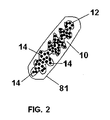
- FIG. 2 shows implement 10 of FIG. 1A contained within a shell 81, with container 12 holding the dry swellable clusters 14 in a folded conformation (first dimension) to facilitate oral administration.
- Shell 81 can be made of a variety of different materials, which can include, but are not limited to, pH-sensitive materials that will only dissolve under certain conditions, for example, the pH of the stomach.
- the material used to make the shell can be the same material, for example, gelatine or cellulose, used to make pharmaceutical capsules known in the art.
- Various sizes of shells can be used, as long as they are swallowable by the patient.
- FIG. 3A is another embodiment of an orally administrable implement of the present invention, referred to generally as 110, comprising a container 112, shown here in a smaller first dimension, housing a plurality of clusters 114 comprising a swellable material shown here in the unswelled state.
- container 112 is made from a fluid-permeable stretchable material such as regenerated oxidized cellulose (for example, CuracelTM by CuraMedical BV, Amsterdam, Holland) which expands or stretches from the first dimension to a second dimension, as shown in FIG. 3B , when the swellable clusters swell (clusters 114' in FIG. 3B ).
- regenerated oxidized cellulose for example, CuracelTM by CuraMedical BV, Amsterdam, Holland
- Regenerated oxidized cellulose fibers such as the ones utilized to make the container may or may not have substance-absorbing properties as well.
- the oxidized cellulose fibers utilized to make the container can be fibers of the type m ⁇ doc TM (Micro Dispersed Oxidised Cellulose) manufactured by Alltracel Pharmaceuticals, Dublin, Ireland, which have proven lipid-absorbing capabilities.
- FIGS. 4A and 4B illustrate another embodiment of an orally administrable implement of the present invention, referred to generally as 210, which is shown in FIG. 4A in its original folded, compact, state and contained in a shell 281, and shown in its expanded state in FIG. 4B .
- implement 210 includes a carrier 230 having an outer surface 268 and an inner surface 270, with the inner surface 270 forming an internal cavity 272.
- Clusters 214 comprising a swellable material are carried in a plurality of containers 212 that are each releasably coupled to the carrier 230 by at least one coupler, shown here as surgical suture 274.
- the release of the containers 212 relies on the reduction of the tensile strength of the absorbable surgical suture 274.
- suture 274 is arranged so as to maximize coverage of carrier 230 with containers 212.
- suture 274 can be threaded through internal cavity 272 of the carrier to form a closed loop so that at least one segment of suture 274 is located within the internal cavity 272.
- Double-threaded suture 274 can enter carrier 230 at a single location 282 for each sac, and can be knotted with a joint knot 266 contained within the internal cavity 272 of the carrier 230.
- the sutures connecting each individual container may or may not be of same long-term tensile decay characteristics, so that full or partial disintegration of the implement 210 is achieved.
- the internal cavity 272 may or may not host a microelectronic feedback-providing mechanism registering the exact moment of disintegration, as will be discussed below.
- swellable clusters 214/214' are made from any swellable material, which can include any material that can expand when in contact with aqueous solutions, and can include, but are not limited to, natural clays (for example, which is not meant to be limiting, Bentonite), microcrystalline hydrogels, polyolefins, polyvinyl alcohol, poly(ethyloxazoline), polyvinylacetate-polyvinylalcohol copolymers, poly(2-hydroxyethylacrylate), poly(2-hydroxyethylmethacrylate), polyacrylic acid, and copolymers thereof, polysaccharides, water soluble proteins, polynucleic acids, or a combination thereof.
- natural clays for example, which is not meant to be limiting, Bentonite
- microcrystalline hydrogels polyolefins
- polyvinyl alcohol poly(ethyloxazoline)
- polyvinylacetate-polyvinylalcohol copolymers poly(2-hydroxyethylacryl
- Clusters 214/214' can be made, if desired, of polyacrylic acid and a crosslinker by solution or suspension polymerization, using the type and quantity of crosslinker to control the swelling capacity and the gel modulus.
- the synthesis and use of such swellable clusters have been previously described in the following references: (1) Buchholz and Peppas, Superabsorbent Polymers, ACS Symposium Series, 1994; (2) Buchholz and Graham, Modern Superabsorbent Polymer Technology, John Wiley & Sons, 1998; and (3) Biocompatible/Biodegradable Materials (Tutorial). Sigma-Aldrich, 2005, available online at: http://www.sigmaaldrich.com/Area of Interest/Chemistry/Materials Science/Bioco mpatibleBiodearadable/Tutorial.html.
- Containers 212 can be made of a biodegradable expandable permeable liner (for example, absorbable medical gauze).
- the permeable liner should be able to allow aqueous solutions to enter containers 212 and contact swellable clusters 214 to allow for their expansion (shown in expanded or swelled form in FIG. 4B as 214').
- containers 212 can be made from natural cellulose fiber or specialty fiber through spun laced process, spun-bonded polypropylene or absorbable haemostatic oxidised regenerated cellulose (commercially available under the name CuracelTM), and are initially folded, containing the non-expanded clusters.
- containers 212 may be expandable or stretchable, so as to concurrently expand with the swelling of the clusters 214.
- containers 212 may be made of biodegradable material, so as to allow for biodegradation after several days or weeks.
- suture 274 is also made of an absorbable biocompatible material, which can include, but are not limited to polycaprolactone, polyglycolide, polylactide, or combinations thereof (commercially available under the names Selecture PLLTM and Selecture VEHTM by Schering-Plough Animal Health Corporation), or the like, each of which is absorbable and has specific tensile strength decaying characteristics that are not necessarily the same.
- sutures 274 to be capable of withstanding the maximum peristaltic force present in the stomach to prevent release of containers 212 before the said suture biodegrades sufficiently so that the decoupling takes place.
- Couplers can be decoupled by a variety of means known in the art.
- decoupling of containers includes but is not limited to the natural biodegradation of the holding suture, or of the container holding the clusters itself, or of a combination thereof. Once suture/s 274 is/are sufficiently biodegraded so that they are disrupted, containers 212 can become separated from the orally administrable implement 210.
- Carrier 230 can be made of a wide variety of different materials, which can include, but are not limited to, electrically non-conductive silicon and other biocompatible materials such as composite acrylics.
- the carrier 230 can adopt a wide variety of different shapes.
- carrier 230 can adopt a sphere shape, a cylinder shape, a pyramid shape, a cube shape or combinations thereof.
- the carrier includes one or more sealed compartments, e.g., internal cavity 272, which may further house electronics (see FIG. 7 ).
- the electronics can be insulated and may be further encapsulated within the internal cavity of the carrier using electrically non-conductive silicon and other biocompatible materials such as composite acrylics.
- shell 281 can be made of a variety of different materials, which can include, but are not limited to, pH-sensitive materials that will only dissolve under certain conditions, for example, the pH of the stomach.
- the material used to make the shell can be the same material, for example, gelatine or cellulose, used to make pharmaceutical capsules known in the art.
- Various sizes of shells can be used, as long as they are swallowable by the patient.
- FIG. 5 shows one embodiment of the present invention where containers 212 are biodegradable.
- container 212 separates from coupler 274 when container 212 starts to disintegrate at the point of attachment 282 of coupler 274 to container 212. Once container 212 detaches, swelled clusters 214' are released into the stomach.
- FIG. 6 shows another embodiment of the present invention where containers 212 are biodegradable.
- container 212 does not separate from coupler 274. Instead, container 212 starts to disintegrate at a point opposite from the point of attachment 282 of coupler 274 to container 212. Once container 212 starts to disintegrate, swelled clusters 214' are released into the stomach.
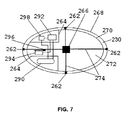
- FIG. 7 illustrates, in a schematic view, one possible mechanism for providing microelectronic feedback information from an embodiment of an orally administrable implement of the present invention to the external world about the exact moment of disintegration of the implement.
- FIG. 7 shows carrier 230 having an outer surface 268 and an inner surface 270, with the inner surface 270 forming an internal cavity 272.
- battery 290 housed within internal cavity 272 is battery 290, which supplies microcontroller 292 through microswitch 294 which has lever 296 that is connected to coupler (suture) 274 in such manner that when the device is intact, the microelectronic components are not turned on.
- the microswitch 294 flips back, turning on the microcontroller 292, which controls a radio-frequency (RF) transmitter 298, sending a message to the external world that disintegration of the device has occurred.
- Suture 274 is threaded through openings in the carrier 230, which are sealed by biocompatible silicon sealant 262.
- FIGS. 8A and 8B illustrate, in a schematic view, another possible mechanism for providing microelectronic feedback information from another embodiment of an orally administrable implement of the present invention to the external world about the exact moment of disintegration of the said implement.
- Clusters 314' comprising swellable material (for example, AquagelTM by Akina Inc., West Lafayette, IN) are stored in an absorbable container 312 (for example, made of CuracelTM, CuraMedical, Zwanenburg, The Netherlands, or SafilTM Mesh Bag, B.Braun, Mels Institute, Gemany), which is kept closed and attached to a carrier 330 by absorbable surgical suture 374 (for example, 5.0 PDS II or 5.0 VicrylTM by Ethicon, Cornelia, GA).
- absorbable surgical suture 374 for example, 5.0 PDS II or 5.0 VicrylTM by Ethicon, Cornelia, GA.
- the suture 374 is knotted inside the carrier 330 with a knot 320.
- the suture 374 enters the carrier 330 through a silicon cap 305, which seals the carrier 330 when the implement is held together.
- Included inside carrier 330 is a sealed compartment, internal cavity 372, which hosts a radio-frequency transmitter 398 and a battery 390.
- the positive terminal 313 of the battery 390 is connected to a wire 308 terminating at the vicinity of the opening 318 sealed by the silicon cap 305 with an electrical terminal 307.
- Another such terminal is located close to the first, again in the vicinity of the opening 318, and an electrical wire 309 connects it to the positive terminal of the radio-frequency transmitter 398.
- the negative terminal 315 of the battery 390 is connected directly to the negative terminal of the radio-frequency transmitter 398.
- the silicon cap 305 keeping the carrier 330 sealed detaches, and the inside of the carrier 330 gets moisturized by gastric ionic juices, thus short-circuiting the wires 308 and 309.
- the electric circuit supplying the radio-frequency transmitter 398 is now closed, and the radio-frequency transmitter emits a signal to the external world, informing that the disintegration of the device has taken place.
- the wires 308 and 309 are kept very close together, so even small moisturizing in the carrier 330 after the sealing cap 305 detaches is sufficient to create a short circuit, thus connecting the radio-frequency transmitter 398 to the battery 390 and to broadcast a signal denoting the exact moment of disintegration.
- the miniature sealing cap 305 can be made of biocompatible silicon.
- Carrier 330 can be made of a wide variety of different materials, which can include, but are not limited to electrically non-conductive silicon and other biocompatible materials such as composite acrylics.
- the carrier 330 can adopt a wide variety of different shapes.
- carrier 330 can adopt a sphere shape, a cylinder shape, a pyramid shape, a cube shape or combinations thereof.
- the carrier includes one or more sealed compartments, e.g., internal cavity 372, as shown in FIGS. 8A and 8B , which house the necessary electronics.
- the electronics can be insulated and may be further encapsulated within the internal cavity of the carrier using electrically non-conductive silicon and other biocompatible materials such as composite acrylics.
- clusters of molecules 314' can include any material that can expand when in contact with aqueous solutions, and can include, but are not limited to, natural clays (for example, which is not meant to be limiting, Bentonite), microcrystalline hydrogels, polyolefins, polyvinyl alcohol, poly(ethyloxazoline), polyvinylacetate-polyvinylalcohol copolymers, poly(2-hydroxyethylacrylate), poly(2-hydroxyethylmethacrylate), polyacrylic acid, and copolymers thereof, polysaccharides, water soluble proteins, polynucleic acids, or a combination thereof. Moreover, they can be prepared using a variety of different methods, also discussed above.
- FIGS. 9A and 9B illustrate schematically another embodiment of an orally administrable implement of the present invention.
- implement 410 comprises container 412 made from permeable absorbable mesh such as VicrylTM Knitted Mesh by Ethicon, CuracelTM by CuraMedical, or SafilTM Mesh by B Braun.
- the container 412 is held together by radial fibers 423 made from absorbable surgical suture such as VicrylTM, PDS IITM (Ethicon), cat gut, regenerated cellulose or MonosynTM (B Braun).
- absorbent molecule clusters 414' which upon expansion or swelling in the gastric juice become spherical bodies not exceeding about 1 cm, preferably, not exceeding about 0.5 to about 0.6 cm in diameter.
- the clusters 414' can be made of various substances, for example, appropriately cross-linked poly(acrylic acid) or poly(2-hydroxyethyl methacrylate). They are of size not permitting their exit from the carrier when dry (unswelled), and not exceeding 1 cm when swelled in the presence of gastric fluid. In addition, preferably the clusters cannot grow any bigger in the small intestine and the colon to prevent them from causing intestinal obstruction.
- FIG. 9B represents the released pieces 432 of the absorbable mesh, each of which is of size precluding the possibility of creating obstruction in the small intestine.
- the weakened disintegrating radial fibers 423 cannot hold the structure together, the gastric peristaltic forces take it apart, and the carrier pieces 432, and the polymer clusters 414' are released in the stomach, so that they can be propelled out of the body by natural peristalsis in a harmless fashion. Thus, the artificially created temporary gastric bezoar ceases to exist.
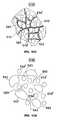
- FIGS. 10A and 10B illustrate schematically another embodiment of an orally administrable implement of the present invention.
- implement 510 comprises container 512 made from a plurality of sections 542 made from permeable absorbable mesh such as VicrylTM Knitted Mesh by Ethicon, CuracelTM by CuraMedical, or SafilTM Mesh by B Braun.
- the container 512 is assembled with several pieces of the said mesh 542, precisely and securely stitched together by absorbable surgical suture 543 such as VicrylTM, PDS IITM (Ethicon) or MonosynTM (B Braun).
- absorbable surgical suture 543 such as VicrylTM, PDS IITM (Ethicon) or MonosynTM (B Braun).
- clusters 514' comprising swellable material, which upon expansion in the gastric fluid become spherical bodies not exceeding 1 cm, preferably not exceeding about 1 cm in diameter.
- the clusters 514' can be made of various substances, for example, appropriately cross-linked poly(acrylic acid) or poly(2-hydroxyethyl methacrylate). They are of size not permitting their exit from the carrier when dry, and preferably not exceeding about 0.5 to about 0.6 cm in diameter when swelled in gastric fluid. In addition, they cannot grow any bigger in the small intestine and the colon to prevent them causing intestinal obstruction.
- FIG. 10B shows the structure after it has started its disintegration.
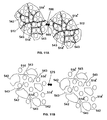
- FIGS. 11A and 11B depict another embodiment of an orally administrable implement of the present invention.
- two containers 512 are essentially as shown in FIG. 10A except each container 512 further comprises a spherical rare Earth magnet 565, covered by thin biocompatible silicone cover 566.
- each container 512 is individually ingested in a pre-determined sequence, and upon expansion in the stomach, the two rare Earth magnets 565 contained in each container 512 attract each other and two temporary bezoars form a larger volume.
- FIG. 11 B represents the released pieces 542 of the absorbable mesh in both temporary bezoars, each of which is of size precluding the possibility of creating obstruction in the small intestine.
- the weakened disintegrating sutures 543 cannot hold the structure together, and the mesh pieces 542, the sutures 543, the swellable clusters 514' and the still coupled magnets 575 are released in the stomach, so that they can be propelled out of the body by natural peristalsis in a harmless fashion.
- the two small rare Earth magnets 575 remain bonded together, but are of size that cannot create any intestinal obstruction.
- the artificially created temporary gastric bezoar ceases to exist and all of its components exit the stomach and the gastrointestinal tract without creating obstruction.
- FIGS. 12A, 12B and 12C represent a schematic drawing of a possible way to vacuum-packing an orally administrable implement of the present invention before positioning it in an ingestible capsule, so that no or minimal volume space in the said capsule is left non-utilized.
- the container 712 is planary situated and is made from absorbable permeable knitted or woven mesh 782, which is vacuum-compressed, while containing inside fibers 783 made of absorbable surgical suture and tied together in a knot 787, dry superabsorbent polymer clusters 714, and a miniature rare Earth permanent magnet 785, covered with a thin biocompatible layer 786.
- FIG. 12A the container 712 is planary situated and is made from absorbable permeable knitted or woven mesh 782, which is vacuum-compressed, while containing inside fibers 783 made of absorbable surgical suture and tied together in a knot 787, dry superabsorbent polymer clusters 714, and a miniature rare Earth permanent magnet 785, covered with a thin
- FIG. 12B depicts the container 712 made of absorbable permeable knitted or woven mesh 792 is tightly folded and in it tightly compressed together are the fibers 793 made of absorbable surgical suture and tied together in a knot 797, the dry superabsorbent polymer clusters 714, and the miniature rare Earth permanent magnet 795.
- FIG. 12C depicts the folded carrier 712 as it fits precisely and without leaving unutilized volume in a stomach-targeted rapidly absorbable ingestible capsule 781, for example AAA R&D capsule by CapsugelTM, Pfizer, New York, NY.
- FIG. 13A represents a container 812 made from permeable absorbable mesh such as VicrylTM Knitted Mesh by Ethicon, CuracelTM by CuraMedical, or SafilTM Mesh by B Braun.
- the container 812 is assembled with separate sections 842 of the mesh, precisely and securely stitched together by absorbable surgical suture 843 such as VicrylTM, PDS IITM (Ethicon) or MonosynTM (B Braun).
- absorbable surgical suture 843 such as VicrylTM, PDS IITM (Ethicon) or MonosynTM (B Braun).
- swellable clusters 814' which upon expansion in the gastric juice become spherical bodies not exceeding about 0.5 to about 0.6 cm in diameter.
- the swellable clusters 814' can be made of various substances, for example, appropriately cross-linked poly(acrylic acid) or poly(2-hydroxyethyl methacrylate). They are of a size not permitting their exit from the container when dry, and not exceeding 0.5-0.6 cm when swollen in gastric acid. In addition, they cannot grow any bigger in the small intestine and the colon to prevent them causing intestinal obstruction.
- the container 812 further contains a radio-frequency identification (RFID) tag 825 to determine the exact location of the device within the gastrointestinal (GI) tract using an external RFID reader.
- RFID radio-frequency identification
- the RFID tag 825 is contained within the volume of the container 812 and has an antenna 826 attached to it.
- the antenna 826 is folded in the non-expanded capsule, and unfolds to facilitate the communication of the RFID tag 825 with an external RFID reader 827 positioned in the vicinity of the abdominal area of the patient.
- FIG. 13B represents the released sections 842 of the absorbable mesh, each of which is of size precluding the possibility of creating obstruction in the small intestine.
- the weakened disintegrating sutures 843 cannot hold the structure together, and the container sections 842, the RFID tag 825, the antenna 826, and the clusters 814 are released in the stomach, so that they can be propelled out of the body by natural peristalsis in a harmless fashion.
- the external RFID reader 827 records the changed position of the internal RFID tag 825 after the disintegration of the internal temporary gastric bezoar.
- FIG. 14 represents a block-diagram of a possible administration schedule that can be in conjunction with an appropriately designed patient-specific behavior/lifestyle modifying diet. The figure also outlines how various possible complications can be handled in the course of the therapy.
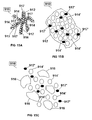
- the orally administrable implement in another embodiment of the present invention, illustrated in FIGS. 15A, 15B and 15C , the orally administrable implement, referred to generally as 910, comprises a container 912, shown here in a folded, compact, first dimension.
- container 912 is made from a biodegradable material that allows for the passage of fluid into its interior 913, for example, a permeable biodegradable mesh such as VicrylTM Knitted Mesh by Ethicon, CuracelTM by CuraMedical, or SafilTM Mesh by B Braun.
- swellable clusters 914 comprising a swellable material, whereby each swellable cluster is capable of swelling when contacted with fluid such as gastric fluid found in the stomach.
- swellable clusters 914 can comprise AquagelTM by Akina Inc., West Lafayette, IN.
- FIG. 1A the swellable clusters 914 are shown prior to contact with fluid, i.e., in their non-swelled form.
- Orally administrable implement 912 further comprises a plurality of clusters comprising a substance-absorbing material (substance-absorbing clusters 917) contained within the container 912 and capable of absorbing targeted substance or substances present in the gastric fluid.
- a substance-absorbing material substance-absorbing clusters 917 contained within the container 912 and capable of absorbing targeted substance or substances present in the gastric fluid.
- the substance-absorbing clusters 917 may be lipid-absorbing and may comprise chitosan, or any other material known to have lipid-absorbing properties.
- FIG. 15 B shows implement 910 of FIG. 15 A in its expanded form, after it has been delivered into the stomach and gastric fluid has been allowed to contact it.
- Container 912 is now shown in its second, expanded dimension, such that the implement 910 can no longer exit the stomach through the pylorus.
- the swellable clusters 914' are now shown in their swelled state due to the gastric fluid seeping through the container 912.
- the swelling of clusters 914' causes container 912 to expand to the second dimension.
- the swelled clusters 914' become spherical bodies not exceeding 1 cm in diameter.
- the clusters can be made of various substances, for example, appropriately cross-linked poly(acrylic acid) or poly(2-hydroxyethyl methacrylate).
- they are of size not permitting their exit from the carrier when dry, and not exceeding about 0.5 to about 0.6 cm when swollen in gastric fluid. In addition, preferably, they cannot grow any bigger in the small intestine and the colon to prevent them causing intestinal obstruction.
- the substance-absorbing clusters 917' do not expand to size greater than about 1 cm, preferably, not exceeding about 0.5 to about 0.6 cm after substance absorption, so that they also do not cause intestinal obstruction and can be easily expelled through the pylorus.
- the substance-absorbing clusters 917' are retained in the stomach long enough to absorb substance present in the gastric fluid, such as for example lipids, due to being retained in the container 912 and the implement 910 expanding to a size that cannot exit the stomach via the pylorus as a result of the swellable clusters 914' swelling when contacted with gastric fluid.
- FIG. 15C represents the released pieces 916 of the container 912 in FIG. 15 B once it biodegrades, each piece 916 of which is of size precluding the possibility of creating obstruction in the small intestine.
- the container pieces 916 along with the swelled clusters 914' and substance-absorbing clusters 917' are released in the stomach, so that they can be propelled out of the body by natural peristalsis in a harmless fashion.
- Two different dry polymer clusters were used in the following example.
- a bezoar of Type 1 about 1.0 to about 1.5 cc of dry polymer clusters comprising swellable polyacrylamide were added to the inside of the container through the open end.
- the average size of the dry polyacrylamide clusters ranged in size from about 500 micrometers to about 1200 micrometers.
- a bezoar of Type 2 about 1.0 to about 1.5 cc of dry polymer clusters comprising swellable cross-linked polyacrylic acid were added to the inside of the container through the open end.
- the average size of the dry polyacrylic acid clusters ranged in size from about 150 micrometers to about 850 micrometers.
- the filled containers were then folded, compressed and made to fit into a standard AAA capsule.
- the dogs were administered 10 ingestible capsules (one capsule per day per dog) each containing a 50 cc container (cylindrical sac) designed from VicrylTM knitted mesh (Ethicon, Summerville, NJ) of 8 cm height and 3 cm diameter, as described above.
- the containers were filled with either dry polymer clusters made from polyacrylamide (The Artistic Shop, Pewaukee WI) (Type 1 bezoars, which were administered to the male dog) of about 0.5 to about 1.2 mm in diameter or cross-linked polyacrylic acid (Wako Pure Chemical Industries, Osaka, Japan) (Type 2 bezoars, which administered to the female dog) of 0.15 to 0.85 mm in diameter.
- the encapsulation was in standard gelatin AAA capsules (CapsugelTM, Peapak, NJ). The administration of the capsules took place during the 9:30-9:40AM break of the regular feeding schedule, modifying the latter as follows:
- the food intake and weight dynamics were averaged for the baseline and the therapy periods, and were compared.
- the food intake measurements during the baseline and during therapy were compared for statistically significant differences using a single-tailed two-sampled unequal variance Student T-test.
- the food intake was reduced by 35% in the male dog (Type 1 bezoars) and by 51% in the female dog (Type 2 bezoars).
- the reduction of the food intake was statistically significant in both animals, with p ⁇ 0.05 for the male dog and p ⁇ 0.005 for the female dog.
- the male dog lost 1.2 kg
- the female dog lost 1.5 kg in weight (4.7% and 4.9%, respectively).
- Examination of the expelled bezoars in the stools revealed that the superabsorbent polymer clusters swelled to about 0.5-0.7 cm diameter, were expellable through the pylorus upon the disintegration of the sac carrier, and were sufficiently soft to prevent gastrointestinal obstruction.
- this temporary bezoar design appears to be a safe and reliable way of reducing gastric volume and regulating food intake for the treatment of obesity.
- Chitosan clusters ranging in size from about 200 micron to about 600 micron were manufactured and supplied by Attix Pharmachem, Toronto, ON and served as lipid-absorbing clusters to be included in a 3x8 cm pillow-like permeable container designed from Vicryl knitted mesh (Ethicon), as described above.
- the containers further contained polyacrylamide clusters ranging in size from about 500 micrometers to about 1200 micrometers, which were supplied by The Artistic Shop, LLC (Pewaukee, WI).
- the containers were filled with about 0.8 cubic centimeters of the chitosan clusters and 0.8 cubic centimeters of the polyacrylamide clusters.
- the containers were closed as described above with VicrylTM USP 6.0 surgical suture.
- the implement (filled container) was put in a blended mixture of 125 ml of water and 25 ml of sunflower oil. After 1/2 hour, the oil-water mixture was completely absorbed by the implement. Subsequently, the implement was put in a mini washing machine manufactured by Ningbo Sanxi Electric Co, Ltd, Ningbo, Zhejiang, China. The implement was mixed with some cotton clothing to simulate gastric peristaltic forces in the presence of other food. The mini washing machine was turned on in two 2-hour intervals with a 1 hour break between them. The implement retained its volume, and no visible oil was released by the chitosan clusters.
Landscapes
- Health & Medical Sciences (AREA)
- Life Sciences & Earth Sciences (AREA)
- Veterinary Medicine (AREA)
- Public Health (AREA)
- General Health & Medical Sciences (AREA)
- Animal Behavior & Ethology (AREA)
- Chemical & Material Sciences (AREA)
- Pharmacology & Pharmacy (AREA)
- Medicinal Chemistry (AREA)
- Epidemiology (AREA)
- Obesity (AREA)
- Engineering & Computer Science (AREA)
- Child & Adolescent Psychology (AREA)
- Nursing (AREA)
- Physiology (AREA)
- Orthopedic Medicine & Surgery (AREA)
- Nutrition Science (AREA)
- Biomedical Technology (AREA)
- Heart & Thoracic Surgery (AREA)
- Vascular Medicine (AREA)
- Bioinformatics & Cheminformatics (AREA)
- Diabetes (AREA)
- Hematology (AREA)
- Chemical Kinetics & Catalysis (AREA)
- General Chemical & Material Sciences (AREA)
- Nuclear Medicine, Radiotherapy & Molecular Imaging (AREA)
- Organic Chemistry (AREA)
- Medicinal Preparation (AREA)
Abstract
Claims (15)
- Un instrument destiné à une utilisation chez un animal, notamment un mammifère, pour remplir un espace interne chez l'animal, l'instrument comporte une pluralité d'agrégats [14, 114, 214, 514, 714, 914] comportant un matériau dilatable capable de se dilater quand il est mis en contact avec un fluide dans l'espace interne, l'instrument comporte de plus :au moins un contenant extensible perméable aux fluides [12, 112, 212, 312, 412, 512, 712, 812, 912] contenant en lui la pluralité d'agrégats [14, 114, 214, 514, 714, 914] et ayant une première dimension et une deuxième dimension ;grâce à quoi quand l'instrument est mis en contact avec le fluide, le fluide entre dans le contenant amenant les agrégats en lui à se dilater [14', 114', 214', 314', 414', 514', 814', 914'] et le contenant [12, 112, 212, 312, 412, 512, 712, 812, 912] à s'étendre de la première dimension à la deuxième dimension.
- L'instrument tel que revendiqué dans la revendication 1, comportant de plus :un porteur [230, 330] destiné à porter l'au moins un contenant [12, 112, 212, 312, 412, 512,712,812,912].
- L'instrument tel que revendiqué dans la revendication 2, comportant de plus :un coupleur [274, 374] destiné à coupler de façon à pouvoir être libéré l'au moins un contenant extensible [12, 112, 212, 312, 412, 512, 712, 812, 912] au porteur [230, 330].
- L'instrument tel que revendiqué dans la revendication 3, dans lequel le coupleur [274, 374] comporte un morceau de gaze médicale ou de fibre biodégradable absorbable destiné à assujettir de façon à pouvoir être libéré l'au moins un contenant [12, 112, 212, 312, 412, 512, 712, 812, 912] au porteur [230, 330].
- L'instrument tel que revendiqué dans la revendication 1 ou 2, comportant de plus un système micro-électronique incorporé [398] associé de façon opérationnelle au porteur [230, 330], ou au contenant [12, 112, 212, 312, 412, 512, 712, 812, 912], ou aux deux, destiné à suivre l'instrument.
- L'instrument tel que revendiqué dans n'importe laquelle des revendications 1 à 5, grâce à quoi quand le contenant [12, 112, 212, 312, 412, 512, 712, 812, 912] est dans la première dimension, l'instrument peut être conservé dans une capsule ingérable [81, 281, 781] et quand le contenant [12, 112, 212, 312, 412, 512, 712, 812, 912] est dans la deuxième dimension, il est suffisamment grand pour être conservé dans l'espace interne après ingestion.
- L'instrument tel que revendiqué dans n'importe laquelle des revendications 1 à 5, dans lequel le contenant [12, 112, 212, 312, 412, 512, 712, 812, 912] est biodégradable avec le temps pour libérer les agrégats dilatés [14', 114', 214', 314', 414', 514', 814', 914'] dans l'espace interne.
- L'instrument tel que revendiqué dans n'importe laquelle des revendications 1 à 5, dans lequel le contenant [12, 112, 212, 312, 412, 512, 712, 812, 912] est fait à partir d'un matériau de maille monofilament tressé, tricoté ou tissé absorbable.
- L'instrument tel que revendiqué dans n'importe laquelle des revendications 1 à 5, dans lequel les agrégats dilatés [14', 114', 214', 314', 414', 514', 814', 914'] ne dépassent pas environ 1,0 cm de diamètre.
- L'instrument tel que revendiqué dans n'importe laquelle des revendications 1 à 5, dans lequel le matériau dilatable des agrégats [14, 114, 214, 514, 714, 914] est sélectionné dans le groupe composé d'une bentonite gonflante, d'hydrogels microcristallins, de polyoléfines et de divers mélanges de ces derniers.
- L'instrument tel que revendiqué dans n'importe laquelle des revendications 1 à 5, comportant de plus au moins un agent actif, qui peut être associé de façon à pouvoir être libéré avec soit le contenant [12, 112, 212, 312, 412, 512, 712, 812, 912], soit les agrégats [14, 114, 214, 514, 714, 914] de matériau dilatable, ou les deux.
- L'instrument tel que revendiqué dans la revendication 11, dans lequel l'au moins un agent actif est sélectionné dans le groupe composé d'agents enzymatiques, d'agents médicinaux, d'agents chimiques, ou de combinaisons de ces derniers.
- L'instrument tel que revendiqué dans n'importe laquelle des revendications 1 à 5, comportant de plus une pluralité d'agrégats [14, 114, 214, 514, 714, 914] comportant un matériau absorbeur de substance contenu à l'intérieur du contenant [12, 112, 212, 312, 412, 512, 712, 812, 912] et capable d'absorber la substance présente dans l'espace interne.
- L'instrument tel que revendiqué dans la revendication 13, dans lequel le matériau absorbeur de substance est un matériau absorbeur de lipides.
- L'instrument tel que revendiqué dans la revendication 14, dans lequel le matériau absorbeur de lipides est de la fibre de cellulose oxydée, de la fibre de chitosane absorbeuse de lipides, ou une combinaison des deux.
Applications Claiming Priority (7)
| Application Number | Priority Date | Filing Date | Title |
|---|---|---|---|
| US74388306P | 2006-03-29 | 2006-03-29 | |
| US78807706P | 2006-04-03 | 2006-04-03 | |
| US83832406P | 2006-08-18 | 2006-08-18 | |
| US85335006P | 2006-10-23 | 2006-10-23 | |
| US87519406P | 2006-12-18 | 2006-12-18 | |
| US90475807P | 2007-03-05 | 2007-03-05 | |
| PCT/CA2007/000512 WO2007109904A1 (fr) | 2006-03-29 | 2007-03-29 | accessoire ingeRABLE pour LE contrôle dU poids |
Publications (3)
| Publication Number | Publication Date |
|---|---|
| EP2004106A1 EP2004106A1 (fr) | 2008-12-24 |
| EP2004106A4 EP2004106A4 (fr) | 2010-10-27 |
| EP2004106B1 true EP2004106B1 (fr) | 2012-05-30 |
Family
ID=38540766
Family Applications (1)
| Application Number | Title | Priority Date | Filing Date |
|---|---|---|---|
| EP07719444A Not-in-force EP2004106B1 (fr) | 2006-03-29 | 2007-03-29 | Accessoire ingerable pour le contrôle du poids |
Country Status (6)
| Country | Link |
|---|---|
| US (1) | US8389003B2 (fr) |
| EP (1) | EP2004106B1 (fr) |
| AU (1) | AU2007231510A1 (fr) |
| CA (1) | CA2647487C (fr) |
| MX (1) | MX2008012587A (fr) |
| WO (1) | WO2007109904A1 (fr) |
Families Citing this family (59)
| Publication number | Priority date | Publication date | Assignee | Title |
|---|---|---|---|---|
| CA2789262C (fr) | 2005-04-28 | 2016-10-04 | Proteus Digital Health, Inc. | Systeme pharma-informatique |
| US8802183B2 (en) | 2005-04-28 | 2014-08-12 | Proteus Digital Health, Inc. | Communication system with enhanced partial power source and method of manufacturing same |
| US8836513B2 (en) | 2006-04-28 | 2014-09-16 | Proteus Digital Health, Inc. | Communication system incorporated in an ingestible product |
| US9198608B2 (en) | 2005-04-28 | 2015-12-01 | Proteus Digital Health, Inc. | Communication system incorporated in a container |
| US8912908B2 (en) | 2005-04-28 | 2014-12-16 | Proteus Digital Health, Inc. | Communication system with remote activation |
| US20110112383A1 (en) * | 2005-11-08 | 2011-05-12 | Plensat, Inc | Devices, systems and methods for treatment of eating disorders |
| US9579227B2 (en) * | 2006-03-29 | 2017-02-28 | Eat Little Inc. | Ingestible implement for weight control |
| US8956287B2 (en) | 2006-05-02 | 2015-02-17 | Proteus Digital Health, Inc. | Patient customized therapeutic regimens |
| SG175681A1 (en) | 2006-10-25 | 2011-11-28 | Proteus Biomedical Inc | Controlled activation ingestible identifier |
| US8718193B2 (en) | 2006-11-20 | 2014-05-06 | Proteus Digital Health, Inc. | Active signal processing personal health signal receivers |
| WO2008074153A1 (fr) * | 2006-12-18 | 2008-06-26 | Electronic Dietary Foods Inc. | Dispositif d'administration d'une substance |
| EP3785599B1 (fr) | 2007-02-01 | 2022-08-03 | Otsuka Pharmaceutical Co., Ltd. | Systèmes de marqueur d'événement ingérable |
| WO2008101107A1 (fr) | 2007-02-14 | 2008-08-21 | Proteus Biomedical, Inc. | Source d'énergie intégrée au corps ayant une électrode de zone de surface supérieure |
| EP2063771A1 (fr) | 2007-03-09 | 2009-06-03 | Proteus Biomedical, Inc. | Dispositif organique à antenne déployable |
| WO2008112577A1 (fr) | 2007-03-09 | 2008-09-18 | Proteus Biomedical, Inc. | Dispositif dans le corps ayant un émetteur multidirectionnel |
| US8540632B2 (en) * | 2007-05-24 | 2013-09-24 | Proteus Digital Health, Inc. | Low profile antenna for in body device |
| US8961412B2 (en) | 2007-09-25 | 2015-02-24 | Proteus Digital Health, Inc. | In-body device with virtual dipole signal amplification |
| EP2231212A2 (fr) * | 2007-12-20 | 2010-09-29 | 7L, Llc | Dispositif autodilatable à avaler occupant l'espace gastrique |
| US9457048B2 (en) | 2008-02-05 | 2016-10-04 | Wellosophy Corporation | Absorbent ingestible agents and associated methods of manufacture and use |
| EP3235491B1 (fr) | 2008-03-05 | 2020-11-04 | Proteus Digital Health, Inc. | Marqueurs et systèmes d'événement de communication multimode ingérables |
| US20090259246A1 (en) * | 2008-04-14 | 2009-10-15 | Sherif Eskaros | Intragastric Volume-Occupying Device |
| WO2009132461A1 (fr) * | 2008-04-28 | 2009-11-05 | Electronic Dietary Foods Inc. | Unités de formation de bézoard en vue du contrôle du poids |
| EP2313002B1 (fr) | 2008-07-08 | 2018-08-29 | Proteus Digital Health, Inc. | Structure de données pour marqueurs d'événements d'ingestion |
| CN102176862B (zh) | 2008-08-13 | 2014-10-22 | 普罗透斯数字保健公司 | 可摄入电路 |
| JP2012514799A (ja) | 2009-01-06 | 2012-06-28 | プロテウス バイオメディカル インコーポレイテッド | 摂取に関連するバイオフィードバックおよび個別薬物療法の方法およびシステム |
| SG172847A1 (en) | 2009-01-06 | 2011-08-29 | Proteus Biomedical Inc | Pharmaceutical dosages delivery system |
| GB2480965B (en) | 2009-03-25 | 2014-10-08 | Proteus Digital Health Inc | Probablistic pharmacokinetic and pharmacodynamic modeling |
| WO2010129288A2 (fr) | 2009-04-28 | 2010-11-11 | Proteus Biomedical, Inc. | Marqueurs d'évènement comestibles à haute fiabilité et leurs procédés d'utilisation |
| EP2432458A4 (fr) | 2009-05-12 | 2014-02-12 | Proteus Digital Health Inc | Marqueurs d'événement ingérables comprenant un composant ingérable |
| TWI517050B (zh) | 2009-11-04 | 2016-01-11 | 普羅托斯數位健康公司 | 供應鏈管理之系統 |
| CN102905672B (zh) | 2010-04-07 | 2016-08-17 | 普罗秋斯数字健康公司 | 微型可吞服装置 |
| TWI557672B (zh) | 2010-05-19 | 2016-11-11 | 波提亞斯數位康健公司 | 用於從製造商跟蹤藥物直到患者之電腦系統及電腦實施之方法、用於確認將藥物給予患者的設備及方法、患者介面裝置 |
| EP2642983A4 (fr) | 2010-11-22 | 2014-03-12 | Proteus Digital Health Inc | Dispositif ingérable avec produit pharmaceutique |
| US9756874B2 (en) | 2011-07-11 | 2017-09-12 | Proteus Digital Health, Inc. | Masticable ingestible product and communication system therefor |
| WO2015112603A1 (fr) | 2014-01-21 | 2015-07-30 | Proteus Digital Health, Inc. | Produit ingérable pouvant être mâché et système de communication associé |
| KR101898964B1 (ko) | 2011-07-21 | 2018-09-14 | 프로테우스 디지털 헬스, 인코포레이티드 | 모바일 통신 장치, 시스템, 및 방법 |
| LT2739270T (lt) * | 2011-08-01 | 2020-07-10 | Hb Biotechnologies Corporation | Nesuvirškinamos kapsulės, skirtos skysčius absorbuojančios medžiagos tiekimui |
| US9235683B2 (en) | 2011-11-09 | 2016-01-12 | Proteus Digital Health, Inc. | Apparatus, system, and method for managing adherence to a regimen |
| US20140343452A1 (en) * | 2011-12-21 | 2014-11-20 | Eatlittle Inc. | Pseudobezoar-Based Intraluminal Gastrointestinal Cleansing and Biospy |
| WO2013183058A2 (fr) | 2012-06-07 | 2013-12-12 | Tulip Medical Ltd. | Dispositif étendu |
| CN104487347B (zh) | 2012-07-23 | 2017-09-01 | 普罗秋斯数字健康公司 | 用于制造包括电子器件的片剂的方法和系统 |
| DK2884950T3 (en) * | 2012-08-17 | 2019-04-23 | Simple Medical Innovations Pty Ltd | INTRAGASTRIC BALLON |
| CA2888871C (fr) | 2012-10-18 | 2016-08-09 | Proteus Digital Health, Inc. | Appareil, systeme, et procede, pour optimiser de facon adaptative une dissipation de la puissance, et transmettre une puissance dans une source de puissance a un dispositif de com munication |
| WO2014106300A1 (fr) * | 2013-01-02 | 2014-07-10 | Eatlittle Inc. | Greffe gastro-intestinale intraluminale à base de pseudobézoard |
| WO2014120669A1 (fr) | 2013-01-29 | 2014-08-07 | Proteus Digital Health, Inc. | Films polymères hautement dilatables et compositions les contenant |
| US10175376B2 (en) | 2013-03-15 | 2019-01-08 | Proteus Digital Health, Inc. | Metal detector apparatus, system, and method |
| JP6511439B2 (ja) | 2013-06-04 | 2019-05-15 | プロテウス デジタル ヘルス, インコーポレイテッド | データ収集および転帰の査定のためのシステム、装置、および方法 |
| US9796576B2 (en) | 2013-08-30 | 2017-10-24 | Proteus Digital Health, Inc. | Container with electronically controlled interlock |
| US10084880B2 (en) | 2013-11-04 | 2018-09-25 | Proteus Digital Health, Inc. | Social media networking based on physiologic information |
| EP3091962B1 (fr) | 2013-12-05 | 2022-06-08 | Epitomee Medical Ltd. | Dispositifs et systèmes de rétention pour la libération in-situ d'agents pharmaceutiques actifs |
| CA2903243C (fr) | 2014-11-19 | 2021-06-01 | Amirix Systems Inc. | Etiquette de suivi d'animal a detection de predation |
| US11051543B2 (en) | 2015-07-21 | 2021-07-06 | Otsuka Pharmaceutical Co. Ltd. | Alginate on adhesive bilayer laminate film |
| CN105476735A (zh) * | 2016-01-20 | 2016-04-13 | 李新民 | 一种半透膜吸水减肥胃球囊 |
| CN109843149B (zh) | 2016-07-22 | 2020-07-07 | 普罗秋斯数字健康公司 | 可摄入事件标记的电磁感测和检测 |
| US10820831B2 (en) | 2016-10-26 | 2020-11-03 | Proteus Digital Health, Inc. | Methods for manufacturing capsules with ingestible event markers |
| US20190246681A1 (en) * | 2018-02-15 | 2019-08-15 | Rotem Naftalovich | Use of nondigestible nonfibrous volumizer of meal content as a method for increasing feeling of satiety |
| IT202000003665A1 (it) * | 2020-02-21 | 2021-08-21 | Keyron Ltd | Palloncino intragastrico somministrabile oralmente |
| JP7847119B2 (ja) * | 2020-07-29 | 2026-04-16 | ザ・セカント・グループ・エルエルシー | 架橋ポリ(セバシン酸グリセロール)を含む構造を含む形状誘導型制御放出および保持 |
| WO2022195476A1 (fr) | 2021-03-15 | 2022-09-22 | Clexio Biosciences Ltd. | Dispositifs de rétention gastrique pour l'évaluation d'états intragastriques |
Family Cites Families (30)
| Publication number | Priority date | Publication date | Assignee | Title |
|---|---|---|---|---|
| US4899747A (en) | 1981-12-10 | 1990-02-13 | Garren Lloyd R | Method and appartus for treating obesity |
| US4485805A (en) | 1982-08-24 | 1984-12-04 | Gunther Pacific Limited Of Hong Kong | Weight loss device and method |
| US4739758A (en) | 1986-05-19 | 1988-04-26 | Criticare Systems, Inc. | Apparatus for stomach cavity reduction |
| US5234454A (en) | 1991-08-05 | 1993-08-10 | Akron City Hospital | Percutaneous intragastric balloon catheter and method for controlling body weight therewith |
| DE4406424A1 (de) * | 1994-02-28 | 1995-08-31 | Bayer Ag | Expandierbare Arzneiformen |
| US5750585A (en) | 1995-04-04 | 1998-05-12 | Purdue Research Foundation | Super absorbent hydrogel foams |
| AU4107297A (en) | 1996-09-05 | 1998-03-26 | Governors Of The University Of Alberta, The | Gastro-intestinal electrical pacemaker |
| DE59803511D1 (de) * | 1997-01-14 | 2002-05-02 | Lohmann Therapie Syst Lts | Expandierbares gastroretentives therapie-system mit kontrollierter wirkstofffreisetzung im gastrointestinaltrakt |
| US20030092673A1 (en) * | 1997-02-06 | 2003-05-15 | Henryk Struszczyk | Substance and method for reduction of lipids and cholesterol |
| US6271278B1 (en) | 1997-05-13 | 2001-08-07 | Purdue Research Foundation | Hydrogel composites and superporous hydrogel composites having fast swelling, high mechanical strength, and superabsorbent properties |
| US5993473A (en) | 1997-11-19 | 1999-11-30 | Chan; Yung C. | Expandable body device for the gastric cavity and method |
| US6460543B1 (en) | 1998-08-13 | 2002-10-08 | Obtech Medical Ag | Non-injection port food intake restriction device |
| US6606523B1 (en) | 1999-04-14 | 2003-08-12 | Transneuronix Inc. | Gastric stimulator apparatus and method for installing |
| US6542776B1 (en) | 1999-04-14 | 2003-04-01 | Transneuronix Inc. | Gastric stimulator apparatus and method for installing |
| US6684104B2 (en) | 1999-04-14 | 2004-01-27 | Transneuronix, Inc. | Gastric stimulator apparatus and method for installing |
| US6454699B1 (en) | 2000-02-11 | 2002-09-24 | Obtech Medical Ag | Food intake restriction with controlled wireless energy supply |
| US6461292B1 (en) | 1999-08-12 | 2002-10-08 | Obtech Medical Ag | Anal incontinence treatment with wireless energy supply |
| US6453907B1 (en) | 1999-08-12 | 2002-09-24 | Obtech Medical Ag | Food intake restriction with energy transfer device |
| US6600953B2 (en) | 2000-12-11 | 2003-07-29 | Impulse Dynamics N.V. | Acute and chronic electrical signal therapy for obesity |
| US6450946B1 (en) | 2000-02-11 | 2002-09-17 | Obtech Medical Ag | Food intake restriction with wireless energy transfer |
| US6615084B1 (en) | 2000-11-15 | 2003-09-02 | Transneuronix, Inc. | Process for electrostimulation treatment of morbid obesity |
| US6579301B1 (en) | 2000-11-17 | 2003-06-17 | Syntheon, Llc | Intragastric balloon device adapted to be repeatedly varied in volume without external assistance |
| US6535764B2 (en) | 2001-05-01 | 2003-03-18 | Intrapace, Inc. | Gastric treatment and diagnosis device and method |
| US7066945B2 (en) * | 2001-05-17 | 2006-06-27 | Wilson-Cook Medical Inc. | Intragastric device for treating obesity |
| US20040192582A1 (en) | 2002-12-19 | 2004-09-30 | Burnett Daniel R. | Ingestible formulations for transient, noninvasive reduction of gastric volume |
| US7554452B2 (en) * | 2003-07-18 | 2009-06-30 | Cary Cole | Ingestible tracking and locating device |
| US20090259236A2 (en) | 2003-07-28 | 2009-10-15 | Baronova, Inc. | Gastric retaining devices and methods |
| CA2586568C (fr) * | 2004-11-05 | 2014-12-02 | Electronic Dietary Foods Inc. | Degradation commandee de polymeres expansibles dans un traitement de reduction du volume gastrique |
| EP1893142B1 (fr) | 2005-05-09 | 2013-04-24 | Cook Medical Technologies LLC | Dispositif intragastrique pour traiter l'obesite |
| WO2007017842A2 (fr) * | 2005-08-09 | 2007-02-15 | Tylerton International Inc. | Capsule permettant de ressentir un etat de satiete |
-
2007
- 2007-03-29 WO PCT/CA2007/000512 patent/WO2007109904A1/fr not_active Ceased
- 2007-03-29 EP EP07719444A patent/EP2004106B1/fr not_active Not-in-force
- 2007-03-29 MX MX2008012587A patent/MX2008012587A/es active IP Right Grant
- 2007-03-29 AU AU2007231510A patent/AU2007231510A1/en not_active Abandoned
- 2007-03-29 CA CA2647487A patent/CA2647487C/fr not_active Expired - Fee Related
- 2007-03-29 US US12/294,659 patent/US8389003B2/en not_active Expired - Fee Related
Also Published As
| Publication number | Publication date |
|---|---|
| CA2647487A1 (fr) | 2007-10-04 |
| WO2007109904A1 (fr) | 2007-10-04 |
| EP2004106A4 (fr) | 2010-10-27 |
| MX2008012587A (es) | 2009-01-14 |
| CA2647487C (fr) | 2014-10-21 |
| EP2004106A1 (fr) | 2008-12-24 |
| US20100215732A1 (en) | 2010-08-26 |
| AU2007231510A1 (en) | 2007-10-04 |
| US8389003B2 (en) | 2013-03-05 |
Similar Documents
| Publication | Publication Date | Title |
|---|---|---|
| EP2004106B1 (fr) | Accessoire ingerable pour le contrôle du poids | |
| US9084663B2 (en) | Electronic device for weight control | |
| US9066877B2 (en) | Bezoar-forming units for weight control | |
| US10307279B2 (en) | Ingestible delivery systems and methods | |
| KR101872064B1 (ko) | 인체 내에 임시 임플란트를 배치하고 방출하기 위한 방법 및 디바이스 | |
| US20110295299A1 (en) | Gastric volume filling construct | |
| US11786474B2 (en) | Device and method for reducing calorie intake | |
| US9579227B2 (en) | Ingestible implement for weight control | |
| CN113332014A (zh) | 胃球囊、胃球囊结构及胃球囊结构使用方法 | |
| EP2916904B1 (fr) | Systèmes d'administration par voie orale adaptés d'un point de vue anatomique | |
| US20230049289A1 (en) | Orally administrable intragastric balloon |
Legal Events
| Date | Code | Title | Description |
|---|---|---|---|
| PUAI | Public reference made under article 153(3) epc to a published international application that has entered the european phase |
Free format text: ORIGINAL CODE: 0009012 |
|
| 17P | Request for examination filed |
Effective date: 20081013 |
|
| AK | Designated contracting states |
Kind code of ref document: A1 Designated state(s): AT BE BG CH CY CZ DE DK EE ES FI FR GB GR HU IE IS IT LI LT LU LV MC MT NL PL PT RO SE SI SK TR |
|
| A4 | Supplementary search report drawn up and despatched |
Effective date: 20100924 |
|
| GRAP | Despatch of communication of intention to grant a patent |
Free format text: ORIGINAL CODE: EPIDOSNIGR1 |
|
| DAX | Request for extension of the european patent (deleted) | ||
| RAP1 | Party data changed (applicant data changed or rights of an application transferred) |
Owner name: EATLITTLE INC. |
|
| GRAS | Grant fee paid |
Free format text: ORIGINAL CODE: EPIDOSNIGR3 |
|
| GRAA | (expected) grant |
Free format text: ORIGINAL CODE: 0009210 |
|
| AK | Designated contracting states |
Kind code of ref document: B1 Designated state(s): AT BE BG CH CY CZ DE DK EE ES FI FR GB GR HU IE IS IT LI LT LU LV MC MT NL PL PT RO SE SI SK TR |
|
| REG | Reference to a national code |
Ref country code: GB Ref legal event code: FG4D |
|
| REG | Reference to a national code |
Ref country code: CH Ref legal event code: EP |
|
| REG | Reference to a national code |
Ref country code: AT Ref legal event code: REF Ref document number: 559693 Country of ref document: AT Kind code of ref document: T Effective date: 20120615 |
|
| REG | Reference to a national code |
Ref country code: IE Ref legal event code: FG4D |
|
| REG | Reference to a national code |
Ref country code: DE Ref legal event code: R096 Ref document number: 602007022977 Country of ref document: DE Effective date: 20120802 |
|
| REG | Reference to a national code |
Ref country code: CH Ref legal event code: NV Representative=s name: OFFICE ERNEST T. FREYLINGER S.A. |
|
| REG | Reference to a national code |
Ref country code: NL Ref legal event code: VDEP Effective date: 20120530 |
|
| REG | Reference to a national code |
Ref country code: LT Ref legal event code: MG4D Effective date: 20120530 |
|
| PG25 | Lapsed in a contracting state [announced via postgrant information from national office to epo] |
Ref country code: FI Free format text: LAPSE BECAUSE OF FAILURE TO SUBMIT A TRANSLATION OF THE DESCRIPTION OR TO PAY THE FEE WITHIN THE PRESCRIBED TIME-LIMIT Effective date: 20120530 Ref country code: CY Free format text: LAPSE BECAUSE OF FAILURE TO SUBMIT A TRANSLATION OF THE DESCRIPTION OR TO PAY THE FEE WITHIN THE PRESCRIBED TIME-LIMIT Effective date: 20120530 Ref country code: LT Free format text: LAPSE BECAUSE OF FAILURE TO SUBMIT A TRANSLATION OF THE DESCRIPTION OR TO PAY THE FEE WITHIN THE PRESCRIBED TIME-LIMIT Effective date: 20120530 Ref country code: IS Free format text: LAPSE BECAUSE OF FAILURE TO SUBMIT A TRANSLATION OF THE DESCRIPTION OR TO PAY THE FEE WITHIN THE PRESCRIBED TIME-LIMIT Effective date: 20120930 Ref country code: SE Free format text: LAPSE BECAUSE OF FAILURE TO SUBMIT A TRANSLATION OF THE DESCRIPTION OR TO PAY THE FEE WITHIN THE PRESCRIBED TIME-LIMIT Effective date: 20120530 |
|
| REG | Reference to a national code |
Ref country code: AT Ref legal event code: MK05 Ref document number: 559693 Country of ref document: AT Kind code of ref document: T Effective date: 20120530 |
|
| PG25 | Lapsed in a contracting state [announced via postgrant information from national office to epo] |
Ref country code: LV Free format text: LAPSE BECAUSE OF FAILURE TO SUBMIT A TRANSLATION OF THE DESCRIPTION OR TO PAY THE FEE WITHIN THE PRESCRIBED TIME-LIMIT Effective date: 20120530 Ref country code: SI Free format text: LAPSE BECAUSE OF FAILURE TO SUBMIT A TRANSLATION OF THE DESCRIPTION OR TO PAY THE FEE WITHIN THE PRESCRIBED TIME-LIMIT Effective date: 20120530 Ref country code: GR Free format text: LAPSE BECAUSE OF FAILURE TO SUBMIT A TRANSLATION OF THE DESCRIPTION OR TO PAY THE FEE WITHIN THE PRESCRIBED TIME-LIMIT Effective date: 20120831 |
|
| PG25 | Lapsed in a contracting state [announced via postgrant information from national office to epo] |
Ref country code: BE Free format text: LAPSE BECAUSE OF FAILURE TO SUBMIT A TRANSLATION OF THE DESCRIPTION OR TO PAY THE FEE WITHIN THE PRESCRIBED TIME-LIMIT Effective date: 20120530 |
|
| PG25 | Lapsed in a contracting state [announced via postgrant information from national office to epo] |
Ref country code: CZ Free format text: LAPSE BECAUSE OF FAILURE TO SUBMIT A TRANSLATION OF THE DESCRIPTION OR TO PAY THE FEE WITHIN THE PRESCRIBED TIME-LIMIT Effective date: 20120530 Ref country code: SK Free format text: LAPSE BECAUSE OF FAILURE TO SUBMIT A TRANSLATION OF THE DESCRIPTION OR TO PAY THE FEE WITHIN THE PRESCRIBED TIME-LIMIT Effective date: 20120530 Ref country code: DK Free format text: LAPSE BECAUSE OF FAILURE TO SUBMIT A TRANSLATION OF THE DESCRIPTION OR TO PAY THE FEE WITHIN THE PRESCRIBED TIME-LIMIT Effective date: 20120530 Ref country code: EE Free format text: LAPSE BECAUSE OF FAILURE TO SUBMIT A TRANSLATION OF THE DESCRIPTION OR TO PAY THE FEE WITHIN THE PRESCRIBED TIME-LIMIT Effective date: 20120530 Ref country code: AT Free format text: LAPSE BECAUSE OF FAILURE TO SUBMIT A TRANSLATION OF THE DESCRIPTION OR TO PAY THE FEE WITHIN THE PRESCRIBED TIME-LIMIT Effective date: 20120530 Ref country code: RO Free format text: LAPSE BECAUSE OF FAILURE TO SUBMIT A TRANSLATION OF THE DESCRIPTION OR TO PAY THE FEE WITHIN THE PRESCRIBED TIME-LIMIT Effective date: 20120530 Ref country code: NL Free format text: LAPSE BECAUSE OF FAILURE TO SUBMIT A TRANSLATION OF THE DESCRIPTION OR TO PAY THE FEE WITHIN THE PRESCRIBED TIME-LIMIT Effective date: 20120530 |
|
| PG25 | Lapsed in a contracting state [announced via postgrant information from national office to epo] |
Ref country code: PL Free format text: LAPSE BECAUSE OF FAILURE TO SUBMIT A TRANSLATION OF THE DESCRIPTION OR TO PAY THE FEE WITHIN THE PRESCRIBED TIME-LIMIT Effective date: 20120530 Ref country code: IT Free format text: LAPSE BECAUSE OF FAILURE TO SUBMIT A TRANSLATION OF THE DESCRIPTION OR TO PAY THE FEE WITHIN THE PRESCRIBED TIME-LIMIT Effective date: 20120530 Ref country code: PT Free format text: LAPSE BECAUSE OF FAILURE TO SUBMIT A TRANSLATION OF THE DESCRIPTION OR TO PAY THE FEE WITHIN THE PRESCRIBED TIME-LIMIT Effective date: 20121001 |
|
| PLBE | No opposition filed within time limit |
Free format text: ORIGINAL CODE: 0009261 |
|
| STAA | Information on the status of an ep patent application or granted ep patent |
Free format text: STATUS: NO OPPOSITION FILED WITHIN TIME LIMIT |
|
| PG25 | Lapsed in a contracting state [announced via postgrant information from national office to epo] |
Ref country code: ES Free format text: LAPSE BECAUSE OF FAILURE TO SUBMIT A TRANSLATION OF THE DESCRIPTION OR TO PAY THE FEE WITHIN THE PRESCRIBED TIME-LIMIT Effective date: 20120910 |
|
| PGFP | Annual fee paid to national office [announced via postgrant information from national office to epo] |
Ref country code: IE Payment date: 20130228 Year of fee payment: 7 Ref country code: CH Payment date: 20130116 Year of fee payment: 7 |
|
| 26N | No opposition filed |
Effective date: 20130301 |
|
| REG | Reference to a national code |
Ref country code: DE Ref legal event code: R097 Ref document number: 602007022977 Country of ref document: DE Effective date: 20130301 |
|
| PG25 | Lapsed in a contracting state [announced via postgrant information from national office to epo] |
Ref country code: BG Free format text: LAPSE BECAUSE OF FAILURE TO SUBMIT A TRANSLATION OF THE DESCRIPTION OR TO PAY THE FEE WITHIN THE PRESCRIBED TIME-LIMIT Effective date: 20120830 |
|
| PG25 | Lapsed in a contracting state [announced via postgrant information from national office to epo] |
Ref country code: MC Free format text: LAPSE BECAUSE OF NON-PAYMENT OF DUE FEES Effective date: 20130331 |
|
| PG25 | Lapsed in a contracting state [announced via postgrant information from national office to epo] |
Ref country code: MT Free format text: LAPSE BECAUSE OF FAILURE TO SUBMIT A TRANSLATION OF THE DESCRIPTION OR TO PAY THE FEE WITHIN THE PRESCRIBED TIME-LIMIT Effective date: 20120530 |
|
| REG | Reference to a national code |
Ref country code: CH Ref legal event code: PL |
|
| REG | Reference to a national code |
Ref country code: IE Ref legal event code: MM4A |
|
| PG25 | Lapsed in a contracting state [announced via postgrant information from national office to epo] |
Ref country code: IE Free format text: LAPSE BECAUSE OF NON-PAYMENT OF DUE FEES Effective date: 20140329 Ref country code: LI Free format text: LAPSE BECAUSE OF NON-PAYMENT OF DUE FEES Effective date: 20140331 Ref country code: CH Free format text: LAPSE BECAUSE OF NON-PAYMENT OF DUE FEES Effective date: 20140331 |
|
| PG25 | Lapsed in a contracting state [announced via postgrant information from national office to epo] |
Ref country code: TR Free format text: LAPSE BECAUSE OF FAILURE TO SUBMIT A TRANSLATION OF THE DESCRIPTION OR TO PAY THE FEE WITHIN THE PRESCRIBED TIME-LIMIT Effective date: 20120530 |
|
| PG25 | Lapsed in a contracting state [announced via postgrant information from national office to epo] |
Ref country code: HU Free format text: LAPSE BECAUSE OF FAILURE TO SUBMIT A TRANSLATION OF THE DESCRIPTION OR TO PAY THE FEE WITHIN THE PRESCRIBED TIME-LIMIT; INVALID AB INITIO Effective date: 20070329 Ref country code: LU Free format text: LAPSE BECAUSE OF NON-PAYMENT OF DUE FEES Effective date: 20130329 |
|
| REG | Reference to a national code |
Ref country code: FR Ref legal event code: PLFP Year of fee payment: 10 |
|
| REG | Reference to a national code |
Ref country code: FR Ref legal event code: PLFP Year of fee payment: 11 |
|
| PGFP | Annual fee paid to national office [announced via postgrant information from national office to epo] |
Ref country code: FR Payment date: 20170322 Year of fee payment: 11 Ref country code: DE Payment date: 20170322 Year of fee payment: 11 |
|
| PGFP | Annual fee paid to national office [announced via postgrant information from national office to epo] |
Ref country code: GB Payment date: 20170322 Year of fee payment: 11 |
|
| REG | Reference to a national code |
Ref country code: DE Ref legal event code: R119 Ref document number: 602007022977 Country of ref document: DE |
|
| GBPC | Gb: european patent ceased through non-payment of renewal fee |
Effective date: 20180329 |
|
| PG25 | Lapsed in a contracting state [announced via postgrant information from national office to epo] |
Ref country code: DE Free format text: LAPSE BECAUSE OF NON-PAYMENT OF DUE FEES Effective date: 20181002 |
|
| PG25 | Lapsed in a contracting state [announced via postgrant information from national office to epo] |
Ref country code: GB Free format text: LAPSE BECAUSE OF NON-PAYMENT OF DUE FEES Effective date: 20180329 |
|
| PG25 | Lapsed in a contracting state [announced via postgrant information from national office to epo] |
Ref country code: FR Free format text: LAPSE BECAUSE OF NON-PAYMENT OF DUE FEES Effective date: 20180331 |