EP2004384B1 - Unite de fermeture pour presse a injection - Google Patents
Unite de fermeture pour presse a injection Download PDFInfo
- Publication number
- EP2004384B1 EP2004384B1 EP07727172A EP07727172A EP2004384B1 EP 2004384 B1 EP2004384 B1 EP 2004384B1 EP 07727172 A EP07727172 A EP 07727172A EP 07727172 A EP07727172 A EP 07727172A EP 2004384 B1 EP2004384 B1 EP 2004384B1
- Authority
- EP
- European Patent Office
- Prior art keywords
- magnetic
- clamping unit
- joint
- unit according
- magnetic device
- Prior art date
- Legal status (The legal status is an assumption and is not a legal conclusion. Google has not performed a legal analysis and makes no representation as to the accuracy of the status listed.)
- Not-in-force
Links
- 238000001746 injection moulding Methods 0.000 title claims abstract description 8
- 238000005461 lubrication Methods 0.000 claims abstract description 48
- 230000005291 magnetic effect Effects 0.000 claims description 118
- 239000000314 lubricant Substances 0.000 claims description 76
- 239000011553 magnetic fluid Substances 0.000 claims description 53
- XEEYBQQBJWHFJM-UHFFFAOYSA-N Iron Chemical compound [Fe] XEEYBQQBJWHFJM-UHFFFAOYSA-N 0.000 claims description 4
- 229910052742 iron Inorganic materials 0.000 claims description 2
- 238000007789 sealing Methods 0.000 abstract description 8
- 230000001050 lubricating effect Effects 0.000 description 30
- 230000000875 corresponding effect Effects 0.000 description 18
- 230000000694 effects Effects 0.000 description 10
- 230000005484 gravity Effects 0.000 description 8
- 238000006073 displacement reaction Methods 0.000 description 7
- 230000003068 static effect Effects 0.000 description 6
- 230000009471 action Effects 0.000 description 5
- 230000008901 benefit Effects 0.000 description 5
- 210000002445 nipple Anatomy 0.000 description 5
- 229910000906 Bronze Inorganic materials 0.000 description 4
- 230000015572 biosynthetic process Effects 0.000 description 4
- 239000010974 bronze Substances 0.000 description 4
- KUNSUQLRTQLHQQ-UHFFFAOYSA-N copper tin Chemical compound [Cu].[Sn] KUNSUQLRTQLHQQ-UHFFFAOYSA-N 0.000 description 4
- 239000004519 grease Substances 0.000 description 4
- 239000007788 liquid Substances 0.000 description 4
- 239000010687 lubricating oil Substances 0.000 description 4
- 239000003921 oil Substances 0.000 description 4
- 239000002245 particle Substances 0.000 description 4
- 238000013016 damping Methods 0.000 description 3
- 239000012530 fluid Substances 0.000 description 3
- 239000000463 material Substances 0.000 description 3
- 230000007246 mechanism Effects 0.000 description 3
- 230000007704 transition Effects 0.000 description 3
- 229910000831 Steel Inorganic materials 0.000 description 2
- 238000005299 abrasion Methods 0.000 description 2
- 238000004891 communication Methods 0.000 description 2
- 238000011109 contamination Methods 0.000 description 2
- 239000006249 magnetic particle Substances 0.000 description 2
- 239000002105 nanoparticle Substances 0.000 description 2
- 230000005298 paramagnetic effect Effects 0.000 description 2
- 230000002093 peripheral effect Effects 0.000 description 2
- 239000010959 steel Substances 0.000 description 2
- 230000003746 surface roughness Effects 0.000 description 2
- 239000000725 suspension Substances 0.000 description 2
- 229910001369 Brass Inorganic materials 0.000 description 1
- OKTJSMMVPCPJKN-UHFFFAOYSA-N Carbon Chemical compound [C] OKTJSMMVPCPJKN-UHFFFAOYSA-N 0.000 description 1
- 230000006978 adaptation Effects 0.000 description 1
- 239000000654 additive Substances 0.000 description 1
- XAGFODPZIPBFFR-UHFFFAOYSA-N aluminium Chemical compound [Al] XAGFODPZIPBFFR-UHFFFAOYSA-N 0.000 description 1
- 229910052782 aluminium Inorganic materials 0.000 description 1
- 230000009286 beneficial effect Effects 0.000 description 1
- 239000010951 brass Substances 0.000 description 1
- 230000008859 change Effects 0.000 description 1
- 238000006243 chemical reaction Methods 0.000 description 1
- 239000011248 coating agent Substances 0.000 description 1
- 238000000576 coating method Methods 0.000 description 1
- 239000012141 concentrate Substances 0.000 description 1
- 238000010276 construction Methods 0.000 description 1
- 239000000356 contaminant Substances 0.000 description 1
- 125000004122 cyclic group Chemical group 0.000 description 1
- 230000006735 deficit Effects 0.000 description 1
- 238000010586 diagram Methods 0.000 description 1
- 230000005292 diamagnetic effect Effects 0.000 description 1
- 239000002889 diamagnetic material Substances 0.000 description 1
- 238000005516 engineering process Methods 0.000 description 1
- 230000002708 enhancing effect Effects 0.000 description 1
- 238000001704 evaporation Methods 0.000 description 1
- 230000008020 evaporation Effects 0.000 description 1
- 230000005294 ferromagnetic effect Effects 0.000 description 1
- 239000003302 ferromagnetic material Substances 0.000 description 1
- 229910002804 graphite Inorganic materials 0.000 description 1
- 239000010439 graphite Substances 0.000 description 1
- 230000002706 hydrostatic effect Effects 0.000 description 1
- 239000012535 impurity Substances 0.000 description 1
- 230000003993 interaction Effects 0.000 description 1
- 239000000696 magnetic material Substances 0.000 description 1
- 238000000034 method Methods 0.000 description 1
- 238000000465 moulding Methods 0.000 description 1
- 239000013618 particulate matter Substances 0.000 description 1
- 239000004033 plastic Substances 0.000 description 1
- 229920000642 polymer Polymers 0.000 description 1
- 238000010992 reflux Methods 0.000 description 1
- 238000004062 sedimentation Methods 0.000 description 1
- 238000005204 segregation Methods 0.000 description 1
- 239000000126 substance Substances 0.000 description 1
- 238000009736 wetting Methods 0.000 description 1
Images




Classifications
-
- B—PERFORMING OPERATIONS; TRANSPORTING
- B29—WORKING OF PLASTICS; WORKING OF SUBSTANCES IN A PLASTIC STATE IN GENERAL
- B29C—SHAPING OR JOINING OF PLASTICS; SHAPING OF MATERIAL IN A PLASTIC STATE, NOT OTHERWISE PROVIDED FOR; AFTER-TREATMENT OF THE SHAPED PRODUCTS, e.g. REPAIRING
- B29C45/00—Injection moulding, i.e. forcing the required volume of moulding material through a nozzle into a closed mould; Apparatus therefor
- B29C45/17—Component parts, details or accessories; Auxiliary operations
- B29C45/83—Lubricating means
-
- B—PERFORMING OPERATIONS; TRANSPORTING
- B29—WORKING OF PLASTICS; WORKING OF SUBSTANCES IN A PLASTIC STATE IN GENERAL
- B29C—SHAPING OR JOINING OF PLASTICS; SHAPING OF MATERIAL IN A PLASTIC STATE, NOT OTHERWISE PROVIDED FOR; AFTER-TREATMENT OF THE SHAPED PRODUCTS, e.g. REPAIRING
- B29C45/00—Injection moulding, i.e. forcing the required volume of moulding material through a nozzle into a closed mould; Apparatus therefor
- B29C45/17—Component parts, details or accessories; Auxiliary operations
- B29C45/64—Mould opening, closing or clamping devices
- B29C45/68—Mould opening, closing or clamping devices hydro-mechanical
- B29C45/681—Mould opening, closing or clamping devices hydro-mechanical using a toggle mechanism as mould clamping device
Definitions
- the present invention relates to a closing unit for an injection molding machine, the swivel joints and in particular toggle joints having relatively moving joint surfaces.
- Closing units for injection molding machines with hinges and in particular toggle joints are for example from JP 2000 141 436 A known. Such joints must be sufficiently lubricated to allow trouble-free continuous operation.
- plain bearing technologies are used for the swivel joints.
- a bearing bush made of bronze is used, which is firmly connected to the connecting rod, and on its inner surface smooth or with so-called dimples, small depressions, in which graphite or similar particulate lubricants may be added, formed.
- This articular surface of the bronze bush cooperates with the outer surface of a bolt, which is usually made of steel. The surfaces can be hardened, chrome-plated or even chrome-plated here.
- greases or oils are used as lubricants.
- the lubricant must be replaced at least cyclically.
- fat from the lubricating gap formed between the articular surfaces due to the pressure load of the joint also the fat is contaminated over the service life with abrasion particles of the articular surfaces.
- a lubrication circuit is provided by means of which liquid lubricant can be replenished cyclically or continuously, while spent liquid lubricant which escapes in particular from the lubricating gap formed between the joint surfaces, must be collected again, which is usually in the field of the machine bed. Since these lubrication techniques consistently lubricant exits, with a clamping unit of this type no clean room conditions, the can be realized by minimal impurity delivery to the environment realized.
- a seal of the joints of a clamping unit is difficult to perform reliable because of the high mechanical stress, in particular in the case of toggle joints, in particular, is a permanent. Sealing effect very difficult to ensure.
- Object of the present invention is therefore to present a closing unit for an injection molding machine, which provides a simple, inexpensive and reliable lubrication and allows a good sealing of the joints.
- a closing unit for an injection molding machine the pivot joints and in particular toggle joints with relatively moving joint surfaces, and in which a magnetic fluid designed for holding a magnetic device and at least one recess which cooperates with the magnetic device for fixing the same in the area
- Articular surfaces are provided by at least one of the joints.
- Joint surfaces are understood to mean surfaces of the joint which correspond to one another, including, for example, an inner surface of a joint eye or a bearing bush and an outer surface of a bolt mounted in this or in this. The joint surfaces can perform a sliding movement against each other, between them both conditions of adhesion and sliding friction prevail.
- a so-called lubricating gap is formed, into which suitable lubricant can be introduced in order to reduce the static friction or sliding friction between the corresponding joint surfaces as much as possible, thereby minimizing wear and reaction inertia of the joint.
- a magnetic device is now formed according to the invention.
- Such a magnetic device the principle of the DE 22 60 080 A1 is known, allows the formation of a magnetic field in the region of the joint surfaces and in particular in the lubricating gap formed between the joint surfaces at least during operation of the closing unit according to the invention.
- a magnetic fluid a so-called magnetic fluid, which is in the range the articular surfaces and in particular between the articular surfaces of the at least one joint can be introduced, are held there substantially.
- Magnetofluids are suspensions of particles of magnetic, in particular ferromagnetic substances. Magnetofluids combine normal rheological properties with strong magnetic force effects, which are already noticeable in a weak magnetic field.
- the diameters of the magnetic particles may, for example, be in the range of 10 nm, they are usually provided with a corresponding coating of long-chain molecules, so that the suspension is stable against sedimentation of the particles in the gravitational field as well as against segregation in strong magnetic field gradients. Also a clumping of the particles can be effectively avoided.
- carrier liquids different fluids such as oil can be used.
- the lubricating effect of the magnetic fluid can advantageously be utilized.
- the presence of the small-sized magnetic particles, the so-called nanoparticles can further contribute to the lubricating effect, since these reduce the surface roughness of the joint surfaces and thus a lower sliding friction and a smaller hysteresis between static and sliding friction can be ensured. Due to the so reduced friction can be done at lower speeds simultaneously with better positioning even at low speeds.
- the magnetic device which according to the invention is provided in the region of the joint surfaces of at least one of the swivel joints of the clamping unit, now makes it possible to hold a magnetic fluid which at the same time has a lubricating effect substantially in the area of the joint surfaces.
- the magnetic device is preferably designed such that over the entire region of the mutually moving joint surfaces or at least in a side region or a peripheral zone of the same over the circumference forms a substantially sufficiently strong magnetic field, which holds the Magnetofluids especially in the lubrication gap allows.
- a magnetic fluid could be kept in operation only in the region of peripheral zones of the joint surfaces moving relative to one another, while in a central region, which is delimited by the edge zones from the environment, a conventional lubricant can be used.
- the magnetic device may for example comprise one or more magnets in different spatial configurations, which may be embedded in correspondingly shaped or moldable elements with suitable material properties, for example paramagnetic behavior.
- the field of the magnet (s) may be modified and adapted to the present needs.
- magnets both permanent and electrically excitable magnets can be used. Due to the permanent action, permanent magnets are particularly preferably used which make it possible to hold the magnetofluid even when there is a complete standstill of a closing unit in the de-energized state.
- the magnetic device can advantageously be formed only in the region of a bush or a connecting rod, only in the region of the bolt, or else both in the bolt and in the bush.
- all toggle lever joints can particularly preferably be equipped with magnetic devices for holding a magnetic fluid in the region of the joint surfaces, since in this way it is possible to ensure the lowest possible contamination output, in particular in the form of lubricating oil or particulate matter, from the region of the joint surfaces.
- Such lubrication is essentially a life-time lubrication, since it also has self-repairing properties due to the surface roughness reducing nanoparticles, which are particularly advantageous in the case of abrasion due to use.
- At least one recess is provided in the area of the joint surfaces, which cooperates with the magnetic device for fixing the same.
- the closing unit according to the invention may have a plurality of recesses distributed regularly over the circumference of the bush, which cooperate with the magnetic device for fixing the same. Due to the distribution of the recesses over the circumference of the articular surfaces, a As uniform as possible formation of the magnetic field in the region between the articular surfaces, so in particular be ensured in the lubrication gap, so that the magnetic fluid can be kept particularly effective and uniform over the entire circumference of the articular surfaces.
- the magnetic device can now be inserted, for example, in the recesses, inserted into this, held between a plurality of recesses or be set in a similar manner by this.
- the recesses may, for example, be puncture bores in the radial direction in the region of a joint eye which encompasses a bolt, or the same in the bolt.
- the regular distribution over the circumference can only take place in one area of the joint surfaces, that is to say, for example, only along a center line, or else distributed over the entire joint surfaces in a planar manner.
- the recesses may be provided only in the side region or in edge zones of the relatively moving joint surfaces.
- the recesses may for example be designed as lying parallel to the axis of rotation of the joint through holes or tap holes that are still in a region of the articular surfaces and in particular between them allow the formation of a magnetic field due to the introduced into the holes magnet device.
- At least one recess may have the shape of a circumferential annular groove or a circumferential gradation.
- a magnetic device can cooperate in such a way that the most uniform possible magnetic field over the entire circumference of the articular surfaces can be provided.
- Under gradation is understood here a recess that grades a joint surface to a rim out, so enlarged the annular gap here.
- an annular groove may be provided in a central region of the joint surface, or in an outer region thereof. It is also possible that, for example, two such circumferential annular grooves are respectively provided in opposite side regions of the joint surfaces.
- one or two circumferential gradations may be provided in opposite side regions.
- the annular grooves or gradations may be provided for example in the bolt, or in the region of the joint eye, or in both the bolt and also in the area of the joint eye. Such annular grooves or gradations are also particularly easy to produce exactly.
- the joint may have a socket in which the bolt is received.
- This socket is preferably firmly connected to the joint eye.
- One or more recesses may be formed on the inside of the socket and / or the outside of a bolt of the joint.
- These recesses preferably have in the direction of the lubricating gap formed between bushing and bolt, but they may also be oriented in the opposite direction, in particular if the material of the bush is selected accordingly.
- the socket material should reinforce the field generated by the magnetic device and in particular be formed paramagnetic.
- the recesses it is also possible to provide the same as through holes in the socket wall.
- the bushing may be formed, for example, as a dimple bush, which has minor depressions on the side of the lubricating surface, in which lubricant in particulate form can be introduced, whereby it is possible to realize a better lubrication even at the transition from static to sliding friction, as this, for example Dismantling of the closing force in the case of toggle joints takes place.
- the socket can also be designed as a bronze bushing.
- the bush may be made of diamagnetic or diamagnetic material.
- the magnetic device is received in the at least one recess.
- the magnetic device may for example comprise a plurality of individual magnets, which can be introduced into different recesses in such a way that one for holding the Magnetofluids suitable magnetic field in the region of the lubrication gap can be generated.
- care must be taken when introducing in particular to a sufficient strength of the individual magnets, as well as to a correct relative arrangement of the same in the recesses.
- the magnetic device may also have the shape of a wire-carrying wire, which is received for example in a groove. In this case, however, it would be advantageous if a certain current flow through the wire is ensured even when the machine is at a standstill so that the magnetofluid can be held in the area of the joint surfaces.
- the extent of the magnetic device in the radial direction is less than the extent of the recess in this direction. This causes, in the case of recesses, which point in the direction of the lubricating gap formed between bushing and bolt, that in the region of the recesses, an extra volume between the relatively moving joint surfaces, and in particular locally a slight increase in the lubricating gap is provided. For small-area recesses, this can additionally achieve a kind of dimple effect.
- this extra volume can absorb the magnetic fluid displaced due to the movement in the lubricating gap in these cavities, so that no complete displacement of the lubricating liquid from the Joint area is done.
- the recess circumferential recess in particular as an annular groove or grooves, can be easily displaced by the circulating extra volume existing between two force receiving surfaces magnetofluid via the annular groove along the joint circumference and redirected to a non-loaded side of the joint.
- the magnetic device can ensure that the magnetic fluid remains substantially in the sphere of influence of the same. This also has the advantage that it thus comes to a constant circulation of the lubricant along the annular groove.
- lubricants of consistent quality can be constantly provided at all points of the joint.
- the magnetic fluid is returned immediately after relieving force-transmitting joint surfaces in the limited of these limited area and against gravity.
- a better lubricating effect can be achieved with a faster transition from static to sliding friction, which allows smoother and jerk-free operation.
- the magnetic device may comprise a particularly flexible magnetic tape.
- a magnetic tape can be particularly easily introduced, in particular in circumferential annular grooves, but can also be easily piecewise introduced in the case of individual, small-area recesses in the same.
- a plastic-embedded magnet can be used, as used for example for the tight closing of refrigerator doors.
- Such a magnetic tape can be easily adapted to the shape of the recess due to its flexibility and any Schneidschneidung.
- Such Kunststoffbedebeteten magnetic tapes are particularly easy to edit and cheap available by the meter.
- the magnetic device may comprise a return element, which may be preferably formed of a ferromagnetic material and in particular of iron. This has the effect of further enhancing the magnetic field. It may extend substantially between the two poles of a magnet inserted and this may also be embedded or stored in him. In the case of using a magnetic tape, for example, this can be reinforced by the return element and a horseshoe magnet-like magnetic field constellation can be achieved.
- a return element which may be preferably formed of a ferromagnetic material and in particular of iron. This has the effect of further enhancing the magnetic field. It may extend substantially between the two poles of a magnet inserted and this may also be embedded or stored in him. In the case of using a magnetic tape, for example, this can be reinforced by the return element and a horseshoe magnet-like magnetic field constellation can be achieved.
- At least one, but in particular two or more, can be circumferentially revolving around the circumference of the joint surfaces of the rotary joint Be provided pressure relief grooves.
- These act similar to the previously described, designed as an annular groove recesses in which a magnetic device is introduced while maintaining a volume. By means of them it is possible to relocate magnetic fluid from the loaded region of the joint via the pressure relief groove in an instantaneously unimpaired joint region during movement of the joint.
- Such pressure relief grooves are particularly advantageous when providing only spatially limited recesses for fixing the magnetic device. It is particularly preferable to provide two such pressure relief grooves circumferentially, ie in the vicinity of lateral joint boundaries of the joint surfaces moving relative to one another, over the circumference.
- the pressure relief groove or the pressure relief grooves can be formed with the involvement of the magnetic device. This is the case, for example, with the peripherally formed annular grooves into which the magnetic device, which has a smaller radial extent than the groove, is introduced.
- the inclusion of the provided in this magnetic device for forming a Druckentlastungsnut that helps prevent leakage of the displaced Magnetofluids has proven to be advantageous.
- an extension of the magnetic device in the radial direction is to be provided less than the radial extent of the same defining recess.
- a closure element may be provided, which is preferably made of a non-magnetic material, and cooperates with the magnetic device such that a substantially circumferential pressure relief groove can be formed.
- the terminating element may, for example, be annular or formed from ring segments and be fixedly connected to the magnet device. It can also have a profiling, for example, a sloping in the direction of Druckentlastungsnut flank, which allows easy confinement of the magnetic fluid, in particular due to an adaptation of the free volume to the field formed by the magnetic device.
- the closing element may be formed, for example, of aluminum, brass or plastic.
- the magnet device With a corresponding design of the magnet device, it can be ensured that the magnetic field generated by the magnet device represents the dominant force in the pressure relief groove which is greater than the gravitational force acting on the magnetofluid. Thus, it is easy to ensure that without conventional seals, a closing unit can be operated cleanly and essentially without emission of contaminants.
- these circumferential annular grooves can preferably be provided in the vicinity of lateral joint boundaries. In particular, they can be provided in the region of the socket and not too far away from the side edges of the socket.
- a closing unit according to the invention can have a lubricant supply device operating in particular via gravity pressure, which is designed in particular for the supply of magnetic fluid.
- a lubricant supply device makes it easy to provide one or more joints of the closing unit with the first startup with lubricant, and in particular with magnetic fluid such that a sufficient lubrication of the joints is guaranteed.
- By providing the magnetic means for holding the Magnetofluids in the area of the joint surfaces can also be carried out without additional sealing measures a clean supply of lubricant to the joints, since the magnetic fluid is held there and does not leave the lubrication gap due to the magnetic field.
- a slight loss of magnetofluid over the operation for example due to evaporation at the outside of the joints, can be compensated reliably and promptly.
- a lubricant pressure supply device operating by gravity can also be provided individually for each joint to be lubricated.
- gravity pressure for the supply of the lubricant, a particularly inexpensive lubricant supply device can be provided.
- the lubricant supply device has a central lubricant supply channel, which is provided in a bolt of the joint and is designed to supply the lubrication points present along the bolt.
- the lubricant supply device in particular from the lubricant supply channel to a bolt surface extending radial bores. Under the simultaneous action of gravity and the magnetic force, the supplied magnetic fluid is distributed substantially over the pin surface in the region of the lubrication gap, as long as a standing with the lubricant supply passage in fluid communication lubricant reservoir is maintained at a greater height.
- each lubrication point may optionally be provided in each case one of the lubricant supply and the lubricant discharge radial bore.
- the magnetic devices provided in the region of the joint surfaces can at the same time effectively prevent the lubricant from leaving the region of the joint surfaces.
- the supply of lubricant to the central lubricant supply channel may, for example via grease nipples and corresponding lines, which are supplied by a lubricant reservoir.
- Such a central lubricant supply channel of a bolt can also supply different lubrication points along the bolt via corresponding radial bores. This can be the case, for example, if a plurality of connecting rods, which are moved relative to one another, are connected via the bolt, wherein these connecting rods in each case form their own lubrication gaps in interaction with the bolt.
- a bushing may be provided with annular grooves encircling in a side region, in each of which a magnetic device is accommodated and a supply of lubricant takes place in each case in regions between the two annular grooves.
- the lubricant supply channels of several bolts can be brought together in particular via hoses in flow connections.
- several lubrication points formed between articular surfaces can be lubricated at different bolts at the same time.
- the lubricant supply channel via a lubricant supply hose or the like contacted, and for example on the opposite side of the lubricant supply channel via another hose or a similar connecting element with the lubricant supply channel connected to the next lower joint.
- all joints of a clamping unit according to the invention can be supplied with lubricant in descending height.
- a connection can be maintained even during operation in order to compensate for any slight losses of lubricant.
- a collecting container can also be provided below the lowermost joint in order to allow a slight exchange of lubricant during operation.
- the closing unit according to the invention is suitable, especially when providing a corresponding magnetic device in the region of all rotary joints, in particular for clean room applications, since it can be operated with particularly low contamination.
- a particularly good lubrication be ensured with simultaneous damping, without conventional sealing devices would be provided in the joints.
- a reliable, clean and quiet operating clamping unit can be provided, which is also particularly cost-effective in construction and operation, as a regular lubrication is not required.
- it is also possible to dispense with corresponding expensive lubricant supply devices which enable precise cyclic lubrication of the individual joints. Rather, if required, a particularly cost-effective supply of lubricant can be provided which operates in particular due to gravity pressure and is used essentially for initial lubrication and for the replacement of minimal losses during operation.
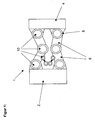
- FIG. 1 shows in side view schematically a closing unit according to the invention 1.
- This comprises a support plate 2, against which a movable mold clamping plate 4 is arranged movable.
- This can carry a mold half, which cooperates with another mold half, which is supported on a fixed platen. These are not shown.
- the movement of movement of the movable platen 4 during opening and closing of the mold is accomplished via a toggle mechanism.
- This has a plurality of connecting rods 6, at the ends of connecting rods 8 are provided, via which they can be connected via bolts 10 with other connecting rods 6 or support means, which may be provided for example on the plates.
- the toggle mechanism can be operated, for example, via a spindle drive, not shown, acting against the support plate 2 or a pressure piston.
- the joints of the toggle lever are rotated during operation of the closing unit according to the invention and must be lubricated accordingly.
- FIG. 2 is a section through such a hinge schematically shown.
- a bearing bush 12 is firmly received in a connecting rod 8 of a connecting rod 6, not shown.
- This can be made for example of bronze.
- the bearing bush 12 of the bolt 10 is rotatably received, under load it can also be moved perpendicular to the axis of rotation relative to the bushing surface.
- a so-called lubricating gap 14 is formed, in which magnetic fluid 18 is received as lubricant during operation. This can be fed into the region of the lubricating gap 14 via a central lubricant supply channel 16 and a supply bore radially branching from it.
- annular grooves 20 In the vicinity of the lateral boundary of the bearing bush 12 two circumferential annular grooves 20 are provided in this.
- a flexible magnetic tape is inserted in each case as a magnetic device, the north pole 22 and south pole 24 are shown schematically hatched differently.
- the magnetic tape In order to produce in the region of the lubricating gap 14 a magnetic field suitable for holding a magnetic fluid serving as a lubricant, the magnetic tape must penetrate into the two annular grooves be placed opposite, so that the south pole of the left magnetic tape with the north pole of the right magnet can build a corresponding field.
- the magnetic tape has a smaller extent in the radial direction than the height extent of the groove 20.
- an extra volume is provided by the groove 20, in which magnetic fluid 18 can be accommodated.
- the grooves 20 thus serve in addition to the inclusion of the magnetic device as a pressure relief grooves.
- the distribution of the magnetic fluid 18 in the region of the articular surfaces is only shown very schematically. The exact extent of the magnetic fluid beyond the annular grooves 20 laterally is determined by the strength of the magnetic field caused by the magnetic device.
- FIG. 3 is shown schematically in cross section an alternative embodiment of a joint of a closing unit 1 according to the invention.
- Corresponding elements are denoted by the same reference numerals as in FIG FIG. 2 designated.
- a bearing bush 12 is received, in which a bolt 10 is movably mounted.
- a lubricating gap 14 is formed between an outer surface of the bolt 10 and an inner surface of the bearing bush 12, a lubricating gap 14 is formed in which a magnetic fluid 18 is received as a lubricant.
- recesses 26 are provided regularly distributed over its circumference, which have the form of a radial blind hole. On average, only one such recess is shown. In each of these recesses, magnets are received in corresponding pole orientation.
- the north pole 28 and the south pole 30 of the magnet is again shown schematically.
- the lateral extent of the magnet can also be smaller than that of the recess.
- Above the magnet is still a volume for receiving Magnetofluid 18 in the recess 26.
- the recess thus also acts like a dimple in a bearing bush.
- Circulation pressure relief grooves 32 are provided in the bush, which can accommodate magnetic fluid 18.
- magnetic devices 28, 30 received in the recesses 26 an attractive force is exerted on the magnetic fluid 18, which substantially prevents removal thereof from the area of influence of the magnetic devices.
- the distribution of the magnetic fluid is only roughly indicated, it could be in the unloaded state depending on the Limit magnetic field strength to the area within the Druckentlastungsnuten 32.
- the supply of the magnetic fluid 18 is again via a central lubricant channel 16 and a tap hole, which ends at a surface of the bolt 10 in the region of the lubricating gap 14.
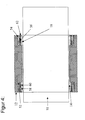
- FIG. 4 is shown schematically in cross section a further alternative embodiment of a joint of a closing unit 1 according to the invention.
- Corresponding elements are denoted by the same reference numerals as in FIG. 2 and 3 designated.
- a bearing bush 12 a bolt 10 is movably mounted. Between an outer surface of the bolt 10 and an inner surface of the bearing bush 12, a lubricating gap 14 is formed in which a magnetic fluid 18 is received as a lubricant.
- circumferential gradations 52 are provided over their circumference. In these gradations 52 each magnetic tapes 56 are added in a corresponding Polorientmaschine. Again, the north pole 58 and the south pole 60 of the magnet is again shown schematically.
- a return element 54 is provided, which amplifies the effect of the magnetic tape and causes a magnetic field constellation, which is comparable to that of a horseshoe magnet.
- the return element 54 may be formed as a ring which can be pressed or glued into the step 52.
- the lateral extent of the return element 54 and the magnetic tape 56 is smaller than that of the gradation 52.
- Above the magnetic tape 56 is still a volume for receiving magnetic fluid 18 in the gradation 52.
- a non-magnetic closing element 62 which is connected to the return element 54 and / or is connected to the magnetic tape 56, completes the gradation to the outside of the joint, so that a Druckentlastungsnut is formed. Through this magnetic fluid 18 can be absorbed and derived.
- FIG. 5 is a section of the joint according to FIG. 4 shown schematically in the manner of a schematic diagram.
- a circumferential pressure relief groove is formed, including return element 54 and magnetic tape 56 and end element 62.
- the magnetic fluid 18 is recorded in the unloaded state, the spatial boundary is shown schematically roughly by the dotted line.
- the lateral Deformation in the displacement compensation volume 68 is shown schematically by the dashed line, the displacement movement is represented by the arrow 64, the reflux movement by the arrow 66.
- the displacement compensation volume 68 is determined under the action of the magnetic field and limited to the region of the lubrication gap 14 of the joint.
- the end element 62 is profiled in such a way, here beveled, that an advantageous feedback along the field lines of the magnetic field is made possible.
- the supply of the magnetic fluid 18 can also take place in this embodiment via a - not shown - central lubricant channel.
- FIG. 6 shows a further bolt 10 which cooperates with a plurality of bearing bushes 12.
- These bushings are as in FIG. 2 shown formed in their side areas ring magnets 34 are received in corresponding polarity in annular grooves.
- the corresponding annular grooves serve here simultaneously as pressure relief grooves.
- the central lubricant supply channel 16 ' is interrupted by a correspondingly mounted screw plug 38, via a further radial branch bore, a connection between the lubricating gap 14 and the second part of the lubricant supply channel 16' is produced.
- a laterally offset further radial tap hole By means of a laterally offset further radial tap hole, the second lubricating gap 14 formed between the second bearing bush 12 and the bolt 10 is supplied, from which a second central lubricant supply channel 16 "is supplied via a laterally offset further tap hole.
- this second central supply channel 16 " is blocked by a closure element 40.
- FIG. 7 schematically shows in plan view a closing unit 1 according to the invention with a support plate 2, a movable platen 4, on which a mold half 44 is mounted, and a fixed platen 42, on which a second mold half 44 is supported.
- a connecting rod 6 of a toggle mechanism Via connecting rod 6 of a toggle mechanism, the movable platen 4 is movable relative to the support plate 2.
- the support plate 2, the connecting rod 6 and the movable platen 4 are movably connected by bolts 10.
- lubrication by means of a magnetic fluid is provided as described above.
- a supply of magnetic fluid to the lubrication gaps 14 of the joints formed along a first pin 10 can take place via a first, highest lubrication point 46, as shown in FIG FIG. 4 is shown schematically.
- a lubricating connection 48 which is formed, for example, via a hose connecting the respective lubricating nipple, the supply of a next lower located joint of the closing unit 1 take place.
- all the joints of the closing unit 1 according to the invention can be supplied with lubricant without the need for additional conveying devices. From the lowest joint opens a manifold in a sump 50th
- this lubricant supply device can as a reservoir. 50 a small vessel sufficient, because in operation takes place substantially no consumption or throughput of lubricant, since due to the inventively provided magnetic device, the magnetofluid lubricant is held in the joints. Over the first greasing point 46, however, even during operation, for example, from a small refill bottle on the support plate, a compensation of minor losses.
- the lubrication gaps 14 of the joints are filled with as much magnetic fluid 18 as can be held by the provided in the grooves 20 magnetic means 22, 24.
- the central one Lubricant supply channel 16 at this time can either be attached to a lubricant supply device as already described, or it may also be sealed against the environment.
- the magnetofluid lubricant 18 is held substantially uniformly in the annular gap by the magnetic devices 22, 24 under a low load, a continuous and sufficient lubrication of the relatively moving joint surfaces are ensured.
- the magnetic field generated by the magnetic devices 22, 24 is also sufficient to keep the magnetic fluid 18 distributed against gravity in the lubrication gap 14 evenly distributed over the outer surface of the bolt 10 and to prevent escape from the lubrication gap 14.
- magnetic devices 28, 30, When operating a closing unit with joints according to the FIG. 3 takes place by the regularly distributed over the circumference of the bearing bush 12 magnetic devices 28, 30, a corresponding effect. These hold the magnetic fluid substantially evenly distributed against the gravity over the lubrication gap 14. Only when pressure is applied to the joint, as when applying the closing pressure or occurs when applying the tearing force, magnetic fluid 18 is displaced from the region of the pressure-loaded surfaces of the bolt 10 and the bearing bush 12. In this case, the magnetic devices 28, 30 regularly distributed over the circumference of the bearing bush 12 continue to be attractive to the magnetofluid, so that leakage from the joint region is prevented. For this purpose, further pressure relief grooves 32 are provided, into which the magnetic fluid 18 can enter when applying a force to the joint and can dodge substantially on the opposite side of the joint. The attracting force of the magnetic means 28, 30 is designed for this purpose sufficiently so that they substantially prevent leakage of the liquid beyond the pressure relief grooves.
- a clamping unit 1 according to the invention is particularly advantageous in operation, since it is also suitable for use under clean room conditions. In addition, it allows a cost-effective lubrication of all hinges of the clamping unit while ensuring a sufficiently adequate lubrication. Furthermore, when using a magnetic fluid as a lubricant damping effect can be achieved, which causes in particular due to the attractive force of the magnetic device and the restoring force on the lubricant rapid and uniform wetting of the relatively moving joint surfaces.
Landscapes
- Engineering & Computer Science (AREA)
- Manufacturing & Machinery (AREA)
- Mechanical Engineering (AREA)
- Sealing Using Fluids, Sealing Without Contact, And Removal Of Oil (AREA)
- Moulds For Moulding Plastics Or The Like (AREA)
- Injection Moulding Of Plastics Or The Like (AREA)
Claims (14)
- Unité de fermeture pour presse à injection qui présente des articulations tournantes (8, 10) et en particulier des articulations de genouillère avec des surfaces d'articulation en mouvement les unes par rapport aux autres, caractérisée en ce qu'un dispositif magnétique réalisé pour retenir un fluide magnétique (18) est prévu dans la zone des surfaces d'articulation d'au moins l'une des articulations, au moins un évidement (20, 26, 52) qui coopère avec le dispositif magnétique pour sa fixation étant prévu dans la zone des surfaces d'articulation.
- Unité de fermeture selon la revendication 1,
caractérisée en ce que
plusieurs évidements (20, 26, 52) répartis régulièrement sur la périphérie des surfaces d'articulation sont prévus, lesquels coopèrent avec le dispositif magnétique pour sa fixation. - Unité de fermeture selon la revendication 1 ou 2,
caractérisée en ce
qu'au moins un évidement présente la forme d'une rainure annulaire (20) rotative ou d'un échelonnement (52). - Unité de fermeture selon l'une quelconque des revendications précitées,
caractérisée en ce que
l'évidement ou les évidements (20, 26, 52) est ou sont réalisé(s) sur le côté intérieur d'une douille (12) ou le côté extérieur d'un boulon (10) de l'articulation. - Unité de fermeture selon l'une quelconque des revendications précitées,
caractérisée en ce que
le dispositif magnétique est reçu dans au moins un évidement (20, 26, 52). - Unité de fermeture selon la revendication 5,
caractérisée en ce que
l'extension du dispositif magnétique dans le sens radial est inférieure à celle de l'évidement (20, 26, 52). - Unité de fermeture selon l'une quelconque des revendications précitées,
caractérisée en ce que
le dispositif magnétique comporte une bande magnétique (22, 24 ; 56) en particulier flexible. - Unité de fermeture selon l'une quelconque des revendications précitées,
caractérisée en ce
que le dispositif magnétique comporte un élément de blindage (54), en particulier en fer. - Unité de fermeture selon l'une quelconque des revendications précitées,
caractérisée en ce
qu'au moins une mais en particulier deux rainures de décompression (32) s'étendant de préférence à proximité de limitations d'articulation latérales sont prévues tournant sur la périphérie dans la zone des surfaces d'articulation. - Unité de fermeture selon la revendication 9,
caractérisée en ce que
la/les rainure(s) de décompression (20) sont réalisées en intégrant le dispositif magnétique. - Unité de fermeture selon la revendication 10,
caractérisée en ce
qu'un élément de terminaison en particulier non magnétique (62) est prévu pour la réalisation d'une rainure de décompression. - Unité de fermeture selon l'une quelconque des revendications précitées,
caractérisée en ce
qu'un dispositif d'amenée de lubrifiant fonctionnant en particulier grâce à la force de gravité est prévu en particulier pour l'amenée de fluide magnétique (18). - Unité de fermeture selon la revendication 12,
caractérisée en ce que
le dispositif d'amenée de lubrifiant présente un canal d'amenée de lubrifiant central (16) dans un boulon (10) de l'articulation pour l'alimentation des points de lubrification présents le long du boulon, en particulier par le biais de perçages radiaux s'étendant du canal d'amenée de lubrifiant (16) à une surface de boulon. - Unité de fermeture selon la revendication 13,
caractérisée en ce que
les canaux d'amenée de lubrifiant (16) de plusieurs boulons (10) peuvent être amenés en liaison d'écoulement les uns avec les autres en particulier par le biais de tuyaux flexibles (48).
Applications Claiming Priority (2)
| Application Number | Priority Date | Filing Date | Title |
|---|---|---|---|
| DE102006017669A DE102006017669A1 (de) | 2006-04-12 | 2006-04-12 | Schließeinheit für eine Spritzgießmaschine |
| PCT/EP2007/052696 WO2007118754A1 (fr) | 2006-04-12 | 2007-03-21 | Unité de fermeture pour presse à injection |
Publications (2)
| Publication Number | Publication Date |
|---|---|
| EP2004384A1 EP2004384A1 (fr) | 2008-12-24 |
| EP2004384B1 true EP2004384B1 (fr) | 2011-06-22 |
Family
ID=38171283
Family Applications (1)
| Application Number | Title | Priority Date | Filing Date |
|---|---|---|---|
| EP07727172A Not-in-force EP2004384B1 (fr) | 2006-04-12 | 2007-03-21 | Unite de fermeture pour presse a injection |
Country Status (4)
| Country | Link |
|---|---|
| EP (1) | EP2004384B1 (fr) |
| AT (1) | ATE513671T1 (fr) |
| DE (1) | DE102006017669A1 (fr) |
| WO (1) | WO2007118754A1 (fr) |
Families Citing this family (2)
| Publication number | Priority date | Publication date | Assignee | Title |
|---|---|---|---|---|
| DE202011004501U1 (de) | 2011-03-25 | 2011-06-09 | Desoi GmbH, 36148 | Antriebsvorrichtung für Gewindekerne von Spritzgießwerkzeugen, Druckgussformen und dergleichen |
| JP7059075B2 (ja) * | 2018-03-30 | 2022-04-25 | 住友重機械工業株式会社 | 射出成形機 |
Family Cites Families (5)
| Publication number | Priority date | Publication date | Assignee | Title |
|---|---|---|---|---|
| DE2264874C3 (de) * | 1972-12-08 | 1980-04-17 | Litton Industries, Inc., Beverly Hills, Calif. (V.St.A.) | Kombiniertes Axial- und Radial-Gleitlager mit magnetisierbarem Schmiermittel |
| DE2260080C3 (de) * | 1972-12-08 | 1981-08-27 | Litton Industries, Inc., 90210 Beverly Hills, Calif. | Gleitlager mit magnetisierbarem Schmiermittel |
| DE3528121A1 (de) * | 1985-08-06 | 1987-02-19 | Papst Motoren Gmbh & Co Kg | Gleitlager fuer praezisionslauf |
| JP2000141436A (ja) * | 1998-11-16 | 2000-05-23 | Toshiba Mach Co Ltd | 射出成形機等のトグルリンク機構の潤滑装置および潤滑方法 |
| DE102004042745B4 (de) * | 2004-09-03 | 2013-05-16 | Sumitomo (Shi) Demag Plastics Machinery Gmbh | Spindeltrieb für eine Spritzgiessmaschine mit einer Schmiervorrichtung |
-
2006
- 2006-04-12 DE DE102006017669A patent/DE102006017669A1/de not_active Withdrawn
-
2007
- 2007-03-21 AT AT07727172T patent/ATE513671T1/de active
- 2007-03-21 WO PCT/EP2007/052696 patent/WO2007118754A1/fr not_active Ceased
- 2007-03-21 EP EP07727172A patent/EP2004384B1/fr not_active Not-in-force
Also Published As
| Publication number | Publication date |
|---|---|
| ATE513671T1 (de) | 2011-07-15 |
| WO2007118754A1 (fr) | 2007-10-25 |
| EP2004384A1 (fr) | 2008-12-24 |
| DE102006017669A1 (de) | 2007-10-18 |
Similar Documents
| Publication | Publication Date | Title |
|---|---|---|
| DE60114542T2 (de) | Kugelumlaufmutter und -schraube mit Schmiervorrichtung | |
| DE19828587B4 (de) | Linearführungsvorrichtung | |
| DE69802762T2 (de) | Linearführungseinheit | |
| DE1675076C2 (de) | Hydrodynamisches Lager zur Aufnahme axialer und radialer Belastungen | |
| EP1470348B1 (fr) | Engrenage planétaire | |
| DE69930899T2 (de) | Linearführungseinheit mit einer Schmierungsscheibe | |
| DE3738571A1 (de) | Gelenkbolzenbaueinheit | |
| DE4424670B4 (de) | Hydraulische Kolbenmaschine | |
| DE102007039522A1 (de) | Vorrichtung an einem Streckwerk einer Strecke für Textilfaserbänder | |
| EP2004384B1 (fr) | Unite de fermeture pour presse a injection | |
| DE102013002267B4 (de) | Tablettenpresse | |
| WO2009133115A1 (fr) | Passage tournant de grande capacité | |
| DE19852478A1 (de) | Vorrichtung zum Zuführen von fließfähigen Medium zu einer umlaufenden Einrichtung, insbesondere für eine mechanische Presse | |
| EP2898232A1 (fr) | Roulement et dispositif tournant à roulement | |
| DE102017112272A1 (de) | Nullpunktspannmodul | |
| EP1412648B1 (fr) | Element palier a roulement lineaire | |
| DE69005040T2 (de) | Magnetische Lagerbüchse. | |
| DE9205662U1 (de) | Rollenanordnung für Raupenkette | |
| DE102004042745B4 (de) | Spindeltrieb für eine Spritzgiessmaschine mit einer Schmiervorrichtung | |
| DE60108063T2 (de) | Linearführungseinheit | |
| DE112008000851T5 (de) | Dichtteil für eine Wälzvorrichtung und Wälzvorrichtung | |
| DE102019203582A1 (de) | Drehlageranordnung, insbesondere für ein Kniehebellager in einer Spritzgießmaschinen-Schließeinheit | |
| DE102023130742B3 (de) | Hydraulische Maschine vom Typ Kaplan | |
| DE102023211787B4 (de) | Elektromechanischer Aktuator mit Gleitkolben für verbesserte hydrodynamische Lagerung | |
| EP2246286A1 (fr) | Dispositif de rotation pour moyen de réception de charge, comme le dispositif de préhension d'un excavateur ou analogue |
Legal Events
| Date | Code | Title | Description |
|---|---|---|---|
| PUAI | Public reference made under article 153(3) epc to a published international application that has entered the european phase |
Free format text: ORIGINAL CODE: 0009012 |
|
| 17P | Request for examination filed |
Effective date: 20080807 |
|
| AK | Designated contracting states |
Kind code of ref document: A1 Designated state(s): AT BE BG CH CY CZ DE DK EE ES FI FR GB GR HU IE IS IT LI LT LU LV MC MT NL PL PT RO SE SI SK TR |
|
| 17Q | First examination report despatched |
Effective date: 20100428 |
|
| GRAP | Despatch of communication of intention to grant a patent |
Free format text: ORIGINAL CODE: EPIDOSNIGR1 |
|
| GRAS | Grant fee paid |
Free format text: ORIGINAL CODE: EPIDOSNIGR3 |
|
| GRAA | (expected) grant |
Free format text: ORIGINAL CODE: 0009210 |
|
| AK | Designated contracting states |
Kind code of ref document: B1 Designated state(s): AT BE BG CH CY CZ DE DK EE ES FI FR GB GR HU IE IS IT LI LT LU LV MC MT NL PL PT RO SE SI SK TR |
|
| REG | Reference to a national code |
Ref country code: GB Ref legal event code: FG4D Free format text: NOT ENGLISH |
|
| REG | Reference to a national code |
Ref country code: CH Ref legal event code: EP |
|
| REG | Reference to a national code |
Ref country code: IE Ref legal event code: FG4D Free format text: LANGUAGE OF EP DOCUMENT: GERMAN |
|
| REG | Reference to a national code |
Ref country code: DE Ref legal event code: R096 Ref document number: 502007007503 Country of ref document: DE Effective date: 20110811 |
|
| REG | Reference to a national code |
Ref country code: NL Ref legal event code: VDEP Effective date: 20110622 |
|
| PG25 | Lapsed in a contracting state [announced via postgrant information from national office to epo] |
Ref country code: SE Free format text: LAPSE BECAUSE OF FAILURE TO SUBMIT A TRANSLATION OF THE DESCRIPTION OR TO PAY THE FEE WITHIN THE PRESCRIBED TIME-LIMIT Effective date: 20110622 Ref country code: LT Free format text: LAPSE BECAUSE OF FAILURE TO SUBMIT A TRANSLATION OF THE DESCRIPTION OR TO PAY THE FEE WITHIN THE PRESCRIBED TIME-LIMIT Effective date: 20110622 |
|
| PG25 | Lapsed in a contracting state [announced via postgrant information from national office to epo] |
Ref country code: GR Free format text: LAPSE BECAUSE OF FAILURE TO SUBMIT A TRANSLATION OF THE DESCRIPTION OR TO PAY THE FEE WITHIN THE PRESCRIBED TIME-LIMIT Effective date: 20110923 Ref country code: SI Free format text: LAPSE BECAUSE OF FAILURE TO SUBMIT A TRANSLATION OF THE DESCRIPTION OR TO PAY THE FEE WITHIN THE PRESCRIBED TIME-LIMIT Effective date: 20110622 Ref country code: FI Free format text: LAPSE BECAUSE OF FAILURE TO SUBMIT A TRANSLATION OF THE DESCRIPTION OR TO PAY THE FEE WITHIN THE PRESCRIBED TIME-LIMIT Effective date: 20110622 Ref country code: LV Free format text: LAPSE BECAUSE OF FAILURE TO SUBMIT A TRANSLATION OF THE DESCRIPTION OR TO PAY THE FEE WITHIN THE PRESCRIBED TIME-LIMIT Effective date: 20110622 Ref country code: CY Free format text: LAPSE BECAUSE OF FAILURE TO SUBMIT A TRANSLATION OF THE DESCRIPTION OR TO PAY THE FEE WITHIN THE PRESCRIBED TIME-LIMIT Effective date: 20110622 |
|
| PG25 | Lapsed in a contracting state [announced via postgrant information from national office to epo] |
Ref country code: NL Free format text: LAPSE BECAUSE OF FAILURE TO SUBMIT A TRANSLATION OF THE DESCRIPTION OR TO PAY THE FEE WITHIN THE PRESCRIBED TIME-LIMIT Effective date: 20110622 |
|
| REG | Reference to a national code |
Ref country code: IE Ref legal event code: FD4D |
|
| PG25 | Lapsed in a contracting state [announced via postgrant information from national office to epo] |
Ref country code: IS Free format text: LAPSE BECAUSE OF FAILURE TO SUBMIT A TRANSLATION OF THE DESCRIPTION OR TO PAY THE FEE WITHIN THE PRESCRIBED TIME-LIMIT Effective date: 20111022 Ref country code: EE Free format text: LAPSE BECAUSE OF FAILURE TO SUBMIT A TRANSLATION OF THE DESCRIPTION OR TO PAY THE FEE WITHIN THE PRESCRIBED TIME-LIMIT Effective date: 20110622 Ref country code: PT Free format text: LAPSE BECAUSE OF FAILURE TO SUBMIT A TRANSLATION OF THE DESCRIPTION OR TO PAY THE FEE WITHIN THE PRESCRIBED TIME-LIMIT Effective date: 20111024 Ref country code: CZ Free format text: LAPSE BECAUSE OF FAILURE TO SUBMIT A TRANSLATION OF THE DESCRIPTION OR TO PAY THE FEE WITHIN THE PRESCRIBED TIME-LIMIT Effective date: 20110622 Ref country code: IE Free format text: LAPSE BECAUSE OF FAILURE TO SUBMIT A TRANSLATION OF THE DESCRIPTION OR TO PAY THE FEE WITHIN THE PRESCRIBED TIME-LIMIT Effective date: 20110622 |
|
| PG25 | Lapsed in a contracting state [announced via postgrant information from national office to epo] |
Ref country code: SK Free format text: LAPSE BECAUSE OF FAILURE TO SUBMIT A TRANSLATION OF THE DESCRIPTION OR TO PAY THE FEE WITHIN THE PRESCRIBED TIME-LIMIT Effective date: 20110622 Ref country code: PL Free format text: LAPSE BECAUSE OF FAILURE TO SUBMIT A TRANSLATION OF THE DESCRIPTION OR TO PAY THE FEE WITHIN THE PRESCRIBED TIME-LIMIT Effective date: 20110622 Ref country code: RO Free format text: LAPSE BECAUSE OF FAILURE TO SUBMIT A TRANSLATION OF THE DESCRIPTION OR TO PAY THE FEE WITHIN THE PRESCRIBED TIME-LIMIT Effective date: 20110622 |
|
| PLBE | No opposition filed within time limit |
Free format text: ORIGINAL CODE: 0009261 |
|
| STAA | Information on the status of an ep patent application or granted ep patent |
Free format text: STATUS: NO OPPOSITION FILED WITHIN TIME LIMIT |
|
| 26N | No opposition filed |
Effective date: 20120323 |
|
| PG25 | Lapsed in a contracting state [announced via postgrant information from national office to epo] |
Ref country code: DK Free format text: LAPSE BECAUSE OF FAILURE TO SUBMIT A TRANSLATION OF THE DESCRIPTION OR TO PAY THE FEE WITHIN THE PRESCRIBED TIME-LIMIT Effective date: 20110622 |
|
| REG | Reference to a national code |
Ref country code: DE Ref legal event code: R097 Ref document number: 502007007503 Country of ref document: DE Effective date: 20120323 |
|
| BERE | Be: lapsed |
Owner name: SUMITOMO (SHI) DEMAG PLASTICS MACHINERY G.M.B.H. Effective date: 20120331 |
|
| PG25 | Lapsed in a contracting state [announced via postgrant information from national office to epo] |
Ref country code: MC Free format text: LAPSE BECAUSE OF NON-PAYMENT OF DUE FEES Effective date: 20120331 |
|
| GBPC | Gb: european patent ceased through non-payment of renewal fee |
Effective date: 20120321 |
|
| REG | Reference to a national code |
Ref country code: FR Ref legal event code: ST Effective date: 20121130 |
|
| PG25 | Lapsed in a contracting state [announced via postgrant information from national office to epo] |
Ref country code: FR Free format text: LAPSE BECAUSE OF NON-PAYMENT OF DUE FEES Effective date: 20120402 Ref country code: BE Free format text: LAPSE BECAUSE OF NON-PAYMENT OF DUE FEES Effective date: 20120331 Ref country code: GB Free format text: LAPSE BECAUSE OF NON-PAYMENT OF DUE FEES Effective date: 20120321 |
|
| PG25 | Lapsed in a contracting state [announced via postgrant information from national office to epo] |
Ref country code: ES Free format text: LAPSE BECAUSE OF FAILURE TO SUBMIT A TRANSLATION OF THE DESCRIPTION OR TO PAY THE FEE WITHIN THE PRESCRIBED TIME-LIMIT Effective date: 20111003 |
|
| PG25 | Lapsed in a contracting state [announced via postgrant information from national office to epo] |
Ref country code: BG Free format text: LAPSE BECAUSE OF FAILURE TO SUBMIT A TRANSLATION OF THE DESCRIPTION OR TO PAY THE FEE WITHIN THE PRESCRIBED TIME-LIMIT Effective date: 20110922 |
|
| PG25 | Lapsed in a contracting state [announced via postgrant information from national office to epo] |
Ref country code: MT Free format text: LAPSE BECAUSE OF FAILURE TO SUBMIT A TRANSLATION OF THE DESCRIPTION OR TO PAY THE FEE WITHIN THE PRESCRIBED TIME-LIMIT Effective date: 20110622 |
|
| PG25 | Lapsed in a contracting state [announced via postgrant information from national office to epo] |
Ref country code: TR Free format text: LAPSE BECAUSE OF FAILURE TO SUBMIT A TRANSLATION OF THE DESCRIPTION OR TO PAY THE FEE WITHIN THE PRESCRIBED TIME-LIMIT Effective date: 20110622 |
|
| PG25 | Lapsed in a contracting state [announced via postgrant information from national office to epo] |
Ref country code: LU Free format text: LAPSE BECAUSE OF NON-PAYMENT OF DUE FEES Effective date: 20120321 |
|
| PG25 | Lapsed in a contracting state [announced via postgrant information from national office to epo] |
Ref country code: HU Free format text: LAPSE BECAUSE OF FAILURE TO SUBMIT A TRANSLATION OF THE DESCRIPTION OR TO PAY THE FEE WITHIN THE PRESCRIBED TIME-LIMIT Effective date: 20070321 |
|
| PGFP | Annual fee paid to national office [announced via postgrant information from national office to epo] |
Ref country code: CH Payment date: 20170227 Year of fee payment: 11 |
|
| PGFP | Annual fee paid to national office [announced via postgrant information from national office to epo] |
Ref country code: AT Payment date: 20170302 Year of fee payment: 11 |
|
| PGFP | Annual fee paid to national office [announced via postgrant information from national office to epo] |
Ref country code: DE Payment date: 20170523 Year of fee payment: 11 |
|
| PGFP | Annual fee paid to national office [announced via postgrant information from national office to epo] |
Ref country code: IT Payment date: 20170323 Year of fee payment: 11 |
|
| REG | Reference to a national code |
Ref country code: DE Ref legal event code: R119 Ref document number: 502007007503 Country of ref document: DE |
|
| REG | Reference to a national code |
Ref country code: CH Ref legal event code: PL |
|
| REG | Reference to a national code |
Ref country code: AT Ref legal event code: MM01 Ref document number: 513671 Country of ref document: AT Kind code of ref document: T Effective date: 20180321 |
|
| PG25 | Lapsed in a contracting state [announced via postgrant information from national office to epo] |
Ref country code: AT Free format text: LAPSE BECAUSE OF NON-PAYMENT OF DUE FEES Effective date: 20180321 Ref country code: DE Free format text: LAPSE BECAUSE OF NON-PAYMENT OF DUE FEES Effective date: 20181002 |
|
| PG25 | Lapsed in a contracting state [announced via postgrant information from national office to epo] |
Ref country code: LI Free format text: LAPSE BECAUSE OF NON-PAYMENT OF DUE FEES Effective date: 20180331 Ref country code: CH Free format text: LAPSE BECAUSE OF NON-PAYMENT OF DUE FEES Effective date: 20180331 Ref country code: IT Free format text: LAPSE BECAUSE OF NON-PAYMENT OF DUE FEES Effective date: 20180321 |