EP2005252B1 - EINRICHTUNG ZUM SAMMELN VON FLUß ELEKTROMAGNETISCHER STRAHLUNG IM EXTREMEN ULTRAVIOLETTBEREICH - Google Patents
EINRICHTUNG ZUM SAMMELN VON FLUß ELEKTROMAGNETISCHER STRAHLUNG IM EXTREMEN ULTRAVIOLETTBEREICH Download PDFInfo
- Publication number
- EP2005252B1 EP2005252B1 EP07731249A EP07731249A EP2005252B1 EP 2005252 B1 EP2005252 B1 EP 2005252B1 EP 07731249 A EP07731249 A EP 07731249A EP 07731249 A EP07731249 A EP 07731249A EP 2005252 B1 EP2005252 B1 EP 2005252B1
- Authority
- EP
- European Patent Office
- Prior art keywords
- collector
- mirror
- concave
- stage
- source
- Prior art date
- Legal status (The legal status is an assumption and is not a legal conclusion. Google has not performed a legal analysis and makes no representation as to the accuracy of the status listed.)
- Not-in-force
Links
- 230000004907 flux Effects 0.000 title claims abstract description 78
- 230000005670 electromagnetic radiation Effects 0.000 title claims abstract description 14
- 230000003287 optical effect Effects 0.000 claims description 62
- 230000005855 radiation Effects 0.000 claims description 48
- 230000005540 biological transmission Effects 0.000 claims description 17
- 230000008021 deposition Effects 0.000 claims 9
- 238000001393 microlithography Methods 0.000 description 15
- XUIMIQQOPSSXEZ-UHFFFAOYSA-N Silicon Chemical compound [Si] XUIMIQQOPSSXEZ-UHFFFAOYSA-N 0.000 description 9
- 238000004519 manufacturing process Methods 0.000 description 6
- 239000002245 particle Substances 0.000 description 6
- 229910052710 silicon Inorganic materials 0.000 description 6
- 239000010703 silicon Substances 0.000 description 6
- ZOKXTWBITQBERF-UHFFFAOYSA-N Molybdenum Chemical compound [Mo] ZOKXTWBITQBERF-UHFFFAOYSA-N 0.000 description 5
- 238000009304 pastoral farming Methods 0.000 description 5
- 238000002310 reflectometry Methods 0.000 description 5
- 238000010586 diagram Methods 0.000 description 4
- 239000000463 material Substances 0.000 description 4
- 238000000034 method Methods 0.000 description 4
- 229910052750 molybdenum Inorganic materials 0.000 description 4
- 239000011733 molybdenum Substances 0.000 description 4
- 235000012431 wafers Nutrition 0.000 description 4
- 230000016571 aggressive behavior Effects 0.000 description 3
- 230000008901 benefit Effects 0.000 description 3
- 238000005516 engineering process Methods 0.000 description 3
- 238000005286 illumination Methods 0.000 description 3
- 239000000243 solution Substances 0.000 description 3
- 206010001488 Aggression Diseases 0.000 description 2
- KJTLSVCANCCWHF-UHFFFAOYSA-N Ruthenium Chemical compound [Ru] KJTLSVCANCCWHF-UHFFFAOYSA-N 0.000 description 2
- 238000013461 design Methods 0.000 description 2
- 238000011161 development Methods 0.000 description 2
- 238000010438 heat treatment Methods 0.000 description 2
- 230000006872 improvement Effects 0.000 description 2
- 238000009434 installation Methods 0.000 description 2
- 230000000670 limiting effect Effects 0.000 description 2
- QSHDDOUJBYECFT-UHFFFAOYSA-N mercury Chemical compound [Hg] QSHDDOUJBYECFT-UHFFFAOYSA-N 0.000 description 2
- 229910052753 mercury Inorganic materials 0.000 description 2
- 230000002093 peripheral effect Effects 0.000 description 2
- 230000008569 process Effects 0.000 description 2
- 230000002829 reductive effect Effects 0.000 description 2
- 230000004044 response Effects 0.000 description 2
- 230000002441 reversible effect Effects 0.000 description 2
- 230000003595 spectral effect Effects 0.000 description 2
- 239000013589 supplement Substances 0.000 description 2
- 241001644893 Entandrophragma utile Species 0.000 description 1
- 241001415961 Gaviidae Species 0.000 description 1
- 229920000297 Rayon Polymers 0.000 description 1
- 230000001154 acute effect Effects 0.000 description 1
- 230000008859 change Effects 0.000 description 1
- 239000011248 coating agent Substances 0.000 description 1
- 238000000576 coating method Methods 0.000 description 1
- 238000011109 contamination Methods 0.000 description 1
- 230000007423 decrease Effects 0.000 description 1
- 230000007812 deficiency Effects 0.000 description 1
- -1 des ions Chemical class 0.000 description 1
- 230000000694 effects Effects 0.000 description 1
- 230000003628 erosive effect Effects 0.000 description 1
- 238000002347 injection Methods 0.000 description 1
- 239000007924 injection Substances 0.000 description 1
- 230000010354 integration Effects 0.000 description 1
- 150000002500 ions Chemical class 0.000 description 1
- 230000001678 irradiating effect Effects 0.000 description 1
- 238000012423 maintenance Methods 0.000 description 1
- 229910052751 metal Inorganic materials 0.000 description 1
- 239000002184 metal Substances 0.000 description 1
- 150000002739 metals Chemical class 0.000 description 1
- 239000002964 rayon Substances 0.000 description 1
- 230000009467 reduction Effects 0.000 description 1
- 238000011160 research Methods 0.000 description 1
- 239000011347 resin Substances 0.000 description 1
- 229920005989 resin Polymers 0.000 description 1
- 230000000717 retained effect Effects 0.000 description 1
- 229910052707 ruthenium Inorganic materials 0.000 description 1
- 238000007493 shaping process Methods 0.000 description 1
- 230000000087 stabilizing effect Effects 0.000 description 1
Images


Classifications
-
- G—PHYSICS
- G03—PHOTOGRAPHY; CINEMATOGRAPHY; ANALOGOUS TECHNIQUES USING WAVES OTHER THAN OPTICAL WAVES; ELECTROGRAPHY; HOLOGRAPHY
- G03F—PHOTOMECHANICAL PRODUCTION OF TEXTURED OR PATTERNED SURFACES, e.g. FOR PRINTING, FOR PROCESSING OF SEMICONDUCTOR DEVICES; MATERIALS THEREFOR; ORIGINALS THEREFOR; APPARATUS SPECIALLY ADAPTED THEREFOR
- G03F7/00—Photomechanical, e.g. photolithographic, production of textured or patterned surfaces, e.g. printing surfaces; Materials therefor, e.g. comprising photoresists; Apparatus specially adapted therefor
- G03F7/70—Microphotolithographic exposure; Apparatus therefor
- G03F7/70058—Mask illumination systems
- G03F7/7015—Details of optical elements
- G03F7/70175—Lamphouse reflector arrangements or collector mirrors, i.e. collecting light from solid angle upstream of the light source
Definitions
- the present invention generally relates to the field of illumination with electromagnetic radiation located in the extreme ultraviolet EUV and, more specifically, the invention relates to improvements made to devices for collecting electromagnetic radiation flux in the extreme ultraviolet (EUV) emitted by a source of electromagnetic radiation EUV, said devices comprising at least one collector stage arranged as set forth in the preamble of claim 1.
- EUV extreme ultraviolet
- extreme ultraviolet is meant the electromagnetic radiation having a wavelength of less than about 150 nm, and more specifically the wavelength of 13.5 nm, which will be discussed in more detail below.
- the collection of the luminous flux delivered by a quasi-point source of electromagnetic radiation such as an arc lamp is not an easy thing when it is desired to collect the largest possible quantity of photons emitted by the source into the surrounding space. .
- Optical microlithography is typically a field for which expensive equipment must produce the largest amount of silicon chips per hour by irradiating a photosensitive resin deposited on silicon wafers in which the chips will then be cut.
- microlithography machines use shorter wavelengths, typically 248 nm and 193 nm, delivered by power lasers of the KrF or ArF type. The collection of luminous flux is facilitated.
- the main characteristic of these two types of sources is to have a quasi-point light emitting element, that is to say of a size which is typically of the order of a millimeter, but capable of radiating in an angular space important to reach the hemisphere, or even more.
- the amount of light flux that is collected and effectively transmitted to the following optical modules of the microlithography machine is another critical element. Any gain in percentage of the luminous flux collected compared to the luminous flux emitted by the source makes it possible to gain in production rate and / or to reduce the need for effective power of the source, thus reducing its aggression power of the optical elements of the source. collector and thereby gain in useful life of the equipment as well as on the actual cost of installation.
- a simple, efficient and commonly used flow collector especially in cinema projectors, consists of a collector mirror in the shape of an ellipsoid of revolution in which the source is placed at one of the foci, the image point being formed at the other home.
- This device has the advantage of being simple and limited to a single component. However, it can not be transposed to the EUV domain for several reasons.
- a first reason lies in the fact that the collected flow is formed with the radiation emitted by the source towards the rear, then reflected towards the front, that is to say that it "crosses" the source to be focused in front of it; however, the EUV sources are complex and bulky devices (typically 30 to 40 cm in diameter for a light source point of about 1 mm): such a source placed at the focus of the ellipsoidal collector would block the flux reflected by the mirror.
- the current EUV flow collection method inspired by the design of X-ray telescopes, is to use grazing incidence mirrors and to use quasi-cylindrical reflectors arranged one after the other and combined into inserting into each other, so that the collected luminous flux is deflected by successive reflections grazing incidences and consists of successive angular rings with occluded intermediate zones in which the flow is lost.
- Another disadvantage of this known technique lies in the fact that, in order to capture a significant portion of the light emitted by the source, the first elements must be approached at a short distance from the source: in devices made on this principle, the first optical elements are placed at a distance of 10 to 15 cm from the source and the aggressions by erosion, contamination, heating then become very serious; the effective life of the collecting device remains limited (see for example the document US2005 / 094764 ).
- the document EP 1 469 349 discloses a collector device for EUV flux based on the use of a concave mirror and a convex mirror in a "Cassegrain-type two-mirror telescope" arrangement. This arrangement suffers from an insufficient efficiency of light collection and does not constitute an adequate response to the problem posed, in particular by the high angles of incidence of the rays arriving at the second convex mirror.
- the document WO 2005/031748 presents a collector arrangement based on a large concave mirror which forms an image of the source laterally offset from the source; the luminous flux is then returned to the front.
- This known device suffers from a lack of efficiency of light collection due to a limitation of the optical range collected by the large mirror and also due to too close proximity to the secondary mirror of the source itself which hinders the path of radii, as well as the presence of various devices for capturing or deflecting particles or debris emitted by the source.
- the document US 2004/223531 presents an EUV flux collector device consisting of an elliptical mirror giving an image of the source point and supplemented by a second annular mirror capturing additional flux and returning it to the same image point thanks to a second reflection on an "axicon" type element placed behind the source.
- the major disadvantage of this known solution is that it is not suitable for sources of the type "Capillary Discharge Plasma", because the optical path passes through the source, where are housed the optical, mechanical and electronic components operating the source.
- This known device therefore has conditions of use which may not be appropriate in the context of a microlithography facility.
- the document JP 2005/109502 presents a device comprising a collector which conjugates the source point and the image point of the source and which is mounted on a moving support. This known device does not provide a powerful response to rule out the disadvantage resulting from the strong deformation of the optics under the thermal flow of the source.
- the document JP 2004/311814 discloses a plasma source of EUV radiation whose divergent light is transmitted to the intermediate focusing point via an EUV radiation collector stage.
- Said collector stage comprises segmented convex and concave mirrors whose surface is covered with a multilayer reflective deposit.
- none of the currently known devices is capable of collecting a significant fraction of the luminous flux emitted by the source, and their efficiency remains limited to a few percent and / or are arranged in such a way that at least some of their components are deteriorated rapidly and / or they are too bulky for the application more specifically targeted in the field of microlithography.
- the invention is essentially intended to meet the expectations of the practice and to propose an EUV flow collector device which is remarkably effective while respecting the many constraints mentioned above.
- Such an additional collector stage is able to transmit a few percent (typically of the order of 5%) of the light emitted by the source, so that the collector device equipped with the two aforementioned stages can provide at the image point approximately 30% of the light source, which represents a significant improvement in the performance of the device, while the resulting dimensional increase is acceptable so that the collector device can be housed in the available space of the microlithography machine.
- the arrangements just described in accordance with the present invention make it possible to constitute an optical flow collection device EUV, and in particular at a wavelength of 13.5 nm.
- This improved device has the essential advantage of returning the light on the same side as the collector itself without "crossing" the source, a provision that is fundamental in view of the very large dimensions of EUV sources implemented. It is more of a high efficiency device that collects a large amount of the light emitted by the source; typically such a device is capable of transmitting on the order of 20 to 25% of the amount of light emitted by the source, to be compared with the amount of the order of 6% transmitted in the current microlithography machines.
- the radius of curvature of the concave collector mirror is large enough so that the reflective surface remains at a great distance, greater than about 250 mm, from the source, and typically at a distance of between 400 and 500 mm from the source; as a result, the reflecting surface of the concave collector mirror remains out of range of the various particles emitted by the source; in this way, the surface energy density of the radiation on the concave collector mirror is reduced and the durability of its reflective coating is ensured.
- the collecting device according to the invention delivers an annular conical light beam which is devoid of discontinuities, unlike the beam delivered by the grazing incidence mirroring devices.
- the layers of the reflective deposit can be given increasing thicknesses with the angle of incidence; in other words, the layers of the reflective deposit have increasing thicknesses from the central edge to the peripheral edge of the mirrors.
- These reflective deposits can be constituted in a manner known per se by alternating layers of molybdenum and silicon of a few nanometers thick.
- the convex mirror implemented in the additional internal collector stage which has just been described is relatively close to the source and will therefore be subjected to the bombardment of the particles emitted by it.
- the central part of the cone of light emitted by the source is not captured. It can therefore be envisaged, if it is desired to further improve the quantity of light collected, to add an additional collector stage, so that the collector device is then equipped with three collector stages, namely a main collector stage and two collector stages additional. This arrangement can make it possible to increase by a few percent the amount of light collected, which can for example increase to a value of about 32 to 34%.
- the additional collector stage recently added may be an additional external stage arranged in front of the aforementioned additional stage; however, the device collector becomes bulky along the optical axis and may no longer be accommodable in the free space available.
- the mirrors of the different stages can be geometrically defined and positioned so as not to obscure the light transmitted by the stages situated behind, with the various light beams passing flush with the edges of the mirrors.
- the conical light beams delivered by the different stages can be juxtaposed perfectly, without discontinuity, and form a continuous conical light beam.
- At least one of the two mirrors of at least one collector stage is made according to an aspherical profile of revolution and / or that at least one of the two mirrors of at least the main collector stage (Of which the largest of the two mirrors which can typically have a diameter of the order of 1.10 m) is made in segmented form.
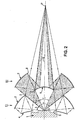
- FIG. 1 We refer first to the figure 1 on which is illustrated an electromagnetic radiation collecting device having a wavelength located in the extreme ultraviolet EUV-that is to say less than about 150 nm, and typically 13.5 nm in the context of the application to a microlithography machine - which is emitted by a source S.
- source S is figured in point form, such a source is, in practice, a very bulky device as schematized in 1.
- the collector device shown at figure 1 has a single collector stage, which will be called floor main collector, designated E1, which is constituted as follows.
- a concave collector mirror 2 pierced with a central hole 3, is placed in front of the source S, its concavity being turned towards the source S.
- the concave mirror 2 is adapted to receive a part of the flux emitted by said source S and return this flux to a point located behind the source S.
- the concave mirror 2 is coated with a multilayer reflective deposit capable of maximizing the transmission of EUV radiation, said reflective deposit comprising several layers adjusted according to the angle incidence of EUV radiation.
- a convex mirror 4 is placed behind the concave mirror 2, approximately at the source S, its convexity being turned towards the front.
- the convex mirror 4 is pierced with a central hole 5 capable of passing the flux emitted by the source S towards the concave mirror 2.
- the convex mirror 4 is adapted to return, through the central hole 3 of the concave mirror 2, the flux received from the concave mirror 2 towards a final image point P located in front of the source S and in front of the concave mirror 2.
- the convex mirror 4 is coated with a multilayer reflective deposit capable of maximizing the transmission of EUV radiation, said reflective deposit comprising several layers adjusted according to the angle of incidence of the EUV radiation.
- the source S and said final image point P define an optical axis 6 coaxially to which said concave mirrors 2 and convex 4 are arranged.
- angles of incidence ⁇ and ⁇ of the EUV radiation respectively on the concave mirror 2 and convex mirror 4 are less than approximately 25 ° relative to the normal, as can be seen in FIG. figure 1 .
- the concave mirror 2 is placed at a distance d from the source S which is greater than about 250 mm, and which is typically between 400 and 500 mm, so that the concave mirror 2 is out of reach of the particles emitted by the source S.
- the multilayer reflective deposit mentioned above which is capable of ensuring the reflection of the EUV radiation, may be of a type known to those skilled in the art, consisting of alternating layers of molybdenum and layers of silicon of a few nanometers thick. By the physical phenomenon of constructive interferences, these layers provide a high reflectivity, of the order of 65 to 70% for radiation close to the normal incidence.
- the thickness of these layers is adjusted to take into account the exact incidence of the rays, that is to say that this thickness (which would be minimal where the incidence would be normal, which is not the case on the figure 1 ) believes that the incidence deviates more than normal; in particular for the concave mirror 2, the incidence is less (although not zero) near the central hole 3 than towards the outer periphery of the mirror, which results in layers of increasing thickness radially from the inside towards
- any other suitable material or combination of materials may be used.
- the beam coming from the convex mirror 4 is a conical beam annular shaded in gray (the optical paths of the radiation from the source S to the image point P through the first collector stage E1 are marked by simple arrows).
- the Applicant was able to measure that at the final image point P (distant about 1.20 m from the source S) a quantity of light representing 20 to 25% of the light emitted by the source S, which is considerable compared with the amount of light of the order of 6% collected in known machines having a different configuration.
- the fraction of the light emitted by the source S which is exploited by the stage E1 forms an annular cone of approximately 40 ° of opening ⁇ , while the light emitted in a central cone of angle ⁇ of about 70 ° opening remains untapped.
- the invention to add to the main collector stage E1 one or more collector stages arranged to collect at least a portion of the light emitted by the source S in the central cone angle ⁇ .
- a concave collector mirror 7, pierced with a central hole 8, is placed coaxially with the optical axis 6 to the front of the concave mirror 2 of the previous collector stage E1, its concavity being turned towards the source S.
- a convex mirror 9 is placed centrally coaxially with the optical axis 6 approximately at the level of the concave mirror 2 of the preceding collector stage E1, its convexity being turned towards the front.
- the concave collector mirror 7 is adapted to receive the part of the flux emitted by the source S which reaches it by passing between the edges facing each other 3 of the concave collector mirror 2 of the preceding stage E1 and of the convex mirror 9 and returning this flux to a point behind said convex mirror 9.
- the convex mirror 9 is adapted to return, through the central hole 8 of the concave collector mirror 7 of said additional collector stage E2, the flux received from said concave collector mirror 7 of the additional collector stage E2 outside towards said final image point P forward from the source S.
- the concave collector mirror 7 and the convex mirror 9 of the additional collector stage E2 are coated with a multilayer reflective deposit capable of maximizing the transmission of EUV radiation, said reflective deposit comprising several layers adjusted according to the angle of incidence of the EUV radiation.
- the beam processed by the additional collector stage E2 shown in gray (the optical paths of the radiation from the source S to the image point P through the second collector stage E2 are indicated by double arrows) is closely aligned with the beam processed by the main E1 collector stage, the two beams being adjacent without discontinuity and providing jointly, seen from the image point P, a single light beam.
- the additional collector stage E2 is unique and therefore the centrally located convex mirror 9 can indifferently be cup-shaped as illustrated or, as only its peripheral annular portion is useful, be annular in shape as are the mirrors 2 and 4 of the stage E1.
- the implementation of the additional external collector E2 stage collects a fraction of the order of 5% of the light emitted by the source S, so that, assuming the main collector stage E1 collects about 25% of the light emitted by the source, all of the two stages collects about 30% of the light of the source S, which is considerable.
- the fraction of the light emitted by the source S which is exploited by the stage E2 forms an annular cone of opening ⁇ , whereas the light emitted in a central cone of opening ⁇ remains always unexploited.
- a concave collector mirror 11, pierced by a central hole 12, is placed coaxially with the optical axis 6 at the front of the concave mirror 7 of the previous collector stage E2, its concavity being turned towards the source S.
- a convex mirror 13 is placed centrally coaxially with the optical axis 6 approximately at the level of the concave mirror 7 of the previous collector stage E2, its convexity being turned towards the front.
- the convex mirror 9 of the collector stage E2 is provided with a central hole 14.
- the concave collector mirror 11 is adapted to receive the portion of the flux emitted by the source S which reaches it by passing between the edges facing each other, respectively, of the hole 14 of the convex mirror 9 of the preceding stage E 2 and the mirror 13. convex of the stage E3 and to return this flux to a point situated behind said convex mirror 13.
- the convex mirror 13 is adapted to return, through the central hole 12 of the concave collector mirror 11 of said additional collector stage E3, the flux received from said concave collector mirror 11 of the external collector stage E3 towards said final image point P forward. from the source S.
- the concave collector mirror 11 and the convex mirror 13 of the additional external collector stage E3 are coated with a multilayer reflective deposit capable of maximizing the transmission of EUV radiation, said deposit reflector with several layers adjusted according to the angle of incidence of the EUV radiation.
- the beam processed by the external additional collector stage E3 shown in gray (the optical paths of the radiation from the source S to the image point P through the third collector stage E3 are indicated by triple arrows, the optical paths of the stages E1 and E2 being only partially drawn so that the representation of the figure 3 remains more legible) is closely related to the beam processed by the additional collector stage E2, the three beams coming from the stages E1, E2 and E3 being adjacent without discontinuity and, together with the image point P, supplying a single light beam.
- the third collector stage E3 which has just been described is capable of collecting a fraction of the order of a few percent (typically of the order of 2 or 3%) of the light emitted by the source S, so that the together the three-stage collector device E1, E2, E3 can bring to the image point P of the order of 32 to 33% of the light of the source S.
- a fourth external additional stage could be added in front of the third collector stage E3 to treat at least a portion of the light emitted by the source S in the open cone ⁇ untreated by the stage E3.
- each additional collector stage only deals with one fraction of light much less than the collector stage which precedes it. Given the optical quality of the equipment used and therefore their very high cost and also considering the additional weight of each additional floor, it is not possible to multiply to infinity the number of collector stages. .
- a one or two stage collector device as shown in FIG. figure 1 or 2 is very satisfactory as to the amount of light that it is able to bring to the image point P and such a device can satisfy alone most applications.
- a three stage collector arrangement can be implemented under acceptable economic and weight conditions.
- the three-stage outdoor collector assembly as shown in the figure 3 meets these requirements.
- the collector device of the figure 1 single-stage main collector is of a small axial footprint and that the collector device of the figure 2 collector two-storey still remains compact (it fits globally in a cube)
- the addition of a third external collector stage as shown in the figure 3 causes a considerable axial elongation of the collecting device due in particular to the very strong inclination of the beam on the optical axis 6.
- Such a long device may not be able to be implanted in machines where the free space is reduced, as it is the case especially in microlithography machines.
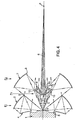
- an additional internal stage that is to say an additional stage F3 located behind the second stage E2 in which the convex mirror 9 is provided with a central hole 14.
- the stage F3 is arranged as follows as illustrated in FIG. figure 4 .
- a concavely concave collector mirror 15 facing the source S is placed coaxially with the optical axis 6 at the rear of the convex mirror 9 of the additional external collector stage E2.
- the concave collector mirror 15 is pierced with a central hole 16 and is adapted to receive a part of the flux emitted by the source S in the opening cone ⁇ and to return this flux towards a point situated at the rear.
- the concave collector mirror 15 of the additional inner collector stage F3 is located on the reverse side of the convex mirror 9 of the additional external collector stage E2.
- a forwardly convex convex mirror 17 is centrally placed coaxially with the optical axis 6 behind said concave collector mirror 15.
- the convex mirror 17 is adapted to return, through the central hole 16 of the concave collector mirror 15, the flux received from the concave mirror 15 towards said final image point P.
- the concave collector mirror 15 and the convex mirror 17 of the additional inner collector stage F3 are coated with a multilayer reflective deposit capable of maximizing the transmission of EUV radiation, said reflective deposit comprising several layers adjusted according to the angle of incidence. EUV radiation.
- the beam processed by the additional internal collector stage F3 shown in gray (the optical paths of the radiation from the source S to the image point P to through the third collector stage F3 are marked by triple arrows, the optical paths of the stages E1 and E2 being plotted only partially so that the representation of the figure 4 remains more legible) is closely integrated in the beam processed by the additional collector stage E2, the three beams coming from the stages E1, E2 and F3 being adjacent without discontinuity and, together with the image point P, providing a single light beam.
- the convex mirror 17 of the inner additional stage F3 is relatively close to the source S. However, it is the rear face of this convex mirror 17 that faces the source S and which is subjected to the bombardment of the particles ejected by the source, which does not involve any assignment of the optical qualities of this mirror whose forward-facing reflective face remains protected.
- the arrangement which has just been described with reference to the figure 4 retains the same overall footprint as the two-stage collector figure 2 and allows to collect a supplement of the order of a few percent (typically about 2 to 3%) of the amount of light emitted by the source S.
- the concave collector mirror 2 of the main collector stage E1 may have a large diameter greater than one meter, typically of the order of 1.10 m.
- Such a mirror is heavy and difficult to manufacture.
- this mirror is realized in segmented form. If need be, other mirrors among those of larger diameters can also be made in this way.
- at least one of the two mirrors of all or part of the collector stages is made according to an aspheric profile of revolution.
Landscapes
- Physics & Mathematics (AREA)
- General Physics & Mathematics (AREA)
- Exposure Of Semiconductors, Excluding Electron Or Ion Beam Exposure (AREA)
- Exposure And Positioning Against Photoresist Photosensitive Materials (AREA)
- Optical Elements Other Than Lenses (AREA)
- Lenses (AREA)
- X-Ray Techniques (AREA)
- Physical Or Chemical Processes And Apparatus (AREA)
Claims (10)
- Vorrichtung zum Sammeln elektromagnetischer Strahlungsflüsse im Extrem-Ultraviolettbereich (EUV), die von einer Quelle (S) elektromagnetischer EUV-Strahlung abgegeben werden, wobei die Vorrichtung mindestens eine Hauptsammelstufe (E1) aufweist, die Folgendes aufweist:- einen konkaven Sammelspiegel (2) mit zu der Quelle (S) gerichteter Konkavität, der vor der Quelle (S) angeordnet und mit einem zentralen Loch (3) durchbohrt ist, das den von der Quelle (S) abgegebenen Fluss empfangen und diesen Fluss zu einem Punkt lenken kann, der sich hinter der Quelle (S) befindet;- einen konvexen Spiegel (4), mit nach vorn gerichteter Konvexität, der hinter dem konkaven Sammelspiegel (2) angeordnet ist und durch das zentrale Loch (3) des konkaven Sammelspiegels (2) den von dem konkaven Sammelspiegel (2) empfangenen Fluss, der von dem konkaven Sammelspiegel (2) her empfangen wird, zu einem Endbildpunkt (P) vor der Quelle (S) und vor dem konkaven Sammelspiegel (2) lenken kann, wobei der konvexe Spiegel (4) in etwa auf dem Niveau der Quelle (S) angeordnet und mit einem zentralen Loch (5) durchbohrt ist, das den von der Quelle (S) gesendeten Fluss zu dem konkaven Sammelspiegel (2) durchlassen kann;- wobei der konkave (2) und der konvexe (4) Sammelspiegel mit einer mehrschichtigen Reflexionsbeschichtung beschichtet sind, die das Übertragen dieser EUV-Strahlung maximal machen kann, wobei die Reflexionsbeschichtung mehrere Schichten aufweist, die gemäß dem Einfallswinkel der EUV-Strahlung eingestellt sind;- wobei die Quelle (S) und der Endbildpunkt (P) eine optische Achse (6) bilden, koaxial zu der der konkave (2) und der konvexe (4) Sammelspiegel angeordnet sind;- wobei die Einfallswinkel der EUV-Strahlung auf dem konkaven Sammelspiegel (2) und auf dem konvexen Sammelspiegel (4) kleiner sind als etwa 25° im Vergleich zu der Senkrechten; und- wobei der konkave Sammelspiegel (2) in einer Entfernung von der Quelle (S) platziert ist, die größer ist als etwa 250 mm ;dadurch gekennzeichnet, dass sie mindestens eine zusätzliche äußere Sammelstufe (E2) aufweist, die sich vor der vorhergehenden Sammelstufe (E1) befindet und Folgendes aufweist:- einen konkaven Sammelspiegel (7), der mit einem zentralen Loch (8) durchbohrt und koaxial zur der optischen Achse (6) vor dem konkaven Spiegel (2) der vorhergehenden Sammelstufe platziert ist, wobei seine Konkavität zu der Quelle (S) gerichtet ist,- einen konvexen Spiegel (9), der zentral koaxial zu der optischen Achse (6) in etwa auf dem Niveau des konkaven Spiegels (2) der vorhergehenden Sammelstufe platziert ist, wobei seine Konvexität nach vorn gerichtet ist,- wobei der konkave Sammelspiegel (7) den Teil der Strömung empfangen kann, der von der Quelle (S) durch Durchgehen zwischen den Rändern (3, 10) in Gegenüberlage jeweils zu dem konkaven Sammelspiegel (2) der vorhergehenden Stufe und dem konvexen Spiegel (9) abgegeben wird, und diesen Fluss zu einem Punkt zurückleiten kann, der sich hinter dem konvexen Spiegel (9) befindet,- wobei der konvexe Spiegel (9) durch das zentrale Loch (8) des konkaven Sammelspiegels (7) der zusätzlichen äußeren Sammelstufe den von dem konkaven Sammelspiegel (7) der zusätzlichen äußeren Sammelstufe empfangenen Fluss zu dem Endbildpunkt (P) vor der Quelle (S) lenken kann,- wobei der konkave Sammelspiegel (7) und der konvexe Spiegel (9) der zusätzlichen äußeren Sammelstufe mit einer mehrschichtigen Reflexionsbeschichtung beschichtet sind, die die EUV-Strahlungsübertragung maximal machen kann, wobei die Reflexionsbeschichtung mehrere Schichten aufweist, die gemäß dem Einfallswinkel der EUV-Strahlung eingestellt sind.
- Vorrichtung zum Sammeln von EUV-Strahlungsflüssen nach Anspruch 1, dadurch gekennzeichnet, dass der konkave Sammelspiegel (2) der Hauptsammelstufe (E1) in einer Entfernung von der Quelle (S) platziert ist, die zwischen 400 und 500 mm liegt.
- Vorrichtung zum Sammeln von EUV-Strahlungsflüssen nach Anspruch 1 oder 2, dadurch gekennzeichnet, dass die Schichten der Reflexionsbeschichtung Stärken aufweisen, die mit dem Einfallswinkel zunehmen.
- Vorrichtung zum Sammeln von EUV-Strahlungsflüssen nach einem der Ansprüche 1 bis 3, dadurch gekennzeichnet, dass sie mindestens eine weitere zusätzliche äußere Sammelstufe (E3) aufweist, die sich vor der anderen zusätzlichen Sammelstufe (E2), in der der konvexe Spiegel (9) mit einem zentralen Loch (14) versehen ist, befindet, und Folgendes aufweist:- einen konkaven Sammelspiegel (11), der mit einem zentralen Loch (12) durchbohrt ist, das koaxial zu der optischen Achse (6) vor dem konkaven Sammelspiegel (7) der vorhergehenden Sammelstufe (E2) platziert ist, wobei seine Konkavität zu der Quelle (S) gerichtet ist,- einen konvexen Spiegel (13), der zentral koaxial zu der optischen Achse (6) in etwa auf dem Niveau des konkaven Spiegels (7) der vorhergehenden Sammelstufe (E2) platziert ist, wobei seine Konvexität nach vorn gerichtet ist,- wobei der konkave Sammelspiegel (11) den Teil des Flusses empfangen kann, der von der Quelle (S) abgegebenen wird, der zu ihm durch Durchgehen zwischen den Rändern in Gegenüberlage jeweils zu dem Loch (14) des konvexen Spiegels (9) der vorhergehenden Stufe (E2) und des konvexen Spiegels (13) der anderen Stufe (E3) gelangt, und diesen Fluss zu einem Punkt zurücklenken kann, der sich hinter dem konvexen Spiegel (13) befindet,- wobei der konvexe Spiegel (13) durch das zentrale Loch (12) des konkaven Sammelspiegels (11) und der anderen zusätzlichen Sammelstufe (E3) den Fluss, den er von dem konkaven Sammelspiegel (11) der anderen zusätzlichen äußeren Sammelstufe (E3) empfangen hat, zu dem Endbildpunkt (P) vor der Quelle (S) zurücklenken kann,- wobei der konkave Sammelspiegel (11) und der konvexe Spiegel (13) der anderen zusätzlichen äußeren Sammelstufe (E3) mit einer mehrschichtigen Reflexionsbeschichtung beschichtet sind, die die EUV-Strahlungsübertragung maximal machen kann, wobei die Reflexionsbeschichtung mehrere Schichten aufweist, die gemäß dem Einfallswinkel der EUV-Strahlung eingestellt sind.
- Vorrichtung zum Sammeln von EUV-Strahlungsflüssen nach einem der Ansprüche 1 bis 4, dadurch gekennzeichnet, dass sie eine zusätzliche innere Sammelstufe (F3) aufweist, die sich hinter einer zusätzlichen äußeren Sammelstufe (E2) befindet, bei der der konvexe Spiegel (9) mit einem zentralen Loch (14) versehen ist, Folgendes aufweisend:- einen konkaven Sammelspiegel (15) mit zu der Quelle (S) gerichteter Konkavität, der koaxial zu der optischen Achse (6) hinter dem konvexen Spiegel (9) der zusätzlichen äußeren Sammelstufe (E2) platziert und mit einem zentralen Loch (16) durchbohrt ist, das den Fluss empfangen kann, der von der Quelle (S) abgegebenen wird, und diesen Fluss nach hinten zurücklenken kann, und- einen konvexen Spiegel (17), der zentral koaxial zu der optischen Achse (6) hinter dem konkaven Sammelspiegel (15) der zusätzlichen inneren Sammelstufe (F3) platziert ist und durch das zentrale Loch (16) des konkaven Sammelspiegels (15) der zusätzlichen inneren Sammelstufe (F3) den Fluss, der von dem konkaven Sammelspiegel (15) der zusätzlichen inneren Sammelstufe (F3) her empfangen wird, zu dem Endbildpunkt (P) vor der Quelle zurücklenken kann,- wobei der konkave Sammelspiegel (15) und der konvexe Spiegel (17) der zusätzlichen inneren Sammelstufe (F3) mit einer mehrschichtigen Reflexionsbeschichtung beschichtet sind, die die EUV-Strahlungsübertragung maximal machen kann, wobei die Reflexionsbeschichtung mehrere Schichten aufweist, die gemäß dem Einfallswinkel der EUV-Strahlung eingestellt sind.
- Vorrichtung zum Sammeln von EUV-Strahlungsflüssen nach Anspruch 5, dadurch gekennzeichnet, dass der konkave Sammelspiegel (15) der zusätzlichen inneren Sammelstufe (F3) auf der Rückseite des konvexen Spiegels (9) der zusätzlichen äußeren Sammelstufe (E2) liegt.
- Vorrichtung nach Anspruch 4, dadurch gekennzeichnet, dass sie drei Sammelstufen aufweist, nämlich eine Hauptsammelstufe (E1), eine zusätzliche äußere Sammelstufe (E2), deren konvexer Spiegel (9) mit einem zentralen Loch (10) versehen ist, und eine zusätzliche äußere Sammelstufe (E3) vor der vorhergehenden.
- Vorrichtung nach Anspruch 5, dadurch gekennzeichnet, dass sie mindestens drei Sammelstufen aufweist, nämlich einen Hauptkollektor (E1), mindestens eine zusätzliche äußere Sammelstufe (E2), deren konvexer Spiegel (9) mit einem zentralen Loch (10) versehen ist, und eine zusätzliche innere Sammelstufe (F3), die sich hinter der vorhergehenden befindet.
- Vorrichtung nach einem der Ansprüche 1 bis 8, dadurch gekennzeichnet, dass mindestens einer der zwei Spiegel mindestens einer Sammelstufe gemäß einem asphärischen Rotationsprofil hergestellt ist.
- Vorrichtung nach einem der Ansprüche 1 bis 9, dadurch gekennzeichnet, dass mindestens einer der zwei Spiegel (2, 4) mindestens der Hauptsammelstufe (E1) in segmentierter Form hergestellt ist.
Applications Claiming Priority (2)
| Application Number | Priority Date | Filing Date | Title |
|---|---|---|---|
| FR0603116A FR2899698A1 (fr) | 2006-04-07 | 2006-04-07 | Dispositif de collecte de flux de rayonnement electromagnetique dans l'extreme ultraviolet |
| PCT/FR2007/000573 WO2007118993A1 (fr) | 2006-04-07 | 2007-04-04 | Dispositif de collecte de flux de rayonnement electromagnetique dans l'extreme ultraviolet |
Publications (2)
| Publication Number | Publication Date |
|---|---|
| EP2005252A1 EP2005252A1 (de) | 2008-12-24 |
| EP2005252B1 true EP2005252B1 (de) | 2009-06-24 |
Family
ID=37451123
Family Applications (1)
| Application Number | Title | Priority Date | Filing Date |
|---|---|---|---|
| EP07731249A Not-in-force EP2005252B1 (de) | 2006-04-07 | 2007-04-04 | EINRICHTUNG ZUM SAMMELN VON FLUß ELEKTROMAGNETISCHER STRAHLUNG IM EXTREMEN ULTRAVIOLETTBEREICH |
Country Status (7)
| Country | Link |
|---|---|
| US (1) | US8023182B2 (de) |
| EP (1) | EP2005252B1 (de) |
| JP (1) | JP4897039B2 (de) |
| AT (1) | ATE434778T1 (de) |
| DE (1) | DE602007001393D1 (de) |
| FR (1) | FR2899698A1 (de) |
| WO (1) | WO2007118993A1 (de) |
Families Citing this family (8)
| Publication number | Priority date | Publication date | Assignee | Title |
|---|---|---|---|---|
| KR101592136B1 (ko) * | 2007-10-26 | 2016-02-04 | 칼 짜이스 에스엠티 게엠베하 | 결상 광학 시스템 및 이러한 유형의 결상 광학 시스템을 갖는 마이크로리소그래피용 투영 노광 장치 |
| FR2932283B1 (fr) * | 2008-06-05 | 2010-07-30 | Sagem Defense Securite | Collecteur de rayonnement |
| WO2010043288A1 (en) * | 2008-10-17 | 2010-04-22 | Asml Netherlands B.V. | Collector assembly, radiation source, lithographic appparatus and device manufacturing method |
| DE102010028655A1 (de) * | 2010-05-06 | 2011-11-10 | Carl Zeiss Smt Gmbh | EUV-Kollektor |
| US9057962B2 (en) * | 2010-06-18 | 2015-06-16 | Media Lario S.R.L. | Source-collector module with GIC mirror and LPP EUV light source |
| DE102010041623A1 (de) | 2010-09-29 | 2012-03-29 | Carl Zeiss Smt Gmbh | Spiegel |
| DE102013012956A1 (de) * | 2013-08-02 | 2015-02-05 | Fraunhofer-Gesellschaft zur Förderung der angewandten Forschung e.V. | Kollektoranordnung für EUV- und/oder weiche Röntgenstrahlung |
| JP6676066B2 (ja) * | 2015-11-05 | 2020-04-08 | ギガフォトン株式会社 | 極端紫外光生成装置 |
Family Cites Families (14)
| Publication number | Priority date | Publication date | Assignee | Title |
|---|---|---|---|---|
| US3325238A (en) * | 1963-06-04 | 1967-06-13 | Keuffel & Esser Co | Solar simulator |
| GB2197962A (en) * | 1986-11-10 | 1988-06-02 | Compact Spindle Bearing Corp | Catoptric reduction imaging apparatus |
| US5212588A (en) * | 1991-04-09 | 1993-05-18 | The United States Of America As Represented By The United States Department Of Energy | Reflective optical imaging system for extreme ultraviolet wavelengths |
| JPH05164966A (ja) * | 1991-12-13 | 1993-06-29 | Olympus Optical Co Ltd | 集光光学系 |
| US5737137A (en) * | 1996-04-01 | 1998-04-07 | The Regents Of The University Of California | Critical illumination condenser for x-ray lithography |
| US7410265B2 (en) | 2000-09-13 | 2008-08-12 | Carl Zeiss Smt Ag | Focusing-device for the radiation from a light source |
| JP2003014893A (ja) * | 2001-04-27 | 2003-01-15 | Nikon Corp | 多層膜反射鏡及び露光装置 |
| DE10139177A1 (de) * | 2001-08-16 | 2003-02-27 | Zeiss Carl | Objektiv mit Pupillenobskuration |
| US7084412B2 (en) * | 2002-03-28 | 2006-08-01 | Carl Zeiss Smt Ag | Collector unit with a reflective element for illumination systems with a wavelength of smaller than 193 nm |
| JP4340851B2 (ja) * | 2003-04-09 | 2009-10-07 | 株式会社ニコン | 光源ユニット、照明光学装置、露光装置および露光方法 |
| EP1469349B1 (de) * | 2003-04-17 | 2011-10-05 | ASML Netherlands B.V. | Lithographische Projektionsvorrichtung mit einem einen Konkavspiegel und einen Konvexspiegel aufweisenden Kollektor |
| US7075713B2 (en) * | 2003-05-05 | 2006-07-11 | University Of Central Florida Research Foundation | High efficiency collector for laser plasma EUV source |
| DE50312037D1 (de) * | 2003-08-27 | 2009-11-26 | Zeiss Carl Smt Ag | Schiefspiegliges normal-incidence-kollektorsystem für lichtquellen, insbesondere euv-plasmaentladungsquellen |
| US7405871B2 (en) * | 2005-02-08 | 2008-07-29 | Intel Corporation | Efficient EUV collector designs |
-
2006
- 2006-04-07 FR FR0603116A patent/FR2899698A1/fr active Pending
-
2007
- 2007-04-04 JP JP2009503614A patent/JP4897039B2/ja not_active Expired - Fee Related
- 2007-04-04 EP EP07731249A patent/EP2005252B1/de not_active Not-in-force
- 2007-04-04 US US12/226,038 patent/US8023182B2/en not_active Expired - Fee Related
- 2007-04-04 WO PCT/FR2007/000573 patent/WO2007118993A1/fr not_active Ceased
- 2007-04-04 DE DE602007001393T patent/DE602007001393D1/de active Active
- 2007-04-04 AT AT07731249T patent/ATE434778T1/de not_active IP Right Cessation
Also Published As
| Publication number | Publication date |
|---|---|
| ATE434778T1 (de) | 2009-07-15 |
| FR2899698A1 (fr) | 2007-10-12 |
| JP2009532891A (ja) | 2009-09-10 |
| WO2007118993A1 (fr) | 2007-10-25 |
| US8023182B2 (en) | 2011-09-20 |
| EP2005252A1 (de) | 2008-12-24 |
| DE602007001393D1 (de) | 2009-08-06 |
| JP4897039B2 (ja) | 2012-03-14 |
| US20090244696A1 (en) | 2009-10-01 |
Similar Documents
| Publication | Publication Date | Title |
|---|---|---|
| EP1800188B1 (de) | Vorrichtung zur erzeugung von extremem uv-licht und anwendung auf eine lithografiequelle mit extremer uv-strahlung | |
| EP2005252A1 (de) | EINRICHTUNG ZUM SAMMELN VON FLUßELEKTROMAGNETISCHER STRAHLUNG IM EXTREMEN ULTRAVIOLETTBEREICH | |
| EP1746339B1 (de) | Vorrichtung zur Beleuchtung oder Signalgebung, insbesondere für Fahrzeuge | |
| EP3396241A1 (de) | Leuchtmodul mit optimierter bildanzeigeoptik für einen verpixelten räumlichen lichtmodulator, der für ein kraftfahrzeug bestimmt ist | |
| EP2277074B1 (de) | Informative brille | |
| EP3266703B1 (de) | Lenkbarer ballon, der mit einem kompakten solargenerator mit lokaler konzentration ausgestattet ist, der reihen von zweiseitigen solarzellen verwendet | |
| FR3010772A1 (fr) | Dispositif d'emission de lumiere pour projecteur de vehicule automobile | |
| FR3015002A1 (fr) | Dispositif d'eclairage | |
| EP0838628B1 (de) | Kraftfahrzeug- Scheinwerfer mit einem Lichtleiter | |
| FR2938046A1 (fr) | Dispositif photoemetteur et installation d'eclairage d'un vehicule equipe d'un tel dispositif | |
| EP0196959B1 (de) | Fluss mit hohem Wirkungsgrad und hoher Homogenität in bestimmten Öffnungswinkeln abgebendem Strahlenprojektor, insbesondere aus einer punkt- oder quasipunktförmigen Quelle | |
| FR3101391A1 (fr) | Système optique | |
| FR2890461A1 (fr) | Obturateur et illuminateur d'un dispositif de photolithographie | |
| EP1943882B1 (de) | Organische leuchtdiode mit einem optischen resonator und einem als räumliches lichtfilter dienenden extraktor | |
| FR3121502A1 (fr) | Unité d’éclairage et dispositif d’éclairage | |
| US20090002998A1 (en) | Reflective iris | |
| WO2010001015A1 (fr) | Collecteur de rayonnement | |
| EP1880249B1 (de) | Optisches system für eine lithographievorrichtung | |
| FR2855273A1 (fr) | Lentille de fresnel a eclairer sous incidence elevee | |
| EP2161605A1 (de) | Beobachtungssystem mit Schutzeinheit | |
| FR2786035A1 (fr) | Laser solide a cavite monolythique | |
| FR2799269A1 (fr) | Procede pour la modification de repartition de lumiere d'eclairage, et projecteur et element dioptrique mettant en oeuvre ce procede | |
| WO2003095138A1 (fr) | Installation de soudage au laser et tête de soudage equipant une telle installation | |
| BE417214A (de) | ||
| FR2885234A1 (fr) | Systeme optique pour un dispositif de photolithographie |
Legal Events
| Date | Code | Title | Description |
|---|---|---|---|
| PUAI | Public reference made under article 153(3) epc to a published international application that has entered the european phase |
Free format text: ORIGINAL CODE: 0009012 |
|
| 17P | Request for examination filed |
Effective date: 20080929 |
|
| AK | Designated contracting states |
Kind code of ref document: A1 Designated state(s): AT BE BG CH CY CZ DE DK EE ES FI FR GB GR HU IE IS IT LI LT LU LV MC MT NL PL PT RO SE SI SK TR |
|
| GRAP | Despatch of communication of intention to grant a patent |
Free format text: ORIGINAL CODE: EPIDOSNIGR1 |
|
| GRAS | Grant fee paid |
Free format text: ORIGINAL CODE: EPIDOSNIGR3 |
|
| GRAA | (expected) grant |
Free format text: ORIGINAL CODE: 0009210 |
|
| AK | Designated contracting states |
Kind code of ref document: B1 Designated state(s): AT BE BG CH CY CZ DE DK EE ES FI FR GB GR HU IE IS IT LI LT LU LV MC MT NL PL PT RO SE SI SK TR |
|
| REG | Reference to a national code |
Ref country code: GB Ref legal event code: FG4D Free format text: NOT ENGLISH |
|
| REG | Reference to a national code |
Ref country code: CH Ref legal event code: EP |
|
| REG | Reference to a national code |
Ref country code: IE Ref legal event code: FG4D Free format text: LANGUAGE OF EP DOCUMENT: FRENCH |
|
| REF | Corresponds to: |
Ref document number: 602007001393 Country of ref document: DE Date of ref document: 20090806 Kind code of ref document: P |
|
| PG25 | Lapsed in a contracting state [announced via postgrant information from national office to epo] |
Ref country code: AT Free format text: LAPSE BECAUSE OF FAILURE TO SUBMIT A TRANSLATION OF THE DESCRIPTION OR TO PAY THE FEE WITHIN THE PRESCRIBED TIME-LIMIT Effective date: 20090624 Ref country code: LT Free format text: LAPSE BECAUSE OF FAILURE TO SUBMIT A TRANSLATION OF THE DESCRIPTION OR TO PAY THE FEE WITHIN THE PRESCRIBED TIME-LIMIT Effective date: 20090624 Ref country code: FI Free format text: LAPSE BECAUSE OF FAILURE TO SUBMIT A TRANSLATION OF THE DESCRIPTION OR TO PAY THE FEE WITHIN THE PRESCRIBED TIME-LIMIT Effective date: 20090624 |
|
| PG25 | Lapsed in a contracting state [announced via postgrant information from national office to epo] |
Ref country code: SI Free format text: LAPSE BECAUSE OF FAILURE TO SUBMIT A TRANSLATION OF THE DESCRIPTION OR TO PAY THE FEE WITHIN THE PRESCRIBED TIME-LIMIT Effective date: 20090624 Ref country code: SE Free format text: LAPSE BECAUSE OF FAILURE TO SUBMIT A TRANSLATION OF THE DESCRIPTION OR TO PAY THE FEE WITHIN THE PRESCRIBED TIME-LIMIT Effective date: 20090924 Ref country code: LV Free format text: LAPSE BECAUSE OF FAILURE TO SUBMIT A TRANSLATION OF THE DESCRIPTION OR TO PAY THE FEE WITHIN THE PRESCRIBED TIME-LIMIT Effective date: 20090624 Ref country code: PL Free format text: LAPSE BECAUSE OF FAILURE TO SUBMIT A TRANSLATION OF THE DESCRIPTION OR TO PAY THE FEE WITHIN THE PRESCRIBED TIME-LIMIT Effective date: 20090624 |
|
| PG25 | Lapsed in a contracting state [announced via postgrant information from national office to epo] |
Ref country code: ES Free format text: LAPSE BECAUSE OF FAILURE TO SUBMIT A TRANSLATION OF THE DESCRIPTION OR TO PAY THE FEE WITHIN THE PRESCRIBED TIME-LIMIT Effective date: 20091005 Ref country code: IS Free format text: LAPSE BECAUSE OF FAILURE TO SUBMIT A TRANSLATION OF THE DESCRIPTION OR TO PAY THE FEE WITHIN THE PRESCRIBED TIME-LIMIT Effective date: 20091024 Ref country code: CZ Free format text: LAPSE BECAUSE OF FAILURE TO SUBMIT A TRANSLATION OF THE DESCRIPTION OR TO PAY THE FEE WITHIN THE PRESCRIBED TIME-LIMIT Effective date: 20090624 Ref country code: EE Free format text: LAPSE BECAUSE OF FAILURE TO SUBMIT A TRANSLATION OF THE DESCRIPTION OR TO PAY THE FEE WITHIN THE PRESCRIBED TIME-LIMIT Effective date: 20090624 |
|
| REG | Reference to a national code |
Ref country code: IE Ref legal event code: FD4D |
|
| PG25 | Lapsed in a contracting state [announced via postgrant information from national office to epo] |
Ref country code: SK Free format text: LAPSE BECAUSE OF FAILURE TO SUBMIT A TRANSLATION OF THE DESCRIPTION OR TO PAY THE FEE WITHIN THE PRESCRIBED TIME-LIMIT Effective date: 20090624 |
|
| PG25 | Lapsed in a contracting state [announced via postgrant information from national office to epo] |
Ref country code: BG Free format text: LAPSE BECAUSE OF FAILURE TO SUBMIT A TRANSLATION OF THE DESCRIPTION OR TO PAY THE FEE WITHIN THE PRESCRIBED TIME-LIMIT Effective date: 20090924 Ref country code: PT Free format text: LAPSE BECAUSE OF FAILURE TO SUBMIT A TRANSLATION OF THE DESCRIPTION OR TO PAY THE FEE WITHIN THE PRESCRIBED TIME-LIMIT Effective date: 20091024 |
|
| PG25 | Lapsed in a contracting state [announced via postgrant information from national office to epo] |
Ref country code: IE Free format text: LAPSE BECAUSE OF FAILURE TO SUBMIT A TRANSLATION OF THE DESCRIPTION OR TO PAY THE FEE WITHIN THE PRESCRIBED TIME-LIMIT Effective date: 20090624 Ref country code: DK Free format text: LAPSE BECAUSE OF FAILURE TO SUBMIT A TRANSLATION OF THE DESCRIPTION OR TO PAY THE FEE WITHIN THE PRESCRIBED TIME-LIMIT Effective date: 20090624 |
|
| PLBE | No opposition filed within time limit |
Free format text: ORIGINAL CODE: 0009261 |
|
| STAA | Information on the status of an ep patent application or granted ep patent |
Free format text: STATUS: NO OPPOSITION FILED WITHIN TIME LIMIT |
|
| 26N | No opposition filed |
Effective date: 20100325 |
|
| PG25 | Lapsed in a contracting state [announced via postgrant information from national office to epo] |
Ref country code: GR Free format text: LAPSE BECAUSE OF FAILURE TO SUBMIT A TRANSLATION OF THE DESCRIPTION OR TO PAY THE FEE WITHIN THE PRESCRIBED TIME-LIMIT Effective date: 20090925 |
|
| BERE | Be: lapsed |
Owner name: SAGEM DEFENSE SECURITE Effective date: 20100430 |
|
| PG25 | Lapsed in a contracting state [announced via postgrant information from national office to epo] |
Ref country code: MC Free format text: LAPSE BECAUSE OF NON-PAYMENT OF DUE FEES Effective date: 20100430 |
|
| PG25 | Lapsed in a contracting state [announced via postgrant information from national office to epo] |
Ref country code: BE Free format text: LAPSE BECAUSE OF NON-PAYMENT OF DUE FEES Effective date: 20100430 |
|
| PG25 | Lapsed in a contracting state [announced via postgrant information from national office to epo] |
Ref country code: MT Free format text: LAPSE BECAUSE OF FAILURE TO SUBMIT A TRANSLATION OF THE DESCRIPTION OR TO PAY THE FEE WITHIN THE PRESCRIBED TIME-LIMIT Effective date: 20090624 |
|
| PGRI | Patent reinstated in contracting state [announced from national office to epo] |
Ref country code: IT Effective date: 20110501 |
|
| REG | Reference to a national code |
Ref country code: CH Ref legal event code: PL |
|
| GBPC | Gb: european patent ceased through non-payment of renewal fee |
Effective date: 20110404 |
|
| PG25 | Lapsed in a contracting state [announced via postgrant information from national office to epo] |
Ref country code: CH Free format text: LAPSE BECAUSE OF NON-PAYMENT OF DUE FEES Effective date: 20110430 Ref country code: LI Free format text: LAPSE BECAUSE OF NON-PAYMENT OF DUE FEES Effective date: 20110430 |
|
| PG25 | Lapsed in a contracting state [announced via postgrant information from national office to epo] |
Ref country code: GB Free format text: LAPSE BECAUSE OF NON-PAYMENT OF DUE FEES Effective date: 20110404 |
|
| PGFP | Annual fee paid to national office [announced via postgrant information from national office to epo] |
Ref country code: IT Payment date: 20120317 Year of fee payment: 6 |
|
| PG25 | Lapsed in a contracting state [announced via postgrant information from national office to epo] |
Ref country code: CY Free format text: LAPSE BECAUSE OF FAILURE TO SUBMIT A TRANSLATION OF THE DESCRIPTION OR TO PAY THE FEE WITHIN THE PRESCRIBED TIME-LIMIT Effective date: 20090624 |
|
| PG25 | Lapsed in a contracting state [announced via postgrant information from national office to epo] |
Ref country code: HU Free format text: LAPSE BECAUSE OF FAILURE TO SUBMIT A TRANSLATION OF THE DESCRIPTION OR TO PAY THE FEE WITHIN THE PRESCRIBED TIME-LIMIT Effective date: 20091225 Ref country code: LU Free format text: LAPSE BECAUSE OF NON-PAYMENT OF DUE FEES Effective date: 20100404 |
|
| PG25 | Lapsed in a contracting state [announced via postgrant information from national office to epo] |
Ref country code: TR Free format text: LAPSE BECAUSE OF FAILURE TO SUBMIT A TRANSLATION OF THE DESCRIPTION OR TO PAY THE FEE WITHIN THE PRESCRIBED TIME-LIMIT Effective date: 20090624 |
|
| PGFP | Annual fee paid to national office [announced via postgrant information from national office to epo] |
Ref country code: DE Payment date: 20130322 Year of fee payment: 7 |
|
| PGFP | Annual fee paid to national office [announced via postgrant information from national office to epo] |
Ref country code: FR Payment date: 20130603 Year of fee payment: 7 Ref country code: NL Payment date: 20130322 Year of fee payment: 7 |
|
| PG25 | Lapsed in a contracting state [announced via postgrant information from national office to epo] |
Ref country code: RO Free format text: LAPSE BECAUSE OF FAILURE TO SUBMIT A TRANSLATION OF THE DESCRIPTION OR TO PAY THE FEE WITHIN THE PRESCRIBED TIME-LIMIT Effective date: 20090624 |
|
| REG | Reference to a national code |
Ref country code: DE Ref legal event code: R119 Ref document number: 602007001393 Country of ref document: DE |
|
| REG | Reference to a national code |
Ref country code: NL Ref legal event code: V1 Effective date: 20141101 |
|
| REG | Reference to a national code |
Ref country code: DE Ref legal event code: R119 Ref document number: 602007001393 Country of ref document: DE Effective date: 20141101 |
|
| REG | Reference to a national code |
Ref country code: FR Ref legal event code: ST Effective date: 20141231 |
|
| PG25 | Lapsed in a contracting state [announced via postgrant information from national office to epo] |
Ref country code: DE Free format text: LAPSE BECAUSE OF NON-PAYMENT OF DUE FEES Effective date: 20141101 |
|
| PG25 | Lapsed in a contracting state [announced via postgrant information from national office to epo] |
Ref country code: FR Free format text: LAPSE BECAUSE OF NON-PAYMENT OF DUE FEES Effective date: 20140430 Ref country code: NL Free format text: LAPSE BECAUSE OF NON-PAYMENT OF DUE FEES Effective date: 20141101 |
|
| PG25 | Lapsed in a contracting state [announced via postgrant information from national office to epo] |
Ref country code: IT Free format text: LAPSE BECAUSE OF NON-PAYMENT OF DUE FEES Effective date: 20140404 |