EP2006348A2 - Verfahren zur herstellung von aluminat-leuchtstoff sowie aluminat-leuchtstoff - Google Patents
Verfahren zur herstellung von aluminat-leuchtstoff sowie aluminat-leuchtstoff Download PDFInfo
- Publication number
- EP2006348A2 EP2006348A2 EP07738048A EP07738048A EP2006348A2 EP 2006348 A2 EP2006348 A2 EP 2006348A2 EP 07738048 A EP07738048 A EP 07738048A EP 07738048 A EP07738048 A EP 07738048A EP 2006348 A2 EP2006348 A2 EP 2006348A2
- Authority
- EP
- European Patent Office
- Prior art keywords
- production method
- aluminate
- metal
- acid
- phosphor
- Prior art date
- Legal status (The legal status is an assumption and is not a legal conclusion. Google has not performed a legal analysis and makes no representation as to the accuracy of the status listed.)
- Withdrawn
Links
Images
Classifications
-
- C—CHEMISTRY; METALLURGY
- C09—DYES; PAINTS; POLISHES; NATURAL RESINS; ADHESIVES; COMPOSITIONS NOT OTHERWISE PROVIDED FOR; APPLICATIONS OF MATERIALS NOT OTHERWISE PROVIDED FOR
- C09K—MATERIALS FOR MISCELLANEOUS APPLICATIONS, NOT PROVIDED FOR ELSEWHERE
- C09K11/00—Luminescent materials, e.g. electroluminescent or chemiluminescent
- C09K11/08—Luminescent materials, e.g. electroluminescent or chemiluminescent containing inorganic luminescent materials
- C09K11/77—Luminescent materials, e.g. electroluminescent or chemiluminescent containing inorganic luminescent materials containing rare earth metals
- C09K11/7728—Luminescent materials, e.g. electroluminescent or chemiluminescent containing inorganic luminescent materials containing rare earth metals containing europium
- C09K11/7734—Aluminates
-
- C—CHEMISTRY; METALLURGY
- C01—INORGANIC CHEMISTRY
- C01F—COMPOUNDS OF THE METALS BERYLLIUM, MAGNESIUM, ALUMINIUM, CALCIUM, STRONTIUM, BARIUM, RADIUM, THORIUM, OR OF THE RARE-EARTH METALS
- C01F17/00—Compounds of rare earth metals
- C01F17/30—Compounds containing rare earth metals and at least one element other than a rare earth metal, oxygen or hydrogen, e.g. La4S3Br6
- C01F17/32—Compounds containing rare earth metals and at least one element other than a rare earth metal, oxygen or hydrogen, e.g. La4S3Br6 oxide or hydroxide being the only anion, e.g. NaCeO2 or MgxCayEuO
- C01F17/34—Aluminates, e.g. YAlO3 or Y3-xGdxAl5O12
-
- C—CHEMISTRY; METALLURGY
- C01—INORGANIC CHEMISTRY
- C01P—INDEXING SCHEME RELATING TO STRUCTURAL AND PHYSICAL ASPECTS OF SOLID INORGANIC COMPOUNDS
- C01P2002/00—Crystal-structural characteristics
- C01P2002/50—Solid solutions
-
- C—CHEMISTRY; METALLURGY
- C01—INORGANIC CHEMISTRY
- C01P—INDEXING SCHEME RELATING TO STRUCTURAL AND PHYSICAL ASPECTS OF SOLID INORGANIC COMPOUNDS
- C01P2002/00—Crystal-structural characteristics
- C01P2002/80—Crystal-structural characteristics defined by measured data other than those specified in group C01P2002/70
- C01P2002/84—Crystal-structural characteristics defined by measured data other than those specified in group C01P2002/70 by UV- or VIS- data
Definitions
- the present invention relates to a method for producing an aluminate phosphor and an aluminate phosphor produced by the method.
- a phosphor having an aluminate as a main structure has been practically used widely as an ultraviolet ray excitation type phosphor which is luminous mainly in a color tone range from blue to green.
- a vacuum ultraviolet ray excitation type luminescence elemental device which is luminous by a mechanism of exciting a phosphor with vacuum ultraviolet rays radiated by rare gas discharge has been actively developed for plasma display panels (PDP) in recent years.
- PDP plasma display panels
- some aluminate phosphors which are luminous from blue color to green color and are used for PDP have been made practicable.
- Aluminates are represented by the composition formula: xMO ⁇ yAl 2 O 3 [wherein, M denotes a metal such as alkaline earth metal].
- Phosphors of various compositions are produced by introducing a plurality of divalent metals for M: metal or doping M sites with rare earth metals and Mn as an activation agent.
- the Phosphor obtained by using Ba and Mg as M: metal and doping Eu as an activation agent at the Ba site is confirmed to emit blue color fluorescence by ultraviolet ray excitation.
- representative examples are BaMg 2 Al 16 O 27 :Eu disclosed in JP 52-22836 B and BaMgAl 10 O 17 :Eu disclosed in JP 08-115673 A .
- Other than these, also known are those obtained by increasing a ratio of Ba and Al of the above-mentioned BaMgAl 10 O 17 :Eu; those obtained by partially replacing Ba with Sr for suppressing heat deterioration due to baking treatment ( JP 2000-226574 A ); and those obtained by adding Eu as an activation agent to aluminate having a magnetoplumbite structure ( JP 2001-240856 A ).
- phosphors obtained by doping aluminate with Mn as an activation agent such as BaAl 12 O 19 :Mn and BaMgAl 14 O 23 :Mn, are also known as green luminous phosphors for emitting green fluorescence by ultraviolet ray excitation.
- phosphors having superior phosphorescent characteristics are also known, such as lanthanum-magnesium aluminate green luminous phosphors activated by Ce and Tb described in JP 06-240252 A and Ce-Mn co-activation green luminous phosphors obtained by partially replacing Ba of manganese-substituted barium-calcium aluminate phosphors with Zn and replacing the remaining Ba with Sr and further activating with Ce ( JP 2000-290647 A ). Additionally, europium-doped strontium aluminates emitting blue-green color with a luminescence peak wavelength of 493 nm are also known as other phosphors.
- the phosphors having long time decay characteristic are included in aluminate phosphors.
- the afterglow phosphors have a main structure of a compound represented by the formula MAlO 4 [wherein, M denotes at least one metal element selected from Ca, Sr and Ba].
- M denotes at least one metal element selected from Ca, Sr and Ba.
- the afterglow phosphors those containing Eu as an activation agent and other rare earth element as a co-activation agent are known ( JP 07-11250 A ).
- conventional aluminate phosphors are constituted with oxides containing three or more kinds of metals, and it is important how to homogenously mix the respective metal components to produce these phosphors.
- phosphors are produced by a classical method, i.e. a solid-phase method, by which a complex metal oxide can be obtained by mixing solid-phase raw materials at a desired metal composition ratio and firing the mixture.
- a classical method i.e. a solid-phase method, by which a complex metal oxide can be obtained by mixing solid-phase raw materials at a desired metal composition ratio and firing the mixture.
- the solid-phase method multiple metal oxides are mixed in a solid-phase state; therefore the obtained phosphors are apparently heterogeneous from a micro viewpoint, even if the metal oxides are mixed so homogenously.
- the metal composition ratio or the doping amount of metal elements is so finely controlled, or even if the composition ratios of the metal components contained in each particle are controlled as desired, it is principally impossible to produce a phosphor having completely homogenous metal distribution in the respective particles.
- the inventors of the present invention made investigations repeatedly to develop a novel aluminate blue luminescence phosphor and first developed a art disclosed in WO2005/090513 .
- the invention disclosed in the publication relates to a novel blue luminescence phosphor represented by Sr 7 Al 12 O 25 :Eu and a wide range of applications is expected.
- this phosphor has a luminescence peak wavelength of 410 nm, which is slightly close to ultraviolet rays; and therefore, an improvement is demanded for applications to displays and three wavelength fluorescent lamps. That is, it is desired that the luminescence peak wavelength is adjusted to close to 450 nm for giving better color purity to apply the phosphor for these uses. If such a characteristic is provided, it is certain that the applications are remarkably expanded.
- An object of the present invention is to develop a novel ultraviolet ray excitation type phosphor or electron beam excitation aluminate type phosphor having a homogenous composition and fluorescing with high blue color by focusing on aluminate phosphor which is confirmed to be luminous by ultraviolet ray excitation or electron beam excitation. Further, another object of the present invention is to provide a method for efficiently producing such a phosphor.
- a method for producing an aluminate phosphor according to the present invention is characterized in comprising a step of heating an aluminate represented by a composition formula: 7(Sr 1-x Eu x )O ⁇ yAl 2 O 3 [wherein, x and y satisfy 0 ⁇ x ⁇ 0.5 and 1 ⁇ y ⁇ 36) in a state of being in contact with magnesium oxide in a reducing atmosphere.
- An aluminate phosphor according to the present invention is characterized in being produced by the above production method and in fluorescing at a luminescence peak wavelength of 450 to 470 nm by ultraviolet ray excitation and electron beam excitation.
- the range of x: Eu-doping amount relative to Sr is "0 ⁇ x ⁇ 0.5" and the range of y: the ratio of alumina, i.e. Al 2 O 3 , is "1 ⁇ y ⁇ 36".
- x Eu-doping amount
- the value of "y” is defined in the above-mentioned range in the present invention.
- the range of "y” is more preferably “3 ⁇ y ⁇ 27", and the highest phosphorescent characteristics are exhibited in this range.
- the aluminate represented by the composition formula: 7(Sr 1-x Eu x )O ⁇ yAl 2 O 3 can be produced by the steps of (1) producing a powder composed of an organic metal chelate containing Sr, Eu and Al as metal components; and (2) firing the powder obtained in the step (1) to obtain the aluminate. More detailed production conditions are disclosed in WO 2005/090513 described above. Specific production conditions are not particularly limited; however when the organic metal chelate powder in which respective metal components such as Sr, Al and Eu are homogenously mixed in molecular level is used as precursor, strontium aluminate represented by the above-mentioned general formula can be more easily obtained.
- the organic metal chelate powder to be a precursor can easily be obtained by preparing an aqueous clear organic metal chelate solution by mixing a respective metal compound and an organic chelating agent at a predetermined metal composition ratio and thereafter, for example, spray-drying this aqueous solution.
- a powder containing organic metal chelates of Sr, Eu and Al is produced. This production is carried out as follows. At first, Sr and Eu are accurately weighed to have a predetermined metal composition, and the metals are reacted with an organic chelating agent to produce the aqueous clear organic metal chelate solution. This reaction is carried out in an aqueous medium at a temperature in a range of, for example, 20°C to a boiling point, preferably 50 to 70°C. The concentration of the aqueous solution in terms of the solid content is preferably 5% by mass or higher, 30% by mass or lower, and more preferably 10% by mass or higher, 20% by mass or lower. The temperature range is not limited to the range.
- the use amount of the organic chelating agent is determined to be not lower than the equivalent amount to the metal ions to completely dissolve all of the metals, and it is preferably not lower than 1.0 time by mole and not higher than 1.5 times by mole.
- the metal chelate or the organic chelating agent is not completely dissolved, it is preferable to add ammonia or amine for complete dissolution.
- the organic metal chelates of the above-mentioned respective metals are prepared separately, and the chelates are accurately weighed and mixed at a predetermined metal ratio.
- substantially preferable raw material to be used is limited to chloride, sulfate or nitrate in consideration of the reactivity with the organic chelating agent, and nitrate is preferable. It is particularly preferable to use an aluminum source obtained by first producing an aluminum chelate solution using chloride, sulfate or nitrate and then producing a high purity aluminum chelate crystal by crystallization.
- a primarily concerning matter at the time of producing an aluminate phosphor is contamination of an impurity element.
- a sodium salt and potassium salt among organic metal chelates remain in a phosphor even after thermal decomposition and become a factor contributing to the disturbance of the composition of the phosphor; therefore, a sodium salt and potassium salt should not be used.
- an inorganic acid and inorganic acid salt containing chlorine, sulfur or phosphorus, such as hydrochloric acid, sulfuric acid and phosphoric acid, and organic compound such as thiol compound as much as possible.
- organic chelating agent to be used in the present invention examples include water-soluble aminocarboxylic acid chelating agents such as ethylenediaminetetraacetic acid, 1,2-cyclohexanediaminetetraacetic acid, dihydroxyethylglycine, diaminopropanoltetraacetic acid, diethylenetriaminepentaacetic acid, ethylenediaminediacetic acid, ethylenediaminedipropionic acid, hydroxyethylenediaminetriacetic acid, glycol ether diaminetetraacetic acid, hexamethylenediaminetetraacetic acid, ethylenediaminedi(o-hydroxyphenyl) acetic acid, hydroxyethyliminodiacetic acid, iminoacetic acid, 1,3-diaminopropanetetraacetic acid, 1,2-diaminopropanetetraacetic acid, nitrilotriacetic acid, nitrilotripropionic acid, triethylenete
- a complex composed of the aminocarboxylic acid chelating agent and a metal ion and/or salt thereof is more preferable to use at least one of compounds selected from a group consisting of nitrilotriacetic acid, ethylenediaminetetraacetic acid, diethylenetriaminepentacetic acid and triethylenetetraminehexacetic acid as the aminocarboxylic acid chelating agent.
- the organic metal chelate aqueous solution to be produced in the above-mentioned manner is subsequently powdered by spray-drying.
- the conditions of spray-drying may be properly set in accordance with the concentration of the aqueous solution, a solution treatment speed, a spraying air quantity, a hot blow air quantity and the like.
- the upper limit of the drying temperature is preferably set to a temperature at which the organic compounds are not decomposed, and the temperature may be that at which drying is sufficiently carried out. From these points of view, the drying temperature is preferably in a range of 100 to 200°C, and more generally in a range of 140 to 180°C. In consideration of such a drying temperature, the above-mentioned aminocarboxylic acid chelating agents to be used in the present invention are preferable to be those which are not thermally decomposed at a temperature about 200°C or lower.
- the organic metal chelate powder obtained in the above-mentioned manner is subsequently fired to be formed into a metal oxide.
- Preferable conditions at that time are as follows.
- a composite oxide powder is obtained due to thermal decomposition of the organic component.
- the firing may be carried out for completely decomposing the organic component. For example, when the firing is carried out at 500°C or higher, the organic component is entirely decomposed and fired out to give a composite metal oxide. As the firing temperature is higher, the crystallinity of the composite metal oxide is improved; therefore, it is possible to fire at a temperature to 1600°C if necessary.
- the atmosphere at the time of firing and heating is not necessarily required to be air, and oxygen-enriched atmosphere, neutral atmosphere or reducing atmosphere may be employed according to the necessity.
- the firing is preferably carried out in an atmosphere containing at least one selected from a group consisting of air, oxygen and nitrogen.
- the aluminate powder obtained in the above-mentioned manner is contacted with magnesium oxide, and is heated in a reducing atmosphere while being kept in the contact state to obtain an aluminate phosphor of the present invention.
- the shape of magnesium oxide to be used is not particularly limited, and, for example, a coarse particle, a fine particle, a thin film, a plate and the like may be used. These shapes may be composed of a single crystal or a polycrystal.
- the method of the invention gives a novel blue luminescence phosphor having a novel crystal structure and composition and fluorescing particular at a luminescence peak wavelength of 450 to 470 nm.
- the precursor powder may be heated in the contact condition in a reducing atmosphere, and a heating temperature is preferably 500°C or higher, 1600°C or lower, more preferably 800°C or higher, 1500°C or lower, and even more preferably 800°C or higher, 1500°C or lower.
- the reducing atmosphere is also not particularly limited; however is preferably argon/hydrogen mixed atmosphere or nitrogen/hydrogen mixed atmosphere.
- the aluminate phosphor of the present invention is produced by the method of the present invention; however, so far, a composition formula after the heat reduction is not yet made clear.
- the heat reduction product has particular luminescent property of emitting blue fluorescence with high color purity particularly at a luminescence peak wavelength of 450 to 470 nm by ultraviolet ray excitation and electron beam excitation as described above.
- the phosphor of the present invention emits blue color fluorescence with high color purity particularly at a luminescence peak wavelength of 450 to 470 nm; however, the fluorescence life is very short. It is quite a contrast to that the strontium aluminate afterglow type phosphor disclosed in the above-mentioned publication has a very long fluorescence life, that is, a long decay characteristic.
- the metal composition ratio and structure of the phosphor according to the present invention is presently not yet made clear. According to the results of x-ray diffractiometry of the phosphor of the present invention obtained by heat reduction, it is supposed that the possibility of coexistence of a plurality of phases is certainly high. The crystal structure is apparently different from that of the strontium aluminate phosphor disclosed in the above-mentioned publication and both should be classified into entirely different phosphors.
- a 1 L beaker was loaded with ethylenediaminetetraacetic acid (217 g) and water to adjust the total weight to be 500 g, and then ethylenediaminetetraacetic acid was dissolved by adding ammonia water (100 g). While stirring the mixture, strontium carbonate (110 g) was slowly added. Then, the temperature was raised to 100°C and the mixture was stirred for 2 hours to completely dissolve strontium carbonate. Water was added to the solution to adjust the concentration, and thus a colorless and transparent strontium-ethylenediaminetetraacetic acid (Sr-EDTA) complex aqueous solution was obtained.
- Sr-EDTA colorless and transparent strontium-ethylenediaminetetraacetic acid
- a 100 ml beaker was loaded with ethylenediaminetetraacetic acid (0.65 g) and water to adjust the total weight to be 100 g, and then ethylenediaminetetraacetic acid was dissolved by adding ammonia water (0.3 g) . While stirring the mixture, europium oxide (0.4 g) was added, and the resulting mixture was stirred at 80°C for 30 minutes. As a result, europium oxide was completely dissolved and a colorless transparent europium-ethylenediaminetetraacetic acid (Eu-EDTA) complex aqueous solution was obtained.
- Eu-EDTA europium-ethylenediaminetetraacetic acid
- a 100 ml beaker was loaded with Sr-EDTA complex solution (29.72 g, Sr content: 4.41% by mass) and Eu-EDTA complex solution (10.55 g, Eu content: 0.440% by mass) obtained by the above and aluminum ammonium ethylenediaminetetraacetate (EDTA-Al-NH 4 ) (9.91 g, Al content: 7.13% by mass), which were accurately weighed, and then water was added to adjust the total weight to be 100 g.
- Sr-EDTA complex solution 29.72 g, Sr content: 4.41% by mass
- Eu-EDTA complex solution 10.55 g, Eu content: 0.440% by mass
- EDTA-Al-NH 4 aluminum ammonium ethylenediaminetetraacetate
- the solution was powdered at a drying temperature of 160°C by a spray-drying method to obtain a (Sr, Al, Eu)-EDTA complex powder.
- a halo pattern was shown due to scattering of impingent x-rays to show that the structure was amorphous.
- the complex powder was pre-fired at 800°C for 3 hours using an open air type electric furnace to thermally decompose the organic compounds and obtain an aluminate powder.
- the obtained aluminate powder (0.01 g) was dispersed in ethanol.
- the dispersion was dropped on a (100)-oriented magnesium oxide substrate (10 mm ⁇ 10 mm) and dried, and then heat reduction was carried out in Ar + H 2 (3%) gas current at 1400°C ⁇ 24 hours to prepare a phosphor film.
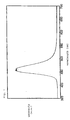
- Fig. 1 shows a photoluminescence spectrum excited by UV at 325 nm of the phosphor film.
- the phosphor emits blue color fluorescence with high color purity and high brightness at a luminescence peak wavelength of 450 to 470 nm.
- the cathodoluminescence spectra obtained at an acceleration voltage for the electrons of 30 kV is also same as the spectrum shown in Fig. 1 , and thus it is proved that the phosphor is a blue luminescence phosphor applicable for both ultraviolet ray excitation and electron beam excitation.
- the aluminate phosphor of the present invention is remarkably advantageously usable as a blue luminescence phosphor for three wavelength fluorescent lamps, plasma displays and the like using ultraviolet rays for excitation source and also a phosphor for Braun tubes, fluorescent display tubes and the like using electron beam for excitation source.
- the blue luminescence phosphor having the above-mentioned properties can be efficiently produced and the phosphor advantageously usable for various applications is provided.
Landscapes
- Chemical & Material Sciences (AREA)
- Organic Chemistry (AREA)
- Inorganic Chemistry (AREA)
- Life Sciences & Earth Sciences (AREA)
- Geology (AREA)
- Engineering & Computer Science (AREA)
- Materials Engineering (AREA)
- Luminescent Compositions (AREA)
Applications Claiming Priority (2)
| Application Number | Priority Date | Filing Date | Title |
|---|---|---|---|
| JP2006066170 | 2006-03-10 | ||
| PCT/JP2007/054558 WO2007105598A1 (ja) | 2006-03-10 | 2007-03-08 | アルミン酸塩系蛍光体の製法およびアルミン酸塩系蛍光体 |
Publications (2)
| Publication Number | Publication Date |
|---|---|
| EP2006348A2 true EP2006348A2 (de) | 2008-12-24 |
| EP2006348A4 EP2006348A4 (de) | 2010-05-05 |
Family
ID=38509423
Family Applications (1)
| Application Number | Title | Priority Date | Filing Date |
|---|---|---|---|
| EP07738048A Withdrawn EP2006348A4 (de) | 2006-03-10 | 2007-03-08 | Verfahren zur herstellung von aluminat-leuchtstoff sowie aluminat-leuchtstoff |
Country Status (5)
| Country | Link |
|---|---|
| US (1) | US20090047202A1 (de) |
| EP (1) | EP2006348A4 (de) |
| JP (1) | JP5261667B2 (de) |
| CN (1) | CN101400758B (de) |
| WO (1) | WO2007105598A1 (de) |
Families Citing this family (3)
| Publication number | Priority date | Publication date | Assignee | Title |
|---|---|---|---|---|
| WO2012121161A1 (ja) * | 2011-03-04 | 2012-09-13 | 国立大学法人長岡技術科学大学 | 塩化セシウム型類似構造の酸化ストロンチウム結晶の製造方法 |
| JP5868542B1 (ja) * | 2014-12-12 | 2016-02-24 | 大電株式会社 | 窒化物または酸窒化物を母体とする蛍光体の製造方法、蛍光体、発光素子、及び発光装置 |
| JP6923804B2 (ja) * | 2017-12-08 | 2021-08-25 | 日亜化学工業株式会社 | 波長変換部材及びその製造方法 |
Family Cites Families (21)
| Publication number | Priority date | Publication date | Assignee | Title |
|---|---|---|---|---|
| NL160869C (nl) * | 1972-11-03 | Philips Nv | Luminescerend scherm, alsmede ontladingslamp en katho- de straalbuis, voorzien van een dergelijk scherm. | |
| JPS5222579A (en) * | 1975-08-14 | 1977-02-19 | Fujitsu Ltd | Production process of fluorescent substance for gas discharge panel |
| JPS5993783A (ja) * | 1982-11-19 | 1984-05-30 | Matsushita Electronics Corp | 青緑色発光螢光体 |
| JPH0625354B2 (ja) * | 1984-04-18 | 1994-04-06 | 松下電子工業株式会社 | 螢光ランプ |
| JP2747018B2 (ja) * | 1989-05-30 | 1998-05-06 | 株式会社東芝 | 蛍光体及び蛍光ランプ |
| DE4321783A1 (de) | 1993-02-06 | 1994-08-11 | Samsung Display Devices Co Ltd | Grün-emittierender phosphoreszierender Stoff zur Verwendung in Fluoreszenzlampen |
| JP2543825B2 (ja) * | 1993-04-28 | 1996-10-16 | 根本特殊化学株式会社 | 蓄光性蛍光体 |
| JP3232548B2 (ja) | 1994-06-29 | 2001-11-26 | 日亜化学工業株式会社 | 残光性蛍光体 |
| JPH08115673A (ja) | 1994-10-17 | 1996-05-07 | Kasei Optonix Co Ltd | 真空紫外線励起発光素子 |
| JP3181218B2 (ja) * | 1995-09-29 | 2001-07-03 | 松下電器産業株式会社 | アルミン酸塩蛍光体とその製造方法、及びこの蛍光体を用いたデバイス |
| JPH09286981A (ja) * | 1996-04-23 | 1997-11-04 | Toshiba Corp | 蛍光体および蛍光ランプ |
| JP3268760B2 (ja) | 1998-08-18 | 2002-03-25 | 株式会社リード | 高輝度アルミン酸ストロンチウム蓄光体 |
| JP2000226574A (ja) | 1999-02-08 | 2000-08-15 | Daiden Co Ltd | プラズマディスプレイパネル用青色蛍光体 |
| JP2000290647A (ja) | 1999-04-13 | 2000-10-17 | Tokyo Kagaku Kenkyusho:Kk | 緑色発光性アルミン酸塩系蛍光体 |
| JP2001240856A (ja) | 2000-02-29 | 2001-09-04 | Sumitomo Chem Co Ltd | 真空紫外線励起発光素子用蛍光体 |
| JP3755390B2 (ja) * | 2000-09-08 | 2006-03-15 | 株式会社日立製作所 | 蛍光体及びそれを用いた表示装置並びに光源 |
| US6899826B2 (en) * | 2000-11-30 | 2005-05-31 | Chubu Chelest Co., Ltd. | Process for producing fluorescent metal oxide material |
| JP2003292949A (ja) * | 2002-03-29 | 2003-10-15 | Japan Science & Technology Corp | 高輝度発光材料とその製造方法 |
| JP4207644B2 (ja) * | 2003-04-22 | 2009-01-14 | パナソニック株式会社 | プラズマディスプレイ装置用蛍光体の製造方法 |
| US7285913B2 (en) * | 2003-08-29 | 2007-10-23 | Matsushita Electric Industrial Co., Ltd. | Plasma display device having blue phosphor layers with alkaline earth metal aluminate containing molybdenum or tungsten |
| EP1726630B1 (de) * | 2004-03-19 | 2011-11-16 | Chubu Chelest Co. Ltd. | Aluminatleuchtstoff und herstellungsverfahren |
-
2007
- 2007-03-08 EP EP07738048A patent/EP2006348A4/de not_active Withdrawn
- 2007-03-08 JP JP2008505094A patent/JP5261667B2/ja not_active Expired - Fee Related
- 2007-03-08 US US12/224,881 patent/US20090047202A1/en not_active Abandoned
- 2007-03-08 CN CN2007800085991A patent/CN101400758B/zh not_active Expired - Fee Related
- 2007-03-08 WO PCT/JP2007/054558 patent/WO2007105598A1/ja not_active Ceased
Also Published As
| Publication number | Publication date |
|---|---|
| CN101400758A (zh) | 2009-04-01 |
| JPWO2007105598A1 (ja) | 2009-07-30 |
| WO2007105598A1 (ja) | 2007-09-20 |
| CN101400758B (zh) | 2013-07-17 |
| EP2006348A4 (de) | 2010-05-05 |
| JP5261667B2 (ja) | 2013-08-14 |
| US20090047202A1 (en) | 2009-02-19 |
Similar Documents
| Publication | Publication Date | Title |
|---|---|---|
| EP1193306B1 (de) | Fluoreszierende Materialien für durch Vakuum-Ultraviolettstrahlung angeregte lichtemittierende Vorrichtungen | |
| KR100858269B1 (ko) | 알루민산염 형광체의 제조 방법, 형광체, 및 형광체를함유하는 소자 | |
| JP3985478B2 (ja) | 真空紫外線励起発光素子用の蛍光体 | |
| JP4568867B2 (ja) | 複合窒化物蛍光体の製造方法 | |
| JP2003243715A (ja) | 白色光源及びそれを用いた画像表示装置 | |
| US6899826B2 (en) | Process for producing fluorescent metal oxide material | |
| EP2006348A2 (de) | Verfahren zur herstellung von aluminat-leuchtstoff sowie aluminat-leuchtstoff | |
| JP4847860B2 (ja) | アルミン酸塩系蛍光体およびその製法 | |
| US6830706B2 (en) | Stable blue phosphor for plasma display panel applications | |
| JP5105353B2 (ja) | 複合窒化物蛍光体 | |
| JP2001131544A (ja) | 耐熱・耐水性・高輝度・長残光性黄緑発光色蓄光体及びその製造法 | |
| KR100417607B1 (ko) | 발화합성법을 이용한 산화물 형광체 제조방법 | |
| JP3754701B2 (ja) | 蛍光体及びそれを使用した発光素子 | |
| JP4656089B2 (ja) | 真空紫外線励起発光素子用の蛍光体 | |
| JP2010196075A (ja) | 複合窒化物蛍光体 | |
| JP6099126B2 (ja) | 蛍光体、その製造方法及び発光装置 | |
| JP5388135B2 (ja) | 複合窒化物蛍光体の製造方法 | |
| JP5014814B2 (ja) | 真空紫外線励起蛍光体 | |
| JP2007246918A (ja) | 真空紫外線励起発光素子用の蛍光体 | |
| JP2007284683A (ja) | 蛍光体 |
Legal Events
| Date | Code | Title | Description |
|---|---|---|---|
| PUAI | Public reference made under article 153(3) epc to a published international application that has entered the european phase |
Free format text: ORIGINAL CODE: 0009012 |
|
| PUAB | Information related to the publication of an a document modified or deleted |
Free format text: ORIGINAL CODE: 0009199EPPU |
|
| 17P | Request for examination filed |
Effective date: 20081009 |
|
| AK | Designated contracting states |
Kind code of ref document: A2 Designated state(s): DE GB |
|
| RBV | Designated contracting states (corrected) |
Designated state(s): DE GB |
|
| RBV | Designated contracting states (corrected) |
Designated state(s): DE GB |
|
| DAX | Request for extension of the european patent (deleted) | ||
| A4 | Supplementary search report drawn up and despatched |
Effective date: 20100406 |
|
| 17Q | First examination report despatched |
Effective date: 20130506 |
|
| GRAP | Despatch of communication of intention to grant a patent |
Free format text: ORIGINAL CODE: EPIDOSNIGR1 |
|
| INTG | Intention to grant announced |
Effective date: 20140109 |
|
| STAA | Information on the status of an ep patent application or granted ep patent |
Free format text: STATUS: THE APPLICATION IS DEEMED TO BE WITHDRAWN |
|
| 18D | Application deemed to be withdrawn |
Effective date: 20140520 |