EP2006402B1 - SUPERALLIAGE À BASE DE Ni ET SON PROCÉDÉ DE FABRICATION - Google Patents
SUPERALLIAGE À BASE DE Ni ET SON PROCÉDÉ DE FABRICATION Download PDFInfo
- Publication number
- EP2006402B1 EP2006402B1 EP07738896.5A EP07738896A EP2006402B1 EP 2006402 B1 EP2006402 B1 EP 2006402B1 EP 07738896 A EP07738896 A EP 07738896A EP 2006402 B1 EP2006402 B1 EP 2006402B1
- Authority
- EP
- European Patent Office
- Prior art keywords
- single crystal
- base superalloy
- less
- base
- superalloy
- Prior art date
- Legal status (The legal status is an assumption and is not a legal conclusion. Google has not performed a legal analysis and makes no representation as to the accuracy of the status listed.)
- Ceased
Links
- 229910000601 superalloy Inorganic materials 0.000 title claims description 78
- 238000004519 manufacturing process Methods 0.000 title claims description 8
- 239000013078 crystal Substances 0.000 claims description 57
- 238000005266 casting Methods 0.000 claims description 35
- 239000000203 mixture Substances 0.000 claims description 28
- 230000032683 aging Effects 0.000 claims description 23
- 239000000126 substance Substances 0.000 claims description 22
- 229910052750 molybdenum Inorganic materials 0.000 claims description 21
- 229910052715 tantalum Inorganic materials 0.000 claims description 20
- 229910052721 tungsten Inorganic materials 0.000 claims description 20
- 229910052804 chromium Inorganic materials 0.000 claims description 19
- 229910052702 rhenium Inorganic materials 0.000 claims description 19
- 229910052735 hafnium Inorganic materials 0.000 claims description 18
- 239000012535 impurity Substances 0.000 claims description 18
- 238000007711 solidification Methods 0.000 claims description 18
- 230000008023 solidification Effects 0.000 claims description 18
- 229910052707 ruthenium Inorganic materials 0.000 claims description 16
- 238000000034 method Methods 0.000 claims description 14
- 229910052782 aluminium Inorganic materials 0.000 claims description 11
- 229910052758 niobium Inorganic materials 0.000 claims description 11
- 238000010438 heat treatment Methods 0.000 claims description 7
- 239000006104 solid solution Substances 0.000 claims description 7
- 229910052719 titanium Inorganic materials 0.000 claims description 6
- 229910052796 boron Inorganic materials 0.000 claims description 4
- 229910052746 lanthanum Inorganic materials 0.000 claims description 3
- 229910052720 vanadium Inorganic materials 0.000 claims description 3
- 229910052727 yttrium Inorganic materials 0.000 claims description 3
- 229910052726 zirconium Inorganic materials 0.000 claims description 3
- 229910052710 silicon Inorganic materials 0.000 claims description 2
- 229910045601 alloy Inorganic materials 0.000 description 31
- 239000000956 alloy Substances 0.000 description 31
- 238000001816 cooling Methods 0.000 description 25
- 239000011651 chromium Substances 0.000 description 18
- PXHVJJICTQNCMI-UHFFFAOYSA-N nickel Substances [Ni] PXHVJJICTQNCMI-UHFFFAOYSA-N 0.000 description 18
- 239000010955 niobium Substances 0.000 description 15
- 230000005484 gravity Effects 0.000 description 13
- 239000010936 titanium Substances 0.000 description 13
- 239000007789 gas Substances 0.000 description 9
- 239000000243 solution Substances 0.000 description 9
- 239000011159 matrix material Substances 0.000 description 8
- 238000005728 strengthening Methods 0.000 description 8
- 239000011248 coating agent Substances 0.000 description 6
- 238000000576 coating method Methods 0.000 description 6
- 230000007423 decrease Effects 0.000 description 6
- 230000000052 comparative effect Effects 0.000 description 5
- VYPSYNLAJGMNEJ-UHFFFAOYSA-N Silicium dioxide Chemical compound O=[Si]=O VYPSYNLAJGMNEJ-UHFFFAOYSA-N 0.000 description 4
- 230000000694 effects Effects 0.000 description 4
- 229910001011 CMSX-4 Inorganic materials 0.000 description 3
- 229910001005 Ni3Al Inorganic materials 0.000 description 3
- KJTLSVCANCCWHF-UHFFFAOYSA-N Ruthenium Chemical compound [Ru] KJTLSVCANCCWHF-UHFFFAOYSA-N 0.000 description 3
- 239000000567 combustion gas Substances 0.000 description 3
- 230000007797 corrosion Effects 0.000 description 3
- 238000005260 corrosion Methods 0.000 description 3
- 230000002950 deficient Effects 0.000 description 3
- 229910000765 intermetallic Inorganic materials 0.000 description 3
- 230000003647 oxidation Effects 0.000 description 3
- 238000007254 oxidation reaction Methods 0.000 description 3
- 238000004881 precipitation hardening Methods 0.000 description 3
- 239000000047 product Substances 0.000 description 3
- 239000007787 solid Substances 0.000 description 3
- ZOXJGFHDIHLPTG-UHFFFAOYSA-N Boron Chemical compound [B] ZOXJGFHDIHLPTG-UHFFFAOYSA-N 0.000 description 2
- 229910001566 austenite Inorganic materials 0.000 description 2
- 230000015572 biosynthetic process Effects 0.000 description 2
- 229910052681 coesite Inorganic materials 0.000 description 2
- 229910052906 cristobalite Inorganic materials 0.000 description 2
- 239000000446 fuel Substances 0.000 description 2
- 230000001771 impaired effect Effects 0.000 description 2
- 230000008018 melting Effects 0.000 description 2
- 238000002844 melting Methods 0.000 description 2
- BASFCYQUMIYNBI-UHFFFAOYSA-N platinum Chemical group [Pt] BASFCYQUMIYNBI-UHFFFAOYSA-N 0.000 description 2
- 239000002244 precipitate Substances 0.000 description 2
- 238000001556 precipitation Methods 0.000 description 2
- 230000001681 protective effect Effects 0.000 description 2
- WUAPFZMCVAUBPE-UHFFFAOYSA-N rhenium atom Chemical compound [Re] WUAPFZMCVAUBPE-UHFFFAOYSA-N 0.000 description 2
- 239000000377 silicon dioxide Substances 0.000 description 2
- 229910052682 stishovite Inorganic materials 0.000 description 2
- GUVRBAGPIYLISA-UHFFFAOYSA-N tantalum atom Chemical compound [Ta] GUVRBAGPIYLISA-UHFFFAOYSA-N 0.000 description 2
- 229910052905 tridymite Inorganic materials 0.000 description 2
- WFKWXMTUELFFGS-UHFFFAOYSA-N tungsten Chemical compound [W] WFKWXMTUELFFGS-UHFFFAOYSA-N 0.000 description 2
- 239000010937 tungsten Substances 0.000 description 2
- -1 A1 or Ta Substances 0.000 description 1
- OKTJSMMVPCPJKN-UHFFFAOYSA-N Carbon Chemical compound [C] OKTJSMMVPCPJKN-UHFFFAOYSA-N 0.000 description 1
- 229910052684 Cerium Inorganic materials 0.000 description 1
- VYZAMTAEIAYCRO-UHFFFAOYSA-N Chromium Chemical compound [Cr] VYZAMTAEIAYCRO-UHFFFAOYSA-N 0.000 description 1
- ZOKXTWBITQBERF-UHFFFAOYSA-N Molybdenum Chemical compound [Mo] ZOKXTWBITQBERF-UHFFFAOYSA-N 0.000 description 1
- RTAQQCXQSZGOHL-UHFFFAOYSA-N Titanium Chemical compound [Ti] RTAQQCXQSZGOHL-UHFFFAOYSA-N 0.000 description 1
- QCWXUUIWCKQGHC-UHFFFAOYSA-N Zirconium Chemical compound [Zr] QCWXUUIWCKQGHC-UHFFFAOYSA-N 0.000 description 1
- XAGFODPZIPBFFR-UHFFFAOYSA-N aluminium Chemical compound [Al] XAGFODPZIPBFFR-UHFFFAOYSA-N 0.000 description 1
- PNEYBMLMFCGWSK-UHFFFAOYSA-N aluminium oxide Inorganic materials [O-2].[O-2].[O-2].[Al+3].[Al+3] PNEYBMLMFCGWSK-UHFFFAOYSA-N 0.000 description 1
- 210000004556 brain Anatomy 0.000 description 1
- 229910052799 carbon Inorganic materials 0.000 description 1
- ZMIGMASIKSOYAM-UHFFFAOYSA-N cerium Chemical compound [Ce][Ce][Ce][Ce][Ce][Ce][Ce][Ce][Ce][Ce][Ce][Ce][Ce][Ce][Ce][Ce][Ce][Ce][Ce][Ce][Ce][Ce][Ce][Ce][Ce][Ce][Ce][Ce][Ce][Ce][Ce][Ce][Ce][Ce][Ce][Ce][Ce][Ce] ZMIGMASIKSOYAM-UHFFFAOYSA-N 0.000 description 1
- 239000010941 cobalt Substances 0.000 description 1
- 229910017052 cobalt Inorganic materials 0.000 description 1
- GUTLYIVDDKVIGB-UHFFFAOYSA-N cobalt atom Chemical compound [Co] GUTLYIVDDKVIGB-UHFFFAOYSA-N 0.000 description 1
- 230000003247 decreasing effect Effects 0.000 description 1
- 230000006866 deterioration Effects 0.000 description 1
- 230000002542 deteriorative effect Effects 0.000 description 1
- 230000018109 developmental process Effects 0.000 description 1
- QDOXWKRWXJOMAK-UHFFFAOYSA-N dichromium trioxide Chemical compound O=[Cr]O[Cr]=O QDOXWKRWXJOMAK-UHFFFAOYSA-N 0.000 description 1
- 239000006185 dispersion Substances 0.000 description 1
- 230000005496 eutectics Effects 0.000 description 1
- 230000004927 fusion Effects 0.000 description 1
- VBJZVLUMGGDVMO-UHFFFAOYSA-N hafnium atom Chemical compound [Hf] VBJZVLUMGGDVMO-UHFFFAOYSA-N 0.000 description 1
- 239000011261 inert gas Substances 0.000 description 1
- FZLIPJUXYLNCLC-UHFFFAOYSA-N lanthanum atom Chemical compound [La] FZLIPJUXYLNCLC-UHFFFAOYSA-N 0.000 description 1
- 239000000463 material Substances 0.000 description 1
- 229910052751 metal Inorganic materials 0.000 description 1
- 239000002184 metal Substances 0.000 description 1
- 239000011733 molybdenum Substances 0.000 description 1
- 229910052759 nickel Inorganic materials 0.000 description 1
- GUCVJGMIXFAOAE-UHFFFAOYSA-N niobium atom Chemical compound [Nb] GUCVJGMIXFAOAE-UHFFFAOYSA-N 0.000 description 1
- 230000002035 prolonged effect Effects 0.000 description 1
- 239000011253 protective coating Substances 0.000 description 1
- 238000005204 segregation Methods 0.000 description 1
- 230000006641 stabilisation Effects 0.000 description 1
- 238000011105 stabilization Methods 0.000 description 1
- 230000035882 stress Effects 0.000 description 1
- GPPXJZIENCGNKB-UHFFFAOYSA-N vanadium Chemical compound [V]#[V] GPPXJZIENCGNKB-UHFFFAOYSA-N 0.000 description 1
- VWQVUPCCIRVNHF-UHFFFAOYSA-N yttrium atom Chemical compound [Y] VWQVUPCCIRVNHF-UHFFFAOYSA-N 0.000 description 1
Images
Classifications
-
- C—CHEMISTRY; METALLURGY
- C22—METALLURGY; FERROUS OR NON-FERROUS ALLOYS; TREATMENT OF ALLOYS OR NON-FERROUS METALS
- C22C—ALLOYS
- C22C19/00—Alloys based on nickel or cobalt
- C22C19/03—Alloys based on nickel or cobalt based on nickel
- C22C19/05—Alloys based on nickel or cobalt based on nickel with chromium
-
- C—CHEMISTRY; METALLURGY
- C22—METALLURGY; FERROUS OR NON-FERROUS ALLOYS; TREATMENT OF ALLOYS OR NON-FERROUS METALS
- C22F—CHANGING THE PHYSICAL STRUCTURE OF NON-FERROUS METALS AND NON-FERROUS ALLOYS
- C22F1/00—Changing the physical structure of non-ferrous metals or alloys by heat treatment or by hot or cold working
- C22F1/02—Changing the physical structure of non-ferrous metals or alloys by heat treatment or by hot or cold working in inert or controlled atmosphere or vacuum
-
- C—CHEMISTRY; METALLURGY
- C22—METALLURGY; FERROUS OR NON-FERROUS ALLOYS; TREATMENT OF ALLOYS OR NON-FERROUS METALS
- C22F—CHANGING THE PHYSICAL STRUCTURE OF NON-FERROUS METALS AND NON-FERROUS ALLOYS
- C22F1/00—Changing the physical structure of non-ferrous metals or alloys by heat treatment or by hot or cold working
- C22F1/10—Changing the physical structure of non-ferrous metals or alloys by heat treatment or by hot or cold working of nickel or cobalt or alloys based thereon
Definitions
- the present invention relates to a Ni-base superalloy and a method for producing the same. More particularly, the present invention relates to a novel conventionally cast Ni-base alloy, directionally solidified Ni-base superalloy or Ni-base single crystal superalloy, having excellent creep property at high temperature, and suitable as a member used at high temperature and under high stress, such as turbine blades, turbine vanes or the like of jet engines, gas turbines or the like, and a method for producing the same.
- Ni-base superalloy is used as a material of rotor blades and stator vanes, which is a high temperature member such as aircraft engines or gas turbine engines.
- the Ni-base superalloy has ⁇ (gamma) matrix which is an austenite phase and ⁇ ' (gamma prime) phase which is an ordered phase dispersed and precipitated in the matrix.
- the ⁇ ' phase mainly comprises an intermetallic compound represented by Ni 3 Al, and due to the presence of this ⁇ ' phase, high temperature strength of a superalloy is improved.
- a conventionally cast Ni-base alloy, a directionally solidified Ni-base superalloy and a Ni-base single crystal superalloy are realized by the compositional ratio of an alloy and the improvement of production process.
- Ni-base single crystal superalloy and a directionally solidified Ni-base superalloy of fourth and fifth generations is carried out by adding a platinum group element such as Ru (Ruthenium), thereby suppressing formation of TCP phase and attempting to improve high temperature strength ( US Patent 6929868 ).
- a platinum group element such as Ru (Ruthenium)
- EP-A-1394278 relates to a Ni-base superalloy having the following composition (in wt %): Al 5.5-7.5, Mo 0-3, W 3.5-7. Re 0-5.5, Hf 0.3-1, Cr 2-9, Co 4-12, Ru 0-3, Ta + Ti 0.6-5.7.
- the present invention has been made to solve the above problems, and has an object to provide a Ni-base superalloy having excellent high temperature strength and low specific gravity while preventing formation of TCP phase, and a method for producing the same.
- a first aspect of the invention is to provide a Ni-base superalloy having a chemical composition comprising Al: 4.5-7.0 wt%, Ta+Nb+Ti: 0.1-4.0 wt%, with Ta being less than 4.0 wt%, Mo: 1.0-5.0 wt%, W: 4.0-7.0 wt%, Re: 3.5-8.0 wt%, Hf: 0.01-1.0 wt%, Cr: 2.0-4.5 wt%, Co: 4.0-8.0 wt%, Ru: 2.0-5.0 wt%, and the balance being Ni and unavoidable impurities, and wherein said composition comprises the following optional elements, either alone or as mixtures thereof: C: 0.05 wt% or less, Zr: 0.1 wt% or less, V: 0.5 wt% or less, B: 0.02 wt% or less, Si: 0.1 wt% or less, Y: 0.2 wt% or less, La: 0.2 w
- a second aspect of the invention is to provide the Ni-base superalloy of the first aspect, wherein the chemical composition comprises Al: 4.7-6.5 wt%, Ta+Nb+Ti: 0.1-4.0 wt%, with Ta being less than 4.0 wt%, Mo: 1.8-4.0 wt%, W: 4.6-6.6 wt%, Re: 5.4-8.0 wt%, Hf: 0.01-1.0 wt%, Cr: 2.2-4.2 wt%, Co: 4.8-6.8 wt%, Ru: 2.6-4.6 wt%, and the balance being Ni and unavoidable impurities.
- the chemical composition comprises Al: 4.7-6.5 wt%, Ta+Nb+Ti: 0.1-4.0 wt%, with Ta being less than 4.0 wt%, Mo: 1.8-4.0 wt%, W: 4.6-6.6 wt%, Re: 5.4-8.0 wt%, Hf: 0.01-1.0 wt%, Cr:
- a third aspect of the invention is to provide the Ni-base superalloy of either of the first and second aspects, wherein the chemical composition comprises Al: 5.7 wt%, Ta: 1.6 wt%, Nb: 2.0 wt%, Mo: 2.8 wt%, W: 5.6 wt%, Re: 6.9 wt%, Hf: 0.1 wt%, Cr: 3.2 wt%, Co: 5.8 wt%, Ru: 3.6 wt%, and the balance being Ni and unavoidable impurities.
- a fourth aspect of the invention is to provide the Ni-base superalloy of either of the first and second aspects, wherein the chemical composition comprises Al: 5.7 wt%, Ta: 1.6 wt%, Nb: 2.0 wt%, Mo: 3.0 wt%, W: 5.6 wt%, Re: 6.4 wt%, Hf: 0.1 wt%, Cr: 3.2 wt%, Co: 5.8 wt%, Ru: 3.6 wt%, and the balance being Ni and unavoidable impurities.
- a fifth aspect of the invention is to provide the Ni-base superalloy of either of the first and second aspects, wherein the chemical composition comprises Al: 5.7 wt%, Ta: 1.6 wt%. Nb: 1.5 wt%. Ti: 0.5 wt%, Mo: 2.8 wt%, W: 5.6 wt%, Re: 6.5 wt%, Hf: 0.1 wt%, Cr: 3.2 wt%, Co: 5.8 wt%, Ru: 3.6 wt%, and the balance being Ni and unavoidable impurities.
- a sixth aspect of the invention is that the Ni-base superalloy of any one of the first to fifth aspects is cast with a conventional casting method, a directional solidification method or a single crystal solidification method.
- a seventh aspect of the invention is that after casting, a pre-heating treatment at 1,200 to 1,300°C for 20 minutes to 2 hours is applied, and a solid solution treatment at 1,280 to 1,360°C for 3 to 10 hours, a first aging treatment at 1,050 to 1,150°C for 2 to 8 hours, and a second aging treatment at 800 to 900°C for 10 to 24 hours are then applied.
- a Ni-base superalloy has the tendency to increase its specific gravity with increased amount of Ru as a platinum group element. Therefore, the present invention realizes a Ni-base single crystal superalloy of high specific strength (strength per unit specific gravity) without sacrificing high temperature strength and with suppressed increase of specific gravity by that the Ta+Nb+Ti compositional ratio is in a range of 0.1 to 4.0 wt%, and Ta is less than 4 wt%.
- Ni-base single crystal superalloy When such a Ni-base single crystal superalloy is used in turbine blades, turbine vanes, turbine disks or the like of jet engines, gas turbines or the like, it can be used in, for example, a combustion gas of higher temperature, and this is effective to improve efficiency of jet engines, gas turbines or the like, and to reduce fuels.
- the invention realizes a conventionally cast Ni-base alloy and a directionally solidified Ni-base superalloy.
- High temperature strength is excellent similar to a Ni-base single crystal superalloy, casting properties are improved, and yield of products becomes better.
- the conventionally cast Ni-base alloy and directionally solidified Ni-base superalloy are useful in the same use application as the Ni-base single crystal superalloy.
- Ni-based single crystal superalloy, directionally solidified Ni-base superalloy and conventionally cast Ni-base alloy provided by the present invention have ⁇ (gamma) phase (matrix) which is an austenite phase and ⁇ ' (gamma prime) phase (precipitated phase) which is an ordered phase dispersed and precipitated in the matrix.
- the ⁇ ' phase mainly comprises an intermetallic compound represented by Ni 3 Al, and due to the presence of this ⁇ ' phase, high temperature strength of a superalloy is further improved.
- the Ni-base superalloy of the present invention defines the chemical composition as follows.
- Cr chromium
- Cr is an element having excellent oxidation resistance, and improves high temperature corrosion resistance.
- the content of Cr is 2.0 to 4.5 wt%. Where Cr is less than 2.0 wt%, the desired high temperature corrosion resistance cannot be ensured.
- Mo mobdenum
- W tungsten
- Ta tantalum
- the content of Mo is 1.0 to 5.0 wt%. Where the content of Mo is less than 1.0 wt%, the desired high temperature strength cannot be ensured.
- W tungsten improves high temperature strength by the action of solid solution strengthening and precipitation hardening in the co-presence of Mo and Ta.
- the content of W is 4.0 to 7.0 wt%.
- Ta tantalum
- Nb niobium
- Ti titanium
- the content of Ta+Nb+Ti is 0.1 to 4.0 wt% by the adjustment of the respective contents, and the content of Ta is less than 4.0 wt%.
- Ta+Nb+Ti is less 0.1 wt%, it is difficult to improve high temperature strength, and where the content exceeds 4.0 wt%, it is difficult to maintain the specific gravity of the alloy at 9.0 g/cm 3 or less while ensuring the desired high temperature strength.
- Al (aluminum) is united with Ni (nickel) to form an intermetallic compound represented by Ni 3 Al constituting ⁇ ' phase finely and uniformly dispersed and precipitated in the matrix in a proportion of 60 to 70% in volume fraction, thereby improving high temperature strength.
- the compositional ratio of A1 is 4.5 to 7.0 wt%. Where the content of A1 is less than 4.5 wt%, the amount of ⁇ ' phase precipitated is deficient, and the desired high temperature strength cannot be ensured. Where the content exceeds 7.0 wt%, coarse ⁇ ' phase called eutectic ⁇ ' phase is formed in large amount. This makes it impossible to conduct solution treatment, and high high-temperature strength cannot be ensured.
- Hf (hafnium) is a grain boundary segregation element, and strengthens a grain boundary by segregating the grain boundary between ⁇ phase and ⁇ ' phase, thereby particularly improving high temperature strength of the conventionally cast Ni-base alloy and the directionally solidified Ni-base superalloy.
- the content of Hf is 0.01 to 1.0 wt%.
- Hf is added in a slight amount or may not be contained.
- crystal grain boundary strengthening is deficient, and the desired high temperature strength cannot be ensured.
- the content of Hf exceeds 1.0 wt%, local fusion is induced, and there is the possibility to decrease high temperature strength.
- Co increases solubility limit at high temperature to a matrix such as A1 or Ta, dispersion precipitates fine ⁇ ' phase by heat treatment, and improves high temperature strength.
- the content of Co is 4.0 to 8.0 wt%. Where the solubility limit that does not precipitates a harmful phase is sufficiently wide, it is possible to ensure high temperature strength even though Co is not contained. Where the content exceeds 15.0 wt%, the balance to other element such as Al, Ta, Mo, W, Hf or Cr is disrupted, and a harmful phase is precipitated, thereby deteriorating high temperature strength.
- Re rhenium
- ⁇ phase As the matrix at high content and improves high temperature strength by solid solution strengthening. Furthermore, Re has the effect to improve corrosion resistance.
- TCP phase which is a harmful phase is precipitated at high temperature, and there is the possibility that high temperature strength deteriorates.
- the content of Re is 3.5 to 8.0 wt%. Where the content is less than 2.0 wt%, solid solution strengthening of ⁇ phase is deficient, and the desired high temperature strength cannot be ensured. Where the content exceeds 8.0 wt%, TCP phase is precipitated at high temperature, and high high-temperature strength cannot be ensured.
- Ru (Ruthenium) suppresses precipitation of TCP phase, thereby improving high temperature strength.
- the content of Ru is 2.0 to 5.0 wt%.
- the content of Ru has the optimum compositional range to the content of a main element constituting TCP phase, such as Re. W. Mo or Cr. Where TCP phase is not precipitated, Ru may not be added. Ru is an expensive metal, and where the content thereof exceeds 5.0 wt%, cost is increased.
- the balance comprises Ni and unavoidable impurities.
- the Ni-base superalloy of the invention having any one of the first to seventh aspects can further contain the following elements in specific ranges alone or in combination thereof.
- C carbon
- the content of C is 0.05 wt% or less. Where C is not contained, the effect of grain boundary strengthening cannot be ensured, which is not preferred. Where the content of C exceeds 0.05 wt%, ductility is impaired, which is not preferred.
- Zr zirconium strengthens the grain boundary similar to B (boron) and C. On the other hand, excessive addition decreases creep strength. Therefore, the content is 0.1 wt% or less.
- V vanadium
- ⁇ ' phase to strengthen ⁇ ' phase.
- excessive addition decreases creep strength. Therefore, the content is 0.5 wt% or less.
- B (boron) contributes to grain boundary strengthening similar to C.
- the content of B is 0.02 wt% or less. Where the content exceeds 0.02 wt%, ductility is impaired, which is not preferred.
- Si (silicon) forms SiO 2 coating film on the surface of an alloy, and the coating film acts as a protective coating film to improve oxidation resistance. Furthermore, the SiO 2 oxide coating film is difficult to generate cracks as compared with other protective oxide coating films, and has the effect to improve creep and fatigue properties. On the other hand, the addition of Si in large amount results in decrease of solubility limit of other elements. Therefore, the upper limit of the content is 0.1 wt%.
- Y yttrium
- La lanthanum
- Ce cerium
- the excessive addition results in decrease of the solubility limit of other elements. Therefore, the content of Y is 0.2 wt% or less, the content of La is 0.2 wt% or less, and the content of Ce is 0.2 wt% or less.
- Ni-base superalloy of the invention having the chemical composition as above can be produced by melting and casting as one having a given chemical composition, taking into consideration the conventional production process and production conditions.
- a Ni-base superalloy can be produced as a directionally solidified alloy or a single crystal alloy by a directional solidification method or a single crystal solidification method.
- the directional solidification method conducts casting using an ingot prepared in the desired chemical composition, and is a method that the casting mold is heated to a temperature of about 1,500°C or higher which is a solidification temperature, the ingot is charged in the casting mold, the casting mold is then gradually moved away from a heating furnace to give temperature gradient, for example, and many crystals are directionally grown.
- the single crystal solidification method is substantially the same as the directional solidification method, and is a method that a zigzag or spiral selector part is provided before solidification, many crystals directionally solidified are formed into a single crystal in a selector part, thereby producing the desired product.
- the Ni-base superalloy of the invention develops high creep strength by applying heat treatment after casting.
- the standard heat treatment is as follows. After applying a pre-heat treatment at 1,200 to 1,300°C for 20 minutes to 2 hours, solution treatment is conducted at 1,280 to 1,350°C for 3 to 10 hours. Subsequently, a first aging treatment for the purpose of precipitation of ⁇ ' phase is conducted in a temperature range of 1,050 to 1,150°C for 2 to 8 hours, and air cooling is conducted. The first aging treatment can combine with a coating treatment for the purpose of heat resistance and oxidation resistance. After air cooling, a second aging treatment for the purpose of stabilization of ⁇ ' phase is subsequently conducted at 800 to 900°C for 10 to 24 hours, and air cooling is conducted. The air cooling in the first aging treatment and the second aging treatment can be conducted by replacing the atmosphere with an inert gas.
- Ni-base superalloy of the invention thus produced makes it possible to realize high temperature components such as turbine blades, turbine vanes or the like of jet engines or gas turbines.
- Solution treatment of maintaining at this temperature for 10 hours and then air cooling was conducted.
- a first aging treatment of maintaining at a temperature of 1,100°C for 4 hours in vacuum and then air cooling and a second aging treatment of maintaining at a temperature of 870°C for 20 hours in vacuum and then air cooling were conducted.
- the single crystal alloy casting was processed into a test piece having a diameter of a parallel portion of 4 mm and a length of 20 mm, and a creep test was conducted under the conditions of 800 to 1,100°C and 137 to 735 MPa.
- the single crystal casting obtained was pre-heated at a temperature of 1,300°C for 1 hour in vacuum, and the temperature was elevated to 1,330°C.
- Solution treatment of maintaining at this temperature for 10 hours and then air cooling was conducted.
- a first aging treatment of maintaining at a temperature of 1,100°C for 4 hours in vacuum and then air cooling and a second aging treatment of maintaining at a temperature of 870°C for 20 hours in vacuum and then air cooling were conducted.
- the single crystal alloy casting was processed into a test piece having a diameter of a parallel portion of 4 mm and a length of 20 mm, and a creep test was conducted under the conditions of 800 to 1,100°C and 137 to 735 MPa.
- a Ni-base superalloy having a chemical composition comprising Co: 5.8 wt%, Cr: 3.2 wt%, Mo: 2.8 wt%, W: 5.6 wt%, Al: 5.7 wt%, Ti: 0.5 wt%, Nb: 1.5 wt%, Ta: 1.6 wt%, Hf: 0.1 wt%, Re: 6.5 wt%, Ru: 3.6 wt%. and the balance being Ni and unavoidable impurities was melted and cast at a solidification rate of 200 mm/h in vacuum to obtain a single crystal casting.
- the single crystal casting obtained was pre-heated at a temperature of 1,300°C for 1 hour in vacuum, and the temperature was elevated to 1,330°C. Solution treatment of maintaining at this temperature for 10 hours and then air cooling was conducted. Subsequently, a first aging treatment of maintaining at a temperature of 1,100°C for 4 hours in vacuum and then air cooling and a second aging treatment of maintaining at a temperature of 870°C for 20 hours in vacuum and then air cooling were conducted.
- the single crystal alloy casting was processed into a test piece having a diameter of a parallel portion of 4 mm and a length of 20 mm, and a creep test was conducted under the conditions of 800 to 1,100°C and 137 to 735 MPa.
- a Ni-base superalloy having a chemical composition comprising Cr: 7.6 wt%, Mo: 6.7 wt%, Al: 5.6 wt%, Ti: 0.9 wt%, Nb: 2.3 wt%, Re: 3.0 wt%, and the balance being Ni and unavoidable impurities was melted and cast at a solidification rate of 200 mm/h in vacuum to obtain a single crystal casting. Subsequently, the single crystal casting obtained was pre-heated at a temperature of 1,260°C for 1 hour in vacuum, and the temperature was elevated to 1,280°C. Solution treatment of maintaining at this temperature for 4 hours and then air cooling was conducted.
- a first aging treatment of maintaining at a temperature of 982°C for 5 hours in vacuum and then air cooling and a second aging treatment of maintaining at a temperature of 870°C for 20 hours in vacuum and then air cooling were conducted.
- the single crystal alloy casting was processed into a test piece having a diameter of a parallel portion of 4 mm and a length of 20 mm, and a creep test was conducted under the conditions of 900 to 1,100°C and 137 to 392 MPa.
- Solution treatment of maintaining at this temperature for 5 hours and then air cooling was conducted.
- a first aging treatment of maintaining at a temperature of 1,100°C for 4 hours in vacuum and then air cooling and a second aging treatment of maintaining at a temperature of 870°C for 20 hours in vacuum and then air cooling were conducted.
- the single crystal alloy casting was processed into a test piece having a diameter of a parallel portion of 4 mm and a length of 20 mm, and a creep test was conducted under the conditions of 900 to 1,100°C and 137 to 392 MPa.
- Solution treatment of maintaining at this temperature for 5 hours and then air cooling was conducted.
- a first aging treatment of maintaining at a temperature of 1,100°C for 4 hours in vacuum and then air cooling and a second aging treatment of maintaining at a temperature of 870°C for 20 hours in vacuum and then air cooling were conducted.
- the single crystal alloy casting was processed into a test piece having a diameter of a parallel portion of 4 mm and a length of 20 mm, and a creep test was conducted under the conditions of 900 to 1,100°C and 137 to 392 MPa.
- a first aging treatment of maintaining at a temperature of 1,100°C for 4 hours in vacuum and then air cooling and a second aging treatment of maintaining at a temperature of 870°C for 20 hours in vacuum and then air cooling were conducted.
- the single crystal alloy casting was processed into a test piece having a diameter of a parallel portion of 4 mm and a length of 20 mm, and a creep test was conducted under the conditions of 900 to 1,100°C and 137 to 392 MPa.
- CMSX-4 alloy as the comparative alloy is the conventional ally which is most widely used, and is disclosed in, for example, US Patent 4,643,782 .
- MX4 (PWA 1497) alloy is a fourth generation alloy containing 3 wt% of Ru (ruthenium) disclosed in US Patent 6,929,868 .
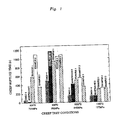
- Ni-base single crystal superalloys of Examples 1 to 3 have specific gravity smaller than 9.0, and have excellent creep rupture life.
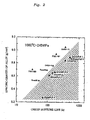
- the creep test results (1,000°C, 245 MPa) of the Ni-base single crystal superalloys of Examples 1 to 7 and the conventional Ni-base single crystal superalloys, and the respective specific gravity are compared and are shown in Fig. 2 .
- the Ni-base single crystal superalloys of Examples 1 to 7 have low specific gravity and prolonged creep life.
- a Ni-base single crystal superalloy having suppressed gravity increase and high specific strength (strength per unit gravity) without sacrificing high temperature strength is realized.
- turbine blades, turbine vanes, turbine disks or the like of jet engines, gas turbines or the like it is possible to use in, for example, a combustion gas of higher temperature, and this is effective to improve efficiency of jet engines and gas turbines, and to reduce fuel.
- a conventionally cast Ni-base alloy and a directionally solidified Ni-base superalloy are realized, and have excellent high temperature strength similar to a Ni-base single crystal superalloy. Additionally, casting properties are improved, and yield of products becomes better.
- the conventionally cast Ni-base alloy and directionally solidified Ni-base superalloy are useful in the same use application as a Ni-base single crystal superalloy.
Landscapes
- Chemical & Material Sciences (AREA)
- Engineering & Computer Science (AREA)
- Materials Engineering (AREA)
- Mechanical Engineering (AREA)
- Metallurgy (AREA)
- Organic Chemistry (AREA)
- Physics & Mathematics (AREA)
- Thermal Sciences (AREA)
- Crystallography & Structural Chemistry (AREA)
- Turbine Rotor Nozzle Sealing (AREA)
Claims (7)
- Superalliage à base de Ni ayant une composition chimique comprenant Al : 4,5-7,0 % en poids, Ta+Nb+Ti : 0,1-4,0 % en poids, avec Ta inférieur à 4,0 % en poids, Mo : 1,0-5,0 % en poids, W : 4,0-7,0 % en poids, Re : 3,5-8,0 % en poids, Hf : 0,01-1,0 % en poids, Cr : 2,0-4,5 % en poids, Co : 4,0-8,0 % en poids, Ru : 2,0-5,0 % en poids, le reste étant du Ni et des impuretés inévitables, et dans lequel ladite composition comprend éventuellement les éléments suivants, soit seuls, soit sous la forme de mélanges de ceux-ci : C : 0,05 % en poids ou moins, Zr : 0,1 % en poids ou moins, V : 0,5 % en poids ou moins, B : 0,02 % en poids ou moins, Si : 0,1 % en poids ou moins, Y : 0,2 % en poids ou moins, La : 0,2 % en poids ou moins et Ce : 0,2 % en poids ou moins.
- Superalliage à base de Ni selon la revendication 1, dans lequel la composition chimique comprend Al : 4,7-6,5 % en poids, Ta+Nb+Ti : 0,1-4,0 % en poids, Ta étant inférieur à 4,0 % en poids, Mo : 1,8-4,0 % en poids, W : 4,6-6,6 % en poids, Re : 5,4-8,0 % en poids, Hf : 0,01-1,0 % en poids, Cr : 2,2-4,2 % en poids, Co : 4,8-6,8 % en poids, Ru : 2,6-4,6 % en poids, le reste étant du Ni et des impuretés inévitables.
- Superalliage à base de Ni selon l'une ou l'autre des revendications 1 et 2, dans lequel la composition chimique comprend Al : 5,7 % en poids, Ta : 1,6 % en poids, Nb : 2,0 % en poids, Mo : 2,8 % en poids, W : 5,6 % en poids, Re : 6,9 % en poids, Hf : 0,1 % en poids, Cr : 3,2 % en poids, Co : 5,8 % en poids, Ru : 3,6 % en poids, le reste étant du Ni et des impuretés inévitables.
- Superalliage à base de Ni selon l'une ou l'autre des revendications 1 et 2, dans lequel la composition chimique comprend Al : 5,7 % en poids, Ta : 1,6 % en poids, Nb : 2,0 % en poids, Mo : 3,0 % en poids, W : 5,6 % en poids, Re : 6,4 % en poids, Hf : 0,1% en poids, Cr : 3,2 % en poids, Co : 5,8 % en poids, Ru : 3,6 % en poids, le reste étant du Ni et des impuretés inévitables.
- Superalliage à base de Ni selon l'une ou l'autre des revendications 1 et 2, dans lequel la composition chimique comprend Al : 5,7 % en poids, Ta : 1,6 % en poids, Nb : 1,5 % en poids, Ti : 0,5 % en poids, Mo : 2,8 % en poids, W : 5,6 % en poids, Re : 6,5 % en poids, Hf : 0,1 % en poids, Cr : 3,2 % en poids, Co : 5,8 % en poids, Ru : 3,6 % en poids, le reste étant du Ni et des impuretés inévitables.
- Procédé de fabrication d'un superalliage à base de Ni, qui comprend le coulage du superalliage à base de Ni selon l'une quelconque des revendications 1 à 5 avec un procédé de coulage classique, un procédé de solidification directionnelle ou un procédé de solidification monocristalline.
- Procédé de fabrication d'un superalliage à base de Ni selon la revendication 6, dans lequel après le coulage, un traitement de préchauffage à une température de 1200 à 1300°C pendant 20 minutes à 2 heures est appliqué, et un traitement de solution solide à une température de 1280 à 1360°C pendant 3 à 10 heures, un premier traitement de veillissement à une température de 1050 à 1150°C pendant 2 à 8 heures, et un second traitement de veillissement à une température de 800 à 900°C pendant 10 à 24 heures sont ensuite appliqués.
Applications Claiming Priority (2)
| Application Number | Priority Date | Filing Date | Title |
|---|---|---|---|
| JP2006096594 | 2006-03-31 | ||
| PCT/JP2007/055451 WO2007122931A1 (fr) | 2006-03-31 | 2007-03-16 | SUPERALLIAGE À BASE DE Ni ET SON PROCÉDÉ DE FABRICATION |
Publications (4)
| Publication Number | Publication Date |
|---|---|
| EP2006402A2 EP2006402A2 (fr) | 2008-12-24 |
| EP2006402A9 EP2006402A9 (fr) | 2009-07-22 |
| EP2006402A4 EP2006402A4 (fr) | 2012-02-01 |
| EP2006402B1 true EP2006402B1 (fr) | 2013-10-30 |
Family
ID=38624841
Family Applications (1)
| Application Number | Title | Priority Date | Filing Date |
|---|---|---|---|
| EP07738896.5A Ceased EP2006402B1 (fr) | 2006-03-31 | 2007-03-16 | SUPERALLIAGE À BASE DE Ni ET SON PROCÉDÉ DE FABRICATION |
Country Status (4)
| Country | Link |
|---|---|
| US (1) | US8696979B2 (fr) |
| EP (1) | EP2006402B1 (fr) |
| JP (1) | JP5299899B2 (fr) |
| WO (1) | WO2007122931A1 (fr) |
Families Citing this family (17)
| Publication number | Priority date | Publication date | Assignee | Title |
|---|---|---|---|---|
| US20100034692A1 (en) * | 2008-08-06 | 2010-02-11 | General Electric Company | Nickel-base superalloy, unidirectional-solidification process therefor, and castings formed therefrom |
| JP5133453B2 (ja) * | 2009-08-10 | 2013-01-30 | 株式会社Ihi | Ni基単結晶超合金及びタービン翼 |
| US8038764B2 (en) * | 2009-11-30 | 2011-10-18 | General Electric Company | Rhenium recovery from superalloys and associated methods |
| US8708659B2 (en) * | 2010-09-24 | 2014-04-29 | United Technologies Corporation | Turbine engine component having protective coating |
| CN102212720B (zh) * | 2011-05-16 | 2013-05-15 | 北京航空航天大学 | 一种Cr改性的高Mo的Ni3Al基单晶高温合金及其制备方法 |
| JP5356572B2 (ja) * | 2012-04-24 | 2013-12-04 | 株式会社日立製作所 | タービンロータ |
| US20160214350A1 (en) | 2012-08-20 | 2016-07-28 | Pratt & Whitney Canada Corp. | Oxidation-Resistant Coated Superalloy |
| US20160222815A1 (en) * | 2013-10-01 | 2016-08-04 | United Technologies Corporation | High Efficiency Geared Turbofan |
| US9352391B2 (en) * | 2013-10-08 | 2016-05-31 | Honeywell International Inc. | Process for casting a turbine wheel |
| CN104975248B (zh) * | 2015-06-30 | 2017-01-25 | 西北工业大学 | 一种第三代镍基单晶高温合金的固溶处理方法 |
| DE102016202837A1 (de) * | 2016-02-24 | 2017-08-24 | MTU Aero Engines AG | Wärmebehandlungsverfahren für Bauteile aus Nickelbasis-Superlegierungen |
| JP6746457B2 (ja) * | 2016-10-07 | 2020-08-26 | 三菱日立パワーシステムズ株式会社 | タービン翼の製造方法 |
| FR3091708B1 (fr) | 2019-01-16 | 2021-01-22 | Safran | Superalliage à base de nickel à faible densité et avec une tenue mécanique et environnementale élevée à haute température |
| DE102019213990A1 (de) * | 2019-09-13 | 2021-03-18 | Siemens Aktiengesellschaft | Nickelbasislegierung für additive Fertigung, Verfahren und Produkt |
| CN113913942A (zh) * | 2021-01-13 | 2022-01-11 | 中国航发北京航空材料研究院 | 镍基单晶合金、用途和热处理方法 |
| CN115747687B (zh) * | 2022-10-31 | 2024-02-20 | 浙江大学 | 一种提高第二代镍基单晶高温合金高温持久寿命的热处理工艺 |
| CN117512404B (zh) * | 2024-01-05 | 2024-04-02 | 中国航发北京航空材料研究院 | 析出相弥散强化抗氢脆镍基单晶高温合金及其制备方法 |
Family Cites Families (13)
| Publication number | Priority date | Publication date | Assignee | Title |
|---|---|---|---|---|
| US4643782A (en) | 1984-03-19 | 1987-02-17 | Cannon Muskegon Corporation | Single crystal alloy technology |
| US5489194A (en) * | 1990-09-14 | 1996-02-06 | Hitachi, Ltd. | Gas turbine, gas turbine blade used therefor and manufacturing method for gas turbine blade |
| EP1184473B1 (fr) * | 2000-08-30 | 2005-01-05 | Kabushiki Kaisha Toshiba | Alliages monocristallins à base de nickel et méthode de fabriction et éléments d'un turbine à gaz à des hautes températures à partir de ceux-ci |
| DE10100790C2 (de) * | 2001-01-10 | 2003-07-03 | Mtu Aero Engines Gmbh | Nickel-Basislegierung für die gießtechnische Herstellung einkristallin erstarrter Bauteile |
| US7473326B2 (en) * | 2002-03-27 | 2009-01-06 | National Institute For Materials Science | Ni-base directionally solidified superalloy and Ni-base single crystal superalloy |
| US20040011650A1 (en) * | 2002-07-22 | 2004-01-22 | Frederic Zenhausern | Method and apparatus for manipulating polarizable analytes via dielectrophoresis |
| US20040042927A1 (en) * | 2002-08-27 | 2004-03-04 | O'hara Kevin Swayne | Reduced-tantalum superalloy composition of matter and article made therefrom, and method for selecting a reduced-tantalum superalloy |
| US6911132B2 (en) * | 2002-09-24 | 2005-06-28 | Duke University | Apparatus for manipulating droplets by electrowetting-based techniques |
| US6929868B2 (en) | 2002-11-20 | 2005-08-16 | General Electric Company | SRZ-susceptible superalloy article having a protective layer thereon |
| WO2004053177A1 (fr) * | 2002-12-06 | 2004-06-24 | Independent Administrative Institution National Institute For Materials Science | Superalliage a cristal unique a base de ni |
| JP3944582B2 (ja) * | 2003-09-22 | 2007-07-11 | 独立行政法人物質・材料研究機構 | Ni基超合金 |
| US6989174B2 (en) * | 2004-03-16 | 2006-01-24 | General Electric Company | Method for aluminide coating a hollow article |
| US20050221473A1 (en) * | 2004-03-30 | 2005-10-06 | Intel Corporation | Sensor array integrated circuits |
-
2007
- 2007-03-16 WO PCT/JP2007/055451 patent/WO2007122931A1/fr not_active Ceased
- 2007-03-16 EP EP07738896.5A patent/EP2006402B1/fr not_active Ceased
- 2007-03-16 US US12/225,710 patent/US8696979B2/en active Active
- 2007-03-16 JP JP2008512028A patent/JP5299899B2/ja not_active Expired - Fee Related
Also Published As
| Publication number | Publication date |
|---|---|
| US8696979B2 (en) | 2014-04-15 |
| JPWO2007122931A1 (ja) | 2009-09-03 |
| EP2006402A9 (fr) | 2009-07-22 |
| US20090317288A1 (en) | 2009-12-24 |
| WO2007122931A1 (fr) | 2007-11-01 |
| JP5299899B2 (ja) | 2013-09-25 |
| EP2006402A2 (fr) | 2008-12-24 |
| EP2006402A4 (fr) | 2012-02-01 |
Similar Documents
| Publication | Publication Date | Title |
|---|---|---|
| EP2006402B1 (fr) | SUPERALLIAGE À BASE DE Ni ET SON PROCÉDÉ DE FABRICATION | |
| US7473326B2 (en) | Ni-base directionally solidified superalloy and Ni-base single crystal superalloy | |
| EP2062990B1 (fr) | SUPERALLIAGE MONOCRISTALLIN À BASE DE Ni | |
| US7169241B2 (en) | Ni-based superalloy having high oxidation resistance and gas turbine part | |
| EP2045345B1 (fr) | Superalliage à base de nickel | |
| CN102816965B (zh) | 钴-镍基合金和由此制造物品的方法 | |
| EP1433865B1 (fr) | Superalliage à haute résistance à base de nickel et aubes de turbine à gaz | |
| EP2128284A1 (fr) | SUPERALLIAGE MONOCRISTALLIN À BASE DE Ni ET AUBE DE TURBINE L'UTILISANT | |
| CN101948969A (zh) | 耐热超级合金 | |
| RU2295585C2 (ru) | Высокопрочный, стойкий к высокотемпературной коррозии и окислению суперсплав на основе никеля и направленно отвержденное изделие из этого суперсплава | |
| CN102803528B (zh) | Ni基单晶超合金及使用其的涡轮叶片 | |
| EP1927669B1 (fr) | Superalliages monocristallins solidifiés directionnellement à faible densité | |
| US7597843B2 (en) | Nickel based superalloys with excellent mechanical strength, corrosion resistance and oxidation resistance | |
| US7306682B2 (en) | Single-crystal Ni-based superalloy with high temperature strength, oxidation resistance and hot corrosion resistance | |
| EP0940473B1 (fr) | Procédé de fabrication par coulage d'un alliage à base de nickel solidifié directionellement | |
| JPH1121645A (ja) | Ni基耐熱超合金、Ni基耐熱超合金の製造方法及びNi基耐熱超合金部品 | |
| JPH10317080A (ja) | Ni基耐熱超合金、Ni基耐熱超合金の製造方法及びNi基耐熱超合金部品 | |
| JP2023018394A (ja) | Ni基超合金及びタービンホイール | |
| JP2013185210A (ja) | ニッケル基合金及びそれを用いたガスタービン翼 |
Legal Events
| Date | Code | Title | Description |
|---|---|---|---|
| PUAI | Public reference made under article 153(3) epc to a published international application that has entered the european phase |
Free format text: ORIGINAL CODE: 0009012 |
|
| PUAB | Information related to the publication of an a document modified or deleted |
Free format text: ORIGINAL CODE: 0009199EPPU |
|
| 17P | Request for examination filed |
Effective date: 20080916 |
|
| AK | Designated contracting states |
Kind code of ref document: A2 Designated state(s): CH DE FR GB LI |
|
| DAX | Request for extension of the european patent (deleted) | ||
| RBV | Designated contracting states (corrected) |
Designated state(s): CH DE FR GB LI |
|
| A4 | Supplementary search report drawn up and despatched |
Effective date: 20111230 |
|
| RIC1 | Information provided on ipc code assigned before grant |
Ipc: C22C 19/05 20060101AFI20111223BHEP |
|
| 17Q | First examination report despatched |
Effective date: 20121029 |
|
| GRAP | Despatch of communication of intention to grant a patent |
Free format text: ORIGINAL CODE: EPIDOSNIGR1 |
|
| INTG | Intention to grant announced |
Effective date: 20130719 |
|
| GRAS | Grant fee paid |
Free format text: ORIGINAL CODE: EPIDOSNIGR3 |
|
| GRAA | (expected) grant |
Free format text: ORIGINAL CODE: 0009210 |
|
| AK | Designated contracting states |
Kind code of ref document: B1 Designated state(s): CH DE FR GB LI |
|
| REG | Reference to a national code |
Ref country code: GB Ref legal event code: FG4D |
|
| REG | Reference to a national code |
Ref country code: CH Ref legal event code: EP |
|
| REG | Reference to a national code |
Ref country code: DE Ref legal event code: R096 Ref document number: 602007033559 Country of ref document: DE Effective date: 20131224 |
|
| REG | Reference to a national code |
Ref country code: DE Ref legal event code: R097 Ref document number: 602007033559 Country of ref document: DE |
|
| PLBE | No opposition filed within time limit |
Free format text: ORIGINAL CODE: 0009261 |
|
| STAA | Information on the status of an ep patent application or granted ep patent |
Free format text: STATUS: NO OPPOSITION FILED WITHIN TIME LIMIT |
|
| 26N | No opposition filed |
Effective date: 20140731 |
|
| REG | Reference to a national code |
Ref country code: DE Ref legal event code: R097 Ref document number: 602007033559 Country of ref document: DE Effective date: 20140731 |
|
| REG | Reference to a national code |
Ref country code: FR Ref legal event code: PLFP Year of fee payment: 10 |
|
| REG | Reference to a national code |
Ref country code: FR Ref legal event code: PLFP Year of fee payment: 11 |
|
| REG | Reference to a national code |
Ref country code: FR Ref legal event code: PLFP Year of fee payment: 12 |
|
| PGFP | Annual fee paid to national office [announced via postgrant information from national office to epo] |
Ref country code: CH Payment date: 20200319 Year of fee payment: 14 |
|
| REG | Reference to a national code |
Ref country code: DE Ref legal event code: R082 Ref document number: 602007033559 Country of ref document: DE |
|
| REG | Reference to a national code |
Ref country code: CH Ref legal event code: PL |
|
| PG25 | Lapsed in a contracting state [announced via postgrant information from national office to epo] |
Ref country code: LI Free format text: LAPSE BECAUSE OF NON-PAYMENT OF DUE FEES Effective date: 20210331 Ref country code: CH Free format text: LAPSE BECAUSE OF NON-PAYMENT OF DUE FEES Effective date: 20210331 |
|
| PGFP | Annual fee paid to national office [announced via postgrant information from national office to epo] |
Ref country code: GB Payment date: 20220321 Year of fee payment: 16 Ref country code: DE Payment date: 20220322 Year of fee payment: 16 |
|
| PGFP | Annual fee paid to national office [announced via postgrant information from national office to epo] |
Ref country code: FR Payment date: 20220322 Year of fee payment: 16 |
|
| REG | Reference to a national code |
Ref country code: DE Ref legal event code: R119 Ref document number: 602007033559 Country of ref document: DE |
|
| GBPC | Gb: european patent ceased through non-payment of renewal fee |
Effective date: 20230316 |
|
| PG25 | Lapsed in a contracting state [announced via postgrant information from national office to epo] |
Ref country code: GB Free format text: LAPSE BECAUSE OF NON-PAYMENT OF DUE FEES Effective date: 20230316 |
|
| PG25 | Lapsed in a contracting state [announced via postgrant information from national office to epo] |
Ref country code: GB Free format text: LAPSE BECAUSE OF NON-PAYMENT OF DUE FEES Effective date: 20230316 Ref country code: FR Free format text: LAPSE BECAUSE OF NON-PAYMENT OF DUE FEES Effective date: 20230331 Ref country code: DE Free format text: LAPSE BECAUSE OF NON-PAYMENT OF DUE FEES Effective date: 20231003 |