EP2006791A1 - Randomisierung - Google Patents
Randomisierung Download PDFInfo
- Publication number
- EP2006791A1 EP2006791A1 EP07012286A EP07012286A EP2006791A1 EP 2006791 A1 EP2006791 A1 EP 2006791A1 EP 07012286 A EP07012286 A EP 07012286A EP 07012286 A EP07012286 A EP 07012286A EP 2006791 A1 EP2006791 A1 EP 2006791A1
- Authority
- EP
- European Patent Office
- Prior art keywords
- key
- identifier
- data
- entry
- memory
- Prior art date
- Legal status (The legal status is an assumption and is not a legal conclusion. Google has not performed a legal analysis and makes no representation as to the accuracy of the status listed.)
- Granted
Links
Images




Classifications
-
- G—PHYSICS
- G06—COMPUTING OR CALCULATING; COUNTING
- G06F—ELECTRIC DIGITAL DATA PROCESSING
- G06F21/00—Security arrangements for protecting computers, components thereof, programs or data against unauthorised activity
- G06F21/60—Protecting data
- G06F21/62—Protecting access to data via a platform, e.g. using keys or access control rules
-
- G—PHYSICS
- G06—COMPUTING OR CALCULATING; COUNTING
- G06F—ELECTRIC DIGITAL DATA PROCESSING
- G06F21/00—Security arrangements for protecting computers, components thereof, programs or data against unauthorised activity
- G06F21/60—Protecting data
- G06F21/602—Providing cryptographic facilities or services
Definitions
- This invention relates to methods of encrypting data and systems for storing and retrieving encrypted data in particular a method of creating and storing keys for use in encrypting data.
- AES Advanced Encryption Standard
- a substitution cipher is where each letter in the original unencrypted text, often called 'plaintext' is substituted for a different letter or number in a pre-determined manner. It is possible to use several different substitution ciphers. If each different substitution cipher is given a letter as an identifier, a key word of several letters can therefore refer to which cipher should be used in which order on the plaintext to create encrypted text, often known as 'ciphertext'. With such a system part of the security of the encryption will be in having secrecy of the substitution ciphers as well as the key itself. Today it has become common to use publicly available algorithms such as AES whereby the security is entirely in keeping the key secret since the algorithm itself is widely available. AES is frequently used due to compliance with Federal Information Processing Standards
- a database can be created with a large number of customers. Each new customer will require a new database entry to be created. When created the encryption algorithm using the key is then applied. If the same data is entered in the same location and the same key is used, this will produce the same result as in a previous entry, and produce the same entry in the ciphertext. This can allow for third parties attacking the security system to look for these repeated patterns in an attempt to break the encryption.
- a third party is in a position of being able to supply new customer details for encryption then every time they place a chosen word such as Jones in a particular place, such as the surname column, in a new entry then new entries will be made in the equivalent ciphertext and the third party can find a repeated pattern of Jones and from this find every entry for a person named Jones placed into the system previously. This can be used as a first line of attack to decrypt the whole system or could be used to just gain specific limited information.
- each persons medical history is deemed highly confidential.
- finding the encrypted form or entering the data to find the encrypted form for a particular common first name, surname and health condition it may be possible to find that particular confidential information.
- a system for encrypting data comprising a computer configured to encrypt a plurality of data entries using at least one encryption algorithm and a system memory, wherein the computer is configured to use different keys with the encryption algorithm(s) for each data entry and the system is configured to store in the system memory or transmit for storage in an external memory the encrypted data corresponding to each entry along with an identifier corresponding to at least part of the key used to encrypt that entry, such that when decrypting a data entry in the system or external memory the associated identifier can be used to locate at least part of the correct key.
- a method of encrypting data comprising the steps of using a computer to encrypt a plurality of data entries using at least one encryption algorithm, using a first key to encrypt a first data entry, storing a first identifier corresponding to at least part of the first key along with the encrypted first data entry in a memory, using a second key to encrypt a second data entry, storing a second identifier corresponding to at least part of the second key along with the encrypted second data entry in a memory.
- a method of decrypting data comprising the steps of locating a first identifier within a set of encrypted data entry corresponding to part of a key, compiling a key from the part of the key corresponding the to the first identifier with a predetermined partial key or a part of a key corresponding to a second identifier located within the encrypted data, using a computer to decrypt the data using the compiled key.
- an identical string of characters is used as part of the key for at least two data entries. More preferably the identical string is used as part of the key for each entry and/or the computer is configured not to store an identifier with the encrypted data corresponding to the identical string.
- the system is configured to store in the system memory or transmit for storage in an external memory the encrypted data corresponding to each entry along with a plurality of identifiers corresponding to a plurality of parts of the key used to encrypt it, such that when decrypting a data entry the associated identifiers can be used to locate at least parts of the correct key for decrypting that data entry.
- the identical string and the part or parts of the key corresponding to the identifier or identifiers together form the complete key for the data entry with which the identifier(s) is associated and/or the identical string is compiled from a plurality of user strings of characters, and the system is preferably configured to store reference to which parts of the user strings are used to form the identical string, such as the position of the first character and number of characters, in the system memory preferably wherein the identical string is stored in the system memory and/or wherein the system is configured to decrypt two or more data entries stored by the system and is configured so that when decrypting the user strings are required in order to be used together with the stored references to recompile the identical string to be used as part of the key for decrypting.
- a database of strings of characters is provided or used for use as at least parts of keys
- the identifier for a data entry and preferably each identifier for each entry, corresponds to a stored string that was used as at least part of the key for the entry associated with the, or preferably each, identifier.
- the identifier(s) for a data entry comprises the at least part of a key and/or the identifier(s) comprises a reference to the location of the at least part of key used with the database, and/or a string from the database is chosen randomly to form at least part of the key for each entry encryption and/or the strings in the store are randomly generated preferably based on fixed input parameters which are preferably stored in the system memory.
- a reference to the location, such as a table column number, in the database is in the system memory, preferably which is combined with an identifier for an entry, such as one that corresponds to a row number, in order to locate the at least part of a key for that entry when decrypting and/or the identifier is stored in the same format as the encysted data such as in alphanumeric format and/or the identifier for a data entry is embedded within the encrypted data entry in a position, with the position in which the identifier is embedded either stored in the system memory of the computer or calculable from the encrypted text by the computer/transmitted to be stored in external memory and/or different identifiers are embedded at different positions within the encrypted data and the different positions are stored and/or the system memory comprises a plurality of memory sources preferably with at least one memory source inside the computer and at least one remote from it connected by a communication path and/or at least part of the keys are randomly generated
- Preferably more than two identifiers are located and the key compiled from more than two corresponding parts.
- a computer system 10 comprising User A server 12, User B server 14, User C server 16, key calculator 18, encryption server 20, plaintext input 22, user input 23, partial key database 24, and a set of ciphertext databases 26.
- an external computer X that does not form part of the invention , trying to access the ciphertext database 26.
- Each of the user servers 12, 14 and 16 include at least one computer with a microprocessor and may be connected to some external system. In commercial settings each of these servers 12, 14 and 16 may be owned by separate companies or divisions within a company or even just used by separate people within a division of a company, which need to use system 10 but are not in charge of administering its use. Each of the user servers 12, 14 and 16 have a communication path such as a wired or wireless network connecting them to both the key calculator 18 and the encryption server 20. Alternative embodiments may also have a further user input for each server 12, 14, and 16 or have the servers connected to the user input 23.
- Key calculator 18 is programmed for the purpose of calculating a key from information provided from each of user A server 12, user B server 14 and user C server 16. It may take the form of a computer with its own microprocessor and display (not shown).
- components 18 can be provided in a single database instance with other components such as the ciphertext of databases 26 on one or more computers.
- Encryption server 20 has at least one computer, though it can comprise several computers, and contains at least one micro-processor. Additionally encryption server 20 includes an encryption memory 28 in which data is stored. As well as having connections to the user servers 12, 14 and 16, the encryption server 20 can also receive information via connection paths from key calculator 18, both the inputs plaintext input 22 and user input 23 and has two way communication paths with both the partial key database 24 and the ciphertext databases 26.
- the plaintext input 22 receives text and sends this to encryption server 20. It can be simply a communication means for moving text from external computers or can take the form of a user input device into which text can be typed.
- User input 23 is a device allowing a user to send information to external encryption server 20 and may take a conventional form such as a keyboard or mouse.
- the encryption server 20 has a display and a user is able to input data to the user input 23 in response to requests on the display on encryption server 20 and/or is able to interact with the external computer by viewing and responding to what is viewed in the conventional manner that a software program may use a mouse.
- Partial key database 24 and ciphertext databases 26 can be structured as conventional databases.
- the data may be stored on a storage device such as a hard drive with the data organised by a conventional database schema such as SQL or Oracle (RTM).
- a conventional database schema such as SQL or Oracle (RTM).
- Either of these databases may form a single unit or a plurality of interconnected units. Again they may alternatively be part of the same database instance as other components.
- the ciphertext databases 26 are depicted as multiple databases, each of which can be in communication with each other or merely in communication directly with encryption server 20, provided that there is a mechanism and a computer program in place either at server 20 or the database 26 or additional computer which is able to inform a user reading the database which data is stored in which unit 26.
- Fig.2 is shown a process 100 of producing a master key.
- the key calculator 18 requests user keys from each of servers 12, 14 and 16. This can be done via a central display connected directly to key calculator 18 or via software present on each of the servers 12, 14 and 16 which communicates with a user on each of the servers 12, 14, 16 or simply communicates directly with part of the servers in which a pre-determined user key is stored.
- the calculator 18 requests that the keys are of a minimum length and in a specific format, in this case a minimum of 12 characters long and using alpha numeric characters. These values can represent different values but in this case the system uses a base 32 system, each character therefore being equivalent to five binary bits. In alternative embodiments there can be any number of servers and/or user keys.
- step S102 the user A server 12 enters a key which in this example is ABCDEFPATGHI
- step S104 user B server 14 enters a key which in this example is ABRICDEFGHIJK
- user C server 16 enters a key which in this example is ABCDEFHICKJKL.
- step S108 the key calculator 18 then uses a random number generator to calculate three separate start positions with three corresponding lengths. New start positions can be any number between zero and the minimum length 12 whilst the three lengths are calculated to add to at least a pre-determined number which in this case is a minimum of 7. In a particular example at step S108 the key calculator calculates the following six numbers.
- these calculated values are then stored in a memory (not shown) along with a corresponding task identifier which specifies the particular task and/or set of cipherdata to which the values apply.
- these values are themselves encrypted to a higher level than the rest of the data since the amount is small. So for example the values may be encrypted using AES 256.
- step S 112 these values are then used to calculate a master key from the three user keys, ie. calculator 18 runs along the entered key from user A for seven characters and takes the next three characters which in this case are P, A and T. Then to add to these three characters it runs along a key from user B server 14 and it runs until the third character and takes the next character also which in this case produces R and I. Then the calculator runs along the key from user C, server 16 to the eight character and takes that and the next character also which are letters C and K. Altogether therefore a master key is built up which is PATRICK.
- this master key is sent to encryption server 20 for use in encrypting a set of values/or particular type of plaintext.
- the master key can be stored in a memory and/or can be displayed to human users of user servers A, B and C 12, 14 and 6 for them to mentally memorise. If it is allowed for the users A, B and C of servers 12, 14, 16 to humanly memorise the master key then step S110 can be skipped.
- the master key is not displayed so that no single individual has access to it.
- the master key is stored it maybe encrypted at a higher level such as AES 256.
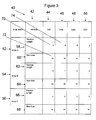
- a template 40 for development of arrays of characters for building partial keys comprises five columns and three rows subdividing into six rows.
- the first column is an attribute column 42.
- the further columns are col1 44, col2 46, col3 48 and col4 50.
- the three rows 52, 54 and 56 correspond to three separate arrays, Array A, Array B and Array C with the rows subdividign into two for the attribute column 42 and additional columns.
- For each array there are two attributes of "random length” and "mem size” which provide two separate rows for each array so that there are six subrows in total.
- the rest of the template is then made up of values corresponding to a random length or memory size for each of col1 44, col2 46, col3 48, col4 50 and array.
- cell 70 contains the number 5 which corresponds to the random length of array A col1 meaning that in the array described below col1 42 of Array A will contain character lengths for use as partial keys which are five characters long.
- Cell 72 contains value xx indicating that the number of entries in coll 42 in the generated array is up to the number of combinations of that number of characters. So in this case xx with a base 32 character system means there may be up to 10 bit combinations which is 1024 entries.
- Fig.4a is illustrated part of array A 80 built according to template 40.
- Array A 80 has four columns corresponding to col1 82 , col2 84, col3 86 and col4 88 and a large number of rows, in this example 1,024 (illustrated in alpha-numerics as UU) as defined by cell 72.
- Each row in col1 82 then contains 5 characters as defined by cell 70.
- a random generator then creates 1,024 sets of five characters randomly putting one in each row of col1 82.
- the rows 75 and 76 (in base 32) are shown to be ABCDE and 0ABDE with the rest of the rows shown blank but in fact all 1,024 will be filled.
- Col2 84 then contains a thousand and twenty four rows of characters sequences which are four characters long as defined by cell 74.
- Col3 86 and col4 88 contain a thousand and twenty four rows similarly set by the entry in the random length row 58.
- Arrays 90 and 96 are substantially the same as array A 80, except the number of characters in each column is different corresponding to the different values in the random length row 62 and row 66 from template 40.
- arrays 80, 90 and 96 are generated based on template 40 and stored in the partial key database 24.
- a specific template 40' is produced as depicted in Fig.5 .
- the specific template is substantially the same as template 40 (with the equivalent rows given the same reference number but with an added apostrophe) but additionally has two new columns.
- RA column 51 corresponds to a random array choice in which values are entered for each of array A, array B and array C rows 52, 54 and 56.
- a random number generator generates two numbers between 1 and the total number of columns containing numerical values which in this case is 4. These two random numbers arc then stored in the specific template 40' in RA column 51 as references to the columns to be used in encryption as described below.
- cell 76 contains the values 1 and 4 which will instruct the system 10 when using encryption to use col 44 and col4 50.
- Column 53 defines the start positions at which parts of keys will be embedded within the ciphertext as explained below.
- the random number generator generates two numbers for each of array, array A, array B and array C, placing them in column 53 across from rows 52, 54 and 56 respectively and picks any number between 1 and minimum length of ciphertext that will be entered.
- the specific template 40' is stored in encryption memory 28 with a task identifier identifying which task or particular information is stored about. This can be the same task identifier as that used with the master key by calculator 18 at step S110.
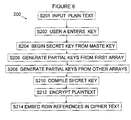
- Fig.6 is shown a flowchart 200 of the process of encrypting a row of plaintext.
- a row of plaintext is entered via plaintext input 22.
- this can be via an external system or inputting manually via user by appropriate means.
- the row of plaintext is 'Mr Smith eats his chips'.
- Step S202 may be necessary to reproduce the a master key by having each of the users enter their user keys. This step is not necessary if the master key is stored.
- step S204 the process is begun of generating a secret key for that row of plain text.
- First the master key is added which in this case is 'PATRICK'.
- step S206 the specific template 40' is used in conjunction with the partial key database 24. Starting from using column 51 and starting with row 52 a partial key is found from columns 44 and 50 as listed in cell 76.
- a random number generator then generates a number between one and one thousand and twenty four and takes the characters in that column in the row corresponding to the generated number. In this example random generator chose the number 75 and therefore picks ABCDE and adds this to the master key.
- step S208 the same is then done for array B and array C each time looking to the partial key database 24 generating random numbers between 1 and 1000 and taking the characters from a particular row corresponding to the columns listed in column 54. In this example it generates the further information ABCDEFG 1234 AB and 123.
- step S210 all these partial keys and the master key is then added together to form the secret key which in this case is PATRICKABCDE12ABCDEFG1234AB123. Since each character is equivalent to five bits this is equivalent to 150 bit key. If the key is shorter than 128bits then it can be padded to the required length in a conventional manner.
- an encryption algorithm is used on the plaintext using the secret key as the key for encryption.
- AES 128 is used. Since AES 128 requires a minimum key of 128 bits when template 40 is constructed or when specific template 40 possibility is created it is ensured that the random length of each of the columns referred to in column 54 add up to the sufficient length to generate 128 bit or greater key. Alternatively the key maybe padded to the required length in a conventional manner.
- step S214 references to the partial keys are embedded within the ciphertext.
- the start positions listed in the random array start position column 53 are used.
- the first start position is position 4 and therefore after the 4 th character which in this case is a 0 the encryption server 20 inserts an identifier corresponding to the first partial key from column 44 of array A.
- One suitable identifier is the row number which in this case was 75.
- the encryption server moves to position number 10 in the ciphertext and inserts the reference to the second partial key and continues this process for the other start positions in column 54.
- the row number is inserted within the ciphertext preferably the row number is placed in an ordered form using the same character based system as used in the number generation. So in this case we are using base 32 system such that the reference comprises both numbers and letters.
- the ciphertext with inserts will read ABC075E55D661278G7H9J5K7L 8P4M6R4D45P99H8K7B4C6XW is inserted into the ciphertext database as 26. No record of the secret key is kept.
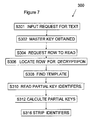
- Fig.7 is shown a flowchart process of decrypting a line of ciphertext stored in database 26.
- ciphenext equivalent to the same text given in the example above will be used.
- the User requests to read a row of ciphertext in decrypted form.
- the Master Key is obtained. The manner in which this is obtained depends on how it is stored in the process described in Process 100. If they Key was stored in the memory, then it can be taken from this, if it was displayed on a screen to a user, then the user can take it from their own human memory and enter the key via user input 23. In a preferred form however all three users representing each of user server A 12, user server B 14 and user server C 16 need to be present. Each of the representatives then enters their user keys in the same manner as they did in process 100 from this servers 12, 14 and 16 or via user input 23.
- the master key calculator then recalculates the master key from these user keys and the stored random values from Step 110.
- the master key is sent to encryption server 20 at step S304 along with a request for the row of text that is wished to be read, in the example given only one particular row is read.
- the process 200 described is repeated for each row input from the plain text input 22 with different random numbers being generated each time equivalent to two will be in the partial key database 24. It is possible to request for even more than one row at once since the master key will be the same for each.
- the required row is located either by the external system or by encryption server 20 itself and is sent to encryption server 20 for decryption.
- the decryption server 20 fnds the specific template 40'equation which was used for encryption of that row. If there is more than one specific template used then a reference to the specific template used can be embedded into the ciphered text in a similar manner to the partial keys in suitably obscure format.
- column 53 is then used to find its 6 start positions with the known length of the identifier used to read the identifier's voyage to the partial key. In this case, cell 78 tells the server 20 to go after character 4 and it therefore takes the next 4 digits which are 0075 as a partial key.
- the server 20 uses these identifiers in combination with column 51 to locate the partial keys. It uses the column reference from column 51 together with the row reference from within the ciphered text to locate the specific cell within an array in partial key database 24. In the simple examples given whereby the partial key itself is stored in the data then this step can be skipped.
- the secret key is compiled from the master key obtained at step 302 together with the partial keys calculated at step s312 from the identifiers in the ciphered text.
- the key identifiers are stripped out of the ciphered text leaving just an encrypted version of the plain text.
- the encryption given is used to decrypt the text using the compiled secret key.
- AES128 which is a symmetric key system, and therefore the secret key that is compiled is PATRICKABCDE12ABCDEFG1234 AB123 and results in the encrypted text value ABC0E55D66 being decrypted into plain text which reads " "Mr Smith eats his chips".
- steps 304-316 are repeated for the different rows using the same master key from step s302.
- identifiers for specific tasks are used for, for example the master key random number from process 100 or specific template 40' are used, the identifier can specify the exact date or maybe even time and date on which the data was entered into the system and encrypted for that task.
- a user has chosen to use a new key, new master key or new specific template for a new task, it is also possible to use an entirely new template 40 with a new set of values in the partial key database 24. Once this is done, preferably all of the previous data created in the partial key database 24 is kept.
- each row of text uses a different key and therefore even if the same row text is entered twice the ciphertext which is entered into database 26 will be entirely different. Accordingly no patterns can be detected and a hacker using computer X to access ciphertext databases 26 cannot enter dummy lines of text in order to try and look at changes in the ciphertext. Additionally if the hacker managed to work out a key for a particular row this will not be useful for any other rows. Further none of the user keys A B and C are useful in themselves for decryption and have to be used together and inserted with the encryption server 20 in combination with the partial key database 26.
- the key used requires components equating to data embedded in the ciphertext and a master key component which is unrelated to it based on user keys provided by separate users and / or stored in a separate location. Accordingly working out either the master key or the partial keys in data is not useful by themselves and both of them must be calculated before a single row can be decrypted
Landscapes
- Engineering & Computer Science (AREA)
- Theoretical Computer Science (AREA)
- Health & Medical Sciences (AREA)
- Bioethics (AREA)
- General Health & Medical Sciences (AREA)
- Computer Hardware Design (AREA)
- Computer Security & Cryptography (AREA)
- Software Systems (AREA)
- Physics & Mathematics (AREA)
- General Engineering & Computer Science (AREA)
- General Physics & Mathematics (AREA)
- Storage Device Security (AREA)
Priority Applications (4)
| Application Number | Priority Date | Filing Date | Title |
|---|---|---|---|
| EP07012286A EP2006791B1 (de) | 2007-06-22 | 2007-06-22 | Randomisierung |
| AT07012286T ATE541265T1 (de) | 2007-06-22 | 2007-06-22 | Randomisierung |
| US11/773,778 US8280061B2 (en) | 2007-06-22 | 2007-07-05 | Methods and systems for storing and retrieving encrypted data |
| PCT/GB2008/002136 WO2009001053A1 (en) | 2007-06-22 | 2008-06-23 | Randomisation |
Applications Claiming Priority (1)
| Application Number | Priority Date | Filing Date | Title |
|---|---|---|---|
| EP07012286A EP2006791B1 (de) | 2007-06-22 | 2007-06-22 | Randomisierung |
Publications (2)
| Publication Number | Publication Date |
|---|---|
| EP2006791A1 true EP2006791A1 (de) | 2008-12-24 |
| EP2006791B1 EP2006791B1 (de) | 2012-01-11 |
Family
ID=38669421
Family Applications (1)
| Application Number | Title | Priority Date | Filing Date |
|---|---|---|---|
| EP07012286A Not-in-force EP2006791B1 (de) | 2007-06-22 | 2007-06-22 | Randomisierung |
Country Status (4)
| Country | Link |
|---|---|
| US (1) | US8280061B2 (de) |
| EP (1) | EP2006791B1 (de) |
| AT (1) | ATE541265T1 (de) |
| WO (1) | WO2009001053A1 (de) |
Families Citing this family (7)
| Publication number | Priority date | Publication date | Assignee | Title |
|---|---|---|---|---|
| US8347111B2 (en) * | 2009-01-06 | 2013-01-01 | Hewlett-Packard Development Company, L.P. | Data processing apparatus |
| US20100174920A1 (en) * | 2009-01-06 | 2010-07-08 | Jonathan Peter Buckingham | Data processing apparatus |
| DE102011088502B3 (de) * | 2011-12-14 | 2013-05-08 | Siemens Aktiengesellschaft | Verfahren und Vorrichtung zur Absicherung von Blockchiffren gegen Template-Attacken |
| US9400892B2 (en) * | 2013-06-28 | 2016-07-26 | Broadcom Corporation | Apparatus and method to secure an electronic storage using a secure element |
| US9298647B2 (en) | 2014-08-25 | 2016-03-29 | HGST Netherlands B.V. | Method and apparatus to generate zero content over garbage data when encryption parameters are changed |
| US10277561B2 (en) | 2016-07-22 | 2019-04-30 | International Business Machines Corporation | Database management system shared ledger support |
| CN118821178B (zh) * | 2024-07-10 | 2025-04-11 | 上海豹云网络信息服务有限公司 | 一种数据库批量加密方法及验证方法 |
Citations (7)
| Publication number | Priority date | Publication date | Assignee | Title |
|---|---|---|---|---|
| US4375579A (en) * | 1980-01-30 | 1983-03-01 | Wisconsin Alumni Research Foundation | Database encryption and decryption circuit and method using subkeys |
| JPH11143780A (ja) * | 1997-11-05 | 1999-05-28 | Hitachi Ltd | データベースにおける秘密情報管理方法およびデータベースの秘密情報管理装置 |
| EP1089194A2 (de) * | 1999-09-30 | 2001-04-04 | Casio Computer Co., Ltd. | Gerät zur Verwaltung einer Datenbank und System zum Verschlüssen und Entschlüssen |
| EP1251423A2 (de) * | 2001-04-19 | 2002-10-23 | Hewlett-Packard Company | Zugangskontrollsystem |
| US20030039362A1 (en) * | 2001-08-24 | 2003-02-27 | Andrea Califano | Methods for indexing and storing genetic data |
| WO2006025346A1 (ja) * | 2004-08-31 | 2006-03-09 | Yamatake Corporation | 暗号化、復号化プログラム及び暗号システム |
| US20060206485A1 (en) * | 2005-03-14 | 2006-09-14 | Microsoft Corporation | Multilevel secure database |
Family Cites Families (2)
| Publication number | Priority date | Publication date | Assignee | Title |
|---|---|---|---|---|
| US6683954B1 (en) * | 1999-10-23 | 2004-01-27 | Lockstream Corporation | Key encryption using a client-unique additional key for fraud prevention |
| US7089425B2 (en) * | 2003-03-18 | 2006-08-08 | Ci4 Technologies, Inc. | Remote access authorization of local content |
-
2007
- 2007-06-22 EP EP07012286A patent/EP2006791B1/de not_active Not-in-force
- 2007-06-22 AT AT07012286T patent/ATE541265T1/de active
- 2007-07-05 US US11/773,778 patent/US8280061B2/en not_active Expired - Fee Related
-
2008
- 2008-06-23 WO PCT/GB2008/002136 patent/WO2009001053A1/en not_active Ceased
Patent Citations (8)
| Publication number | Priority date | Publication date | Assignee | Title |
|---|---|---|---|---|
| US4375579A (en) * | 1980-01-30 | 1983-03-01 | Wisconsin Alumni Research Foundation | Database encryption and decryption circuit and method using subkeys |
| JPH11143780A (ja) * | 1997-11-05 | 1999-05-28 | Hitachi Ltd | データベースにおける秘密情報管理方法およびデータベースの秘密情報管理装置 |
| EP1089194A2 (de) * | 1999-09-30 | 2001-04-04 | Casio Computer Co., Ltd. | Gerät zur Verwaltung einer Datenbank und System zum Verschlüssen und Entschlüssen |
| EP1251423A2 (de) * | 2001-04-19 | 2002-10-23 | Hewlett-Packard Company | Zugangskontrollsystem |
| US20030039362A1 (en) * | 2001-08-24 | 2003-02-27 | Andrea Califano | Methods for indexing and storing genetic data |
| WO2006025346A1 (ja) * | 2004-08-31 | 2006-03-09 | Yamatake Corporation | 暗号化、復号化プログラム及び暗号システム |
| US20070211896A1 (en) * | 2004-08-31 | 2007-09-13 | Yamatake Corporation | Encryption and decryption programs and cryptosystem |
| US20060206485A1 (en) * | 2005-03-14 | 2006-09-14 | Microsoft Corporation | Multilevel secure database |
Also Published As
| Publication number | Publication date |
|---|---|
| WO2009001053A1 (en) | 2008-12-31 |
| ATE541265T1 (de) | 2012-01-15 |
| EP2006791B1 (de) | 2012-01-11 |
| US8280061B2 (en) | 2012-10-02 |
| US20080317251A1 (en) | 2008-12-25 |
Similar Documents
| Publication | Publication Date | Title |
|---|---|---|
| US9489521B2 (en) | Format preserving encryption methods for data strings with constraints | |
| CN110337649B (zh) | 用于搜索模式未察觉的动态对称可搜索加密的方法和系统 | |
| US7864952B2 (en) | Data processing systems with format-preserving encryption and decryption engines | |
| US8429720B2 (en) | Method and apparatus for camouflaging of data, information and functional transformations | |
| EP2006791B1 (de) | Randomisierung | |
| US9208491B2 (en) | Format-preserving cryptographic systems | |
| US8949625B2 (en) | Systems for structured encryption using embedded information in data strings | |
| US20140108813A1 (en) | Data processing systems with format-preserving encryption and decryption engines | |
| US8600048B1 (en) | Format-translating encryption systems | |
| Xu et al. | Applications of cryptography in database: a review | |
| US7269736B2 (en) | Distributed cryptographic methods and arrangements | |
| US20130339252A1 (en) | Format-preserving cryptographic systems | |
| EP1374464B1 (de) | Verfahren und vorrichtung zum tarnen von daten, informationen und funktionstransformationen | |
| CN101512525A (zh) | 加密的数据搜索 | |
| JP2001507837A (ja) | データを安全に格納する方法及び装置 | |
| Rao et al. | R-PEKS: RBAC enabled PEKS for secure access of cloud data | |
| CN101887713A (zh) | 字库的加密方法及装置 | |
| CN101149768B (zh) | 一种专用处理器软件的加密和解密方法 | |
| US20090316887A1 (en) | Database encryption and query method keeping order within bucket partially | |
| CN113965314B (zh) | 同态加密处理方法及相关设备 | |
| KR100910303B1 (ko) | 가변코드 테이블을 이용한 데이터 암복호화 장치 및 그 방법 | |
| CN111526000B (zh) | 一种基于混淆模投影的并行部分同态加密方法和系统 | |
| CN117807614A (zh) | 基于cp-abe的机器人数据安全保护方法、系统及介质 | |
| JP2005167794A (ja) | 秘密情報保管方法及び装置、秘密情報復元方法及び装置、秘密情報保管プログラム並びに秘密情報復元プログラム。 | |
| Schroeder | Pad and Chaff: secure approximate string matching in private record linkage |
Legal Events
| Date | Code | Title | Description |
|---|---|---|---|
| PUAI | Public reference made under article 153(3) epc to a published international application that has entered the european phase |
Free format text: ORIGINAL CODE: 0009012 |
|
| 17P | Request for examination filed |
Effective date: 20081110 |
|
| AK | Designated contracting states |
Kind code of ref document: A1 Designated state(s): AT BE BG CH CY CZ DE DK EE ES FI FR GB GR HU IE IS IT LI LT LU LV MC MT NL PL PT RO SE SI SK TR |
|
| AX | Request for extension of the european patent |
Extension state: AL BA HR MK RS |
|
| 17Q | First examination report despatched |
Effective date: 20090804 |
|
| AKX | Designation fees paid |
Designated state(s): AT BE BG CH CY CZ DE DK EE ES FI FR GB GR HU IE IS IT LI LT LU LV MC MT NL PL PT RO SE SI SK TR |
|
| GRAP | Despatch of communication of intention to grant a patent |
Free format text: ORIGINAL CODE: EPIDOSNIGR1 |
|
| GRAS | Grant fee paid |
Free format text: ORIGINAL CODE: EPIDOSNIGR3 |
|
| GRAA | (expected) grant |
Free format text: ORIGINAL CODE: 0009210 |
|
| AK | Designated contracting states |
Kind code of ref document: B1 Designated state(s): AT BE BG CH CY CZ DE DK EE ES FI FR GB GR HU IE IS IT LI LT LU LV MC MT NL PL PT RO SE SI SK TR |
|
| REG | Reference to a national code |
Ref country code: GB Ref legal event code: FG4D |
|
| REG | Reference to a national code |
Ref country code: CH Ref legal event code: EP |
|
| REG | Reference to a national code |
Ref country code: AT Ref legal event code: REF Ref document number: 541265 Country of ref document: AT Kind code of ref document: T Effective date: 20120115 |
|
| REG | Reference to a national code |
Ref country code: IE Ref legal event code: FG4D |
|
| REG | Reference to a national code |
Ref country code: DE Ref legal event code: R096 Ref document number: 602007019909 Country of ref document: DE Effective date: 20120315 |
|
| REG | Reference to a national code |
Ref country code: NL Ref legal event code: VDEP Effective date: 20120111 |
|
| PG25 | Lapsed in a contracting state [announced via postgrant information from national office to epo] |
Ref country code: SI Free format text: LAPSE BECAUSE OF FAILURE TO SUBMIT A TRANSLATION OF THE DESCRIPTION OR TO PAY THE FEE WITHIN THE PRESCRIBED TIME-LIMIT Effective date: 20120111 |
|
| LTIE | Lt: invalidation of european patent or patent extension |
Effective date: 20120111 |
|
| PG25 | Lapsed in a contracting state [announced via postgrant information from national office to epo] |
Ref country code: BG Free format text: LAPSE BECAUSE OF FAILURE TO SUBMIT A TRANSLATION OF THE DESCRIPTION OR TO PAY THE FEE WITHIN THE PRESCRIBED TIME-LIMIT Effective date: 20120411 Ref country code: LT Free format text: LAPSE BECAUSE OF FAILURE TO SUBMIT A TRANSLATION OF THE DESCRIPTION OR TO PAY THE FEE WITHIN THE PRESCRIBED TIME-LIMIT Effective date: 20120111 Ref country code: BE Free format text: LAPSE BECAUSE OF FAILURE TO SUBMIT A TRANSLATION OF THE DESCRIPTION OR TO PAY THE FEE WITHIN THE PRESCRIBED TIME-LIMIT Effective date: 20120111 Ref country code: IS Free format text: LAPSE BECAUSE OF FAILURE TO SUBMIT A TRANSLATION OF THE DESCRIPTION OR TO PAY THE FEE WITHIN THE PRESCRIBED TIME-LIMIT Effective date: 20120511 Ref country code: NL Free format text: LAPSE BECAUSE OF FAILURE TO SUBMIT A TRANSLATION OF THE DESCRIPTION OR TO PAY THE FEE WITHIN THE PRESCRIBED TIME-LIMIT Effective date: 20120111 |
|
| PG25 | Lapsed in a contracting state [announced via postgrant information from national office to epo] |
Ref country code: FI Free format text: LAPSE BECAUSE OF FAILURE TO SUBMIT A TRANSLATION OF THE DESCRIPTION OR TO PAY THE FEE WITHIN THE PRESCRIBED TIME-LIMIT Effective date: 20120111 Ref country code: LV Free format text: LAPSE BECAUSE OF FAILURE TO SUBMIT A TRANSLATION OF THE DESCRIPTION OR TO PAY THE FEE WITHIN THE PRESCRIBED TIME-LIMIT Effective date: 20120111 Ref country code: GR Free format text: LAPSE BECAUSE OF FAILURE TO SUBMIT A TRANSLATION OF THE DESCRIPTION OR TO PAY THE FEE WITHIN THE PRESCRIBED TIME-LIMIT Effective date: 20120412 Ref country code: PL Free format text: LAPSE BECAUSE OF FAILURE TO SUBMIT A TRANSLATION OF THE DESCRIPTION OR TO PAY THE FEE WITHIN THE PRESCRIBED TIME-LIMIT Effective date: 20120111 Ref country code: PT Free format text: LAPSE BECAUSE OF FAILURE TO SUBMIT A TRANSLATION OF THE DESCRIPTION OR TO PAY THE FEE WITHIN THE PRESCRIBED TIME-LIMIT Effective date: 20120511 |
|
| REG | Reference to a national code |
Ref country code: AT Ref legal event code: MK05 Ref document number: 541265 Country of ref document: AT Kind code of ref document: T Effective date: 20120111 |
|
| PG25 | Lapsed in a contracting state [announced via postgrant information from national office to epo] |
Ref country code: CY Free format text: LAPSE BECAUSE OF FAILURE TO SUBMIT A TRANSLATION OF THE DESCRIPTION OR TO PAY THE FEE WITHIN THE PRESCRIBED TIME-LIMIT Effective date: 20120111 |
|
| PG25 | Lapsed in a contracting state [announced via postgrant information from national office to epo] |
Ref country code: DK Free format text: LAPSE BECAUSE OF FAILURE TO SUBMIT A TRANSLATION OF THE DESCRIPTION OR TO PAY THE FEE WITHIN THE PRESCRIBED TIME-LIMIT Effective date: 20120111 Ref country code: SE Free format text: LAPSE BECAUSE OF FAILURE TO SUBMIT A TRANSLATION OF THE DESCRIPTION OR TO PAY THE FEE WITHIN THE PRESCRIBED TIME-LIMIT Effective date: 20120111 Ref country code: CZ Free format text: LAPSE BECAUSE OF FAILURE TO SUBMIT A TRANSLATION OF THE DESCRIPTION OR TO PAY THE FEE WITHIN THE PRESCRIBED TIME-LIMIT Effective date: 20120111 Ref country code: RO Free format text: LAPSE BECAUSE OF FAILURE TO SUBMIT A TRANSLATION OF THE DESCRIPTION OR TO PAY THE FEE WITHIN THE PRESCRIBED TIME-LIMIT Effective date: 20120111 Ref country code: EE Free format text: LAPSE BECAUSE OF FAILURE TO SUBMIT A TRANSLATION OF THE DESCRIPTION OR TO PAY THE FEE WITHIN THE PRESCRIBED TIME-LIMIT Effective date: 20120111 |
|
| PLBE | No opposition filed within time limit |
Free format text: ORIGINAL CODE: 0009261 |
|
| STAA | Information on the status of an ep patent application or granted ep patent |
Free format text: STATUS: NO OPPOSITION FILED WITHIN TIME LIMIT |
|
| PG25 | Lapsed in a contracting state [announced via postgrant information from national office to epo] |
Ref country code: SK Free format text: LAPSE BECAUSE OF FAILURE TO SUBMIT A TRANSLATION OF THE DESCRIPTION OR TO PAY THE FEE WITHIN THE PRESCRIBED TIME-LIMIT Effective date: 20120111 Ref country code: IT Free format text: LAPSE BECAUSE OF FAILURE TO SUBMIT A TRANSLATION OF THE DESCRIPTION OR TO PAY THE FEE WITHIN THE PRESCRIBED TIME-LIMIT Effective date: 20120111 |
|
| 26N | No opposition filed |
Effective date: 20121012 |
|
| PG25 | Lapsed in a contracting state [announced via postgrant information from national office to epo] |
Ref country code: MC Free format text: LAPSE BECAUSE OF NON-PAYMENT OF DUE FEES Effective date: 20120630 Ref country code: AT Free format text: LAPSE BECAUSE OF FAILURE TO SUBMIT A TRANSLATION OF THE DESCRIPTION OR TO PAY THE FEE WITHIN THE PRESCRIBED TIME-LIMIT Effective date: 20120111 |
|
| REG | Reference to a national code |
Ref country code: CH Ref legal event code: PL |
|
| REG | Reference to a national code |
Ref country code: DE Ref legal event code: R097 Ref document number: 602007019909 Country of ref document: DE Effective date: 20121012 |
|
| REG | Reference to a national code |
Ref country code: CH Ref legal event code: PL |
|
| REG | Reference to a national code |
Ref country code: IE Ref legal event code: MM4A |
|
| PG25 | Lapsed in a contracting state [announced via postgrant information from national office to epo] |
Ref country code: IE Free format text: LAPSE BECAUSE OF NON-PAYMENT OF DUE FEES Effective date: 20120622 Ref country code: LI Free format text: LAPSE BECAUSE OF NON-PAYMENT OF DUE FEES Effective date: 20120630 Ref country code: CH Free format text: LAPSE BECAUSE OF NON-PAYMENT OF DUE FEES Effective date: 20120630 Ref country code: ES Free format text: LAPSE BECAUSE OF FAILURE TO SUBMIT A TRANSLATION OF THE DESCRIPTION OR TO PAY THE FEE WITHIN THE PRESCRIBED TIME-LIMIT Effective date: 20120422 |
|
| PG25 | Lapsed in a contracting state [announced via postgrant information from national office to epo] |
Ref country code: MT Free format text: LAPSE BECAUSE OF FAILURE TO SUBMIT A TRANSLATION OF THE DESCRIPTION OR TO PAY THE FEE WITHIN THE PRESCRIBED TIME-LIMIT Effective date: 20120111 |
|
| PG25 | Lapsed in a contracting state [announced via postgrant information from national office to epo] |
Ref country code: TR Free format text: LAPSE BECAUSE OF FAILURE TO SUBMIT A TRANSLATION OF THE DESCRIPTION OR TO PAY THE FEE WITHIN THE PRESCRIBED TIME-LIMIT Effective date: 20120111 |
|
| REG | Reference to a national code |
Ref country code: GB Ref legal event code: 732E Free format text: REGISTERED BETWEEN 20140417 AND 20140423 |
|
| REG | Reference to a national code |
Ref country code: FR Ref legal event code: GC Effective date: 20140409 |
|
| PG25 | Lapsed in a contracting state [announced via postgrant information from national office to epo] |
Ref country code: LU Free format text: LAPSE BECAUSE OF NON-PAYMENT OF DUE FEES Effective date: 20120622 |
|
| REG | Reference to a national code |
Ref country code: DE Ref legal event code: R079 Ref document number: 602007019909 Country of ref document: DE Free format text: PREVIOUS MAIN CLASS: G06F0021240000 Ipc: G06F0021000000 |
|
| PG25 | Lapsed in a contracting state [announced via postgrant information from national office to epo] |
Ref country code: HU Free format text: LAPSE BECAUSE OF FAILURE TO SUBMIT A TRANSLATION OF THE DESCRIPTION OR TO PAY THE FEE WITHIN THE PRESCRIBED TIME-LIMIT Effective date: 20070622 |
|
| PGFP | Annual fee paid to national office [announced via postgrant information from national office to epo] |
Ref country code: GB Payment date: 20140627 Year of fee payment: 8 |
|
| REG | Reference to a national code |
Ref country code: DE Ref legal event code: R079 Ref document number: 602007019909 Country of ref document: DE Free format text: PREVIOUS MAIN CLASS: G06F0021240000 Ipc: G06F0021000000 Effective date: 20140701 |
|
| PGFP | Annual fee paid to national office [announced via postgrant information from national office to epo] |
Ref country code: DE Payment date: 20140627 Year of fee payment: 8 |
|
| PGFP | Annual fee paid to national office [announced via postgrant information from national office to epo] |
Ref country code: FR Payment date: 20140627 Year of fee payment: 8 |
|
| REG | Reference to a national code |
Ref country code: DE Ref legal event code: R119 Ref document number: 602007019909 Country of ref document: DE |
|
| GBPC | Gb: european patent ceased through non-payment of renewal fee |
Effective date: 20150622 |
|
| REG | Reference to a national code |
Ref country code: FR Ref legal event code: ST Effective date: 20160229 |
|
| PG25 | Lapsed in a contracting state [announced via postgrant information from national office to epo] |
Ref country code: GB Free format text: LAPSE BECAUSE OF NON-PAYMENT OF DUE FEES Effective date: 20150622 Ref country code: DE Free format text: LAPSE BECAUSE OF NON-PAYMENT OF DUE FEES Effective date: 20160101 |
|
| PG25 | Lapsed in a contracting state [announced via postgrant information from national office to epo] |
Ref country code: FR Free format text: LAPSE BECAUSE OF NON-PAYMENT OF DUE FEES Effective date: 20150630 |