EP2007329B1 - Nasendilatator - Google Patents
Nasendilatator Download PDFInfo
- Publication number
- EP2007329B1 EP2007329B1 EP07732342.6A EP07732342A EP2007329B1 EP 2007329 B1 EP2007329 B1 EP 2007329B1 EP 07732342 A EP07732342 A EP 07732342A EP 2007329 B1 EP2007329 B1 EP 2007329B1
- Authority
- EP
- European Patent Office
- Prior art keywords
- limb
- dilator
- nasal
- limbs
- nasal dilator
- Prior art date
- Legal status (The legal status is an assumption and is not a legal conclusion. Google has not performed a legal analysis and makes no representation as to the accuracy of the status listed.)
- Not-in-force
Links
- 210000003928 nasal cavity Anatomy 0.000 claims description 24
- 230000010339 dilation Effects 0.000 claims description 9
- 239000000463 material Substances 0.000 claims description 9
- 210000004872 soft tissue Anatomy 0.000 claims description 6
- DHKHKXVYLBGOIT-UHFFFAOYSA-N acetaldehyde Diethyl Acetal Natural products CCOC(C)OCC DHKHKXVYLBGOIT-UHFFFAOYSA-N 0.000 claims description 5
- 125000002777 acetyl group Chemical class [H]C([H])([H])C(*)=O 0.000 claims description 5
- -1 polyethylene Polymers 0.000 claims description 4
- 239000004677 Nylon Substances 0.000 claims description 2
- 239000004698 Polyethylene Substances 0.000 claims description 2
- 239000004743 Polypropylene Substances 0.000 claims description 2
- 229920001778 nylon Polymers 0.000 claims description 2
- 239000004033 plastic Substances 0.000 claims description 2
- 229920003023 plastic Polymers 0.000 claims description 2
- 229920000573 polyethylene Polymers 0.000 claims description 2
- 229920001155 polypropylene Polymers 0.000 claims description 2
- 230000001419 dependent effect Effects 0.000 claims 1
- 210000003414 extremity Anatomy 0.000 description 107
- 210000001331 nose Anatomy 0.000 description 13
- 238000003780 insertion Methods 0.000 description 10
- 230000037431 insertion Effects 0.000 description 10
- 210000003097 mucus Anatomy 0.000 description 9
- 206010028735 Nasal congestion Diseases 0.000 description 7
- 238000000034 method Methods 0.000 description 6
- 239000000126 substance Substances 0.000 description 3
- 210000001519 tissue Anatomy 0.000 description 3
- 230000008901 benefit Effects 0.000 description 2
- 230000001684 chronic effect Effects 0.000 description 2
- 238000010276 construction Methods 0.000 description 2
- 239000002537 cosmetic Substances 0.000 description 2
- 210000003141 lower extremity Anatomy 0.000 description 2
- 238000004519 manufacturing process Methods 0.000 description 2
- 238000000465 moulding Methods 0.000 description 2
- 210000000492 nasalseptum Anatomy 0.000 description 2
- WYWIFABBXFUGLM-UHFFFAOYSA-N oxymetazoline Chemical compound CC1=CC(C(C)(C)C)=C(O)C(C)=C1CC1=NCCN1 WYWIFABBXFUGLM-UHFFFAOYSA-N 0.000 description 2
- 239000004417 polycarbonate Substances 0.000 description 2
- 229920000515 polycarbonate Polymers 0.000 description 2
- 230000029058 respiratory gaseous exchange Effects 0.000 description 2
- 210000002345 respiratory system Anatomy 0.000 description 2
- 230000028327 secretion Effects 0.000 description 2
- 108090000790 Enzymes Proteins 0.000 description 1
- 102000004190 Enzymes Human genes 0.000 description 1
- 206010016059 Facial pain Diseases 0.000 description 1
- 206010019233 Headaches Diseases 0.000 description 1
- 206010019280 Heart failures Diseases 0.000 description 1
- 206010021143 Hypoxia Diseases 0.000 description 1
- 108060003951 Immunoglobulin Proteins 0.000 description 1
- 206010061218 Inflammation Diseases 0.000 description 1
- 102000015728 Mucins Human genes 0.000 description 1
- 108010063954 Mucins Proteins 0.000 description 1
- 102000016943 Muramidase Human genes 0.000 description 1
- 108010014251 Muramidase Proteins 0.000 description 1
- 108010062010 N-Acetylmuramoyl-L-alanine Amidase Proteins 0.000 description 1
- 206010041235 Snoring Diseases 0.000 description 1
- 210000003484 anatomy Anatomy 0.000 description 1
- 230000002421 anti-septic effect Effects 0.000 description 1
- QVGXLLKOCUKJST-UHFFFAOYSA-N atomic oxygen Chemical compound [O] QVGXLLKOCUKJST-UHFFFAOYSA-N 0.000 description 1
- 238000005452 bending Methods 0.000 description 1
- 230000000903 blocking effect Effects 0.000 description 1
- 208000030303 breathing problems Diseases 0.000 description 1
- 210000000845 cartilage Anatomy 0.000 description 1
- 239000000084 colloidal system Substances 0.000 description 1
- 238000012790 confirmation Methods 0.000 description 1
- 208000027744 congestion Diseases 0.000 description 1
- 239000000850 decongestant Substances 0.000 description 1
- 229940124581 decongestants Drugs 0.000 description 1
- 238000011161 development Methods 0.000 description 1
- 201000010099 disease Diseases 0.000 description 1
- 208000037265 diseases, disorders, signs and symptoms Diseases 0.000 description 1
- 210000005069 ears Anatomy 0.000 description 1
- 229920001971 elastomer Polymers 0.000 description 1
- 239000000806 elastomer Substances 0.000 description 1
- 229940088598 enzyme Drugs 0.000 description 1
- 230000001815 facial effect Effects 0.000 description 1
- 210000002175 goblet cell Anatomy 0.000 description 1
- 230000007954 hypoxia Effects 0.000 description 1
- 102000018358 immunoglobulin Human genes 0.000 description 1
- 229940072221 immunoglobulins Drugs 0.000 description 1
- 208000015181 infectious disease Diseases 0.000 description 1
- 230000004054 inflammatory process Effects 0.000 description 1
- 238000001746 injection moulding Methods 0.000 description 1
- 229960000274 lysozyme Drugs 0.000 description 1
- 235000010335 lysozyme Nutrition 0.000 description 1
- 239000004325 lysozyme Substances 0.000 description 1
- 238000012986 modification Methods 0.000 description 1
- 230000004048 modification Effects 0.000 description 1
- 229940051875 mucins Drugs 0.000 description 1
- 210000004400 mucous membrane Anatomy 0.000 description 1
- 230000003843 mucus production Effects 0.000 description 1
- 201000009240 nasopharyngitis Diseases 0.000 description 1
- 229910052760 oxygen Inorganic materials 0.000 description 1
- 239000001301 oxygen Substances 0.000 description 1
- 229960001528 oxymetazoline Drugs 0.000 description 1
- 230000035790 physiological processes and functions Effects 0.000 description 1
- 230000000284 resting effect Effects 0.000 description 1
- 230000000717 retained effect Effects 0.000 description 1
- 150000003839 salts Chemical class 0.000 description 1
- 230000003248 secreting effect Effects 0.000 description 1
- 201000002859 sleep apnea Diseases 0.000 description 1
- 208000024891 symptom Diseases 0.000 description 1
- 238000012546 transfer Methods 0.000 description 1
- 230000001052 transient effect Effects 0.000 description 1
- 239000005526 vasoconstrictor agent Substances 0.000 description 1
- XLYOFNOQVPJJNP-UHFFFAOYSA-N water Substances O XLYOFNOQVPJJNP-UHFFFAOYSA-N 0.000 description 1
Images




Classifications
-
- A—HUMAN NECESSITIES
- A61—MEDICAL OR VETERINARY SCIENCE; HYGIENE
- A61F—FILTERS IMPLANTABLE INTO BLOOD VESSELS; PROSTHESES; DEVICES PROVIDING PATENCY TO, OR PREVENTING COLLAPSING OF, TUBULAR STRUCTURES OF THE BODY, e.g. STENTS; ORTHOPAEDIC, NURSING OR CONTRACEPTIVE DEVICES; FOMENTATION; TREATMENT OR PROTECTION OF EYES OR EARS; BANDAGES, DRESSINGS OR ABSORBENT PADS; FIRST-AID KITS
- A61F5/00—Orthopaedic methods or devices for non-surgical treatment of bones or joints; Nursing devices ; Anti-rape devices
- A61F5/01—Orthopaedic devices, e.g. long-term immobilising or pressure directing devices for treating broken or deformed bones such as splints, casts or braces
- A61F5/08—Devices for correcting deformities of the nose ; Devices for enlarging the nostril, e.g. for breathing improvement
-
- A—HUMAN NECESSITIES
- A61—MEDICAL OR VETERINARY SCIENCE; HYGIENE
- A61F—FILTERS IMPLANTABLE INTO BLOOD VESSELS; PROSTHESES; DEVICES PROVIDING PATENCY TO, OR PREVENTING COLLAPSING OF, TUBULAR STRUCTURES OF THE BODY, e.g. STENTS; ORTHOPAEDIC, NURSING OR CONTRACEPTIVE DEVICES; FOMENTATION; TREATMENT OR PROTECTION OF EYES OR EARS; BANDAGES, DRESSINGS OR ABSORBENT PADS; FIRST-AID KITS
- A61F5/00—Orthopaedic methods or devices for non-surgical treatment of bones or joints; Nursing devices ; Anti-rape devices
- A61F5/56—Devices for preventing snoring
Definitions
- the present invention relates to a nasal dilator, in particular but not exclusively, to nasal dilators that can improve inhalation and exhalation through the nose and thereby alleviate problems associated with chronic or temporary nasal congestion. Additionally, the invention relates to methods of inserting the nasal dilator into the nose and the treatment of chronic or temporary nasal congestion.
- Mucus is a viscous colloid made by goblet cells in the mucous membranes of the nose.
- Mucus contains antiseptic enzymes (such as lysozyme), immunoglobulins, mucins and inorganic salts suspended in water.
- antiseptic enzymes such as lysozyme
- immunoglobulins such as lysozyme
- mucins mucins
- Mucus In the respiratory system, it catches foreign matter and tries to prevent it from entering the body.
- Mucus is normally secreted in only one nostril at a time, and the nostril secreting the mucus changes about every 4 to 6 hours.
- mucus has important physiological functions, abnormally increased mucus production in the respiratory tract is problematic and is a symptom of many common diseases, such as the common cold.
- the presence of mucus in the nose and throat is normal, but increased quantities can impede comfortable breathing.
- Nasal congestion is the blockage of the nasal passages and is usually due to excessive secretion of mucus. As mucus is usually secreted in one nostril at a time, it is normal to have only a single nostril blocked at any one time. Nasal congestion has many causes and can range from a mild annoyance to a life-threatening condition. Nasal congestion can interfere with the ears, hearing, and speech development. Significant congestion may interfere with sleep, cause snoring, can be associated with sleep apnea, can result in insufficient oxygen levels and hypoxia, as well as right-sided heart failure. A blocked nose can also causes mild facial and head pain.
- the anatomical structure of the human nose contributes to the difficulties experienced when breathing.
- the lower internal portion of each nostril known as the vestibule
- the ostium intemum which defines the opening of the nasal air passage defined by the isthmus nasi (running from 1.65 to 2.65 cm from the nostril, and is typically about 0.3 cm in diameter). It is this narrowed portion of the nose that can become blocked with mucus.
- the ostium internum (located about 1 to 1,5cm from the nostril) is an orifice whose pear-shaped format, visualized under anterior rhinoscopy, is laterally limited by the inferior border of lateral superior cartilage, medially to the nasal septum and inferiorly to the floor of the nasal cavity.
- Chemical decongestants such as pseudoephidrine and oxymetazoline, are commonly used to clear nasal decongestion. These chemicals work by reducing inflammation of the nasal cavity and acting as vasoconstrictors. However, where possible, it is not desirable to use such chemical interventions as they can be associated with harmful side affects.
- Cage or stent like devices have also been used to combat nasal decongestion, see for example US Patent No. 4,414,977 .
- Such devices work by acting as fixed volume dilators and are placed inside the nostril.
- these dilators are not capable of expanding the breadth of the nasal cavity passed the fixed volume, are uncomfortable to wear, and difficult to retrieve after use.
- Nasal dilators are known that include a pair of outwardly biased opposing limbs that are designed for inserting one limb into each nostril (see, for example, British Patent Publication No. 2 330 079 ). Such devices expand the outermost fleshy portion of the vestibule of the nose which can be uncomfortable and may result in a transient or even permanent stretching of that tissue, which can be undesirable for cosmetic reasons. Additionally, as both nostrils are being dilated at the same time, each nostril cannot be optimally dilated. There is a finite amount of tissue forming the nostril, which is capable of a finite amount of stretch, and so if both nostrils are being stretched in two opposing directions optimum dilation of each nostril is not possible.
- WO 99/55404 describes a device for inserting into the human nose.
- the device is characterised by at least one elastically deformable, plate-like base element with an inside and an outside and an essentially rectangular shape. In the device's unstressed state, said base element is essentially flat or slightly bent.
- FR2419711 describes a nasal dilator for insertion in a nostril.
- the nasal dilator comprises two opposing limbs joined at a bridge.
- the nasal dilators are used in pairs, each nasal dilator being inserted, bridge first, into a nostril such that the ends of the limbs dilate the vestibule area of the nostril.
- a nasal dilator comprising at least two opposing limbs that are biased apart and that are configured so as to be capable of being inserted simultaneously into a single nostril.
- Such a construction may be created by moulding (e.g. injection moulding) the device so as to leave the mould with the at least two opposing limbs connected by a resiliently deformable bridge configuration.
- the dilator is arranged such that the deformable bridge is adjacent an end of each limb.
- the limbs extend from the bridge in substantially the same direction.
- the limbs diverge as they extend away from the bridge. Divergence of the limbs ensures the optimum dilation of the nasal passage without extending the nostril entrance.
- the dilator may be formed from a length of material comprising a notch, around which the length of material may be bent so as to form the resiliently deformable bridge.
- the length of material extending from the notch defining the limbs.
- the thickness of the limbs taper from the thickest point at the bridge.
- the diameter of each limb at its thickest point is less than 0.3, 0.25, 0.2 or 0.1 cm.
- All limbs are preferably of equal length, and so maintain equal pressure on the nasal cavity from each limb and so prevent any torsional forces.
- each limb is preferably more than 1, 1.5, 2 or 2.5 cm in length.
- the nasal dilator further comprises a cushioned portion provided on each limb.
- the cushioned portions may be provided, at or towards the end of each limb that is furthest removed from the bridge. It has been found that cushioned portions that mould or are shaped to the contours of the nasal cavity are most comfortable, for example concaved pads. Concaved pads are preferred as they match the contours of the nasal cavity and provide only limited obstruction to the airway.
- the cushioned portions may be provided directly onto the limbs or may provided on a stalk that laterally extends from the end of the limb that is furthest removed from the bridge.
- the stalk may be off reduced thickness to the rest of the limb so that the outer surface of the limb and the cushioned portion can be continuous.
- the cushioned portion maybe sleeves.
- the cushioned portions may be bonded to the stalks or limbs or maybe moulded onto the stalks or limbs.
- the stalks or limbs may include a projecting portion to retain the cushioned pads thereon.
- the dilator may include at least one stop means associated with at least one limb and configured such that the dilator cannot be inserted into the nasal cavity passed the stop means.
- the stop means preferably extends laterally from at least one limb.
- the stop means may alternatively be formed by at least one laterally extending kink in the at least one limb. In such a confirmation the bend or kink along the otherwise substantially straight limb can block the insertion of the dilator passed the kink in the limb.
- Two kinks may be provided on one limb with a finger grip portion defined by the portion of the limb provided between the kinks.
- the stop means may also act as a finger grip portion.
- the stop means may be formed integrally with at least one limb.
- the stop means preferably extends more than 1 cm from the limb, or the kink extends more than 1 cm from the line of the limb. It is preferred that each limb extends more than 1.5, 2 or 2.5 cm from the stop means to the end of each limb that is furthest removed from the bridge. Preferably the same stop means is provided in all limbs.
- An alternative or additional safety feature that could be included in the present invention is an elbow bend in at least one limb. Such a bend in the limb prevents the insertion of the dilator passed the point in the limb of the bend.
- the elbow defines an angle in the limb of substantially 90° and/or the same elbow bend is provided in all limbs.
- the dilator in order to spread the outward pressure from the dilator and optimise the dilation of the nasal cavity the dilator may be provided with a plurality of limbs, for example, 2, 3, 4, 5 or more limbs.
- the limbs are preferably equally biased away from each other.
- Embodiments of the present invention may be configured for use during the day, when a device extending from the nose is not desired, for cosmetic reasons.
- the limbs and resiliently deformable bridge may be configured, when in use, so as to be entirely housed within the nasal cavity.
- the resiliently deformable bridge may take the form of a horse shoe with each limb extending in a perpendicular manner therefrom.
- the horse shoe shaped bridge may be shaped so as to mirror the shape of the internal nasal cavity.
- the resiliently deformable bridge may be formed from a first and second resiliently deformable u-bend that are connected by a third resiliently deformable u-bend, wherein the third resiliently deformable u-bend is inverted in relation to the first and second deformable u-bends, i.e. the resiliently deformable bridge takes a "M" shape.
- the nasal dilator may comprise a passageway through which air can flow.
- the passageway may be associated with the nasal dilator in a number of ways, for example, the passageway can be associated with a limb from the bridge or attached directly to the bridge.
- the passageway may be a tubular member. Such a tubular member can be moveably retained on a limb.
- the passageway can be rotatably mounted and/or made of a flexible material and/or a mesh.
- the limb associated with the passageway may extend further from the bridge than the other limbs.
- it preferably includes a mesh provided at its end furthest removed from the bridge.
- the dilator should be made of a light material so that it may be easily worn in the nose without causing any discomfort.
- the nasal dilator is preferably less than 1, 0.5 or 0.25 g in weight.
- the nasal dilator may be made from synthetic plastics, such as nylon, polyethylene, polypropylene, or any combination thereof. Such a dilator can be cheaply made by integral moulding.
- the nasal dilator comprises acetal, most preferably medical grade acetal.
- Acetal is advantageous because it has good shape memory and nasal dilators of specific tensions can be manufactured. Acetal is also very resistant to bending fatigue.
- the nasal dilator comprises polycarbonate.
- Polycarbonate lends itself to being adjusted by the user to a preferred tension.
- the dilator is preferably disposable.
- a method of inserting a nasal dilator comprising the steps of urging together opposing limbs of a dilator that comprises at least two biased apart limbs so as to reduce the profile of the dilator, passing all limbs of the reduced profile dilator in through a single nostril, and releasing the limbs such that they spring apart providing an outward dilation of the single nostril.
- the dilator is preferably passed through the nostril until they may perform an outward dilation of the nostril at the soft tissue surrounding the ostium internum.
- the step of passing the limbs in through a single nostril comprises inserting the limbs such that a plane through the limbs is substantially parallel to the nasal septum.
- the step of passing the limbs in through a single nostril comprises rotating the nasal dilator such that the plane through the limbs is substantially perpendicular to the septum.
- the limbs Preferably, once the limbs are released the limbs outwardly dilate a side of the nostril away from the septum.
- the method may include a first step of locating the unblocked nostril for inserting the dilator into. This can simply be achieved by the user closing one nostril and exhaling through the open nostril, if exhalation is difficult then the open nostril is congested. Alternatively, the method may involve inserting one dilator into each nostril.
- the method may be used to maintain an open airway and may therefore make it easier for the user to achieve the state of sleep.
- the method may be used to treat nasal congestion.
- the dilator used in the second aspect of the present invention is any one of the dilators described in the first aspect of the present invention.
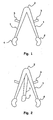
- the nasal dilator of the present invention as illustrated in Figure 1 , comprises a pair of opposing limbs (1) that are connected by a resiliently deformable bridge (2).
- a spar (3) extends laterally from each limb (1) and concave pads (4) are provided at the end of each limb (1) that is furthest removed from the bridge (2).
- the spars (3) engage with the outer portion of the nostril during insertion of the dilator into the nostril, thereby preventing insertion passed the point on the limb (1) from where the spars (3) extend.
- FIG. 2 A further embodiment of the nasal dilator of the present invention can be seen in Figure 2 .
- This embodiment is similar to the embodiment shown in figure 1 , but has three limbs (1). Each limb (1) is equally biased, and so spaced, apart.
- each limb includes two kinks (5) at the portion of each limb that is closest to the bridge (2). Between these kinks (5) is defined a grip portion (6) that is sized so as to be suitable to accommodate a finger tip. In use, the user may grip the dilator between two fingers, each finger resting in the grip portion (6).
- the kinks (5) engage with the outer portion of the nostril during insertion of the dilator into the nostril, thereby preventing insertion passed the point on the limb (1) from where the kink (5) that is furthest removed from the bridge (2) is formed.
- FIG. 4 A further embodiment of the nasal dilator of the present invention can be seen in Figure 4 .
- This embodiment is similar to the embodiment shown in figure 3 , but has three limbs (1). Each limb (1) is equally biased, and so spaced, apart.
- the limbs (1) include identical 90 degree bends (7) in the portion of each limb (1) towards the bridge (2).
- the limbs (1) include protrusions (8) that laterally extend from the end of each limb (1) that is furthest removed from the bridge (2).
- the protrusions (8) laterally extend away from the protrusion (8) on the opposing limb (1).
- Concave pads are provided at the end of each lateral protrusion.
- the portion of the limb (1) that extends from the 90 degree bend (7) to the bridge (2) engages with the outer portion of the nostril during insertion of the dilator into the nostril, thereby preventing insertion passed the 90 degree bend (7).
- the outward bias of the limbs (1) urges the concave pads (4) towards the soft tissue within the nasal cavity that surrounds the ostium internum.
- FIG. 6 A further embodiment of the nasal dilator of the present invention can be seen in Figure 6 .
- the deformable bridge (2) is not formed from a u-bend, like earlier embodiments, but is instead provided in the shape of a horse shoe.
- a limb (1) extends in a perpendicular manner from the horse shoe shaped bridge (2) at each of the portions provided towards the free ends of the horse shoe (2).
- the horse shoe bridge (2) is resiliently deformable, in use, it may be squeezed between two fingers, thereby narrowing the profile of the horse shoe (2) and bringing the limbs (1) closer together. In such a squeezed configuration, the dilator may easily pass entirely into the nasal cavity.
- the bridge (2) When the pressure applied to the bridge (2) is removed, once the dilator has been inserted into the nasal cavity, the bridge (2) is able to return to its original shape which conforms to the shape of the interior of the nasal cavity and the outward bias of the limbs (1) urges the concave pads (4) towards the soft tissue within the nasal cavity that surrounds the ostium internum.
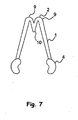
- FIG. 7 A further embodiment of the nasal dilator of the present invention can be seen in Figure 7 .
- the deformable bridge (2) is formed from a first and second resiliently deformable u-bend (9)that are connected by a third resiliently deformable u-bend (10), which is inverted in relation to the first and second deformable bridge (10).
- the bridge (2) takes the form of an "M”.
- the configurations permit the dilator to be entirely housed within the nasal cavity.
- FIG. 8 A further embodiment of the nasal dilator of the present invention can be seen in Figure 8 .
- This embodiment is similar to the embodiment illustrated in Figure 3 , but includes a longer limb (11) that extends further than the other two limbs (1).
- This longer limb (11) includes a tube (12) rotatably mounted around a portion of the longer limb (11).
- the tube (12) is made from a mesh.
- the dilator can be inserted into the nostril in much the same manner as described for Figure 3 above, however, the third limb (11) is inserted passed the ostium internum and into the isthmus nasi.
- the tube When inserted, the tube is positioned in the isthmus nasi and forces the walls of this cavity apart thereby defining a passageway through which air can travel. This is assisted by the outwardly biased limbs (1).
- the longer limb (11) and the tube (12) are flexible, enabling them to be configured to the shape of the nasal passageway.
- the tube (12) can move longitudinally and rotate on the third limb (11) so as to be positioned in at the appropriate position along the longer limb (11).
- FIG. 9 shows a still further embodiment of the present invention with combined spars (3) and grip portions (18).
- each limb (1) defines a reduced lower limb section (1a, shown in broken outline) over which cushioned sleeves (20) can be positioned.
- the cushioned sleeves (20) are moulded out of a soft elastomer and are bonded to the reduced limb sections (1a) to provide a continuous outer limb surface (22).
- the cushioned sleeves (20) define a rounded end (24) to assist in easing the dilator into the nasal cavity with minimum discomfort to the wearer.
- FIG 10 shows an embodiment of the present invention with a notched bridge (2).
- the bridge (2) of the dilator bends around a notch (26) located at the midpoint of the bridge (2).
- the bridge (2) also includes opposing kinks (5) which prevent over insertion over the dilator into the nasal cavity.
- the kinks (5) also define grip portions (18).
- the lower ends of the reduced limb portions (1a) define projections (28).
- cushioned sleeves (20) are moulded over the lower limb portions (1a), the projections (28) being provided to prevent the cushioned sleeves (20) from slipping off.
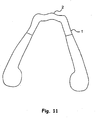
- Figure 11 shows an embodiment of the present invention with a reduced profile.
- the bridge (2) is fairly flat so that the dilator can be inserted fully into the nose and worn more discreetly.
- the user When using the above devices, the user will first determine which one of the nasal passageways that is blocked by physically closing one nostril by pinching it with ones fingers and exhaling through the remaining open nasal passageway. If it is difficult to exhale through the open passageway then this passageway is congested. If exhalation is easy then this is the nostril in which the dilator is to be inserted in the above mentioned manner.
Landscapes
- Health & Medical Sciences (AREA)
- Otolaryngology (AREA)
- Pulmonology (AREA)
- Nursing (AREA)
- Orthopedic Medicine & Surgery (AREA)
- Engineering & Computer Science (AREA)
- Biomedical Technology (AREA)
- Heart & Thoracic Surgery (AREA)
- Vascular Medicine (AREA)
- Life Sciences & Earth Sciences (AREA)
- Animal Behavior & Ethology (AREA)
- General Health & Medical Sciences (AREA)
- Public Health (AREA)
- Veterinary Medicine (AREA)
- Orthopedics, Nursing, And Contraception (AREA)
Claims (15)
- Nasaldilator, der dafür gestaltet ist, in ein einzelnes Nasenloch eingeführt zu werden, wobei der Nasaldilator mindestens zwei gegenüberliegende Glieder (1) umfasst, die auseinandergespannt sind und die dafür gestaltet sind, gleichzeitig in ein einzelnes Nasenloch eingeführt werden zu können, wobei die Glieder (1), sobald sie eingeführt sind, ein Auswärtsdehnen am Weichgewebe des Nasenlochs, welches das Ostium internum umgibt, ausführen, dadurch gekennzeichnet, dass die gegenüberliegenden Glieder (1) durch eine elastisch verformbare Brücke (2) verbunden sind, wobei sich die Dicke der Glieder (1) vom dicksten Punkt an der Brücke (2) aus verjüngt.
- Nasaldilator nach Anspruch 1, wobei der Dilator derart geformt ist, dass mindestens zwei gegenüberliegende Glieder (1) gebildet sind, die durch die verformbare Brücke (2) verbunden sind.
- Nasaldilator nach Anspruch 1, der aus einer Materiallänge gebildet ist, die eine Kerbstelle umfasst, um welche die Materiallänge gebogen werden kann, sodass die elastisch verformbare Brücke (2) gebildet wird, wobei die Materiallängen, die sich von der Kerbstelle aus erstrecken, die Glieder (1) definieren.
- Nasaldilator nach einem der vorhergehenden Ansprüche, ferner einen gepolsterten Abschnitt umfassend, der an jedem Glied (1) bereitgestellt ist, wobei der gepolsterte Abschnitt an jedem Glied (1) oder hin zum Ende jeden Gliedes (1) bereitgestellt ist, das am weitesten von der Brücke (2) entfernt ist.
- Nasaldilator nach einem der vorhergehenden Ansprüche, wobei die Glieder (1) und die elastisch verformbare Brücke (2) dafür gestaltet sind, sich während des Gebrauchs vollständig in der Nasenhöhle zu befinden.
- Nasaldilator nach Anspruch 5, wobei die elastisch verformbare Brücke (2) aus einem ersten und einem zweiten elastisch verformbaren U-Bogen (9) gebildet ist, die durch einen dritten elastisch verformbaren U-Bogen (10) verbunden sind, wobei die dritte elastisch verformbare Brücke (2) im Verhältnis zur ersten und zweiten verformbaren Brücke (2) umgekehrt liegt.
- Nasaldilator nach einem der Ansprüche 1 bis 4, ferner mindestens ein Stoppmittel umfassend, das mit mindestens einem Glied (1) verbunden und derart gestaltet ist, dass der Dilator nicht über das Stoppmittel hinaus in den Nasenraum eingeführt werden kann.
- Nasaldilator nach Anspruch 7, wobei mindestens ein Stoppmittel einstückig mit dem mindestens einen Glied (1) gebildet ist und wobei das Stoppmittel aus einem sich zur Seite erstreckenden Knick (5) in mindestens einem Glied (1) gebildet ist.
- Nasaldilator nach einem der vorhergehenden Ansprüche, wobei jedes Glied (1) mehr als 1, 1,5, 2 oder 2,5 cm lang ist und, wenn abhängig von Anspruch 7 oder 8, sich jedes Glied (1) um mehr als 1,5, 2 oder 2,5 cm vom Stoppmittel bis zum von der Brücke (2) weiter entfernten Ende jeden Gliedes (1) erstreckt.
- Nasaldilator nach einem der vorhergehenden Ansprüche, wobei jedes Glied (1) weniger als 0,3, 0,25, 0,2 oder 0,1 cm dick ist.
- Nasaldilator nach einem der vorhergehenden Ansprüche, ferner einen Durchlassweg umfassend, durch den Luft strömen kann.
- Nasaldilator nach Anspruch 11, wobei der Durchlassweg mit einem Glied (1) verbunden ist und/oder wobei der Durchlassweg und/oder das Glied (1), das mit dem Durchlassweg verbunden ist, aus einem flexiblen Material hergestellt ist/sind.
- Nasaldilator nach einem der vorhergehenden Ansprüche, der weniger als 1 g, 0,5 g oder 0,25 g wiegt.
- Nasaldilator nach einem der vorhergehenden Ansprüche, der aus einem synthetischen Kunststoff hergestellt ist, der aus Nylon, Polyethylen, Polypropylen oder einer Kombination daraus oder aus Acetal ausgewählt ist.
- Nasaldilator nach Anspruch 7 oder 8, wobei das mindestens eine Stoppmittel einen Griffabschnitt (6) umfasst.
Applications Claiming Priority (2)
| Application Number | Priority Date | Filing Date | Title |
|---|---|---|---|
| GBGB0606669.0A GB0606669D0 (en) | 2006-04-03 | 2006-04-03 | Nasal Dilator |
| PCT/GB2007/001298 WO2007113586A1 (en) | 2006-04-03 | 2007-04-03 | Nasal dilator |
Publications (2)
| Publication Number | Publication Date |
|---|---|
| EP2007329A1 EP2007329A1 (de) | 2008-12-31 |
| EP2007329B1 true EP2007329B1 (de) | 2013-07-17 |
Family
ID=36425143
Family Applications (1)
| Application Number | Title | Priority Date | Filing Date |
|---|---|---|---|
| EP07732342.6A Not-in-force EP2007329B1 (de) | 2006-04-03 | 2007-04-03 | Nasendilatator |
Country Status (5)
| Country | Link |
|---|---|
| US (1) | US20100030252A1 (de) |
| EP (1) | EP2007329B1 (de) |
| JP (1) | JP2009532159A (de) |
| GB (1) | GB0606669D0 (de) |
| WO (1) | WO2007113586A1 (de) |
Families Citing this family (12)
| Publication number | Priority date | Publication date | Assignee | Title |
|---|---|---|---|---|
| USD652143S1 (en) * | 2006-05-22 | 2012-01-10 | Thomas Brown | Multi-layer internal nasal dilator with tubular expanders and compound delivery protrusions |
| EP2222359A4 (de) * | 2007-12-05 | 2014-03-12 | Svip 7 Llc | Vorrichtungen und verfahren zur behandlung von atemstörungen im schlaf |
| AU2010248992B2 (en) * | 2009-05-15 | 2014-11-27 | Intersect Ent, Inc. | Expandable devices and methods therefor |
| US9381332B2 (en) * | 2009-10-30 | 2016-07-05 | Brian Judd | Nasal dilator |
| EP3120888A1 (de) | 2010-03-05 | 2017-01-25 | seven dreamers laboratories, Inc. | Nasenhohlraum-einführungsvorrichtungshalterung und nasenhohlraum-einführungsvorrichtungssatz damit |
| US20110230829A1 (en) * | 2010-03-19 | 2011-09-22 | Fitzgerald Patrick J | Arterial Tamponade Device and Method |
| US20110230907A1 (en) * | 2010-03-19 | 2011-09-22 | Sinocclusive Llc | Arterial tamponade device and method |
| US9775738B2 (en) * | 2011-11-14 | 2017-10-03 | Robert Andre | Nasal dilator and use thereof |
| WO2014151963A2 (en) | 2013-03-14 | 2014-09-25 | Intersect Ent, Inc. | Systems, devices, and method for treating a sinus condition |
| CA158527S (en) | 2014-03-07 | 2015-05-18 | Seven Dreamers Lab Inc | Nasal airway tube |
| LT3102275T (lt) * | 2014-03-21 | 2020-05-11 | Nasal Medical Limited | Nosies dilatatorius |
| USD1117746S1 (en) * | 2025-04-09 | 2026-03-10 | Job Santoyo | Insertable nasal device |
Family Cites Families (14)
| Publication number | Priority date | Publication date | Assignee | Title |
|---|---|---|---|---|
| US513458A (en) * | 1894-01-23 | Nasal expander | ||
| US1034123A (en) * | 1911-09-15 | 1912-07-30 | Annie C Knowlson | Nostril-expander. |
| US1743993A (en) * | 1928-11-26 | 1930-01-14 | Lawrence D Washington | Nasal distender |
| US4120302A (en) * | 1976-10-08 | 1978-10-17 | American Hospital Supply Corporation | Disposable pads for surgical instruments |
| FR2419711A1 (fr) * | 1978-03-13 | 1979-10-12 | Gardin Andre | Dispositif destine a etre introduit a l'interieur des narines afin d'en permettre l'elargissement |
| US4414977A (en) * | 1981-07-20 | 1983-11-15 | Wisconsin Alumni Research Foundation | Nasal dilator |
| US4759365A (en) * | 1987-03-27 | 1988-07-26 | Leo Askinazy | Spring coil wire device |
| US5816241A (en) * | 1995-09-29 | 1998-10-06 | Cook; Lori Irene | Coiled nasal dilator |
| US5931852A (en) * | 1997-06-04 | 1999-08-03 | Brennan; H. George | Nose airway device |
| US6270512B1 (en) * | 1998-01-22 | 2001-08-07 | Jean V Rittmann | Internal nasal dilator |
| DE19980731D2 (de) * | 1998-04-30 | 2001-05-10 | Siemens & Co Quellenprodukte | Vorrichtung zum Einsetzen in die menschliche Nase |
| ES1040491Y (es) * | 1998-05-22 | 1999-08-16 | Guerra Navas Antonio | Dispositivo anatomico nasal para ampliar la capacidad respiratoria. |
| US7390331B2 (en) * | 2001-05-22 | 2008-06-24 | Sanostec Corp | Nasal inserts |
| FR2872054B1 (fr) * | 2004-06-28 | 2007-03-02 | Alexandre Yazdi | Dilatateur nasal |
-
2006
- 2006-04-03 GB GBGB0606669.0A patent/GB0606669D0/en not_active Ceased
-
2007
- 2007-04-03 JP JP2009503660A patent/JP2009532159A/ja active Pending
- 2007-04-03 US US12/295,773 patent/US20100030252A1/en not_active Abandoned
- 2007-04-03 WO PCT/GB2007/001298 patent/WO2007113586A1/en not_active Ceased
- 2007-04-03 EP EP07732342.6A patent/EP2007329B1/de not_active Not-in-force
Also Published As
| Publication number | Publication date |
|---|---|
| GB0606669D0 (en) | 2006-05-10 |
| JP2009532159A (ja) | 2009-09-10 |
| WO2007113586A1 (en) | 2007-10-11 |
| US20100030252A1 (en) | 2010-02-04 |
| EP2007329A1 (de) | 2008-12-31 |
Similar Documents
| Publication | Publication Date | Title |
|---|---|---|
| EP2007329B1 (de) | Nasendilatator | |
| JP7667359B2 (ja) | 患者インターフェースのためのヘッドギア | |
| US4414977A (en) | Nasal dilator | |
| US12458522B2 (en) | Nasal dilator apparatus | |
| US6386197B1 (en) | Nasal air passageway opening device | |
| US10085873B2 (en) | Nasal congestion and obstruction relief and breathing assist devices | |
| AU2005266235B2 (en) | Nasal dilator and uses thereof | |
| EP2112937B1 (de) | Nasenmaske | |
| CN110075405B (zh) | 鼻罩系统 | |
| US20030089371A1 (en) | Breathing assistance apparatus | |
| AU765265B2 (en) | An improved breathing assistance apparatus | |
| EP2734149B1 (de) | Vorrichtungen und verfahren zur behandlung von atemstörungen im schlaf | |
| JP2018501918A (ja) | ガス送達装置 | |
| US6328754B1 (en) | Nasal dilator | |
| US20060266367A1 (en) | Nasal dilator | |
| KR101969677B1 (ko) | 비강확장기를 갖는 코마스크 | |
| JP7177553B2 (ja) | いびき防止装置 | |
| WO2012127193A1 (en) | Breathing device | |
| US20160235577A1 (en) | Nasal dilator | |
| EP1175189A1 (de) | Vorrichtung zur verbesserung des atmens und zur verhinderung des schnarchens | |
| US11918502B2 (en) | Bi-flow nasal stent | |
| KR102470587B1 (ko) | 비강 확장기 | |
| KR20230169004A (ko) | 코골이감소 비강확장기 | |
| WO2025181525A1 (en) | Nasal dilator |
Legal Events
| Date | Code | Title | Description |
|---|---|---|---|
| PUAI | Public reference made under article 153(3) epc to a published international application that has entered the european phase |
Free format text: ORIGINAL CODE: 0009012 |
|
| 17P | Request for examination filed |
Effective date: 20081031 |
|
| AK | Designated contracting states |
Kind code of ref document: A1 Designated state(s): AT BE BG CH CY CZ DE DK EE ES FI FR GB GR HU IE IS IT LI LT LU LV MC MT NL PL PT RO SE SI SK TR |
|
| AX | Request for extension of the european patent |
Extension state: AL BA HR MK RS |
|
| 17Q | First examination report despatched |
Effective date: 20100128 |
|
| GRAP | Despatch of communication of intention to grant a patent |
Free format text: ORIGINAL CODE: EPIDOSNIGR1 |
|
| DAX | Request for extension of the european patent (deleted) | ||
| GRAP | Despatch of communication of intention to grant a patent |
Free format text: ORIGINAL CODE: EPIDOSNIGR1 |
|
| GRAS | Grant fee paid |
Free format text: ORIGINAL CODE: EPIDOSNIGR3 |
|
| GRAA | (expected) grant |
Free format text: ORIGINAL CODE: 0009210 |
|
| AK | Designated contracting states |
Kind code of ref document: B1 Designated state(s): AT BE BG CH CY CZ DE DK EE ES FI FR GB GR HU IE IS IT LI LT LU LV MC MT NL PL PT RO SE SI SK TR |
|
| REG | Reference to a national code |
Ref country code: GB Ref legal event code: FG4D |
|
| REG | Reference to a national code |
Ref country code: CH Ref legal event code: EP |
|
| REG | Reference to a national code |
Ref country code: IE Ref legal event code: FG4D |
|
| REG | Reference to a national code |
Ref country code: AT Ref legal event code: REF Ref document number: 621695 Country of ref document: AT Kind code of ref document: T Effective date: 20130815 |
|
| REG | Reference to a national code |
Ref country code: DE Ref legal event code: R096 Ref document number: 602007031693 Country of ref document: DE Effective date: 20130912 |
|
| REG | Reference to a national code |
Ref country code: NL Ref legal event code: T3 |
|
| REG | Reference to a national code |
Ref country code: AT Ref legal event code: MK05 Ref document number: 621695 Country of ref document: AT Kind code of ref document: T Effective date: 20130717 |
|
| REG | Reference to a national code |
Ref country code: LT Ref legal event code: MG4D |
|
| PG25 | Lapsed in a contracting state [announced via postgrant information from national office to epo] |
Ref country code: AT Free format text: LAPSE BECAUSE OF FAILURE TO SUBMIT A TRANSLATION OF THE DESCRIPTION OR TO PAY THE FEE WITHIN THE PRESCRIBED TIME-LIMIT Effective date: 20130717 Ref country code: BE Free format text: LAPSE BECAUSE OF FAILURE TO SUBMIT A TRANSLATION OF THE DESCRIPTION OR TO PAY THE FEE WITHIN THE PRESCRIBED TIME-LIMIT Effective date: 20130717 Ref country code: PT Free format text: LAPSE BECAUSE OF FAILURE TO SUBMIT A TRANSLATION OF THE DESCRIPTION OR TO PAY THE FEE WITHIN THE PRESCRIBED TIME-LIMIT Effective date: 20131118 Ref country code: IS Free format text: LAPSE BECAUSE OF FAILURE TO SUBMIT A TRANSLATION OF THE DESCRIPTION OR TO PAY THE FEE WITHIN THE PRESCRIBED TIME-LIMIT Effective date: 20131117 Ref country code: CY Free format text: LAPSE BECAUSE OF FAILURE TO SUBMIT A TRANSLATION OF THE DESCRIPTION OR TO PAY THE FEE WITHIN THE PRESCRIBED TIME-LIMIT Effective date: 20130619 Ref country code: SE Free format text: LAPSE BECAUSE OF FAILURE TO SUBMIT A TRANSLATION OF THE DESCRIPTION OR TO PAY THE FEE WITHIN THE PRESCRIBED TIME-LIMIT Effective date: 20130717 Ref country code: LT Free format text: LAPSE BECAUSE OF FAILURE TO SUBMIT A TRANSLATION OF THE DESCRIPTION OR TO PAY THE FEE WITHIN THE PRESCRIBED TIME-LIMIT Effective date: 20130717 |
|
| PG25 | Lapsed in a contracting state [announced via postgrant information from national office to epo] |
Ref country code: FI Free format text: LAPSE BECAUSE OF FAILURE TO SUBMIT A TRANSLATION OF THE DESCRIPTION OR TO PAY THE FEE WITHIN THE PRESCRIBED TIME-LIMIT Effective date: 20130717 Ref country code: ES Free format text: LAPSE BECAUSE OF FAILURE TO SUBMIT A TRANSLATION OF THE DESCRIPTION OR TO PAY THE FEE WITHIN THE PRESCRIBED TIME-LIMIT Effective date: 20131028 Ref country code: SI Free format text: LAPSE BECAUSE OF FAILURE TO SUBMIT A TRANSLATION OF THE DESCRIPTION OR TO PAY THE FEE WITHIN THE PRESCRIBED TIME-LIMIT Effective date: 20130717 Ref country code: GR Free format text: LAPSE BECAUSE OF FAILURE TO SUBMIT A TRANSLATION OF THE DESCRIPTION OR TO PAY THE FEE WITHIN THE PRESCRIBED TIME-LIMIT Effective date: 20131018 Ref country code: PL Free format text: LAPSE BECAUSE OF FAILURE TO SUBMIT A TRANSLATION OF THE DESCRIPTION OR TO PAY THE FEE WITHIN THE PRESCRIBED TIME-LIMIT Effective date: 20130717 Ref country code: LV Free format text: LAPSE BECAUSE OF FAILURE TO SUBMIT A TRANSLATION OF THE DESCRIPTION OR TO PAY THE FEE WITHIN THE PRESCRIBED TIME-LIMIT Effective date: 20130717 |
|
| PG25 | Lapsed in a contracting state [announced via postgrant information from national office to epo] |
Ref country code: CY Free format text: LAPSE BECAUSE OF FAILURE TO SUBMIT A TRANSLATION OF THE DESCRIPTION OR TO PAY THE FEE WITHIN THE PRESCRIBED TIME-LIMIT Effective date: 20130717 |
|
| PG25 | Lapsed in a contracting state [announced via postgrant information from national office to epo] |
Ref country code: DK Free format text: LAPSE BECAUSE OF FAILURE TO SUBMIT A TRANSLATION OF THE DESCRIPTION OR TO PAY THE FEE WITHIN THE PRESCRIBED TIME-LIMIT Effective date: 20130717 Ref country code: RO Free format text: LAPSE BECAUSE OF FAILURE TO SUBMIT A TRANSLATION OF THE DESCRIPTION OR TO PAY THE FEE WITHIN THE PRESCRIBED TIME-LIMIT Effective date: 20130717 Ref country code: CZ Free format text: LAPSE BECAUSE OF FAILURE TO SUBMIT A TRANSLATION OF THE DESCRIPTION OR TO PAY THE FEE WITHIN THE PRESCRIBED TIME-LIMIT Effective date: 20130717 Ref country code: SK Free format text: LAPSE BECAUSE OF FAILURE TO SUBMIT A TRANSLATION OF THE DESCRIPTION OR TO PAY THE FEE WITHIN THE PRESCRIBED TIME-LIMIT Effective date: 20130717 Ref country code: EE Free format text: LAPSE BECAUSE OF FAILURE TO SUBMIT A TRANSLATION OF THE DESCRIPTION OR TO PAY THE FEE WITHIN THE PRESCRIBED TIME-LIMIT Effective date: 20130717 |
|
| PLBE | No opposition filed within time limit |
Free format text: ORIGINAL CODE: 0009261 |
|
| STAA | Information on the status of an ep patent application or granted ep patent |
Free format text: STATUS: NO OPPOSITION FILED WITHIN TIME LIMIT |
|
| PG25 | Lapsed in a contracting state [announced via postgrant information from national office to epo] |
Ref country code: IT Free format text: LAPSE BECAUSE OF FAILURE TO SUBMIT A TRANSLATION OF THE DESCRIPTION OR TO PAY THE FEE WITHIN THE PRESCRIBED TIME-LIMIT Effective date: 20130717 |
|
| 26N | No opposition filed |
Effective date: 20140422 |
|
| REG | Reference to a national code |
Ref country code: DE Ref legal event code: R097 Ref document number: 602007031693 Country of ref document: DE Effective date: 20140422 |
|
| REG | Reference to a national code |
Ref country code: NL Ref legal event code: V1 Effective date: 20141101 |
|
| PG25 | Lapsed in a contracting state [announced via postgrant information from national office to epo] |
Ref country code: MC Free format text: LAPSE BECAUSE OF FAILURE TO SUBMIT A TRANSLATION OF THE DESCRIPTION OR TO PAY THE FEE WITHIN THE PRESCRIBED TIME-LIMIT Effective date: 20130717 Ref country code: LU Free format text: LAPSE BECAUSE OF FAILURE TO SUBMIT A TRANSLATION OF THE DESCRIPTION OR TO PAY THE FEE WITHIN THE PRESCRIBED TIME-LIMIT Effective date: 20140403 |
|
| REG | Reference to a national code |
Ref country code: CH Ref legal event code: PL |
|
| PG25 | Lapsed in a contracting state [announced via postgrant information from national office to epo] |
Ref country code: LI Free format text: LAPSE BECAUSE OF NON-PAYMENT OF DUE FEES Effective date: 20140430 Ref country code: CH Free format text: LAPSE BECAUSE OF NON-PAYMENT OF DUE FEES Effective date: 20140430 |
|
| PG25 | Lapsed in a contracting state [announced via postgrant information from national office to epo] |
Ref country code: NL Free format text: LAPSE BECAUSE OF NON-PAYMENT OF DUE FEES Effective date: 20141101 |
|
| PGFP | Annual fee paid to national office [announced via postgrant information from national office to epo] |
Ref country code: IE Payment date: 20150129 Year of fee payment: 9 |
|
| PG25 | Lapsed in a contracting state [announced via postgrant information from national office to epo] |
Ref country code: MT Free format text: LAPSE BECAUSE OF FAILURE TO SUBMIT A TRANSLATION OF THE DESCRIPTION OR TO PAY THE FEE WITHIN THE PRESCRIBED TIME-LIMIT Effective date: 20130717 |
|
| REG | Reference to a national code |
Ref country code: FR Ref legal event code: PLFP Year of fee payment: 10 |
|
| PG25 | Lapsed in a contracting state [announced via postgrant information from national office to epo] |
Ref country code: BG Free format text: LAPSE BECAUSE OF FAILURE TO SUBMIT A TRANSLATION OF THE DESCRIPTION OR TO PAY THE FEE WITHIN THE PRESCRIBED TIME-LIMIT Effective date: 20130717 |
|
| PG25 | Lapsed in a contracting state [announced via postgrant information from national office to epo] |
Ref country code: HU Free format text: LAPSE BECAUSE OF FAILURE TO SUBMIT A TRANSLATION OF THE DESCRIPTION OR TO PAY THE FEE WITHIN THE PRESCRIBED TIME-LIMIT; INVALID AB INITIO Effective date: 20070403 Ref country code: TR Free format text: LAPSE BECAUSE OF FAILURE TO SUBMIT A TRANSLATION OF THE DESCRIPTION OR TO PAY THE FEE WITHIN THE PRESCRIBED TIME-LIMIT Effective date: 20130717 |
|
| REG | Reference to a national code |
Ref country code: IE Ref legal event code: MM4A |
|
| REG | Reference to a national code |
Ref country code: FR Ref legal event code: PLFP Year of fee payment: 11 |
|
| PG25 | Lapsed in a contracting state [announced via postgrant information from national office to epo] |
Ref country code: IE Free format text: LAPSE BECAUSE OF NON-PAYMENT OF DUE FEES Effective date: 20160403 |
|
| REG | Reference to a national code |
Ref country code: FR Ref legal event code: PLFP Year of fee payment: 12 |
|
| PGFP | Annual fee paid to national office [announced via postgrant information from national office to epo] |
Ref country code: FR Payment date: 20190225 Year of fee payment: 13 |
|
| PGFP | Annual fee paid to national office [announced via postgrant information from national office to epo] |
Ref country code: DE Payment date: 20190227 Year of fee payment: 13 |
|
| PGFP | Annual fee paid to national office [announced via postgrant information from national office to epo] |
Ref country code: GB Payment date: 20200217 Year of fee payment: 14 |
|
| REG | Reference to a national code |
Ref country code: DE Ref legal event code: R119 Ref document number: 602007031693 Country of ref document: DE |
|
| PG25 | Lapsed in a contracting state [announced via postgrant information from national office to epo] |
Ref country code: DE Free format text: LAPSE BECAUSE OF NON-PAYMENT OF DUE FEES Effective date: 20201103 Ref country code: FR Free format text: LAPSE BECAUSE OF NON-PAYMENT OF DUE FEES Effective date: 20200430 |
|
| GBPC | Gb: european patent ceased through non-payment of renewal fee |
Effective date: 20210403 |
|
| PG25 | Lapsed in a contracting state [announced via postgrant information from national office to epo] |
Ref country code: GB Free format text: LAPSE BECAUSE OF NON-PAYMENT OF DUE FEES Effective date: 20210403 |