EP2007920B1 - Composition de conditionnement de surface, procédé de préparation de cette composition et procédé de conditionnement de surface - Google Patents
Composition de conditionnement de surface, procédé de préparation de cette composition et procédé de conditionnement de surface Download PDFInfo
- Publication number
- EP2007920B1 EP2007920B1 EP07741656.8A EP07741656A EP2007920B1 EP 2007920 B1 EP2007920 B1 EP 2007920B1 EP 07741656 A EP07741656 A EP 07741656A EP 2007920 B1 EP2007920 B1 EP 2007920B1
- Authority
- EP
- European Patent Office
- Prior art keywords
- surface conditioning
- particles
- conditioning composition
- zinc
- compound
- Prior art date
- Legal status (The legal status is an assumption and is not a legal conclusion. Google has not performed a legal analysis and makes no representation as to the accuracy of the status listed.)
- Active
Links
Images


Classifications
-
- C—CHEMISTRY; METALLURGY
- C23—COATING METALLIC MATERIAL; COATING MATERIAL WITH METALLIC MATERIAL; CHEMICAL SURFACE TREATMENT; DIFFUSION TREATMENT OF METALLIC MATERIAL; COATING BY VACUUM EVAPORATION, BY SPUTTERING, BY ION IMPLANTATION OR BY CHEMICAL VAPOUR DEPOSITION, IN GENERAL; INHIBITING CORROSION OF METALLIC MATERIAL OR INCRUSTATION IN GENERAL
- C23C—COATING METALLIC MATERIAL; COATING MATERIAL WITH METALLIC MATERIAL; SURFACE TREATMENT OF METALLIC MATERIAL BY DIFFUSION INTO THE SURFACE, BY CHEMICAL CONVERSION OR SUBSTITUTION; COATING BY VACUUM EVAPORATION, BY SPUTTERING, BY ION IMPLANTATION OR BY CHEMICAL VAPOUR DEPOSITION, IN GENERAL
- C23C22/00—Chemical surface treatment of metallic material by reaction of the surface with a reactive liquid, leaving reaction products of surface material in the coating, e.g. conversion coatings, passivation of metals
- C23C22/78—Pretreatment of the material to be coated
-
- C—CHEMISTRY; METALLURGY
- C09—DYES; PAINTS; POLISHES; NATURAL RESINS; ADHESIVES; COMPOSITIONS NOT OTHERWISE PROVIDED FOR; APPLICATIONS OF MATERIALS NOT OTHERWISE PROVIDED FOR
- C09D—COATING COMPOSITIONS, e.g. PAINTS, VARNISHES OR LACQUERS; FILLING PASTES; CHEMICAL PAINT OR INK REMOVERS; INKS; CORRECTING FLUIDS; WOODSTAINS; PASTES OR SOLIDS FOR COLOURING OR PRINTING; USE OF MATERIALS THEREFOR
- C09D5/00—Coating compositions, e.g. paints, varnishes or lacquers, characterised by their physical nature or the effects produced; Filling pastes
- C09D5/002—Priming paints
-
- C—CHEMISTRY; METALLURGY
- C09—DYES; PAINTS; POLISHES; NATURAL RESINS; ADHESIVES; COMPOSITIONS NOT OTHERWISE PROVIDED FOR; APPLICATIONS OF MATERIALS NOT OTHERWISE PROVIDED FOR
- C09D—COATING COMPOSITIONS, e.g. PAINTS, VARNISHES OR LACQUERS; FILLING PASTES; CHEMICAL PAINT OR INK REMOVERS; INKS; CORRECTING FLUIDS; WOODSTAINS; PASTES OR SOLIDS FOR COLOURING OR PRINTING; USE OF MATERIALS THEREFOR
- C09D5/00—Coating compositions, e.g. paints, varnishes or lacquers, characterised by their physical nature or the effects produced; Filling pastes
- C09D5/08—Anti-corrosive paints
- C09D5/10—Anti-corrosive paints containing metal dust
- C09D5/106—Anti-corrosive paints containing metal dust containing Zn
-
- C—CHEMISTRY; METALLURGY
- C23—COATING METALLIC MATERIAL; COATING MATERIAL WITH METALLIC MATERIAL; CHEMICAL SURFACE TREATMENT; DIFFUSION TREATMENT OF METALLIC MATERIAL; COATING BY VACUUM EVAPORATION, BY SPUTTERING, BY ION IMPLANTATION OR BY CHEMICAL VAPOUR DEPOSITION, IN GENERAL; INHIBITING CORROSION OF METALLIC MATERIAL OR INCRUSTATION IN GENERAL
- C23C—COATING METALLIC MATERIAL; COATING MATERIAL WITH METALLIC MATERIAL; SURFACE TREATMENT OF METALLIC MATERIAL BY DIFFUSION INTO THE SURFACE, BY CHEMICAL CONVERSION OR SUBSTITUTION; COATING BY VACUUM EVAPORATION, BY SPUTTERING, BY ION IMPLANTATION OR BY CHEMICAL VAPOUR DEPOSITION, IN GENERAL
- C23C22/00—Chemical surface treatment of metallic material by reaction of the surface with a reactive liquid, leaving reaction products of surface material in the coating, e.g. conversion coatings, passivation of metals
- C23C22/05—Chemical surface treatment of metallic material by reaction of the surface with a reactive liquid, leaving reaction products of surface material in the coating, e.g. conversion coatings, passivation of metals using aqueous solutions
- C23C22/60—Chemical surface treatment of metallic material by reaction of the surface with a reactive liquid, leaving reaction products of surface material in the coating, e.g. conversion coatings, passivation of metals using aqueous solutions using alkaline aqueous solutions with pH greater than 8
-
- C—CHEMISTRY; METALLURGY
- C23—COATING METALLIC MATERIAL; COATING MATERIAL WITH METALLIC MATERIAL; CHEMICAL SURFACE TREATMENT; DIFFUSION TREATMENT OF METALLIC MATERIAL; COATING BY VACUUM EVAPORATION, BY SPUTTERING, BY ION IMPLANTATION OR BY CHEMICAL VAPOUR DEPOSITION, IN GENERAL; INHIBITING CORROSION OF METALLIC MATERIAL OR INCRUSTATION IN GENERAL
- C23C—COATING METALLIC MATERIAL; COATING MATERIAL WITH METALLIC MATERIAL; SURFACE TREATMENT OF METALLIC MATERIAL BY DIFFUSION INTO THE SURFACE, BY CHEMICAL CONVERSION OR SUBSTITUTION; COATING BY VACUUM EVAPORATION, BY SPUTTERING, BY ION IMPLANTATION OR BY CHEMICAL VAPOUR DEPOSITION, IN GENERAL
- C23C22/00—Chemical surface treatment of metallic material by reaction of the surface with a reactive liquid, leaving reaction products of surface material in the coating, e.g. conversion coatings, passivation of metals
- C23C22/05—Chemical surface treatment of metallic material by reaction of the surface with a reactive liquid, leaving reaction products of surface material in the coating, e.g. conversion coatings, passivation of metals using aqueous solutions
- C23C22/68—Chemical surface treatment of metallic material by reaction of the surface with a reactive liquid, leaving reaction products of surface material in the coating, e.g. conversion coatings, passivation of metals using aqueous solutions using aqueous solutions with pH between 6 and 8
Definitions
- the present invention relates to a surface conditioning composition and a method for producing the same, and a surface conditioning method.
- Automotive bodies, home electric appliances and the like have been manufactured with metal materials such as steel sheets, galvanized steel sheets, and aluminum alloys.
- a treatment such as coating is carried out.
- a treatment using phosphate is generally carried out.
- a surface conditioning treatment is generally carried out as a pretreatment for allowing fine and dense phosphate crystals to be deposited on the metal material surface.
- Examples of known surface conditioning compositions for use in such a surface conditioning treatment include treatment liquids containing titanium phosphate particles referred to as a Jernstedt salt, or bivalent or trivalent metal phosphate particles.
- a surface conditioning composition which includes phosphate particles of at least one kind of bivalent or trivalent metals having a particle diameter of 5 ⁇ m or less, and an alkali metal salt or ammonium salt, or a mixture thereof, and which has a pH adjusted to be 4 to 13 (for example, see Patent Document 1).
- a surface conditioning composition which includes at least one kind of phosphate particles selected from phosphate particles including one or more kind(s) of bivalent and/or trivalent metals, and a variety of accelerator (for example, see Patent Document 2).
- Patent Document 1 Japanese Unexamined Patent Application, First Publication No. Hei 10-245685 .
- Patent Document 2 Japanese Unexamined Patent Application, First Publication No. 2000-096256 .
- EP 1 566 466 A1 describes a surface conditioning composition containing fine zinc phosphate particles together with at least one compound selected from the group consisting of compounds on the base of carboxylate group-containing copolymers, polyamino acids and phosphate esters of certain formulas.
- EP 1 378 586 A1 discloses a similar surface conditioning composition based on fine zinc phosphate particles.
- US 6,361,623 B1 protects a method of forming a phosphate conversion coating with a surface conditioning liquid composition and a calcium containing phosphating solution.
- JP 2002-060960 A concerns a method for producing a blackened galvanized steel sheet which is treated with a titanium hydroxide particles containing alkalescent surface conditioner and a zinc nickel containing phosphate solution.
- high-tensile steel sheets and the like have been known as conversion resistant metal materials, and it is difficult to obtain therefrom a conversion coating film having excellent corrosion resistance by a conventional chemical conversion treatment.
- the capability of the chemical conversion is significantly deteriorated in the vicinity of the portion where they are in contact.
- the level demanded for corrosion resistance has recently been elevating also, formation of a more dense phosphate crystal coating film has been desired.
- the present invention was made taking into account the current status mentioned above, and an object of the invention is to provide a surface conditioning composition having a surface conditioning function that is even more superior as compared with conventional compositions for surface conditioning.
- the present inventors thoroughly investigated the aforementioned problems to find a solution. Consequently, it was found that the foregoing problems can be solved by a surface conditioning composition in which at least one kind of zinc compound particles selected from the group consisting of zinc oxide particles, zinc hydroxide particles, and basic zinc carbonate particles are dispersed and stabilized by phosphoric acid and/or condensed phosphoric acid, and an amine compound having a specific structure. Accordingly, the present invention was accomplished. More specifically, aspects of the present invention are to provide the following.
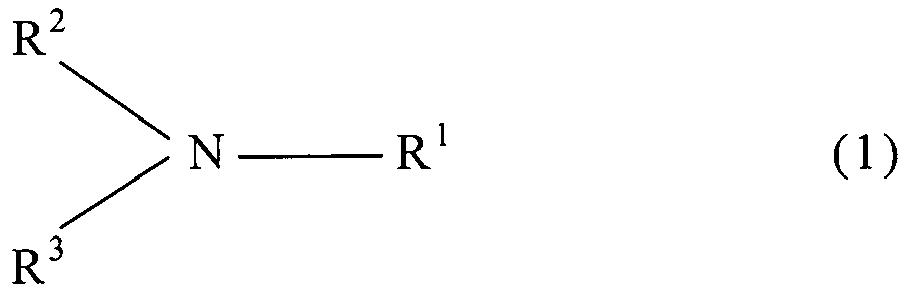
- a surface conditioning composition for use in surface conditioning of a metal prior to being subjected to a phosphate-based chemical conversion treatment, in which the surface conditioning composition has a pH of 3 to 12, and includes at least one kind of zinc compound particles selected from the group consisting of zinc oxide particles, zinc hydroxide particles, and basic zinc carbonate particles; phosphoric acid and/or condensed phosphoric acid; and an amine compound represented by the following general formula (1) and in which the zinc compound particles are dispersed and stabilized by the phosphoric acid and/or condensed phosphoric acid, and the amine compound.
- R 1 , R 2 , and R 3 each independently represent a hydrogen atom, a straight or branched alkyl group having 1 to 10 carbon atoms, or a straight or branched alkyl group having 1 to 10 carbon atoms and having a hydrophilic functional group in the skeleton thereof.
- R 1 , R 2 , and R 3 are not all a hydrogen atom.
- a surface conditioning composition according to the first aspect in which the zinc compound particles are dispersed and stabilized by a dispersion means in an aqueous solution containing the phosphoric acid and/or condensed phosphoric acid, and the amine compound, and has a pH of 7 to 13.
- a surface conditioning composition according to the first or second aspect in which the condensed phosphoric acid is pyrophosphoric acid.
- a surface conditioning composition according to any one of the first to third aspects is provided in which the zinc compound particles have an average particle diameter from 0.05 ⁇ m to 3 ⁇ m.
- a surface conditioning composition according to any one of the first to fourth aspects is provided in which the hydrophilic functional group is a hydroxyl group.
- a surface conditioning composition according to any one of the first to fifth aspects is provided in which the amine compound is tertiary alkanolamine.
- a surface conditioning composition according to any one of the first to sixth aspects further includes at least one selected from the group consisting of an aromatic organic acid, a phenolic compound, and a phenolic resin.
- a surface conditioning composition according to any one of the first to seventh aspects further includes at least one selected from the group consisting of a clay compound, fine particles of an oxide, and a water soluble thickening agent.
- a surface conditioning composition according to any one of the first to eighth aspects further includes at least one selected from the group consisting of a water soluble carboxyl group-containing resin, a saccharide, and a phosphonic acid compound.
- a surface conditioning composition according to any one of the first to ninth aspects further includes a chelating agent and/or a surfactant.
- a surface conditioning composition according to any one of the first to tenth aspects further includes a zirconium complex ion and/or an oxidized metal ion.
- a surface conditioning method for use in the conditioning of a surface of a metal prior to being subjected to a phosphate-based chemical conversion treatment, in which the method includes a step of bringing a surface conditioning composition according to any one of the first to eleventh aspects into contact with the surface of the metal.
- a method for production of a surface conditioning composition for use in the surface conditioning of a metal prior to being subjected to a phosphate-based chemical conversion treatment, in which the method includes a step of allowing at least one kind of zinc compound particle selected from the group consisting of zinc oxide particles, zinc hydroxide particles, and basic zinc carbonate particles to be dispersed and stabilized by a dispersion means in an aqueous solution having a pH of 7 to 13 and containing phosphoric acid and/or condensed phosphoric acid, and an amine compound represented by the following general formula (1).
- R 1 , R 2 , and R 3 each independently represent a hydrogen atom, a straight or branched alkyl group having 1 to 10 carbon atoms, or a straight or branched alkyl group having 1 to 10 carbon atoms and having a hydrophilic functional group in the skeleton thereof.
- R 1 , R 2 , and R 3 are not all a hydrogen atom.
- a surface conditioning composition having an even more superior surface conditioning function as compared with conventional surface conditioning compositions can be provided.
- the surface conditioning composition according to the present embodiment is for use in surface conditioning of a metal prior to being subjected to a phosphate-based chemical conversion treatment, and is characterized by including zinc compound particles which were dispersed and stabilized. More specifically, the composition includes at least one kind of zinc compound particle selected from the group consisting of zinc oxide particles, zinc hydroxide particles, and basic zinc carbonate particles, which are highly distinct in terms of not being zinc phosphate particles included in conventionally general compositions for surface conditioning.
- the surface conditioning composition according to the present embodiment is arbitrarily diluted with water to give a surface conditioning treatment liquid (treatment bath), which is utilized in surface conditioning of a metal prior to being subjected to a phosphate-based chemical conversion treatment.
- the surface conditioning composition according to the present embodiment has a pH of 3 to 12.
- the pH of the surface conditioning composition is higher than 12, zinc may be dissolved, resulting in the deterioration of the surface conditioning function. While in the case of the pH being lower than 3, the surface conditioning function may also be deteriorated.
- NaOH or other commonly used compounds may be used to adjust the pH to fall with in the above range. In other words, the pH falling within the range in which zinc is insoluble is acceptable.
- favorable performances may be achieved when the pH is approximately 12, an extremely large amount of alkali is required.
- the pH is less than 7, the iron sheet may rust, and repulsive force among particles may be impaired, whereby the stability and chemical conversion properties are likely to be deteriorated. Accordingly, it is preferred that the pH be 7 to 11.
- the zinc compound particles included in the surface conditioning composition according to the present embodiment are at least one selected from the group consisting of zinc oxide particles, zinc hydroxide particles, and basic zinc carbonate particles.
- a completely novel surface conditioning composition is provided in which zinc phosphate particles are not used as the main ingredient as in conventional surface conditioning compositions, but the aforementioned zinc compound particles are used as main ingredients.
- These zinc compound particles are dispersed and stabilized by coordination of the phosphoric acid and/or condensed phosphoric acid, and the amine compound having a specific structure described later.
- the zinc compound particles be fine particles having an average particle diameter from 0.05 ⁇ m to 3 ⁇ m.
- the shape thereof is nearly spherical and uniform (see, Fig. 1 ).
- a dispersant such as a water soluble organic polymer for the purpose of preventing aggregation, sedimentation and the like; however, such a dispersant is not essential in the surface conditioning composition according to the present embodiment.
- stabilization of the dispersion is enabled without using a dispersant such as a saccharide, organic phosphonic acid, vinyl acetate, polyacrylic acid, or the like.
- a dispersant such as a saccharide, organic phosphonic acid, vinyl acetate, polyacrylic acid, or the like.
- use of such a dispersant is not precluded, but such a dispersant can be also used.
- use of such a dispersant is preferred in light of further improvement of dispersibility of the zinc compound particles, such a dispersant may decrease corrosion resistance when it is incorporated in a coating film. Therefore, it is preferred that the dispersant is not used, or used in a small amount when it is used.
- the zinc compound particles used in the present embodiment have a nearly spherical uniform shape, use of the dispersant as described above is not required.
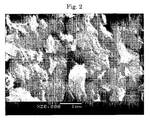
- the zinc phosphate particles included in conventional surface conditioning compositions have a nonuniform shape because they are produced by finely pulverizing commercially available zinc phosphate (see, Fig. 2 ), but in contrast, since the zinc compound particles of the present embodiment have a shape that is nearly spherical and uniform, repulsive force among the zinc compound particles that are present in the surface conditioning composition acts efficiently, thereby resulting in stable dispersion irrespective of being fine particles. Therefore, the surface conditioning composition according to the present embodiment can avoid the occurrence of aggregation and sedimentation without the use of the special dispersant as described above.
- the zinc compound particle used in the present embodiment has an average particle diameter from 0.05 ⁇ m to 3 ⁇ m, but preferably from 0.1 ⁇ m to 0.5 ⁇ m.
- the average particle diameter of the zinc compound particle is less than 0.05 ⁇ m, a particular method of the dispersion is needed, and in addition, a long period of time may be required for the dispersion. Nevertheless, chemical conversion properties as well as stability are less likely to be altered.
- the zinc compound particles have an average particle diameter of greater than 3 ⁇ m, a fine zinc phosphate crystal coating film cannot be formed.
- the term "dispersion stability" referred to herein indicates that the zinc compound particles do not aggregate or sediment, even though they have been stored for a predetermined time.
- the zinc compound particles of the present embodiment having a small particle diameter, and having a nearly spherical uniform shape are readily obtained by carrying out dispersion and stabilization by a dispersion means in a neutral or basic aqueous solution containing the phosphoric acid and/or condensed phosphoric acid, and the amine compound having a specific structure described later. Specifically, they are obtained by allowing the aforementioned zinc compound particles to be dispersed using a dispersion means such as beads dispersion for dispersion and stabilization in an aqueous solution that contains the phosphoric acid and/or condensed phosphoric acid, and the amine compound having a specific structure in a specified amount and has a pH of 7 to 13.
- a dispersion means such as beads dispersion for dispersion and stabilization in an aqueous solution that contains the phosphoric acid and/or condensed phosphoric acid, and the amine compound having a specific structure in a specified amount and has a pH of 7 to 13.
- the mass ratio of the zinc element/phosphorus element falls within the range of 0.3 to 30.
- the efficiency of dispersion may be reduced because a large amount of alkali is required for maintaining the pH.
- the weight ratio is greater than 30, the zinc compound particles may not be dispersed sufficiently.
- the mass ratio is more preferably 1 to 10.
- the dispersion means used in the present embodiment is not particularly limited, but conventionally known dispersion means may be employed.
- Specific examples of the means include bead mills typified by disc type, and pin type, high-pressure homogenizers, ultrasonic dispersion machines and the like.
- the aqueous solution has a pH of 7 to 13, and preferably 7.5 to 10.
- the pH is lower than 7, the zinc compound particles may be dissolved, leading to progress of the reaction with coexisting phosphoric acid or condensed phosphoric acid whereby zinc phosphate may be produced.
- the pH is higher than 13, a strong alkaline component is required in a large quantity, whereby the dispersibility may be deteriorated.
- the condensed phosphoric acid is believed to be readily coordinated with the zinc compound particle in terms of the chemical structure when compared with phosphoric acid; however, when the degree of condensation is too high, an improvement of the dispersion stability cannot be expected to the contrary because it becomes difficult to be coordinated. Therefore, as the condensed phosphoric acid, one having a low degree of condensation is preferably used, and pyrophosphoric acid in particularly is preferably used. When pyrophosphoric acid is used, more superior dispersion stability is achieved compared to the case in which phosphoric acid is used. This is speculated to result from the fact that pyrophosphoric acid has a chelating effect that captures hardening components such as magnesium ions and calcium ions in tap water. Therefore, when pyrophosphoric acid is used, aggregation and sedimentation of the zinc compound particles can also be prevented in the case in which the hardening components in tap water contaminate the surface conditioning composition.
- the zinc compound particles are dispersed and stabilized by the amine compound (a) represented by the following general formula (1).
- the dispersion stability of the zinc compound particles can be improved, and the denser zinc phosphate film can be formed, by dispersing the above described zinc compound particle in the presence of this amine compound (a), and phosphoric acid and/or condensed phosphoric acid described above.
- R 1 , R 2 , and R 3 each independently represent a hydrogen atom, a straight or branched alkyl group having 1 to 10 carbon atoms, or a straight or branched alkyl group having 1 to 10 carbon atoms and having a hydrophilic functional group in the skeleton thereof; however, R 1 , R 2 , and R 3 are not all a hydrogen atom.
- the amine compound (a) having the above structure achieves a favorable property as a dispersant, it is speculated to result from its chemical structure.
- the amine compound (a) described above has a nitrogen atom including a lone electron pair, and has a low molecular weight; therefore, it is speculated that the nitrogen atom is coordinated on the surface of the zinc phosphate particle, thereby enhancing the dispersion stability.
- the amine compound (a) has additional hydrophilic functional groups in its skeleton, the dispersion stability is further enhanced.
- the surface conditioning composition according to the present embodiment is advantageous in that it can be stored for a long period of time, even in the state of a concentrated liquid because the zinc compound particles exhibit high dispersion stability.
- the stability of the surface conditioning treatment liquid (treatment bath) obtained by diluting the surface conditioning composition is also favorable. Furthermore, it is superior in achieving an effect to provide favorable chemical conversion properties in the chemical conversion reaction, and thus, a conversion coating film of a sufficient amount can be formed even in the case in which it is applied to conversion resistant metal materials such as high-tensile steel sheets and the like.
- the abovementioned amine compound (a) is not particularly limited as long as it is an amine compound represented by the abovementioned general formula (1).
- the hydrophilic group in the general formula (1) is not particularly limited, but may be, for example, a hydroxyl group, carboxyl group, sulfonic acid group, amino group and the like. Among these, a hydroxyl group is preferable, and tertiary alkanolamine is particularly preferably used.
- amine compound (a) examples include triethylamine, ethylenediamine, 2-ethyldiamine, tri-n-butylamine, n-propylamine, triethylenetetramine, hydrazine, taurine, adipic acid dihydrazide and the like, as well as amino carboxylic acids such as NTA (Nitrilo Triacetic Acid), DTPA (Diethylene Triamine Pentaacetic Acid), EDTA (Ethylene Diamine Tetraacetic Acid), HIDA (Hydroxyethyl Imino Diacetic Acid), DHEG (Dihydroxyethyl Glycine), and the like.
- examples of particularly preferably used amine compounds having a hydroxyl group include, for example, aliphatic hydroxyamine compounds such as monoethanolamine, diethanolamine, dimethylethanolamine, methyldiethanolamine, triethanolamine, triisopropanolamine and aminoethylethanolamine; aromatic amine compounds such as amine modified resol and amine modified novolak, and the like. These amine compounds may be used alone, or two or more thereof may be used in combination. Of these, in light of excellent adsorptivity to the zinc compound particles, resistance to secondary aggregation, and excellent dispersion stability in liquids, aliphatic hydroxyamine compounds are preferred, and diethanolamine, dimethylethanolamine and triethanolamine are more preferred.
- the lower limit be 0.01% by mass, and the upper limit be 1000% by mass on the basis of the mass of the zinc compound particle.
- the content is less than 0.01% by mass, further enhancement of dispersion stability is not expected because the amount of adsorption to the zinc compound particle becomes insufficient, and also, an additional improvement of the surface conditioning function cannot be expected.
- Content greater than 1000% by mass is not economical because no effect exceeding the desired effect can be achieved.
- the lower limit is more preferably 0.1% by mass, while the upper limit is more preferably 100% by mass.
- the lower limit be 0.1% by mass, and the upper limit be 50% by mass in the concentrated liquid.
- the amount is less than 0.1% by mass, the dispersion stability may not be satisfactorily improved.
- the amount is greater than 50% by mass, dispersibility may be deteriorated due to the influence of excess additive, and it would not be economical even if the dispersion was satisfactory.
- the lower limit is more preferably 0.5% by mass, while the upper limit is more preferably 20% by mass.
- the lower limit be 1 ppm and the upper limit be 10000 ppm in the surface conditioning treatment bath.
- the content is less than 1 ppm, the amount of adsorption of the zinc compound particle may be insufficient, whereby secondary aggregation may be likely to occur.
- Content greater than 10000 ppm is not economical because no effect exceeding the desired effect can be achieved.
- the lower limit is more preferably 10 ppm, while the upper limit is more preferably 5000 ppm.
- the surface conditioning composition according to the present embodiment preferably contains at least one selected from the group consisting of an aromatic organic acid, a phenolic compound, and a phenolic resin.
- the compound (b) has an effect which allows the zinc compound particles to be dispersed and stabilized, similar to the amine compound (a) and the phosphoric acid and/or condensed phosphoric acid described above. Moreover, it has a particularly superior property as the surface conditioning agent in the chemical conversion treatment of aluminum-based substrates. More specifically, although conventional surface conditioning agents containing the zinc phosphate particles do not achieve a sufficient effect in the treatment of the aluminum-based substrate, the surface conditioning agent according to the present embodiment can form a favorable conversion coating film.
- the aforementioned compound (b) is a compound that has a high affinity for aluminum metal, it is speculated that the use of the compound (b) enables the zinc compound particles to stably adhere to the substrate surface, thus improving the surface conditioning function.
- the compound (b) has a function to chelate cationic components in tap water, the time dependent stability of the treatment bath can be maintained.
- the aromatic organic acid is not particularly limited, but benzoic acid, salicylic acid, gallic acid, lignosulfonic acid, and tannic acid are preferably used. Among these, gallic acid, lignosulfonic acid, and tannic acid in particularly are preferably used.
- the phenolic compound is not particularly limited as long as it is a compound having a phenolic hydroxyl group.
- phenol, catechol, pyrogallol, catechin and flavonoid are preferably used.
- catechin in particularly is preferably used.
- the aforementioned flavonoid is not particularly limited, and examples thereof include flavone, isoflavone, flavonol, flavanone, flavanol, anthocyanidin, aurone, chalcone, epigallocatechin gallate, gallocatechin, theaflavin, daidzin, genistin, rutin, myricitrin, and the like.
- phenolic resin examples include polymers having the aromatic organic acid and/or the phenolic compound as a basic skeleton (for example, polyphenolic compounds including tannin, catechin and the like, polyvinyl phenol as well as water soluble resol, novolak resins and the like), and lignin, and the like.
- the aforementioned tannin is a generic name of aromatic compounds which have a complicated structure having many phenolic hydroxyl groups, and which have widely distributed in the plant kingdom.
- the tannin may be either hydrolyzed tannin or condensed tannin. Examples of the tannin include hamameli tannin, persimmon tannin, tea tannin, oak gall tannin, gall nut tannin, myrobalan tannin, divi-divi tannin, algarovilla tannin, valonia tannin, catechin tannin, and the like.
- the tannin may also be hydrolyzed tannin yielded by decomposition with a process such as hydrolysis or the like of tannin found in a plant.
- examples of the tannin which can be used also include commercially available ones such as e.g., "Tannic acid extract A”, “B tannic acid”, “N tannic acid”, “Industrial tannic acid”, “Purified tannic acid”, “Hi tannic acid”, “F tannic acid”, “Official tannic acid” (all manufactured by Dainippon Pharmaceutical Co., Ltd.), “Tannic acid: AL” (manufactured by Fuji Chemical Industry Co., Ltd.), and the like. Two or more kinds of tannin may be concurrently used.
- the aforementioned lignin is a network polymer compound involving a phenol derivative, to which a propyl group is bound as a base unit.
- the lower limit be 0.01% by mass
- the upper limit be 1000% by mass on the basis of the mass of the zinc compound particles at the metal material surface treatment.
- the content is less than 0.01% by mass, the amount of adsorption to the zinc compound particles becomes insufficient; therefore, the effect of stabilizing the dispersion and effect of adsorption of the zinc compound particles to the metal material cannot be anticipated, and thus, the surface conditioning effect may not be achieved.
- Content greater than 1000% by mass is not economical because no effect exceeding the desired effect can be achieved.
- the lower limit is more preferably 0.1% by mass, while the upper limit is more preferably 100% by mass.
- the lower limit be 0.1% by mass, and the upper limit be 50% by mass in the concentrated liquid.
- the amount is less than 0.1% by mass, the dispersion may not be satisfactorily executed.
- the amount is greater than 50% by mass, dispersibility may be deteriorated due to the influence of excess additive, and would not be advantageous economically, even if the dispersion were satisfactory.
- the lower limit is more preferably 0.5% by mass, while the upper limit is more preferably 20% by mass.
- the lower limit be 1 ppm
- the upper limit be 10000 ppm in the surface conditioning treatment liquid (treatment bath).
- the content is less than 1 ppm, the amount of adsorption to the zinc compound particles may be insufficient, whereby secondary aggregation may be likely to occur.
- Content greater than 10000 ppm is not economical because no effect exceeding the desired effect can be achieved.
- the lower limit is more preferably 10 ppm, while the upper limit is more preferably 5000 ppm.
- Compound (c) Clay Compound, Fine Particle of an Oxide, Water Soluble Thickening Agent
- the surface conditioning composition according to the present embodiment further contains at least one compound (c) selected from the group consisting of a clay compound, fine particles of an oxide, and a water soluble thickening agent.
- the compound (c) greatly improves the chemical conversion property through addition to the surface conditioning composition of the present invention. Furthermore, it is speculated to be responsible for stabilization by way of interactions such as adsorption with the zinc compound particles, thereby contributing to stability during storage in the state of an aqueous dispersion liquid (concentrated liquid before use in surface conditioning) for a long period of time, stability of the surface conditioning treatment bath, and stability against hardening components such as calcium ions, magnesium ions, and the like derived from tap water.
- the zinc compound particles become more resistant to sedimentation when compared with the case in which the compound (c) is not used because the thickening effect is presumed to result from the compound (c) since the compound (c) interacts with the zinc compound particles. Therefore, by further including the compound (c), crystals of more dense conversion coating film can be formed on the surface of a variety of metal materials. In particular, with respect to cold-rolled steel sheets, and galvanized steel sheets, it is preferred in light of ability to uniformly and finely cover the entire face of the metal material.
- the aforementioned clay compound is not particularly limited, and examples thereof include smectites such as montmorillonite, beidellite, saponite, and hectorite; kaolinites such as kaolinite, and halloysite; vermiculites such as dioctahedral vermiculite, and trioctahedral vermiculite; micas such as teniolite, tetrasilicic mica, muscovite, illite, sericite, phlogopite, and biotite; hydrotalcite; pyrophilolite; layered polysilicates such as kanemite, makatite, ilerite, magadiite, and kenyaite, and the like.
- These clay compounds may be either a naturally occurring mineral, or a synthetic mineral yielded by hydrothermal synthesis, a melt process, a solid phase process or the like.
- the average particle diameter of the clay compound in the dispersed state in water be 0.1 ⁇ m or less.
- the average aspect ratio (mean value of maximum size/minimum size) of the clay compound is more preferably 10 or greater, and still more preferably 20 or greater. When the average aspect ratio is less than 10, the dispersion stability may be deteriorated.
- the aforementioned average particle diameter in the dispersed state in water can be determined by TEM or SEM following lyophilization of the water dispersion liquid. Also, two or more of these may be concurrently used.
- intercalation compounds of the aforementioned clay compound pillared crystals and the like
- those subjected to an ion exchahge treatment, and to surface modification such as a silane coupling treatment, a composite formation treatment with an organic binder, or the like
- These clay compounds may be used alone, or two or more thereof may be used in combination.
- Examples of commercially available products of the saponite include synthetic saponite ("Sumecton SA", trade name, manufactured by KUNIMINE INDUSTRIES CO., LTD.), and the like.
- Examples of commercially available products of the natural hectorite include "BENTON EW” and "BENTON AD” (both manufactured by ELEMENTIS plc), and the like.
- Examples of commercially available products of the synthetic hectorite include trade names "Laponite B, S, RD, RDS, XLG, XLS” manufactured by ROOKWOOD Additives Ltd., and the like. These are in the state of a white powder, and readily form sol ("Laponite S, RDS, XLS") or gel ("Laponite B, RD, XLG”) upon addition to water. Moreover, “Lucentite SWN" of CO-OP Chemical Co., Ltd. may be also exemplified. These natural hectorite and synthetic hectorite may be used alone, or two or more thereof may be used in combination.
- the aforementioned fine particles of an oxide are not particularly limited, and examples thereof include silica particles, alumina particles, titania particles, zirconia particles, niobium oxide particles and the like.
- the oxide particles suitably have an average particle diameter of approximately 1 nm to 300 nm. These may be used alone, or two or more of them may be used in combination. Among these, in light of thixotropic properties, alumina particles or a silicic acid compound may be preferably used.
- the aforementioned water soluble thickening agent is not particularly limited, and examples thereof include a swollen dispersion of fatty amide, amide-based fatty acid such as acrylamide, and polyamide-based thickening agents such as phosphate of long-chain polyaminoamide, urethane-based thickening agents, and polyethylene oxide.
- acrylamide, polyacrylic acid, acrylic acid copolymers are preferably used.
- the lower limit be 0.01% by mass
- the upper limit be 1000% by mass on the basis of the mass of the zinc compound particles.
- the content is less than 0.01% by mass, the amount of adsorption to the zinc compound particles becomes insufficient, whereby the effect of adsorption of the particles to the metal material may not be sufficient, which may lead to incorrectly anticipating the effect of addition.
- Content greater than 1000% by mass is not economical because no effect exceeding the desired effect can be achieved.
- the lower limit is more preferably 0.1% by mass, while the upper limit is more preferably 100% by mass.
- the lower limit be 0.1% by mass and the upper limit be 50% by mass in the concentrated liquid.
- the amount is less than 0.1% by mass, the dispersion may not be satisfactory.
- the amount is greater than 50% by mass, dispersibility may be deteriorated due to the influence of excess additive, and would not be economical even if the dispersion were satisfactory.
- the lower limit is more preferably 0.5% by mass, while the upper limit is more preferably 20% by mass.
- the lower limit be 1 ppm and the upper limit be 1000 ppm in the surface conditioning treatment bath.
- the content is less than 1 ppm, the amount of adsorption to the zinc compound particles may be insufficient; therefore, adsorption and the like of the zinc compound particles to the metal material surface may not be facilitated.
- Content greater than 1000 ppm is not economical because no effect exceeding the desired effect can be achieved.
- the lower limit is more preferably 10 ppm, while the upper limit is more preferably 500 ppm.
- a variety of components for use in the surface conditioning composition may be added to the aforementioned surface conditioning composition, in addition to the compounds as described above.
- the aforementioned surface conditioning composition according to the present embodiment may further include at least one compound (d) selected from the group consisting of a water soluble carboxyl group-containing resin, a saccharide, and a phosphonic acid compound.
- the compound (d) tends to be negatively charged in a solution, and adhesion or the like of the same to the surface of the zinc compound particles may result in electromagnetic repulsion. It is speculated that reaggregation of the zinc compound particles is suppressed as a consequence, facilitating adhesion on the metal material surface of the crystal nucleus at a uniform density, and thus a phosphate coating film of a sufficient amount is able to be formed on the metal material surface in the chemical conversion treatment.
- the aforementioned compound (d) not only suppresses sedimentation of the zinc compound particles in the surface conditioning composition, but also suppresses sedimentation of the zinc compound particles in the aqueous dispersion liquid of the zinc compound particles (concentrated liquid before use in surface conditioning). Accordingly, long-term storage stability of the concentrated liquid can be maintained.
- the water soluble carboxyl group-containing resin is not particularly limited as long as it is a water soluble resin, and examples thereof include resins obtained by polymerization of a monomer composition containing a carboxyl group-containing an ethylenic unsaturated monomer such as (meth)acrylic acid, maleic acid, fumaric acid, and the like.
- the water soluble carboxyl group-containing resin is preferably a resin that is obtained by radical polymerization of an ethylenic unsaturated monomer composition and has an acid value of 10 to 500. By using such a resin, the dispersion stability of the zinc compound particles can be further enhanced.
- the water soluble carboxyl group-containing resin may be a commercially available product; for example; "Aron A12SL" (manufactured by Toagosei Chemical Industry Co., Ltd.) can be used.
- the aforementioned saccharide is not particularly limited, and examples thereof include polysaccharides, polysaccharide derivatives, and alkali metal salts such as sodium salts and potassium salts of the same, and the like.
- the polysaccharide include cellulose, methyl cellulose, ethyl cellulose, methylethyl cellulose, hemicellulose, starch, methyl starch, ethyl starch, methylethyl starch, agar, carrageen, alginic acid, pectic acid, guar gum, tamarind seed gum, locust bean gum, konjac mannan, dextran, xanthan gum, pullulan, gellan gum, chitin, chitosan, chondroitin sulfate, heparin, hyaluronic acid, and the like.
- examples of the polysaccharide derivative include the carboxyalkylated or hydroxyalkylated polysaccharides described above such as carboxymethyl cellulose (CMC) and hydroxyethyl cellulose, starch glycolic acid, agar derivatives, carrageen derivatives, and the like.
- CMC carboxymethyl cellulose
- hydroxyethyl cellulose starch glycolic acid
- agar derivatives agar derivatives
- carrageen derivatives and the like.
- Examples of the phosphonic acid compound include phosphonic acid, and products yielded by direct binding of a carbon atom with a phosphorus atom, as well as amine salts or ammonium salts thereof, excluding phosphoric acid esters.
- the content of the compound (d) is preferably from 0.01% to 1000% by mass per mass of the zinc compound particles.
- the content is less than 0.01% by mass the effect of preventing sedimentation may not be sufficient.
- Content greater than 1000% by mass is not economical because no effect exceeding the desired effect can be achieved.
- the concentration is more preferably from 0.1% to 100% by mass.
- the content of the compound (d) in the concentrated liquid is preferably from 0.1% to 40% by mass.
- the content of the compound (d) is preferably from 1 ppm to 1000 ppm in the surface conditioning treatment bath. When the content is less than 1 ppm, the effect of preventing sedimentation may not be sufficiently achieved. Content greater than 1000 ppm is not economical because no effect exceeding the desired effect can be achieved. The concentration is more preferably from 10 ppm to 500 ppm.
- the surface conditioning composition according to the present embodiment may further include a compound (e) that is a chelating agent and/or a surfactant.
- a compound (e) that is a chelating agent and/or a surfactant.
- the compound (e) By including the compound (e), more superior dispersion stability can be imparted, and properties in dispersion stability can be also improved. More specifically, even in the case in which hardening components such as magnesium ions, calcium ions, and the like in tap water contaminate surface conditioning composition, the stability of the surface conditioning treatment bath can be maintained without aggregation of the zinc compound particles. Accordingly, the aforementioned chelating agent indicates a compound having the ability to capture the magnesium ions and calcium ions in an aqueous solution.
- the aforementioned chelating agent is not particularly limited, and examples thereof include citric acid, tartaric acid, EDTA, gluconic acid, succinic acid and malic acid, and compounds and derivatives of the same.
- the content of the chelating agent is preferably from 1 ppm to 10000 ppm in the surface conditioning treatment bath.
- the content is less than 1 ppm, the hardening components in tap water cannot be sufficiently chelated, whereby metal polycations such as calcium ions, which serve as the hardening component, may cause the zinc compound particles to aggregate.
- Content greater than 10000 ppm can achieve no effect exceeding the desired effect, and the chemical conversion properties may be deteriorated through a reaction with active ingredients in the chemical conversion liquid.
- the content is more preferably from 10 ppm to 1000 ppm.
- an anionic surfactant or a nonionic surfactant may be more preferably used.
- nonionic surfactant is not particularly limited, but nonionic surfactants having a hydrophilic-lipophilic balance (HLB) of at least 6 are preferred, and examples thereof include polyoxyethylene alkyl ether, polyoxyalkylene alkyl ether, polyoxyethylene derivatives, oxyethylene-oxypropylene block copolymers, sorbitan fatty acid esters, polyoxyethylene sorbitan fatty acid esters, polyoxyethylene sorbitol fatty acid esters, glycerin fatty acid esters, polyoxyethylene fatty acid esters, polyoxyethylene alkylamine, alkylalkanode amide, nonylphenol, alkylnonylphenol, polyoxyalkylene glycol, alkylamine oxide, acetylene diol, polyoxyethylene nonylphenyl ether, silicon based surfactants such as polyoxyethylene alkylphenyl ether-modified silicone, fluorine-based surfactants prepared through substitution of at least one hydrogen atom in
- the aforementioned anionic surfactant is not particularly limited, and examples thereof include fatty acid salts, alkylsulfuric acid ester salts, alkyl ether sulfuric acid ester salts, alkylbenzenesulfonate, alkylnaphthalenesulfonate, alkylsulfosuccinate, alkyldiphenyl ether disulfonate, polybisphenol sulfonate, alkyl phosphate, polyoxyethylalkyl sulfuric acid ester salts, polyoxyethylalkylallylsulfuric acid ester salts, alpha-olefin sulfonate, methyl taurine acid salts, polyaspartate, ether carboxylate, naphthalenesulfonic acid-formalin condensates, polyoxyethylene alkyl phosphoric acid esters, alkyl ether phosphoric acid ester salts, and the like.
- alkyl ether phosphoric acid al
- the lower limit be 3 ppm, and the upper limit be 500 ppm in the surface conditioning treatment bath.
- the lower limit is more preferably 5 ppm, while the upper limit is more preferably 300 ppm.
- the surfactant may be used alone, or two or more thereof may be used in combination.
- the surface conditioning composition further contains a Zr complex ion and/or an oxidized metal ion (f).
- the ion (f) may be preferably used in light of eliminating segregation products on the basal plate surface.
- the oxidized metal ion referred to herein indicates a metal ion having a higher valence in a metal having a plurality of valences. Specific examples include oxidized metal ions of Fe, Mn, Co, Ni, Ce, and the like.
- the source of the Zr complex ion is not particularly limited, and examples thereof include zircon hydrofluoride, and zirconium ammonium carbonate; hydroxylated zirconium, zirconium oxycarbonate, basic zirconium carbonate, zirconium borate, zirconium oxalate, zirconium sulfate, zirconium nitrate, zirconyl nitrate, zirconium chloride and the like; and organic zirconium compounds such as dibutyl zirconium dilaurylate, dibutylzirconium dioctate, zirconium naphthenate, zirconium octylate and acetylacetone zirconium, and the like.
- zircon hydrofluoride, and zirconyl nitrate are preferably used in light of eliminating segregation products on the basal plate surface.
- the source of the oxidized metal ion of Fe is not particularly limited, and examples thereof include water soluble ferric salts such as iron (III) sulfate, iron (III) nitrate, and iron (III) perchlorate; water soluble ferrous salts such as iron (II) sulfate, and iron (II) nitrate, and the like.
- ferric nitrate is preferably used in light of oxidation of the basal plate surface.
- the source of the oxidized metal ion of Mn is not particularly limited, and examples thereof include organic acid salts such as manganese acetate, manganese benzoate, manganese lactate, manganese formate, and manganese tartrate; harogenated products such as manganese chloride, and manganese bromide; inorganic acid salts such as manganese nitrate, manganese carbonate, manganese phosphate, manganese sulfate, and manganese phosphate; alkoxides such as manganese methoxide; and acetylacetone manganese (II), acetylacetone manganese (III), manganese dioxide, manganese oxide, and the like.
- potassium permanganate may be preferably used in light of oxidation of the basal plate surface.
- the source of the oxidized metal ion of Co is not particularly limited, and examples thereof include cobalt nitrate, cobalt sulfate, and the like.
- the source of the oxidized metal ion of Ni is not particularly limited, and examples thereof include carbonates such as nickel (II) carbonate, basic nickel (II) carbonate, and acidic nickel (II) carbonate; phosphates such as nickel (II) phosphate and nickel pyrophosphate; nitrates such as nickel (II) nitrate and basic nickel nitrate; sulfates such as nickel (II) sulfate; oxides such as nickel (II) oxide, trinickel tetraoxide, and nickel (III) oxide; acetates such as nickel (II) acetate and nickel (III) acetate; oxalates such as nickel (II) oxalate; and nickel amidosulfate, acetylacetone nickel (II), nickel (II) hydroxide, and the like.
- carbonates such as nickel (II) carbonate, basic nickel (II) carbonate, and acidic nickel (II) carbonate
- the source of the oxidized metal ion of Ce is not particularly limited, and examples thereof include cerium nitrate, cerium sulfate, and the like.
- the lower limit be 0.01% by mass and the upper limit be 10% by mass in the concentrated liquid.
- the content is less than 0.01% by mass, the effect may not be achieved, while content greater than 10% by mass may result in instability of the concentrated liquid.
- the lower limit be 0.1 ppm and the upper limit be 1000 ppm in the surface conditioning treatment bath.
- the content is less than 0.1 ppm, the effect may not be achieved, while content greater than 1000 ppm will not achieve additional effects.
- a bivalent or trivalent metal nitrite compound can also be added to the surface conditioning composition according to the present embodiment as needed to still further suppress rust generation.
- the surface conditioning composition according to the present embodiment may be further blended metal alkoxide, a deforming agent, a rust-preventive agent, an antiseptic agent, a thickening agent, an alkaline builder such as sodium silicate, and the like in a range not to inhibit the effect of the present invention, in addition to the components as described above.
- various surfactants may be added to improve the wettability.
- the surface conditioning composition according to the present embodiment can also include a dispersion solvent for allowing the zinc compound particles to be dispersed.
- a dispersion solvent for allowing the zinc compound particles to be dispersed.
- the dispersion solvent include aqueous solvents containing 80% by mass or more water, and a variety of water soluble organic solvent can be used other than water; however, the content of the organic solvent is preferred to be as low as possible, which may account for preferably no more than 10% by mass, and more preferably no more than 5% by mass.
- a dispersion liquid without including any dispersion solvent other than water may also be provided.
- the water soluble organic solvent is not particularly limited, and examples thereof include alcohol based solvents such as methanol, ethanol, isopropanol, and ethylene glycol; ether-based solvents such as ethylene glycol monopropyl ether, butyl glycol, and 1-methoxy-2-propanol; ketone-based solvents such as acetone, and diacetone alcohol; amide-based solvents such as dimethyl acetamide, and methyl pyrrolidone; ester-based solvents such as ethyl carbitol acetate, and the like. These may be used alone, or two or more thereof may be used in combination.
- alcohol based solvents such as methanol, ethanol, isopropanol, and ethylene glycol
- ether-based solvents such as ethylene glycol monopropyl ether, butyl glycol, and 1-methoxy-2-propanol
- ketone-based solvents such as acetone, and diacetone alcohol
- an alkali salt such as calcined soda for the purpose of stabilizing the zinc compound particles, and forming a fine conversion coating film in the zinc phosphate chemical conversion treatment step to be carried out subsequently.
- the surface conditioning method according to the present embodiment is characterized by including the step of bringing the aforementioned surface.conditioning composition in contact with a metal material surface.
- a sufficient amount of the zinc compound fine particles can adhere to the surface of not only iron-based and zinc-based metal materials, but also to the conversion resistant metal materials such as aluminum and high-tensile steel sheets. Accordingly, a favorable conversion coating film can be formed in the chemical conversion treatment step.
- the process for bringing the surface conditioning composition into contact with the metal material surface in the surface conditioning method according to the present embodiment is not particularly limited, but a conventionally known method such as dipping, spraying and the like can be freely employed.
- the metal material subjected to the surface conditioning is not particularly limited, but the process can be applied to a variety of metals generally subjected to the phosphate conversion treatment, such as galvanized steel sheets; aluminum-based metal materials such as aluminum or aluminum alloys; magnesium alloys; and iron-based metal materials such as cold-rolled steel sheets and high-tensile steel sheets. Particularly, it can be suitably applied to cold-rolled steel sheets and high-tensile steel sheets.
- a step of surface conditioning in combination with degreasing can also be carried out. Accordingly, the step for washing with water following a degreasing treatment can be omitted.
- a known inorganic alkali builder, an organic builder and the like may be added for the purpose of increasing the detergency.
- a known condensed phosphate or the like may be added.
- the contact time of the surface conditioning composition with the metal material surface, and the temperature of the surface conditioning composition are not particularly limited, but the process can be performed under conventionally known conditions.
- the phosphate chemical conversion treatment is then carried out to enable production of a phosphate chemical conversion treated metal sheet.
- the process for the phosphate chemical conversion treatment is not particularly limited, but any one of various known processes such as a dipping treatment, a spraying treatment, or an electrolytic treatment can be employed. Multiple kinds of these treatments may be conducted in combination.
- the phosphate crystal coating film deposited on the metal material surface it is not particularly limited as long as it is a metal phosphate, and examples thereof include zinc phosphate, iron phosphate, manganese phosphate, calcium phosphate and the like, but not in anyhow limited thereto..
- the contact time of the chemical conversion treatment agent with the metal material surface and the temperature of the chemical conversion treatment agent are not particularly limited, but can be carried out under conventionally known conditions.
- a coated sheet can be produced by further carrying out coating.
- electrodeposition coating is employed as the coating process. Paint for use in the coating is not particularly limited, but may be of various types generally used in coating a phosphate chemical conversion treated metal sheet, and examples thereof include epoxymelamine paints, as well as combination of cation electrodeposition paint, polyester-based intermediate coating paints, and polyester-based over coating paints, and the like.
- a known process may be employed such as a washing step.
- the method for production of the aforementioned surface conditioning composition is characterized by including a step of allowing at least one kind of zinc compound particles selected from the group consisting of zinc oxide particles, zinc hydroxide particles, and basic zinc carbonate particles to be dispersed and stabilized by a dispersion means in an aqueous solution that contains the phosphoric acid and/or condensed phosphoric acid, and the amine compound (a), and has a pH of 7 to 13. Furthermore, by carrying out the dispersion and stabilization of the zinc compound particles in this step in the presence of the compounds (b) to (e) and the ion (f) described above, a surface conditioning composition that is more superior in the dispersion stability may be produced.
- the surface conditioning composition may be produced according to the following procedures.
- (i) The aforementioned zinc compound particles in a specified amount are added to pure water, and the mixture is subjected to prestirring for a specified time with a Disper or the like.
- the amine compound (a) is added in a specified amount at the same time.
- Dispersion is conducted using a dispersion means such as beads.
- phosphoric acid and/or condensed phosphoric acid in a specified amount is gradually added over time while allowing for dispersion, followed by additional dispersion for a specified time.
- the desired surface conditioning composition is produced through adjusting the pH of the mixture.
- dispersion was continued with the SG mill having a filling ratio of zirconia beads (1 mm) of 80% for 180 minutes to obtain the dispersion liquid of the zinc compound fine particles.
- the thus resulting dispersion liquid was poured into a bath with pure water to give a zinc compound concentration of 0.1%, and the surface conditioning composition was obtained through adjusting the pH to 9 with NaOH.
- titanium-based surface conditioning composition As a titanium-based surface conditioning composition, "Surf fine 5N10", manufactured by Nippon Paint Co., Ltd. was poured into a bath with tap water to give a concentration of 0.1%, and the surface conditioning composition was obtained through adjusting the pH to 9 with NaOH.
- a cold-rolled steel sheet (SPC) (70 mm x 150 mm x 0.8 mm), a high-tensile steel sheet (70 mm x 150 mm x 1.0 mm), as well as an aluminum sheet (70 mm x 150 mm x 1.0 mm) and a galvanized steel sheet (GA) (70 mm x 150 mm x 0.8 mm), which had been laid on each half and fixed by clamping with clips on two sides to provide an aluminum-electrically modified part (a part where the aluminum and galvanized steel sheets were in contact), were prepared.
- each metal sheet was subjected to a chemical conversion treatment using a zinc phosphate treatment liquid ("SURFDINE 6350", trade name, manufactured by Nippon Paint Co., Ltd.) by a dipping method at 35°C for 2 minutes, followed by washing with water, washing with pure water, and drying to obtain a test sheet.
- a zinc phosphate treatment liquid ("SURFDINE 6350", trade name, manufactured by Nippon Paint Co., Ltd.)
- evaluation was made in light of chemical conversion unevenness, generation of rust, and average particle diameter attained by dispersion for a short period of time.
- the evaluation standards or evaluation method of each evaluation were as follows. The evaluation of the chemical conversion unevenness and generation of rust was made using the conversion coating film formed on SPC.
- the conversion coating films (SPC used) obtained in the Examples and Comparative Examples were sealed with a tape, and cross cuts were made with a cutter, whereby a CCT test was carried out. More pecifically, in a saline spray test device maintained at a temperature of 35°C with a humidity of 95%, a 5% aqueous solution of NaCl maintained at a temperature of 35°C was continuously sprayed for 2 hours. Next, after drying under the conditions of a temperature of 60°C with a humidity of 20 to 30% for 4 hours, the test piece was maintained under humid conditions at 50°C with a humidity of 95% or higher for 2 hours. These steps were specified as one cycle, and the width of the blister of the coated film was measured following 200 cycles. The results are shown in Table 1.
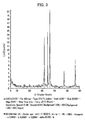
- Example 1 and Example 3 are shown in Fig. 3 and Fig. 4 , respectively. From these Figures, it was ascertained that the zinc oxide particles in Example 1 and the basic zinc carbonate particles in Example 3 were dispersed and stabilized without reaction. Moreover, as shown in Table 1, it was proven that the dispersion stability of the zinc compound particles was extremely favorable, and additionally, the working properties were also satisfactory when the surface conditioning composition of the present Example was used when compared with the case in which the surface conditioning composition of Comparative Example was used. In addition, it was verified that a favorable conversion coating film could be formed on all of the cold-rolled steel sheets, the high-tensile steel sheets, and the aluminum-electrically modified part.
Landscapes
- Chemical & Material Sciences (AREA)
- Engineering & Computer Science (AREA)
- Materials Engineering (AREA)
- Organic Chemistry (AREA)
- General Chemical & Material Sciences (AREA)
- Chemical Kinetics & Catalysis (AREA)
- Mechanical Engineering (AREA)
- Metallurgy (AREA)
- Life Sciences & Earth Sciences (AREA)
- Wood Science & Technology (AREA)
- Chemical Treatment Of Metals (AREA)
Claims (13)
- Composition de conditionnement de surface, conçue pour servir à conditionner une surface métallique avant de lui faire subir un traitement de phosphatation, laquelle composition présente un pH de 3 à 12 et comprend :- des particules de composé du zinc d'au moins un type, choisies dans l'ensemble constitué par des particules d'oxyde de zinc, des particules d'hydroxyde de zinc et des particules de carbonate basique de zinc,- de l'acide phosphorique et/ou un acide polyphosphorique,- et un composé de type amine représenté par la formule générale (1) donnée ci-dessous,et dans laquelle composition les particules de composé du zinc ont été dispersées et sont stabilisées par l'acide phosphorique et/ou l'acide polyphosphorique et par le composé de type amine ;
- Composition de conditionnement de surface, conforme à la revendication 1, dans laquelle les particules de composé du zinc ont été dispersées à l'aide d'un moyen de dispersion et stabilisées dans une solution aqueuse contenant de l'acide phosphorique et/ou un acide polyphosphorique ainsi qu'un composé de type amine et présentant un pH de 7 à 13.
- Composition de conditionnement de surface, conforme à la revendication 1 ou 2, dans laquelle l'acide polyphosphorique est de l'acide pyrophosphorique.
- Composition de conditionnement de surface, conforme à l'une des revendications 1 à 3, dans laquelle le diamètre moyen des particules de composé de zinc vaut de 0,05 à 3 µm.
- Composition de conditionnement de surface, conforme à l'une des revendications 1 à 4, dans laquelle le groupe fonctionnel hydrophile est un groupe hydroxyle.
- Composition de conditionnement de surface, conforme à l'une des revendications 1 à 5, dans laquelle le composé de type amine est une alcanolamine tertiaire.
- Composition de conditionnement de surface, conforme à l'une des revendications 1 à 6, qui comprend en outre au moins un composant choisi dans l'ensemble formé par un acide organique aromatique, un composé phénolique et une résine phénolique.
- Composition de conditionnement de surface, conforme à l'une des revendications 1 à 7, qui comprend en outre au moins un composant choisi dans l'ensemble formé par un composé de type argile, un oxyde en fines particules, et un agent épaississant hydrosoluble.
- Composition de conditionnement de surface, conforme à l'une des revendications 1 à 8, qui comprend en outre au moins un composant choisi dans l'ensemble formé par une résine hydrosoluble comportant des groupes carboxyle, un glucide et un composé de type acide phosphonique.
- Composition de conditionnement de surface, conforme à l'une des revendications 1 à 9, qui comprend en outre un agent chélatant et/ou un tensioactif.
- Composition de conditionnement de surface, conforme à l'une des revendications 1 à 10, qui comprend en outre un ion complexe de zirconium et/ou un ion de type métallate.
- Procédé de conditionnement de surface, conçu pour servir à conditionner une surface métallique avant de lui faire subir un traitement de phosphatation, lequel procédé comporte une étape où l'on met en contact avec la surface métallique une composition de conditionnement de surface, conforme à l'une des revendications 1 à 11.
- Procédé de préparation d'une composition de conditionnement de surface, conçue pour servir à conditionner une surface métallique avant de lui faire subir un traitement de phosphatation, lequel procédé comporte une étape où l'on fait en sorte que des particules de composé du zinc d'au moins un type, choisies dans l'ensemble formé par des particules d'oxyde de zinc, des particules d'hydroxyde de zinc et des particules de carbonate basique de zinc, soient dispersées à l'aide d'un moyen de dispersion et stabilisées dans une solution aqueuse présentant un pH de 7 à 13 et contenant de l'acide phosphorique et/ou un acide polyphosphorique ainsi qu'un composé de type amine, représenté par la formule générale (1) suivante :

Priority Applications (1)
| Application Number | Priority Date | Filing Date | Title |
|---|---|---|---|
| PL07741656T PL2007920T3 (pl) | 2006-04-07 | 2007-04-09 | Kompozycja do kondycjonowania powierzchni, sposób jej wytwarzania i sposób kondycjonowania powierzchni |
Applications Claiming Priority (2)
| Application Number | Priority Date | Filing Date | Title |
|---|---|---|---|
| JP2006106388 | 2006-04-07 | ||
| PCT/JP2007/058220 WO2007117043A1 (fr) | 2006-04-07 | 2007-04-09 | Composition de conditionnement de surface, procédé de préparation de cette composition et procédé de conditionnement de surface |
Publications (2)
| Publication Number | Publication Date |
|---|---|
| EP2007920A1 EP2007920A1 (fr) | 2008-12-31 |
| EP2007920B1 true EP2007920B1 (fr) | 2013-10-02 |
Family
ID=38274498
Family Applications (1)
| Application Number | Title | Priority Date | Filing Date |
|---|---|---|---|
| EP07741656.8A Active EP2007920B1 (fr) | 2006-04-07 | 2007-04-09 | Composition de conditionnement de surface, procédé de préparation de cette composition et procédé de conditionnement de surface |
Country Status (5)
| Country | Link |
|---|---|
| US (2) | US20100029814A1 (fr) |
| EP (1) | EP2007920B1 (fr) |
| ES (1) | ES2441248T3 (fr) |
| PL (1) | PL2007920T3 (fr) |
| WO (1) | WO2007117043A1 (fr) |
Cited By (1)
| Publication number | Priority date | Publication date | Assignee | Title |
|---|---|---|---|---|
| US12203172B2 (en) | 2018-06-11 | 2025-01-21 | Henkel Ag & Co. Kgaa | Aqueous dispersion for activating a metal surface and method for the phosphating thereof |
Families Citing this family (9)
| Publication number | Priority date | Publication date | Assignee | Title |
|---|---|---|---|---|
| GB0715576D0 (en) | 2007-08-09 | 2007-09-19 | Syngenta Ltd | Novel herbicides |
| US8506728B2 (en) | 2009-09-03 | 2013-08-13 | Mazda Motor Corporation | Surface treatment method of metal material |
| JP2018514653A (ja) * | 2015-05-07 | 2018-06-07 | フォスファン エルティーディー | 超微細リン酸塩化成結晶質コーティングを適用する方法 |
| JP7028452B2 (ja) * | 2015-11-05 | 2022-03-02 | フォスファン エルティーディー. | 複合リン酸塩コーティング |
| ES2883105T3 (es) * | 2017-03-30 | 2021-12-07 | Tata Steel Ijmuiden Bv | Composición ácida acuosa para tratar superficies metálicas, método de tratamiento que usa esta composición y uso de una superficie metálica tratada |
| JP2019137777A (ja) * | 2018-02-09 | 2019-08-22 | セイコーエプソン株式会社 | 顔料捺染インクジェットインク組成物、顔料捺染インクジェットインク組成物セット及びインクジェット顔料捺染方法 |
| US12312694B2 (en) | 2018-08-17 | 2025-05-27 | Jfe Steel Corporation | Production method for treatment solution for forming insulating coating, production method for steel sheet having insulating coating, and production apparatus for treatment solution for forming insulating coating |
| CN114075663B (zh) * | 2020-08-21 | 2023-09-12 | 宝山钢铁股份有限公司 | 一种碳钢表面用水基处理剂、良耐蚀碳钢及其制备方法 |
| CA3197973A1 (fr) * | 2020-12-02 | 2022-06-09 | Takahiko Ohtani | Composition de revetement antirouille, film antirouille et article et particules composites a base de zinc et composition contenant des particules composites a base de zinc |
Family Cites Families (7)
| Publication number | Priority date | Publication date | Assignee | Title |
|---|---|---|---|---|
| JP3451334B2 (ja) | 1997-03-07 | 2003-09-29 | 日本パーカライジング株式会社 | 金属のりん酸塩皮膜化成処理前の表面調整用前処理液及び表面調整方法 |
| US6214132B1 (en) * | 1997-03-07 | 2001-04-10 | Henkel Corporation | Conditioning metal surfaces prior to phosphate conversion coating |
| US6361623B1 (en) * | 1997-06-13 | 2002-03-26 | Henkel Corporation | Method for phosphatizing iron and steel |
| JP3451337B2 (ja) | 1998-07-21 | 2003-09-29 | 日本パーカライジング株式会社 | 金属のりん酸塩被膜化成処理前の表面調整用処理液及び表面調整方法 |
| JP2002060960A (ja) * | 2000-08-23 | 2002-02-28 | Nisshin Steel Co Ltd | 色調安定性に優れた黒色化亜鉛系めっき鋼板の製造方法 |
| ATE353987T1 (de) * | 2002-06-13 | 2007-03-15 | Nippon Paint Co Ltd | Zinkphosphatkonditioniermittel für phosphatkonversionsbeschichtung von stahlplatte und entsprechendes produkt |
| CN1657652B (zh) * | 2004-02-20 | 2011-05-11 | 日本油漆株式会社 | 表面调整剂及表面调整方法 |
-
2007
- 2007-04-09 EP EP07741656.8A patent/EP2007920B1/fr active Active
- 2007-04-09 PL PL07741656T patent/PL2007920T3/pl unknown
- 2007-04-09 ES ES07741656.8T patent/ES2441248T3/es active Active
- 2007-04-09 WO PCT/JP2007/058220 patent/WO2007117043A1/fr not_active Ceased
- 2007-04-09 US US12/295,821 patent/US20100029814A1/en not_active Abandoned
-
2012
- 2012-03-07 US US13/414,449 patent/US9096935B2/en active Active
Cited By (1)
| Publication number | Priority date | Publication date | Assignee | Title |
|---|---|---|---|---|
| US12203172B2 (en) | 2018-06-11 | 2025-01-21 | Henkel Ag & Co. Kgaa | Aqueous dispersion for activating a metal surface and method for the phosphating thereof |
Also Published As
| Publication number | Publication date |
|---|---|
| PL2007920T3 (pl) | 2014-05-30 |
| ES2441248T3 (es) | 2014-02-03 |
| EP2007920A1 (fr) | 2008-12-31 |
| US20100029814A1 (en) | 2010-02-04 |
| US20120160372A1 (en) | 2012-06-28 |
| WO2007117043A1 (fr) | 2007-10-18 |
| US9096935B2 (en) | 2015-08-04 |
Similar Documents
| Publication | Publication Date | Title |
|---|---|---|
| EP2007921B1 (fr) | Procédé de préparation d'une composition de conditionnement de surface et procédé de conditionnement de surface | |
| AU2007210465B2 (en) | Composition for surface conditioning and surface conditioning method | |
| US9096935B2 (en) | Surface conditioning composition, method for producing the same, and surface conditioning method | |
| CA2619723C (fr) | Composition de conditionnement de surface et son procede de production, et procede de conditionnement de surface | |
| US7722710B2 (en) | Surface-conditioning composition, method for production thereof, and surface conditioning method | |
| US8119239B2 (en) | Surface-conditioning composition comprising metal phosphate particles, metal alkoxide and stabilizer, and method of production thereof | |
| JP2007297709A (ja) | 表面調整用組成物及びその製造方法、並びに表面調整方法 | |
| JP2007297710A (ja) | 表面調整用組成物及びその製造方法、並びに表面調整方法 | |
| JP2007077498A (ja) | 表面調整用組成物及び表面調整方法 | |
| JP2007077499A (ja) | 表面調整用組成物及び表面調整方法 |
Legal Events
| Date | Code | Title | Description |
|---|---|---|---|
| PUAI | Public reference made under article 153(3) epc to a published international application that has entered the european phase |
Free format text: ORIGINAL CODE: 0009012 |
|
| 17P | Request for examination filed |
Effective date: 20081024 |
|
| AK | Designated contracting states |
Kind code of ref document: A1 Designated state(s): AT BE BG CH CY CZ DE DK EE ES FI FR GB GR HU IE IS IT LI LT LU LV MC MT NL PL PT RO SE SI SK TR |
|
| AX | Request for extension of the european patent |
Extension state: AL BA HR MK RS |
|
| RAP1 | Party data changed (applicant data changed or rights of an application transferred) |
Owner name: CHEMETALL GMBH |
|
| DAX | Request for extension of the european patent (deleted) | ||
| RIC1 | Information provided on ipc code assigned before grant |
Ipc: C09D 5/10 20060101ALI20130222BHEP Ipc: C09D 5/00 20060101ALI20130222BHEP Ipc: C23C 22/78 20060101AFI20130222BHEP |
|
| GRAP | Despatch of communication of intention to grant a patent |
Free format text: ORIGINAL CODE: EPIDOSNIGR1 |
|
| INTG | Intention to grant announced |
Effective date: 20130417 |
|
| GRAS | Grant fee paid |
Free format text: ORIGINAL CODE: EPIDOSNIGR3 |
|
| GRAA | (expected) grant |
Free format text: ORIGINAL CODE: 0009210 |
|
| AK | Designated contracting states |
Kind code of ref document: B1 Designated state(s): AT BE BG CH CY CZ DE DK EE ES FI FR GB GR HU IE IS IT LI LT LU LV MC MT NL PL PT RO SE SI SK TR |
|
| REG | Reference to a national code |
Ref country code: GB Ref legal event code: FG4D |
|
| REG | Reference to a national code |
Ref country code: CH Ref legal event code: EP Ref country code: AT Ref legal event code: REF Ref document number: 634676 Country of ref document: AT Kind code of ref document: T Effective date: 20131015 |
|
| REG | Reference to a national code |
Ref country code: IE Ref legal event code: FG4D |
|
| REG | Reference to a national code |
Ref country code: DE Ref legal event code: R096 Ref document number: 602007033127 Country of ref document: DE Effective date: 20131128 |
|
| REG | Reference to a national code |
Ref country code: NL Ref legal event code: T3 |
|
| REG | Reference to a national code |
Ref country code: SE Ref legal event code: TRGR |
|
| REG | Reference to a national code |
Ref country code: ES Ref legal event code: FG2A Ref document number: 2441248 Country of ref document: ES Kind code of ref document: T3 Effective date: 20140203 |
|
| PG25 | Lapsed in a contracting state [announced via postgrant information from national office to epo] |
Ref country code: SI Free format text: LAPSE BECAUSE OF FAILURE TO SUBMIT A TRANSLATION OF THE DESCRIPTION OR TO PAY THE FEE WITHIN THE PRESCRIBED TIME-LIMIT Effective date: 20131002 |
|
| REG | Reference to a national code |
Ref country code: LT Ref legal event code: MG4D |
|
| PG25 | Lapsed in a contracting state [announced via postgrant information from national office to epo] |
Ref country code: IS Free format text: LAPSE BECAUSE OF FAILURE TO SUBMIT A TRANSLATION OF THE DESCRIPTION OR TO PAY THE FEE WITHIN THE PRESCRIBED TIME-LIMIT Effective date: 20140202 Ref country code: CZ Free format text: LAPSE BECAUSE OF FAILURE TO SUBMIT A TRANSLATION OF THE DESCRIPTION OR TO PAY THE FEE WITHIN THE PRESCRIBED TIME-LIMIT Effective date: 20131002 Ref country code: FI Free format text: LAPSE BECAUSE OF FAILURE TO SUBMIT A TRANSLATION OF THE DESCRIPTION OR TO PAY THE FEE WITHIN THE PRESCRIBED TIME-LIMIT Effective date: 20131002 Ref country code: LT Free format text: LAPSE BECAUSE OF FAILURE TO SUBMIT A TRANSLATION OF THE DESCRIPTION OR TO PAY THE FEE WITHIN THE PRESCRIBED TIME-LIMIT Effective date: 20131002 |
|
| REG | Reference to a national code |
Ref country code: SK Ref legal event code: T3 Ref document number: E 15798 Country of ref document: SK |
|
| PG25 | Lapsed in a contracting state [announced via postgrant information from national office to epo] |
Ref country code: CY Free format text: LAPSE BECAUSE OF FAILURE TO SUBMIT A TRANSLATION OF THE DESCRIPTION OR TO PAY THE FEE WITHIN THE PRESCRIBED TIME-LIMIT Effective date: 20131002 Ref country code: LV Free format text: LAPSE BECAUSE OF FAILURE TO SUBMIT A TRANSLATION OF THE DESCRIPTION OR TO PAY THE FEE WITHIN THE PRESCRIBED TIME-LIMIT Effective date: 20131002 |
|
| REG | Reference to a national code |
Ref country code: PL Ref legal event code: T3 |
|
| PG25 | Lapsed in a contracting state [announced via postgrant information from national office to epo] |
Ref country code: PT Free format text: LAPSE BECAUSE OF FAILURE TO SUBMIT A TRANSLATION OF THE DESCRIPTION OR TO PAY THE FEE WITHIN THE PRESCRIBED TIME-LIMIT Effective date: 20140203 |
|
| REG | Reference to a national code |
Ref country code: DE Ref legal event code: R026 Ref document number: 602007033127 Country of ref document: DE |
|
| PLBI | Opposition filed |
Free format text: ORIGINAL CODE: 0009260 |
|
| PG25 | Lapsed in a contracting state [announced via postgrant information from national office to epo] |
Ref country code: EE Free format text: LAPSE BECAUSE OF FAILURE TO SUBMIT A TRANSLATION OF THE DESCRIPTION OR TO PAY THE FEE WITHIN THE PRESCRIBED TIME-LIMIT Effective date: 20131002 |
|
| 26 | Opposition filed |
Opponent name: HENKEL AG & CO. KGAA Effective date: 20140702 |
|
| PLAX | Notice of opposition and request to file observation + time limit sent |
Free format text: ORIGINAL CODE: EPIDOSNOBS2 |
|
| PG25 | Lapsed in a contracting state [announced via postgrant information from national office to epo] |
Ref country code: RO Free format text: LAPSE BECAUSE OF FAILURE TO SUBMIT A TRANSLATION OF THE DESCRIPTION OR TO PAY THE FEE WITHIN THE PRESCRIBED TIME-LIMIT Effective date: 20131002 |
|
| REG | Reference to a national code |
Ref country code: DE Ref legal event code: R026 Ref document number: 602007033127 Country of ref document: DE Effective date: 20140702 |
|
| PG25 | Lapsed in a contracting state [announced via postgrant information from national office to epo] |
Ref country code: DK Free format text: LAPSE BECAUSE OF FAILURE TO SUBMIT A TRANSLATION OF THE DESCRIPTION OR TO PAY THE FEE WITHIN THE PRESCRIBED TIME-LIMIT Effective date: 20131002 |
|
| PG25 | Lapsed in a contracting state [announced via postgrant information from national office to epo] |
Ref country code: LU Free format text: LAPSE BECAUSE OF FAILURE TO SUBMIT A TRANSLATION OF THE DESCRIPTION OR TO PAY THE FEE WITHIN THE PRESCRIBED TIME-LIMIT Effective date: 20140409 Ref country code: MC Free format text: LAPSE BECAUSE OF FAILURE TO SUBMIT A TRANSLATION OF THE DESCRIPTION OR TO PAY THE FEE WITHIN THE PRESCRIBED TIME-LIMIT Effective date: 20131002 |
|
| REG | Reference to a national code |
Ref country code: CH Ref legal event code: PL |
|
| PLAF | Information modified related to communication of a notice of opposition and request to file observations + time limit |
Free format text: ORIGINAL CODE: EPIDOSCOBS2 |
|
| REG | Reference to a national code |
Ref country code: IE Ref legal event code: MM4A |
|
| PG25 | Lapsed in a contracting state [announced via postgrant information from national office to epo] |
Ref country code: LI Free format text: LAPSE BECAUSE OF NON-PAYMENT OF DUE FEES Effective date: 20140430 Ref country code: CH Free format text: LAPSE BECAUSE OF NON-PAYMENT OF DUE FEES Effective date: 20140430 |
|
| PLBB | Reply of patent proprietor to notice(s) of opposition received |
Free format text: ORIGINAL CODE: EPIDOSNOBS3 |
|
| REG | Reference to a national code |
Ref country code: FR Ref legal event code: PLFP Year of fee payment: 9 |
|
| PG25 | Lapsed in a contracting state [announced via postgrant information from national office to epo] |
Ref country code: IE Free format text: LAPSE BECAUSE OF NON-PAYMENT OF DUE FEES Effective date: 20140409 |
|
| PG25 | Lapsed in a contracting state [announced via postgrant information from national office to epo] |
Ref country code: MT Free format text: LAPSE BECAUSE OF FAILURE TO SUBMIT A TRANSLATION OF THE DESCRIPTION OR TO PAY THE FEE WITHIN THE PRESCRIBED TIME-LIMIT Effective date: 20131002 |
|
| PLAB | Opposition data, opponent's data or that of the opponent's representative modified |
Free format text: ORIGINAL CODE: 0009299OPPO |
|
| REG | Reference to a national code |
Ref country code: FR Ref legal event code: PLFP Year of fee payment: 10 |
|
| R26 | Opposition filed (corrected) |
Opponent name: HENKEL AG & CO. KGAA Effective date: 20140702 |
|
| PG25 | Lapsed in a contracting state [announced via postgrant information from national office to epo] |
Ref country code: BG Free format text: LAPSE BECAUSE OF FAILURE TO SUBMIT A TRANSLATION OF THE DESCRIPTION OR TO PAY THE FEE WITHIN THE PRESCRIBED TIME-LIMIT Effective date: 20131002 |
|
| PG25 | Lapsed in a contracting state [announced via postgrant information from national office to epo] |
Ref country code: GR Free format text: LAPSE BECAUSE OF FAILURE TO SUBMIT A TRANSLATION OF THE DESCRIPTION OR TO PAY THE FEE WITHIN THE PRESCRIBED TIME-LIMIT Effective date: 20140103 |
|
| PG25 | Lapsed in a contracting state [announced via postgrant information from national office to epo] |
Ref country code: HU Free format text: LAPSE BECAUSE OF FAILURE TO SUBMIT A TRANSLATION OF THE DESCRIPTION OR TO PAY THE FEE WITHIN THE PRESCRIBED TIME-LIMIT; INVALID AB INITIO Effective date: 20070409 |
|
| PLCK | Communication despatched that opposition was rejected |
Free format text: ORIGINAL CODE: EPIDOSNREJ1 |
|
| REG | Reference to a national code |
Ref country code: DE Ref legal event code: R100 Ref document number: 602007033127 Country of ref document: DE |
|
| REG | Reference to a national code |
Ref country code: FR Ref legal event code: PLFP Year of fee payment: 11 |
|
| PLBN | Opposition rejected |
Free format text: ORIGINAL CODE: 0009273 |
|
| STAA | Information on the status of an ep patent application or granted ep patent |
Free format text: STATUS: OPPOSITION REJECTED |
|
| 27O | Opposition rejected |
Effective date: 20170319 |
|
| REG | Reference to a national code |
Ref country code: FR Ref legal event code: PLFP Year of fee payment: 12 |
|
| REG | Reference to a national code |
Ref country code: AT Ref legal event code: MM01 Ref document number: 634676 Country of ref document: AT Kind code of ref document: T Effective date: 20200409 |
|
| PG25 | Lapsed in a contracting state [announced via postgrant information from national office to epo] |
Ref country code: AT Free format text: LAPSE BECAUSE OF NON-PAYMENT OF DUE FEES Effective date: 20200409 Ref country code: SE Free format text: LAPSE BECAUSE OF NON-PAYMENT OF DUE FEES Effective date: 20200410 |
|
| PGFP | Annual fee paid to national office [announced via postgrant information from national office to epo] |
Ref country code: PL Payment date: 20250321 Year of fee payment: 19 |
|
| PGFP | Annual fee paid to national office [announced via postgrant information from national office to epo] |
Ref country code: NL Payment date: 20250424 Year of fee payment: 19 |
|
| PGFP | Annual fee paid to national office [announced via postgrant information from national office to epo] |
Ref country code: DE Payment date: 20250428 Year of fee payment: 19 |
|
| PGFP | Annual fee paid to national office [announced via postgrant information from national office to epo] |
Ref country code: ES Payment date: 20250513 Year of fee payment: 19 Ref country code: GB Payment date: 20250422 Year of fee payment: 19 |
|
| PGFP | Annual fee paid to national office [announced via postgrant information from national office to epo] |
Ref country code: BE Payment date: 20250424 Year of fee payment: 19 Ref country code: IT Payment date: 20250422 Year of fee payment: 19 |
|
| PGFP | Annual fee paid to national office [announced via postgrant information from national office to epo] |
Ref country code: FR Payment date: 20250424 Year of fee payment: 19 |
|
| PGFP | Annual fee paid to national office [announced via postgrant information from national office to epo] |
Ref country code: TR Payment date: 20260323 Year of fee payment: 20 |
|
| PGFP | Annual fee paid to national office [announced via postgrant information from national office to epo] |
Ref country code: SK Payment date: 20260319 Year of fee payment: 20 |