EP2009386B1 - Dispositif de sécurité pour des récipients pour explosifs, récipients pour explosifs et procédé de sécurisation pour récipients pour explosifs - Google Patents
Dispositif de sécurité pour des récipients pour explosifs, récipients pour explosifs et procédé de sécurisation pour récipients pour explosifs Download PDFInfo
- Publication number
- EP2009386B1 EP2009386B1 EP07425398A EP07425398A EP2009386B1 EP 2009386 B1 EP2009386 B1 EP 2009386B1 EP 07425398 A EP07425398 A EP 07425398A EP 07425398 A EP07425398 A EP 07425398A EP 2009386 B1 EP2009386 B1 EP 2009386B1
- Authority
- EP
- European Patent Office
- Prior art keywords
- safety device
- closing body
- closing
- melting
- explosive
- Prior art date
- Legal status (The legal status is an assumption and is not a legal conclusion. Google has not performed a legal analysis and makes no representation as to the accuracy of the status listed.)
- Active
Links
Images


Classifications
-
- F—MECHANICAL ENGINEERING; LIGHTING; HEATING; WEAPONS; BLASTING
- F42—AMMUNITION; BLASTING
- F42B—EXPLOSIVE CHARGES, e.g. FOR BLASTING, FIREWORKS, AMMUNITION
- F42B39/00—Packaging or storage of ammunition or explosive charges; Safety features thereof; Cartridge belts or bags
- F42B39/20—Packages or ammunition having valves for pressure-equalising; Packages or ammunition having plugs for pressure release, e.g. meltable ; Blow-out panels; Venting arrangements
Definitions
- the present invention relates to a safety device for explosive containers, a relative explosive container and a method for making explosive containers safe; in particular the present invention is preferably applied in the field of insensitive munition explosive of the IM (Insensitive Munition) type.
- IM Insensitive Munition
- Insensitive explosives are characterised in that they do not explode suddenly when directly reached by a flame or in any case when subject to a high and/or sudden increase in temperature.
- Such explosives like all explosives, have a priming temperature above which they decompose, releasing amounts of gas; such gases must be readily ejected from the explosive containment chamber to prevent too high overpressures from causing the breakage of the enclosure and also the decomposition and consequent explosion/detonation.
- the strength and the time of reaction depend on the type of explosive used.
- Known devices for example envisage the use of closing caps or rings made of a material having a melting point calibrated for allowing the cap, in the proximity of critical temperatures for the explosive, to melt and free venting apertures suitable for allowing the gas discharge so as to prevent the pressure in the explosive containment chamber from reaching limit values.
- Such devices are known from US-A-5155298 , US 2003/205161 A1 , US H1144H .
- the devices of the prior art do not ensure optimum behaviour both in conditions of storage and/or transport of the explosive container and in conditions of high overheating.
- the problem that the present invention intends to solve is to make a safety device which solves the disadvantages mentioned with reference to the prior art, and in particular a device which ensures quick and effective gas discharge following a prolonged exposure of the container to a high overheating of the surrounding environment and at the same time good mechanical resistance in all the conditions of storage and/or transport of the explosive container.
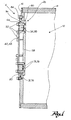
- figure 1 shows a section view of an explosive container comprising a safety device according to an embodiment of the present invention
- figure 2 shows a section view of an explosive container comprising a safety device according to a further embodiment of the present invention
- figure 3 shows a section view of a further embodiment of the safety device of the present invention.
- reference numeral 4 generally relates to a safety device for containers 8 of explosive substances.
- Containers 8 of explosive substances for example comprise a chamber 12 for receiving the explosive substance, preferably hydraulically or pneumatically sealed, delimited by at least one closing wall 16.
- the closing wall 16 has a venting aperture 20 suitable for seating at least partly device 4.
- the venting aperture 20 has a circular or in any case axial-symmetric shape relative to a symmetry axis X-X.
- device 4 comprises at least one closing body 28 suitable for hermetically closing the venting aperture 20.
- the closing body 28 is counter-shaped relative to the venting aperture 20; for example, the closing body 28 is shaped as a disc.
- Device 4 comprises retain means 34 of the closing body 28, mechanically separate from the closing body 28, and suitable for constraining the closing body 28 on the venting aperture 20.
- the retain means 34 comprise a melting element 38, suitable for melting for releasing the closing body 28, in the case of overheating of the environment surrounding the container of explosive material; the melting element 38 in an assembled configuration interferes at least partly with the closing body 28 for preventing the extraction of the closing body 28 from the containment chamber 12.
- the melting element 38 has a ring shape, so that in an assembled configuration it is axial-symmetrical relative to axis X-X of aperture 20.
- the retain means 34 comprise an abutment element 42 that in an assembled configuration interferes with the melting element 38 so as to lock the melting element 38 into position against the closing body 28.
- the melting element 38 in an assembled configuration, is preloaded in compression between the abutment element 42 and the closing body 28, according to an axial direction parallel to said axis X-X of aperture 20.
- the abutment element 42 comprises a first plate 48 suitable for influencing in compression a portion of melting element 38 in contact with the closing body 28.
- the first plate 48 is substantially counter-shaped relative to the closing body 28 so as to have external overall dimensions smaller than or equal to, the overall dimensions of the closing body 28.
- the first plate 48 and the closing body 28 are shaped as discs having substantially the same diameter.
- the abutment element 42 is mechanically constrained to the closing body 28 by constraining means, such as for example removable connections of threaded type 52.
- the abutment element 42 is not mechanically constrained to the closing body 28 but to the closing wall 16.
- the closing wall 28 is directly seated in a first seat 53 obtained in the thickness of wall 16 and delimited by a stopping edge 54 that axially constrains the closing body against the wall 16.
- the constraining means comprise spacer bushes 56 arranged between the first plate 48 and the closing body 28.
- Bushes 56 are preferably inserted coaxially to the threaded connections 52 and have the function of preventing bending deformations of the closing body or of the first plate.
- a venting valve 60 is inserted between the first plate 48 and the closing body 28, suitable for intercepting the gases of the containment chamber 12 and ejecting them outside said chamber 12, as a limit pressure value is exceeded.
- the abutment element 42 comprises a second plate 64 suitable for influencing in compression a portion of the melting element 38 in contact with a portion of said closing wall 16 or with a support flange 80 of device 4, as better described hereinafter.
- the first and the second plate 48, 64 are mechanically separate from each other.
- the first plate has a disc shape, counter-shaped relative to the closing body 28, and the second plate 64 has the shape of a circular crown, having an inside diameter larger than the outer diameter of the first plate 48 and of the closing body 28.
- the melting element 38 comprises at least one guiding rib 68 suitable for facilitating the coupling between element 38 itself and at least one between the closing body 28 and the first plate 48.
- the edge forms a containment guide of the closing body 28 and of the first plate 48.
- the melting element 38 comprises a bismuth-tin alloy, having a melting point comprised between 135 °C and 145 °C.
- the melting element is made of an eutectic bismuth and tin alloy having a melting point equal to 138 °C.
- the melting element 38 comprises high molecular density polyethylene (HDPE) having a melting point equal to about 135 °C.
- HDPE high molecular density polyethylene
- the melting element 38 is a ring having a dimensional ratio between a radial thickness and an axial thickness greater than or equal to 1; and more in particular, said dimensional ratio is comprised between 2 and 2.5.
- axial thickness it is meant a thickness measured along a direction parallel to axis X-X of the venting aperture 20.
- radial thickness it is meant a thickness measured along a radial direction perpendicular to axis X-X and incident therewith.
- the closing body 28 is preferably made of aluminium so as to allow good resistance to the inside pressures of the chamber and at the same time limit the weight of the component itself; the mass containment is useful for limiting the stresses that subsequent to shocks and/or vibrations the closing body 28 would transmit to the retain means 34, 38, 42.
- device 4 comprises sealing means 74 suitable for ensuring the hydraulic seal of the containment chamber 12.
- sealing means 74 comprise at least one O-ring 76 arranged between the closing wall 16 and the closing body 28 ( figure 3 ).
- the sealing means 74 comprise at least one 0-ring 76 arranged between the closing body 28 and the melting element 38 ( figure 1 ).
- device 4 comprises a flange 80 suitable for being inserted in the venting aperture 20 and for seating at least partly the closing body 28, so as to sealingly close, together with the closing body 28, the venting aperture 20 ( figures 1-2 ).
- flange 80 can comprise a fixing collar 84 suitable for making an abutment against the closing wall 16 in the insertion of flange 80 in aperture 20 and for allowing the fixing of flange 80 to said closing wall 16, for example by threaded connections 52.
- a sealing ring such as an O-ring 76, is inserted between collar 84 and the closing wall 16.
- Flange 80 delimits a second seat 86 for seating said melting element 38. It is possible to provide for a second flange 90 coaxial relative to flange 80, for example for adapting the dimensions of the device to those of the venting aperture 20.
- the device and the relative explosive container are normally exposed to a temperature comprised between -40 °C and +70 °C.
- the melting ring In the presence of any shocks or vibrations, the melting ring is in a tensional pre-compression state, so that any tensile stress, for example due to bending stresses, are annulled or in any case dampened or reduced by said tensional state.
- the melting ring has a geometry of 'stocky' body, such component is essentially stressed by shearing actions rather than bending actions. Such geometry increases the mechanical resistance of the component to even impulsive stresses optionally combined with pressure actions of the gases inside the chamber.
- the melting element 38 melts.
- the retain means 34,38,42 are not capable anymore of locking the closing body 28, since the melting disc melts, and the closing body tends, also thanks to its weight, to fall and exit from the relative seat, freeing the venting aperture 20 for the gases contained in chamber 12; optionally, the thrust action of the gases themselves can favour the ejection of the closing body 28.
- first plate 48 represents a mass integral to the closing body 28, positioned externally relative to aperture 20 and to the containment chamber 12, thus the overall barycentre of the closing body 28 and first plate 48 system is external to the containment chamber 12 and favours the fall by gravity of the closing body 28.
- the exit of the closing body 28 from the seat thereof does not exhibit risks of sticking that could lock it on aperture 20, closing at least partly the gas outlet section: in fact, after the melting of the ring, the passage section available for the closing body increases, since the closing body meets a passage section of the second plate 64 or of flange 80 that are greater than the dimensions of the closing body 28 and of the first plate 48.
- the closing body is normally mounted with slight clearance relative to the relevant aperture, since the locking into position of the body itself takes place through the retain means 34,38,42 and the hermetic seal of the gases is obtained by special seals.
- the safety devices according to the present invention can be advantageously applied also the existing explosive containers either without safety devices and provided with little effective safety devices.
- the method consists in determining an existing venting aperture on a wall 16 of the containment chamber 12 of the explosive container.
- said venting aperture 20 is made on a closing wall 16 of the containment chamber 12 of the explosive material.
- a safety device 4 according to the present invention is then sealingly inserted in said venting aperture 20.
- the device may be inserted in a pre-assembled configuration, that is, having already mechanically connected the melting element 38, the closing body 28, the abutment element 42 and any flanges 80, 90 to one another.
- the safety device according to the present invention allows overcoming the disadvantages of the prior art safety devices.
- the device has a small mass as compared to the melting discs of the prior art; in this way, the inertia forces resulting from shocks and/or vibrations that could cause damages or cracks to the disc itself are avoided.
- the device is advantageously mounted in a tensional pre-compression state between the respective flange and counter-flange retaining means; in this way it is possible to prevent that following the dynamic action of shocks and/or vibrations, the melting element may be subject to tensile stresses that could generate the formation of cracks. Therefore, the device is resistant to environmental stresses the container it is applied to may undergo during the life steps, either logistics or operating, that is, resistant to shocks and vibrations, as well as to high ambient temperatures.
- the device allows maintaining the hydraulic and pneumatic seal of the explosive containment chamber so as to protect the explosive from possible risks of pollution from other substances, in ordinary logistic and operating conditions.
- the device ensures the sealing up to its triggering for extraordinary overheating conditions.
- the safety device according to the invention ensures quick and effective gas discharge before the limit explosive triggering temperature is reached.
- the closing body can be easily ejected without any risk of sticking; in particular, the ejection of the closing body can take place by gravity and does not need the thrusting action of the gases inside the chamber.
- the device according to the present invention therefore operates based on temperature rather than on the internal gas pressure, with opening quickness and simplicity.
- the device frees an aperture having a wide section which allows releasing larger amounts of burnt gases and quickly decreasing the pressure in the containment chamber, without generating hazardous overpressures.
- the device according to the present invention does not require high coupling accuracy; in fact, it does not envisage shaft-hole type couplings that could easily stick but flanged joints that are simple and inexpensive to make and assemble. In fact, the device can be removed by removable threaded connections and therefore does not require destructive sheet or welded part cuts.
- the device is therefore inexpensive to make and assemble as well as to maintain; in particular it does not need casting of metal material on site, a procedure that would imply considerable risks and that would complicate the end assembly and maintenance steps.
- the device according to the present invention can be advantageously mounted also on existing explosive containers; in fact it is sufficient to apply the device to an aperture obtained or made on a closing wall of the containment chamber.
- the device according to the present invention can be produced, installed, maintained and inspected at low cost in terms of labour, material and equipment.
Landscapes
- Engineering & Computer Science (AREA)
- General Engineering & Computer Science (AREA)
- Safety Valves (AREA)
- Magnetic Resonance Imaging Apparatus (AREA)
- Pressure Vessels And Lids Thereof (AREA)
Claims (25)
- Dispositif de sécurité (4) pour conteneurs (8) de substances explosives, lesdits conteneurs (8) comprenant une chambre de logement scellée par voie hydraulique (12) pour une substance explosive délimitée par au moins une paroi de fermeture (16), ladite paroi de fermeture (16) ayant une ouverture d'aération (20);- le dispositif (4) comprenant au moins un corps de fermeture (28) approprié pour fermer hermétiquement ladite ouverture d'aération (20),- le dispositif comprenant des moyens de retenue (34, 38, 42) du corps de fermeture (28), séparés mécaniquement du corps de fermeture (28), et convenant pour presser le corps de fermeture (28) sur l'ouverture d'aération (20), dans lequel lesdits moyens de retenue (34, 38, 42) comprennent :- un élément de fusion (38), convenant à une fusion pour libérer le corps de fermeture (28), dans le cas de dépassement d'un seuil de température prédéterminé en dessous de la température d'amorçage de l'explosif, ledit élément de fusion (38) en configuration assemblée interférant au moins en partie avec le corps de fermeture (28) pour empêcher l'extraction du corps de fermeture (28) de la chambre de confinement (12),
caractérisé en ce que
les moyens de retenue (34, 38, 42) comprennent en outre un élément de butée (42) qui, en configuration assemblée, interfère avec l'élément de fusion (38) de manière à verrouiller l'élément de fusion (38) en position contre le corps de fermeture (28), ledit élément de fusion (38), en configuration assemblée, étant préchargé à la compression entre l'élément de butée (42) et le corps de fermeture (28),
dans lequel l'ouverture d'aération (20) a une forme axialement symétrique par rapport à un axe (X-X) et le corps de fermeture (28) a une forme externe correspondant à la forme interne de ladite ouverture d'aération (20), dans lequel l'élément de fusion (38) a une forme annulaire, de sorte que, en configuration assemblée, il soit axialement symétrique par rapport à l'axe (X-X) de l'ouverture (20),
l'élément de fusion (38), en configuration assemblée, étant préchargé à la compression entre l'élément de butée (42) et le corps de fermeture (28), selon une direction axiale parallèle audit axe (X-X) de l'ouverture (20). - Dispositif de sécurité (4) selon la revendication 1, dans lequel ledit élément de butée (42) comprend une première plaque (48) appropriée pour influencer en compression une partie de l'élément de fusion (38) en contact avec le corps de fermeture (28).
- Dispositif de sécurité (4) selon la revendication 2, dans lequel ladite première plaque (48) a une forme similaire à la forme du corps de fermeture (28) de manière à avoir des dimensions globales externes inférieures ou égales aux dimensions globales du corps de fermeture (28).
- Dispositif de sécurité (4) selon la revendication 2 ou 3, dans lequel ladite première plaque (48) est mécaniquement pressée sur le corps de fermeture (28) par des moyens de contrainte amovibles.
- Dispositif de sécurité (4) selon la revendication 4, dans lequel lesdits moyens de contrainte comprennent des raccordements amovibles de type fileté (52).
- Dispositif de sécurité (4) selon la revendication 4, ou 5, dans lequel lesdits moyens de contrainte comprennent des douilles d'espacement (56) aménagées entre la première plaque (48) et le corps de fermeture (28).
- Dispositif de sécurité (4) selon l'une quelconque des revendications 2 à 6, dans lequel une soupape d'aération (60) est aménagée entre la première plaque (48) et le corps de fermeture (28), appropriée pour intercepter les gaz de la chambre de confinement (12) et les éjecter de ladite chambre (12) lorsqu'une valeur de pression limite est dépassée.
- Dispositif de sécurité (4) selon l'une quelconque des revendications précédentes, dans lequel ledit élément de butée (42) comprend une seconde plaque (64) appropriée pour influencer en compression une partie de l'élément de fusion (38) en contact avec une partie de ladite paroi de fermeture (16)
- Dispositif de sécurité (4) selon la revendication 8, dans lequel lesdites première et seconde plaques (48, 64) sont séparées mécaniquement l'une de l'autre.
- Dispositif de sécurité (4) selon l'une quelconque des revendications 2 à 9, dans lequel ledit élément de fusion (38) comprend au moins une nervure de guidage (68) appropriée pour faciliter le positionnement de l'élément de fusion (38) par rapport au moins au corps de fermeture (28) ou à la première plaque (48).
- Dispositif de sécurité (4) selon l'une quelconque des revendications précédentes, dans lequel ledit élément de fusion (38) comprend un alliage bismuth-étain, ayant un point de fusion compris entre 135 °C et 145 °C.
- Dispositif de sécurité (4) selon l'une quelconque des revendications précédentes, dans lequel ledit élément de fusion (38) comprend un alliage eutectique bismuth-étain, ayant un point de fusion égal à 138 °C.
- Dispositif de sécurité (4) selon l'une quelconque des revendications 1 à 10, dans lequel ledit élément de fusion (38) comprend un polyéthylène de haute densité (HDPE) ayant un point de fusion égal à 135 °C.
- Dispositif de sécurité (4) selon l'une quelconque des revendications précédentes, dans lequel ledit élément de fusion (38) est un anneau ayant un rapport dimensionnel entre une épaisseur radiale et une épaisseur axiale supérieure ou égale à 1.
- Dispositif de sécurité (4) selon la revendication 11, dans lequel ledit rapport dimensionnel est compris entre 2 et 2,5.
- Dispositif de sécurité (4) selon l'une quelconque des revendications 1 à 15, dans lequel le corps de fermeture (28) est fabriqué en aluminium.
- Dispositif de sécurité (4) selon l'une quelconque des revendications 1 à 16, comprenant des moyens de scellage (74, 76) appropriés pour assurer l'étanchéité hydraulique de la chambre de confinement (12).
- Dispositif de sécurité (4) selon la revendication 17, dans lequel lesdits moyens de scellage comprennent au moins un joint torique (76) aménagé entre la paroi de fermeture (16) et le corps de fermeture (28).
- Dispositif de sécurité (4) selon la revendication 17 ou 18, dans lequel lesdits moyens de scellage comprennent au moins un joint torique aménagé entre le corps de fermeture (28) et l'élément de fusion (38).
- Dispositif de sécurité (4) selon l'une quelconque des revendications 1 à 19, comprenant une bride (80) appropriée pour être insérée dans l'ouverture d'aération (20) et pour loger au moins en partie le corps de fermeture (28), de manière à fermer de façon étanche, conjointement avec le corps de fermeture (28), l'ouverture d'aération (20).
- Dispositif de sécurité (4) selon la revendication 20, dans lequel ladite bride (80) comprend un collier de fixation (84) approprié pour presser une butée contre la paroi de fermeture (16) dans l'insertion de la bride (80) dans l'ouverture (20) et pour permettre la fixation de ladite bride (80) à ladite paroi de fermeture (16).
- Dispositif de sécurité (4) selon la revendication 21, comprenant au moins un joint d'étanchéité de type torique (76) entre ledit collier (84) et la paroi de fermeture (16).
- Dispositif de sécurité (4) selon la revendication 20, 21 ou 22, dans lequel ladite bride délimite un second siège (86) pour loger ledit élément de fusion (38).
- Conteneur pour explosifs (8) comprenant une chambre de confinement (12) de matériau explosif délimitée par au moins une paroi de fermeture (16), ladite paroi de fermeture (16) ayant une ouverture d'aération (20), le conteneur (8) étant caractérisé en ce qu'il comprend un dispositif de sécurité (4) selon l'une quelconque des revendications 1 à 23.
- Procédé de sécurisation d'un conteneur d'explosifs (8), comprenant les étapes consistant à :- réaliser une ouverture d'aération (20) dans une paroi de fermeture (16) de la chambre de confinement (12) du matériau explosif,- insérer de manière étanche un dispositif de sécurité dans ladite ouverture d'aération (20) selon l'une quelconque des revendications 1 à 23.
Priority Applications (4)
| Application Number | Priority Date | Filing Date | Title |
|---|---|---|---|
| ES07425398T ES2352881T3 (es) | 2007-06-28 | 2007-06-28 | Dispositivo de seguridad para recipientes de explosivos, recipientes de explosivos y método para preparar recipientes seguros para explosivos. |
| EP07425398A EP2009386B1 (fr) | 2007-06-28 | 2007-06-28 | Dispositif de sécurité pour des récipients pour explosifs, récipients pour explosifs et procédé de sécurisation pour récipients pour explosifs |
| AT07425398T ATE481620T1 (de) | 2007-06-28 | 2007-06-28 | Sicherheitsvorrichtung für explosive behälter, explosive behälter und verfahren zur herstellung der sicherheit explosiver behälter |
| DE602007009207T DE602007009207D1 (de) | 2007-06-28 | 2007-06-28 | Sicherheitsvorrichtung für explosive Behälter, explosive Behälter und Verfahren zur Herstellung der Sicherheit explosiver Behälter |
Applications Claiming Priority (1)
| Application Number | Priority Date | Filing Date | Title |
|---|---|---|---|
| EP07425398A EP2009386B1 (fr) | 2007-06-28 | 2007-06-28 | Dispositif de sécurité pour des récipients pour explosifs, récipients pour explosifs et procédé de sécurisation pour récipients pour explosifs |
Publications (2)
| Publication Number | Publication Date |
|---|---|
| EP2009386A1 EP2009386A1 (fr) | 2008-12-31 |
| EP2009386B1 true EP2009386B1 (fr) | 2010-09-15 |
Family
ID=38698310
Family Applications (1)
| Application Number | Title | Priority Date | Filing Date |
|---|---|---|---|
| EP07425398A Active EP2009386B1 (fr) | 2007-06-28 | 2007-06-28 | Dispositif de sécurité pour des récipients pour explosifs, récipients pour explosifs et procédé de sécurisation pour récipients pour explosifs |
Country Status (4)
| Country | Link |
|---|---|
| EP (1) | EP2009386B1 (fr) |
| AT (1) | ATE481620T1 (fr) |
| DE (1) | DE602007009207D1 (fr) |
| ES (1) | ES2352881T3 (fr) |
Families Citing this family (4)
| Publication number | Priority date | Publication date | Assignee | Title |
|---|---|---|---|---|
| KR101461709B1 (ko) * | 2012-06-21 | 2014-11-19 | 주식회사 한화 | 탄약용 압력배기 컨테이너 |
| DE102013000043A1 (de) * | 2013-01-07 | 2014-07-10 | Rheinmetall Waffe Munition Gmbh | Munitionskiste |
| EP3070219B1 (fr) * | 2015-03-20 | 2020-12-16 | ABB Schweiz AG | Évent d'explosion |
| GB2585026B (en) | 2019-06-25 | 2023-03-29 | Bae Systems Plc | Overpressure protection system for a magazine |
Family Cites Families (3)
| Publication number | Priority date | Publication date | Assignee | Title |
|---|---|---|---|---|
| USH1144H (en) * | 1990-10-04 | 1993-03-02 | Hercules Incorporated | Solid propellant rocket motor with fusible end closure holder |
| US5155298A (en) * | 1991-09-30 | 1992-10-13 | The United States Of America As Represented By The Secretary Of The Navy | Thermally activated case venting safety apparatus |
| US6752085B2 (en) * | 2002-05-06 | 2004-06-22 | Lockheed Martin Corporation | Method and apparatus for releasably attaching a closure plate to a casing |
-
2007
- 2007-06-28 ES ES07425398T patent/ES2352881T3/es active Active
- 2007-06-28 EP EP07425398A patent/EP2009386B1/fr active Active
- 2007-06-28 DE DE602007009207T patent/DE602007009207D1/de active Active
- 2007-06-28 AT AT07425398T patent/ATE481620T1/de not_active IP Right Cessation
Also Published As
| Publication number | Publication date |
|---|---|
| ES2352881T3 (es) | 2011-02-23 |
| DE602007009207D1 (de) | 2010-10-28 |
| EP2009386A1 (fr) | 2008-12-31 |
| ATE481620T1 (de) | 2010-10-15 |
Similar Documents
| Publication | Publication Date | Title |
|---|---|---|
| EP1502073B1 (fr) | Procede et appareil pour fixer de façon amovible une plaque d'obturation a un boitier | |
| US8573127B2 (en) | Pressure-relief system for gun fired cannon cartridges | |
| KR101929667B1 (ko) | 둔감 성능이 향상된 고폭탄용 운반고리 | |
| US8997774B2 (en) | Pressure discharge valve | |
| EP2009386B1 (fr) | Dispositif de sécurité pour des récipients pour explosifs, récipients pour explosifs et procédé de sécurisation pour récipients pour explosifs | |
| US8082846B2 (en) | Temperature responsive safety devices for munitions | |
| US8596291B2 (en) | Venting lifting plug for munitions | |
| US20060054046A1 (en) | Temperature responsive safety devices for munitions | |
| US5361703A (en) | Inert thermally activated burster | |
| US4671177A (en) | Temperature resistant detonator | |
| US11940101B2 (en) | Fusible link, gas tank, and method for assembling a fusible link and for installing same in a gas tank | |
| US10571234B1 (en) | Venting lifting plug for munitions | |
| US9995563B2 (en) | Cartridge with safety fuse in the drive system, and method for producing it | |
| US5611424A (en) | Container fuse for enhanced survivability | |
| EP2335010B1 (fr) | Culot et cylindre comprenant ledit culot | |
| KR102788675B1 (ko) | 둔감 성능을 갖는 관통형 탄두의 후방마개 및 그 조립방법 | |
| EP1418372A1 (fr) | Soupape de sécurité à activation thermique | |
| US11054229B2 (en) | Device for venting an explosive charge and munition equipped with such a device | |
| NO148792B (no) | Sikringsanordning for rotasjonsprosjektil. | |
| US6360526B2 (en) | Rocket motor with desensitizer injector | |
| EP0836700B1 (fr) | Moteurs-fusees a combustible solide a securite amelioree | |
| KR20170038204A (ko) | 추진장약 포장용기 | |
| JP2015227764A (ja) | スティッチ状脆弱部を有する弾薬用容器 | |
| JP6399815B2 (ja) | 本体円筒部に脆弱部を、かつ、蓋体にロックスパイダを有する弾薬用容器 | |
| CN222992277U (zh) | 一种泄压装置 |
Legal Events
| Date | Code | Title | Description |
|---|---|---|---|
| PUAI | Public reference made under article 153(3) epc to a published international application that has entered the european phase |
Free format text: ORIGINAL CODE: 0009012 |
|
| AK | Designated contracting states |
Kind code of ref document: A1 Designated state(s): AT BE BG CH CY CZ DE DK EE ES FI FR GB GR HU IE IS IT LI LT LU LV MC MT NL PL PT RO SE SI SK TR |
|
| AX | Request for extension of the european patent |
Extension state: AL BA HR MK RS |
|
| 17P | Request for examination filed |
Effective date: 20090618 |
|
| 17Q | First examination report despatched |
Effective date: 20090720 |
|
| AKX | Designation fees paid |
Designated state(s): AT BE BG CH CY CZ DE DK EE ES FI FR GB GR HU IE IS IT LI LT LU LV MC MT NL PL PT RO SE SI SK TR |
|
| GRAP | Despatch of communication of intention to grant a patent |
Free format text: ORIGINAL CODE: EPIDOSNIGR1 |
|
| GRAS | Grant fee paid |
Free format text: ORIGINAL CODE: EPIDOSNIGR3 |
|
| GRAA | (expected) grant |
Free format text: ORIGINAL CODE: 0009210 |
|
| AK | Designated contracting states |
Kind code of ref document: B1 Designated state(s): AT BE BG CH CY CZ DE DK EE ES FI FR GB GR HU IE IS IT LI LT LU LV MC MT NL PL PT RO SE SI SK TR |
|
| REG | Reference to a national code |
Ref country code: GB Ref legal event code: FG4D Ref country code: CH Ref legal event code: EP |
|
| REG | Reference to a national code |
Ref country code: IE Ref legal event code: FG4D |
|
| REF | Corresponds to: |
Ref document number: 602007009207 Country of ref document: DE Date of ref document: 20101028 Kind code of ref document: P |
|
| REG | Reference to a national code |
Ref country code: NL Ref legal event code: VDEP Effective date: 20100915 |
|
| PG25 | Lapsed in a contracting state [announced via postgrant information from national office to epo] |
Ref country code: FI Free format text: LAPSE BECAUSE OF FAILURE TO SUBMIT A TRANSLATION OF THE DESCRIPTION OR TO PAY THE FEE WITHIN THE PRESCRIBED TIME-LIMIT Effective date: 20100915 Ref country code: LT Free format text: LAPSE BECAUSE OF FAILURE TO SUBMIT A TRANSLATION OF THE DESCRIPTION OR TO PAY THE FEE WITHIN THE PRESCRIBED TIME-LIMIT Effective date: 20100915 Ref country code: AT Free format text: LAPSE BECAUSE OF FAILURE TO SUBMIT A TRANSLATION OF THE DESCRIPTION OR TO PAY THE FEE WITHIN THE PRESCRIBED TIME-LIMIT Effective date: 20100915 |
|
| REG | Reference to a national code |
Ref country code: ES Ref legal event code: FG2A Effective date: 20110211 |
|
| LTIE | Lt: invalidation of european patent or patent extension |
Effective date: 20100915 |
|
| PG25 | Lapsed in a contracting state [announced via postgrant information from national office to epo] |
Ref country code: CY Free format text: LAPSE BECAUSE OF FAILURE TO SUBMIT A TRANSLATION OF THE DESCRIPTION OR TO PAY THE FEE WITHIN THE PRESCRIBED TIME-LIMIT Effective date: 20100915 Ref country code: SI Free format text: LAPSE BECAUSE OF FAILURE TO SUBMIT A TRANSLATION OF THE DESCRIPTION OR TO PAY THE FEE WITHIN THE PRESCRIBED TIME-LIMIT Effective date: 20100915 Ref country code: PL Free format text: LAPSE BECAUSE OF FAILURE TO SUBMIT A TRANSLATION OF THE DESCRIPTION OR TO PAY THE FEE WITHIN THE PRESCRIBED TIME-LIMIT Effective date: 20100915 |
|
| PG25 | Lapsed in a contracting state [announced via postgrant information from national office to epo] |
Ref country code: LV Free format text: LAPSE BECAUSE OF FAILURE TO SUBMIT A TRANSLATION OF THE DESCRIPTION OR TO PAY THE FEE WITHIN THE PRESCRIBED TIME-LIMIT Effective date: 20100915 Ref country code: GR Free format text: LAPSE BECAUSE OF FAILURE TO SUBMIT A TRANSLATION OF THE DESCRIPTION OR TO PAY THE FEE WITHIN THE PRESCRIBED TIME-LIMIT Effective date: 20101216 Ref country code: SE Free format text: LAPSE BECAUSE OF FAILURE TO SUBMIT A TRANSLATION OF THE DESCRIPTION OR TO PAY THE FEE WITHIN THE PRESCRIBED TIME-LIMIT Effective date: 20100915 |
|
| PG25 | Lapsed in a contracting state [announced via postgrant information from national office to epo] |
Ref country code: RO Free format text: LAPSE BECAUSE OF FAILURE TO SUBMIT A TRANSLATION OF THE DESCRIPTION OR TO PAY THE FEE WITHIN THE PRESCRIBED TIME-LIMIT Effective date: 20100915 Ref country code: SK Free format text: LAPSE BECAUSE OF FAILURE TO SUBMIT A TRANSLATION OF THE DESCRIPTION OR TO PAY THE FEE WITHIN THE PRESCRIBED TIME-LIMIT Effective date: 20100915 Ref country code: PT Free format text: LAPSE BECAUSE OF FAILURE TO SUBMIT A TRANSLATION OF THE DESCRIPTION OR TO PAY THE FEE WITHIN THE PRESCRIBED TIME-LIMIT Effective date: 20110117 Ref country code: CZ Free format text: LAPSE BECAUSE OF FAILURE TO SUBMIT A TRANSLATION OF THE DESCRIPTION OR TO PAY THE FEE WITHIN THE PRESCRIBED TIME-LIMIT Effective date: 20100915 Ref country code: IS Free format text: LAPSE BECAUSE OF FAILURE TO SUBMIT A TRANSLATION OF THE DESCRIPTION OR TO PAY THE FEE WITHIN THE PRESCRIBED TIME-LIMIT Effective date: 20110115 Ref country code: NL Free format text: LAPSE BECAUSE OF FAILURE TO SUBMIT A TRANSLATION OF THE DESCRIPTION OR TO PAY THE FEE WITHIN THE PRESCRIBED TIME-LIMIT Effective date: 20100915 Ref country code: EE Free format text: LAPSE BECAUSE OF FAILURE TO SUBMIT A TRANSLATION OF THE DESCRIPTION OR TO PAY THE FEE WITHIN THE PRESCRIBED TIME-LIMIT Effective date: 20100915 |
|
| PG25 | Lapsed in a contracting state [announced via postgrant information from national office to epo] |
Ref country code: BE Free format text: LAPSE BECAUSE OF FAILURE TO SUBMIT A TRANSLATION OF THE DESCRIPTION OR TO PAY THE FEE WITHIN THE PRESCRIBED TIME-LIMIT Effective date: 20100915 |
|
| PLBE | No opposition filed within time limit |
Free format text: ORIGINAL CODE: 0009261 |
|
| STAA | Information on the status of an ep patent application or granted ep patent |
Free format text: STATUS: NO OPPOSITION FILED WITHIN TIME LIMIT |
|
| 26N | No opposition filed |
Effective date: 20110616 |
|
| PG25 | Lapsed in a contracting state [announced via postgrant information from national office to epo] |
Ref country code: DK Free format text: LAPSE BECAUSE OF FAILURE TO SUBMIT A TRANSLATION OF THE DESCRIPTION OR TO PAY THE FEE WITHIN THE PRESCRIBED TIME-LIMIT Effective date: 20100915 |
|
| REG | Reference to a national code |
Ref country code: DE Ref legal event code: R097 Ref document number: 602007009207 Country of ref document: DE Effective date: 20110616 |
|
| PG25 | Lapsed in a contracting state [announced via postgrant information from national office to epo] |
Ref country code: MT Free format text: LAPSE BECAUSE OF FAILURE TO SUBMIT A TRANSLATION OF THE DESCRIPTION OR TO PAY THE FEE WITHIN THE PRESCRIBED TIME-LIMIT Effective date: 20100915 |
|
| REG | Reference to a national code |
Ref country code: CH Ref legal event code: PL |
|
| REG | Reference to a national code |
Ref country code: IE Ref legal event code: MM4A |
|
| PG25 | Lapsed in a contracting state [announced via postgrant information from national office to epo] |
Ref country code: LI Free format text: LAPSE BECAUSE OF NON-PAYMENT OF DUE FEES Effective date: 20110630 Ref country code: IE Free format text: LAPSE BECAUSE OF NON-PAYMENT OF DUE FEES Effective date: 20110628 Ref country code: CH Free format text: LAPSE BECAUSE OF NON-PAYMENT OF DUE FEES Effective date: 20110630 |
|
| REG | Reference to a national code |
Ref country code: DE Ref legal event code: R082 Ref document number: 602007009207 Country of ref document: DE Representative=s name: MUELLER-BORE & PARTNER PATENTANWAELTE, EUROPEA, DE Effective date: 20120809 Ref country code: DE Ref legal event code: R081 Ref document number: 602007009207 Country of ref document: DE Owner name: RMW ITALIA MUNITIONS S.R.L., IT Free format text: FORMER OWNER: S.E.I. SOCIETA ESPLOSIVI INDUSTIALI S.P.A., GHEDI, IT Effective date: 20120809 Ref country code: DE Ref legal event code: R081 Ref document number: 602007009207 Country of ref document: DE Owner name: RWM ITALIA S.P.A., IT Free format text: FORMER OWNER: S.E.I. SOCIETA ESPLOSIVI INDUSTIALI S.P.A., GHEDI, IT Effective date: 20120809 Ref country code: DE Ref legal event code: R081 Ref document number: 602007009207 Country of ref document: DE Owner name: RWM ITALIA S.P.A., IT Free format text: FORMER OWNER: S.E.I. SOCIETA ESPLOSIVI INDUSTIALI S.P.A., GHEDI, BRESCIA, IT Effective date: 20120809 Ref country code: DE Ref legal event code: R082 Ref document number: 602007009207 Country of ref document: DE Representative=s name: MUELLER-BORE & PARTNER PATENTANWAELTE PARTG MB, DE Effective date: 20120809 |
|
| REG | Reference to a national code |
Ref country code: DE Ref legal event code: R082 Ref document number: 602007009207 Country of ref document: DE Representative=s name: MUELLER-BORE & PARTNER PATENTANWAELTE, EUROPEA, DE |
|
| REG | Reference to a national code |
Ref country code: GB Ref legal event code: 732E Free format text: REGISTERED BETWEEN 20121122 AND 20121128 |
|
| REG | Reference to a national code |
Ref country code: ES Ref legal event code: PC2A Owner name: RWM ITALIA S.P.A. Effective date: 20121212 |
|
| REG | Reference to a national code |
Ref country code: FR Ref legal event code: TP Owner name: RWM ITALIA S.P.A., IT Effective date: 20121206 |
|
| REG | Reference to a national code |
Ref country code: DE Ref legal event code: R081 Ref document number: 602007009207 Country of ref document: DE Owner name: RWM ITALIA S.P.A., IT Free format text: FORMER OWNER: RMW ITALIA MUNITIONS S.R.L., GHEDI, IT Effective date: 20121120 Ref country code: DE Ref legal event code: R082 Ref document number: 602007009207 Country of ref document: DE Representative=s name: MUELLER-BORE & PARTNER PATENTANWAELTE, EUROPEA, DE Effective date: 20121120 Ref country code: DE Ref legal event code: R082 Ref document number: 602007009207 Country of ref document: DE Representative=s name: MUELLER-BORE & PARTNER PATENTANWAELTE PARTG MB, DE Effective date: 20121120 |
|
| REG | Reference to a national code |
Ref country code: FR Ref legal event code: CD Owner name: RWM ITALIA S.P.A., IT Effective date: 20121218 |
|
| PG25 | Lapsed in a contracting state [announced via postgrant information from national office to epo] |
Ref country code: MC Free format text: LAPSE BECAUSE OF NON-PAYMENT OF DUE FEES Effective date: 20110630 |
|
| PG25 | Lapsed in a contracting state [announced via postgrant information from national office to epo] |
Ref country code: LU Free format text: LAPSE BECAUSE OF NON-PAYMENT OF DUE FEES Effective date: 20110628 |
|
| PG25 | Lapsed in a contracting state [announced via postgrant information from national office to epo] |
Ref country code: BG Free format text: LAPSE BECAUSE OF FAILURE TO SUBMIT A TRANSLATION OF THE DESCRIPTION OR TO PAY THE FEE WITHIN THE PRESCRIBED TIME-LIMIT Effective date: 20101215 Ref country code: TR Free format text: LAPSE BECAUSE OF FAILURE TO SUBMIT A TRANSLATION OF THE DESCRIPTION OR TO PAY THE FEE WITHIN THE PRESCRIBED TIME-LIMIT Effective date: 20100915 |
|
| PG25 | Lapsed in a contracting state [announced via postgrant information from national office to epo] |
Ref country code: HU Free format text: LAPSE BECAUSE OF FAILURE TO SUBMIT A TRANSLATION OF THE DESCRIPTION OR TO PAY THE FEE WITHIN THE PRESCRIBED TIME-LIMIT Effective date: 20100915 |
|
| REG | Reference to a national code |
Ref country code: FR Ref legal event code: PLFP Year of fee payment: 9 |
|
| REG | Reference to a national code |
Ref country code: FR Ref legal event code: PLFP Year of fee payment: 10 |
|
| REG | Reference to a national code |
Ref country code: FR Ref legal event code: PLFP Year of fee payment: 11 |
|
| REG | Reference to a national code |
Ref country code: FR Ref legal event code: PLFP Year of fee payment: 12 |
|
| PGFP | Annual fee paid to national office [announced via postgrant information from national office to epo] |
Ref country code: DE Payment date: 20250624 Year of fee payment: 19 |
|
| PGFP | Annual fee paid to national office [announced via postgrant information from national office to epo] |
Ref country code: GB Payment date: 20250618 Year of fee payment: 19 |
|
| PGFP | Annual fee paid to national office [announced via postgrant information from national office to epo] |
Ref country code: IT Payment date: 20250404 Year of fee payment: 19 |
|
| PGFP | Annual fee paid to national office [announced via postgrant information from national office to epo] |
Ref country code: FR Payment date: 20250530 Year of fee payment: 19 |
|
| PGFP | Annual fee paid to national office [announced via postgrant information from national office to epo] |
Ref country code: ES Payment date: 20250701 Year of fee payment: 19 |