EP2009442A2 - Aggregation and dispersion methods of magnetic particles, separation and detection methods using the same and detection kit - Google Patents
Aggregation and dispersion methods of magnetic particles, separation and detection methods using the same and detection kit Download PDFInfo
- Publication number
- EP2009442A2 EP2009442A2 EP08011729A EP08011729A EP2009442A2 EP 2009442 A2 EP2009442 A2 EP 2009442A2 EP 08011729 A EP08011729 A EP 08011729A EP 08011729 A EP08011729 A EP 08011729A EP 2009442 A2 EP2009442 A2 EP 2009442A2
- Authority
- EP
- European Patent Office
- Prior art keywords
- substance
- sodium
- adsorbent
- detected
- thermoresponsive polymer
- Prior art date
- Legal status (The legal status is an assumption and is not a legal conclusion. Google has not performed a legal analysis and makes no representation as to the accuracy of the status listed.)
- Withdrawn
Links
- 239000006249 magnetic particle Substances 0.000 title claims abstract description 124
- 238000000034 method Methods 0.000 title claims abstract description 84
- 238000001514 detection method Methods 0.000 title abstract description 17
- 238000000926 separation method Methods 0.000 title abstract description 12
- 230000002776 aggregation Effects 0.000 title description 17
- 238000004220 aggregation Methods 0.000 title description 17
- 239000006185 dispersion Substances 0.000 title description 17
- 229920000208 temperature-responsive polymer Polymers 0.000 claims abstract description 90
- 239000003463 adsorbent Substances 0.000 claims abstract description 79
- 239000000126 substance Substances 0.000 claims abstract description 78
- 239000007864 aqueous solution Substances 0.000 claims abstract description 45
- 150000003839 salts Chemical class 0.000 claims abstract description 45
- 239000002245 particle Substances 0.000 claims abstract description 28
- 238000002156 mixing Methods 0.000 claims abstract description 15
- 230000004931 aggregating effect Effects 0.000 claims abstract description 14
- 229920000642 polymer Polymers 0.000 claims description 44
- 239000000178 monomer Substances 0.000 claims description 24
- PMZURENOXWZQFD-UHFFFAOYSA-L Sodium Sulfate Chemical compound [Na+].[Na+].[O-]S([O-])(=O)=O PMZURENOXWZQFD-UHFFFAOYSA-L 0.000 claims description 17
- 229910052938 sodium sulfate Inorganic materials 0.000 claims description 17
- DGAQECJNVWCQMB-PUAWFVPOSA-M Ilexoside XXIX Chemical compound C[C@@H]1CC[C@@]2(CC[C@@]3(C(=CC[C@H]4[C@]3(CC[C@@H]5[C@@]4(CC[C@@H](C5(C)C)OS(=O)(=O)[O-])C)C)[C@@H]2[C@]1(C)O)C)C(=O)O[C@H]6[C@@H]([C@H]([C@@H]([C@H](O6)CO)O)O)O.[Na+] DGAQECJNVWCQMB-PUAWFVPOSA-M 0.000 claims description 16
- 230000004048 modification Effects 0.000 claims description 16
- 238000012986 modification Methods 0.000 claims description 16
- 239000011734 sodium Substances 0.000 claims description 16
- 229910052708 sodium Inorganic materials 0.000 claims description 16
- 235000015424 sodium Nutrition 0.000 claims description 16
- 238000006116 polymerization reaction Methods 0.000 claims description 11
- 235000011152 sodium sulphate Nutrition 0.000 claims description 11
- 150000001875 compounds Chemical class 0.000 claims description 10
- 239000012266 salt solution Substances 0.000 claims description 10
- CSNNHWWHGAXBCP-UHFFFAOYSA-L Magnesium sulfate Chemical compound [Mg+2].[O-][S+2]([O-])([O-])[O-] CSNNHWWHGAXBCP-UHFFFAOYSA-L 0.000 claims description 8
- ZLMJMSJWJFRBEC-UHFFFAOYSA-N Potassium Chemical compound [K] ZLMJMSJWJFRBEC-UHFFFAOYSA-N 0.000 claims description 8
- CDBYLPFSWZWCQE-UHFFFAOYSA-L Sodium Carbonate Chemical compound [Na+].[Na+].[O-]C([O-])=O CDBYLPFSWZWCQE-UHFFFAOYSA-L 0.000 claims description 8
- 229910052700 potassium Inorganic materials 0.000 claims description 8
- 239000011591 potassium Substances 0.000 claims description 8
- BWHMMNNQKKPAPP-UHFFFAOYSA-L potassium carbonate Chemical compound [K+].[K+].[O-]C([O-])=O BWHMMNNQKKPAPP-UHFFFAOYSA-L 0.000 claims description 8
- HELHAJAZNSDZJO-OLXYHTOASA-L sodium L-tartrate Chemical compound [Na+].[Na+].[O-]C(=O)[C@H](O)[C@@H](O)C([O-])=O HELHAJAZNSDZJO-OLXYHTOASA-L 0.000 claims description 8
- 239000001433 sodium tartrate Substances 0.000 claims description 8
- 229960002167 sodium tartrate Drugs 0.000 claims description 8
- 235000011004 sodium tartrates Nutrition 0.000 claims description 8
- QNILTEGFHQSKFF-UHFFFAOYSA-N n-propan-2-ylprop-2-enamide Chemical compound CC(C)NC(=O)C=C QNILTEGFHQSKFF-UHFFFAOYSA-N 0.000 claims description 6
- 239000003109 Disodium ethylene diamine tetraacetate Substances 0.000 claims description 5
- ZGTMUACCHSMWAC-UHFFFAOYSA-L EDTA disodium salt (anhydrous) Chemical compound [Na+].[Na+].OC(=O)CN(CC([O-])=O)CCN(CC(O)=O)CC([O-])=O ZGTMUACCHSMWAC-UHFFFAOYSA-L 0.000 claims description 5
- PXEDJBXQKAGXNJ-QTNFYWBSSA-L disodium L-glutamate Chemical compound [Na+].[Na+].[O-]C(=O)[C@@H](N)CCC([O-])=O PXEDJBXQKAGXNJ-QTNFYWBSSA-L 0.000 claims description 5
- 235000019262 disodium citrate Nutrition 0.000 claims description 5
- 239000002526 disodium citrate Substances 0.000 claims description 5
- 235000019301 disodium ethylene diamine tetraacetate Nutrition 0.000 claims description 5
- MSJMDZAOKORVFC-UAIGNFCESA-L disodium maleate Chemical compound [Na+].[Na+].[O-]C(=O)\C=C/C([O-])=O MSJMDZAOKORVFC-UAIGNFCESA-L 0.000 claims description 5
- HAXVIVNBOQIMTE-UHFFFAOYSA-L disodium;2-(carboxylatomethylamino)acetate Chemical compound [Na+].[Na+].[O-]C(=O)CNCC([O-])=O HAXVIVNBOQIMTE-UHFFFAOYSA-L 0.000 claims description 5
- CEYULKASIQJZGP-UHFFFAOYSA-L disodium;2-(carboxymethyl)-2-hydroxybutanedioate Chemical compound [Na+].[Na+].[O-]C(=O)CC(O)(C(=O)O)CC([O-])=O CEYULKASIQJZGP-UHFFFAOYSA-L 0.000 claims description 5
- 235000013923 monosodium glutamate Nutrition 0.000 claims description 5
- 229940073490 sodium glutamate Drugs 0.000 claims description 5
- PRWXGRGLHYDWPS-UHFFFAOYSA-L sodium malonate Chemical compound [Na+].[Na+].[O-]C(=O)CC([O-])=O PRWXGRGLHYDWPS-UHFFFAOYSA-L 0.000 claims description 5
- ZNCPFRVNHGOPAG-UHFFFAOYSA-L sodium oxalate Chemical compound [Na+].[Na+].[O-]C(=O)C([O-])=O ZNCPFRVNHGOPAG-UHFFFAOYSA-L 0.000 claims description 5
- 229940039790 sodium oxalate Drugs 0.000 claims description 5
- ZDQYSKICYIVCPN-UHFFFAOYSA-L sodium succinate (anhydrous) Chemical compound [Na+].[Na+].[O-]C(=O)CCC([O-])=O ZDQYSKICYIVCPN-UHFFFAOYSA-L 0.000 claims description 5
- WTWSHHITWMVLBX-DKWTVANSSA-M sodium;(2s)-2-aminobutanedioate;hydron Chemical compound [Na+].[O-]C(=O)[C@@H](N)CC(O)=O WTWSHHITWMVLBX-DKWTVANSSA-M 0.000 claims description 5
- XLPJNCYCZORXHG-UHFFFAOYSA-N 1-morpholin-4-ylprop-2-en-1-one Chemical compound C=CC(=O)N1CCOCC1 XLPJNCYCZORXHG-UHFFFAOYSA-N 0.000 claims description 4
- RESPXSHDJQUNTN-UHFFFAOYSA-N 1-piperidin-1-ylprop-2-en-1-one Chemical compound C=CC(=O)N1CCCCC1 RESPXSHDJQUNTN-UHFFFAOYSA-N 0.000 claims description 4
- WLPAQAXAZQUXBG-UHFFFAOYSA-N 1-pyrrolidin-1-ylprop-2-en-1-one Chemical compound C=CC(=O)N1CCCC1 WLPAQAXAZQUXBG-UHFFFAOYSA-N 0.000 claims description 4
- AKVUWTYSNLGBJY-UHFFFAOYSA-N 2-methyl-1-morpholin-4-ylprop-2-en-1-one Chemical compound CC(=C)C(=O)N1CCOCC1 AKVUWTYSNLGBJY-UHFFFAOYSA-N 0.000 claims description 4
- RASDUGQQSMMINZ-UHFFFAOYSA-N 2-methyl-1-piperidin-1-ylprop-2-en-1-one Chemical compound CC(=C)C(=O)N1CCCCC1 RASDUGQQSMMINZ-UHFFFAOYSA-N 0.000 claims description 4
- LVCMKNCJDCTPIB-UHFFFAOYSA-N 2-methyl-1-pyrrolidin-1-ylprop-2-en-1-one Chemical compound CC(=C)C(=O)N1CCCC1 LVCMKNCJDCTPIB-UHFFFAOYSA-N 0.000 claims description 4
- YQIGLEFUZMIVHU-UHFFFAOYSA-N 2-methyl-n-propan-2-ylprop-2-enamide Chemical compound CC(C)NC(=O)C(C)=C YQIGLEFUZMIVHU-UHFFFAOYSA-N 0.000 claims description 4
- CCIDRBFZPRURMU-UHFFFAOYSA-N 2-methyl-n-propylprop-2-enamide Chemical compound CCCNC(=O)C(C)=C CCIDRBFZPRURMU-UHFFFAOYSA-N 0.000 claims description 4
- VMHLLURERBWHNL-UHFFFAOYSA-M Sodium acetate Chemical compound [Na+].CC([O-])=O VMHLLURERBWHNL-UHFFFAOYSA-M 0.000 claims description 4
- BFNBIHQBYMNNAN-UHFFFAOYSA-N ammonium sulfate Chemical compound N.N.OS(O)(=O)=O BFNBIHQBYMNNAN-UHFFFAOYSA-N 0.000 claims description 4
- 229910052921 ammonium sulfate Inorganic materials 0.000 claims description 4
- 235000011130 ammonium sulphate Nutrition 0.000 claims description 4
- INHCSSUBVCNVSK-UHFFFAOYSA-L lithium sulfate Inorganic materials [Li+].[Li+].[O-]S([O-])(=O)=O INHCSSUBVCNVSK-UHFFFAOYSA-L 0.000 claims description 4
- 229910052943 magnesium sulfate Inorganic materials 0.000 claims description 4
- 235000019341 magnesium sulphate Nutrition 0.000 claims description 4
- QRWZCJXEAOZAAW-UHFFFAOYSA-N n,n,2-trimethylprop-2-enamide Chemical compound CN(C)C(=O)C(C)=C QRWZCJXEAOZAAW-UHFFFAOYSA-N 0.000 claims description 4
- 229940088644 n,n-dimethylacrylamide Drugs 0.000 claims description 4
- YLGYACDQVQQZSW-UHFFFAOYSA-N n,n-dimethylprop-2-enamide Chemical compound CN(C)C(=O)C=C YLGYACDQVQQZSW-UHFFFAOYSA-N 0.000 claims description 4
- ZIWDVJPPVMGJGR-UHFFFAOYSA-N n-ethyl-2-methylprop-2-enamide Chemical compound CCNC(=O)C(C)=C ZIWDVJPPVMGJGR-UHFFFAOYSA-N 0.000 claims description 4
- SWPMNMYLORDLJE-UHFFFAOYSA-N n-ethylprop-2-enamide Chemical compound CCNC(=O)C=C SWPMNMYLORDLJE-UHFFFAOYSA-N 0.000 claims description 4
- WDFKEEALECCKTJ-UHFFFAOYSA-N n-propylprop-2-enamide Chemical compound CCCNC(=O)C=C WDFKEEALECCKTJ-UHFFFAOYSA-N 0.000 claims description 4
- 229910000027 potassium carbonate Inorganic materials 0.000 claims description 4
- OTYBMLCTZGSZBG-UHFFFAOYSA-L potassium sulfate Chemical compound [K+].[K+].[O-]S([O-])(=O)=O OTYBMLCTZGSZBG-UHFFFAOYSA-L 0.000 claims description 4
- 229910052939 potassium sulfate Inorganic materials 0.000 claims description 4
- 235000011151 potassium sulphates Nutrition 0.000 claims description 4
- 239000001632 sodium acetate Substances 0.000 claims description 4
- 235000017281 sodium acetate Nutrition 0.000 claims description 4
- 229910000029 sodium carbonate Inorganic materials 0.000 claims description 4
- RBTVSNLYYIMMKS-UHFFFAOYSA-N tert-butyl 3-aminoazetidine-1-carboxylate;hydrochloride Chemical compound Cl.CC(C)(C)OC(=O)N1CC(N)C1 RBTVSNLYYIMMKS-UHFFFAOYSA-N 0.000 claims description 4
- GVGGWUXGMRTNIK-UHFFFAOYSA-N n-(2-amino-2-oxoethyl)prop-2-enamide Chemical compound NC(=O)CNC(=O)C=C GVGGWUXGMRTNIK-UHFFFAOYSA-N 0.000 claims description 3
- XFHJDMUEHUHAJW-UHFFFAOYSA-N n-tert-butylprop-2-enamide Chemical compound CC(C)(C)NC(=O)C=C XFHJDMUEHUHAJW-UHFFFAOYSA-N 0.000 claims description 3
- WIEFOJWXOGVOKJ-BYPYZUCNSA-N (2s)-2-amino-n-prop-2-enoylbutanediamide Chemical compound NC(=O)C[C@H](N)C(=O)NC(=O)C=C WIEFOJWXOGVOKJ-BYPYZUCNSA-N 0.000 claims description 2
- IZBQAIGPFVPPJB-UHFFFAOYSA-N n-prop-2-enoylpiperidine-3-carboxamide Chemical compound C=CC(=O)NC(=O)C1CCCNC1 IZBQAIGPFVPPJB-UHFFFAOYSA-N 0.000 claims description 2
- 235000011181 potassium carbonates Nutrition 0.000 claims description 2
- 235000017550 sodium carbonate Nutrition 0.000 claims description 2
- 238000010438 heat treatment Methods 0.000 abstract description 8
- 238000001816 cooling Methods 0.000 abstract description 6
- YBJHBAHKTGYVGT-ZKWXMUAHSA-N (+)-Biotin Chemical compound N1C(=O)N[C@@H]2[C@H](CCCCC(=O)O)SC[C@@H]21 YBJHBAHKTGYVGT-ZKWXMUAHSA-N 0.000 description 30
- 239000003153 chemical reaction reagent Substances 0.000 description 26
- 238000006243 chemical reaction Methods 0.000 description 19
- -1 iron(II) compound Chemical class 0.000 description 18
- 239000000427 antigen Substances 0.000 description 16
- 108091007433 antigens Proteins 0.000 description 16
- 102000036639 antigens Human genes 0.000 description 16
- 102000011923 Thyrotropin Human genes 0.000 description 15
- 108010061174 Thyrotropin Proteins 0.000 description 15
- 229960002685 biotin Drugs 0.000 description 15
- 235000020958 biotin Nutrition 0.000 description 15
- 239000011616 biotin Substances 0.000 description 15
- 230000027455 binding Effects 0.000 description 14
- 239000003446 ligand Substances 0.000 description 14
- 239000000872 buffer Substances 0.000 description 11
- 238000007885 magnetic separation Methods 0.000 description 11
- 238000004519 manufacturing process Methods 0.000 description 11
- 150000005846 sugar alcohols Polymers 0.000 description 11
- XLYOFNOQVPJJNP-UHFFFAOYSA-N water Substances O XLYOFNOQVPJJNP-UHFFFAOYSA-N 0.000 description 11
- FAPWRFPIFSIZLT-UHFFFAOYSA-M Sodium chloride Chemical compound [Na+].[Cl-] FAPWRFPIFSIZLT-UHFFFAOYSA-M 0.000 description 10
- 239000000203 mixture Substances 0.000 description 10
- 239000000243 solution Substances 0.000 description 10
- 102000002260 Alkaline Phosphatase Human genes 0.000 description 9
- 108020004774 Alkaline Phosphatase Proteins 0.000 description 9
- 108090001008 Avidin Proteins 0.000 description 9
- 229920002307 Dextran Polymers 0.000 description 9
- UQSXHKLRYXJYBZ-UHFFFAOYSA-N Iron oxide Chemical compound [Fe]=O UQSXHKLRYXJYBZ-UHFFFAOYSA-N 0.000 description 8
- 238000004020 luminiscence type Methods 0.000 description 8
- 102000004190 Enzymes Human genes 0.000 description 7
- 108090000790 Enzymes Proteins 0.000 description 7
- ZMXDDKWLCZADIW-UHFFFAOYSA-N N,N-Dimethylformamide Chemical compound CN(C)C=O ZMXDDKWLCZADIW-UHFFFAOYSA-N 0.000 description 7
- 239000006228 supernatant Substances 0.000 description 7
- 239000007832 Na2SO4 Substances 0.000 description 6
- RWSXRVCMGQZWBV-WDSKDSINSA-N glutathione Chemical compound OC(=O)[C@@H](N)CCC(=O)N[C@@H](CS)C(=O)NCC(O)=O RWSXRVCMGQZWBV-WDSKDSINSA-N 0.000 description 6
- 102000004169 proteins and genes Human genes 0.000 description 6
- 108090000623 proteins and genes Proteins 0.000 description 6
- GEHJYWRUCIMESM-UHFFFAOYSA-L sodium sulfite Chemical compound [Na+].[Na+].[O-]S([O-])=O GEHJYWRUCIMESM-UHFFFAOYSA-L 0.000 description 6
- QKNYBSVHEMOAJP-UHFFFAOYSA-N 2-amino-2-(hydroxymethyl)propane-1,3-diol;hydron;chloride Chemical compound Cl.OCC(N)(CO)CO QKNYBSVHEMOAJP-UHFFFAOYSA-N 0.000 description 5
- NIXOWILDQLNWCW-UHFFFAOYSA-M Acrylate Chemical compound [O-]C(=O)C=C NIXOWILDQLNWCW-UHFFFAOYSA-M 0.000 description 5
- 229920003171 Poly (ethylene oxide) Polymers 0.000 description 5
- 239000007850 fluorescent dye Substances 0.000 description 5
- 238000005259 measurement Methods 0.000 description 5
- 239000011780 sodium chloride Substances 0.000 description 5
- 238000001179 sorption measurement Methods 0.000 description 5
- 102100023635 Alpha-fetoprotein Human genes 0.000 description 4
- 108010074051 C-Reactive Protein Proteins 0.000 description 4
- 102100032752 C-reactive protein Human genes 0.000 description 4
- 102000011022 Chorionic Gonadotropin Human genes 0.000 description 4
- 108010062540 Chorionic Gonadotropin Proteins 0.000 description 4
- 102000004576 Placental Lactogen Human genes 0.000 description 4
- 108010003044 Placental Lactogen Proteins 0.000 description 4
- 239000000381 Placental Lactogen Substances 0.000 description 4
- 238000005516 engineering process Methods 0.000 description 4
- 125000000524 functional group Chemical group 0.000 description 4
- 239000011521 glass Substances 0.000 description 4
- 229940084986 human chorionic gonadotropin Drugs 0.000 description 4
- 230000003100 immobilizing effect Effects 0.000 description 4
- NOESYZHRGYRDHS-UHFFFAOYSA-N insulin Chemical compound N1C(=O)C(NC(=O)C(CCC(N)=O)NC(=O)C(CCC(O)=O)NC(=O)C(C(C)C)NC(=O)C(NC(=O)CN)C(C)CC)CSSCC(C(NC(CO)C(=O)NC(CC(C)C)C(=O)NC(CC=2C=CC(O)=CC=2)C(=O)NC(CCC(N)=O)C(=O)NC(CC(C)C)C(=O)NC(CCC(O)=O)C(=O)NC(CC(N)=O)C(=O)NC(CC=2C=CC(O)=CC=2)C(=O)NC(CSSCC(NC(=O)C(C(C)C)NC(=O)C(CC(C)C)NC(=O)C(CC=2C=CC(O)=CC=2)NC(=O)C(CC(C)C)NC(=O)C(C)NC(=O)C(CCC(O)=O)NC(=O)C(C(C)C)NC(=O)C(CC(C)C)NC(=O)C(CC=2NC=NC=2)NC(=O)C(CO)NC(=O)CNC2=O)C(=O)NCC(=O)NC(CCC(O)=O)C(=O)NC(CCCNC(N)=N)C(=O)NCC(=O)NC(CC=3C=CC=CC=3)C(=O)NC(CC=3C=CC=CC=3)C(=O)NC(CC=3C=CC(O)=CC=3)C(=O)NC(C(C)O)C(=O)N3C(CCC3)C(=O)NC(CCCCN)C(=O)NC(C)C(O)=O)C(=O)NC(CC(N)=O)C(O)=O)=O)NC(=O)C(C(C)CC)NC(=O)C(CO)NC(=O)C(C(C)O)NC(=O)C1CSSCC2NC(=O)C(CC(C)C)NC(=O)C(NC(=O)C(CCC(N)=O)NC(=O)C(CC(N)=O)NC(=O)C(NC(=O)C(N)CC=1C=CC=CC=1)C(C)C)CC1=CN=CN1 NOESYZHRGYRDHS-UHFFFAOYSA-N 0.000 description 4
- SZVJSHCCFOBDDC-UHFFFAOYSA-N iron(II,III) oxide Inorganic materials O=[Fe]O[Fe]O[Fe]=O SZVJSHCCFOBDDC-UHFFFAOYSA-N 0.000 description 4
- 239000011859 microparticle Substances 0.000 description 4
- 238000002360 preparation method Methods 0.000 description 4
- 238000000746 purification Methods 0.000 description 4
- 239000008213 purified water Substances 0.000 description 4
- 239000011541 reaction mixture Substances 0.000 description 4
- 239000000758 substrate Substances 0.000 description 4
- 238000005406 washing Methods 0.000 description 4
- 229910000859 α-Fe Inorganic materials 0.000 description 4
- HRPVXLWXLXDGHG-UHFFFAOYSA-N Acrylamide Chemical compound NC(=O)C=C HRPVXLWXLXDGHG-UHFFFAOYSA-N 0.000 description 3
- 108010024636 Glutathione Proteins 0.000 description 3
- OKKJLVBELUTLKV-UHFFFAOYSA-N Methanol Chemical compound OC OKKJLVBELUTLKV-UHFFFAOYSA-N 0.000 description 3
- ZMANZCXQSJIPKH-UHFFFAOYSA-N Triethylamine Chemical compound CCN(CC)CC ZMANZCXQSJIPKH-UHFFFAOYSA-N 0.000 description 3
- 230000006287 biotinylation Effects 0.000 description 3
- 238000007413 biotinylation Methods 0.000 description 3
- 150000007942 carboxylates Chemical class 0.000 description 3
- 239000011557 critical solution Substances 0.000 description 3
- 229960003180 glutathione Drugs 0.000 description 3
- 239000007788 liquid Substances 0.000 description 3
- 239000001509 sodium citrate Substances 0.000 description 3
- NLJMYIDDQXHKNR-UHFFFAOYSA-K sodium citrate Chemical compound O.O.[Na+].[Na+].[Na+].[O-]C(=O)CC(O)(CC([O-])=O)C([O-])=O NLJMYIDDQXHKNR-UHFFFAOYSA-K 0.000 description 3
- 235000011083 sodium citrates Nutrition 0.000 description 3
- 235000010265 sodium sulphite Nutrition 0.000 description 3
- 239000002904 solvent Substances 0.000 description 3
- JMACLQNOGHFEEL-YFKPBYRVSA-N (2s)-2-(prop-2-enoylamino)pentanediamide Chemical compound NC(=O)CC[C@@H](C(N)=O)NC(=O)C=C JMACLQNOGHFEEL-YFKPBYRVSA-N 0.000 description 2
- RGIKRHKHRAAZIO-CIUDSAMLSA-N (3as,4s,6ar)-4-(5-hydroxypentyl)-1,3,3a,4,6,6a-hexahydrothieno[3,4-d]imidazol-2-one Chemical compound N1C(=O)N[C@@H]2[C@H](CCCCCO)SC[C@@H]21 RGIKRHKHRAAZIO-CIUDSAMLSA-N 0.000 description 2
- QAPSNMNOIOSXSQ-YNEHKIRRSA-N 1-[(2r,4s,5r)-4-[tert-butyl(dimethyl)silyl]oxy-5-(hydroxymethyl)oxolan-2-yl]-5-methylpyrimidine-2,4-dione Chemical compound O=C1NC(=O)C(C)=CN1[C@@H]1O[C@H](CO)[C@@H](O[Si](C)(C)C(C)(C)C)C1 QAPSNMNOIOSXSQ-YNEHKIRRSA-N 0.000 description 2
- OZAIFHULBGXAKX-UHFFFAOYSA-N 2-(2-cyanopropan-2-yldiazenyl)-2-methylpropanenitrile Chemical compound N#CC(C)(C)N=NC(C)(C)C#N OZAIFHULBGXAKX-UHFFFAOYSA-N 0.000 description 2
- LPSFJOYQZGJDFZ-UHFFFAOYSA-N 2-methylidene-3-oxobutanamide Chemical compound CC(=O)C(=C)C(N)=O LPSFJOYQZGJDFZ-UHFFFAOYSA-N 0.000 description 2
- IVBZNGISIGLAAT-UHFFFAOYSA-N 5-(2-oxobut-3-enyl)-1H-pyrimidine-2,4-dione Chemical compound C(=O)(C=C)CC=1C(NC(NC=1)=O)=O IVBZNGISIGLAAT-UHFFFAOYSA-N 0.000 description 2
- QGZKDVFQNNGYKY-UHFFFAOYSA-N Ammonia Chemical compound N QGZKDVFQNNGYKY-UHFFFAOYSA-N 0.000 description 2
- IJGRMHOSHXDMSA-UHFFFAOYSA-N Atomic nitrogen Chemical compound N#N IJGRMHOSHXDMSA-UHFFFAOYSA-N 0.000 description 2
- 231100000699 Bacterial toxin Toxicity 0.000 description 2
- HEDRZPFGACZZDS-UHFFFAOYSA-N Chloroform Chemical compound ClC(Cl)Cl HEDRZPFGACZZDS-UHFFFAOYSA-N 0.000 description 2
- 102000009123 Fibrin Human genes 0.000 description 2
- 108010073385 Fibrin Proteins 0.000 description 2
- BWGVNKXGVNDBDI-UHFFFAOYSA-N Fibrin monomer Chemical compound CNC(=O)CNC(=O)CN BWGVNKXGVNDBDI-UHFFFAOYSA-N 0.000 description 2
- 102000005720 Glutathione transferase Human genes 0.000 description 2
- 108010070675 Glutathione transferase Proteins 0.000 description 2
- 102000008100 Human Serum Albumin Human genes 0.000 description 2
- 108091006905 Human Serum Albumin Proteins 0.000 description 2
- 241000725303 Human immunodeficiency virus Species 0.000 description 2
- 108060003951 Immunoglobulin Proteins 0.000 description 2
- 102000004877 Insulin Human genes 0.000 description 2
- 108090001061 Insulin Proteins 0.000 description 2
- TWRXJAOTZQYOKJ-UHFFFAOYSA-L Magnesium chloride Chemical compound [Mg+2].[Cl-].[Cl-] TWRXJAOTZQYOKJ-UHFFFAOYSA-L 0.000 description 2
- 241001421711 Mithras Species 0.000 description 2
- 102100030856 Myoglobin Human genes 0.000 description 2
- 108010062374 Myoglobin Proteins 0.000 description 2
- 229920001213 Polysorbate 20 Polymers 0.000 description 2
- 239000004372 Polyvinyl alcohol Substances 0.000 description 2
- WCUXLLCKKVVCTQ-UHFFFAOYSA-M Potassium chloride Chemical compound [Cl-].[K+] WCUXLLCKKVVCTQ-UHFFFAOYSA-M 0.000 description 2
- 206010036790 Productive cough Diseases 0.000 description 2
- 241000700605 Viruses Species 0.000 description 2
- 150000001252 acrylic acid derivatives Chemical class 0.000 description 2
- 239000013566 allergen Substances 0.000 description 2
- 108010026331 alpha-Fetoproteins Proteins 0.000 description 2
- ROOXNKNUYICQNP-UHFFFAOYSA-N ammonium persulfate Chemical compound [NH4+].[NH4+].[O-]S(=O)(=O)OOS([O-])(=O)=O ROOXNKNUYICQNP-UHFFFAOYSA-N 0.000 description 2
- 230000001580 bacterial effect Effects 0.000 description 2
- 239000000688 bacterial toxin Substances 0.000 description 2
- 108091006004 biotinylated proteins Proteins 0.000 description 2
- 210000001124 body fluid Anatomy 0.000 description 2
- 239000010839 body fluid Substances 0.000 description 2
- ZCCIPPOKBCJFDN-UHFFFAOYSA-N calcium nitrate Chemical compound [Ca+2].[O-][N+]([O-])=O.[O-][N+]([O-])=O ZCCIPPOKBCJFDN-UHFFFAOYSA-N 0.000 description 2
- 150000004649 carbonic acid derivatives Chemical class 0.000 description 2
- 238000005119 centrifugation Methods 0.000 description 2
- 230000008859 change Effects 0.000 description 2
- 239000013043 chemical agent Substances 0.000 description 2
- 239000007857 degradation product Substances 0.000 description 2
- 238000011161 development Methods 0.000 description 2
- 238000010790 dilution Methods 0.000 description 2
- 239000012895 dilution Substances 0.000 description 2
- 230000000694 effects Effects 0.000 description 2
- 125000003700 epoxy group Chemical group 0.000 description 2
- 210000003608 fece Anatomy 0.000 description 2
- 229950003499 fibrin Drugs 0.000 description 2
- 235000013305 food Nutrition 0.000 description 2
- 208000006454 hepatitis Diseases 0.000 description 2
- 231100000283 hepatitis Toxicity 0.000 description 2
- 239000005556 hormone Substances 0.000 description 2
- 229940088597 hormone Drugs 0.000 description 2
- 229940106780 human fibrinogen Drugs 0.000 description 2
- 229940096329 human immunoglobulin a Drugs 0.000 description 2
- 229940098197 human immunoglobulin g Drugs 0.000 description 2
- 229940094342 human immunoglobulin m Drugs 0.000 description 2
- 102000018358 immunoglobulin Human genes 0.000 description 2
- 238000007689 inspection Methods 0.000 description 2
- 229940125396 insulin Drugs 0.000 description 2
- YIXJRHPUWRPCBB-UHFFFAOYSA-N magnesium nitrate Chemical compound [Mg+2].[O-][N+]([O-])=O.[O-][N+]([O-])=O YIXJRHPUWRPCBB-UHFFFAOYSA-N 0.000 description 2
- 229910052751 metal Inorganic materials 0.000 description 2
- 239000002184 metal Substances 0.000 description 2
- ZSJUXXUZEZXKDJ-UHFFFAOYSA-N n-(2-amino-2-oxoethyl)-n,2-dimethylprop-2-enamide Chemical compound NC(=O)CN(C)C(=O)C(C)=C ZSJUXXUZEZXKDJ-UHFFFAOYSA-N 0.000 description 2
- KBNKOJQIEZDCJH-UHFFFAOYSA-N n-(2-amino-2-oxoethyl)-n-methylprop-2-enamide Chemical compound NC(=O)CN(C)C(=O)C=C KBNKOJQIEZDCJH-UHFFFAOYSA-N 0.000 description 2
- 239000003960 organic solvent Substances 0.000 description 2
- 239000008188 pellet Substances 0.000 description 2
- 239000003505 polymerization initiator Substances 0.000 description 2
- 239000000256 polyoxyethylene sorbitan monolaurate Substances 0.000 description 2
- 235000010486 polyoxyethylene sorbitan monolaurate Nutrition 0.000 description 2
- 229920002451 polyvinyl alcohol Polymers 0.000 description 2
- 159000000001 potassium salts Chemical class 0.000 description 2
- 210000003802 sputum Anatomy 0.000 description 2
- 208000024794 sputum Diseases 0.000 description 2
- 238000003756 stirring Methods 0.000 description 2
- 150000003467 sulfuric acid derivatives Chemical class 0.000 description 2
- 239000013076 target substance Substances 0.000 description 2
- 210000002700 urine Anatomy 0.000 description 2
- BSWJMFFRNVUDIQ-BYPYZUCNSA-N (2s)-2-(prop-2-enoylamino)butanediamide Chemical compound NC(=O)C[C@@H](C(N)=O)NC(=O)C=C BSWJMFFRNVUDIQ-BYPYZUCNSA-N 0.000 description 1
- FFJCNSLCJOQHKM-CLFAGFIQSA-N (z)-1-[(z)-octadec-9-enoxy]octadec-9-ene Chemical compound CCCCCCCC\C=C/CCCCCCCCOCCCCCCCC\C=C/CCCCCCCC FFJCNSLCJOQHKM-CLFAGFIQSA-N 0.000 description 1
- URBHUGQFAFSSRQ-UHFFFAOYSA-N 1-prop-2-enoylpiperidine-3-carboxamide Chemical compound NC(=O)C1CCCN(C(=O)C=C)C1 URBHUGQFAFSSRQ-UHFFFAOYSA-N 0.000 description 1
- VFXXTYGQYWRHJP-UHFFFAOYSA-N 4,4'-azobis(4-cyanopentanoic acid) Chemical compound OC(=O)CCC(C)(C#N)N=NC(C)(CCC(O)=O)C#N VFXXTYGQYWRHJP-UHFFFAOYSA-N 0.000 description 1
- 239000004342 Benzoyl peroxide Substances 0.000 description 1
- OMPJBNCRMGITSC-UHFFFAOYSA-N Benzoylperoxide Chemical compound C=1C=CC=CC=1C(=O)OOC(=O)C1=CC=CC=C1 OMPJBNCRMGITSC-UHFFFAOYSA-N 0.000 description 1
- UXVMQQNJUSDDNG-UHFFFAOYSA-L Calcium chloride Chemical compound [Cl-].[Cl-].[Ca+2] UXVMQQNJUSDDNG-UHFFFAOYSA-L 0.000 description 1
- 244000241257 Cucumis melo Species 0.000 description 1
- 235000015510 Cucumis melo subsp melo Nutrition 0.000 description 1
- 229920000858 Cyclodextrin Polymers 0.000 description 1
- FBPFZTCFMRRESA-FSIIMWSLSA-N D-Glucitol Natural products OC[C@H](O)[C@H](O)[C@@H](O)[C@H](O)CO FBPFZTCFMRRESA-FSIIMWSLSA-N 0.000 description 1
- FBPFZTCFMRRESA-KVTDHHQDSA-N D-Mannitol Chemical compound OC[C@@H](O)[C@@H](O)[C@H](O)[C@H](O)CO FBPFZTCFMRRESA-KVTDHHQDSA-N 0.000 description 1
- FBPFZTCFMRRESA-JGWLITMVSA-N D-glucitol Chemical compound OC[C@H](O)[C@@H](O)[C@H](O)[C@H](O)CO FBPFZTCFMRRESA-JGWLITMVSA-N 0.000 description 1
- VTLYFUHAOXGGBS-UHFFFAOYSA-N Fe3+ Chemical compound [Fe+3] VTLYFUHAOXGGBS-UHFFFAOYSA-N 0.000 description 1
- 108010001336 Horseradish Peroxidase Proteins 0.000 description 1
- UFHFLCQGNIYNRP-UHFFFAOYSA-N Hydrogen Chemical compound [H][H] UFHFLCQGNIYNRP-UHFFFAOYSA-N 0.000 description 1
- 229920002153 Hydroxypropyl cellulose Polymers 0.000 description 1
- 108090001090 Lectins Proteins 0.000 description 1
- 102000004856 Lectins Human genes 0.000 description 1
- 229930195725 Mannitol Natural products 0.000 description 1
- CERQOIWHTDAKMF-UHFFFAOYSA-M Methacrylate Chemical compound CC(=C)C([O-])=O CERQOIWHTDAKMF-UHFFFAOYSA-M 0.000 description 1
- CERQOIWHTDAKMF-UHFFFAOYSA-N Methacrylic acid Chemical compound CC(=C)C(O)=O CERQOIWHTDAKMF-UHFFFAOYSA-N 0.000 description 1
- 229910019142 PO4 Inorganic materials 0.000 description 1
- 229920001214 Polysorbate 60 Polymers 0.000 description 1
- 101710120037 Toxin CcdB Proteins 0.000 description 1
- LWZFANDGMFTDAV-BURFUSLBSA-N [(2r)-2-[(2r,3r,4s)-3,4-dihydroxyoxolan-2-yl]-2-hydroxyethyl] dodecanoate Chemical compound CCCCCCCCCCCC(=O)OC[C@@H](O)[C@H]1OC[C@H](O)[C@H]1O LWZFANDGMFTDAV-BURFUSLBSA-N 0.000 description 1
- LXEKPEMOWBOYRF-UHFFFAOYSA-N [2-[(1-azaniumyl-1-imino-2-methylpropan-2-yl)diazenyl]-2-methylpropanimidoyl]azanium;dichloride Chemical compound Cl.Cl.NC(=N)C(C)(C)N=NC(C)(C)C(N)=N LXEKPEMOWBOYRF-UHFFFAOYSA-N 0.000 description 1
- FJJCIZWZNKZHII-UHFFFAOYSA-N [4,6-bis(cyanoamino)-1,3,5-triazin-2-yl]cyanamide Chemical compound N#CNC1=NC(NC#N)=NC(NC#N)=N1 FJJCIZWZNKZHII-UHFFFAOYSA-N 0.000 description 1
- 239000002253 acid Substances 0.000 description 1
- 150000003926 acrylamides Chemical class 0.000 description 1
- 125000003158 alcohol group Chemical group 0.000 description 1
- 239000003513 alkali Substances 0.000 description 1
- 150000003973 alkyl amines Chemical class 0.000 description 1
- 150000005215 alkyl ethers Chemical class 0.000 description 1
- 125000003277 amino group Chemical group 0.000 description 1
- 229910021529 ammonia Inorganic materials 0.000 description 1
- 229910001870 ammonium persulfate Inorganic materials 0.000 description 1
- 238000004458 analytical method Methods 0.000 description 1
- ZPKOKIDOEZWTDT-UHFFFAOYSA-N azido(diphenyl)phosphane Chemical compound C=1C=CC=CC=1P(N=[N+]=[N-])C1=CC=CC=C1 ZPKOKIDOEZWTDT-UHFFFAOYSA-N 0.000 description 1
- 244000052616 bacterial pathogen Species 0.000 description 1
- WDIHJSXYQDMJHN-UHFFFAOYSA-L barium chloride Chemical compound [Cl-].[Cl-].[Ba+2] WDIHJSXYQDMJHN-UHFFFAOYSA-L 0.000 description 1
- 229910001626 barium chloride Inorganic materials 0.000 description 1
- 235000019400 benzoyl peroxide Nutrition 0.000 description 1
- 229920001400 block copolymer Polymers 0.000 description 1
- 150000001642 boronic acid derivatives Chemical class 0.000 description 1
- 239000001110 calcium chloride Substances 0.000 description 1
- 229910001628 calcium chloride Inorganic materials 0.000 description 1
- 125000003178 carboxy group Chemical group [H]OC(*)=O 0.000 description 1
- XMPZTFVPEKAKFH-UHFFFAOYSA-P ceric ammonium nitrate Chemical compound [NH4+].[NH4+].[Ce+4].[O-][N+]([O-])=O.[O-][N+]([O-])=O.[O-][N+]([O-])=O.[O-][N+]([O-])=O.[O-][N+]([O-])=O.[O-][N+]([O-])=O XMPZTFVPEKAKFH-UHFFFAOYSA-P 0.000 description 1
- 238000003759 clinical diagnosis Methods 0.000 description 1
- 238000004440 column chromatography Methods 0.000 description 1
- 230000000052 comparative effect Effects 0.000 description 1
- 239000000470 constituent Substances 0.000 description 1
- 229920001577 copolymer Polymers 0.000 description 1
- 238000007334 copolymerization reaction Methods 0.000 description 1
- 238000013461 design Methods 0.000 description 1
- 239000013024 dilution buffer Substances 0.000 description 1
- 239000012153 distilled water Substances 0.000 description 1
- 230000007613 environmental effect Effects 0.000 description 1
- RTZKZFJDLAIYFH-UHFFFAOYSA-N ether Substances CCOCC RTZKZFJDLAIYFH-UHFFFAOYSA-N 0.000 description 1
- 230000002349 favourable effect Effects 0.000 description 1
- 238000000855 fermentation Methods 0.000 description 1
- 230000004151 fermentation Effects 0.000 description 1
- 229940044631 ferric chloride hexahydrate Drugs 0.000 description 1
- 229960002089 ferrous chloride Drugs 0.000 description 1
- VOZRXNHHFUQHIL-UHFFFAOYSA-N glycidyl methacrylate Chemical compound CC(=C)C(=O)OCC1CO1 VOZRXNHHFUQHIL-UHFFFAOYSA-N 0.000 description 1
- 238000010559 graft polymerization reaction Methods 0.000 description 1
- 150000004820 halides Chemical class 0.000 description 1
- 229920001519 homopolymer Polymers 0.000 description 1
- 239000001257 hydrogen Substances 0.000 description 1
- 229910052739 hydrogen Inorganic materials 0.000 description 1
- 125000002887 hydroxy group Chemical group [H]O* 0.000 description 1
- UCNNJGDEJXIUCC-UHFFFAOYSA-L hydroxy(oxo)iron;iron Chemical compound [Fe].O[Fe]=O.O[Fe]=O UCNNJGDEJXIUCC-UHFFFAOYSA-L 0.000 description 1
- 239000001863 hydroxypropyl cellulose Substances 0.000 description 1
- 235000010977 hydroxypropyl cellulose Nutrition 0.000 description 1
- 229940099472 immunoglobulin a Drugs 0.000 description 1
- 229940027941 immunoglobulin g Drugs 0.000 description 1
- 239000011261 inert gas Substances 0.000 description 1
- XEEYBQQBJWHFJM-UHFFFAOYSA-N iron Substances [Fe] XEEYBQQBJWHFJM-UHFFFAOYSA-N 0.000 description 1
- 229910052742 iron Inorganic materials 0.000 description 1
- NMCUIPGRVMDVDB-UHFFFAOYSA-L iron dichloride Chemical compound Cl[Fe]Cl NMCUIPGRVMDVDB-UHFFFAOYSA-L 0.000 description 1
- NQXWGWZJXJUMQB-UHFFFAOYSA-K iron trichloride hexahydrate Chemical compound O.O.O.O.O.O.[Cl-].Cl[Fe+]Cl NQXWGWZJXJUMQB-UHFFFAOYSA-K 0.000 description 1
- 238000002372 labelling Methods 0.000 description 1
- 239000002523 lectin Substances 0.000 description 1
- 229910001629 magnesium chloride Inorganic materials 0.000 description 1
- 239000002122 magnetic nanoparticle Substances 0.000 description 1
- 239000000594 mannitol Substances 0.000 description 1
- 235000010355 mannitol Nutrition 0.000 description 1
- 239000000463 material Substances 0.000 description 1
- 125000005641 methacryl group Chemical group 0.000 description 1
- 244000005700 microbiome Species 0.000 description 1
- 239000012046 mixed solvent Substances 0.000 description 1
- XHIRWEVPYCTARV-UHFFFAOYSA-N n-(3-aminopropyl)-2-methylprop-2-enamide;hydrochloride Chemical compound Cl.CC(=C)C(=O)NCCCN XHIRWEVPYCTARV-UHFFFAOYSA-N 0.000 description 1
- 229910001172 neodymium magnet Inorganic materials 0.000 description 1
- 150000002823 nitrates Chemical class 0.000 description 1
- 229910052757 nitrogen Inorganic materials 0.000 description 1
- 229920002114 octoxynol-9 Polymers 0.000 description 1
- 230000001590 oxidative effect Effects 0.000 description 1
- 150000002978 peroxides Chemical class 0.000 description 1
- 235000021317 phosphate Nutrition 0.000 description 1
- 239000008363 phosphate buffer Substances 0.000 description 1
- 150000003013 phosphoric acid derivatives Chemical class 0.000 description 1
- 229920002432 poly(vinyl methyl ether) polymer Polymers 0.000 description 1
- 229920000259 polyoxyethylene lauryl ether Polymers 0.000 description 1
- 229920002503 polyoxyethylene-polyoxypropylene Polymers 0.000 description 1
- 229920000136 polysorbate Polymers 0.000 description 1
- 239000001103 potassium chloride Substances 0.000 description 1
- 235000011164 potassium chloride Nutrition 0.000 description 1
- TYJJADVDDVDEDZ-UHFFFAOYSA-M potassium hydrogencarbonate Chemical compound [K+].OC([O-])=O TYJJADVDDVDEDZ-UHFFFAOYSA-M 0.000 description 1
- USHAGKDGDHPEEY-UHFFFAOYSA-L potassium persulfate Chemical compound [K+].[K+].[O-]S(=O)(=O)OOS([O-])(=O)=O USHAGKDGDHPEEY-UHFFFAOYSA-L 0.000 description 1
- ZNNZYHKDIALBAK-UHFFFAOYSA-M potassium thiocyanate Chemical compound [K+].[S-]C#N ZNNZYHKDIALBAK-UHFFFAOYSA-M 0.000 description 1
- 229940116357 potassium thiocyanate Drugs 0.000 description 1
- 239000000843 powder Substances 0.000 description 1
- 238000001226 reprecipitation Methods 0.000 description 1
- 230000004044 response Effects 0.000 description 1
- 238000007142 ring opening reaction Methods 0.000 description 1
- HFHDHCJBZVLPGP-UHFFFAOYSA-N schardinger α-dextrin Chemical compound O1C(C(C2O)O)C(CO)OC2OC(C(C2O)O)C(CO)OC2OC(C(C2O)O)C(CO)OC2OC(C(O)C2O)C(CO)OC2OC(C(C2O)O)C(CO)OC2OC2C(O)C(O)C1OC2CO HFHDHCJBZVLPGP-UHFFFAOYSA-N 0.000 description 1
- 229950006451 sorbitan laurate Drugs 0.000 description 1
- 235000011067 sorbitan monolaureate Nutrition 0.000 description 1
- 239000000600 sorbitol Substances 0.000 description 1
- 230000009870 specific binding Effects 0.000 description 1
- 230000000638 stimulation Effects 0.000 description 1
- 238000012360 testing method Methods 0.000 description 1
- 150000003567 thiocyanates Chemical class 0.000 description 1
Images

Classifications
-
- G—PHYSICS
- G01—MEASURING; TESTING
- G01N—INVESTIGATING OR ANALYSING MATERIALS BY DETERMINING THEIR CHEMICAL OR PHYSICAL PROPERTIES
- G01N33/00—Investigating or analysing materials by specific methods not covered by groups G01N1/00 - G01N31/00
- G01N33/48—Biological material, e.g. blood, urine; Haemocytometers
- G01N33/50—Chemical analysis of biological material, e.g. blood, urine; Testing involving biospecific ligand binding methods; Immunological testing
- G01N33/53—Immunoassay; Biospecific binding assay; Materials therefor
- G01N33/543—Immunoassay; Biospecific binding assay; Materials therefor with an insoluble carrier for immobilising immunochemicals
- G01N33/54313—Immunoassay; Biospecific binding assay; Materials therefor with an insoluble carrier for immobilising immunochemicals the carrier being characterised by its particulate form
- G01N33/54326—Magnetic particles
- G01N33/54333—Modification of conditions of immunological binding reaction, e.g. use of more than one type of particle, use of chemical agents to improve binding, choice of incubation time or application of magnetic field during binding reaction
-
- G—PHYSICS
- G01—MEASURING; TESTING
- G01N—INVESTIGATING OR ANALYSING MATERIALS BY DETERMINING THEIR CHEMICAL OR PHYSICAL PROPERTIES
- G01N27/00—Investigating or analysing materials by the use of electric, electrochemical, or magnetic means
- G01N27/72—Investigating or analysing materials by the use of electric, electrochemical, or magnetic means by investigating magnetic variables
- G01N27/74—Investigating or analysing materials by the use of electric, electrochemical, or magnetic means by investigating magnetic variables of fluids
- G01N27/745—Investigating or analysing materials by the use of electric, electrochemical, or magnetic means by investigating magnetic variables of fluids for detecting magnetic beads used in biochemical assays
-
- G—PHYSICS
- G01—MEASURING; TESTING
- G01N—INVESTIGATING OR ANALYSING MATERIALS BY DETERMINING THEIR CHEMICAL OR PHYSICAL PROPERTIES
- G01N2446/00—Magnetic particle immunoreagent carriers
- G01N2446/80—Magnetic particle immunoreagent carriers characterised by the agent used to coat the magnetic particles, e.g. lipids
- G01N2446/84—Polymer coating, e.g. gelatin
-
- Y—GENERAL TAGGING OF NEW TECHNOLOGICAL DEVELOPMENTS; GENERAL TAGGING OF CROSS-SECTIONAL TECHNOLOGIES SPANNING OVER SEVERAL SECTIONS OF THE IPC; TECHNICAL SUBJECTS COVERED BY FORMER USPC CROSS-REFERENCE ART COLLECTIONS [XRACs] AND DIGESTS
- Y10—TECHNICAL SUBJECTS COVERED BY FORMER USPC
- Y10T—TECHNICAL SUBJECTS COVERED BY FORMER US CLASSIFICATION
- Y10T428/00—Stock material or miscellaneous articles
- Y10T428/29—Coated or structually defined flake, particle, cell, strand, strand portion, rod, filament, macroscopic fiber or mass thereof
- Y10T428/2982—Particulate matter [e.g., sphere, flake, etc.]
- Y10T428/2991—Coated
- Y10T428/2998—Coated including synthetic resin or polymer
Definitions
- the present invention relates to aggregation and dispersion methods of magnetic particles, separation and detection methods using the same and a detection kit.
- a method of collecting a substance to be detected also referred to as a target substance in a mixed liquid (sample)
- a method in which microparticles on which a ligand capable of specifically adsorbing a substance to be detected has been immobilized are added to a sample thereby adsorbing the substance to be detected on the microparticles, thereafter, the microparticles are collected, and the substance to be detected is separated and collected from the microparticles is known.
- magnetic particles have a feature that they can be easily collected by a magnet, therefore, they are used as a means for efficiently collecting a substance to be detected.
- the particle size of magnetic particles is more than 500 nm, the magnetic particles are easy to be magnetically collected, however, the adsorption reaction rate between the ligand on the surface of magnetic particles and the substance to be detected is not sufficient. On the contrary, when the particle size is 200 nm or less, though the adsorption reaction rate is high, the magnetic particles are difficult to be magnetically collected, and thus the substance to be detected cannot be collected.
- Non-patent document 1 Appl. Microbiol. Biotechnol., vol. 41, pp. 99-105, 1994 (Non-patent document 1) and Journal of Fermentation and Bioengineering, vol. 84, pp. 337-341, 1997 (Non-patent document 2) disclose stimulus-responsive magnetic particles (magnetic particles having a surface modified with a stimulus-responsive polymer) obtained by subjecting magnetic particles having a particle size of about 100 to 200 nm to surface modification with polyisopropyl acrylamide having a lower critical solution temperature (hereinafter sometimes referred to as "LCST").
- LCST critical solution temperature
- the magnetic particles having a surface modified with a stimulus-responsive polymer have a particle size of about 100 to 200 nm and are very small, therefore they are well dispersed in water, but cannot be magnetically collected in a dispersed state.
- an aqueous solution of magnetic particles having a surface modified with a thermoresponsive polymer is heated and the temperature thereof is raised to a temperature not lower than the LCST, the magnetic particles having a surface modified with a thermoresponsive polymer are deposited and aggregated.
- a heating and cooling system is required for raising the temperature of a sample containing the adsorbent using a magnetic particle having a surface modified with a thermoresponsive polymer to a temperature not lower than the LCST by heating thereby to aggregate or magnetically collect the adsorbent.
- a heating and cooling operation is required, therefore, the procedure is complicated.
- a method of more promptly performing redispersion after once aggregating the adsorbent has also been demanded.
- an object of the present invention is to provide a method capable of simply aggregating magnetic particles having a surface modified with a thermoresponsive polymer at a given temperature without heating or cooling an aqueous solution containing an adsorbent and a sample, and a separation method and a detection method of a substance to be detected in a sample using the method. Further, another object of the present invention is to provide a method of redispersing the adsorbent in a short time.
- the present inventors made intensive studies in order to achieve the above object, and as a result, they found that by changing a salt concentration in an aqueous solution containing magnetic particles having a surface modified with a thermoresponsive polymer, the magnetic particles can be aggregated and dispersed, and thus the present invention has been completed based on this finding.
- the gist of the present invention is as follows.
- magnetic particles having a surface modified with a thermoresponsive polymer and an adsorbent using such magnetic particles can be aggregated simply at a given temperature without heating or cooling an aqueous solution containing the adsorbent and the sample, and this aggregated adsorbent can be magnetically collected, thereby the substance to be detected can be separated or detected.
- the present invention is directed to an aggregation and dispersion method of magnetic particles having a surface modified with a thermoresponsive polymer or an adsorbent, in which the magnetic particles having a surface modified with a thermoresponsive polymer or the adsorbent is aggregated and dispersed by changing a salt concentration in an aqueous solution.
- Magnetic particle having a surface modified with thermoresponsive polymer Magnetic particle having a surface modified with thermoresponsive polymer
- the magnetic particle having a surface modified with a thermoresponsive polymer to be used in the present invention is a particle which is obtained by subjecting a magnetic particle to surface modification with a thermoresponsive polymer.
- the "surface modification” refers to a state in which a thermoresponsive polymer has been directly or indirectly and chemically immobilized on the surface of a magnetic particle, or a state in which a thermoresponsive polymer has been directly or indirectly entangled on the surface of a magnetic particle.
- the term “indirectly” refers to a state in which the surface modification of a magnetic particle with a thermoresponsive polymer is achieved via another substance (for example, a polyhydric alcohol such as dextran).
- the magnetic particle to be used in the present invention may be a particle formed of iron oxide or ferrite, and for example, may be a particle formed of iron oxide, ferrite or magnetite and another inorganic substance or organic substance, such as a particle formed of a polyhydric alcohol and magnetite.
- the thermoresponsive polymer may be immobilized (for surface modification) on iron oxide, ferrite, magnetite or the like, or, may be immobilized on a polyhydric alcohol or a polyhydric alcohol derivative, which is a component of the magnetic particle.
- the average particle size of the magnetic particle having a surface modified with a thermoresponsive polymer is generally from 50 to 1000 nm, and preferably from 80 to 200 nm.
- the magnetic particle to be used for the magnetic particle having a surface modified with a thermoresponsive polymer can be produced by the method disclosed in, for example, JP-T-2002-517085 . That is, the method is a method in which an aqueous solution containing an iron(II) compound, or an iron(II) compound and a metal(II) compound is placed under an oxidative condition necessary for forming a magnetic oxide, the pH of the solution is maintained at 7 or higher, whereby a magnetic nanoparticle of iron oxide or ferrite is formed. Further, the magnetic particle can also be produced by mixing an aqueous solution containing a metal(II) compound and an aqueous solution containing iron(III) under an alkaline condition.
- the magnetic particle can also be produced from a polyhydric alcohol and magnetite.
- the polyhydric alcohol any can be used without particular limitation as long as it is an alcohol which has at least two hydroxy groups as its constituent units and can bind to an iron ion.
- the polyhydric alcohol include dextran, polyvinyl alcohol, mannitol, sorbitol, cyclodextrin and the like.
- a method for producing a magnetic particle using dextran is disclosed in, for example, JP-A-2005-082538 , and the magnetic particle can also be produced by this method.
- a compound which has an epoxy group and is capable of forming a polyhydric alcohol structure after ring opening such as a glycidyl methacrylate polymer can also be used.
- the magnetic particle to be used in the present invention preferably has an average particle size of less than 1000 nm so as to have a favorable dispersibility after being subjected to surface modification with a thermoresponsive polymer.
- the average particle size thereof is preferably less than 200 nm.
- the magnetic particle preferably has an average particle size of 30 nm or more, more preferably 40 nm or more.
- thermoresponsive polymer to be used in the present invention is a polymer which changes its structure in response to a change in temperature, which enables the control of aggregation and dispersion.
- thermoresponsive polymer there are a polymer having an upper critical solution temperature (hereinafter sometimes referred to as "UCST”) and a polymer having a lower critical solution temperature (hereinafter sometimes referred to as "LCST”), and from the viewpoint of operability or the like, a polymer having an LCST can be more preferably used.
- polymers having an LCST include polymers obtained by polymerization of at least one type of monomer selected from the group consisting of N-substituted (meth)acrylamide derivatives such as N-n-propylacrylamide, N-isopropylacrylamide, N-t-butylacrylamide, N-ethylacrylamide, N,N-dimethylacrylamide, N-acryloylpyrrolidine, N-acryloylpiperidine, N-acryloylmorpholine, N-n-propylmethacrylamide, N-isopropylmethacrylamide, N-ethylmethacrylamide, N,N-dimethylmethacrylamide, N-methacryloylpyrrolidine, N-methacryloylpiperidine and N-methacryloylmorpholine; polyoxyethylene alkylamine derivatives such as hydroxypropyl cellulose, partially oxidized polyvinyl alcohol, polyvinyl methyl ether, a (polyl)
- thermoresponsive polymer the above-mentioned LCST-type polymer can be used.
- the content of such a monomer constituting the LCST-type polymer in the polymer is 90 mol% or more of the content of total monomers constituting the polymer.
- thermoresponsive polymer a polymer obtained by polymerization of at least one type of monomer selected from the group consisting of N-n-propylacrylamide, N-isopropylacrylamide, N-ethylacrylamide, N,N-dimethylacrylamide, N-acryloylpyrrolidine, N-acryloylpiperidine, N-acryloylmorpholine, N-n-propylmethacrylamide, N-isopropylmethacrylamide, N-ethylmethacrylamide, N,N-dimethylmethacrylamide, N-methacryloylpyrrolidine, N-methacryloylpiperidine and N-methacryloylmorpholine can be preferably used.
- a polymer obtained by polymerization of N-isopropylacrylamide can be further more preferably used.
- a homopolymer or a copolymer obtained by polymerization of at least one type of monomer selected from the group consisting of acryloylglycinamide, acryloylnipecotamide and acryloylasparaginamide (hereinafter referred to as a "UCST-type polymer”) can be exemplified.
- thermoresponsive polymer the above-mentioned UCST-type polymer can be used.
- the content of such a monomer constituting the UCST-type polymer in the polymer is 90 mol% or more of the content of total monomers constituting the polymer.
- the LCST or UCST can be controlled by changing the type of monomer to be polymerized or copolymerized or a ratio thereof, therefore, it is possible to design a polymer in accordance with the operating temperature.
- the degree of polymerization of the thermoresponsive polymer that can be suitably used in the present invention is generally from 50 to 10000.
- the thermoresponsive polymer can be obtained by dissolving the above-mentioned monomer in an organic solvent or water, replacing the system with an inert gas, raising the temperature to a polymerization temperature, adding an azo-based polymerization initiator such as azobisisobutyronitrile or a peroxide such as benzoyl peroxide in the case of an organic solvent, a polymerization initiator such as ammonium persulfate, potassium persulfate, 2,2'-azobis(2-amidinopropane) dihydrochloride or 4,4'-azobis (4-cyanovalerate) in the case of an aqueous system, and continuing heating with stirring.
- an azo-based polymerization initiator such as azobisisobutyronitrile or a peroxide such as benzoyl peroxide
- a polymerization initiator such as ammonium persulfate, potassium persulfate, 2,2'-azobis(2-amidinopropane) dihydr
- the binding between the magnetic particle and the thermoresponsive polymer can be achieved by a method well known in this technical field (for example, a method described in ADV. Polym. Sci., vol. 4, p. 111, 1965 , or J. Polymer Sci., Part-A, 3, p. 1031, 1965 ) such as a method in which binding is achieved through a reactive functional group, or a method in which a polymerizable unsaturated bond is introduced into an active hydrogen of the polyhydric alcohol in the magnetic particle or the polyhydric alcohol, and graft polymerization is carried out between the thermoresponsive polymer and the magnetic particle.
- a method well known in this technical field for example, a method described in ADV. Polym. Sci., vol. 4, p. 111, 1965 , or J. Polymer Sci., Part-A, 3, p. 1031, 1965
- graft polymerization is carried out between the thermoresponsive polymer and the magnetic particle.
- a magnetic particle having a surface modified with a thermoresponsive polymer obtained by subjecting a magnetic particle to surface modification using an LCST-type polymer as the thermoresponsive polymer is sometimes referred to as an "LCST-type magnetic particle".
- a magnetic polymer having a surface modified with a thermoresponsive polymer obtained by subjecting a magnetic particle to surface modification using a UCST-type polymer as the thermoresponsive polymer is sometimes referred to as a "UCST-type magnetic particle”.
- the thickness of a layer of the thermoresponsive polymer to be used for surface modification of the magnetic particle is preferably from 1 to 100 nm, more preferably from 5 to 50 nm.
- the adsorbent to be used in the present invention is a particle, obtained by immobilizing a substance (ligand) having an affinity for a substance to be detected on a thermoresponsive polymer-modified surface of the magnetic particle.
- the adsorbent of the present invention has a substance (ligand) having an affinity for a substance to be detected on the surface of the magnetic particle, it specifically adsorbs the substance to be detected which specifically interacts with the ligand.
- the substance to be detected is a protein
- by immobilizing biotin, avidin, glutathione, lectin, an antibody or the like as the substance having an affinity for the substance to be detected on the surface of the magnetic particle and labeling the protein with the counterpart of such a substance specific adsorption of the protein can be achieved.
- a biotinylated protein to be detected can be adsorbed via a specific binding to avidin, or a biotinylated antibody is adsorbed, which is then used for further adsorbing antigens against the antibody.
- commercially available avidin or a biotinylated protein can be used, and biotinylation can be performed in accordance with a method well known in this technical field.
- glutathione specific adsorption of a protein containing glutathione S-transferase (hereinafter referred to as "GST") can be achieved.
- GST protein containing glutathione S-transferase
- thermoresponsive polymer-modified surface of the magnetic particle As a method of immobilizing a ligand to a thermoresponsive polymer-modified surface of the magnetic particle, a method of binding an antibody to a thermoresponsive polymer will be described.
- an addition polymerizable monomer is formed by binding biotin to a polymerizable functional group such as a methacryl group or an acryl group and the resulting addition polymerizable monomer is copolymerized with another monomer, whereby biotin can be bound to a thermoresponsive polymer.
- avidin is bound to an antibody as a ligand, and the resulting conjugate is mixed with a biotin-bound thermoresponsive polymer, whereby the antibody can be adsorbed on the thermoresponsive polymer by utilizing the binding between avidin and biotin.
- glutathione is used in place of biotin
- glutathione S-transferase may be used in place of avidin.
- a monomer having a functional group such as a carboxyl group, an amino group or an epoxy group may be copolymerized with another monomer, and then a substance having an affinity for an antibody (for example, Melon Gel, Protein A, Protein G or the like) may be bound to the resulting polymer via this functional group in accordance with a method well known in this technical field.
- an antibody as a ligand to the thus obtained substance having an affinity for the antibody, the antibody can be bound to the thermoresponsive polymer.
- thermoresponsive polymer bound to a ligand can be obtained.
- Such a thermoresponsive polymer bound to a ligand can be separated and purified by placing it under a condition in which the thermoresponsive polymer aggregates, followed by centrifugation or the like. Further, in the case where a thermoresponsive polymer has been immobilized on the surface of a magnetic particle, by collecting the magnetic particle with a magnet, purification thereof can be achieved.
- the magnetic force of a magnet or the like to be used for collection of the magnetic particles having a surface modified with a thermoresponsive polymer or the adsorbent varies depending on the magnitude of the magnetic force of the magnetic particles to be used or the like.
- a magnetic force of a magnitude capable of collecting target magnetic particles can be suitably used.
- a material of the magnet for example, Neodymium Magnet manufactured by Magna Co. , Ltd. can be used.
- the magnetic particles having a surface modified with a thermoresponsive polymer, the adsorbent or the like are collected by a magnetic force of a magnet or the like.
- thermoresponsive polymer Since a thermoresponsive polymer has been immobilized on the surface of the magnetic particles, magnetic particles with a nanometer size, which are difficult to be collected in a dispersed state, are intentionally aggregated, whereby the collection ratio thereof can be increased.
- aggregation or dispersion of such magnetic particles having a surface modified with a thermoresponsive polymer, adsorbent or the like can be achieved by changing a salt concentration in an aqueous solution. Accordingly, in the present invention, such an adsorbent is simply aggregated and magnetically collected at a given temperature without heating or cooling an aqueous solution containing the adsorbent and a sample, and a substance to be detected in the sample can be separated or detected.
- aggregation and dispersion of the magnetic particles having a surface modified with a thermoresponsive polymer, the adsorbent or the like can be achieved by changing a salt concentration in an aqueous solution.
- a preferred concentration of the magnetic particles having a surface modified with a thermoresponsive polymer or the adsorbent in an aqueous solution (after a salt is added) varies depending on the substance to be detected, type of magnetic particles having a surface modified with a thermoresponsive polymer or the like, however, from the viewpoint of operability or the like, it is generally in the range of from 0.1 to 10 mg/mL.
- the salt to be used in the present invention is not particularly limited as long as it can exhibit the effect of the present invention, and examples thereof include sulfates such as lithium sulfate, sodium sulfate, potassium sulfate, magnesium sulfate and ammonium sulfate; halides such as sodium chloride, potassium chloride, magnesium chloride, calcium chloride and barium chloride; nitrates such as magnesium nitrate and calcium nitrate; thiocyanates such as potassium thiocyanate; carbonates such as sodium carbonate and potassium carbonate; borates; phosphates and the like. These salts can be used alone or by combining two or more types thereof.
- organic acid salts including sodium monocarboxylates such as sodium acetate; sodium dicarboxylates such as sodium aspartate, sodium glutamate, sodium iminodiacetate, sodium maleate, sodium malonate, sodium oxalate, disodium succinate and sodium tartrate; sodium tricarboxylates such as disodium citrate; sodium tetracarboxylates such as disodium ethylenediamine tetraacetate and the like can be exemplified, and organic acid salts including potassium salts thereof and the like can also be used. These salts can be used alone or by combining two or more types thereof.
- the magnetic particles having a surface modified with a thermoresponsive polymer or the adsorbent can be aggregated by the addition of a small amount of salts, organic acid salts such as sodium aspartate, disodium citrate, disodium ethylenediamine tetraacetate, sodium glutamate, sodium iminodiacetate, sodium maleate, sodium malonate, sodium oxalate, disodium succinate and sodium tartrate; sulfates such as lithium sulfate, sodium sulfate, potassium sulfate, magnesium sulfate and ammonium sulfate; carbonates such as sodium carbonate and potassium carbonate are preferred.
- organic acid salts such as sodium aspartate, disodium citrate, disodium ethylenediamine tetraacetate, sodium glutamate, sodium iminodiacetate, sodium maleate, sodium malonate, sodium oxalate, disodium succinate and sodium tartrate
- sulfates such as lithium sulfate, sodium s
- organic acid salts including sodium monocarboxylates such as sodium acetate; sodium dicarboxylates such as sodium aspartate, sodium glutamate, sodium iminodiacetate, sodium maleate, sodium malonate, sodium oxalate, disodium succinate and sodium tartrate; sodium tricarboxylates such as disodium citrate; sodium tetracarboxylates such as disodium ethylenediamine tetraacetate and the like are preferred, and also potassium salts thereof are preferred.
- sodium monocarboxylates such as sodium acetate
- sodium dicarboxylates such as sodium aspartate, sodium glutamate, sodium iminodiacetate, sodium maleate, sodium malonate, sodium oxalate, disodium succinate and sodium tartrate
- sodium tricarboxylates such as disodium citrate
- sodium tetracarboxylates such as disodium ethylenediamine tetraacetate and the like
- an aqueous salt solution may be added to a dispersion of the magnetic particles having a surface modified with a thermoresponsive polymer or the adsorbent to obtain a desired salt concentration.
- the necessary amount of the salt to be added for aggregating the magnetic particles having a surface modified with a thermoresponsive polymer or the adsorbent is generally in the range of from 50 mM to 5 M, preferably from 100 to 1000 mM in terms of the final concentration thereof in an aqueous solution though it depends on the type of salt, temperature of the aqueous solution, type of thermoresponsive polymer, concentration of the magnetic particles having a surface modified with a thermoresponsive polymer or the adsorbent or the like.
- an aqueous solution containing 4 mg/mL of the magnetic particles having a surface modified with a thermoresponsive polymer or the adsorbent by adding one-third volume of a 1 M aqueous salt solution such as a 1 M aqueous sodium sulfate or potassium carbonate solution, the magnetic particles having a surface modified with a thermoresponsive polymer or the adsorbent can be easily aggregated under a condition that the concentration of magnetic particles having a surface modified with a thermoresponsive polymer or the adsorbent is 3 mg/mL, and the salt concentration is 250 mM.
- Such an aqueous salt solution may be neutralized with an acid or an alkali, or may be dissolved in a buffer or the like for use.
- an aqueous salt solution of a desired concentration may be added, or the salt concentration may be diluted with purified water or the like so that a salt concentration returns to the same concentration as that before dispersion.
- separation refers to a procedure in which a substance to be detected is separated and taken out.
- the method of separating a substance to be detected from a sample of the present invention is a method comprising the steps of: (1) mixing an adsorbent and the sample in an aqueous solution to adsorb the substance to be detected on the adsorbent, (2) aggregating the adsorbent by changing a salt concentration in the aqueous solution; and (3) collecting the adsorbent by a magnetic force.
- the method of detecting a substance to be detected in a sample of the present invention is a method further comprising the step of: (4) detecting the substance to be detected adsorbed on the adsorbent following the steps (1) (2) and (3).
- the separation method or detection method of the present invention can be preferably used for separation, detection and determination of various substances to be used in the environmental inspection, food inspection, clinical diagnosis or the like.
- the substances include pathogenic bacteria in water or food, human immunoglobulin G (IgG), human immunoglobulin M (IgM), human immunoglobulin A (IgA), human immunoglobulin E (IgE), human albumin, human fibrinogen (fibrin and degradation products thereof), ⁇ -fetoprotein (AFP), C-reactive protein (CRP), myoglobin, carcinoembryonic antigens, hepatitis virus antigens, human chorionic gonadotropin (hCG), human placental lactogen (hPL), insulin, HIV virus antigens, allergens, bacterial toxins, bacterial antigens, enzymes, hormones, chemical agents and the like in body fluid, urine, sputum, feces and the like.
- human immunoglobulin G IgG
- human immunoglobulin M IgM
- human immunoglobulin A IgA
- human immunoglobulin E IgE
- human albumin human fibrinogen (fibrin and degradation
- the kit for separating a substance to be separated in a sample of the present invention includes, for example, the following Reagent A, Reagent B and Reagent C.
- Reagent A A dispersion of an adsorbent (particles having a surface modified with a thermoresponsive polymer and immobilized with a ligand)
- Reagent B An aqueous salt solution
- Reagent C A dilution buffer (It is a buffer that can be used for dilution of the above-mentioned Reagents A and B, and for dilution of a sample, and examples thereof include a Tris-HCl buffer, a phosphate buffer and the like.)
- the kit for detecting a substance to be detected in a sample of the present invention includes, for example, the following Reagent D, Reagent E and Reagent F in addition to the above-mentioned kit for separating a substance to be separated in a sample (Reagent A, Reagent B and Reagent C).
- Reagent D A solution containing a conjugate of a ligand capable of recognizing a site of a substance to be detected different from that of the ligand in Reagent A with a detection unit (a fluorescent dye, a radioisotope element, an enzyme or the like)
- a detection unit a fluorescent dye, a radioisotope element, an enzyme or the like
- Reagent E A substrate for an enzyme (in the case where an enzyme is used as the detection unit)
- Reagent F A reference standard for a substance to be detected (as an example, a purified antigen can be used.)
- the average particle size of the thus obtained LCST-type magnetic particles was measured using a laser zeta potential meter, ELS-8000 manufactured by Otsuka Electronics Co. Ltd., and it was found to be about 100 nm. These particles had an LCST of 37°C, and completely dispersed and were difficult to be collected with a magnet in an aqueous solution at a temperature lower than the LCST. However, when the temperature of the aqueous solution was raised to the LCST or higher, the particles immediately aggregated and could be easily collected with a magnet.
- An aqueous dispersion containing 0.4% by weight of the dextran-containing magnetic particles prepared by the above-mentioned method and an aqueous dispersion containing 0.4% by weight of the LCST-type magnetic particles prepared by the above-mentioned method were prepared in an amount of 100 ⁇ L each, and 25 ⁇ L of a 1 M Na 2 SO 4 aqueous solution was added thereto at a constant temperature of 30°C such that the final concentration of Na 2 SO 4 was 200 mM.
- the dextran-containing magnetic particles were in a completely dispersed state even after addition of the Na 2 SO 4 aqueous solution, and could not be magnetically collected.
- the LCST-type magnetic particles aggregated after addition of the Na 2 SO 4 aqueous solution and could be magnetically collected within 1 minute.
- H 2 O was added to the magnetically collected LCST-type magnetic particles, the particles were redispersed.
- the LCST-type magnetic particles which were subjected to surface modification with a thermoresponsive polymer could be magnetically separated when the final concentration of Na 2 SO 4 was 200 mM, however, the dextran-containing magnetic particles which were not subjected to surface modification with a thermoresponsive polymer could not be magnetically separated when the final concentration of Na 2 SO 4 was 200 mM.
- the magnetic particles prepared in the above-mentioned Production example 1 were used as the magnetic particles which were not subjected to surface modification with a thermoresponsive polymer, and the LCST-type magnetic particles on which biotin was immobilized prepared in the above-mentioned Production example 3 were used as the adsorbent.
- each of the aqueous salt solutions shown in Table 1 and Table 3 was added to 100 ⁇ L of an aqueous dispersion of 0.4% by weight of the above-mentioned LCST-type magnetic particles to give a desired final concentration, followed by mixing by pipetting. Then, the mixture was left stand at 30°C for 30 seconds, and aggregation was visually observed (Tables 1 and 3).
- a magnet Magnetic-Stand 6 manufactured by Magnabeat Inc.
- Example 2 and Table 4 The same procedure as in Example was carried out except that magnetic particles which were not subjected to surface modification with a thermoresponsive polymer and prepared in Production example 1 were used in place of the LCST-type magnetic particles, and aggregation was visually observed. As a result, aggregation could not be observed (Table 2 and Table 4).
- TSH thyroid-stimulating hormone
- a biotinylated anti-TSH- ⁇ antibody an antibody obtained by biotinylating a mouse anti-TSH- ⁇ antibody manufactured by Leinco Technologies, Inc. (biotinylation was performed by Asahi Techno Glass), concentration: 0.75 mg/mL
- an alkaline phosphatase-binding anti-TSH- ⁇ antibody an antibody obtained by binding alkaline phosphatase to a mouse anti-TSH- ⁇ antibody manufactured by Leinco Technologies, Inc.
- TSH calibrator manufactured by Abbot Japan
- Architect registered trademark
- TSH calibrator manufactured by Abbot Japan
- the concentration of TSH was 0 ⁇ IU/mL, 4. 0 ⁇ IU/mL or 40. 0 ⁇ IU/mL
- 30 ⁇ L of a 1 M sodium sulfate solution was added to the reaction mixture (total salt concentration: 268 mM), followed by mixing by pipetting.
- the microtubes were placed on a stand with a magnet (Magna-Stand 6 (trade name) manufactured by Magnabeat Inc.) and magnetic separation was carried out at 30°C for 1 minute, and the supernatant was removed. Then, 100 ⁇ L of a TBS-T buffer (20 mM Tris-HCl (pH 7.5), 150 mM NaCl, 0.05% (w/v) Tween 20) was added to the residue to redisperse it, and 30 ⁇ L of a 1 M sodium sulfate solution was added thereto (total salt concentration: 380 mM), followed by mixing by pipetting.
- a TBS-T buffer (20 mM Tris-HCl (pH 7.5), 150 mM NaCl, 0.05% (w/v) Tween 20) was added to the residue to redisperse it, and 30 ⁇ L of a 1 M sodium sulfate solution was added thereto (total salt concentration: 380 mM), followed by mixing
- Table 5 and Fig. 1 The results of measurement of luminescence intensity are shown in Table 5 and Fig. 1 . According to Table 5 and Fig. 1 , it was found that the luminescence intensity changed in proportion to the concentration of TSH. That is, it was found that by using the present method, TSH could be detected and the concentration thereof could be determined favorably under a given condition of a temperature of 30°C. Table 5 TSH ( ⁇ IU/mL) 1 2 0 2196 3589 4 8604 9082 40 106412 124103
- TSH thyroid-stimulating hormone
- 0.2 ⁇ L of a biotinylated anti-TSH- ⁇ , antibody an antibody obtained by biotinylating a mouse anti-TSH- ⁇ antibody manufactured by Leinco Technologies, Inc. (biotinylation was performed by Asahi Techno Glass), concentration: 0.75 mg/mL
- an alkaline phosphatase-binding anti-TSH- ⁇ antibody an antibody obtained by binding alkaline phosphatase to a mouse anti-TSH- ⁇ antibody manufactured by Leinco Technologies, Inc.
- TSH solution Lipulse (registered trademark) manufactured by Fujirebio Inc., TSH-N standard TSH solution (WHO Standard, 2nd International Standard)
- concentration of TSH was 0 ⁇ IU/mL, 5.0 ⁇ IU/mL, 60.0 ⁇ IU/mL or 200.0 ⁇ IU/mL
- a reaction was allowed to proceed at room temperature for 5 minutes.
- 30 ⁇ L of a 1 M sodium tartrate solution was added to the reaction mixture (total salt concentration: 268 mM), followed by mixing by pipetting.
- human immunoglobulin G human immunoglobulin M, human immunoglobulin A, human immunoglobulin E, human albumin, human fibrinogen (fibrin and degradation products thereof), ⁇ -fetoprotein (AFP), C-reactive protein (CRP), myoglobin, carcinoembryonic antigens, hepatitis virus antigens, human chorionic gonadotropin (hCG), human placental lactogen (hPL), insulin, HIV virus antigens, allergens, bacterial toxins, bacterial antigens, enzymes, hormones, chemical agents and the like in body fluid, urine, sputum, feces and the like can be assayed.
- AFP ⁇ -fetoprotein
- CRP C-reactive protein
- myoglobin carcinoembryonic antigens
- hCG human chorionic gonadotropin
- hPL human placental lactogen
- insulin HIV virus antigens, allergens, bacterial toxins, bacterial anti
- microtubes 100 ⁇ L of an aqueous dispersion of 0.4% by weight of the LCST-type magnetic particles prepared in the above-mentioned Production example 3 was left stand at 42°C for 30 seconds thereby aggregating the particles. Subsequently, each microtube was placed on a stand with a magnet (Magna-Stand 6 (trade name) manufactured by Magnabeat Inc.) and magnetic separation was carried out at 42°C until the supernatant became clear. The time required for magnetic separation at this time was 60 seconds.
- a magnet Magneticna-Stand 6 (trade name) manufactured by Magnabeat Inc.
Landscapes
- Health & Medical Sciences (AREA)
- Immunology (AREA)
- Life Sciences & Earth Sciences (AREA)
- Chemical & Material Sciences (AREA)
- Engineering & Computer Science (AREA)
- Analytical Chemistry (AREA)
- Hematology (AREA)
- Biochemistry (AREA)
- General Health & Medical Sciences (AREA)
- General Physics & Mathematics (AREA)
- Physics & Mathematics (AREA)
- Pathology (AREA)
- Chemical Kinetics & Catalysis (AREA)
- Biomedical Technology (AREA)
- Urology & Nephrology (AREA)
- Molecular Biology (AREA)
- Electrochemistry (AREA)
- Microbiology (AREA)
- Cell Biology (AREA)
- Biotechnology (AREA)
- Food Science & Technology (AREA)
- Medicinal Chemistry (AREA)
- Solid-Sorbent Or Filter-Aiding Compositions (AREA)
- Investigating Or Analyzing Materials Using Thermal Means (AREA)
Abstract
Description
- The present invention relates to aggregation and dispersion methods of magnetic particles, separation and detection methods using the same and a detection kit.
- As a method of collecting a substance to be detected (also referred to as a target substance) in a mixed liquid (sample), a method in which microparticles on which a ligand capable of specifically adsorbing a substance to be detected has been immobilized are added to a sample thereby adsorbing the substance to be detected on the microparticles, thereafter, the microparticles are collected, and the substance to be detected is separated and collected from the microparticles is known. In particular, magnetic particles have a feature that they can be easily collected by a magnet, therefore, they are used as a means for efficiently collecting a substance to be detected. When the particle size of magnetic particles is more than 500 nm, the magnetic particles are easy to be magnetically collected, however, the adsorption reaction rate between the ligand on the surface of magnetic particles and the substance to be detected is not sufficient. On the contrary, when the particle size is 200 nm or less, though the adsorption reaction rate is high, the magnetic particles are difficult to be magnetically collected, and thus the substance to be detected cannot be collected.
- Appl. Microbiol. Biotechnol., vol. 41, pp. 99-105, 1994 (Non-patent document 1) and Journal of Fermentation and Bioengineering, vol. 84, pp. 337-341, 1997 (Non-patent document 2) disclose stimulus-responsive magnetic particles (magnetic particles having a surface modified with a stimulus-responsive polymer) obtained by subjecting magnetic particles having a particle size of about 100 to 200 nm to surface modification with polyisopropyl acrylamide having a lower critical solution temperature (hereinafter sometimes referred to as "LCST").
- The magnetic particles having a surface modified with a stimulus-responsive polymer have a particle size of about 100 to 200 nm and are very small, therefore they are well dispersed in water, but cannot be magnetically collected in a dispersed state. However, in the case where an aqueous solution of magnetic particles having a surface modified with a thermoresponsive polymer is heated and the temperature thereof is raised to a temperature not lower than the LCST, the magnetic particles having a surface modified with a thermoresponsive polymer are deposited and aggregated. Since this aggregate can be easily collected by a magnetic force, an attempt has been made to perform separation of various biomolecules or microorganisms in a sample using the magnetic particles having a surface modified with the thermoresponsive polymer and is immobilized with an antibody or an antigen (an adsorbent).
- However, in the case where collection is carried out using such a method, a heating and cooling system is required for raising the temperature of a sample containing the adsorbent using a magnetic particle having a surface modified with a thermoresponsive polymer to a temperature not lower than the LCST by heating thereby to aggregate or magnetically collect the adsorbent. Further, in the case where the adsorbent is applied to an immunodiagnostic system or the like for measuring a large variety of analytical items in a short time, a heating and cooling operation is required, therefore, the procedure is complicated. Further, in order to further reduce the time for analysis and measurement, a method of more promptly performing redispersion after once aggregating the adsorbent has also been demanded.
- Accordingly, an object of the present invention is to provide a method capable of simply aggregating magnetic particles having a surface modified with a thermoresponsive polymer at a given temperature without heating or cooling an aqueous solution containing an adsorbent and a sample, and a separation method and a detection method of a substance to be detected in a sample using the method. Further, another object of the present invention is to provide a method of redispersing the adsorbent in a short time.
- The present inventors made intensive studies in order to achieve the above object, and as a result, they found that by changing a salt concentration in an aqueous solution containing magnetic particles having a surface modified with a thermoresponsive polymer, the magnetic particles can be aggregated and dispersed, and thus the present invention has been completed based on this finding.
- That is, the gist of the present invention is as follows.
- [1] A method of separating a substance to be detected in a sample, comprising the steps of:
- mixing an adsorbent and the sample in an aqueous solution to adsorb the substance to be detected on the adsorbent,
- aggregating the adsorbent by changing a salt concentration in the aqueous solution; and
- collecting the adsorbent from the aqueous solution by a magnetic force, wherein said adsorbent comprises a magnetic particle of an average particle size of 50 to 1000 nm, a surface of which is modified with a thermoresponsive polymer and is immobilized with a substance having an affinity for the substance to be detected.
- [2] The method according to [1], wherein the thermoresponsive polymer is a polymer obtained by polymerization of at least one type of monomer selected from the group consisting of N-n-propylacrylamide,
N-isopropylacrylamide, N-t-butylacrylamide,
N-ethylacrylamide, N,N-dimethylacrylamide,
N-acryloylpyrrolidine, N-acryloylpiperidine,
N-acryloylmorpholine, N-n-propylmethacrylamide,
N-isopropylmethacrylamide, N-ethylmethacrylamide,
N,N-dimethylmethacrylamide, N-methacryloylpyrrolidine,
N-methacryloylpiperidine and N-methacryloylmorpholine. - [3] The method according to [1], wherein the thermoresponsive polymer is a polymer obtained by polymerization of at least one type of monomer selected from the group consisting of N-acryloylglycinamide,
N-acryloylnipecotamide and N-acryloylasparaginamide. - [4] The method according to any one of [1] to [3], wherein the average particle size of the magnetic particle is from 50 to 200 nm.
- [5] The method according to any one of [1] to [4], wherein the salt contains at least one type of compound selected from the group consisting of lithium sulfate, sodium sulfate, potassium sulfate, magnesium sulfate, ammonium sulfate, sodium carbonate and potassium carbonate.
- [6] The method according to any one of [1] to [4], wherein the salt contains at least one type of compound selected from the group consisting of a sodium monocarboxylate, a potassium monocarboxylate, a sodium dicarboxylate, a potassium dicarboxylate, a sodium tricarboxylate, a potassium tricarboxylate, a sodium tetracarboxylate and a potassium tetracarboxylate.
- [7] The method according to [6], wherein the salt contains at least one type of compound selected from the group consisting of sodium acetate, sodium aspartate, disodium citrate, disodium ethylenediamine tetraacetate, sodium glutamate, sodium iminodiacetate, sodium maleate, sodium malonate, sodium oxalate, disodium succinate and sodium tartrate.
- [8] A kit for separating or detecting a substance to be detected in a sample, comprising an adsorbent and an aqueous salt solution, wherein said adsorbent comprises a magnetic particle of an average particle size of 50 to 1000 nm, a surface of which is modified with a thermoresponsive polymer and is immobilized with a substance having an affinity for the substance to be detected.
- [9] A method of aggregating or dispersing magnetic particles, comprising the step of aggregating or dispersing magnetic particles having a surface modified with a thermoresponsive polymer, which are obtained by subjecting magnetic particles to surface modification with a thermoresponsive polymer, by changing a salt concentration in an aqueous solution.
- [10] The method according to [9], wherein the magnetic particle having a surface modified with a thermoresponsive polymer has a substance having an affinity for a substance to be detected on its surface.
- [11] A method of detecting a substance to be detected in a sample, comprising the steps of: separating the substance to be detected from the sample by adsorbing the substance to be detected on the adsorbent by the method according to any one of [1] to [7]; and detecting the substance to be detected adsorbed on the adsorbent.
- By using the aggregation and dispersion method of the present invention and the separation method or detection method of a substance to be detected in a sample to which this method is applied, magnetic particles having a surface modified with a thermoresponsive polymer and an adsorbent using such magnetic particles can be aggregated simply at a given temperature without heating or cooling an aqueous solution containing the adsorbent and the sample, and this aggregated adsorbent can be magnetically collected, thereby the substance to be detected can be separated or detected. In particular, it is advantageous to apply such an adsorbent to an immunodiagnostic system or the like for measuring a large variety of analytical items in a short time. Further, prompt separation or detection of a substance to be detected in a sample can be achieved.
-
Fig. 1 is a graph showing the results of detection and measurement of the concentration of TSH by the method (sodium sulfate was used as a salt) of the present invention (N = 2; represented by an average value). -
Fig. 2 is a graph showing the results of detection and measurement of the concentration of TSH by the method (sodium tartrate was used as a salt) of the present invention (N = 2; represented by an average value). - Hereinafter, the present invention will be described in detail.
- The present invention is directed to an aggregation and dispersion method of magnetic particles having a surface modified with a thermoresponsive polymer or an adsorbent, in which the magnetic particles having a surface modified with a thermoresponsive polymer or the adsorbent is aggregated and dispersed by changing a salt concentration in an aqueous solution. (Magnetic particle having a surface modified with thermoresponsive polymer)
- The magnetic particle having a surface modified with a thermoresponsive polymer to be used in the present invention is a particle which is obtained by subjecting a magnetic particle to surface modification with a thermoresponsive polymer. The "surface modification" refers to a state in which a thermoresponsive polymer has been directly or indirectly and chemically immobilized on the surface of a magnetic particle, or a state in which a thermoresponsive polymer has been directly or indirectly entangled on the surface of a magnetic particle. Here, the term "indirectly" refers to a state in which the surface modification of a magnetic particle with a thermoresponsive polymer is achieved via another substance (for example, a polyhydric alcohol such as dextran).
- The magnetic particle to be used in the present invention may be a particle formed of iron oxide or ferrite, and for example, may be a particle formed of iron oxide, ferrite or magnetite and another inorganic substance or organic substance, such as a particle formed of a polyhydric alcohol and magnetite. The thermoresponsive polymer may be immobilized (for surface modification) on iron oxide, ferrite, magnetite or the like, or, may be immobilized on a polyhydric alcohol or a polyhydric alcohol derivative, which is a component of the magnetic particle.
- The average particle size of the magnetic particle having a surface modified with a thermoresponsive polymer is generally from 50 to 1000 nm, and preferably from 80 to 200 nm. (Magnetic particle)
- The magnetic particle to be used for the magnetic particle having a surface modified with a thermoresponsive polymer can be produced by the method disclosed in, for example,
JP-T-2002-517085 - Alternatively, the magnetic particle can also be produced from a polyhydric alcohol and magnetite. As the polyhydric alcohol, any can be used without particular limitation as long as it is an alcohol which has at least two hydroxy groups as its constituent units and can bind to an iron ion. Examples of the polyhydric alcohol include dextran, polyvinyl alcohol, mannitol, sorbitol, cyclodextrin and the like. A method for producing a magnetic particle using dextran is disclosed in, for example,
JP-A-2005-082538 - The magnetic particle to be used in the present invention preferably has an average particle size of less than 1000 nm so as to have a favorable dispersibility after being subjected to surface modification with a thermoresponsive polymer. In particular, in order to increase the adsorption reaction rate between a substance having an affinity for a substance to be detected which is immobilized on the thermoresponsive polymer-modified surface of the magnetic particle and the substance to be detected, the average particle size thereof is preferably less than 200 nm. In order to increase the magnetic collection rate of the magnetic particle having a surface modified with a thermoresponsive polymer, the magnetic particle preferably has an average particle size of 30 nm or more, more preferably 40 nm or more. (Thermoresponsive polymer)
- The thermoresponsive polymer to be used in the present invention is a polymer which changes its structure in response to a change in temperature, which enables the control of aggregation and dispersion. As the thermoresponsive polymer, there are a polymer having an upper critical solution temperature (hereinafter sometimes referred to as "UCST") and a polymer having a lower critical solution temperature (hereinafter sometimes referred to as "LCST"), and from the viewpoint of operability or the like, a polymer having an LCST can be more preferably used.
- Examples of the polymer having an LCST include polymers obtained by polymerization of at least one type of monomer selected from the group consisting of N-substituted
(meth)acrylamide derivatives such as N-n-propylacrylamide,
N-isopropylacrylamide, N-t-butylacrylamide,
N-ethylacrylamide, N,N-dimethylacrylamide,
N-acryloylpyrrolidine, N-acryloylpiperidine,
N-acryloylmorpholine, N-n-propylmethacrylamide,
N-isopropylmethacrylamide, N-ethylmethacrylamide,
N,N-dimethylmethacrylamide, N-methacryloylpyrrolidine,
N-methacryloylpiperidine and N-methacryloylmorpholine;
polyoxyethylene alkylamine derivatives such as hydroxypropyl cellulose, partially oxidized polyvinyl alcohol, polyvinyl methyl ether, a (polyoxyethylene-polyoxypropylene) block copolymer and polyoxyethylene laurylamine; polyoxyethylene sorbitan ester derivatives such as polyoxyethylene sorbitan laurate; (polyoxyethylene alkylphenyl ether) (meth)acrylates such as (polyoxyethylene nonylphenyl ether) acrylate and (polyoxyethylene octylphenyl ether) methacrylate;
polyoxyethylene (meth)acrylic acid ester derivatives including (polyoxyethylene alkyl ether) (meth)acrylates such as (polyoxyethylene lauryl ether) acrylate and (polyoxyethylene oleyl ether) (meth)acrylate and the like (hereinafter referred to as an "LCST-type polymer"). - As the thermoresponsive polymer, the above-mentioned LCST-type polymer can be used. Also, a polymer obtained by copolymerization by further adding a monomer such as acrylamide, acetylacrylamide, biotinol acrylate, N-biotinyl-N'-methacryloyltrimethyleneamide (it is also possible to form a monomer by binding a substance other than biotin), acryloylsarcosinamide, methacryloylsarcosinamide, acryloylmethyluracil or acryloylglutaminamide to a monomer constituting the above-mentioned LCST-type polymer can also be used. In general, the content of such a monomer constituting the LCST-type polymer in the polymer is 90 mol% or more of the content of total monomers constituting the polymer.
- In particular, as the thermoresponsive polymer, a polymer obtained by polymerization of at least one type of monomer selected from the group consisting of
N-n-propylacrylamide, N-isopropylacrylamide,
N-ethylacrylamide, N,N-dimethylacrylamide,
N-acryloylpyrrolidine, N-acryloylpiperidine,
N-acryloylmorpholine, N-n-propylmethacrylamide,
N-isopropylmethacrylamide, N-ethylmethacrylamide,
N,N-dimethylmethacrylamide, N-methacryloylpyrrolidine, N-methacryloylpiperidine and N-methacryloylmorpholine can be preferably used. ' - In the present invention, a polymer obtained by polymerization of N-isopropylacrylamide can be further more preferably used.
- As the polymer having a UCST, a homopolymer or a copolymer obtained by polymerization of at least one type of monomer selected from the group consisting of acryloylglycinamide, acryloylnipecotamide and acryloylasparaginamide (hereinafter referred to as a "UCST-type polymer") can be exemplified.
- As the thermoresponsive polymer, the above-mentioned UCST-type polymer can be used. Further, a polymer obtained by polymerization of acrylamide, acetylacrylamide, biotinol acrylate, N-biotinyl-N'-methacryloyltrimethyleneamide (it is also possible to form a monomer by binding a substance other than biotin), acryloylsarcosinamide,
methacryloylsarcosinamide, acryloylmethyluracil, acryloylglutaminamide or the like can be used as the above-mentioned UCST-type polymer. In general, the content of such a monomer constituting the UCST-type polymer in the polymer is 90 mol% or more of the content of total monomers constituting the polymer. - In both of the LCST-type polymer and the UCST-type polymer, the LCST or UCST can be controlled by changing the type of monomer to be polymerized or copolymerized or a ratio thereof, therefore, it is possible to design a polymer in accordance with the operating temperature.
- The degree of polymerization of the thermoresponsive polymer that can be suitably used in the present invention is generally from 50 to 10000.
- As for a method for producing the thermoresponsive polymer, the thermoresponsive polymer can be obtained by dissolving the above-mentioned monomer in an organic solvent or water, replacing the system with an inert gas, raising the temperature to a polymerization temperature, adding an azo-based polymerization initiator such as
azobisisobutyronitrile or a peroxide such as benzoyl peroxide in the case of an organic solvent, a polymerization initiator such as ammonium persulfate, potassium persulfate,
2,2'-azobis(2-amidinopropane) dihydrochloride or
4,4'-azobis (4-cyanovalerate) in the case of an aqueous system, and continuing heating with stirring. Thereafter, also purification of the thus produced polymer can be carried out by a method in which reprecipitation is carried out in a poor solvent and a deposited polymer is filtered, or a method in which stimulation of temperature change to cause aggregation of polymer is given to aggregate the polymer and the aggregated polymer is separated by centrifugation. - The binding between the magnetic particle and the thermoresponsive polymer can be achieved by a method well known in this technical field (for example, a method described in ADV. Polym. Sci., vol. 4, p. 111, 1965, or J. Polymer Sci., Part-A, 3, p. 1031, 1965) such as a method in which binding is achieved through a reactive functional group, or a method in which a polymerizable unsaturated bond is introduced into an active hydrogen of the polyhydric alcohol in the magnetic particle or the polyhydric alcohol, and graft polymerization is carried out between the thermoresponsive polymer and the magnetic particle. In this way, the magnetic particle having a surface modified with the thermoresponsive polymer can be obtained. A magnetic particle having a surface modified with a thermoresponsive polymer obtained by subjecting a magnetic particle to surface modification using an LCST-type polymer as the thermoresponsive polymer is sometimes referred to as an "LCST-type magnetic particle". In the same manner, a magnetic polymer having a surface modified with a thermoresponsive polymer obtained by subjecting a magnetic particle to surface modification using a UCST-type polymer as the thermoresponsive polymer is sometimes referred to as a "UCST-type magnetic particle".
- The thickness of a layer of the thermoresponsive polymer to be used for surface modification of the magnetic particle is preferably from 1 to 100 nm, more preferably from 5 to 50 nm. (Adsorbent)
- The adsorbent to be used in the present invention is a particle, obtained by immobilizing a substance (ligand) having an affinity for a substance to be detected on a thermoresponsive polymer-modified surface of the magnetic particle.
- Since the adsorbent of the present invention has a substance (ligand) having an affinity for a substance to be detected on the surface of the magnetic particle, it specifically adsorbs the substance to be detected which specifically interacts with the ligand. In the case where the substance to be detected is a protein, by immobilizing biotin, avidin, glutathione, lectin, an antibody or the like as the substance having an affinity for the substance to be detected on the surface of the magnetic particle and labeling the protein with the counterpart of such a substance, specific adsorption of the protein can be achieved. In the case of biotin, by immobilizing avidin, a biotinylated protein to be detected can be adsorbed via a specific binding to avidin, or a biotinylated antibody is adsorbed, which is then used for further adsorbing antigens against the antibody. In the present invention, commercially available avidin or a biotinylated protein can be used, and biotinylation can be performed in accordance with a method well known in this technical field. In the case of glutathione, specific adsorption of a protein containing glutathione S-transferase (hereinafter referred to as "GST") can be achieved. The preparation of such a GST-containing protein can be performed in accordance with a method well known in this technical field.
- As a method of immobilizing a ligand to a thermoresponsive polymer-modified surface of the magnetic particle, a method of binding an antibody to a thermoresponsive polymer will be described. As disclosed in
WO 01/009141 - In this way, a thermoresponsive polymer bound to a ligand can be obtained. Such a thermoresponsive polymer bound to a ligand can be separated and purified by placing it under a condition in which the thermoresponsive polymer aggregates, followed by centrifugation or the like. Further, in the case where a thermoresponsive polymer has been immobilized on the surface of a magnetic particle, by collecting the magnetic particle with a magnet, purification thereof can be achieved.
- The magnetic force of a magnet or the like to be used for collection of the magnetic particles having a surface modified with a thermoresponsive polymer or the adsorbent varies depending on the magnitude of the magnetic force of the magnetic particles to be used or the like. As the magnetic force, a magnetic force of a magnitude capable of collecting target magnetic particles can be suitably used. As a material of the magnet, for example, Neodymium Magnet manufactured by Magna Co. , Ltd. can be used. As described above, in the present invention, the magnetic particles having a surface modified with a thermoresponsive polymer, the adsorbent or the like are collected by a magnetic force of a magnet or the like. Since a thermoresponsive polymer has been immobilized on the surface of the magnetic particles, magnetic particles with a nanometer size, which are difficult to be collected in a dispersed state, are intentionally aggregated, whereby the collection ratio thereof can be increased. In the present invention, aggregation or dispersion of such magnetic particles having a surface modified with a thermoresponsive polymer, adsorbent or the like can be achieved by changing a salt concentration in an aqueous solution. Accordingly, in the present invention, such an adsorbent is simply aggregated and magnetically collected at a given temperature without heating or cooling an aqueous solution containing the adsorbent and a sample, and a substance to be detected in the sample can be separated or detected.
- In the present invention, aggregation and dispersion of the magnetic particles having a surface modified with a thermoresponsive polymer, the adsorbent or the like can be achieved by changing a salt concentration in an aqueous solution.
- A preferred concentration of the magnetic particles having a surface modified with a thermoresponsive polymer or the adsorbent in an aqueous solution (after a salt is added) varies depending on the substance to be detected, type of magnetic particles having a surface modified with a thermoresponsive polymer or the like, however, from the viewpoint of operability or the like, it is generally in the range of from 0.1 to 10 mg/mL.
- The salt to be used in the present invention is not particularly limited as long as it can exhibit the effect of the present invention, and examples thereof include sulfates such as lithium sulfate, sodium sulfate, potassium sulfate, magnesium sulfate and ammonium sulfate; halides such as sodium chloride, potassium chloride, magnesium chloride, calcium chloride and barium chloride; nitrates such as magnesium nitrate and calcium nitrate; thiocyanates such as potassium thiocyanate; carbonates such as sodium carbonate and potassium carbonate; borates; phosphates and the like. These salts can be used alone or by combining two or more types thereof.
- Further, as the salt to be used in the present invention, organic acid salts including sodium monocarboxylates such as sodium acetate; sodium dicarboxylates such as sodium aspartate, sodium glutamate, sodium iminodiacetate, sodium maleate, sodium malonate, sodium oxalate, disodium succinate and sodium tartrate; sodium tricarboxylates such as disodium citrate; sodium tetracarboxylates such as disodium ethylenediamine tetraacetate and the like can be exemplified, and organic acid salts including potassium salts thereof and the like can also be used. These salts can be used alone or by combining two or more types thereof.
- In particular, from the viewpoint that the magnetic particles having a surface modified with a thermoresponsive polymer or the adsorbent can be aggregated by the addition of a small amount of salts, organic acid salts such as sodium aspartate, disodium citrate, disodium ethylenediamine tetraacetate, sodium glutamate, sodium iminodiacetate, sodium maleate, sodium malonate, sodium oxalate, disodium succinate and sodium tartrate; sulfates such as lithium sulfate, sodium sulfate, potassium sulfate, magnesium sulfate and ammonium sulfate; carbonates such as sodium carbonate and potassium carbonate are preferred.
- Further, from the viewpoint that the adsorbent is easily redispersed after aggregation, organic acid salts including sodium monocarboxylates such as sodium acetate; sodium dicarboxylates such as sodium aspartate, sodium glutamate, sodium iminodiacetate, sodium maleate, sodium malonate, sodium oxalate, disodium succinate and sodium tartrate; sodium tricarboxylates such as disodium citrate; sodium tetracarboxylates such as disodium ethylenediamine tetraacetate and the like are preferred, and also potassium salts thereof are preferred.
- In order to aggregate the magnetic particles having a surface modified with a thermoresponsive polymer or the adsorbent, for example, an aqueous salt solution may be added to a dispersion of the magnetic particles having a surface modified with a thermoresponsive polymer or the adsorbent to obtain a desired salt concentration.
- The necessary amount of the salt to be added for aggregating the magnetic particles having a surface modified with a thermoresponsive polymer or the adsorbent is generally in the range of from 50 mM to 5 M, preferably from 100 to 1000 mM in terms of the final concentration thereof in an aqueous solution though it depends on the type of salt, temperature of the aqueous solution, type of thermoresponsive polymer, concentration of the magnetic particles having a surface modified with a thermoresponsive polymer or the adsorbent or the like.
- For example, in the case of an aqueous solution containing 4 mg/mL of the magnetic particles having a surface modified with a thermoresponsive polymer or the adsorbent, by adding one-third volume of a 1 M aqueous salt solution such as a 1 M aqueous sodium sulfate or potassium carbonate solution, the magnetic particles having a surface modified with a thermoresponsive polymer or the adsorbent can be easily aggregated under a condition that the concentration of magnetic particles having a surface modified with a thermoresponsive polymer or the adsorbent is 3 mg/mL, and the salt concentration is 250 mM. Such an aqueous salt solution may be neutralized with an acid or an alkali, or may be dissolved in a buffer or the like for use.
- On the other hand, in order to redisperse the aggregated magnetic particles having a surface modified with a thermoresponsive polymer or adsorbent, an aqueous salt solution of a desired concentration may be added, or the salt concentration may be diluted with purified water or the like so that a salt concentration returns to the same concentration as that before dispersion.
- In the present invention, separation refers to a procedure in which a substance to be detected is separated and taken out.
- The method of separating a substance to be detected from a sample of the present invention is a method comprising the steps of: (1) mixing an adsorbent and the sample in an aqueous solution to adsorb the substance to be detected on the adsorbent, (2) aggregating the adsorbent by changing a salt concentration in the aqueous solution; and (3) collecting the adsorbent by a magnetic force.
- The method of detecting a substance to be detected in a sample of the present invention is a method further comprising the step of: (4) detecting the substance to be detected adsorbed on the adsorbent following the steps (1) (2) and (3).
- Hereinafter, an example in which an antigen as the substance to be detected is detected and assayed by a sandwich method using a fluorescent dye will be described.
- (a) Reagent A containing magnetic particles having a surface modified with a thermoresponsive polymer (an adsorbent) and immobilized with Antibody a against an antigen to be detected and assayed is mixed with a sample containing the antigen which is a substance to be detected to react with each other in a reaction container.
- (b) An aqueous solution of a high concentration of a salt (Reagent B) is added and mixed in the reaction mixture to give a salt concentration at which the adsorbent can be aggregated, whereby the adsorbent is aggregated.
- (c) The adsorbent is magnetically collected on the wall of the reaction container with a magnet, and a liquid portion containing unnecessary components in the sample is removed. Then, the magnet is removed, and a buffer (Reagent C) is added in such an amount that the adsorbent is dispersed, whereby the adsorbent is redispersed. The same procedure is repeated to wash the adsorbent.
- (d) An aqueous solution of a fluorescent dye-labeled Antibody b capable of recognizing a site of the antigen to be detected and assayed different from that of the above-mentioned Antibody a (Reagent D) is added to the resulting adsorbent, and a reaction is allowed to proceed in the reaction container.
- (e) The aqueous solution of a high concentration of a salt (Reagent B) is added and mixed in the reaction mixture to give a salt concentration at which the adsorbent can be aggregated, whereby the adsorbent is aggregated.
- (f) The adsorbent is magnetically collected on the wall of the reaction container with a magnet, and a liquid portion containing excess components in the Reagent D is removed. Then, the magnet is removed, and the buffer (Reagent C) is added in such an amount that the adsorbent is dispersed, whereby the adsorbent is redispersed. The same procedure is repeated to wash the adsorbent.
- (g) The fluorescence intensity of the fluorescent dye is measured.
- In this example, a method in which fluorescence is measured using a fluorescent dye-labeled Antibody b capable of recognizing a site of the antigen different from that of the above-mentioned Antibody a as the Reagent D is described, however, any of various methods such as a method in which radioactivity is measured using radiolabeled Antibody b, and a method in which luminescence or color development intensity is measured using Antibody b labeled with an enzyme such as horseradish peroxidase or alkaline phosphatase and a luminescent or color developing reagent which is a substrate for the enzyme can be applied.
- The separation method or detection method of the present invention can be preferably used for separation, detection and determination of various substances to be used in the environmental inspection, food inspection, clinical diagnosis or the like.
- Specific examples of the substances include pathogenic bacteria in water or food, human immunoglobulin G (IgG), human immunoglobulin M (IgM), human immunoglobulin A (IgA), human immunoglobulin E (IgE), human albumin, human fibrinogen (fibrin and degradation products thereof), α-fetoprotein (AFP), C-reactive protein (CRP), myoglobin, carcinoembryonic antigens, hepatitis virus antigens, human chorionic gonadotropin (hCG), human placental lactogen (hPL), insulin, HIV virus antigens, allergens, bacterial toxins, bacterial antigens, enzymes, hormones, chemical agents and the like in body fluid, urine, sputum, feces and the like.
- The kit for separating a substance to be separated in a sample of the present invention includes, for example, the following Reagent A, Reagent B and Reagent C.
- Reagent A: A dispersion of an adsorbent (particles having a surface modified with a thermoresponsive polymer and immobilized with a ligand)
- Reagent B: An aqueous salt solution
- Reagent C: A dilution buffer (It is a buffer that can be used for dilution of the above-mentioned Reagents A and B, and for dilution of a sample, and examples thereof include a Tris-HCl buffer, a phosphate buffer and the like.)
- Further, the kit for detecting a substance to be detected in a sample of the present invention includes, for example, the following Reagent D, Reagent E and Reagent F in addition to the above-mentioned kit for separating a substance to be separated in a sample (Reagent A, Reagent B and Reagent C).
- Reagent D: A solution containing a conjugate of a ligand capable of recognizing a site of a substance to be detected different from that of the ligand in Reagent A with a detection unit (a fluorescent dye, a radioisotope element, an enzyme or the like)
- Reagent E: A substrate for an enzyme (in the case where an enzyme is used as the detection unit)
- Reagent F: A reference standard for a substance to be detected (as an example, a purified antigen can be used.)
- In addition, depending on the type of detection unit, an apparatus for measuring fluorescence intensity, radioactivity intensity, luminescence intensity, color development intensity or the like is needed.
- Hereinafter, the present invention will be described in further detail with reference to Examples, however, the present invention is not limited to these Examples.
[Production example 1] Preparation method of magnetic particles (60 nm) - In a 100 mL flask, 3 mL of a mixed aqueous solution of ferric chloride hexahydrate (1.0 mol) and ferrous chloride tetrahydrate (0.5 mol) and 60 mL of an aqueous solution of 10% by weight of dextran (manufactured by Wako Pure Chemicals Industries, Ltd., molecular weight of 32000 to 40000), which is a polyhydric alcohol, were placed, and the mixed aqueous solution was stirred using a mechanical stirrer. After the temperature of this mixed aqueous solution was raised to 50°C, 5.0 mL of an aqueous solution of 25% by weight of ammonia was added dropwise thereto, and the mixed aqueous solution was stirred for about 1 hour. By this procedure, dextran-containing magnetic particles having an average particle size of about 60 nm were obtained (In the production example, reference was made to
JP-A-2005-82538 - 18 g of N-(3-aminopropyl)methacrylamide hydrochloride, 24 g of biotin and 30 g of triethylamine were dissolved in 300 mL of N,N-dimethylformamide (DMF) and the resulting mixture was cooled to 0°C. A solution obtained by dissolving 28 g of diphenylphosphanylazide in 50 mL of DMF was added dropwise to this mixture over 1 hour. After completion of dropwise addition, the mixture was stirred at 0°C for 3 hours, and stirred at room temperature for an additional 12 hours. Thereafter, the solvent was distilled off under reduced pressure, and the residue was purified by column chromatography using a mixed solvent of chloroform and methanol as a developing solvent, whereby 22 g of white powder was obtained. This was a target substance, N-biotinyl-N'-methacryloyltrimethyleneamide, (yield: 59%).
- In a 50 ml three-neck flask, 300 mg of
N-isopropylacrylamide, 3 mg of the biotin monomer prepared by the above-mentioned method and 2 mL of an aqueous solution of 2% by weight of the dextran-containing magnetic particles (60 nm) prepared by the above-mentioned method were placed, and the final volume was made up to 20 mL with distilled water. After the aqueous solution was subjected to nitrogen replacement, 200 µL of a 0.2 M cerium(IV) diammonium nitrate solution was further added thereto, and a reaction was allowed to proceed with stirring for 2 hours, whereby LCST-type magnetic particles were obtained. The average particle size of the thus obtained LCST-type magnetic particles was measured using a laser zeta potential meter, ELS-8000 manufactured by Otsuka Electronics Co. Ltd., and it was found to be about 100 nm. These particles had an LCST of 37°C, and completely dispersed and were difficult to be collected with a magnet in an aqueous solution at a temperature lower than the LCST. However, when the temperature of the aqueous solution was raised to the LCST or higher, the particles immediately aggregated and could be easily collected with a magnet. - An aqueous dispersion containing 0.4% by weight of the dextran-containing magnetic particles prepared by the above-mentioned method and an aqueous dispersion containing 0.4% by weight of the LCST-type magnetic particles prepared by the above-mentioned method were prepared in an amount of 100 µL each, and 25 µL of a 1 M Na2SO4 aqueous solution was added thereto at a constant temperature of 30°C such that the final concentration of Na2SO4 was 200 mM. The dextran-containing magnetic particles were in a completely dispersed state even after addition of the Na2SO4 aqueous solution, and could not be magnetically collected. On the other hand, the LCST-type magnetic particles aggregated after addition of the Na2SO4 aqueous solution and could be magnetically collected within 1 minute. When H2O was added to the magnetically collected LCST-type magnetic particles, the particles were redispersed.
- As described above, the LCST-type magnetic particles which were subjected to surface modification with a thermoresponsive polymer could be magnetically separated when the final concentration of Na2SO4 was 200 mM, however, the dextran-containing magnetic particles which were not subjected to surface modification with a thermoresponsive polymer could not be magnetically separated when the final concentration of Na2SO4 was 200 mM.
- An example in which an effect of salt concentration on aggregation and dispersion of LCST-type magnetic particles was studied will be described.
- In this connection, the magnetic particles prepared in the above-mentioned Production example 1 were used as the magnetic particles which were not subjected to surface modification with a thermoresponsive polymer, and the LCST-type magnetic particles on which biotin was immobilized prepared in the above-mentioned Production example 3 were used as the adsorbent.
- In a 1.5 mL microtube, each of the aqueous salt solutions shown in Table 1 and Table 3 was added to 100 µL of an aqueous dispersion of 0.4% by weight of the above-mentioned LCST-type magnetic particles to give a desired final concentration, followed by mixing by pipetting. Then, the mixture was left stand at 30°C for 30 seconds, and aggregation was visually observed (Tables 1 and 3).
- The microtube containing a sample, in which aggregation was observed, was placed on a stand with a magnet (Magna-Stand 6 manufactured by Magnabeat Inc.) and magnetic separation was carried out at 30°C for 1 minute, and the supernatant was removed. 100 µL of purified water (water obtained by purification using Direct-Q (trade name) manufactured by Millipore) was added to the residue, and redispersion thereof was confirmed.
- The same procedure as in Example was carried out except that magnetic particles which were not subjected to surface modification with a thermoresponsive polymer and prepared in Production example 1 were used in place of the LCST-type magnetic particles, and aggregation was visually observed. As a result, aggregation could not be observed (Table 2 and Table 4).
- The results are shown in Table 1 to Table 4. It was found that the LCST-type magnetic particles could allow the adsorbent to be aggregated and separated by adjusting a salt concentration using any of various aqueous salt solutions, while the magnetic particles which were not subjected to surface modification with a thermoresponsive polymer could not allow the adsorbent to be aggregated or separated even by adjusting a salt concentration using any of various aqueous salt solutions.
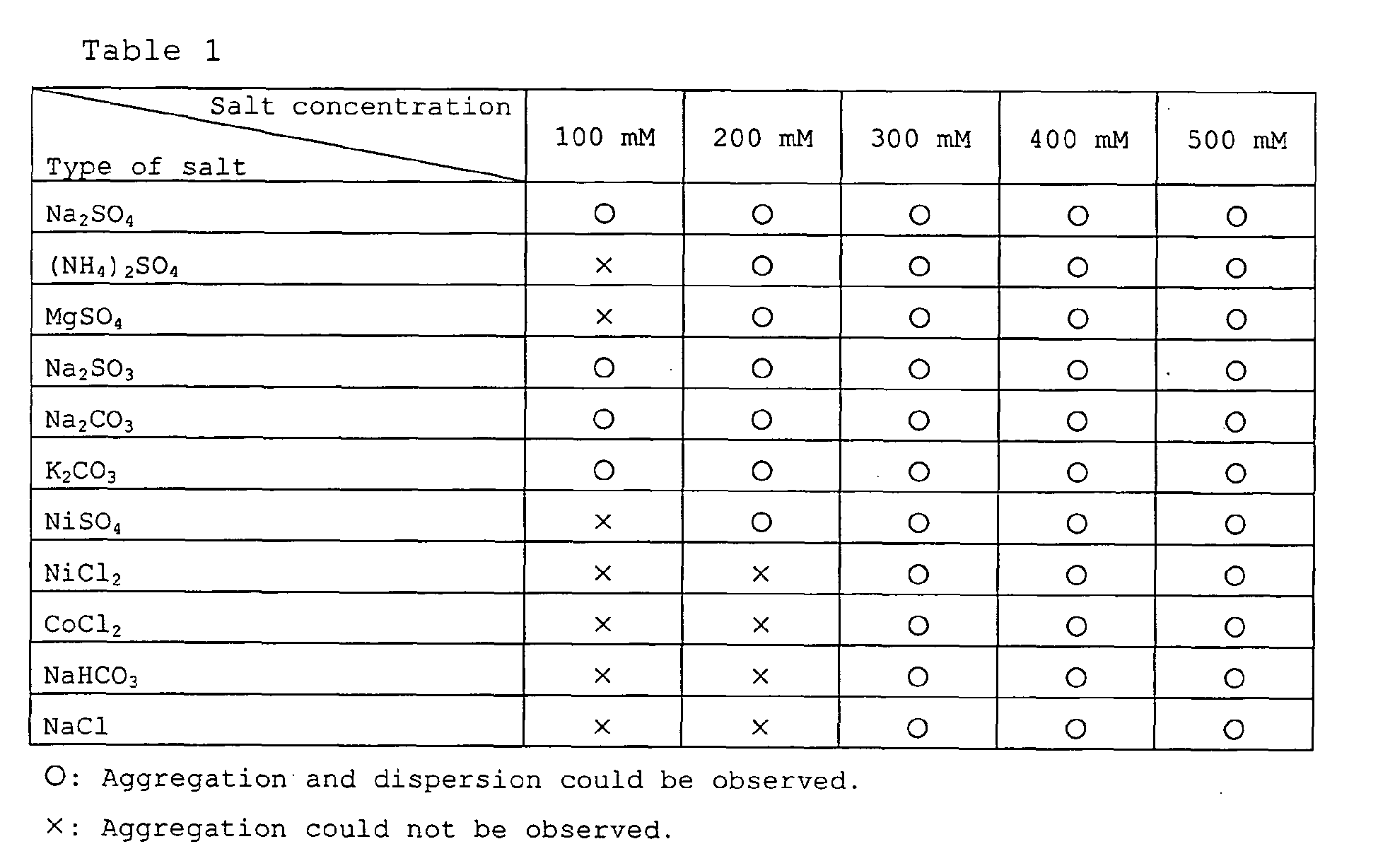


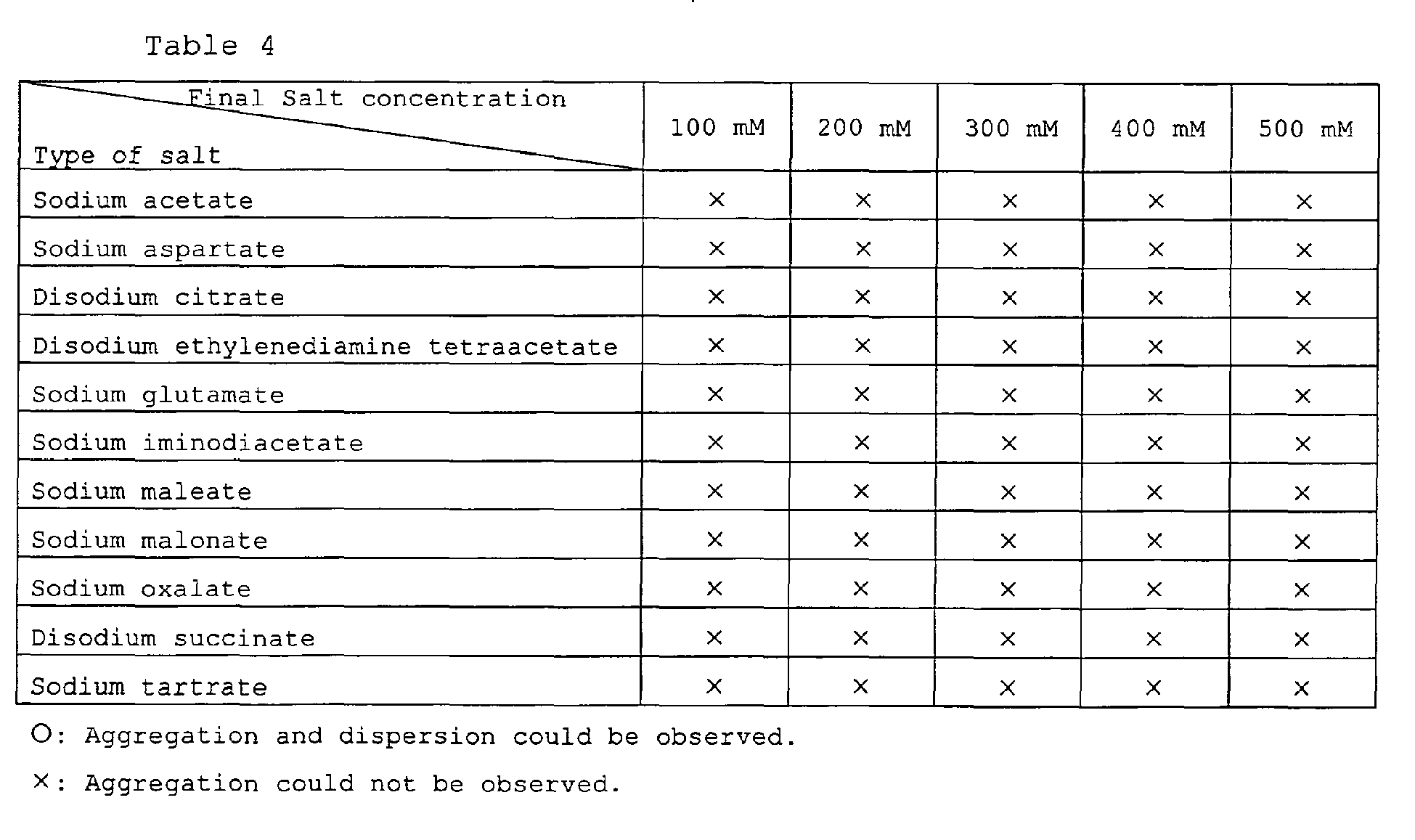
- An example in which TSH (thyroid-stimulating hormone) was determined by a sandwich method using an antibody bound to magnetic particles having a surface modified with a thermoresponsive polymer and an antibody bound to alkaline phosphatase will be described.
- 2 µL of a biotinylated anti-TSH-α antibody (an antibody obtained by biotinylating a mouse anti-TSH-α antibody manufactured by Leinco Technologies, Inc. (biotinylation was performed by Asahi Techno Glass), concentration: 0.75 mg/mL), 0.5 µL of an alkaline phosphatase-binding anti-TSH-β antibody (an antibody obtained by binding alkaline phosphatase to a mouse anti-TSH-β antibody manufactured by Leinco Technologies, Inc. (binding of alkaline phosphatase was performed by Asahi Techno Glass), concentration: 1.09 mg/mL), 12.5 µL of a TBS buffer (20 mM Tris-HCl (pH 7.5), 150 mM NaCl), and 20 µL of magnetic particles having a surface modified with a thermoresponsive polymer (Therma-Max (registered trademark) LA Avidin manufactured by Magnabeat Inc., concentration: 4 mg/mL) were mixed at this ratio and a necessary amount thereof was prepared. The thus prepared mixture was dispensed into microtubes in an amount of 35 µL each (2 series). To each of the microtubes, 65 µL of Architect (registered trademark) TSH calibrator (manufactured by Abbot Japan) was added such that the concentration of TSH was 0 µIU/mL, 4. 0 µIU/mL or 40. 0 µIU/mL, followed by mixing by pipetting, and a reaction was allowed to proceed at room temperature for 1 minute. After completion of the reaction, 30 µL of a 1 M sodium sulfate solution was added to the reaction mixture (total salt concentration: 268 mM), followed by mixing by pipetting. After a reaction was allowed to proceed at 30°C for 30 seconds, the microtubes were placed on a stand with a magnet (Magna-Stand 6 (trade name) manufactured by Magnabeat Inc.) and magnetic separation was carried out at 30°C for 1 minute, and the supernatant was removed. Then, 100 µL of a TBS-T buffer (20 mM Tris-HCl (pH 7.5), 150 mM NaCl, 0.05% (w/v) Tween 20) was added to the residue to redisperse it, and 30 µL of a 1 M sodium sulfate solution was added thereto (total salt concentration: 380 mM), followed by mixing by pipetting. After a reaction was allowed to proceed at 30°C for 30 seconds, magnetic separation was carried out at 30°C for 1 minute, followed by washing. The washing was carried out by the same procedure as above and repeated twice. Finally, the pellet was redispersed in 100 µL of a TBS buffer, and 100 µL of a luminescent substrate (Lumigen (registered trademark) APS-5 manufactured by Lumigen Inc.) was added thereto, and the mixture was stirred for 5 seconds. Then, a reaction was allowed to proceed for 10 seconds, and a luminescence intensity was measured for 0.1 second using a multilabel plate reader (Mithras LB940, a multilabel plate reader manufactured by Berthold Japan).
- The results of measurement of luminescence intensity are shown in Table 5 and
Fig. 1 . According to Table 5 andFig. 1 , it was found that the luminescence intensity changed in proportion to the concentration of TSH. That is, it was found that by using the present method, TSH could be detected and the concentration thereof could be determined favorably under a given condition of a temperature of 30°C.Table 5 TSH (µIU/mL) 1 2 0 2196 3589 4 8604 9082 40 106412 124103 - An example in which TSH (thyroid-stimulating hormone) was determined by a sandwich method using an antibody bound to magnetic particles having a surface modified with a thermoresponsive polymer and an antibody bound to alkaline phosphatase will be described.
- 0.2 µL of a biotinylated anti-TSH-α, antibody (an antibody obtained by biotinylating a mouse anti-TSH-α antibody manufactured by Leinco Technologies, Inc. (biotinylation was performed by Asahi Techno Glass), concentration: 0.75 mg/mL), 0.2 µL of an alkaline phosphatase-binding anti-TSH-β antibody (an antibody obtained by binding alkaline phosphatase to a mouse anti-TSH-β antibody manufactured by Leinco Technologies, Inc. (binding of alkaline phosphatase was performed by Asahi Techno Glass), concentration: 1.09 mg/mL), 12.5 µL of a TBS buffer (20 mM Tris-HCl (pH 7.5), 150 mM NaCl), and 20 µL of magnetic particles having a surface modified with a thermoresponsive polymer (Therma-Max (registered trademark) LA Avidin manufactured by Magnabeat Inc., concentration: 4 mg/mL) were mixed at this ratio and a necessary amount thereof was prepared. The thus prepared mixture was dispensed into microtubes in an amount of 35 µL each (2 series). To each of the microtubes, 65 µL of a TSH solution (Lumipulse (registered trademark) manufactured by Fujirebio Inc., TSH-N standard TSH solution (WHO Standard, 2nd International Standard)) was added such that the concentration of TSH was 0 µIU/mL, 5.0 µIU/mL, 60.0 µIU/mL or 200.0 µIU/mL, followed by mixing by pipetting, and a reaction was allowed to proceed at room temperature for 5 minutes. After completion of the reaction, 30 µL of a 1 M sodium tartrate solution was added to the reaction mixture (total salt concentration: 268 mM), followed by mixing by pipetting. After a reaction was allowed to proceed at 30°C for 30 seconds, the microtubes were placed on a stand with a magnet (Magna-Stand 6 (trade name) manufactured by Magnabeat Inc.) and magnetic separation was carried out at 30°C for 1 minute, and the supernatant was removed. Then, 100 µL of a TBS-T buffer (20 mM Tris-HCl (pH 7.5), 150 mM NaCl, 0.05% (w/v) Tween 20) was added to the residue to redisperse it, and 30 µL of a 1 M sodium tartrate solution was added thereto (total salt concentration: 380 mM), followed by mixing by pipetting. After a reaction was allowed to proceed at 30°C for 30 seconds, magnetic separation was carried out at 30°C for 1 minute, followed by washing. The washing was carried out by the same procedure as above and repeated twice. Finally, the pellet was redispersed in 100 µL of a TBS buffer, and 100 µL of a luminescent substrate (Lumigen (registered trademark) APS-5 manufactured by Lumigen Inc.) was added thereto, and the mixture was stirred for 5 seconds. Then, a reaction was allowed to proceed for 10 seconds, and a luminescence intensity was measured for 0.1 second using a multilabel plate reader
- The results of measurement of luminescence intensity are shown in Table 6 and
Fig. 2 . According to Table 6 andFig. 2 , it was found that the luminescence intensity changed in proportion to the concentration of TSH. That is, it was found that by using the present method, TSH could be detected and the concentration thereof could be determined favorably under a given condition of a temperature of 30°C.Table 6 TSH (µIU/mL) 1 2 0 449 335 5 9469 8831 60 96182 89915 200 213702 213035 - By using the same method as in Example 2 or Example 3, human immunoglobulin G, human immunoglobulin M, human immunoglobulin A, human immunoglobulin E, human albumin, human fibrinogen (fibrin and degradation products thereof), α-fetoprotein (AFP), C-reactive protein (CRP), myoglobin, carcinoembryonic antigens, hepatitis virus antigens, human chorionic gonadotropin (hCG), human placental lactogen (hPL), insulin, HIV virus antigens, allergens, bacterial toxins, bacterial antigens, enzymes, hormones, chemical agents and the like in body fluid, urine, sputum, feces and the like can be assayed.
- An example in which a study in which redispersion could be achieved in a short time when a carboxylate was used was performed will be described.
- In microtubes, 100 µL of an aqueous dispersion of 0.4% by weight of the LCST-type magnetic particles prepared in the above-mentioned Production example 3 was left stand at 42°C for 30 seconds thereby aggregating the particles. Subsequently, each microtube was placed on a stand with a magnet (Magna-Stand 6 (trade name) manufactured by Magnabeat Inc.) and magnetic separation was carried out at 42°C until the supernatant became clear. The time required for magnetic separation at this time was 60 seconds. Thereafter, the supernatant was removed, and 100 µL of purified water (water obtained by purification using Direct-Q (trade name) manufactured by Millipore) was added to the residue, followed by mixing by pipetting to redisperse the residue. The time required for redispersion at this time was 60 seconds.
- In a similar manner, to 100 µL of an aqueous dispersion of 0.4% by weight of the LCST-type magnetic particles on which biotin was immobilized prepared in the above-mentioned Production example 3, sodium sulfate, sodium sulfite or sodium citrate was added to give a final concentration of the respective compounds shown in Table 7, followed by mixing by pipetting. Then, the mixture was left stand at 30°C for 30 seconds thereby aggregating the particles. Subsequently, the microtubes were placed on Magna-Stand 6, and magnetic separation was carried out at 30°C until the supernatant became clear. The time required for magnetic separation at this time is shown in Table 7. Then, the supernatant was removed, and 100 µL of purified water was added to the residue, followed by mixing by pipetting, and the time required for redispersion was measured.
- The results are shown in Table 7. In the case where aggregation and magnetic separation were carried out by raising the temperature of the mixture to 42°C without adding a salt, the time required for redispersion was 60 seconds. In the case where the same procedure was carried out at 30°C using sodium sulfate and sodium sulfite, the time required for redispersion was 60 seconds. On the other hand, in the case where the same procedure was carried out at 30°C using sodium citrate, which is a carboxylate, the time required for redispersion was 30 seconds. From the results, it was indicated that when a carboxylate was used, redispersion could be achieved at short time.
Table 7 Type of salt Final salt concentration Aggregation at 30°C (sec) Time required for magnetic separation (sec) Time required for redispersion (sec) Sodium sulfate 100 mM 30 60 60 200 mM 30 60 60 300 mM 30 30 60 Sodium sulfite 100 mM 30 60 60 200 mM 30 60 60 300 mM 30 30 60 Sodium citrate 100 mM 30 60 30 200 mM 30 30 30 300 mM 30 30 30
Claims (11)
- A method of separating a substance to be detected from a sample, comprising the steps of:mixing an adsorbent and the sample in an aqueous solution to adsorb the substance to be detected on the adsorbent,aggregating the adsorbent by changing a salt concentration in the aqueous solution; andcollecting the adsorbent from the aqueous solution by a magnetic force, wherein said adsorbent comprises a magnetic particle of an average particle size of 50 to 1000 nm, a surface of which is modified with a thermoresponsive polymer and is immobilized with a substance having an affinity for the substance to be detected.
- The method according to claim 1, wherein the thermoresponsive polymer is a polymer obtained by polymerization of at least one type of monomer selected from the group consisting of N-n-propylacrylamide,
N-isopropylacrylamide, N-t-butylacrylamide,
N-ethylacrylamide, N,N-dimethylacrylamide,
N-acryloylpyrrolidine, N-acryloylpiperidine,
N-acryloylmorpholine, N-n-propylmethacrylamide,
N-isopropylmethacrylamide, N-ethylmethacrylamide,
N,N-dimethylmethacrylamide, N-methacryloylpyrrolidine,
N-methacryloylpiperidine and N-methacryloylmorpholine. - The method according to claim 1, wherein the thermoresponsive polymer is a polymer obtained by polymerization of at least one type of monomer selected from the group consisting of N-acryloylglycinamide,
N-acryloylnipecotamide and N-acryloylasparaginamide. - The method according to any one of claims 1 to 3, wherein the average particle size of the magnetic particle is from 50 to 200 nm.
- The method according to any one of claims 1 to 4, wherein the salt contains at least one type of compound selected from the group consisting of lithium sulfate, sodium sulfate, potassium sulfate, magnesium sulfate, ammonium sulfate, sodium carbonate and potassium carbonate.
- The method according to any one of claims 1 to 4, wherein the salt contains at least one type of compound selected from the group consisting of a sodium monocarboxylate, a potassium monocarboxylate, a sodium dicarboxylate, a potassium dicarboxylate, a sodium tricarboxylate, a potassium tricarboxylate, a sodium tetracarboxylate and a potassium tetracarboxylate.
- The method according to claim 6, wherein the salt contains at least one type of compound selected from the group consisting of sodium acetate, sodium aspartate, disodium citrate, disodium ethylenediamine tetraacetate, sodium glutamate, sodium iminodiacetate, sodium maleate, sodium malonate, sodium oxalate, disodium succinate and sodium tartrate.
- A kit for separating or detecting a substance to be detected in a sample, comprising an adsorbent and an aqueous salt solution, wherein said adsorbent comprises a magnetic particle of an average particle size of 50 to 1000 nm, a surface of which is modified with a thermoresponsive polymer and is immobilized with a substance having an affinity for the substance to be detected.
- A method of aggregating or dispersing magnetic particles, comprising the step of aggregating or dispersing magnetic particles having a surface modified with a thermoresponsive polymer, which are obtained by subjecting magnetic particles to surface modification with a thermoresponsive polymer, by changing a salt concentration in an aqueous solution.
- The method according to claim 9, wherein the magnetic particle having a surface modified with a thermoresponsive polymer has a substance having an affinity for a substance to be detected on its surface.
- A method of detecting a substance to be detected in a sample, comprising the steps of:separating the substance to be detected from the sample by adsorbing the substance to be detected on the adsorbent by the method according to any one of claims 1 to 7; anddetecting the substance to be detected adsorbed on the adsorbent.
Applications Claiming Priority (2)
| Application Number | Priority Date | Filing Date | Title |
|---|---|---|---|
| JP2007173469 | 2007-06-29 | ||
| JP2008028641A JP5428166B2 (en) | 2007-06-29 | 2008-02-08 | Aggregation and dispersion method of magnetic particles and separation, detection method and detection kit using the same |
Publications (2)
| Publication Number | Publication Date |
|---|---|
| EP2009442A2 true EP2009442A2 (en) | 2008-12-31 |
| EP2009442A3 EP2009442A3 (en) | 2009-09-02 |
Family
ID=39869680
Family Applications (1)
| Application Number | Title | Priority Date | Filing Date |
|---|---|---|---|
| EP08011729A Withdrawn EP2009442A3 (en) | 2007-06-29 | 2008-06-27 | Aggregation and dispersion methods of magnetic particles, separation and detection methods using the same and detection kit |
Country Status (2)
| Country | Link |
|---|---|
| US (1) | US8105493B2 (en) |
| EP (1) | EP2009442A3 (en) |
Cited By (11)
| Publication number | Priority date | Publication date | Assignee | Title |
|---|---|---|---|---|
| WO2010121792A1 (en) * | 2009-04-22 | 2010-10-28 | Karlsruher Institut für Technologie | Method and device for the sorptive separation of substance mixtures |
| WO2011077333A1 (en) * | 2009-12-23 | 2011-06-30 | Koninklijke Philips Electronics N.V. | Analyte measurement apparatus and method |
| US8426214B2 (en) | 2009-06-12 | 2013-04-23 | University Of Washington | System and method for magnetically concentrating and detecting biomarkers |
| US8507283B2 (en) | 2007-03-08 | 2013-08-13 | University Of Washington | Stimuli-responsive magnetic nanoparticles and related methods |
| US9080933B2 (en) | 2009-11-09 | 2015-07-14 | University Of Washington Through Its Center For Commercialization | Stimuli-responsive polymer diagnostic assay comprising magnetic nanoparticles and capture conjugates |
| EP2894475A4 (en) * | 2012-09-04 | 2016-04-13 | Jnc Corp | SUBSTANCE MEASURING SENSOR |
| EP3054283A4 (en) * | 2013-10-02 | 2017-04-19 | Furukawa Electric Co. Ltd. | Method for detecting target substance |
| US10188691B2 (en) | 2016-05-27 | 2019-01-29 | Synthex, Inc. | Protein interfaces |
| US10252258B2 (en) | 2014-03-24 | 2019-04-09 | Nitto Boseki Co., Ltd. | Method for separating and concentrating target substance using novel cationic graft polymer |
| CN115850615A (en) * | 2022-12-09 | 2023-03-28 | 郑州安图生物工程股份有限公司 | Carboxyl magnetic beads and its preparation method and application |
| US11780881B2 (en) | 2017-11-22 | 2023-10-10 | Synthex, Inc. | Compounds for selective disruption of protein-protein interactions |
Families Citing this family (12)
| Publication number | Priority date | Publication date | Assignee | Title |
|---|---|---|---|---|
| FR2902799B1 (en) | 2006-06-27 | 2012-10-26 | Millipore Corp | METHOD AND UNIT FOR PREPARING A SAMPLE FOR THE MICROBIOLOGICAL ANALYSIS OF A LIQUID |
| US8362217B2 (en) | 2006-12-21 | 2013-01-29 | Emd Millipore Corporation | Purification of proteins |
| US8569464B2 (en) | 2006-12-21 | 2013-10-29 | Emd Millipore Corporation | Purification of proteins |
| WO2008079302A2 (en) | 2006-12-21 | 2008-07-03 | Millipore Corporation | Purification of proteins |
| US8999702B2 (en) | 2008-06-11 | 2015-04-07 | Emd Millipore Corporation | Stirred tank bioreactor |
| JP2012511929A (en) | 2008-12-16 | 2012-05-31 | イー・エム・デイー・ミリポア・コーポレイシヨン | Stirred tank reactor and method |
| US20110117668A1 (en) * | 2009-11-09 | 2011-05-19 | University Of Washington Through Its Center For Commercialization | Self-powered smart diagnostic devices |
| WO2011121596A2 (en) * | 2010-04-01 | 2011-10-06 | Neuland Laboratories Ltd. | Crystal modification of moxifloxacin hydrochloride |
| WO2011146394A1 (en) | 2010-05-17 | 2011-11-24 | Millipore Corporation | Stimulus responsive polymers for the purification of biomolecules |
| EP2537589A1 (en) * | 2011-06-21 | 2012-12-26 | Siemens Aktiengesellschaft | Method for separating a material from a flowable primary material, device for separating a material from a flowable primary material and control and/or regulating device |
| CN104054136B (en) * | 2011-12-21 | 2016-05-11 | 捷恩智株式会社 | Method for removing cesium ions in aqueous solution using magnetic particles |
| KR101434722B1 (en) * | 2012-01-31 | 2014-09-01 | 연세대학교 산학협력단 | Organic-inorganic nanocomposites for adsorption and desorption of metal ions and manufacturing method of the same |
Citations (3)
| Publication number | Priority date | Publication date | Assignee | Title |
|---|---|---|---|---|
| WO2001009141A1 (en) | 1999-07-29 | 2001-02-08 | National Institute Of Advanced Industrial Science And Technology | Polymerizable biotin derivatives, biotin polymer, and polymer responsive to avidin stimulation |
| JP2002517085A (en) | 1998-05-26 | 2002-06-11 | バー−イラン ユニバーシティ | Nucleation and growth of magnetic metal oxide nanoparticles and uses thereof |
| JP2005082538A (en) | 2003-09-09 | 2005-03-31 | Chisso Corp | Stimulus-responsive polymer-immobilized magnetic fine particles and adsorbent using the same |
Family Cites Families (3)
| Publication number | Priority date | Publication date | Assignee | Title |
|---|---|---|---|---|
| JP2004201648A (en) | 2002-12-26 | 2004-07-22 | Chisso Corp | Gene screening method |
| CN101627065B (en) * | 2006-12-21 | 2012-05-23 | 茵维特罗根戴纳股份公司 | Particles and their use in methods for isolating nucleic acids or in methods for isolating phosphoproteins |
| JP5176411B2 (en) | 2007-06-29 | 2013-04-03 | Jnc株式会社 | Polymer aqueous solution having upper critical solution temperature, aqueous dispersion of particles modified with the polymer, and storage method thereof |
-
2008
- 2008-06-26 US US12/147,216 patent/US8105493B2/en active Active
- 2008-06-27 EP EP08011729A patent/EP2009442A3/en not_active Withdrawn
Patent Citations (3)
| Publication number | Priority date | Publication date | Assignee | Title |
|---|---|---|---|---|
| JP2002517085A (en) | 1998-05-26 | 2002-06-11 | バー−イラン ユニバーシティ | Nucleation and growth of magnetic metal oxide nanoparticles and uses thereof |
| WO2001009141A1 (en) | 1999-07-29 | 2001-02-08 | National Institute Of Advanced Industrial Science And Technology | Polymerizable biotin derivatives, biotin polymer, and polymer responsive to avidin stimulation |
| JP2005082538A (en) | 2003-09-09 | 2005-03-31 | Chisso Corp | Stimulus-responsive polymer-immobilized magnetic fine particles and adsorbent using the same |
Non-Patent Citations (5)
| Title |
|---|
| ADV. POLYM. SCI., vol. 4, 1965, pages 111 |
| APPL. MICROBIOL. BIOTECHNOL., vol. 41, 1994, pages 99 - 105 |
| HOSHINO FUTOSHI ET AL: "N-SUBSTITUTED ACRYLAMIDE-STYRENE COPOLYMER LATICES: II. POLYMERIZATION BEHAVIOR AND THERMOSENSITIVE STABILITY OF LATICES", POLYMER JOURNAL, vol. 19, no. 2, 1 January 1987 (1987-01-01), pages 241 - 247, XP055165228 * |
| J. POLYMER SCI., vol. 3, 1965, pages 1031 |
| JOURNAL OF FERMENTATION AND BIOENGINEERING, vol. 84, 1997, pages 337 - 341 |
Cited By (17)
| Publication number | Priority date | Publication date | Assignee | Title |
|---|---|---|---|---|
| US10203326B2 (en) | 2003-10-02 | 2019-02-12 | Furukawa Electric Co., Ltd. | Method of detecting target substance |
| US8507283B2 (en) | 2007-03-08 | 2013-08-13 | University Of Washington | Stimuli-responsive magnetic nanoparticles and related methods |
| WO2010121792A1 (en) * | 2009-04-22 | 2010-10-28 | Karlsruher Institut für Technologie | Method and device for the sorptive separation of substance mixtures |
| US8426214B2 (en) | 2009-06-12 | 2013-04-23 | University Of Washington | System and method for magnetically concentrating and detecting biomarkers |
| US9080933B2 (en) | 2009-11-09 | 2015-07-14 | University Of Washington Through Its Center For Commercialization | Stimuli-responsive polymer diagnostic assay comprising magnetic nanoparticles and capture conjugates |
| US9429570B2 (en) | 2009-11-09 | 2016-08-30 | University Of Washington Through Its Center For Commercialization | Stimuli-responsive polymer diagnostic assay comprising magnetic nanoparticles and capture conjugates |
| WO2011077333A1 (en) * | 2009-12-23 | 2011-06-30 | Koninklijke Philips Electronics N.V. | Analyte measurement apparatus and method |
| US10401356B2 (en) | 2012-09-04 | 2019-09-03 | Jnc Corporation | Analyte-measuring sensor |
| EP2894475A4 (en) * | 2012-09-04 | 2016-04-13 | Jnc Corp | SUBSTANCE MEASURING SENSOR |
| EP3054283A4 (en) * | 2013-10-02 | 2017-04-19 | Furukawa Electric Co. Ltd. | Method for detecting target substance |
| CN105556289B (en) * | 2013-10-02 | 2019-06-14 | 古河电气工业株式会社 | Methods of detecting target substances |
| US10252258B2 (en) | 2014-03-24 | 2019-04-09 | Nitto Boseki Co., Ltd. | Method for separating and concentrating target substance using novel cationic graft polymer |
| US10188691B2 (en) | 2016-05-27 | 2019-01-29 | Synthex, Inc. | Protein interfaces |
| US12214008B2 (en) | 2016-05-27 | 2025-02-04 | Synthex, Inc. | Protein interfaces |
| US11780881B2 (en) | 2017-11-22 | 2023-10-10 | Synthex, Inc. | Compounds for selective disruption of protein-protein interactions |
| US12590126B2 (en) | 2017-11-22 | 2026-03-31 | Synthex, Inc. | Compounds for selective disruption of protein-protein interactions |
| CN115850615A (en) * | 2022-12-09 | 2023-03-28 | 郑州安图生物工程股份有限公司 | Carboxyl magnetic beads and its preparation method and application |
Also Published As
| Publication number | Publication date |
|---|---|
| EP2009442A3 (en) | 2009-09-02 |
| US8105493B2 (en) | 2012-01-31 |
| US20090001025A1 (en) | 2009-01-01 |
Similar Documents
| Publication | Publication Date | Title |
|---|---|---|
| US8105493B2 (en) | Aggregation and dispersion methods of magnetic particles, separation and detection methods using the same and detection kit | |
| JP5428166B2 (en) | Aggregation and dispersion method of magnetic particles and separation, detection method and detection kit using the same | |
| JP5326443B2 (en) | Temperature-responsive magnetic fine particles that can be freeze-dried | |
| JP5329658B2 (en) | Detection method and quantification method of detection target | |
| KR101115903B1 (en) | Particle Having Magnetic Material Incorporated Therein, Process for Producing the Same, Particle for Immunoassay and Method of Immunoassay | |
| EP3054283B1 (en) | Method for detecting target substance | |
| US20190170758A1 (en) | Method of detection with a fluorescent labeling particle | |
| JP5184554B2 (en) | Detection method and quantification method of detection target | |
| JP5193228B2 (en) | Detection method and quantification method of detection target | |
| Basinska | Hydrophilic Core‐Shell Microspheres: A Suitable Support for Controlled Attachment of Proteins and Biomedical Diagnostics | |
| JP5026251B2 (en) | Detection method and quantification method of detection target | |
| JP7402050B2 (en) | Metal complex particles and immunoassay reagents using the same | |
| JP5145526B2 (en) | Stimulus responsive noble metal / magnetic fine particle composite | |
| JP2007263935A (en) | Magnetic marker and method for producing the same | |
| JP2009171853A (en) | Charged material recovery method and kit using magnetic fine particles surface-modified with temperature-responsive polymer having upper critical solution temperature | |
| JP5844825B2 (en) | Method and kit for detection and quantification of detection target | |
| JP6282819B2 (en) | Kit and method for detecting or quantifying a detection target | |
| JP2006162284A (en) | Fluorescent labeling compound using optical crystal fine particles and biopolymer detection method using the same | |
| Nash et al. | Smart Surfaces for Point‐of‐Care Diagnostics | |
| WO2017090721A1 (en) | Method of determining quantity of objects to be detected in specimen |
Legal Events
| Date | Code | Title | Description |
|---|---|---|---|
| PUAI | Public reference made under article 153(3) epc to a published international application that has entered the european phase |
Free format text: ORIGINAL CODE: 0009012 |
|
| AK | Designated contracting states |
Kind code of ref document: A2 Designated state(s): AT BE BG CH CY CZ DE DK EE ES FI FR GB GR HR HU IE IS IT LI LT LU LV MC MT NL NO PL PT RO SE SI SK TR |
|
| AX | Request for extension of the european patent |
Extension state: AL BA MK RS |
|
| PUAL | Search report despatched |
Free format text: ORIGINAL CODE: 0009013 |
|
| AK | Designated contracting states |
Kind code of ref document: A3 Designated state(s): AT BE BG CH CY CZ DE DK EE ES FI FR GB GR HR HU IE IS IT LI LT LU LV MC MT NL NO PL PT RO SE SI SK TR |
|
| AX | Request for extension of the european patent |
Extension state: AL BA MK RS |
|
| 17P | Request for examination filed |
Effective date: 20091126 |
|
| 17Q | First examination report despatched |
Effective date: 20091228 |
|
| AKX | Designation fees paid |
Designated state(s): AT BE BG CH CY CZ DE DK EE ES FI FR GB GR HR HU IE IS IT LI LT LU LV MC MT NL NO PL PT RO SE SI SK TR |
|
| RAP1 | Party data changed (applicant data changed or rights of an application transferred) |
Owner name: JNC CORPORATION |
|
| GRAJ | Information related to disapproval of communication of intention to grant by the applicant or resumption of examination proceedings by the epo deleted |
Free format text: ORIGINAL CODE: EPIDOSDIGR1 |
|
| GRAP | Despatch of communication of intention to grant a patent |
Free format text: ORIGINAL CODE: EPIDOSNIGR1 |
|
| INTG | Intention to grant announced |
Effective date: 20170215 |
|
| STAA | Information on the status of an ep patent application or granted ep patent |
Free format text: STATUS: THE APPLICATION IS DEEMED TO BE WITHDRAWN |
|
| 18D | Application deemed to be withdrawn |
Effective date: 20170627 |