EP2009492A2 - Rétroviseur électrochromique - Google Patents
Rétroviseur électrochromique Download PDFInfo
- Publication number
- EP2009492A2 EP2009492A2 EP08011425A EP08011425A EP2009492A2 EP 2009492 A2 EP2009492 A2 EP 2009492A2 EP 08011425 A EP08011425 A EP 08011425A EP 08011425 A EP08011425 A EP 08011425A EP 2009492 A2 EP2009492 A2 EP 2009492A2
- Authority
- EP
- European Patent Office
- Prior art keywords
- electrically conductive
- film
- electrochromic
- reflective film
- conductive reflective
- Prior art date
- Legal status (The legal status is an assumption and is not a legal conclusion. Google has not performed a legal analysis and makes no representation as to the accuracy of the status listed.)
- Withdrawn
Links
Images






Classifications
-
- G—PHYSICS
- G02—OPTICS
- G02F—OPTICAL DEVICES OR ARRANGEMENTS FOR THE CONTROL OF LIGHT BY MODIFICATION OF THE OPTICAL PROPERTIES OF THE MEDIA OF THE ELEMENTS INVOLVED THEREIN; NON-LINEAR OPTICS; FREQUENCY-CHANGING OF LIGHT; OPTICAL LOGIC ELEMENTS; OPTICAL ANALOGUE/DIGITAL CONVERTERS
- G02F1/00—Devices or arrangements for the control of the intensity, colour, phase, polarisation or direction of light arriving from an independent light source, e.g. switching, gating or modulating; Non-linear optics
- G02F1/01—Devices or arrangements for the control of the intensity, colour, phase, polarisation or direction of light arriving from an independent light source, e.g. switching, gating or modulating; Non-linear optics for the control of the intensity, phase, polarisation or colour
- G02F1/15—Devices or arrangements for the control of the intensity, colour, phase, polarisation or direction of light arriving from an independent light source, e.g. switching, gating or modulating; Non-linear optics for the control of the intensity, phase, polarisation or colour based on an electrochromic effect
- G02F1/1514—Devices or arrangements for the control of the intensity, colour, phase, polarisation or direction of light arriving from an independent light source, e.g. switching, gating or modulating; Non-linear optics for the control of the intensity, phase, polarisation or colour based on an electrochromic effect characterised by the electrochromic material, e.g. by the electrodeposited material
- G02F1/1523—Devices or arrangements for the control of the intensity, colour, phase, polarisation or direction of light arriving from an independent light source, e.g. switching, gating or modulating; Non-linear optics for the control of the intensity, phase, polarisation or colour based on an electrochromic effect characterised by the electrochromic material, e.g. by the electrodeposited material comprising inorganic material
- G02F1/1524—Transition metal compounds
-
- G—PHYSICS
- G02—OPTICS
- G02F—OPTICAL DEVICES OR ARRANGEMENTS FOR THE CONTROL OF LIGHT BY MODIFICATION OF THE OPTICAL PROPERTIES OF THE MEDIA OF THE ELEMENTS INVOLVED THEREIN; NON-LINEAR OPTICS; FREQUENCY-CHANGING OF LIGHT; OPTICAL LOGIC ELEMENTS; OPTICAL ANALOGUE/DIGITAL CONVERTERS
- G02F1/00—Devices or arrangements for the control of the intensity, colour, phase, polarisation or direction of light arriving from an independent light source, e.g. switching, gating or modulating; Non-linear optics
- G02F1/01—Devices or arrangements for the control of the intensity, colour, phase, polarisation or direction of light arriving from an independent light source, e.g. switching, gating or modulating; Non-linear optics for the control of the intensity, phase, polarisation or colour
- G02F1/15—Devices or arrangements for the control of the intensity, colour, phase, polarisation or direction of light arriving from an independent light source, e.g. switching, gating or modulating; Non-linear optics for the control of the intensity, phase, polarisation or colour based on an electrochromic effect
- G02F1/153—Constructional details
-
- G—PHYSICS
- G02—OPTICS
- G02F—OPTICAL DEVICES OR ARRANGEMENTS FOR THE CONTROL OF LIGHT BY MODIFICATION OF THE OPTICAL PROPERTIES OF THE MEDIA OF THE ELEMENTS INVOLVED THEREIN; NON-LINEAR OPTICS; FREQUENCY-CHANGING OF LIGHT; OPTICAL LOGIC ELEMENTS; OPTICAL ANALOGUE/DIGITAL CONVERTERS
- G02F1/00—Devices or arrangements for the control of the intensity, colour, phase, polarisation or direction of light arriving from an independent light source, e.g. switching, gating or modulating; Non-linear optics
- G02F1/01—Devices or arrangements for the control of the intensity, colour, phase, polarisation or direction of light arriving from an independent light source, e.g. switching, gating or modulating; Non-linear optics for the control of the intensity, phase, polarisation or colour
- G02F1/15—Devices or arrangements for the control of the intensity, colour, phase, polarisation or direction of light arriving from an independent light source, e.g. switching, gating or modulating; Non-linear optics for the control of the intensity, phase, polarisation or colour based on an electrochromic effect
- G02F1/153—Constructional details
- G02F1/155—Electrodes
- G02F2001/1552—Inner electrode, e.g. the electrochromic layer being sandwiched between the inner electrode and the support substrate
Definitions
- the present invention relates to an electrochromic mirror that is used, for example, in a rearview outer mirror or rearview inner mirror of a vehicle, and in which reflectance is changed by applying a voltage.
- an electrochromic mirror in which an electrochromic film is colored due to the electrochromic film undergoing a reduction reaction, whereby transmission of reflected light is reduced, resulting in reflectance of light being reduced.
- an electrochromic mirror which can prevent or effectively suppress the occurrence of problems, such as reflectance being greatly reduced or the like, and can obtain a clear reflected image, even when a configuration is provided in which holes are formed in an electrically conductive reflective film.
- the present invention has been made in view of the above circumstances and provides an electrochromic mirror.
- an electrochromic mirror comprising: an electrically conductive reflective film capable of reflecting light that is incident thereto and having electrical conductivity, the electrically conductive reflective film having formed therein a plurality of fine penetration holes that penetrate in a thickness direction of the electrically conductive reflective film, and a ratio of a distance between respective centers of the penetration holes and an inner peripheral diameter dimension of the penetration holes being 7 or more; an electrochromic film that is provided at a side of the electrically conductive reflective film at which the light is incident and reflected, and that is colored due to being subjected to a reduction reaction; an electrically conductive film having electrical conductivity that is provided at a side of the electrically conductive reflective film that is opposite from the electrochromic film; and an electrolytic solution that comprises lithium ions and is enclosed between the electrically conductive film and the electrically conductive reflective film, and in which, due to applying a voltage such that the electrically conductive film is made positive and the electrically conductive reflective film is made negative, the lithium ions
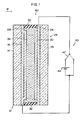
- FIG. 1 the configuration of an electrochromic mirror 60 according to a first exemplary embodiment of the present invention is shown in a schematic cross-sectional view.
- the electrochromic mirror 60 is provided with a front surface side substrate 12.
- the front surface side substrate 12 is provided with a transparent substrate main body 14 formed from glass or the like.
- an electrochromic film 16 is formed at a surface at one thickness direction (arrow W direction in FIG. 1 ) side of the substrate main body 14.
- the electrochromic film 16 is formed, for example, from tungsten trioxide (WO 3 ), molybdenum trioxide (MoO 3 ), or a mixture containing such an oxide, and in particular, in the present exemplary embodiment, the electrochromic film 16 is formed from tungsten trioxide.
- a thickness of the electrochromic film 16 along the thickness direction of the substrate main body 14 is set in a range of from 300 nm to 1000 nm, and in particular, in the present exemplary embodiment, the thickness of the electrochromic film 16 is set at 500 nm.
- an electrically conductive reflective film 68 is formed at a surface at a side of the electrochromic film 16 that is opposite from the substrate main body 14.
- the electrically conductive reflective film 68 has electrical conductivity and is formed from a metal having luster and through which transmission of lithium ions is possible, such as, for example, rhodium (Rh), ruthenium (Ru), palladium (Pd), nickel (Ni) or the like.
- a thickness of the electrically conductive reflective film 68 along the thickness direction of the substrate main body 14 is set in a range of from 30 nm to 200 nm, and in particular, in the present exemplary embodiment, the thickness of the electrically conductive reflective film 68 is set at 50 nm.
- plural fine penetration holes 70 that penetrate in the thickness direction of the electrically conductive reflective film 68 are formed therein.
- An inner diameter (diameter of an inner peripheral portion) dimension D of the penetration holes 70 is 20 ⁇ m or less, and in particular, in the present exemplary embodiment, it is made to be 0.5 ⁇ m.
- the penetration holes 70 are basically formed irregularly (randomly) in the electrically conductive reflective film 68.
- the penetration holes 70 are configured such that a distance L between centers of adjacent penetration holes 70 is 20 ⁇ m or less, and more preferably 10 ⁇ m or less, and in particular, in the present exemplary embodiment, the distance L between centers is set at 5 ⁇ m or less.
- the penetration holes 70 are configured such that a ratio of the inner diameter (diameter of an inner peripheral portion) dimension D of the penetration holes 70 and the distance L between centers of adjacent penetration holes 70 is 7 or more, and such that a ratio of the distance L between centers and the inner diameter dimension D, which is a reciprocal thereof, is 0.5 or less.
- the penetration holes 70 are formed by providing a photomask, in which a pattern of the penetration holes 70 is printed on the electrically conductive reflective film 68 on which a photoresist has been coated, and carrying out exposure, followed by removing the photoresist corresponding to the penetration holes 70 and dissolving the electrically conductive reflective film 68 with an etching solution.
- a back surface side substrate 24 is provided so as to face the front surface side substrate 12.
- the back surface side substrate 24 is provided with a transparent substrate main body 26 formed from glass or the like.
- an electrically conductive film 28 is formed at a surface at the other thickness direction side, i.e., the front surface side substrate 12 side, of the substrate main body 26, an electrically conductive film 28 is formed.
- the electrically conductive film 28 is formed from a metal such as chrome (Cr) or nickel (Ni), indium tin oxide (IN 2 O 3 :Sn, or so-called "ITO"), tin oxide (SnO 2 ), fluorine-doped tin oxide (SnO 2 :F), zinc oxide (ZnO 2 ) or the like, or from a mixture of these.
- a metal such as chrome (Cr) or nickel (Ni), indium tin oxide (IN 2 O 3 :Sn, or so-called "ITO"), tin oxide (SnO 2 ), fluorine-doped tin oxide (SnO 2 :F), zinc oxide (ZnO 2 ) or the like, or from a mixture of these.
- the carbon film 30 comprises a synthetic resin material such as a phenol resin, a polyimide resin, an acrylic resin or the like, as a binder. Further, in addition to these binders, the carbon film 30 is formed from a mixture of graphite, carbon black and activated carbon, and in particular, the activated carbon is contained in this mixture in an amount of 50 weight % or more.
- a thickness dimension of the carbon film 30 along the thickness direction of the substrate main body 26 is set to be 50 ⁇ m or more, and in the carbon film 30 of the above configuration, a capacitance is set to be 10 mF/cm 2 or greater, or a charge storage capacity at a voltage of 1.5 V is set to be 15 mQ/cm 2 or greater.
- the capacitance is set to be 20 mF/cm 2 , or the charge storage capacity at a voltage of 1.5 V is set to be 30 mQ/cm 2 .
- the electrolytic solution 34 comprises a solvent formed from propylene carbonate, ethylene carbonate, butylene carbonate, diethyl carbonate, ⁇ -butyrolactone, dimethyl formamide or the like, or from a mixture of these, and in particular, in the present exemplary embodiment, propylene carbonate is used as the solvent.
- the electrolytic solution 34 comprises lithium perchlorate (LiClO 4 ), lithium hexafluorophosphate (LiPF 6 ), lithium tetrafluoroborate (LiBF 4 ), lithium bis(trifluoromethane-sulfonyl)imide (LiN(SO 2 CF 3 ) 2 ), lithium bis(pentafluoroethane-sulfonyl)imide (LiN(SO 2 C 2 F 5 ) 2 ), lithium trifluoromethanesulfonate (LiCF 3 SO 3 ) or the like, or a mixture of these, as an electrolyte, and in particular, in the present exemplary embodiment, lithium perchlorate is used as the electrolyte.
- lithium perchlorate LiClO 4
- LiPF 6 lithium hexafluorophosphate
- LiBF 4 lithium tetrafluoroborate
- LiN(SO 2 CF 3 ) 2 lithium bis(trifluoromethane-s
- the electrically conductive film 28 of the electrochromic mirror 60 of the above configuration is connected to a switch 42 constituting a circuit 40.
- a positive electrode of a direct-current power source 44 which is constituted by a battery or the like mounted at a vehicle and has a rated voltage of about 1.3 V, is connected to a terminal that is connected in an ON state.
- a negative electrode of the direct-current power source 44 is connected to the electrically conductive reflective film 68.
- a terminal at which the switch 42 is connected in an OFF state is connected to the electrically conductive reflective film 68 without being connected through the aforementioned direct-current power source 44, and in the OFF state, the electrically conductive film 28 and the electrically conductive reflective film 68 are short-circuited.
- the electrochromic film 16 in the OFF state of the switch 42, the electrochromic film 16 becomes substantially transparent, and for this reason, light that is incident from the side of the substrate main body 14 that is opposite from the electrochromic film 16 is transmitted through the substrate main body 14 and the electrochromic film 16 and is reflected at the electrically conductive reflective film 68. Furthermore, light that is reflected at the electrically conductive reflective film 68 is transmitted through the electrochromic film 16 and the substrate main body 14, and in the present exemplary embodiment of the above configuration, reflectance of light becomes about 55 % as a result.
- the reflectance which was about 55 % before the electrochromic film 16 was colored, is reduced to about 7 %.
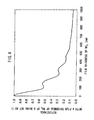
- FIG. 4 the relationship between the film thickness of the electrochromic film 16 and the reflectance is shown in a graph.
- the reflectance when there is no electrochromic film 16 is standardized as 1.
- the film thickness of the electrochromic film 16 is preferably set in the range of from 300 nm to 500 nm.
- a film thickness d of the electrochromic film 16 is set at 500 nm
- a bulk density ⁇ of the tungsten trioxide constituting the electrochromic film 16 is set at 7.18 g/cm 3
- a degree of hole P of the tungsten trioxide constituting the electrochromic film 16 is set at 0.8
- a Faraday constant F is set at 96485.3415 Q/mol
- a molecular weight M of the tungsten trioxide is set at 231.9 mol, and these are substituted in the following formula 3
- a charge storage capacity Q becomes 17.92 mQ/cm 2
- Q X • d • ⁇ • P • F
- the carbon film 30 comprises activated carbon.
- the activated carbon is porous, and thus, the surface area is large. For this reason, it has a capacity for storing many negative ions and positive charges, and as a result, the capacitance of the carbon film 30 can be set at 20 mF/cm 2 , or the charge storage capacity at a voltage of 1.5 V can be set to 30 mQ/cm 2 .
- the capacitance and the charge storage capacity are both sufficiently larger than the calculation results in the above formula 3 and formula 4. Therefore, a sufficient reduction reaction can be caused to occur in the electrochromic film 16, and as a result, by switching the switch 42 to the ON state and applying a voltage, the electrochromic film 16 can be sufficiently colored, as discussed above.
- the carbon film 30 contains not only the activated carbon, but also graphite and carbon ink, and as a result, the carbon film 30 is provided with sufficient electrical conductivity, and the reaction in the carbon film 30 can be made to be faster.
- the voltage that is applied can be lowered to 1.3 V.
- the switch 42 is switched to the OFF state and the electrically conductive reflective film 68 and the electrically conductive film 28 are short-circuited, a reaction in the opposite direction from the above formula 1 and formula 2 occurs, and the electrochromic film 16 is quickly decolored.
- the switch 42 can be maintained in the OFF state to conduct rear viewing with a high reflectance, and at nighttime or the like, when a vehicle to the rear turns on its headlights, by switching the switch 42 to the ON state to color the electrochromic film 16 and reduce the reflectance, reflected light of the headlights can be reduced, and glare is lowered.
- the electrochromic mirror 60 of the above configuration due to the fact that lithium ions (Li + ) constituting the electrolyte of the electrolytic solution 34 pass through the penetration holes 70, the lithium ions (Li + ) enter into the electrochromic film 16 more quickly than when they are transmitted through the electrically conductive reflective film 68 at regions where the penetration holes 70 are not formed. As a result, the reduction reaction occurs quickly in the electrochromic film 16, and the entire electrochromic film 16 is quickly colored.
- the penetration holes 70 due to the inner diameter (diameter of the inner peripheral portion) dimension D of the penetration holes 70 being set at 5 ⁇ m (i.e., 20 ⁇ m or less), the penetration holes 70 basically cannot be directly visually observed. As a result, even when the penetration holes 70 are formed, no unnatural feeling is generated upon visually observing light reflected at the electrochromic mirror 60.
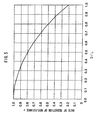
- the ratio of the inner diameter (diameter of the inner peripheral portion) dimension D of the penetration holes 70 and the distance L between centers of adjacent penetration holes 70, and the rate of reduction of reflectance at the electrochromic mirror 60 due to the formation of the penetration holes 70 is shown.
- the ratio of the inner diameter dimension D of the penetration holes 70 and the distance L between centers of adjacent penetration holes 70 is 7 or more, and the ratio of the distance L between centers and the inner diameter dimension D, which is a reciprocal thereof, is 0.5 or less.
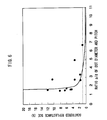
- FIG. 6 the relationship between the ratio of the inner diameter dimension D of the penetration holes 70 and the distance L between centers of adjacent penetration holes 70 and scattered reflectance is shown in a graph.
- the ratio of the inner diameter dimension D and the distance L between centers becomes 7 or more, scattering in light caused by a diffraction phenomenon of light of a boundary of the penetration holes 70 is extremely effectively reduced.
- a reflected image formed from reflected light can be prevented or effectively suppressed from generating optical interference or becoming clouded.
- the inner diameter (diameter of an inner peripheral portion) dimension D of the penetration holes 70 formed in the electrically conductive reflective film 68 is set at 0.5 ⁇ m, in the case where not only the scattered reflectance described above but also the reaction time when the electrochromic film 16 is colored is considered, it is preferable to set the inner diameter dimension D of the penetration holes 70 at 300 nm or less, while also maintaining the ratio of the inner diameter dimension D of the penetration holes 70 and the aforementioned distance L between centers at 7 or more.
- the opening shape of the penetration holes 70 is presumed to be a circular shape
- SCE is proportional to the square of (D/L) as shown in the following formula 5.
- the entire area thereof is colored.
- the time ⁇ until the lithium ions reach portions that do not correspond to the penetration holes 70 in the electrochromic film 16 is generally proportional to the square of the distance and is therefore as shown in the following formula 6.
- ⁇ ⁇ L 2 From the above formula 5 and formula 6, the following formula 7 is obtained.
- the scattered reflectance SCE is measured for a case where the inner diameter D of the penetration holes 70 is set at 250 nm and the distance L between centers of the penetration holes 70 is set at 1.8 ⁇ m, upon which the proportional constant of formula 5 is found, and on this basis, the relationship between the scattered reflectance and the coloring reaction time of the electrochromic film 16 for cases in which the inner diameter D of the penetration holes 70 has been changed is shown in the graph in FIG. 7 .
- FIG. 8 the configuration of an electrochromic mirror 80 according to a second exemplary embodiment of the present invention is shown in schematic cross-sectional view.
- the electrochromic mirror 80 is not provided with the electrochromic film 16, and instead, is provided with an electrochromic film 86.
- the electrochromic film 86 is formed with the same material and with the same thickness as the electrochromic film 16, but as shown in FIG. 9 , plural fine penetration holes 92 that penetrate in the thickness direction of the electrochromic film 86 are formed therein.
- the penetration holes 92 are in communication with the penetration holes 70, and the inner diameter (diameter of an inner peripheral portion) dimension D thereof is 20 ⁇ m or less and, in particular, is set at 0.5 ⁇ m in the present exemplary embodiment. Further, the penetration holes 92 are basically formed irregularly (randomly) in the electrochromic film 86. However, the distance L between centers of adjacent penetration holes 92 is set at 5 ⁇ m.
- the penetration holes 92 are formed by providing a photomask, in which a pattern of the penetration holes 92 is printed on the electrochromic film 86 on which a photoresist has been coated, and carrying out exposure, followed by removing the photoresist corresponding to the penetration holes 92 and dissolving the electrochromic film 86 with an etching solution.
- the penetration holes 70 are formed in the electrically conductive reflective film 68, and the penetration holes 92 are formed in the electrochromic film 86.
- the switch 42 is switched to the ON state and the voltage is applied, first, due to the fact that lithium ions (Li + ) constituting the electrolyte of the electrolytic solution 34 pass through the penetration holes 70, the lithium ions (Li + ) reach the electrochromic film 86 more quickly than when they are transmitted through the electrically conductive reflective film 68 at regions where the penetration holes 70 are not formed.
- the lithium ions that have reached the electrochromic film 86 enter into the penetration holes 92 and enter into the electrochromic film 86 from the inner peripheral portions of the penetration holes 92.
- the reduction reaction occurs even more quickly in the electrochromic film 86, and the entire electrochromic film 86 is colored even more quickly.
- the penetration holes 92 due to the inner diameter (diameter of the inner peripheral portion) dimension D of the penetration holes 92 being set at 5 ⁇ m (i.e., 20 ⁇ m or less) the penetration holes 92 basically cannot be directly visually observed. As a result, even when the penetration holes 92 are formed, no unnatural feeling is generated upon visually observing light reflected at the electrically conductive reflective film 68.
- the ratio therebetween becomes 0.5.
- 80 % of the reflectance in the case where the penetration holes 92 are not formed can be ensured.
- reduction in reflectance is kept low (about 20 %), and light can be sufficiently reflected at the electrochromic film 86 in spite of the fact that the penetration holes 92 are formed.
- the distance L between centers of adjacent penetration holes 92 is set at 10 ⁇ m, the formation positions thereof are irregular (random), similarly to those of the penetration holes 70. For this reason, no regular interference in the light reflected at the electrochromic film 86 is generated. As a result, a reflected image can be made even more clear.
- the configuration of the electrochromic mirror 80 according to the present exemplary embodiment is basically the same as that of the electrochromic mirror 60 according to the first exemplary embodiment, except for the fact that the electrochromic film 86 in which the penetration holes 92 are formed is provided in place of the electrochromic film 86. Accordingly, the electrochromic mirror 80 basically achieves the same operation as that of the electrochromic mirror 60 and can obtain the same effects as those of the electrochromic mirror 60.
- FIG. 10 the configuration of an electrochromic mirror 110 according to the present exemplary embodiment is shown in schematic cross-sectional view.
- the electrochromic mirror 110 is not provided with the electrically conductive reflective film 68, and instead, is provided with an electrically conductive reflective film 118.
- the electrically conductive reflective film 118 is constituted by a first electrically conductive reflective film 120 and a second electrically conductive reflective film 122 serving as an electrically conductive protection film.
- the first electrically conductive reflective film 120 is formed at a side of the electrochromic film 16 that is opposite from the substrate main body 14.
- the first electrically conductive reflective film 120 is formed from aluminum (Al), silver (Ag), indium (In) or the like.
- the second electrically conductive reflective film 122 is formed from a metal that is more corrosion-resistant than the first electrically conductive reflective film 120, such as, for example, rhodium (Rh), ruthenium (Ru), palladium (Pd), nickel (Ni), chrome (Cr) or the like.
- an outer peripheral edge portion of the second electrically conductive reflective film 122 is formed so as to be positioned further toward an outer side than an outer peripheral edge portion of the first electrically conductive reflective film 120. As a result, the entire first electrically conductive reflective film 120 is covered by the second electrically conductive reflective film 122 from the side that is opposite from the electrochromic film 16.
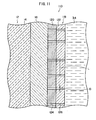
- penetration holes 70 were formed in the electrically conductive reflective film 68 in the first and second exemplary embodiments, as shown in FIG. 11 , in the present exemplary embodiment, penetration holes 124 corresponding to the penetration holes 70 are formed in the first electrically conductive reflective film 120, and penetration holes 126 corresponding to the penetration holes 70 are formed in the second electrically conductive reflective film 122, according to the same conditions as the penetration holes 70.
- the electrochromic mirror 110 of the above configuration light that is incident from the side of the substrate main body 14 that is opposite from the electrochromic film 86 is transmitted through the substrate main body 14 and the electrochromic film 16 and is reflected at the first electrically conductive reflective film 120. Further, any light that is transmitted through the first electrically conductive reflective film 120 without being reflected at the first electrically conductive reflective film 120 is reflected at the second electrically conductive reflective film 122.
- the electrolytic solution 34 is enclosed at the side of the electrically conductive reflective film 118 that is opposite from the electrochromic film 86.
- the electrolytic solution 34 side of the first electrically conductive reflective film 120 which mainly reflects the light, is covered by the second electrically conductive reflective film 122 formed from a metal that is more corrosion-resistant than the first electrically conductive reflective film 120. Therefore, the first electrically conductive reflective film 120 is protected by the second electrically conductive reflective film 122 with respect to the electrolytic solution 34, and it becomes harder for the first electrically conductive reflective film 120 to be corroded. As a result, light can be reflected in an excellent manner by the first electrically conductive reflective film 120 over a long period.
- the outer peripheral edge portion of the second electrically conductive reflective film 122 is positioned further toward the outer side than the outer peripheral edge portion of the first electrically conductive reflective film 120.
- the entire first electrically conductive reflective film 120 is covered by the second electrically conductive reflective film 122 from the side that is opposite from the electrochromic film 16, and not only the surface at the side that is opposite from the electrochromic film 16, but also the outer peripheral end of the first electrically conductive reflective film 120 is protected by the second electrically conductive reflective film 122 with respect to the electrolytic solution 34, so that corrosion of the first electrically conductive reflective film 120 can be effectively suppressed or prevented.
- the second electrically conductive reflective film 122 itself reflects light from the side of the substrate main body 14, although light that is transmitted through the substrate main body 14 further toward the outer side than the outer peripheral edge portion of the first electrically conductive reflective film 120 is not reflected at the first electrically conductive reflective film 120, it is instead reflected by the second electrically conductive reflective film 122.
- the reflection region of the light can be broadened (in other words, since a configuration is provided in which the entire first electrically conductive reflective film 120 is covered by the second electrically conductive reflective film 122, even if the first electrically conductive reflective film 120 is made to be smaller, the reflection region of the light is not narrowed).
- the configuration of the electrochromic mirror 110 according to the present exemplary embodiment is basically the same as that of the electrochromic mirror 60 according to the first exemplary embodiment, except for the fact that the electrically conductive reflective film 118 comprising the first electrically conductive reflective film 120 in which the penetration holes 124 are formed and the second electrically conductive reflective film 122 in which the penetration holes 126 are formed is provided in place of the electrically conductive reflective film 68 in which the penetration holes 70 are formed. Accordingly, the electrochromic mirror 110 basically achieves the same operation as that of the electrochromic mirror 60 and can obtain the same effects as those of the electrochromic mirror 60.
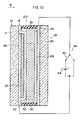
- the electrochromic mirror 110 according to the present exemplary embodiment has a configuration in which the electrochromic film 16 is provided, in the case of a configuration in which the electrochromic film 86 is provided in place of the electrochromic film 16 as shown in FIG. 12 , the same operation as that of the electrochromic mirror 80 according to the second exemplary embodiment is achieved, and the same effects as those of the electrochromic mirror 80 can be obtained, in addition to the operation and effects of the present exemplary embodiment.
- FIG. 13 the configuration of an electrochromic mirror 210 according to the present exemplary embodiment is shown in schematic cross-sectional view.
- the electrochromic mirror 210 is not provided with the carbon film 30, and instead is provided with a negative ion reaction film 212 as the reduction reaction compensation unit.
- the negative ion reaction film 212 is formed from an electrically conductive polymer such as polypyrrole, polyaniline, polyacetylene, polythiophene, polyparapyrene, polyfuran or the like, or a redox polymer such as polyvinylferrocene.
- an electrically conductive polymer such as polypyrrole, polyaniline, polyacetylene, polythiophene, polyparapyrene, polyfuran or the like, or a redox polymer such as polyvinylferrocene.
- formation is carried out by dissolving pyrrole in a solvent and coating this on the substrate main body 26.
- the negative ion reaction film 212 formation is carried out by dissolving vinylferrocene in a solvent and coating this on the substrate main body 26.
- the mass of the negative ion reaction film 212 is set so as to be 0.012 mg/cm 2 or more.
- the electrically conductive polymer or redox polymer constituting the negative ion reaction film 212 is oxidized to take on a positive charge.
- negative ions (ClO 4 - ) of the lithium perchlorate constituting the electrolyte enter into the negative ion reaction film 212 to establish a charge balance.
- PPy indicates polypyrrole in formula 8a
- PVF indicates polyvinylferrocene in formula 8b.
- the film thickness d of the electrochromic film 16 is set at 500 nm
- the bulk density ⁇ of the tungsten trioxide constituting the electrochromic film 16 is set at 7.18 g/cm 3
- the degree of hole P of the tungsten trioxide constituting the electrochromic film 16 is set at 0.8
- the molecular weight M w of the tungsten trioxide is set at 231.9 mol, and these are substituted in the following formula 9, a reaction amount (number of moles) n of the tungsten trioxide becomes 1.86 mM/cm 2 .
- n X • d • ⁇ • P / M W
- m is set at 0.012 mg/cm 2 or greater for the negative ion reaction film 212. Therefore, a sufficient reduction reaction can be caused to occur in the electrochromic film 16, and as a result, by switching the switch 42 to the ON state and applying a voltage, the electrochromic film 16 can be sufficiently colored, as discussed above.
- the voltage that is applied can be lowered to 1.3 V.
- the switch 42 is switched to the OFF state and the electrically conductive reflective film 68 and the electrically conductive film 28 are short-circuited, a reaction in the opposite direction from the above formula 8a or formula 8b occurs, and the electrochromic film 16 is quickly decolored.
- the switch 42 can be maintained in the OFF state to conduct rear viewing with a high reflectance, and at nighttime or the like, when a vehicle to the rear turns on its headlights, by switching the switch 42 to the ON state to color the electrochromic film 16 and reduce the reflectance, reflected light of the headlights can be reduced, and glare is lowered.
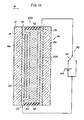
- FIG. 14 the configuration of an electrochromic mirror 220 according to a fifth exemplary embodiment of the present invention is shown in schematic cross-sectional view.
- the electrically conductive film 28 is formed from silver (Ag).
- the carbon film 30 is not formed at the surface at the front surface side substrate 12 side of the electrically conductive film 28, and instead, a hardly-soluble salt film 224 constituting the reduction reaction compensation unit is formed as a precipitation film.
- the hardly-soluble salt film 224 is formed from silver chloride, bromine chloride, thiocyanate chloride or the like, and in particular, in the present exemplary embodiment, the hardly-soluble salt film 224 is formed from silver chloride.
- the compensation reaction reliably occurs with respect to the reduction reaction in the electrochromic film 16, at the time of coloring the electrochromic film 16, the voltage that is applied can be lowered to 1.3 V.
- the switch 42 is switched to the OFF state and the electrically conductive reflective film 68 and the electrically conductive film 28 are short-circuited, a reaction in the opposite direction from the above formula 1 and formula 11 occurs, and the electrochromic film 16 is quickly decolored.
- the switch 42 can be maintained in the OFF state to conduct rear viewing with a high reflectance, and at nighttime or the like, when a vehicle to the rear turns on its headlights, by switching the switch 42 to the ON state to color the electrochromic film 16 and reduce the reflectance, reflected light of the headlights can be reduced, and glare is lowered.
- FIG. 15 the configuration of an electrochromic mirror 240 according to a sixth exemplary embodiment of the present invention is shown in schematic cross-sectional view.
- the carbon film 30 is not formed at the surface at the front surface side substrate 12 side of the electrically conductive film 28. Further, an electrolytic solution 244 is enclosed between the front surface side substrate 12 and the back surface side substrate 24 in place of the electrolytic solution 34.
- the electrolytic solution 244 contains ferrocene (Fe(C 5 H 5 ) 2 ), which is a neutral material serving as an oxidant constituting the reduction reaction compensation unit.
- the compensation reaction reliably occurs with respect to the reduction reaction in the electrochromic film 16, at the time of coloring the electrochromic film 16, the voltage that is applied can be lowered to 1.3 V.
- the switch 42 is switched to the OFF state and the electrically conductive reflective film 68 and the electrically conductive film 28 are short-circuited, a reaction in the opposite direction from the above formula 1 and formula 12 occurs, and the electrochromic film 16 is quickly decolored.
- the switch 42 can be maintained in the OFF state to conduct rear viewing with a high reflectance, and at nighttime or the like, when a vehicle to the rear turns on its headlights, by switching the switch 42 to the ON state to color the electrochromic film 16 and reduce the reflectance, reflected light of the headlights can be reduced, and glare is lowered.
- the fourth exemplary embodiment through the sixth exemplary embodiment described above were modified examples of the first exemplary embodiment, the fourth exemplary embodiment through the sixth exemplary embodiment may be configured to be modified examples of the second exemplary embodiment or third exemplary embodiment.
- an electrochromic mirror comprising: an electrically conductive reflective film capable of reflecting light that is incident thereto and having electrical conductivity, the electrically conductive reflective film having formed therein a plurality of fine penetration holes that penetrate in a thickness direction of the electrically conductive reflective film, and a ratio of a distance between respective centers of the penetration holes and an inner peripheral diameter dimension of the penetration holes being 7 or more; an electrochromic film that is provided at a side of the electrically conductive reflective film at which the light is incident and reflected, and that is colored due to being subjected to a reduction reaction; an electrically conductive film having electrical conductivity that is provided at a side of the electrically conductive reflective film that is opposite from the electrochromic film; and an electrolytic solution that comprises lithium ions and is enclosed between the electrically conductive film and the electrically conductive reflective film, and in which, due to applying a voltage such that the electrically conductive film is made positive and the electrically conductive reflective film is made negative, the lithium
- the electrochromic mirror of the aforementioned first aspect plural fine penetration holes that penetrate in the thickness direction of the electrically conductive reflective film are formed in the electrically conductive reflective film. Therefore, when the voltage is applied such that the electrically conductive film is made positive and the electrically conductive reflective film is made negative, the lithium ions of the electrolytic solution pass through the penetration holes formed in the electrically conductive reflective film to easily and smoothly reach the electrochromic film. As a result, the reduction reaction smoothly and quickly occurs in the electrochromic film, and the electrochromic film is smoothly and quickly colored.
- the ratio of the distance between centers of the plural penetration holes formed in the electrically conductive reflective film and the inner peripheral diameter dimension of the respective penetration holes is set to be 7 or more, interference or clouding of a reflected image caused by scattering of reflected light due to a diffraction phenomenon in a boundary or edge portion of the respective penetration holes within the electrically conductive reflective film is prevented or effectively suppressed.
- a reflected image can be made to be clear.
- a configuration may be provided in which a plurality of fine penetration holes that penetrate in a thickness direction of the electrochromic film are formed in the electrochromic film, and a ratio of a distance between respective centers of the penetration holes formed in the electrochromic film and an inner peripheral diameter dimension of the penetration holes formed in the electrochromic film is set at 7 or more.
- the ratio of the distance between centers of the plural penetration holes formed in the electrochromic film and the inner peripheral diameter dimension of the respective penetration holes is set to be 7 or more, interference or clouding of a reflected image caused by scattering of reflected light due to a diffraction phenomenon in a boundary or edge portion of the respective penetration holes within the electrochromic film is prevented or effectively suppressed.
- a reflected image can be made to be clear.
- a configuration may be provided in which the diameter dimension of the penetration holes formed in the electrically conductive reflective film is 20 ⁇ m or less, and a ratio of the diameter dimension and the distance between centers of the plurality of penetration holes formed in the electrically conductive reflective film is 0.5 or less.
- the diameter dimension of the penetration holes formed in the electrically conductive reflective film is set at 20 ⁇ m or less, visual observation of the penetration holes is extremely difficult, and the penetration holes are extremely inconspicuous. Moreover, since the ratio of the diameter dimension of the plural penetration holes formed in the electrically conductive reflective film and the distance between centers of the respective penetration holes is set at 0.5 or less, reduction of reflectance can be kept small.
- a configuration may be provided in which the diameter dimension of the penetration holes formed in the electrically conductive reflective film is 300 nm or less.
- the diameter dimension of the plural penetration holes formed in the electrically conductive reflective film is set at 300 nm or less, scattered reflectance at an end portion of the penetration holes can be effectively suppressed, and moreover, the electrochromic film can be colored within a reaction time that is suitable for practical use.
- a configuration may be provided in which the distance between respective centers of the plurality of penetration holes is 10 ⁇ m or less.
- the distance between respective centers of the plural penetration holes formed in the electrically conductive reflective film or the electrochromic film is set at 10 ⁇ m or less, the coloring speed of the electrochromic film between penetration holes becomes faster.
- a configuration may be provided in which formation positions of the penetration holes are random.
- the electrically conductive reflective film comprises: a first electrically conductive reflective film having electrical conductivity that is formed at one thickness direction side of the electrochromic film and reflects light that has transmitted through the electrochromic film; and an electrically conductive protection film having electrical conductivity that is formed at a side of the first electrically conductive reflective film that is opposite from the electrochromic film, from a material that is more corrosion-resistant than a material constituting the first electrically conductive reflective film.
- the voltage is applied such that the first electrically conductive reflective film and the electrically conductive protection film are made negative.
- the electrically conductive protection film which is formed further toward the side of the electrolytic solution than the first electrically conductive reflective film, is formed from a material that is more corrosion-resistant than the material constituting the first electrically conductive reflective film. Therefore, the first electrically conductive reflective film is protected by the electrically conductive protection film, and it becomes harder for the first electrically conductive reflective film to be corroded. As a result, light can be reflected in an excellent manner by the first electrically conductive reflective film over a long period.
- the first electrically conductive reflective film since it becomes harder for the first electrically conductive reflective film to be corroded due to being protected by the electrically conductive protection film, the first electrically conductive reflective film itself can be made thinner, and as a result, the overall thickness of the electrically conductive reflective film does not become thicker even when the electrically conductive protection film is provided.
- the electrically conductive protection film comprises a second electrically conductive reflective film having electrical conductivity that reflects light from the side of the first electrically conductive reflective film.
- the electrically conductive protection film that protects the first electrically conductive reflective film is configured as the second electrically conductive reflective film which reflects light from the side of the first electrically conductive reflective film. As a result, even if a portion of the light is transmitted through the first electrically conductive reflective film due to the first electrically conductive reflective film being made thinner, this transmitted light can be reflected at the second electrically conductive reflective film.
- the second electrically conductive reflective film is provided so as to cover the entire first electrically conductive reflective film from the side of the electrolytic solution and, moreover, so that the second electrically conductive reflective film is positioned further toward the outer side than the peripheral edge portion of the first electrically conductive reflective film, not only is the protection performance of the first electrically conductive reflective film by the second electrically conductive reflective film improved, but due to a portion of the second electrically conductive reflective film being positioned at the outer side of the peripheral edge portion of the first electrically conductive reflective film, light can be reflected even at the outer side of the first electrically conductive reflective film.
- the electrochromic mirror further comprises a reduction reaction compensation unit that compensates the reduction reaction by storing electrical charge in a state in which the voltage is applied or by carrying out an oxidation reaction with negative ions in the electrolytic solution.
- the reduction reaction compensation unit comprises a negative ion reaction film that is formed from an electrically conductive polymer or redox polymer and provided at an electrically conductive reflective film side of the electrically conductive film, and that is oxidized by negative ions that have moved toward the side of the electrically conductive film due to the voltage being applied.
- the reduction reaction can be sufficiently caused to occur in the electrochromic film. Moreover, since the reduction reaction can be caused to occur in the electrochromic film even with a low voltage in this manner, the electrochromic film can be easily decolored after the termination of the voltage application.
- the electrically conductive film is formed from silver or an alloy containing silver
- the electrolytic solution comprises negative ions of a hardly-soluble salt that react with ions of silver forming the electrically conductive film when a voltage is applied such that the electrically conductive film is made positive and the electrically conductive reflective film is made negative
- the electrochromic mirror further comprises a precipitation film that is formed from the hardly-soluble salt and provided at the electrically conductive reflective film side of the electrically conductive film, and that causes a precipitate, which is formed by a reaction between negative ions of the hardly-soluble salt that have moved toward the side of the electrically conductive film due to the voltage being applied and ions of silver constituting the electrically conductive film, to precipitate
- the reduction reaction compensation unit comprises the silver forming the electrically conductive film, the negative ions constituting the electrolytic solution, and the precipitation film.
- an oxidation reaction corresponding to the reduction reaction in the electrochromic film can be sufficiently caused to occur at the electrically conductive film and the precipitation film, even if the aforementioned voltage that is applied to the electrically conductive film and the electrically conductive reflective film is low, the reduction reaction can be sufficiently caused to occur in the electrochromic film. Moreover, since the reduction reaction can be caused to occur in the electrochromic film even with a low voltage in this manner, the electrochromic film can be easily decolored after the termination of the voltage application.
- the electrolytic solution contains a reaction material that can be oxidized by neutral molecules or negative ions and undergoes an oxidation reaction due to applying a voltage with the electrically conductive film being made positive and the electrically conductive reflective film being made negative, and the reduction reaction compensation unit comprises the reaction material.
- the electrolytic solution is constituted containing, in addition to the lithium ions, a reaction material that can be oxidized by neutral molecules or negative ions, and when the voltage is applied such that the electrically conductive film is made positive and the electrically conductive reflective film is made negative, an oxidization reaction occurs in the reaction material constituting the electrolytic solution.
- the aforementioned reduction reaction in the electrochromic film is compensated, and even if the aforementioned voltage that is applied to the electrically conductive film and the electrically conductive reflective film is low, the reduction reaction can be sufficiently caused to occur in the electrochromic film.
- the reduction reaction can be caused to occur in the electrochromic film even with a low voltage in this manner, the electrochromic film can be easily decolored after the termination of the voltage application.
- the electrochromic mirror according to the present invention even when a configuration is provided in which holes are formed in the electrically conductive reflective film, the occurrence of problems, such as reflectance being greatly reduced or the like, can be prevented or effectively suppressed, and a clear reflected image can be obtained.
- the features disclosed in the foregoing description, in the claims and/or in the accompanying drawings may, both separately and in any combination thereof, be material for realising the invention in diverse forms thereof.
Landscapes
- Physics & Mathematics (AREA)
- Chemical & Material Sciences (AREA)
- Inorganic Chemistry (AREA)
- Nonlinear Science (AREA)
- Crystallography & Structural Chemistry (AREA)
- General Physics & Mathematics (AREA)
- Optics & Photonics (AREA)
- Electrochromic Elements, Electrophoresis, Or Variable Reflection Or Absorption Elements (AREA)
Applications Claiming Priority (2)
| Application Number | Priority Date | Filing Date | Title |
|---|---|---|---|
| JP2007167911 | 2007-06-26 | ||
| JP2008029330A JP4949287B2 (ja) | 2007-06-26 | 2008-02-08 | エレクトロクロミックミラー |
Publications (2)
| Publication Number | Publication Date |
|---|---|
| EP2009492A2 true EP2009492A2 (fr) | 2008-12-31 |
| EP2009492A3 EP2009492A3 (fr) | 2009-10-21 |
Family
ID=40001470
Family Applications (1)
| Application Number | Title | Priority Date | Filing Date |
|---|---|---|---|
| EP08011425A Withdrawn EP2009492A3 (fr) | 2007-06-26 | 2008-06-24 | Rétroviseur électrochromique |
Country Status (2)
| Country | Link |
|---|---|
| US (1) | US7692843B2 (fr) |
| EP (1) | EP2009492A3 (fr) |
Cited By (1)
| Publication number | Priority date | Publication date | Assignee | Title |
|---|---|---|---|---|
| WO2015039011A1 (fr) * | 2013-09-16 | 2015-03-19 | Sage Electrochromics, Inc. | Amélioration du rendu de couleur dans des vitrages optiques |
Families Citing this family (5)
| Publication number | Priority date | Publication date | Assignee | Title |
|---|---|---|---|---|
| US7800807B2 (en) * | 2007-06-26 | 2010-09-21 | Kabushiki Kaisha Tokai-Rika-Denki-Seisakusho | Electrochromic mirror |
| JP4972001B2 (ja) * | 2008-01-23 | 2012-07-11 | 株式会社東海理化電機製作所 | エレクトロクロミックミラー |
| CN102998870A (zh) * | 2011-09-08 | 2013-03-27 | 华德塑料制品有限公司 | 电致变色材料 |
| KR101448671B1 (ko) * | 2012-12-07 | 2014-10-13 | 주식회사 엔케이이씨 | 전기 변색 필름 및 이의 제조방법 |
| KR101448673B1 (ko) * | 2012-12-07 | 2014-10-08 | 주식회사 엔케이이씨 | 전기 변색 필름 및 이의 제조방법 |
Citations (1)
| Publication number | Priority date | Publication date | Assignee | Title |
|---|---|---|---|---|
| US3844636A (en) | 1972-12-13 | 1974-10-29 | American Cyanamid Co | Electrochromic mirror |
Family Cites Families (1)
| Publication number | Priority date | Publication date | Assignee | Title |
|---|---|---|---|---|
| WO1994016356A1 (fr) | 1993-01-05 | 1994-07-21 | Martin Marietta Corporation | Electrode amelioree pour dispositifs d'affichage |
-
2008
- 2008-06-23 US US12/144,128 patent/US7692843B2/en not_active Expired - Fee Related
- 2008-06-24 EP EP08011425A patent/EP2009492A3/fr not_active Withdrawn
Patent Citations (1)
| Publication number | Priority date | Publication date | Assignee | Title |
|---|---|---|---|---|
| US3844636A (en) | 1972-12-13 | 1974-10-29 | American Cyanamid Co | Electrochromic mirror |
Cited By (2)
| Publication number | Priority date | Publication date | Assignee | Title |
|---|---|---|---|---|
| WO2015039011A1 (fr) * | 2013-09-16 | 2015-03-19 | Sage Electrochromics, Inc. | Amélioration du rendu de couleur dans des vitrages optiques |
| US9341911B2 (en) | 2013-09-16 | 2016-05-17 | Sage Electrochromics, Inc. | Color rendering in optical glazings |
Also Published As
| Publication number | Publication date |
|---|---|
| US7692843B2 (en) | 2010-04-06 |
| US20090002799A1 (en) | 2009-01-01 |
| EP2009492A3 (fr) | 2009-10-21 |
Similar Documents
| Publication | Publication Date | Title |
|---|---|---|
| EP2009491A1 (fr) | Miroir électrochrome | |
| US7692843B2 (en) | Electrochromic mirror | |
| KR20170101702A (ko) | 전기변색 소자 | |
| KR20030040361A (ko) | 빠른 스위칭 속도를 갖는 가역 전기화학 거울 | |
| KR20010033200A (ko) | 높은 광투과성을 갖는 전착 셀 | |
| JP4098736B2 (ja) | エレクトロクロミックミラー | |
| JP4949287B2 (ja) | エレクトロクロミックミラー | |
| EP2083318B1 (fr) | Miroir électrochimique | |
| CN101334568B (zh) | 电致变色镜 | |
| EP2009490A2 (fr) | Rétroviseur électrochromique | |
| JP5014893B2 (ja) | エレクトロクロミックミラー | |
| US7327509B2 (en) | Electrochromic mirror | |
| JP2003154845A (ja) | 車両用サンバイザ | |
| JP2009008750A (ja) | エレクトロクロミックミラー | |
| US7573632B2 (en) | Electrochromic mirror | |
| JP2009008749A (ja) | エレクトロクロミックミラー | |
| JP2011095483A (ja) | エレクトロクロミックミラー | |
| JP3771398B2 (ja) | 溶液相エレクトロクロミック素子 | |
| JP2011095487A (ja) | エレクトロクロミックミラー | |
| JP2011141426A (ja) | エレクトロクロミックミラー |
Legal Events
| Date | Code | Title | Description |
|---|---|---|---|
| PUAI | Public reference made under article 153(3) epc to a published international application that has entered the european phase |
Free format text: ORIGINAL CODE: 0009012 |
|
| 17P | Request for examination filed |
Effective date: 20080624 |
|
| AK | Designated contracting states |
Kind code of ref document: A2 Designated state(s): AT BE BG CH CY CZ DE DK EE ES FI FR GB GR HR HU IE IS IT LI LT LU LV MC MT NL NO PL PT RO SE SI SK TR |
|
| AX | Request for extension of the european patent |
Extension state: AL BA MK RS |
|
| PUAL | Search report despatched |
Free format text: ORIGINAL CODE: 0009013 |
|
| AK | Designated contracting states |
Kind code of ref document: A3 Designated state(s): AT BE BG CH CY CZ DE DK EE ES FI FR GB GR HR HU IE IS IT LI LT LU LV MC MT NL NO PL PT RO SE SI SK TR |
|
| AX | Request for extension of the european patent |
Extension state: AL BA MK RS |
|
| AKX | Designation fees paid |
Designated state(s): DE FR GB |
|
| 17Q | First examination report despatched |
Effective date: 20110211 |
|
| GRAP | Despatch of communication of intention to grant a patent |
Free format text: ORIGINAL CODE: EPIDOSNIGR1 |
|
| INTG | Intention to grant announced |
Effective date: 20180202 |
|
| STAA | Information on the status of an ep patent application or granted ep patent |
Free format text: STATUS: THE APPLICATION IS DEEMED TO BE WITHDRAWN |
|
| 18D | Application deemed to be withdrawn |
Effective date: 20180613 |