EP2009548A1 - Architecture de traitement de signal et procédé - Google Patents
Architecture de traitement de signal et procédé Download PDFInfo
- Publication number
- EP2009548A1 EP2009548A1 EP07290787A EP07290787A EP2009548A1 EP 2009548 A1 EP2009548 A1 EP 2009548A1 EP 07290787 A EP07290787 A EP 07290787A EP 07290787 A EP07290787 A EP 07290787A EP 2009548 A1 EP2009548 A1 EP 2009548A1
- Authority
- EP
- European Patent Office
- Prior art keywords
- services
- subsystem
- data processing
- service
- service registry
- Prior art date
- Legal status (The legal status is an assumption and is not a legal conclusion. Google has not performed a legal analysis and makes no representation as to the accuracy of the status listed.)
- Ceased
Links
Images
Classifications
-
- G—PHYSICS
- G06—COMPUTING OR CALCULATING; COUNTING
- G06F—ELECTRIC DIGITAL DATA PROCESSING
- G06F9/00—Arrangements for program control, e.g. control units
- G06F9/06—Arrangements for program control, e.g. control units using stored programs, i.e. using an internal store of processing equipment to receive or retain programs
- G06F9/46—Multiprogramming arrangements
- G06F9/50—Allocation of resources, e.g. of the central processing unit [CPU]
- G06F9/5005—Allocation of resources, e.g. of the central processing unit [CPU] to service a request
- G06F9/5027—Allocation of resources, e.g. of the central processing unit [CPU] to service a request the resource being a machine, e.g. CPUs, Servers, Terminals
-
- G—PHYSICS
- G06—COMPUTING OR CALCULATING; COUNTING
- G06F—ELECTRIC DIGITAL DATA PROCESSING
- G06F9/00—Arrangements for program control, e.g. control units
- G06F9/06—Arrangements for program control, e.g. control units using stored programs, i.e. using an internal store of processing equipment to receive or retain programs
- G06F9/46—Multiprogramming arrangements
- G06F9/465—Distributed object oriented systems
-
- H—ELECTRICITY
- H04—ELECTRIC COMMUNICATION TECHNIQUE
- H04L—TRANSMISSION OF DIGITAL INFORMATION, e.g. TELEGRAPHIC COMMUNICATION
- H04L61/00—Network arrangements, protocols or services for addressing or naming
- H04L61/45—Network directories; Name-to-address mapping
- H04L61/4552—Lookup mechanisms between a plurality of directories; Synchronisation of directories, e.g. metadirectories
-
- G—PHYSICS
- G06—COMPUTING OR CALCULATING; COUNTING
- G06F—ELECTRIC DIGITAL DATA PROCESSING
- G06F2209/00—Indexing scheme relating to G06F9/00
- G06F2209/46—Indexing scheme relating to G06F9/46
- G06F2209/462—Lookup
-
- G—PHYSICS
- G06—COMPUTING OR CALCULATING; COUNTING
- G06F—ELECTRIC DIGITAL DATA PROCESSING
- G06F2209/00—Indexing scheme relating to G06F9/00
- G06F2209/50—Indexing scheme relating to G06F9/50
- G06F2209/5015—Service provider selection
-
- H—ELECTRICITY
- H04—ELECTRIC COMMUNICATION TECHNIQUE
- H04L—TRANSMISSION OF DIGITAL INFORMATION, e.g. TELEGRAPHIC COMMUNICATION
- H04L67/00—Network arrangements or protocols for supporting network services or applications
- H04L67/01—Protocols
- H04L67/10—Protocols in which an application is distributed across nodes in the network
- H04L67/1095—Replication or mirroring of data, e.g. scheduling or transport for data synchronisation between network nodes
-
- H—ELECTRICITY
- H04—ELECTRIC COMMUNICATION TECHNIQUE
- H04L—TRANSMISSION OF DIGITAL INFORMATION, e.g. TELEGRAPHIC COMMUNICATION
- H04L67/00—Network arrangements or protocols for supporting network services or applications
- H04L67/50—Network services
- H04L67/51—Discovery or management thereof, e.g. service location protocol [SLP] or web services
-
- Y—GENERAL TAGGING OF NEW TECHNOLOGICAL DEVELOPMENTS; GENERAL TAGGING OF CROSS-SECTIONAL TECHNOLOGIES SPANNING OVER SEVERAL SECTIONS OF THE IPC; TECHNICAL SUBJECTS COVERED BY FORMER USPC CROSS-REFERENCE ART COLLECTIONS [XRACs] AND DIGESTS
- Y02—TECHNOLOGIES OR APPLICATIONS FOR MITIGATION OR ADAPTATION AGAINST CLIMATE CHANGE
- Y02D—CLIMATE CHANGE MITIGATION TECHNOLOGIES IN INFORMATION AND COMMUNICATION TECHNOLOGIES [ICT], I.E. INFORMATION AND COMMUNICATION TECHNOLOGIES AIMING AT THE REDUCTION OF THEIR OWN ENERGY USE
- Y02D10/00—Energy efficient computing, e.g. low power processors, power management or thermal management
Definitions
- the present invention relates to a data processing system configured to provide a plurality of signal processing services, said services being distributed over a plurality of signal processing subsystems that are interconnected via a network.
- the present invention further relates to a method for enabling access to a signal processing service of such a data processing system.
- the system may be built up by means of a number of subsystems interconnected via a data communication network, such as a number of separate ICs or IP cores of an IC together forming the data processing system.
- a subsystem is typically capable of providing a number of services.
- a service is a software (SW) instantiation that invokes the grouping of one or more hardware and/or SW resources of the subsystem into single identifiable unit.
- SW software
- a service can be an audio file player, which invokes the grouping of decoding and encoding logic, file readers and writers and so on.
- the UniPro standard of the MIPI alliance offers a standardized way of interconnecting subsystems via a data communication network of a data processing system, which enables the access to services by remote subsystems, i.e. subsystems other than the subsystem hosting the service.
- a (user-driven) application of a data processing system typically comprises a collection of interacting services.
- An application typically runs on the hardware of one or more of the subsystems of the data processing systems.
- the application will typically require the use of services located on other subsystems. For this reason, the application requires knowledge about the location of the required services.
- state of the art data processing systems typically have a master subsystem that comprises a service registry in which all services of all subsystems are listed.
- a service registry in which all services of all subsystems are listed.
- an application requiring access to a service of another subsystem can contact the service registry to locate the required service, after which this service can be accessed through the network.
- the present invention seeks to provide a data processing system according to the opening paragraph that can be more easily reconfigured.
- the present invention further seeks to provide a method that facilitates easier reconfiguration of such a data processing system.
- a data processing system configured to provide a plurality of signal processing services, said services being distributed over a plurality of signal processing subsystems that are interconnected via a network, each subsystem comprising a service registry, each service registry comprising a list of services accessible within its own subsystem and being arranged to store the location of the other signal processing services from the plurality of signal processing services, each service registry being configured to connect two services upon request of one of the two services.
- each subsystem By providing each subsystem with its own registry, and having the multiple registries share information, it becomes easier to add and remove subsystems to and from a data processing system, thus making the system more scalable as a whole, because it is no longer required that the full set of services of the system is known to at least one subsystem at the design stage of the data processing system, since this information can be shared between the various service registries during operation of the data processing system. Moreover, each subsystem can be powered down if its services are not required, because no subsystem is dependent on the information stored in the service registry of any other subsystem.
- Each subsystem preferably is configured to send and receive configuration signals over the network, said configuration signals triggering the communication of service information between the service registry of a subsystem sending a configuration signal and the service registry of a subsystem receiving the configuration signal.
- This embodiment provides an efficient mechanism for updating the service information stored in the service registries of the subsystems such as upon start-up of the data processing system or upon a change in the composition of the data processing system.
- a method for enabling access to a signal processing service of a data processing system configured to provide a plurality of data processing services, said services being distributed over a plurality of data processing subsystems that are interconnected via a network, the method comprising providing each subsystem with its own service registry; storing, in each respective service registry, a list of services accessible within the subsystem of the associated service registry; and storing, in each service registry, the location of the data processing services from the plurality of data processing services located outside the subsystem of the service registry.
- This method ensures that each subsystem is aware of all the available services in the data processing system, thus obviating the need to keep this information stored centrally, e.g. in a master subsystem.
- the accessibility of the plurality of services is configured by selecting a service registry; sending a configuration signal from the subsystem of the selected service registry to another subsystem; sending the list of services from the selected service registry to the service registry of the other subsystem; storing the received list of services in the service registry of the other subsystem ; and repeating these steps until all other service registries have received and stored the list of services from the selected service registries.
- the selected service registry may be the service registry of the subsystem added to the data processing system or of a subsystem to be removed from the data processing system.
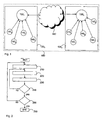
- Fig. 1 shows a data processing system according to the present invention.
- a data processing system 100 has n subsystems 120 i , in which n is a positive integer, and i is an identifier ranging from 1 to n.
- n 2 by way of non-limiting example only.
- Subsystem 120 1 comprises a service registry 130 1 and can offer four services 140 a-d .
- Subsystem 120 2 comprises a service registry 130 2 and can offer five services 140 e-j .
- the subsystems 120 are interconnected through a network 160.
- a data processing system typically is an electronic device or a System-on-Chip (SoC), which comprises a number of smaller portions that cooperate by using the network 160.
- SoC System-on-Chip
- the smaller portions i.e. the subsystems 120, may comprise several integrated circuits (ICs) or may comprise several discrete building blocks inside an IC, e.g. IP cores.
- ICs integrated circuits
- IP cores e.g. IP cores
- a subsystem may be a software instance such as an operating system (OS) in a multiple-OS data processing system.
- OS operating system
- the building blocks are typically capable of providing a service, i.e. capable of executing a particular data fetching or processing task, which may be executed by running appropriate SW on at least a part of the building block, e.g. a dedicated processor, or may be executed in its entirety by hardware.
- a service i.e. capable of executing a particular data fetching or processing task, which may be executed by running appropriate SW on at least a part of the building block, e.g. a dedicated processor, or may be executed in its entirety by hardware.
- Such a task typically can form a part of a chain of tasks that in its entirety form the processing of a user-requested operation, e.g. a use case.
- each subsystem 120 with a service registry 130, i.e. subsystem 120 1 comprises a service registry 130 1 and subsystem 120 2 comprises a service registry 130 2 .
- the service registries 130 comprise a list of available services within its own subsystem 120.
- the service registries 130 comprise a list of addresses of services outside each own subsystem 120. These may be different lists or may be combined into a single list.
- the service registries 130 are configured to, upon request of a service 140 such as a service from its own subsystem, connect the requesting service to a requested service. For instance, service 140 a may need to pass own the result of its processing task to service 140 f .
- service 140 a sends a request to its service registry 130 1 to be connected to service 140 f .
- Service registry 130 1 subsequently establishes a connection between the service 140 a of subsystem 120 1 and service 140 f of subsystem 120 2 based on the location information that service registry 130 1 contains. The establishment of such a connection is routine practice to the skilled practitioner and will not be further explained for that reason.
- the service registries 130 are also implemented as services, since this is particularly efficient from an implementation perspective; a service 140 is typically configured to send service requests to other services, so that in the above example, service 140 a can simply send a service request connect to service 140 f ' to service registry 130 1 .
- the definition of a service registry 130 as a service itself makes the service registry 130 accessible through the network 160.
- the service registries 130 may be implemented in any known way; for instance, the service registries may be realized in software on a dedicated or general processor (not shown) of a subsystem, with the service data stored in an embedded memory of said processor. The data may be stored in any known form, e.g. a look-up table, a hash table and so on.
- service registries 130 that contain location information of each service 140 in the data processing system 100 has the significant advantage of reducing the amount of data traffic over the network 160, thus reducing the risk of network congestion.
- a local service registry i.e. a service registry 130 within the same subsystem 120 as a service 140 requiring a connection to another service 140 obviates the need for the requesting service 140 to broadcast a request to all other subsystems 120 for locating the required service, which typically triggers a number of response signals from the subsystems 120 receiving the location request signal.
- the service registry can lookup the location information in its list, and connect the requesting service 140 to its target service based on the information retrieved from the list.
- An, additional advantage is that the presence of a service registry 130 in each subsystem 120 allows the subsystem 120 to operate autonomously. This for instance means that each subsystem 120 can be powered down during periods of inactivity, thus significantly reducing the power consumption of the data processing system 100 compared to systems that use a central service registry.
- each subsystem 120 is configured to store the location information of each service 140 in the data processing system 100 in its service registry 130, a subsystem can be easily added or removed from the data processing system 100. This is not only beneficial at the design stage, where it avoids the requirement of detailed knowledge of the implementation of subsystems from third parties at an early design stage, but it is also beneficial during the operation of the data processing system 100 of a modular nature, because subsystems 120 can easily be added to or removed from the data processing system 100 as long as the subsystem 120 is suitable for use in the data processing system 100, i.e. comprises a system registry 130 as previously described, and a methodology is available to provide various service registries 130 with up-to-date information regarding the full set of services 140 available in the data processing system 100.
- Fig. 2 depicts an example of a method to provide such information.
- a subsystem 120 e.g. by means of its service registry 130, sends a configuration signal to the other subsystems 120 via the network 160.
- the configuration signal may be generated upon start-up of the data processing system 120 or upon addition or deletion of the configuration signal generating subsystem 120 to or from the data processing system 120.
- the configuration signal notifies the other subsystems 120 that their respective service registries 130 are to receive information regarding the location of remote services 140, i.e. services located on another subsystem 120.
- this location information is exchanged between the subsystem 120 sending the configuration signal and the subsystem 120 receiving the configuration signal.
- the receiving subsystem 120 stores the received information in its service registry 130 in step 230.
- This information may include the physical address on the network 160 of the service 140 or the subsystem 120 offering the service 140, or other suitable ways to enable information receiving service registries 130 to locate the remote service 140.
- the exchange of information may take place in the form of a broadcast, in which all service registries 130 receive the location information from the sending subsystem 120 in a single step, or may take place in a peer-to-peer (P2P) fashion, in which a single receiving subsystem 120 is connected to a sender.
- the subsystems 120 typically comprise an ordering, e.g.
- step 250 it is checked if all subsystems 120 have exchanged their local services list with the other subsystems 120; if not, the method loops back to step 210, or otherwise terminates in step 260.
- step 250 may be skipped if a subsystem 120 is added to or deleted from the data processing system 100; in that case, the subsystem 120 notifies the other subsystems as described above that its local list is either to be added to or to be removed from the location information stored in the other service registries 130. This ensures that the information regarding the locations of the available services 140 as stored in these service registries 130 is kept up to date at all times.
Landscapes
- Engineering & Computer Science (AREA)
- Software Systems (AREA)
- Theoretical Computer Science (AREA)
- Physics & Mathematics (AREA)
- General Engineering & Computer Science (AREA)
- General Physics & Mathematics (AREA)
- Computer Networks & Wireless Communication (AREA)
- Signal Processing (AREA)
- Computer And Data Communications (AREA)
Priority Applications (4)
| Application Number | Priority Date | Filing Date | Title |
|---|---|---|---|
| EP07290787A EP2009548A1 (fr) | 2007-06-26 | 2007-06-26 | Architecture de traitement de signal et procédé |
| US12/665,305 US20100281096A1 (en) | 2007-06-26 | 2008-06-25 | Signal processing architecture and method |
| EP08776496A EP2160681A1 (fr) | 2007-06-26 | 2008-06-25 | Architecture et procédé de traitement de signaux |
| PCT/IB2008/052537 WO2009001302A1 (fr) | 2007-06-26 | 2008-06-25 | Architecture et procédé de traitement de signaux |
Applications Claiming Priority (1)
| Application Number | Priority Date | Filing Date | Title |
|---|---|---|---|
| EP07290787A EP2009548A1 (fr) | 2007-06-26 | 2007-06-26 | Architecture de traitement de signal et procédé |
Publications (1)
| Publication Number | Publication Date |
|---|---|
| EP2009548A1 true EP2009548A1 (fr) | 2008-12-31 |
Family
ID=38521014
Family Applications (2)
| Application Number | Title | Priority Date | Filing Date |
|---|---|---|---|
| EP07290787A Ceased EP2009548A1 (fr) | 2007-06-26 | 2007-06-26 | Architecture de traitement de signal et procédé |
| EP08776496A Ceased EP2160681A1 (fr) | 2007-06-26 | 2008-06-25 | Architecture et procédé de traitement de signaux |
Family Applications After (1)
| Application Number | Title | Priority Date | Filing Date |
|---|---|---|---|
| EP08776496A Ceased EP2160681A1 (fr) | 2007-06-26 | 2008-06-25 | Architecture et procédé de traitement de signaux |
Country Status (3)
| Country | Link |
|---|---|
| US (1) | US20100281096A1 (fr) |
| EP (2) | EP2009548A1 (fr) |
| WO (1) | WO2009001302A1 (fr) |
Families Citing this family (2)
| Publication number | Priority date | Publication date | Assignee | Title |
|---|---|---|---|---|
| US9037678B2 (en) * | 2012-05-14 | 2015-05-19 | Sap Se | Distribution of messages in system landscapes |
| US9705995B2 (en) * | 2014-03-18 | 2017-07-11 | Axis Ab | Capability monitoring in a service oriented architecture |
Citations (3)
| Publication number | Priority date | Publication date | Assignee | Title |
|---|---|---|---|---|
| EP0932275A2 (fr) * | 1998-01-06 | 1999-07-28 | Sony Electronics Inc. | Méthodes, systèmes et dispositif pour fournir une identification à un équipement dans un réseau |
| EP1022876A1 (fr) * | 1999-01-25 | 2000-07-26 | International Business Machines Corporation | Annonces de service dans réseaux locaux sans fil |
| WO2000062479A2 (fr) * | 1999-04-09 | 2000-10-19 | Sony Electronics Inc. | Systeme et procede de tenue a jour de registres totalement dupliques dans un reseau electronique |
Family Cites Families (1)
| Publication number | Priority date | Publication date | Assignee | Title |
|---|---|---|---|---|
| US8001052B2 (en) * | 2001-12-10 | 2011-08-16 | Dunkeld Bryan C | System and method for unique digital asset identification and transaction management |
-
2007
- 2007-06-26 EP EP07290787A patent/EP2009548A1/fr not_active Ceased
-
2008
- 2008-06-25 US US12/665,305 patent/US20100281096A1/en not_active Abandoned
- 2008-06-25 EP EP08776496A patent/EP2160681A1/fr not_active Ceased
- 2008-06-25 WO PCT/IB2008/052537 patent/WO2009001302A1/fr not_active Ceased
Patent Citations (3)
| Publication number | Priority date | Publication date | Assignee | Title |
|---|---|---|---|---|
| EP0932275A2 (fr) * | 1998-01-06 | 1999-07-28 | Sony Electronics Inc. | Méthodes, systèmes et dispositif pour fournir une identification à un équipement dans un réseau |
| EP1022876A1 (fr) * | 1999-01-25 | 2000-07-26 | International Business Machines Corporation | Annonces de service dans réseaux locaux sans fil |
| WO2000062479A2 (fr) * | 1999-04-09 | 2000-10-19 | Sony Electronics Inc. | Systeme et procede de tenue a jour de registres totalement dupliques dans un reseau electronique |
Non-Patent Citations (1)
| Title |
|---|
| RELLERMEYER J ET AL: "Services Everywhere: OSGi in Distributed Environments", PAPER PRESENTED AT ECLIPSECON 2007, 5 March 2007 (2007-03-05) - 8 March 2007 (2007-03-08), Santa Clara, CA, USA, XP002453213, Retrieved from the Internet <URL:http://www.iks.inf.ethz.ch/publications/files/rellermeyer_eclipsecon07.pdf> [retrieved on 20070928] * |
Also Published As
| Publication number | Publication date |
|---|---|
| WO2009001302A1 (fr) | 2008-12-31 |
| EP2160681A1 (fr) | 2010-03-10 |
| US20100281096A1 (en) | 2010-11-04 |
Similar Documents
| Publication | Publication Date | Title |
|---|---|---|
| CN110262902B (zh) | 信息处理方法及系统、介质和计算设备 | |
| US8356117B2 (en) | Control of electronic devices based on capability descriptions | |
| US9847903B2 (en) | Method and apparatus for configuring a communication system | |
| CN106663033B (zh) | 在事务中间件机器环境支持绕域和代理模型并更新服务信息以跨域消息传送的系统和方法 | |
| CN113760447B (zh) | 服务管理方法、装置、设备、存储介质及程序产品 | |
| JPWO2008126210A1 (ja) | 通信経路選択プログラム、通信経路選択方法および通信経路選択装置 | |
| JP5352367B2 (ja) | 仮想マシン起動端末および仮想マシン起動プログラム | |
| JP2022514834A (ja) | Mpeg nbmpにおいてメディアコンテンツを処理する方法、装置、及びプログラム | |
| CN104639596A (zh) | 用于使用rdma的低等待时间fifo消息收发中支持多个发送器的系统和方法 | |
| WO2015078497A1 (fr) | Procédé et contrôleur pour regrouper des applications dans un réseau défini par logiciel | |
| CN102375894B (zh) | 一种管理不同类型文件系统的方法 | |
| CN115314376B (zh) | 集群中网络插件部署方法和装置、电子设备和存储介质 | |
| CN114565502A (zh) | Gpu资源管理方法、调度方法、装置、电子设备及存储介质 | |
| CN111078238A (zh) | 容器环境下应用配置集中处理方法及装置 | |
| WO2020104448A1 (fr) | Procédés fournissant un contexte de restauration de service de réseau et ensembles d'instances de service associées et nœuds de ressources de stockage | |
| CN112087311A (zh) | 一种虚拟网络功能vnf部署方法及装置 | |
| EP2009548A1 (fr) | Architecture de traitement de signal et procédé | |
| CN113037812A (zh) | 数据包调度方法、装置、电子设备、介质和智能网卡 | |
| US8386584B2 (en) | Multimedia processing control apparatus and multimedia processing control method | |
| JP2025539438A (ja) | 仮想化ネットワーク機能vnfのためのインスタンス化方法および装置 | |
| CN102571683B (zh) | 端口业务配置方法及装置 | |
| US20110113138A1 (en) | Semantically enhanced service switching | |
| CN114072768A (zh) | 用于桥接数据库架构的控制器 | |
| CN117857578B (zh) | 兼容多场景的镜像同步方法、装置、设备及介质 | |
| CN114385129B (zh) | 应用开发及访问方法、系统、设备及存储介质 |
Legal Events
| Date | Code | Title | Description |
|---|---|---|---|
| PUAI | Public reference made under article 153(3) epc to a published international application that has entered the european phase |
Free format text: ORIGINAL CODE: 0009012 |
|
| AK | Designated contracting states |
Kind code of ref document: A1 Designated state(s): AT BE BG CH CY CZ DE DK EE ES FI FR GB GR HU IE IS IT LI LT LU LV MC MT NL PL PT RO SE SI SK TR |
|
| AX | Request for extension of the european patent |
Extension state: AL BA HR MK RS |
|
| STAA | Information on the status of an ep patent application or granted ep patent |
Free format text: STATUS: THE APPLICATION HAS BEEN REFUSED |
|
| 17P | Request for examination filed |
Effective date: 20090630 |
|
| 18R | Application refused |
Effective date: 20090417 |