EP2009642A2 - Disk array system - Google Patents
Disk array system Download PDFInfo
- Publication number
- EP2009642A2 EP2009642A2 EP08250528A EP08250528A EP2009642A2 EP 2009642 A2 EP2009642 A2 EP 2009642A2 EP 08250528 A EP08250528 A EP 08250528A EP 08250528 A EP08250528 A EP 08250528A EP 2009642 A2 EP2009642 A2 EP 2009642A2
- Authority
- EP
- European Patent Office
- Prior art keywords
- module
- power source
- chassis
- modules
- main body
- Prior art date
- Legal status (The legal status is an assumption and is not a legal conclusion. Google has not performed a legal analysis and makes no representation as to the accuracy of the status listed.)
- Withdrawn
Links
- 238000003780 insertion Methods 0.000 claims abstract description 39
- 230000037431 insertion Effects 0.000 claims abstract description 39
- 230000009471 action Effects 0.000 claims description 53
- 230000007246 mechanism Effects 0.000 claims description 28
- 230000008878 coupling Effects 0.000 claims description 21
- 238000010168 coupling process Methods 0.000 claims description 21
- 238000005859 coupling reaction Methods 0.000 claims description 21
- 210000000078 claw Anatomy 0.000 claims description 18
- 238000003860 storage Methods 0.000 claims description 14
- 238000003825 pressing Methods 0.000 claims description 11
- 230000001419 dependent effect Effects 0.000 claims 3
- 238000010586 diagram Methods 0.000 description 42
- 238000005192 partition Methods 0.000 description 27
- 238000013461 design Methods 0.000 description 25
- 230000006870 function Effects 0.000 description 25
- 239000000758 substrate Substances 0.000 description 22
- 238000000034 method Methods 0.000 description 19
- 238000001816 cooling Methods 0.000 description 13
- 239000002184 metal Substances 0.000 description 8
- 238000009434 installation Methods 0.000 description 7
- 238000005516 engineering process Methods 0.000 description 6
- 238000012545 processing Methods 0.000 description 6
- 230000000694 effects Effects 0.000 description 4
- 238000012423 maintenance Methods 0.000 description 4
- 238000006243 chemical reaction Methods 0.000 description 3
- 230000010365 information processing Effects 0.000 description 3
- 238000009423 ventilation Methods 0.000 description 3
- 230000008901 benefit Effects 0.000 description 2
- 230000008859 change Effects 0.000 description 2
- 238000004040 coloring Methods 0.000 description 2
- 238000004891 communication Methods 0.000 description 2
- 239000000835 fiber Substances 0.000 description 2
- 230000002452 interceptive effect Effects 0.000 description 2
- 230000033001 locomotion Effects 0.000 description 2
- 230000002265 prevention Effects 0.000 description 2
- 230000004044 response Effects 0.000 description 2
- 208000003443 Unconsciousness Diseases 0.000 description 1
- 230000004075 alteration Effects 0.000 description 1
- 230000005540 biological transmission Effects 0.000 description 1
- 230000015572 biosynthetic process Effects 0.000 description 1
- 239000003086 colorant Substances 0.000 description 1
- 238000010276 construction Methods 0.000 description 1
- 230000003247 decreasing effect Effects 0.000 description 1
- 230000006866 deterioration Effects 0.000 description 1
- 238000009826 distribution Methods 0.000 description 1
- 230000020169 heat generation Effects 0.000 description 1
- 238000012986 modification Methods 0.000 description 1
- 230000004048 modification Effects 0.000 description 1
- 230000036961 partial effect Effects 0.000 description 1
- 230000035699 permeability Effects 0.000 description 1
- 230000002829 reductive effect Effects 0.000 description 1
- 230000002787 reinforcement Effects 0.000 description 1
- 230000003252 repetitive effect Effects 0.000 description 1
- 230000002441 reversible effect Effects 0.000 description 1
- 238000005549 size reduction Methods 0.000 description 1
Images








Classifications
-
- G—PHYSICS
- G11—INFORMATION STORAGE
- G11B—INFORMATION STORAGE BASED ON RELATIVE MOVEMENT BETWEEN RECORD CARRIER AND TRANSDUCER
- G11B33/00—Constructional parts, details or accessories not provided for in the other groups of this subclass
- G11B33/12—Disposition of constructional parts in the apparatus, e.g. of power supply, of modules
- G11B33/125—Disposition of constructional parts in the apparatus, e.g. of power supply, of modules the apparatus comprising a plurality of recording/reproducing devices, e.g. modular arrangements, arrays of disc drives
Definitions
- the present invention relates to a disk array system (also referred to as a storage system) having a function to control a storage device such as a HDD (Hard Disk Drive). More particularly, it relates to a structure and method for a handle, a lever and others for use in operations (actions) of a module such as insertion/removal and fixation thereof.
- a disk array system also referred to as a storage system
- HDD Hard Disk Drive
- elements such as boards (circuit boards) corresponding to various functions and power sources are installed in the system chassis by means of the structure and method of a module (also referred to as a unit, package, and assembly) to take the maintainability into consideration.
- a module also referred to as a unit, package, and assembly
- the module is provided with a structure (hereinafter, referred to as operating structure) such as a handle and a lever.
- operating structure a structure
- the structure and method for operation of the module are different depending on the modules (for example, controller module, power source module and the like) because of the difference in the mounting structure of the system chassis and each module.
- the module is handled mainly by a maintenance person with knowledge.
- the structure and method for operations of the module such as insertion/removal and fixation thereof in the configuration of the chassis and module of a conventional disk array system are insufficient in operability because plural types of the structures and methods are mixed. In particular, this is not suitable for the operations by an end user without sufficient knowledge.
- the module is fixed to the chassis with screws using a tool such as a screw driver. In this case, since there is a possibility that the screws which constitute the module itself are not operated appropriately, the operability is insufficient. Further, since outer appearance of each operating structure such as shape and color is different, the operability is insufficient.
- the present invention has been made in view of the above-described problems, and an object of the present invention is to provide a technology for realizing the structure and method for operations such as insertion/removal and fixation of the module that can efficiently improve the operability in consideration of the operation by an end user in the disk array system in which high density mounting and cooling performance are taken into consideration.
- an aspect of the present invention provides a disk array system comprising a group of storage devices (disk array) such as a HDD and a control device thereof (controller or disk controller), wherein elements such as controllers and power sources are installed in the system chassis by means of the structure and method of a module, and in a redundant configuration in which each function is at least duplicated, each module is inserted or removed through the opening in front or at the back of the chassis and connected to the front or rear surface of a backboard inside the chassis, and wherein technological means and configurations as shown below are provided.
- a new operating structure (referred to as operation lever herein) which takes into consideration the operation of an end user is provided on an object module so as to correspond to the structure of the chassis and module.
- aspects of the present invention include mainly (1) a structure in which common operation levers are provided to plural types of modules, (2) a structure in which common operation levers designed based on a controller module (necessary operation forces are estimated from a connector coupling force (insertion/removal force)) are provided to other various types of modules, and (3) detailed configuration about the number, location, and mounting method of the operation levers, which differs depending on the detailed structure of each module.
- the chassis and module thereof have the following configuration in consideration of the high density mounting and cooling performance.
- a storage device module for example, SAS HDD
- a battery module are installed from the front surface into the front part of a backboard
- duplex (two) controller modules are installed up and down from the rear surface
- duplex (two) power source modules each containing a fan unit (plural fans) are installed in the right and left areas thereof in the rear part.
- an enclosure module is to be installed instead of the controller module, and a storage device module is installed from the front surface into the front part of the backboard, and duplex (two) enclosure modules are installed side by side in an upper area of the rear part from the rear surface and duplex (two) power source modules each containing the fan unit (plural fans) are installed side by side in the lower area.
- HDD connectors are disposed near the center area in the longitudinal direction of the backboard so as to correspond to the positions of the connectors of the SAS HDDs
- connectors of the controller are disposed near the upper and lower sides of the backboard so as not to interfere with the HDD connectors.
- the two power source modules are disposed in right and left areas of the two controller modules so as to correspond to the positions near the right and left sides of the backboard.
- aspects of the present invention it is possible to realize the structure and method for operations such as insertion/removal and fixation of the module that can efficiently improve the operability in consideration of the operation by an end user in the disk array system in which high density mounting and cooling performance are taken into consideration.
- a disk array system will be described with reference to FIG. 1 to FIG. 32 .
- the main features of the present embodiment are as follows.
- a disk array system 500 for example, in a basic chassis 100, HDD modules 30, battery modules 50 and others are installed in a front part 1 of a backboard 20 from a front surface (A), and duplex CTL modules 10 and duplex power source modules 40 containing fan units 42 are installed in a rear part 2 from a rear surface (B).
- HDD modules 30 are installed in a front part 3 of a backboard 20B from the front surface (C)
- duplex ENC modules 70 and duplex power source modules 80 are installed in a rear part 4 from a rear surface (D).
- an operation lever 5 is used in common for the five types of modules, that is, the CTL module 10, the power source module 40, and the battery module 50 of the basic chassis 100 and the ENC module 70 and the power source module 80 of the expanded chassis 200.
- FIG. 1 shows a functional block configuration of the information processing system of the disk array system 500.
- a host system 502 is a high order information processing system such as a PC, a server, and a main frame used by a user.
- the host system 502 and the disk array system 500 are connected by communication means such as a SAN (Storage Area Network) 501 or a LAN (Local Area Network).
- SAN Storage Area Network
- LAN Local Area Network
- the disk array system 500 mainly comprises a basic chassis 100 and an expanded chassis 200.
- the basic chassis 100 is provided with both a control function (CTL 110 and the like) and a storage function (HDD 31 group).
- the expanded chassis 200 is optional and is mainly provided with the storage function (HDD 31 group).
- a controller (CTL#1 and #2) 110 comprises a CPU 11, a bridge 12, a program memory (P memory) 13, a host I/F (also referred to as a host interface control unit, a channel I/F control unit, and the like) 14, a data controller (DCTL) 15, a disk I/F (disk interface control unit) 16, a cash memory (CM) 17, a switch (SW) 18, and others.
- the CPU 11 executes a program stored in the program memory 13 through the bridge 12, thereby performing a processing to control the entire system.
- the DCTL 15 mutually connects each of the units and controls data transmission.
- the cache memory CM 17 is a shared memory to cash (store) the data in the CTL 110.
- the host I/F 14 is a processing unit to which the host system 502 and the like are connected.
- the disk I/F 16 is a processing unit to which the HDD 31 group is connected via the SW 18.
- the SW 18 has a SAS expander (EXP) function and an environment management function.
- the EXP function is a function such as an access control for the group of HDDs 31 corresponding to the SAS interface.
- the environment management function includes a function (conventional environment management function) to monitor and detect a trouble, a failure and a state such as connection of resources including a power source (PS), fans, and the HDD 31, and a temperature management function (cooling management function) including a fan control.
- the HDD 31 is the SAS HDD (or SATA interface HDD). On the physical memory area provided by the HDD 31 group, a logical volume which is a logical memory area is set. Further, a RAID group by the plurality of HDDs 31 is set, and a RAID control can be executed.
- the SAS HDDs 31 are connected by "two-path two-port" to the switches SW18 and SW19.
- the enclosure (ENC#1 and #2) 170 comprises the SW19 and performs a connection with the CTL 110 and a relay to the ENC 170 when another ENC 170 is connected.
- the SW 19 has a function similar to that of the SW18 in the CTL110 of the basic chassis 100, and it takes charge of the control in the expanded chassis 200.
- the SW18 of the basic chassis 100 and the SW19 of the expanded chassis 200 are connected, and the disk I/F 16 can access the target HDDs 31 in the basic chassis 100 and the expanded chassis 200.
- the CTL 110, ENC 170, HDD 31 group, and others are duplicated, and an access can be made from one side (#1 and #2) to the other side (#2 and #1).
- the data processing in the disk array system 500 is as follows.
- the CTL 110 In response to a data write request (command) from the host system 502, the CTL 110 temporarily stores the data received from the host I/F 14 in the CM 17 and writes the data in the predetermined logical volume on the HDD 31 group by the disk I/F 16. Further, in response to the data read request (command) from the host system 502, the CTL 110 reads the data from the predetermined logical volume on the HDD 31 group by the disk I/F 16 and stores the data temporarily in the CM 17, and then transmits it to the host system 502 through the host I/F 14. Since a plurality of host I/Fs 14 and a plurality of disk I/Fs 16 are provided in this configuration, a plurality of data inputs and outputs can be processed in parallel.
- FIG. 2 shows a system configuration (duplicated parts are omitted) for connecting the modules (shown by m) to the backboards (BB) 20 and 20B in the basic chassis 100 and the expanded chassis 200 of the disk array system 500.
- the backboards 20 and 20B Through the wirings of the backboards 20 and 20B, each of the components is mutually connected.
- the HDDs 31 of the plurality of HDD modules 30, duplex battery modules 50, and a panel 60 are connected to the front surface of the backboard 20 through the connectors.
- the duplex CTL modules 10 and the duplex power source (PS) modules 40 are connected to the rear surface of the backboard 20.
- PS duplex power source
- the HDDs 31 of the plurality of HDD modules 30 are connected to the front surface of the backboard 20B through the connectors. Further, the duplex ENC modules 70 and duplex power source modules 80 are connected to the rear surface of the backboard 20B.
- the SW18 of the CTL 110 (the bridge 12 and others are omitted here) and the SW19 of the ENC 170 have the SAS expander (EXP) 21 corresponding to the EXP function and the environment management unit (K) 22 corresponding to the environment management function. Between the chassis, the connection between the EXPs 21 is made by a communication cable and the like. Incidentally, the configuration in which the environment management unit (K) 22 is located at positions other than the SW18 and SW19 is also possible.
- the environment management unit (K) 22 based on a control from the high order (CPU 11 and others), monitors and detects a state of the power source unit (41 and the like), the fan unit (42 and the like), the HDD 31 and the like installed in the chassis and performs the control of the power source system and the fan control using the fan unit (42 and the like) through the backboard 20 and others.
- the power source module 40 comprises a power source unit 41 and a fan unit 42.
- the power source unit 41 based on an AC input, converts AC into DC by an AC/DC conversion unit 411 and outputs DC power to the backboard 20 from a DC output unit 412.
- the DC power is supplied to each component through the circuit of the backboard 20.
- the fan unit 42 comprises a plurality of fans 43.
- the DC power (driving voltage) is inputted to the fan unit 42 from the power source 41 and others and the fans 43 are rotated.
- the power source module 80 on the expanded chassis 200 side has basically the same configuration (layout, cooling structure and the like are different) as the power source module 40 on the basic chassis 100 side, and it comprises a power source unit 81, a fan unit 82 (a plurality of fans 83) and others.
- the configuration of the power source system of the disk array system 500 will be described with reference to FIG. 3 .
- This is the configuration of the power source of two systems corresponding to the duplex structures of the CTL 110, ENC 170, and HDD 31 group.
- the power source unit 41 (#1 and #2) in each power source module 40 (or 80) has a redundant configuration comprising two switching power sources (SWPS) 913 (corresponding to 411).
- This power source unit 41 generates DC outputs (DC#1 and #2) based on two AC inputs (AC#1 and #2), respectively, and outputs them to each component such as the corresponding CTL 110 and the like.
- each processor 911 (CPU 11 and the like) can refer not only to the memory 912 (CM 17 and the like) on its own side (for example, #1) but also to the processor 911 and the memory 912 in the CTL 110 of the other side (for example, #2).
- the read/write of the data, the control information and others can be mutually performed between the duplex CTLs 110 so that no problem occurs even when one of them is in trouble.
- the DC output is supplied also to components such as the ENC 170, HDDs 31, and the like from the corresponding power source unit in the same manner.
- the DC output is supplied from the battery module 50.
- the battery module 50 corresponds to UPS (uninterruptible power source unit), and it contains a plurality of batteries and supplies an emergency power source.
- UPS uninterruptible power source unit
- the battery module 50 supplies necessary power to prevent the data loss and the like at the power outage. More specifically, the battery module 50 supplies at least the power required until the data of the memory 912 (CM17 and the like) is written in the HDD 31 by the processor 911 of the CTL 110 and a premeditated stop is automatically executed and completed. As a result, the data loss at the time of the power outage can be prevented.
- the basic chassis 100 and the expanded chassis 200 have a predetermined size which is mountable on a rack (frame) with a size in conformity to the predetermined standard.
- the size of the basic chassis 100 is Width: X1 (about 483 mm), Depth: Y1 (about 656 mm), and Height: Z1 (4U, about 172 mm).
- the size of the expanded chassis 200 is Width: X1, Depth: Y1, and Height: Z2 (3U, about 127 mm).
- the rack (not shown) has a box shape with openings in its front and rear surfaces, and each chassis (100 and 200) can be mounted up and down therein.
- the modules to be installed in each of the chassis include various types of modules in the present embodiment, for example, the CTL module 10, the HDD module 30, the power source module 40, the battery module 50, the ENC module 70, and the power source module 80.
- the hot plug is enabled. Operations such as insertion/removal and fixation of each module to and from the chassis (100 and 200) by a person are performed by using an operation lever 5 and the like provided in the module. The operation of the HDD module 30 is performed by using a handle 301 and the like.
- Each chassis is made of metal in general and has a box shape, and can be disassembled by screws and others.
- a partition plate and the like which correspond to the area to which each module is installed are provided in the chassis.
- an outer wall (main body) and the partition plate of the chassis are provided with the structure for the operations of insertion/removal and fixation of the modules, for example, a guide rail (structure of grooves, protrusions, and the like) and a receiving portion of the operation lever 5 (structure for receiving a latch portion 6 and a hook portion 7 of the operation lever 5).
- the partition plate has a function to adjust the flow of the cooling air in addition to the function of fixation, reinforcement, and the like.
- the duplex two modules have the same configuration and are configured to be attachable to both of the two mounting areas in the chassis.
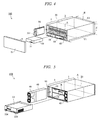
- FIG. 4 is a diagram showing the configuration seen from the side of the opening of the front surface (A) of the basic chassis 100
- FIG. 5 is a diagram seen from the side of the opening of the rear surface (B) of the basic chassis 100.
- the basic chassis 100 has openings in the front surface (A) and the rear surface (B) thereof, and the chassis is divided into a front part 1 (front side space) and a rear part 2 (rear side space) by the backboard 20 attached to the position at the midpoint in the chassis as a boundary.
- a plurality of HDD modules 30 can be installed to the upper side area thereof. Further, two battery modules 50 and the panel 60 can be installed to the lower side area thereof.
- a bezel (door) 91 having an air permeability can be attached to the front surface (A) in a state where each module is installed.
- the rear surface (B) of the rear part 2 of the basic chassis 100 has the configuration to which two CTL modules 10 and two power source modules 40 can be installed.
- the two power source modules 40 are installed in the left and right side areas of the rear surface (B) of the rear part 2, and the two CTL modules 10 are installed in the areas sandwiched between these power source modules.
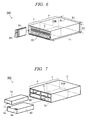
- FIG. 6 shows a configuration of the expanded chassis 200 seen from the side of the opening of the front surface (C)
- FIG. 7 shows a configuration of the expanded chassis 200 seen from the side of the opening of the rear surface (D).
- the expanded chassis 200 has the openings in the front surface (C) and the rear surface. (D) thereof, and the chassis is divided into a front part 3 (front side space) and a rear part 4 (rear side space) by the backboard 20B attached to the position at the midpoint in the chassis as a boundary.
- the plurality (15 sets) of HDD modules 30 can be installed in a state aligned in a lateral direction.
- the rear surface (D) of the rear part 4 of the expanded chassis 200 has the configuration to which two ENC modules 70 and two power source modules 80 can be installed.
- the duplex ENC modules 70 are disposed side by side in an upper central area of the rear surface (D) of the rear part 4, and the duplex power source models 80 are disposed side by side in an area below them.
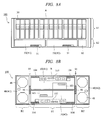
- FIG. 8A shows a configuration of the front surface (A) of the basic chassis 100.
- a plurality (up to 15 sets in the present embodiment) of HDD modules 30 in an upright position are installed in a relatively wider upper area (A1) in a state aligned in a lateral direction.
- Two battery modules (#1 and #2) 50 in a horizontal position are installed side by side in a relatively narrower lower area (A2), and the panel 60 is installed adjacent to the battery module, that is, in the lower right corner area of the front surface (A).
- the panel 60 is a unit to display basic operations and states such as ON and OFF of the disk array system.
- the boundary between the upper area (A1) and the lower area (A2) is provided with a partition plate.
- the operation lever 51 is provided at one position of the lower side of the battery module 50.
- FIG. 8B shows a configuration of the rear surface (B) of the basic chassis 100.
- the power source modules (#1 and #2) 40 in an upright position are installed in the areas (B2) close to the left and right sides of the rear surface (B).
- Two CTL modules (#1 and #2) 10 in a horizontal position are installed up and down in the intermediate area (B1) sandwiched between the power source modules.
- the same two CTL modules 10 are installed upside down relative to each other.
- the same two power source modules 40 laterally reversed to each other are installed.
- the partition plate 95 is provided at the boundary between the side surface of the power source module 40 and the side surface of the CTL module 10.
- a partition plate is provided at the boundary between the upper and lower two CTL modules 10.
- a surface of a host I/F unit 103 corresponding to the host I/F 14 and an area 107 of various types of terminals are provided in a part of the front surface (106) of the CTL module 10.
- Two operation levers 104 are provided at the left and right corners on one side of the front surface (106) of the CTL module 10, and the insertion/removal and the fixation of the CTL module 10 by the two operation levers 104 can be performed.
- Exhaust holes 48 and the like corresponding to the positions of the exhaust ports of fans 43 are provided in the front surface of the power source module 40.
- One operation lever 46 is provided close to the center of one side surface of the power source module 40.
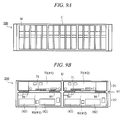
- FIG. 9A shows a configuration of the front surface (C) of the expanded chassis 200.
- a plurality (up to 15 sets) of HDD modules 30 are installed into the entire area of the front part 3 in a state aligned in a lateral direction.
- FIG. 9B shows a configuration of the rear surface (D) of the expanded chassis 200.
- two ENC modules 70 in a horizontal position are installed side by side in an upper central area (D1) of the rear surface (D).
- Two power source modules 80 in a horizontal position are installed side by side in the lower area (D2).
- the two ENC modules 70 and the two power source modules 80 are oriented in the same direction.
- the partition plate 97 is provided at the boundary between the upper ENC module 70 and the lower power source module 80.
- a partition plate is provided between the left and right modules.
- One operation lever 71 is provided at the middle of a lower side of the front surface of the ENC module 70.
- the ventilation holes and the like corresponding to the positions of the exhaust ports of fans (82) are provided in the front surface of the power source module 80.
- Two operation levers 86 are provided at the upper left and right sides of the power source module 80.
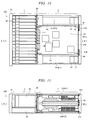
- FIG. 10 shows a schematic horizontal planar configuration (corresponding to the section of one CTL module 10 seen from above) of the basic chassis 100.
- the front part 1 has the HDD modules 30, and the rear part 2 has the CTL module 10 and the two left and right power source modules 40.
- Two fans 43 as a fan unit 42 are provided in a row in a back-and-forth direction on the rear side of the power source module 40.
- a lever main body (9) of the operation lever 104 is disposed on the front surface 106 side of the CTL module 10.
- a part (screw fixing portion 8 and hook portion 7) of the operation lever 104 is disposed in a recessed portion (notched portion) at the corner of the front surface 106 of the CTL module 10, and a receiving portion (157) thereof is provided at a corresponding position of the partition plate 95.
- the lever main body (9) of the operation lever 46 of the power source module 40 is disposed on the side of the chassis rear surface (B) of the partition plate 95 between the CTL module 10 and the power source module 40, and the corresponding receiving portion (156) is provided.
- FIG. 11 shows a schematic vertical planar configuration (corresponding to the section of the CTL module 10 seen from the side thereof) of the basic chassis 100.
- the HDD module 30 is installed on the upper side
- the battery module 50 is installed on the lower side.
- two CTL modules 10 are installed up and down.
- the lever main body (9) of the operation lever 104 of the CTL module 10 is disposed near the upper and lower sides of the chassis rear surface (B).
- the lever main body (9) of the operation lever 46 of the power source module 40 (not shown) is disposed near the center in the vertical direction of the chassis rear surface (B) .
- FIG. 12 shows the surface (front surface) of the backboard 20 in the basic chassis 100.
- the backboard 20 is a circuit board with a roughly flat planar shape and is fixed to a frame part positioned at the middle and slightly close to the front side of the basic chassis 100.
- the backboard 20 electrically connects each of the modules through connectors and physically supports them.
- the fixation of the module mentioned here corresponds to the state in which the connector of the rear surface of the module and the corresponding connector of the backboard 20 are engaged and electrically connected.
- a group of connectors (203, 205, and 206) for connecting the HDD module 30, the battery module 50, the panel 60, and the like are provided on the front surface of the backboard 20.
- a group of connectors (201 and 204) for connecting the CTL module 10, the power source module 40, and the like are provided on the rear surface of the backboard 20.
- wiring patterns for the mutual connection between the connectors and openings (ventilation holes) 220 through which the cooling air is supplied from the front part 1 to the rear part 2 are provided in the backboard 20.
- a plurality of connectors (HDD connectors) 203 for the connection of the HDD modules 30 with a longitudinal rectangular shape are disposed on a zone extending in a lateral direction near the center (center zone) of the backboard 20. Further, connectors (battery connectors) 205 for the connection of the battery modules 50 with a horizontal rectangular shape are disposed below the HDD connectors 203. Also, a connector (panel connector) 206 for the connection of the panel 60 is disposed near the lower right corner of the backboard 20.
- connectors (CTL connectors) 201 to be connected to the CTL modules 10 are disposed near the center of the upper and lower sides on the rear surface side of the backboard 20, while interposing the area of the HDD connector 203 therebetween. That is, on the upper side, the CTL connector 201 for the connection of the module (10) of a first CTL (#1) with a lateral rectangular shape is disposed. On the lower side, the CTL connector 201 for the connection of the module (10) of a second CTL (#2) is similarly disposed. Further, connectors (power source connectors) 204 for the connection of each power source module 40 with a longitudinal rectangular shape are disposed near the center of the left and right sides of the backboard 20.
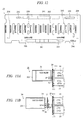
- FIG. 13A and FIG. 13B show the HDD module 30 (also referred to as canister module).
- the HDD 31 is stored in the HDD module 30, and a connector 32 to be connected to the connector 203 on the backboard 20 is provided on the rear surface of the HDD module 30.
- a handle 301 is provided on the front surface of the HDD module 30, and the operation of insertion/removal and fixation of the HDD module 30 can be performed by this handle.
- the HDD module 30 has a uniform external appearance by the design of the handle 301 and the like.
- the HDD 31 of the HDD module 30 installable in the present embodiment is either the Serial Attached SCSI HDD (SAS-HDD) 31 shown in FIG. 13A or the Serial ATA (SATA) interface HDD (SATA-HDD) 35 shown in FIG. 13B .
- FIG. 13A in consideration of the position of the connector 32 of the SAS-HDD 31 and the installing position of the HDD module 30, the connector position of each of other modules, the module installing position, and shape are designed. Between the duplex CTL 110 (disk I/F 16) and the SAS-HDD 31, the data input/output processing is performed by the "two-port and two-path (2P)" according to the SAS interface.
- the SAS-HDD 31 side has two ports (2P).
- a path control board (I/F conversion board) 37 is interposed and connected between the connector 36 of the SATA-HDD 35 and the connector (203) of the backboard 20 so as to match with the position of the connector 32 of the SAS-HDD 31. More specifically, the connector 32 of the SAS-HDD 31 and the corresponding connector of the path control board 37 are connected, and the connector 38 of the path control board 37 and the corresponding connector (203) of the backboard 20 are connected.
- the SATA-HDD 35 has one port (1P). In the case of the connection of the SATA-HDD 35, the I/F conversion is performed by the SATA and the SAS by the control board 37 having the two ports.
- the power source module 40 has an integrated module configuration including the power source unit 41 and the fan unit 42, thereby reducing the size of the chassis.
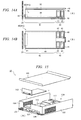
- FIG. 14A shows a state in which one power source module 40 is installed between the outer wall 99 of the basic chassis 100 and the partition plate 95 in a horizontal plane.
- FIG. 14B schematically shows the state in a vertical plane (side surface).
- the power source unit 41 comprises a substrate 44, and a connector 45 to be connected with the corresponding connector 204 of the backboard 20 is provided on the rear surface side of the power source module 40.
- the operation lever 46 is disposed on the side of the chassis rear surface (B) of the partition plate 95 and receiving portions (156, 157) corresponding thereto are provided in the partition plate.
- the operation lever 46 is disposed outside the external shape (box-like shape) of the power source module 40 (formed as a projected portion).
- the fan unit 42 has a redundant configuration to cool the inside of the basic chassis 100 by the operation of a plurality of fans (air blowers) 43.
- the fan unit 42 is similarly provided with two fans 43 each in the upper and lower areas corresponding to the upper and lower two CTL modules 10, and further, it is provided with two (duplex) fans 43 aligned in a back-and-forth direction (in tandem).
- total of four fans 43 are provided in one power source module 40.
- the fan 43 for example, a fan such as an axial-flow fan is used.
- each fan 43 takes air from an air-intake port facing the front surface (A) of the chassis and exhausts the air from the exhaust port facing the rear surface (B) of the chassis.
- the cooling air is taken in from the air intake port, and then exhausted to the outside of the basic chassis 100 from the exhaust port in the back and the exhaust hole 48 of the power source module 40.
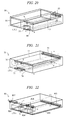
- FIG. 15 shows a structure of the CTL module 10 in a disassembled state. After storing and connecting component parts such as a CTL substrate (control package) 120, a host I/F unit 103, and the like in a main body 101 of the CTL module 10, a top cover 102 serving as the upper surface is attached by screws and the like.
- a CTL substrate control package
- a host I/F unit 103 host I/F unit
- a top cover 102 serving as the upper surface is attached by screws and the like.
- the CTL substrate 120 is attached to the inner bottom surface of the main body 101.
- the CTL substrate 120 generally has a plate-like shape formed of a substrate 113.
- a connector (BB connecting connector) 111 to be connected to the backboard 20 is provided on one side of the CTL substrate 120.
- Components such as an IC are mounted on the substrate 113.
- the main body 101 and the top cover 102 are package mainly formed of sheet metal constitute most of the external shape of the CTL module 10.
- the front surface 106 (the rear surface (B) side of the basic chassis 100) of the may body 101 has a notched area corresponding to the attachment of the host I/F unit 103.
- the host I/F unit 103 includes a substrate, a front panel, terminals and others.
- the connector 111 and the like of the CTL substrate 120 are exposed on the rear surface side of the main body 101.
- various terminals, display elements, and the like are mounted in a part of the area of the front surface 106 of the CTL module 10, particularly in an area 107 near the center of the lower side thereof.
- this area 107 for example, a display LED, LAN terminal, backend system terminal, remote adaptor terminal, UPS terminal and the like are mounted.
- the operation levers 104 in a horizontal position are provided on the left and right sides of this area 107, that is, at the bottom left and right corners of the front surface 106.
- the CTL module 10 is fixed and released to and from the chassis by the operation of rotating a rod-like lever main body (9) on a screw fixing portion 8 (fulcrum point) at the corner of the CTL module 10, that is, by the operation of moving up or down the lever main body (9) on the front surface 106 of the CTL module 10.
- the lever main body (9) is put down so as to be in parallel with the front surface 106.
- modules such as the HDD group, the battery, and the like are installed in the front part, that is, on the front surface side from the backboard.
- three types of modules such the CTL, power source, and fans and duplicated modules thereof, that is, a total of six modules are installed in the rear part, that is, on the rear surface side from the backboard.
- two CTL modules are adjacently disposed up and down in the upper area
- two power source modules are adjacently disposed side by side in the lower area.
- the HDD is, for example, a HDD of a fiber channel I/F.
- the modules of the HDD group are installed in the front part, that is, on the front surface side from the backboard.
- Two types of modules of the ENC and the power source and duplicated modules thereof, that is, a total of four modules are installed in the rear part, that is, on the rear surface side from the backboard.
- two ENC modules are adjacently disposed side by side in the upper area
- two power source modules are adjacently disposed side by side in the lower area.
- the operating structures of these modules are different in each module (for example, CTL module, power source module) due to a difference in the mounting structure of the system chassis and modules.
- some modules are connected directly, some modules are mounted by fixing its lever with screws using a screw driver, and some modules are mounted with a locking bar.
- the outline of the design for the basic structure of the basic chassis 100 and the layout of each module in the chassis will be shown in the following (1) to (4).
- the shape, size, layout, and the like of the module are designed considering the prevention of the interference between the connectors in the backboard 20 and the cooling structure in the chassis and the size reduction thereof (size standard and the like).
- the design is made so that the positions of the connectors to connect each module do not overlap one upon another and they are not located too close in the front and rear surfaces of the backboard 20.
- the configuration of the operation lever 5 will be described based on the configuration of the disk array system 500 described above.
- the design of the common operation lever 5 in this disk array system 500 is outlined as follows.
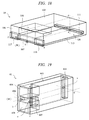
- FIG. 16 shows the basic structure of the operation lever 5.
- the operation lever 5 is a latch-type lever having a mechanism using the principle of leverage and constituted of a lever main body 9, a screw fixing portion (rotary shaft portion) 8, a latch portion (fixed latch portion) 6, a hook portion 7, and others.
- One or more operation levers 5 are attached at each predetermined position of a module in consideration of a force (operation force) necessary for the operation of the module.
- the lever main body 9 can be moved down or up with respect to the module surface by the rotary shaft portion 8.
- the latch portion 6 is fixed to the structure of the receiving portion on the chassis side or the module side by the latch action when the module is fixed.
- the hook portion 7 is fixed to the structure of the receiving portion on the chassis side when the module is fixed.
- the basis of the design of the arrangement (mounting position) of the operation lever 5 with respect to the module will be described below with reference to FIG. 17 .
- the basic concept for determining a preferred arrangement of the operation lever 5 in the module will be described.
- the arrangement position of the operation lever 5 to the module is determined based on a balance of the connector connection force between the module and the backboards 20 and 20B. More specifically, in the operation for insertion/removal and fixation of the module by the operation lever 5, it is required that the lever can bear a sufficient force.
- FIG. 17 shows an example of the position of the connector 191 to be connected to the backboard 20/20B in an object module 190 substantially rectangular in its external shape (lower side of the rear surface of the module 190), and it also shows an example of the positions (points b, c, e, f, etc.) at which the operation lever 5 is to be disposed and the operation lever arrangement area (areas 192 to 195).
- the respective areas 192 to 195 indicate a range in which the object areas for arrangement and installation of the operation lever 5 can be contained.
- the detailed mounting position in the areas 192 to 195 is determined considering the mounting structure nearby.
- the mounting position is determined as follows. Basically, it is determined considering the operation force based on the connector coupling force with the backboards 20 and 20B. Arrows indicate the direction in which an operation force works when the module 190 is inserted or removed. As an ideal position, the lever is disposed at a symmetrical position with respect to the center position of the connector 191 (for example, in case where the connector 191 is located on the lower side of the rear surface) to be connected to the backboards 20 and 20B of the rear surface of the object module 190.
- the ideal position is the point b defined by an extension line (a-b) from a center position (point a) of the connector 191 on the rear surface to its corresponding position (point b) on the front surface 199 of the module 190 on an opposite side. It is ideal to dispose the hook portion 7 (point of action) of the operation lever 5 at this position (point b).
- the structure is preferable.
- the area in which the operation lever 5 is to be disposed is required not to interfere with an area of any mounting components of the module 190 and the chassis corresponding to the module 190.
- the structure in which the operation lever is arranged at the ideal position (point b, area 192) is difficult in some cases because of detailed requirement of the installation. For example, when an area in which a necessary component is mounted is present near the point b and the mounting space of the operation lever 5 cannot be secured, it is difficult to use the structure described above. In such a case, the operation lever is disposed at a position shifted from the ideal position to its surrounding.
- the operation levers 5 are disposed at symmetrical positions (area 193 of the point e, area 194 of the point f) on the right and left sides of the ideal position (point b) on the front surface 199 of the module 190, and a single operating function is borne by the two operation levers 5.
- two or more operation levers 5 are disposed at symmetrical positions such as the right and left positions as described above. Note that it is inappropriate to arrange or mount only one of these two operation levers 5 in view of the balance of force.
- a next preferable position to the ideal position (point b) is not limited to the right and left positions but may be at a position on an extension line (b-c) extending in a vertical direction from the point b on the front surface 199, in particular, it may be an area 195 of the point c. In other words, it may be a position (point c) existing on a section including the center position (point a) of the connector 191 in the direction of the side surface of the module (a-b-c-d) and farther from the center point (point a) of the connector 191 on the rear surface than the ideal position (point b).
- the detailed arrangement and mounting structure of the operation levers 5 are determined considering the detailed structure of the module 190 and the structure of the chassis adjacent to the module. For example, the direction of the operation lever 5 (vertical and horizontal arrangement, arrangement on the front surface of the module or arrangement on the side surface of the module) is determined. Further, for example, the operation lever is disposed and mounted in a recessed portion (internal part) or on a projected portion (external part) of an area of the module 190. Also, the internal arrangement in the case where the notched portion (recessed portion) exists in the area of the module 190 or the external arrangement in the case where such notched portion does not exist can be selected.
- the chassis has the receiving portion (156, 157) which is a structure to receive a part (latch portion 6 or hook portion 7) of the operation lever 5.
- a structure for example, there are structures of the recessed portion (internal part) and projected portion (external part).
- the structure of the receiving portion (156) of the latch portion 6 for example, provision of a hole in the outside wall of the module or attachment of a recessed component is available.
- the structure of the recessed portion (internal part) of the receiving portion (157) of the hook portion 7 for example, provision of a hole in the plate metal (outside wall or partition plate) of the chassis or attachment of a recessed component is available.
- the projected portion (external part) attachment of a separate component (external attachment metal with screws) to the chassis or formation thereof directly to the chassis (plate metal) is available.
- the operation force of the operation lever 5 will be described with reference to FIG. 16 .
- An operation force necessary for the operation lever 5 is estimated and calculated for each module based on the arrangement position, number, and coupling force between the connectors (connector coupling force) in the module.
- the connector coupling force can be calculated from the capacity of power source, the number of signal lines and others.
- the operation force differs depending on each module in accordance with the differences in plural types of the modules.
- the operation force is largest in the CTL module 10 and becomes smaller in the order of the power source module 80 of the expanded chassis 200, the ENC module 70, the power source module 40 of the basic chassis 100, and the battery module 50.
- the condition for forming a plurality of operation levers in plural types of the modules is that one operation lever (one of two operation levers) of the CTL module 10 covers the operation force of one operation lever in other modules (the former is greater than the latter).
- the operation lever can be used in common as a plurality of operation levers in the plural types of modules based on the operation lever 104 of the CTL module 10.
- a lever ratio is calculated from the operation force of the operation lever 5 and the connector coupling force (load on the operation lever 5) and necessary external dimensions of the operation lever 5 (length of the lever main body 9 and others) are measured, thereby determining the specifications.
- A denotes a length from a fulcrum point (rotary shaft portion 8) to the tip (power point) of the lever main body 9.
- B denotes a length from the fulcrum point (rotary shaft portion 8) to the tip (action point) of the hook portion 7.
- W 1 denotes a force applied to the tip (power point) of the lever main body 9.
- W 2 denotes a force applied to the tip (action point) of the hook portion 7.
- the lever ratio is a ratio of length between A and B for obtaining a necessary operation force around the fulcrum point (rotary shaft portion 8).
- W 1 : W 2 is equal to A : B. If A is increased relative to B, the necessary operation force is decreased due to the principle of leverage.
- the stroke (ST) is a predetermined movable length which can be obtained when the operation lever 5 is rotated around the fulcrum point (rotary shaft portion 8) of the operation lever 5 in the insertion or removal of the module. ST is, for example, 14 mm.
- the coupling force mentioned here refers to the maximum coupling force necessary for the insertion or removal of the module.
- the coupling force is 250N for the CTL module 10, 110N for the power source module 40, 35N for the battery module 50.
- the coupling force is 125N for the ENC module 70 and 110N for the power source module 80.
- the CTL module 10 of the basic chassis 100 has the largest coupling force in all the modules.
- the common operation lever 5 is designed (calculated) based on the CTL module 10.
- the design of the operation lever 5 is made in the following manner.
- the maximum connector coupling force is 250[N].
- the specification of the lever operation force is 39.2[N] ( ⁇ 4[kgf] or less: design target value). Since the necessary operation force cannot be obtained with one operation lever 5 for the CTL module 10, the design is made so as to provide two operation levers 5.
- the modules (40, 50, 70, 80) other than the CTL module 10 can be operated with a load (125N) corresponding to that of a single operation lever 5.
- load applied to one operation lever ⁇
- specification of operation force of the operation lever 125 ⁇ 39.2 ⁇ 3.2.
- the specification of the lever ratio (A : B) is set to 3.2.
- FIG. 18 shows the case where the module is installed on the lower side of the rear surface (B) of the rear part 2 (#2).
- the substrate 113 of the CTL substrate 120 is disposed on the lower surface in the CTL module 10, and the connector (BB connecting connector) 111 of the CTL substrate 120 is disposed on the lower side of the rear surface.
- the ideal position for the arrangement of the operation lever 104 is a position (point b) near the center of the front surface 106 on the center line (a-b) of the connector 111 on the rear surface.
- the area near this point b is inappropriate for the arrangement of the operation lever 104 due to interference in view of the mounting specification of the CTL module 10 because this area is to be an area 107 where a terminal or the like is mounted. Therefore, as a position second best to this point b, the position on a line (e-f) in the right and left direction or that on a line (b-c) in the vertical direction is considered.
- the two operation levers 104 are disposed on the line (e-f) in the right and left direction, in particular, symmetrically in an area 116 near the right bottom corner (point e) and in an area 117 near the left bottom corner (point f).
- FIG. 19 shows the case where the module is installed in the left side area of the rear surface (B) in the rear part 2 (#1).
- a substrate 403 of the power source unit 41 is disposed on the side surface of the chassis (outside wall 99) in the power source module 40, and a corresponding connector 401 is provided on the rear surface.
- an area 404 in which the fans 43 of the fan unit 42 are mounted up and down is provided near the front surface at the back of the power source unit 41.
- the preferred position for the arrangement of the operation lever 46 is as follows.
- the ideal position for the operation lever is on an extension line (a-b) from the center point a of the connector 401 toward the front surface side, in particular, near the point b on the front surface.
- arrangement of the operation lever 46 on this extension line (a-b) is inappropriate due to interference in view of the mounting specification of the power source module 40 because the substrate 403 of the power source unit 41 and the fan 43 exist on the extension line (a-b) and an inlet or LED is mounted in the area 406 near the point b and near the center of the front surface (between the exhaust holes 48).
- an area near a point c on an extension line (b-c) in the direction from the side surface (left side face) of the point b to its opposite side surface (right side surface) can be considered.
- the operation lever 46 is disposed in an upright position on the side surface (right side surface) near the point c so as to correspond to the direction of the connector 401.
- a substrate 53 of the battery module 50 is disposed in a part of the upper surface (right side) of the battery module 50, and a corresponding connector 52 is disposed in a part of the upper side of the rear surface (right side). Further, an area 56 in which the battery is disposed is provided on the left side in the battery module 50.
- the preferred position for the arrangement of the operation lever 51 is as follows.
- a point b on an extension line (a-b) from the center point a of the connector 52 to the front surface is an ideal position.
- the operation lever 51 cannot be disposed thereon in view of the mounting specification of the module. Therefore, as a position second best to the ideal point b, the operation lever 51 is disposed on an extension line (b-c) downwardly extending from the point b to the lower surface, in particular, in an area 55 near the point c.
- a substrate 73 of the ENC 170 is disposed on the upper surface of the ENC module 70, and a corresponding connector 72 is disposed on the upper side of the rear surface.
- a point b on an extension line (a-b) extending from the center point a of the connector 72 to the front surface is an ideal position.
- the operation lever 71 cannot be disposed on this extension line (a-b) in view of the detailed mounting specification of the module because the substrate 73 of the ENC 170 exists on this extension line (a-b). Therefore, as s position second best to the point b of the ideal position, a position on an extension line (b-c) extending downwardly from the point b to the lower surface can be considered.
- An area 76 on the upper side of the front surface including the line (b-c) is inappropriate for the arrangement of the operation lever 71 due to interference because a path input/output connector or LED is mounted in this area. Accordingly, the operation lever 71 is disposed in an area 75 near the point c.
- a substrate 803 of the power source unit 81 is provided on the lower surface in the power source module 80, and a corresponding connector 801 is provided on the lower side of the rear surface. Further, areas 804 in which the fans 83 are to be mounted side by side are provided in the front surface of the power source module 80.
- the preferred position for the arrangement of the operation lever 86 is as follows. A point b on an extension line (a-b) extending from the center point a of the connector 801 to the front surface is an ideal position. However, the operation lever 86 cannot be disposed on this extension line (a-b) in view of the detailed mounting specification of the module because the substrate 803 of the power source unit 81 or an incorporated fan 83 exists on the extension line (a-b). Therefore, as a position second best to the ideal point b, a position on an extension line (b-c) extending upwardly from the point b to the upper surface and an area near the point c can be considered.
- the area on the extension line (b-c) is inappropriate for the arrangement of the operation lever 86 due to interference because an LED or the like is mounted in this area, and the right and left sides of the front surface are also inappropriate because the fan 83 and an inlet are disposed in these areas. Further, the specification (condition) can be satisfied by disposing one operation lever 86 near the point c if the aforementioned necessary operation force is considered. In this example, however, the two operation levers 86 are disposed symmetrically on the right and left of the point c, that is, in an area 806 near a point e at a corner of the front surface and an area 807 near a point f in consideration of the installation of other module (ENC module 70).
- the screw fixing portions 8 of the operation levers 104 are attached in the notched portions at the right and left corners of the front surface 106 of the CTL module 10.
- the lever main body 9 is disposed outside the external shape (box-like shape) of the CTL module 10.
- the lever main body 9 is provided horizontally so that it is opened (stood) from the inside of the module front surface 106 in the direction toward the side surface of the module.
- the receiving portion 156 of the latch portion 6 is provided at a predetermined position corresponding to the length of the lever main body 9 inside the right and left corners of the module front surface 106.
- the receiving portion for the hook portion 7 is provided as a recessed portion in the partition plate 95 adjacent to the side surface of the module.
- the screw fixing portion 8 and the lever main body 9 of the operation lever 46 are disposed in an area outside thereof.
- the receiving portion 156 of the latch portion 6 and the receiving portion 157 of the hook portion 7 are provided as recessed portions in the partition plate 95 adjacent to its side surface (right side surface).
- the two operation levers 5 can be disposed near the corners (points e and f) in consideration of a margin for the force on the premise that they do not interfere with any adjacent module.
- the lower surface of the module 50 corresponds to the outside wall (lower surface) of the basic chassis 100 in an area near the point c on the lower side of the front surface in FIG. 20 , and no operation lever 51 is disposed on this side.
- the screw fixing portion 8 of the operation lever 51 and the receiving portion are disposed on the internal side of the external shape (box-like shape) of the battery module 50.
- the external shape of the battery module 50 has a notched portion (recessed portion) 54 in its lower surface side.
- the notched portion 54 is provided so that it penetrates from the front surface to the rear surface in the area near the line (c-d) of the lower surface corresponding to the point c in consideration of the operation for insertion or removal of the battery module 50.
- the screw fixing portion 8 of the operation lever 51 is attached to an end portion of the notched portion 54, and correspondingly, the receiving portion 156 of the latch portion 6 is provided at a predetermined position inside the battery module 50. Further, the receiving portion 157 of the hook portion 7 is provided as a projected portion on the outside wall side of the basic chassis 100 in the space of the notched portion 54.
- the lower surface of the module 70 corresponds to the partition plate 97 of the expanded chassis 200 in an area near the point c on the lower side of the front surface in FIG. 21 , and no operation lever 71 is disposed on this side (operation lever 86 of power source module 80 is provided).
- the screw fixing portion 8 of the operation lever 51 and the receiving portion are disposed on the internal side of the external shape (box-like shape) of the ENC module 70.
- the external shape of the ENC module 70 has a notched portion (recessed portion) 74 in its lower surface side.
- the notched portion 74 is provided so that it penetrates from the front surface to the rear surface in the area near the center line (c-d) of the lower surface in consideration of the operation for insertion or removal of the ENC module 70.
- the screw fixing portion 8 of the operation lever 71 is attached to an end portion of the notched portion 74, and correspondingly, the receiving portion 156 of the latch portion 6 is provided at a predetermined position inside the ENC module 70. Further, the receiving portion 157 of the hook portion 7 is provided as a projected portion on the side of the partition plate 97 of the expanded chassis 200 in the space of the notched portion 74.
- the screw fixing portion 8 and the lever main body 9 are disposed in an area outside the power source module 80, that is, on the side of the partition plate 97 of the expanded chassis 200 instead of inside the external shape of the power source module 80.
- the receiving portion 156 of the latch portion 6 and the receiving portion 157 of the hook portion 7 are provided as recessed portions on the side of the partition plate 97.
- the operation lever 5 is disposed not on the same plane as the connector but diagonally. Further, in the power source module 40 and the ENC module 70, the operation lever 5 is disposed at a central position of a side of the front surface because it can be disposed in such a manner. Further, the case of the internal mounting structure (using the recessed portion) to the external shape of the module is effective when no component interfering with the module exists at an arrangement object position of the operation lever 5, and accordingly, the module is reduced in size.
- the case of the external mounting structure (using the projected portion) to the external shape of the module is effective when no interfering component (structure) of the chassis exists at an arrangement object position of the operation lever 5, and therefore, the module can have a box-like external shape.
- the detail of these mounting structures can be appropriately selected considering the relationship among plural modules.
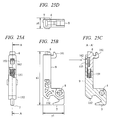
- FIG. 25A to FIG. 25D show the detailed structure (first structure example) of the operation lever 5.
- FIG. 25A shows a structure thereof seen from the front side
- FIG. 25B shows the appearance of the side surface
- FIG. 25C shows a sectional structure (section along the line A-A of FIG. 25A ) thereof seen from the side
- FIG. 25D shows a tip side of the operation lever 5, indicating the latch portion 6 seen from above.
- the operation lever 5 has the latch portion 6 which is a movable portion at one end, that is, at a tip of the lever main body 9 having a predetermined length from the rotary shaft portion 8 and has the hook portion 7 at a position near the rotary shaft portion 8 at the other end thereof.
- the lever main body 9 and the latch portion 6 are made of, for example, plastic.
- the tip (a portion to be pressed by a user) of the latch portion 6 projects from an end of the lever main body 9 as also shown in FIG. 25D .
- a hole portion 153 is provided near the tip of the lever main body 9 so as to correspond to the arrangement of the latch portion 6.
- a part of the latch portion 6 in the lever main body 9, in particular, a fastening portion 162 of the latch portion 6 is seen in the hole portion 153.
- the hook portion 7 is seen at the other end of the lever main body 9.
- the operation lever 5 incorporates a spring portion 151 made of metal between the lever main body 9 and the latch portion 6 for the latch action of the latch portion 6.
- the lever main body 9 incorporates the spring portion 151 in contact with the latch portion 6. Further, the latch portion 6 is incorporated in a state in contact with the spring portion 151.
- the lever main body 9 (elongated rod-like portion) is formed as an integrated component with the screw fixing portion 8 and the hook portion 7.
- the tip of the latch portion 6 and a claw portion 161 are projected from an end portion of the lever main body 9.
- a slip stopper and a predetermined shape are designed on the surface of the lever main body 9.
- a contact portion 152 to the chassis is provided on the other end of the lever main body 9.
- the screw fixing portion 8 is connected integrally, and further, the hook portion 7 is connected integrally.
- the screw fixing portion 8 is fixed to the module side with screw and functions as a fulcrum (rotary shaft).
- the hook portion 7 is located on an opposite side to the contact portion 152 with respect to the position of the screw fixing portion 8.
- the main body of the latch portion 6 is incorporated so as to be concealed behind the rear side of the front surface of the lever main body 9.
- its projecting portion is inserted partly into the spring portion 151.
- the fastening portion 162 of the latch portion 6 is fastened by being hooked to the wall of the hole portion 153 in the lever main body 9, and the position (initial position in normal state) of the latch portion 6 is thus determined.
- the spring portion 151 is flexed when the latch portion 6 is pressed in the internal direction of the lever main body 9, and the latch portion 6 can be moved by a predetermined length.
- the lever main body 9 (screw fixing portion 8 and hook portion 7) is colored in a color different from that of the module main body, for example, black, and further, the latch portion 6 is colored in another different color, for example, blue.
- the components can be distinguished visibly in association with the contents of the operation (rotating action of the lever main body 9 and pressing action of the latch portion 6).
- the same coloring method is employed for all the operation levers 5 so that the portions which the user touches are colored in the same uniform colors. In this manner, visibility of the components is improved, thereby improving the operability.
- the length (x1) thereof in the direction of the lever main body 9 is 55.7 mm
- the length (y1) in the depth direction including the screw fixing portion 8 is 21.5 mm
- the width (z1) is 11 mm.
- the operation lever 5 does not employ any screw parts by providing the latch portion 6. Accordingly, handling of the screw parts and any special tool relating to the operation of the module is eliminated to reduce labor and time. Further, confusion with screw parts used in the module itself is prevented, thereby improving the operability.
- the operation lever 5 has a structure which can be disassembled to respective components (lever main body 9, latch portion 6, spring portion 151 and the like) easily without using any special tool.
- the user presses the fastening portion 162 of the latch portion through the hole portion 153 in the front surface of the lever main body 9 of the operation lever 5.
- the hook of the fastening portion 162 to the lever main body 9 is released and the latch portion 6 is detached, and also the spring portion 151 therein is taken out.
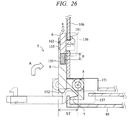
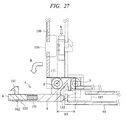
- FIG. 26 and FIG. 27 show an attachment structure and operation state of the operation lever 5 to the chassis and the module.
- the description will be made using the CTL module 10 and the operation lever 104 as examples.
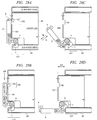
- FIG. 26 shows a module fixing state (corresponding to FIG. 28A ) and
- FIG. 27 shows a module releasing state (corresponding to FIG. 28D ).
- the module is moved by a predetermined stroke (ST) between the states shown in FIG. 26 and FIG. 27 .
- the latch portion 6 is fixed to the receiving portion 156 which is a part of the module (front surface 106) by an action A of moving down the lever main body 9 of the operation lever 5 and an action a of pressing the latch portion 6.
- the spring portion 151 is flexed and the latch portion 6 is moved by a predetermined length (p), and the claw portion 161 gets into the interior of the receiving portion 156. Consequently, the claw portion 161 is hooked and fixed to the wall of the receiving portion 156 by an elastic force of the spring portion 151.
- the screw fixing portion 8 is attached to a part of the area of the module, that is, a notched (recessed portion) area 171 at the corner of the CTL module 10 (partial internal arrangement/mounting structure).
- the tip of the hook portion 7 gets into a part of the area on the chassis side, that is, the interior of the receiving portion 157 of the partition plate 95, and is then hooked and fixed to the wall.
- the latch portion 6 is released from the receiving portion 156 which is a part of the module (front surface 106) by an action b of pressing the latch portion 6 of the operation lever 5 and an action B of moving up the lever main body 9 (in other words, action of moving it toward an operator).
- the spring portion 151 is flexed and the latch portion 6 is moved by a predetermined length (p), and the claw portion 161 comes from inside of the receiving portion 156 to outside. Consequently, the latch portion 6 is returned to its initial position by an elastic force of the spring portion 151.
- the tip of the hook portion 7 comes out of the receiving portion 157 of the partition plate 95 on the chassis side and the hooking thereof is released. Further, the contact portion 152 of the lever main body 9 gets contact with the front wall of the partition plate 95 on the chassis side.
- the stroke (ST) for moving of the module is set to a predetermined length (14 mm) in this embodiment, any other lengths can be used.
- each structure example exists as variations of the structure of the latch portion 6, the hook portion 7, the screw fixing portion (rotary shaft portion) 8, and the lever main body 9.
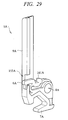
- a latch portion 6A (for example, blue) is attached to an integrated structure (for example, black) including a lever main body 9A, a rotary shaft portion 8A, and a hook portion 7A.
- This structure does not need the spring portion 151.
- the latch portion 6A is not disposed at the front tip side of the lever main body 9A but on the other tip side (contact portion 152 side) near the screw fixing portion 8A (fulcrum point). A part of the latch portion 6A is projected from a hole portion 153A on the fulcrum side of the lever main body 9A.
- a claw portion 161A of the latch portion 6A is disposed between the hole portion 153A and the screw fixing portion 8A.
- the latch portion 6A itself is deformed to displace the claw portion 161A, and the claw portion 161A is hooked and fixed to or released from the receiving portion 156.
- the structures of the receiving portions (156, 157) on the chassis side and module side are the same as those of the first structure example.
- an operation lever 5B as a third structure example will be described with reference to FIG. 30 .
- a latch portion 6B is not disposed on the front tip side of a lever main body 9B but on the other tip side.
- the latch portion 6B has a rotary shaft portion, and a spring portion 151B is attached to the rotary shaft portion.
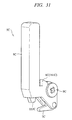
- An operation lever 5C as a fourth structure example will be described with reference to FIG. 31 .
- a lever main body 9C and a latch portion 6C are integrated.
- a screw fixing portion 8C, a hook portion 7C, and a contact portion 152C are integrally formed of plate metal.
- a spring portion 151C is incorporated in the lever main body 9C.
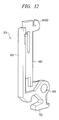
- an operation lever 5D as a fifth structure example will be described with reference to FIG. 32 .
- a latch portion 6D (particularly a claw portion 161D and a portion to be pressed by a user) is disposed on the front tip side of a lever main body 9D.
- the lever main body 9D, a screw fixing portion 8D, and a hook portion 7D are integrated, and a rod-like construction which is the latch portion 6D is attached thereto.
- the latch portion 6 is disposed on the rear side of the front surface of the lever main body 9D.
- an area 154 in which a spring portion (not shown) is incorporated is provided on the other end side of the structure of the latch portion 6 near the other tip of the lever main body 9D.
- the first and fifth structure examples have an advantage that the rotating action of the lever main body 9 and the latching action can be easily associated and the operation thereof is easy to execute because the latch portion 6 (portion to be pressed by a user) is disposed on the front tip side of the lever main body 9. Further, the second to fourth structure examples have an advantage that processing of the receiving portion 156 (hole portion or the like) on the chassis side or module side with respect to the latch portion 6 is not necessary (shared by the receiving portion 157 with respect to the hook portion 7).
- FIG. 33 shows the case where the mechanism is provided in the power source module 40 on the rear surface (B) of the basic chassis 100
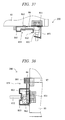
- FIG. 34 to FIG. 38 show the case where the mechanism is provided in the power source module 80 on the rear surface (D) of the expanded chassis 200.
- this safety mechanism is basically similar on the side of the power source module 40 and on the side of the power source module 80 (detailed shapes may be different depending on the module mounting states), and the description will be made based on the example on the side of the power source module 80.
- a protection and prevention mechanism for erroneous operations including operating structures related to the operation of the power source cable and others (for example, lever lock members 454 and 854) and associated with the operation of the operation lever 5 (46 and 86) (that is, insertion and removal of modules) is provided in the power source module (40 and 80).
- this safety mechanism the insertion and removal of the modules by the operation lever 5 (46 and 86) in a state where the power source cable (452 and 852) remains inserted in the power source module (40 and 80) become impossible.
- a power source cable connector 451 to which the power source cable 452 is connected (inserted) is provided at a position between the exhaust holes 48 in the module surface. Further, at the position of the connector 451, a retainer 453 for the power source cable 452 is provided. Also, the lever lock member 454 for realizing the safety function is provided at a position between the connector 451 as well as the retainer 453 and the operation lever 46 of the power source module 40.
- a power source cable connector 851 to which the power source cable 852 is connected (inserted) is provided at a position adjacent to the exhaust hole of the fan (82) and at the middle of the right side of the module surface. Further, at the position of the connector 851, a retainer 853 for the power source cable 852 is provided. Also, the lever lock member 854 for realizing the safety function is provided at a position between the connector 851 as well as the retainer 853 and the operation lever 86 of the power source module 80.
- LEDs (light emitting diode) 470 and 870 showing a state of the power source for example, ready (green) state and alarm (red) state
- a state of the power source for example, ready (green) state and alarm (red) state
- the power source switch for switching ON and OFF the power source
- ON and OFF states of the power source are determined by the insertion and removal states of the power source cable (452 and 852) to and from the power source module (40 and 80) and the insertion state of the power source module. More specifically, in a state where the power source module (40 and 80) is inserted and the power source cable (452 and 852) is inserted, the power source is in an ON state. On the other hand, in a state where the power source module (40 and 80) is removed or the power source cable (452 and 852) is removed, the power source is in an OFF state. Note that ON and OFF of the disk array system can be controlled by a switch of the panel 60.
- a mechanism formed from wires or the like for preventing the accidental removal of the power source cable (452 and 852), that is, a retainer (453 and 853) is provided.
- a retainer formed from wires or the like
- the lever lock member (454 and 854) that is the characteristic of this embodiment is a component for preventing the removal of the power source module (40 and 80) in a state where the power source cable (452 and 852) remains inserted.
- the operation lever (46 and 86) is fixed, and thus the removal of the power source module (40 and 80) itself is impossible in principle.
- this disk array system has the configuration formed in consideration of that an end user conducts the operations related to each of the modules including the power source module (40 and 80) (user maintenance support), the power source detachment mechanism is simplified. More specifically, the mechanism in which the power source module (40 and 80) is inserted and removed using the operation lever (46 and 86) by an end user is provided as described above.
- the safety mechanism composed of the lever lock member (454 and 854) is provided in addition to the operation lever 5 and the retainer (453 and 853).
- the operation lever (46 and 86) of the power source module (40 and 80) is automatically put into an inoperable fixed state (state where the latch cannot be released). Therefore, the above-mentioned erroneous operation by the user can be prevented. Since the series of operations are simple and consecutive and do not require any particular intention for an end user, and the above-mentioned effect can be automatically achieved without adding troublesome procedures and difficult operations. More detailed description will be made below.
- a metal body in an approximate L-shape in accordance with the arrangement between the operation lever 86 and the connector 851 has a first end portion 861 (lever side fixing portion), a second end portion 862 (power source cable side fixing portion), a rotary shaft portion 863 and an exhaust hole portion 864.
- the first end portion 861 is a portion for fixing the operation lever 86, and it has a cover portion in the form of an L-shaped claw in accordance with the shape of the operation lever 86 as shown in FIG. 38 .
- the second end portion 862 is a portion abutting to the connector 851 and the power source cable 852, and it has a surface portion to which the power source cable 852 is pressed.
- the rotary shaft portion 863 is a portion fixed to the surface of the power source module 80 by screwing and others.
- the exhaust hole portion 864 is provided so as not to interfere with the exhaustion when the lever lock member 854 is placed over the exhaust hole of the fan (82).
- FIG. 34 shows the state A, in which the power source cable 852 is not inserted into the connector 851 (retainer 853 is laid), the operation lever 86 is not fixed by the lever lock member 854, and the power source module 80 can be inserted or removed.
- FIG. 36 shows the state B, in which the power source cable 852 is inserted into the connector 851 (fixed by the retainer 853), the operation lever 86 is fixed by the lever lock member 854, and the power source module 80 cannot be inserted or removed.
- this system is offered to an end user in the state A. Then, the end user conducts the operation of inserting the power source cable 852 to bring the power source into an ON state, thereby achieving the state B.
- the power source cable 852 is removed and then the power source module 80 is removed by the operation of the operation lever 86.
- the power source cable 852 is inserted into the connector 851 and fixed by the retainer 853, and the operation lever 86 is fixed (locked) by the lever lock member 854.
- the retainer 853 is moved down and the power source cable 852 is removed from the connector 851 by an end user.
- the lever lock member 854 automatically rotates around the rotary shaft portion and is in an inclined state, and the cover by the first end portion 861 over the operation lever 86 is taken off (state A).
- the operation of pushing the latch portion 6 of the operation lever 86 to move up the operation lever 86 becomes possible, and the operation of the operation lever 86 is conducted by the end user and the power source module 80 is removed.
- the power source state of the basic chassis 100 will be described below.
- a user can control the ON and OFF operation of the switch provided on the surface of the panel 60.
- the switch When the switch is in an OFF state, the power source of the disk array system is in a Ready state. In the Ready state, power is supplied to a part of the CTL module 10 and the backboard 20.
- the switch When the switch is brought into an ON state by the operation of the user, power is supplied to the whole of the CTL module 10, and the whole of the disk array system is started up.
- the power source state of the expanded chassis 200 will be described below.
- the ON and OFF states of the expanded chassis 200 are switched by the insertion and removal of the power source cable (852). Even when the switch of the panel 60 of the basic chassis 100 is brought into an OFF state, the power supply is maintained unless the power source cable (852) of the expanded chassis 200 is removed.
- the power source system in a state where the power source cable (452 and 852) is inserted in this disk array system will be described below.
- the power source module (40 and 80) is provided with a decision circuit, and no voltage is supplied to the output side (backboard 20, CTL module 10 and others) unless the state where the power source module is normally inserted (connected) into the backboard 20 is achieved.
- the system in which voltage is supplied to the output side even with the single failure (failure in one of duplex (two) modules) is considered undesirable in general.
- the voltage is supplied to the output side even with the signal failure mentioned above. Therefore, in this disk array system, the safety mechanism described above is adopted so that the power source module (40 and 80) cannot be removed from the chassis in the state where the power source cable (452 and 852) remains inserted.
- the safety mechanism of the power source system related to the common operation lever 5 Since the safety mechanism of the power source system related to the common operation lever 5 is provided, the erroneous operation can be prevented and the operability for a user can be improved.
- the present invention can be applied to a disk array system which needs to be provided with a cooling structure for a heat generating portion such as HDD.
Landscapes
- Power Sources (AREA)
- Casings For Electric Apparatus (AREA)
Abstract
Description
- The present invention relates to a disk array system (also referred to as a storage system) having a function to control a storage device such as a HDD (Hard Disk Drive). More particularly, it relates to a structure and method for a handle, a lever and others for use in operations (actions) of a module such as insertion/removal and fixation thereof.
- In a recent disk array system, mounting density has been increased and performance thereof has been improved. Accordingly, higher cooling performance has been demanded in order to cope with the temperature rise due to the increase in heat generation of component parts and resulting performance deterioration.
- For example, in the disk array system of a predetermined method, elements such as boards (circuit boards) corresponding to various functions and power sources are installed in the system chassis by means of the structure and method of a module (also referred to as a unit, package, and assembly) to take the maintainability into consideration. Further, as a structure and method for operations by a maintenance person such as insertion/removal and fixation of the module, the module is provided with a structure (hereinafter, referred to as operating structure) such as a handle and a lever. Conventionally, the structure and method for operation of the module are different depending on the modules (for example, controller module, power source module and the like) because of the difference in the mounting structure of the system chassis and each module. Further, the module is handled mainly by a maintenance person with knowledge.
- The structure and method for operations of the module such as insertion/removal and fixation thereof in the configuration of the chassis and module of a conventional disk array system are insufficient in operability because plural types of the structures and methods are mixed. In particular, this is not suitable for the operations by an end user without sufficient knowledge. Further, as another example of the operating structure, the module is fixed to the chassis with screws using a tool such as a screw driver. In this case, since there is a possibility that the screws which constitute the module itself are not operated appropriately, the operability is insufficient. Further, since outer appearance of each operating structure such as shape and color is different, the operability is insufficient.
- The present invention has been made in view of the above-described problems, and an object of the present invention is to provide a technology for realizing the structure and method for operations such as insertion/removal and fixation of the module that can efficiently improve the operability in consideration of the operation by an end user in the disk array system in which high density mounting and cooling performance are taken into consideration.
- The typical aspects of the invention disclosed in this application will be briefly described as follows. In order to preferably achieve the above-described object, an aspect of the present invention provides a disk array system comprising a group of storage devices (disk array) such as a HDD and a control device thereof (controller or disk controller), wherein elements such as controllers and power sources are installed in the system chassis by means of the structure and method of a module, and in a redundant configuration in which each function is at least duplicated, each module is inserted or removed through the opening in front or at the back of the chassis and connected to the front or rear surface of a backboard inside the chassis, and wherein technological means and configurations as shown below are provided.
- According to another aspect of the present invention, in the disk array system in which high density mounting and cooling performance are taken into consideration, as a structure and method for operations such as insertion/removal and fixation of a module to a chassis, a new operating structure (referred to as operation lever herein) which takes into consideration the operation of an end user is provided on an object module so as to correspond to the structure of the chassis and module. Aspects of the present invention include mainly (1) a structure in which common operation levers are provided to plural types of modules, (2) a structure in which common operation levers designed based on a controller module (necessary operation forces are estimated from a connector coupling force (insertion/removal force)) are provided to other various types of modules, and (3) detailed configuration about the number, location, and mounting method of the operation levers, which differs depending on the detailed structure of each module.
- In the disk array system of an aspect of the present invention, first, the chassis and module thereof have the following configuration in consideration of the high density mounting and cooling performance. In the basic chassis, a storage device module (for example, SAS HDD) and a battery module are installed from the front surface into the front part of a backboard, and duplex (two) controller modules are installed up and down from the rear surface and duplex (two) power source modules each containing a fan unit (plural fans) are installed in the right and left areas thereof in the rear part. Further, in the expanded chassis, an enclosure module is to be installed instead of the controller module, and a storage device module is installed from the front surface into the front part of the backboard, and duplex (two) enclosure modules are installed side by side in an upper area of the rear part from the rear surface and duplex (two) power source modules each containing the fan unit (plural fans) are installed side by side in the lower area. In the basic chassis, HDD connectors are disposed near the center area in the longitudinal direction of the backboard so as to correspond to the positions of the connectors of the SAS HDDs, and connectors of the controller are disposed near the upper and lower sides of the backboard so as not to interfere with the HDD connectors. Further, the two power source modules are disposed in right and left areas of the two controller modules so as to correspond to the positions near the right and left sides of the backboard.
- (1) The modules to which the operation levers are provided may include five types, for example, a controller module, a power source module, and a battery module of the basic chassis and an enclosure module and a power source module of the expanded chassis. A plurality of storage device modules may be excluded from the object for consideration because there occurs no problem in operability if a structure such as its own handle is provided. In this structure, the common operation lever may be a latch-type lever which is constituted of a lever main body (rod-like component), a screw fixing portion (rotary shaft portion), a latch portion (fixed latch portion), and a hook portion and applies the principle of leverage. One or more operation levers may be attached to predetermined positions of one module in consideration of a force necessary for operation of the module (operation force). The lever main body can be moved up and down with respect to a module surface around a rotary shaft portion as a fulcrum point. The latch portion may be hooked and fixed to the structure of a receiving portion on the chassis side or the module side by the latch action when the module is fixed. The hook portion may be hooked and fixed to the structure of a receiving portion on the chassis side when the module is fixed.
- (2) If the structure of the chassis and module is considered in the design of the common operation lever for the above-mentioned modules, the operation force necessary for the operations of insertion/removal and fixation of the module may be estimated from a connector coupling force for the connection to the backboard, and for example, the operation force is largest in the controller module of the basic chassis. Accordingly, the structure of the operation lever to be provided to the controller module may be determined based on the controller module. Then, that operation lever may be applied to other modules in common, that is, all the object modules are provided with the common operation levers. As a condition for the common use of the operation lever, an operation lever (one of two operation levers) of the controller module may cover the operation force of an operation lever in other modules.
For example, a controller substrate is mounted in the controller module and its connector on the rear surface side is connected to a corresponding connector on the backboard (coupled through connector). The operation force necessary for the operation of the controller module is estimated from the position, number, coupling force, and force balance of the connectors. Then, the operation lever (for example, two operation levers) to be provided in the controller module is designed in accordance with the operation force.
Basically, the operation lever is preferably disposed at a position (ideal position) on an extension line (same plane as connector arrangement plane) from the central position of a connector (backboard connecting connector) on the module rear surface to the front surface of the module on an opposite side. One or more operation levers are disposed in an area near the ideal position on the module front surface so as to satisfy the condition of the operation force necessary for the module. It is preferable that the hook portion of the operation lever is disposed at the ideal position. Further, the arrangement of the operation lever at the ideal position is difficult in some cases due to the detailed requirement for module installation. In this case, the operation lever may be disposed at a position shifted from the ideal position to its surrounding area. - (3) The detailed configuration of the operation levers to be provided to various object modules including the aforementioned operation lever provided to the controller module may be determined. Since the installation area, connector coupling force and detailed requirement for mounting differ depending on each module, the difference in the configuration of the operation levers for each module, for example, the number of arranged levers, position and mounting method thereof may be determined in detail in accordance with the differences. As for the number of the operation levers to be arranged, an operation lever may be arranged if the necessary operation force is satisfied or two levers are arranged if the operation force is insufficient. The arrangement position is preferably a position exposed on a side of an opening of the chassis in consideration of the position of a connector for the connection to the backboard. As for the mounting method of the operation lever component, the operation lever may be disposed and mounted inside (in a recessed portion) or outside (on a projected portion) the module area which is substantially box-shaped in its external shape, and alternatively, the receiving portion for the operation lever component may be provided in the form of an internal mounting portion (recessed portion) or an external mounting portion (projected portion) in an area on the chassis side or module side.
- (4) The configuration of the module and operation lever may be as follows. By fixing a screw fixing portion of the operation lever at a predetermined position of the module, the module having the operation lever may be formed. The operation lever has a lever main body of a predetermined length on one end side relative to the screw fixing portion (rotary shaft portion) which serves as a fulcrum point, a latch portion which is a movable portion at a tip of the lever main body, and a hook portion at a position in a predetermined length on the other end side. The lever main body, screw fixing portion, and hook portion are, for example, an integral structural member. A spring portion is incorporated between the lever main body and the latch portion for the latching action of the latch portion to the receiving portion on the module side or the chassis side. The latch portion is accommodated in the lever main body in a state where it is in contact with the spring portion, and the initial position of the operation lever (latch portion) is determined so that the tip of the latch portion is projected from the lever main body when a part of the latch portion (fastening portion) is hooked to a part (hole portion) of the lever main body. When the tip of the latch portion is pressed by a user or the latch portion is pressed with a rotation of the lever main body, the spring portion is flexed and the latch portion is moved in the length direction of the lever main body, and at the same time, a claw portion which is a part of the latch portion is moved.
In the operations of insertion and fixation of the module using the operation lever, the lever main body of the operation lever may be moved down relative to the module surface with the screw fixing portion acting as a fulcrum point by a user. Along with the operation (consecutively), an action of pressing the tip of the latch portion is carried out automatically or consciously. Accordingly, the claw portion of the latch portion gets into the receiving portion on the module side or chassis side in the state where the spring portion is flexed, and then it is hooked and fixed (latched) by an elastic force of the spring portion. At the same time, the hook portion on the other end side of the screw fixing portion also gets into the receiving portion on the chassis side and is hooked and fixed. Further, the module is connected to the backboard through a connector in the mounting area in the chassis, and it is fixed securely by the operation lever. In the operation for removing the module and releasing the fixation thereof using the operation lever, the action reverse to that described above is carried out. - (5) Further, in this configuration, the operation lever (particularly, lever main body which is an object for rotation action) of each module, which is a portion to be operated by a user, may be colored in a predetermined color so as to be distinguished from the module itself to improve the visibility. In addition, the latch portion which is an object to be pressed (shifted) of the operation lever may be colored so as to be distinguished from other portions to improve the visibility. Consequently, a portion for the operation (action) by a user becomes easy to find, and the operability can be thus improved.
- (6) Further, the operation lever preferably has a structure which can be disassembled to respective components easily without any special tool. When disassembling it into components for recycle, a user presses a part (fastening portion) of the latch portion toward the inside through a hole in the front surface of the lever main body of the operation lever. By this means, hooking of the fastening portion to the lever main body is released and the latch portion is detached from the lever main body, and the incorporated spring portion is taken out.
- The effects obtained by typical aspects of the present invention will be briefly described below. According to aspects of the present invention, it is possible to realize the structure and method for operations such as insertion/removal and fixation of the module that can efficiently improve the operability in consideration of the operation by an end user in the disk array system in which high density mounting and cooling performance are taken into consideration.
-
-
FIG. 1 is a diagram showing a configuration of an information processing system by a disk array system according to an embodiment of the present invention; -
FIG. 2 is a diagram showing a system configuration by the connection of modules to backboards in a basic chassis and an expanded chassis in the disk array system of the present embodiment; -
FIG. 3 is a diagram schematically showing a configuration of a power source system in the disk array system of the present embodiment; -
FIG. 4 is a perspective view showing a hardware configuration of the basic chassis seen from a side of a front surface (A); -
FIG. 5 is a perspective view showing a hardware configuration of the basic chassis seen from a side of a rear surface (B); -
FIG. 6 is a perspective view showing a hardware configuration of the expanded chassis seen from as side of a front surface (C); -
FIG. 7 is a perspective view showing a hardware configuration of the expanded chassis seen from a side of a rear surface (D); -
FIG. 8A is a diagram showing a configuration of the front surface (A) of the basic chassis; -
FIG. 8B is a diagram showing a configuration of the rear surface (B) of the basic chassis; -
FIG. 9A is a diagram showing a configuration of the front surface (C) of the expanded chassis; -
FIG. 9B is a diagram showing a configuration of the rear surface (D) of the expanded chassis; -
FIG. 10 is a diagram schematically showing a planar configuration of the basic chassis in the horizontal direction; -
FIG. 11 is a diagram schematically showing a planar configuration of the basic chassis in vertical direction (side surface); -
FIG. 12 is a diagram showing the configuration of the basic chassis seen from the front surface side of the backboard; -
FIG. 13A is a diagram showing a configuration of the connection of a HDD module to the backboard of the basic chassis in the case of a SAS-HDD; -
FIG. 13B is a diagram showing a configuration of the connection of a HDD module to the backboard of the basic chassis in the case of a SATA-HDD; -
FIG. 14A is a diagram schematically showing a planar configuration of a power source module installed in the basic chassis and its periphery in the horizontal direction; -
FIG. 14B is a diagram schematically showing a planar configuration of a power source module installed in the basic chassis and its periphery in the vertical direction (side surface); -
FIG. 15 is a perspective view showing a disassembled state of the structure of a CTL module installed in the basic chassis; -
FIG. 16 is a diagram showing the basic structure of an operation lever; -
FIG. 17 is a schematic diagram for describing the basis of the design of arrangement (mounting positions) of the operation lever to the module; -
FIG. 18 is a schematic diagram for describing the design of arrangement of the operation lever to the CTL module of the basic chassis; -
FIG. 19 is a schematic diagram for describing the design of arrangement of the operation lever to the power source module of the basic chassis; -
FIG. 20 is a schematic diagram for describing the design of arrangement of the operation lever to the battery module of the basic chassis; -
FIG. 21 is a schematic diagram for describing the design of arrangement of the operation lever to the ENC module of the expanded chassis; -
FIG. 22 is a schematic diagram for describing the design of arrangement of the operation lever to the power source module of the expanded chassis; -
FIG. 23A is a diagram showing an example of the mounting structure of respective operation levers to the rear surface of the basic chassis; -
FIG. 23B is a diagram showing an example of the mounting structure of respective operation levers to the front surface of the basic chassis; -
FIG. 24 is a diagram showing an example of the mounting structure of respective operation levers to the rear surface of the expanded chassis; -
FIG. 25A is a plan view showing a detailed structure (first structure example) of the operation lever; -
FIG. 25B is a plan view showing a detailed structure (first structure example) of the operation lever; -
FIG. 25C is a plan view showing a detailed structure (first structure example) of the operation lever; -
FIG. 25D is a plan view showing a detailed structure (first structure example) of the operation lever; -
FIG. 26 is a diagram showing an example of the attachment of the operation lever to the chassis and module and a module fixing state; -
FIG. 27 is a diagram showing an example of the attachment of the operation lever to the chassis and module and a module fixation released state; -
FIG. 28A is a diagram showing the operations of insertion/removal and fixation of the module having the operation levers to and from an area in the chassis by a user and corresponding mechanism; -
FIG. 28B is a diagram showing the operations of insertion/removal and fixation of the module having the operation levers to and from an area in the chassis by a user and corresponding mechanism; -
FIG. 28C is a diagram showing the operations of insertion/removal and fixation of the module having the operation levers to and from an area in the chassis by a user and corresponding mechanism; -
FIG. 28D is a diagram showing the operations of insertion/removal and fixation of the module having the operation levers to and from an area in the chassis by a user and corresponding mechanism; -
FIG. 29 is a diagram showing the sectional structure of the operation lever of a second structure example as another embodiment; -
FIG. 30 is a diagram showing the sectional structure of the operation lever of a third structure example as another embodiment; -
FIG. 31 is a diagram showing the sectional structure of the operation lever of a fourth structure example as another embodiment; -
FIG. 32 is a diagram showing the sectional structure of the operation lever of a fifth structure example as another embodiment; -
FIG. 33 is a diagram showing a planar configuration (state A) of a rear surface (B) in an example of the configuration of a safety mechanism related to a power source system in a power source module of a basic chassis; -
FIG. 34 is a diagram showing a planar configuration (state A) of a rear surface (D) in an example of the configuration of a safety mechanism related to a power source system in a power source module of an expanded chassis; -
FIG. 35 is a schematic diagram showing the configuration (state A) inFIG. 34 seen from above the chassis; -
FIG. 36 is a diagram showing a planar configuration (state B) of a rear surface (D) in an example of the configuration of a safety mechanism related to a power source system in a power source module of an expanded chassis; -
FIG. 37 is a schematic diagram showing the configuration (state B) inFIG. 36 seen from above the chassis; and -
FIG. 38 is a schematic diagram showing the configuration (state B) inFIG. 36 seen from a side surface of the chassis. - Hereinafter, embodiments of the present invention will be described in detail with reference to the accompanying drawings. Note that components having the same function are denoted by the same reference symbols throughout the drawings for describing the embodiment, and the repetitive description thereof will be omitted.
- A disk array system according to an embodiment of the present invention will be described with reference to
FIG. 1 to FIG. 32 . The main features of the present embodiment are as follows. In adisk array system 500, for example, in abasic chassis 100,HDD modules 30,battery modules 50 and others are installed in afront part 1 of a backboard 20 from a front surface (A), andduplex CTL modules 10 and duplexpower source modules 40 containingfan units 42 are installed in arear part 2 from a rear surface (B). Also, in an expandedchassis 200,HDD modules 30 are installed in afront part 3 of abackboard 20B from the front surface (C), andduplex ENC modules 70 and duplexpower source modules 80 are installed in arear part 4 from a rear surface (D). In this structure, as the operating structure for operations of insertion/removal and fixation of a module, anoperation lever 5 is used in common for the five types of modules, that is, theCTL module 10, thepower source module 40, and thebattery module 50 of thebasic chassis 100 and theENC module 70 and thepower source module 80 of the expandedchassis 200. -
FIG. 1 shows a functional block configuration of the information processing system of thedisk array system 500. First, the configuration of the entire system will be described, and then, its characteristic structure will be described. Ahost system 502 is a high order information processing system such as a PC, a server, and a main frame used by a user. Thehost system 502 and thedisk array system 500 are connected by communication means such as a SAN (Storage Area Network) 501 or a LAN (Local Area Network). - The
disk array system 500 mainly comprises abasic chassis 100 and an expandedchassis 200. Thebasic chassis 100 is provided with both a control function (CTL 110 and the like) and a storage function (HDD 31 group). The expandedchassis 200 is optional and is mainly provided with the storage function (HDD 31 group). - A controller (
CTL# 1 and #2) 110 comprises aCPU 11, abridge 12, a program memory (P memory) 13, a host I/F (also referred to as a host interface control unit, a channel I/F control unit, and the like) 14, a data controller (DCTL) 15, a disk I/F (disk interface control unit) 16, a cash memory (CM) 17, a switch (SW) 18, and others. - The
CPU 11 executes a program stored in theprogram memory 13 through thebridge 12, thereby performing a processing to control the entire system. TheDCTL 15 mutually connects each of the units and controls data transmission. Thecache memory CM 17 is a shared memory to cash (store) the data in theCTL 110. The host I/F 14 is a processing unit to which thehost system 502 and the like are connected. The disk I/F 16 is a processing unit to which theHDD 31 group is connected via theSW 18. - The
SW 18 has a SAS expander (EXP) function and an environment management function. The EXP function is a function such as an access control for the group ofHDDs 31 corresponding to the SAS interface. The environment management function includes a function (conventional environment management function) to monitor and detect a trouble, a failure and a state such as connection of resources including a power source (PS), fans, and theHDD 31, and a temperature management function (cooling management function) including a fan control. - The
HDD 31 is the SAS HDD (or SATA interface HDD). On the physical memory area provided by theHDD 31 group, a logical volume which is a logical memory area is set. Further, a RAID group by the plurality ofHDDs 31 is set, and a RAID control can be executed. TheSAS HDDs 31 are connected by "two-path two-port" to the switches SW18 and SW19. - The enclosure (
ENC# 1 and #2) 170 comprises the SW19 and performs a connection with theCTL 110 and a relay to theENC 170 when anotherENC 170 is connected. TheSW 19 has a function similar to that of the SW18 in the CTL110 of thebasic chassis 100, and it takes charge of the control in the expandedchassis 200. The SW18 of thebasic chassis 100 and the SW19 of the expandedchassis 200 are connected, and the disk I/F 16 can access thetarget HDDs 31 in thebasic chassis 100 and the expandedchassis 200. - As shown by a chain line in the center, the
CTL 110,ENC 170,HDD 31 group, and others are duplicated, and an access can be made from one side (#1 and #2) to the other side (#2 and #1). - The data processing in the
disk array system 500 is as follows. In response to a data write request (command) from thehost system 502, theCTL 110 temporarily stores the data received from the host I/F 14 in theCM 17 and writes the data in the predetermined logical volume on theHDD 31 group by the disk I/F 16. Further, in response to the data read request (command) from thehost system 502, theCTL 110 reads the data from the predetermined logical volume on theHDD 31 group by the disk I/F 16 and stores the data temporarily in theCM 17, and then transmits it to thehost system 502 through the host I/F 14. Since a plurality of host I/Fs 14 and a plurality of disk I/Fs 16 are provided in this configuration, a plurality of data inputs and outputs can be processed in parallel. -
FIG. 2 shows a system configuration (duplicated parts are omitted) for connecting the modules (shown by m) to the backboards (BB) 20 and 20B in thebasic chassis 100 and the expandedchassis 200 of thedisk array system 500. Through the wirings of thebackboards basic chassis 100, theHDDs 31 of the plurality ofHDD modules 30,duplex battery modules 50, and apanel 60 are connected to the front surface of the backboard 20 through the connectors. Further, theduplex CTL modules 10 and the duplex power source (PS)modules 40 are connected to the rear surface of thebackboard 20. In the expandedchassis 200, theHDDs 31 of the plurality ofHDD modules 30 are connected to the front surface of thebackboard 20B through the connectors. Further, theduplex ENC modules 70 and duplexpower source modules 80 are connected to the rear surface of thebackboard 20B. - The SW18 of the CTL 110 (the
bridge 12 and others are omitted here) and the SW19 of theENC 170 have the SAS expander (EXP) 21 corresponding to the EXP function and the environment management unit (K) 22 corresponding to the environment management function. Between the chassis, the connection between the EXPs 21 is made by a communication cable and the like. Incidentally, the configuration in which the environment management unit (K) 22 is located at positions other than the SW18 and SW19 is also possible. - The
EXP 21, based on a control from the high order disk I/F 16, controls the data input and output accesses and the path switching and others to theHDD 31 group of each chassis by the SAS interface. - The environment management unit (K) 22, based on a control from the high order (
CPU 11 and others), monitors and detects a state of the power source unit (41 and the like), the fan unit (42 and the like), theHDD 31 and the like installed in the chassis and performs the control of the power source system and the fan control using the fan unit (42 and the like) through the backboard 20 and others. - The
power source module 40 comprises apower source unit 41 and afan unit 42. Thepower source unit 41, based on an AC input, converts AC into DC by an AC/DC conversion unit 411 and outputs DC power to the backboard 20 from aDC output unit 412. The DC power is supplied to each component through the circuit of thebackboard 20. Thefan unit 42 comprises a plurality offans 43. The DC power (driving voltage) is inputted to thefan unit 42 from thepower source 41 and others and thefans 43 are rotated. - The
power source module 80 on the expandedchassis 200 side has basically the same configuration (layout, cooling structure and the like are different) as thepower source module 40 on thebasic chassis 100 side, and it comprises apower source unit 81, a fan unit 82 (a plurality of fans 83) and others. - The configuration of the power source system of the
disk array system 500 will be described with reference toFIG. 3 . This is the configuration of the power source of two systems corresponding to the duplex structures of theCTL 110,ENC 170, andHDD 31 group. The power source unit 41 (#1 and #2) in each power source module 40 (or 80) has a redundant configuration comprising two switching power sources (SWPS) 913 (corresponding to 411). Thispower source unit 41 generates DC outputs (DC# 1 and #2) based on two AC inputs (AC# 1 and #2), respectively, and outputs them to each component such as the correspondingCTL 110 and the like. - In each
CTL 110, each processor 911 (CPU 11 and the like) can refer not only to the memory 912 (CM 17 and the like) on its own side (for example, #1) but also to theprocessor 911 and thememory 912 in theCTL 110 of the other side (for example, #2). The read/write of the data, the control information and others can be mutually performed between theduplex CTLs 110 so that no problem occurs even when one of them is in trouble. - The DC output is supplied also to components such as the
ENC 170,HDDs 31, and the like from the corresponding power source unit in the same manner. When the DC supply is cut off, the DC output is supplied from thebattery module 50. - The
battery module 50 corresponds to UPS (uninterruptible power source unit), and it contains a plurality of batteries and supplies an emergency power source. When the power supply is stopped due to the power outage and the like, thebattery module 50 supplies necessary power to prevent the data loss and the like at the power outage. More specifically, thebattery module 50 supplies at least the power required until the data of the memory 912 (CM17 and the like) is written in theHDD 31 by theprocessor 911 of theCTL 110 and a premeditated stop is automatically executed and completed. As a result, the data loss at the time of the power outage can be prevented. - Next, the external configuration of the entire hardware of the chassis of the
disk array system 500 will be described with reference toFIG. 4 to FIG. 9 and others. Thebasic chassis 100 and the expandedchassis 200 have a predetermined size which is mountable on a rack (frame) with a size in conformity to the predetermined standard. The size of thebasic chassis 100 is Width: X1 (about 483 mm), Depth: Y1 (about 656 mm), and Height: Z1 (4U, about 172 mm). The size of the expandedchassis 200 is Width: X1, Depth: Y1, and Height: Z2 (3U, about 127 mm). For example, the rack (not shown) has a box shape with openings in its front and rear surfaces, and each chassis (100 and 200) can be mounted up and down therein. - The modules to be installed in each of the chassis include various types of modules in the present embodiment, for example, the
CTL module 10, theHDD module 30, thepower source module 40, thebattery module 50, theENC module 70, and thepower source module 80. In the installation of theHDD module 30 to the chassis, the hot plug is enabled. Operations such as insertion/removal and fixation of each module to and from the chassis (100 and 200) by a person are performed by using anoperation lever 5 and the like provided in the module. The operation of theHDD module 30 is performed by using ahandle 301 and the like. - Each chassis is made of metal in general and has a box shape, and can be disassembled by screws and others. A partition plate and the like which correspond to the area to which each module is installed are provided in the chassis. Further, an outer wall (main body) and the partition plate of the chassis are provided with the structure for the operations of insertion/removal and fixation of the modules, for example, a guide rail (structure of grooves, protrusions, and the like) and a receiving portion of the operation lever 5 (structure for receiving a
latch portion 6 and ahook portion 7 of the operation lever 5). Further, the partition plate has a function to adjust the flow of the cooling air in addition to the function of fixation, reinforcement, and the like. Incidentally, the duplex two modules have the same configuration and are configured to be attachable to both of the two mounting areas in the chassis. - A hardware configuration of the
basic chassis 100 will be described with reference toFIG. 4 and FIG. 5. FIG. 4 is a diagram showing the configuration seen from the side of the opening of the front surface (A) of thebasic chassis 100, andFIG. 5 is a diagram seen from the side of the opening of the rear surface (B) of thebasic chassis 100. - In
FIG. 4 , thebasic chassis 100 has openings in the front surface (A) and the rear surface (B) thereof, and the chassis is divided into a front part 1 (front side space) and a rear part 2 (rear side space) by the backboard 20 attached to the position at the midpoint in the chassis as a boundary. - In the front surface (A) of the
front part 1 of thebasic chassis 100, a plurality ofHDD modules 30 can be installed to the upper side area thereof. Further, twobattery modules 50 and thepanel 60 can be installed to the lower side area thereof. A bezel (door) 91 having an air permeability can be attached to the front surface (A) in a state where each module is installed. - In
FIG. 5 , the rear surface (B) of therear part 2 of thebasic chassis 100 has the configuration to which twoCTL modules 10 and twopower source modules 40 can be installed. The twopower source modules 40 are installed in the left and right side areas of the rear surface (B) of therear part 2, and the twoCTL modules 10 are installed in the areas sandwiched between these power source modules. - A hardware configuration of the expanded
chassis 200 will be described with reference toFIG. 6 and FIG. 7. FIG. 6 shows a configuration of the expandedchassis 200 seen from the side of the opening of the front surface (C), andFIG. 7 shows a configuration of the expandedchassis 200 seen from the side of the opening of the rear surface (D). - In
FIG. 6 , the expandedchassis 200 has the openings in the front surface (C) and the rear surface. (D) thereof, and the chassis is divided into a front part 3 (front side space) and a rear part 4 (rear side space) by thebackboard 20B attached to the position at the midpoint in the chassis as a boundary. - In the front surface (C) of the
rear part 3 of the expandedchassis 200, the plurality (15 sets) ofHDD modules 30 can be installed in a state aligned in a lateral direction. - In
FIG. 7 , the rear surface (D) of therear part 4 of the expandedchassis 200 has the configuration to which twoENC modules 70 and twopower source modules 80 can be installed. Theduplex ENC modules 70 are disposed side by side in an upper central area of the rear surface (D) of therear part 4, and the duplexpower source models 80 are disposed side by side in an area below them. - Next,
FIG. 8A shows a configuration of the front surface (A) of thebasic chassis 100. In thefront part 1, a plurality (up to 15 sets in the present embodiment) ofHDD modules 30 in an upright position are installed in a relatively wider upper area (A1) in a state aligned in a lateral direction. Two battery modules (#1 and #2) 50 in a horizontal position are installed side by side in a relatively narrower lower area (A2), and thepanel 60 is installed adjacent to the battery module, that is, in the lower right corner area of the front surface (A). Thepanel 60 is a unit to display basic operations and states such as ON and OFF of the disk array system. The boundary between the upper area (A1) and the lower area (A2) is provided with a partition plate. Theoperation lever 51 is provided at one position of the lower side of thebattery module 50. -
FIG. 8B shows a configuration of the rear surface (B) of thebasic chassis 100. In therear part 2, the power source modules (#1 and #2) 40 in an upright position are installed in the areas (B2) close to the left and right sides of the rear surface (B). Two CTL modules (#1 and #2) 10 in a horizontal position are installed up and down in the intermediate area (B1) sandwiched between the power source modules. The same twoCTL modules 10 are installed upside down relative to each other. The same twopower source modules 40 laterally reversed to each other are installed. - The
partition plate 95 is provided at the boundary between the side surface of thepower source module 40 and the side surface of theCTL module 10. A partition plate is provided at the boundary between the upper and lower twoCTL modules 10. - A surface of a host I/
F unit 103 corresponding to the host I/F 14 and anarea 107 of various types of terminals are provided in a part of the front surface (106) of theCTL module 10. Two operation levers 104 are provided at the left and right corners on one side of the front surface (106) of theCTL module 10, and the insertion/removal and the fixation of theCTL module 10 by the twooperation levers 104 can be performed. - Exhaust holes 48 and the like corresponding to the positions of the exhaust ports of
fans 43 are provided in the front surface of thepower source module 40. Oneoperation lever 46 is provided close to the center of one side surface of thepower source module 40. -
FIG. 9A shows a configuration of the front surface (C) of the expandedchassis 200. A plurality (up to 15 sets) ofHDD modules 30 are installed into the entire area of thefront part 3 in a state aligned in a lateral direction. -
FIG. 9B shows a configuration of the rear surface (D) of the expandedchassis 200. In therear part 4, twoENC modules 70 in a horizontal position are installed side by side in an upper central area (D1) of the rear surface (D). Twopower source modules 80 in a horizontal position are installed side by side in the lower area (D2). The twoENC modules 70 and the twopower source modules 80 are oriented in the same direction. - The
partition plate 97 is provided at the boundary between theupper ENC module 70 and the lowerpower source module 80. A partition plate is provided between the left and right modules. Oneoperation lever 71 is provided at the middle of a lower side of the front surface of theENC module 70. - The ventilation holes and the like corresponding to the positions of the exhaust ports of fans (82) are provided in the front surface of the
power source module 80. Two operation levers 86 are provided at the upper left and right sides of thepower source module 80. - Next,
FIG. 10 shows a schematic horizontal planar configuration (corresponding to the section of oneCTL module 10 seen from above) of thebasic chassis 100. Thefront part 1 has theHDD modules 30, and therear part 2 has theCTL module 10 and the two left and rightpower source modules 40. Twofans 43 as afan unit 42 are provided in a row in a back-and-forth direction on the rear side of thepower source module 40. A lever main body (9) of theoperation lever 104 is disposed on thefront surface 106 side of theCTL module 10. A part (screw fixingportion 8 and hook portion 7) of theoperation lever 104 is disposed in a recessed portion (notched portion) at the corner of thefront surface 106 of theCTL module 10, and a receiving portion (157) thereof is provided at a corresponding position of thepartition plate 95. The lever main body (9) of theoperation lever 46 of thepower source module 40 is disposed on the side of the chassis rear surface (B) of thepartition plate 95 between theCTL module 10 and thepower source module 40, and the corresponding receiving portion (156) is provided. -
FIG. 11 shows a schematic vertical planar configuration (corresponding to the section of theCTL module 10 seen from the side thereof) of thebasic chassis 100. In thefront part 1, theHDD module 30 is installed on the upper side, and thebattery module 50 is installed on the lower side. In therear part 2, twoCTL modules 10 are installed up and down. The lever main body (9) of theoperation lever 104 of theCTL module 10 is disposed near the upper and lower sides of the chassis rear surface (B). The lever main body (9) of theoperation lever 46 of the power source module 40 (not shown) is disposed near the center in the vertical direction of the chassis rear surface (B) . -
FIG. 12 shows the surface (front surface) of the backboard 20 in thebasic chassis 100. The backboard 20 is a circuit board with a roughly flat planar shape and is fixed to a frame part positioned at the middle and slightly close to the front side of thebasic chassis 100. The backboard 20 electrically connects each of the modules through connectors and physically supports them. The fixation of the module mentioned here corresponds to the state in which the connector of the rear surface of the module and the corresponding connector of the backboard 20 are engaged and electrically connected. - A group of connectors (203, 205, and 206) for connecting the
HDD module 30, thebattery module 50, thepanel 60, and the like are provided on the front surface of thebackboard 20. A group of connectors (201 and 204) for connecting theCTL module 10, thepower source module 40, and the like are provided on the rear surface of thebackboard 20. Further, wiring patterns for the mutual connection between the connectors and openings (ventilation holes) 220 through which the cooling air is supplied from thefront part 1 to therear part 2 are provided in thebackboard 20. - A plurality of connectors (HDD connectors) 203 for the connection of the
HDD modules 30 with a longitudinal rectangular shape are disposed on a zone extending in a lateral direction near the center (center zone) of thebackboard 20. Further, connectors (battery connectors) 205 for the connection of thebattery modules 50 with a horizontal rectangular shape are disposed below theHDD connectors 203. Also, a connector (panel connector) 206 for the connection of thepanel 60 is disposed near the lower right corner of thebackboard 20. - Further, connectors (CTL connectors) 201 to be connected to the
CTL modules 10 are disposed near the center of the upper and lower sides on the rear surface side of the backboard 20, while interposing the area of theHDD connector 203 therebetween. That is, on the upper side, theCTL connector 201 for the connection of the module (10) of a first CTL (#1) with a lateral rectangular shape is disposed. On the lower side, theCTL connector 201 for the connection of the module (10) of a second CTL (#2) is similarly disposed. Further, connectors (power source connectors) 204 for the connection of eachpower source module 40 with a longitudinal rectangular shape are disposed near the center of the left and right sides of thebackboard 20. - Next,
FIG. 13A and FIG. 13B show the HDD module 30 (also referred to as canister module). TheHDD 31 is stored in theHDD module 30, and aconnector 32 to be connected to theconnector 203 on the backboard 20 is provided on the rear surface of theHDD module 30. Ahandle 301 is provided on the front surface of theHDD module 30, and the operation of insertion/removal and fixation of theHDD module 30 can be performed by this handle. TheHDD module 30 has a uniform external appearance by the design of thehandle 301 and the like. TheHDD 31 of theHDD module 30 installable in the present embodiment is either the Serial Attached SCSI HDD (SAS-HDD) 31 shown inFIG. 13A or the Serial ATA (SATA) interface HDD (SATA-HDD) 35 shown inFIG. 13B . - In
FIG. 13A , in consideration of the position of theconnector 32 of the SAS-HDD 31 and the installing position of theHDD module 30, the connector position of each of other modules, the module installing position, and shape are designed. Between the duplex CTL 110 (disk I/F 16) and the SAS-HDD 31, the data input/output processing is performed by the "two-port and two-path (2P)" according to the SAS interface. The SAS-HDD 31 side has two ports (2P). - In
FIG. 13B , when theHDD module 30 of the SATA-HDD 35 is to be installed, a path control board (I/F conversion board) 37 is interposed and connected between theconnector 36 of the SATA-HDD 35 and the connector (203) of the backboard 20 so as to match with the position of theconnector 32 of the SAS-HDD 31. More specifically, theconnector 32 of the SAS-HDD 31 and the corresponding connector of the path controlboard 37 are connected, and theconnector 38 of the path controlboard 37 and the corresponding connector (203) of the backboard 20 are connected. The SATA-HDD 35 has one port (1P). In the case of the connection of the SATA-HDD 35, the I/F conversion is performed by the SATA and the SAS by thecontrol board 37 having the two ports. - In
FIG. 14A and FIG. 14B , thepower source module 40 has an integrated module configuration including thepower source unit 41 and thefan unit 42, thereby reducing the size of the chassis.FIG. 14A shows a state in which onepower source module 40 is installed between theouter wall 99 of thebasic chassis 100 and thepartition plate 95 in a horizontal plane.FIG. 14B schematically shows the state in a vertical plane (side surface). - The
power source unit 41 comprises asubstrate 44, and aconnector 45 to be connected with the correspondingconnector 204 of the backboard 20 is provided on the rear surface side of thepower source module 40. Theoperation lever 46 is disposed on the side of the chassis rear surface (B) of thepartition plate 95 and receiving portions (156, 157) corresponding thereto are provided in the partition plate. Theoperation lever 46 is disposed outside the external shape (box-like shape) of the power source module 40 (formed as a projected portion). - The
fan unit 42 has a redundant configuration to cool the inside of thebasic chassis 100 by the operation of a plurality of fans (air blowers) 43. In the present embodiment, thefan unit 42 is similarly provided with twofans 43 each in the upper and lower areas corresponding to the upper and lower twoCTL modules 10, and further, it is provided with two (duplex)fans 43 aligned in a back-and-forth direction (in tandem). In this configuration, total of fourfans 43 are provided in onepower source module 40. As thefan 43, for example, a fan such as an axial-flow fan is used. - By a blade rotational motion by a DC power supply, each
fan 43 takes air from an air-intake port facing the front surface (A) of the chassis and exhausts the air from the exhaust port facing the rear surface (B) of the chassis. By the operation of thefan 43, the cooling air is taken in from the air intake port, and then exhausted to the outside of thebasic chassis 100 from the exhaust port in the back and theexhaust hole 48 of thepower source module 40. -
FIG. 15 shows a structure of theCTL module 10 in a disassembled state. After storing and connecting component parts such as a CTL substrate (control package) 120, a host I/F unit 103, and the like in amain body 101 of theCTL module 10, atop cover 102 serving as the upper surface is attached by screws and the like. - The
CTL substrate 120 is attached to the inner bottom surface of themain body 101. TheCTL substrate 120 generally has a plate-like shape formed of asubstrate 113. A connector (BB connecting connector) 111 to be connected to the backboard 20 is provided on one side of theCTL substrate 120. Components such as an IC are mounted on thesubstrate 113. Themain body 101 and thetop cover 102 are package mainly formed of sheet metal constitute most of the external shape of theCTL module 10. The front surface 106 (the rear surface (B) side of the basic chassis 100) of themay body 101 has a notched area corresponding to the attachment of the host I/F unit 103. The host I/F unit 103 includes a substrate, a front panel, terminals and others. Theconnector 111 and the like of theCTL substrate 120 are exposed on the rear surface side of themain body 101. - Further, various terminals, display elements, and the like are mounted in a part of the area of the
front surface 106 of theCTL module 10, particularly in anarea 107 near the center of the lower side thereof. In thisarea 107, for example, a display LED, LAN terminal, backend system terminal, remote adaptor terminal, UPS terminal and the like are mounted. - Further, on the left and right sides of this
area 107, that is, at the bottom left and right corners of thefront surface 106, the operation levers 104 in a horizontal position are provided. In the mechanism of theoperation lever 104, for example, theCTL module 10 is fixed and released to and from the chassis by the operation of rotating a rod-like lever main body (9) on a screw fixing portion 8 (fulcrum point) at the corner of theCTL module 10, that is, by the operation of moving up or down the lever main body (9) on thefront surface 106 of theCTL module 10. When fixing the module, the lever main body (9) is put down so as to be in parallel with thefront surface 106. By this means, its one end (side surface side) is hooked on the structure (receiving portion) on the side of thepartition plate 95 of the chassis, and the other side (inner side) is latched on the structure (receiving portion 156) on the side of thefront surface 106 of theCTL module 10. - Next, for comparison purpose, a configuration (chassis, module and operating structure) in the disk array system of the conventional technology (background technology) of the present embodiment will be briefly described below. In this conventional technology, in the basic chassis, modules such as the HDD group, the battery, and the like are installed in the front part, that is, on the front surface side from the backboard. Also, three types of modules such the CTL, power source, and fans and duplicated modules thereof, that is, a total of six modules are installed in the rear part, that is, on the rear surface side from the backboard. In the rear part, two CTL modules are adjacently disposed up and down in the upper area, and two power source modules are adjacently disposed side by side in the lower area. Two fan modules are disposed on both left and right sides of these modules. That is, in this configuration, power source module and fan module are separated. The HDD is, for example, a HDD of a fiber channel I/F. Further, in the expanded chassis, the modules of the HDD group are installed in the front part, that is, on the front surface side from the backboard. Two types of modules of the ENC and the power source and duplicated modules thereof, that is, a total of four modules are installed in the rear part, that is, on the rear surface side from the backboard. In the rear part, two ENC modules are adjacently disposed side by side in the upper area, and two power source modules are adjacently disposed side by side in the lower area.
- The operating structures of these modules are different in each module (for example, CTL module, power source module) due to a difference in the mounting structure of the system chassis and modules. For example, some modules are connected directly, some modules are mounted by fixing its lever with screws using a screw driver, and some modules are mounted with a locking bar.
- The outline of the design for the basic structure of the
basic chassis 100 and the layout of each module in the chassis will be shown in the following (1) to (4). Basically, based on the mounting details of the modules, required specifications, and the like, the shape, size, layout, and the like of the module are designed considering the prevention of the interference between the connectors in the backboard 20 and the cooling structure in the chassis and the size reduction thereof (size standard and the like). With respect to the connector interference, the design is made so that the positions of the connectors to connect each module do not overlap one upon another and they are not located too close in the front and rear surfaces of thebackboard 20. - (1) The layout of the
HDD modules 30 is determined. Since the specification basically requires the mounting of the SAS-HDD 31, the position of theconnector 32 on the side of theHDD 31 of theHDD module 30 and the position of thecorresponding connector 203 on the side of the backboard 20 are determined. Specifically, the positions of the connectors (32 and 203) are located in the center zone of the backboard 20 as shown inFIG. 12 and FIG. 13 . Further, in thefront part 1, thebattery module 50 and the like are disposed below theHDD module 30, and the configuration of thefront part 1 is thus roughly determined. Also when the SATA-HDD 35 is installed, because of the interposition of the path controlboard 37, the chassis has approximately the same configuration as the case of SAS-HDD 31 in its entirety. By the change in the specification from the conventional configuration, the position of theconnector 32 of the SAS-HDD 31 for thebackboard 20 of the present configuration differs from the conventional position of the connector of the HDD of the fiber channel I/F for the backboard (moved from upper area to the center zone). - (2) The layout of the
CTL module 10 is determined. The position of aconnector 111 of theCTL module 10 and the position of thecorresponding connector 201 on the backboard 20 are determined so as to prevent the connector interference in the backboard 20, in particular, to prevent the overlap with the position of theconnector 32 of theHDD module 30 of the item (1). Specifically, the positions of the connectors (111 and 201) are located at the positions near the upper and lower sides of the backboard 20 as shown inFIG. 12 and FIG. 13 . In the conventional configuration, the two power source modules are disposed below the two CTL modules (#1 and #2), and the connector of one CTL module (#2) is disposed near the center of the backboard. In the present configuration, in therear part 2, the conventional two power source modules are moved to the left and right side areas (power source module 40), and two CTL modules (10) only are adjacently disposed up and down in the area between the power source modules. By this means, the position of the connector of one (lower side) CTL module (#2) is moved further downward than the conventional position. - (3) The layout of the
power source module 40 is determined. According to the item (2), though thepower source modules 40 are disposed in the left and right side areas (B2) of the chassis, since the fan modules exist in these areas in the conventional configuration, thepower source modules 40 are integrated with the fan modules. More specifically, thispower source module 40 is a combination type containing thepower source unit 41 and thefan unit 42. Further, the positions of theconnector 45 of the rear surface of thepower source module 40 and thecorresponding connector 204 on the backboard 20 are determined so as to prevent the connector interference. Specifically, the positions of the connectors (45 and 204) with a longitudinal rectangular shape are located near the left and right sides of the backboard 20 as shown inFIG. 12 . The connectors of the power source module of the conventional configuration are disposed near the lower side of the backboard. In the present configuration, however, these connectors are unified with connectors of the left and right fan modules and are moved to the positions near the left and right sides of thebackboard 20. In this manner, the configuration of therear part 2 is roughly determined. - (4) Next, the structure of the flow path of the cooling air from the front surface (A) of the
front part 1 to the rear surface (B) of therear part 2 of thebasic chassis 100 through the backboard 20 is considered and designed. The layout and size distribution of the module mounting area in the chassis, the layout of the partition plate and ventilation hole, the layout, area, and the like of theopening hole 220 of the backboard 20 are considered and designed. - The configuration of the
operation lever 5 will be described based on the configuration of thedisk array system 500 described above. The design of thecommon operation lever 5 in thisdisk array system 500 is outlined as follows. - (1) The modules to which the
operation lever 5 is provided include five types of modules, that is, theCTL module 10, thepower source module 40 and thebattery module 50 of thebasic chassis 100 and theENC module 70 and thepower source module 80 of the expandedchassis 200. The plurality ofHDD modules 30 are excluded from the object for consideration because there occurs no problem in operability if a structure such as itsown handle 301 is provided. As theoperation lever 5, the twooperation levers 104 of theCTL module 10, theoperation lever 46 of thepower source module 40, theoperation lever 51 of thebattery module 50, theoperation lever 71 of theENC module 70, and the two operation levers 86 of thepower source module 80 are provided. - (2) If the structure of the chassis and module is considered in the design of the
common operation lever 5 for the modules, the force necessary for the operations of insertion/removal and fixation of the modules (connector coupling) is largest in theCTL module 10 among the various modules. Accordingly, the structure of theoperation lever 104 to be provided to the modules is determined based on theCTL module 10 of the basic chassis. Then, the structure and method of theoperation lever 104 are applied to other modules (40, 50, 70, and 80) in common, that is, all the object modules are provided with thecommon operation lever 5.
In theCTL module 10, theCTL substrate 120 is mounted and its rear surface is connected to the backboard 20 through a connector. That is, theconnector 111 on the rear surface side of theCTL module 10 is coupled with the correspondingconnector 201 on thebackboard 20. The force necessary for the operation (operation force) of theCTL module 10 is estimated from the force necessary for the connector connection (connector coupling force). Accordingly, theoperation lever 104 to be provided to theCTL module 10 is designed. In oneCTL module 10, for example, two same operation levers 104 are required because a relatively large operation force is applied. - (3) The detailed configuration of the operation levers 5 to be provided to various object modules (10, 40, 50, 70, and 80) including the
operation lever 104 provided to the CTL module is determined. Since the installation area, connector coupling force and detailed requirement for mounting in the chassis differ depending on each module, the difference in the configuration of the operation levers 5 for each module, for example, the number of arranged levers, position and mounting method thereof is determined in detail in accordance with the differences. As for the number of the operation levers to be arranged, an operation lever is arranged if the necessary operation force is satisfied or two levers are arranged if the operation force is insufficient. The arrangement position is a position exposed on a side of an opening of the chassis (front surface or rear surface) in consideration of the positions of the connectors for the connection to thebackboards operation lever 5 is provided in the form of an internal mounting portion (recessed portion) or an external mounting portion (projected portion) in an area (wall or others) of the chassis or the module. -
FIG. 16 shows the basic structure of theoperation lever 5. Theoperation lever 5 is a latch-type lever having a mechanism using the principle of leverage and constituted of a levermain body 9, a screw fixing portion (rotary shaft portion) 8, a latch portion (fixed latch portion) 6, ahook portion 7, and others. One ormore operation levers 5 are attached at each predetermined position of a module in consideration of a force (operation force) necessary for the operation of the module. The levermain body 9 can be moved down or up with respect to the module surface by therotary shaft portion 8. Thelatch portion 6 is fixed to the structure of the receiving portion on the chassis side or the module side by the latch action when the module is fixed. Thehook portion 7 is fixed to the structure of the receiving portion on the chassis side when the module is fixed. - The basis of the design of the arrangement (mounting position) of the
operation lever 5 with respect to the module will be described below with reference toFIG. 17 . The basic concept for determining a preferred arrangement of theoperation lever 5 in the module will be described. The arrangement position of theoperation lever 5 to the module is determined based on a balance of the connector connection force between the module and thebackboards operation lever 5, it is required that the lever can bear a sufficient force.FIG. 17 shows an example of the position of theconnector 191 to be connected to the backboard 20/20B in anobject module 190 substantially rectangular in its external shape (lower side of the rear surface of the module 190), and it also shows an example of the positions (points b, c, e, f, etc.) at which theoperation lever 5 is to be disposed and the operation lever arrangement area (areas 192 to 195). Therespective areas 192 to 195 indicate a range in which the object areas for arrangement and installation of theoperation lever 5 can be contained. The detailed mounting position in theareas 192 to 195 is determined considering the mounting structure nearby. - More specifically, the mounting position is determined as follows. Basically, it is determined considering the operation force based on the connector coupling force with the
backboards module 190 is inserted or removed. As an ideal position, the lever is disposed at a symmetrical position with respect to the center position of the connector 191 (for example, in case where theconnector 191 is located on the lower side of the rear surface) to be connected to thebackboards object module 190. That is, on the surface seen from above where theconnector 191 is disposed (lower surface of the module 190), the ideal position is the point b defined by an extension line (a-b) from a center position (point a) of theconnector 191 on the rear surface to its corresponding position (point b) on thefront surface 199 of themodule 190 on an opposite side. It is ideal to dispose the hook portion 7 (point of action) of theoperation lever 5 at this position (point b). When oneoperation lever 5 is disposed in thearea 192 of this position (point b) and the condition for the operation force is satisfied, the structure is preferable. - In addition to the description above, the area in which the
operation lever 5 is to be disposed is required not to interfere with an area of any mounting components of themodule 190 and the chassis corresponding to themodule 190. The structure in which the operation lever is arranged at the ideal position (point b, area 192) is difficult in some cases because of detailed requirement of the installation. For example, when an area in which a necessary component is mounted is present near the point b and the mounting space of theoperation lever 5 cannot be secured, it is difficult to use the structure described above. In such a case, the operation lever is disposed at a position shifted from the ideal position to its surrounding. - For example, the operation levers 5 are disposed at symmetrical positions (
area 193 of the point e,area 194 of the point f) on the right and left sides of the ideal position (point b) on thefront surface 199 of themodule 190, and a single operating function is borne by the two operation levers 5. Unless the necessary operation force can be given by asingle operation lever 5, two ormore operation levers 5 are disposed at symmetrical positions such as the right and left positions as described above. Note that it is inappropriate to arrange or mount only one of these twooperation levers 5 in view of the balance of force. - Further, a next preferable position to the ideal position (point b) is not limited to the right and left positions but may be at a position on an extension line (b-c) extending in a vertical direction from the point b on the
front surface 199, in particular, it may be anarea 195 of the point c. In other words, it may be a position (point c) existing on a section including the center position (point a) of theconnector 191 in the direction of the side surface of the module (a-b-c-d) and farther from the center point (point a) of theconnector 191 on the rear surface than the ideal position (point b). - Further, the detailed arrangement and mounting structure of the operation levers 5 are determined considering the detailed structure of the
module 190 and the structure of the chassis adjacent to the module. For example, the direction of the operation lever 5 (vertical and horizontal arrangement, arrangement on the front surface of the module or arrangement on the side surface of the module) is determined. Further, for example, the operation lever is disposed and mounted in a recessed portion (internal part) or on a projected portion (external part) of an area of themodule 190. Also, the internal arrangement in the case where the notched portion (recessed portion) exists in the area of themodule 190 or the external arrangement in the case where such notched portion does not exist can be selected. The chassis has the receiving portion (156, 157) which is a structure to receive a part (latchportion 6 or hook portion 7) of theoperation lever 5. As such a structure, for example, there are structures of the recessed portion (internal part) and projected portion (external part). As the structure of the receiving portion (156) of thelatch portion 6, for example, provision of a hole in the outside wall of the module or attachment of a recessed component is available. As the structure of the recessed portion (internal part) of the receiving portion (157) of thehook portion 7, for example, provision of a hole in the plate metal (outside wall or partition plate) of the chassis or attachment of a recessed component is available. Further, as the structure of the projected portion (external part), attachment of a separate component (external attachment metal with screws) to the chassis or formation thereof directly to the chassis (plate metal) is available. - The operation force of the
operation lever 5 will be described with reference toFIG. 16 . An operation force necessary for theoperation lever 5 is estimated and calculated for each module based on the arrangement position, number, and coupling force between the connectors (connector coupling force) in the module. The connector coupling force can be calculated from the capacity of power source, the number of signal lines and others. The operation force differs depending on each module in accordance with the differences in plural types of the modules. In the chassis and module structure of thisdisk array system 500, the operation force is largest in theCTL module 10 and becomes smaller in the order of thepower source module 80 of the expandedchassis 200, theENC module 70, thepower source module 40 of thebasic chassis 100, and thebattery module 50. The condition for forming a plurality of operation levers in plural types of the modules is that one operation lever (one of two operation levers) of theCTL module 10 covers the operation force of one operation lever in other modules (the former is greater than the latter). By satisfying this condition, the operation lever can be used in common as a plurality of operation levers in the plural types of modules based on theoperation lever 104 of theCTL module 10. - An example of the estimation calculation is shown below. A lever ratio is calculated from the operation force of the
operation lever 5 and the connector coupling force (load on the operation lever 5) and necessary external dimensions of the operation lever 5 (length of the levermain body 9 and others) are measured, thereby determining the specifications. A denotes a length from a fulcrum point (rotary shaft portion 8) to the tip (power point) of the levermain body 9. B denotes a length from the fulcrum point (rotary shaft portion 8) to the tip (action point) of thehook portion 7. W1 denotes a force applied to the tip (power point) of the levermain body 9. W2 denotes a force applied to the tip (action point) of thehook portion 7. The lever ratio is a ratio of length between A and B for obtaining a necessary operation force around the fulcrum point (rotary shaft portion 8). W1 : W2 is equal to A : B. If A is increased relative to B, the necessary operation force is decreased due to the principle of leverage. The stroke (ST) is a predetermined movable length which can be obtained when theoperation lever 5 is rotated around the fulcrum point (rotary shaft portion 8) of theoperation lever 5 in the insertion or removal of the module. ST is, for example, 14 mm. - An example of the estimation of the connector coupling force (unit: [N]) of each module in the aforementioned structure of the
disk array system 500 is shown below. The coupling force mentioned here refers to the maximum coupling force necessary for the insertion or removal of the module. In each module of thebasic chassis 100, the coupling force is 250N for theCTL module 10, 110N for thepower source module 40, 35N for thebattery module 50. In each module of the expandedchassis 200, the coupling force is 125N for theENC module 70 and 110N for thepower source module 80. As evident from above, theCTL module 10 of thebasic chassis 100 has the largest coupling force in all the modules. Thus, thecommon operation lever 5 is designed (calculated) based on theCTL module 10. - The design of the
operation lever 5 is made in the following manner. The maximum connector coupling force is 250[N]. The specification of the lever operation force is 39.2[N] (≈ 4[kgf] or less: design target value). Since the necessary operation force cannot be obtained with oneoperation lever 5 for theCTL module 10, the design is made so as to provide two operation levers 5. Here, "maximum connector coupling force" ÷ "the number of operation levers" = "load applied to a single operation lever", that is, 250 ÷ 2 = 125[N]. - The modules (40, 50, 70, 80) other than the
CTL module 10 can be operated with a load (125N) corresponding to that of asingle operation lever 5. Here, "load applied to one operation lever" ÷ "specification of operation force of the operation lever" = 125 ÷ 39.2 ≈ 3.2. Thus, the specification of the lever ratio (A : B) is set to 3.2. - Next, the design of arrangement of the operation levers 104 in the
CTL module 10 of thebasic chassis 100 will be described with reference toFIG. 18. FIG. 18 shows the case where the module is installed on the lower side of the rear surface (B) of the rear part 2 (#2). Thesubstrate 113 of theCTL substrate 120 is disposed on the lower surface in theCTL module 10, and the connector (BB connecting connector) 111 of theCTL substrate 120 is disposed on the lower side of the rear surface. - Similar to
FIG. 17 , the ideal position for the arrangement of theoperation lever 104 is a position (point b) near the center of thefront surface 106 on the center line (a-b) of theconnector 111 on the rear surface. However, the area near this point b is inappropriate for the arrangement of theoperation lever 104 due to interference in view of the mounting specification of theCTL module 10 because this area is to be anarea 107 where a terminal or the like is mounted. Therefore, as a position second best to this point b, the position on a line (e-f) in the right and left direction or that on a line (b-c) in the vertical direction is considered. Since thearea 107 for the terminal or a host I/F mounting area 108 exists on the line (b-c) in the vertical direction, the twooperation levers 104 are disposed on the line (e-f) in the right and left direction, in particular, symmetrically in anarea 116 near the right bottom corner (point e) and in anarea 117 near the left bottom corner (point f). - The design of arrangement of the
operation lever 46 to thepower source module 40 of thebasic chassis 100 will be described with reference toFIG. 19. FIG. 19 shows the case where the module is installed in the left side area of the rear surface (B) in the rear part 2 (#1). Asubstrate 403 of thepower source unit 41 is disposed on the side surface of the chassis (outside wall 99) in thepower source module 40, and acorresponding connector 401 is provided on the rear surface. Further, anarea 404 in which thefans 43 of thefan unit 42 are mounted up and down is provided near the front surface at the back of thepower source unit 41. - The preferred position for the arrangement of the
operation lever 46 is as follows. The ideal position for the operation lever is on an extension line (a-b) from the center point a of theconnector 401 toward the front surface side, in particular, near the point b on the front surface. However, arrangement of theoperation lever 46 on this extension line (a-b) is inappropriate due to interference in view of the mounting specification of thepower source module 40 because thesubstrate 403 of thepower source unit 41 and thefan 43 exist on the extension line (a-b) and an inlet or LED is mounted in thearea 406 near the point b and near the center of the front surface (between the exhaust holes 48). Therefore, as a position second best to the ideal point b, an area near a point c on an extension line (b-c) in the direction from the side surface (left side face) of the point b to its opposite side surface (right side surface) can be considered. Theoperation lever 46 is disposed in an upright position on the side surface (right side surface) near the point c so as to correspond to the direction of theconnector 401. - The design of arrangement of the
operation lever 51 to thebattery module 50 of thebasic chassis 100 will be described with reference toFIG. 20 . Asubstrate 53 of thebattery module 50 is disposed in a part of the upper surface (right side) of thebattery module 50, and a correspondingconnector 52 is disposed in a part of the upper side of the rear surface (right side). Further, anarea 56 in which the battery is disposed is provided on the left side in thebattery module 50. - The preferred position for the arrangement of the
operation lever 51 is as follows. A point b on an extension line (a-b) from the center point a of theconnector 52 to the front surface is an ideal position. However, since thesubstrate 53 exists on this extension line (a-b), theoperation lever 51 cannot be disposed thereon in view of the mounting specification of the module. Therefore, as a position second best to the ideal point b, theoperation lever 51 is disposed on an extension line (b-c) downwardly extending from the point b to the lower surface, in particular, in anarea 55 near the point c. - The design of arrangement of the
operation lever 71 to theENC module 70 of the expandedchassis 200 will be described with reference toFIG. 21 . Asubstrate 73 of theENC 170 is disposed on the upper surface of theENC module 70, and a correspondingconnector 72 is disposed on the upper side of the rear surface. - The preferred position for arrangement of the
operation lever 71 is described below. A point b on an extension line (a-b) extending from the center point a of theconnector 72 to the front surface is an ideal position. However, theoperation lever 71 cannot be disposed on this extension line (a-b) in view of the detailed mounting specification of the module because thesubstrate 73 of theENC 170 exists on this extension line (a-b). Therefore, as s position second best to the point b of the ideal position, a position on an extension line (b-c) extending downwardly from the point b to the lower surface can be considered. Anarea 76 on the upper side of the front surface including the line (b-c) is inappropriate for the arrangement of theoperation lever 71 due to interference because a path input/output connector or LED is mounted in this area. Accordingly, theoperation lever 71 is disposed in anarea 75 near the point c. - The design of arrangement of the
operation lever 71 to thepower source module 80 of the expandedchassis 200 will be described with reference toFIG. 22 . Asubstrate 803 of thepower source unit 81 is provided on the lower surface in thepower source module 80, and acorresponding connector 801 is provided on the lower side of the rear surface. Further,areas 804 in which thefans 83 are to be mounted side by side are provided in the front surface of thepower source module 80. - The preferred position for the arrangement of the
operation lever 86 is as follows. A point b on an extension line (a-b) extending from the center point a of theconnector 801 to the front surface is an ideal position. However, theoperation lever 86 cannot be disposed on this extension line (a-b) in view of the detailed mounting specification of the module because thesubstrate 803 of thepower source unit 81 or an incorporatedfan 83 exists on the extension line (a-b). Therefore, as a position second best to the ideal point b, a position on an extension line (b-c) extending upwardly from the point b to the upper surface and an area near the point c can be considered. The area on the extension line (b-c) is inappropriate for the arrangement of theoperation lever 86 due to interference because an LED or the like is mounted in this area, and the right and left sides of the front surface are also inappropriate because thefan 83 and an inlet are disposed in these areas. Further, the specification (condition) can be satisfied by disposing oneoperation lever 86 near the point c if the aforementioned necessary operation force is considered. In this example, however, the two operation levers 86 are disposed symmetrically on the right and left of the point c, that is, in anarea 806 near a point e at a corner of the front surface and anarea 807 near a point f in consideration of the installation of other module (ENC module 70). - Also, in the mounting example of the
operation lever 104 to theCTL module 10 shown inFIG. 18 andFIG. 23A , thescrew fixing portions 8 of the operation levers 104 are attached in the notched portions at the right and left corners of thefront surface 106 of theCTL module 10. The levermain body 9 is disposed outside the external shape (box-like shape) of theCTL module 10. The levermain body 9 is provided horizontally so that it is opened (stood) from the inside of the modulefront surface 106 in the direction toward the side surface of the module. The receivingportion 156 of thelatch portion 6 is provided at a predetermined position corresponding to the length of the levermain body 9 inside the right and left corners of the modulefront surface 106. The receiving portion for thehook portion 7 is provided as a recessed portion in thepartition plate 95 adjacent to the side surface of the module. - Also, in the mounting example of the
operation lever 46 to thepower source module 40 shown inFIG. 19 andFIG. 23A , since thefan 43 or the like exists inside the external shape (box-like shape) of thepower source module 40, thescrew fixing portion 8 and the levermain body 9 of theoperation lever 46 are disposed in an area outside thereof. The receivingportion 156 of thelatch portion 6 and the receivingportion 157 of thehook portion 7 are provided as recessed portions in thepartition plate 95 adjacent to its side surface (right side surface). Further, the twooperation levers 5 can be disposed near the corners (points e and f) in consideration of a margin for the force on the premise that they do not interfere with any adjacent module. - Also, in the mounting example of the
operation lever 51 to thebattery module 50 shown inFIG. 20 andFIG. 23B , the lower surface of themodule 50 corresponds to the outside wall (lower surface) of thebasic chassis 100 in an area near the point c on the lower side of the front surface inFIG. 20 , and nooperation lever 51 is disposed on this side. Instead, thescrew fixing portion 8 of theoperation lever 51 and the receiving portion are disposed on the internal side of the external shape (box-like shape) of thebattery module 50. For this reason, the external shape of thebattery module 50 has a notched portion (recessed portion) 54 in its lower surface side. The notchedportion 54 is provided so that it penetrates from the front surface to the rear surface in the area near the line (c-d) of the lower surface corresponding to the point c in consideration of the operation for insertion or removal of thebattery module 50. Thescrew fixing portion 8 of theoperation lever 51 is attached to an end portion of the notchedportion 54, and correspondingly, the receivingportion 156 of thelatch portion 6 is provided at a predetermined position inside thebattery module 50. Further, the receivingportion 157 of thehook portion 7 is provided as a projected portion on the outside wall side of thebasic chassis 100 in the space of the notchedportion 54. - Also, in the mounting example of the
operation lever 71 to theENC module 70 shown inFIG. 21 andFIG. 24 , the lower surface of themodule 70 corresponds to thepartition plate 97 of the expandedchassis 200 in an area near the point c on the lower side of the front surface inFIG. 21 , and nooperation lever 71 is disposed on this side (operation lever 86 ofpower source module 80 is provided). Instead, thescrew fixing portion 8 of theoperation lever 51 and the receiving portion are disposed on the internal side of the external shape (box-like shape) of theENC module 70. For this reason, the external shape of theENC module 70 has a notched portion (recessed portion) 74 in its lower surface side. The notchedportion 74 is provided so that it penetrates from the front surface to the rear surface in the area near the center line (c-d) of the lower surface in consideration of the operation for insertion or removal of theENC module 70. Thescrew fixing portion 8 of theoperation lever 71 is attached to an end portion of the notchedportion 74, and correspondingly, the receivingportion 156 of thelatch portion 6 is provided at a predetermined position inside theENC module 70. Further, the receivingportion 157 of thehook portion 7 is provided as a projected portion on the side of thepartition plate 97 of the expandedchassis 200 in the space of the notchedportion 74. - Also, in the mounting example of the
operation lever 86 to thepower source module 80 shown inFIG. 22 andFIG. 24 , thescrew fixing portion 8 and the levermain body 9 are disposed in an area outside thepower source module 80, that is, on the side of thepartition plate 97 of the expandedchassis 200 instead of inside the external shape of thepower source module 80. Further, the receivingportion 156 of thelatch portion 6 and the receivingportion 157 of thehook portion 7 are provided as recessed portions on the side of thepartition plate 97. - In each of the above-described structures of the modules except the
CTL module 10, theoperation lever 5 is disposed not on the same plane as the connector but diagonally. Further, in thepower source module 40 and theENC module 70, theoperation lever 5 is disposed at a central position of a side of the front surface because it can be disposed in such a manner. Further, the case of the internal mounting structure (using the recessed portion) to the external shape of the module is effective when no component interfering with the module exists at an arrangement object position of theoperation lever 5, and accordingly, the module is reduced in size. Further, the case of the external mounting structure (using the projected portion) to the external shape of the module is effective when no interfering component (structure) of the chassis exists at an arrangement object position of theoperation lever 5, and therefore, the module can have a box-like external shape. The detail of these mounting structures can be appropriately selected considering the relationship among plural modules. - Next,
FIG. 25A to FIG. 25D show the detailed structure (first structure example) of theoperation lever 5.FIG. 25A shows a structure thereof seen from the front side,FIG. 25B shows the appearance of the side surface,FIG. 25C shows a sectional structure (section along the line A-A ofFIG. 25A ) thereof seen from the side,FIG. 25D shows a tip side of theoperation lever 5, indicating thelatch portion 6 seen from above. Theoperation lever 5 has thelatch portion 6 which is a movable portion at one end, that is, at a tip of the levermain body 9 having a predetermined length from therotary shaft portion 8 and has thehook portion 7 at a position near therotary shaft portion 8 at the other end thereof. The levermain body 9 and thelatch portion 6 are made of, for example, plastic. - In
FIG. 25A , the tip (a portion to be pressed by a user) of thelatch portion 6 projects from an end of the levermain body 9 as also shown inFIG. 25D . Ahole portion 153 is provided near the tip of the levermain body 9 so as to correspond to the arrangement of thelatch portion 6. A part of thelatch portion 6 in the levermain body 9, in particular, afastening portion 162 of thelatch portion 6 is seen in thehole portion 153. Thehook portion 7 is seen at the other end of the levermain body 9. Theoperation lever 5 incorporates aspring portion 151 made of metal between the levermain body 9 and thelatch portion 6 for the latch action of thelatch portion 6. The levermain body 9 incorporates thespring portion 151 in contact with thelatch portion 6. Further, thelatch portion 6 is incorporated in a state in contact with thespring portion 151. - In
FIG. 25B , the lever main body 9 (elongated rod-like portion) is formed as an integrated component with thescrew fixing portion 8 and thehook portion 7. In a normal state, the tip of thelatch portion 6 and aclaw portion 161 are projected from an end portion of the levermain body 9. A slip stopper and a predetermined shape are designed on the surface of the levermain body 9. Acontact portion 152 to the chassis is provided on the other end of the levermain body 9. Next to thecontact portion 152, thescrew fixing portion 8 is connected integrally, and further, thehook portion 7 is connected integrally. Thescrew fixing portion 8 is fixed to the module side with screw and functions as a fulcrum (rotary shaft). Thehook portion 7 is located on an opposite side to thecontact portion 152 with respect to the position of thescrew fixing portion 8. - In
FIG. 25C , the main body of thelatch portion 6 is incorporated so as to be concealed behind the rear side of the front surface of the levermain body 9. On the other side of thelatch portion 6, for example, its projecting portion is inserted partly into thespring portion 151. Thefastening portion 162 of thelatch portion 6 is fastened by being hooked to the wall of thehole portion 153 in the levermain body 9, and the position (initial position in normal state) of thelatch portion 6 is thus determined. Thespring portion 151 is flexed when thelatch portion 6 is pressed in the internal direction of the levermain body 9, and thelatch portion 6 can be moved by a predetermined length. - In this configuration, in consideration of the operation by an end user, the lever main body 9 (screw fixing
portion 8 and hook portion 7) is colored in a color different from that of the module main body, for example, black, and further, thelatch portion 6 is colored in another different color, for example, blue. By this coloring, the components can be distinguished visibly in association with the contents of the operation (rotating action of the levermain body 9 and pressing action of the latch portion 6). The same coloring method is employed for all the operation levers 5 so that the portions which the user touches are colored in the same uniform colors. In this manner, visibility of the components is improved, thereby improving the operability. - As for the size of the
operation lever 5, the length (x1) thereof in the direction of the levermain body 9 is 55.7 mm, the length (y1) in the depth direction including thescrew fixing portion 8 is 21.5 mm, and the width (z1) is 11 mm. - Different from the conventional technology, the
operation lever 5 does not employ any screw parts by providing thelatch portion 6. Accordingly, handling of the screw parts and any special tool relating to the operation of the module is eliminated to reduce labor and time. Further, confusion with screw parts used in the module itself is prevented, thereby improving the operability. - Also, the
operation lever 5 has a structure which can be disassembled to respective components (levermain body 9,latch portion 6,spring portion 151 and the like) easily without using any special tool. When disassembling theoperation lever 5, the user presses thefastening portion 162 of the latch portion through thehole portion 153 in the front surface of the levermain body 9 of theoperation lever 5. By this means, the hook of thefastening portion 162 to the levermain body 9 is released and thelatch portion 6 is detached, and also thespring portion 151 therein is taken out. -
FIG. 26 andFIG. 27 show an attachment structure and operation state of theoperation lever 5 to the chassis and the module. The description will be made using theCTL module 10 and theoperation lever 104 as examples.FIG. 26 shows a module fixing state (corresponding toFIG. 28A ) andFIG. 27 shows a module releasing state (corresponding toFIG. 28D ). The module is moved by a predetermined stroke (ST) between the states shown inFIG. 26 andFIG. 27 . - In
FIG. 26 , thelatch portion 6 is fixed to the receivingportion 156 which is a part of the module (front surface 106) by an action A of moving down the levermain body 9 of theoperation lever 5 and an action a of pressing thelatch portion 6. By the above-described actions, thespring portion 151 is flexed and thelatch portion 6 is moved by a predetermined length (p), and theclaw portion 161 gets into the interior of the receivingportion 156. Consequently, theclaw portion 161 is hooked and fixed to the wall of the receivingportion 156 by an elastic force of thespring portion 151. - The
screw fixing portion 8 is attached to a part of the area of the module, that is, a notched (recessed portion)area 171 at the corner of the CTL module 10 (partial internal arrangement/mounting structure). The tip of thehook portion 7 gets into a part of the area on the chassis side, that is, the interior of the receivingportion 157 of thepartition plate 95, and is then hooked and fixed to the wall. - In
FIG. 27 , thelatch portion 6 is released from the receivingportion 156 which is a part of the module (front surface 106) by an action b of pressing thelatch portion 6 of theoperation lever 5 and an action B of moving up the lever main body 9 (in other words, action of moving it toward an operator). By the above-described actions, thespring portion 151 is flexed and thelatch portion 6 is moved by a predetermined length (p), and theclaw portion 161 comes from inside of the receivingportion 156 to outside. Consequently, thelatch portion 6 is returned to its initial position by an elastic force of thespring portion 151. The tip of thehook portion 7 comes out of the receivingportion 157 of thepartition plate 95 on the chassis side and the hooking thereof is released. Further, thecontact portion 152 of the levermain body 9 gets contact with the front wall of thepartition plate 95 on the chassis side. - Although the stroke (ST) for moving of the module is set to a predetermined length (14 mm) in this embodiment, any other lengths can be used.
- The operations for insertion/removal and fixation of the module (for example, CTL module 10) having the
operation lever 5 to/from the area in the chassis by a user (maintenance person or end user) and corresponding mechanism will be described below with reference toFIG. 28A to FIG. 28D . - (1) Insertion of module: The module (for example, CTL module 10) is inserted and fixed into the area in the chassis by a user in the following manner. A user inserts a module into the area in the chassis through an opening surface and moves down the lever
main body 9 of the operation lever 5 (by this means, the module is connected to a connector on the backboard side). Then, along with this action (consecutively), thelatch portion 6 at the tip of the levermain body 9 is pressed toward the deep side so that thelatch portion 6 is fixed to the receivingportion 156. At the same time, thehook portion 7 of theoperation lever 5 is fixed to the receivingportion 157 on the chassis side. By this means, the module is fixed. In a series of actions described above, it is assumed that thelatch portion 6 at the tip completes insertion and fixation of the module without any special operation. This will be described in detail below.- (1-1)
FIG. 28D shows a state d, that is, the state of a stroke position when the module is inserted into the internal area of the chassis or the state of releasing the fixation of the module. A user holds the module and the operation lever and inserts the rear surface side of the module into the internal area of the chassis through an opening surface of the chassis, and then pushes it toward the deep side along the guide rail. The module is inserted up to a position at which the operation lever stands at right angle with respect to the module surface and the operation lever gets contact with the chassis (partition plate 95). The module is located at a position at which it projects by an amount equivalent to the stroke of the operation lever from a fixing position in the internal area of the chassis. - (1-2)
FIG. 28C shows a state c, that is, a state at the middle of the operation of inserting the module (action A). More specifically, the module is moved by an amount equivalent to the stroke from the position of the state d to a fixing position by the action based on the principle of leverage using the operation lever, that is, by the action A of rotating the levermain body 9 to move down the same with respect to the module front surface (106). By this means, the module is completely inserted into the internal area of the chassis. At the same time, the connector (111) on the rear surface of the module is connected to the connector (201) on the backboard (the connectors are coupled with each other). - (1-3)
FIG. 28B shows a state b, that is, a state when thelatch portion 6 is fixed (action a). Along with the action A of moving down the levermain body 9 in the state c (consecutively), the action a of pressing thelatch portion 6 at the tip of the levermain body 9 into the levermain body 9 smoothly is performed. In this manner, thespring portion 151 is flexed and theclaw portion 161 of thelatch portion 6 gets into the inside of the receivingportion 156 on the module side (or chassis side).
Although the description of the action a to thelatch portion 6 is clearly separated from that of the action A for the easy understanding, the action a is automatically achieved by the motions of theclaw portion 161 of thelatch portion 6 and thespring portion 151 only by the action A which is unconscious of the action a. That is, as described above, insertion and fixation of the module are completed without any special operation. - (1-4)
FIG. 28A shows a state a, in which the module is fixed. Subsequent to the action in the state b, theclaw portion 161 of thelatch portion 6 is hooked and fixed (latched or locked) to the inside of the receiving portion 156 (latch action). At the same time, thehook portion 7 is hooked and fixed to the inside of the receivingportion 157 on the chassis side. In this manner, the module is fixed completely. In this state a, the levermain body 9 keeps a parallel contact with the module surface, thelatch portion 6 is completely fixed to the receivingportion 156, and thehook portion 7 is completely fixed to the receivingportion 157. In other words, the module is connected to the backboard through connectors.
- (1-1)
- (2) Removal of module: The operation by a user for removing the module (for example, CTL module 10) from the internal area of the chassis and releasing the fixation thereof is as follows. In the module fixation state, a user presses the
latch portion 6 at the tip of the levermain body 9 and simultaneously (consecutively) moves up (pulls) the levermain body 9 to move the same toward the side of the user. Consequently, the fixing state of thelatch portion 6 to the receivingportion 156 is released, and at the same time, the fixing state of thehook portion 7 to the receivingportion 157 on the chassis side is released. Also, the other tip of the levermain body 9 is brought into a contact with a part of the chassis by the principle of leverage, and thehook portion 7 comes out of the inside of the receivingportion 157 on the chassis side. In this manner, the connectors of the module are disconnected, and the module itself is released from the fixing state. Further, when the levermain body 9 is moved up (pulled) toward the user, the module is moved by an amount equivalent to a predetermined stroke (ST) toward the user from the internal area of the chassis or the fixing position, and after that, the module can be removed completely by detaching the same. The detail will be described below.- (2-1)
FIG. 28A shows a state a, that is, a module fixing state. The levermain body 9 is located in parallel to the module surface, thelatch portion 6 is completely fixed to the receivingportion 156, and thehook portion 7 is fixed completely to the receivingportion 157. In other words, the module is connected to the backboard through connectors. - (2-2)
FIG. 28B shows a state b, that is, a state when the fixation of the latch portion is released (action b). A user grips the operation lever of the module and presses thelatch portion 6 at the tip of the levermain body 9 toward the interior of the levermain body 9. By this means, the fixing state of theclaw portion 161 of thelatch portion 6 to the inside of the receivingportion 156 on the module side (or chassis side) is released. - (2-3)
FIG. 28C shows a state c, that is, a state at the middle of the operation of removing the module (action B). Subsequent to the state b, the module is moved so that it comes out by an amount equivalent to the predetermined stroke (ST) by the action based on the principle of leverage. That is, along with the action in the state b (consecutively), the levermain body 9 is rotated smoothly so as to move up the same (pull) toward the user with respect to the front surface of the module (106). By the action to move up (pull) the levermain body 9, the other tip (contact portion 152 on an opposite side to the latch portion 6) of the levermain body 9 is pressed against a part of the chassis (front side of the receivingportion 157 of the partition plate 95), and thehook portion 7 comes out of the inside of the receivingportion 157 on the chassis side by the principle of leverage. In this manner, the fixing state of thelatch portion 6 to the receivingportion 156 on the module side (or chassis side) is released, and simultaneously, the hooking of thehook portion 7 to the receivingportion 157 on the chassis side is also released. The consecutive actions of the pressing action of thelatch portion 6 and the rotating (moving up) action of the levermain body 9 is achieved by only sliding the levermain body 9 slightly sideway while pressing thelatch portion 6. Accordingly, this is a smooth action with a small load. - (2-4)
FIG. 28D shows a state d, that is, a state when the module is removed from the internal area of the chassis (at stroke (ST) position) or the state of releasing the fixation of the module. When the rotation of the levermain body 9 ends and the levermain body 9 stands at right angle with respect to the module surface, the module is moved by an amount equivalent to a predetermined stroke (ST) obtained by that action toward the user from the fixing position in the area of the chassis and it is projected outside. Thereafter, the module is detached by moving it toward the user along guide rails. In this manner, it is taken out of the internal area of the chassis.
- (2-1)
- Next, a different structure (example of the structure) of the
operation lever 5 will be described as another embodiment. Each structure example exists as variations of the structure of thelatch portion 6, thehook portion 7, the screw fixing portion (rotary shaft portion) 8, and the levermain body 9. - An
operation lever 5A as a second structure example will be described with reference toFIG. 29 (sectional structure). In thisoperation lever 5A, alatch portion 6A (for example, blue) is attached to an integrated structure (for example, black) including a levermain body 9A, arotary shaft portion 8A, and ahook portion 7A. This structure does not need thespring portion 151. Different from the first structure example, thelatch portion 6A is not disposed at the front tip side of the levermain body 9A but on the other tip side (contact portion 152 side) near thescrew fixing portion 8A (fulcrum point). A part of thelatch portion 6A is projected from ahole portion 153A on the fulcrum side of the levermain body 9A. Aclaw portion 161A of thelatch portion 6A is disposed between thehole portion 153A and thescrew fixing portion 8A. When a user presses a part of thelatch portion 6A (shifts it in the right or left direction), thelatch portion 6A itself is deformed to displace theclaw portion 161A, and theclaw portion 161A is hooked and fixed to or released from the receivingportion 156. The structures of the receiving portions (156, 157) on the chassis side and module side are the same as those of the first structure example. - An
operation lever 5B as a third structure example will be described with reference toFIG. 30 . Similar to the second structure example (5A), in theoperation lever 5B, alatch portion 6B is not disposed on the front tip side of a levermain body 9B but on the other tip side. Further, thelatch portion 6B has a rotary shaft portion, and aspring portion 151B is attached to the rotary shaft portion. By the action of pressing a part of thelatch portion 6B projecting from ahole portion 153B in the levermain body 9B (by shifting it in the right or left direction), a force of thespring portion 151B is applied, and theclaw portion 161B on the other tip is fixed to or released from the receivingportion 156. - An
operation lever 5C as a fourth structure example will be described with reference toFIG. 31 . In theoperation lever 5C, a levermain body 9C and alatch portion 6C (particularly aclaw portion 161C) are integrated. Also, ascrew fixing portion 8C, ahook portion 7C, and acontact portion 152C are integrally formed of plate metal. A spring portion 151C is incorporated in the levermain body 9C. When the fixation of the module is released, thelatch portion 6C is released to rotate the levermain body 9C. - An
operation lever 5D as a fifth structure example will be described with reference toFIG. 32 . Similar to the first structure example, in theoperation lever 5D, alatch portion 6D (particularly aclaw portion 161D and a portion to be pressed by a user) is disposed on the front tip side of a levermain body 9D. The levermain body 9D, ascrew fixing portion 8D, and ahook portion 7D are integrated, and a rod-like construction which is thelatch portion 6D is attached thereto. Thelatch portion 6 is disposed on the rear side of the front surface of the levermain body 9D. Similar to the first structure example, on the other end side of the structure of thelatch portion 6 near the other tip of the levermain body 9D, an area 154 in which a spring portion (not shown) is incorporated is provided. When releasing the fixation of the module, the fixing state is released by pressing a part of thelatch portion 6 on the front tip side of the levermain body 9D. - The first and fifth structure examples have an advantage that the rotating action of the lever
main body 9 and the latching action can be easily associated and the operation thereof is easy to execute because the latch portion 6 (portion to be pressed by a user) is disposed on the front tip side of the levermain body 9. Further, the second to fourth structure examples have an advantage that processing of the receiving portion 156 (hole portion or the like) on the chassis side or module side with respect to thelatch portion 6 is not necessary (shared by the receivingportion 157 with respect to the hook portion 7). - Further, a configuration example of a safety mechanism related to a power source system (including an operating structure) provided in a power source module (40 and 80) will be described with reference to
FIG. 33 to FIG. 38 .FIG. 33 shows the case where the mechanism is provided in thepower source module 40 on the rear surface (B) of thebasic chassis 100, andFIG. 34 to FIG. 38 show the case where the mechanism is provided in thepower source module 80 on the rear surface (D) of the expandedchassis 200. Note that this safety mechanism is basically similar on the side of thepower source module 40 and on the side of the power source module 80 (detailed shapes may be different depending on the module mounting states), and the description will be made based on the example on the side of thepower source module 80. - In this disk array system, with the adoption of the
common operation lever 5 described above, a protection and prevention mechanism for erroneous operations (safety mechanism) including operating structures related to the operation of the power source cable and others (for example,lever lock members 454 and 854) and associated with the operation of the operation lever 5 (46 and 86) (that is, insertion and removal of modules) is provided in the power source module (40 and 80). Briefly, by this safety mechanism, the insertion and removal of the modules by the operation lever 5 (46 and 86) in a state where the power source cable (452 and 852) remains inserted in the power source module (40 and 80) become impossible. - Basically, in the
power source module 40 inFIG. 33 (only a part on the right side of thebasic chassis 100 is shown), a powersource cable connector 451 to which thepower source cable 452 is connected (inserted) is provided at a position between the exhaust holes 48 in the module surface. Further, at the position of theconnector 451, aretainer 453 for thepower source cable 452 is provided. Also, thelever lock member 454 for realizing the safety function is provided at a position between theconnector 451 as well as theretainer 453 and theoperation lever 46 of thepower source module 40. - Similarly, in the
power source module 80 inFIG. 34 (only a lower right part of the expandedchassis 200 is shown), a powersource cable connector 851 to which thepower source cable 852 is connected (inserted) is provided at a position adjacent to the exhaust hole of the fan (82) and at the middle of the right side of the module surface. Further, at the position of theconnector 851, aretainer 853 for thepower source cable 852 is provided. Also, thelever lock member 854 for realizing the safety function is provided at a position between theconnector 851 as well as theretainer 853 and theoperation lever 86 of thepower source module 80. - Further, LEDs (light emitting diode) 470 and 870 showing a state of the power source (for example, ready (green) state and alarm (red) state) are provided in a part of the power source module (40 and 80).
- In the configuration of the power source module (40 and 80), the power source switch (for switching ON and OFF the power source) is not provided on the module surface. Therefore, ON and OFF states of the power source are determined by the insertion and removal states of the power source cable (452 and 852) to and from the power source module (40 and 80) and the insertion state of the power source module. More specifically, in a state where the power source module (40 and 80) is inserted and the power source cable (452 and 852) is inserted, the power source is in an ON state. On the other hand, in a state where the power source module (40 and 80) is removed or the power source cable (452 and 852) is removed, the power source is in an OFF state. Note that ON and OFF of the disk array system can be controlled by a switch of the
panel 60. - Since the power source switch is not provided, a mechanism (formed from wires or the like) for preventing the accidental removal of the power source cable (452 and 852), that is, a retainer (453 and 853) is provided. By the retainer (453 and 853), the accidental removal of the power source cable (452 and 852) itself can be prevented.
- The lever lock member (454 and 854) that is the characteristic of this embodiment is a component for preventing the removal of the power source module (40 and 80) in a state where the power source cable (452 and 852) remains inserted. By providing the lever lock member (454 and 854), in a state where the power source cable (452 and 852) remains inserted, the operation lever (46 and 86) is fixed, and thus the removal of the power source module (40 and 80) itself is impossible in principle.
- Since this disk array system has the configuration formed in consideration of that an end user conducts the operations related to each of the modules including the power source module (40 and 80) (user maintenance support), the power source detachment mechanism is simplified. More specifically, the mechanism in which the power source module (40 and 80) is inserted and removed using the operation lever (46 and 86) by an end user is provided as described above. Therefore, in the case where only the conventional power source cable retaining mechanism (retainer (453 and 853) and the like) is provided (in the case where the lever lock member (454 and 854) is not provided), the operation of removing the power source module (40 and 80) by the operation of the operation lever (46 and 86) (latch release and the like) can be conducted in principle even in a state where the power source cable (452 and 852) remains inserted. Although such an operation is not desirable, there is the possibility that an uninitiated end user may conduct the operation by mistake. In such a case, the effect on the human body due to the secondary failure of the power source is of a concern. Further, even if one of the duplex (two) power source modules (40 and 80) is removed by the operation mentioned above, there is no problem on the performance of the power source system, but the state where both of the duplex modules are properly connected is of course more desirable.
- Accordingly, in this embodiment, as the mechanism capable of automatically preventing such an erroneous operation described above (insertion and removal of power source module in a power source cable inserted state), the safety mechanism composed of the lever lock member (454 and 854) is provided in addition to the
operation lever 5 and the retainer (453 and 853). With this mechanism, when the power source cable (452 and 852) is inserted into the connector (451 and 851), due to the positional change of the lever lock member (454 and 854) by the rotation thereof, the operation lever (46 and 86) of the power source module (40 and 80) is automatically put into an inoperable fixed state (state where the latch cannot be released). Therefore, the above-mentioned erroneous operation by the user can be prevented. Since the series of operations are simple and consecutive and do not require any particular intention for an end user, and the above-mentioned effect can be automatically achieved without adding troublesome procedures and difficult operations. More detailed description will be made below. - In the case of the
power source module 80, as an example of the detailed structure of thelever lock member 854, a metal body in an approximate L-shape in accordance with the arrangement between theoperation lever 86 and theconnector 851 has a first end portion 861 (lever side fixing portion), a second end portion 862 (power source cable side fixing portion), arotary shaft portion 863 and anexhaust hole portion 864. Thefirst end portion 861 is a portion for fixing theoperation lever 86, and it has a cover portion in the form of an L-shaped claw in accordance with the shape of theoperation lever 86 as shown inFIG. 38 . Thesecond end portion 862 is a portion abutting to theconnector 851 and thepower source cable 852, and it has a surface portion to which thepower source cable 852 is pressed. Therotary shaft portion 863 is a portion fixed to the surface of thepower source module 80 by screwing and others. Theexhaust hole portion 864 is provided so as not to interfere with the exhaustion when thelever lock member 854 is placed over the exhaust hole of the fan (82). -
FIG. 34 (andFIG. 35 ) shows the state A, in which thepower source cable 852 is not inserted into the connector 851 (retainer 853 is laid), theoperation lever 86 is not fixed by thelever lock member 854, and thepower source module 80 can be inserted or removed.FIG. 36 (andFIGs. 37 and 38 ) shows the state B, in which thepower source cable 852 is inserted into the connector 851 (fixed by the retainer 853), theoperation lever 86 is fixed by thelever lock member 854, and thepower source module 80 cannot be inserted or removed. At first, this system is offered to an end user in the state A. Then, the end user conducts the operation of inserting thepower source cable 852 to bring the power source into an ON state, thereby achieving the state B. On the other hand, when the power source is brought into an ON state by the end user and thepower source module 80 is taken out, from the state B, thepower source cable 852 is removed and then thepower source module 80 is removed by the operation of theoperation lever 86. - In the state A, the terminal face of the
connector 851 is opened and thelever lock member 854 is in an inclined state, and thepower source cable 852 can be inserted by pushing away thesecond end portion 862 of thelever lock member 854. When thesecond end portion 862 is pushed, thelever lock member 854 rotates around therotary shaft portion 863, and thefirst end portion 861 moves to the position where it covers a part of theoperation lever 86, for example, a part adjacent to an end portion thereof (including a front surface side) (FIG. 38 and the like). This is the state where thepower source cable 852 is inserted into theconnector 851 and theoperation lever 86 is fixed (locked) by thelever lock member 854. In succession to the operation described above, theretainer 853 is moved up (state B). In this manner, a part of the retainer 853 (convex portion) is engaged with a part of thepower source cable 852. Consequently, even if thepower source cable 852 is pulled in a removal direction due to the erroneous operation, the removal can be prevented by the engagement. Meanwhile, since theoperation lever 86 is fixed (locked) by thefirst end portion 861, it is possible to prevent the end user from removing the power source module by pushing thelatch portion 6 on the front tip of theoperation lever 86 to move up theoperation lever 86. - In the state B, the
power source cable 852 is inserted into theconnector 851 and fixed by theretainer 853, and theoperation lever 86 is fixed (locked) by thelever lock member 854. When thepower source module 80 is to be removed, from the state B, theretainer 853 is moved down and thepower source cable 852 is removed from theconnector 851 by an end user. Subsequently, thelever lock member 854 automatically rotates around the rotary shaft portion and is in an inclined state, and the cover by thefirst end portion 861 over theoperation lever 86 is taken off (state A). As a result, the operation of pushing thelatch portion 6 of theoperation lever 86 to move up theoperation lever 86 becomes possible, and the operation of theoperation lever 86 is conducted by the end user and thepower source module 80 is removed. - Additionally, the power source state of the
basic chassis 100 will be described below. A user can control the ON and OFF operation of the switch provided on the surface of thepanel 60. When the switch is in an OFF state, the power source of the disk array system is in a Ready state. In the Ready state, power is supplied to a part of theCTL module 10 and thebackboard 20. When the switch is brought into an ON state by the operation of the user, power is supplied to the whole of theCTL module 10, and the whole of the disk array system is started up. Further, the power source state of the expandedchassis 200 will be described below. The ON and OFF states of the expandedchassis 200 are switched by the insertion and removal of the power source cable (852). Even when the switch of thepanel 60 of thebasic chassis 100 is brought into an OFF state, the power supply is maintained unless the power source cable (852) of the expandedchassis 200 is removed. - The power source system in a state where the power source cable (452 and 852) is inserted in this disk array system will be described below. The power source module (40 and 80) is provided with a decision circuit, and no voltage is supplied to the output side (
backboard 20,CTL module 10 and others) unless the state where the power source module is normally inserted (connected) into the backboard 20 is achieved. However, from an aspect of the safety standard of a power source, the system in which voltage is supplied to the output side even with the single failure (failure in one of duplex (two) modules) is considered undesirable in general. In the design of the power source system including the power source module (40 and 80) in this disk array system, basically, the voltage is supplied to the output side even with the signal failure mentioned above. Therefore, in this disk array system, the safety mechanism described above is adopted so that the power source module (40 and 80) cannot be removed from the chassis in the state where the power source cable (452 and 852) remains inserted. - Since the safety mechanism of the power source system related to the
common operation lever 5 is provided, the erroneous operation can be prevented and the operability for a user can be improved. - As described above, although plural types of operating structures corresponding to plural types of modules coexist conventionally, according to the embodiments described above, those operating structures are standardized and the operability of the entire disk array system and all the modules is improved. Further, a necessity of using special knowledge about operation of the module or any special tool such as screw driver is eliminated and a mistake in operation of screws or the like of the module itself can be avoided. Therefore, it is possible to provide a disk array system suitable for the operation by an end user.
- In the foregoing, the invention made by the inventors of the present invention has been concretely described based on the embodiments. However, it is needless to say that the present invention is not limited to the foregoing embodiments and various modifications and alterations can be made within the scope of the present invention.
- The present invention can be applied to a disk array system which needs to be provided with a cooling structure for a heat generating portion such as HDD.
Claims (13)
- A disk array system provided with a group of storage devices and a controller for controlling these devices, comprising:a basic chassis having openings in front and rear surfaces thereof and a backboard fixed at a midpoint in its interior; anda plurality of storage device modules, two duplicated battery modules, two duplicated controller modules and two duplicated power source modules as modules installed by insertion/removal and fixation to a front part and a rear part of the backboard in the basic chassis,wherein the plurality of storage device modules and the two battery modules are installed to the front part of the basic chassis and the two controller modules and the two power source modules are installed to the rear part,
object modules including the controller modules, the battery modules, and the power source modules are provided with a common operating structure for operations of insertion/removal and fixation thereof,
the operating structure is a lever structure using the principle of leverage and it includes a rotary shaft portion which is fixed to the object module and serves as a fulcrum point, a lever main body located on one side of the rotary shaft portion, a latch portion connected to the lever main body and containing no screw part, and a hook portion located on the other side of the rotary shaft portion, and
when the object module is inserted and fixed, by an action of rotating the lever main body of the operating structure and pressing the latch portion by a user, the latch portion is fixed to a receiving portion of the object module or the chassis, the hook portion is fixed to the receiving portion on the chassis side, and a connector on a rear surface of the object module and a connector on the backboard are connected to each other. - The disk array system according to claim 1 further comprising: an expanded chassis which is electrically connected to the basic chassis and has openings in front and rear surfaces thereof and a backboard fixed at a midpoint in its interior; anda plurality of storage device modules, two duplicated enclosure modules and two duplicated power source modules as modules installed by insertion/removal and fixation to a front part and a rear part of the backboard in the expanded chassis,wherein the plurality of storage device modules are installed to the front part of the expanded chassis and the two enclosure modules and the two power source modules are installed to the rear part, andobject modules including the enclosure modules and the power source modules of the expanded chassis are provided with a common operating structure for operations of insertion/removal and fixation thereof.
- The disk array system according to claim 1 or claim 2,
wherein, based on an operation force necessary for each module estimated from a coupling force, arrangement, and number of connectors of the object modules to be connected to the backboard, a configuration of one or more operating structures to be provided to the controller module is determined with reference to the controller module whose operation force is the largest, and the one or more operating structures are provided to each of other object modules. - The disk array system according to any one of claims 1 to 3,
wherein, in the operation lever, the lever main body, the rotary shaft portion, and the hook portion are formed as an integrated structure, a part of the latch portion is projected from a tip of the lever main body as a portion operated by a user, a spring portion for a latch action is incorporated in the lever main body and between the lever main body and the latch portion, and an initial position is determined when a fastening portion which is a part of the latch portion is fixed to a hole portion which is a part of the lever main body, and
by a user's action of pressing a tip portion of the latch portion or an action of the latch portion being pressed caused by a rotation of the lever main body, the spring portion is flexed and the latch portion is moved in a length direction of the lever main body, and at the same time, a claw portion which is a part of the latch portion is moved, and thus, the operation lever is enabled to be fixed to or released from the receiving portion. - The disk array system according to any one of claims 1 to 4,
wherein, in all the operating structures, the lever main body is colored in a different color from that of the module and the latch portion is colored in a further different color. - The disk array system according to any one of claims 1 to 5,
wherein the operating structure can be disassembled to respective components without any tool, and
when it is disassembled, a fastening portion which is a part of the latch portion is pressed by a user through a hole portion in a front surface of the lever main body of the operating structure to release hooking of the fastening portion to the lever main body, thereby detaching the latch portion from the lever main body and taking out the spring portion. - The disk array system according to any one of claims 1 to 6,
wherein the controller module incorporates a controller board on one surface side and has a connector to be connected to the backboard on one side of the rear surface and a component mounting area near a center of the front surface,
as for the operating structures of the controller module, the two operating structures are disposed symmetrically at right and left corners on one side of the front surface so as to be located on the same side as that of the connector arranged on the rear surface, and
the rotary shaft portion is screwed to each of the right and left corners on one side of the front surface, the latch portion is fixed to a receiving portion which is a part of the module front surface, and the hook portion is fixed to a receiving portion on the chassis side. - The disk array system according to any one of claims 1 to 7,
wherein the power source module of the basic chassis incorporates a board of a power source unit having a connector to be connected to the backboard near the rear surface side and a fan unit near the front surface side,
as for the operating structure of the power source module of the basic chassis, the operating structure is disposed near a center of one of right and left sides of the front surface of the module so as to be located on an opposite side to that of the connector arranged on the rear surface, and
the rotary shaft portion is screwed near the center of the side of the front surface, the latch portion is fixed to the receiving portion on the chassis side, and the hook portion is fixed to the receiving portion on the chassis side. - The disk array system according to claim 2, or any claim dependent on claim 2,
wherein the battery module of the basic chassis and the enclosure module of the expanded chassis incorporate a board on one surface side and a connector to be connected to the backboard on one side of the rear surface,
as for the operating structures of the battery module and the enclosure module, the operating structure is disposed on one side of the front surface so as to be located on an opposite side to that of the connector arranged on the rear surface, and
one side of the front surface has a notched portion for providing the operating structure and a receiving portion on the chassis side, which penetrates from the front surface to the rear surface of the module, and in the notched portion, the rotary shaft portion is screwed, the latch portion is fixed to the receiving portion on the module side, and the hook portion is fixed to the receiving portion on the chassis side. - The disk array system according to claim 2, or any claim dependent on claim 2,
wherein the power source module of the expanded chassis incorporates a board of a power source unit near the rear surface side, a fan unit near the front surface side, and a connector to be connected to the backboard on one side of the rear surface, and
as for the operating structures of the power source modules of the expanded chassis, the two operating structures are disposed near right and left corners on one of upper and lower sides of the front surface so as to be located on an opposite side to that of the connector arranged on the rear surface, and
the rotary shaft portion is screwed near the right and left corners of one of upper and lower sides of the front surface, the latch portion is fixed to the receiving portion on the chassis side, and the hook portion is fixed to the receiving portion on the chassis side. - The disk array system according to claim 2, or any claim dependent on claim 2,
wherein the power source module of the basic chassis and the expanded chassis has a power source cable connector, to which a power source cable is connected, in a module front surface, and
a safety component having a mechanism by which the operating structure is brought into a fixed state when the power source cable is connected to the power source cable connector by a user and a fixed state of the operating structure is released when the power source cable is removed from the power source cable connector by the user is provided at a position between the operating structure and the power source cable connector of the power source module. - The disk array system according to claim 11,
wherein the first safety component has a rotary shaft portion fixed to the power source module, a first end portion for fixing the operating structure, and a second end portion fixed to a side of the power source cable and the power source cable connector, and
when the power source cable is connected to the power source cable connector, the second end portion of the first safety component is pushed, the first safety portion is rotated around the rotary shaft portion, and the first end portion of the first safety portion brings the operating structure into a fixed state. - The disk array system according to claim 12,
wherein a second safety component for preventing an accidental removal of the power source cable in a connected state is provided at a position of the power source cable connector, and
when the power source cable is connected to the power source cable connector, the power source cable is brought into a fixed state by the second safety component moved by the user, and when the power source cable is to be removed from the power source cable connector, the power source cable is brought into a removable state by moving the second safety component by the user.
Applications Claiming Priority (2)
| Application Number | Priority Date | Filing Date | Title |
|---|---|---|---|
| JP2007091647 | 2007-03-30 | ||
| JP2007332718A JP4958762B2 (en) | 2007-03-30 | 2007-12-25 | Disk array device |
Publications (2)
| Publication Number | Publication Date |
|---|---|
| EP2009642A2 true EP2009642A2 (en) | 2008-12-31 |
| EP2009642A3 EP2009642A3 (en) | 2010-11-03 |
Family
ID=40010896
Family Applications (1)
| Application Number | Title | Priority Date | Filing Date |
|---|---|---|---|
| EP08250528A Withdrawn EP2009642A3 (en) | 2007-03-30 | 2008-02-13 | Disk array system |
Country Status (1)
| Country | Link |
|---|---|
| EP (1) | EP2009642A3 (en) |
Citations (2)
| Publication number | Priority date | Publication date | Assignee | Title |
|---|---|---|---|---|
| US6490153B1 (en) | 1999-08-06 | 2002-12-03 | California Digital Corporation | Computer system for highly-dense mounting of system components |
| US6862173B1 (en) | 2002-07-11 | 2005-03-01 | Storage Technology Corporation | Modular multiple disk drive apparatus |
Family Cites Families (2)
| Publication number | Priority date | Publication date | Assignee | Title |
|---|---|---|---|---|
| ATE218030T1 (en) * | 1997-02-03 | 2002-06-15 | Rittal Electronic Systems Gmbh | FRONT SYSTEM FOR CIRCUIT BOARDS IN MOUNT RACKS WITH LATCHABLE LEVER PULL HANDLE |
| US6356441B1 (en) * | 2000-04-18 | 2002-03-12 | Emc Corporation | Disk drive assembly with improved securing and releasing mechanism |
-
2008
- 2008-02-13 EP EP08250528A patent/EP2009642A3/en not_active Withdrawn
Patent Citations (2)
| Publication number | Priority date | Publication date | Assignee | Title |
|---|---|---|---|---|
| US6490153B1 (en) | 1999-08-06 | 2002-12-03 | California Digital Corporation | Computer system for highly-dense mounting of system components |
| US6862173B1 (en) | 2002-07-11 | 2005-03-01 | Storage Technology Corporation | Modular multiple disk drive apparatus |
Also Published As
| Publication number | Publication date |
|---|---|
| EP2009642A3 (en) | 2010-11-03 |
Similar Documents
| Publication | Publication Date | Title |
|---|---|---|
| US7724529B2 (en) | Disk array system | |
| US7738254B2 (en) | Disk array system | |
| EP1975940B1 (en) | Disk array system | |
| US7965502B2 (en) | Storage device | |
| US5379184A (en) | Pry-in/pry-out disk drive receptacle | |
| US6583989B1 (en) | Computer system | |
| US5604662A (en) | Expandable modular data storage system | |
| US6688965B1 (en) | Invertible back flow damper for an air moving device | |
| US6018456A (en) | Enclosure for removable computer peripheral equipment | |
| US6819567B2 (en) | Apparatus and system for functional expansion of a blade | |
| US8432700B2 (en) | Storage apparatus | |
| US7271999B2 (en) | Enclosure for computer peripheral devices | |
| US6906918B2 (en) | Enclosure for computer peripheral devices | |
| US6462670B1 (en) | Server system having front and rear identification | |
| US6778381B1 (en) | Retractable display module | |
| US8107256B1 (en) | Serviceable networking appliance chassis | |
| US20040100765A1 (en) | Server blade chassis with airflow bypass damper engaging upon blade removal | |
| US20090237876A1 (en) | Disk array device | |
| CN103974593B (en) | Electronic module bracket component and method | |
| US20080130219A1 (en) | Enclosure for computer peripheral devices | |
| TWI553445B (en) | Top loading cartridge | |
| US6754084B1 (en) | System for mounting PCI cards | |
| US6970974B2 (en) | Method for managing disk drives of different types in disk array device | |
| US20110078374A1 (en) | Disk array apparatus | |
| JP2001356839A (en) | Computer constituted by providing module type power source assembly in separate bay |
Legal Events
| Date | Code | Title | Description |
|---|---|---|---|
| PUAI | Public reference made under article 153(3) epc to a published international application that has entered the european phase |
Free format text: ORIGINAL CODE: 0009012 |
|
| 17P | Request for examination filed |
Effective date: 20080303 |
|
| AK | Designated contracting states |
Kind code of ref document: A2 Designated state(s): AT BE BG CH CY CZ DE DK EE ES FI FR GB GR HR HU IE IS IT LI LT LU LV MC MT NL NO PL PT RO SE SI SK TR |
|
| AX | Request for extension of the european patent |
Extension state: AL BA MK RS |
|
| PUAL | Search report despatched |
Free format text: ORIGINAL CODE: 0009013 |
|
| AK | Designated contracting states |
Kind code of ref document: A3 Designated state(s): AT BE BG CH CY CZ DE DK EE ES FI FR GB GR HR HU IE IS IT LI LT LU LV MC MT NL NO PL PT RO SE SI SK TR |
|
| AX | Request for extension of the european patent |
Extension state: AL BA MK RS |
|
| AKX | Designation fees paid |
Designated state(s): DE FR GB IE |
|
| 17Q | First examination report despatched |
Effective date: 20121023 |
|
| STAA | Information on the status of an ep patent application or granted ep patent |
Free format text: STATUS: THE APPLICATION HAS BEEN WITHDRAWN |
|
| 18W | Application withdrawn |
Effective date: 20130705 |