EP2009654A1 - Verfahren zum herstellen von kohlenstoffmaterial für die elektrode einer elektrochemischen anordnung - Google Patents
Verfahren zum herstellen von kohlenstoffmaterial für die elektrode einer elektrochemischen anordnung Download PDFInfo
- Publication number
- EP2009654A1 EP2009654A1 EP07742120A EP07742120A EP2009654A1 EP 2009654 A1 EP2009654 A1 EP 2009654A1 EP 07742120 A EP07742120 A EP 07742120A EP 07742120 A EP07742120 A EP 07742120A EP 2009654 A1 EP2009654 A1 EP 2009654A1
- Authority
- EP
- European Patent Office
- Prior art keywords
- carbon
- conductive additive
- electrode
- carbonous
- activation
- Prior art date
- Legal status (The legal status is an assumption and is not a legal conclusion. Google has not performed a legal analysis and makes no representation as to the accuracy of the status listed.)
- Withdrawn
Links
- 239000003575 carbonaceous material Substances 0.000 title claims abstract description 57
- 238000004519 manufacturing process Methods 0.000 title description 5
- 239000002482 conductive additive Substances 0.000 claims abstract description 62
- 239000000463 material Substances 0.000 claims abstract description 55
- 238000000034 method Methods 0.000 claims abstract description 36
- 239000000203 mixture Substances 0.000 claims abstract description 14
- 230000003213 activating effect Effects 0.000 claims abstract description 8
- 239000006229 carbon black Substances 0.000 claims description 9
- 229910021384 soft carbon Inorganic materials 0.000 claims description 6
- 229910021385 hard carbon Inorganic materials 0.000 claims description 4
- 238000002156 mixing Methods 0.000 claims description 4
- 239000003245 coal Substances 0.000 claims description 2
- 238000010000 carbonizing Methods 0.000 claims 1
- 230000004913 activation Effects 0.000 description 52
- 239000003990 capacitor Substances 0.000 description 32
- OKTJSMMVPCPJKN-UHFFFAOYSA-N Carbon Chemical compound [C] OKTJSMMVPCPJKN-UHFFFAOYSA-N 0.000 description 26
- 230000000052 comparative effect Effects 0.000 description 23
- 239000010410 layer Substances 0.000 description 21
- KWYUFKZDYYNOTN-UHFFFAOYSA-M Potassium hydroxide Chemical compound [OH-].[K+] KWYUFKZDYYNOTN-UHFFFAOYSA-M 0.000 description 15
- 238000003763 carbonization Methods 0.000 description 14
- 238000004898 kneading Methods 0.000 description 14
- 229910052799 carbon Inorganic materials 0.000 description 13
- 239000003513 alkali Substances 0.000 description 9
- 239000002994 raw material Substances 0.000 description 9
- 230000009467 reduction Effects 0.000 description 9
- 238000004939 coking Methods 0.000 description 8
- 239000007772 electrode material Substances 0.000 description 7
- -1 graphite Chemical compound 0.000 description 7
- 230000008569 process Effects 0.000 description 7
- 239000011149 active material Substances 0.000 description 6
- 238000001354 calcination Methods 0.000 description 6
- 238000007796 conventional method Methods 0.000 description 6
- 238000010438 heat treatment Methods 0.000 description 6
- 238000005259 measurement Methods 0.000 description 6
- 238000002360 preparation method Methods 0.000 description 6
- 239000011230 binding agent Substances 0.000 description 5
- 230000000694 effects Effects 0.000 description 5
- 239000002245 particle Substances 0.000 description 5
- IJGRMHOSHXDMSA-UHFFFAOYSA-N Atomic nitrogen Chemical compound N#N IJGRMHOSHXDMSA-UHFFFAOYSA-N 0.000 description 4
- 239000002253 acid Substances 0.000 description 4
- 239000003792 electrolyte Substances 0.000 description 4
- 239000011301 petroleum pitch Substances 0.000 description 4
- 239000011295 pitch Substances 0.000 description 4
- XLYOFNOQVPJJNP-UHFFFAOYSA-N water Chemical compound O XLYOFNOQVPJJNP-UHFFFAOYSA-N 0.000 description 4
- WMFOQBRAJBCJND-UHFFFAOYSA-M Lithium hydroxide Chemical compound [Li+].[OH-] WMFOQBRAJBCJND-UHFFFAOYSA-M 0.000 description 3
- HBBGRARXTFLTSG-UHFFFAOYSA-N Lithium ion Chemical compound [Li+] HBBGRARXTFLTSG-UHFFFAOYSA-N 0.000 description 3
- HEMHJVSKTPXQMS-UHFFFAOYSA-M Sodium hydroxide Chemical compound [OH-].[Na+] HEMHJVSKTPXQMS-UHFFFAOYSA-M 0.000 description 3
- 239000000470 constituent Substances 0.000 description 3
- 239000013078 crystal Substances 0.000 description 3
- 229910001416 lithium ion Inorganic materials 0.000 description 3
- 230000004048 modification Effects 0.000 description 3
- 238000012986 modification Methods 0.000 description 3
- VEXZGXHMUGYJMC-UHFFFAOYSA-N Hydrochloric acid Chemical compound Cl VEXZGXHMUGYJMC-UHFFFAOYSA-N 0.000 description 2
- UFHFLCQGNIYNRP-UHFFFAOYSA-N Hydrogen Chemical compound [H][H] UFHFLCQGNIYNRP-UHFFFAOYSA-N 0.000 description 2
- 239000002033 PVDF binder Substances 0.000 description 2
- NBIIXXVUZAFLBC-UHFFFAOYSA-N Phosphoric acid Chemical compound OP(O)(O)=O NBIIXXVUZAFLBC-UHFFFAOYSA-N 0.000 description 2
- 229920001328 Polyvinylidene chloride Polymers 0.000 description 2
- CDBYLPFSWZWCQE-UHFFFAOYSA-L Sodium Carbonate Chemical compound [Na+].[Na+].[O-]C([O-])=O CDBYLPFSWZWCQE-UHFFFAOYSA-L 0.000 description 2
- 229910052782 aluminium Inorganic materials 0.000 description 2
- XAGFODPZIPBFFR-UHFFFAOYSA-N aluminium Chemical compound [Al] XAGFODPZIPBFFR-UHFFFAOYSA-N 0.000 description 2
- RHZUVFJBSILHOK-UHFFFAOYSA-N anthracen-1-ylmethanolate Chemical compound C1=CC=C2C=C3C(C[O-])=CC=CC3=CC2=C1 RHZUVFJBSILHOK-UHFFFAOYSA-N 0.000 description 2
- 239000003830 anthracite Substances 0.000 description 2
- 239000012298 atmosphere Substances 0.000 description 2
- 230000008901 benefit Effects 0.000 description 2
- 239000011335 coal coke Substances 0.000 description 2
- 230000001276 controlling effect Effects 0.000 description 2
- 230000003247 decreasing effect Effects 0.000 description 2
- 230000003111 delayed effect Effects 0.000 description 2
- 238000009792 diffusion process Methods 0.000 description 2
- 239000008151 electrolyte solution Substances 0.000 description 2
- 229910002804 graphite Inorganic materials 0.000 description 2
- 239000010439 graphite Substances 0.000 description 2
- 238000000227 grinding Methods 0.000 description 2
- 239000001257 hydrogen Substances 0.000 description 2
- 229910052739 hydrogen Inorganic materials 0.000 description 2
- 239000011229 interlayer Substances 0.000 description 2
- 229910052751 metal Inorganic materials 0.000 description 2
- VNWKTOKETHGBQD-UHFFFAOYSA-N methane Chemical compound C VNWKTOKETHGBQD-UHFFFAOYSA-N 0.000 description 2
- 239000013081 microcrystal Substances 0.000 description 2
- 229910052757 nitrogen Inorganic materials 0.000 description 2
- 239000012299 nitrogen atmosphere Substances 0.000 description 2
- 239000002006 petroleum coke Substances 0.000 description 2
- 230000000704 physical effect Effects 0.000 description 2
- 229920000915 polyvinyl chloride Polymers 0.000 description 2
- 239000004800 polyvinyl chloride Substances 0.000 description 2
- 229920002981 polyvinylidene fluoride Polymers 0.000 description 2
- 239000011148 porous material Substances 0.000 description 2
- BWHMMNNQKKPAPP-UHFFFAOYSA-L potassium carbonate Chemical compound [K+].[K+].[O-]C([O-])=O BWHMMNNQKKPAPP-UHFFFAOYSA-L 0.000 description 2
- RUOJZAUFBMNUDX-UHFFFAOYSA-N propylene carbonate Chemical compound CC1COC(=O)O1 RUOJZAUFBMNUDX-UHFFFAOYSA-N 0.000 description 2
- JIAARYAFYJHUJI-UHFFFAOYSA-L zinc dichloride Chemical compound [Cl-].[Cl-].[Zn+2] JIAARYAFYJHUJI-UHFFFAOYSA-L 0.000 description 2
- JQMFQLVAJGZSQS-UHFFFAOYSA-N 2-[4-[2-(2,3-dihydro-1H-inden-2-ylamino)pyrimidin-5-yl]piperazin-1-yl]-N-(2-oxo-3H-1,3-benzoxazol-6-yl)acetamide Chemical compound C1C(CC2=CC=CC=C12)NC1=NC=C(C=N1)N1CCN(CC1)CC(=O)NC1=CC2=C(NC(O2)=O)C=C1 JQMFQLVAJGZSQS-UHFFFAOYSA-N 0.000 description 1
- KXGFMDJXCMQABM-UHFFFAOYSA-N 2-methoxy-6-methylphenol Chemical compound [CH]OC1=CC=CC([CH])=C1O KXGFMDJXCMQABM-UHFFFAOYSA-N 0.000 description 1
- XMWRBQBLMFGWIX-UHFFFAOYSA-N C60 fullerene Chemical compound C12=C3C(C4=C56)=C7C8=C5C5=C9C%10=C6C6=C4C1=C1C4=C6C6=C%10C%10=C9C9=C%11C5=C8C5=C8C7=C3C3=C7C2=C1C1=C2C4=C6C4=C%10C6=C9C9=C%11C5=C5C8=C3C3=C7C1=C1C2=C4C6=C2C9=C5C3=C12 XMWRBQBLMFGWIX-UHFFFAOYSA-N 0.000 description 1
- 229920002134 Carboxymethyl cellulose Polymers 0.000 description 1
- 229920006369 KF polymer Polymers 0.000 description 1
- VCUFZILGIRCDQQ-KRWDZBQOSA-N N-[[(5S)-2-oxo-3-(2-oxo-3H-1,3-benzoxazol-6-yl)-1,3-oxazolidin-5-yl]methyl]-2-[[3-(trifluoromethoxy)phenyl]methylamino]pyrimidine-5-carboxamide Chemical compound O=C1O[C@H](CN1C1=CC2=C(NC(O2)=O)C=C1)CNC(=O)C=1C=NC(=NC=1)NCC1=CC(=CC=C1)OC(F)(F)F VCUFZILGIRCDQQ-KRWDZBQOSA-N 0.000 description 1
- 239000000654 additive Substances 0.000 description 1
- 230000000996 additive effect Effects 0.000 description 1
- 229910000288 alkali metal carbonate Inorganic materials 0.000 description 1
- 150000008041 alkali metal carbonates Chemical class 0.000 description 1
- 150000008044 alkali metal hydroxides Chemical class 0.000 description 1
- 230000004075 alteration Effects 0.000 description 1
- 239000004411 aluminium Substances 0.000 description 1
- 239000005030 aluminium foil Substances 0.000 description 1
- 229910000147 aluminium phosphate Inorganic materials 0.000 description 1
- 239000002041 carbon nanotube Substances 0.000 description 1
- 229910021393 carbon nanotube Inorganic materials 0.000 description 1
- 239000011336 carbonized pitch Substances 0.000 description 1
- 239000001768 carboxy methyl cellulose Substances 0.000 description 1
- 235000010948 carboxy methyl cellulose Nutrition 0.000 description 1
- 239000008112 carboxymethyl-cellulose Substances 0.000 description 1
- 239000001913 cellulose Substances 0.000 description 1
- 229920002678 cellulose Polymers 0.000 description 1
- 230000008859 change Effects 0.000 description 1
- 239000007795 chemical reaction product Substances 0.000 description 1
- 150000001875 compounds Chemical class 0.000 description 1
- 230000001419 dependent effect Effects 0.000 description 1
- 238000009826 distribution Methods 0.000 description 1
- 230000005611 electricity Effects 0.000 description 1
- 238000002474 experimental method Methods 0.000 description 1
- 239000000835 fiber Substances 0.000 description 1
- 239000011888 foil Substances 0.000 description 1
- 229910003472 fullerene Inorganic materials 0.000 description 1
- 239000007789 gas Substances 0.000 description 1
- 150000002500 ions Chemical class 0.000 description 1
- 239000007769 metal material Substances 0.000 description 1
- 239000003208 petroleum Substances 0.000 description 1
- 229920001568 phenolic resin Polymers 0.000 description 1
- 239000004810 polytetrafluoroethylene Substances 0.000 description 1
- 229920001343 polytetrafluoroethylene Polymers 0.000 description 1
- 229910000027 potassium carbonate Inorganic materials 0.000 description 1
- 239000000843 powder Substances 0.000 description 1
- 238000009656 pre-carbonization Methods 0.000 description 1
- 238000012545 processing Methods 0.000 description 1
- 239000000047 product Substances 0.000 description 1
- 230000001105 regulatory effect Effects 0.000 description 1
- 238000005096 rolling process Methods 0.000 description 1
- 239000002002 slurry Substances 0.000 description 1
- 229910000029 sodium carbonate Inorganic materials 0.000 description 1
- 239000000243 solution Substances 0.000 description 1
- 238000001179 sorption measurement Methods 0.000 description 1
- 229910001220 stainless steel Inorganic materials 0.000 description 1
- 239000010935 stainless steel Substances 0.000 description 1
- 239000000126 substance Substances 0.000 description 1
- CBXCPBUEXACCNR-UHFFFAOYSA-N tetraethylammonium Chemical compound CC[N+](CC)(CC)CC CBXCPBUEXACCNR-UHFFFAOYSA-N 0.000 description 1
- 239000011592 zinc chloride Substances 0.000 description 1
- 235000005074 zinc chloride Nutrition 0.000 description 1
Images
Classifications
-
- H—ELECTRICITY
- H01—ELECTRIC ELEMENTS
- H01M—PROCESSES OR MEANS, e.g. BATTERIES, FOR THE DIRECT CONVERSION OF CHEMICAL ENERGY INTO ELECTRICAL ENERGY
- H01M4/00—Electrodes
- H01M4/02—Electrodes composed of, or comprising, active material
- H01M4/36—Selection of substances as active materials, active masses, active liquids
- H01M4/58—Selection of substances as active materials, active masses, active liquids of inorganic compounds other than oxides or hydroxides, e.g. sulfides, selenides, tellurides, halogenides or LiCoFy; of polyanionic structures, e.g. phosphates, silicates or borates
- H01M4/583—Carbonaceous material, e.g. graphite-intercalation compounds or CFx
- H01M4/587—Carbonaceous material, e.g. graphite-intercalation compounds or CFx for inserting or intercalating light metals
-
- H—ELECTRICITY
- H01—ELECTRIC ELEMENTS
- H01G—CAPACITORS; CAPACITORS, RECTIFIERS, DETECTORS, SWITCHING DEVICES, LIGHT-SENSITIVE OR TEMPERATURE-SENSITIVE DEVICES OF THE ELECTROLYTIC TYPE
- H01G11/00—Hybrid capacitors, i.e. capacitors having different positive and negative electrodes; Electric double-layer [EDL] capacitors; Processes for the manufacture thereof or of parts thereof
- H01G11/22—Electrodes
- H01G11/30—Electrodes characterised by their material
- H01G11/32—Carbon-based
-
- C—CHEMISTRY; METALLURGY
- C01—INORGANIC CHEMISTRY
- C01B—NON-METALLIC ELEMENTS; COMPOUNDS THEREOF; METALLOIDS OR COMPOUNDS THEREOF NOT COVERED BY SUBCLASS C01C
- C01B32/00—Carbon; Compounds thereof
- C01B32/30—Active carbon
- C01B32/312—Preparation
- C01B32/342—Preparation characterised by non-gaseous activating agents
- C01B32/348—Metallic compounds
-
- H—ELECTRICITY
- H01—ELECTRIC ELEMENTS
- H01G—CAPACITORS; CAPACITORS, RECTIFIERS, DETECTORS, SWITCHING DEVICES, LIGHT-SENSITIVE OR TEMPERATURE-SENSITIVE DEVICES OF THE ELECTROLYTIC TYPE
- H01G11/00—Hybrid capacitors, i.e. capacitors having different positive and negative electrodes; Electric double-layer [EDL] capacitors; Processes for the manufacture thereof or of parts thereof
- H01G11/22—Electrodes
- H01G11/30—Electrodes characterised by their material
- H01G11/32—Carbon-based
- H01G11/34—Carbon-based characterised by carbonisation or activation of carbon
-
- H—ELECTRICITY
- H01—ELECTRIC ELEMENTS
- H01G—CAPACITORS; CAPACITORS, RECTIFIERS, DETECTORS, SWITCHING DEVICES, LIGHT-SENSITIVE OR TEMPERATURE-SENSITIVE DEVICES OF THE ELECTROLYTIC TYPE
- H01G11/00—Hybrid capacitors, i.e. capacitors having different positive and negative electrodes; Electric double-layer [EDL] capacitors; Processes for the manufacture thereof or of parts thereof
- H01G11/22—Electrodes
- H01G11/30—Electrodes characterised by their material
- H01G11/32—Carbon-based
- H01G11/38—Carbon pastes or blends; Binders or additives therein
-
- H—ELECTRICITY
- H01—ELECTRIC ELEMENTS
- H01G—CAPACITORS; CAPACITORS, RECTIFIERS, DETECTORS, SWITCHING DEVICES, LIGHT-SENSITIVE OR TEMPERATURE-SENSITIVE DEVICES OF THE ELECTROLYTIC TYPE
- H01G11/00—Hybrid capacitors, i.e. capacitors having different positive and negative electrodes; Electric double-layer [EDL] capacitors; Processes for the manufacture thereof or of parts thereof
- H01G11/22—Electrodes
- H01G11/30—Electrodes characterised by their material
- H01G11/32—Carbon-based
- H01G11/42—Powders or particles, e.g. composition thereof
-
- H—ELECTRICITY
- H01—ELECTRIC ELEMENTS
- H01G—CAPACITORS; CAPACITORS, RECTIFIERS, DETECTORS, SWITCHING DEVICES, LIGHT-SENSITIVE OR TEMPERATURE-SENSITIVE DEVICES OF THE ELECTROLYTIC TYPE
- H01G11/00—Hybrid capacitors, i.e. capacitors having different positive and negative electrodes; Electric double-layer [EDL] capacitors; Processes for the manufacture thereof or of parts thereof
- H01G11/84—Processes for the manufacture of hybrid or EDL capacitors, or components thereof
- H01G11/86—Processes for the manufacture of hybrid or EDL capacitors, or components thereof specially adapted for electrodes
-
- H—ELECTRICITY
- H01—ELECTRIC ELEMENTS
- H01M—PROCESSES OR MEANS, e.g. BATTERIES, FOR THE DIRECT CONVERSION OF CHEMICAL ENERGY INTO ELECTRICAL ENERGY
- H01M4/00—Electrodes
- H01M4/02—Electrodes composed of, or comprising, active material
- H01M4/13—Electrodes for accumulators with non-aqueous electrolyte, e.g. for lithium-accumulators; Processes of manufacture thereof
- H01M4/133—Electrodes based on carbonaceous material, e.g. graphite-intercalation compounds or CFx
-
- H—ELECTRICITY
- H01—ELECTRIC ELEMENTS
- H01M—PROCESSES OR MEANS, e.g. BATTERIES, FOR THE DIRECT CONVERSION OF CHEMICAL ENERGY INTO ELECTRICAL ENERGY
- H01M10/00—Secondary cells; Manufacture thereof
- H01M10/05—Accumulators with non-aqueous electrolyte
- H01M10/052—Li-accumulators
- H01M10/0525—Rocking-chair batteries, i.e. batteries with lithium insertion or intercalation in both electrodes; Lithium-ion batteries
-
- Y—GENERAL TAGGING OF NEW TECHNOLOGICAL DEVELOPMENTS; GENERAL TAGGING OF CROSS-SECTIONAL TECHNOLOGIES SPANNING OVER SEVERAL SECTIONS OF THE IPC; TECHNICAL SUBJECTS COVERED BY FORMER USPC CROSS-REFERENCE ART COLLECTIONS [XRACs] AND DIGESTS
- Y02—TECHNOLOGIES OR APPLICATIONS FOR MITIGATION OR ADAPTATION AGAINST CLIMATE CHANGE
- Y02E—REDUCTION OF GREENHOUSE GAS [GHG] EMISSIONS, RELATED TO ENERGY GENERATION, TRANSMISSION OR DISTRIBUTION
- Y02E60/00—Enabling technologies; Technologies with a potential or indirect contribution to GHG emissions mitigation
- Y02E60/10—Energy storage using batteries
-
- Y—GENERAL TAGGING OF NEW TECHNOLOGICAL DEVELOPMENTS; GENERAL TAGGING OF CROSS-SECTIONAL TECHNOLOGIES SPANNING OVER SEVERAL SECTIONS OF THE IPC; TECHNICAL SUBJECTS COVERED BY FORMER USPC CROSS-REFERENCE ART COLLECTIONS [XRACs] AND DIGESTS
- Y02—TECHNOLOGIES OR APPLICATIONS FOR MITIGATION OR ADAPTATION AGAINST CLIMATE CHANGE
- Y02E—REDUCTION OF GREENHOUSE GAS [GHG] EMISSIONS, RELATED TO ENERGY GENERATION, TRANSMISSION OR DISTRIBUTION
- Y02E60/00—Enabling technologies; Technologies with a potential or indirect contribution to GHG emissions mitigation
- Y02E60/13—Energy storage using capacitors
Definitions
- the present invention relates to a method for preparing a carbon material available for an electrode of electrochemical devices, in particular, an electrical double layer capacitor.
- electrochemical devices for example, an electrical double layer capacitor, a lithium-ion secondary battery, and the like
- electrochemical devices have the advantages of being able to easily realize reduction in size and weight thereof, they are expected to be used for power supplies for mobile devices, back-up power supplies, auxiliary power supplies for electrical or hybrid vehicles and the like.
- power supplies for mobile devices back-up power supplies, auxiliary power supplies for electrical or hybrid vehicles and the like.
- An electrode used in the electrochemical devices usually contains the following constituents: a current collector foil made of aluminium, stainless-steel, or the like; and an electrode layer consisting of a mixture of an active material with high-specific surface area, such as, activated carbon, a conductive additive, such as, a conductive carbon and a binder.
- an active material with high-specific surface area such as, activated carbon
- a conductive additive such as, a conductive carbon and a binder.
- the activated carbon used as one of the active materials is typically processed by modifying a surface part thereof, increasing its specific surface area and the like with conventional activation methods, such as an alkaline activation method.
- a modification with such an activation method is also utilized for increasing capacitance of a polarizable electrode for an electrical double layer capacitor.
- Japanese Unexamined Patent Publication (Kokai) No. 11-317333 discloses a carbon material for an electrical double layer capacitor which has a microcrystal carbon similar to a graphite-like carbon manufactured by operating an activation processing to a carbon material, wherein the interlayer distance of the microcrystal carbon is 0.365 nm to 0.385 nm.
- 2002-25867 discloses a nonporous carbon material for use in an electric double-layer capacitor, wherein the material consists of microcrystalline carbon like graphite, the carbon being a nonporous carbon having a specific surface area of less than 270 m 2 /g, and wherein interlayer distance of the carbon is 0.360 to 0.380 nm.
- the present inventors have found that this can be solved by blending a conductive additive in the step of activating a carbonous main material, whereby the electrochemical device provided with the resultant carbon electrodes can show substantial reduction in internal resistance. Furthermore, according to the present inventors, it has also been found that an electric double layer capacitor provided with the carbon electrodes can show an increase in capacitance as well as a reduction in internal resistance.
- the present invention provides a method for preparing a carbon material for an electrode comprising a step of activating a mixture of a carbonous main material and a conductive additive.
- the electrochemical device provided with the electrode thus obtained has improved conductivity and interface resistance of the electrode has decreased, whereby internal resistance of the device also can be reduced.
- activating the mixture of the carbonous main material and the conductive additive could bring about a change in orientation of carbon crystals in the active material obtained therefrom, and that in addition to improved conductivity, wettability of an electrolytic solution onto the surface of the crystals and diffusion rate of the electrolytic solution and electrolyte therein can be improved, which could result in reduced internal resistance.
- the carbon material obtained from the present method can reduce internal resistance of the devices compared to the prior art, and as used as a material for an electrode of an electrical double layer capacitor, can reduce internal resistance and increase capacitance of the capacitor in a well-balanced manner. Therefore, the present carbon material is suitable for a polarizable electrode material used for electrical double layer capacitors, in particular preferably, an electrode material used for large volume capacitors, for example, hybrid capacitor wherein high-energy density is required. It also could be applied to electrodes of all kinds of electrochemical devices including a lithium-ion battery and the like wherein reduction in internal resistance is required.
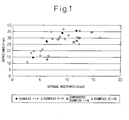
- Figure 1 is a graph showing the relationship between internal resistances ( ⁇ cm 2 ) and capacitances (F/ml) of electrical double layer capacitors provided with electrodes prepared using the carbon materials of Examples 1-24 and Comparative Examples 1-5.
- carbonous main material refers to a carbon-based material consisting primarily of such as activated carbon, conductive carbon and the like which can absorb and desorb ions, wherein the conductive additive is not added into the material at least before a step for activating the material.
- the raw material of the carbonous main material can be any kind of material being widely used in the production of an electrode for electrochemical devices.
- Exemplary raw material of the carbonous main material includes, but is not limited to, soft carbons such as petroleum- and coal-pitches, and petroleum- and coal-cokes obtained by calcining pitch materials, poly(vinyl chloride) (PVC) carbon and the like, and hard carbons such as carbon black, poly(vinylidene chloride) (PVDC) carbon, sugar carbons, cellulose carbons, carbons from phenol-formaldehyde resin, coals, charcoals and the like.
- PVC poly(vinyl chloride)
- PVDC poly(vinylidene chloride)
- soft carbons in particular, petroleum- and coal-derived materials, such as, petroleum- and coal-pitches, or petroleum- and coal-cokes, because an electrodes for electrochemical devices with high-capacitance could be obtained.
- petroleum-derived materials like petroleum-pitch are particularly preferable as they are relatively amorphous and less oriented, and have the advantage of being able to control microstructure of the carbonous main material to the desired extent by regulating conditions in the carbonization step thereof.
- the form of the raw material of the carbonous main material is not specifically limited, and can be in any form, such as powder, particle, or fiber.
- a soft carbon like petroleum-pitch is used as the carbonous main material
- conventional methods for preparing carbon materials used for electrode materials are usually through the following main steps: 1) coking; 2) carbonization; 3) activation; and 4) grinding.
- a conventional coking step such as the delayed coking process so that it is precarbonized by heating, and then is highly carbonized at further elevated temperature.
- a precarbonization can be carried out at the temperature of 300 to 500 degrees C, and the following highly carbonization step be at the temperature of 500 to 900 degrees C.
- the carbon crystals become high density, i.e., high orientation.
- the coking and carbonization steps are not necessarily required unlike a soft carbon.
- the other steps are not specifically limited and arbitrary, except that the step of activating the mixture of the carbonous main material and the conductive additive is required as described herein below.
- calcining the raw material of the carbonous main material at elevated temperature can play a role in eventually obtaining an electrode material with low-specific surface area.
- a carbon material for an electrode which has high-specific surface area can be obtained by calcining the raw material at low temperature.
- a carbon material for an electrode can be subjected to a highly carbonization step heating at further elevated temperature, such as, 700 to 950 degrees C.
- this highly carbonization step can be carried out at relatively low temperature.
- the carbonization step in the present method is not specifically limited to the above mentioned heating temperature, and specific surface area of the carbon material varies depending on the other factors including heating period and the like.
- conductive additive has never been added. Rather, in the following step of kneading the additive in the preparation of an electrode, it has been added together with a binder.
- the conductive additive is added in the activation step in the preparation of the carbon material.
- a further conductive additive can be added to the carbon material for an electrode after subjected to the present method, even in the kneading step in the process of preparing electrodes.
- the conductive additive be added before the above activation step, for example, the above mentioned step 2) of carbonization as it could be so hard to mix with the carbonous main material, and to attain sufficient reduction in internal resistance and increase in capacitance of the devices compared to the prior art.
- conductive additive refers to a material which can be used to contribute to increase in conductivity of an active material formed by going through the above activation and grinding processes in conventional methods for preparing an electrode, wherein the increased conductivity can be due to the location of the conductive additive between particles of the active material, or between particles of the active material and those of the current collector.
- Exemplary conductive additive includes, but not limited to, carbon materials, metallic materials and the like.
- the conductive additive is carbon black, carbon nanotube, graphite, fullerene and the like as these show high conductivity and stability.
- the conductive additive can also be used in the kneading step in the preparation of an electrode as well as the above activation step. In this case, the conductive additive used in these steps can be the same or different.
- the conductive additive can be activated after mixing about 0.5 to 100 part by weight of it with 100 part by weight of the carbonous main material. In this quantitative ratio, if the amount of the conductive additive exceeds 100 part by weight, it would be so hard to be mixed with the carbonous main material. Also, in the case where more than 100 part by weight of the conductive additive is used to mix with the carbonous main material, it is not preferable because the advantageous effect of the present invention, i.e., the increased capacitance of the resultant electrochemical device can be not enough compared to a conventional product prepared using the carbon material having a comparable specific surface area though the internal resistance thereof can be reduced.
- the amount of the conductive additive is less than 0.5 part by weight to 100 part by weight of the carbonous main material, the advantageous effect of attaining both of reduction in internal resistance and increase in capacitance can be not enough.
- the amount of the conductive additive used at the activation step be from 1 to 30 part by weight, in particular preferably, about 5 to 20 part by weight, to 100 part by weight of the carbonous main material.
- activation refers to any treatment to increase the specific surface area or interplanar spacing of the carbonous main material, preferably with an acid, an alkaline or water vapor.
- acid activation zinc chloride, phosphoric acid and the like can be used
- alkali activation alkali metal hydroxides including potassium hydroxide, sodium hydroxide, lithium hydroxide and the like and alkali metal carbonates including potassium carbonate, sodium carbonate and the like can be used, but are not limited thereto.
- alkali activation is preferred by means of potassium hydroxide.
- the resulting activated mixture is cleaned with pure water so as to remove the acid or alkali compound after the activation step.
- the activation treatment can be carried out by maintaining the carbonous main material and the conductive additive at 700 to 900 degrees C under nitrogen atmosphere or under a mixed gas of nitrogen/water vapor for 1 to 10 hours.
- the activation treatment is not limited to such a condition as the present invention is characterized by mixing the carbonous main material and the conductive additive before the activation step.
- a pore volume of the carbon material for an electrode which is prepared by the present method can be determined by a pore distribution measurement using nitrogen adsorption method. It is believed that increasing the absolute value of mesopore volume could allow to produce the carbon material for an electrode of electrochemical devices having a low-internal resistance, in particular, for electrodes of an electrical double layer capacitor wherein its internal resistance is reduced and capacitance is increased in a well-balanced manner.
- carbon material for an electrode refers to ones containing a carbonous material as a constituent material of the electrode, not ones wherein its primary constituent is carbonous material. Furthermore, the above carbon material for an electrode can contain the publicly known component(s) other than the carbonous material as long as it does not affect performance of the electrochemical device.
- the mixture of the carbonous main material and the conductive additive after the activation treatment is milled to a desired particle size.
- the carbonous material treated by such a powderization is calcined at an elevated temperature under hydrogen atmosphere so that the present carbon material for an electrode could be prepared.
- an electrode layer can be manufactured by kneading the electrode material obtained by the present method with the above-mentioned conductive additive and a binder, such as, polytetrafluoroethylene, polyvinylidenefluoride, carboxymethylcellulose and the like, and then rolling them so that they are formed in a sheet shape.
- a binder such as, polytetrafluoroethylene, polyvinylidenefluoride, carboxymethylcellulose and the like
- a BET specific surface area of the obtained carbon material for an electrode can vary depending on the used carbonous main material. As described above, if it is via the carbonization step like the case of soft carbon, its BET specific surface area would be dependent on calcination temperature at the carbonization step. The higher the calcining temperature is, the lower the BET specific surface area is, and the lower the calcining temperature is, the higher the BET specific surface area is. In addition to control of the amount of the conductive additive at the activation thereof, controlling the BET specific surface area of the carbon material for an electrode can regulate balance between internal resistance and capacitance of the electrochemical devices to a desired extent.
- an interplanar spacing of the carbon material prepared according to the present method about 0.36 nm will be required as measured by X-ray diffractometer (RINT-2000, Rigaku Co.). If the spacing is too long, it would be impossible for the electrical double layer capacitor as end-product to charge and discharge electricity at high-voltage, and be hard to obtain the increased capacitance.
- the interplanar spacing can be controlled by alteration of a raw material of the carbonous main material, modification of conditions at the coking, carbonization and alkali activation steps, and the like. For example, in the alkali activation, lowering the temperature at the alkali activation would reduce the interplanar spacing, and vice versa.
- a petroleum-pitch (MPN-BL, Adchemco Co.) was used as the carbonous main material.
- the pitch was precarbonized by heating it according to the delayed coking process (coking step), and furthermore heated at 750 degrees C under pressure of 0.15 Pa for one hour to highly carbonize it (carbonization step).
- the mixture treated by the activation was milled to an average particle size of about 10 micrometer by impact crushing using a dry impact mill (Vibro Mill, Uras Techno co.). By maintaining it at 700 degrees C under hydrogen atmosphere for 4 hours, a carbon material for an electrode according to the present invention was prepared (Example 1).
- the BET specific surface area per gram of the said carbon material was measured by means of a specific surface area measuring apparatus (NOVA 3000, Yuasa Ionics Inc.), and found to be 120 m 2 /g. Also, it was confirmed that interplanar spacing of the carbon material was 0.367 nm as measured by a X-ray diffractometer (RINT-2000, Rigaku Co.).
- Examples 2 to 4 Three carbon materials for an electrode in the present invention (Examples 2 to 4) were prepared in the same manner as in Example 1 except for modification of the following conditions: the heating temperature in the coking step as described in Example 1 was changed to 900 degrees C (Example 2) and 600 degrees C (Example 3), and a raw material of the carbonous main material was changed from the petroleum-pitch as a soft carbon to a commercially-available anthracite as a hard carbon (Example 4).
- the BET specific surface areas of these carbon materials thus obtained were 70 m 2 /g (Example 2), 530 m 2 /g (Example 3) and 1780 m 2 /g (Example 4), respectively.
- Example 1 In order to study how an amount of the conductive additive affects an internal resistance and capacitance of electrochemical devices, the amount of the conductive additive at the activation step in Example 1 was changed to 2, 5, 25, 40 or 80 parts by weight to prepare five carbon materials for electrodes in the present invention (Examples 5 to 9, respectively). The other conditions are the same as described in Example 1.
- the corresponding four carbon materials for electrodes were prepared as Comparative Examples 1 to 4 provided that the conductive additive was not added before the alkali activation step.
- the materials thus obtained had the BET specific surface areas of 110 m 2 /g (Comparative Example 1), 70 m 2 /g (Comparative Example 2), 500 m 2 /g (Comparative Example 3), and 1700 m 2 /g (Comparative Example 4), respectively.
- a carbon material of Comparative Example 5 was prepared wherein 10 part by weight of carbon black(Denka Black, Denki Kagaku, co.) was added to 100 part by weight of the carbon material of Comparative Example 1.
- the BET specific surface area of the carbon material of Comparative Example 5 was 130 m 2 /g.
- Examples 1-9 and Comparative Examples 1-5 were individually subjected to a vacuum kneading process using T.K. HIVIS MIX® manufactured by Tokushu Kika Kogyo Co., Ltd, and then coated on an aluminium foil by means of Mini Coater manufactured by Thank-Metal Co. Ltd. so that it wad formed into a sheet. Furthermore, the sheet was densified by a roll press machine manufactured by Thank-Metal Co. Ltd, and then cut into pieces 5 cm in length to obtain a electrode sheet.
- Each coated side of two electrode sheets thus obtained were arranged in face-to-face relation so as to sandwich a separator (TF4060, Nippon Kodoshi Co.). After that, they were dried under a vacuum at 150 degrees C for four hours, and impregnated with a electrolyte (1M tetraethylammonium tetraflouraborate (TEA. BF4)/propylene carbonate (PC) solution, Kishida Kagaku Co.).
- TEA. BF4 tetraethylammonium tetraflouraborate
- PC propylene carbonate
- Example 1 Amount of conductive additive (part by weight) Specific surface area Interplanar spacing Internal resistance Capacitance Just before activation step Just after activation step Kneading step (m 2 /g) (nm) ( ⁇ cm 2 ) (F/ml)
- Example 1 10 0 10 120 0.367 9.1 34.0
- Example 2 10 0 10 70 0.367 11.7 35.8
- Example 3 10 0 10 530 0.369 6.2 27.5
- Example 4 10 0 10 1780 0.375 3.7 14.7
- Example 5 2
- Example 6 5 0 10 120 0.367 10.2 32.2
- Example 7 25 0 10 125 0.366 8.6 30.9
- Example 8 40 0 10 125 0.367 8.4 29.3
- Example 9 80 0 10 130 0.367 8.2 28.8 Comparative Example 1 0 0 10 110 0.365 12.3 30.1 Comparative Example 2 0 0 10 70 0.366 14.6 34.5 Comparative Example 3 0
- the capacitances of the capacitors manufactured using the carbon materials of Examples 1-4 were increased while their internal resistances were reduced compared to those prepared by the carbon materials of Comparative Examples 1-4. Also, as is clear from the results of Examples 5-8, their internal resistances were decreased with increasing the amount of the conductive additive. On the other hand, the capacitances were also increased in proportion to the amount of the added conductive additive. The increase, however, slowed down gradually from 10 part by weight of the conductive additive (Example 1), and, when it reached 40 part by weight, the capacitance became approximately the same as that of Comparative Example 1.
- the electrical double layer capacitor manufactured by using the carbon material of Example 1 for an electrode yielded excellent results in comparison with that of Comparative Example 5 wherein carbon black was added in an amount equal to the total amount of the added carbon black in Example 1 after the alkali activation. From these results, it is obvious that the above advantageous effects of the present invention were attributed to the addition of the conductive additive in the activation step, not the increase in the amount of the conductive additive.
- Example 4 Since reduction in internal resistance and increase in capacitance of Example 4 manufactured by using the anthracite as a hard carbon were also confirmed compared to Comparative Example 4, it can be understood that the present method is not affected by a raw material of the carbonous main material to be used.
- Examples 15 to 19 Further five carbon materials for electrodes (Examples 15 to 19) were prepared in a similar manner to the above Examples. All of the BET specific surface areas were 500 m 2 /g, and all the interplanar spacings were 0.368 nm. As with Examples 10 to 14, electrodes were prepared using the carbon materials for an electrode without addition of the conductive additive in the kneading step.
- Example 20 to 24 Further five carbon materials for electrodes (Examples 20 to 24) were prepared in a similar manner to the above Examples. All the BET specific surface areas were 2300 m 2 /g, and all the interplanar spacings were 0.380 nm. As with Examples 10 to 14, electrodes were prepared using the carbon materials for electrodes without addition of the conductive additive in the kneading step.
- Table 2 and Figure 1 show the measured results of the internal resistances and capacitances of the capacitor provided with the above electrodes. In addition, the measurement conditions thereof were the same as those given above.
- Table 2 Amount of conductive additive (part by weight) Addition of conductive additive Specific surface area Interplanar spacing Internal resistance Capacitance Just before activation Just after activation Kneading step step step (m 2 /g) (nm) ( ⁇ cm 2 ) (F/ml)
- Example 10 100 0 0 Before activation step 70 0.366 5.5 21.0
- Examples 12 25 0 0 Before activation step 70 0.366 9.3 36.8
- Example 13 10 0 0 Before activation step 70 0.366 12.4 35.5
- Example 14 5 0 0 step activation step 70 0.366 16.1 30.1
- Example 15 100 0 0 Before activation step 500 0.368 5.0 16.2
- Example 16 45 0 0 Before activ
- the electrodes prepared using the carbon materials of Example 10-24 in spite of the absence of the conductive additive in the kneading step, showed the reduced internal resistances and the increased capacitances in a well-balanced manner. Also, regardless of the specific areas of the carbon materials, the internal resistances thereof were reduced as the amount of the conductive additive was increased.
- preliminarily adding the conductive additive which has been added in the kneading step in conventional methods of manufacturing electrodes can provide a carbon material for an electrode of electrochemical devices in a well-balanced manner where internal resistance is reduced and capacitance is increased.
- the carbon material for an electrode in the present invention is suitable for preparing electrodes for large volume capacitors wherein high-energy density is required, or lithium-ion batteries wherein reduction in internal resistance is required.
Landscapes
- Engineering & Computer Science (AREA)
- Power Engineering (AREA)
- Chemical & Material Sciences (AREA)
- Microelectronics & Electronic Packaging (AREA)
- Materials Engineering (AREA)
- Chemical Kinetics & Catalysis (AREA)
- Electrochemistry (AREA)
- General Chemical & Material Sciences (AREA)
- Inorganic Chemistry (AREA)
- Organic Chemistry (AREA)
- Manufacturing & Machinery (AREA)
- Electric Double-Layer Capacitors Or The Like (AREA)
- Battery Electrode And Active Subsutance (AREA)
Applications Claiming Priority (2)
| Application Number | Priority Date | Filing Date | Title |
|---|---|---|---|
| JP2006111948 | 2006-04-14 | ||
| PCT/JP2007/058685 WO2007119885A1 (ja) | 2006-04-14 | 2007-04-16 | 電気化学デバイス電極用炭素材料の製造方法 |
Publications (2)
| Publication Number | Publication Date |
|---|---|
| EP2009654A1 true EP2009654A1 (de) | 2008-12-31 |
| EP2009654A4 EP2009654A4 (de) | 2017-02-22 |
Family
ID=38609635
Family Applications (1)
| Application Number | Title | Priority Date | Filing Date |
|---|---|---|---|
| EP07742120.4A Withdrawn EP2009654A4 (de) | 2006-04-14 | 2007-04-16 | Verfahren zum herstellen von kohlenstoffmaterial für die elektrode einer elektrochemischen anordnung |
Country Status (6)
| Country | Link |
|---|---|
| US (1) | US8012376B2 (de) |
| EP (1) | EP2009654A4 (de) |
| JP (1) | JP5058155B2 (de) |
| KR (1) | KR101462578B1 (de) |
| CN (1) | CN101421803B (de) |
| WO (1) | WO2007119885A1 (de) |
Families Citing this family (5)
| Publication number | Priority date | Publication date | Assignee | Title |
|---|---|---|---|---|
| JP5280246B2 (ja) * | 2008-03-18 | 2013-09-04 | 迪 山城 | 電気二重層キャパシタの性能測定方法及び性能測定システム |
| JP5604227B2 (ja) * | 2010-08-27 | 2014-10-08 | 日本カーボン株式会社 | キャパシタ用活性炭の製造方法及び活性炭 |
| KR102799571B1 (ko) * | 2018-07-06 | 2025-04-28 | 주식회사 엘지에너지솔루션 | 전도성 물질의 비표면적 측정 방법 |
| KR102429237B1 (ko) * | 2018-07-12 | 2022-08-05 | 주식회사 엘지에너지솔루션 | 리튬 이차전지용 음극 활물질, 이를 포함하는 음극, 및 리튬 이차전지 |
| KR102457534B1 (ko) * | 2020-08-14 | 2022-10-21 | 한국원자력연구원 | 원전 |
Family Cites Families (15)
| Publication number | Priority date | Publication date | Assignee | Title |
|---|---|---|---|---|
| US2008146A (en) * | 1934-03-07 | 1935-07-16 | Jacque C Morrell | Structural activated carbon and process of making same |
| JPH07307250A (ja) * | 1994-05-16 | 1995-11-21 | Asahi Glass Co Ltd | 電気二重層キャパシタ |
| JPH08107048A (ja) * | 1994-08-12 | 1996-04-23 | Asahi Glass Co Ltd | 電気二重層キャパシタ |
| JP3446339B2 (ja) * | 1994-10-18 | 2003-09-16 | 三菱化学株式会社 | 活性炭の製造方法 |
| JPH09102441A (ja) * | 1995-10-06 | 1997-04-15 | Furukawa Co Ltd | 電気二重層コンデンサー |
| JP3417206B2 (ja) * | 1996-05-13 | 2003-06-16 | トヨタ自動車株式会社 | 電気二重層キャパシタ用活性炭材料 |
| JPH11162795A (ja) * | 1997-11-21 | 1999-06-18 | Isuzu Advanced Engineering Center Ltd | 活性炭粉末、炭素体、炭素電極及び電気二重層コンデンサ用電極並びにそれらの製造法 |
| JPH11317333A (ja) | 1998-03-03 | 1999-11-16 | Jeol Ltd | 電気二重層コンデンサ用炭素材料、電気二重層コンデンサ用炭素材料の製造方法、電気二重層コンデンサ及び電気二重層コンデンサの製造方法 |
| JP2002025867A (ja) | 2000-07-04 | 2002-01-25 | Jeol Ltd | 電気二重層キャパシタおよび電気二重層キャパシタ用炭素材料 |
| JP2002128514A (ja) * | 2000-10-16 | 2002-05-09 | Nisshinbo Ind Inc | 炭素質材料、電気二重層キャパシタ用分極性電極及び電気二重層キャパシタ |
| JP4342123B2 (ja) * | 2001-06-06 | 2009-10-14 | アドバンスト・キャパシタ・テクノロジーズ株式会社 | 残存活性酸化水素の除去方法 |
| EP1426334A4 (de) * | 2001-09-11 | 2009-07-29 | Showa Denko Kk | Aktivkohle, herstellungsverfahren dafür und anwendung davon |
| JP4313547B2 (ja) * | 2002-06-06 | 2009-08-12 | Jfeケミカル株式会社 | 電気二重層コンデンサー用炭素材料の製造方法 |
| US7317607B2 (en) * | 2003-10-20 | 2008-01-08 | Sanyo Electric Co., Ltd. | Electric double layer capacitor |
| JP2006216748A (ja) * | 2005-02-03 | 2006-08-17 | Showa Denko Kk | 電気二重層キャパシタの電極用炭素複合粉及びその製造方法並びに、該炭素複合粉を用いた電気二重層キャパシタ。 |
-
2007
- 2007-04-16 JP JP2008511031A patent/JP5058155B2/ja not_active Expired - Fee Related
- 2007-04-16 CN CN2007800134362A patent/CN101421803B/zh not_active Expired - Fee Related
- 2007-04-16 WO PCT/JP2007/058685 patent/WO2007119885A1/ja not_active Ceased
- 2007-04-16 US US12/296,695 patent/US8012376B2/en not_active Expired - Fee Related
- 2007-04-16 EP EP07742120.4A patent/EP2009654A4/de not_active Withdrawn
- 2007-04-16 KR KR1020087023723A patent/KR101462578B1/ko not_active Expired - Fee Related
Also Published As
| Publication number | Publication date |
|---|---|
| US8012376B2 (en) | 2011-09-06 |
| JP5058155B2 (ja) | 2012-10-24 |
| CN101421803A (zh) | 2009-04-29 |
| KR20080109782A (ko) | 2008-12-17 |
| US20090272945A1 (en) | 2009-11-05 |
| WO2007119885A1 (ja) | 2007-10-25 |
| CN101421803B (zh) | 2013-06-05 |
| EP2009654A4 (de) | 2017-02-22 |
| KR101462578B1 (ko) | 2014-11-18 |
| JPWO2007119885A1 (ja) | 2009-08-27 |
Similar Documents
| Publication | Publication Date | Title |
|---|---|---|
| EP2278597A1 (de) | Leitfähiger kleber, elektrode für elektrischen doppelschichtkondensator damit und elektrischer doppelschichtkondensator | |
| EP4235720A1 (de) | Wasserfreies alkalimetall-stromspeicherelement und positivelektrodenbeschichtungsflüssigkeit | |
| KR20150126636A (ko) | 전기 이중층 캐패시터 전극용 활성탄 및 그 제조 방법 | |
| US8012376B2 (en) | Method for preparing carbon material for electrode of electrochemical devices | |
| Payá et al. | Biomass-derived carbon sponges for use as sodium-ion capacitor electrodes | |
| CN107207257B (zh) | 基于碳化椰壳的用于锂离子电容器的阳极 | |
| WO2016057914A1 (en) | Electrical double-layer capacitor for high-voltage operation at high-temperatures | |
| KR102086589B1 (ko) | 전극 재료, 이를 포함하는 전기 화학 소자 및 그 제조방법 | |
| JP2006004978A (ja) | 電気二重層キャパシタ | |
| JP7197089B2 (ja) | 電気化学キャパシタ電極用の黒鉛系多孔質炭素材料及びその製造方法、電気化学キャパシタ電極並びに電気化学キャパシタ | |
| KR102040379B1 (ko) | 전극소재용 활성탄의 제조방법 | |
| KR101970134B1 (ko) | 활성탄과 그래핀 시트를 포함하는 전극, 그 제조방법, 및 이를 포함하는 수퍼커패시터 | |
| EP3831772A1 (de) | Kohlenstoffmaterial und verfahren zur herstellung davon, elektrodenmaterial für elektrizitätsspeichervorrichtung und elektrizitätsspeichervorrichtung | |
| KR20170113611A (ko) | 리튬이온 커패시터용 캐소드 | |
| EP2879143B1 (de) | Polarisierbares elektrodenmaterial und doppelschichtkondensator damit | |
| JP3602933B2 (ja) | 活性炭基板 | |
| KR101094240B1 (ko) | 다공성 활성탄소재와 비다공성 탄소재를 이용한 축전 탈이온화용 복합전극 제조방법 | |
| JP5164418B2 (ja) | 蓄電デバイス電極用炭素材料及びその製造方法 | |
| US9672992B2 (en) | Coke sourced anode for lithium ion capacitor | |
| WO2016066860A1 (en) | A method for making a high-density carbon material for high-density carbon electrodes | |
| JP5604227B2 (ja) | キャパシタ用活性炭の製造方法及び活性炭 | |
| EP1930921A1 (de) | Kohlenstoffmaterial für einen elektrischen doppelschichtkondensator und elektrischer doppelschichtkondensator | |
| KR101215555B1 (ko) | 고출력용 팽창탄소의 제조방법 및 이를 이용한 에너지저장 디바이스 | |
| KR20180016668A (ko) | p-페닐렌디아민-환원된 산화 그래핀 복합체, 이를 포함한 슈퍼커패시터 및 이의 제조방법 | |
| KR102765452B1 (ko) | 슈퍼 커패시터의 전극용 복합체, 이를 포함하는 슈퍼 커패시터의 전극 및 슈퍼 커패시터 |
Legal Events
| Date | Code | Title | Description |
|---|---|---|---|
| PUAI | Public reference made under article 153(3) epc to a published international application that has entered the european phase |
Free format text: ORIGINAL CODE: 0009012 |
|
| 17P | Request for examination filed |
Effective date: 20081009 |
|
| AK | Designated contracting states |
Kind code of ref document: A1 Designated state(s): AT BE BG CH CY CZ DE DK EE ES FI FR GB GR HU IE IS IT LI LT LU LV MC MT NL PL PT RO SE SI SK TR |
|
| AX | Request for extension of the european patent |
Extension state: AL BA HR MK RS |
|
| DAX | Request for extension of the european patent (deleted) | ||
| RA4 | Supplementary search report drawn up and despatched (corrected) |
Effective date: 20170120 |
|
| RIC1 | Information provided on ipc code assigned before grant |
Ipc: H01M 4/587 20100101ALI20170116BHEP Ipc: H01G 11/38 20130101ALI20170116BHEP Ipc: C01B 32/30 20170101ALI20170116BHEP Ipc: H01M 10/0525 20100101ALN20170116BHEP Ipc: H01G 11/34 20130101AFI20170116BHEP Ipc: H01M 4/133 20100101ALI20170116BHEP Ipc: H01G 11/42 20130101ALI20170116BHEP Ipc: H01G 11/86 20130101ALI20170116BHEP |
|
| STAA | Information on the status of an ep patent application or granted ep patent |
Free format text: STATUS: REQUEST FOR EXAMINATION WAS MADE |
|
| STAA | Information on the status of an ep patent application or granted ep patent |
Free format text: STATUS: THE APPLICATION IS DEEMED TO BE WITHDRAWN |
|
| 18D | Application deemed to be withdrawn |
Effective date: 20170818 |
|
| RIC1 | Information provided on ipc code assigned before grant |
Ipc: H01G 11/86 20130101ALI20170116BHEP Ipc: H01G 11/34 20130101AFI20170116BHEP Ipc: H01G 11/42 20130101ALI20170116BHEP Ipc: H01M 10/0525 20100101ALN20170116BHEP Ipc: H01M 4/133 20100101ALI20170116BHEP Ipc: H01M 4/587 20100101ALI20170116BHEP Ipc: H01G 11/38 20130101ALI20170116BHEP Ipc: C01B 32/30 20170101ALI20170116BHEP |
|
| RIC1 | Information provided on ipc code assigned before grant |
Ipc: C01B 32/30 20170101ALI20170116BHEP Ipc: H01M 4/133 20100101ALI20170116BHEP Ipc: H01G 11/34 20130101AFI20170116BHEP Ipc: H01M 4/587 20100101ALI20170116BHEP Ipc: H01G 11/38 20130101ALI20170116BHEP Ipc: H01G 11/86 20130101ALI20170116BHEP Ipc: H01G 11/42 20130101ALI20170116BHEP Ipc: H01M 10/0525 20100101ALN20170116BHEP |