EP2009713A2 - Nanostrukturierte Solarzelle - Google Patents
Nanostrukturierte Solarzelle Download PDFInfo
- Publication number
- EP2009713A2 EP2009713A2 EP08158812A EP08158812A EP2009713A2 EP 2009713 A2 EP2009713 A2 EP 2009713A2 EP 08158812 A EP08158812 A EP 08158812A EP 08158812 A EP08158812 A EP 08158812A EP 2009713 A2 EP2009713 A2 EP 2009713A2
- Authority
- EP
- European Patent Office
- Prior art keywords
- conductor
- electron
- solar
- absorber
- cathode
- Prior art date
- Legal status (The legal status is an assumption and is not a legal conclusion. Google has not performed a legal analysis and makes no representation as to the accuracy of the status listed.)
- Granted
Links
Images


Classifications
-
- H—ELECTRICITY
- H10—SEMICONDUCTOR DEVICES; ELECTRIC SOLID-STATE DEVICES NOT OTHERWISE PROVIDED FOR
- H10K—ORGANIC ELECTRIC SOLID-STATE DEVICES
- H10K30/00—Organic devices sensitive to infrared radiation, light, electromagnetic radiation of shorter wavelength or corpuscular radiation
- H10K30/30—Organic devices sensitive to infrared radiation, light, electromagnetic radiation of shorter wavelength or corpuscular radiation comprising bulk heterojunctions, e.g. interpenetrating networks of donor and acceptor material domains
- H10K30/35—Organic devices sensitive to infrared radiation, light, electromagnetic radiation of shorter wavelength or corpuscular radiation comprising bulk heterojunctions, e.g. interpenetrating networks of donor and acceptor material domains comprising inorganic nanostructures, e.g. CdSe nanoparticles
-
- B—PERFORMING OPERATIONS; TRANSPORTING
- B82—NANOTECHNOLOGY
- B82Y—SPECIFIC USES OR APPLICATIONS OF NANOSTRUCTURES; MEASUREMENT OR ANALYSIS OF NANOSTRUCTURES; MANUFACTURE OR TREATMENT OF NANOSTRUCTURES
- B82Y30/00—Nanotechnology for materials or surface science, e.g. nanocomposites
-
- H—ELECTRICITY
- H10—SEMICONDUCTOR DEVICES; ELECTRIC SOLID-STATE DEVICES NOT OTHERWISE PROVIDED FOR
- H10K—ORGANIC ELECTRIC SOLID-STATE DEVICES
- H10K30/00—Organic devices sensitive to infrared radiation, light, electromagnetic radiation of shorter wavelength or corpuscular radiation
- H10K30/50—Photovoltaic [PV] devices
-
- H—ELECTRICITY
- H10—SEMICONDUCTOR DEVICES; ELECTRIC SOLID-STATE DEVICES NOT OTHERWISE PROVIDED FOR
- H10K—ORGANIC ELECTRIC SOLID-STATE DEVICES
- H10K71/00—Manufacture or treatment specially adapted for the organic devices covered by this subclass
- H10K71/10—Deposition of organic active material
- H10K71/12—Deposition of organic active material using liquid deposition, e.g. spin coating
- H10K71/13—Deposition of organic active material using liquid deposition, e.g. spin coating using printing techniques, e.g. ink-jet printing or screen printing
-
- H—ELECTRICITY
- H10—SEMICONDUCTOR DEVICES; ELECTRIC SOLID-STATE DEVICES NOT OTHERWISE PROVIDED FOR
- H10K—ORGANIC ELECTRIC SOLID-STATE DEVICES
- H10K77/00—Constructional details of devices covered by this subclass and not covered by groups H10K10/80, H10K30/80, H10K50/80 or H10K59/80
- H10K77/10—Substrates, e.g. flexible substrates
- H10K77/111—Flexible substrates
-
- H—ELECTRICITY
- H10—SEMICONDUCTOR DEVICES; ELECTRIC SOLID-STATE DEVICES NOT OTHERWISE PROVIDED FOR
- H10K—ORGANIC ELECTRIC SOLID-STATE DEVICES
- H10K85/00—Organic materials used in the body or electrodes of devices covered by this subclass
- H10K85/791—Starburst compounds
-
- Y—GENERAL TAGGING OF NEW TECHNOLOGICAL DEVELOPMENTS; GENERAL TAGGING OF CROSS-SECTIONAL TECHNOLOGIES SPANNING OVER SEVERAL SECTIONS OF THE IPC; TECHNICAL SUBJECTS COVERED BY FORMER USPC CROSS-REFERENCE ART COLLECTIONS [XRACs] AND DIGESTS
- Y02—TECHNOLOGIES OR APPLICATIONS FOR MITIGATION OR ADAPTATION AGAINST CLIMATE CHANGE
- Y02E—REDUCTION OF GREENHOUSE GAS [GHG] EMISSIONS, RELATED TO ENERGY GENERATION, TRANSMISSION OR DISTRIBUTION
- Y02E10/00—Energy generation through renewable energy sources
- Y02E10/50—Photovoltaic [PV] energy
- Y02E10/542—Dye sensitized solar cells
-
- Y—GENERAL TAGGING OF NEW TECHNOLOGICAL DEVELOPMENTS; GENERAL TAGGING OF CROSS-SECTIONAL TECHNOLOGIES SPANNING OVER SEVERAL SECTIONS OF THE IPC; TECHNICAL SUBJECTS COVERED BY FORMER USPC CROSS-REFERENCE ART COLLECTIONS [XRACs] AND DIGESTS
- Y02—TECHNOLOGIES OR APPLICATIONS FOR MITIGATION OR ADAPTATION AGAINST CLIMATE CHANGE
- Y02E—REDUCTION OF GREENHOUSE GAS [GHG] EMISSIONS, RELATED TO ENERGY GENERATION, TRANSMISSION OR DISTRIBUTION
- Y02E10/00—Energy generation through renewable energy sources
- Y02E10/50—Photovoltaic [PV] energy
- Y02E10/549—Organic PV cells
Definitions
- the invention pertains to electrical power devices and particularly to power generating devices. More particularly, the invention pertains to solar-based power generating devices.
- the invention is a solar cell having a nano-type structure.
- the present invention involving solar PV technology, based on nanostructure components and respective fabrication processes aimed to significantly increase conversion efficiency and reduce production costs, may allow a solar PV to become an economically viable form of a renewable alternative energy source within a timeframe shorter than several decades.
- the present solar cell may maximize solar-to-electrical conversion efficiency through the use of nanostructure electron conductors, and nanoparticles such as quantum dots (QDs) as an absorber.
- QDs quantum dots
- the cell may be fabricated on a flexible substrate. Combining these components may result in a flexible, low-cost, rugged solar sheet which can be produced with a simple, low temperature process.
- the solar cell may be a result of precise engineering of consistent QD uniformity to match solar spectra, nanowire electron conductors, matching work functions / electron affinities, efficient hole-transport media, reduction or elimination of leakage / recombination, and low temperature process compatibility.
- the solar cell may include, for instance, nanowire-based electron conductors having a high surface area, significant transparency, good flexibility, and so on.
- the solar cell may have a QD absorber, have enhanced absorption cross-section, and have charge multiplication within the quantum dots, and be made with a simple additive process.
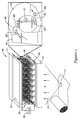
- the solar cell may be a nanostructure which includes significant characteristics such as a fractal architecture of nanostructure electron conductors 14 and a solid-state hole conductor 16, as indicated in Figures 1 and 2 .
- An absorber 20 may consist of quantum dots (QDs) 15 which are nanoparticles that can be shaped to be band-gap engineered so as to match a solar spectrum or spectra for optimized absorption.
- QDs quantum dots
- Band-gap engineering of the quantum dots, for a given element of material or compound may be effected with geometrical design of the dots. Changing the shape of a quantum dot may affect the dot's band-gap.
- Band gaps of the QDs may be changed to maximize the solar cell's efficiency. For example, QDs may be round, oval, have points, and so on, for attaining particular energy levels to achieve particular band gaps.
- QDs with enhanced absorption cross-sections may also maximize energy absorption within a very thin film, including a potential of multiple charge generation for each high-energy photon 21.
- a nanostructured high porosity electron conductors 14 which can provide maximized large surface areas for loading a solar absorber 20 of a given geometric area and thickness.
- the absorber elements 15 i.e., QDs
- the electron conductors 14 may look like trees with branches 19 to attain greater surface.
- a complementary carrier conductor such as a hole conductor 16, which is in intimate contact with the nanoparticles or QDs 15 which are attached to the nanoporous electron conductors 14, such that the conductor 16 provides efficient hole transfer and transport path. It is desirable to have the hole conductor 16 in a stable and solid state after completion of the solar cell fabrication.
- the material of the hole conductor 16 may be a polymer. These items may be formed and assembled with low-cost mass producible methods such as solution-based growth, self-assembly, additive process printing, and/or spraying, on a flexible substrate in a roll-to-roll (R2R) production line.
- the present nanostructure-enabled solar cell (NESC) 10 may operate as indicated in Figure 1 .
- Solar energy photons 21 with energy hv
- quantum dots 15 which can be engineered to maximize absorption of a spectrum.
- Each solar photon 21 may generate one or more pairs, each pair including an electron (e-) 22 and a hole (h+) 23.
- the electrons 22 may be transferred to the nanowire electron conductors 14 with structure appendages 19 consisting of a transparent electron conducting (EC) material (for example, TiO 2 , ZnO,...), and the electrons 22 may be collected by a transparent negative electrode (anode) 11 from a contact plate 12 on which the electron conductors 14 are situated.
- EC transparent electron conducting
- the holes 23 may be transferred to a transparent organic polymer hole conducting (HC) material 16 and the holes 23 may eventually be collected by a reflective and protective positive electrode (cathode) 27.
- the electron conducting material of conductors 14 with structures 19 should be of a certain porous nanostructure having a relatively large surface area (such that of nanowires or nanotubes 19) in order for more QDs 15 to be loaded and exposed to absorb as much solar energy as possible.
- Figure 2 shows an illustration of an electron conductor 14 having nanowires or nanotubes 19.
- the conductor 14 may resemble a "tree” having nanowires or tubes 19 which may resemble "branches".
- a group of "trees" with shorter "branches” may provide more surface area of a given volume, for holding more QDs 15.
- the electron conductors 14 and hole conducting material 16 need to be in intimate contact with the QDs 15 for efficient charge transfer.
- the incident solar energy 21 may be considered as converted to electrical energy when the collected electrons 22 flow through an external conductive path 25 and recombine with the collected holes 23.
- the path 25 may be a load connected across the cathode 27 and anode 12.
- An advantage of using nanowires 19 in the cell structure 10 may include the high porosity characteristic which maximizes absorber 20 loading with a resulting high absorption efficiency. Also, the fractal-type architecture of the nano electron conductors 14 with appendages of wires or tubes 19 may aid in an efficient carrier transport path and minimize carrier leakage.
- An approach for producing the present solar cell 10 may include an additive process flow with increments of the structure build as shown in Figure 3 .
- One may start with a flexible substrate 11.
- a contact layer 12 may be added and situated on substrate 11.
- the layer may be transparent and conductive, and be seeding for nanowires 19 of electron conductors 14.
- a layer 13 of nanowire electron conductors 14 may be added and situated on contact layer 12.
- the nanowires 19 may have diameters from tens to hundreds of nanometers (i.e., less than 500 nanometers) with lengths up to 20 microns.
- QDs 15 may be loaded to maximum levels of available space of the electron conductors and wires 14 and 19.
- a passivation coating (not shown) may be applied on electron conductors 14 and 19 for reduced leakage.
- the passivation coating may be a barrier to prevent the electrons from leaving the electron conductors 14 and recombining with holes of a hole conductor 16. Since a barrier on the QDs may prevent a desired movement of electrons or holes; a technique, for instance a chemical trick such as providing a material that permits a passage of holes but not electrons may be used. Another technique may achieve covering only open areas of the electron conductor 14 and 19 with the barrier material, and not areas of the QDs. However, if the transport of the electrons and the holes is faster than a recombination of them, then a passivation coating or barrier is not necessarily needed.
- the hole+ conductor 16 may be applied in a liquid or gel form to the assembly.
- the liquid or gel material 16 may essentially immerse or permeate rather completely the nanoparticle CDs 15. Once applied, the liquid or gel form of the hole conductor 16 material may solidify for structural rigidity and containment.
- a top-reflector and contact interconnect (cathode) 27 and protective layer(s) 17 may be connected to the hole conductor 16 and added to the assembly.
- Layer 17 or cathode 27 may include an anti-reflective coating.
- Layer 17 and cathode 27 may instead be one layer.
- a total thickness 18 of the present solar cell 10 assembly ( Figure 3 ) may be less than one millimeter.
- a nanostructure-enabled solar cell (NESC) 10 manufacturing process may suitably involve a low cost roll-to-roll manufacturing.
- the process may involve a minimum amount of and efficient use of materials, e.g., QD ⁇ 1mg/m 2 .
- the desired aspects of the manufacturing or fabrication process may include a low-temperature setting and a lack of the need for a vacuum and ultra-clean environment.
- the present process may be compatible with using a flexible substrate 11 and a spraying/printing process for loading QDs 15 and a polymer conductor (i.e., conductor 16).
- the process for making the present cell 10 may leverage a manufacturing infrastructure developed for making displays (e.g., LCDs), which involves conductive transparent oxides or thin-films, and anti-reflective coatings.
- quantum dots 15 in the cell 10 may allow bandgap engineering to match various solar spectra, provide significantly large absorption cross-sections for maximum efficiency, and result in potential charge multiplication to increase single-layer cell conversion efficiency by 30 percent as indicated by a graph 30 in Figure 4 .
- the graph shows conversion efficiency (percent) versus bandgap (eV) of a single junction (semiconductor) solar cell, as shown by curve 31, and of an example of the present single junction quantum dot solar cell 10 (with charge multiplication), as shown by curve 32.
- the nanostructure solar cell 10 may provide relatively significant power.
- Solar cell 10 may have high solar-to-electrical conversion efficiency.
- the cell may be a flexible, light weight and highly portable energy source with a power output performance in a range of 20-40 mW/cm 2 .
- Cell 10 may provide NSC 40 mW/cm 2 continuous power under one-sun.
- One cm 2 cell may provide adequate power for wireless communication and operation of unattended ground sensors.
- One to two cm 2 cells may power a miniature atomic-clock.
- Two cm 2 cells may power a micro gas analyzer (MGA) for one analysis every 25 seconds (with a 1J/analysis goal).
- a laptop PC may be self-powered under the sun.
- Flexible solar sheets (of cell 10) covering a "power-helmet" may charge a cell-phone battery in less than 30 minutes.
- the solar cell or converter 10 may provide more sustained power and longer life for unattended ground sensors compared to other like out-in-the-field power sources meeting similar power requirements. Nanostructures of the solar cell 10 may provide low cost and high efficiency for continuous power and integrated energy solutions for the soldiers' miniaturized systems.
Landscapes
- Chemical & Material Sciences (AREA)
- Engineering & Computer Science (AREA)
- Nanotechnology (AREA)
- Physics & Mathematics (AREA)
- Crystallography & Structural Chemistry (AREA)
- Composite Materials (AREA)
- Condensed Matter Physics & Semiconductors (AREA)
- General Physics & Mathematics (AREA)
- Materials Engineering (AREA)
- Inorganic Chemistry (AREA)
- Electromagnetism (AREA)
- Photovoltaic Devices (AREA)
Applications Claiming Priority (1)
| Application Number | Priority Date | Filing Date | Title |
|---|---|---|---|
| US11/768,690 US20100043874A1 (en) | 2007-06-26 | 2007-06-26 | Nanostructured solar cell |
Publications (3)
| Publication Number | Publication Date |
|---|---|
| EP2009713A2 true EP2009713A2 (de) | 2008-12-31 |
| EP2009713A3 EP2009713A3 (de) | 2011-11-02 |
| EP2009713B1 EP2009713B1 (de) | 2018-04-18 |
Family
ID=39671618
Family Applications (1)
| Application Number | Title | Priority Date | Filing Date |
|---|---|---|---|
| EP08158812.1A Ceased EP2009713B1 (de) | 2007-06-26 | 2008-06-23 | Nanostrukturierte Solarzelle |
Country Status (3)
| Country | Link |
|---|---|
| US (1) | US20100043874A1 (de) |
| EP (1) | EP2009713B1 (de) |
| JP (1) | JP2009021585A (de) |
Cited By (2)
| Publication number | Priority date | Publication date | Assignee | Title |
|---|---|---|---|---|
| CN101924151A (zh) * | 2009-06-15 | 2010-12-22 | 霍尼韦尔国际公司 | 纳米结构太阳能电池 |
| CN102683440A (zh) * | 2011-01-13 | 2012-09-19 | 霍尼韦尔国际公司 | 毫微结构的太阳能电池 |
Families Citing this family (27)
| Publication number | Priority date | Publication date | Assignee | Title |
|---|---|---|---|---|
| US20110174364A1 (en) * | 2007-06-26 | 2011-07-21 | Honeywell International Inc. | nanostructured solar cell |
| US20100275985A1 (en) * | 2009-04-30 | 2010-11-04 | Honeywell International Inc. | Electron collector and its application in photovoltaics |
| US20110139233A1 (en) * | 2009-12-11 | 2011-06-16 | Honeywell International Inc. | Quantum dot solar cell |
| US8106388B2 (en) * | 2007-12-19 | 2012-01-31 | Honeywell International Inc. | Quantum dot solar cell with rigid bridge molecule |
| US8710354B2 (en) * | 2007-12-19 | 2014-04-29 | Honeywell International Inc. | Solar cell with hyperpolarizable absorber |
| US8067763B2 (en) * | 2007-12-19 | 2011-11-29 | Honeywell International Inc. | Quantum dot solar cell with conjugated bridge molecule |
| US8089063B2 (en) * | 2007-12-19 | 2012-01-03 | Honeywell International Inc. | Quantum dot solar cell with electron rich anchor group |
| US8288649B2 (en) * | 2008-02-26 | 2012-10-16 | Honeywell International Inc. | Quantum dot solar cell |
| US8373063B2 (en) * | 2008-04-22 | 2013-02-12 | Honeywell International Inc. | Quantum dot solar cell |
| US8299355B2 (en) * | 2008-04-22 | 2012-10-30 | Honeywell International Inc. | Quantum dot solar cell |
| US8283561B2 (en) * | 2008-05-13 | 2012-10-09 | Honeywell International Inc. | Quantum dot solar cell |
| US20100006148A1 (en) * | 2008-07-08 | 2010-01-14 | Honeywell International Inc. | Solar cell with porous insulating layer |
| US8148632B2 (en) * | 2008-07-15 | 2012-04-03 | Honeywell International Inc. | Quantum dot solar cell |
| US20100012168A1 (en) * | 2008-07-18 | 2010-01-21 | Honeywell International | Quantum dot solar cell |
| US8455757B2 (en) | 2008-08-20 | 2013-06-04 | Honeywell International Inc. | Solar cell with electron inhibiting layer |
| US8227686B2 (en) * | 2009-02-04 | 2012-07-24 | Honeywell International Inc. | Quantum dot solar cell |
| US8227687B2 (en) * | 2009-02-04 | 2012-07-24 | Honeywell International Inc. | Quantum dot solar cell |
| US8426728B2 (en) * | 2009-06-12 | 2013-04-23 | Honeywell International Inc. | Quantum dot solar cells |
| US20100326499A1 (en) * | 2009-06-30 | 2010-12-30 | Honeywell International Inc. | Solar cell with enhanced efficiency |
| US8772627B2 (en) * | 2009-08-07 | 2014-07-08 | Semiconductor Energy Laboratory Co., Ltd. | Photoelectric conversion device and manufacturing method thereof |
| US20110108102A1 (en) * | 2009-11-06 | 2011-05-12 | Honeywell International Inc. | Solar cell with enhanced efficiency |
| US20110139248A1 (en) * | 2009-12-11 | 2011-06-16 | Honeywell International Inc. | Quantum dot solar cells and methods for manufacturing solar cells |
| US8372678B2 (en) * | 2009-12-21 | 2013-02-12 | Honeywell International Inc. | Counter electrode for solar cell |
| US20110155233A1 (en) * | 2009-12-29 | 2011-06-30 | Honeywell International Inc. | Hybrid solar cells |
| US20120312375A1 (en) * | 2010-02-18 | 2012-12-13 | Korea Research Institute Of Chemical Technology | All-Solid-State Heterojunction Solar Cell |
| KR101168227B1 (ko) | 2010-02-18 | 2012-07-30 | 한국화학연구원 | 나노구조 무기-유기 이종 접합 태양전지의 제조방법 |
| KR101391475B1 (ko) * | 2012-04-05 | 2014-05-27 | 경희대학교 산학협력단 | 다층 투명 전극을 구비하는 인버티드 유기 태양전지의 제조 방법 |
Family Cites Families (35)
| Publication number | Priority date | Publication date | Assignee | Title |
|---|---|---|---|---|
| CH644471A5 (fr) * | 1981-02-02 | 1984-07-31 | Michael Graetzel | Produit destine a etre utilise comme photocatalyseur, procede de preparation de ce produit et utilisation de ce produit. |
| CH674596A5 (de) * | 1988-02-12 | 1990-06-15 | Sulzer Ag | |
| JP2997773B1 (ja) * | 1998-07-15 | 2000-01-11 | 工業技術院長 | 増感剤として有用な金属錯体、酸化物半導体電極及び太陽電池 |
| US6936143B1 (en) * | 1999-07-05 | 2005-08-30 | Ecole Polytechnique Federale De Lausanne | Tandem cell for water cleavage by visible light |
| US6919119B2 (en) * | 2000-05-30 | 2005-07-19 | The Penn State Research Foundation | Electronic and opto-electronic devices fabricated from nanostructured high surface to volume ratio thin films |
| US7042029B2 (en) * | 2000-07-28 | 2006-05-09 | Ecole Polytechnique Federale De Lausanne (Epfl) | Solid state heterojunction and solid state sensitized photovoltaic cell |
| EP1176646A1 (de) * | 2000-07-28 | 2002-01-30 | Ecole Polytechnique Féderale de Lausanne (EPFL) | Festkörper-Heteroübergang und sensibilisierte Festkörper photovoltaische Zelle |
| JP3753605B2 (ja) * | 2000-11-01 | 2006-03-08 | シャープ株式会社 | 太陽電池およびその製造方法 |
| WO2002084708A2 (en) * | 2001-04-16 | 2002-10-24 | Basol Bulent M | Method of forming semiconductor compound film for fabrication of electronic device and film produced by same |
| CA2471162C (en) * | 2001-12-21 | 2010-04-06 | Sony International (Europe) Gmbh | A polymer gel hybrid solar cell |
| US7202412B2 (en) * | 2002-01-18 | 2007-04-10 | Sharp Kabushiki Kaisha | Photovoltaic cell including porous semiconductor layer, method of manufacturing the same and solar cell |
| US7462774B2 (en) * | 2003-05-21 | 2008-12-09 | Nanosolar, Inc. | Photovoltaic devices fabricated from insulating nanostructured template |
| EP1513171A1 (de) * | 2003-09-05 | 2005-03-09 | Sony International (Europe) GmbH | Farbstoffsensibilisierte Solarzelle und Herstellungsverfahren |
| US7202943B2 (en) * | 2004-03-08 | 2007-04-10 | National Research Council Of Canada | Object identification using quantum dots fluorescence allocated on Fraunhofer solar spectral lines |
| JP5029015B2 (ja) * | 2004-10-15 | 2012-09-19 | 株式会社ブリヂストン | 色素増感型金属酸化物半導体電極及びその製造方法並びに色素増感型太陽電池 |
| US20060112983A1 (en) * | 2004-11-17 | 2006-06-01 | Nanosys, Inc. | Photoactive devices and components with enhanced efficiency |
| KR100682928B1 (ko) * | 2005-02-03 | 2007-02-15 | 삼성전자주식회사 | 양자점 화합물을 포함하는 에너지 변환막 및 양자점 박막 |
| KR100696529B1 (ko) * | 2005-08-02 | 2007-03-19 | 삼성에스디아이 주식회사 | 금속원소를 포함하는 광전변환소자용 전극 및 이를 채용한염료감응 태양전지 |
| GB2432722A (en) * | 2005-11-25 | 2007-05-30 | Seiko Epson Corp | Electrochemical cell and method of manufacture |
| GB2432723B (en) * | 2005-11-25 | 2010-12-08 | Seiko Epson Corp | Electrochemical cell and method of manufacture |
| GB2432720A (en) * | 2005-11-25 | 2007-05-30 | Seiko Epson Corp | Electrochemical cell structure and method of fabrication |
| TW200802903A (en) * | 2006-02-16 | 2008-01-01 | Solexant Corp | Nanoparticle sensitized nanostructured solar cells |
| US8106388B2 (en) * | 2007-12-19 | 2012-01-31 | Honeywell International Inc. | Quantum dot solar cell with rigid bridge molecule |
| US8089063B2 (en) * | 2007-12-19 | 2012-01-03 | Honeywell International Inc. | Quantum dot solar cell with electron rich anchor group |
| US8710354B2 (en) * | 2007-12-19 | 2014-04-29 | Honeywell International Inc. | Solar cell with hyperpolarizable absorber |
| US8067763B2 (en) * | 2007-12-19 | 2011-11-29 | Honeywell International Inc. | Quantum dot solar cell with conjugated bridge molecule |
| US8288649B2 (en) * | 2008-02-26 | 2012-10-16 | Honeywell International Inc. | Quantum dot solar cell |
| US8373063B2 (en) * | 2008-04-22 | 2013-02-12 | Honeywell International Inc. | Quantum dot solar cell |
| US8299355B2 (en) * | 2008-04-22 | 2012-10-30 | Honeywell International Inc. | Quantum dot solar cell |
| US8283561B2 (en) * | 2008-05-13 | 2012-10-09 | Honeywell International Inc. | Quantum dot solar cell |
| US20100006148A1 (en) * | 2008-07-08 | 2010-01-14 | Honeywell International Inc. | Solar cell with porous insulating layer |
| US8148632B2 (en) * | 2008-07-15 | 2012-04-03 | Honeywell International Inc. | Quantum dot solar cell |
| US20100012168A1 (en) * | 2008-07-18 | 2010-01-21 | Honeywell International | Quantum dot solar cell |
| US8227687B2 (en) * | 2009-02-04 | 2012-07-24 | Honeywell International Inc. | Quantum dot solar cell |
| US8227686B2 (en) * | 2009-02-04 | 2012-07-24 | Honeywell International Inc. | Quantum dot solar cell |
-
2007
- 2007-06-26 US US11/768,690 patent/US20100043874A1/en not_active Abandoned
-
2008
- 2008-06-23 EP EP08158812.1A patent/EP2009713B1/de not_active Ceased
- 2008-06-26 JP JP2008167046A patent/JP2009021585A/ja not_active Withdrawn
Cited By (3)
| Publication number | Priority date | Publication date | Assignee | Title |
|---|---|---|---|---|
| CN101924151A (zh) * | 2009-06-15 | 2010-12-22 | 霍尼韦尔国际公司 | 纳米结构太阳能电池 |
| EP2264780A3 (de) * | 2009-06-15 | 2012-09-12 | Honeywell International Inc. | Nanostrukturierte Solarzelle |
| CN102683440A (zh) * | 2011-01-13 | 2012-09-19 | 霍尼韦尔国际公司 | 毫微结构的太阳能电池 |
Also Published As
| Publication number | Publication date |
|---|---|
| EP2009713A3 (de) | 2011-11-02 |
| JP2009021585A (ja) | 2009-01-29 |
| US20100043874A1 (en) | 2010-02-25 |
| EP2009713B1 (de) | 2018-04-18 |
Similar Documents
| Publication | Publication Date | Title |
|---|---|---|
| EP2009713B1 (de) | Nanostrukturierte Solarzelle | |
| Sahoo et al. | Self-charging supercapacitors for smart electronic devices: A concise review on the recent trends and future sustainability | |
| US20080230120A1 (en) | Photovoltaic device with nanostructured layers | |
| KR101208272B1 (ko) | 양면 구조를 가지는 태양전지 및 이의 제조방법 | |
| Christian et al. | Application of nanotechnologies in the energy sector: A brief and short review | |
| El-Atab et al. | Ultraflexible corrugated monocrystalline silicon solar cells with high efficiency (19%), improved thermal performance, and reliability using low-cost laser patterning | |
| Dong et al. | Indium tin oxide branched nanowire and poly (3-hexylthiophene) hybrid structure for a photorechargeable supercapacitor | |
| Wu et al. | Air cathode design for light-assisted charging of metal–air batteries: recent advances and perspectives | |
| CN105900249A (zh) | 太阳能涂料材料和使用太阳能涂料材料的涂刷系统 | |
| Taft et al. | Overview: photovoltaic solar cells, science, materials, artificial intelligence, nanotechnology and state of the art | |
| JP2022535268A (ja) | 高効率グラフェン/ワイドバンドギャップ半導体ヘテロ接合太陽電池セル | |
| CN105513812B (zh) | 一种石墨烯太阳能电池及其制备方法 | |
| AbdulAlmohsin et al. | Fabrication and simulation of peroviskite solar cells comparable study of CuO and Nano composite PANI/SWCNTS as HTM | |
| US20110174364A1 (en) | nanostructured solar cell | |
| Li et al. | Nanostructured solar cells harvesting multi-type energies | |
| Verma et al. | Application of a polymer nanocomposite for energy harvesting | |
| Ahmad et al. | Multifunctional Nanocomposites for Coupled Photovoltaic and Electrochemical Energy Storage Devices | |
| Nongthombam et al. | Nanowires/graphene nanocomposites for photovoltaic applications | |
| Eletskii et al. | Graphene for solar energy | |
| Safie et al. | Graphene-based materials for energy production, conversion, and storage | |
| CN109427487B (zh) | 一种柔性基染料敏化太阳能电池结构及其制备方法 | |
| Priya et al. | Aspects of Nanotechnology Applied in the Energy Sector: A Review | |
| Nayak | Functionalized Nanomaterial–Based Solar Cells and Photovoltaic Systems | |
| CN102683440A (zh) | 毫微结构的太阳能电池 | |
| Petchimuthu et al. | Recent development in one-dimensional polymer-based nanomaterials for high-performance solar cells |
Legal Events
| Date | Code | Title | Description |
|---|---|---|---|
| PUAI | Public reference made under article 153(3) epc to a published international application that has entered the european phase |
Free format text: ORIGINAL CODE: 0009012 |
|
| 17P | Request for examination filed |
Effective date: 20080623 |
|
| AK | Designated contracting states |
Kind code of ref document: A2 Designated state(s): AT BE BG CH CY CZ DE DK EE ES FI FR GB GR HR HU IE IS IT LI LT LU LV MC MT NL NO PL PT RO SE SI SK TR |
|
| AX | Request for extension of the european patent |
Extension state: AL BA MK RS |
|
| PUAL | Search report despatched |
Free format text: ORIGINAL CODE: 0009013 |
|
| AK | Designated contracting states |
Kind code of ref document: A3 Designated state(s): AT BE BG CH CY CZ DE DK EE ES FI FR GB GR HR HU IE IS IT LI LT LU LV MC MT NL NO PL PT RO SE SI SK TR |
|
| AX | Request for extension of the european patent |
Extension state: AL BA MK RS |
|
| RIC1 | Information provided on ipc code assigned before grant |
Ipc: H01L 51/42 20060101AFI20110926BHEP |
|
| AKX | Designation fees paid |
Designated state(s): DE FR GB |
|
| 17Q | First examination report despatched |
Effective date: 20120720 |
|
| RAP1 | Party data changed (applicant data changed or rights of an application transferred) |
Owner name: HONEYWELL INTERNATIONAL INC. |
|
| REG | Reference to a national code |
Ref country code: DE Ref legal event code: R079 Ref document number: 602008054862 Country of ref document: DE Free format text: PREVIOUS MAIN CLASS: H01L0051420000 Ipc: H01L0051440000 |
|
| GRAP | Despatch of communication of intention to grant a patent |
Free format text: ORIGINAL CODE: EPIDOSNIGR1 |
|
| RIC1 | Information provided on ipc code assigned before grant |
Ipc: H01L 51/44 20060101AFI20170824BHEP |
|
| INTG | Intention to grant announced |
Effective date: 20170919 |
|
| GRAS | Grant fee paid |
Free format text: ORIGINAL CODE: EPIDOSNIGR3 |
|
| GRAJ | Information related to disapproval of communication of intention to grant by the applicant or resumption of examination proceedings by the epo deleted |
Free format text: ORIGINAL CODE: EPIDOSDIGR1 |
|
| GRAL | Information related to payment of fee for publishing/printing deleted |
Free format text: ORIGINAL CODE: EPIDOSDIGR3 |
|
| INTC | Intention to grant announced (deleted) | ||
| GRAP | Despatch of communication of intention to grant a patent |
Free format text: ORIGINAL CODE: EPIDOSNIGR1 |
|
| GRAA | (expected) grant |
Free format text: ORIGINAL CODE: 0009210 |
|
| INTG | Intention to grant announced |
Effective date: 20180306 |
|
| AK | Designated contracting states |
Kind code of ref document: B1 Designated state(s): DE FR GB |
|
| REG | Reference to a national code |
Ref country code: GB Ref legal event code: FG4D |
|
| REG | Reference to a national code |
Ref country code: DE Ref legal event code: R096 Ref document number: 602008054862 Country of ref document: DE |
|
| REG | Reference to a national code |
Ref country code: FR Ref legal event code: PLFP Year of fee payment: 11 |
|
| PGFP | Annual fee paid to national office [announced via postgrant information from national office to epo] |
Ref country code: FR Payment date: 20180628 Year of fee payment: 11 |
|
| PGFP | Annual fee paid to national office [announced via postgrant information from national office to epo] |
Ref country code: NL Payment date: 20180917 Year of fee payment: 15 |
|
| REG | Reference to a national code |
Ref country code: DE Ref legal event code: R097 Ref document number: 602008054862 Country of ref document: DE |
|
| PLBE | No opposition filed within time limit |
Free format text: ORIGINAL CODE: 0009261 |
|
| STAA | Information on the status of an ep patent application or granted ep patent |
Free format text: STATUS: NO OPPOSITION FILED WITHIN TIME LIMIT |
|
| 26N | No opposition filed |
Effective date: 20190121 |
|
| PGFP | Annual fee paid to national office [announced via postgrant information from national office to epo] |
Ref country code: DE Payment date: 20190628 Year of fee payment: 12 |
|
| GBPC | Gb: european patent ceased through non-payment of renewal fee |
Effective date: 20190623 |
|
| PG25 | Lapsed in a contracting state [announced via postgrant information from national office to epo] |
Ref country code: GB Free format text: LAPSE BECAUSE OF NON-PAYMENT OF DUE FEES Effective date: 20190623 |
|
| PG25 | Lapsed in a contracting state [announced via postgrant information from national office to epo] |
Ref country code: FR Free format text: LAPSE BECAUSE OF NON-PAYMENT OF DUE FEES Effective date: 20190630 |
|
| REG | Reference to a national code |
Ref country code: DE Ref legal event code: R119 Ref document number: 602008054862 Country of ref document: DE |
|
| PG25 | Lapsed in a contracting state [announced via postgrant information from national office to epo] |
Ref country code: DE Free format text: LAPSE BECAUSE OF NON-PAYMENT OF DUE FEES Effective date: 20210101 |