EP2009891A2 - Übertragung eines Audiosignals in einem immersiven Audiokonferenzsystem - Google Patents
Übertragung eines Audiosignals in einem immersiven Audiokonferenzsystem Download PDFInfo
- Publication number
- EP2009891A2 EP2009891A2 EP08158735A EP08158735A EP2009891A2 EP 2009891 A2 EP2009891 A2 EP 2009891A2 EP 08158735 A EP08158735 A EP 08158735A EP 08158735 A EP08158735 A EP 08158735A EP 2009891 A2 EP2009891 A2 EP 2009891A2
- Authority
- EP
- European Patent Office
- Prior art keywords
- conference
- station
- channel
- stations
- signals
- Prior art date
- Legal status (The legal status is an assumption and is not a legal conclusion. Google has not performed a legal analysis and makes no representation as to the accuracy of the status listed.)
- Granted
Links
Images


Classifications
-
- H—ELECTRICITY
- H04—ELECTRIC COMMUNICATION TECHNIQUE
- H04M—TELEPHONIC COMMUNICATION
- H04M3/00—Automatic or semi-automatic exchanges
- H04M3/42—Systems providing special services or facilities to subscribers
- H04M3/56—Arrangements for connecting several subscribers to a common circuit, i.e. affording conference facilities
- H04M3/568—Arrangements for connecting several subscribers to a common circuit, i.e. affording conference facilities audio processing specific to telephonic conferencing, e.g. spatial distribution, mixing of participants
-
- H—ELECTRICITY
- H04—ELECTRIC COMMUNICATION TECHNIQUE
- H04L—TRANSMISSION OF DIGITAL INFORMATION, e.g. TELEGRAPHIC COMMUNICATION
- H04L65/00—Network arrangements, protocols or services for supporting real-time applications in data packet communication
- H04L65/40—Support for services or applications
- H04L65/403—Arrangements for multi-party communication, e.g. for conferences
- H04L65/4053—Arrangements for multi-party communication, e.g. for conferences without floor control
-
- H—ELECTRICITY
- H04—ELECTRIC COMMUNICATION TECHNIQUE
- H04L—TRANSMISSION OF DIGITAL INFORMATION, e.g. TELEGRAPHIC COMMUNICATION
- H04L65/00—Network arrangements, protocols or services for supporting real-time applications in data packet communication
- H04L65/60—Network streaming of media packets
- H04L65/75—Media network packet handling
- H04L65/765—Media network packet handling intermediate
-
- H—ELECTRICITY
- H04—ELECTRIC COMMUNICATION TECHNIQUE
- H04L—TRANSMISSION OF DIGITAL INFORMATION, e.g. TELEGRAPHIC COMMUNICATION
- H04L65/00—Network arrangements, protocols or services for supporting real-time applications in data packet communication
- H04L65/80—Responding to QoS
Definitions
- the present invention relates to a method of transmitting audio signals in an immersive audio conferencing system. More particularly, the present invention relates to an immersive audio conference system comprising a plurality of conference stations and a conference bridge implementing the method according to the invention.
- the audio signals thus obtained are transmitted after digitization and if necessary compression to another conference station which retransmits them to a pair of speakers or a plurality of headsets that each stakeholder may have.
- the natural sound has the advantage of pleasant listening comfort and realism.
- MCU Multi-point Control Unit
- HRTF Head Related Transfer Function
- State-of-the-art methods do not provide for the possibility of natural (or immersive) spatialized listening of a multi-site and multi-user audio conference.
- the existing state-of-the-art space conferencing bridges also do not allow the number of speakers or the number of sites in the audio conferencing system to be expanded over time.
- the proposed methods do not allow both to locate the speaker during the listening and to know the speaker's affiliation to a conference site.
- the present invention improves the situation.
- the method makes it possible to superimpose the natural sound scenes of a plurality of sites.
- the superimposition of the ambiences makes it possible both to locate the speaker of the conference even remotely and to determine its membership of a conference site.
- the same processing function is applied to the two signals of a two-channel signal from a conference station.
- the two-channel audio signals from the conference stations are acquired via binaural microphones.
- the sound taken at the different sites provides two-channel audio signals that give a location information of the speaker.
- the quality of the natural spatialization is preserved in the spatialized audio scene resulting from the method according to the invention.
- the two-channel audio signals of a portion of the conference stations are two-channel artificial audio signals.
- Some conference stations may have only monophonic sound and will benefit from the natural spatialization of other conference stations by the method according to the invention.
- a processing function is a gain calculated as a function of acoustic characteristics of the location of the corresponding conference station.
- a processing function is a filter characterizing the ambience of the location of the conference station.
- a filter adapted for each site allows, for example, to accentuate an ambience of a site in order to better recognize it and thus, by simply listening remotely, to define a speaker's belonging to a site.
- a processing function is a non-linear function taking into account the level variations occurring over time at the location of the corresponding conference station.
- This type of function makes it possible to take into account the variations of noise or acoustic echo that may occur over time in the conference stations concerned.
- This conference bridge may be a device independent of the conference stations or in another embodiment it may be included in a conference station.
- the invention finally relates to a computer program stored in a memory of a conference bridge and / or stored on a memory medium intended to cooperate with a reader of the conference bridge, comprising code instructions for the implementation of the steps of the method according to the invention, when said program is executed by a processor of the conference bridge.
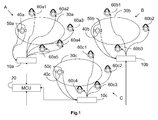
- the figure 1 represents an example of an audio conference system according to the invention.
- This system shows three conference stations 10a, 10b and 10c for three respective conference rooms or venues, A, B and C.
- a manikin head 40a is provided with a pair of binaural microphones 50a. These microphones are positioned on the manikin at the location of the left ear and the right ear of a fictional individual.
- the microphones are omnidirectional. They can capture sounds from all directions for a more natural rendering.
- These microphones are for example electrostatic type in order to obtain good sound results.
- Such microphones requiring power can advantageously be powered by a phantom power method from a preamplifier placed in the conference station.
- the conference table is illustrated in 30a. Around this table, five speakers are positioned, each equipped with a headset 60al, 60a2, ..., 60a5.
- the helmets are "open" type helmets that make it possible to hear the sounds locally. It is however more judicious to envisage in addition a local return of the ambience sensed by the microphones of the site. Thus, enhancing the sound of the participants in the local conference, allows a natural discussion between the participants of the same site. In order to avoid too much latency of the local return, it is preferable that it be provided in the local conference station rather than in the conference bridge.
- These helmets can be wireless headsets to facilitate the movements of speakers.
- the conference station is responsible for receiving the sounds received from the binaural microphones to process them if necessary and transmit them to the conference bridge. In return, it receives the signals of a spatialized audio scene of the conference bridge 20 and transmits these signals to the various speakers of the room, via their respective headphones. This conference station is described later with reference to the figure 2 .
- the other conference rooms B and C are similarly equipped for three people with headphones (60bl, 60b2, 60b3) in room B and four people with headphones (60c1, 60c2, 60c3, 60c4) in room C.
- the helmets can be replaced by mini speakers located near each person (on a chair backrest by example) or by a single pair of speakers located near the manikin head for example.
- a conference bridge 20 which may be located either in a communication network or in a conference station of the conference system, receives the various signals from the conference stations of the conference system.
- This conference bridge implements the steps of the method of the invention described with reference to the figure 4 .
- the spatialized audio scene resulting from this implementation of the method is then transmitted from the conference bridge to the different conference stations.
- a conference station 10a, 10b or 10c receives at input 110G and 110D, the signals from the two microphones 50 (a, b or c depending on the station concerned). It comprises a preamplifier 120 able to increase the level of the signals received while ensuring a good signal-to-noise ratio.
- the 110'G and 110'D signals at the output of the preamplifier enter a two-channel Analogue / Digital conversion module so as to convert the two sound signals into digital audio signals G and D. This converter must be able to keep as faithfully as possible , most of the information audible.
- An appropriate sampling frequency must therefore be chosen. For example, the sampling frequencies of 32 kHz, 44.1 kHz or 48 kHz give good results.
- This conversion module may have two converters so as to convert right and left signals in parallel.
- a module having a single converter clocked accordingly may also be provided.
- the left digital signals G and right D will be out of phase by half a sampling period, which may lead to a slight degradation of the spatialization.
- a communication module 140 connected to a communication network 150 exchanges the digital signals G and D for transmission and reception.
- This module can optionally perform a compression on these digital signals depending for example on the bandwidth available on the communication network.
- a two-channel encoder or two single channel encoders in parallel can be used and direct use of the PCM (Pulse Code Modulation) signals, that is, the sampled and quantized signals derived from converters of the module 130.
- PCM Pulse Code Modulation
- a perceptual encoder with loss of information can be used to decrease the rate.
- This communication module is in communication with the conference bridge 20 of the conference system to which it sends the digitized audio data G e and transmission.
- the signals of the hybrid spatialized audio scene are received by the communication module 140.
- This module decompresses, if necessary, the signals received with a suitable codec and converts the received signals into a two-channel signal before to transmit it to the conversion module 130.
- the dual channel signal enters the amplification module 125 which will duplicate this signal so as to provide it to the different headphones connected to this station. conference.
- conference stations 10b and 10c of the figure 1 is the same as that of the station 10a thus described.
- This conference bridge comprises a communication module 310 adapted to receive the two-channel streams G e emission and the different conference stations.
- the communication module of the conference bridge 20 receives the two-channel signal G e 1 and De 1 of the conference station 10a, the two-channel signal G e 2 and D e 2 of the conference station 10b and the dual channel signal G e 3 and D e 3 of the conference station 10c.
- the communication module receives the two-channel signals G e i and D e i for i ranging from 1 to N, where N is the number of conference stations of the conference system.
- the communication module 310 performs a suitable decompression of these signals.
- a processing module 320 receives as input the signals G e i and D e i . This module 320 is adapted to determine at least one processing function F i per conference site. So with reference to the figure 1 , a processing function F 1 is determined for the site A, a function F 2 is defined for the site B and a function F 3 is defined for the site C.
- the module 320 applies the respective function F 'to the two-channel signal from the corresponding conference site.
- this weighting function F ' is applied identically to both the right signal and the left signal of the two-channel signal of the corresponding site i.
- a hybrid spatial scene building module 330 is adapted to form the hybrid two-channel receive signal G r i and D r i for each of the conference stations.
- the module 330 sum the processed signals of the B and C sites to form the hybrid space scene.
- the superimposition of the ambiences thus makes it possible both to locate the speaker of the conference even remotely and to determine its membership of a conference site.
- the conference rooms are generally different and therefore provide a different "color" (a particular frequency response) that acts as a filter on the voice of the speaker. This makes it possible to differentiate a speaker from a site A, from a speaker of a site B for example.
- the digital reception signals G r i and D r i are then optionally coded before being transmitted.
- the function F ' may in a first embodiment be a simple gain.
- a gain adapted to the different sites can thus make it possible to equalize the levels of the different sites.
- the equalization of the levels between the signals coming from these sites is important.
- This gain is applied symmetrically to the right and left signals before summation to maintain the right / left balance of the natural scene and the accuracy of the spatialization effects.
- BOY WUT e i not D r k not ⁇ i ⁇ k F i .
- the application of a gain can also make it possible to manage the possible saturations without disturbing the effects of spatialization. In the case for example where many sites are connected, there may be saturation. In order to avoid this, it may be interesting to normalize the result of the sum and thus apply attenuation to some of the signals. This attenuation must also be applied in the same way on the left signals as on the right signals in order to keep the effects of the spatialization.
- the function F ' is a filter.
- a determination of one filter per site may enhance the "coloring" of one site relative to another in the hybrid spatial scene. For example, it may be interesting to make the distant sound scenes less realistic compared to local sound sources by applying a filter, or to compensate for a too strong natural color of the room.
- D r k not ⁇ i ⁇ k F i * D e i ( not ) with n the time index, F i a filter, and * the convolution product.
- the function F 'in a third embodiment may be a non-linear function.
- a non-linear function such as a dynamic compressor can be envisaged. This makes it possible to reduce the difference in perceived level between signals located above a certain threshold.
- BOY WUT e i not D r k not ⁇ i ⁇ k F i not .
- N is the length of the energy observation window.
- Another non-linear function may for example be the application of a noise reducer or an echo canceller. This can thus improve the perceived quality.
- An acoustic echo canceller provides hands-free listening on a terminal. It removes in the microphone signal sent to the correspondent, the signal broadcast by the speaker and filtered by the environment and then picked up by the microphone, so that the correspondent does not get along with a delay (echo phenomenon). This processing is generally based on the use of an adaptive filter placed between the signal sent to the loudspeaker and the microphone signal sent to the correspondent.
- This echo canceller can be implemented for example in the case where one or more speakers are placed in a conference room instead of the use of headphones by the listeners.
- a noise reducer serves to attenuate the environmental noise (background noise) that is supposed to be stationary. This treatment is generally based on a long-term estimate of noise characteristics, and a filtering adapted to these characteristics.
- a limiter locally attenuates the gain of a high level signal so that it is not clipped. Indeed, a clipped signal generates harmonics unpleasant to the ear.
- This processing is generally based on signal level monitoring, and attenuation when this level exceeds a certain threshold.
- the signal components to be modified from the left and right microphones are generally not identical. Indeed, in the case of a sound recording in non-coincident microphones (the capsules are not placed at the same point of the space) as is the case in the binaural sound, the sound from the speaker in the case of the echo canceller (respectively the noise to be suppressed in the case of the noise reducer, the level signal too high in the case of the limiter) reaches the first microphone with a delay and / or a level and / or a spectrum change different from the second microphone.
- the echo cancellation requires the left and right channels to be independently processed in order to optimize the result. This is possible in the method according to the invention by applying a different processing function on each of the channels.
- the processing parameters such as the echo cancellation (respectively the noise reduction or the limiter) must be calculated on the signal Left, or Right, or a matrix of both (typically the sum Left + Right), and these parameters must be applied symmetrically on the left and right channels, leading to suboptimal treatment on at least one of the two channels.
- This conference bridge as described may be independent of the conferencing system conference stations. It may in a particular embodiment be integrated in a conference station of the system.
- the conference bridge is for example a computer, a workstation or a communication terminal.
- X i and Y i are delay and intensity filters, then an additional participant is added to the hybrid spatial scene by amplitude / phase spatialization based on time and intensity differences between the signals. right and left.
- X i and Y i are HRTF filters, then an additional participant is added to the hybrid space scene through a binaural system.
- the two-channel audio signals received from these conference stations are then two-channel artificial audio signals.
- the participants of these sites can however take advantage of the hybrid space scene resulting from the method according to the invention, if they have a headset or at least one pair of speakers.
- the method comprises a first step E410 for receiving the two-channel transmission signals G e i and D e i from the different conference stations of the conference system.
- a step E420 for determining at least one processing function F 'per conference station is implemented.
- the processing functions are applied to the respective two-channel signals received.
- Step E440 then consists in constituting a hybrid dual channel signal per conference station. This step is performed by summing a portion of the dual-channel audio signals processed. For a given conference station, the processed signals summed are those from the N-1 other conference stations, where N is the number of conference stations of the conference system.
- the step E450 of transmission to the different conference stations of the hybrid dual-channel signal conference system thus constituted is then implemented. These different steps are implemented in a conference bridge as described with reference to the figure 3 .
- a stored computer program is in a memory of the conference bridge and / or stored on a storage medium intended to cooperate with a reader of the conference bridge and / or downloaded via a communication network.
- This program includes code instructions for implementing the steps of the method according to the invention, when said program is executed by a processor of the conference bridge.
Landscapes
- Engineering & Computer Science (AREA)
- Multimedia (AREA)
- Signal Processing (AREA)
- Computer Networks & Wireless Communication (AREA)
- Telephonic Communication Services (AREA)
- Stereophonic System (AREA)
Applications Claiming Priority (1)
| Application Number | Priority Date | Filing Date | Title |
|---|---|---|---|
| FR0756017 | 2007-06-26 |
Publications (3)
| Publication Number | Publication Date |
|---|---|
| EP2009891A2 true EP2009891A2 (de) | 2008-12-31 |
| EP2009891A3 EP2009891A3 (de) | 2011-12-14 |
| EP2009891B1 EP2009891B1 (de) | 2019-01-16 |
Family
ID=39135306
Family Applications (1)
| Application Number | Title | Priority Date | Filing Date |
|---|---|---|---|
| EP08158735.4A Active EP2009891B1 (de) | 2007-06-26 | 2008-06-23 | Übertragung eines Audiosignals in einem immersiven Audiokonferenzsystem |
Country Status (2)
| Country | Link |
|---|---|
| US (1) | US8515091B2 (de) |
| EP (1) | EP2009891B1 (de) |
Families Citing this family (8)
| Publication number | Priority date | Publication date | Assignee | Title |
|---|---|---|---|---|
| CN102270456B (zh) * | 2010-06-07 | 2012-11-21 | 华为终端有限公司 | 一种音频信号的混音处理方法及装置 |
| EP2829048B1 (de) | 2012-03-23 | 2017-12-27 | Dolby Laboratories Licensing Corporation | Platzierung von tonsignalen in einer 2d oder 3d-audiokonferenz |
| US9749473B2 (en) | 2012-03-23 | 2017-08-29 | Dolby Laboratories Licensing Corporation | Placement of talkers in 2D or 3D conference scene |
| EP2974253B1 (de) * | 2013-03-15 | 2019-05-08 | Dolby Laboratories Licensing Corporation | Normalisierung von schallfeldausrichtungen auf basis von auditorischer szenenanalyse |
| US9530426B1 (en) * | 2015-06-24 | 2016-12-27 | Microsoft Technology Licensing, Llc | Filtering sounds for conferencing applications |
| EP3688975B1 (de) * | 2017-09-26 | 2024-08-14 | Hewlett-Packard Development Company, L.P. | Identifikation von konferenzanrufteilnehmern |
| US12301748B2 (en) * | 2021-02-08 | 2025-05-13 | Samsung Electronics Co., Ltd. | System and method for simultaneous multi-call support capability on compatible audio devices |
| EP4362502A1 (de) * | 2022-10-25 | 2024-05-01 | Nokia Technologies Oy | Steuerung der lokalen wiedergabe von audio einer entfernten umgebung |
Citations (2)
| Publication number | Priority date | Publication date | Assignee | Title |
|---|---|---|---|---|
| US20050018039A1 (en) | 2003-07-08 | 2005-01-27 | Gonzalo Lucioni | Conference device and method for multi-point communication |
| US7012630B2 (en) | 1996-02-08 | 2006-03-14 | Verizon Services Corp. | Spatial sound conference system and apparatus |
Family Cites Families (6)
| Publication number | Priority date | Publication date | Assignee | Title |
|---|---|---|---|---|
| US6256394B1 (en) * | 1996-01-23 | 2001-07-03 | U.S. Philips Corporation | Transmission system for correlated signals |
| US5889843A (en) * | 1996-03-04 | 1999-03-30 | Interval Research Corporation | Methods and systems for creating a spatial auditory environment in an audio conference system |
| US6728221B1 (en) * | 1999-04-09 | 2004-04-27 | Siemens Information & Communication Networks, Inc. | Method and apparatus for efficiently utilizing conference bridge capacity |
| US6850496B1 (en) * | 2000-06-09 | 2005-02-01 | Cisco Technology, Inc. | Virtual conference room for voice conferencing |
| US7778206B2 (en) * | 2005-01-06 | 2010-08-17 | Cisco Technology, Inc. | Method and system for providing a conference service using speaker selection |
| US7920488B2 (en) * | 2005-03-15 | 2011-04-05 | Alcatel-Lucent Usa Inc. | Method and apparatus for establishing a distributed conference bridge |
-
2008
- 2008-06-23 EP EP08158735.4A patent/EP2009891B1/de active Active
- 2008-06-26 US US12/215,226 patent/US8515091B2/en active Active
Patent Citations (2)
| Publication number | Priority date | Publication date | Assignee | Title |
|---|---|---|---|---|
| US7012630B2 (en) | 1996-02-08 | 2006-03-14 | Verizon Services Corp. | Spatial sound conference system and apparatus |
| US20050018039A1 (en) | 2003-07-08 | 2005-01-27 | Gonzalo Lucioni | Conference device and method for multi-point communication |
Also Published As
| Publication number | Publication date |
|---|---|
| EP2009891B1 (de) | 2019-01-16 |
| US20090010441A1 (en) | 2009-01-08 |
| EP2009891A3 (de) | 2011-12-14 |
| US8515091B2 (en) | 2013-08-20 |
Similar Documents
| Publication | Publication Date | Title |
|---|---|---|
| Rafaely et al. | Spatial audio signal processing for binaural reproduction of recorded acoustic scenes–review and challenges | |
| US11037544B2 (en) | Sound output device, sound output method, and sound output system | |
| CN112312297B (zh) | 音频带宽减小 | |
| CN114402631B (zh) | 用于回放捕获的声音的方法和电子设备 | |
| EP2009891B1 (de) | Übertragung eines Audiosignals in einem immersiven Audiokonferenzsystem | |
| EP1600042B1 (de) | Verfahren zum bearbeiten komprimierter audiodaten zur räumlichen wiedergabe | |
| US9313599B2 (en) | Apparatus and method for multi-channel signal playback | |
| US9055371B2 (en) | Controllable playback system offering hierarchical playback options | |
| EP2042001B1 (de) | Binaurale spatialisierung kompressionsverschlüsselter tondaten | |
| EP3821333B1 (de) | Audio-vorrichtung, audio-verteilungssystem und verfahren zum betrieb davon | |
| WO2007110520A1 (fr) | Procede de synthese binaurale prenant en compte un effet de salle | |
| WO2007101958A2 (fr) | Optimisation d'une spatialisation sonore binaurale a partir d'un encodage multicanal | |
| FR3032586A1 (fr) | Appareil de reception et de lecture de signaux audio et systeme de sonorisation live | |
| JP2021192553A (ja) | カンファレンスのためのサブバンド空間処理およびクロストークキャンセルシステム | |
| EP3842923B1 (de) | Vernetzte box mit einer lan- und einer wpan-schnittstelle | |
| CN106576204A (zh) | 声场的辅助增大 | |
| FR3065137A1 (fr) | Procede de spatialisation sonore | |
| CN118972776A (zh) | 三维音频系统 | |
| WO1997027723A1 (fr) | Systeme de prise de son et d'ecoute pour equipement de tete en ambiance bruitee | |
| EP3025514B1 (de) | Klangverräumlichung mit raumwirkung | |
| JP6972858B2 (ja) | 音響処理装置、プログラム及び方法 | |
| CA2909580A1 (fr) | Procede de restitution sonore d'un signal numerique audio | |
| Chen et al. | Highly realistic audio spatialization for multiparty conferencing using headphones | |
| HK40081515A (en) | Sound effect processing method, sound effect processing device, terminal and storage medium | |
| WO2006075079A1 (fr) | Procede d’encodage de pistes audio d’un contenu multimedia destine a une diffusion sur terminaux mobiles |
Legal Events
| Date | Code | Title | Description |
|---|---|---|---|
| PUAI | Public reference made under article 153(3) epc to a published international application that has entered the european phase |
Free format text: ORIGINAL CODE: 0009012 |
|
| AK | Designated contracting states |
Kind code of ref document: A2 Designated state(s): AT BE BG CH CY CZ DE DK EE ES FI FR GB GR HR HU IE IS IT LI LT LU LV MC MT NL NO PL PT RO SE SI SK TR |
|
| AX | Request for extension of the european patent |
Extension state: AL BA MK RS |
|
| PUAL | Search report despatched |
Free format text: ORIGINAL CODE: 0009013 |
|
| AK | Designated contracting states |
Kind code of ref document: A3 Designated state(s): AT BE BG CH CY CZ DE DK EE ES FI FR GB GR HR HU IE IS IT LI LT LU LV MC MT NL NO PL PT RO SE SI SK TR |
|
| AX | Request for extension of the european patent |
Extension state: AL BA MK RS |
|
| RIC1 | Information provided on ipc code assigned before grant |
Ipc: H04M 3/56 20060101AFI20111110BHEP Ipc: H04L 29/06 20060101ALN20111110BHEP |
|
| 17P | Request for examination filed |
Effective date: 20120601 |
|
| AKX | Designation fees paid |
Designated state(s): AT BE BG CH CY CZ DE DK EE ES FI FR GB GR HR HU IE IS IT LI LT LU LV MC MT NL NO PL PT RO SE SI SK TR |
|
| RAP1 | Party data changed (applicant data changed or rights of an application transferred) |
Owner name: ORANGE |
|
| STAA | Information on the status of an ep patent application or granted ep patent |
Free format text: STATUS: EXAMINATION IS IN PROGRESS |
|
| 17Q | First examination report despatched |
Effective date: 20170419 |
|
| GRAP | Despatch of communication of intention to grant a patent |
Free format text: ORIGINAL CODE: EPIDOSNIGR1 |
|
| STAA | Information on the status of an ep patent application or granted ep patent |
Free format text: STATUS: GRANT OF PATENT IS INTENDED |
|
| RIC1 | Information provided on ipc code assigned before grant |
Ipc: H04L 29/06 20060101ALN20180821BHEP Ipc: H04M 3/56 20060101AFI20180821BHEP |
|
| INTG | Intention to grant announced |
Effective date: 20180917 |
|
| GRAS | Grant fee paid |
Free format text: ORIGINAL CODE: EPIDOSNIGR3 |
|
| GRAA | (expected) grant |
Free format text: ORIGINAL CODE: 0009210 |
|
| STAA | Information on the status of an ep patent application or granted ep patent |
Free format text: STATUS: THE PATENT HAS BEEN GRANTED |
|
| AK | Designated contracting states |
Kind code of ref document: B1 Designated state(s): AT BE BG CH CY CZ DE DK EE ES FI FR GB GR HR HU IE IS IT LI LT LU LV MC MT NL NO PL PT RO SE SI SK TR |
|
| REG | Reference to a national code |
Ref country code: GB Ref legal event code: FG4D Free format text: NOT ENGLISH |
|
| REG | Reference to a national code |
Ref country code: CH Ref legal event code: EP |
|
| REG | Reference to a national code |
Ref country code: IE Ref legal event code: FG4D Free format text: LANGUAGE OF EP DOCUMENT: FRENCH |
|
| REG | Reference to a national code |
Ref country code: DE Ref legal event code: R096 Ref document number: 602008058752 Country of ref document: DE |
|
| REG | Reference to a national code |
Ref country code: AT Ref legal event code: REF Ref document number: 1090614 Country of ref document: AT Kind code of ref document: T Effective date: 20190215 |
|
| REG | Reference to a national code |
Ref country code: NL Ref legal event code: MP Effective date: 20190116 |
|
| REG | Reference to a national code |
Ref country code: LT Ref legal event code: MG4D |
|
| PG25 | Lapsed in a contracting state [announced via postgrant information from national office to epo] |
Ref country code: NL Free format text: LAPSE BECAUSE OF FAILURE TO SUBMIT A TRANSLATION OF THE DESCRIPTION OR TO PAY THE FEE WITHIN THE PRESCRIBED TIME-LIMIT Effective date: 20190116 |
|
| REG | Reference to a national code |
Ref country code: AT Ref legal event code: MK05 Ref document number: 1090614 Country of ref document: AT Kind code of ref document: T Effective date: 20190116 |
|
| PG25 | Lapsed in a contracting state [announced via postgrant information from national office to epo] |
Ref country code: SE Free format text: LAPSE BECAUSE OF FAILURE TO SUBMIT A TRANSLATION OF THE DESCRIPTION OR TO PAY THE FEE WITHIN THE PRESCRIBED TIME-LIMIT Effective date: 20190116 Ref country code: LT Free format text: LAPSE BECAUSE OF FAILURE TO SUBMIT A TRANSLATION OF THE DESCRIPTION OR TO PAY THE FEE WITHIN THE PRESCRIBED TIME-LIMIT Effective date: 20190116 Ref country code: ES Free format text: LAPSE BECAUSE OF FAILURE TO SUBMIT A TRANSLATION OF THE DESCRIPTION OR TO PAY THE FEE WITHIN THE PRESCRIBED TIME-LIMIT Effective date: 20190116 Ref country code: PT Free format text: LAPSE BECAUSE OF FAILURE TO SUBMIT A TRANSLATION OF THE DESCRIPTION OR TO PAY THE FEE WITHIN THE PRESCRIBED TIME-LIMIT Effective date: 20190516 Ref country code: NO Free format text: LAPSE BECAUSE OF FAILURE TO SUBMIT A TRANSLATION OF THE DESCRIPTION OR TO PAY THE FEE WITHIN THE PRESCRIBED TIME-LIMIT Effective date: 20190416 Ref country code: PL Free format text: LAPSE BECAUSE OF FAILURE TO SUBMIT A TRANSLATION OF THE DESCRIPTION OR TO PAY THE FEE WITHIN THE PRESCRIBED TIME-LIMIT Effective date: 20190116 Ref country code: FI Free format text: LAPSE BECAUSE OF FAILURE TO SUBMIT A TRANSLATION OF THE DESCRIPTION OR TO PAY THE FEE WITHIN THE PRESCRIBED TIME-LIMIT Effective date: 20190116 |
|
| PG25 | Lapsed in a contracting state [announced via postgrant information from national office to epo] |
Ref country code: IS Free format text: LAPSE BECAUSE OF FAILURE TO SUBMIT A TRANSLATION OF THE DESCRIPTION OR TO PAY THE FEE WITHIN THE PRESCRIBED TIME-LIMIT Effective date: 20190516 Ref country code: BG Free format text: LAPSE BECAUSE OF FAILURE TO SUBMIT A TRANSLATION OF THE DESCRIPTION OR TO PAY THE FEE WITHIN THE PRESCRIBED TIME-LIMIT Effective date: 20190416 Ref country code: HR Free format text: LAPSE BECAUSE OF FAILURE TO SUBMIT A TRANSLATION OF THE DESCRIPTION OR TO PAY THE FEE WITHIN THE PRESCRIBED TIME-LIMIT Effective date: 20190116 Ref country code: LV Free format text: LAPSE BECAUSE OF FAILURE TO SUBMIT A TRANSLATION OF THE DESCRIPTION OR TO PAY THE FEE WITHIN THE PRESCRIBED TIME-LIMIT Effective date: 20190116 Ref country code: GR Free format text: LAPSE BECAUSE OF FAILURE TO SUBMIT A TRANSLATION OF THE DESCRIPTION OR TO PAY THE FEE WITHIN THE PRESCRIBED TIME-LIMIT Effective date: 20190417 |
|
| REG | Reference to a national code |
Ref country code: DE Ref legal event code: R097 Ref document number: 602008058752 Country of ref document: DE |
|
| PG25 | Lapsed in a contracting state [announced via postgrant information from national office to epo] |
Ref country code: IT Free format text: LAPSE BECAUSE OF FAILURE TO SUBMIT A TRANSLATION OF THE DESCRIPTION OR TO PAY THE FEE WITHIN THE PRESCRIBED TIME-LIMIT Effective date: 20190116 Ref country code: DK Free format text: LAPSE BECAUSE OF FAILURE TO SUBMIT A TRANSLATION OF THE DESCRIPTION OR TO PAY THE FEE WITHIN THE PRESCRIBED TIME-LIMIT Effective date: 20190116 Ref country code: SK Free format text: LAPSE BECAUSE OF FAILURE TO SUBMIT A TRANSLATION OF THE DESCRIPTION OR TO PAY THE FEE WITHIN THE PRESCRIBED TIME-LIMIT Effective date: 20190116 Ref country code: AT Free format text: LAPSE BECAUSE OF FAILURE TO SUBMIT A TRANSLATION OF THE DESCRIPTION OR TO PAY THE FEE WITHIN THE PRESCRIBED TIME-LIMIT Effective date: 20190116 Ref country code: EE Free format text: LAPSE BECAUSE OF FAILURE TO SUBMIT A TRANSLATION OF THE DESCRIPTION OR TO PAY THE FEE WITHIN THE PRESCRIBED TIME-LIMIT Effective date: 20190116 Ref country code: RO Free format text: LAPSE BECAUSE OF FAILURE TO SUBMIT A TRANSLATION OF THE DESCRIPTION OR TO PAY THE FEE WITHIN THE PRESCRIBED TIME-LIMIT Effective date: 20190116 Ref country code: CZ Free format text: LAPSE BECAUSE OF FAILURE TO SUBMIT A TRANSLATION OF THE DESCRIPTION OR TO PAY THE FEE WITHIN THE PRESCRIBED TIME-LIMIT Effective date: 20190116 |
|
| PLBE | No opposition filed within time limit |
Free format text: ORIGINAL CODE: 0009261 |
|
| STAA | Information on the status of an ep patent application or granted ep patent |
Free format text: STATUS: NO OPPOSITION FILED WITHIN TIME LIMIT |
|
| 26N | No opposition filed |
Effective date: 20191017 |
|
| PG25 | Lapsed in a contracting state [announced via postgrant information from national office to epo] |
Ref country code: MC Free format text: LAPSE BECAUSE OF FAILURE TO SUBMIT A TRANSLATION OF THE DESCRIPTION OR TO PAY THE FEE WITHIN THE PRESCRIBED TIME-LIMIT Effective date: 20190116 |
|
| REG | Reference to a national code |
Ref country code: CH Ref legal event code: PL |
|
| PG25 | Lapsed in a contracting state [announced via postgrant information from national office to epo] |
Ref country code: SI Free format text: LAPSE BECAUSE OF FAILURE TO SUBMIT A TRANSLATION OF THE DESCRIPTION OR TO PAY THE FEE WITHIN THE PRESCRIBED TIME-LIMIT Effective date: 20190116 |
|
| REG | Reference to a national code |
Ref country code: BE Ref legal event code: MM Effective date: 20190630 |
|
| PG25 | Lapsed in a contracting state [announced via postgrant information from national office to epo] |
Ref country code: TR Free format text: LAPSE BECAUSE OF FAILURE TO SUBMIT A TRANSLATION OF THE DESCRIPTION OR TO PAY THE FEE WITHIN THE PRESCRIBED TIME-LIMIT Effective date: 20190116 |
|
| PG25 | Lapsed in a contracting state [announced via postgrant information from national office to epo] |
Ref country code: IE Free format text: LAPSE BECAUSE OF NON-PAYMENT OF DUE FEES Effective date: 20190623 |
|
| PG25 | Lapsed in a contracting state [announced via postgrant information from national office to epo] |
Ref country code: CH Free format text: LAPSE BECAUSE OF NON-PAYMENT OF DUE FEES Effective date: 20190630 Ref country code: LI Free format text: LAPSE BECAUSE OF NON-PAYMENT OF DUE FEES Effective date: 20190630 Ref country code: BE Free format text: LAPSE BECAUSE OF NON-PAYMENT OF DUE FEES Effective date: 20190630 Ref country code: LU Free format text: LAPSE BECAUSE OF NON-PAYMENT OF DUE FEES Effective date: 20190623 |
|
| PG25 | Lapsed in a contracting state [announced via postgrant information from national office to epo] |
Ref country code: CY Free format text: LAPSE BECAUSE OF FAILURE TO SUBMIT A TRANSLATION OF THE DESCRIPTION OR TO PAY THE FEE WITHIN THE PRESCRIBED TIME-LIMIT Effective date: 20190116 |
|
| PG25 | Lapsed in a contracting state [announced via postgrant information from national office to epo] |
Ref country code: MT Free format text: LAPSE BECAUSE OF FAILURE TO SUBMIT A TRANSLATION OF THE DESCRIPTION OR TO PAY THE FEE WITHIN THE PRESCRIBED TIME-LIMIT Effective date: 20190116 Ref country code: HU Free format text: LAPSE BECAUSE OF FAILURE TO SUBMIT A TRANSLATION OF THE DESCRIPTION OR TO PAY THE FEE WITHIN THE PRESCRIBED TIME-LIMIT; INVALID AB INITIO Effective date: 20080623 |
|
| PGFP | Annual fee paid to national office [announced via postgrant information from national office to epo] |
Ref country code: DE Payment date: 20250520 Year of fee payment: 18 |
|
| PGFP | Annual fee paid to national office [announced via postgrant information from national office to epo] |
Ref country code: GB Payment date: 20250520 Year of fee payment: 18 |
|
| PGFP | Annual fee paid to national office [announced via postgrant information from national office to epo] |
Ref country code: FR Payment date: 20250520 Year of fee payment: 18 |