EP2009929A2 - Adaptable screen adjustment for non-vertical viewing angles in display systems - Google Patents
Adaptable screen adjustment for non-vertical viewing angles in display systems Download PDFInfo
- Publication number
- EP2009929A2 EP2009929A2 EP08104430A EP08104430A EP2009929A2 EP 2009929 A2 EP2009929 A2 EP 2009929A2 EP 08104430 A EP08104430 A EP 08104430A EP 08104430 A EP08104430 A EP 08104430A EP 2009929 A2 EP2009929 A2 EP 2009929A2
- Authority
- EP
- European Patent Office
- Prior art keywords
- user
- image
- remote controller
- screen
- parameters
- Prior art date
- Legal status (The legal status is an assumption and is not a legal conclusion. Google has not performed a legal analysis and makes no representation as to the accuracy of the status listed.)
- Ceased
Links
Images

Classifications
-
- G—PHYSICS
- G09—EDUCATION; CRYPTOGRAPHY; DISPLAY; ADVERTISING; SEALS
- G09G—ARRANGEMENTS OR CIRCUITS FOR CONTROL OF INDICATING DEVICES USING STATIC MEANS TO PRESENT VARIABLE INFORMATION
- G09G3/00—Control arrangements or circuits, of interest only in connection with visual indicators other than cathode-ray tubes
- G09G3/20—Control arrangements or circuits, of interest only in connection with visual indicators other than cathode-ray tubes for presentation of an assembly of a number of characters, e.g. a page, by composing the assembly by combination of individual elements arranged in a matrix no fixed position being assigned to or needed to be assigned to the individual characters or partial characters
- G09G3/34—Control arrangements or circuits, of interest only in connection with visual indicators other than cathode-ray tubes for presentation of an assembly of a number of characters, e.g. a page, by composing the assembly by combination of individual elements arranged in a matrix no fixed position being assigned to or needed to be assigned to the individual characters or partial characters by control of light from an independent source
- G09G3/36—Control arrangements or circuits, of interest only in connection with visual indicators other than cathode-ray tubes for presentation of an assembly of a number of characters, e.g. a page, by composing the assembly by combination of individual elements arranged in a matrix no fixed position being assigned to or needed to be assigned to the individual characters or partial characters by control of light from an independent source using liquid crystals
- G09G3/3611—Control of matrices with row and column drivers
-
- H—ELECTRICITY
- H04—ELECTRIC COMMUNICATION TECHNIQUE
- H04N—PICTORIAL COMMUNICATION, e.g. TELEVISION
- H04N21/00—Selective content distribution, e.g. interactive television or video on demand [VOD]
- H04N21/40—Client devices specifically adapted for the reception of or interaction with content, e.g. set-top-box [STB]; Operations thereof
- H04N21/41—Structure of client; Structure of client peripherals
- H04N21/422—Input-only peripherals, i.e. input devices connected to specially adapted client devices, e.g. global positioning system [GPS]
- H04N21/42202—Input-only peripherals, i.e. input devices connected to specially adapted client devices, e.g. global positioning system [GPS] environmental sensors, e.g. for detecting temperature, luminosity, pressure, earthquakes
-
- H—ELECTRICITY
- H04—ELECTRIC COMMUNICATION TECHNIQUE
- H04N—PICTORIAL COMMUNICATION, e.g. TELEVISION
- H04N21/00—Selective content distribution, e.g. interactive television or video on demand [VOD]
- H04N21/40—Client devices specifically adapted for the reception of or interaction with content, e.g. set-top-box [STB]; Operations thereof
- H04N21/41—Structure of client; Structure of client peripherals
- H04N21/422—Input-only peripherals, i.e. input devices connected to specially adapted client devices, e.g. global positioning system [GPS]
- H04N21/42204—User interfaces specially adapted for controlling a client device through a remote control device; Remote control devices therefor
-
- H—ELECTRICITY
- H04—ELECTRIC COMMUNICATION TECHNIQUE
- H04N—PICTORIAL COMMUNICATION, e.g. TELEVISION
- H04N21/00—Selective content distribution, e.g. interactive television or video on demand [VOD]
- H04N21/40—Client devices specifically adapted for the reception of or interaction with content, e.g. set-top-box [STB]; Operations thereof
- H04N21/43—Processing of content or additional data, e.g. demultiplexing additional data from a digital video stream; Elementary client operations, e.g. monitoring of home network or synchronising decoder's clock; Client middleware
- H04N21/431—Generation of visual interfaces for content selection or interaction; Content or additional data rendering
- H04N21/4318—Generation of visual interfaces for content selection or interaction; Content or additional data rendering by altering the content in the rendering process, e.g. blanking, blurring or masking an image region
-
- H—ELECTRICITY
- H04—ELECTRIC COMMUNICATION TECHNIQUE
- H04N—PICTORIAL COMMUNICATION, e.g. TELEVISION
- H04N21/00—Selective content distribution, e.g. interactive television or video on demand [VOD]
- H04N21/40—Client devices specifically adapted for the reception of or interaction with content, e.g. set-top-box [STB]; Operations thereof
- H04N21/43—Processing of content or additional data, e.g. demultiplexing additional data from a digital video stream; Elementary client operations, e.g. monitoring of home network or synchronising decoder's clock; Client middleware
- H04N21/442—Monitoring of processes or resources, e.g. detecting the failure of a recording device, monitoring the downstream bandwidth, the number of times a movie has been viewed, the storage space available from the internal hard disk
- H04N21/44213—Monitoring of end-user related data
- H04N21/44218—Detecting physical presence or behaviour of the user, e.g. using sensors to detect if the user is leaving the room or changes his face expression during a TV programme
-
- H—ELECTRICITY
- H04—ELECTRIC COMMUNICATION TECHNIQUE
- H04N—PICTORIAL COMMUNICATION, e.g. TELEVISION
- H04N5/00—Details of television systems
- H04N5/44—Receiver circuitry for the reception of television signals according to analogue transmission standards
- H04N5/57—Control of contrast or brightness
-
- H—ELECTRICITY
- H04—ELECTRIC COMMUNICATION TECHNIQUE
- H04N—PICTORIAL COMMUNICATION, e.g. TELEVISION
- H04N9/00—Details of colour television systems
- H04N9/12—Picture reproducers
- H04N9/31—Projection devices for colour picture display, e.g. using electronic spatial light modulators [ESLM]
- H04N9/3179—Video signal processing therefor
- H04N9/3185—Geometric adjustment, e.g. keystone or convergence
-
- G—PHYSICS
- G09—EDUCATION; CRYPTOGRAPHY; DISPLAY; ADVERTISING; SEALS
- G09G—ARRANGEMENTS OR CIRCUITS FOR CONTROL OF INDICATING DEVICES USING STATIC MEANS TO PRESENT VARIABLE INFORMATION
- G09G2320/00—Control of display operating conditions
- G09G2320/02—Improving the quality of display appearance
- G09G2320/028—Improving the quality of display appearance by changing the viewing angle properties, e.g. widening the viewing angle, adapting the viewing angle to the view direction
-
- G—PHYSICS
- G09—EDUCATION; CRYPTOGRAPHY; DISPLAY; ADVERTISING; SEALS
- G09G—ARRANGEMENTS OR CIRCUITS FOR CONTROL OF INDICATING DEVICES USING STATIC MEANS TO PRESENT VARIABLE INFORMATION
- G09G2320/00—Control of display operating conditions
- G09G2320/06—Adjustment of display parameters
- G09G2320/0626—Adjustment of display parameters for control of overall brightness
-
- G—PHYSICS
- G09—EDUCATION; CRYPTOGRAPHY; DISPLAY; ADVERTISING; SEALS
- G09G—ARRANGEMENTS OR CIRCUITS FOR CONTROL OF INDICATING DEVICES USING STATIC MEANS TO PRESENT VARIABLE INFORMATION
- G09G2320/00—Control of display operating conditions
- G09G2320/06—Adjustment of display parameters
- G09G2320/066—Adjustment of display parameters for control of contrast
Definitions
- Current invention relates to a system and method that provide local improvement on the image according to the position of the user in three dimensional space to improve the view quality.
- LCD Liquid Crystal Display
- CRT Cathode Ray Tube
- Some of the viewing parameters can not be changed as can be adapted by the user and some predefined values related to these parameters are stored in the TV set even when the user changed his place.
- the object of this invention is to produce a user friendly TV set that has adaptable screen parameters allowing improvement of local - based image quality according to the position of user in three dimensional space.
- Image adjustments such as contrast and brightness should for example increased or decreased according to the position of the user in order to improve the perceived image quality, and they should be increased if the user is in a far position from the TV set, and softer and less contrasted images should be provided to the users staying closer to the TV set.
- the optional configuration of the current invention comprises a combination of a remote controller (this remote controller can run the TV set), sensors which constitute a sensor mechanism included in the TV set (receives the signal or signals coming from the remote controller) and a TV set image adjustment mechanism that can perform local - based image improvement according to the position of the user.
- the user first may determine how to perform color adjustment according to his position by selecting among the pre-loaded options or may use pre-loaded settings, for example the user may choose softer image quality when viewing from a closer location or sharper image quality when viewing from a further location or may accept the pre-loaded standard settings before making any selection.
- the user makes the color adjustment of the current invention according to his three dimensional position by pushing a pre-defined button on the remote controller.
- the said signal is detected by the sensors (1, 2, 3) included in the sensor mechanism on the system.
- a comparator mechanism in the current invention compares the amplitudes of the RF signals received by the sensors (1, 2, 3).
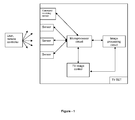
- Figure 1 General block diagram of the system of this invention is given in Figure 1 .
- the current invention calculates the position of the user and this procedure is performed logically according to this idea: the signal power rates received by the sensors (1, 2, 3) are compared with each other for the same transmitted signal and it is assumed that the user is closer to the sensor detecting the biggest power level and further to the sensor detecting the smaller power level.
- the reason for selecting at least three sensors is to create a three dimensional space to determine the position of the user not only vertically but also to determine horizontally at the same time.
- RF transmitters may be on TV side and RF receivers may be on remote controller side.
- the current invention estimates the position of the user and refers to a previously created reference table to make the image adjustment according to the user's position.
- These reference tables may be pre-loaded into the system or may be created before any adjustment is made on the image according to the selection of the user or determined distance or position of the user, by this way instead of creating different reference tables for each user selection or angular position, reference tables may be created according to the parameters entered at that moment. Said reference table is previously created in the system in order to increase system's effectiveness.
- the other parameters related to sharpness, saturity and distance may be changed to suit the updated situation and in this context while the part of the screen closer to the user displays softer and less contrasted images, the part of the screen further to the user may utilize sharper and more contrasted images, however it should be noted that this given image parameters are exemplary and all color adjustments allowing adaptation on the screen can be made in the context of this patent. Determination of the user's position in three dimensional space lets finding the distance of the user as well as the angular position of the user relative to TV set, by this way the invention may be used not only for angular image quality but also for the distance of any user to the TV set or for any position.
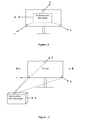
- the inactive viewing angle of the user is drawn in Figure 2 ; here the view angle of the user is aligned with television screen and it is evaluated that maximum image quality is perceived.
- FIG. 3 The position of the user relative to TV screen is shown in Figure 3 ; here, the user is located on the left and below the television set and makes a local - based image improvement on the TV screen by pushing a button on the remote controller from this distance.
- Figure 4 shows the top view of the situation shown in Figure 3 ; according to this when the relative distance is considered in one dimension, in fact there is a relative distance between the selected two "A” and “B” points according to the view angle of the user and point “B” is at a constant distance given approximately by (screen width)*(sin ⁇ ) relatively from point "A” to the location of the user.
- This relation is based on the assumption that both "A", “B” and user's position are aligned, otherwise to find the exact relative distance between "A” and “B” points, it is possible to make a more complex analysis in three dimensional space.
- the remote controller assumed to be in the same direction with the view angle of the user sends an RF signal and these signals can be received by all sensors (1, 2 and 3) drawn in Figures 2 and 3 .
- the signals received by the sensors (1, 2 and 3) are compared to each other and as shown in Figure 5 , the calculated RF powers of the sensors referenced by "1, 2 and 3" should be in 1 > 2 > 3 order, because while sensor "1" is the closest sensor to the user sensor “3" is the farthest sensor to the user.
- required image adjustment values are compared to a previously created reference table and these image adjustments are performed.
- All image quality parameters can be changed to be adapted for the calculated position of the user in three dimensional space, however by this example, by assuming that the users prefer more contrasted and sharper colors as getting farther from the screen, owing to the properties of the present invention, after estimation of the position of the user on left and downward directions, the image parameters that are valid on whole screen in Figure 4 are changed to adapt this situation.
- the image parameters that are valid on whole screen in Figure 4 are changed to adapt this situation.
- the sharpness values of the marked local areas (6, 7, 8) are changed as 8 > 7 > 6 and the contrast values are changed as 8 > 7 > 6.
- the local adapted color adjustment of the user can be performed not only for left and right user positions but also for high and low user positions, because the position of the user relative to the points on the screen will be different and it will have to be adjusted according to this.
- the RF signals transmitted from the remote controller are detected by the sensors included in the sensor mechanism and positioned on different regions of the screen.
- the relative position of the user to the screen is defined by evaluating these received signal values by a micro processor.
- Micro processor circuit controls the color adjustment process based on the preferences of the user.
- a local image adjustment is made on the screen based on the evaluated image setting preferences of the user and determined position of the user. This procedure is performed by the cooperative work of the micro processor and the integrated responsible from the video settings.
- the color values of each pixel in the LCD television sets can be changed, and owing to this invention on different regions of the screen, different color adjustments may be performed automatically according to the position of the user.
- the TV set manufacturer may decide which adjustments to do on which regions and how much to do them, or allow the user to choose one or more of the options by providing lots of options to the user. For example, as there can be 3 regions (6, 7, 8) on the screen where there are different image adjustments like the one in Figure 5 , the number of these regions can be increased or decreased by the manufacturer, or by asking the user how many regions should be on the TV set and how he wants the image settings to change according to the position, the image settings can be changed by considering answers of the user according to the position of the user.
- the selections of the user are stored in a memory by the microprocessor, and when the user starts to use the invention the image parameter changes that the user asked according to the position of the user on more than one position on the TV set.
- the image adjustments are made according to 3 regions defined on the screen determined by the TV set manufacturer as it will be softer on the regions close to the user and sharper on the regions far from the user. It should be noted that the number of the regions and the image parameters in the preferred embodiment of the invention should not limit the invention, and different image parameters are applied on one or more different regions on the TV screen according to the three dimensional position of the user, the quality of the image perceived by the user is improved.
- the present invention is applicable not only to LCD television sets but also to CRT television sets and other screen systems.
Landscapes
- Engineering & Computer Science (AREA)
- Signal Processing (AREA)
- Multimedia (AREA)
- General Health & Medical Sciences (AREA)
- Social Psychology (AREA)
- Physics & Mathematics (AREA)
- Health & Medical Sciences (AREA)
- Ecology (AREA)
- Remote Sensing (AREA)
- Business, Economics & Management (AREA)
- Life Sciences & Earth Sciences (AREA)
- Biodiversity & Conservation Biology (AREA)
- Databases & Information Systems (AREA)
- Emergency Management (AREA)
- Environmental & Geological Engineering (AREA)
- Environmental Sciences (AREA)
- Human Computer Interaction (AREA)
- Computer Networks & Wireless Communication (AREA)
- Geometry (AREA)
- Chemical & Material Sciences (AREA)
- Crystallography & Structural Chemistry (AREA)
- Computer Hardware Design (AREA)
- General Physics & Mathematics (AREA)
- Theoretical Computer Science (AREA)
- Liquid Crystal Display Device Control (AREA)
- Controls And Circuits For Display Device (AREA)
- Transforming Electric Information Into Light Information (AREA)
Abstract
Description
- Current invention relates to a system and method that provide local improvement on the image according to the position of the user in three dimensional space to improve the view quality.
- In the first days of the screen technology, viewers were seriously suffering from the view quality loss they encountered when they changed position. In the first LCD (Liquid Crystal Display) screen technologies, viewing angle was less than 140 degrees and perceived view quality was limited on every direction except vertical viewing angle.
- Even though the LCD (Liquid Crystal Display) devices provide some advantages in terms of power consumption and weight when compared to CRT (Cathode Ray Tube) screen devices, the perceived picture of LCD screens are affected by viewing angle to a large extent.
- Some of the viewing parameters can not be changed as can be adapted by the user and some predefined values related to these parameters are stored in the TV set even when the user changed his place.
- In the patent document
US5488434 , a method for adjusting the color values and the other parameters according to position of the user is described. According to this system included in the prior art, the user defines his position relative to the mechanism of TV stand in a first step and this invention improves the perceived image quality by changing the screen parameters according to this defined distance and in this context it utilizes a radio frequency (RF) transmitter and evaluates the position of the user by using the calculated RF signal value and other factors. - When compared to other systems in the prior art, the users are asked to define their position relative to the TV system and even though the position of the user is correctly estimated, the color adjustments are performed all over the screen system and in this context, some things are ignored such as changes in user's position, user's getting closer to a specific side of screen system and therefore getting further from the other side.
- The object of this invention is to produce a user friendly TV set that has adaptable screen parameters allowing improvement of local - based image quality according to the position of user in three dimensional space.
-
-
Figure 1 is a general view of the system according to current invention. -
Figure 2 shows the preferred viewing angle of the user relative to TV screen interface. -
Figure 3 shows the TV set with a sample viewing angle. -
Figure 4 shows the position of the user and different points on view screen. -
Figure 5 shows the position of the user and the adaptable color adjustment performed according to this position. - The parts in the figures are given reference numbers and these numbers are described below.
- Sensors that can receive RF signals (1), (2), (3)
- The preferred viewing angle of the user (4)
- The position and the viewing angle of the user (5)
- Local points randomly defined on the screen (6), (7), (8)
- Corner points of the screen (A), (B)
- According to the nature of screen devices, and especially in LCD television sets, as it is faced when the users try to watch the screen from sides, side angle viewing problems emerge. Image adjustments such as contrast and brightness should for example increased or decreased according to the position of the user in order to improve the perceived image quality, and they should be increased if the user is in a far position from the TV set, and softer and less contrasted images should be provided to the users staying closer to the TV set.
- The optional configuration of the current invention comprises a combination of a remote controller (this remote controller can run the TV set), sensors which constitute a sensor mechanism included in the TV set (receives the signal or signals coming from the remote controller) and a TV set image adjustment mechanism that can perform local - based image improvement according to the position of the user.
- The user first may determine how to perform color adjustment according to his position by selecting among the pre-loaded options or may use pre-loaded settings, for example the user may choose softer image quality when viewing from a closer location or sharper image quality when viewing from a further location or may accept the pre-loaded standard settings before making any selection. During normal use of screen system, the user makes the color adjustment of the current invention according to his three dimensional position by pushing a pre-defined button on the remote controller. In the preferred configuration of the invention, after an RF signal is sent to the screen system the said signal is detected by the sensors (1, 2, 3) included in the sensor mechanism on the system. A comparator mechanism in the current invention compares the amplitudes of the RF signals received by the sensors (1, 2, 3). General block diagram of the system of this invention is given in
Figure 1 . - According to comparison of the amplitudes of the RF signals received by the sensors (1, 2, 3), the current invention calculates the position of the user and this procedure is performed logically according to this idea: the signal power rates received by the sensors (1, 2, 3) are compared with each other for the same transmitted signal and it is assumed that the user is closer to the sensor detecting the biggest power level and further to the sensor detecting the smaller power level. The reason for selecting at least three sensors is to create a three dimensional space to determine the position of the user not only vertically but also to determine horizontally at the same time.
- The reason for using the transmitters and sensors that can transmit and receive RF signals is that: Even though most of the TV sets utilize infrared communication systems (such as RC5), it is almost impossible to evaluate the signal power in infrared communication systems and similarly it becomes very difficult to determine the position of the user. It is possible to use any transmitter - receiver combination that can detect the position of the user in three dimensional space in the context of present invention, in this scope RF transmitters may be on TV side and RF receivers may be on remote controller side.
- After the comparison of power levels received by the sensors (1, 2, 3), the current invention estimates the position of the user and refers to a previously created reference table to make the image adjustment according to the user's position. These reference tables may be pre-loaded into the system or may be created before any adjustment is made on the image according to the selection of the user or determined distance or position of the user, by this way instead of creating different reference tables for each user selection or angular position, reference tables may be created according to the parameters entered at that moment. Said reference table is previously created in the system in order to increase system's effectiveness. By determining the position of the user, the other parameters related to sharpness, saturity and distance may be changed to suit the updated situation and in this context while the part of the screen closer to the user displays softer and less contrasted images, the part of the screen further to the user may utilize sharper and more contrasted images, however it should be noted that this given image parameters are exemplary and all color adjustments allowing adaptation on the screen can be made in the context of this patent. Determination of the user's position in three dimensional space lets finding the distance of the user as well as the angular position of the user relative to TV set, by this way the invention may be used not only for angular image quality but also for the distance of any user to the TV set or for any position.
- The inactive viewing angle of the user is drawn in
Figure 2 ; here the view angle of the user is aligned with television screen and it is evaluated that maximum image quality is perceived. - Most of the image quality parameters such as sharpness and contrast values in TV sets are set for the normal distance values (i.e. 1 meter) assumed that the user would watch the TV set from a constant distance and view angle (mostly vertical angle); but for the properties of the present invention, the angular position and distance value of the user are taken into consideration by local - based increment of the image parameters.
- The position of the user relative to TV screen is shown in
Figure 3 ; here, the user is located on the left and below the television set and makes a local - based image improvement on the TV screen by pushing a button on the remote controller from this distance. - By the two opposite points indicated on the TV screen in
Figure 3 , for a user watching the television in an angle, it can be clearly seen inFigure 4 that the point marked by "A" is closer to him than the point marked by "B".Figure 4 shows the top view of the situation shown inFigure 3 ; according to this when the relative distance is considered in one dimension, in fact there is a relative distance between the selected two "A" and "B" points according to the view angle of the user and point "B" is at a constant distance given approximately by (screen width)*(sinα) relatively from point "A" to the location of the user. This relation is based on the assumption that both "A", "B" and user's position are aligned, otherwise to find the exact relative distance between "A" and "B" points, it is possible to make a more complex analysis in three dimensional space. - For example, in case that the screen is viewed indirectly with 37 degrees from the left relative to a user, for the constant value given above and for a screen width of 100 cm, the opposite sides of the screen ("A" and "B" in this example) are located at a relative distance of approximately 60 cm [(1 00cm)*(sin37)=60cm] to the view point of the user.
- According to the properties of the present invention, the remote controller assumed to be in the same direction with the view angle of the user sends an RF signal and these signals can be received by all sensors (1, 2 and 3) drawn in
Figures 2 and 3 . The signals received by the sensors (1, 2 and 3) are compared to each other and as shown inFigure 5 , the calculated RF powers of the sensors referenced by "1, 2 and 3" should be in 1 > 2 > 3 order, because while sensor "1" is the closest sensor to the user sensor "3" is the farthest sensor to the user. After evaluation powers of the RF signals received by the sensors (1, 2 and 3), required image adjustment values are compared to a previously created reference table and these image adjustments are performed. - All image quality parameters can be changed to be adapted for the calculated position of the user in three dimensional space, however by this example, by assuming that the users prefer more contrasted and sharper colors as getting farther from the screen, owing to the properties of the present invention, after estimation of the position of the user on left and downward directions, the image parameters that are valid on whole screen in
Figure 4 are changed to adapt this situation. In a specific example shown inFigures 3 ,4 and 5 , by comparing the power levels received by the sensors, it is calculated that the position of the user is left and below, and sharpness and contrast values are changed to adapt this situation, for example the sharpness values of the marked local areas (6, 7, 8) are changed as 8 > 7 > 6 and the contrast values are changed as 8 > 7 > 6. The reason for such a selection is that the point "8" is the farthest and point "6" is the closest point to the user. According to the view preferences of the user and to angular position in three dimensional space, it should be noted that it is possible to make every kind of color adjustments. - By determining the position of the user in three dimensional space, the local adapted color adjustment of the user can be performed not only for left and right user positions but also for high and low user positions, because the position of the user relative to the points on the screen will be different and it will have to be adjusted according to this.
- In a preferred embodiment of the present invention, the RF signals transmitted from the remote controller are detected by the sensors included in the sensor mechanism and positioned on different regions of the screen. The relative position of the user to the screen is defined by evaluating these received signal values by a micro processor. Micro processor circuit, at the same time, controls the color adjustment process based on the preferences of the user. A local image adjustment is made on the screen based on the evaluated image setting preferences of the user and determined position of the user. This procedure is performed by the cooperative work of the micro processor and the integrated responsible from the video settings. The color values of each pixel in the LCD television sets can be changed, and owing to this invention on different regions of the screen, different color adjustments may be performed automatically according to the position of the user. The TV set manufacturer may decide which adjustments to do on which regions and how much to do them, or allow the user to choose one or more of the options by providing lots of options to the user. For example, as there can be 3 regions (6, 7, 8) on the screen where there are different image adjustments like the one in
Figure 5 , the number of these regions can be increased or decreased by the manufacturer, or by asking the user how many regions should be on the TV set and how he wants the image settings to change according to the position, the image settings can be changed by considering answers of the user according to the position of the user. The selections of the user are stored in a memory by the microprocessor, and when the user starts to use the invention the image parameter changes that the user asked according to the position of the user on more than one position on the TV set. If the user makes no selection, in the preferred embodiment of the invention, the image adjustments are made according to 3 regions defined on the screen determined by the TV set manufacturer as it will be softer on the regions close to the user and sharper on the regions far from the user. It should be noted that the number of the regions and the image parameters in the preferred embodiment of the invention should not limit the invention, and different image parameters are applied on one or more different regions on the TV screen according to the three dimensional position of the user, the quality of the image perceived by the user is improved. - The present invention is applicable not only to LCD television sets but also to CRT television sets and other screen systems.
Claims (6)
- A system for display systems to determine the position of the user relative to TV set and to make image adjustments, characterized in that it comprises;- a remote controller device that can transmit signals;- a sensor mechanism to receive the signals transmitted by the said remote controller device;- a processor circuit to determine the position of the user by evaluation of the data received by the said sensor mechanism;- the said processor circuit controlling the image adjustment process;- a processor circuit to adjust the image parameters according to the determined position of the user by applying different image parameters on at least one region on the screen image.
- A system according to Claim 1, characterized in that the said remote controller device transmits radio frequency (RF) signals and said sensor mechanism receives these radio frequency (RF) signals.
- A system according to Claim 1, characterized in that the said sensor mechanism includes at least three sensors that can receive the signals transmitted by the said remote controller device.
- A system according to Claim 1, characterized in that the said micro processor circuit to determine the position of the user has a reference table for estimating the position of the user in accordance with the said sensor mechanism.
- A system according to Claim 1, characterized in that the said micro processor circuit includes previously created reference tables to save the image adjustment parameters.
- A method for display systems to make image adjustments on display image according to the position of the user in three dimensional space, characterized in that it comprises the steps of;- pushing a button on the remote controller by the user to determine the angular position of the user relative to the TV set;- determining the angular position of the user relative to the TV set;- adjusting the color parameters by the system as being adapted to more than one regions on the display image according to the determined angular position of the user.
Applications Claiming Priority (1)
| Application Number | Priority Date | Filing Date | Title |
|---|---|---|---|
| TR2007/04550A TR200704550A2 (en) | 2007-06-29 | 2007-06-29 | Adaptive display adjustment for non-vertical viewing angles in display systems |
Publications (2)
| Publication Number | Publication Date |
|---|---|
| EP2009929A2 true EP2009929A2 (en) | 2008-12-31 |
| EP2009929A3 EP2009929A3 (en) | 2009-01-14 |
Family
ID=39824331
Family Applications (1)
| Application Number | Title | Priority Date | Filing Date |
|---|---|---|---|
| EP08104430A Ceased EP2009929A3 (en) | 2007-06-29 | 2008-06-16 | Adaptable screen adjustment for non-vertical viewing angles in display systems |
Country Status (2)
| Country | Link |
|---|---|
| EP (1) | EP2009929A3 (en) |
| TR (1) | TR200704550A2 (en) |
Cited By (5)
| Publication number | Priority date | Publication date | Assignee | Title |
|---|---|---|---|---|
| CN102595172A (en) * | 2011-12-06 | 2012-07-18 | 四川长虹电器股份有限公司 | Displaying method of 3D (three-dimensional) image |
| CN103903539A (en) * | 2012-12-24 | 2014-07-02 | 联想(北京)有限公司 | Screen brightness adjusting method and system |
| JP2014134820A (en) * | 2009-02-16 | 2014-07-24 | Seiko Epson Corp | Projector and control method |
| CN107230446A (en) * | 2017-07-05 | 2017-10-03 | 深圳市华星光电技术有限公司 | The driving method and system of display device |
| US10438528B2 (en) | 2017-07-05 | 2019-10-08 | Shenzhen China Star Optoelectronics Semiconductor Display Technology Co., Ltd. | Driving method and system of display device with viewing angle calculation and color shift compensation |
Citations (5)
| Publication number | Priority date | Publication date | Assignee | Title |
|---|---|---|---|---|
| US5488434A (en) | 1991-05-16 | 1996-01-30 | Samsung Electronics Co., Ltd. | Picture adjusting method of a color television and its circuit |
| US20050117186A1 (en) * | 2003-11-21 | 2005-06-02 | Baoxin Li | Liquid crystal display with adaptive color |
| US6954193B1 (en) * | 2000-09-08 | 2005-10-11 | Apple Computer, Inc. | Method and apparatus for correcting pixel level intensity variation |
| US20050229200A1 (en) | 2004-04-08 | 2005-10-13 | International Business Machines Corporation | Method and system for adjusting a display based on user distance from display device |
| EP1635613A2 (en) | 2004-09-06 | 2006-03-15 | Samsung Electronics Co.,Ltd. | Audio-visual system and tuning method therefor |
Family Cites Families (1)
| Publication number | Priority date | Publication date | Assignee | Title |
|---|---|---|---|---|
| US6757422B1 (en) * | 1998-11-12 | 2004-06-29 | Canon Kabushiki Kaisha | Viewpoint position detection apparatus and method, and stereoscopic image display system |
-
2007
- 2007-06-29 TR TR2007/04550A patent/TR200704550A2/en unknown
-
2008
- 2008-06-16 EP EP08104430A patent/EP2009929A3/en not_active Ceased
Patent Citations (5)
| Publication number | Priority date | Publication date | Assignee | Title |
|---|---|---|---|---|
| US5488434A (en) | 1991-05-16 | 1996-01-30 | Samsung Electronics Co., Ltd. | Picture adjusting method of a color television and its circuit |
| US6954193B1 (en) * | 2000-09-08 | 2005-10-11 | Apple Computer, Inc. | Method and apparatus for correcting pixel level intensity variation |
| US20050117186A1 (en) * | 2003-11-21 | 2005-06-02 | Baoxin Li | Liquid crystal display with adaptive color |
| US20050229200A1 (en) | 2004-04-08 | 2005-10-13 | International Business Machines Corporation | Method and system for adjusting a display based on user distance from display device |
| EP1635613A2 (en) | 2004-09-06 | 2006-03-15 | Samsung Electronics Co.,Ltd. | Audio-visual system and tuning method therefor |
Cited By (7)
| Publication number | Priority date | Publication date | Assignee | Title |
|---|---|---|---|---|
| JP2014134820A (en) * | 2009-02-16 | 2014-07-24 | Seiko Epson Corp | Projector and control method |
| CN102595172A (en) * | 2011-12-06 | 2012-07-18 | 四川长虹电器股份有限公司 | Displaying method of 3D (three-dimensional) image |
| CN103903539A (en) * | 2012-12-24 | 2014-07-02 | 联想(北京)有限公司 | Screen brightness adjusting method and system |
| CN107230446A (en) * | 2017-07-05 | 2017-10-03 | 深圳市华星光电技术有限公司 | The driving method and system of display device |
| WO2019006910A1 (en) * | 2017-07-05 | 2019-01-10 | 深圳市华星光电半导体显示技术有限公司 | Display device driving method and system, and display device |
| CN107230446B (en) * | 2017-07-05 | 2019-02-26 | 深圳市华星光电半导体显示技术有限公司 | The driving method and system of display device |
| US10438528B2 (en) | 2017-07-05 | 2019-10-08 | Shenzhen China Star Optoelectronics Semiconductor Display Technology Co., Ltd. | Driving method and system of display device with viewing angle calculation and color shift compensation |
Also Published As
| Publication number | Publication date |
|---|---|
| EP2009929A3 (en) | 2009-01-14 |
| TR200704550A2 (en) | 2009-01-21 |
Similar Documents
| Publication | Publication Date | Title |
|---|---|---|
| EP2069881B1 (en) | Method and apparatus for controlling screen of image display device | |
| JP3701609B2 (en) | Projection-type image display device image quality compensation apparatus and method | |
| EP2009929A2 (en) | Adaptable screen adjustment for non-vertical viewing angles in display systems | |
| US8294825B2 (en) | Image display device and image display method | |
| EP1086584B1 (en) | Apparatus for processing signals | |
| US20150054807A1 (en) | Methods and Apparatus for Estimating Light Adaptation Levels of Persons Viewing Displays | |
| US20170264851A1 (en) | Display device viewing angle compensation | |
| US20140160101A1 (en) | Display wall adjusting apparatus and method for adjusting display parameters of display screens of display wall | |
| US20100141777A1 (en) | Display apparatus and method of displaying power comsumption thereof | |
| US7106342B2 (en) | Method of controlling brightness of user-selected area for image display device | |
| US20070296867A1 (en) | Method of controlling display characteristic and television receiver using the same | |
| US7667781B2 (en) | Picture quality adjusting device and a television set having a picture quality adjusting device | |
| US9270921B2 (en) | Method of controlling display characteristic and display apparatus using the same | |
| US7068293B2 (en) | Method of automatic monitor display adjustments | |
| EP2053850B1 (en) | Changing the parameters of a video system according to the position of a user relative to such video system | |
| EP2573671A2 (en) | Colour calibration method and apparatus | |
| US7345690B2 (en) | Display system for adjusting video parameters for user-selected area | |
| EP2008546A1 (en) | A user-friendly TV stand rotating mechanism and method | |
| KR100989580B1 (en) | Image Adjustment Method of Ultrasound Imager | |
| US20020163574A1 (en) | Aperture controlled flicker reduction for active stereoscopic glasses | |
| TR201613370A2 (en) | IMAGING DEVICE WITH MULTI-ANGLE IR RECEIVER UNIT | |
| KR20140002353A (en) | Display device and calibration method for the same | |
| KR20070079221A (en) | Display device viewing condition optimization device and method | |
| AU2003200313B2 (en) | Display system for adjusting video parameters for user-selected area | |
| EP2088774A1 (en) | Adaptive scaling method for an entertainment system |
Legal Events
| Date | Code | Title | Description |
|---|---|---|---|
| PUAI | Public reference made under article 153(3) epc to a published international application that has entered the european phase |
Free format text: ORIGINAL CODE: 0009012 |
|
| PUAL | Search report despatched |
Free format text: ORIGINAL CODE: 0009013 |
|
| 17P | Request for examination filed |
Effective date: 20080710 |
|
| AK | Designated contracting states |
Kind code of ref document: A2 Designated state(s): AT BE BG CH CY CZ DE DK EE ES FI FR GB GR HR HU IE IS IT LI LT LU LV MC MT NL NO PL PT RO SE SI SK TR |
|
| AX | Request for extension of the european patent |
Extension state: AL BA MK RS |
|
| AK | Designated contracting states |
Kind code of ref document: A3 Designated state(s): AT BE BG CH CY CZ DE DK EE ES FI FR GB GR HR HU IE IS IT LI LT LU LV MC MT NL NO PL PT RO SE SI SK TR |
|
| AX | Request for extension of the european patent |
Extension state: AL BA MK RS |
|
| RIC1 | Information provided on ipc code assigned before grant |
Ipc: H04N 5/44 20060101AFI20081210BHEP |
|
| AKX | Designation fees paid |
Designated state(s): AT BE BG CH CY CZ DE DK EE ES FI FR GB GR HR HU IE IS IT LI LT LU LV MC MT NL NO PL PT RO SE SI SK TR |
|
| 17Q | First examination report despatched |
Effective date: 20100817 |
|
| STAA | Information on the status of an ep patent application or granted ep patent |
Free format text: STATUS: THE APPLICATION HAS BEEN REFUSED |
|
| 18R | Application refused |
Effective date: 20111213 |