EP2009943B1 - Transmission de liaison montante dans des réseaux mobiles - Google Patents
Transmission de liaison montante dans des réseaux mobiles Download PDFInfo
- Publication number
- EP2009943B1 EP2009943B1 EP07290792A EP07290792A EP2009943B1 EP 2009943 B1 EP2009943 B1 EP 2009943B1 EP 07290792 A EP07290792 A EP 07290792A EP 07290792 A EP07290792 A EP 07290792A EP 2009943 B1 EP2009943 B1 EP 2009943B1
- Authority
- EP
- European Patent Office
- Prior art keywords
- terminals
- access network
- uplink transmission
- internal buffer
- filling status
- Prior art date
- Legal status (The legal status is an assumption and is not a legal conclusion. Google has not performed a legal analysis and makes no representation as to the accuracy of the status listed.)
- Not-in-force
Links
- 230000005540 biological transmission Effects 0.000 title claims abstract description 34
- 239000000872 buffer Substances 0.000 claims abstract description 39
- 238000000034 method Methods 0.000 claims abstract description 14
- 230000003068 static effect Effects 0.000 claims abstract description 8
- 238000004891 communication Methods 0.000 claims description 3
- 238000005516 engineering process Methods 0.000 abstract description 6
- 238000005457 optimization Methods 0.000 description 5
- 230000011664 signaling Effects 0.000 description 4
- 238000010295 mobile communication Methods 0.000 description 2
- 230000001934 delay Effects 0.000 description 1
- 230000001419 dependent effect Effects 0.000 description 1
- 230000000694 effects Effects 0.000 description 1
- 230000002452 interceptive effect Effects 0.000 description 1
- 238000012544 monitoring process Methods 0.000 description 1
- 238000013468 resource allocation Methods 0.000 description 1
- 238000001228 spectrum Methods 0.000 description 1
Images
Classifications
-
- H—ELECTRICITY
- H04—ELECTRIC COMMUNICATION TECHNIQUE
- H04W—WIRELESS COMMUNICATION NETWORKS
- H04W72/00—Local resource management
- H04W72/20—Control channels or signalling for resource management
- H04W72/23—Control channels or signalling for resource management in the downlink direction of a wireless link, i.e. towards a terminal
-
- H—ELECTRICITY
- H04—ELECTRIC COMMUNICATION TECHNIQUE
- H04W—WIRELESS COMMUNICATION NETWORKS
- H04W72/00—Local resource management
- H04W72/20—Control channels or signalling for resource management
- H04W72/21—Control channels or signalling for resource management in the uplink direction of a wireless link, i.e. towards the network
Definitions
- the present invention relates to the field of mobile networks, in particular to the uplink transmission technology of radio access networks.
- a radio access network is part of a mobile telecommunication system and implements a radio access technology. Conceptually, it sits between the mobile phone and the core network (CN).
- the RAN performs the radio functionality of the network, provides the connection to the CN, and typically includes a controller and several transmitters/receivers.
- UMTS Universal Mobile Telecommunications System
- IT Information technology
- UMTS delivers low cost, high capacity mobile communications offering high data rates.
- UTRAN short for UMTS Terrestrial Radio Access Network
- NodeB's transmitter/receiver
- RNC Radio Network Controllers
- the RNC provides control functionalities for one or more NodeB's.
- a NodeB and a RNC can be the same device, although typical implementations have a separate RNC located in a central office serving multiple NodeB's.
- HSUPA stands for High Speed Uplink Packet Access and describes an extremely efficient procedure for sending data in a great performance way through UMTS devices.
- HSUPA enables high-speed symmetrical data communications such as voice over internet protocol (VoIP) and interactive multimedia by better data rates and shorter delay.
- VoIP voice over internet protocol
- the suitable procedure for the receiving is called High Speed Downlink Packet Access, briefly HSDPA. Both procedures resemble each other technically and by the employment of special modulation procedures allow a higher extent of utilization of the net infrastructure.
- the power spectrum of the UMTS networks is extended at relatively small expenditure and improved intensive data services can be offered.
- HSUPA opens further areas for innovations and new business possibilities.
- the NodeB In UMTS, all users share one common uplink resource.
- the NodeB When data is transmitted via HSUPA, the NodeB is responsible for the allocation of the available uplink resources to the users, i.e. to specify the part of the common uplink resource which a user equipment (UE; term for mobile phone in UMTS) is allowed to use.
- the NodeB shall make optimum use of the available uplink resources.
- different delay and throughput requirements have to be met.
- RTT Round Trip Time
- gaming and TCP/IP download which leads to TCP/IP acknowledgements in the uplink, are known as delay sensitive applications.
- the throughput needs to be maximized for users having data intensive applications, e.g. FTP file upload.
- a powerful HSUPA scheduler in the NodeB shall consider these requirements in the resource allocation strategy although he has no explicit knowledge of the user's traffic characteristics.
- the allocation of uplink resources is done by sending absolute or relative grants from the NodeB to the UEs.
- the UE will send only as much data as allowed by the grant so that only the granted uplink resource is used
- each UE sends scheduling information (SI) to the NodeB.
- SI contains information on the filling status of the UE internal data buffers, the UE transmission power and the logical channel priority.
- the NodeB scheduling algorithm may decide about the allocation of uplink resources to the users. UEs that do not have data in their buffer do temporarily not need uplink resources until the buffer is filled again by the user application. This unused resources may temporarily be allocated to other UEs. Similar methods are described in US 2006/0189334 and US 2006/0209869 .
- the scheduling information is updated frequently.
- the scheduler will frequently revise its scheduling decisions based on the updated information. Since the updated decisions need to be signaled to the UEs, this will lead to high downlink signaling traffic.
- the delay i.e. the scheduling delay or scheduling latency
- the delay can amount to 40 ms for a 10 ms transmission time interval (TTI).
- TTI transmission time interval
- the scheduling delay adds up to other delays in the transmission network and therefore it may be difficult to guarantee the quality of service for delay sensitive applications.
- high downlink signaling traffic requires a big amount of the available NodeB transmission power and will consequently reduce the used data throughput in downlink. This fact has a negative influence on HSDPA traffic.
- a radio access network assigns to each terminal a specific classification tag depending on an internal buffer filling status information, which each terminal sends to the access network. Furthermore, the access network allocates to the terminals a specific static amount or a dynamic amount of uplink resources depending on said assigned classification tag.
- the internal buffer filling status information is reported in uplink from the terminal to the access network via scheduling information.
- the present invention provides a scheduling concept by predicting traffic characteristics of the application services (i.e. application service type) based on the internal buffer filling status of each terminal.
- specific criteria are defined to classify each terminal.
- the access network assigns to a terminal a first classification tag if its internal buffer filling status is below a specific threshold or a second classification tag if its internal buffer filling status is above said threshold.
- the first classification tag is assigned to a terminal
- said terminal belongs to a so called passive user, since the internal buffer filling status of said terminal is below a specific threshold.
- the second classification tag is assigned to a terminal, said terminal belongs to a so called active user, since the internal buffer filling status of said terminal is above a specific threshold.
- each terminal is classified to belong to an active or a passive user.
- the access network generates scheduling decisions optimized to meet classification specific service requirements.
- a scheduler of the access network is adapted accordingly. Said scheduler allocates a specific static amount of uplink transmission resources to the so called passive users.
- An advantage of allocating a specific static amount of uplink transmission resources to a terminal is that said terminal can use such allocated grant immediately without sending a request to the access network.
- said scheduler is also adapted to allocate a dynamic amount of uplink transmission resources to the so called active users.
- the access network may assign more than two different classification tags to the plurality of terminals.
- one of said classification tags will always define that the access network assigns a dynamic amount of uplink transmission resources to specific terminals.
- the remaining classification tags may define different static amounts of uplink transmission resources. In such case the uplink transmission resources are allocated to the terminals in a more precisely manner.
- An advantage of the scheduling strategy according to the present invention is that for application services generating bursty traffic delay is reduced. Therefore, a better quality of service is provided for applications using bursty transmission. This will increase the performance for applications like gaming or TCP acknowledges and will lead to a better quality of service for these applications.
- a further advantage of the present invention is that downlink signaling traffic is reduced.
- the application of the above explained scheduling strategy for the passive users can significantly reduce the signal processing effort in the scheduler of the access network, which directly leads to lower hardware costs with respect to the access network. Additionally, the concept according to the present invention is flexible and is tunable with respect to customer needs.
- the access network is a UMTS Terrestrial Radio Access Network (UTRAN).
- UTRAN UMTS Terrestrial Radio Access Network
- the receivers and transmitters, which are part of the access network are usually called NodeB's.
- the terminals are usually called User Equipment (UE) and perform the uplink communication according to High Speed Uplink Packet Access (HSUPA) service.
- UE User Equipment
- HSUPA High Speed Uplink Packet Access
- the NodeB hardware costs can be reduced, since the signal processing effort in a NodeB HSUPA scheduler is significantly reduced.
- the present invention provides an uplink transmission technology UMTS HSUPA, which is optimized for specific packet applications.
- the signaling traffic reduction in downlink according to the present invention saves NodeB downlink transmission power and consequently minimizes the impact of HSUPA on HSDPA data throughput.
- HSUPA is one of the key services introduced with UMTS Release 6.
- the present invention provides an optimization of available common uplink transmission resources in radio access networks. Therefore, the scheduling concept according to the present invention increases the performance of an UTRAN especially for packet services, which will become dominant in the future. This is achieved by optimizing at the same time delay sensitive applications as well as data intensive applications.
- a hysteresis timer is introduced to prevent the scheduler from fast switching between different classification tags assigned to one terminal, in case the user application data would cause fast toggling therebetween. Such fast toggling may occur in case the switching criteria are not properly set.
- the inventive scheduling concept may be called "Active Passive Scheduling Concept".
- the invention is not restricted to these scheduling strategies for the identified classes. Also other scheduling strategies can be applied to satisfy the different optimization targets which are "short scheduling delay” and "high data throughput”.
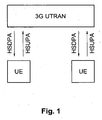
- Figure 1 shows a UMTS system comprising a 3G UTRAN and two UEs.
- the present invention provides a scheduling concept for uplink transmission from terminals to an access network, wherein in future releases of 3G UTRAN said uplink transmission is referred to as HSUPA.
- HSUPA scheduling concept for uplink transmission from terminals to an access network
- the following description refers to such future UMTS system using HSUPA for the uplink transmission.
- the method according to the present invention is also applicable in other mobile communication standards.
- the filling status of the UEs internal data buffers are reported from the UEs to a NodeB (not shown) of the UTRAN via scheduling information (SI) in uplink.
- SI scheduling information
- the scheduling concept according to the present invention is based on the prediction of user traffic characteristics using the buffer filling status report of the UEs.
- the NodeB classifies each UE, wherein the classification is based on the internal buffer filling status of each UE.
- two situations may occur.
- the UE has a relatively low internal buffer filling status, which is below a specific threshold. Said threshold can be determined depending on the application.
- the UE has a relatively high internal buffer filling status, which is above said threshold. It depends on the data characteristics provided on application level in which of said situations the UE is. In particular, each UE can change between the first and the second situation over time, i.e. dependent on the application.
- a UE might be in the first situation (relatively low internal buffer filling status) for some time and change to the second situation (relatively high internal buffer filling status), when the present application fills a bigger amount of data into the buffer.
- the UE may get back to the first situation, depending on the internal buffer filling status and the previously determined threshold, which separates the first and the second situation.
- the NodeB HSUPA scheduler (not shown) does not have explicit knowledge of the application service type, it can identify both UE situations by monitoring the filling status of the buffer, for example by exploiting the scheduling information which the UE sends to the UTRAN. Therefore, the NodeB HSUPA scheduler can predict the application service type and the related traffic characteristics.
- the UTRAN shown in Figure 1 is adapted to classify each of the UEs according to the internal buffer filling status thereof.
- two criteria are defined based on the internal buffer filling status of each UE to classify users being in either the first or the second situation.
- Users in the first situation are classified to belong to a first class and are called passive users, since the UE of such users has a relatively low internal buffer filling status.
- users in the second situation are classified to belong to a second class and are called active users, since the UE of such users has a relatively high internal buffer filling status.
- the HSUPA scheduler of the UTRAN allocates a certain part of the uplink transmission resources statically to said UE and accounts for the burstiness of the data transmission by considering a certain activity factor. All UEs of said first class can use the allocated passive grant immediately without sending scheduling information to the UTRAN. Hence, said UE is allowed to send data without any additional delay. This case is called passive scheduling.
- the HSUPA scheduler of the UTRAN allocates a certain part of the uplink transmission resources dynamically to said UE.
- Such dynamic allocation may be performed according to additional scheduling criteria like fairness aspects, channel quality and/or UE capabilities. This case is called active scheduling.
- the strategy of the HSUPA scheduler for generating scheduling decisions may be different for each class and can separately be optimized to meet class specific service requirements. Criteria are defined to decide to which class each terminal (user) belongs to and when to switch from one class to another.
Landscapes
- Engineering & Computer Science (AREA)
- Computer Networks & Wireless Communication (AREA)
- Signal Processing (AREA)
- Mobile Radio Communication Systems (AREA)
Claims (7)
- Procédé d'attribution des ressources de transmission sur liaison montante commune disponibles à une pluralité de terminaux transmettant des informations de données en paquet à un réseau d'accès, le procédé comprenant les étapes suivantes :- envoi d'une information d'état de remplissage du tampon interne des terminaux au réseau d'accès ; et- attribution aux terminaux d'une quantité spécifique de ressources de transmission sur liaison montante en fonction de l'information d'état de remplissage du tampon interne,
caractérisé par- affectation aux terminaux d'une balise de classification spécifique en fonction de l'information d'état de remplissage du tampon interne et,- attribution aux terminaux d'une quantité statique spécifique ou d'une quantité dynamique de ressources de transmission sur liaison montante en fonction de la balise de classification affectée, les étapes d'affectation et d'attribution étant exécutées par le réseau d'accès, et la commutation entre les différentes balises de classification affectées à un terminal étant effectuée par un temporisateur à hystérésis. - Procédé selon la revendication 1, comprenant en outre l'étape d'affectation à un terminal d'une première balise de classification si l'état de remplissage de son tampon interne est au-dessous d'un seuil spécifique ou d'une deuxième balise de classification si l'état de remplissage de son tampon interne est au-dessus dudit seuil.
- Procédé selon la revendication 2, comprenant en outre l'étape d'attribution à un terminal d'une quantité statique spécifique de ressources de transmission sur liaison montante s'il est affecté à la première balise de classification et d'une quantité dynamique de ressources de transmission sur liaison montante s'il est affecté à la deuxième balise de classification.
- Procédé selon la revendication 1, selon lequel, dans la liaison montante, les terminaux notifient leur information d'état de remplissage du tampon interne au réseau d'accès par le biais d'une information d'ordonnancement.
- Procédé selon la revendication 1, selon lequel le réseau d'accès est un réseau d'accès radioélectrique terrestre UMTS (UTRAN) et les terminaux réalisent la communication de liaison montante conformément au service d'accès en paquets sur liaison montante à haut débit (HSUPA).
- Réseau d'accès radioélectrique, comprenant des contrôleurs, des terminaux et des stations de base, avec lequel chaque station de base comprend des émetteurs, des récepteurs et un ordonnanceur, et avec lequel l'ordonnanceur est adapté pour- affecter aux terminaux associés une balise de classification spécifique en fonction d'une information d'état de remplissage du tampon interne reçue de la part desdits terminaux,- attribuer aux terminaux une quantité statique spécifique ou une quantité dynamique de ressources de transmission sur liaison montante en fonction de la balise de classification affectée, et avec lequel la commutation entre les différentes balises de classification affectées à un terminal est effectuée par un temporisateur à hystérésis.
- Réseau d'accès radioélectrique selon la revendication 6, avec lequel le réseau d'accès radioélectrique est un réseau d'accès radioélectrique terrestre UMTS (UTRAN), les récepteurs et les émetteurs étant des noeuds B et les contrôleurs étant des contrôleurs de réseau radioélectrique.
Priority Applications (3)
| Application Number | Priority Date | Filing Date | Title |
|---|---|---|---|
| DE602007013734T DE602007013734D1 (de) | 2007-06-25 | 2007-06-25 | Aufwärtsübertragung in mobilen Netzen |
| AT07290792T ATE505053T1 (de) | 2007-06-25 | 2007-06-25 | Aufwärtsübertragung in mobilen netzen |
| EP07290792A EP2009943B1 (fr) | 2007-06-25 | 2007-06-25 | Transmission de liaison montante dans des réseaux mobiles |
Applications Claiming Priority (1)
| Application Number | Priority Date | Filing Date | Title |
|---|---|---|---|
| EP07290792A EP2009943B1 (fr) | 2007-06-25 | 2007-06-25 | Transmission de liaison montante dans des réseaux mobiles |
Publications (2)
| Publication Number | Publication Date |
|---|---|
| EP2009943A1 EP2009943A1 (fr) | 2008-12-31 |
| EP2009943B1 true EP2009943B1 (fr) | 2011-04-06 |
Family
ID=38720911
Family Applications (1)
| Application Number | Title | Priority Date | Filing Date |
|---|---|---|---|
| EP07290792A Not-in-force EP2009943B1 (fr) | 2007-06-25 | 2007-06-25 | Transmission de liaison montante dans des réseaux mobiles |
Country Status (3)
| Country | Link |
|---|---|
| EP (1) | EP2009943B1 (fr) |
| AT (1) | ATE505053T1 (fr) |
| DE (1) | DE602007013734D1 (fr) |
Cited By (1)
| Publication number | Priority date | Publication date | Assignee | Title |
|---|---|---|---|---|
| WO2016175521A1 (fr) * | 2015-04-27 | 2016-11-03 | Samsung Electronics Co., Ltd. | Appareil et procédé de commande de débit de liaison descendante dans un système de communication |
Families Citing this family (1)
| Publication number | Priority date | Publication date | Assignee | Title |
|---|---|---|---|---|
| US9554373B2 (en) | 2012-10-30 | 2017-01-24 | Telefonaktiebolaget L M Ericsson | Methods and apparatuses for processing uplink data |
Family Cites Families (2)
| Publication number | Priority date | Publication date | Assignee | Title |
|---|---|---|---|---|
| DE60328235D1 (de) | 2003-09-30 | 2009-08-13 | Mitsubishi Electric Corp | System für Mobilkommunikation zur Steuerung des Kommunikationsmodus |
| KR100905588B1 (ko) | 2005-01-10 | 2009-07-02 | 삼성전자주식회사 | 향상된 상향링크 전용채널을 지원하는 이동통신시스템에서자율전송을 지원하는 단말의 향상된 상향링크 전용채널전송전력 결정 방법 |
-
2007
- 2007-06-25 AT AT07290792T patent/ATE505053T1/de not_active IP Right Cessation
- 2007-06-25 EP EP07290792A patent/EP2009943B1/fr not_active Not-in-force
- 2007-06-25 DE DE602007013734T patent/DE602007013734D1/de active Active
Cited By (4)
| Publication number | Priority date | Publication date | Assignee | Title |
|---|---|---|---|---|
| WO2016175521A1 (fr) * | 2015-04-27 | 2016-11-03 | Samsung Electronics Co., Ltd. | Appareil et procédé de commande de débit de liaison descendante dans un système de communication |
| KR20160127511A (ko) * | 2015-04-27 | 2016-11-04 | 삼성전자주식회사 | 통신 시스템에서 하향링크 전송률 제어를 위한 장치 및 방법 |
| EP3289802A4 (fr) * | 2015-04-27 | 2018-04-11 | Samsung Electronics Co., Ltd. | Appareil et procédé de commande de débit de liaison descendante dans un système de communication |
| US10193779B2 (en) | 2015-04-27 | 2019-01-29 | Samsung Electronics Co., Ltd. | Apparatus and method for controlling downlink throughput in communication system |
Also Published As
| Publication number | Publication date |
|---|---|
| DE602007013734D1 (de) | 2011-05-19 |
| EP2009943A1 (fr) | 2008-12-31 |
| ATE505053T1 (de) | 2011-04-15 |
Similar Documents
| Publication | Publication Date | Title |
|---|---|---|
| EP1909442B1 (fr) | Système et procédés pour déterminer le degré de granularité de l'information d'après le statut du tampon | |
| KR101177136B1 (ko) | 기지국에서 전송 리소스를 할당하기 위한 방법 | |
| KR101372184B1 (ko) | 롱텀 에볼루션 시스템에서의 업링크 고갈 회피 지원 방법 및 장치 | |
| US8948006B2 (en) | System for managing uplink quality of service (QoS) in cellular network | |
| CN103988543B (zh) | 无线局域网中的控制设备、网络系统及业务处理方法 | |
| US20060019671A1 (en) | QoS differentiation for WCDMA services mapped onto an E-DCH channel | |
| Ali et al. | A capacity and minimum guarantee-based service class-oriented scheduler for LTE networks | |
| Mai et al. | Design of dynamic resource allocation scheme for real-time traffic in the LTE network | |
| CN1972462A (zh) | 移动通信系统中分组业务调度的方法 | |
| Adesh et al. | Adaptive downlink packet scheduling in LTE networks based on queue monitoring | |
| US20070258364A1 (en) | Resource control for scheduled and non-scheduled traffic | |
| EP2009943B1 (fr) | Transmission de liaison montante dans des réseaux mobiles | |
| KR101756434B1 (ko) | 이동통신 시스템에서의 음성 및 데이터 서비스를 제공하기 위한 송신 장치 및 그 송신 장치를 이용한 서비스 제공 방법 | |
| WO2018210572A1 (fr) | Mécanisme de planification de transmissions de données de communication à faible latence ultra-fiables | |
| KR100523996B1 (ko) | 이동통신 시스템의 패킷 스케줄링 시스템 및 방법 | |
| KR100837080B1 (ko) | 패킷 스케줄링을 위한 자원 할당 방법과, 그를 이용하는시스템 | |
| EP3198813B1 (fr) | Procédé, appareil et système | |
| Sağlam et al. | A new long‐term evolution downlink delay based lean scheduler | |
| Mai et al. | Design of Dynamic Resource Allocation Scheme for Real-Time and Non-Real-Time Traffics in The Advanced Mobile Communications Network | |
| Khattab | Opportunistic subcarrier management for delay sensitive traffic in OFDMA-based wireless multimedia networks | |
| WO2026019952A1 (fr) | Systèmes et procédés de collaboration entre o-du et o-ru dans des architectures o-ran à découpage en tranches de réseau | |
| KR20050063422A (ko) | 이동통신 시스템의 프레임 구성 장치 및 프레임 구성 방법 | |
| Tzeng et al. | QoS provisioning for multiple non‐real‐time services in cellular wireless networks | |
| Aleksieva | Analysis of the Factors which Influence on QoS in LTE Networks | |
| KR20060111952A (ko) | 이동통신 시스템에서 스케줄링 장치 및 방법 |
Legal Events
| Date | Code | Title | Description |
|---|---|---|---|
| PUAI | Public reference made under article 153(3) epc to a published international application that has entered the european phase |
Free format text: ORIGINAL CODE: 0009012 |
|
| 17P | Request for examination filed |
Effective date: 20080401 |
|
| AK | Designated contracting states |
Kind code of ref document: A1 Designated state(s): AT BE BG CH CY CZ DE DK EE ES FI FR GB GR HU IE IS IT LI LT LU LV MC MT NL PL PT RO SE SI SK TR |
|
| AX | Request for extension of the european patent |
Extension state: AL BA HR MK RS |
|
| AKX | Designation fees paid |
Designated state(s): AT BE BG CH CY CZ DE DK EE ES FI FR GB GR HU IE IS IT LI LT LU LV MC MT NL PL PT RO SE SI SK TR |
|
| GRAP | Despatch of communication of intention to grant a patent |
Free format text: ORIGINAL CODE: EPIDOSNIGR1 |
|
| RIC1 | Information provided on ipc code assigned before grant |
Ipc: H04W 72/12 20090101AFI20101123BHEP |
|
| GRAS | Grant fee paid |
Free format text: ORIGINAL CODE: EPIDOSNIGR3 |
|
| GRAA | (expected) grant |
Free format text: ORIGINAL CODE: 0009210 |
|
| AK | Designated contracting states |
Kind code of ref document: B1 Designated state(s): AT BE BG CH CY CZ DE DK EE ES FI FR GB GR HU IE IS IT LI LT LU LV MC MT NL PL PT RO SE SI SK TR |
|
| REG | Reference to a national code |
Ref country code: GB Ref legal event code: FG4D |
|
| REG | Reference to a national code |
Ref country code: CH Ref legal event code: EP |
|
| REG | Reference to a national code |
Ref country code: IE Ref legal event code: FG4D |
|
| REF | Corresponds to: |
Ref document number: 602007013734 Country of ref document: DE Date of ref document: 20110519 Kind code of ref document: P |
|
| REG | Reference to a national code |
Ref country code: DE Ref legal event code: R096 Ref document number: 602007013734 Country of ref document: DE Effective date: 20110519 |
|
| REG | Reference to a national code |
Ref country code: NL Ref legal event code: VDEP Effective date: 20110406 |
|
| PG25 | Lapsed in a contracting state [announced via postgrant information from national office to epo] |
Ref country code: SI Free format text: LAPSE BECAUSE OF FAILURE TO SUBMIT A TRANSLATION OF THE DESCRIPTION OR TO PAY THE FEE WITHIN THE PRESCRIBED TIME-LIMIT Effective date: 20110406 |
|
| LTIE | Lt: invalidation of european patent or patent extension |
Effective date: 20110406 |
|
| PG25 | Lapsed in a contracting state [announced via postgrant information from national office to epo] |
Ref country code: LT Free format text: LAPSE BECAUSE OF FAILURE TO SUBMIT A TRANSLATION OF THE DESCRIPTION OR TO PAY THE FEE WITHIN THE PRESCRIBED TIME-LIMIT Effective date: 20110406 Ref country code: PT Free format text: LAPSE BECAUSE OF FAILURE TO SUBMIT A TRANSLATION OF THE DESCRIPTION OR TO PAY THE FEE WITHIN THE PRESCRIBED TIME-LIMIT Effective date: 20110808 Ref country code: SE Free format text: LAPSE BECAUSE OF FAILURE TO SUBMIT A TRANSLATION OF THE DESCRIPTION OR TO PAY THE FEE WITHIN THE PRESCRIBED TIME-LIMIT Effective date: 20110406 |
|
| PG25 | Lapsed in a contracting state [announced via postgrant information from national office to epo] |
Ref country code: IS Free format text: LAPSE BECAUSE OF FAILURE TO SUBMIT A TRANSLATION OF THE DESCRIPTION OR TO PAY THE FEE WITHIN THE PRESCRIBED TIME-LIMIT Effective date: 20110806 Ref country code: LV Free format text: LAPSE BECAUSE OF FAILURE TO SUBMIT A TRANSLATION OF THE DESCRIPTION OR TO PAY THE FEE WITHIN THE PRESCRIBED TIME-LIMIT Effective date: 20110406 Ref country code: GR Free format text: LAPSE BECAUSE OF FAILURE TO SUBMIT A TRANSLATION OF THE DESCRIPTION OR TO PAY THE FEE WITHIN THE PRESCRIBED TIME-LIMIT Effective date: 20110707 Ref country code: BE Free format text: LAPSE BECAUSE OF FAILURE TO SUBMIT A TRANSLATION OF THE DESCRIPTION OR TO PAY THE FEE WITHIN THE PRESCRIBED TIME-LIMIT Effective date: 20110406 Ref country code: AT Free format text: LAPSE BECAUSE OF FAILURE TO SUBMIT A TRANSLATION OF THE DESCRIPTION OR TO PAY THE FEE WITHIN THE PRESCRIBED TIME-LIMIT Effective date: 20110406 Ref country code: CY Free format text: LAPSE BECAUSE OF FAILURE TO SUBMIT A TRANSLATION OF THE DESCRIPTION OR TO PAY THE FEE WITHIN THE PRESCRIBED TIME-LIMIT Effective date: 20110406 Ref country code: FI Free format text: LAPSE BECAUSE OF FAILURE TO SUBMIT A TRANSLATION OF THE DESCRIPTION OR TO PAY THE FEE WITHIN THE PRESCRIBED TIME-LIMIT Effective date: 20110406 Ref country code: ES Free format text: LAPSE BECAUSE OF FAILURE TO SUBMIT A TRANSLATION OF THE DESCRIPTION OR TO PAY THE FEE WITHIN THE PRESCRIBED TIME-LIMIT Effective date: 20110717 |
|
| PG25 | Lapsed in a contracting state [announced via postgrant information from national office to epo] |
Ref country code: MT Free format text: LAPSE BECAUSE OF FAILURE TO SUBMIT A TRANSLATION OF THE DESCRIPTION OR TO PAY THE FEE WITHIN THE PRESCRIBED TIME-LIMIT Effective date: 20110406 Ref country code: NL Free format text: LAPSE BECAUSE OF FAILURE TO SUBMIT A TRANSLATION OF THE DESCRIPTION OR TO PAY THE FEE WITHIN THE PRESCRIBED TIME-LIMIT Effective date: 20110406 |
|
| PG25 | Lapsed in a contracting state [announced via postgrant information from national office to epo] |
Ref country code: EE Free format text: LAPSE BECAUSE OF FAILURE TO SUBMIT A TRANSLATION OF THE DESCRIPTION OR TO PAY THE FEE WITHIN THE PRESCRIBED TIME-LIMIT Effective date: 20110406 Ref country code: CZ Free format text: LAPSE BECAUSE OF FAILURE TO SUBMIT A TRANSLATION OF THE DESCRIPTION OR TO PAY THE FEE WITHIN THE PRESCRIBED TIME-LIMIT Effective date: 20110406 |
|
| REG | Reference to a national code |
Ref country code: CH Ref legal event code: PL |
|
| PLBE | No opposition filed within time limit |
Free format text: ORIGINAL CODE: 0009261 |
|
| STAA | Information on the status of an ep patent application or granted ep patent |
Free format text: STATUS: NO OPPOSITION FILED WITHIN TIME LIMIT |
|
| RAP2 | Party data changed (patent owner data changed or rights of a patent transferred) |
Owner name: ALCATEL LUCENT |
|
| PG25 | Lapsed in a contracting state [announced via postgrant information from national office to epo] |
Ref country code: DK Free format text: LAPSE BECAUSE OF FAILURE TO SUBMIT A TRANSLATION OF THE DESCRIPTION OR TO PAY THE FEE WITHIN THE PRESCRIBED TIME-LIMIT Effective date: 20110406 Ref country code: RO Free format text: LAPSE BECAUSE OF FAILURE TO SUBMIT A TRANSLATION OF THE DESCRIPTION OR TO PAY THE FEE WITHIN THE PRESCRIBED TIME-LIMIT Effective date: 20110406 Ref country code: PL Free format text: LAPSE BECAUSE OF FAILURE TO SUBMIT A TRANSLATION OF THE DESCRIPTION OR TO PAY THE FEE WITHIN THE PRESCRIBED TIME-LIMIT Effective date: 20110406 Ref country code: SK Free format text: LAPSE BECAUSE OF FAILURE TO SUBMIT A TRANSLATION OF THE DESCRIPTION OR TO PAY THE FEE WITHIN THE PRESCRIBED TIME-LIMIT Effective date: 20110406 |
|
| 26N | No opposition filed |
Effective date: 20120110 |
|
| REG | Reference to a national code |
Ref country code: IE Ref legal event code: MM4A |
|
| PG25 | Lapsed in a contracting state [announced via postgrant information from national office to epo] |
Ref country code: IE Free format text: LAPSE BECAUSE OF NON-PAYMENT OF DUE FEES Effective date: 20110625 Ref country code: CH Free format text: LAPSE BECAUSE OF NON-PAYMENT OF DUE FEES Effective date: 20110630 Ref country code: LI Free format text: LAPSE BECAUSE OF NON-PAYMENT OF DUE FEES Effective date: 20110630 |
|
| REG | Reference to a national code |
Ref country code: DE Ref legal event code: R097 Ref document number: 602007013734 Country of ref document: DE Effective date: 20120110 |
|
| PG25 | Lapsed in a contracting state [announced via postgrant information from national office to epo] |
Ref country code: MC Free format text: LAPSE BECAUSE OF NON-PAYMENT OF DUE FEES Effective date: 20110630 |
|
| PG25 | Lapsed in a contracting state [announced via postgrant information from national office to epo] |
Ref country code: LU Free format text: LAPSE BECAUSE OF NON-PAYMENT OF DUE FEES Effective date: 20110625 |
|
| PG25 | Lapsed in a contracting state [announced via postgrant information from national office to epo] |
Ref country code: BG Free format text: LAPSE BECAUSE OF FAILURE TO SUBMIT A TRANSLATION OF THE DESCRIPTION OR TO PAY THE FEE WITHIN THE PRESCRIBED TIME-LIMIT Effective date: 20110706 |
|
| PG25 | Lapsed in a contracting state [announced via postgrant information from national office to epo] |
Ref country code: TR Free format text: LAPSE BECAUSE OF FAILURE TO SUBMIT A TRANSLATION OF THE DESCRIPTION OR TO PAY THE FEE WITHIN THE PRESCRIBED TIME-LIMIT Effective date: 20110406 |
|
| PG25 | Lapsed in a contracting state [announced via postgrant information from national office to epo] |
Ref country code: HU Free format text: LAPSE BECAUSE OF FAILURE TO SUBMIT A TRANSLATION OF THE DESCRIPTION OR TO PAY THE FEE WITHIN THE PRESCRIBED TIME-LIMIT Effective date: 20110406 |
|
| REG | Reference to a national code |
Ref country code: FR Ref legal event code: GC Effective date: 20131018 |
|
| PG25 | Lapsed in a contracting state [announced via postgrant information from national office to epo] |
Ref country code: IT Free format text: LAPSE BECAUSE OF FAILURE TO SUBMIT A TRANSLATION OF THE DESCRIPTION OR TO PAY THE FEE WITHIN THE PRESCRIBED TIME-LIMIT Effective date: 20110406 |
|
| REG | Reference to a national code |
Ref country code: FR Ref legal event code: RG Effective date: 20141016 |
|
| REG | Reference to a national code |
Ref country code: FR Ref legal event code: PLFP Year of fee payment: 9 |
|
| REG | Reference to a national code |
Ref country code: FR Ref legal event code: PLFP Year of fee payment: 10 |
|
| REG | Reference to a national code |
Ref country code: FR Ref legal event code: PLFP Year of fee payment: 11 |
|
| PGFP | Annual fee paid to national office [announced via postgrant information from national office to epo] |
Ref country code: FR Payment date: 20170621 Year of fee payment: 11 Ref country code: DE Payment date: 20170621 Year of fee payment: 11 Ref country code: GB Payment date: 20170620 Year of fee payment: 11 |
|
| REG | Reference to a national code |
Ref country code: DE Ref legal event code: R119 Ref document number: 602007013734 Country of ref document: DE |
|
| GBPC | Gb: european patent ceased through non-payment of renewal fee |
Effective date: 20180625 |
|
| PG25 | Lapsed in a contracting state [announced via postgrant information from national office to epo] |
Ref country code: GB Free format text: LAPSE BECAUSE OF NON-PAYMENT OF DUE FEES Effective date: 20180625 Ref country code: FR Free format text: LAPSE BECAUSE OF NON-PAYMENT OF DUE FEES Effective date: 20180630 Ref country code: DE Free format text: LAPSE BECAUSE OF NON-PAYMENT OF DUE FEES Effective date: 20190101 |
|
| REG | Reference to a national code |
Ref country code: DE Ref legal event code: R082 Ref document number: 602007013734 Country of ref document: DE Representative=s name: BARKHOFF REIMANN VOSSIUS, DE Ref country code: DE Ref legal event code: R081 Ref document number: 602007013734 Country of ref document: DE Owner name: WSOU INVESTMENTS, LLC, LOS ANGELES, US Free format text: FORMER OWNER: ALCATEL LUCENT, PARIS, FR |
|
| REG | Reference to a national code |
Ref country code: GB Ref legal event code: 732E Free format text: REGISTERED BETWEEN 20201203 AND 20201209 |