EP2010973B1 - Multifunktionsuhrensystem und verfahren - Google Patents
Multifunktionsuhrensystem und verfahren Download PDFInfo
- Publication number
- EP2010973B1 EP2010973B1 EP07755911.0A EP07755911A EP2010973B1 EP 2010973 B1 EP2010973 B1 EP 2010973B1 EP 07755911 A EP07755911 A EP 07755911A EP 2010973 B1 EP2010973 B1 EP 2010973B1
- Authority
- EP
- European Patent Office
- Prior art keywords
- world
- watch
- worlds
- bezel
- current
- Prior art date
- Legal status (The legal status is an assumption and is not a legal conclusion. Google has not performed a legal analysis and makes no representation as to the accuracy of the status listed.)
- Not-in-force
Links
Images



Classifications
-
- G—PHYSICS
- G06—COMPUTING OR CALCULATING; COUNTING
- G06F—ELECTRIC DIGITAL DATA PROCESSING
- G06F1/00—Details not covered by groups G06F3/00 - G06F13/00 and G06F21/00
- G06F1/16—Constructional details or arrangements
- G06F1/1613—Constructional details or arrangements for portable computers
- G06F1/163—Wearable computers, e.g. on a belt
-
- G—PHYSICS
- G04—HOROLOGY
- G04G—ELECTRONIC TIME-PIECES
- G04G21/00—Input or output devices integrated in time-pieces
-
- G—PHYSICS
- G04—HOROLOGY
- G04G—ELECTRONIC TIME-PIECES
- G04G9/00—Visual time or date indication means
- G04G9/0064—Visual time or date indication means in which functions not related to time can be displayed
Definitions
- the present invention relates generally to watches and more particularly to multifunction watches.
- Watches are commonly available that provide a variety of modes of operation.
- digital watches generally include time-of-day, alarm clock and stopwatch functions.
- most watches have limited input and display capabilities due to limited space and limitations of user dexterity.
- crude menuing systems are often implemented to allow users to sequentially select parameters for configuring watches.
- current menuing techniques bring limited benefit when complex and diverse functions must be programmed and navigation of resulting menus is increasingly time-consuming, overly complex and non-intuitive.
- US 2002/101457 A1 discloses a watch in which a rotating bezel is used to control movement of a cursor in a display screen.
- Embodiments of the present invention provide a multifunction watch in which plural worlds are defined, each world supporting one or more modes of operation within the world and wherein each world includes a menu distinct from menus of the other worlds.
- modes of operation are configurable.
- configurable modes of operation of a given world are distinctly configurable with respect to modes of operation in other worlds.
- a desired world is selected by manipulating a bezel that rotates to engage and activate one of a plurality of switches, thereby selecting a corresponding world.
- each world operates independently of other worlds.
- a multimode watch provides four worlds including TIME, RIDE, COMPASS and SPEED worlds.
- the multifunction watch can provide environments customized for each of the provided worlds.
- each world can format and populate a display and assign functionality to inputs such as switches and buttons.
- certain inputs provide similar functionality across some or all worlds.
- Fig. 1 is a block diagram representing one embodiment of the invention
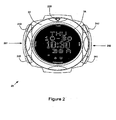
- Fig. 2 depicts an example of a multifunction watch
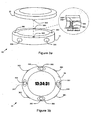
- Figs. 3a and 3b illustrates relative locations of switches and operation of a bezel, the arrangement shown in Fig. 3b not being in accordance with the claimed invention
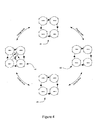
- Fig. 4 illustrates distinct menus within worlds
- Fig. 5 depicts a display provided in one embodiment of the invention.
- Fig. 6 shows a top level menu structure provided by certain embodiments of the invention.
- Fig.7 is a table identifying switch functions in an example of an embodiment of the invention.
- Certain embodiments of the present invention comprise a multifunction watch providing a plurality of worlds wherein each world can operate independently of the other worlds.
- each world defines at least one mode of operation of the multifunction watch.
- a mode of operation can provide sets of operations, functions and displays.
- multiple instances of a mode can be provided to support, for example, plural time zone tracking, multiple timers, and so on.
- at least some operations and functions of the modes of a world have at least one common characteristic.
- modes of operation may include a clock, one or more timers, one or more alarm clocks and a chronograph. It will be appreciated that a common characteristic of each of the modes of operation in this example is a measurement of time.
- a processor 10 maintains the configurations 15 in storage, typically in a combination of volatile and non-volatile memory.
- Configurations 15 may be modified or accessed by navigating a corresponding menu 14.
- each menu 14 is associated with a single corresponding configuration 15.
- access to a configuration and menu is provided only when the configuration and menu relate to a currently selected world.
- configuration of a first world typically does not affect configuration of a second world.
- selection of a world is made using selection controls 12 as will be discussed in more detail later. Navigation within a world is typically effected using configuration controls 13 as will be discussed in more detail later.
- a common configuration 16 can be maintained for all worlds.
- a common configuration 16 maintains components, elements and functions that apply in all worlds.
- Examples of common elements can include language selection, certain calibration values and certain user interface selections such as timeout values.
- Examples of functions include timers, alarms, messaging functions and menu navigation functions.
- common functions may be provided for use in more than one world and, in some of these embodiments, operation of the function in any one world can be controlled using configuration information provided by the one world.
- identical worlds may be provided and maintained separately.
- a first TIME world could be configured for a U.S. time zone such as Pacific Standard Time (“PST") while a second TIME world could be configured for a European time zone such as Greenwich Mean Time (“GMT").
- PST Pacific Standard Time
- GTT Greenwich Mean Time
- alarms, and timers provided by the two TIME worlds can be maintained separately.
- a multimode watch may support four worlds, including TIME, RIDE, COMPASS and SPEED worlds.
- each world can format and populate a display and configure and control inputs such as switches and pushbuttons.
- certain inputs can provide similar functionality across some or all of the worlds.
- a mode switch can be provided that operates in each world to control configuration within that world. Operation of the worlds and associated functions is described in greater detail below.
- a multifunction watch is shown generally at 20, where the watch comprises a bezel 22 and a plurality of control switches 240, 241, 242 and 243 located at selected positions on the watch face. Locations of control switches 240-243 are selected for easy access by a wearer of the watch. In the example of Fig. 2 , four control switches 240-243 are located on two sides of the watch at maximal separation.
- control switches 240-243 can be provided based on supported watch functions and associated programming needs. Fewer than four control switches 240-243 can be provided based on supported watch functions and associated programming needs. In some embodiments, some of the control switches 240-243 can be located asymmetrically on a side of watch 20. In some embodiments, a majority or all of control switches 240-243 can be located on one side of the watch. For example, three or more of switches 240-243 could be arranged along side 20 while remaining switches 240-243 (if any) can be placed on side 202.
- each of control switches 240-243 is assigned at least one function.
- the functionality of some of control switches 240-243 is consistently defined across multiple worlds.
- a mode control switch is defined that causes the watch to enter a configuration menu.
- the configuration menu is typically used to set operating parameters and to calibrate functions of the watch.
- an alarm clock may be programmed to trigger an alarm at a predetermined time, whereby the alarm may sound a user-selected sound.
- the time of alarm and sound selection can be provided by the wearer using a configuration menu.
- the configuration menus associated with the modes of operation for a given world are uniquely accessible in that world and, preferably, transition between worlds is uniquely controlled by a single switching device in the form of a manipulable bezel which can engage and activate any one of a plurality of switches corresponding to separate worlds in order to select such world.
- Bezel 22 can be manipulated to select a desired world.
- the watch 20 Upon selecting a world, the watch 20 typically performs the functions and operations associated with the selected world. Previous functions and operations associated with the prior world can be terminated, but many functions and operations may be performed as background or hidden functions and operations. For example, configuration menus are typically abandoned upon transition between worlds but alarm functions can continue to operate even after switching worlds. Thus, an alarm can be triggered while the watch is configured to operate in a world other than the TIME world and, in at least some embodiments, display and sound notifications can be made in the other world. For example, in SPEED world, a flashing indicator accompanied by a distinctive tone can be used to indicate that an alarm was triggered.
- operation of the watch is controlled according to characteristics configured for a currently selected world.
- the watch 20 operates as an apparent single function watch, exhibiting characteristics and behaviors associated with the single function. Display, input switches and control devices may be reconfigured or redefined to support such apparent single function operation.
- navigation between worlds through world menus is prevented and world transitions can be effected only by switching the watch operation to the desired world.
- a configuration menu is typically defined for each world and each control menu may be navigated using control switches 240-243.
- control switches 240-243 may be assigned functionalities other than configuration functions. Typically, control switches 240-243 may be reconfigured to obtain watch response, display and operational characteristics that appear to be consistent with a single function watch. For example, a start/stop control switch has utility in a stopwatch but a compass may not require a switch that starts or stops any of its functions. In this latter example, a start/stop control switch could be optionally disabled or redefined during world transition.
- a watch bezel 22 is used to select between worlds.
- the watch bezel 22 is rotatable and adapted to activate one or more function switches based on the orientation of the watch bezel 22.
- the example illustrated in Fig. 3a depicts one embodiment in which a watch, depicted generally at 30, comprises a rotatable annular bezel 22 with at least one protuberance 320 for activating control switches 334 accessed through one or more recesses 300, 301, 302 and 303 in watch body 31.
- switch 334 may be directly activated by protuberance 320.
- protuberance 320 can be formed as a generally spherical, conical or cylindrical protrusion or post such that when the protuberance 320 is aligned above recess 303, protuberance 320 penetrates recess 303 and activates switch 334.
- protuberance 320 can be formed on an insert 343 attached to bezel 22 where the insert 343 can be manufactured from any suitable material, including various metals as well as nylons or other plastics.
- protuberance 320 activates switch 334 using a pusher 332 provided generally within recess 303.
- Activation of switch 303 may be effected by direct electrical contact between protuberance 320 and one or more electrical contacts (not shown).
- protuberance 320 can cause mechanically activation of a pushbutton or other mechanically operated switch.
- protuberance 320 can be constructed of a material providing sufficient magnetic field to activate a reed switch, relay, hall-effect switch or the like.
- protuberance 320 can cause switch activation by altering a combination of capacitive, inductive and resistive characteristics of the switch 334.
- protuberance 320 may be constructed to resist rotation of the bezel when protuberance 320 engages one of the control switch recesses 300-303 such that bezel 22 can be retained or locked in position relative to the watch face.
- one or more additional protuberances can be provided for bezel lock or stabilization.
- a watch 34 is shown that is not in accordance with the claimed invention and which is provided with fixed bezel 35 and additional function-select or world-select switches 350, 351, 352 and 353.
- switches 350-353 are provided using pushbutton switches, although other types of switch may be employed, including capacitive switches and transducers adapted to detect pressure on the bezel.
- a non-rotatable bezel 35 may be provided that transmits a force to switches 350-353 deployed below designated pressure points 354, 355, 356 and 357 identified on the bezel 35.
- Switches 350-353 can be mechanically activated using a tilting, rocking or deformable bezel 35.
- switches for selecting watch world are positioned at even angular spacing around the watch dial.
- the watch when positional indicator 220 is located at the top of the watch 20 (that is, at 0° rotation), the watch may function, for example, as a timepiece.
- the watch When the positional indicator 220 is rotated through 90° clockwise to a second position on the watch 202, the watch may, for example, function in RIDE mode.
- four locations are defined at which bezel 22 may be engaged located approximately at the 12 o'clock, 3 o'clock, 6 o'clock and 9 o'clock positions. It will be appreciated that the number and location of rest positions provided for the bezel in any embodiment depends upon factors including the number of functional components provided in the watch, ergonomics and designer preferences.
- bezel 22 includes an indicator for identifying which operating function of the watch is currently selected. Identification of function can be made by any suitable visual and tactile means. Visual indication can be provided by using a combination of markings on bezel 22, watch body, watch crystal and watch face. In the example, functions of watch 20 are marked on the watch crystal as TIME, RIDE, COMP (compass) and SPEED. In some embodiments, the bezel can be shaped to include a pointer that indicates current function.
- the multifunction watch 20 may include instruments 17, including barometers, compasses, real time clocks, accelerometers, GPS systems, measuring devices and calculators configured to provide information used by one or more watch worlds.
- the SPEED function may use an accelerometer, a real time clock and a barometer to calculate a speed of descent.
- Instruments 17 can be configured using one or more configuration devices 13 including, for example, one or more mode switches, selector switches and start/stop switches.
- rotatable input devices including wheels, trackballs, sensitive pads, keypads and conventional watch winders may be incorporated and adapted for configuration and operation of the watch and its instruments.
- each of the configuration devices 13 can be commonly shared in all watch worlds.
- configuration devices 13 can be used to manage functionality of the watch within a current world.
- a start/stop switch 242 may be used to start a timer in TIME mode and, in SPEED mode, the start/stop switch 242 can be used can be used to begin calculation of an average speed.
- four control switches are provided, including light control 240, mode/set 241, start/stop 242 and lap/reset 243.
- Fig. 7 shows typical control matrices for a four world watch having characteristics similar to those provided in the example depicted in Fig. 2 .
- both world select 12 and configuration 13 control switches/devices can be varied as necessary to provide desired operational characteristics and in view of factors such as ergonomic design.
- an example of a watch will be described in more detail where the watch is constructed with features similar to those in the example of Fig. 2 and operating in a manner described in Fig. 7 .
- a plurality of configuration menus is provided for configuring corresponding watch worlds.
- Menus are typically hierarchical, allowing navigation through options provided one level until an option is selected which can lead to another level of options or can cause an action to be taken.
- Actions may include enabling or disabling features, setting variables and initiating operations.
- Navigation within each of the configuration menus is typically independent of navigation within the other configuration menus.
- cyclic menus and interconnected menus can be implemented as needed to support the operation of the various worlds 41, 42, 43, 44.
- top level menus for four worlds 41, 42, 43, 44 are illustrated in which the menus are cyclic for worlds 41, 42 and 43 and interconnected for world 44.
- menu options are accessed sequentially; in some embodiments, forward and backward navigation is supported.
- interconnected menus certain options may be accessed from multiple locations and non-sequential jumps between options may be supported.
- Each menu may define a single menu root from which configuration submenus enable specific configuration activities within a currently selected world. In some embodiments, it may be desirable within one or more worlds to commence all configuration activity at the corresponding menu root. However, a menu structure can be provided with some degree of persistence such that the configuration menu can be exited at a certain location and configuration recommenced at the selected location upon reentry to the menu structure. Persistence can be time limited such that return to the configuration menu must occur within a predetermined time of exit from the configuration menu. In some embodiments, persistence may also be destroyed upon change of worlds.
- a watch may be configured to function as a stopwatch within the timepiece world whereby the stopwatch offers more features than can be controlled by mode or configuration switches. Such would be the case when multiple timers can be enabled with split time capability.
- menu reentry may be desirable to control operation of the multiple timers by selecting one of the multiple timers to be initialized, started, stopped or paused. Some embodiments ease the management of this type of operation by allowing exit from a place in the menu structure and reentry to the same place.
- functional persistence is provided between worlds. Functional persistence enables operations of watch worlds to continue even when other worlds are currently selected.
- a basic example involves the operation of a timepiece world.
- timepiece world causes display of common watch functions including time of day, calendar, timer, alarm, chronograph, and so on.
- initiation of configuration by selecting a mode switch may initiate a menu display that permits configuration of the timepiece mode. This configuration can include setting time of day, date and so on. Menu options may configure the watch to function as a stopwatch within the timepiece world. After initiating the stopwatch, other worlds may be selected without affecting operation of the timepiece primary functions, operations and features. Thus, time of day will typically be maintained regardless of world selection. Additionally, a stopwatch operation may be continued and alarms remain active while other worlds are selected.
- control of display is maintained by the currently selected world.
- a mode of operation within a world can control a portion or all of the display.
- alarms triggered in the timepiece may cause a display change in all other worlds accompanied by a pre-selected audio alarm. This display change may cause an icon to be displayed or temporary overwrite of a portion of the display.
- some watch functions can cause information to be displayed in other worlds for a desired period of time or indefinitely. For example, time of day may be prominently display in TIME world while other worlds may allocate a portion of the display to show current time.
- the multifunctional watch 20 can be configured to function as any of a plurality of watch types.
- TIME world can be selected and configured as a basic time display, with date information for one or more time zones.
- the watch 20 may also be configurable to operate as a chronograph. While operating as a timepiece, activation of mode/set 241 typically initiates a configuration menu that permits a user to set time, date, alarm and other relevant information.
- Time World can be initiated in many embodiments by rotating or otherwise manipulating the watch bezel.
- “Ride World, "Compass World” and “Speed World” will be used to refer to watch operating environments described in the examples above.
- the display of multifunction watch 50 can convey information in a plurality of forms.
- a graphics display area 52 is provided to display text and graphics generated by the watch functional components.
- the display 50 may also display bezel setting information indication for example TIME 500, RIDE 501, COMPASS 502 and SPEED 503 world engagement or selection points.
- the active world 500-503 can be highlighted in color, brightness, size, by being turned on or by other suitable means.
- the status of a plurality of common watch functions or operations may be indicated by symbols 54, the functions or operations including timers, Time, Chrono and alarm.
- world-specific indicators 56 may indicate that attention is needed in the operation of a world other than that currently selected.
- Mode and configuration switches can be identified by indicators 510, 511, 512 and 513. It will be appreciated that other display elements can include compass points (N, S, E, W, etc,), speed and altitude indicators and other useful indicators.
- a top level menu structure is provided.
- two levels of selection are defined: bezel switch selection 60 for choosing a current world and menu navigation 62 for traversing the menu within a world.
- a mode switch is typically operated to sequentially review options in a loop fashion.
- options to set time of day 621, configure one or more timers 622, configure chronograph mode 623 and set an alarm 624 can be selected.
- a mode switch selects between options including configuration of RIDE mode operation 626 and for managing or viewing RIDE mode records 627.
- typical options include COMPASS configuration 631, establishing a reference altitude 632, setting compass declination 633 and calibration 634.
- menu options typically include configuring speed mode 636, setting slope parameters 637 and managing and displaying speed records 638. Selection of any option typically passes control to a submenu for identifying and altering configurable options or for displaying system parameters.
- control buttons are provided for mode and configuration selection and a bezel mechanism is provided for selecting worlds.
- Rotating bezels that cooperate with or identify world select switches are used to select between plural worlds, including: TIME, RIDE, COMPASS, and SPEED worlds.
- a "light" button can be provided to turn on a display backlight.
- a Mode/Set button may be provided to perform multiple functions including changing foreground mode (e.g. select between watch and stopwatch) within a world, entering the setting mode and changing a selected setting field.
- a Start/Stop/+ button may be provided for starting or stopping an operation, functional unit or application and for incrementing the value of a selected parameter or setting field.
- a Lap/Reset/- button can be used to record a lap time, to reset a chrono or timer and to decrement the value of a selected parameter or setting field.
- Fig. 7 illustrate the operation of Light button 704, mode/set button 706, start/stop+ button 708 and lap/reset/- button 710 in one example of an embodiment.
- the operation of the buttons is provided for TIME 72, RIDE 74, COMPASS 76 and SPEED 78 worlds and for relevant modes 700 within the worlds 72, 74, 76 and 78. Switch operations are identified, typically as "Press once" or "Hold" 702.
- manipulation of predetermined combinations of watch buttons can cause partial or complete reset of one or more worlds.
- hard reset and soft resets can be performed, whereby a hard reset typically initiates all stored configuration and recorded data in the watch and restarts watch functions from scratch while a soft reset typically restarts watch functions from scratch while preserving certain configuration and recorded data.
- a hard reset is performed by closing a special reset switch.
- a hard reset applies to only a current world while, in other embodiments, hard reset may affect one or more worlds.
- a soft reset is typically performed by depressing a combination of keys simultaneously for a period of time, e.g.: by depressing the LIGHT, MODE/SET, START/STOP/+, and the LAP/RESET/- buttons for 5 seconds.
- the watch after reset the watch generates a button beep to confirm Piezo operation, turns on all LCD segments in the display, turns on EL display for 2 seconds, turns off all LCD segments and EL, displays configuration information including software version number and displays the default mode of the current function pointed to by the rotating bezel.
- a multimode watch provides a plurality of modes of operation including time of day, timer, chrono, alarm, ride, compass and speed.
- modes including Ride, Compass and Speed modes are accessible by means of a bezel.
- the bezel is adapted to rotate and engage at least one switch at predetermined locations on the periphery of the watch.
- operation of the rotating bezel is processed with higher priority than other watch switches by a processor provided in the watch.
- embodiments of the watch support features including:
- COMPASS world embodiments of the watch have a read range from 0° to 359° and, in some embodiments, a 1° resolution.
- a multifunction watch comprises a bezel operative to select a watch function, a processor for controlling watch operation, an electro-luminescent (EL) backlight, an LCD Display, a plurality of buttons having operations assigned including LIGHT, MODE/SET, START/STOP/+, LAP/RESET/-.
- the bezel is rotatable for easy access of major watch functions.
- the bezel is adapted to activate or actuate one of a plurality of switches for selecting the watch function.
- watch operations in each world is distinct and separate.
- configuration of each world can only be reached when the associated functionality is selected, through manipulation of the bezel.
- a change of worlds from a first world to a second world during configuration in the first world may cause abandonment of any incomplete changes.
- multifunction watch 20 includes a display light that facilitates viewing of the watch face.
- the watch face is typically provided as an electronic display.
- the electronic display includes a liquid crystal display (“LCD”) portion and light control causes backlight illumination of the LCD display.
- the electronic displays includes a light emitting display portion using technology such as light emitting diode or electroluminescent light, and control 240 can be used to adjust light intensity emitted by the electronic display.
Landscapes
- Engineering & Computer Science (AREA)
- Physics & Mathematics (AREA)
- General Physics & Mathematics (AREA)
- Computer Hardware Design (AREA)
- Theoretical Computer Science (AREA)
- Human Computer Interaction (AREA)
- General Engineering & Computer Science (AREA)
- Electric Clocks (AREA)
Claims (15)
- Eine Multifunktionsuhr mit
einer Uhranzeige (26), einem Prozessor (10), einer Einfassung (22), die dazu ausgestaltet ist, eine Benutzereingabe für den Prozessor zu ermöglichen;
dadurch gekennzeichnet, dass:der Prozessor dazu ausgestaltet ist, eine Mehrzahl von Welten (41 bis 44) zur Verfügung zu stellen, wobei jede Welt einen oder mehrere Betriebsmodi der Uhr definiert,die Einfassung (22) dazu ausgestaltet ist, an einem einer Mehrzahl von Weltauswahlschaltern (300-303, 334) anzugreifen und diesen zu aktivieren, wobei jeder Weltauswahlschalter einer der mehreren Welten zugeordnet ist, wobei aus der Mehrzahl von Welten eine aktuelle Welt ausgewählt wird (62), wenn der entsprechende Einfassungsschalter aktiviert wird,die Uhranzeige durch wenigstens einen der Betriebsmodi, der durch die aktuelle Welt definiert wird, gehalten wird,die Uhr eine Mehrzahl von Steuerschaltern (240-243) aufweist, die getrennt von der Einfassung angeordnet sind, wobei Funktionen der mehreren Steuerschalter durch die aktuelle Welt definiert werden, wobei wenigstens ein Steuerschalter dazu vorgesehen ist, die Auswahl von Optionen aus einem Menü, das durch die aktuelle Welt (72, 74, 76, 78) vorgegeben wird, zu ermöglichen, wobei die aktuelle Welt mit Hilfe der mehreren Steuerschalter navigiert wird,eine Orientierung der Einfassung (22) dazu ausgestaltet ist, festzulegen, welche der mehreren Welten als die aktuelle Welt ausgewählt wird, und wobei wenigstens einer der mehreren Steuerschalter eine Funktion in der aktuellen Welt hat, die sich von seiner Funktion in einer anderen der mehreren Welten unterscheidet. - Eine Multifunktionsuhr nach Anspruch 1, wobei die mehreren Welten eine ZEIT Welt (620), die zeitbezogene Informationen liefert, eine GESCHWINDIGKEITS-Welt (635), die Informationen liefert, die einer gemessenen Geschwindigkeit zugeordnet sind, eine KOMPASS (630) Welt, die Richtungsinformationen liefert, und eine STRECKEN Welt (625), die Informationen hinsichtlich der Dauer, Höhe und Geschwindigkeit, die einer oder mehreren Reisen zugeordnet sind, aufweist.
- Eine Multifunktionsuhr nach Anspruch 1, wobei
jede der mehreren Welten eine andere Konfiguration (15) als die anderen Welten aufweist, wobei jede Konfiguration (15) Anzeige- und Funktionseigenschaften der entsprechenden Welt definiert;
die Uhr außerdem ein oder mehrere Instrumente (17) aufweist, die dazu ausgestaltet sind, Messergebnisse an den Prozessor zu liefern und
der Prozessor dazu ausgestaltet ist, die Messergebnisse zu verarbeiten, wobei er wenigstens eine Funktion der aktuellen Welt verwendet und die auf die Messergebnisse bezogene Information an die Anzeige liefert, um die Information entsprechend einem durch die aktuelle Welt vorgegebenen Format anzuzeigen. - Eine Multifunktionsuhr nach einem der Ansprüche 1 bis 3, wobei jede Welt wenigstens eine Eigenschaft hat, die sich von den Eigenschaften der anderen Welten (41 bis 44) unterscheidet.
- Eine Multifunktionsuhr nach Anspruch 4, wobei Eigenschaften der aktuellen Welt mit Hilfe von Optionen, die in der aktuellen Welt vorhanden sind, einstellbar ist.
- Eine Multifunktionsuhr nach Anspruch 7 oder Anspruch 8, wobei bestimmte der mehreren Steuerschalter (240-243) betätigt werden, um die Eigenschaften der aktuellen Welt zu konfigurieren.
- Eine Multifunktionsuhr nach Anspruch 6, wobei die mehreren Steuerschalter (240-243) elektrische Schalter sind.
- Eine Multifunktionsuhr nach Anspruch 7, wobei die mehreren Steuerschalter (240-243) Schalter umfassen, die als eine oder mehrere eines Modusschalters, eines Startschalters und eines Stoppschalters betätigt werden.
- Eine Multifunktionsuhr nach einem der Ansprüche 6 bis 8, wobei die mehreren Steuerschalter (240-243) einen Modusschalter zum Auswählen eines der Betriebsmodi (700), der durch die aktuelle Welt definiert wird, und wenigstens einen Menünavigationsschalter aufweist.
- Eine Multifunktionsuhr nach Anspruch 1 oder Anspruch 9, wobei der Prozessor dazu ausgestattet ist, eine oder mehrere Funktionen wenigstens einer der mehreren Welten als eine Hintergrundfunktion in wenigstens einer der mehreren Welten ausführen zu können, wenn die aktuelle Welt ausgewählt ist.
- Eine Multifunktionsuhr nach Anspruch 1 oder Anspruch 9, wobei die Einfassung ein Stellglied (320) aufweist und die aktuelle Welt ausgewählt wird, wenn das Stellglied an einem Weltauswahlschalter (300-303, 334) angreift, der einer Einfassungsposition zugeordnet ist, welche der aktuellen Welt zugeordnet ist.
- Eine Multifunktionsuhr nach einem der Ansprüche 1 bis 11, wobei jeder Einfassungsschalter (300-304, 334) betätigt wird, wenn ein Positionsindikator (220) der Einfassung zu einem Winkelabschnitt gedreht wird, der einer Welt zugeordnet ist, die mit jedem Weltauswahlschalter verbunden ist, und wobei die Anzeige geändert wird, wenn die durch Aktivierung eines Weltauswahlschalters ausgewählte Welt sich von der aktuellen Welt unterscheidet.
- Ein Verfahren für das zur Verfügung Stellen mehrerer Funktionen in einer Uhr (20; 30) wobei die Uhr eine Einfassung (22) aufweist, dadurch gekenntzeichnet, dass das Verfahren umfasst:das zur Verfügung Stellen mehrerer Welten (41-44), wobei jede Welt einen oder mehrere Betriebsmodi der Uhr definiert, wobei jede Welt unabhängig von den anderen Welten arbeitet, und wobei die Betriebsmodi jeder Welt nur in dieser Welt zugängig sind, und wobei jede Welt eine Konfiguration (15) aufweist, die Anzeige- und Funktionseigenschaften dieser Welt definiert, und wobei jede Welt eine sich von den anderen Welten unterscheidende Konfiguration aufweist,Auswählen einer aktuellen Welt aus den mehreren Welten in Reaktion auf die Aktivierung eines einer Mehrzahl von Weltauswahlschaltern (300-303) durch ein Stellglied (320) der Einfassung, wobei die Orientierung der Einfassung festlegt, welcher Weltauswahlschalter aktiviert wird,Zuweisen einer Funktionalität, die mit der aktuellen Welt konsistent ist, zu einem oder mehreren Steuerschaltern (240-243), die getrennt von der Einfassung an einer Seite (201, 202) der Uhr angeordnet sind,in Reaktion auf die Aktivierung eines der Steuerschalter Durchführen wenigstens einer Funktion (708, 710), die konsistent mit den Funktionseigenschaften der aktuellen Welt ist, und
zur Verfügung Stellen einer Anzeige, die mit den Anzeigeeigenschaften der aktuellen Welt konsistent ist. - Ein Verfahren nach Anspruch 13, wobei der Schritt der Auswahl einer aktuellen Welt in Reaktion auf eine Manipulation der Einfassung (22) durchgeführt wird und umfasst
Schalten aus der aktuellen Welt in eine andere Welt in Reaktion auf die Deaktivierung eines ersten Weltauswahlschalters und die Aktivierung eines zweiten Weltauswahlschalters, wenn sich der zweite Weltauswahlschalter von dem ersten Weltauswahlschalter unterscheidet, und außerdem umfassend das Erhalten einer oder mehrere Funktionen einer höheren Welt als eine Hintergrundfunktion in der aktuellen Welt. - Ein Verfahren nach Anspruch 13, wobei wenigstens einige der Eigenschaften der aktuellen Welt durch Navigieren mit Hilfe eines oder mehrerer der Steuerschalter (240-243) in einem Menü konfiguriert werden, das für die aktuelle Welt reserviert ist, und wobei das für die aktuelle Welt (72, 74, 76, 78) reservierte Menü sich von für die anderen Welten reservierten Menüs unterscheidet.
Applications Claiming Priority (2)
| Application Number | Priority Date | Filing Date | Title |
|---|---|---|---|
| US11/409,390 US7382691B2 (en) | 2006-04-21 | 2006-04-21 | Multifunction watch system and method |
| PCT/US2007/009834 WO2007124156A2 (en) | 2006-04-21 | 2007-04-23 | Multifunction watch and method |
Publications (2)
| Publication Number | Publication Date |
|---|---|
| EP2010973A2 EP2010973A2 (de) | 2009-01-07 |
| EP2010973B1 true EP2010973B1 (de) | 2013-05-29 |
Family
ID=38542078
Family Applications (1)
| Application Number | Title | Priority Date | Filing Date |
|---|---|---|---|
| EP07755911.0A Not-in-force EP2010973B1 (de) | 2006-04-21 | 2007-04-23 | Multifunktionsuhrensystem und verfahren |
Country Status (6)
| Country | Link |
|---|---|
| US (1) | US7382691B2 (de) |
| EP (1) | EP2010973B1 (de) |
| JP (1) | JP2009534662A (de) |
| AU (1) | AU2007240637B2 (de) |
| CA (1) | CA2650039A1 (de) |
| WO (1) | WO2007124156A2 (de) |
Cited By (1)
| Publication number | Priority date | Publication date | Assignee | Title |
|---|---|---|---|---|
| EP4517446A1 (de) * | 2023-08-30 | 2025-03-05 | SAS Byrne | Steuervorrichtung für eine uhr |
Families Citing this family (32)
| Publication number | Priority date | Publication date | Assignee | Title |
|---|---|---|---|---|
| US20080288866A1 (en) * | 2007-05-17 | 2008-11-20 | Spencer James H | Mobile device carrousel systems and methods |
| EP2230576A1 (de) * | 2009-03-19 | 2010-09-22 | Hamilton International AG | Bedienungsvorrichtung eines Chronographen mit zwei Drückern |
| JP5743386B2 (ja) * | 2009-05-26 | 2015-07-01 | Necカシオモバイルコミュニケーションズ株式会社 | 通信端末装置、及びプログラム |
| US20110205851A1 (en) * | 2010-02-23 | 2011-08-25 | Jared Harris | E-Watch |
| DE102010042527A1 (de) * | 2010-10-15 | 2012-04-19 | Siemens Aktiengesellschaft | Gerät mit einer Anzeige- und Bedieneinheit |
| EP2503416A1 (de) * | 2011-03-23 | 2012-09-26 | Hamilton International AG | Instrument for counting the duration of distinct phases |
| CN202889407U (zh) * | 2012-03-15 | 2013-04-17 | 中兴通讯股份有限公司 | 一种便携式终端 |
| JP6164815B2 (ja) * | 2012-09-26 | 2017-07-19 | セイコーインスツル株式会社 | 時計 |
| US9477313B2 (en) | 2012-11-20 | 2016-10-25 | Samsung Electronics Co., Ltd. | User gesture input to wearable electronic device involving outward-facing sensor of device |
| US11372536B2 (en) * | 2012-11-20 | 2022-06-28 | Samsung Electronics Company, Ltd. | Transition and interaction model for wearable electronic device |
| US10423214B2 (en) | 2012-11-20 | 2019-09-24 | Samsung Electronics Company, Ltd | Delegating processing from wearable electronic device |
| US8994827B2 (en) | 2012-11-20 | 2015-03-31 | Samsung Electronics Co., Ltd | Wearable electronic device |
| US11157436B2 (en) | 2012-11-20 | 2021-10-26 | Samsung Electronics Company, Ltd. | Services associated with wearable electronic device |
| US10551928B2 (en) | 2012-11-20 | 2020-02-04 | Samsung Electronics Company, Ltd. | GUI transitions on wearable electronic device |
| US11237719B2 (en) | 2012-11-20 | 2022-02-01 | Samsung Electronics Company, Ltd. | Controlling remote electronic device with wearable electronic device |
| US10185416B2 (en) | 2012-11-20 | 2019-01-22 | Samsung Electronics Co., Ltd. | User gesture input to wearable electronic device involving movement of device |
| DE102012024000B4 (de) * | 2012-12-06 | 2015-10-01 | Cosi - Elektronik Gmbh | Notrufsender |
| US10691332B2 (en) | 2014-02-28 | 2020-06-23 | Samsung Electronics Company, Ltd. | Text input on an interactive display |
| US20150331589A1 (en) * | 2014-05-15 | 2015-11-19 | Todd KAWAKITA | Circular interface for navigating applications and an authentication mechanism on a wearable device |
| DE102014214586A1 (de) * | 2014-07-24 | 2016-01-28 | Siemens Aktiengesellschaft | Bedienvorrichtung |
| KR101520806B1 (ko) * | 2014-10-24 | 2015-05-15 | (주)아바엔터테인먼트 | 베젤을 이용한 손목시계형 휴대용 단말기 |
| US10599327B2 (en) | 2014-12-24 | 2020-03-24 | Korea Electronics Technology Institute | Wearable electronic device |
| US9672707B2 (en) | 2015-03-12 | 2017-06-06 | Alarm.Com Incorporated | Virtual enhancement of security monitoring |
| WO2016171467A1 (en) * | 2015-04-23 | 2016-10-27 | Samsung Electronics Co., Ltd. | Electronic device including rotary member and display method thereof |
| KR102406102B1 (ko) | 2015-04-24 | 2022-06-10 | 삼성전자주식회사 | 전자 장치 및 그의 표시 방법 |
| KR20160139377A (ko) * | 2015-05-27 | 2016-12-07 | 엘지전자 주식회사 | 와치 타입의 이동 단말기 및 그의 동작 방법 |
| US10261607B2 (en) * | 2015-06-01 | 2019-04-16 | Compal Electronics, Inc. | Portable electronic device and control method thereof |
| US10466817B2 (en) | 2015-10-01 | 2019-11-05 | Huawei Technologies Co., Ltd. | Electronic device with rotatably mounted bezel for interaction and method of operating such an electronic device |
| KR102443545B1 (ko) * | 2015-10-27 | 2022-09-15 | 삼성전자주식회사 | 어플리케이션 또는 서비스 실행을 위한 방법 및 전자 장치 |
| TWI687843B (zh) * | 2018-05-07 | 2020-03-11 | 仁寶電腦工業股份有限公司 | 穿戴式裝置、及其通知系統與通知方法 |
| WO2022200978A1 (en) * | 2021-03-23 | 2022-09-29 | Indian Institute Of Technology Kanpur | A tactile smart watch for visually impaired |
| KR20220139059A (ko) * | 2021-04-07 | 2022-10-14 | 삼성전자주식회사 | 전자 장치 및 전자 장치의 동작 방법 |
Citations (1)
| Publication number | Priority date | Publication date | Assignee | Title |
|---|---|---|---|---|
| US6443614B1 (en) * | 1997-08-28 | 2002-09-03 | John Robert Read | Wrist-worn instrument face with indicating icons for programming |
Family Cites Families (15)
| Publication number | Priority date | Publication date | Assignee | Title |
|---|---|---|---|---|
| JPS568590A (en) * | 1980-07-04 | 1981-01-28 | Seiko Epson Corp | Electronic watch |
| JP2001167211A (ja) * | 1999-12-07 | 2001-06-22 | Hitachi Ltd | Icカード用端末 |
| US20020186621A1 (en) | 2000-05-05 | 2002-12-12 | Jimmy Lai | Nested menu digital watch |
| US6525997B1 (en) * | 2000-06-30 | 2003-02-25 | International Business Machines Corporation | Efficient use of display real estate in a wrist watch display |
| US7081905B1 (en) * | 2000-06-30 | 2006-07-25 | International Business Machines Corporation | Method and apparatus for dynamically controlling scroller speed employed for a user interface of a wearable appliance |
| US6477117B1 (en) * | 2000-06-30 | 2002-11-05 | International Business Machines Corporation | Alarm interface for a smart watch |
| US6556222B1 (en) * | 2000-06-30 | 2003-04-29 | International Business Machines Corporation | Bezel based input mechanism and user interface for a smart watch |
| US6678535B1 (en) * | 2000-06-30 | 2004-01-13 | International Business Machines Corporation | Pervasive dock and router with communication protocol converter |
| US20020101457A1 (en) * | 2001-01-31 | 2002-08-01 | Microsoft Corporation | Bezel interface for small computing devices |
| GB2384395A (en) * | 2002-01-19 | 2003-07-23 | Hewlett Packard Co | Personal article capable of receiving specified items or data |
| US7181701B2 (en) * | 2003-01-03 | 2007-02-20 | Microsoft Corporation | Glanceable information system and method |
| US7113450B2 (en) * | 2003-05-20 | 2006-09-26 | Timex Group B.V. | Wearable electronic device with multiple display functionality |
| US20060035628A1 (en) * | 2004-07-30 | 2006-02-16 | Microsoft Corporation | Weather channel |
| AU2006230045A1 (en) * | 2005-03-25 | 2006-10-05 | Swiss Army Brands, Inc. | Timepiece having compass feature |
| KR100754674B1 (ko) | 2006-03-10 | 2007-09-03 | 삼성전자주식회사 | 휴대 단말의 메뉴 선택 방법 및 장치 |
-
2006
- 2006-04-21 US US11/409,390 patent/US7382691B2/en active Active
-
2007
- 2007-04-23 EP EP07755911.0A patent/EP2010973B1/de not_active Not-in-force
- 2007-04-23 AU AU2007240637A patent/AU2007240637B2/en not_active Ceased
- 2007-04-23 JP JP2009506637A patent/JP2009534662A/ja active Pending
- 2007-04-23 CA CA002650039A patent/CA2650039A1/en not_active Abandoned
- 2007-04-23 WO PCT/US2007/009834 patent/WO2007124156A2/en not_active Ceased
Patent Citations (1)
| Publication number | Priority date | Publication date | Assignee | Title |
|---|---|---|---|---|
| US6443614B1 (en) * | 1997-08-28 | 2002-09-03 | John Robert Read | Wrist-worn instrument face with indicating icons for programming |
Cited By (1)
| Publication number | Priority date | Publication date | Assignee | Title |
|---|---|---|---|---|
| EP4517446A1 (de) * | 2023-08-30 | 2025-03-05 | SAS Byrne | Steuervorrichtung für eine uhr |
Also Published As
| Publication number | Publication date |
|---|---|
| US7382691B2 (en) | 2008-06-03 |
| EP2010973A2 (de) | 2009-01-07 |
| WO2007124156A2 (en) | 2007-11-01 |
| AU2007240637A1 (en) | 2007-11-01 |
| JP2009534662A (ja) | 2009-09-24 |
| CA2650039A1 (en) | 2007-11-01 |
| WO2007124156A3 (en) | 2008-03-27 |
| US20070247976A1 (en) | 2007-10-25 |
| AU2007240637B2 (en) | 2012-11-08 |
Similar Documents
| Publication | Publication Date | Title |
|---|---|---|
| EP2010973B1 (de) | Multifunktionsuhrensystem und verfahren | |
| US9201401B2 (en) | Timepiece with display devices | |
| JP5572704B2 (ja) | タッチ画面を備えた腕時計及びタッチ画面に時計を表示する方法 | |
| US7272077B2 (en) | Watch with digital display | |
| US10248227B2 (en) | Wearable terminal device and image processing method | |
| US20140293755A1 (en) | Device with functional display and method for time management | |
| US10551797B2 (en) | Time display, method of presenting time information and timekeeping devices | |
| KR102166836B1 (ko) | 외부정보에 의해 제어되는 다기능 휴대용 장치 | |
| US20020186621A1 (en) | Nested menu digital watch | |
| JP7251128B2 (ja) | 電子時計および電子時計の状態報知方法 | |
| HK1125465B (en) | Multifunction watch system and method | |
| HK1125465A (en) | Multifunction watch system and method | |
| JP2017078950A (ja) | ウェアラブル端末装置及びウェアラブル端末装置の制御方法 | |
| JP7310129B2 (ja) | 電子時計および制御方法 | |
| JP6024444B2 (ja) | アナログ電子時計 | |
| JP2025034316A (ja) | 電子時計、表示制御方法及びプログラム | |
| JP2017078626A (ja) | ウェアラブル端末装置及びウェアラブル端末装置の制御方法 | |
| HK1183117B (en) | Timepiece with display devices | |
| KR20090060396A (ko) | 시간대 전환 방법 및 이를 위한 시계 | |
| HK1062716A (en) | Watch with digital display | |
| HK1129744A (en) | Method for changing a time zone, and timepiece therefor |
Legal Events
| Date | Code | Title | Description |
|---|---|---|---|
| PUAI | Public reference made under article 153(3) epc to a published international application that has entered the european phase |
Free format text: ORIGINAL CODE: 0009012 |
|
| 17P | Request for examination filed |
Effective date: 20081031 |
|
| AK | Designated contracting states |
Kind code of ref document: A2 Designated state(s): AT BE BG CH CY CZ DE DK EE ES FI FR GB GR HU IE IS IT LI LT LU LV MC MT NL PL PT RO SE SI SK TR |
|
| AX | Request for extension of the european patent |
Extension state: AL BA HR MK RS |
|
| RIC1 | Information provided on ipc code assigned before grant |
Ipc: G06F 1/16 20060101ALI20090512BHEP Ipc: G04G 1/02 20060101AFI20090512BHEP |
|
| REG | Reference to a national code |
Ref country code: HK Ref legal event code: DE Ref document number: 1125465 Country of ref document: HK |
|
| 17Q | First examination report despatched |
Effective date: 20100113 |
|
| DAX | Request for extension of the european patent (deleted) | ||
| REG | Reference to a national code |
Ref country code: DE Ref legal event code: R079 Ref document number: 602007030768 Country of ref document: DE Free format text: PREVIOUS MAIN CLASS: G04G0001020000 Ipc: G04G0021000000 |
|
| RIC1 | Information provided on ipc code assigned before grant |
Ipc: G04G 21/00 20100101AFI20121017BHEP |
|
| GRAP | Despatch of communication of intention to grant a patent |
Free format text: ORIGINAL CODE: EPIDOSNIGR1 |
|
| GRAS | Grant fee paid |
Free format text: ORIGINAL CODE: EPIDOSNIGR3 |
|
| GRAA | (expected) grant |
Free format text: ORIGINAL CODE: 0009210 |
|
| AK | Designated contracting states |
Kind code of ref document: B1 Designated state(s): AT BE BG CH CY CZ DE DK EE ES FI FR GB GR HU IE IS IT LI LT LU LV MC MT NL PL PT RO SE SI SK TR |
|
| REG | Reference to a national code |
Ref country code: GB Ref legal event code: FG4D |
|
| REG | Reference to a national code |
Ref country code: CH Ref legal event code: EP |
|
| REG | Reference to a national code |
Ref country code: AT Ref legal event code: REF Ref document number: 614772 Country of ref document: AT Kind code of ref document: T Effective date: 20130615 |
|
| REG | Reference to a national code |
Ref country code: IE Ref legal event code: FG4D |
|
| REG | Reference to a national code |
Ref country code: DE Ref legal event code: R096 Ref document number: 602007030768 Country of ref document: DE Effective date: 20130725 |
|
| REG | Reference to a national code |
Ref country code: AT Ref legal event code: MK05 Ref document number: 614772 Country of ref document: AT Kind code of ref document: T Effective date: 20130529 |
|
| REG | Reference to a national code |
Ref country code: LT Ref legal event code: MG4D |
|
| PG25 | Lapsed in a contracting state [announced via postgrant information from national office to epo] |
Ref country code: LT Free format text: LAPSE BECAUSE OF FAILURE TO SUBMIT A TRANSLATION OF THE DESCRIPTION OR TO PAY THE FEE WITHIN THE PRESCRIBED TIME-LIMIT Effective date: 20130529 Ref country code: PT Free format text: LAPSE BECAUSE OF FAILURE TO SUBMIT A TRANSLATION OF THE DESCRIPTION OR TO PAY THE FEE WITHIN THE PRESCRIBED TIME-LIMIT Effective date: 20130930 Ref country code: ES Free format text: LAPSE BECAUSE OF FAILURE TO SUBMIT A TRANSLATION OF THE DESCRIPTION OR TO PAY THE FEE WITHIN THE PRESCRIBED TIME-LIMIT Effective date: 20130909 Ref country code: SE Free format text: LAPSE BECAUSE OF FAILURE TO SUBMIT A TRANSLATION OF THE DESCRIPTION OR TO PAY THE FEE WITHIN THE PRESCRIBED TIME-LIMIT Effective date: 20130529 Ref country code: AT Free format text: LAPSE BECAUSE OF FAILURE TO SUBMIT A TRANSLATION OF THE DESCRIPTION OR TO PAY THE FEE WITHIN THE PRESCRIBED TIME-LIMIT Effective date: 20130529 Ref country code: GR Free format text: LAPSE BECAUSE OF FAILURE TO SUBMIT A TRANSLATION OF THE DESCRIPTION OR TO PAY THE FEE WITHIN THE PRESCRIBED TIME-LIMIT Effective date: 20130830 Ref country code: FI Free format text: LAPSE BECAUSE OF FAILURE TO SUBMIT A TRANSLATION OF THE DESCRIPTION OR TO PAY THE FEE WITHIN THE PRESCRIBED TIME-LIMIT Effective date: 20130529 Ref country code: SI Free format text: LAPSE BECAUSE OF FAILURE TO SUBMIT A TRANSLATION OF THE DESCRIPTION OR TO PAY THE FEE WITHIN THE PRESCRIBED TIME-LIMIT Effective date: 20130529 Ref country code: IS Free format text: LAPSE BECAUSE OF FAILURE TO SUBMIT A TRANSLATION OF THE DESCRIPTION OR TO PAY THE FEE WITHIN THE PRESCRIBED TIME-LIMIT Effective date: 20130929 |
|
| REG | Reference to a national code |
Ref country code: NL Ref legal event code: VDEP Effective date: 20130529 |
|
| PG25 | Lapsed in a contracting state [announced via postgrant information from national office to epo] |
Ref country code: PL Free format text: LAPSE BECAUSE OF FAILURE TO SUBMIT A TRANSLATION OF THE DESCRIPTION OR TO PAY THE FEE WITHIN THE PRESCRIBED TIME-LIMIT Effective date: 20130529 Ref country code: BG Free format text: LAPSE BECAUSE OF FAILURE TO SUBMIT A TRANSLATION OF THE DESCRIPTION OR TO PAY THE FEE WITHIN THE PRESCRIBED TIME-LIMIT Effective date: 20130829 |
|
| PG25 | Lapsed in a contracting state [announced via postgrant information from national office to epo] |
Ref country code: LV Free format text: LAPSE BECAUSE OF FAILURE TO SUBMIT A TRANSLATION OF THE DESCRIPTION OR TO PAY THE FEE WITHIN THE PRESCRIBED TIME-LIMIT Effective date: 20130529 |
|
| PG25 | Lapsed in a contracting state [announced via postgrant information from national office to epo] |
Ref country code: CZ Free format text: LAPSE BECAUSE OF FAILURE TO SUBMIT A TRANSLATION OF THE DESCRIPTION OR TO PAY THE FEE WITHIN THE PRESCRIBED TIME-LIMIT Effective date: 20130529 Ref country code: DK Free format text: LAPSE BECAUSE OF FAILURE TO SUBMIT A TRANSLATION OF THE DESCRIPTION OR TO PAY THE FEE WITHIN THE PRESCRIBED TIME-LIMIT Effective date: 20130529 Ref country code: SK Free format text: LAPSE BECAUSE OF FAILURE TO SUBMIT A TRANSLATION OF THE DESCRIPTION OR TO PAY THE FEE WITHIN THE PRESCRIBED TIME-LIMIT Effective date: 20130529 Ref country code: EE Free format text: LAPSE BECAUSE OF FAILURE TO SUBMIT A TRANSLATION OF THE DESCRIPTION OR TO PAY THE FEE WITHIN THE PRESCRIBED TIME-LIMIT Effective date: 20130529 Ref country code: BE Free format text: LAPSE BECAUSE OF FAILURE TO SUBMIT A TRANSLATION OF THE DESCRIPTION OR TO PAY THE FEE WITHIN THE PRESCRIBED TIME-LIMIT Effective date: 20130529 |
|
| PG25 | Lapsed in a contracting state [announced via postgrant information from national office to epo] |
Ref country code: RO Free format text: LAPSE BECAUSE OF FAILURE TO SUBMIT A TRANSLATION OF THE DESCRIPTION OR TO PAY THE FEE WITHIN THE PRESCRIBED TIME-LIMIT Effective date: 20130529 Ref country code: IT Free format text: LAPSE BECAUSE OF FAILURE TO SUBMIT A TRANSLATION OF THE DESCRIPTION OR TO PAY THE FEE WITHIN THE PRESCRIBED TIME-LIMIT Effective date: 20130529 Ref country code: NL Free format text: LAPSE BECAUSE OF FAILURE TO SUBMIT A TRANSLATION OF THE DESCRIPTION OR TO PAY THE FEE WITHIN THE PRESCRIBED TIME-LIMIT Effective date: 20130529 |
|
| REG | Reference to a national code |
Ref country code: HK Ref legal event code: GR Ref document number: 1125465 Country of ref document: HK |
|
| PLBE | No opposition filed within time limit |
Free format text: ORIGINAL CODE: 0009261 |
|
| STAA | Information on the status of an ep patent application or granted ep patent |
Free format text: STATUS: NO OPPOSITION FILED WITHIN TIME LIMIT |
|
| 26N | No opposition filed |
Effective date: 20140303 |
|
| REG | Reference to a national code |
Ref country code: DE Ref legal event code: R097 Ref document number: 602007030768 Country of ref document: DE Effective date: 20140303 |
|
| PGFP | Annual fee paid to national office [announced via postgrant information from national office to epo] |
Ref country code: GB Payment date: 20140423 Year of fee payment: 8 |
|
| PGFP | Annual fee paid to national office [announced via postgrant information from national office to epo] |
Ref country code: FR Payment date: 20140409 Year of fee payment: 8 Ref country code: DE Payment date: 20140430 Year of fee payment: 8 |
|
| PG25 | Lapsed in a contracting state [announced via postgrant information from national office to epo] |
Ref country code: LU Free format text: LAPSE BECAUSE OF FAILURE TO SUBMIT A TRANSLATION OF THE DESCRIPTION OR TO PAY THE FEE WITHIN THE PRESCRIBED TIME-LIMIT Effective date: 20140423 Ref country code: MC Free format text: LAPSE BECAUSE OF FAILURE TO SUBMIT A TRANSLATION OF THE DESCRIPTION OR TO PAY THE FEE WITHIN THE PRESCRIBED TIME-LIMIT Effective date: 20130529 |
|
| REG | Reference to a national code |
Ref country code: CH Ref legal event code: PL |
|
| REG | Reference to a national code |
Ref country code: IE Ref legal event code: MM4A |
|
| PG25 | Lapsed in a contracting state [announced via postgrant information from national office to epo] |
Ref country code: LI Free format text: LAPSE BECAUSE OF NON-PAYMENT OF DUE FEES Effective date: 20140430 Ref country code: CH Free format text: LAPSE BECAUSE OF NON-PAYMENT OF DUE FEES Effective date: 20140430 |
|
| PG25 | Lapsed in a contracting state [announced via postgrant information from national office to epo] |
Ref country code: IE Free format text: LAPSE BECAUSE OF NON-PAYMENT OF DUE FEES Effective date: 20140423 |
|
| REG | Reference to a national code |
Ref country code: DE Ref legal event code: R119 Ref document number: 602007030768 Country of ref document: DE |
|
| GBPC | Gb: european patent ceased through non-payment of renewal fee |
Effective date: 20150423 |
|
| PG25 | Lapsed in a contracting state [announced via postgrant information from national office to epo] |
Ref country code: GB Free format text: LAPSE BECAUSE OF NON-PAYMENT OF DUE FEES Effective date: 20150423 Ref country code: DE Free format text: LAPSE BECAUSE OF NON-PAYMENT OF DUE FEES Effective date: 20151103 |
|
| REG | Reference to a national code |
Ref country code: FR Ref legal event code: ST Effective date: 20151231 |
|
| PG25 | Lapsed in a contracting state [announced via postgrant information from national office to epo] |
Ref country code: FR Free format text: LAPSE BECAUSE OF NON-PAYMENT OF DUE FEES Effective date: 20150430 |
|
| PG25 | Lapsed in a contracting state [announced via postgrant information from national office to epo] |
Ref country code: MT Free format text: LAPSE BECAUSE OF FAILURE TO SUBMIT A TRANSLATION OF THE DESCRIPTION OR TO PAY THE FEE WITHIN THE PRESCRIBED TIME-LIMIT Effective date: 20130529 |
|
| PG25 | Lapsed in a contracting state [announced via postgrant information from national office to epo] |
Ref country code: CY Free format text: LAPSE BECAUSE OF FAILURE TO SUBMIT A TRANSLATION OF THE DESCRIPTION OR TO PAY THE FEE WITHIN THE PRESCRIBED TIME-LIMIT Effective date: 20130529 |
|
| PG25 | Lapsed in a contracting state [announced via postgrant information from national office to epo] |
Ref country code: HU Free format text: LAPSE BECAUSE OF FAILURE TO SUBMIT A TRANSLATION OF THE DESCRIPTION OR TO PAY THE FEE WITHIN THE PRESCRIBED TIME-LIMIT; INVALID AB INITIO Effective date: 20070423 Ref country code: TR Free format text: LAPSE BECAUSE OF FAILURE TO SUBMIT A TRANSLATION OF THE DESCRIPTION OR TO PAY THE FEE WITHIN THE PRESCRIBED TIME-LIMIT Effective date: 20130529 |