EP2011387A1 - Baufolie - Google Patents
Baufolie Download PDFInfo
- Publication number
- EP2011387A1 EP2011387A1 EP08159499A EP08159499A EP2011387A1 EP 2011387 A1 EP2011387 A1 EP 2011387A1 EP 08159499 A EP08159499 A EP 08159499A EP 08159499 A EP08159499 A EP 08159499A EP 2011387 A1 EP2011387 A1 EP 2011387A1
- Authority
- EP
- European Patent Office
- Prior art keywords
- film
- heat storage
- latent heat
- film according
- storage materials
- Prior art date
- Legal status (The legal status is an assumption and is not a legal conclusion. Google has not performed a legal analysis and makes no representation as to the accuracy of the status listed.)
- Granted
Links
Images

Classifications
-
- C—CHEMISTRY; METALLURGY
- C09—DYES; PAINTS; POLISHES; NATURAL RESINS; ADHESIVES; COMPOSITIONS NOT OTHERWISE PROVIDED FOR; APPLICATIONS OF MATERIALS NOT OTHERWISE PROVIDED FOR
- C09K—MATERIALS FOR MISCELLANEOUS APPLICATIONS, NOT PROVIDED FOR ELSEWHERE
- C09K5/00—Heat-transfer, heat-exchange or heat-storage materials, e.g. refrigerants; Materials for the production of heat or cold by chemical reactions other than by combustion
- C09K5/02—Materials undergoing a change of physical state when used
- C09K5/06—Materials undergoing a change of physical state when used the change of state being from liquid to solid or vice versa
- C09K5/063—Materials absorbing or liberating heat during crystallisation; Heat storage materials
-
- A—HUMAN NECESSITIES
- A01—AGRICULTURE; FORESTRY; ANIMAL HUSBANDRY; HUNTING; TRAPPING; FISHING
- A01G—HORTICULTURE; CULTIVATION OF VEGETABLES, FLOWERS, RICE, FRUIT, VINES, HOPS OR SEAWEED; FORESTRY; WATERING
- A01G13/00—Protection of plants
- A01G13/30—Ground coverings
- A01G13/32—Mats; Nets; Sheets or films
- A01G13/33—Sheets or films
-
- F—MECHANICAL ENGINEERING; LIGHTING; HEATING; WEAPONS; BLASTING
- F28—HEAT EXCHANGE IN GENERAL
- F28D—HEAT-EXCHANGE APPARATUS, NOT PROVIDED FOR IN ANOTHER SUBCLASS, IN WHICH THE HEAT-EXCHANGE MEDIA DO NOT COME INTO DIRECT CONTACT
- F28D20/00—Heat storage plants or apparatus in general; Regenerative heat-exchange apparatus not covered by groups F28D17/00 or F28D19/00
- F28D20/02—Heat storage plants or apparatus in general; Regenerative heat-exchange apparatus not covered by groups F28D17/00 or F28D19/00 using latent heat
- F28D20/023—Heat storage plants or apparatus in general; Regenerative heat-exchange apparatus not covered by groups F28D17/00 or F28D19/00 using latent heat the latent heat storage material being enclosed in granular particles or dispersed in a porous, fibrous or cellular structure
-
- Y—GENERAL TAGGING OF NEW TECHNOLOGICAL DEVELOPMENTS; GENERAL TAGGING OF CROSS-SECTIONAL TECHNOLOGIES SPANNING OVER SEVERAL SECTIONS OF THE IPC; TECHNICAL SUBJECTS COVERED BY FORMER USPC CROSS-REFERENCE ART COLLECTIONS [XRACs] AND DIGESTS
- Y02—TECHNOLOGIES OR APPLICATIONS FOR MITIGATION OR ADAPTATION AGAINST CLIMATE CHANGE
- Y02A—TECHNOLOGIES FOR ADAPTATION TO CLIMATE CHANGE
- Y02A30/00—Adapting or protecting infrastructure or their operation
-
- Y—GENERAL TAGGING OF NEW TECHNOLOGICAL DEVELOPMENTS; GENERAL TAGGING OF CROSS-SECTIONAL TECHNOLOGIES SPANNING OVER SEVERAL SECTIONS OF THE IPC; TECHNICAL SUBJECTS COVERED BY FORMER USPC CROSS-REFERENCE ART COLLECTIONS [XRACs] AND DIGESTS
- Y02—TECHNOLOGIES OR APPLICATIONS FOR MITIGATION OR ADAPTATION AGAINST CLIMATE CHANGE
- Y02A—TECHNOLOGIES FOR ADAPTATION TO CLIMATE CHANGE
- Y02A40/00—Adaptation technologies in agriculture, forestry, livestock or agroalimentary production
- Y02A40/10—Adaptation technologies in agriculture, forestry, livestock or agroalimentary production in agriculture
- Y02A40/25—Greenhouse technology, e.g. cooling systems therefor
-
- Y—GENERAL TAGGING OF NEW TECHNOLOGICAL DEVELOPMENTS; GENERAL TAGGING OF CROSS-SECTIONAL TECHNOLOGIES SPANNING OVER SEVERAL SECTIONS OF THE IPC; TECHNICAL SUBJECTS COVERED BY FORMER USPC CROSS-REFERENCE ART COLLECTIONS [XRACs] AND DIGESTS
- Y02—TECHNOLOGIES OR APPLICATIONS FOR MITIGATION OR ADAPTATION AGAINST CLIMATE CHANGE
- Y02B—CLIMATE CHANGE MITIGATION TECHNOLOGIES RELATED TO BUILDINGS, e.g. HOUSING, HOUSE APPLIANCES OR RELATED END-USER APPLICATIONS
- Y02B30/00—Energy efficient heating, ventilation or air conditioning [HVAC]
- Y02B30/90—Passive houses; Double facade technology
-
- Y—GENERAL TAGGING OF NEW TECHNOLOGICAL DEVELOPMENTS; GENERAL TAGGING OF CROSS-SECTIONAL TECHNOLOGIES SPANNING OVER SEVERAL SECTIONS OF THE IPC; TECHNICAL SUBJECTS COVERED BY FORMER USPC CROSS-REFERENCE ART COLLECTIONS [XRACs] AND DIGESTS
- Y02—TECHNOLOGIES OR APPLICATIONS FOR MITIGATION OR ADAPTATION AGAINST CLIMATE CHANGE
- Y02E—REDUCTION OF GREENHOUSE GAS [GHG] EMISSIONS, RELATED TO ENERGY GENERATION, TRANSMISSION OR DISTRIBUTION
- Y02E60/00—Enabling technologies; Technologies with a potential or indirect contribution to GHG emissions mitigation
- Y02E60/14—Thermal energy storage
-
- Y—GENERAL TAGGING OF NEW TECHNOLOGICAL DEVELOPMENTS; GENERAL TAGGING OF CROSS-SECTIONAL TECHNOLOGIES SPANNING OVER SEVERAL SECTIONS OF THE IPC; TECHNICAL SUBJECTS COVERED BY FORMER USPC CROSS-REFERENCE ART COLLECTIONS [XRACs] AND DIGESTS
- Y02—TECHNOLOGIES OR APPLICATIONS FOR MITIGATION OR ADAPTATION AGAINST CLIMATE CHANGE
- Y02P—CLIMATE CHANGE MITIGATION TECHNOLOGIES IN THE PRODUCTION OR PROCESSING OF GOODS
- Y02P20/00—Technologies relating to chemical industry
- Y02P20/10—Process efficiency
Definitions
- the present invention relates to a film as a substrate for an external plaster or an external facade and an insulating element.
- Typical systems include attaching an insulating material to an exterior wall, for example by means of an adhesive mortar. Subsequently, a primer and a plaster are applied to the outside of the insulating material.
- a primer and a plaster are applied to the outside of the insulating material.
- mineral materials may also be used, for example mineral fiber boards.
- the improved insulation of the wall reduces energy losses. Since this can save a considerable amount of energy, there is still a need for improved materials for the insulation of walls.
- the object of the present invention was to provide alternative materials for facade insulation systems.
- the film according to the invention has, on the one hand, areas in which latent heat storage materials are present.
- latent heat storage materials can be welded directly into a film.
- microencapsulated latent heat storage materials which are then enveloped by a film.
- Latent heat storage materials are known in the art. Usually, they are lipophilic materials which show a solid / liquid phase transformation in the desired temperature range (between a minimum of -20 ° C. and a maximum of 120 ° C.).
- the film comprises at least two layers, wherein the latent heat storage materials lie between the layers.
- the amount by weight of 1 to 40% by weight refers to the total weight of the film including latent heat storage materials.
- the structure of the film according to the invention is like that of an air cushion film, but the "air cushions" are filled with latent heat storage materials.
- Suitable melting ranges for the latent heat storage materials are between 5 and 30 ° C, preferably 5 to 10 ° C, more preferably between 5 to 7 ° C.
- mixtures of these substances are suitable, as long as it does not come to a melting point lowering outside the desired range, or the heat of fusion of the mixture is too low for a meaningful application.
- Paraffin-based latent heat storage materials are particularly preferred.
- the latent heat storage materials are encapsulated, ie the latent heat storage materials are enveloped and are then introduced into the film.
- the lipophilic substance to be encapsulated (the latent heat storage material) is brought into a stable oil-in-water emulsion together with monomers, a radical initiator and a protective colloid. Triggering the polymer insulation produces polymers that enclose the lipophilic substances. Ways to do this are, for example, in the EP 0 457 154 A1 described.
- Suitable capsule shells are for example of (meth) -Acrylklareesterpolymeren.
- the capsule sizes are in the range from 1 to 5000 .mu.m, preferred ranges being from 5 to 100 .mu.m, particularly preferably from 10 to 50 .mu.m.
- the film comprises perforation areas in which there are no latent heat storage materials. These are areas in which the film is weakened or perforated, for example, by slits or dots. These areas are particularly suitable for receiving fasteners for mounting the films.
- the film includes recessed areas in which the film has openings, ie, the film has larger open areas. Preferably, these recessed areas occupy about 5 to 25% of the total area of the film.
- a cleaning material is finally applied. Through the recess areas, the plaster can bind the underlying insulating material in these areas, so that a particularly good adhesion of the plaster and thus a good integration of the film is achieved.
- Suitable thicknesses for the film are in the range of 8 to 80 microns, with thicknesses of 10 to 25 microns are preferred. If the film has two or more layers, each individual layer has a thickness of preferably about 3 to 7 ⁇ m.
- Suitable film materials are in principle all plastic materials which are also used today for films, such as polyolefins, polyvinyl chlorides, polyamides and polyvinyl acetates.
- the films of the invention can be applied in particular under plaster in the facade area, where they are plastered after installation. In this way the dew point of the facade can be raised.
- the film is attached to the usual capillary tube mat on a ceiling and then can be plastered.
- the film could for example be laminated with a conventional perforated plate (acoustic plate) on one side and then mounted on a suspended ceiling.
- a suspended ceiling would be able to absorb heat on hot days, thereby cooling the room and relinquishing the heat at cooler times.
- the invention also provides an insulating element comprising an insulating material having a film according to the invention on one of the main surfaces.
- the insulating material may be, for example Styrofoam or a mineral fiber board.
- the film may be attached, for example by gluing.
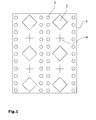
- FIGS. 1 and 2 show exemplary embodiments of the film according to the invention.
- the film (1) according to the invention has recess areas (2) which can assume different configurations and can assume identical or different shapes within the film.
- the film has areas of latent heat storage materials (3) which can take different forms and can be the same or different within a film.
- the film has perforation areas (4), which are shown as slots in the embodiments of the invention. The film may be weakened in these areas by slots or holes. But it is also sufficient if it is clearly evident that in these areas no latent heat storage materials are present so that there fasteners can be used.
- Films can be produced by conventional methods by extrusion or coextrusion.
- the microencapsulated latent heat storage are added directly to the plastic melt, just before the extrusion process.
- the film is cooled after extrusion in a water bath.
- a film in the case of coextrusion, can be provided with protuberances that are filled with the corresponding liquefied latent heat storage materials.
- the second film layer is co-extruded, wherein the filled with latent heat storage first layer is completed.
Landscapes
- Chemical & Material Sciences (AREA)
- Engineering & Computer Science (AREA)
- Thermal Sciences (AREA)
- Health & Medical Sciences (AREA)
- Environmental Sciences (AREA)
- Physics & Mathematics (AREA)
- Toxicology (AREA)
- General Health & Medical Sciences (AREA)
- Life Sciences & Earth Sciences (AREA)
- Materials Engineering (AREA)
- Combustion & Propulsion (AREA)
- Chemical Kinetics & Catalysis (AREA)
- Organic Chemistry (AREA)
- Dispersion Chemistry (AREA)
- Mechanical Engineering (AREA)
- General Engineering & Computer Science (AREA)
- Building Environments (AREA)
- Laminated Bodies (AREA)
- Protection Of Plants (AREA)
- Chemical And Physical Treatments For Wood And The Like (AREA)
Abstract
- Bereiche von Latentwärmespeichermaterialien in einer Menge von 1 bis 40 Gew.-%
- Perforationsbereiche, in denen sich keine Latentwärmespeichermaterialien befinden
- Aussparungsbereiche, in denen die Folie Öffnungen aufweist.
Description
- Die vorliegende Erfindung betrifft eine Folie als Untergrund für einen Außenputz oder eine Außenfassade sowie ein Dämmelement.
- Dem Fachmann sind zahlreiche Fassendendämmsysteme bekannt. Typische Systeme umfassen das Anbringen eines Dämmmaterials auf einer Außenwand, beispielsweise mit Hilfe eines Klebemörtels. Anschließend werden auf die Außenseite des Dämmmaterials eine Grundierung und ein Putz aufgebracht. Neben Styropormaterialien können auch mineralische Materialen zum Einsatz kommen, beispielsweise Mineralfaserplatten.
- Durch die verbesserte Dämmung der Wand werden Energieverluste reduziert. Da hierdurch in erheblichem Umfang Energie eingespart werden kann, besteht weiterhin Bedarf nach verbesserten Materialien der Dämmung von Wänden.
- Aufgabe der vorliegenden Erfindung war es, alternative Materialien für Fassadendämmsysteme bereitzustellen.
- Gelöst wird die Aufgabe durch eine Folie umfassend:
- Bereiche von Latentwärmespeichermaterialien in einer Menge von 1 bis 40 Gew.-%
- Perforationsbereiche, in denen sich keine Latentwärmespeichermaterialien befinden
- Aussparungsbereiche, in denen die Folie Öffnungen aufweist.
- Die erfindungsgemäße Folie weist zum einen Bereiche auf, in denen Latentwärmespeichermaterialien vorhanden sind. Dabei können Latentwärmespeichermaterialien direkt in eine Folie eingeschweißt sein. Es können jedoch auch mikroverkapselte Latentwärmespeichermaterialien benutzt werden, die dann von einer Folie umhüllt sind.
- Latentwärmespeichermaterialien sind dem Fachmann bekannt. Üblicherweise handelt es sich lipophile Materialien, die im gewünschten Temperaturbereich (zwischen minimal -20°C und maximal 120°C) eine Fest-/Flüssigphasenumwandlung zeigen.
- In einer bevorzugten Ausführungsform umfasst die Folie mindestens zwei Schichten, wobei die Latentwärmespeichermaterialien zwischen den Schichten liegen. Die Gewichtsmenge von 1 bis 40 Gew.-% bezieht sich auf das Gesamtgewicht der Folie einschließlich Latentwärmespeichermaterialien.
- In einer besonders bevorzugten Ausführungsform ist der Aufbau der erfindungsgemäßen Folie wie der einer Luftkissenfolie, wobei jedoch die "Luftkissen" mit Latentwärmespeichermaterialien gefüllt sind.
- Geeignete Schmelzbereiche für die Latentwärmespeichermaterialien liegen zwischen 5 und 30°C, bevorzugt 5 bis 10°C, mehr bevorzugt zwischen 5 bis 7°C.
- Grundsätzlich geeignete Latentwärmespeichermaterialien sind beispielsweise
- aliphatische Kohlenwasserstoffverbindungen wie gesättigte oder ungesättigte C10-C40-Kohlenwasserstoffe, die verzweigt oder bevorzugt linear sind, z.B. wie n-Tetradecan, n-Pentadecan, n-Hexadecan, n-Heptadecan, n-Octadecan, n-Nonadecan, n-Eicosan, n-Heneicosan, n-Docosan, n-Tricosan, n-Tetracosan, n-Pentacosan, n-Hexacosan, n-Heptacosan, n-Octacosan sowie cyclische Kohlenwasserstoffe, z.B. Cyclohexan, Cyclooctan,Cyclodecan;
- aromatische Kohlenwasserstoffverbindungen wie Benzol, Naphthalin, Biphenyl, o- oder n-Terphenyl, C1-C40-alkyl-substituierte aromatische Kohlenwasserstoffe wie Dodecylbenzol, Tetradecylbenzol, Hexadecylbenzol, Hexylnaphthalin oder Decylnaphthalin;
- gesättigte oder ungesättigte C6-C30-Fettsäuren wie Laurin-, Stearin-, Öloder Behensäure, bevorzugt eutektische Gemische aus Decansäure mit z.B. Myristin-, Palmitin- oder Laurinsäure;
- Fettalkohole wie Lauryl-, Stearyl-, Oleyl-, Myristyl-, Cetylalkohol, Gemische wie Kokosfettalkohol sowie die sogenannten Oxoalkohole, die man durch Hydroformylierung von α-Olefinen und weiteren Umsetzungen erhält;
- C6-C30-Fettamine, wie Decylamin, Dodecylamin, Tetradecylamin oder Hexadecylamin;
- Ester wie C1-C10-Alkylester von Fettsäuren wie Propylpalmitat, Methylstearat oder Methylpalmitat sowie bevorzugt ihre eutektischen Gemische oder Methylcinnamat;
- natürliche und synthetische Wachse wie Montansäurewachse, Montanesterwachse, Carnaubawachs, Polyethylenwachs, oxidierte Wachse, Polyvinyletherwachs, Ethylenvinylacetatwachs oder Hartwachse nach Fischer-Tropsch-Verfahren;
- halogenierte Kohlenwasserstoffe wie Chlorparaffin, Bromoctadecan, Brompentadecan, Bromnonadecan, Bromeicosan, Bromdocosan.
- Weiterhin sind Mischungen dieser Substanzen geeignet, solange es nicht zu einer Schmelzpunkterniedrigung außerhalb des gewünschten Bereichs kommt, oder die Schmelzwärme der Mischung für eine sinnvolle Anwendung zu gering wird.
- Latentwärmespeichermaterialen auf Basis von Paraffinen werden besonders bevorzugt.
- In einer Ausführungsform der Erfindung liegen die Latentwärmespeichermaterialien verkapselt vor, d.h. die Latentwärmespeichermaterialien sind umhüllt und werden dann in die Folie eingebracht.
- Die
WO 2003/016650 , auf die vollinhaltlich Bezug genommen wird, beschreibt unter anderem Verfahren zur Herstellung von verkapselten Latentwärmespeichermaterialien. - In typischen Herstellungswegen wird die einzukapselnde, lipophile Substanz (das Latentwärmespeichermaterial) zusammen mit Monomeren, einem Radikalstarter und einem Schutzkolloid in eine stabile Öl-in-Wasser-Emulsion gebracht. Durch Auslösung der Polymerisolation entstehen Polymere, die die lipophilen Substanzen umschließen. Wege hierzu sind beispielsweise auch in der
EP 0 457 154 A1 beschrieben. - Geeignete Kapselhüllen sind beispielsweise aus (Meth)-Acrylsäureesterpolymeren.
- Abhängig vom gewünschten Einsatz und der Dicke der Folien liegen die Kapselgrößen im Bereich von 1 bis 5000 µm, wobei bevorzugte Bereiche 5 bis 100 µm, besonders bevorzugt 10 bis 50 µm sind.
- Weiterhin umfasst die Folie Perforationsbereiche, in denen sich keine Latentwärmespeichermaterialien befinden. Dies sind Bereiche, in denen die Folie beispielsweise durch Schlitze oder Punkte geschwächt bzw. perforiert ist. Diese Bereiche eignen sich insbesondere zur Aufnahme von Befestigungselementen zur Montage der Folien.
- Drittens umfasst die Folie Aussparungsbereiche, in denen die Folie Öffnungen aufweist, d.h. die Folie weist größere offene Bereiche auf. Bevorzugt nehmen diesen Aussparungsbereiche etwas 5 bis 25% der gesamten Fläche der Folie ein. Bei einer Montage der Folie im Rahmen einer Fassadendämmung wird abschließend ein Putzmaterial aufgetragen. Durch die Aussparungsbereiche kann der Putz in diesen Bereichen das darunterliegende Dämmmaterial binden, so dass eine besonders gute Haftung des Putzes und damit eine gute Einbindung der Folie erreicht wird.
- Geeignete Dicken für die Folie liegen im Bereich von 8 bis 80 µm, wobei Dicken von 10 bis 25 µm bevorzugt sind. Weist die Folie zwei oder mehr Schichten auf, so hat jede einzelne Schicht eine Dicke von bevorzugt etwa 3 bis 7 µm.
- Als Folienmaterialien eignen sich grundsätzlich alle Kunststoffmaterialien, die auch heute für Folien eingesetzt werden, beispielsweise Polyolefine, Polyvinylchloride, Polyamide und Polyvinylacetate.
- Die erfindungsgemäßen Folien lassen sich insbesondere unter Putz im Fassadenbereich anwenden, wobei sie nach der Montage überputzt werden. Auf diese Weise kann der Taupunkt der Fassade angehoben werden.
- Weitere Anwendungsmöglichkeiten wären für eine Kühldecke, wobei die Folie mit der üblichen Kapillarrohrmatte an einer Decke befestigt wird und dann überputzt werden kann.
- Weitere Anwendungsmöglichkeiten ergeben sich beim Einbau einer abgehängten Decke. Hierzu könnte die Folie beispielsweise mit einer üblichen Lochplatte (Akustikpatte) auf der einen Seite kaschiert werden und dann an einer abgehängten Decke montiert werden. Eine solche abgehängte Decke wäre in der Lage, an heißen Tagen Wärme aufzunehmen und damit den Raum zu kühlen und zu kühleren Zeiten die entsprechende Wärme wieder abzugeben.
- Gegenstand der Erfindung ist auch ein Dämmelement, das ein Dämmmaterial umfasst, das auf einer der Hauptflächen eine erfindungsgemäße Folie aufweist. Das Dämmmaterial kann beispielsweise Styropor oder eine Mineralfaserplatte sein. Die Folie kann beispielsweise durch Kleben befestigt sein.
- Ein weiterer Gegenstand der Erfindung ist ein Verfahren zur Dämmung einer Hauswand umfassend die Schritte:
- Befestigen eines Dämmmaterials an der Hauswand
- Befestigen einer erfindungsgemäßen Folie am Dämmmaterial
- gegebenenfalls Anbringen von Befestigungselementen
- Verputzen der Hauswand mit einem Putzmaterial, wobei das Putzmaterial durch die Aussparungsbereiche tritt.
- Ein weiterer Gegenstand des Verfahrens ist ein Verfahren zur Dämmung einer Hauswand umfassend die Schritte:
- Befestigen eines erfindungsgemäßen Dämmelements an der Hauswand
- gegebenenfalls Anbringen von Befestigungselementen
- Verputzen der Hauswand mit einem Putzmaterial, wobei das Putzmaterial durch die Aussparungsbereiche tritt.
- Die
Figuren 1 und2 zeigen beispielhafte Ausgestaltungen der erfindungsgemäßen Folie. Die erfindungsgemäße Folie (1) weist Aussparungsbereiche (2) auf, die verschiedene Gestaltungen annehmen können und innerhalb der Folie gleiche oder unterschiedliche Formen annehmen können. Weiterhin weist die Folie Bereiche von Latentwärmespeichermaterialen (3) auf, die unterschiedliche Formen annehmen können und innerhalb einer Folie gleich oder unterschiedlich sein können. Weiterhin weist die Folie Perforationsbereiche (4) auf, die in den Ausführungsformen der Erfindung als Schlitze dargestellt sind. Die Folie kann in diesen Bereichen durch Schlitze oder Löcher geschwächt sein. Es genügt aber auch, wenn eindeutig erkennbar ist, dass in diesen Bereichen keine Latentwärmespeichermaterialien vorhanden sind, damit dort Befestigungselemente genutzt werden können. - Die Erfindung wird durch die nachfolgenden Beispiele näher erläutert.
- Folien können nach den gängigen Verfahren durch Extrusion oder Co-Extrusion hergestellt werden. Dabei werden die mikroverkapselten Latentwärmespeicher direkt der Kunststoffschmelze zugegeben, unmittelbar vor dem Extrusionsprozess.
- Die Folie wird nach Extrusion in einem Wasserbad gekühlt.
- Im Fall der Co-Extrusion kann eine Folie mit Ausstülpungen versehen werden, die mit den entsprechend verflüssigten Latentwärmespeichermaterialien gefüllt werden.
- Anschließend wird die zweite Folienlage co-extrudiert, wobei die mit Latentwärmespeicher gefüllte erste Lage abgeschlossen wird.
Claims (12)
- Folie umfassend:- Bereiche von Latentwärmespeichermaterialien in einer Menge von 1 bis 40 Gew.-%- Perforationsbereiche, in denen sich keine Latentwärmespeichermaterialien befinden- Aussparungsbereiche, in denen die Folie Öffnungen aufweist.
- Folie nach Anspruch 1, dadurch gekennzeichnet, dass die Perforationsbereiche geeignet sind, Befestigungselemente aufzunehmen.
- Folie nach Anspruch 1, dadurch gekennzeichnet, dass die Aussparungsbereiche 2 bis 25% der Gesamtfläche der Folie umfassen.
- Folie nach mindestens einem der Ansprüche 1 bis 3, dadurch gekennzeichnet, dass die Folie doppellagig ist.
- Folie nach mindestens einem der Ansprüche 1 bis 4, dadurch gekennzeichnet, dass die Latentwärmespeichermaterialien ausgewählt sind aus aliphatischen Kohlenwasserstoffverbindungen, aromatischen Kohlenwasserstoffverbindungen, gesättigten oder ungesättigten Fettsäuren, gesättigten oder ungesättigten Fettalkoholen, gesättigten oder ungesättigten Ester, Wachsen, halogenierten Kohlenwasserstoffverbindungen und Mischungen davon.
- Folie nach mindestens einem der Ansprüche 1 bis 5, dadurch gekennzeichnet, dass die Dicke der Folie 8 bis 80 µm beträgt.
- Folie nach mindestens einem der Ansprüche 1 bis 6, dadurch gekennzeichnet, dass das Folienmaterial ausgewählt wird aus Polyolefin, Polyvinylchlorid, Polyamid, Polyvinylacetat und Mischungen davon.
- Folie nach mindestens einem der Ansprüche 1 bis 7, dadurch gekennzeichnet, dass die Latentwärmespeicher mikroverkapselt sind.
- Folie nach mindestens einem der Ansprüche 1 bis 8, dadurch gekennzeichnet, dass die Latentwärmespeichermaterialien einen Schmelzbereich zwischen 5 und 30°C, bevorzugt 5 bis 10°C, mehr bevorzugt 5 bis 7°C aufweisen.
- Dämmelement umfassend ein Dämmmaterial mit einer mindestens an einer Fläche befestigten Folie nach einem der Ansprüche 1 bis 9.
- Verfahren zur Dämmung einer Hauswand umfassend die Schritte:- Befestigen eines Dämmmaterials an der Hauswand- Befestigen einer Folie nach einem der Ansprüche 1 bis 9 am Dämmmaterial- gegebenenfalls Anbringen von Befestigungselementen- Verputzen der Hauswand mit einem Putzmaterial, wobei das Putzmaterial durch die Aussparungsbereiche tritt.
- Verfahren zur Dämmung einer Hauswand umfassend die Schritte:- Befestigen eines Dämmelements nach Anspruch 10 an der Hauswand- gegebenenfalls Anbringen von Befestigungselementen- Verputzen der Hauswand mit einem Putzmaterial, wobei das Putzmaterial durch die Aussparungsbereiche tritt.
Priority Applications (1)
| Application Number | Priority Date | Filing Date | Title |
|---|---|---|---|
| EP08159499A EP2011387B1 (de) | 2007-07-04 | 2008-07-02 | Baufolie |
Applications Claiming Priority (2)
| Application Number | Priority Date | Filing Date | Title |
|---|---|---|---|
| EP07111712A EP2011386A1 (de) | 2007-07-04 | 2007-07-04 | Bau-, Teich- und Schwimmbadfolie |
| EP08159499A EP2011387B1 (de) | 2007-07-04 | 2008-07-02 | Baufolie |
Publications (2)
| Publication Number | Publication Date |
|---|---|
| EP2011387A1 true EP2011387A1 (de) | 2009-01-07 |
| EP2011387B1 EP2011387B1 (de) | 2010-02-17 |
Family
ID=38508917
Family Applications (2)
| Application Number | Title | Priority Date | Filing Date |
|---|---|---|---|
| EP07111712A Ceased EP2011386A1 (de) | 2007-07-04 | 2007-07-04 | Bau-, Teich- und Schwimmbadfolie |
| EP08159499A Active EP2011387B1 (de) | 2007-07-04 | 2008-07-02 | Baufolie |
Family Applications Before (1)
| Application Number | Title | Priority Date | Filing Date |
|---|---|---|---|
| EP07111712A Ceased EP2011386A1 (de) | 2007-07-04 | 2007-07-04 | Bau-, Teich- und Schwimmbadfolie |
Country Status (5)
| Country | Link |
|---|---|
| EP (2) | EP2011386A1 (de) |
| AT (1) | ATE457634T1 (de) |
| DE (1) | DE502008000373D1 (de) |
| DK (1) | DK2011387T3 (de) |
| ES (1) | ES2339192T3 (de) |
Citations (7)
| Publication number | Priority date | Publication date | Assignee | Title |
|---|---|---|---|---|
| US3772232A (en) * | 1971-06-30 | 1973-11-13 | Monsanto Chemicals | Flame-retardant polymers |
| EP0073836A1 (de) * | 1981-03-13 | 1983-03-16 | Kubota Corporation | Gewächshäuser mit Latentwärmespeicherung |
| EP0457154A1 (de) | 1990-05-16 | 1991-11-21 | BASF Aktiengesellschaft | Mikrokapseln |
| US5532039A (en) * | 1994-04-25 | 1996-07-02 | Gateway Technologies, Inc. | Thermal barriers for buildings, appliances and textiles |
| WO2003016650A1 (de) | 2001-08-16 | 2003-02-27 | Basf Aktiengesellschaft | Verwendung von mikrokapseln in gipskartonplatten |
| WO2003085346A1 (en) * | 2002-04-02 | 2003-10-16 | Omnova Wallcovering (Uk) Limited | Wall lining |
| US20040224156A1 (en) * | 2003-03-19 | 2004-11-11 | Cheng Loong Corporation | Waterproof heat-preservative film and manufacture method thereof |
-
2007
- 2007-07-04 EP EP07111712A patent/EP2011386A1/de not_active Ceased
-
2008
- 2008-07-02 AT AT08159499T patent/ATE457634T1/de active
- 2008-07-02 DK DK08159499.6T patent/DK2011387T3/da active
- 2008-07-02 EP EP08159499A patent/EP2011387B1/de active Active
- 2008-07-02 DE DE502008000373T patent/DE502008000373D1/de active Active
- 2008-07-02 ES ES08159499T patent/ES2339192T3/es active Active
Patent Citations (7)
| Publication number | Priority date | Publication date | Assignee | Title |
|---|---|---|---|---|
| US3772232A (en) * | 1971-06-30 | 1973-11-13 | Monsanto Chemicals | Flame-retardant polymers |
| EP0073836A1 (de) * | 1981-03-13 | 1983-03-16 | Kubota Corporation | Gewächshäuser mit Latentwärmespeicherung |
| EP0457154A1 (de) | 1990-05-16 | 1991-11-21 | BASF Aktiengesellschaft | Mikrokapseln |
| US5532039A (en) * | 1994-04-25 | 1996-07-02 | Gateway Technologies, Inc. | Thermal barriers for buildings, appliances and textiles |
| WO2003016650A1 (de) | 2001-08-16 | 2003-02-27 | Basf Aktiengesellschaft | Verwendung von mikrokapseln in gipskartonplatten |
| WO2003085346A1 (en) * | 2002-04-02 | 2003-10-16 | Omnova Wallcovering (Uk) Limited | Wall lining |
| US20040224156A1 (en) * | 2003-03-19 | 2004-11-11 | Cheng Loong Corporation | Waterproof heat-preservative film and manufacture method thereof |
Also Published As
| Publication number | Publication date |
|---|---|
| DK2011387T3 (da) | 2010-06-07 |
| ATE457634T1 (de) | 2010-03-15 |
| EP2011387B1 (de) | 2010-02-17 |
| DE502008000373D1 (de) | 2010-04-01 |
| EP2011386A1 (de) | 2009-01-07 |
| ES2339192T3 (es) | 2010-05-17 |
Similar Documents
| Publication | Publication Date | Title |
|---|---|---|
| EP1470372B1 (de) | Thermoaktives wand- und deckenelement | |
| EP2519783B1 (de) | Einrichtung zur temperierung eines raums | |
| EP4227570A1 (de) | Verfahren zum halten der temperatur von fluiden medien | |
| EP1815077B1 (de) | Wärmedämmplatte | |
| EP3317360A1 (de) | Verwendung eines verbundwerkstoffes zum wärmemanagement | |
| US20130251986A1 (en) | Building Material Containing Latent Heat Storage Material and Methods of Making the Same | |
| DE102005029051A1 (de) | Wärmeleitvorrichtung für eine Fußboden-, Wand- oder Deckenheizung | |
| DE202007007930U1 (de) | Decken- oder Wandelement | |
| DE10311214A1 (de) | Raumkühlungssystem | |
| EP2011387B1 (de) | Baufolie | |
| WO2014044709A1 (de) | Wandaufbau für innendämmungssysteme mit verlegten wärmedämmplatten bei variablen fugenabständen | |
| EP3234275B1 (de) | Gipsplatte mit pcm-speichermaterial | |
| DE102014218138A1 (de) | Bauplatte mit dampfbremsenden bzw. dampfsperrenden Eigenschaften und Verfahren zur Herstellung selbiger | |
| DE10149414A1 (de) | Deckenplatten auf der Basis von Gipskartonplatten oder Gipsfaserplatten, Verfahren zur Herstellung derselben und Verwendung derselben | |
| EP2667102A1 (de) | Verbundbauelement für eine Fußboden-, Wand- oder Deckenklimatisierungsvorrichtung eines Gebäudes | |
| EP3144136B1 (de) | Trägerfolie für ein klettverlegesystem einer flächentemperierungsvorrichtung, dieses umfassendes flächentemperierungssystem sowie verfahren zur herstellung eines flächentemperierungssystems | |
| EP1508552B1 (de) | Holzwollespäne-Bauprodukt | |
| DE202016104752U1 (de) | Fußbodendämmelement sowie Wärmetauscheranordnung | |
| EP3263793A1 (de) | Brandschutzelement mit einem trägergewebe | |
| DE4423137C2 (de) | Gebäudeaußenwand | |
| DE10045002B4 (de) | Plastisch verformbare Materialbahn | |
| DE102010047673A1 (de) | Baustoff, insbesondere Putz, sowie Verfahren zur Ausstattung einer Fläche mit einer raumklima- und akustikverbessernden Schicht | |
| DE212013000014U1 (de) | ETICS Fassadensystem | |
| DE2700416B2 (de) | Mehrschichtiges Verbundtragwerk | |
| DE69632048T2 (de) | Gegen hohe temperaturen beständiges isolationselement |
Legal Events
| Date | Code | Title | Description |
|---|---|---|---|
| PUAI | Public reference made under article 153(3) epc to a published international application that has entered the european phase |
Free format text: ORIGINAL CODE: 0009012 |
|
| AK | Designated contracting states |
Kind code of ref document: A1 Designated state(s): AT BE BG CH CY CZ DE DK EE ES FI FR GB GR HR HU IE IS IT LI LT LU LV MC MT NL NO PL PT RO SE SI SK TR |
|
| AX | Request for extension of the european patent |
Extension state: AL BA MK RS |
|
| 17P | Request for examination filed |
Effective date: 20090421 |
|
| GRAP | Despatch of communication of intention to grant a patent |
Free format text: ORIGINAL CODE: EPIDOSNIGR1 |
|
| AKX | Designation fees paid |
Designated state(s): AT BE BG CH CY CZ DE DK EE ES FI FR GB GR HR HU IE IS IT LI LT LU LV MC MT NL NO PL PT RO SE SI SK TR |
|
| GRAS | Grant fee paid |
Free format text: ORIGINAL CODE: EPIDOSNIGR3 |
|
| GRAA | (expected) grant |
Free format text: ORIGINAL CODE: 0009210 |
|
| AK | Designated contracting states |
Kind code of ref document: B1 Designated state(s): AT BE BG CH CY CZ DE DK EE ES FI FR GB GR HR HU IE IS IT LI LT LU LV MC MT NL NO PL PT RO SE SI SK TR |
|
| REG | Reference to a national code |
Ref country code: GB Ref legal event code: FG4D Free format text: NOT ENGLISH |
|
| REG | Reference to a national code |
Ref country code: CH Ref legal event code: EP Ref country code: CH Ref legal event code: NV Representative=s name: SCHMAUDER & PARTNER AG PATENT- UND MARKENANWAELTE |
|
| REG | Reference to a national code |
Ref country code: IE Ref legal event code: FG4D Free format text: LANGUAGE OF EP DOCUMENT: GERMAN |
|
| REF | Corresponds to: |
Ref document number: 502008000373 Country of ref document: DE Date of ref document: 20100401 Kind code of ref document: P |
|
| REG | Reference to a national code |
Ref country code: ES Ref legal event code: FG2A Ref document number: 2339192 Country of ref document: ES Kind code of ref document: T3 |
|
| REG | Reference to a national code |
Ref country code: DK Ref legal event code: T3 |
|
| REG | Reference to a national code |
Ref country code: NL Ref legal event code: VDEP Effective date: 20100217 |
|
| LTIE | Lt: invalidation of european patent or patent extension |
Effective date: 20100217 |
|
| PG25 | Lapsed in a contracting state [announced via postgrant information from national office to epo] |
Ref country code: LT Free format text: LAPSE BECAUSE OF FAILURE TO SUBMIT A TRANSLATION OF THE DESCRIPTION OR TO PAY THE FEE WITHIN THE PRESCRIBED TIME-LIMIT Effective date: 20100217 Ref country code: HR Free format text: LAPSE BECAUSE OF FAILURE TO SUBMIT A TRANSLATION OF THE DESCRIPTION OR TO PAY THE FEE WITHIN THE PRESCRIBED TIME-LIMIT Effective date: 20100217 Ref country code: NO Free format text: LAPSE BECAUSE OF FAILURE TO SUBMIT A TRANSLATION OF THE DESCRIPTION OR TO PAY THE FEE WITHIN THE PRESCRIBED TIME-LIMIT Effective date: 20100517 Ref country code: IS Free format text: LAPSE BECAUSE OF FAILURE TO SUBMIT A TRANSLATION OF THE DESCRIPTION OR TO PAY THE FEE WITHIN THE PRESCRIBED TIME-LIMIT Effective date: 20100617 |
|
| PG25 | Lapsed in a contracting state [announced via postgrant information from national office to epo] |
Ref country code: LV Free format text: LAPSE BECAUSE OF FAILURE TO SUBMIT A TRANSLATION OF THE DESCRIPTION OR TO PAY THE FEE WITHIN THE PRESCRIBED TIME-LIMIT Effective date: 20100217 Ref country code: FI Free format text: LAPSE BECAUSE OF FAILURE TO SUBMIT A TRANSLATION OF THE DESCRIPTION OR TO PAY THE FEE WITHIN THE PRESCRIBED TIME-LIMIT Effective date: 20100217 Ref country code: PL Free format text: LAPSE BECAUSE OF FAILURE TO SUBMIT A TRANSLATION OF THE DESCRIPTION OR TO PAY THE FEE WITHIN THE PRESCRIBED TIME-LIMIT Effective date: 20100217 Ref country code: SI Free format text: LAPSE BECAUSE OF FAILURE TO SUBMIT A TRANSLATION OF THE DESCRIPTION OR TO PAY THE FEE WITHIN THE PRESCRIBED TIME-LIMIT Effective date: 20100217 |
|
| REG | Reference to a national code |
Ref country code: IE Ref legal event code: FD4D |
|
| PG25 | Lapsed in a contracting state [announced via postgrant information from national office to epo] |
Ref country code: IE Free format text: LAPSE BECAUSE OF FAILURE TO SUBMIT A TRANSLATION OF THE DESCRIPTION OR TO PAY THE FEE WITHIN THE PRESCRIBED TIME-LIMIT Effective date: 20100217 Ref country code: EE Free format text: LAPSE BECAUSE OF FAILURE TO SUBMIT A TRANSLATION OF THE DESCRIPTION OR TO PAY THE FEE WITHIN THE PRESCRIBED TIME-LIMIT Effective date: 20100217 Ref country code: GR Free format text: LAPSE BECAUSE OF FAILURE TO SUBMIT A TRANSLATION OF THE DESCRIPTION OR TO PAY THE FEE WITHIN THE PRESCRIBED TIME-LIMIT Effective date: 20100518 Ref country code: NL Free format text: LAPSE BECAUSE OF FAILURE TO SUBMIT A TRANSLATION OF THE DESCRIPTION OR TO PAY THE FEE WITHIN THE PRESCRIBED TIME-LIMIT Effective date: 20100217 Ref country code: RO Free format text: LAPSE BECAUSE OF FAILURE TO SUBMIT A TRANSLATION OF THE DESCRIPTION OR TO PAY THE FEE WITHIN THE PRESCRIBED TIME-LIMIT Effective date: 20100217 Ref country code: SE Free format text: LAPSE BECAUSE OF FAILURE TO SUBMIT A TRANSLATION OF THE DESCRIPTION OR TO PAY THE FEE WITHIN THE PRESCRIBED TIME-LIMIT Effective date: 20100217 Ref country code: CY Free format text: LAPSE BECAUSE OF FAILURE TO SUBMIT A TRANSLATION OF THE DESCRIPTION OR TO PAY THE FEE WITHIN THE PRESCRIBED TIME-LIMIT Effective date: 20100217 |
|
| PG25 | Lapsed in a contracting state [announced via postgrant information from national office to epo] |
Ref country code: BG Free format text: LAPSE BECAUSE OF FAILURE TO SUBMIT A TRANSLATION OF THE DESCRIPTION OR TO PAY THE FEE WITHIN THE PRESCRIBED TIME-LIMIT Effective date: 20100517 Ref country code: CZ Free format text: LAPSE BECAUSE OF FAILURE TO SUBMIT A TRANSLATION OF THE DESCRIPTION OR TO PAY THE FEE WITHIN THE PRESCRIBED TIME-LIMIT Effective date: 20100217 Ref country code: SK Free format text: LAPSE BECAUSE OF FAILURE TO SUBMIT A TRANSLATION OF THE DESCRIPTION OR TO PAY THE FEE WITHIN THE PRESCRIBED TIME-LIMIT Effective date: 20100217 |
|
| PGFP | Annual fee paid to national office [announced via postgrant information from national office to epo] |
Ref country code: FR Payment date: 20100802 Year of fee payment: 3 |
|
| PLBE | No opposition filed within time limit |
Free format text: ORIGINAL CODE: 0009261 |
|
| STAA | Information on the status of an ep patent application or granted ep patent |
Free format text: STATUS: NO OPPOSITION FILED WITHIN TIME LIMIT |
|
| 26N | No opposition filed |
Effective date: 20101118 |
|
| PGFP | Annual fee paid to national office [announced via postgrant information from national office to epo] |
Ref country code: DK Payment date: 20100726 Year of fee payment: 3 |
|
| PG25 | Lapsed in a contracting state [announced via postgrant information from national office to epo] |
Ref country code: MC Free format text: LAPSE BECAUSE OF NON-PAYMENT OF DUE FEES Effective date: 20100731 |
|
| PGFP | Annual fee paid to national office [announced via postgrant information from national office to epo] |
Ref country code: BE Payment date: 20100726 Year of fee payment: 3 |
|
| REG | Reference to a national code |
Ref country code: ES Ref legal event code: FD2A Effective date: 20110818 |
|
| PG25 | Lapsed in a contracting state [announced via postgrant information from national office to epo] |
Ref country code: ES Free format text: LAPSE BECAUSE OF NON-PAYMENT OF DUE FEES Effective date: 20100703 |
|
| PG25 | Lapsed in a contracting state [announced via postgrant information from national office to epo] |
Ref country code: MT Free format text: LAPSE BECAUSE OF FAILURE TO SUBMIT A TRANSLATION OF THE DESCRIPTION OR TO PAY THE FEE WITHIN THE PRESCRIBED TIME-LIMIT Effective date: 20100217 |
|
| BERE | Be: lapsed |
Owner name: KNAUF GIPS K.G. Effective date: 20110731 |
|
| REG | Reference to a national code |
Ref country code: DK Ref legal event code: EBP |
|
| REG | Reference to a national code |
Ref country code: FR Ref legal event code: ST Effective date: 20120330 |
|
| PG25 | Lapsed in a contracting state [announced via postgrant information from national office to epo] |
Ref country code: FR Free format text: LAPSE BECAUSE OF NON-PAYMENT OF DUE FEES Effective date: 20110801 Ref country code: BE Free format text: LAPSE BECAUSE OF NON-PAYMENT OF DUE FEES Effective date: 20110731 |
|
| PG25 | Lapsed in a contracting state [announced via postgrant information from national office to epo] |
Ref country code: DK Free format text: LAPSE BECAUSE OF NON-PAYMENT OF DUE FEES Effective date: 20110731 |
|
| PG25 | Lapsed in a contracting state [announced via postgrant information from national office to epo] |
Ref country code: LU Free format text: LAPSE BECAUSE OF NON-PAYMENT OF DUE FEES Effective date: 20100702 Ref country code: HU Free format text: LAPSE BECAUSE OF FAILURE TO SUBMIT A TRANSLATION OF THE DESCRIPTION OR TO PAY THE FEE WITHIN THE PRESCRIBED TIME-LIMIT Effective date: 20100818 Ref country code: PT Free format text: LAPSE BECAUSE OF FAILURE TO SUBMIT A TRANSLATION OF THE DESCRIPTION OR TO PAY THE FEE WITHIN THE PRESCRIBED TIME-LIMIT Effective date: 20100717 |
|
| PG25 | Lapsed in a contracting state [announced via postgrant information from national office to epo] |
Ref country code: TR Free format text: LAPSE BECAUSE OF FAILURE TO SUBMIT A TRANSLATION OF THE DESCRIPTION OR TO PAY THE FEE WITHIN THE PRESCRIBED TIME-LIMIT Effective date: 20100217 |
|
| PGFP | Annual fee paid to national office [announced via postgrant information from national office to epo] |
Ref country code: CH Payment date: 20150723 Year of fee payment: 8 Ref country code: DE Payment date: 20150925 Year of fee payment: 8 |
|
| PGFP | Annual fee paid to national office [announced via postgrant information from national office to epo] |
Ref country code: AT Payment date: 20150722 Year of fee payment: 8 |
|
| REG | Reference to a national code |
Ref country code: DE Ref legal event code: R119 Ref document number: 502008000373 Country of ref document: DE |
|
| REG | Reference to a national code |
Ref country code: CH Ref legal event code: PL |
|
| REG | Reference to a national code |
Ref country code: AT Ref legal event code: MM01 Ref document number: 457634 Country of ref document: AT Kind code of ref document: T Effective date: 20160702 |
|
| PG25 | Lapsed in a contracting state [announced via postgrant information from national office to epo] |
Ref country code: DE Free format text: LAPSE BECAUSE OF NON-PAYMENT OF DUE FEES Effective date: 20170201 Ref country code: LI Free format text: LAPSE BECAUSE OF NON-PAYMENT OF DUE FEES Effective date: 20160731 Ref country code: CH Free format text: LAPSE BECAUSE OF NON-PAYMENT OF DUE FEES Effective date: 20160731 |
|
| PG25 | Lapsed in a contracting state [announced via postgrant information from national office to epo] |
Ref country code: AT Free format text: LAPSE BECAUSE OF NON-PAYMENT OF DUE FEES Effective date: 20160702 |
|
| P01 | Opt-out of the competence of the unified patent court (upc) registered |
Effective date: 20230822 |
|
| PGFP | Annual fee paid to national office [announced via postgrant information from national office to epo] |
Ref country code: IT Payment date: 20250721 Year of fee payment: 18 |
|
| PGFP | Annual fee paid to national office [announced via postgrant information from national office to epo] |
Ref country code: GB Payment date: 20250728 Year of fee payment: 18 |