EP2011694A2 - Longeron de toit, élément de verrouillage et véhicule - Google Patents
Longeron de toit, élément de verrouillage et véhicule Download PDFInfo
- Publication number
- EP2011694A2 EP2011694A2 EP20080150832 EP08150832A EP2011694A2 EP 2011694 A2 EP2011694 A2 EP 2011694A2 EP 20080150832 EP20080150832 EP 20080150832 EP 08150832 A EP08150832 A EP 08150832A EP 2011694 A2 EP2011694 A2 EP 2011694A2
- Authority
- EP
- European Patent Office
- Prior art keywords
- roof rail
- protrusion
- roof
- clamping member
- shaped groove
- Prior art date
- Legal status (The legal status is an assumption and is not a legal conclusion. Google has not performed a legal analysis and makes no representation as to the accuracy of the status listed.)
- Granted
Links
Images




Classifications
-
- B—PERFORMING OPERATIONS; TRANSPORTING
- B60—VEHICLES IN GENERAL
- B60R—VEHICLES, VEHICLE FITTINGS, OR VEHICLE PARTS, NOT OTHERWISE PROVIDED FOR
- B60R9/00—Supplementary fittings on vehicle exterior for carrying loads, e.g. luggage, sports gear or the like
- B60R9/04—Carriers associated with vehicle roof
- B60R9/045—Carriers being adjustable or transformable, e.g. expansible, collapsible
-
- B—PERFORMING OPERATIONS; TRANSPORTING
- B60—VEHICLES IN GENERAL
- B60R—VEHICLES, VEHICLE FITTINGS, OR VEHICLE PARTS, NOT OTHERWISE PROVIDED FOR
- B60R9/00—Supplementary fittings on vehicle exterior for carrying loads, e.g. luggage, sports gear or the like
- B60R9/04—Carriers associated with vehicle roof
- B60R9/058—Carriers associated with vehicle roof characterised by releasable attaching means between carrier and roof
Definitions
- the present invention concerns a roof rail and a roof load bar for a vehicle, whereby roof rails are arranged to bear at least part of the weight of roof load bars and its load when the roof rails are arranged on the roof of a vehicle and the roof load bars are attached to the roof rails.
- the present invention also concerns a clamping member for use with such a roof rail and a roof load bar comprising such a clamping member.
- the present invention further concerns a vehicle comprising such a roof rail, roof load bar or clamping member.
- Roof rails may be used to transport large and/or bulky items, such as bicycles, skis, canoes, luggage and other equipment or containers, on the roof of a vehicle.
- Many vehicles comprise two roof rails that extend in the longitudinal direction of the vehicle. Roof load bars are clamped to the roof rails and objects to be transported by the vehicle are then secured to the roof load bars.
- Roof load bars often comprise means, such as clamps, for rigidly securing the roof load bar to the roof rails so that it will not move during transport.
- EP 1153798 discloses a vehicle roof that has rails along its longitudinal edges.
- a roof load bar may be fastened to the rails via support feet.
- Each roof rail has a constriction for engagement with a tensioning clamp of a support foot.
- the constriction comprises vertical ribs to limit the horizontal movement of the clamp.
- the weight of the roof load bar is borne by the upper surface of the roof rails.
- Conventional roof rails generally extend along the roof edges in the longitudinal direction of the vehicle on which they are provided.
- Conventional roof rails are usually located at a distance of about a couple of centimeters from the area where the roof of the vehicle is joined to the side panels of the vehicle.
- These types of roof rails are generally provided with holes, notches, indentations or the like for clamping the roof load bars onto the roof rails. In this way, the roof load bars are clamped onto the roof rails in fixed positions.
- these types of roof rails are provided with a strut that bears the weight of the roof rails and consequently of the roof load bars and any load attached thereto.
- such struts are provided in an area above the A- and C-pillars of a vehicle. By means of these struts, the roof load bars are also arranged in a fixed position on the roof rails.
- roof load bars it is however desirable to allow roof load bars to be positioned in any location along the roof rails of a vehicle. It is also desirable to provide such free positioning of the roof load bars onto a type of roof rail, which is partially depressed into the area where the roof is joined to the side panels of the vehicle.
- a roof rail that is arranged to bear at least part of the weight of a roof load bar and its load or an object that is to be transported on the roof of the vehicle, whereby at least one roof rail is arranged to be releasably or non-releasably attached to the roof of a vehicle and whereby at least one roof load bar is arranged to be releasably or non-releasably attached to the at least one roof rail.
- the roof rail includes a substantially V-shaped groove that is arranged to receive a corresponding protrusion, such as a wedge-shaped protrusion, on a roof load bar, whereby at least one surface of the substantially V-shaped groove constitutes said load-bearing surface.
- the roof rail includes a substantially V-shaped protrusion, such as a wedge-shaped protrusion, that is arranged to be inserted into a corresponding substantially V-shaped groove on a roof load bar.
- the V shaped groove or protrusion includes a first and a second load bearing surface which are inclined at an angle of less than 90o with respect to each other.
- Said plane bisecting the angle between the first and second load bearing surfaces is a symmetry plane if the V-shaped groove or protrusion are symmetrical, which need not necessarily be the case.
- the first and second load bearing surfaces are inclined at an angle of between 15o and 60o with respect to each other, ensuring that the normal forces N will be at least twice as large as the force F with which the protrusion is pressed against the groove or vice versa.
- the V shaped groove of said roof rail is arranged to freely receive said V shaped protrusion of said clamping member or said V shaped protrusion of said roof rail is arranged to be freely inserted into said groove of said clamping member.
- the expressions "freely receive” and “freely receive”, as used in this document, are intended to mean that said roof rail and said clamping member are arranged so that when a V shaped protrusion and a V shaped groove are pressed against each other during the clamping of the clamping member to the roof rail, a substantial part, i.e.
- clamping force is intended to mean the compressive force that the clamping member exerts on the roof rail.
- the “entire clamping force” is intended to mean the total compressive force (or the sum of all compressive forces) that the clamping member exerts on the roof rail.
- V shaped groove or protrusion having first and second load bearing surfaces which are inclined at an angle of less than 90o, preferably between 15o and 60o, and by ensuring that the compressive force exerted on the inclined surfaces of the groove or protrusion is not reduced by allowing a substantial part of the compressive force exerted by the clamping member to act outside of the groove or the protrusion, large friction forces can act on the clamping member without the need for very large clamping forces or a clamping element having a considerable extension in the length direction of the roof rail.
- the V shaped groove or protrusion of said roof rail is positioned on a first side of the roof rail for engagement with said protrusion or groove arranged on a first leg of said clamping member and that a track is arranged on an opposite side of said roof rail for engagement with a holding member arranged on a second leg of a clamping member and that the protrusion or groove arranged on a first leg of said clamping member is formed to be the sole contact point between the roof rail and the clamping member on said first side of the roof rail at the mating point of said groove and protrusion.
- the entire clamping force exerted by the clamping member will act within the groove or on the protrusion of said roof rail.
- small contact forces can act elsewhere, for instance in connection with that the clamping member is further secured from movement in the vertical direction upwards from the roof rail.
- Such small forces should be smaller than 20% of the clamping force, preferably less than 10% of the clamping force, still more preferably less than 5% of the clamping force.
- the force exerted by the clamping member that is the clamping force F, lies in a plane bisecting the angle between the first and second load bearing surfaces of the V shaped groove or V shaped protrusion. This maximizes the upscaling effect of the wedge. In the event a deviation from the plane bisecting the angle between the first and second load bearing surfaces exists, the force will be directed more closely to a perpendicular direction to the load bearing surfaces of the groove or protrusion and a reduction in the normal force will occur at one of the load bearing surfaces.
- the track is positioned less than 10o, preferably less than 5o from a plane bisecting the angle between the first and second load bearing surfaces of the V shaped groove or protrusion of said roof rail measured from the bottom of the V shaped groove or top of the V shaped protrusion of said roof rail to the location of the track from the plane bisecting the angle between the first and second load bearing surfaces.
- the roof rail is adapted to be connected to a clamping member having a pivot point P for said first leg, wherein when attaching the clamping member to the roof rail, the V shaped protrusion or V shaped groove of the clamping member follows a circular path
- the construction of the roof rail gives rise to a large frictional force that will act in the longitudinal direction of the vehicle will be developed under a considerably smaller contact force needed, thereby eliminating the need for separate locks in the longitudinal direction as are required in a construction as disclosed in for instance in EP 1153798 .
- the V-shaped groove may be rounded, it may for example have the shape of part of an ellipse, or have any other shape which gives rise to at least two contact points or surfaces between the surface(s) of a protrusion and the surfaces of the V-shaped groove when a roof load bar is attached to the roof rail.
- a protrusion need not necessarily have a V-shaped profile.
- the protrusion may for example have a spherical or elliptical surface and may be of any shape as long as at least two contact points or surfaces are obtained between the surface(s) of the protrusion and the surfaces of the V-shaped groove when a roof load bar or a clamping member is attached to the roof rail.
- the roof rail has a longitudinal extension, L, and a transverse extension, T, that extends between a first side wall and a second side wall.
- the roof rail includes a substantially V-shaped groove in the form of a recessed undercut in the first side wall.
- the recessed undercut comprises a load-bearing surface that at least partially extends within the boundaries of the maximum transverse extension, T max , of the part of the roof rail overlapping the recessed undercut when the roof rail is mounted on a vehicle.
- the recessed undercut is arranged in the side wall that is to be located closest to the centre of the roof of the vehicle, i.e. the inner side wall.
- the roof rail comprises receiving means to receive a leg of a clamp that clamps the roof load bar to the roof rail.
- the receiving means may be located on the side wall that is to be located furthest from the centre of the roof of the vehicle, i.e. the outer side wall.
- the receiving means may be located on the side wall that is to be located closest to the centre of the roof of the vehicle, i.e. the inner side wall.
- one side of the substantially V-shaped groove, which constitutes a load-bearing surface is located substantially at the same height on the roof rail as the receiving means. This enables a roof rail to be made as compact as possible.
- roof load bar is intended to mean any framework, stand, grating or container that is secured to the roof of a vehicle, on, or in which articles may be placed or to which articles may be attached.
- the expression “roof load bar” as used in this document therefore includes roof boxes.
- At least one side of the substantially V-shaped groove or protrusion i.e. a side constituting at least part of the V-shape is arranged to be vertically inclined to the vehicle's horizontal plane when the roof rail is mounted on a vehicle, i.e. the plane defined by the contact points of the vehicle's tyres with an underlying surface, when the vehicle is standing on substantially flat ground.
- Said at least one side of the substantially V-shaped groove or protrusion is for example vertically inclined at an angle of 1 - 45° to the vehicle's horizontal plane when the roof rail is mounted on a vehicle.
- said at least one side of the substantially V-shaped groove or protrusion extends along at least part of the length of the roof rail or preferably along substantially the entire length of the roof rail, whereby the latter option enables a roof load bar or object to be attached at any position along the roof rail.
- the V-shaped groove or protrusion extends in a curved/non-linear manner along the length and/or breadth of said roof rail.
- a substantially V-shaped protrusion is adapted for partial or complete insertion into a substantially V-shaped groove.
- the roof rail is arranged to be located in a channel/depression in the area where the roof of the vehicle is joined to the side panels of the vehicle, i.e. within 10 cm of the side edge of the roof, when mounted in a vehicle.
- the present invention also concerns a clamping member for attaching a load, such as a roof load bar or any other object, such as a bicycle or a pair of skis, directly to a roof rail according to any of the embodiments of the invention.
- the clamping member comprises a first leg having a distal end comprising a substantially V-shaped protrusion, such as a wedge-shaped protrusion, or a substantially V-shaped groove having a lower downwardly-facing surface and an upper upwardly-facing locking surface when mounted on a roof rail, whereby the downwardly- and upwardly-facing surfaces minimize or prevent the movement of the load and whereby said protrusion or said groove is adapted to mate with a corresponding substantially V-shaped groove or substantially V-shaped protrusion of said roof rail.
- the substantially V-shaped protrusion will have at least two surfaces in contact with two surfaces of a substantially V-shaped groove when a roof load bar is attached to the roof rail, thereby increasing the contact surface area between the protrusion and the groove. At least one of these surfaces may be arranged to have a high coefficient of friction, by lining the at least one surface with a material such as rubber, or by increasing its roughness for example, to allow loads to be borne on the roof rail without sliding in the longitudinal direction of the vehicle when the vehicle is moving.
- the clamping member comprises a second leg that is arranged to clamp the clamping member onto the roof rail.
- the clamping member comprises tightening means, such as a threaded member, or clamping means for adjusting the distance between the first and second legs to tighten the clamping member to the roof rail.
- the clamping member comprises means to attach itself to an object such as a roof load bar or any other object that is to be transported on the roof rail of a vehicle.
- the present invention also concerns a roof load bar, a roof box or roof rack for a vehicle for use with a roof rail according to any of the embodiments of the invention, whereby the roof load bar comprises a clamping member according to any of the embodiments of the invention.
- the clamping member is integrally formed with the roof load bar or merely attached thereto.
- the present invention also concerns a vehicle, such as a passenger car, especially an estate car, which comprises a roof rail, a clamping member or a roof load bar according to any of the embodiments of the invention.
- the roof rail may be mounted on the roof of the vehicle, or integrally formed with part of the vehicle, such as its roof or door frame.
- FIG. 1 shows a vehicle 10 comprising two roof rails 12 which are integrated with the roof 14 of the vehicle 10.
- Each roof rail 12 extends in the longitudinal direction, L, of the vehicle and is located on a longitudinal side of the roof 14 of the vehicle 10.
- a roof rail 12 may however be placed anywhere on the roof 14 of the vehicle and it need not necessarily extend in a substantially straight line.
- Each roof rail 12 may be a multipart construction, but preferably consists of one piece, such as a single section of a metal tube.
- the roof rails 12 are fastened on top of the roof 14 of the vehicle 10, or in a channel in the roof 14 of the vehicle, at their front and rear downwardly-sloping regions by means of gluing, soldering, screwing or welding for example.
- the roof rails 12 are fastened to vehicle pillars, such as the A- and C-pillar of the vehicle 10. It should be noted that the roof rails 12 need not necessarily be located at a distance from the top of the roof 14 of the vehicle 10 as exemplified in figure 1 ; the roof rails 12 may namely be placed immediately adjacent to the top of the roof 14, i.e. without a gap between the roof rails 12 and the top of the roof 14 in a channel/depression in the area where the roof is joined to the side panels of the vehicle.
- FIG. 2 shows the roof 14 of a vehicle on which two roof rails 12a, 12b extend in the longitudinal direction L of the vehicle; one on each of the longitudinal sides of the roof 14.
- Two detachable transverse roof load bars 16a, 16b are attached to the roof rails 12a, 12b.
- Figure 3 i shows a first embodiment of the invention in which a roof rail 12 is provided with substantially V-shaped groove that is arranged to mate with a corresponding substantially V-shaped protrusion on the leg of a roof load bar 16.
- Figure 3 ii shows a second embodiment of the invention in which a roof rail 12 is provided with substantially V-shaped protrusion that is arranged to mate with a corresponding substantially V-shaped groove on the leg of a roof load bar 16.
- a normal force, N is always directed perpendicular to the plane of contact between the roof rail 12 and the roof load bar 16.
- a frictional force, F whose magnitude is proportional to the normal force, N, will act in the longitudinal direction of the vehicle (i.e. into or out of the plane of the paper depending on whether the vehicle is accelerating or decelerating) as indicated in figure 3 i) and 3 ii) .
- the frictional force, F will minimize or prevent the movement of the roof load bar 16 and its load in the longitudinal direction of the vehicle during transport.
- the sides constituting the V-shape of the groove or the protrusion need not necessarily be planar; they may be curved.
- the V-shaped protrusion may form a substantially conical shape comprising a plurality of sides that are arranged to mate with a correspondingly formed conical groove. Furthermore, the protrusion may have any shape as long as at least two contact points or surfaces are obtained between the surface(s) of the protrusion and the surfaces of the substantially V-shaped groove.
- FIG 4 shows how one end of a roof load bar 16a of a roof load bar 16 may be attached to a roof rail 12a according to an embodiment of the invention.
- the roof rail 12a has a transverse extension that extends between an inner side wall 18 and an outer side wall 20, whereby the inner side wall 18 is located closest to the centre C of the roof 14.
- the roof rail 12a may be of any shape, it may for example be of substantially circular cross-section whereby the expression "side wall” is intended to mean a part at the side of the substantially circular roof rail 12a.
- the roof rails are arranged in a depression in the area where the roof is joined to the side panels of the vehicle.
- the roof rail 12a includes a recessed undercut 22 in the inner side wall 18.
- the recessed undercut 22 comprises a load-bearing surface 24 that at least partially extends within the boundaries of the maximum transverse extension, T max , of the part of the roof rail 12a that overlaps the recessed undercut 22 (said boundaries indicated by the ends of the double-headed arrow in figure 4 ).
- the maximum transverse extension, T max may be 3 - 10 cm, whereby the recessed undercut 22 may extend 2-6 cm within the boundaries of the maximum transverse extension, T max , and, optionally, 2-6 cm outside the boundaries to facilitate mounting of the roof load bar on the roof rail 12a, i.e.
- the height of the roof rail 12a above the roof section on which it is mounted may be 3 - 10 cm. At least substantial part of the weight of the roof load bar 16 that is attached to the roof rail 12a will be borne by that load-bearing surface 24.
- the recessed undercut 22 is constituted by a substantially V-shaped groove that is arranged to receive a corresponding wedge-shaped protrusion 26 that is provided on the foot of the roof load bar 16.
- a lower downwardly-facing surface 26a of the protrusion is arranged to lie on the load-bearing surface 24 of the roof rail 12a, whereby at least a substantial part of the weight of the roof load bar will be borne by the load-bearing surface 24 of the roof rail 12a when the roof load bar is attached to the roof rail 12a.
- the protrusion 26 also comprises an upper upwardly-facing locking surface 26b to prevent or minimize movement of the roof load bar 16.
- the locking surface 26b is arranged to abut against a second surface 25 of the groove, whereby the protrusion 26 will have two surfaces in contact with two surfaces of the substantially V-shaped groove of the roof rail 12a when the roof load bar is attached to the roof rail.
- the load-bearing surface 24 of the roof rail 12a is vertically inclined with respect to the horizontal plane (not shown) of the vehicle.
- the load-bearing surface 24 may be inclined at an angle of 1 - 45° to horizontal plane of the vehicle.
- the angle between the load-bearing surface 24 and the second surface 25 may be 15-60°.
- the second surface 25 may be arranged to be substantially parallel to the horizontal plane of the vehicle or may be arranged to be vertically inclined at an angle of 1 - 45° thereto.
- the load-bearing surface 24 may extend along just part of the length of the roof rail 12a in the longitudinal direction of the car or it may extend along the entire length of the roof rail 12a.
- the load-bearing surface of the roof rail 12a may extend in a curved/non-linear manner along the length and/or breadth of the roof rail 12a. It should therefore be noted that the cross-section of the roof rail 12 need not necessarily be uniform along the entire length of the roof rail 12a and that the roof rail cross section that is shown in figures 4 and 5 is the cross section at one part of the roof rail 12a only.
- the roof rail 12a also comprises receiving means 28 to receive a leg of a clamp 30 that is integrally formed with the end of the roof load bar 16a and that clamps the roof load bar to the roof rail 12a.
- the load bearing surface 24 is located on the inner side wall 18 of the roof rail 12a and the receiving means 28 are located on the outer side wall 20 opposite the load bearing surface 24 and substantially at the at the same height on the roof rail 12a as the receiving means 28.
- the clamp 30 comprises tightening means 32, such as a threaded member, for tightening the roof load bar around the roof rail 12a. No special tool is therefore required to attach or detach the roof load bar 16 from the roof rail 12 and the clamp 30 and tightening means 32 are easily accessible.
- Figure 5 shows a clamping member 34 for attaching an object 36, such as the handlebar of an inverted bicycle (not shown) to a roof rail 12a.
- the clamping member 34 comprises means 38, such as lockable jaws that firmly grip the object 36 and thereby attach the clamping member to the object 36.
- the attachment means 38 may be slidably mounted to facilitate the attachment of an object 36 whose transverse extension is less than the distance between two roof rails.
- the clamping member 34 comprises a foot having a protrusion 26.
- a lower downwardly-facing surface 26a of the protrusion 26 is arranged to lie on a load-bearing surface 24 of the roof rail 12a, whereby at least a substantial part of the weight of the object 36 will be borne by the load-bearing surface 24 of the roof rail 12a when the object 36 is attached to the roof rail 12a.
- An upper upwardly-facing locking surface 26b prevents or minimizes movement of the roof rail 16 when the protrusion 26 has been inserted into the V-shaped groove of the roof rail 12a.
- the clamping member 34 is clamped to the roof rail 12a by means of a clamp 30.
- the clamping member 34 may comprise a cover, such as a plastic cover that is designed to improve the vehicle's external appearance and/or aerodynamics, and/or which prevents the clamping member from becoming dirty and consequently facilitates long term use.
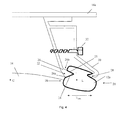
- FIG 6 a schematic drawing explaining the upscaling effect of the normal force is shown.
- a clamping force Fc is exerted by a clamping member 34.
- a normal force N will develop, the normal force being normal to the plane defined by a first load bearing surface 24 of the groove.
- the normal force N shall fulfil the following requirement:
- a track 40 for attachment of a second leg of a clamping member is positioned in the plane bisecting the angle between the first and second load bearing surfaces, namely in the symmetry plane of the V shaped groove. This ensures that the upscaling effect will not decrease at one of the load bearing surfaces, which would be the result if the clamping force were not to lie in the symmetry plane.
- At least 80%, preferably at least 90% and still more preferably at least 95% of the force field exerted by the clamping member acts in the mating between the V shaped groove and corresponding protrusion.
- the force field exerted by the clamping member is intended the force generated by the clamping action of the clamping member.
- the clamping member has the sole contact to the roof rail in the mating between the V shaped groove and corresponding protrusion at one side of the roof rail and in the track for attachment on the other opposite side of the roof rail.
- the clamping member may be allowed to include a portion which rests on a top part of the roof rail and which is acted upon by gravity forces as long as such portion does not substantially interfere with the clamping force exerted by the clamping member. Even though gravity forces generate a force field downwardly in the vertical direction, the gravity forces can not be relied upon for generation of a friction force for locking a member to the rail, since dynamical forces occurring when the vehicle is in motion may counteract the gravity forces such that the contact force will be too low for generating a sufficient friction force. In order to ensure the presence of a sufficiently large friction force it is necessary to rely on the clamping force exerted by the clamping member.
- the invention thus relates to two embodiments.
- the groove is situated on the roof rail:
Landscapes
- Engineering & Computer Science (AREA)
- Mechanical Engineering (AREA)
- Fittings On The Vehicle Exterior For Carrying Loads, And Devices For Holding Or Mounting Articles (AREA)
Priority Applications (1)
| Application Number | Priority Date | Filing Date | Title |
|---|---|---|---|
| EP08150832.7A EP2011694B1 (fr) | 2007-07-03 | 2008-01-30 | Longeron de toit, élément de verrouillage et véhicule |
Applications Claiming Priority (2)
| Application Number | Priority Date | Filing Date | Title |
|---|---|---|---|
| EP20070111649 EP2011693B1 (fr) | 2007-07-03 | 2007-07-03 | Rail de toit, composant de montage et véhicule |
| EP08150832.7A EP2011694B1 (fr) | 2007-07-03 | 2008-01-30 | Longeron de toit, élément de verrouillage et véhicule |
Publications (3)
| Publication Number | Publication Date |
|---|---|
| EP2011694A2 true EP2011694A2 (fr) | 2009-01-07 |
| EP2011694A3 EP2011694A3 (fr) | 2011-01-26 |
| EP2011694B1 EP2011694B1 (fr) | 2015-09-02 |
Family
ID=38617275
Family Applications (2)
| Application Number | Title | Priority Date | Filing Date |
|---|---|---|---|
| EP20070111649 Ceased EP2011693B1 (fr) | 2007-07-03 | 2007-07-03 | Rail de toit, composant de montage et véhicule |
| EP08150832.7A Not-in-force EP2011694B1 (fr) | 2007-07-03 | 2008-01-30 | Longeron de toit, élément de verrouillage et véhicule |
Family Applications Before (1)
| Application Number | Title | Priority Date | Filing Date |
|---|---|---|---|
| EP20070111649 Ceased EP2011693B1 (fr) | 2007-07-03 | 2007-07-03 | Rail de toit, composant de montage et véhicule |
Country Status (2)
| Country | Link |
|---|---|
| EP (2) | EP2011693B1 (fr) |
| DE (1) | DE602007010271D1 (fr) |
Families Citing this family (3)
| Publication number | Priority date | Publication date | Assignee | Title |
|---|---|---|---|---|
| NZ592162A (en) * | 2011-04-08 | 2012-07-27 | Hubco Automotive Ltd | Roof Rack Leg |
| GB201416289D0 (en) * | 2014-09-15 | 2014-10-29 | Rhino Products Ltd | Improved roof bar and connection system |
| GB2533383A (en) * | 2014-12-18 | 2016-06-22 | Bentley Motors Ltd | Roof rail |
Citations (2)
| Publication number | Priority date | Publication date | Assignee | Title |
|---|---|---|---|---|
| EP1153798A2 (fr) | 2000-05-13 | 2001-11-14 | Adam Opel Ag | Moyen de fixation d'une galerie de toit |
| WO2006130076A1 (fr) | 2005-05-30 | 2006-12-07 | Astrazeneca Ab | Procedes permettant d'identifier des modulateurs fzd8 et utilisation de ces modulateurs pour traiter l'osteoarthrite |
Family Cites Families (7)
| Publication number | Priority date | Publication date | Assignee | Title |
|---|---|---|---|---|
| US4295587A (en) * | 1974-07-08 | 1981-10-20 | Bott John Anthony | Article carrier for automotive vehicles |
| US5314104A (en) * | 1991-09-26 | 1994-05-24 | Douglas Lee | Auto mount for bicycle rack |
| SE522739C2 (sv) * | 2000-08-10 | 2004-03-02 | Mont Blanc Ind Ab | Takräckesfot-2 |
| US6409063B1 (en) * | 2000-10-20 | 2002-06-25 | Jac Products, Inc. | Vehicle article carrier having angled tap plate and cooperating slat |
| DE10304016A1 (de) * | 2003-02-01 | 2004-08-05 | Adam Opel Ag | Dachreling für ein Fahrzeug und Fahrzeugdach |
| SE528792C2 (sv) * | 2005-06-01 | 2007-02-13 | Thule Sweden Ab | Lasthållare för fast takreling |
| SE529091C2 (sv) * | 2005-06-01 | 2007-04-24 | Thule Sweden Ab | Lasthållarfot för fastspänning av en lasthållare |
-
2007
- 2007-07-03 DE DE200760010271 patent/DE602007010271D1/de active Active
- 2007-07-03 EP EP20070111649 patent/EP2011693B1/fr not_active Ceased
-
2008
- 2008-01-30 EP EP08150832.7A patent/EP2011694B1/fr not_active Not-in-force
Patent Citations (2)
| Publication number | Priority date | Publication date | Assignee | Title |
|---|---|---|---|---|
| EP1153798A2 (fr) | 2000-05-13 | 2001-11-14 | Adam Opel Ag | Moyen de fixation d'une galerie de toit |
| WO2006130076A1 (fr) | 2005-05-30 | 2006-12-07 | Astrazeneca Ab | Procedes permettant d'identifier des modulateurs fzd8 et utilisation de ces modulateurs pour traiter l'osteoarthrite |
Also Published As
| Publication number | Publication date |
|---|---|
| EP2011694B1 (fr) | 2015-09-02 |
| DE602007010271D1 (de) | 2010-12-16 |
| EP2011693A1 (fr) | 2009-01-07 |
| EP2011693B1 (fr) | 2010-11-03 |
| EP2011694A3 (fr) | 2011-01-26 |
Similar Documents
| Publication | Publication Date | Title |
|---|---|---|
| US8955201B2 (en) | Flexible strap for a securement mechanism | |
| US7014020B2 (en) | Folding travel bag with cart | |
| US6814529B2 (en) | Transport container for unit goods | |
| CN104853959A (zh) | 负荷承载器根部和车顶架 | |
| CN103097200A (zh) | 负载承载器支脚及用于车辆的车辆行李架装置 | |
| EP2011694B1 (fr) | Longeron de toit, élément de verrouillage et véhicule | |
| US20230001857A1 (en) | Configurable roof rack and associated components and methods | |
| KR102220970B1 (ko) | 무거운 부하를 고정하기 위한 방법 및 시스템 | |
| CN107567395A (zh) | 用于交通工具座椅的适配器装置以及交通工具座椅 | |
| US8226102B2 (en) | Baby trailer safety structure that prohibits baby from standing up | |
| JP6721941B2 (ja) | 遮断器現地保守点検作業台 | |
| FI124856B (fi) | Laivausjärjestely kelojen laivaamiseksi | |
| US8746522B2 (en) | Cycle carrier system | |
| AU2008216958B2 (en) | Trailer for hauling tyres | |
| JP6964753B2 (ja) | 重量物を固定する方法及びシステム | |
| EP2159139B1 (fr) | Dispositif de fixation d'un siège enfant au cadre d'un véhicule à deux roues | |
| JP7809263B2 (ja) | 台車 | |
| US9527541B2 (en) | Method for mounting a cycle carrier system | |
| CN211627187U (zh) | 一种汽车横梁检测装置 | |
| CN109878607A (zh) | 一种用于自行车的儿童座椅安装机构 | |
| CN112606864A (zh) | 一种安全性高的管状材料的运输车 | |
| CN218430821U (zh) | 电池托架和新能源车辆 | |
| JP3247194U (ja) | 転落防止装置 | |
| CN223866318U (zh) | 搬运车叉臂连续可调节结构 | |
| CN211033385U (zh) | 一种物品收容装置 |
Legal Events
| Date | Code | Title | Description |
|---|---|---|---|
| PUAI | Public reference made under article 153(3) epc to a published international application that has entered the european phase |
Free format text: ORIGINAL CODE: 0009012 |
|
| AK | Designated contracting states |
Kind code of ref document: A2 Designated state(s): AT BE BG CH CY CZ DE DK EE ES FI FR GB GR HR HU IE IS IT LI LT LU LV MC MT NL NO PL PT RO SE SI SK TR |
|
| AX | Request for extension of the european patent |
Extension state: AL BA MK RS |
|
| PUAL | Search report despatched |
Free format text: ORIGINAL CODE: 0009013 |
|
| AK | Designated contracting states |
Kind code of ref document: A3 Designated state(s): AT BE BG CH CY CZ DE DK EE ES FI FR GB GR HR HU IE IS IT LI LT LU LV MC MT NL NO PL PT RO SE SI SK TR |
|
| AX | Request for extension of the european patent |
Extension state: AL BA MK RS |
|
| 17P | Request for examination filed |
Effective date: 20110706 |
|
| RAP1 | Party data changed (applicant data changed or rights of an application transferred) |
Owner name: VOLVO CAR CORPORATION |
|
| AKX | Designation fees paid |
Designated state(s): DE GB SE |
|
| RIC1 | Information provided on ipc code assigned before grant |
Ipc: B60R 9/045 20060101AFI20121101BHEP Ipc: B60R 9/058 20060101ALI20121101BHEP |
|
| GRAP | Despatch of communication of intention to grant a patent |
Free format text: ORIGINAL CODE: EPIDOSNIGR1 |
|
| INTG | Intention to grant announced |
Effective date: 20140205 |
|
| GRAP | Despatch of communication of intention to grant a patent |
Free format text: ORIGINAL CODE: EPIDOSNIGR1 |
|
| INTG | Intention to grant announced |
Effective date: 20150421 |
|
| GRAS | Grant fee paid |
Free format text: ORIGINAL CODE: EPIDOSNIGR3 |
|
| GRAA | (expected) grant |
Free format text: ORIGINAL CODE: 0009210 |
|
| AK | Designated contracting states |
Kind code of ref document: B1 Designated state(s): DE GB SE |
|
| REG | Reference to a national code |
Ref country code: GB Ref legal event code: FG4D |
|
| REG | Reference to a national code |
Ref country code: DE Ref legal event code: R096 Ref document number: 602008039894 Country of ref document: DE |
|
| REG | Reference to a national code |
Ref country code: SE Ref legal event code: TRGR |
|
| REG | Reference to a national code |
Ref country code: DE Ref legal event code: R097 Ref document number: 602008039894 Country of ref document: DE |
|
| PLBE | No opposition filed within time limit |
Free format text: ORIGINAL CODE: 0009261 |
|
| STAA | Information on the status of an ep patent application or granted ep patent |
Free format text: STATUS: NO OPPOSITION FILED WITHIN TIME LIMIT |
|
| 26N | No opposition filed |
Effective date: 20160603 |
|
| PGFP | Annual fee paid to national office [announced via postgrant information from national office to epo] |
Ref country code: SE Payment date: 20170119 Year of fee payment: 10 |
|
| PGFP | Annual fee paid to national office [announced via postgrant information from national office to epo] |
Ref country code: GB Payment date: 20170116 Year of fee payment: 10 |
|
| REG | Reference to a national code |
Ref country code: SE Ref legal event code: EUG |
|
| GBPC | Gb: european patent ceased through non-payment of renewal fee |
Effective date: 20180130 |
|
| PG25 | Lapsed in a contracting state [announced via postgrant information from national office to epo] |
Ref country code: SE Free format text: LAPSE BECAUSE OF NON-PAYMENT OF DUE FEES Effective date: 20180131 |
|
| PG25 | Lapsed in a contracting state [announced via postgrant information from national office to epo] |
Ref country code: GB Free format text: LAPSE BECAUSE OF NON-PAYMENT OF DUE FEES Effective date: 20180130 |
|
| P01 | Opt-out of the competence of the unified patent court (upc) registered |
Effective date: 20231212 |
|
| PGFP | Annual fee paid to national office [announced via postgrant information from national office to epo] |
Ref country code: DE Payment date: 20231219 Year of fee payment: 17 |
|
| REG | Reference to a national code |
Ref country code: DE Ref legal event code: R119 Ref document number: 602008039894 Country of ref document: DE |
|
| PG25 | Lapsed in a contracting state [announced via postgrant information from national office to epo] |
Ref country code: DE Free format text: LAPSE BECAUSE OF NON-PAYMENT OF DUE FEES Effective date: 20250801 |