EP2011872A1 - Instrument et procédé d'isolation d'acide nucléique - Google Patents
Instrument et procédé d'isolation d'acide nucléique Download PDFInfo
- Publication number
- EP2011872A1 EP2011872A1 EP08012041A EP08012041A EP2011872A1 EP 2011872 A1 EP2011872 A1 EP 2011872A1 EP 08012041 A EP08012041 A EP 08012041A EP 08012041 A EP08012041 A EP 08012041A EP 2011872 A1 EP2011872 A1 EP 2011872A1
- Authority
- EP
- European Patent Office
- Prior art keywords
- nucleic acid
- acid isolation
- isolation column
- nucleic
- reagent
- Prior art date
- Legal status (The legal status is an assumption and is not a legal conclusion. Google has not performed a legal analysis and makes no representation as to the accuracy of the status listed.)
- Withdrawn
Links
Images



Classifications
-
- C—CHEMISTRY; METALLURGY
- C12—BIOCHEMISTRY; BEER; SPIRITS; WINE; VINEGAR; MICROBIOLOGY; ENZYMOLOGY; MUTATION OR GENETIC ENGINEERING
- C12N—MICROORGANISMS OR ENZYMES; COMPOSITIONS THEREOF; PROPAGATING, PRESERVING, OR MAINTAINING MICROORGANISMS; MUTATION OR GENETIC ENGINEERING; CULTURE MEDIA
- C12N15/00—Mutation or genetic engineering; DNA or RNA concerning genetic engineering, vectors, e.g. plasmids, or their isolation, preparation or purification; Use of hosts therefor
- C12N15/09—Recombinant DNA-technology
- C12N15/10—Processes for the isolation, preparation or purification of DNA or RNA
- C12N15/1003—Extracting or separating nucleic acids from biological samples, e.g. pure separation or isolation methods; Conditions, buffers or apparatuses therefor
- C12N15/1006—Extracting or separating nucleic acids from biological samples, e.g. pure separation or isolation methods; Conditions, buffers or apparatuses therefor by means of a solid support carrier, e.g. particles, polymers
-
- G—PHYSICS
- G01—MEASURING; TESTING
- G01F—MEASURING VOLUME, VOLUME FLOW, MASS FLOW OR LIQUID LEVEL; METERING BY VOLUME
- G01F23/00—Indicating or measuring liquid level or level of fluent solid material, e.g. indicating in terms of volume or indicating by means of an alarm
- G01F23/22—Indicating or measuring liquid level or level of fluent solid material, e.g. indicating in terms of volume or indicating by means of an alarm by measuring physical variables, other than linear dimensions, pressure or weight, dependent on the level to be measured, e.g. by difference of heat transfer of steam or water
- G01F23/28—Indicating or measuring liquid level or level of fluent solid material, e.g. indicating in terms of volume or indicating by means of an alarm by measuring physical variables, other than linear dimensions, pressure or weight, dependent on the level to be measured, e.g. by difference of heat transfer of steam or water by measuring the variations of parameters of electromagnetic or acoustic waves applied directly to the liquid or fluent solid material
- G01F23/284—Electromagnetic waves
- G01F23/292—Light, e.g. infrared or ultraviolet
- G01F23/2921—Light, e.g. infrared or ultraviolet for discrete levels
-
- G—PHYSICS
- G01—MEASURING; TESTING
- G01N—INVESTIGATING OR ANALYSING MATERIALS BY DETERMINING THEIR CHEMICAL OR PHYSICAL PROPERTIES
- G01N35/00—Automatic analysis not limited to methods or materials provided for in any single one of groups G01N1/00 - G01N33/00; Handling materials therefor
- G01N35/10—Devices for transferring samples or any liquids to, in, or from, the analysis apparatus, e.g. suction devices, injection devices
- G01N35/1009—Characterised by arrangements for controlling the aspiration or dispense of liquids
- G01N2035/1025—Fluid level sensing
Definitions
- the present invention relates to a method and an instrument for nucleic acid isolation, wherein nucleic acids are isolated from a sample containing nucleic acids.
- PCR polymerase chain reaction
- nucleic acids isolated from a biological sample or the like are used.
- nucleic acid isolation it is necessary to remove the influence of contaminants, including inhibitors of an analysis reaction, such as nucleic acids derived from the external environment that cause false-positive analytical results.
- nucleic acid isolation from a biological sample an operation such as ethanol precipitation or the like is carried out using poisonous material such as phenol or chloroform.
- poisonous material such as phenol or chloroform.
- JP Patent Publication (Kokai) No. 2005-204578 A is a method wherein a solution containing nucleic acids is introduced into an isolation cartridge comprising, as nucleic-acid-adsorptive members, organic macromolecules such as acetylcellulose and the solution is discharged through the nucleic-acid-adsorptive members by pressurization, such that nucleic acids are allowed to adsorb to the nucleic-acid-adsorptive members.
- a pressure change in a nucleic acid isolation column immediately after the discharge of the entire volume of a solution is analyzed, a pressure release valve is operated, and then the pressurized air in the nucleic acid isolation column is released. Accordingly, dispersion of the discharged solution in a mist form caused by the remaining pressurized air is prevented such that risks of causing contamination are reduced.
- contamination might be caused as a result of dispersion of a discharged solution in a mist or droplet form following disruption of bubbles caused at the residual pressure or as a result of adherence of bubbles (formed at the residual pressure) to the vicinity of a nucleic acid isolation column outlet.
- nucleic acids of interest are isolated from a liquid sample containing nucleic acids
- such method comprises the steps of:
- an instrument for nucleic acid isolation in which nucleic acids of interest are isolated from a liquid sample containing nucleic acids, such instrument comprises:
- control unit controls an operation of the aspiration and discharge unit so as to cause elution of nucleic acids of interest from the nucleic-acid-adsorptive solid phase by the steps of:
- Fig. 1 is a general operational flowchart of a method for nucleic acid isolation in one embodiment of the present invention.
- the method for nucleic acid isolation comprises a nucleic acid adsorption step (A), a first washing step (B), a second washing step (C), and a nucleic acid elution step (D).
- the nucleic acid adsorption process (A) comprises introducing a liquid mixture obtained by adding an adsorption reagent to a sample containing nucleic acids into a nucleic acid isolation column, pressurizing the inside of the nucleic acid isolation column such that the liquid mixture is allowed to pass through a nucleic-acid-adsorptive solid phase so as to be discharged, detecting that the remaining liquid volume in the nucleic acid isolation column has become a predetermined volume, and releasing pressure (corresponding to steps 100 to 105).
- the first washing process (B) comprises introducing a first washing reagent into a nucleic acid isolation column, pressurizing the inside of the nucleic acid isolation column such that the washing reagent is allowed to pass through the nucleic-acid-adsorptive solid phase so as to be discharged, detecting that the remaining liquid volume in the nucleic acid isolation column has become a predetermined volume, and releasing pressure (corresponding to steps 106 to 110).
- the second washing process (C) comprises introducing a second washing reagent into a nucleic acid isolation column, pressurizing the inside of the nucleic acid isolation column such that the washing reagent is allowed to pass through the nucleic-acid-adsorptive solid phase so as to be discharged, detecting that the remaining liquid volume in the nucleic acid isolation column has become a predetermined volume, releasing pressure, and removing the remaining solution (corresponding to steps 111 to 116).
- the first washing process (B) and the second washing process (C) each correspond to a step of allowing nucleic acids of interest to remain in a nucleic-acid-adsorptive solid phase and removing the other nucleic acids.
- the nucleic acid elution process (D) comprises introducing an elution reagent into a nucleic acid isolation column, pressurizing the inside of the nucleic acid isolation column such that the elution reagent is allowed to pass through the nucleic-acid-adsorptive solid phase so as to be discharged, detecting that the remaining liquid volume in the nucleic acid isolation column has become a predetermined volume, releasing pressure, and discharging nucleic acids of interest in the nucleic-acid-adsorptive solid phase so as to obtain a nucleic acid solution (corresponding to steps 117 to 122).
- samples containing nucleic acids examples include body fluids such as whole blood, plasma, serum, urine, saliva, sputum, or seminal fluid, tissues or cells of plants and animals, microorganisms, bacteria, viruses, and suspensions containing any thereof or lysates of any thereof.
- examples of adsorption reagents that can be used include a variety of chaotropic salts, which allow nucleic acids in a sample containing nucleic acids to be released and promote adsorption of nucleic acids to a nucleic-acid-adsorptive solid phase.
- examples of such chaotropic salt that can be used include guanidine thiocyanate, guanidine hydrochloride, sodium iodide, potassium iodide, and sodium perchlorate.
- a surfactant in order to promote release of nucleic acids, a surfactant, a protease, and the like can be used.
- surfactants that can be used include nonionic surfactants such as polyoxyethylene (10) octylphenyl ether and polyoxyethylene (20) sorbitan monolaurate.
- reductants such as 2-mercaptoethanol and dithiothreitol and metal chelating agents such as ethylenediamine tetraacetate can be used.
- an organic solvent in order to promote release of nucleic acids, heating, agitation, homogenization, and ultrasonication treatments can be used in combination. Furthermore, in order to promote adsorption of nucleic acids to a nucleic-acid-adsorptive solid phase, an organic solvent can be used.
- organic solvents include aqueous organic solvents such as methanol, ethanol, isopropanol, butanol, acetone, diethylene glycoldimethyl ether, and ethyl lactate.
- Fig. 2 is an explanatory drawing of a nucleic acid isolation column 35 comprising a nucleic-acid-adsorptive solid phase that is used in one embodiment of the present invention.
- the nucleic acid isolation column 35 comprises an opening 21 through which a solution is introduced, a connecting portion 22 to which a pressurization mechanism is connected, and a tube 26 having an opening 23 through which the solution is discharged.
- a nucleic-acid-adsorptive solid phase 24 is provided inside the tube 26, such solid phase being fixed with a supporting member 25.
- nucleic-acid-adsorptive solid phase 24 is a solid phase comprising glass, silica, diatom earth, acetylcellulose, or the like.
- Such solid phase has a fine and tightly knitted filter-like structure having a plurality of consecutive liquid passage pores through which a solution can pass, such that a solution passes through the solid phase with sufficient efficiency of contact between the solution and the solid phase.
- a supporting member 25 that can be used is a member capable of maintaining the shape and installation position of a nucleic-acid-adsorptive solid phase 24 and having a plurality of consecutive liquid passage pores through which a solution can pass. Examples thereof include sintered polypropylene particles.
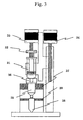
- Fig. 3 is an explanatory drawing of a pressurization mechanism whereby the inside of a nucleic acid isolation column 35 into which a solution has been introduced is pressurized such that the solution is allowed to pass through a nucleic-acid-adsorptive solid phase 24 so as to be discharged.
- the pressurization mechanism comprises: a syringe 31 that is used to pressurize the inside of a nucleic acid isolation column 35; a plunger 32; a plunger-driving motor 33 that drives the plunger 32 in the vertical direction; a syringe-driving motor 34 that drives the syringe 31 and the plunger 32 in the vertical direction; a sealing member 36 used between the syringe 31 and the nucleic acid isolation column 35; a nucleic acid isolation column-supporting stand 37; a waste solution reservoir 38; and a waste solution reservoir-supporting stand 39.
- the plunger 32 and the syringe 31 are moved upward and the nucleic acid isolation column 35 and the waste solution reservoir 38 are each placed on the relevant supporting stand. Then, a certain solution is introduced into the nucleic acid isolation column 35, the syringe 31 is moved downward, and the syringe 31 and the nucleic acid isolation column 35 are allowed to adhere to each other via the sealing member 36. Further, the plunger 32 is moved downward and the inside of the nucleic acid isolation column 35 is pressurized, such that the solution in the nucleic acid isolation column 35 is allowed to pass through inside the nucleic-acid-adsorptive solid phase 24 so as to be discharged into the waste solution reservoir 38.
- the nucleic-acid-adsorptive solid phase 24 in the nucleic acid isolation column 35 has a fine and tightly knitted liquid passage pore structure.
- a highly viscous solution such as a liquid mixture of a sample and an adsorption solution
- the liquid passage resistance becomes high. Therefore, in order to efficiently carry out liquid passage treatment, application of high pressure is necessary.
- a method for detecting that the remaining liquid volume in a nucleic acid isolation column 35 has become a predetermined volume may preferably be a method wherein detection is carried out in a solution-contactless manner.
- detection is carried out in a solution-contactless manner.
- sensors such as a photosensor, a pressure sensor, an image sensor, and an ultrasonic sensor.
- An example of a method using a photosensor is a method wherein a light source unit and a light-receiving unit of a photosensor are placed at a position at which the fluid level should be detected, such position being outside of the nucleic acid isolation column, and the fluid level is detected by measuring optical properties that change when the fluid surface passes the position at which the fluid level should be detected. Such optical properties that change as a result of the passage of the fluid surface are detected based on a difference between the refractive index of the solution and that of air.
- the refractive index of the nucleic acid isolation column 35 and that of the solution are small.
- incident light having a certain angle of incidence permeates the nucleic acid isolation column 35 and the solution.
- the refractive index of the nucleic acid isolation column 35 and that of air are large.
- incident light having the above angle of incidence is totally reflected from the internal surface of the nucleic acid isolation column 35 or permeates the nucleic acid isolation column and the solution along a light beam path that differs from that of transmitted light in a case in which the solution is contained in the nucleic acid isolation column 35.
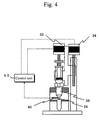
- Fig. 4 is an explanatory drawing of a pressurization unit in a case in which the fluid level is detected using a photosensor 41.
- a light source unit and a light-receiving unit that receives totally reflected light of the photosensor 41 for detecting the fluid level are placed on a site on the side surface of the nucleic acid isolation column 35, where the photosensor can detect the fluid level corresponding to a remaining liquid volume of approximately 10 ul.
- the light source unit of the photosensor 41 is positioned in a manner such that incident light is totally reflected from the interface between the nucleic acid isolation column 35 and air in the nucleic acid isolation column 35 and light is allowed to be incident in the solution when reaching the interface between the nucleic acid isolation column 35 and the solution in the nucleic acid isolation column 35.
- the light-receiving unit of the photosensor 41 is positioned in a manner such that it receives the above totally reflected light and is fixed on the upper part of the nucleic-acid-adsorptive solid phase 24.
- the fluid level detection sensor is in communication with a syringe-driving motor 34 via a control unit 40 such that a syringe 31 is driven upward when the fluid level reaches a predetermined level.
- a nucleic acid isolation column 35 and a waste liquid reservoir 38 are provided to a pressurization unit. Then, a liquid mixture of a sample (200 ul) and an adsorption solution (800 ul) is introduced into a nucleic acid isolation column and then the pressurization unit is activated. A syringe 31 is driven downward so as to adhere to a nucleic acid isolation column 35 via a sealing member 36. Thereafter, a plunger 32 is driven downward such that an air phase having an initial syringe volume of 5 ml is compressed to 1 ml (pressurization operation). The above operations correspond to operations in steps 100 to 103 in fig. 1 .
- the volume of the liquid mixture remaining in the nucleic acid isolation column 35 has become a predetermined volume (e.g., 10 ul). If not, the pressurization operation is continued (step 104). When the remaining volume has become 10 ul, the syringe 31 is driven upward so as to become disconnected from the nucleic acid isolation column 35, and the plunger 32 is driven upward (step 105).
- a predetermined volume e.g. 10 ul
- a first washing reagent (1200 ul) is introduced into the nucleic acid isolation column 35 (steps 106 and 107).
- the syringe 31 is driven downward so as to adhere to the nucleic acid isolation column 35 via the sealing member 36.
- the plunger 32 is driven downward such that an air phase having an initial syringe volume of 5 ml is compressed to 1 ml (step 108).
- the syringe 31 is driven upward so as to become disconnected from the nucleic acid isolation column 35, and the plunger 32 is driven upward (step 110).
- a second washing reagent (1200 ul) is introduced into the nucleic acid isolation column 35 (steps 111 and 112).
- the syringe 31 is driven downward so as to adhere to the nucleic acid isolation column 35 via the sealing member 36.
- the plunger 32 is driven downward such that an air phase having an initial syringe volume of 5 ml is compressed to 1 ml (step 113).
- the syringe 31 is driven upward so as to become disconnected from the nucleic acid isolation column 35, and the plunger 32 is driven upward (step 115).
- Steps 111 to 115 are carried out again. Then, the nucleic acid isolation column 35 is removed and heated at 65°C for 5 minutes. Accordingly, the remaining washing reagent is removed therefrom by volatilization (step 116).
- the waste liquid reservoir 38 is removed and discarded and then a purified liquid reservoir is positioned. Then, the nucleic acid isolation column 35 is positioned again. Thereafter, an elution reagent (110 ul) is introduced into the nucleic acid isolation column 35 (steps 117 and 118).
- the plunger 32 is driven downward such that an air phase (in the syringe 31) having an initial volume of 2 ml is compressed to 1 ml (step 119). Then, it is detected whether or not the remaining volume of the washing reagent in the nucleic acid isolation column 35 has become a predetermined volume (e.g., 10 ul). If not, the pressurization operation is continued (step 120). When the remaining volume has become 10 ul, the syringe 31 is driven upward so as to become disconnected from the nucleic acid isolation column 35, and the plunger 32 is driven upward (step 121). Thus, the elution reagent (approximately 100 ul) is obtained in the purified liquid reservoir (step 122).
- a predetermined volume e.g. 10 ul
- a syringe 31 is moved upward by a control unit 40 that is in communication with a photosensor 41 and a motor 34 that drives the syringe in the vertical direction such that the syringe becomes disconnected from a nucleic acid isolation column 35, followed by release of the pressure in the nucleic acid isolation column 35.
- a plunger 32 is moved upward by a control unit 40 that is in communication with a photosensor 41 and a motor 33 that drives the plunger in the vertical direction, followed by release of the pressure in the nucleic acid isolation column 35.
- a method comprising detecting a decrease in a fluid level in a stepwise manner with at least one photosensor 41 that is placed at a site at which a fluid level at which the remaining liquid volume becomes a predetermined volume or a fluid level located above such level can be detected, moving a plunger 32 upward so as to reduce the pressure in a nucleic acid isolation column 35 in a stepwise manner, and completely releasing the pressure in the nucleic acid isolation column 35 when the remaining liquid volume has become a predetermined volume.
- a first washing reagent is a solution capable of maintaining adsorption of nucleic acids to a nucleic-acid-adsorptive solid phase and removing nonspecific adsorbing substances such as proteins.
- a first washing reagent that can be used include a solution that can be used in an adsorption solution, such solution containing a chaotropic salt, a surfactant, a reductant, a metal chelating agent, an organic solvent, or the like.
- a second washing reagent is a solution capable of maintaining adsorption of nucleic acids to a nucleic-acid-adsorptive solid phase and removing nonspecific adsorbing substances, which were impossible to remove with a first washing reagent, and the remaining components of a first washing reagent to such an extent that the substances and the remaining components can be removed before an elution reagent is introduced in the subsequent step and thus they do not inhibit the subsequent analytical reaction.
- Examples of a second washing reagent that can be used include a solution containing, for example, a volatile organic solvent such as ethanol or acetone.
- a method for removing a remaining portion of a second washing reagent a method wherein a nucleic acid isolation column 35 is heated such that a remaining washing reagent is volatilized can be used.
- an elution reagent is a solution that elutes nucleic acids from a nucleic-acid-adsorptive solid phase and does not contain components that inhibit the subsequent analytical reaction.
- examples of such elution reagent that can be used include nucleotidase-free pure water and low-salt buffer.
- an elution reagent can be heated.
- the above method is a method for calculating the remaining liquid volume by measuring the pressure in a syringe 31 and that in an isolation column 35 with the use of a pressure sensor connected to the inside of the syringe 31.
- the pressure in the syringe 31 and that in the nucleic acid isolation column 35 upon pressurization are determined based on the initial position of and distance moved by a plunger 32 and the initial volume and remaining volume of a solution, respectively. For instance, in a case in which the initial position of a plunger 32 and the initial volume of a solution are stable, the remaining volume of the solution can be calculated based on the pressure in the nucleic acid isolation column 35 and the distance moved by the plunger in accordance with the driving force of a plunger-driving motor 33.
- Fig. 5 is an explanatory drawing of a pressurization unit in a case in which a pressure sensor is used for detection of fluid level.
- the pressurization unit used is a pressurization unit in which a pressure sensor 51 for detecting the remaining liquid volume is placed in a pressurization mechanism as shown in fig. 3 described above.
- the pressure sensor 51 is connected to the side surface of the lower portion of the syringe via a communication path to the inside of the syringe 31.
- the remaining liquid volume is calculated based on the pressure value, the initial position of the plunger 32, and the distance moved by the plunger 32.
- the pressure sensor 51 is in communication with the plunger-driving motor 33 and the syringe-driving motor 34 via the control unit 40.
- a method comprising measuring the pressure in a nucleic acid isolation column 35 with a pressure sensor 51 so as to calculate the remaining liquid volume, reducing the pressure in the nucleic acid isolation column 35 in a stepwise manner by moving a plunger 32 upward until the remaining liquid volume in the nucleic acid isolation column 35 has become a predetermined volume, and completely releasing the pressure in the nucleic acid isolation column when the remaining liquid volume has become a predetermined volume; or a method comprising detecting the remaining liquid volume with an image sensor, reducing the pressure in the nucleic acid isolation column 35 in a stepwise manner by moving a plunger 32 upward until the remaining liquid volume in a nucleic acid isolation column 35 has become a predetermined volume, and completely releasing the pressure in the nucleic acid isolation column 35 when the remaining liquid volume has become a predetermined volume.
- nucleic acid analysis involving the following can be applied: nucleic acid amplification, reverse transcription reactions, and nucleic acid elongation reactions, including PCR (Polymerase Chain Reaction), RT-PCR (Reverse Transcription-Polymerase Chain Reaction), LCR (Ligase Chain Reaction), SDA (Strand Displacement Amplification), NASBA (Nucleic Acid Sequence-Based Amplification), TMA (Transcription-Mediated Amplification), LAMP (Loop-mediated isothermal amplification), and ICAN (Isothermal and Chimeric primer-initiated Amplification of Nucleic acids); enzymatic reactions using restriction enzymes and the like; and electrophoresis.
- PCR Polymerase Chain Reaction
- RT-PCR Reverse Transcription-Polymerase Chain Reaction
- LCR Liigase Chain Reaction
- SDA Strand Displacement Amplification
- NASBA Nucleic Acid Sequence-Based Amplification
- TMA Transcription-Mediated Amplification
- the sample used was a false-positive specimen obtained by adding purified DNA of HBV-positive serum to HBV-negative serum (10 3 copies/200 ⁇ l).
- the reagent used was an adsorption reagent (6 M guanidine hydrochloride, 100 mM MES, 25 mM EDTA ⁇ 2Na, and 20% (v/v) polyoxyethylene (10) octylphenyl ether).
- the first washing reagent used contained 2.5 M guanidine thiocyanate, 100 mM MES, 25 mM EDTA ⁇ 2Na, and 1% (v/v) polyoxyethylene (10) octylphenyl ether.
- the second washing reagent used contained 10 mM Tris-HCl (pH 8.0) and 80% (v/v) EtOH.
- the elution reagent used was 10 mM Tris-HCl (pH 8.0).
- the nucleic acid isolation column used was a nucleic acid isolation column 35 as shown in fig. 2 , such that the internal volume of the nucleic acid isolation column 35 was 2 ml, the material of the nucleic acid isolation column 35 was polypropylene, a nucleic-acid-adsorptive solid phase containing nucleic acids was a glass fiber filter paper having an average pore size of 0.7 ⁇ m, and a supporting member was a sintered body comprising polypropylene particles having an average particle retension size of approximately 100 ⁇ m.
- PCR was used for a nucleic acid analysis method. PCR involving the use of HBV-derived DNA as template DNA was carried out under the following conditions in accordance with the existing report ( J. Clin. Microbiol., 29(9), 1804-1811 (1991 )).
- Primer FIP 5'CCT GCT GCT ATG CCT CAT CTT CTT TGA CAA ACG GGC AAC ATA CCT T 3' Primer BIP: 5'GAT AAA ACG CCG CAG ACA CAT CCT TCC AAC CTC TTG TCC TCC AA 3' Primer F3: 5' GGT GGT TGA TGT TCC TGG A 3' Primer B3: 5'CAAAAT TCG CAG TCC CCAAC 3' Temperature conditions: 95°C (5 min) ⁇ On ice (3 min) ⁇ addition of Bst DNA polymerase ⁇ 65°C (1 h) ⁇ 80°C (10 min) Confirmation of amplification products: Electrophoresis was carried out with the use of 0.8% agarose gel as a support.
- nucleic acid isolation column outlet it is possible to realize an instrument and a method for nucleic acid isolation, whereby it is possible to prevent, for example, adherence of a discharged solution upon dispersion of the solution to the vicinity of the nucleic acid isolation column outlet.
- an ultrasonic sensor instead of a photosensor.
- an ultrasonic sensor it is possible to detect the position corresponding to the fluid level by placing an ultrasonic generating element and an ultrasonic detecting element in a nucleic acid isolation column in a manner such that they face each other and detecting whether or not solution is present between the ultrasonic generating element and the ultrasonic detecting element based on the difference between the detection level of the ultrasonic detecting element.
- the fluid level can be detected by subjecting an image obtained by the image sensor to image processing.
- image processing can be carried out by a control unit 40.
Landscapes
- Physics & Mathematics (AREA)
- Chemical & Material Sciences (AREA)
- Engineering & Computer Science (AREA)
- Health & Medical Sciences (AREA)
- Life Sciences & Earth Sciences (AREA)
- Biomedical Technology (AREA)
- Genetics & Genomics (AREA)
- Electromagnetism (AREA)
- Zoology (AREA)
- Biotechnology (AREA)
- General Engineering & Computer Science (AREA)
- Organic Chemistry (AREA)
- Bioinformatics & Cheminformatics (AREA)
- Wood Science & Technology (AREA)
- Molecular Biology (AREA)
- Microbiology (AREA)
- Plant Pathology (AREA)
- Biophysics (AREA)
- Biochemistry (AREA)
- General Health & Medical Sciences (AREA)
- Crystallography & Structural Chemistry (AREA)
- Analytical Chemistry (AREA)
- Thermal Sciences (AREA)
- Fluid Mechanics (AREA)
- General Physics & Mathematics (AREA)
- Apparatus Associated With Microorganisms And Enzymes (AREA)
- Measuring Or Testing Involving Enzymes Or Micro-Organisms (AREA)
Applications Claiming Priority (1)
| Application Number | Priority Date | Filing Date | Title |
|---|---|---|---|
| JP2007176325A JP5022794B2 (ja) | 2007-07-04 | 2007-07-04 | 核酸抽出方法及び核酸抽出装置 |
Publications (1)
| Publication Number | Publication Date |
|---|---|
| EP2011872A1 true EP2011872A1 (fr) | 2009-01-07 |
Family
ID=39876531
Family Applications (1)
| Application Number | Title | Priority Date | Filing Date |
|---|---|---|---|
| EP08012041A Withdrawn EP2011872A1 (fr) | 2007-07-04 | 2008-07-03 | Instrument et procédé d'isolation d'acide nucléique |
Country Status (3)
| Country | Link |
|---|---|
| US (1) | US20090099350A1 (fr) |
| EP (1) | EP2011872A1 (fr) |
| JP (1) | JP5022794B2 (fr) |
Cited By (3)
| Publication number | Priority date | Publication date | Assignee | Title |
|---|---|---|---|---|
| EP3226004A1 (fr) * | 2016-03-30 | 2017-10-04 | CTC Analytics AG | Procede destine au fonctionnement d'un dispositif de dosage |
| CN110272808A (zh) * | 2018-03-13 | 2019-09-24 | 武汉医蒂生物科技有限公司 | 一种核酸提取系统 |
| CN111239065A (zh) * | 2020-02-25 | 2020-06-05 | 山东大学 | 一种中药提取在线检测系统及方法 |
Families Citing this family (8)
| Publication number | Priority date | Publication date | Assignee | Title |
|---|---|---|---|---|
| GB0603869D0 (en) * | 2006-02-28 | 2006-04-05 | Loach Andrew R | Cable recoil system for an exercise machine |
| WO2010087109A1 (fr) * | 2009-01-29 | 2010-08-05 | 株式会社 日立ハイテクノロジーズ | Dispositif de prétraitement d'échantillon biologique et spectromètre de masse équipé de celui-ci |
| KR101626846B1 (ko) * | 2009-12-22 | 2016-06-02 | 삼성전자주식회사 | 핵산 분리 방법 및 장치 |
| JP2012154917A (ja) * | 2011-01-05 | 2012-08-16 | Hitachi High-Technologies Corp | 固相抽出の異常判定方法、及び固相抽出装置 |
| US8865456B2 (en) * | 2011-04-28 | 2014-10-21 | Arkray, Inc. | Nucleic acid collection device and nucleic acid collection amount estimation method |
| WO2016035140A1 (fr) * | 2014-09-02 | 2016-03-10 | 株式会社島津製作所 | Dispositif de pré-traitement et système d'analyse le comportant |
| WO2018156906A1 (fr) * | 2017-02-27 | 2018-08-30 | miDiagnostics NV | Système et procédé de purification et d'amplification d'acides nucléiques |
| US11938738B2 (en) | 2018-08-30 | 2024-03-26 | Hewlett-Packard Development Company, L.P. | Syringe bodies |
Citations (7)
| Publication number | Priority date | Publication date | Assignee | Title |
|---|---|---|---|---|
| WO2000007686A1 (fr) * | 1998-08-03 | 2000-02-17 | Brian Brestovac | Dispositif a pression d'air pour l'extraction d'adn et/ou d'arn dans une colonne de separation |
| US20030170664A1 (en) * | 2001-08-01 | 2003-09-11 | Toshihiro Mori | Method for the separation and purification of nucleic acid |
| EP1508792A2 (fr) * | 2003-08-19 | 2005-02-23 | Fuji Photo Film Co., Ltd. | Dispositif pour l'extraction d'acide nucléique |
| EP1563886A1 (fr) * | 2004-01-23 | 2005-08-17 | Fuji Photo Film Co., Ltd. | Système d'extraction |
| WO2005093053A1 (fr) * | 2004-03-29 | 2005-10-06 | Fuji Photo Film Co., Ltd. | Procede et appareil d'isolement et de purification automatiques d'acides nucleiques |
| EP1630228A1 (fr) * | 2004-08-25 | 2006-03-01 | Fuji Photo Film Co., Ltd. | Procédé de séparation et purification d'acide nucléique |
| EP1964920A1 (fr) * | 2007-03-01 | 2008-09-03 | Hitachi High-Technologies Corporation | Instrument et procédé d'isolation d'acide nucléique |
Family Cites Families (7)
| Publication number | Priority date | Publication date | Assignee | Title |
|---|---|---|---|---|
| JPH11266864A (ja) * | 1998-03-19 | 1999-10-05 | Hitachi Ltd | 核酸の精製方法および精製用装置 |
| US6492162B1 (en) * | 1998-10-27 | 2002-12-10 | Hitachi, Ltd. | Apparatus for the recovery of nucleic acids |
| JP3752417B2 (ja) * | 2000-09-07 | 2006-03-08 | 株式会社日立製作所 | 核酸の精製方法および精製装置 |
| EP1436586A2 (fr) * | 2001-10-19 | 2004-07-14 | MonoGen, Inc. | Systeme et procede automatises de traitement d'echantillons multiples a base de liquide |
| JP2005110670A (ja) * | 2003-09-19 | 2005-04-28 | Fuji Photo Film Co Ltd | 抽出装置 |
| JP2005204578A (ja) * | 2004-01-23 | 2005-08-04 | Fuji Photo Film Co Ltd | 抽出装置 |
| US8518347B2 (en) * | 2005-01-07 | 2013-08-27 | Universal Bio Research Co., Ltd. | Carrier enclosing tip, carrier treating apparatus and method of carrier treatment |
-
2007
- 2007-07-04 JP JP2007176325A patent/JP5022794B2/ja not_active Expired - Fee Related
-
2008
- 2008-07-03 EP EP08012041A patent/EP2011872A1/fr not_active Withdrawn
- 2008-07-03 US US12/216,411 patent/US20090099350A1/en not_active Abandoned
Patent Citations (7)
| Publication number | Priority date | Publication date | Assignee | Title |
|---|---|---|---|---|
| WO2000007686A1 (fr) * | 1998-08-03 | 2000-02-17 | Brian Brestovac | Dispositif a pression d'air pour l'extraction d'adn et/ou d'arn dans une colonne de separation |
| US20030170664A1 (en) * | 2001-08-01 | 2003-09-11 | Toshihiro Mori | Method for the separation and purification of nucleic acid |
| EP1508792A2 (fr) * | 2003-08-19 | 2005-02-23 | Fuji Photo Film Co., Ltd. | Dispositif pour l'extraction d'acide nucléique |
| EP1563886A1 (fr) * | 2004-01-23 | 2005-08-17 | Fuji Photo Film Co., Ltd. | Système d'extraction |
| WO2005093053A1 (fr) * | 2004-03-29 | 2005-10-06 | Fuji Photo Film Co., Ltd. | Procede et appareil d'isolement et de purification automatiques d'acides nucleiques |
| EP1630228A1 (fr) * | 2004-08-25 | 2006-03-01 | Fuji Photo Film Co., Ltd. | Procédé de séparation et purification d'acide nucléique |
| EP1964920A1 (fr) * | 2007-03-01 | 2008-09-03 | Hitachi High-Technologies Corporation | Instrument et procédé d'isolation d'acide nucléique |
Cited By (5)
| Publication number | Priority date | Publication date | Assignee | Title |
|---|---|---|---|---|
| EP3226004A1 (fr) * | 2016-03-30 | 2017-10-04 | CTC Analytics AG | Procede destine au fonctionnement d'un dispositif de dosage |
| US10900983B2 (en) | 2016-03-30 | 2021-01-26 | Ctc Analytics Ag | Method for operating a dosing device |
| CN110272808A (zh) * | 2018-03-13 | 2019-09-24 | 武汉医蒂生物科技有限公司 | 一种核酸提取系统 |
| US11679382B2 (en) | 2018-03-13 | 2023-06-20 | Wuhan Edebio Technology Llc. | Nucleic acid extraction system |
| CN111239065A (zh) * | 2020-02-25 | 2020-06-05 | 山东大学 | 一种中药提取在线检测系统及方法 |
Also Published As
| Publication number | Publication date |
|---|---|
| JP2009011225A (ja) | 2009-01-22 |
| JP5022794B2 (ja) | 2012-09-12 |
| US20090099350A1 (en) | 2009-04-16 |
Similar Documents
| Publication | Publication Date | Title |
|---|---|---|
| EP2011872A1 (fr) | Instrument et procédé d'isolation d'acide nucléique | |
| US8017379B2 (en) | Nucleic acid purification instrument | |
| JP3619514B2 (ja) | 核酸の回収器具および方法 | |
| CN108103057B (zh) | 用于纯化核酸的方法和试剂盒 | |
| US8629264B2 (en) | Gravity flow fluidic device for nucleic acid extraction | |
| US20160326516A1 (en) | Method and kit for purifying nucleic acids | |
| KR101794736B1 (ko) | 다이렉트 용리 반응에 의한 핵산 추출 및 증폭 방법 | |
| US20070269829A1 (en) | Instrument and method for nucleic acid isolation | |
| EP2096163A1 (fr) | Récipient rotatif d'extraction, procédé destiné à identifier des espèces cellulaires et procédé de détection de gène utilisant ledit récipient, et extracteur automatique d'acide nucléique | |
| WO2007026929A1 (fr) | Procédé pour séparer et purifier l’arn | |
| JP5880626B2 (ja) | 簡便かつ迅速な核酸抽出方法 | |
| JP2010158190A (ja) | 核酸回収方法及び核酸回収装置 | |
| JP2005192558A (ja) | 核酸分離精製用の核酸吸着性多孔性膜及び核酸分離精製装置 | |
| EP1454983A1 (fr) | Procédé de récuperation d'acides nucléiques | |
| US20180237769A1 (en) | Method and System for Isolation of Nucleic Acids | |
| EP1437407B1 (fr) | Dispositif et procede de collecte d'acides nucleiques | |
| US20250242343A1 (en) | Solid Phase Reversible Immobilization (SPRI) Tips | |
| US20070175826A1 (en) | Method for separating and purifying nucleic acid | |
| CN101233233A (zh) | 分离和纯化rna的方法 | |
| JP2005130805A (ja) | 核酸の分離精製方法 | |
| HK1218573B (en) | Method and kit for purifying nucleic acids | |
| JP2005137297A (ja) | 核酸の分離精製方法 |
Legal Events
| Date | Code | Title | Description |
|---|---|---|---|
| PUAI | Public reference made under article 153(3) epc to a published international application that has entered the european phase |
Free format text: ORIGINAL CODE: 0009012 |
|
| AK | Designated contracting states |
Kind code of ref document: A1 Designated state(s): AT BE BG CH CY CZ DE DK EE ES FI FR GB GR HR HU IE IS IT LI LT LU LV MC MT NL NO PL PT RO SE SI SK TR |
|
| AX | Request for extension of the european patent |
Extension state: AL BA MK RS |
|
| RIN1 | Information on inventor provided before grant (corrected) |
Inventor name: UMETSU, HIROSHI Inventor name: SAKURAI, TOSHINARI Inventor name: SHOJI, YOSHIYUKI Inventor name: YAMAMOTO, SHUHEI Inventor name: YAMASHITA, YOSHIHIRO |
|
| AKX | Designation fees paid | ||
| STAA | Information on the status of an ep patent application or granted ep patent |
Free format text: STATUS: THE APPLICATION IS DEEMED TO BE WITHDRAWN |
|
| 18D | Application deemed to be withdrawn |
Effective date: 20090708 |
|
| REG | Reference to a national code |
Ref country code: DE Ref legal event code: 8566 |