EP2012280A2 - Support de données portatif et procédé destiné à la personnalisation d'un support de données portatif - Google Patents
Support de données portatif et procédé destiné à la personnalisation d'un support de données portatif Download PDFInfo
- Publication number
- EP2012280A2 EP2012280A2 EP08010987A EP08010987A EP2012280A2 EP 2012280 A2 EP2012280 A2 EP 2012280A2 EP 08010987 A EP08010987 A EP 08010987A EP 08010987 A EP08010987 A EP 08010987A EP 2012280 A2 EP2012280 A2 EP 2012280A2
- Authority
- EP
- European Patent Office
- Prior art keywords
- write
- phase
- files
- personalization
- data carrier
- Prior art date
- Legal status (The legal status is an assumption and is not a legal conclusion. Google has not performed a legal analysis and makes no representation as to the accuracy of the status listed.)
- Ceased
Links
Images

Classifications
-
- G—PHYSICS
- G07—CHECKING-DEVICES
- G07F—COIN-FREED OR LIKE APPARATUS
- G07F7/00—Mechanisms actuated by objects other than coins to free or to actuate vending, hiring, coin or paper currency dispensing or refunding apparatus
- G07F7/08—Mechanisms actuated by objects other than coins to free or to actuate vending, hiring, coin or paper currency dispensing or refunding apparatus by coded identity card or credit card or other personal identification means
- G07F7/10—Mechanisms actuated by objects other than coins to free or to actuate vending, hiring, coin or paper currency dispensing or refunding apparatus by coded identity card or credit card or other personal identification means together with a coded signal, e.g. in the form of personal identification information, like personal identification number [PIN] or biometric data
- G07F7/1008—Active credit-cards provided with means to personalise their use, e.g. with PIN-introduction/comparison system
-
- G—PHYSICS
- G06—COMPUTING OR CALCULATING; COUNTING
- G06F—ELECTRIC DIGITAL DATA PROCESSING
- G06F11/00—Error detection; Error correction; Monitoring
- G06F11/07—Responding to the occurrence of a fault, e.g. fault tolerance
- G06F11/08—Error detection or correction by redundancy in data representation, e.g. by using checking codes
- G06F11/10—Adding special bits or symbols to the coded information, e.g. parity check, casting out 9's or 11's
- G06F11/1004—Adding special bits or symbols to the coded information, e.g. parity check, casting out 9's or 11's to protect a block of data words, e.g. CRC or checksum
-
- G—PHYSICS
- G06—COMPUTING OR CALCULATING; COUNTING
- G06Q—INFORMATION AND COMMUNICATION TECHNOLOGY [ICT] SPECIALLY ADAPTED FOR ADMINISTRATIVE, COMMERCIAL, FINANCIAL, MANAGERIAL OR SUPERVISORY PURPOSES; SYSTEMS OR METHODS SPECIALLY ADAPTED FOR ADMINISTRATIVE, COMMERCIAL, FINANCIAL, MANAGERIAL OR SUPERVISORY PURPOSES, NOT OTHERWISE PROVIDED FOR
- G06Q20/00—Payment architectures, schemes or protocols
- G06Q20/30—Payment architectures, schemes or protocols characterised by the use of specific devices or networks
- G06Q20/34—Payment architectures, schemes or protocols characterised by the use of specific devices or networks using cards, e.g. integrated circuit [IC] cards or magnetic cards
- G06Q20/341—Active cards, i.e. cards including their own processing means, e.g. including an IC or chip
-
- G—PHYSICS
- G06—COMPUTING OR CALCULATING; COUNTING
- G06Q—INFORMATION AND COMMUNICATION TECHNOLOGY [ICT] SPECIALLY ADAPTED FOR ADMINISTRATIVE, COMMERCIAL, FINANCIAL, MANAGERIAL OR SUPERVISORY PURPOSES; SYSTEMS OR METHODS SPECIALLY ADAPTED FOR ADMINISTRATIVE, COMMERCIAL, FINANCIAL, MANAGERIAL OR SUPERVISORY PURPOSES, NOT OTHERWISE PROVIDED FOR
- G06Q20/00—Payment architectures, schemes or protocols
- G06Q20/30—Payment architectures, schemes or protocols characterised by the use of specific devices or networks
- G06Q20/34—Payment architectures, schemes or protocols characterised by the use of specific devices or networks using cards, e.g. integrated circuit [IC] cards or magnetic cards
- G06Q20/355—Personalisation of cards for use
Definitions
- the invention relates to a portable data carrier. Furthermore, the invention relates to a method for personalizing a portable data carrier.
- a portable data carrier may include an operating system implemented in a non-volatile memory (ROM) of the portable data carrier.
- programs may be stored in a portable data carrier as well as data needed for executing the programs.
- the programs and the data may be stored in a particular nonvolatile memory (EEPROM) of the portable data carrier.
- Registering the programs and the data can be done in two stages. First, in a first stage, called initialization, data and programs identical to a plurality of portable data carriers are written in the portable data carrier. Subsequently, in a second stage, called personalization, data and programs specific to a single portable volume or to a few portable volumes are written to the portable volume.
- personalization installs applications in non-volatile storage and enrolls personal information.
- the initialization and personalization of the portable data carrier usually takes the manufacturer or publisher of the portable data carrier in front. After completion of the personalization, the portable data carrier is ready for publication to the user.
- a method for personalizing a portable data carrier in which a structuring and / or a content of a memory of a portable data carrier are at least partially changed.
- the personalization of the portable data carrier itself is carried out by means of a personalization software, which is at least temporarily implemented in the portable data carrier.
- the WO 2007/014699 A1 discloses a method for executing a sequence of a plurality of similar commands in a portable data carrier, wherein for the execution of each of these commands a same Set of operations is provided. Although all operations are performed in this procedure, not every single command. Omitting operations can reduce the overall time required to execute the commands.
- the invention has for its object to enable rapid personalization of a portable data carrier while ensuring compatibility with standardized processes.
- the portable data carrier has a memory in which files are stored whose contents are each protected by a checksum and is set up for writing data into the files in a normal mode and in a personalization mode.
- normal mode the checksum of each file is updated after each write access.
- personalization mode multiple write accesses are performed during a write phase without subsequent checksum update, and during a save phase following the write phase, checksum updates are performed for files modified in the write phase or for write-modifiable files.
- the invention has the advantage that a personalization of the portable data carrier can be performed quickly and compatibility with standardized processes can be achieved.
- the memory may be configured as a nonvolatile memory so that the changes to the file contents are retained until a rewrite access occurs.
- the write accesses in normal mode and in personalization mode can be initiated by identical commands. This has the advantage that when using the portable data carrier with respect to the commands no adjustments are required. Furthermore, it can be provided that the write accesses in the normal mode and / or in the personalization mode are initiated by ISO-compliant commands. This allows use of the portable data carrier in applications where the use of ISO compliant commands is desired or even required. In particular, it can be provided that the write accesses in the normal mode and / or in the personalization mode are prompted by commands in accordance with the ISO / IEC 7816 standard. In addition, it can be provided that the data is written into the memory in normal mode without interruption. As a result, a very high safety standard can be realized and a reliable protection against errors can be ensured.
- the portable data carrier can be designed, for example, as a chip card.
- the invention further relates to a method for personalizing a portable data carrier.
- the personalization is carried out in a personalization mode and subdivided into a writing phase and a time period following the writing phase.
- a writing phase several write accesses to a file or to several files of the portable data carrier are carried out, the contents of which are each protected by a checksum.
- the checksums of the files that were write-accessed during the write phase or files that allowed write access during the write phase are updated.
- a transition is made from personalization mode to normal mode, where the checksum of the file is updated after each write to a file.
- a selection of files can be specified, to which a write access is permitted during the writing phase. This has the advantage that updating the checksums requires no further preparation and can be carried out very efficiently.
- the selection of files can be specified, for example, as part of an initialization of the portable data carrier, which is carried out before the personalization. This can be done with a relatively low cost. In particular, it is possible to save the selection of files as a list in the portable data carrier.
- the files to which a write access is made may be marked. It is also possible that during the write phase the files to which a write access is made are noted in a list. Another possibility is to determine during the backup phase which files were write-accessed during the write phase. All of these variants each offer the The advantage of being able to limit the checksum update to the files that actually had write access.
- the personalization can be repeated if an error occurs. As a result, a correct personalization can be guaranteed even if there is no need for an uninterrupted writing of the data.
- the write accesses in the normal mode and / or in the personalization mode are caused by ISO-compliant commands.
- the write accesses in the normal mode and / or in the personalization mode can be initiated by commands in accordance with the ISO / IEC 7816 standard.
- the write accesses in personalization mode and in normal mode are caused by identical write commands.
- the data is preferably written into the memory in an interruption-proof manner.
- the portable data carrier is designed as a chip card.
- the invention is not limited to smart cards, but equally applies to other portable data carriers.
- a computer system in the sense of the invention is to be considered as a portable data carrier in which the resources, ie memory resources and / or computing capacity (computing power) are limited, eg a chip card (smart card, microprocessor chip card) or a token or a chip module for installation in a chip card or in a token.
- the portable data carrier has a body in which a CPU (a microprocessor) is arranged, and which may have any standardized or non-standardized shape, for example, the shape of a flat chip card without Standard or according to a standard such as ISO 7810 (eg ID-1, ID-00, ID-000) or a voluminous token.
- the portable data carrier may further have one or more arbitrary interfaces for contactless and / or contact communication with a reader or data processing system (eg personal computer, workstation, server).
- Fig. 1 shows a highly simplified block diagram of an arrangement of a chip card 1 and a personalization device 2.
- the chip card 1 has a processor unit 3, which controls the functional sequences of the chip card 1 and is also referred to as a central processing unit, abbreviated CPU. Furthermore, the chip card 1 has an interface 4 for inputting and outputting data and a memory 5.
- the memory 5 consists of a permanent memory 6, a nonvolatile memory 7 and a volatile memory 8. Alternatively, another structure of the memory 5 is possible.
- the processor unit 3 is connected to the interface 4, the non-volatile memory 6, the nonvolatile memory 7 and the volatile memory 8.
- non-volatile memory 6 which is also referred to as read only memory, ROM for short, data is stored, which remain unchanged during the entire life of the chip card 1, such as software, parameters, personal information, keys, etc.
- ROM read only memory
- data is stored, which remain unchanged during the entire life of the chip card 1, such as software, parameters, personal information, keys, etc.
- the permanent memory 6 a Operating system of the chip card 1 stored.
- the volatile memory 8 which is also referred to as random access memory, in short RAM, serves as a working memory for the processor unit 3, so that secret data, for example when performing calculations in the volatile memory 8 are cached.
- the volatile memory 8 the memory contents are retained only as long as the chip card 1 is supplied with an operating voltage.
- the nonvolatile memory 7 can be rewritten over and over again during the lifetime of the chip card 1.
- the respective memory content is maintained even if the chip card 1 is not supplied with the operating voltage.
- the non-volatile memory 7 are, for example, additions to the operating system, application software, keys, information on a misoperation counter, personal data, telephone numbers, Transaction data, etc. stored.
- the content of the non-volatile memory 7 can be changed both in the context of a personalization of the chip card 1 and after the personalization in the use of the chip card 1.
- a substantial change in the content of the nonvolatile memory 7 is made by writing a comparatively large amount of data into the nonvolatile memory 7.
- minor changes to the non-volatile memory 7 are made in comparison to the personalization by, for example, a current value of a misoperation counter is written, a new phone book entry is stored, etc.
- the personalization device 2 may be a component of a personalization system and, in the illustrated embodiment, has a processor unit 9, an interface 10 and a memory 11.
- the processor unit 9 is connected to the interface 10 and the memory 11.
- the memory 11 may be formed analogously to the memory 5 of the chip card 1.
- a data transmission between the smart card 1 and the personalization device 2 can be performed.
- data can be transmitted from the personalization device 2 to the chip card 1 and written into the nonvolatile memory 7 of the chip card 1.
- data includes both program code, for example, the operating system of the chip card 1 or an application program as well as data in the strict sense, such as user data, keys, etc.
- Fig. 2 shows a highly simplified representation of a portion of the nonvolatile memory 7 of the smart card 1.
- the data stored in the nonvolatile memory 7 data are combined into files 12 to facilitate access to the data.
- the files 12 can be integrated into a non-figured directory structure.
- Each file 12 is associated with a checksum EDC (Error Detection Code) stored in a memory location 13.
- the checksum EDC is determined and stored, for example, after an authorized write to one of the files 12 from the file content of this file 12. By comparing the stored value of the checksum EDC with a currently determined value, it can then be determined at a later time whether an unauthorized change to the file 12 has been made. Therefore, at least functionally and / or security-relevant files 12 are backed up by means of checksums EDC.
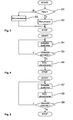
- Fig. 3 shows a flowchart illustrating the procedure according to the invention in the writing of data in the nonvolatile memory 7 of the smart card.
- step S1 in which it is checked whether a personalization of the chip card 1 should be performed. If the check leads to a positive result, then a step S2 is carried out in which data in a personalization mode are written into the nonvolatile memory 7. Otherwise, following step S1, a step S3 is executed in which data is written in the nonvolatile memory 7 in a normal mode.
- the normal mode and the personalization mode differ in terms of performing the update of the checksums EDC.
- the smart card 1 can determine, for example, based on the master file, abbreviated MF, whether the normal mode or the personalization mode exists.
- the master file represents a higher-level directory for all directories and files 12 of the chip card 1. If the master file is in the creation state, the personalization mode is active. Activation of the master file initiates a transition from personalization mode to field mode.
- the procedure for writing data in personalization mode is in Fig. 4 , the procedure in normal mode in Fig. 5 displayed.
- Fig. 4 shows a flow chart for a possible approach when writing data in the nonvolatile memory 7 of the smart card 1 in the personalization mode.
- step S4 The flow of the flowchart begins with a step S4 in which a write command is executed and, accordingly, data is written to the non-volatile memory 7 of the smart card 1. Registering is not performed according to the rules of non-interruptible writing, so the enrollment process is quick and easy. in the The frame of step S4 is also not intended to update the checksum EDC of the file 12 changed by the write-in. However, data that would result in a write interruption that the file system would be unusable, a special status can be granted. Such data is either written outside the personalization described here or it is exceptionally inscribed for this data in the context of personalization interruption-proof.
- step S5 is carried out in which it is checked whether another write command is to be executed in the context of personalization in order to write further data into the non-volatile memory 7 of the chip card 1.
- the currently received command is a predetermined command (e.g., "end of write phase").
- the further write command may refer to a writing of data into the same file 12 in which data has already been written during the previous run of the flowchart.
- the further write command may refer to the writing of data into a file 12 into which no data has yet been written during the previous run of the flowchart.
- step S4 If another write command is to be executed, the flow of the flowchart is continued at step S4 independently of the file 12 into which the data is to be written. Otherwise, a step S6 is next executed in which the checksums EDC of the files 12 changed by the writing are updated. This can be done differently.
- the list can be stored in the nonvolatile memory 7 of the chip card 1 and generated in different ways. For example, when executing a write command, the file name of the respective file 12 affected can be noted in the list. Likewise, it is also possible to register the list in the nonvolatile memory 7 as part of an initialization of the chip card 1 carried out before the personalization. In this case, care is taken during personalization to ensure that only those files are written in which 12 data are listed. Other files 12 are locked during personalization for writing.
- step S6 the flow of the flowchart is finished.
- the personalization of the chip card 1 is preferably carried out in a secure environment to ward off manipulation attempts. Authentication can be performed at the beginning of the personalization. If there is an interruption during personalization, the complete personalization process is repeated. This can also be done A high standard of security can be achieved without uninterrupted writing and without an interim update of the checksums EDC.
- Fig. 5 shows a flow chart for a possible approach when writing data in the nonvolatile memory 7 of the smart card 1 in the normal mode.
- the smart card 1 When writing in normal mode, the smart card 1 is usually not connected to the personalization device 2 but with a terminal such as a mobile phone, a point of sale (POS) terminal, a cash dispenser, and so on.
- a terminal such as a mobile phone, a point of sale (POS) terminal, a cash dispenser, and so on.
- the writing in the normal mode can be done, for example, in the context of an application that is implemented on the chip card 1.
- the flow of the flowchart begins with a step S7, in which a write command is executed and, accordingly, data is written to one of the files 12 in the non-volatile memory 7 of the chip card 1. Registering is carried out interruption-proof.
- step S7 a step S8 is performed in which the checksum EDC is updated for the file 12 into which data has been written in step S7. Then, a step S9 is executed, in which it is queried whether further write commands should be executed. If so, then step S7 is continued. Otherwise, the flow of the flowchart is finished.
- write commands can be used in accordance with ISO / IEC 7816, in particular according to ISO / IEC 7816-13.
Landscapes
- Engineering & Computer Science (AREA)
- Business, Economics & Management (AREA)
- General Physics & Mathematics (AREA)
- Theoretical Computer Science (AREA)
- Physics & Mathematics (AREA)
- Computer Networks & Wireless Communication (AREA)
- Microelectronics & Electronic Packaging (AREA)
- General Engineering & Computer Science (AREA)
- Accounting & Taxation (AREA)
- Strategic Management (AREA)
- General Business, Economics & Management (AREA)
- Quality & Reliability (AREA)
- Computer Security & Cryptography (AREA)
- Storage Device Security (AREA)
- Information Retrieval, Db Structures And Fs Structures Therefor (AREA)
Applications Claiming Priority (1)
| Application Number | Priority Date | Filing Date | Title |
|---|---|---|---|
| DE200710027935 DE102007027935A1 (de) | 2007-06-18 | 2007-06-18 | Tragbarer Datenträger und Verfahren zur Personalisierung eines tragbaren Datenträgers |
Publications (2)
| Publication Number | Publication Date |
|---|---|
| EP2012280A2 true EP2012280A2 (fr) | 2009-01-07 |
| EP2012280A3 EP2012280A3 (fr) | 2009-12-09 |
Family
ID=39739529
Family Applications (1)
| Application Number | Title | Priority Date | Filing Date |
|---|---|---|---|
| EP08010987A Ceased EP2012280A3 (fr) | 2007-06-18 | 2008-06-17 | Support de données portatif et procédé destiné à la personnalisation d'un support de données portatif |
Country Status (2)
| Country | Link |
|---|---|
| EP (1) | EP2012280A3 (fr) |
| DE (1) | DE102007027935A1 (fr) |
Cited By (2)
| Publication number | Priority date | Publication date | Assignee | Title |
|---|---|---|---|---|
| WO2013144719A1 (fr) * | 2012-03-26 | 2013-10-03 | Assa Abloy Ab | Révisions de champ pour dispositif de sécurité personnelle |
| EP3019992B1 (fr) * | 2013-07-08 | 2020-04-29 | Assa Abloy AB | Mot de passe à usage unique généré sur un dispositif de lecture en utilisant une clé lue dans un dispositif de sécurité personnel |
Citations (2)
| Publication number | Priority date | Publication date | Assignee | Title |
|---|---|---|---|---|
| WO2006087192A1 (fr) | 2005-02-18 | 2006-08-24 | Giesecke & Devrient Gmbh | Procede de personnalisation d'un support de donnees portable |
| WO2007014699A1 (fr) | 2005-08-01 | 2007-02-08 | Giesecke & Devrient Gmbh | Procede permettant l'execution d'une suite d'instructions de meme type dans un support de donnees portable |
Family Cites Families (2)
| Publication number | Priority date | Publication date | Assignee | Title |
|---|---|---|---|---|
| US7134070B2 (en) * | 2003-09-08 | 2006-11-07 | Intel Corporation | Checksum determination |
| DE102004006645A1 (de) * | 2004-02-11 | 2005-09-22 | Giesecke & Devrient Gmbh | Verfahren zum sicheren Berechnen einer Prüfsumme |
-
2007
- 2007-06-18 DE DE200710027935 patent/DE102007027935A1/de not_active Withdrawn
-
2008
- 2008-06-17 EP EP08010987A patent/EP2012280A3/fr not_active Ceased
Patent Citations (2)
| Publication number | Priority date | Publication date | Assignee | Title |
|---|---|---|---|---|
| WO2006087192A1 (fr) | 2005-02-18 | 2006-08-24 | Giesecke & Devrient Gmbh | Procede de personnalisation d'un support de donnees portable |
| WO2007014699A1 (fr) | 2005-08-01 | 2007-02-08 | Giesecke & Devrient Gmbh | Procede permettant l'execution d'une suite d'instructions de meme type dans un support de donnees portable |
Cited By (4)
| Publication number | Priority date | Publication date | Assignee | Title |
|---|---|---|---|---|
| WO2013144719A1 (fr) * | 2012-03-26 | 2013-10-03 | Assa Abloy Ab | Révisions de champ pour dispositif de sécurité personnelle |
| US10042990B2 (en) | 2012-03-26 | 2018-08-07 | Assa Abloy Ab | Field revisions for a personal security device |
| EP3019992B1 (fr) * | 2013-07-08 | 2020-04-29 | Assa Abloy AB | Mot de passe à usage unique généré sur un dispositif de lecture en utilisant une clé lue dans un dispositif de sécurité personnel |
| US10826893B2 (en) | 2013-07-08 | 2020-11-03 | Assa Abloy Ab | One-time-password generated on reader device using key read from personal security device |
Also Published As
| Publication number | Publication date |
|---|---|
| EP2012280A3 (fr) | 2009-12-09 |
| DE102007027935A1 (de) | 2008-12-24 |
Similar Documents
| Publication | Publication Date | Title |
|---|---|---|
| EP2318921B1 (fr) | Chargement et actualisation d une application nécessitant une personnalisation | |
| EP1611510B1 (fr) | Execution controlee d'un programme prevu pour une machine virtuelle sur un support de donnees portable | |
| DE102014220616A1 (de) | Verfahren zum Laden von ausführbaren Programminstruktionen in eine Chipkarte im Wirkbetrieb | |
| DE69911174T2 (de) | System und verfahren zur kontrolle des zugangs zu dem computercode in einer chipkarte | |
| EP2795934B1 (fr) | Procédé de communication avec une application sur un support de données portable ainsi que support de données portable de ce type | |
| EP2012280A2 (fr) | Support de données portatif et procédé destiné à la personnalisation d'un support de données portatif | |
| EP2652665B1 (fr) | Support de données portatif comportant un compteur des erreurs de commande | |
| EP1634252B1 (fr) | Procede de chargement de supports de donnees portatifs, en donnees | |
| EP2524333B1 (fr) | Procédé pour permettre d'obtenir un compteur fiable sur un appareil terminal | |
| EP1854072A1 (fr) | Procede de personnalisation d'un support de donnees portable | |
| DE102008056710A1 (de) | Verfahren zum Betrieb eines tragbaren Datenträgers, insbesondere einer Chipkarte, in einem Endgerät | |
| EP1927870B1 (fr) | Support de données portatif | |
| EP2210210B1 (fr) | Procédé de chargement de données d'initialisation et/ou de personnalisation sur un support de données portable | |
| EP1932122A2 (fr) | Procede pour initialiser et/ou personnaliser un support de donnees portatif | |
| EP0977160B1 (fr) | Méthode et dispositif de traitment de données pour l'exécution fiable des instructions | |
| EP1564639B1 (fr) | Méthode d'utilisation d'un support de mémoire de données ayant une mémoire de traçage | |
| EP3175383B1 (fr) | Procédé pour modifier les données de contrôle d'une carte à puce et système de carte à puce | |
| EP1899883B1 (fr) | Procédé de protection de données confidentielles | |
| EP1638058A2 (fr) | Procédé de vérification d'un suppport de données avant l'installation d'un programme d'application | |
| DE202007013423U1 (de) | Chipkarten-Terminal | |
| DE102008020343A1 (de) | Portabler Datenträger | |
| DE102005036069A1 (de) | Verfahren zum Ausführen einer Folge von gleichartigen Kommandos in einem tragbaren Datenträger | |
| WO2006037609A2 (fr) | Procede pour charger une application dans un support de donnees |
Legal Events
| Date | Code | Title | Description |
|---|---|---|---|
| PUAI | Public reference made under article 153(3) epc to a published international application that has entered the european phase |
Free format text: ORIGINAL CODE: 0009012 |
|
| AK | Designated contracting states |
Kind code of ref document: A2 Designated state(s): AT BE BG CH CY CZ DE DK EE ES FI FR GB GR HR HU IE IS IT LI LT LU LV MC MT NL NO PL PT RO SE SI SK TR |
|
| AX | Request for extension of the european patent |
Extension state: AL BA MK RS |
|
| PUAL | Search report despatched |
Free format text: ORIGINAL CODE: 0009013 |
|
| AK | Designated contracting states |
Kind code of ref document: A3 Designated state(s): AT BE BG CH CY CZ DE DK EE ES FI FR GB GR HR HU IE IS IT LI LT LU LV MC MT NL NO PL PT RO SE SI SK TR |
|
| AX | Request for extension of the european patent |
Extension state: AL BA MK RS |
|
| 17P | Request for examination filed |
Effective date: 20100609 |
|
| AKX | Designation fees paid |
Designated state(s): AT BE BG CH CY CZ DE DK EE ES FI FR GB GR HR HU IE IS IT LI LT LU LV MC MT NL NO PL PT RO SE SI SK TR |
|
| 17Q | First examination report despatched |
Effective date: 20160624 |
|
| RAP1 | Party data changed (applicant data changed or rights of an application transferred) |
Owner name: GIESECKE+DEVRIENT MOBILE SECURITY GMBH |
|
| STAA | Information on the status of an ep patent application or granted ep patent |
Free format text: STATUS: THE APPLICATION HAS BEEN REFUSED |
|
| 18R | Application refused |
Effective date: 20181022 |