EP2013336B1 - Neue gruppe von esterasen zur herstellung von fein- und spezialchemikalien - Google Patents
Neue gruppe von esterasen zur herstellung von fein- und spezialchemikalien Download PDFInfo
- Publication number
- EP2013336B1 EP2013336B1 EP07724699.9A EP07724699A EP2013336B1 EP 2013336 B1 EP2013336 B1 EP 2013336B1 EP 07724699 A EP07724699 A EP 07724699A EP 2013336 B1 EP2013336 B1 EP 2013336B1
- Authority
- EP
- European Patent Office
- Prior art keywords
- polynucleotide
- polypeptide
- activity
- enzyme
- seq
- Prior art date
- Legal status (The legal status is an assumption and is not a legal conclusion. Google has not performed a legal analysis and makes no representation as to the accuracy of the status listed.)
- Not-in-force
Links
- 238000004519 manufacturing process Methods 0.000 title claims description 17
- 108090000371 Esterases Proteins 0.000 title description 23
- 239000000126 substance Substances 0.000 title description 8
- 102000004190 Enzymes Human genes 0.000 claims description 154
- 108090000790 Enzymes Proteins 0.000 claims description 154
- 108091033319 polynucleotide Proteins 0.000 claims description 100
- 239000002157 polynucleotide Substances 0.000 claims description 100
- 102000040430 polynucleotide Human genes 0.000 claims description 100
- 230000000694 effects Effects 0.000 claims description 82
- 108090000765 processed proteins & peptides Proteins 0.000 claims description 68
- 229920001184 polypeptide Polymers 0.000 claims description 67
- 102000004196 processed proteins & peptides Human genes 0.000 claims description 67
- 238000000034 method Methods 0.000 claims description 50
- 239000000758 substrate Substances 0.000 claims description 48
- 238000006243 chemical reaction Methods 0.000 claims description 41
- 125000003729 nucleotide group Chemical group 0.000 claims description 39
- 239000002773 nucleotide Substances 0.000 claims description 38
- 102000013392 Carboxylesterase Human genes 0.000 claims description 37
- 108010051152 Carboxylesterase Proteins 0.000 claims description 37
- FWMNVWWHGCHHJJ-SKKKGAJSSA-N 4-amino-1-[(2r)-6-amino-2-[[(2r)-2-[[(2r)-2-[[(2r)-2-amino-3-phenylpropanoyl]amino]-3-phenylpropanoyl]amino]-4-methylpentanoyl]amino]hexanoyl]piperidine-4-carboxylic acid Chemical compound C([C@H](C(=O)N[C@H](CC(C)C)C(=O)N[C@H](CCCCN)C(=O)N1CCC(N)(CC1)C(O)=O)NC(=O)[C@H](N)CC=1C=CC=CC=1)C1=CC=CC=C1 FWMNVWWHGCHHJJ-SKKKGAJSSA-N 0.000 claims description 31
- 239000013598 vector Substances 0.000 claims description 28
- 239000012634 fragment Substances 0.000 claims description 26
- 150000001875 compounds Chemical class 0.000 claims description 15
- 241000894006 Bacteria Species 0.000 claims description 14
- 125000003275 alpha amino acid group Chemical group 0.000 claims description 13
- 230000008569 process Effects 0.000 claims description 13
- 230000000295 complement effect Effects 0.000 claims description 12
- 108091026890 Coding region Proteins 0.000 claims description 11
- 210000003527 eukaryotic cell Anatomy 0.000 claims description 11
- 239000007858 starting material Substances 0.000 claims description 11
- 239000000203 mixture Substances 0.000 claims description 10
- 241000588724 Escherichia coli Species 0.000 claims description 9
- 125000000539 amino acid group Chemical group 0.000 claims description 9
- XHXUANMFYXWVNG-UHFFFAOYSA-N D-menthyl acetate Natural products CC(C)C1CCC(C)CC1OC(C)=O XHXUANMFYXWVNG-UHFFFAOYSA-N 0.000 claims description 8
- 230000003287 optical effect Effects 0.000 claims description 8
- 239000000523 sample Substances 0.000 claims description 7
- 241000589774 Pseudomonas sp. Species 0.000 claims description 5
- NOOLISFMXDJSKH-UHFFFAOYSA-N DL-menthol Natural products CC(C)C1CCC(C)CC1O NOOLISFMXDJSKH-UHFFFAOYSA-N 0.000 claims description 4
- 210000002308 embryonic cell Anatomy 0.000 claims description 4
- 229940075966 (+)- menthol Drugs 0.000 claims description 2
- NOOLISFMXDJSKH-AEJSXWLSSA-N (+)-menthol Chemical compound CC(C)[C@H]1CC[C@H](C)C[C@@H]1O NOOLISFMXDJSKH-AEJSXWLSSA-N 0.000 claims description 2
- 241000194110 Bacillus sp. (in: Bacteria) Species 0.000 claims description 2
- 241001453380 Burkholderia Species 0.000 claims description 2
- 241000863013 Caulobacter sp. Species 0.000 claims description 2
- 241000178948 Lactococcus sp. Species 0.000 claims description 2
- 241000187488 Mycobacterium sp. Species 0.000 claims description 2
- 241000529919 Ralstonia sp. Species 0.000 claims description 2
- 241000589187 Rhizobium sp. Species 0.000 claims description 2
- 241000191021 Rhodobacter sp. Species 0.000 claims description 2
- 241000144249 Sinorhizobium sp. Species 0.000 claims description 2
- 241000187180 Streptomyces sp. Species 0.000 claims description 2
- 238000006555 catalytic reaction Methods 0.000 claims description 2
- 238000012258 culturing Methods 0.000 claims description 2
- 210000004027 cell Anatomy 0.000 description 42
- 108090000623 proteins and genes Proteins 0.000 description 34
- 108020004414 DNA Proteins 0.000 description 32
- 235000018102 proteins Nutrition 0.000 description 26
- 102000004169 proteins and genes Human genes 0.000 description 26
- IAZDPXIOMUYVGZ-UHFFFAOYSA-N Dimethylsulphoxide Chemical compound CS(C)=O IAZDPXIOMUYVGZ-UHFFFAOYSA-N 0.000 description 24
- 150000007523 nucleic acids Chemical class 0.000 description 24
- 102000039446 nucleic acids Human genes 0.000 description 20
- 108020004707 nucleic acids Proteins 0.000 description 20
- 230000014509 gene expression Effects 0.000 description 18
- 238000009396 hybridization Methods 0.000 description 18
- 229940024606 amino acid Drugs 0.000 description 14
- 235000001014 amino acid Nutrition 0.000 description 14
- 150000001413 amino acids Chemical class 0.000 description 14
- CSCPPACGZOOCGX-UHFFFAOYSA-N Acetone Chemical compound CC(C)=O CSCPPACGZOOCGX-UHFFFAOYSA-N 0.000 description 12
- WEVYAHXRMPXWCK-UHFFFAOYSA-N Acetonitrile Chemical compound CC#N WEVYAHXRMPXWCK-UHFFFAOYSA-N 0.000 description 12
- OKKJLVBELUTLKV-UHFFFAOYSA-N Methanol Chemical compound OC OKKJLVBELUTLKV-UHFFFAOYSA-N 0.000 description 12
- 102000037865 fusion proteins Human genes 0.000 description 12
- 108020001507 fusion proteins Proteins 0.000 description 12
- 150000002168 ethanoic acid esters Chemical class 0.000 description 11
- KFZMGEQAYNKOFK-UHFFFAOYSA-N Isopropanol Chemical compound CC(C)O KFZMGEQAYNKOFK-UHFFFAOYSA-N 0.000 description 10
- ZMXDDKWLCZADIW-UHFFFAOYSA-N N,N-Dimethylformamide Chemical compound CN(C)C=O ZMXDDKWLCZADIW-UHFFFAOYSA-N 0.000 description 10
- FAPWRFPIFSIZLT-UHFFFAOYSA-M Sodium chloride Chemical compound [Na+].[Cl-] FAPWRFPIFSIZLT-UHFFFAOYSA-M 0.000 description 10
- UYXTWWCETRIEDR-UHFFFAOYSA-N Tributyrin Chemical compound CCCC(=O)OCC(OC(=O)CCC)COC(=O)CCC UYXTWWCETRIEDR-UHFFFAOYSA-N 0.000 description 10
- 238000012986 modification Methods 0.000 description 10
- 230000004048 modification Effects 0.000 description 10
- 108090001060 Lipase Proteins 0.000 description 9
- HEMHJVSKTPXQMS-UHFFFAOYSA-M Sodium hydroxide Chemical compound [OH-].[Na+] HEMHJVSKTPXQMS-UHFFFAOYSA-M 0.000 description 9
- 230000003197 catalytic effect Effects 0.000 description 9
- 238000011534 incubation Methods 0.000 description 9
- 239000000047 product Substances 0.000 description 9
- ZHNUHDYFZUAESO-UHFFFAOYSA-N Formamide Chemical compound NC=O ZHNUHDYFZUAESO-UHFFFAOYSA-N 0.000 description 8
- 102000004882 Lipase Human genes 0.000 description 8
- 239000004367 Lipase Substances 0.000 description 8
- 108091093037 Peptide nucleic acid Proteins 0.000 description 8
- 239000000872 buffer Substances 0.000 description 8
- 239000013604 expression vector Substances 0.000 description 8
- 235000019421 lipase Nutrition 0.000 description 8
- 238000003752 polymerase chain reaction Methods 0.000 description 8
- 239000000243 solution Substances 0.000 description 8
- 239000002904 solvent Substances 0.000 description 8
- 230000015572 biosynthetic process Effects 0.000 description 7
- 238000003786 synthesis reaction Methods 0.000 description 7
- 102000004308 Carboxylic Ester Hydrolases Human genes 0.000 description 6
- 108090000863 Carboxylic Ester Hydrolases Proteins 0.000 description 6
- 238000004458 analytical method Methods 0.000 description 6
- 230000001580 bacterial effect Effects 0.000 description 6
- 238000010367 cloning Methods 0.000 description 6
- 150000002148 esters Chemical class 0.000 description 6
- 230000003301 hydrolyzing effect Effects 0.000 description 6
- 238000000746 purification Methods 0.000 description 6
- 230000001105 regulatory effect Effects 0.000 description 6
- 238000012360 testing method Methods 0.000 description 6
- URAYPUMNDPQOKB-UHFFFAOYSA-N triacetin Chemical compound CC(=O)OCC(OC(C)=O)COC(C)=O URAYPUMNDPQOKB-UHFFFAOYSA-N 0.000 description 6
- 108091032973 (ribonucleotides)n+m Proteins 0.000 description 5
- MTCFGRXMJLQNBG-UHFFFAOYSA-N Serine Natural products OCC(N)C(O)=O MTCFGRXMJLQNBG-UHFFFAOYSA-N 0.000 description 5
- 238000007792 addition Methods 0.000 description 5
- 238000003556 assay Methods 0.000 description 5
- 239000011942 biocatalyst Substances 0.000 description 5
- 230000000903 blocking effect Effects 0.000 description 5
- 238000004422 calculation algorithm Methods 0.000 description 5
- 238000012217 deletion Methods 0.000 description 5
- 230000037430 deletion Effects 0.000 description 5
- 239000000284 extract Substances 0.000 description 5
- 210000004962 mammalian cell Anatomy 0.000 description 5
- 238000012216 screening Methods 0.000 description 5
- 125000003607 serino group Chemical group [H]N([H])[C@]([H])(C(=O)[*])C(O[H])([H])[H] 0.000 description 5
- 239000011780 sodium chloride Substances 0.000 description 5
- 150000003509 tertiary alcohols Chemical class 0.000 description 5
- NOOLISFMXDJSKH-KXUCPTDWSA-N (-)-Menthol Chemical compound CC(C)[C@@H]1CC[C@@H](C)C[C@H]1O NOOLISFMXDJSKH-KXUCPTDWSA-N 0.000 description 4
- XHXUANMFYXWVNG-ADEWGFFLSA-N (-)-Menthyl acetate Chemical compound CC(C)[C@@H]1CC[C@@H](C)C[C@H]1OC(C)=O XHXUANMFYXWVNG-ADEWGFFLSA-N 0.000 description 4
- HBAQYPYDRFILMT-UHFFFAOYSA-N 8-[3-(1-cyclopropylpyrazol-4-yl)-1H-pyrazolo[4,3-d]pyrimidin-5-yl]-3-methyl-3,8-diazabicyclo[3.2.1]octan-2-one Chemical class C1(CC1)N1N=CC(=C1)C1=NNC2=C1N=C(N=C2)N1C2C(N(CC1CC2)C)=O HBAQYPYDRFILMT-UHFFFAOYSA-N 0.000 description 4
- -1 Ca2+ and Mg2+ Chemical class 0.000 description 4
- 241000701022 Cytomegalovirus Species 0.000 description 4
- 241000196324 Embryophyta Species 0.000 description 4
- DHMQDGOQFOQNFH-UHFFFAOYSA-N Glycine Chemical compound NCC(O)=O DHMQDGOQFOQNFH-UHFFFAOYSA-N 0.000 description 4
- 241000238631 Hexapoda Species 0.000 description 4
- 102000004157 Hydrolases Human genes 0.000 description 4
- 108090000604 Hydrolases Proteins 0.000 description 4
- CMWTZPSULFXXJA-UHFFFAOYSA-N Naproxen Natural products C1=C(C(C)C(O)=O)C=CC2=CC(OC)=CC=C21 CMWTZPSULFXXJA-UHFFFAOYSA-N 0.000 description 4
- 239000007983 Tris buffer Substances 0.000 description 4
- 230000003321 amplification Effects 0.000 description 4
- 239000003153 chemical reaction reagent Substances 0.000 description 4
- 239000002299 complementary DNA Substances 0.000 description 4
- 239000003623 enhancer Substances 0.000 description 4
- 230000002255 enzymatic effect Effects 0.000 description 4
- 230000002538 fungal effect Effects 0.000 description 4
- 238000004817 gas chromatography Methods 0.000 description 4
- CDOSHBSSFJOMGT-UHFFFAOYSA-N linalool Chemical compound CC(C)=CCCC(C)(O)C=C CDOSHBSSFJOMGT-UHFFFAOYSA-N 0.000 description 4
- 238000003199 nucleic acid amplification method Methods 0.000 description 4
- 239000013612 plasmid Substances 0.000 description 4
- 230000010076 replication Effects 0.000 description 4
- 238000013518 transcription Methods 0.000 description 4
- 230000035897 transcription Effects 0.000 description 4
- 230000014616 translation Effects 0.000 description 4
- VMPHSYLJUKZBJJ-UHFFFAOYSA-N trilaurin Chemical compound CCCCCCCCCCCC(=O)OCC(OC(=O)CCCCCCCCCCC)COC(=O)CCCCCCCCCCC VMPHSYLJUKZBJJ-UHFFFAOYSA-N 0.000 description 4
- LENZDBCJOHFCAS-UHFFFAOYSA-N tris Chemical compound OCC(N)(CO)CO LENZDBCJOHFCAS-UHFFFAOYSA-N 0.000 description 4
- CDOSHBSSFJOMGT-SNVBAGLBSA-N (S)-linalool Chemical compound CC(C)=CCC[C@](C)(O)C=C CDOSHBSSFJOMGT-SNVBAGLBSA-N 0.000 description 3
- DKYWVDODHFEZIM-UHFFFAOYSA-M 2-(3-benzoylphenyl)propanoate Chemical compound [O-]C(=O)C(C)C1=CC=CC(C(=O)C=2C=CC=CC=2)=C1 DKYWVDODHFEZIM-UHFFFAOYSA-M 0.000 description 3
- YPGCWEMNNLXISK-UHFFFAOYSA-M 2-Phenylpropionate Chemical compound [O-]C(=O)C(C)C1=CC=CC=C1 YPGCWEMNNLXISK-UHFFFAOYSA-M 0.000 description 3
- ZZEWMYILWXCRHZ-UHFFFAOYSA-N 3-phenylbutyric acid Chemical compound OC(=O)CC(C)C1=CC=CC=C1 ZZEWMYILWXCRHZ-UHFFFAOYSA-N 0.000 description 3
- 241000972773 Aulopiformes Species 0.000 description 3
- 244000063299 Bacillus subtilis Species 0.000 description 3
- 235000014469 Bacillus subtilis Nutrition 0.000 description 3
- 108020004256 Beta-lactamase Proteins 0.000 description 3
- 108091035707 Consensus sequence Proteins 0.000 description 3
- 108091028043 Nucleic acid sequence Proteins 0.000 description 3
- 238000002105 Southern blotting Methods 0.000 description 3
- 208000037065 Subacute sclerosing leukoencephalitis Diseases 0.000 description 3
- 206010042297 Subacute sclerosing panencephalitis Diseases 0.000 description 3
- 239000002253 acid Substances 0.000 description 3
- 238000013459 approach Methods 0.000 description 3
- WPYMKLBDIGXBTP-UHFFFAOYSA-N benzoic acid Chemical compound OC(=O)C1=CC=CC=C1 WPYMKLBDIGXBTP-UHFFFAOYSA-N 0.000 description 3
- 102000006635 beta-lactamase Human genes 0.000 description 3
- 238000004364 calculation method Methods 0.000 description 3
- 150000001768 cations Chemical class 0.000 description 3
- NZNMSOFKMUBTKW-UHFFFAOYSA-N cyclohexanecarboxylic acid Chemical compound OC(=O)C1CCCCC1 NZNMSOFKMUBTKW-UHFFFAOYSA-N 0.000 description 3
- 239000003205 fragrance Substances 0.000 description 3
- 230000002068 genetic effect Effects 0.000 description 3
- 239000001087 glyceryl triacetate Substances 0.000 description 3
- 235000013773 glyceryl triacetate Nutrition 0.000 description 3
- 238000004128 high performance liquid chromatography Methods 0.000 description 3
- 210000004408 hybridoma Anatomy 0.000 description 3
- HEFNNWSXXWATRW-UHFFFAOYSA-M ibuprofen(1-) Chemical compound CC(C)CC1=CC=C(C(C)C([O-])=O)C=C1 HEFNNWSXXWATRW-UHFFFAOYSA-M 0.000 description 3
- 230000002366 lipolytic effect Effects 0.000 description 3
- 239000012528 membrane Substances 0.000 description 3
- 230000000813 microbial effect Effects 0.000 description 3
- 244000005700 microbiome Species 0.000 description 3
- 238000010369 molecular cloning Methods 0.000 description 3
- CMWTZPSULFXXJA-VIFPVBQESA-N naproxen Chemical compound C1=C([C@H](C)C(O)=O)C=CC2=CC(OC)=CC=C21 CMWTZPSULFXXJA-VIFPVBQESA-N 0.000 description 3
- 229960002009 naproxen Drugs 0.000 description 3
- 125000000636 p-nitrophenyl group Chemical group [H]C1=C([H])C(=C([H])C([H])=C1*)[N+]([O-])=O 0.000 description 3
- 239000013600 plasmid vector Substances 0.000 description 3
- 238000002360 preparation method Methods 0.000 description 3
- 235000019515 salmon Nutrition 0.000 description 3
- 150000003839 salts Chemical class 0.000 description 3
- 229910000162 sodium phosphate Inorganic materials 0.000 description 3
- 239000007790 solid phase Substances 0.000 description 3
- 238000001890 transfection Methods 0.000 description 3
- 229960002622 triacetin Drugs 0.000 description 3
- 239000013638 trimer Substances 0.000 description 3
- 229940070710 valerate Drugs 0.000 description 3
- YBJHBAHKTGYVGT-ZKWXMUAHSA-N (+)-Biotin Chemical compound N1C(=O)N[C@@H]2[C@H](CCCCC(=O)O)SC[C@@H]21 YBJHBAHKTGYVGT-ZKWXMUAHSA-N 0.000 description 2
- JZFUHAGLMZWKTF-SECBINFHSA-N (1r)-3-chloro-1-phenylpropan-1-ol Chemical compound ClCC[C@@H](O)C1=CC=CC=C1 JZFUHAGLMZWKTF-SECBINFHSA-N 0.000 description 2
- 239000001490 (3R)-3,7-dimethylocta-1,6-dien-3-ol Substances 0.000 description 2
- 239000001605 (5-methyl-2-propan-2-ylcyclohexyl) acetate Substances 0.000 description 2
- CDOSHBSSFJOMGT-JTQLQIEISA-N (R)-linalool Natural products CC(C)=CCC[C@@](C)(O)C=C CDOSHBSSFJOMGT-JTQLQIEISA-N 0.000 description 2
- LNETULKMXZVUST-UHFFFAOYSA-M 1-naphthoate Chemical compound C1=CC=C2C(C(=O)[O-])=CC=CC2=C1 LNETULKMXZVUST-UHFFFAOYSA-M 0.000 description 2
- UOBYKYZJUGYBDK-UHFFFAOYSA-M 2-naphthoate Chemical compound C1=CC=CC2=CC(C(=O)[O-])=CC=C21 UOBYKYZJUGYBDK-UHFFFAOYSA-M 0.000 description 2
- ZDPVRUJCZBIQPO-UHFFFAOYSA-N 3-trimethylsilylbut-1-yn-1-ol Chemical compound CC(C#CO)[Si](C)(C)C ZDPVRUJCZBIQPO-UHFFFAOYSA-N 0.000 description 2
- VTDOEFXTVHCAAM-UHFFFAOYSA-N 4-methylpent-3-ene-1,2,3-triol Chemical compound CC(C)=C(O)C(O)CO VTDOEFXTVHCAAM-UHFFFAOYSA-N 0.000 description 2
- 241000251468 Actinopterygii Species 0.000 description 2
- 241001135516 Burkholderia gladioli Species 0.000 description 2
- FERIUCNNQQJTOY-UHFFFAOYSA-M Butyrate Chemical compound CCCC([O-])=O FERIUCNNQQJTOY-UHFFFAOYSA-M 0.000 description 2
- FERIUCNNQQJTOY-UHFFFAOYSA-N Butyric acid Natural products CCCC(O)=O FERIUCNNQQJTOY-UHFFFAOYSA-N 0.000 description 2
- 102100036806 Carboxylesterase 5A Human genes 0.000 description 2
- 102100021864 Cocaine esterase Human genes 0.000 description 2
- 229920002307 Dextran Polymers 0.000 description 2
- KCXVZYZYPLLWCC-UHFFFAOYSA-N EDTA Chemical compound OC(=O)CN(CC(O)=O)CCN(CC(O)=O)CC(O)=O KCXVZYZYPLLWCC-UHFFFAOYSA-N 0.000 description 2
- XEKOWRVHYACXOJ-UHFFFAOYSA-N Ethyl acetate Chemical compound CCOC(C)=O XEKOWRVHYACXOJ-UHFFFAOYSA-N 0.000 description 2
- 239000004471 Glycine Substances 0.000 description 2
- HEFNNWSXXWATRW-UHFFFAOYSA-N Ibuprofen Chemical compound CC(C)CC1=CC=C(C(C)C(O)=O)C=C1 HEFNNWSXXWATRW-UHFFFAOYSA-N 0.000 description 2
- 102000008394 Immunoglobulin Fragments Human genes 0.000 description 2
- 108010021625 Immunoglobulin Fragments Proteins 0.000 description 2
- 241000235058 Komagataella pastoris Species 0.000 description 2
- PXHVJJICTQNCMI-UHFFFAOYSA-N Nickel Chemical compound [Ni] PXHVJJICTQNCMI-UHFFFAOYSA-N 0.000 description 2
- 238000000636 Northern blotting Methods 0.000 description 2
- 239000004952 Polyamide Substances 0.000 description 2
- XBDQKXXYIPTUBI-UHFFFAOYSA-N Propionic acid Chemical compound CCC(O)=O XBDQKXXYIPTUBI-UHFFFAOYSA-N 0.000 description 2
- 108700029229 Transcriptional Regulatory Elements Proteins 0.000 description 2
- XTXRWKRVRITETP-UHFFFAOYSA-N Vinyl acetate Chemical compound CC(=O)OC=C XTXRWKRVRITETP-UHFFFAOYSA-N 0.000 description 2
- 241000700605 Viruses Species 0.000 description 2
- UKPIBFMHHUEUQR-DTORHVGOSA-N [(1s,4r)-4-acetyloxycyclopent-2-en-1-yl] acetate Chemical compound CC(=O)O[C@@H]1C[C@H](OC(C)=O)C=C1 UKPIBFMHHUEUQR-DTORHVGOSA-N 0.000 description 2
- 150000007513 acids Chemical class 0.000 description 2
- JIMXXGFJRDUSRO-UHFFFAOYSA-N adamantane-1-carboxylic acid Chemical compound C1C(C2)CC3CC2CC1(C(=O)O)C3 JIMXXGFJRDUSRO-UHFFFAOYSA-N 0.000 description 2
- 150000001298 alcohols Chemical class 0.000 description 2
- AVKUERGKIZMTKX-NJBDSQKTSA-N ampicillin Chemical compound C1([C@@H](N)C(=O)N[C@H]2[C@H]3SC([C@@H](N3C2=O)C(O)=O)(C)C)=CC=CC=C1 AVKUERGKIZMTKX-NJBDSQKTSA-N 0.000 description 2
- 229960000723 ampicillin Drugs 0.000 description 2
- 239000000427 antigen Substances 0.000 description 2
- 102000036639 antigens Human genes 0.000 description 2
- 108091007433 antigens Proteins 0.000 description 2
- 108010054191 butyrylesterase Proteins 0.000 description 2
- 150000001732 carboxylic acid derivatives Chemical class 0.000 description 2
- 150000001733 carboxylic acid esters Chemical class 0.000 description 2
- PFURGBBHAOXLIO-OLQVQODUSA-N cis-cyclohexane-1,2-diol Chemical compound O[C@H]1CCCC[C@H]1O PFURGBBHAOXLIO-OLQVQODUSA-N 0.000 description 2
- 108010064410 cocaine esterase Proteins 0.000 description 2
- 239000013601 cosmid vector Substances 0.000 description 2
- OPTASPLRGRRNAP-UHFFFAOYSA-N cytosine Chemical compound NC=1C=CNC(=O)N=1 OPTASPLRGRRNAP-UHFFFAOYSA-N 0.000 description 2
- 239000000539 dimer Substances 0.000 description 2
- 239000000839 emulsion Substances 0.000 description 2
- 238000005516 engineering process Methods 0.000 description 2
- 238000006911 enzymatic reaction Methods 0.000 description 2
- 108010088545 esterase B Proteins 0.000 description 2
- 238000002474 experimental method Methods 0.000 description 2
- 239000012847 fine chemical Substances 0.000 description 2
- 235000019688 fish Nutrition 0.000 description 2
- 239000000796 flavoring agent Substances 0.000 description 2
- 235000019634 flavors Nutrition 0.000 description 2
- 230000004927 fusion Effects 0.000 description 2
- 238000010353 genetic engineering Methods 0.000 description 2
- UYTPUPDQBNUYGX-UHFFFAOYSA-N guanine Chemical compound O=C1NC(N)=NC2=C1N=CN2 UYTPUPDQBNUYGX-UHFFFAOYSA-N 0.000 description 2
- FUZZWVXGSFPDMH-UHFFFAOYSA-M hexanoate Chemical compound CCCCCC([O-])=O FUZZWVXGSFPDMH-UHFFFAOYSA-M 0.000 description 2
- 229960001680 ibuprofen Drugs 0.000 description 2
- 238000000338 in vitro Methods 0.000 description 2
- 208000015181 infectious disease Diseases 0.000 description 2
- 230000000977 initiatory effect Effects 0.000 description 2
- 101150066555 lacZ gene Proteins 0.000 description 2
- 229960004873 levomenthol Drugs 0.000 description 2
- 238000007834 ligase chain reaction Methods 0.000 description 2
- 229930007744 linalool Natural products 0.000 description 2
- 239000006166 lysate Substances 0.000 description 2
- 230000001404 mediated effect Effects 0.000 description 2
- 108020004999 messenger RNA Proteins 0.000 description 2
- WWZKQHOCKIZLMA-UHFFFAOYSA-M octanoate Chemical compound CCCCCCCC([O-])=O WWZKQHOCKIZLMA-UHFFFAOYSA-M 0.000 description 2
- DVDUMIQZEUTAGK-UHFFFAOYSA-N p-nitrophenyl butyrate Chemical compound CCCC(=O)OC1=CC=C([N+]([O-])=O)C=C1 DVDUMIQZEUTAGK-UHFFFAOYSA-N 0.000 description 2
- 238000010647 peptide synthesis reaction Methods 0.000 description 2
- 239000000816 peptidomimetic Substances 0.000 description 2
- 229920002647 polyamide Polymers 0.000 description 2
- 229920000642 polymer Polymers 0.000 description 2
- 238000000164 protein isolation Methods 0.000 description 2
- 230000006340 racemization Effects 0.000 description 2
- 230000002285 radioactive effect Effects 0.000 description 2
- 230000000717 retained effect Effects 0.000 description 2
- 238000000926 separation method Methods 0.000 description 2
- AJPJDKMHJJGVTQ-UHFFFAOYSA-M sodium dihydrogen phosphate Chemical compound [Na+].OP(O)([O-])=O AJPJDKMHJJGVTQ-UHFFFAOYSA-M 0.000 description 2
- 239000007787 solid Substances 0.000 description 2
- 241000894007 species Species 0.000 description 2
- 238000006467 substitution reaction Methods 0.000 description 2
- RWQNBRDOKXIBIV-UHFFFAOYSA-N thymine Chemical compound CC1=CNC(=O)NC1=O RWQNBRDOKXIBIV-UHFFFAOYSA-N 0.000 description 2
- 238000004448 titration Methods 0.000 description 2
- PFURGBBHAOXLIO-PHDIDXHHSA-N trans-cyclohexane-1,2-diol Chemical compound O[C@@H]1CCCC[C@H]1O PFURGBBHAOXLIO-PHDIDXHHSA-N 0.000 description 2
- 238000013519 translation Methods 0.000 description 2
- YZWRNSARCRTXDS-UHFFFAOYSA-N tripropionin Chemical compound CCC(=O)OCC(OC(=O)CC)COC(=O)CC YZWRNSARCRTXDS-UHFFFAOYSA-N 0.000 description 2
- 229940117958 vinyl acetate Drugs 0.000 description 2
- 125000000391 vinyl group Chemical group [H]C([*])=C([H])[H] 0.000 description 2
- 229920002554 vinyl polymer Polymers 0.000 description 2
- FDKWRPBBCBCIGA-REOHCLBHSA-N (2r)-2-azaniumyl-3-$l^{1}-selanylpropanoate Chemical compound [Se]C[C@H](N)C(O)=O FDKWRPBBCBCIGA-REOHCLBHSA-N 0.000 description 1
- OMKGCEUSXVDVAP-UHFFFAOYSA-N (4,5-dihydroxy-2-methylpent-2-en-3-yl) acetate Chemical compound CC(=O)OC(=C(C)C)C(O)CO OMKGCEUSXVDVAP-UHFFFAOYSA-N 0.000 description 1
- SYTBZMRGLBWNTM-SNVBAGLBSA-N (R)-flurbiprofen Chemical compound FC1=CC([C@H](C(O)=O)C)=CC=C1C1=CC=CC=C1 SYTBZMRGLBWNTM-SNVBAGLBSA-N 0.000 description 1
- WUOACPNHFRMFPN-SECBINFHSA-N (S)-(-)-alpha-terpineol Chemical compound CC1=CC[C@@H](C(C)(C)O)CC1 WUOACPNHFRMFPN-SECBINFHSA-N 0.000 description 1
- JRZGPXSSNPTNMA-UHFFFAOYSA-N 1,2,3,4-tetrahydronaphthalen-1-amine Chemical compound C1=CC=C2C(N)CCCC2=C1 JRZGPXSSNPTNMA-UHFFFAOYSA-N 0.000 description 1
- FPIPGXGPPPQFEQ-UHFFFAOYSA-N 13-cis retinol Natural products OCC=C(C)C=CC=C(C)C=CC1=C(C)CCCC1(C)C FPIPGXGPPPQFEQ-UHFFFAOYSA-N 0.000 description 1
- BWILOKXTGAEHCY-UHFFFAOYSA-N 2-(5-methyl-2-propan-2-ylcyclohexyl)acetic acid Chemical compound CC(C)C1CCC(C)CC1CC(O)=O BWILOKXTGAEHCY-UHFFFAOYSA-N 0.000 description 1
- CMWTZPSULFXXJA-UHFFFAOYSA-M 2-(6-methoxynaphthalen-2-yl)propanoate Chemical compound C1=C(C(C)C([O-])=O)C=CC2=CC(OC)=CC=C21 CMWTZPSULFXXJA-UHFFFAOYSA-M 0.000 description 1
- QKNYBSVHEMOAJP-UHFFFAOYSA-N 2-amino-2-(hydroxymethyl)propane-1,3-diol;hydron;chloride Chemical compound Cl.OCC(N)(CO)CO QKNYBSVHEMOAJP-UHFFFAOYSA-N 0.000 description 1
- ASJSAQIRZKANQN-CRCLSJGQSA-N 2-deoxy-D-ribose Chemical class OC[C@@H](O)[C@@H](O)CC=O ASJSAQIRZKANQN-CRCLSJGQSA-N 0.000 description 1
- BTJIUGUIPKRLHP-UHFFFAOYSA-N 4-nitrophenol Chemical compound OC1=CC=C([N+]([O-])=O)C=C1 BTJIUGUIPKRLHP-UHFFFAOYSA-N 0.000 description 1
- 108010013043 Acetylesterase Proteins 0.000 description 1
- 241000218592 Acidovorax delafieldii Species 0.000 description 1
- 241000607528 Aeromonas hydrophila Species 0.000 description 1
- 244000105975 Antidesma platyphyllum Species 0.000 description 1
- 241000228212 Aspergillus Species 0.000 description 1
- 101000796806 Aspergillus parasiticus (strain ATCC 56775 / NRRL 5862 / SRRC 143 / SU-1) Versiconal hemiacetal acetate esterase Proteins 0.000 description 1
- 241001203868 Autographa californica Species 0.000 description 1
- 241000589513 Burkholderia cepacia Species 0.000 description 1
- 241000589638 Burkholderia glumae Species 0.000 description 1
- 125000001433 C-terminal amino-acid group Chemical group 0.000 description 1
- 241000282465 Canis Species 0.000 description 1
- 108020004635 Complementary DNA Proteins 0.000 description 1
- FDKWRPBBCBCIGA-UWTATZPHSA-N D-Selenocysteine Natural products [Se]C[C@@H](N)C(O)=O FDKWRPBBCBCIGA-UWTATZPHSA-N 0.000 description 1
- 238000007399 DNA isolation Methods 0.000 description 1
- SHIBSTMRCDJXLN-UHFFFAOYSA-N Digoxigenin Natural products C1CC(C2C(C3(C)CCC(O)CC3CC2)CC2O)(O)C2(C)C1C1=CC(=O)OC1 SHIBSTMRCDJXLN-UHFFFAOYSA-N 0.000 description 1
- 102100031375 Endothelial lipase Human genes 0.000 description 1
- YQYJSBFKSSDGFO-UHFFFAOYSA-N Epihygromycin Natural products OC1C(O)C(C(=O)C)OC1OC(C(=C1)O)=CC=C1C=C(C)C(=O)NC1C(O)C(O)C2OCOC2C1O YQYJSBFKSSDGFO-UHFFFAOYSA-N 0.000 description 1
- 102000005486 Epoxide hydrolase Human genes 0.000 description 1
- 108020002908 Epoxide hydrolase Proteins 0.000 description 1
- 241001198387 Escherichia coli BL21(DE3) Species 0.000 description 1
- LFQSCWFLJHTTHZ-UHFFFAOYSA-N Ethanol Chemical compound CCO LFQSCWFLJHTTHZ-UHFFFAOYSA-N 0.000 description 1
- 108700039691 Genetic Promoter Regions Proteins 0.000 description 1
- 241000193385 Geobacillus stearothermophilus Species 0.000 description 1
- 101100175482 Glycine max CG-3 gene Proteins 0.000 description 1
- HTTJABKRGRZYRN-UHFFFAOYSA-N Heparin Chemical compound OC1C(NC(=O)C)C(O)OC(COS(O)(=O)=O)C1OC1C(OS(O)(=O)=O)C(O)C(OC2C(C(OS(O)(=O)=O)C(OC3C(C(O)C(O)C(O3)C(O)=O)OS(O)(=O)=O)C(CO)O2)NS(O)(=O)=O)C(C(O)=O)O1 HTTJABKRGRZYRN-UHFFFAOYSA-N 0.000 description 1
- 241000282412 Homo Species 0.000 description 1
- 101001094647 Homo sapiens Serum paraoxonase/arylesterase 1 Proteins 0.000 description 1
- 101000671620 Homo sapiens Usher syndrome type-1C protein-binding protein 1 Proteins 0.000 description 1
- 102000001706 Immunoglobulin Fab Fragments Human genes 0.000 description 1
- 108010054477 Immunoglobulin Fab Fragments Proteins 0.000 description 1
- JGFBQFKZKSSODQ-UHFFFAOYSA-N Isothiocyanatocyclopropane Chemical compound S=C=NC1CC1 JGFBQFKZKSSODQ-UHFFFAOYSA-N 0.000 description 1
- 101710175625 Maltose/maltodextrin-binding periplasmic protein Proteins 0.000 description 1
- 241001465754 Metazoa Species 0.000 description 1
- 241000187480 Mycobacterium smegmatis Species 0.000 description 1
- 229930193140 Neomycin Natural products 0.000 description 1
- 101710163270 Nuclease Proteins 0.000 description 1
- 241001195348 Nusa Species 0.000 description 1
- 241000028547 Oleomonas sagaranensis Species 0.000 description 1
- 108091034117 Oligonucleotide Proteins 0.000 description 1
- 108700026244 Open Reading Frames Proteins 0.000 description 1
- 241000283973 Oryctolagus cuniculus Species 0.000 description 1
- 108091005804 Peptidases Proteins 0.000 description 1
- 102000035195 Peptidases Human genes 0.000 description 1
- 102000002508 Peptide Elongation Factors Human genes 0.000 description 1
- 108010068204 Peptide Elongation Factors Proteins 0.000 description 1
- BHHGXPLMPWCGHP-UHFFFAOYSA-N Phenethylamine Chemical compound NCCC1=CC=CC=C1 BHHGXPLMPWCGHP-UHFFFAOYSA-N 0.000 description 1
- OAICVXFJPJFONN-UHFFFAOYSA-N Phosphorus Chemical compound [P] OAICVXFJPJFONN-UHFFFAOYSA-N 0.000 description 1
- 101001052533 Piromyces equi Feruloyl esterase B Proteins 0.000 description 1
- 101710159752 Poly(3-hydroxyalkanoate) polymerase subunit PhaE Proteins 0.000 description 1
- 241000206607 Porphyra umbilicalis Species 0.000 description 1
- 101710130262 Probable Vpr-like protein Proteins 0.000 description 1
- XBDQKXXYIPTUBI-UHFFFAOYSA-M Propionate Chemical compound CCC([O-])=O XBDQKXXYIPTUBI-UHFFFAOYSA-M 0.000 description 1
- 108010016080 Protocatechuate-3,4-Dioxygenase Proteins 0.000 description 1
- 241000589540 Pseudomonas fluorescens Species 0.000 description 1
- 241000589776 Pseudomonas putida Species 0.000 description 1
- 241000589614 Pseudomonas stutzeri Species 0.000 description 1
- 102000004879 Racemases and epimerases Human genes 0.000 description 1
- 108090001066 Racemases and epimerases Proteins 0.000 description 1
- 102000007056 Recombinant Fusion Proteins Human genes 0.000 description 1
- 108010008281 Recombinant Fusion Proteins Proteins 0.000 description 1
- 241000714474 Rous sarcoma virus Species 0.000 description 1
- 240000004808 Saccharomyces cerevisiae Species 0.000 description 1
- 235000014680 Saccharomyces cerevisiae Nutrition 0.000 description 1
- 241000293869 Salmonella enterica subsp. enterica serovar Typhimurium Species 0.000 description 1
- 241000242677 Schistosoma japonicum Species 0.000 description 1
- 241000710961 Semliki Forest virus Species 0.000 description 1
- SFZKGGOGCNQPJY-CIUDSAMLSA-N Ser-Asp-His Chemical compound C1=C(NC=N1)C[C@@H](C(=O)O)NC(=O)[C@H](CC(=O)O)NC(=O)[C@H](CO)N SFZKGGOGCNQPJY-CIUDSAMLSA-N 0.000 description 1
- 241000607715 Serratia marcescens Species 0.000 description 1
- 102100035476 Serum paraoxonase/arylesterase 1 Human genes 0.000 description 1
- 241000862997 Sorangium cellulosum Species 0.000 description 1
- 241000256251 Spodoptera frugiperda Species 0.000 description 1
- 108091081024 Start codon Proteins 0.000 description 1
- 241000529895 Stercorarius Species 0.000 description 1
- 244000057717 Streptococcus lactis Species 0.000 description 1
- 235000014897 Streptococcus lactis Nutrition 0.000 description 1
- 241000187747 Streptomyces Species 0.000 description 1
- 241000187398 Streptomyces lividans Species 0.000 description 1
- QAOWNCQODCNURD-UHFFFAOYSA-L Sulfate Chemical compound [O-]S([O-])(=O)=O QAOWNCQODCNURD-UHFFFAOYSA-L 0.000 description 1
- 239000012505 Superdex™ Substances 0.000 description 1
- RYYWUUFWQRZTIU-UHFFFAOYSA-N Thiophosphoric acid Chemical class OP(O)(S)=O RYYWUUFWQRZTIU-UHFFFAOYSA-N 0.000 description 1
- 208000007536 Thrombosis Diseases 0.000 description 1
- 241000209140 Triticum Species 0.000 description 1
- 235000021307 Triticum Nutrition 0.000 description 1
- 102100040093 Usher syndrome type-1C protein-binding protein 1 Human genes 0.000 description 1
- 241000700618 Vaccinia virus Species 0.000 description 1
- 241000251539 Vertebrata <Metazoa> Species 0.000 description 1
- FPIPGXGPPPQFEQ-BOOMUCAASA-N Vitamin A Natural products OC/C=C(/C)\C=C\C=C(\C)/C=C/C1=C(C)CCCC1(C)C FPIPGXGPPPQFEQ-BOOMUCAASA-N 0.000 description 1
- 241000567019 Xanthomonas vesicatoria Species 0.000 description 1
- TTYVYRHNIVBWCB-VNQPRFMTSA-N [(1r,2s,5r)-5-methyl-2-propan-2-ylcyclohexyl] benzoate Chemical compound CC(C)[C@@H]1CC[C@@H](C)C[C@H]1OC(=O)C1=CC=CC=C1 TTYVYRHNIVBWCB-VNQPRFMTSA-N 0.000 description 1
- JLCPHMBAVCMARE-UHFFFAOYSA-N [3-[[3-[[3-[[3-[[3-[[3-[[3-[[3-[[3-[[3-[[3-[[5-(2-amino-6-oxo-1H-purin-9-yl)-3-[[3-[[3-[[3-[[3-[[3-[[5-(2-amino-6-oxo-1H-purin-9-yl)-3-[[5-(2-amino-6-oxo-1H-purin-9-yl)-3-hydroxyoxolan-2-yl]methoxy-hydroxyphosphoryl]oxyoxolan-2-yl]methoxy-hydroxyphosphoryl]oxy-5-(5-methyl-2,4-dioxopyrimidin-1-yl)oxolan-2-yl]methoxy-hydroxyphosphoryl]oxy-5-(6-aminopurin-9-yl)oxolan-2-yl]methoxy-hydroxyphosphoryl]oxy-5-(6-aminopurin-9-yl)oxolan-2-yl]methoxy-hydroxyphosphoryl]oxy-5-(6-aminopurin-9-yl)oxolan-2-yl]methoxy-hydroxyphosphoryl]oxy-5-(6-aminopurin-9-yl)oxolan-2-yl]methoxy-hydroxyphosphoryl]oxyoxolan-2-yl]methoxy-hydroxyphosphoryl]oxy-5-(5-methyl-2,4-dioxopyrimidin-1-yl)oxolan-2-yl]methoxy-hydroxyphosphoryl]oxy-5-(4-amino-2-oxopyrimidin-1-yl)oxolan-2-yl]methoxy-hydroxyphosphoryl]oxy-5-(5-methyl-2,4-dioxopyrimidin-1-yl)oxolan-2-yl]methoxy-hydroxyphosphoryl]oxy-5-(5-methyl-2,4-dioxopyrimidin-1-yl)oxolan-2-yl]methoxy-hydroxyphosphoryl]oxy-5-(6-aminopurin-9-yl)oxolan-2-yl]methoxy-hydroxyphosphoryl]oxy-5-(6-aminopurin-9-yl)oxolan-2-yl]methoxy-hydroxyphosphoryl]oxy-5-(4-amino-2-oxopyrimidin-1-yl)oxolan-2-yl]methoxy-hydroxyphosphoryl]oxy-5-(4-amino-2-oxopyrimidin-1-yl)oxolan-2-yl]methoxy-hydroxyphosphoryl]oxy-5-(4-amino-2-oxopyrimidin-1-yl)oxolan-2-yl]methoxy-hydroxyphosphoryl]oxy-5-(6-aminopurin-9-yl)oxolan-2-yl]methoxy-hydroxyphosphoryl]oxy-5-(4-amino-2-oxopyrimidin-1-yl)oxolan-2-yl]methyl [5-(6-aminopurin-9-yl)-2-(hydroxymethyl)oxolan-3-yl] hydrogen phosphate Polymers Cc1cn(C2CC(OP(O)(=O)OCC3OC(CC3OP(O)(=O)OCC3OC(CC3O)n3cnc4c3nc(N)[nH]c4=O)n3cnc4c3nc(N)[nH]c4=O)C(COP(O)(=O)OC3CC(OC3COP(O)(=O)OC3CC(OC3COP(O)(=O)OC3CC(OC3COP(O)(=O)OC3CC(OC3COP(O)(=O)OC3CC(OC3COP(O)(=O)OC3CC(OC3COP(O)(=O)OC3CC(OC3COP(O)(=O)OC3CC(OC3COP(O)(=O)OC3CC(OC3COP(O)(=O)OC3CC(OC3COP(O)(=O)OC3CC(OC3COP(O)(=O)OC3CC(OC3COP(O)(=O)OC3CC(OC3COP(O)(=O)OC3CC(OC3COP(O)(=O)OC3CC(OC3COP(O)(=O)OC3CC(OC3COP(O)(=O)OC3CC(OC3CO)n3cnc4c(N)ncnc34)n3ccc(N)nc3=O)n3cnc4c(N)ncnc34)n3ccc(N)nc3=O)n3ccc(N)nc3=O)n3ccc(N)nc3=O)n3cnc4c(N)ncnc34)n3cnc4c(N)ncnc34)n3cc(C)c(=O)[nH]c3=O)n3cc(C)c(=O)[nH]c3=O)n3ccc(N)nc3=O)n3cc(C)c(=O)[nH]c3=O)n3cnc4c3nc(N)[nH]c4=O)n3cnc4c(N)ncnc34)n3cnc4c(N)ncnc34)n3cnc4c(N)ncnc34)n3cnc4c(N)ncnc34)O2)c(=O)[nH]c1=O JLCPHMBAVCMARE-UHFFFAOYSA-N 0.000 description 1
- 230000021736 acetylation Effects 0.000 description 1
- 238000006640 acetylation reaction Methods 0.000 description 1
- 230000003213 activating effect Effects 0.000 description 1
- 125000002252 acyl group Chemical group 0.000 description 1
- 108010058834 acylcarnitine hydrolase Proteins 0.000 description 1
- GFFGJBXGBJISGV-UHFFFAOYSA-N adenyl group Chemical class N1=CN=C2N=CNC2=C1N GFFGJBXGBJISGV-UHFFFAOYSA-N 0.000 description 1
- 239000000443 aerosol Substances 0.000 description 1
- 238000001042 affinity chromatography Methods 0.000 description 1
- 238000001261 affinity purification Methods 0.000 description 1
- 239000003905 agrochemical Substances 0.000 description 1
- FPIPGXGPPPQFEQ-OVSJKPMPSA-N all-trans-retinol Chemical compound OC\C=C(/C)\C=C\C=C(/C)\C=C\C1=C(C)CCCC1(C)C FPIPGXGPPPQFEQ-OVSJKPMPSA-N 0.000 description 1
- OVKDFILSBMEKLT-UHFFFAOYSA-N alpha-Terpineol Natural products CC(=C)C1(O)CCC(C)=CC1 OVKDFILSBMEKLT-UHFFFAOYSA-N 0.000 description 1
- WUOACPNHFRMFPN-UHFFFAOYSA-N alpha-terpineol Chemical compound CC1=CCC(C(C)(C)O)CC1 WUOACPNHFRMFPN-UHFFFAOYSA-N 0.000 description 1
- 229940088601 alpha-terpineol Drugs 0.000 description 1
- 150000001408 amides Chemical class 0.000 description 1
- 238000000137 annealing Methods 0.000 description 1
- 230000003110 anti-inflammatory effect Effects 0.000 description 1
- 230000000692 anti-sense effect Effects 0.000 description 1
- 229940009098 aspartate Drugs 0.000 description 1
- CKLJMWTZIZZHCS-REOHCLBHSA-L aspartate group Chemical group N[C@@H](CC(=O)[O-])C(=O)[O-] CKLJMWTZIZZHCS-REOHCLBHSA-L 0.000 description 1
- 238000011914 asymmetric synthesis Methods 0.000 description 1
- QVGXLLKOCUKJST-UHFFFAOYSA-N atomic oxygen Chemical compound [O] QVGXLLKOCUKJST-UHFFFAOYSA-N 0.000 description 1
- 210000003719 b-lymphocyte Anatomy 0.000 description 1
- 239000002876 beta blocker Substances 0.000 description 1
- 229940097320 beta blocking agent Drugs 0.000 description 1
- 230000002210 biocatalytic effect Effects 0.000 description 1
- 238000010876 biochemical test Methods 0.000 description 1
- 230000003115 biocidal effect Effects 0.000 description 1
- 239000011616 biotin Substances 0.000 description 1
- 229960002685 biotin Drugs 0.000 description 1
- 235000020958 biotin Nutrition 0.000 description 1
- 239000008366 buffered solution Substances 0.000 description 1
- PWLNAUNEAKQYLH-UHFFFAOYSA-N butyric acid octyl ester Natural products CCCCCCCCOC(=O)CCC PWLNAUNEAKQYLH-UHFFFAOYSA-N 0.000 description 1
- 210000004899 c-terminal region Anatomy 0.000 description 1
- 238000010804 cDNA synthesis Methods 0.000 description 1
- 239000001506 calcium phosphate Substances 0.000 description 1
- 229910000389 calcium phosphate Inorganic materials 0.000 description 1
- 235000011010 calcium phosphates Nutrition 0.000 description 1
- 150000007942 carboxylates Chemical class 0.000 description 1
- 230000015556 catabolic process Effects 0.000 description 1
- 239000003054 catalyst Substances 0.000 description 1
- 230000001413 cellular effect Effects 0.000 description 1
- 238000004587 chromatography analysis Methods 0.000 description 1
- 238000003776 cleavage reaction Methods 0.000 description 1
- 238000004590 computer program Methods 0.000 description 1
- 239000000470 constituent Substances 0.000 description 1
- 238000007796 conventional method Methods 0.000 description 1
- 230000009260 cross reactivity Effects 0.000 description 1
- 238000002425 crystallisation Methods 0.000 description 1
- 230000008025 crystallization Effects 0.000 description 1
- 229940104302 cytosine Drugs 0.000 description 1
- GHVNFZFCNZKVNT-UHFFFAOYSA-N decanoic acid Chemical compound CCCCCCCCCC(O)=O GHVNFZFCNZKVNT-UHFFFAOYSA-N 0.000 description 1
- 238000006731 degradation reaction Methods 0.000 description 1
- 238000001514 detection method Methods 0.000 description 1
- 238000011161 development Methods 0.000 description 1
- 235000014113 dietary fatty acids Nutrition 0.000 description 1
- 230000029087 digestion Effects 0.000 description 1
- QONQRTHLHBTMGP-UHFFFAOYSA-N digitoxigenin Natural products CC12CCC(C3(CCC(O)CC3CC3)C)C3C11OC1CC2C1=CC(=O)OC1 QONQRTHLHBTMGP-UHFFFAOYSA-N 0.000 description 1
- SHIBSTMRCDJXLN-KCZCNTNESA-N digoxigenin Chemical compound C1([C@@H]2[C@@]3([C@@](CC2)(O)[C@H]2[C@@H]([C@@]4(C)CC[C@H](O)C[C@H]4CC2)C[C@H]3O)C)=CC(=O)OC1 SHIBSTMRCDJXLN-KCZCNTNESA-N 0.000 description 1
- 238000009826 distribution Methods 0.000 description 1
- POULHZVOKOAJMA-UHFFFAOYSA-M dodecanoate Chemical compound CCCCCCCCCCCC([O-])=O POULHZVOKOAJMA-UHFFFAOYSA-M 0.000 description 1
- 229940079593 drug Drugs 0.000 description 1
- 239000003814 drug Substances 0.000 description 1
- 239000000975 dye Substances 0.000 description 1
- 238000004520 electroporation Methods 0.000 description 1
- 238000010828 elution Methods 0.000 description 1
- 210000001671 embryonic stem cell Anatomy 0.000 description 1
- 238000001952 enzyme assay Methods 0.000 description 1
- 229930013356 epothilone Natural products 0.000 description 1
- 150000003883 epothilone derivatives Chemical class 0.000 description 1
- MEGHWIAOTJPCHQ-UHFFFAOYSA-N ethenyl butanoate Chemical compound CCCC(=O)OC=C MEGHWIAOTJPCHQ-UHFFFAOYSA-N 0.000 description 1
- LZWYWAIOTBEZFN-UHFFFAOYSA-N ethenyl hexanoate Chemical compound CCCCCC(=O)OC=C LZWYWAIOTBEZFN-UHFFFAOYSA-N 0.000 description 1
- QBDADGJLZNIRFQ-UHFFFAOYSA-N ethenyl octanoate Chemical compound CCCCCCCC(=O)OC=C QBDADGJLZNIRFQ-UHFFFAOYSA-N 0.000 description 1
- UIWXSTHGICQLQT-UHFFFAOYSA-N ethenyl propanoate Chemical compound CCC(=O)OC=C UIWXSTHGICQLQT-UHFFFAOYSA-N 0.000 description 1
- 229930195729 fatty acid Natural products 0.000 description 1
- 239000000194 fatty acid Substances 0.000 description 1
- 150000004665 fatty acids Chemical class 0.000 description 1
- 239000012467 final product Substances 0.000 description 1
- 239000007850 fluorescent dye Substances 0.000 description 1
- 238000009472 formulation Methods 0.000 description 1
- 239000007789 gas Substances 0.000 description 1
- 238000001502 gel electrophoresis Methods 0.000 description 1
- 238000001641 gel filtration chromatography Methods 0.000 description 1
- 108091008053 gene clusters Proteins 0.000 description 1
- 239000011521 glass Substances 0.000 description 1
- RWSXRVCMGQZWBV-WDSKDSINSA-N glutathione Chemical compound OC(=O)[C@@H](N)CCC(=O)N[C@@H](CS)C(=O)NCC(O)=O RWSXRVCMGQZWBV-WDSKDSINSA-N 0.000 description 1
- 235000003969 glutathione Nutrition 0.000 description 1
- 229960003180 glutathione Drugs 0.000 description 1
- 230000013595 glycosylation Effects 0.000 description 1
- 238000006206 glycosylation reaction Methods 0.000 description 1
- 239000001963 growth medium Substances 0.000 description 1
- 235000009424 haa Nutrition 0.000 description 1
- 150000004820 halides Chemical class 0.000 description 1
- 239000001307 helium Substances 0.000 description 1
- 229910052734 helium Inorganic materials 0.000 description 1
- SWQJXJOGLNCZEY-UHFFFAOYSA-N helium atom Chemical compound [He] SWQJXJOGLNCZEY-UHFFFAOYSA-N 0.000 description 1
- 229960002897 heparin Drugs 0.000 description 1
- 229920000669 heparin Polymers 0.000 description 1
- IPCSVZSSVZVIGE-UHFFFAOYSA-M hexadecanoate Chemical compound CCCCCCCCCCCCCCCC([O-])=O IPCSVZSSVZVIGE-UHFFFAOYSA-M 0.000 description 1
- HNDVDQJCIGZPNO-UHFFFAOYSA-N histidine Natural products OC(=O)C(N)CC1=CN=CN1 HNDVDQJCIGZPNO-UHFFFAOYSA-N 0.000 description 1
- 230000006801 homologous recombination Effects 0.000 description 1
- 238000002744 homologous recombination Methods 0.000 description 1
- 210000005260 human cell Anatomy 0.000 description 1
- 230000007062 hydrolysis Effects 0.000 description 1
- 238000006460 hydrolysis reaction Methods 0.000 description 1
- 238000001114 immunoprecipitation Methods 0.000 description 1
- 230000006872 improvement Effects 0.000 description 1
- 230000002779 inactivation Effects 0.000 description 1
- 239000003112 inhibitor Substances 0.000 description 1
- 230000002401 inhibitory effect Effects 0.000 description 1
- 239000012212 insulator Substances 0.000 description 1
- 239000000543 intermediate Substances 0.000 description 1
- 238000011835 investigation Methods 0.000 description 1
- 238000004255 ion exchange chromatography Methods 0.000 description 1
- 230000002427 irreversible effect Effects 0.000 description 1
- 229960000318 kanamycin Drugs 0.000 description 1
- SBUJHOSQTJFQJX-NOAMYHISSA-N kanamycin Chemical compound O[C@@H]1[C@@H](O)[C@H](O)[C@@H](CN)O[C@@H]1O[C@H]1[C@H](O)[C@@H](O[C@@H]2[C@@H]([C@@H](N)[C@H](O)[C@@H](CO)O2)O)[C@H](N)C[C@@H]1N SBUJHOSQTJFQJX-NOAMYHISSA-N 0.000 description 1
- 229930027917 kanamycin Natural products 0.000 description 1
- 229930182823 kanamycin A Natural products 0.000 description 1
- 229940070765 laurate Drugs 0.000 description 1
- 101150077696 lip-1 gene Proteins 0.000 description 1
- 239000002502 liposome Substances 0.000 description 1
- YAFQFNOUYXZVPZ-UHFFFAOYSA-N liproxstatin-1 Chemical compound ClC1=CC=CC(CNC=2C3(CCNCC3)NC3=CC=CC=C3N=2)=C1 YAFQFNOUYXZVPZ-UHFFFAOYSA-N 0.000 description 1
- 239000007788 liquid Substances 0.000 description 1
- 150000004668 long chain fatty acids Chemical class 0.000 description 1
- 239000003550 marker Substances 0.000 description 1
- 239000011159 matrix material Substances 0.000 description 1
- 238000002844 melting Methods 0.000 description 1
- 230000008018 melting Effects 0.000 description 1
- 230000003228 microsomal effect Effects 0.000 description 1
- 230000000897 modulatory effect Effects 0.000 description 1
- 238000012544 monitoring process Methods 0.000 description 1
- UUIQMZJEGPQKFD-UHFFFAOYSA-N n-butyric acid methyl ester Natural products CCCC(=O)OC UUIQMZJEGPQKFD-UHFFFAOYSA-N 0.000 description 1
- 229930014626 natural product Natural products 0.000 description 1
- 239000006225 natural substrate Substances 0.000 description 1
- 229960004927 neomycin Drugs 0.000 description 1
- 230000007935 neutral effect Effects 0.000 description 1
- 229910052759 nickel Inorganic materials 0.000 description 1
- 229940021182 non-steroidal anti-inflammatory drug Drugs 0.000 description 1
- 238000007899 nucleic acid hybridization Methods 0.000 description 1
- XVYQSHKCWNDVGL-UHFFFAOYSA-N octan-3-yl 4-hydroxy-4-methyl-2-(2-oxochromen-7-yl)oxypentanoate Chemical compound C1=CC(=O)OC2=CC(OC(CC(C)(C)O)C(=O)OC(CC)CCCCC)=CC=C21 XVYQSHKCWNDVGL-UHFFFAOYSA-N 0.000 description 1
- 238000011275 oncology therapy Methods 0.000 description 1
- 239000003960 organic solvent Substances 0.000 description 1
- 239000001301 oxygen Substances 0.000 description 1
- 229910052760 oxygen Inorganic materials 0.000 description 1
- 238000010979 pH adjustment Methods 0.000 description 1
- 238000004806 packaging method and process Methods 0.000 description 1
- 230000036961 partial effect Effects 0.000 description 1
- 239000000825 pharmaceutical preparation Substances 0.000 description 1
- 229940127557 pharmaceutical product Drugs 0.000 description 1
- 230000000144 pharmacologic effect Effects 0.000 description 1
- 239000008363 phosphate buffer Substances 0.000 description 1
- 239000011574 phosphorus Substances 0.000 description 1
- 229910052698 phosphorus Inorganic materials 0.000 description 1
- 229910001392 phosphorus oxide Inorganic materials 0.000 description 1
- LFGREXWGYUGZLY-UHFFFAOYSA-N phosphoryl Chemical class [P]=O LFGREXWGYUGZLY-UHFFFAOYSA-N 0.000 description 1
- 230000026731 phosphorylation Effects 0.000 description 1
- 238000006366 phosphorylation reaction Methods 0.000 description 1
- 230000000704 physical effect Effects 0.000 description 1
- 230000035790 physiological processes and functions Effects 0.000 description 1
- 230000010287 polarization Effects 0.000 description 1
- 230000008488 polyadenylation Effects 0.000 description 1
- 229940124606 potential therapeutic agent Drugs 0.000 description 1
- 239000000843 powder Substances 0.000 description 1
- 230000000063 preceeding effect Effects 0.000 description 1
- 239000002243 precursor Substances 0.000 description 1
- 230000009465 prokaryotic expression Effects 0.000 description 1
- 230000000644 propagated effect Effects 0.000 description 1
- 108010053079 propionyl esterase Proteins 0.000 description 1
- 150000003174 prostaglandin I2 derivatives Chemical class 0.000 description 1
- 235000019833 protease Nutrition 0.000 description 1
- 238000001742 protein purification Methods 0.000 description 1
- 238000001243 protein synthesis Methods 0.000 description 1
- 239000011535 reaction buffer Substances 0.000 description 1
- 239000011541 reaction mixture Substances 0.000 description 1
- 230000035484 reaction time Effects 0.000 description 1
- 210000001995 reticulocyte Anatomy 0.000 description 1
- 230000001177 retroviral effect Effects 0.000 description 1
- 238000004007 reversed phase HPLC Methods 0.000 description 1
- 210000003705 ribosome Anatomy 0.000 description 1
- 108010093322 s-formylglutathione hydrolase Proteins 0.000 description 1
- 102000028528 s-formylglutathione hydrolase Human genes 0.000 description 1
- 230000007017 scission Effects 0.000 description 1
- 150000008028 secondary esters Chemical class 0.000 description 1
- 230000028327 secretion Effects 0.000 description 1
- 238000010187 selection method Methods 0.000 description 1
- 229940055619 selenocysteine Drugs 0.000 description 1
- ZKZBPNGNEQAJSX-UHFFFAOYSA-N selenocysteine Natural products [SeH]CC(N)C(O)=O ZKZBPNGNEQAJSX-UHFFFAOYSA-N 0.000 description 1
- 235000016491 selenocysteine Nutrition 0.000 description 1
- 238000002864 sequence alignment Methods 0.000 description 1
- 108020002447 serine esterase Proteins 0.000 description 1
- 102000005428 serine esterase Human genes 0.000 description 1
- 150000004666 short chain fatty acids Chemical class 0.000 description 1
- 235000021391 short chain fatty acids Nutrition 0.000 description 1
- 238000001542 size-exclusion chromatography Methods 0.000 description 1
- 239000001509 sodium citrate Substances 0.000 description 1
- NLJMYIDDQXHKNR-UHFFFAOYSA-K sodium citrate Chemical compound O.O.[Na+].[Na+].[Na+].[O-]C(=O)CC(O)(CC([O-])=O)C([O-])=O NLJMYIDDQXHKNR-UHFFFAOYSA-K 0.000 description 1
- 238000002415 sodium dodecyl sulfate polyacrylamide gel electrophoresis Methods 0.000 description 1
- 239000001488 sodium phosphate Substances 0.000 description 1
- 238000001228 spectrum Methods 0.000 description 1
- 230000006641 stabilisation Effects 0.000 description 1
- 238000011105 stabilization Methods 0.000 description 1
- 230000000087 stabilizing effect Effects 0.000 description 1
- 238000010561 standard procedure Methods 0.000 description 1
- 230000000707 stereoselective effect Effects 0.000 description 1
- 230000004936 stimulating effect Effects 0.000 description 1
- 230000000638 stimulation Effects 0.000 description 1
- 239000011550 stock solution Substances 0.000 description 1
- 229910021653 sulphate ion Inorganic materials 0.000 description 1
- 238000002198 surface plasmon resonance spectroscopy Methods 0.000 description 1
- 230000009897 systematic effect Effects 0.000 description 1
- 150000007970 thio esters Chemical class 0.000 description 1
- 229940113082 thymine Drugs 0.000 description 1
- 231100000331 toxic Toxicity 0.000 description 1
- 230000002588 toxic effect Effects 0.000 description 1
- 230000005030 transcription termination Effects 0.000 description 1
- 230000002103 transcriptional effect Effects 0.000 description 1
- 238000010361 transduction Methods 0.000 description 1
- 230000026683 transduction Effects 0.000 description 1
- 230000001131 transforming effect Effects 0.000 description 1
- 230000009261 transgenic effect Effects 0.000 description 1
- 230000014621 translational initiation Effects 0.000 description 1
- 150000003626 triacylglycerols Chemical class 0.000 description 1
- QORWJWZARLRLPR-UHFFFAOYSA-H tricalcium bis(phosphate) Chemical compound [Ca+2].[Ca+2].[Ca+2].[O-]P([O-])([O-])=O.[O-]P([O-])([O-])=O QORWJWZARLRLPR-UHFFFAOYSA-H 0.000 description 1
- 229940093609 tricaprylin Drugs 0.000 description 1
- 238000009966 trimming Methods 0.000 description 1
- VLPFTAMPNXLGLX-UHFFFAOYSA-N trioctanoin Chemical compound CCCCCCCC(=O)OCC(OC(=O)CCCCCCC)COC(=O)CCCCCCC VLPFTAMPNXLGLX-UHFFFAOYSA-N 0.000 description 1
- RYFMWSXOAZQYPI-UHFFFAOYSA-K trisodium phosphate Chemical compound [Na+].[Na+].[Na+].[O-]P([O-])([O-])=O RYFMWSXOAZQYPI-UHFFFAOYSA-K 0.000 description 1
- 241000701366 unidentified nuclear polyhedrosis viruses Species 0.000 description 1
- 241001515965 unidentified phage Species 0.000 description 1
- NQPDZGIKBAWPEJ-UHFFFAOYSA-N valeric acid Chemical compound CCCCC(O)=O NQPDZGIKBAWPEJ-UHFFFAOYSA-N 0.000 description 1
- 239000013603 viral vector Substances 0.000 description 1
- 230000003612 virological effect Effects 0.000 description 1
- 235000019155 vitamin A Nutrition 0.000 description 1
- 239000011719 vitamin A Substances 0.000 description 1
- 229940045997 vitamin a Drugs 0.000 description 1
- 238000005406 washing Methods 0.000 description 1
- XLYOFNOQVPJJNP-UHFFFAOYSA-N water Substances O XLYOFNOQVPJJNP-UHFFFAOYSA-N 0.000 description 1
- 238000001262 western blot Methods 0.000 description 1
- 210000005253 yeast cell Anatomy 0.000 description 1
- 150000003952 β-lactams Chemical class 0.000 description 1
Images




Classifications
-
- C—CHEMISTRY; METALLURGY
- C12—BIOCHEMISTRY; BEER; SPIRITS; WINE; VINEGAR; MICROBIOLOGY; ENZYMOLOGY; MUTATION OR GENETIC ENGINEERING
- C12N—MICROORGANISMS OR ENZYMES; COMPOSITIONS THEREOF; PROPAGATING, PRESERVING, OR MAINTAINING MICROORGANISMS; MUTATION OR GENETIC ENGINEERING; CULTURE MEDIA
- C12N9/00—Enzymes; Proenzymes; Compositions thereof; Processes for preparing, activating, inhibiting, separating or purifying enzymes
- C12N9/14—Hydrolases (3)
- C12N9/16—Hydrolases (3) acting on ester bonds (3.1)
- C12N9/18—Carboxylic ester hydrolases (3.1.1)
Definitions
- the present invention relates to a polynucleotide encoding an enzyme having carboxyl esterase E.C. 3.1.1.1 activity, wherein the coding sequence is selected from the group consisting of (a) a polynucleotide encoding an amino acid sequence as depicted in SEQ ID NO: 2; (b) a polynucleotide having or comprising a nucleotide sequence as shown in SEQ ID NO: 1; (c) a polynucleotide having or comprising a nucleotide sequence encoding a fragment or derivative of an enzyme encoded by a polynucleotide of (a) or (b), wherein in said derivative one or more amino acid residues are conservatively substituted compared to the amino acid sequence of (a); (d) a polynucleotide which is at least 90% identical to a polynucleotide encoding an enzyme as shown in SEQ ID NO: 2; (e) a polynucleotide having
- the present invention also relates to a non-human host, genetically engineered with the polynucleotide of the present invention or the vector of the present invention.
- the present invention also relates to a polypeptide comprising the amino acid sequence encoded by a polynucleotide of the present invention or which is obtainable by the process of the present invention and having carboxyl esterase E.C. 3.1.1.1 activity.
- the present invention relates to a process for producing said polypeptide and for producing bacteria expressing said polypeptide.
- the present invention relates to a composition
- a composition comprising the polynucleotide of the present invention, the vector of the present invention, the non-human host of the present invention, the polypeptide of the present invention, the antibody of the present invention and or one or more primers of the present invention.
- Carboxylesterases EC 3.1.1.1 and lipases EC 3.1.1.3 represent a diverse group of hydrolytic enzymes catalysing the cleavage and formation of ester bonds.
- the discrimination of esterases and lipases is usually based on the acyl chain length of their ester substrates: while esterases hydrolyse preferentially short chain water-soluble ester substrates, lipases are capable of hydrolysing also water insoluble, emulsified long chain ester substrates.
- the catalytic triad is composed of Ser-Asp-His (Glu instead of Asp for some enzymes) and usually also a consensus sequence (Sm-x-Ser-x-Gly) is found around the active site serine where "Sm” is a small amino acid (usually a glycine) and "x" is any amino acid.
- Sm is a small amino acid (usually a glycine)
- x is any amino acid.
- the so called oxyanion hole is essential for the enzymatic activity. Its function is to stabilize the oxyanions of the carboxylic acid oxygen of the tetrahedral intermediates formed during the catalytic process.
- esterases have been identified containing a "GDSL"-amino acid motif around the active site serine as well as enzymes showing high homology to class C ⁇ -lactamases [5].
- Arpigny and Jaeger [6] suggested a classification for bacterial esterases and lipases which identified 8 families and 6 subfamilies.
- Esterase family IV is characterised not only by the conserved catalytic triad and the consensus sequence around the active site serine but also by a highly conserved "GGGX"-motif comprising part of the oxyanion hole [6]).
- This structural motif (GGGX) distinguishes family IV from all other esterases showing an ⁇ / ⁇ hydrolase fold and led to the classification of esterases in "GGGX"-type and "GX”-type esterases [7]. It was found that the presence of the GGGX-type motif correlates with the capability of these enzymes to hydrolyse the esters of tertiary alcohols (TAE) [8].
- Tertiary alcohols (TA) and TAEs represent a very important group of molecules and constitute very useful synthons for the production of fine chemicals [9]. They are found in several natural products, e.g. ⁇ -terpineol and linalool, which is an important terpene alcohol of the flavour and fragrance industry.
- ⁇ -terpineol and linalool which is an important terpene alcohol of the flavour and fragrance industry.
- the two different stereoisomers of linalool, licareol (the R-(-) enantiomer) and coriandrol (the S-(+) enantiomer) differ in their fragrance so that it is desirable to separate the optically pure isomers for the production of flavour and fragrance compositions.
- Esterase family V comprises enzymes which share significant similarity to various bacterial non-lipolytic enzymes, namely epoxide hydrolases, dehalogenases, haloperoxidases and other ⁇ / ⁇ hydrolases [6]. Furthermore, the members of this familiy are characterized by the sequence motif " Gly-X-Ser-X-Gly-Gly around the active site serine and the motif "Pro-Thr-X 4 -Gly-X 2 -Asp" preceeding the active site aspartate.
- Familiy VIII comprises enzymes which show higher homology to class C ⁇ -lactamases than to other esterases.
- This family is characterised by the active site motif "Ser-x-x-Lys" which is typical for class C ⁇ -lactamases.
- Enzymes belonging to this esterase-family usually do not hydrolyse ⁇ -lactams.
- these proteins also form ⁇ / ⁇ structures their ⁇ -sheets consist mainly of antiparallel ⁇ -strands and the catalytic serine- which is not part of a triad- is at the beginning of an ⁇ -helix adjacent to the central ⁇ -sheet [10].
- the esterase B from Burkholderia gladioli has been demonstrated to be capable of hydrolyzing esters of tertiary alcohols (TAE) [11].
- esterases In spite of their distribution throughout humans, animals, plants and microorganisms [5], the physiological function of esterases remains to be elucidated [12]. Nevertheless, due to their high stability, the fact that they do not require cofactors, their activity in organic solvents, and their high regio- and enantioselectivity, carboxylesterases appear to be attractive biocatalysts for the production of optically pure compounds in fine chemicals synthesis [5].
- Products intended for use in biological systems must often be synthesized in a particular enantiomeric form due to preferences that relate to the "handedness" (i.e., optical rotation) of the molecule.
- the "handedness" i.e., optical rotation
- the S-form of the widely prescribed anti-inflammatory Naproxen (2-(6-methoxy-2-naphthyl)-propionic acid) shows the desired pharmacological effect.
- the R-form is toxic [13]. Therefore, the drug must be supplied such that the S-enantiomer, and not the R-enantiomer, is highly enriched in the final product.
- the synthetic chemist is often faced with a difficult problem because most chemical catalysts do not discriminate by the optical form of their substrates.
- enantiomers by definition, have identical physical properties and differ only in the direction that they rotate the plane of polarized light, separation of individual enantiomers from a mixture of S- and R-enantiomers (deracemisation) is difficult.
- the technical problem underlying the present invention was to provide means and methods for the improvement of the spectrum of enzymes capable of the conversion of a multiplicity of substrates with high reaction rates or capable of the enantioselective conversion of racemic starting material.
- the provision of such enzymes may increase the efficiency of the conversion and further reduce the cost for the industrial application of the produced synthons.
- the present invention relates to a polynucleotide encoding an enzyme having carboxyl esterase E.C. 3.1.1.1 activity, wherein the coding sequence is selected from the group consisting of (a) a polynucleotide encoding an amino acid sequence as depicted in SEQ ID NO: 2; (b) a polynucleotide having or comprising a nucleotide sequence as shown in SEQ ID NO: 1; (c) a polynucleotide having or comprising a nucleotide sequence encoding a fragment or derivative of an enzyme encoded by a polynucleotide of (a) or (b), wherein in said derivative one or more amino acid residues are conservatively substituted compared to the amino acid sequence of (a); (d) a polynucleotide which is at least 90% identical to a polynucleotide encoding an enzyme as shown in one of SEQ ID NO: 2; (e) a polynucle
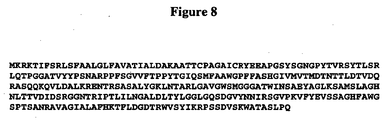
- polypeptide sequences and polypeptide sequences are depicted in figures 1- 8 .
- polynucleotide defines a nucleic acid molecule consisting of more than 30 nucleotides.
- the group of molecules designated as “polynucleotides” also comprises complete genes. Also included by said definition are vectors such as cloning and expression vectors.
- oligonucleotides describes nucleic acid molecules consisting of at least ten and up to 30 nucleotides.
- Nucleic acid molecules include DNA, such as cDNA or genomic DNA, RNA (e.g. mRNA), also in synthetic or semisynthetic form, further synthetic or semisynthetic derivatives of DNA or RNA (e.g. PNA or phosphorothioates) and mixed polymers, both sense and antisense strands. They may contain additional non-natural or derivatized nucleotide bases, as will be readily appreciated by those skilled in the art. In a preferred embodiment the polynucleotide or the nucleic acid molecule(s) is/are DNA.
- a peptide nucleic acid is a polyamide type of DNA analog and the monomeric units for the derivatives of adenine, guanine, thymine and cytosine are available commercially (Perceptive Biosystems). Certain components of DNA, such as phosphorus, phosphorus oxides, or deoxyribose derivatives, are not present in PNAs. As disclosed by Nielsen et al., Science 254:1497 (1991 ); and Egholm et al., Nature 365:666 (1993 ), PNAs bind specifically and tightly to complementary DNA strands and are not degraded by nucleases. In fact, PNA binds more strongly to DNA than DNA itself does.
- PNA/DNA duplexes bind under a wider range of stringency conditions than DNA/DNA duplexes, making it easier to perform multiplex hybridization. Smaller probes can be used than with DNA due to the strong binding.
- T.sub.m melting point
- vs. 4°-16° C melting point
- the absence of charge groups in PNA means that hybridization can be done at low ionic strengths and reduce possible interference by salt during the analysis.
- additional nucleotides extend over the specific sequence either on the 5' end or the 3' end or both.
- Those additional polynucleotides may be of heterologous or homologous nature and may comprise stretches of about 50 to 500 nucleotides although higher or lower values are not excluded.
- homologous sequences those embodiments do not include complete genomes and are generally confined to about 1500 additional nucleotides at the 5' and/or the 3' end.
- Additional heterologous sequences may include heterologous promoters which are operatively linked to the coding sequences of the invention.
- polypeptide as used herein describes a group of molecules which consist of more than 30 amino acids.
- the group of polypeptides comprises "proteins" as long as the proteins consist of a single polypeptide.
- polypeptide describes fragments of proteins as long as these fragments consist of more than 30 amino acids.
- Polypeptides may further form multimers such as dimers, trimers and higher oligomers, i.e. consisting of more than one polypeptide molecule. Polypeptide molecules forming such dimers, trimers etc. may be identical or non-identical. The corresponding higher order structures of such multimers are, consequently, termed homo- or heterodimers, homo- or heterotrimers etc.
- homomultimer is the enzyme according SEQ ID NO: 2.
- homomultimer is the enzyme according SEQ ID NO: 2.
- homomultimer is the enzyme according SEQ ID NO: 2.
- homomultimer is the enzyme according SEQ ID NO: 2.
- homomultimer is the enzyme according SEQ ID NO: 2.
- homomultimer is the enzyme according SEQ ID NO: 2.
- homomultimer is the enzyme according SEQ ID NO: 2.
- homomultimer is the enzyme according SEQ ID NO: 2.
- homomultimer is the enzyme according SEQ ID NO: 2.
- enzyme defines in the context of the invention a polypeptide, polypeptides and/or protein(s), comprising either the triad of active site residues with the active site serine embedded in the consensus sequence "Sm-x-Ser-x-Gly” typical of families I, III, IV V, VI and VII of bacterial lypolytic enzymes [6] with "Sm” being a small amino acid and "x” being any amino acid or the N-terminally located active site motif "Ser-x-x-Lys" of family VIII of bacterial lypolytic enzymes [6].
- the said polypeptide, protein or fragment thereof has catalytic activity.
- An enzyme in accordance with the present invention is preferably defined by its capability of hydrolysing Tributyrin.
- carboxylesterase or “carboxyl-esterase” refers to an enzyme with the systematic name “carboxylic-ester hydrolase”, i.e. an enzyme having an activity which may e.g. be described as hydrolysis of carboxylic esters.
- a carboxylic ester + H 2 O an alcohol + a carboxylate.
- the IUBMB Enzyme Nomenclature refers to carboxylesterases as "EC 3.1.1.1".
- carboxylesterases are: ali-esterase; B-esterase; monobutyrase; cocaine esterase; procaine esterase; methylbutyrase; vitamin A esterase; butyryl esterase; carboxyesterase; carboxylate esterase; carboxylic esterase; methylbutyrate esterase; triacetin esterase; carboxyl ester hydrolase; butyrate esterase; methylbutyrase; a-carboxylesterase; propionyl esterase; nonspecific carboxylesterase; esterase D; esterase B; esterase A; serine esterase; carboxylic acid esterase; cocaine esterase.
- percent identity describes the number of matches ("hits") of identical nucleotides/amino acids of two or more aligned nucleic acid or amino acid sequences as compared to the number of nucleotides making up the overall length of the nucleic acid or amino acid sequences (or the overall compared part thereof).
- the percentage of amino acid residues or nucleotides that are the same may be determined, when the (sub)sequences are compared and aligned for maximum correspondence over a window of comparison, or over a designated region as measured using a sequence comparison algorithm as known in the art, or when manuaiiy alignment and visually inspected.
- This definition also applies to the complement of a test sequence.
- Preferred polynucleotides/polypeptides in accordance with the invention are those where the described identity exists over a region that is at least about 15 to 25 amino acids or nucleotides in length, more preferably, over a region that is about 50 to 100 amino acids or nucleotides in length.
- Those having skill in the art will know how to determine percent identity between/among sequences using, for example, algorithms such as those based on CLUSTALW computer program ( Thompson Nucl. Acids Res. 2 (1994), 4673-4680 ) or FASTA [21], as known in the art.
- the present invention refers to polynucleotides encoding an enzyme having carboxylesterase E.C. 3.1.1.1 activity as defined in claim 1. Particularly preferred are polynucleotides which are at least 90% identical to a polynucleotide encoding an enzyme as shown in SEQ ID NO: 2. More preferred are, with increasing preference, polynucleotides having at least 95%, at least 97, at least 99% sequence identity.
- the FASTDB gorithm typically does not consider internal non-matching deletions or additions in sequences, i.e., gaps, in its calculation, this can be corrected manually to avoid an overestimation of the % identity.
- CLUSTALW does take sequence gaps into account in its identity calculations.
- the BLASTP program uses as defaults a wordlength (W) of 3, and an expectation (E) of 10.
- hybridizes/hybridizing refers to a pairing of a polynucleotide to a (partially) complementary strand of this polynucleotide which thereby form a hybrid.
- Said complementary strand polynucleotides are, e.g. the polynucleotides described in item (e), supra, or parts of polynucleotides comprising at least 10, preferably at least 15 such as at least 25 consecutive nucleotides thereof, if used as primers or probes.
- Said complementary polynucleotides may be useful as probes in Northern or Southern blot analysis of RNA or DNA preparations, PCRs and the like or primer extension protocols respectively.
- fragments thereof useful as specific probes or primers refers to nucleic acid molecules the sequence of which is uniquely fitting to (hybridizing to/complementary to preferably 100%) the sequences of the nucleic acid molecules described in accordance with the present invention, but not to prior art sequences.
- the skilled person can identify such fragments by simple sequence alignments. For example, if there is a 100% stretch of identity with a prior art sequence, the addition of a further nucleotide to that sequence of identity will yield a novel sequence which is encompassed by the present invention, since it is to 100% complementary to the polynucleotide of the invention but not to the prior art sequence.
- Hybridizing polynucleotides of the present invention to be used as a probe in Southern or Northern blot preferably comprises at least 100, more preferably at least 200, and most preferably at least 500 nucleotides in length.
- those polynucleotides that hybridize to the complementary strand of the specifically disclosed polynucleotide sequences and retain or essentially retain carboxylesterase activity must encode at least the amino acids of the catalytic triade and the oxyanion hole of the enzyme.
- polynucleotide fragment refers to a fragment of the polynucleotide of the present invention lacking at least 1 nucleotide.
- at least 1 nucleotide means e.g. up to 1, up to 10, up to 20, up to 50 or up to 100 nucleotides.
- Said fragment may correspond to a 5' and/or 3' deletion of the full-length polynucleotide of the present invention.
- the deletion may be located in an internal position.
- the deletion may affect a contiguous number of residues, however, it is also envisaged that the fragment is the polynucleotide of the present invention having deletions of various, also non-contiguous residues.
- said fragment encodes a protein or polypeptide with carboxylesterase activity. The activity may not necessarily be of the same degree as the full-length or wild-type carboxylesterase as long as some activity is retained.
- “Stringent hybridization conditions” refers to conditions which comprise, e.g. an overnight incubation at 42°C in a solution comprising 50% formamide, 5x SSC (750 mM NaCl, 75 mM sodium citrate), 50 mM sodium phosphate (pH 7.6), 5x Denhardt's solution, 10% dextran sulphate, and 20 ⁇ g/ml denatured, sheared salmon sperm DNA, followed by washing the filters in 0.1 x SSC at about 65°C. Said conditions for hybridization are also known by a person skilled in the art as “highly stringent conditions for hybridization”.
- lower stringency conditions for hybridization Changes in the stringency of hybridization and signal detection are primarily accomplished through the manipulation of formamide concentration (lower percentages of formamide result in lowered stringency), salt conditions, or temperature.
- washes performed following stringent hybridization can be done at higher salt concentrations (e.g. 5X SSC).
- salt concentrations e.g. 5X SSC.
- Typical blocking reagents include Denhardt's reagent, BLOTTO, heparin, denatured salmon sperm DNA, and commercially available proprietary formulations.
- the inclusion of specific blocking reagents may require modification of the hybridization conditions described above, due to problems with compatibility. Such modifications can generally be effected by the skilled person without further ado.
- a hybridization complex may be formed in solution (e.g., Cot or Rot analysis) or between one nucleic acid sequence present in solution and another nucleic acid sequence immobilized on a solid support (e.g., membranes, filters, chips, pins or glass slides to which, e.g., cells have been fixed).
- a solid support e.g., membranes, filters, chips, pins or glass slides to which, e.g., cells have been fixed.
- coding sequence refers to the coding sequence of the carboxylesterase of the present invention or a fragment or derivative thereof. Said term relates to the genomic coding sequence as well as the coding sequence in a RNA or cDNA molecule.
- the optical purity of chiral compounds is usually expressed as percent enantiomeric excess (%ee).
- %ee values can be calculated from the molar ratio of each enantiomer, Eq. 1.
- the peak areas of chromatographic elution for each enantiomer are obtained by gas chromatography or HPLC analysis using a chiral column and are then used to calculate %ee instead of the molar ratios.
- a racemate has a %ee value of 0, optically pure compounds have a %ee value of 100.
- % ee X A ⁇ X B X A + X B * 100
- X A _ Concentration of enantiomer A
- X B _ Concentration of enantiomer B
- Enzymatic syntheses of optically active compounds either start from racemic mixtures or from prostereogenic (prochiral) precursors. The latter ideally yields a product with 100%ee at 100% yield. In contrast, a kinetic resolution will only lead to a yield of 50%. Methods to increase the yield include racemization of the non-wanted enantiomer, by using a racemase or chemical racemization or by performing a so-called dynamic kinetic resolution (DKR).
- DKR dynamic kinetic resolution
- the requirements for a DKR are: (1), the substrate must racemize faster than the subsequent enzymatic reaction, (2), the product must not racemize, and (3), as in any asymmetric synthesis, the enzymatic reaction must be highly stereoselective.
- the stereo-preference (enantio-preference) of an enzyme is routinely described by the enantiomeric excess (ee) of the product enantiomers after a reaction has taken place.
- ee enantiomeric excess
- a kinetic resolution the enantiomeric purity of the product and starting material varies as the reaction proceeds.
- Charles Sih's group developed equations to calculate their inherent enantioselectivity [14, 15]. This enantioselectivity, called the enantiomeric ratio, E, measures the ability of the enzyme to distinguish between enantiomers.
- a non-selective reaction has an E of 1, while resolutions with E's above 20 (better E>50) are useful for synthesis.
- E one measures two of the three variables: enantiomeric purity of the starting material ( ee s ), enantiomeric purity of the product ( ee p ), and extent of conversion (c) and uses one of the three equations below (Eq. 2). Often enantiomeric purities are more accurately measured than conversion; in these cases, the third equation is more accurate. Note that these equations are only applicable to irreversible reactions. In other cases, the equilibrium constant must be determined and alternative equations must be used.
- the recombinant enzyme according to SEQ ID NO: 2 and 6 hydrolyzed rac-cis-3,5-diacetoxy-1-cyclopenten with an ee-value of 100% at a conversion of 24% and 100%, respectively, for the preferred enantiomer. The enantiopreference was not determined due to the lack of enantiopure reference compounds.
- the recombinant enzymes according to SEQ ID NO. 4 and 8 hydrolyzed this substrate with an ee-value of 66% and 76% at 12% and 100% conversion, respectively.
- Chiral cyclopentanoid building blocks are used for the synthesis of carbacyclic prostaglandin I 2 derivatives - potential therapeutic agents for the treatment of thrombotic diseases [17].
- the enzyme according to SEQ ID NO: 4 hydrolyzed the acetic acid ester of rac-trans-1,2-cyclohexanediol enantioselectively with an ee of 38% at 100% conversion of the prefered enantiomer.
- the enantiopreference was not determined due to the lack of enantiopure reference compounds.
- the enzymes according to SEQ ID NO: 2 and 4 were capable of hydrolyzing acetic acid esters of rac -1-octin-3-ol, of R-(+)-3-chlor-1-phenyl-1-propanol, and of trimethylsilylbutinol.
- the enzyme according to SEQ ID NO: 4 was capable of converting acetic acid esters of cis-1,2-cyclohexanediol and isopropylidene glycerol.
- Isopropylidene glycerol is widely used as a pharmaceutical synthon, especially for the production of ⁇ -blockers.
- the enzymes according to SEQ ID NOs: 2 and 4 hydrolyzed the p-nitrophenyl (pNP) esters of different substrates with importance for the production of pharmaceutical synthons. Cyclohexanoate was converted with specific activities of 50.0 U/mg and 16.8 U/mg, respectively.
- the pNP-ester of benzoate was hydrolyzed with specific activities of 9.4 U/mg and 12.1 U/mg, respectively.
- the pNP-esters of 3-phenylbutanoate and 2-(3-benzoylphenyl) propanoate were hydrolyzed by the recombiant enzyme according to SEQ ID NO: 2 with specific activities of 31,6 U/mg and 26,7 U/mg, respectively.
- the recombinant enzyme according to SEQ ID NO: 4 showed specific activities for these substrates of 1.0 and 0.8 U/mg, respectively.
- the recombinant enzyme according to SEQ ID NO: 2 converted the pNP-ester of 2-phenylpropanoate with a specific activity of 21.0 U/mg. Furthermore, this enzyme hydrolyzed the nonsteroidal anti-inflammatory drugs ibuprofen, 2-(4-isobutylphenyl) propanoate and naproxen, 2-(6-methoxynaphtalen-2-yl) propanoate with specific activities of 7.2 U/mg and 26,7 U/mg, respectively.
- the recombinant enzyme according to SEQ ID NO: 2 showed an exceptionally high specific activity towards pNP-valerate of 425,7 U/mg.
- the esterases from Xanthomonas vesicatoria [18], Pseudomonas sp. B11-1 [19] and Aeromonas hydrophila MCC-2 [20] were reported to convert this substrate with a specific activity of 10.5 U/mg, 64 U/mg and 86,3 U/mg, respectively.
- the enzyme according to SEQ ID NO: 2 was able to convert the secondary ester 7 - (3 - octylcarboxy - (3 - hydroxy - 3 - methyl - butyloxy)) - coumarine as determined by a fingerprint analysis (see example 7).
- This substrate is very unreactive and almost never converted to any measurable extent by other enzymes.
- the enzyme according to SEQ ID NO: 6 was denoted to belong to family IV of bacterial lipolytic enzymes.
- the enzyme according to SEQ ID NO: 8 was denoted to belong to the family V of bacterial lipolytic enzymes, those according to SEQ ID NO: 2 and 4 were denoted to be members of family VIII.
- the similarity of the polynucleotides according to SEQ ID NOs: 1, 3, 5, and 7 to other polynucleotides is shown in tables 1 - 4.
- the analysis was performed using the Fasta algorithm [21] using : GenBank database [23], Release 152.0, (released on 18Feb2005).
- Table 1 Sequence identity of the enzyme according to SEQ ID No.
- polynucleotide as defined in claim 1 is fused with a heterologous or homologous polynucleotide
- This heterologous or homologous polynucleotide may or may not be or comprise a coding region.
- the polynucleotide and/or the encoded enzyme having carboxylesterase activity is/are either heterologous with respect to the host or is/are homologous with respect to the host but located in a different genomic environment than the naturally occurring counterpart of said nucleotide sequence.
- a polynucleotide is "heterologous" when it is derived from a cell or organism belonging to a different strain (preferably to a different species) with regard to the origin of the sequence encoding the carboxylesterase of the present invention.
- a polynucleotide is "homologous" when it is derived from the same cell or organism as the sequence encoding the carboxylesterase of the invention.
- "Homologous" with respect to the host but located in a different genomic environment than the naturally occurring counterpart of said nucleotide sequence means that, if the nucleotide sequence is homologous with respect to the host (i.e. is naturally present in the same strain or species), it is not located in its natural location in the genome of said host. In particular it may be surrounded by different genes. In this case the nucleotide sequence may be either under the control of its own promoter or under the control of a heterologous promoter.
- the location of the introduced nucleic acid molecule can be determined by the skilled person by using methods well-known in the art, including Southern blotting.
- the polynucleotide(s) according to the invention which is/are present in the host may either be integrated into the genome of the host or be maintained extrachromosomally. With respect to the first option, it is also to be understood that the polynucleotide of the invention can be used to restore or create a mutant gene via homologous recombination.
- bivalent cations have a modulating effect on the activity of the carboxyl esterase of the present invention.
- the catalytic activity of the enzyme of SEQ ID NO: 2 of the present invention is stimulated in the presence of Co 2+ by about 130%.
- other bivalent cations like Ca 2+ .
- Cu 2+ Mg 2+ , Zn 2+ Rb 2+ and EDTA have a inhibitory effect on enzymes such as the carboxyl esterase of SEQ ID NO: 2.
- EstCE1 the enzyme of SEQ ID NO: 4
- the present inventors observed a reversed modulatory effect in the presence of bivalent cations such as Ca 2+ and Mg 2+ , which resulted in a stimulation of the catalytic activity.
- the present inventors have observed a stimulatory effect amounting to 118% and 108%, respectively.
- said heterologous or homologous polynucleotide encodes a polypeptide.
- heterologous polypeptides are NusA from E. coli, glutathion S-transferase from Schistosoma japonicum or the maltose binding protein from E. coli all of which might increase the solubility of the carboxylesterase.
- the present invention also relates to a vector containing the polynucleotide of the present invention.
- the vector is a plasmid, cosmid, virus, bacteriophage or another vector used e.g. conventionally in genetic engineering.
- the polynucleotide of the present invention may be inserted into several commercially available vectors.
- Non-limiting examples include prokaryotic plasmid vectors, such as the pUC-series, pBluescript (Stratagene), the pET-series of expression vectors (Novagen) or pCRTOPO (Invitrogen) and vectors compatible with an expression in mammalian cells like pREP (Invitrogen), pcDNA3 (Invitrogen), pCEP4 (Invitrogen), pMC1neo (Stratagene), pXT1 (Stratagene), pSG5 (Stratagene), EBO-pSV2neo, pBPV-1, pdBPVMMTneo, pRSVgpt, pRSVneo, pSV2-dhfr, pIZD35, pLXIN, pSIR (Clontech), pIRES-EGFP (Clon
- the polynucleotide of the present invention referred to above may also be inserted into vectors such that a translational fusion with another polynucleotide is generated.
- the other polynucleotide may encode a protein which may e.g. increase the solubility and/or facilitate the purification of the fusion protein.
- Non-limiting examples include pET32, pET41, and pET43.
- vectors can contain one or more origin of replication (ORI) and inheritance systems for cloning or expression, one or more markers for selection in the host, e. g., antibiotic resistance, and one or more expression cassettes.
- ORI origin of replication
- Suitable origins of replication include, for example, the Col E1, the SV40 viral and the M 13 origins of replication.
- the coding sequences inserted in the vector can e.g. be synthesized by standard methods, or isolated from natural sources. Ligation of the coding sequences to transcriptional regulatory elements and/or to other amino acid encoding sequences can be carried out using established methods.
- Transcriptional regulatory elements parts of an expression cassette
- These elements comprise regulatory sequences ensuring the initiation of the transcription (e. g., translation initiation codon, promoters, enhancers, and/or insulators), internal ribosomal entry sites (IRES) ( Owens, Proc. Natl. Acad. Sci.
- poly-A signals ensuring termination of transcription and stabilization of the transcript.
- Additional regulatory elements may include transcriptional as well as translational enhancers, and/or naturally-associated or heterologous promoter regions.
- the polynucleotide of the invention is operatively linked to such expression control sequences allowing expression in prokaryotes or eukaryotic cells.
- the vector may further comprise nucleotide sequences encoding secretion signals as further regulatory elements. Such sequences are well known to the person skilled in the art.
- leader sequences capable of directing the expressed polypeptide to a cellular compartment may be added to the coding sequence of the polynucleotide of the invention. Such leader sequences are well known in the art.
- regulatory elements ensuring the initiation of transcription comprise the cytomegalovirus (CMV) promoter, SV40-promoter, RSV-promoter (Rous Sarcoma Virus), the lacZ promoter, the gai10 promoter, human elongation factor 1 ⁇ -promoter, CMV enhancer, CaM-kinase promoter, the Autographa californica multiple nuclear polyhedrosis virus (AcMNPV) polyhedral promoter or the SV40-enhancer.
- CMV cytomegalovirus
- SV40-promoter RSV-promoter (Rous Sarcoma Virus)
- the lacZ promoter the gai10 promoter
- human elongation factor 1 ⁇ -promoter CMV enhancer
- CaM-kinase promoter the Autographa californica multiple nuclear polyhedrosis virus (AcMNPV) polyhedral promoter or the SV40-enhancer.
- AcMNPV Autographa cali
- transcription termination signals such as SV40-poly-A site or the tk-poly-A site or the SV40, lacZ and AcMNPV polyhedral polyadenylation signals, downstream of the polynucleotide.
- the vector of the invention comprises a selectable marker.
- selectable markers include neomycin, ampicillin, and hygromycin resistance and the like.
- Specifically-designed vectors allow the shuttling of DNA between different hosts, such as bacteria- fungal cells or bacteria-animal cells.
- An expression vector according to this invention is capable of directing the replication, and the expression, of the polynucleotide and encoded enzyme of this invention.
- Suitable expression vectors which comprise the described regulatory elements are known in the art such as Okayama-Berg cDNA expression vector pcDV1 (Pharmacia), pRc/CMV, pcDNA1, pcDNA3 (In-Vitrogene, as used, inter alia in the appended examples), pSPORT1 (GIBCO BRL) or pGEMHE (Promega), or prokaryotic expression vectors, such as lambda gt11, pJOE, the pBBR1-MCS -series, pJB861, pBSMuL, pBC2, pUCPKS, pTACT1 or, preferably, the pET vector (Novagen).
- nucleic acid molecules of the invention as described herein above may be designed for direct introduction or for introduction via liposomes, phage vectors or viral vectors (e.g. adenoviral, retroviral) into the cell. Additionally, baculoviral systems or systems based on Vaccinia Virus or Semliki Forest Virus can be used as eukaryotic expression system for the nucleic acid molecules of the invention.
- the present invention also relates to a non-human host, genetically engineered with the polynucleotide of the present invention or the vector of the present invention:
- Said non-human host may be produced by introducing said polynucleotide or vector(s) into said non-human host which upon its/their presence mediates the expression of the enzyme having carboxylesterase E.C. 3.1.1.1 activity.
- the non-human host may be any prokaryote or eukaryotic cell.
- a suitable eukaryotic host cell may be a mammalian cell, an amphibian cell, a fish cell, an insect cell a fungal cell or a plant cell.
- a cukaryotic cell may be an insect cell such as a Spodoptera frugiperda cell, a yeast cell such as a Saccharomyces cerevisiae or Pichia pastoris cell, a fungal cell such as an Aspergillus cell or a vertebrate cell.
- the cell is a mammalian cell such as a human cell.
- the cell may be a part of a cell line.
- the eukaryotic cell is not a human embryonic cell.
- Suitable prokaryotes/bacteria are those generally used for cloning/expression like E . coli (e.g., E coli strains HB101, DH5a, XL1 Blue, Y1090 and JM101), Salmonella typhimurium, Serratia marcescens, Burkholderia glumae, Pseudomonas putida, Pseudomonas fluorescens, Pseudomonas stutzeri, Streptomyces lividans, Lactococcus lactis, Mycobacterium smegmatis or Bacillus subtilis.
- E coli e.g., E coli strains HB101, DH5a, XL1 Blue, Y1090 and JM101
- Salmonella typhimurium e.g., Serratia marcescens, Burkholderia glumae, Pseudomonas putida, P
- a suitable eukaryotic host may be a mammalian cell, an amphibian cell, a fish cell, an insect cell, a fungal cell or a plant cell.
- Preferred examples for hosts to be genetically engineered with the polynucleotide of the invention are E. coli and Bacillus subtilis.
- the host is a prokaryotic host selected from the group consisting of E. coli, Bacillus sp., Pseudomonas sp., Streptomyces sp., Mycobacterium sp., Caulobacter sp., Rhodobacter sp., Lactococcus sp., Burkholderia sp, Rhizobium sp., Sinorhizobium sp. and Ralstonia sp.
- the non-human host of the present invention expresses the polypeptide encoded by the polynucleotide of the present invention or the vector of the present invention and one or more additional enzyme(s) wherein said enzymes in toto catalyze a multi-step conversion of a substrate or contribute thereto.
- the present invention also relates to a process for producing a polypeptide having carboxyl esterase E.C. 3.1.1.1 activity, comprising culturing the non-human host of the present invention and recovering the polypeptide produced by said host.
- the host is a unicellular organism such as a prokaryote, a mammalian cell which is not a human embryonic stem cell, or an insect cell, the person skilled in the art can revert to a variety of culture conditions.
- the produced protein is harvested from the culture medium, lysates of the cultured organisms or from isolated (biological) membranes by established techniques, in the case of a multicellular non-human organism, the non-human host may be a cell which is part of or derived from a part of the organism, for example said host cell may be the harvestable part of a plant.
- a preferred method involves the recombinant production of protein in non-human hosts as indicated above.
- nucleic acid sequences comprising the polynucleotide according to the invention can be synthesized by PCR, inserted into an expression vector.
- a suitable non-human host may be transformed with the expression vector.
- the non-human host is cultured to produce the desired polypeptide(s), which is/are isolated and purified.
- Suitable cell-free expression systems for use in accordance with the present invention include rabbit reticulocyte lysate, wheat germ extract, canine pancreatic microsomal membranes, E . coli S30 extract, and coupled transcription/translation systems such as the TNT-system (Promega). These systems allow the expression of recombinant polypeptides upon the addition of cloning vectors, DNA fragments, or RNA sequences containing coding regions and appropriate promoter elements.
- fragments of the protein, the fusion protein or fragments of the invention may e.g. be produced by direct peptide synthesis using solid-phase techniques (cf Stewart et al. (1969) Solid Phase Peptide Synthesis; Freeman Co. San Francisco ; Merrified, J. Am. Chem. Soc. 85 (1963), 2149-2154 ).
- Synthetic protein synthesis may be performed using manual techniques or by automation. Automated synthesis may be achieved, for example, using the Applied Biosystems 431A Peptide Synthesizer (Perkin Elmer, Foster City CA) in accordance with the instructions provided by the manufacturer. Various fragments may be chemically synthesized separately and combined using chemical methods to produce the full length molecule. As indicated above, chemical synthesis, such as the solid phase procedure described by Houghton Proc. Natl. Acad. Sci. USA (82) (1985), 5131-5135 , can be used.
- Protein isolation and purification can be achieved by any one of several known techniques; for example and without limitation, ion exchange chromatography, gel filtration chromatography and affinity chromatography, high pressure liquid chromatography (HPLC), reversed phase HPLC, and preparative disc gel electrophoresis.
- Protein isolation/purification techniques may require modification of the proteins of the present invention using conventional methods. For example, a histidine tag can be added to the protein to allow purification on a nickel column. Other modifications may cause higher or lower activity, permit higher levels of protein production, or simplify purification of the protein.
- the present invention also relates to a process for producing bacteria or eukaryotic cells which are not human embryonic cells capable of expressing a polypeptide having carboxyl esterase E.C. 3.1.1:1 activity, the process comprising genetically engineering bacteria or eukaryotic cells which are not human embryonic cells with the vector of the present invention.
- Said polypeptide may comprise additional Nor C-terminal amino acid sequences.
- Such polypeptides are sometimes also referred to as fusion proteins.
- the term "genetic engineering” refers to the process of bringing into a cell genetic information or modifying the genetic information of a cell. This is generally accomplished by transfecting or transforming a host cell with a nucleic acid molecule.
- Introduction of a construct into the host cell can be effected by calcium phosphate transfection, DEAE-dextran mediated transfection, cationic lipid-mediated transfection, electroporation, transduction, infection or other methods. Such methods are described in many standard laboratory manuals, such as Sambrook et al., "Molecular Cloning, A Laboratory Manual”; ISBN: 0879695765, CSH Press, Cold Spring Harbor, 2001 .
- Said nucleic acid molecule introduced into the, host cell comprises an open reading frame encoding the polypeptide of the present invention.
- the present invention also relates to a polypeptide comprising the amino acid sequence encoded by a polynucleotide of the present invention or obtainable by the process of the present invention, and having carboxyl esterase E.C. 3.1.1.1 activity.
- the polypeptide of the present invention may contain additional, heterologous sequences. Often, but not necessarily, these additional sequences will be located at the N- or C-terminal end of the polypeptide, in other words the polypeptide may be a fusion protein. It may be convenient to initially express the polypeptide as a fusion protein from which the additional amino acid residues can be removed, e.g.
- heterologous sequences may help in the expression or purification of the present invention.
- heterologous sequences may assist in attaching the polypeptide of the present invention to a carrier.
- the present invention also relates to an antibody specifically binding to the polypeptide of the present invention, having carboxylesterase E.C. 3.1.1.1 activity.
- the antibody specifically binds either to epitopes formed by carboxylesterase residues within of the fusion protein.
- the antibody may however also bind to epitopes formed by the stretch of amino acids including the fusion point of the two heterologous polypeptides. This epitopes are characteristic (unique) for the fusion protein of the invention.
- the antibody of the present invention can be, for example, polyclonal or monoclonal.
- the term "antibody” also comprises derivatives or fragments thereof which still retain the binding specificity. Techniques for the production of antibodies are well known in the art and described, e.g. in Harlow and Lane “Antibodies, A Laboratory Manual”, Cold Spring Harbor Laboratory Press, 1988 and Harlow and Lane “Using Antibodies: A Laboratory Manual” Cold Spring Harbor Laboratory Press, 1999 . These antibodies can be used, for example, for the immunoprecipitation, affinity purification and immunolocalization of the polypeptides or fusion proteins of the invention as well as for the monitoring of the presence and amount of such polypeptides, for example, in cultures of recombinant prokaryotes or eukaryotic cells or organisms.
- the antibody of the invention also includes embodiments such as chimeric, single chain and humanized antibodies, as well as antibody fragments, like, inter alia, Fab fragments.
- Antibody fragments or derivatives further comprise F(ab') 2 , Fv or scFv fragments; see, for example, Harlow and Lane (1988) and (1999), loc. cit.
- F(ab') 2 , Fv or scFv fragments see, for example, Harlow and Lane (1988) and (1999), loc. cit.
- the (antibody) derivatives can be produced by peptidomimetics.
- techniques described for the production of single chain antibodies see, inter alia, US Patent 4,946,778 ) can be adapted to produce single chain antibodies specific for polypeptide(s) of this invention.
- transgenic non-human animals may be used to express humanized antibodies specific for polypeptides and fusion proteins of this invention.
- the antibody of this invention is a monoclonal antibody.
- any technique which provides antibodies produced by continuous cell line cultures can be used. Examples for such techniques include the hybridoma technique ( Köhler and Milstein Nature 256 (1975), 495-497 ), the trioma technique, the human B-cell hybridoma technique ( Kozbor, Immunology Today 4 (1983), 72 ) and the EBV-hybridoma technique to produce human monoclonal antibodies ( Cole et al., Monoclonal Antibodies and Cancer Therapy, Alan R. Liss, Inc. (1985), 77-96 ).
- antibody comprises antibody constructs which may be expressed in cells, e.g. antibody constructs which may be transfected and/or transduced via, inter alia, viruses or plasmid vectors.
- the antibody described in the context of the invention is capable to specifically bind/interact with an epitope of the polypeptides of the invention.
- the term "specifically binding/interacting with” as used in accordance with the present invention means that the antibody does not or essentially does not cross-react with an epitope of similar structure. Thus, the antibody does not bind to prior art carboxylesterase.
- Cross-reactivity of a panel of antibodies under investigation may be tested, for example, by assessing binding of said panel of antibodies under conventional conditions to the epitope of interest as well as to a number of more or less (structurally and/or functionally) closely related epitopes. Only those antibodies that bind to the epitope of interest in its relevant context (e.g.
- the antibody specifically binds to/interacts with conformational or continuous epitopes which are unique for the polypeptides of the invention.
- a conformational or discontinuous epitope is characterized for polypeptide antigens by the presence of two or more discrete amino acid residues which are separated in the primary sequence, but come together on the surface of the molecule when the polypeptide folds into the native protein/antigen ( Sela, (1969) Science 166, 1365 and Laver, (1990) Cell 61, 553-6 ).
- the two or more discrete amino acid residues contributing to the epitope are present on separate sections of one or more polypeptide chain(s).
- a continuous or linear epitope consists of two or more discrete amino acid residues which are present in a single linear segment of a polypeptide chain.
- the present invention also relates to a primer which specifically hybridizes under stringent conditions to a polynucleotide of the present invention.
- Said primer is at least 10, more preferably at least 15, further preferably at least 20, furthermore preferably at least 25 nucleotides in length.
- Preferably said primer is up to 30, more preferably up to 35, further preferably up to 40 nucleotides in length.
- primer when used in the present invention means a single-stranded nucleic acid molecule capable of annealing to the nucleic acid molecule of the present invention and thereby being capable of serving as a starting point for amplification or elongation.
- primers For an amplification reaction it is preferred that a pair of primers is elected.
- the term "pair of primers” means a pair of primers that are with respect to a complementary region of a nucleic acid molecule directed in the opposite direction towards each other to enable, for example, amplification by polymerase chain reaction (PCR).
- amplifying refers to repeated copying of a specified sequence of nucleotides resulting in an increase in the amount of said specified sequence of nucleotides and allows the generation of a multitude of identical or essentially identical (i.e. at least 95% more preferred at least 98%, even more preferred at least 99% and most preferred at least 99.5% such as 99.9% identical) nucleic acid molecules or parts thereof.
- Such methods are well established in the art; see Sambrook et al. "Molecular Cloning, A Laboratory Manual", 2nd edition 1989, CSH Press, Cold Spring Harb or. They include polymerase chain reaction (PCR) and modifications thereof, ligase chain reaction (LCR) to name some preferred amplification methods.
- the nucleic acid molecule of the invention also including the primer of the present invention, is labelled.
- the label may, for example, be a radioactive label, such as 32 P, 33 P or 35 S.
- the label is a non-radioactive label, for example, digoxigenin, biotin and fluorescence dye or a dye.
- the present invention also relates to a composition
- a composition comprising the polynucleotide of the present invention, the vector of the present invention, the non-human host of the present invention, the polypeptide of the present invention, the antibody of the present invention and/or one or more primers of the present invention.
- composition as used in accordance with the present invention, relates to a composition which comprises at least one of the recited compounds. It may, optionally, comprise further molecules capable of altering the characteristics of the compounds of the invention thereby, for example, suppressing, stabilizing, blocking, modulating and/or activating their function.
- the composition may be in solid, liquid or gaseous form and may be, inter alia, in the form of (a) powder(s), (a) tablet(s), (a) solution(s) or (an) aerosol(s).
- the present invention also relates to a method for the production of an optical active compound comprising allowing the enantioselective conversion of a racemic starting material by a polypeptide of the present invention.
- ee-values of 100 % were determined for the conversion of rac -menthylacetate by the enzyme according to SEQ ID NO: 4, for the conversion of rac -isopropylideneglycerol acetate by the enzyme according to SEQ ID NO:6 and for the conversion of rac -cis-3,5-diacetoxy-1-cyclopenten by the enzymes according to SEQ ID NO: 2 and 6 as outlined in example 8.
- optically active as used herein describes the capability of a molecule to rotate the plane of polarization of a light wave. This capability is associated with asymmetry in the molecule. It is very often the result of a chiral centre.
- enantioselective conversion refers to the selective conversion of a chiral or prochiral substrate into an enantioenriched or enantiopure product.
- said optical active compound is (+)-menthol and the racemic starting material is rac -menthyl acetate.
- racemic starting material (educt) is produced by catalysis of a conversion by one or more different enzymes and/or the optical active compound (product) is the starting material (educt) for a further conversion by one or more different enzyme(s).
- DNA isolation methods were based on the method described previously [24]. Libraries were prepared in the cosmid vector pWE15 which has kanamycin and ampicillin resistance (Stratagene, La Jolla, CA) using protocols as provided by the manufacturer. DNA fragments (20-40 kb) obtained after partial Sau 3Al digestion were ligated into the Bam HI restriction site of the cosmid vector. Phage packaging mixes were obtained from Stratagene (La Jolla, CA), and infection of E. coli VCS257 was performed according to the manufacturer's protocol.
- estCE1, estA3, estCL1 and estCL2 genes were amplified from cosmid DNAs using PCR in 35 cycles with primer pairs ESTCE1-for (5'-GGC ATA TGT CGA TAG CGG ATC AGT CA -3') and ESTCE1-rev (5'- GGA TCC TTA GCG AGT AGG TTC GTT TG -3'), ESTA3-for (5'-GCG GAT CCA TGA GCG CCG AAG AAC TAG GG -3') and ESTA3-rev (5'-CGA AGC TTG GCG GCG AGC GCG CTG TA -3'), estcl1up (5'-AGA GAC CAT ATG ACC GAT CCC TAT GTG CG-3') and estcl1dw (5'-CGG TTT GGA TCC TCA TGC TTC TGC CAT AAC-3'), estCL2up (5'-ACT ATC CAT ATG AAA AGA AAA ACA ATC TTC-3') and
- Primers were designed to introduce a 3'- Bam HI restriction site and a 5'- Nde I site into the cloned fragment of estCE1, estCL1 and estCL2 and a 3'- Hin dIII site and a 5- BamH I site into estA3, respectively.
- PCR fragments were first ligated into pBSK+ (Stratagene, La Jolla, CA), then excised with Ndel I and Bam HI, and ligated into pET19b (Novagen, Madison, USA) for estCE1 or into pET16a (Novagen, Madison, USA) for estCL1 or into pET22b (Novagen, Madison, USA) for estCL2 and exised with Bam HI and Hin dIII and ligated into pET24c (Novagen, Madison, USA) for estA3, respectively.
- the plasmids carrying the estCE1, estA3, estCL1 and the estCL2 sequence were designated pET19b-EstCE1, pET24c-EstA3, p16estCL1 and p22estCL22, respectively.
- Freshly transformed E. coli BL21(DE3) cells carrying the respective plasmid were used to overproduce the corresponding proteins.
- Cultures were grown at 37°C to an optical density of 0.5 at 600 nm, and production of the recombinant protein was induced by the addition of 0.5 mM isopropyl-beta-D-thiogalactopyrranoside (IPTG). After 4-5 h, cells were harvested, disrupted in a French pressure cell, and the enzymes were purified from the soluble fraction.
- IPTG isopropyl-beta-D-thiogalactopyrranoside
- Extracts were loaded on Protino-Ni-2000 prepacked columns, and chromatography was done as specified by the manufacturer (Machery & Nagel, Düren, Germany). Protein extracts were then dialyzed overnight against 50 mM NaH 2 PO 4 /300 mM NaCl (pH 7.5). The resulting protein fractions were analyzed by 12% SDS polyacrylamide gel electrophoresis and Western-immunoblotting using 6-His-specific antibodies. EstA3 and EstCE proteins were further purified by size exclusion chromatography (Superdex 200 prep grade, column: HiLoad 16/60, 50 mM NaH 2 PO 4 /300 mM NaCl 1 ml/min) to homogeneity.
- Enzyme activity tests were performed by incubating the enzyme with 4 mM substrate at 45°C in 100 mM Tris-HCl buffer at pH 7.2, unless otherwise indicated. The reaction was measured at 410 nm. One unit is defined as the amount of enzyme catalyzing the appearance of 1 ⁇ mol of free p-nitrophenol/min. Enzyme activity against pNP-acylesters (butyrate, valerate, caproate, octanoate, decanoate and palmitate) was tested under the above conditions. The recombinant enzymes according to SEQ ID NO.2 and 4 showed highest activity towards short chain fatty acids (C 4 ) while activity towards long chain fatty acids (>C 8 ) was much lower.
- the enzyme according to SEQ ID NO: 6 converted pNP-caproate with a specific activity of 80.0 U/mg.
- the results are shown in Table 5.
- Table 5 Activity of the enzymes with various pNP-acylesters of different chain length substrate specific activity [U/mg] EstCE1 EstA3 EstCL1 pNP-butyrate (C 4 ) 31.1 513.6 n.d. pNP-valerate (C 5 ) 22.9 425.7 n.d. pNP-caproate (C 6 ) 7.4 425.7 80.0 pNP-octanoate (C 8 ) 1.0 3.6 n.d. pNP-decanoate (C 10 ) 0.9 0 n.d. pNP-palmitate (C 16 ) 0.0 0 n.d.
- Enzyme activities on the substrates triacetin, tripropionin, tributyrin, tricaprylene, trilaurin and vinyl-substrates were determined using a standard titration assay with minor modifications [25]. Tests were performed with a Methrom 718 STAT potentiometric titrator (Herisau, Switzerland) and by using 10 mM NaOH for titration. The substrates at 10 mM concentration were emulsified in 20 ml reaction buffer containing 2 mM Tris/HCl pH 7.0. After addition of 7.5 ⁇ g of the purified enzyme the NaOH consumption was recorded at a reaction temperature of 37°C. One unit was defined as the amount of enzyme that released 1.0 mmol of fatty acid per min.
- the specific activity of the enzyme according to SEQ ID NO: 2 was significantly higher and this enzyme was capable of hydrolyzing substrates with a chain length of up to C 12 with the optimum at a chain length of C 4 .
- the enzyme according to SEQ ID NO: 6 showed its chain length optimum also at C 4 with the highest activity of all enzymes of the present invention.
- the stability of the enzymes was determined in the presence of the following solvents: DMSO, isopropanol, methanol, dimethylformamide, acetone and acetonitrile.
- the enzymes were incubated for 1 hour at 30°C in the presence of either 15% (v/v) or 30% (v/v) of the solvents and the residual activity was measured at 45°C.
- the substrate used was pNP-butyrate.
- the recombinant enzyme according to SEQ ID NO: 4 was quite stable in the presence of 15% (v/v) DMSO, methanol and isopropanol, retaining 103%, 90% and 75% residual activity, respectively.
- dimethylformamide, acetone and acetonitrile strongly inhibited activity of the enzyme according to SEQ ID NO: 4 with the enzyme displaying only 34%, 14% and 0% residual activity, respectively.
- this enzyme was tested against a higher concentration, 30% (v/v), of the solvents it was completely inhibited and only able to retain 17% and 23% activity in the presence of DMSO and isopropanol, respectively.
- the enzyme according to SEQ ID NO: 2 proved to be very stable, displaying increased activity in the presence of all the tested solvents. With 15% and 30% (v/v) DMSO it retained full activity at 102% and 104%, respectively. The enzyme activity was stimulated to the same level by both concentrations of dimethylformamide and acetone with activity measured at levels up to 128% and 155%, respectively. When the concentration of methanol was increased from 15% (v/v) to 30% (v/v) there was an increase in the activity of the enzyme according to SEQ ID NO: 2 from 111% to 130%.
- the substrate range of the two enzymes was determined using pNP esters of the following: benzoate, 2-(4-isobutylphenyl) propanoate (Ibuprofen), 2-phenylpropanoate, 3-phenylbutanoate, cyclohexanoate, 2-(3-benzoylphenyl) propanoate, 2-naphthoate, 1-naphthoate, adamantanoate and 2-(6-methoxynaphthalene-2-yl) propanoate (Naproxen). Activity was determined at 410 nm after 30 minute incubation at 40°C.
- the reaction mixture was 950 ⁇ l buffer (100 mM Tris, pH 7.5), 50 ⁇ l substrate (5 mg/ml in DMSO) and 1 ⁇ g enzyme.
- Table 9 Activity of the enzymes on pNP-substrates with importance for pharmaceutical products pNP-ester of... Specific activity [U/mg] EstCE1 EstA3 EstCL1 benzoate 12.1 9.4 n.d. 2-(4-isobutylphenyl) propanoate 0 7.2 n.d. 2-phenylpropanoate 0 21.0 n.d. 3-phenylbutanoate 1.0 31.6 n.d. cyclohexanoate 16.8 50.0 n.d.
- the enzyme activity fingerprinting used 10 substrates and was carried out as described previously [26].
- the assay conditions were 75% PBS buffer at pH 7.4, 25% DMSO and 0.0025% SDS. Each substrate was present in the cocktail at 15 ⁇ M, the total concentration of the substrate cocktail was 150 ⁇ M.
- EstA3 was added at a concentration of 0.75 mg/L and EstCE1 at 0.2075 mg/L.
- the reaction time was 30 min.
- the chemical background was measured by recording the products observed under the same assay conditions after a 5 day incubation in the absence of the enzyme. The blank value was taken from the reaction after 30 min incubation in the absence of the enzyme.
- the results and the structures of the substrates are shown in Figure 9 .
- the pH optimum for the enzymes was determined using tributyrin as substrate.
- the incubation conditions were 20 ml buffer (2.5 mM phosphate buffer [pH 4 - 7], 2.5 mM Tris/HCl buffer [pH 7 - 11] or 2.5 mM glycine buffer [pH 9-11], supplemented with 100 mM NaCl) stirred at a constant temperature of 37°C.
- the esterase substrate tributyrin (final concentration of 2 mM) was added to 5 ml of the corresponding buffer at 37°C, emulsified and added to the whole preparation.
- This substrate emulsion was held constant at the correct pH automatically by the titrator (718 STAT Titrino; Metrohm, Herisau, Switzerland) for 2 min and this served as the control.
- the enzymes were added separately to the emulsion and the consumption of 0.01 M NaOH was measured over 4 min, which allowed the calculation of the specific activity of each enzyme at various pH adjustments.
- the activity of enzymes according to SEQ ID NOs: 2, 4 and 6 was tested under buffered conditions over the range pH 4 to 11. All enzymes displayed high activities under neutral to alkalophilic conditions with no activity below pH 6 for the enzyme according to SEQ ID NO: 6, below pH 5 for the enzyme according to SEQ ID NO: 4 and below pH 4 for the enzyme according to SEQ ID NO: 2. The highest activity was measured at pH 10 for the enzyme according to SEQ ID NO: 4, pH 9 for the enzyme according to Seq ID NO. 2 and pH 8 for the enzyme according to SEQ ID NO: 6 ( Figure 10 ). Surprisingly, the enzymes according to SEQ ID NOs: 2 and 4 were extremely stable with little loss of activity after incubation for up to 48 hours under alkaline conditions up to pH 12 (data not shown).
- the temperature range of the enzymes was tested using pNP-caproate as substrate. To determine the temperature optimum, the enzymes were tested at temperatures ranging from 25°C to 70°C as described above.
- the enzymes according to SEQ ID NOs: 2 and 4 were active over a wide temperature range retaining a minimum of 50% relative activity between 37.6°C and 55.8°C for the enzyme according to the SEQ ID NO: 2 and between 36.3°C and 51.2°C for the enzyme according to the SEQ ID NO: 4 Maximum activity was measured at 47°C and 50°C for the enzyme according to the SEQ ID NOs: 2 and 4, respectively ( Figure 11 ). Both enzymes displayed similar overall activity patterns with a rapid decrease in activity when incubated at temperatures higher than their optimum.
- thermostability of the enzymes they were incubated at different temperatures for one hour and the residual activity assayed at 10 minute intervals. Residual activity was measured using pNP-caproate as substrate as described above.
- the enzymes according to the SEQ ID NO: 2 and 4 remained relatively stable at temperatures below 40°C and could be incubated for at least 60 minutes without a major loss of activity at 40°C ( Figure 12 ). However, incubation at temperatures above 45°C for more than 60 minutes resulted in a rapid inactivation of both enzymes (data not shown).
Landscapes
- Life Sciences & Earth Sciences (AREA)
- Chemical & Material Sciences (AREA)
- Health & Medical Sciences (AREA)
- Genetics & Genomics (AREA)
- Organic Chemistry (AREA)
- Engineering & Computer Science (AREA)
- Bioinformatics & Cheminformatics (AREA)
- Zoology (AREA)
- Wood Science & Technology (AREA)
- Molecular Biology (AREA)
- Microbiology (AREA)
- Biotechnology (AREA)
- Biomedical Technology (AREA)
- Biochemistry (AREA)
- General Engineering & Computer Science (AREA)
- General Health & Medical Sciences (AREA)
- Medicinal Chemistry (AREA)
- Enzymes And Modification Thereof (AREA)
- Micro-Organisms Or Cultivation Processes Thereof (AREA)
Claims (17)
- Polynukleotid, das ein Enzym kodiert, das Carboxylesterase E.C. 3.1.1.1 Aktivität hat, wobei die kodierende Sequenz ausgewählt ist aus(a) einem Polynukleotid, das eine in SEQ ID NO: 2 dargestellte Aminosäuresequenz kodiert;(b) einem Polynukleotid, das eine in SEQ ID NO: 1 dargestellte Nukleotidsequenz hat oder umfasst;(c) einem Polynukleotid, das eine Nukleotidsequenz hat oder umfasst, die ein Fragment oder Derivat eines Enzyms kodiert, das von einem Polynukleotid gemäß (a) oder (b) kodiert wird, wobei im Derivat ein Aminosäurerest oder mehrere Aminosäurereste im Vergleich zur Aminosäuresequenz gemäß (a) konservativ substituiert ist/sind;(d) einem Polynukleotid, das mindestens 90% identisch ist mit einem Polynukleotid, das ein in SEQ ID NO: 2 dargestelltes Enzym kodiert; und(e) einem Polynukleotid, das eine Nukleotidsequenz hat oder umfasst, die in Bezug auf die Nukleotidsequenz des Polynukleotids von (d) degeneriert ist.
- Polynukleotid nach Anspruch 1, wobei die kodierende Sequenz mit einem heterologen oder homologen Polynukleotid fusioniert ist.
- Polynukleotid nach Anspruch 2, wobei das heterologe oder homologe Polynukleotid ein Polypeptid kodiert.
- Vektor enthaltend das Polynukleotid nach einem der Ansprüche 1 bis 3.
- Nicht-humaner Wirt, der mit dem Polynukleotid nach einem der Ansprüche 1 bis 3 oder dem Vektor nach Anspruch 4 genetisch modifiziert ist.
- Wirt nach Anspruch 5, der ein prokaryotischer Wirt, ausgewählt aus E. coli, Bacillus Sp., Pseudomonas Sp., Streptomyces Sp., Mycobacterium Sp., Caulobacter Sp., Rhodobacter Sp., Lactococcus Sp., Burkholderia Sp., Rhizobium Sp., Sinorhizobium Sp. und Ralstonia Sp. ist.
- Wirt nach Anspruch 5 oder 6, der das vom Polynukleotid nach einem der Ansprüche 1 bis 3 oder dem Vektor nach Anspruch 4 kodierte Polypeptid exprimiert, und eines oder mehrere zusätzliche Enzyme, wobei die Enzyme insgesamt eine mehrschrittige Umwandlung eines Substrats katalysieren oder dazu beitragen.
- Verfahren zum Herstellen eines Polypeptids, das Carboxylesterase E.C. 3.1.1.1 Aktivität hat, umfassend das Züchten des Wirts nach Anspruch 5 oder 6 und das Gewinnen des Polypeptids, das Carboxylesterase E.C. 3.1.1.1 Aktivität hat und von dem Wirt hergestellt ist.
- Verfahren zum Herstellen von Bakterien oder eukaryontischen Zellen, die in der Lage sind, ein Polypeptid zu exprimieren, das Carboxylesterase E.C. 3.1.1.1 Aktivität hat, wobei das Verfahren das genetische Modifizieren von Bakterien oder eukaryontischen Zellen mit dem Vektor nach Anspruch 4 umfasst, wobei die eukaryontischen Zellen keine humanen embryonalen Zellen sind.
- Polypeptid umfassend die Aminosäuresequenz, die von einem Polynukleotid nach einem der Ansprüche 1 bis 3 kodiert wird oder das mit dem Verfahren nach Anspruch 8 erhältlich ist, und Carboxylesterase E.C. 3.1.1.1 Aktivität hat.
- Antikörper, der spezifisch an das vom Polynukleotid gemäß Anspruch 1 kodierte Polypeptid bindet.
- Komplementärer Strang des Polynukleotids nach Anspruch 1(a) bis (e).
- Primer oder Sonde, die mindestens 15 aufeinanderfolgende Nukleotide des komplementären Strangs gemäß Anspruch 12 umfasst und mit dem Polynukleotid von Anspruch 1 (a) bis (e) hybridisiert.
- Zusammensetzung umfassend das Polynukleotid nach einem der Ansprüche 1 bis 3, den Vektor nach Anspruch 4, den Wirt nach einem der Ansprüche 5 bis 7, das Polypeptid nach Anspruch 10, den Antikörper nach Anspruch 11 und/oder einen oder mehrere Primer nach Anspruch 13.
- Verfahren zur Herstellung einer optisch aktiven Verbindung, umfassend das Ermöglichen der enantioselektiven Umwandlung eines razemischen Ausgangsmaterials durch ein Polypeptid gemäß Anspruch 10.
- Verfahren nach Anspruch 15, wobei(i) die optisch aktive Verbindung (+)Menthol und das razemische Ausgangsmaterial rac-Menthylacetat ist.
- Verfahren nach Anspruch 15 oder 16, wobei das razemische Ausgangsmaterial (Edukt) mittels einer Katalyse einer Umwandlung hergestellt ist, die von einem oder mehreren unterschiedlichen Enzymen vermittelt wird und/oder die optisch aktive Verbindung (Produkt) das Ausgangsmaterial (Edukt) für eine weitere Umwandlung durch eines oder mehrere unterschiedliche Enzyme ist.
Priority Applications (1)
| Application Number | Priority Date | Filing Date | Title |
|---|---|---|---|
| EP07724699.9A EP2013336B1 (de) | 2006-04-28 | 2007-04-27 | Neue gruppe von esterasen zur herstellung von fein- und spezialchemikalien |
Applications Claiming Priority (3)
| Application Number | Priority Date | Filing Date | Title |
|---|---|---|---|
| EP06008953 | 2006-04-28 | ||
| EP07724699.9A EP2013336B1 (de) | 2006-04-28 | 2007-04-27 | Neue gruppe von esterasen zur herstellung von fein- und spezialchemikalien |
| PCT/EP2007/003772 WO2007128441A2 (en) | 2006-04-28 | 2007-04-27 | A novel group of esterases for the production of fine and speciality chemicals |
Publications (2)
| Publication Number | Publication Date |
|---|---|
| EP2013336A2 EP2013336A2 (de) | 2009-01-14 |
| EP2013336B1 true EP2013336B1 (de) | 2016-06-22 |
Family
ID=38421450
Family Applications (1)
| Application Number | Title | Priority Date | Filing Date |
|---|---|---|---|
| EP07724699.9A Not-in-force EP2013336B1 (de) | 2006-04-28 | 2007-04-27 | Neue gruppe von esterasen zur herstellung von fein- und spezialchemikalien |
Country Status (5)
| Country | Link |
|---|---|
| US (1) | US8956838B2 (de) |
| EP (1) | EP2013336B1 (de) |
| CA (1) | CA2650608C (de) |
| DK (1) | DK2013336T3 (de) |
| WO (1) | WO2007128441A2 (de) |
Families Citing this family (5)
| Publication number | Priority date | Publication date | Assignee | Title |
|---|---|---|---|---|
| CO7020177A1 (es) * | 2014-04-30 | 2014-08-11 | Corporacion Corpogen | Enzima esterasa modificada enantioselectiva y proceso para la obtención de la misma |
| CN105779410B (zh) * | 2014-12-22 | 2020-08-14 | 丰益(上海)生物技术研发中心有限公司 | 一种酯酶及其编码基因 |
| JP2021506252A (ja) * | 2017-12-13 | 2021-02-22 | コデクシス, インコーポレイテッド | アミドカップリングのためのカルボキシエステラーゼポリペプチド |
| CN108753805A (zh) * | 2018-05-29 | 2018-11-06 | 安徽师范大学 | 一种耐热的酯酶编码基因、载体、工程菌及其编码蛋白的用途 |
| CN114540456B (zh) * | 2020-11-25 | 2025-04-22 | 弈柯莱生物科技(集团)股份有限公司 | 拆分2-(苄氧基羰基氨基)-2-(氧杂环丁烷-3-基)乙酸甲酯的方法 |
Family Cites Families (1)
| Publication number | Priority date | Publication date | Assignee | Title |
|---|---|---|---|---|
| US5939534A (en) * | 1993-12-29 | 1999-08-17 | Sumitomo Pharmaceuticals Company, Limited | Factors mutated in the D1 cap region |
-
2007
- 2007-04-27 EP EP07724699.9A patent/EP2013336B1/de not_active Not-in-force
- 2007-04-27 WO PCT/EP2007/003772 patent/WO2007128441A2/en not_active Ceased
- 2007-04-27 US US12/298,874 patent/US8956838B2/en not_active Expired - Fee Related
- 2007-04-27 DK DK07724699.9T patent/DK2013336T3/en active
- 2007-04-27 CA CA2650608A patent/CA2650608C/en not_active Expired - Fee Related
Non-Patent Citations (1)
| Title |
|---|
| None * |
Also Published As
| Publication number | Publication date |
|---|---|
| CA2650608C (en) | 2017-02-14 |
| CA2650608A1 (en) | 2007-11-15 |
| US8956838B2 (en) | 2015-02-17 |
| DK2013336T3 (en) | 2016-09-05 |
| EP2013336A2 (de) | 2009-01-14 |
| WO2007128441A2 (en) | 2007-11-15 |
| US20090221031A1 (en) | 2009-09-03 |
| WO2007128441A3 (en) | 2008-02-28 |
Similar Documents
| Publication | Publication Date | Title |
|---|---|---|
| Kim et al. | Screening and characterization of a novel esterase from a metagenomic library | |
| EP2013337B1 (de) | Esterasegruppe für die enantioselektive herstellung von feinen und speziellen chemikalien | |
| EP2013336B1 (de) | Neue gruppe von esterasen zur herstellung von fein- und spezialchemikalien | |
| Sunna et al. | Biochemical characterization of a recombinant thermoalkalophilic lipase and assessment of its substrate enantioselectivity | |
| US8008051B2 (en) | Butynol I esterase | |
| EP2004814B1 (de) | Gruppe neuer enantioselektiver mikrobieller nitrilhydratasen mit breiter substratspezifität | |
| US7229817B2 (en) | Recombinant porcine liver esterases, their use and a method for the production thereof | |
| JP2002515736A (ja) | エステル加水分解のための安定した生体触媒 | |
| JP5119166B2 (ja) | エステラーゼ活性を有する新規なポリペプチドおよび組換えエステラーゼ、並びに、それらの使用 | |
| KR20010044879A (ko) | 슈도모나스 이어루지노사 유래의 신규 에스터라제, 그유전자 및 이를 이용한 광학활성 카르복실산의 제조방법 | |
| JP2009521239A5 (de) |
Legal Events
| Date | Code | Title | Description |
|---|---|---|---|
| PUAI | Public reference made under article 153(3) epc to a published international application that has entered the european phase |
Free format text: ORIGINAL CODE: 0009012 |
|
| 17P | Request for examination filed |
Effective date: 20081107 |
|
| AK | Designated contracting states |
Kind code of ref document: A2 Designated state(s): AT BE BG CH CY CZ DE DK EE ES FI FR GB GR HU IE IS IT LI LT LU LV MC MT NL PL PT RO SE SI SK TR |
|
| AX | Request for extension of the european patent |
Extension state: AL BA HR MK RS |
|
| RIN1 | Information on inventor provided before grant (corrected) |
Inventor name: JAEGER, KARL-ERICH Inventor name: STREIT, WOLFGANG Inventor name: LEGGEWIE, CHRISTIAN Inventor name: SCHMEISSER, CHRISTEL Inventor name: ELEND, CHRISTIAN |
|
| RIN1 | Information on inventor provided before grant (corrected) |
Inventor name: JAEGER, KARL-ERICH Inventor name: ELEND, CHRISTIAN Inventor name: LEGGEWIE, CHRISTIAN Inventor name: STREIT, WOLFGANG Inventor name: VOLLSTEDT, CHRISTEL |
|
| DAX | Request for extension of the european patent (deleted) | ||
| 17Q | First examination report despatched |
Effective date: 20140508 |
|
| GRAP | Despatch of communication of intention to grant a patent |
Free format text: ORIGINAL CODE: EPIDOSNIGR1 |
|
| INTG | Intention to grant announced |
Effective date: 20160104 |
|
| GRAR | Information related to intention to grant a patent recorded |
Free format text: ORIGINAL CODE: EPIDOSNIGR71 |
|
| GRAS | Grant fee paid |
Free format text: ORIGINAL CODE: EPIDOSNIGR3 |
|
| GRAA | (expected) grant |
Free format text: ORIGINAL CODE: 0009210 |
|
| INTG | Intention to grant announced |
Effective date: 20160506 |
|
| AK | Designated contracting states |
Kind code of ref document: B1 Designated state(s): AT BE BG CH CY CZ DE DK EE ES FI FR GB GR HU IE IS IT LI LT LU LV MC MT NL PL PT RO SE SI SK TR |
|
| REG | Reference to a national code |
Ref country code: GB Ref legal event code: FG4D |
|
| REG | Reference to a national code |
Ref country code: CH Ref legal event code: EP |
|
| REG | Reference to a national code |
Ref country code: IE Ref legal event code: FG4D |
|
| REG | Reference to a national code |
Ref country code: AT Ref legal event code: REF Ref document number: 807693 Country of ref document: AT Kind code of ref document: T Effective date: 20160715 |
|
| REG | Reference to a national code |
Ref country code: DE Ref legal event code: R096 Ref document number: 602007046715 Country of ref document: DE |
|
| REG | Reference to a national code |
Ref country code: DK Ref legal event code: T3 Effective date: 20160830 |
|
| REG | Reference to a national code |
Ref country code: NL Ref legal event code: FP |
|
| REG | Reference to a national code |
Ref country code: LT Ref legal event code: MG4D |
|
| PG25 | Lapsed in a contracting state [announced via postgrant information from national office to epo] |
Ref country code: LT Free format text: LAPSE BECAUSE OF FAILURE TO SUBMIT A TRANSLATION OF THE DESCRIPTION OR TO PAY THE FEE WITHIN THE PRESCRIBED TIME-LIMIT Effective date: 20160622 Ref country code: FI Free format text: LAPSE BECAUSE OF FAILURE TO SUBMIT A TRANSLATION OF THE DESCRIPTION OR TO PAY THE FEE WITHIN THE PRESCRIBED TIME-LIMIT Effective date: 20160622 |
|
| REG | Reference to a national code |
Ref country code: AT Ref legal event code: MK05 Ref document number: 807693 Country of ref document: AT Kind code of ref document: T Effective date: 20160622 |
|
| PG25 | Lapsed in a contracting state [announced via postgrant information from national office to epo] |
Ref country code: LV Free format text: LAPSE BECAUSE OF FAILURE TO SUBMIT A TRANSLATION OF THE DESCRIPTION OR TO PAY THE FEE WITHIN THE PRESCRIBED TIME-LIMIT Effective date: 20160622 Ref country code: SE Free format text: LAPSE BECAUSE OF FAILURE TO SUBMIT A TRANSLATION OF THE DESCRIPTION OR TO PAY THE FEE WITHIN THE PRESCRIBED TIME-LIMIT Effective date: 20160622 Ref country code: GR Free format text: LAPSE BECAUSE OF FAILURE TO SUBMIT A TRANSLATION OF THE DESCRIPTION OR TO PAY THE FEE WITHIN THE PRESCRIBED TIME-LIMIT Effective date: 20160923 |
|
| PG25 | Lapsed in a contracting state [announced via postgrant information from national office to epo] |
Ref country code: IS Free format text: LAPSE BECAUSE OF FAILURE TO SUBMIT A TRANSLATION OF THE DESCRIPTION OR TO PAY THE FEE WITHIN THE PRESCRIBED TIME-LIMIT Effective date: 20161022 Ref country code: RO Free format text: LAPSE BECAUSE OF FAILURE TO SUBMIT A TRANSLATION OF THE DESCRIPTION OR TO PAY THE FEE WITHIN THE PRESCRIBED TIME-LIMIT Effective date: 20160622 Ref country code: IT Free format text: LAPSE BECAUSE OF FAILURE TO SUBMIT A TRANSLATION OF THE DESCRIPTION OR TO PAY THE FEE WITHIN THE PRESCRIBED TIME-LIMIT Effective date: 20160622 Ref country code: CZ Free format text: LAPSE BECAUSE OF FAILURE TO SUBMIT A TRANSLATION OF THE DESCRIPTION OR TO PAY THE FEE WITHIN THE PRESCRIBED TIME-LIMIT Effective date: 20160622 Ref country code: EE Free format text: LAPSE BECAUSE OF FAILURE TO SUBMIT A TRANSLATION OF THE DESCRIPTION OR TO PAY THE FEE WITHIN THE PRESCRIBED TIME-LIMIT Effective date: 20160622 Ref country code: SK Free format text: LAPSE BECAUSE OF FAILURE TO SUBMIT A TRANSLATION OF THE DESCRIPTION OR TO PAY THE FEE WITHIN THE PRESCRIBED TIME-LIMIT Effective date: 20160622 |
|
| PG25 | Lapsed in a contracting state [announced via postgrant information from national office to epo] |
Ref country code: BE Free format text: LAPSE BECAUSE OF FAILURE TO SUBMIT A TRANSLATION OF THE DESCRIPTION OR TO PAY THE FEE WITHIN THE PRESCRIBED TIME-LIMIT Effective date: 20160622 Ref country code: PT Free format text: LAPSE BECAUSE OF FAILURE TO SUBMIT A TRANSLATION OF THE DESCRIPTION OR TO PAY THE FEE WITHIN THE PRESCRIBED TIME-LIMIT Effective date: 20161024 Ref country code: PL Free format text: LAPSE BECAUSE OF FAILURE TO SUBMIT A TRANSLATION OF THE DESCRIPTION OR TO PAY THE FEE WITHIN THE PRESCRIBED TIME-LIMIT Effective date: 20160622 Ref country code: AT Free format text: LAPSE BECAUSE OF FAILURE TO SUBMIT A TRANSLATION OF THE DESCRIPTION OR TO PAY THE FEE WITHIN THE PRESCRIBED TIME-LIMIT Effective date: 20160622 Ref country code: ES Free format text: LAPSE BECAUSE OF FAILURE TO SUBMIT A TRANSLATION OF THE DESCRIPTION OR TO PAY THE FEE WITHIN THE PRESCRIBED TIME-LIMIT Effective date: 20160622 |
|
| REG | Reference to a national code |
Ref country code: DE Ref legal event code: R097 Ref document number: 602007046715 Country of ref document: DE |
|
| PLBE | No opposition filed within time limit |
Free format text: ORIGINAL CODE: 0009261 |
|
| STAA | Information on the status of an ep patent application or granted ep patent |
Free format text: STATUS: NO OPPOSITION FILED WITHIN TIME LIMIT |
|
| 26N | No opposition filed |
Effective date: 20170323 |
|
| PG25 | Lapsed in a contracting state [announced via postgrant information from national office to epo] |
Ref country code: SI Free format text: LAPSE BECAUSE OF FAILURE TO SUBMIT A TRANSLATION OF THE DESCRIPTION OR TO PAY THE FEE WITHIN THE PRESCRIBED TIME-LIMIT Effective date: 20160622 |
|
| REG | Reference to a national code |
Ref country code: DE Ref legal event code: R119 Ref document number: 602007046715 Country of ref document: DE |
|
| REG | Reference to a national code |
Ref country code: DK Ref legal event code: EBP Effective date: 20170430 |
|
| REG | Reference to a national code |
Ref country code: CH Ref legal event code: PL |
|
| REG | Reference to a national code |
Ref country code: NL Ref legal event code: MM Effective date: 20170501 |
|
| GBPC | Gb: european patent ceased through non-payment of renewal fee |
Effective date: 20170427 |
|
| REG | Reference to a national code |
Ref country code: IE Ref legal event code: MM4A |
|
| REG | Reference to a national code |
Ref country code: FR Ref legal event code: ST Effective date: 20171229 |
|
| PG25 | Lapsed in a contracting state [announced via postgrant information from national office to epo] |
Ref country code: DE Free format text: LAPSE BECAUSE OF NON-PAYMENT OF DUE FEES Effective date: 20171103 Ref country code: FR Free format text: LAPSE BECAUSE OF NON-PAYMENT OF DUE FEES Effective date: 20170502 Ref country code: MC Free format text: LAPSE BECAUSE OF FAILURE TO SUBMIT A TRANSLATION OF THE DESCRIPTION OR TO PAY THE FEE WITHIN THE PRESCRIBED TIME-LIMIT Effective date: 20160622 Ref country code: NL Free format text: LAPSE BECAUSE OF NON-PAYMENT OF DUE FEES Effective date: 20170501 |
|
| PG25 | Lapsed in a contracting state [announced via postgrant information from national office to epo] |
Ref country code: LU Free format text: LAPSE BECAUSE OF NON-PAYMENT OF DUE FEES Effective date: 20170427 Ref country code: LI Free format text: LAPSE BECAUSE OF NON-PAYMENT OF DUE FEES Effective date: 20170430 Ref country code: GB Free format text: LAPSE BECAUSE OF NON-PAYMENT OF DUE FEES Effective date: 20170427 Ref country code: CH Free format text: LAPSE BECAUSE OF NON-PAYMENT OF DUE FEES Effective date: 20170430 |
|
| PG25 | Lapsed in a contracting state [announced via postgrant information from national office to epo] |
Ref country code: IE Free format text: LAPSE BECAUSE OF NON-PAYMENT OF DUE FEES Effective date: 20170427 Ref country code: DK Free format text: LAPSE BECAUSE OF NON-PAYMENT OF DUE FEES Effective date: 20170430 |
|
| PG25 | Lapsed in a contracting state [announced via postgrant information from national office to epo] |
Ref country code: MT Free format text: LAPSE BECAUSE OF NON-PAYMENT OF DUE FEES Effective date: 20170427 |
|
| PG25 | Lapsed in a contracting state [announced via postgrant information from national office to epo] |
Ref country code: HU Free format text: LAPSE BECAUSE OF FAILURE TO SUBMIT A TRANSLATION OF THE DESCRIPTION OR TO PAY THE FEE WITHIN THE PRESCRIBED TIME-LIMIT; INVALID AB INITIO Effective date: 20070427 |
|
| PG25 | Lapsed in a contracting state [announced via postgrant information from national office to epo] |
Ref country code: BG Free format text: LAPSE BECAUSE OF FAILURE TO SUBMIT A TRANSLATION OF THE DESCRIPTION OR TO PAY THE FEE WITHIN THE PRESCRIBED TIME-LIMIT Effective date: 20160622 |
|
| PG25 | Lapsed in a contracting state [announced via postgrant information from national office to epo] |
Ref country code: CY Free format text: LAPSE BECAUSE OF NON-PAYMENT OF DUE FEES Effective date: 20160622 |
|
| PG25 | Lapsed in a contracting state [announced via postgrant information from national office to epo] |
Ref country code: TR Free format text: LAPSE BECAUSE OF FAILURE TO SUBMIT A TRANSLATION OF THE DESCRIPTION OR TO PAY THE FEE WITHIN THE PRESCRIBED TIME-LIMIT Effective date: 20160622 |