EP2014078B1 - Technik zum verbinden von leitungsvermittelten und paketvermittelten domänen - Google Patents
Technik zum verbinden von leitungsvermittelten und paketvermittelten domänen Download PDFInfo
- Publication number
- EP2014078B1 EP2014078B1 EP06742808.6A EP06742808A EP2014078B1 EP 2014078 B1 EP2014078 B1 EP 2014078B1 EP 06742808 A EP06742808 A EP 06742808A EP 2014078 B1 EP2014078 B1 EP 2014078B1
- Authority
- EP
- European Patent Office
- Prior art keywords
- call
- domain
- interface
- services
- server
- Prior art date
- Legal status (The legal status is an assumption and is not a legal conclusion. Google has not performed a legal analysis and makes no representation as to the accuracy of the status listed.)
- Expired - Lifetime
Links
Images



Classifications
-
- H—ELECTRICITY
- H04—ELECTRIC COMMUNICATION TECHNIQUE
- H04M—TELEPHONIC COMMUNICATION
- H04M7/00—Arrangements for interconnection between switching centres
- H04M7/12—Arrangements for interconnection between switching centres for working between exchanges having different types of switching equipment, e.g. power-driven and step by step or decimal and non-decimal
- H04M7/1205—Arrangements for interconnection between switching centres for working between exchanges having different types of switching equipment, e.g. power-driven and step by step or decimal and non-decimal where the types of switching equipement comprises PSTN/ISDN equipment and switching equipment of networks other than PSTN/ISDN, e.g. Internet Protocol networks
- H04M7/1225—Details of core network interconnection arrangements
- H04M7/123—Details of core network interconnection arrangements where the packet-switched network is an Internet Protocol Multimedia System-type network
-
- H—ELECTRICITY
- H04—ELECTRIC COMMUNICATION TECHNIQUE
- H04L—TRANSMISSION OF DIGITAL INFORMATION, e.g. TELEGRAPHIC COMMUNICATION
- H04L69/00—Network arrangements, protocols or services independent of the application payload and not provided for in the other groups of this subclass
- H04L69/08—Protocols for interworking; Protocol conversion
- H04L69/085—Protocols for interworking; Protocol conversion specially adapted for interworking of IP-based networks with other networks
-
- H—ELECTRICITY
- H04—ELECTRIC COMMUNICATION TECHNIQUE
- H04L—TRANSMISSION OF DIGITAL INFORMATION, e.g. TELEGRAPHIC COMMUNICATION
- H04L69/00—Network arrangements, protocols or services independent of the application payload and not provided for in the other groups of this subclass
- H04L69/18—Multiprotocol handlers, e.g. single devices capable of handling multiple protocols
Definitions
- the present invention generally relates to a technique for interconnecting circuit-switched (CS) and packet-switched (PS) domains.
- the invention relates to the provision of CS services to a network component having a PS network access.
- MSC mobile switching center
- MSC-Ss MSC servers
- MGWs media gateways
- the MSC-S is responsible for control signalling and contains service logic for setting up, releasing and monitoring CS connections.
- the MGW processes and manages the transport of CS payload traffic (such as voice or data traffic).
- the MGW also provides interconnections to external networks including public switched telephone networks (PSTNs) and public land mobile networks (PLMNs). Separating the service and control functions from payload transport is advantageous for operators who wish to expand into new geographical areas. All they have to do is to install additional MGWs in the new areas for payload transport. The newly installed MGWs may then be connected to existing MSCs and MSC-Ss.
- PSTNs public switched telephone networks
- PLMNs public land mobile networks
- IMS Internet protocol multimedia subsystem
- 3GPP 3 rd generation partnership project
- Fig. 1 shows a typical configuration of a communication scenario 100 including a SIP-enabled user terminal 102 connected via a PS access network 104 to an IMS 106.
- the IMS 106 may in turn be connected via a network-network interface (NNI) 108 to one or more further networks such as another IMS or a layered CS network (not shown).
- NNI network-network interface
- the IMS 106 has a layered internal structure including a transport layer (or user plane) 110, a control layer (or IMS core) 112 and an application layer (or service plane) 114.
- the transport layer 110 comprises a media resource function processor (MRFP) implementing payload-related functions and an IMS-MGW interfacing for example a layered CS network.
- MRFP media resource function processor
- the control layer 112 comprises several functionalities for processing SIP signalling (SIP proxies) that are collectively called call/session control function (CSCF). More specifically, the control layer 112 includes an interrogating CSCF (I-CSCF) 116 sitting at the network border and providing a single point of entry (and exit), as well as a serving CSCF (S-CSCF) 118 responsible for handling session registrations and for routing of SIP messages to the application layer 114.
- I-CSCF interrogating CSCF
- S-CSCF serving CSCF
- HSS home subscriber server
- HLR home location register
- the service component 120 and the HSS 122 communicate via the standardised Sh interface. Communication between the HSS 122 and the control layer 112 takes place via the standardised Cx interface, and a likewise standardised IMS service control (ISC) interface is used for communication between the control layer 112 and the one or more service components 120.
- ISC IMS service control
- US 2003/0027569 A1 teaches an interworking MSC server configured to translate CS domain registration, call control, feature control, and feature invocation procedures associated with a specific access technology to standard SIP procedures.
- the call is routed to an MGCF via an S-CSCF and BGCF.
- a server for providing CS services for a call stretching between a PS domain and a CS domain comprises a first interface adapted to receive PS protocol messages requesting CS services for a call, a service component providing the requested CS services for the call, and a second interface adapted to pass call control towards the CS domain after the CS services have been provided.
- the second interface is configured as at least one of an integrated services digital network user part-ISUP-interface and bearer independent call control BICC interface to enable a direct breakout to the CS domain.
- the server additionally comprises a decision (or routing) logic adapted to decide about the further course of the call path.
- the decision logic is applied to dynamically implement call control. With respect to call control, the decision logic is used to decide if call control is to be passed back via the first interface or if call control is alternatively to be passed via the second interface towards the CS domain (and thus possibly out of the PS domain).
- the PS protocol messages received by the server via the first interface may be SIP messages or messages according to another control protocol with similar functionalities.
- the first interface is configured as an ISC interface bridg-ing IMS control and application layers.
- the second interface towards the CS domain is configured as an integrated services digital network user part (ISUP) interface. Additionally, or in the alternative, the second interface is configured as a bearer independent call control (BICC) interface.
- the second interface or a dedicated further interface of the server may be configured as a direct transfer application part (DTAP) and/or a base station system management as application part (BSSMAP) interface.
- DTAP direct transfer application part
- BSSMAP base station system management as application part
- the server is preferably located on an application layer.
- the first interface may be directed towards a control layer for receiving the PS protocol messages.
- the server may additionally comprise a converter adapted to convert the content of the PS protocol messages in a format interpretable by the service component.
- the service component may then provide the CS services in accordance with the converted content. This approach allows for a re-use of existing CS network components as the content may be converted into a CS protocol format.
- the server includes means for handling subscriber data.
- the subscriber data handling means may comprise at least one of a third interface for receiving subscriber data and a storage for subscriber data.
- the server includes a third interface for receiving subscriber data and additionally a storage for storing the subscriber data received via the third interface.
- the subscriber data may include subscriber sittings and/or subscriber preferences.
- the subscriber data may be indicative of one or more services that need to be applied to a particular call involving a particular subscriber (either as an originating or terminating endpoint).
- the decision logic implemented at the server may be adapted to take into account subscriber data associated with a particular call.
- the decision if call control is to be passed back via the first interface or if call control is to be passed via the second interface towards the CS domain may be based at least partially on subscriber data associated with the call.
- the service component may be adapted to provide the CS services taking into account subscriber data associated with the call. This means that the CS services provided by the service components may at least partially be based on subscriber data associated with the call.
- the CS services provided by the service component may include one or more functionalities of a MSC.
- the service component may provide one or more functionalities of an MSC-S. These functionalities may include network control signalling and service logic in context with setting up, releasing and monitoring connections stretching into the CS domain.
- an IMS comprising a server as described herein.
- the server is preferably located on an application layer of the IMS and is adapted to receive SIP messages from an underlying control layer via the ISC interface.
- the server preferably may be co-located with an MSC-S.
- the combination of an MSC-S with the server provides the server with a direct radio access towards the CS domain. In certain situations, such an arrangement allows the direct termination in the CS domain of a call originating from the PS domain without the need of using a CS-NNI.
- a method of providing CS services for a call stretching between a PS domain and a CS domain comprises the steps of receiving PS protocol messages requesting CS services for a call, providing the requested CS services for the call, and passing call control towards the CS domain after the CS services have been provided.
- the latter step may be implemented by a direct brakeout towards the CS domain, i.e. without passing call control back to e.g. a control layer.
- Call control is passed towards the CS domain via at least one of an ISUP interface and a BICC interface to enable the direct breakout to the CS domain.
- the steps of the method are preferably performed by a dedicated application server.
- the dedicated application server may belong to a group of several application servers, wherein each application server is adapted for being linked into a call path.
- the dedicated application server is preferably linked as first application server into the call path.
- the dedicated application server may be the first component on the application layer to take over call control.
- the method further comprises the step of deciding if call control is to be passed back to a component in the PS domain, or in the alternative, if call control is to be passed (directly) towards the CS domain.
- This decision may be based on various parameters, including one or more of the following: subscriber data associated with the call, the requirement of linking further application servers into the call, the content type (e.g. voice only, data only, or multimedia) of the call, and a destination address (or destination domain such as PS or CS) of the call.
- the method allows for a switching between two or more different modes of operation, in particular following the provision of the CS services.
- a first mode of operation may include mandatorily passing call control towards the CS domain.
- a second mode of operation may include mandatorily passing call control towards the PS domain.
- a third mode of operation may include dynamically deciding if call control is to be passed towards the PS domain or if call control is to be passed towards the CS domain.
- additional or alternative modes of operation could also be implemented.
- the provided CS services are telephony services as typically provided by at least one of an MSC and an MSC-S.
- the invention can be implemented as software, as hardware or as a software/hardware combination.
- a computer program product comprising program code portions for performing the steps of the above methods when the computer program product is run on one or more computing devices is provided.
- the computer program product may be stored on a computer readable recording medium.
- Fig. 2 shows a block diagram of a first embodiment of a server 200 adapted to provide CS services for a call stretching between a PS domain and a CS domain.
- the server 200 is configured as an application server and, in a layered network configuration, may therefore be located on an application layer.
- the server 200 comprises a first interface 202 for receiving PS protocol messages requesting CS services for a call.
- the call may originate from a user terminal having a PS network access and terminate at a user terminal located in the CS domain.
- both the originating user terminal and the terminating user terminal may be located in the CS domain, and the call may be routed at least partially through the PS domain.
- the server 200 further includes a service component 204 for providing the CS services requested by the PS protocol messages received via the first interface 202.
- the CS services provided by the service component 204 may include telephony services. If required, the service component 204 may alternatively, or additionally, provide multimedia or other services.
- the server 200 further comprises a second interface 206 for passing call control towards the CS domain after the CS services have been provided by the service component 204.
- the second interface 206 is preferably an interface separate from the first interface 202. It should be noted that the second interface 206 need not be utilized for each call. In other words, in certain situations it may be decided not to pass call control, via the second interface 206, towards the CS domain. Rather, call control may also be passed back via the first interface 202 (and the call may thus possibly remain in the PS domain).
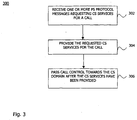
- a flowchart 300 shows the individual steps of a method embodiment of the present invention.
- the method embodiment shown in Fig. 3 can be implemented using the server 200 of Fig. 2 or using a server having a different configuration.
- the method starts, in step 302, with receiving PS protocol messages requesting CS services for a call.
- the PS protocol messages may be received from an underlying control layer.
- the CS services requested for the call are provided.
- the CS services may relate to session control such as setting up, monitoring and releasing a connection towards the CS domain.
- call control is passed towards the CS domain.
- Step 306 may be performed in various ways. In one example, call control is selectively passed towards the CS domain depending on one or more predefined parameters.
- FIG. 4 to 8 further embodiments of the present invention will be described with reference to Figs. 4 to 8 . These embodiments are based on a communication scenario similar to the one shown in Fig. 1 . Accordingly, identical components will be denoted with the same reference numerals. The major differences between the scenario of Fig. 1 and the present embodiments will be emphasized where appropriate.
- Fig. 4 shows an IMS 106 to which, as shown in Fig. 1 , a SIP-enabled user terminal 102 may be coupled via a PS access network 104.
- the IMS 106 of Fig. 4 additionally comprises a media gateway controller function (MGCF) 132 interfacing, via the NNI 108, with the transport layer (or media plane) of a layered CS network.
- MGCF media gateway controller function
- the MGCF 132 performs conversion tasks between SIP and ISUP.
- the IMS application server 120 of Fig. 1 has been replaced by a dedicated ISC-MSC application server 130.
- the ISC-MSC 130 has a direct ISUP/BICC connection via the NNI 108 to the CS domain.
- the ISC-MSC 130 optimizes IMS-CS inter-working.
- the ISC-MSC 130 constitutes an MSC-S with an additional ISC interface to the IMS core or, more specifically, to the S-CSCF 118.
- Fig. 5 illustrates the individual functional entities of the ISC-MSC 130 in more detail.
- the ISC-MSC 130 includes an ISC interface 140 for receiving SIP messages from the S-CSCF 118.
- the ISC interface 140 is implemented as an ISC interface handler capable of communicating with the S-CSCF 118 via SIP messages.
- the ISC-MSC 130 further includes a BICC/ISUP interface 142 for being coupled to the CS-NNI 108.
- the BICC/ISUP interface 142 is implemented as a BICC/ISUP interface handler capable of communicating with CS components via BICC/ISUP messages.
- the core entity of the ISC-MSC 130 is a service component 144 including CS telephony service logic as conventionally implemented in a MSC-S. If required, the service component 144 may additionally perform multimedia or other services.
- SIP messages received by the ISC-MSC 130 via the ISC interface 140 are first processed by a conversion logic implemented in the form of a converter 146.
- the converter 146 ensures that the received SIP messages can call telephony services within the service component 144. To this end, the converter 146 converts the content of the received SIP messages into a format that can be interpreted by the service component 144, thus enabling the service component 144 to provide the requested telephony services.
- the telephony services are provided by the service component 144 dependent on subscriber data.
- the ISC-MSC 130 additionally comprises a storage 148 for subscriber data.
- the subscriber data included the storage 148 have been received from the HSS 122 via a dedicated Sh interface (in Fig. 5 the corresponding interface handler for the ISC-MSC 130 has been omitted) and in accordance with the DIAMETER protocol.
- the ISC-MSC 130 further includes a routing component 150 for deciding about the further call path once the services have been provided by the service component 144.
- the routing component 150 basically decides if call control is to be passed back via the ISC interface 140 to the S-CSCF 118 or, in the alternative, if call control is to be passed via the BICC/ISUP interface 142 to the CS domain. The decision performed by the routing component 150 may be based on various parameters including subscriber data stored in the storage 148. If it is decided that call control is to be passed to the CS domain, the routing component 150 may call the converter 146 for converting any messages received from the service component 144 after the requested CS services have been provided into the appropriate CS format (such as the BICC format or the ISUP format).
- the appropriate CS format such as the BICC format or the ISUP format
- the functionalities of the ISC-MSC 130 will be described with reference to the IMS scenario of Fig. 6 and an exemplary call path (dashed arrow).
- a call initiated in the PS domain will be terminated in the CS domain.
- the invention can also be practised in other scenarios.
- the IMS 106 may comprise further application servers 134, 136 in addition to the ISC-MSC 130.
- a call from a SIP-enabled user terminal is first routed to the S-CSCF 118.
- the S-CSCF 118 determines that the call requires certain CS call services and therefore routes the call to the application layer.
- the S-CSCF 118 is configured to route the call, upon detection of the necessity of CS call services, to the ISC-MSC 130 first.
- the ISC-MSC 130 will be linked as the first application servers in the call path and is thus given preference over the remaining application server 134, 136.
- Such a preference can be implemented by an appropriate setting of the initial filter criteria (iFC) in the subscriber data stored in the HSS 120.
- the ISC-MSC 130 receives call control from the S-CSCF 118 via a SIP message, and is thus requested to provide CS services for the call, there exist various call handling alternatives for the ISC-MSC 130.
- the ISC-MSC 130 upon receipt of call control, fetches the subscriber data associated with the respective call from the HSS 122 and stores the fetched subscriber data in the storage 148 shown in Fig. 5 .
- the subscriber data fetched from the HSS 122 include the iFC. From the iFC the ISC-MSC 130 can derive whether or not it is necessary to link one or more of the further application servers 134, 136 into the call (and in which order).
- the ISC-MSC 130 does not pass call control back to the S-CSCF 118. Rather, after the telephony services have been executed by the service component 144, the call is routed directly to the CS domain via the BICC/ISUP interface 142 (thus re-using the conventional routing interface of the underlying MSC-S from which the ISC-MSC 130 has evolved). This situation is shown in Fig. 6 .
- call control is passed back to the S-CSCF 118 as shown in Fig. 7 .
- the S-CSCF 118 then links in one or more further application servers as exemplarily shown in Fig. 7 for the application server 136.
- the order in which the further application servers 134, 136 are linked in the call path may be defined (e.g. in the iFC).
- call control will again be passed back to the S-CSCF 118.
- S-CSCF 118 determines that no further application servers need to be linked into the call path, and a further analysis of the destination address indicates that a brakeout to the CS domain is needed, call control is passed to the MGCF 132.
- the MGCF 132 converts the corresponding one or more SIP messages received in this context from S-CSCF 118 into one or more corresponding ISUP messages and forwards the ISUP messages via the NNI 108 towards the CS domain.
- the first call handling alternative discussed above has assumed that the ISC-MSC 130 has fetched subscriber data from the HSS 122 in order to determine whether or not call control received from the S-CSCF 118 has to be passed back to the S-CSCF 118.
- the ISC-MSC 122 does not fetch subscriber data from the HSS 122 (in which case the storage 148 could be omitted). Rather, after execution of the telephony services, the ISC-MSC 130 always routes the call directly to the CS domain via the BICC/ISUP interface 142.
- the ISC-MSC 130 does not fetch any subscriber data (similar to the second alternative). After the requested telephony services have been provided, call control is always passed back to the S-CSCF 118 for conventional IMS call handling.
- the ISC-MSC 130 is provided with a mechanism (such as a management interface, not shown) for controlling the switching between two or more of the modes of operation (handling alternatives) described above.
- the behaviour of the ISC-MSC 130 of Fig. 5 as regards the passing of call control may depend on the content type of the call for which CS call services have been requested.
- the content type of the call may for example be derived from session description protocol (SDP) information relating to the call.
- SDP describes the transport layer (or user plane) characteristics of the particular call.
- the call may directly be routed to the CS domain (similar to the second alternative discussed above). If it is determined that the call contains additional or alternative media (such as video), but this media can also be handled by the ISC-MSC 130, it may also be decided that the call can directly be routed to the CS domain after the services have been performed.
- additional or alternative media such as video
- the ISC-MSC 130 determines that the call contains media that cannot be handled by the ISC-MSC 130, it may be decided to continue with the first handling alternative, at least if it is not clear whether or not further application servers need to be linked in the call path after the ISC-MSC 130. Otherwise, i.e. if it is clear that one or more further application servers need to be linked in (or if the call shall not directly brake out into the CS domain for other reasons), it may be decided to continue with the third handling alternative.
- the routing of a call treated by the ISC-MSC 130 may also be dependent on the destination domain or, more specifically, on the received destination address.
- the destination address may have in principle one of two different formats.
- the first format is the SIP uniform resource locator (SIP-URL) format indicating that the destination is most likely an IMS subscriber as well.
- the second format is the TEL uniform resource identifier (TEL-URI) format that can be mapped to an E.164 number and indicates that the destination is a CS subscriber outside the IMS domain.
- SIP-URL SIP uniform resource locator
- TEL-URI TEL uniform resource identifier
- the ISC-MSC 130 determines that the destination address is of a SIP-URL format, it will be the best choice to keep the call in the IMS domain. This means that the ISC-MSC 130, under control of the routing component 150, will return the call to the S-CSCF 118 via the ISC interface 140. If, on the other hand, it is determined that the destination address is of a TEL-URI format, the routing component 150 will decide to pass call control via the BICC/ISUP interface 142 to the CS domain.
- the ISC-MSC 130 may be provided with a direct radio access.
- an MSC-S may be co-located with the ISC-MSC (e.g. by combining an MSC-S into the ISC-MSC 130), thus resulting in a combined ISC-MSC/MSC-S node 160.
- the call can directly be terminated via the DTAP protocol at the user terminal 162 without braking out to the CS-NNI 108.
- This direct termination is performed via the DTAP interface of the MSC-S included in the node 160. If, however, it is found that the CS user terminal 162 is attached to an MSC-S different from the MSC-S included in the node 160, CS brake out via the BICC/ISUP interface 142 of the ISC-MSC component will be required.
- the approach of having call services, and in particular telephony services, located in an ISC-MSC with direct brakeout in the CS domain provides a highly efficient call handling strategy for a frequent traffic case.
- this approach allows the re-use of already available interfaces and network infrastructure (MSC-S) as in one implementation a ISC interface is added to an existing MSC-S.
- MSC-S network infrastructure
- BICC-based CS networks can be facilitated as, in contrast to MSC-Ss, standard MGCFs are conventionally not provided with BICC capabilities.
Landscapes
- Engineering & Computer Science (AREA)
- Computer Networks & Wireless Communication (AREA)
- Signal Processing (AREA)
- Computer Security & Cryptography (AREA)
- Multimedia (AREA)
- Telephonic Communication Services (AREA)
- Mobile Radio Communication Systems (AREA)
Claims (17)
- Server (130; 200) zum Bereitstellen von leitungsvermittelten CS-Diensten für eine Rufausdehnung zwischen einer paketvermittelten, PS-Domäne und einer CS-Domäne, wobei der Server umfasst:- eine erste Schnittstelle (140; 202), die so ausgelegt ist, dass sie PS-Protokollnachrichten empfängt, welche CS-Dienste für einen Ruf anfordern;- eine Dienstkomponente (144; 204), welche die angeforderten CS-Dienste für den Ruf bereitstellt; und- eine zweite Schnittstelle (142; 206), die so ausgelegt ist, dass sie Rufsteuerung nach der Bereitstellung der CS-Dienste an die CS-Domäne weitergibt,dadurch gekennzeichnet, dass die zweite Schnittstelle als mindestens eine von einer Schnittstelle eines Benutzerteils eines dienstintegrierenden Digitalnetzes, ISUP, und einer Schnittstelle einer trägerunabängigen Rufsteuerung, BICC, konfiguriert ist, um einen direkten Übergang in die CS-Domäne zu ermöglichen, dadurch, dass die erste Schnittstelle als eine Schnittstelle einer Dienststeuerung eines Internetprotokoll-Multimedia-Subsystems, ISC, konfiguriert ist, und ferner gekennzeichnet durch eine Entscheidungslogik (150), die so ausgelegt ist, dass sie entscheidet, ob die Rufsteuerung über die erste Schnittstelle zurückgegeben werden soll, oder ob die Rufsteuerung über die zweite Schnittstelle an die CS-Domäne weitergegeben werden soll.
- Server nach Anspruch 1, ferner umfassend:einen Konverter (146), der so ausgelegt ist, dass er den Inhalt der PS-Protokollnachrichten in ein Format konvertiert, das durch die Dienstkomponente interpretiert werden kann, und wobei die Dienstkomponente die CS-Dienste gemäß dem konvertierten Inhalt bereitstellt.
- Server nach Anspruch 1 oder 2, ferner umfassend:mindestens eines von einem Speicher (148) für Teilnehmerdaten und einer dritten Schnittstelle zum Empfangen von Teilnehmerdaten.
- Server nach einem der Ansprüche 1 bis 3, wobei
die Entscheidungslogik so ausgelegt ist, dass sie Teilnehmerdaten, die mit dem Ruf assoziiert sind, berücksichtigt. - Server nach Anspruch 3 oder 4, wobei
die Dienstkomponente so ausgelegt ist, dass sie die CS-Dienste unter Berücksichtigung von mit dem Ruf assoziierten Teilnehmerdaten bereitstellt. - Server nach einem der Ansprüche 1 bis 5, wobei
die PS-Protokollnachrichten SIP-Nachrichten sind. - Server nach einem der Ansprüche 1 bis 6, wobei
die Dienstkomponente eine oder mehrere Funktionalitäten einer Mobilvermittlungsstelle, MSC, oder eines MSC-Servers bereitstellt. - Internetprotokoll-Multimedia-Subsystem, IMS, (106), umfassend den Server nach einem der Ansprüche 1 bis 7.
- IMS nach Anspruch 8, ferner umfassend:einen mit dem Server (160) ortsgleich angeordneten MSC-S.
- Verfahren zur Bereitstellung von leitungsvermittelten, CS-Diensten für eine Rufausdehnung zwischen einer paketvermittelten, PS-Domäne und einer CS-Domäne, wobei das Verfahren die folgenden Schritte umfasst, die von einem Server (130; 200) ausgeführt werden:- Empfangen von PS-Protokollnachrichten über eine Schnittstelle einer Dienststeuerung eines Internetprotokoll-Multimedia-Subsystems, ISC, welche CS-Dienste für einen Ruf anfordern;- Bereitstellen der angeforderten CS-Dienste für den Ruf; und- Entscheiden, ob Rufsteuerung über die ISC-Schnittstelle an die Komponente in der PS-Domäne zurückgegeben werden soll, oder ob Rufsteuerung an die CS-Domäne weitergegeben werden soll,wobei bei Weitergeben der Rufsteuerung an die CS-Domäne nach der Bereitstellung der CS-Dienste die Rufsteuerung über wenigstens eine von einer Schnittstelle eines Benutzerteils eines dienstintegrierenden Digitalnetzes, ISUP, und einer Schnittstelle einer trägerunabhängigen Rufsteuerung, BICC, weitergegeben wird, um einen direkten Übergang in die CS-Domäne zu ermöglichen.
- Verfahren nach Anspruch 10, wobei
die Schritte durch einen dedizierten (130) einer Mehrzahl von Anwendungsservern (130, 134, 136) ausgeführt werden, wobei jeder der Anwendungsserver so ausgelegt ist, dass er an einen Pfad des Rufs angebunden wird. - Verfahren nach Anspruch 11, ferner umfassend:Anbinden des dedizierten Anwendungsservers als ersten Anwendungsserver an den Rufpfad.
- Verfahren nach einem der Ansprüche 10 bis 12, wobei die Entscheidung auf einem oder mehreren von mit dem Ruf assoziierten Teilnehmerdaten; der Anforderung des Anbindens von weiteren Anwendungsservern an den Ruf; dem Inhaltstyp des Rufs; einer Zieladresse des Rufs basiert.
- Verfahren nach einem der Ansprüche 10 bis 13, wobei ein Umschalten zwischen zwei oder mehr der folgenden Betriebsmodi ermöglicht wird:- zwangsläufiges Weitergeben der Rufsteuerung an die CS-Domäne;- zwangsläufiges Weitergeben der Rufsteuerung an die PS-Domäne;- dynamisches Entscheiden, ob die Rufsteuerung an die PS-Domäne zurückgegeben werden soll, oder ob die Rufsteuerung an die CS-Domäne weitergegeben werden soll.
- Verfahren nach einem der Ansprüche 10 bis 14, wobei die bereitgestellten CS-Dienste Telefondienste sind.
- Computerprogrammprodukt,umfassend Programmcodeabschnitte zum Ausführen der Schritte nach einem der Ansprüche 10 bis 15, wenn das Computerprogrammprodukt auf einem Computersystem ausgeführt wird.
- Computerprogrammprodukt nach Anspruch 16, gespeichert auf einem computerlesbaren Aufzeichnungsmedium.
Applications Claiming Priority (1)
| Application Number | Priority Date | Filing Date | Title |
|---|---|---|---|
| PCT/EP2006/004197 WO2007128329A1 (en) | 2006-05-04 | 2006-05-04 | Technique for interconnecting circuit-switched and packet-switched domains |
Publications (2)
| Publication Number | Publication Date |
|---|---|
| EP2014078A1 EP2014078A1 (de) | 2009-01-14 |
| EP2014078B1 true EP2014078B1 (de) | 2016-07-27 |
Family
ID=37649277
Family Applications (1)
| Application Number | Title | Priority Date | Filing Date |
|---|---|---|---|
| EP06742808.6A Expired - Lifetime EP2014078B1 (de) | 2006-05-04 | 2006-05-04 | Technik zum verbinden von leitungsvermittelten und paketvermittelten domänen |
Country Status (3)
| Country | Link |
|---|---|
| US (1) | US9413898B2 (de) |
| EP (1) | EP2014078B1 (de) |
| WO (1) | WO2007128329A1 (de) |
Families Citing this family (6)
| Publication number | Priority date | Publication date | Assignee | Title |
|---|---|---|---|---|
| US8484326B2 (en) * | 2006-09-28 | 2013-07-09 | Rockstar Bidco Lp | Application server billing |
| US9705935B2 (en) * | 2008-01-14 | 2017-07-11 | Qualcomm Incorporated | Efficient interworking between circuit-switched and packet-switched multimedia services |
| US8438856B2 (en) | 2009-03-02 | 2013-05-14 | General Electric Company | Effusion cooled one-piece can combustor |
| US20100257863A1 (en) * | 2009-04-13 | 2010-10-14 | General Electric Company | Combined convection/effusion cooled one-piece can combustor |
| CA2764247A1 (en) | 2009-06-09 | 2010-12-16 | Joerg Christian Ewert | Short messaging service over 3gpp long term evolution |
| WO2013013726A1 (en) * | 2011-07-28 | 2013-01-31 | Telefonaktiebolaget L M Ericsson (Publ) | Inter-domain service provision |
Family Cites Families (9)
| Publication number | Priority date | Publication date | Assignee | Title |
|---|---|---|---|---|
| DE10005282A1 (de) * | 2000-02-07 | 2001-08-09 | Ericsson Telefon Ab L M | Leitungsvermitteltes Privatkommunikationsnetz mit integrierten Paketvermittelten Multimedia-Nebenstellen |
| US7085260B2 (en) * | 2000-08-22 | 2006-08-01 | Lucent Technologies Inc. | Internet protocol based wireless call processing |
| US6871070B2 (en) * | 2001-07-31 | 2005-03-22 | Lucent Technologies Inc. | Communication system for providing roaming between an internet protocol multimedia system and a circuit-switched domain |
| US6996087B2 (en) * | 2001-07-31 | 2006-02-07 | Lucent Technologies Inc. | Communication system including an interworking mobile switching center for call termination |
| US7586857B2 (en) * | 2003-04-01 | 2009-09-08 | Alcatel-Lucent Usa Inc. | Fast network SIP/SDP procedures for conference operations upon request from end user with optimization of network resources |
| EP1560458A1 (de) * | 2004-01-27 | 2005-08-03 | Siemens Aktiengesellschaft | Verfahren, Netzwerkanordnung und Vorrichtung zur Bereitstellung von ISDN-Diensten in paketbasierten Telekommunikationsnetzen der nächsten Generation |
| US7451921B2 (en) * | 2004-09-01 | 2008-11-18 | Eric Morgan Dowling | Methods, smart cards, and systems for providing portable computer, VoIP, and application services |
| US20060105766A1 (en) * | 2004-10-26 | 2006-05-18 | Azada Maria R | Method for delivering a call to a dual-mode mobile unit using a single number |
| US20060291488A1 (en) * | 2005-06-24 | 2006-12-28 | Aylus Networks, Inc. | System and method of interworking non-IMS and IMS networks to create new services utilizing both networks |
-
2006
- 2006-05-04 US US12/299,346 patent/US9413898B2/en not_active Expired - Fee Related
- 2006-05-04 WO PCT/EP2006/004197 patent/WO2007128329A1/en not_active Ceased
- 2006-05-04 EP EP06742808.6A patent/EP2014078B1/de not_active Expired - Lifetime
Also Published As
| Publication number | Publication date |
|---|---|
| US9413898B2 (en) | 2016-08-09 |
| EP2014078A1 (de) | 2009-01-14 |
| WO2007128329A1 (en) | 2007-11-15 |
| US20100177764A1 (en) | 2010-07-15 |
Similar Documents
| Publication | Publication Date | Title |
|---|---|---|
| US7561535B2 (en) | System and method for providing dynamic call models for users as function of the user environment in an IMS network | |
| US7864936B2 (en) | Method of avoiding or minimizing cost of stateful connections between application servers and S-CSCF nodes in an IMS network with multiple domains | |
| US7792528B2 (en) | Method and system for provisioning IMS networks with virtual service organizations having distinct service logic | |
| US7672297B2 (en) | Mediation system and method for hybrid network including an IMS network | |
| US8300629B2 (en) | Device and method for providing interaction management for communication networks | |
| US8542672B2 (en) | Call handling for IMS registered user | |
| CN100539723C (zh) | Ip多媒体子系统及其编解码转换控制方法 | |
| EP2615794A2 (de) | Leitungsvermitteltes Benutzerendsystemteil, Kommunikationsvorrichtung und Dienstbereitstellungsverfahren dafür | |
| WO2007002488A2 (en) | Mediation system and method for hybrid network including an ip multimedia subsystem network | |
| US20140064217A1 (en) | Method for providing ims support for enterprise pbx users | |
| EP2716001B1 (de) | Routen von anrufen in ip-multimedia-subsystem netzwerken für zentralisierte dienste | |
| EP1941694B1 (de) | Technik zum verbinden von leitungsvermittelten und paketvermittelten domänen | |
| US9509547B2 (en) | Selection of service domain in IMS centralised services | |
| US8532091B2 (en) | Method and apparatus for providing IMS services to circuit-switched controlled terminals | |
| US9413898B2 (en) | Technique for interconnecting circuit-switched and packet-switched domains | |
| WO2008040171A1 (en) | A method, system of circuit switching domain apperceiving multi-media session media information of ims domain | |
| EP2094026B1 (de) | Verfahren, system und gerät zum umschalten der domäne | |
| CN101651991B (zh) | 呼叫控制方法和呼叫控制装置 | |
| CN100426825C (zh) | 实现紧急业务检测的方法、系统及接入控制功能实体 | |
| CN102158496B (zh) | 针对ims注册用户的呼叫处理 | |
| Oberle et al. | D B1. 10p–Flexible multi-service edge router |
Legal Events
| Date | Code | Title | Description |
|---|---|---|---|
| PUAI | Public reference made under article 153(3) epc to a published international application that has entered the european phase |
Free format text: ORIGINAL CODE: 0009012 |
|
| 17P | Request for examination filed |
Effective date: 20081028 |
|
| AK | Designated contracting states |
Kind code of ref document: A1 Designated state(s): AT BE BG CH CY CZ DE DK EE ES FI FR GB GR HU IE IS IT LI LT LU LV MC NL PL PT RO SE SI SK TR |
|
| AX | Request for extension of the european patent |
Extension state: AL BA HR MK YU |
|
| 17Q | First examination report despatched |
Effective date: 20091203 |
|
| DAX | Request for extension of the european patent (deleted) | ||
| GRAP | Despatch of communication of intention to grant a patent |
Free format text: ORIGINAL CODE: EPIDOSNIGR1 |
|
| INTG | Intention to grant announced |
Effective date: 20160309 |
|
| GRAS | Grant fee paid |
Free format text: ORIGINAL CODE: EPIDOSNIGR3 |
|
| GRAA | (expected) grant |
Free format text: ORIGINAL CODE: 0009210 |
|
| AK | Designated contracting states |
Kind code of ref document: B1 Designated state(s): AT BE BG CH CY CZ DE DK EE ES FI FR GB GR HU IE IS IT LI LT LU LV MC NL PL PT RO SE SI SK TR |
|
| REG | Reference to a national code |
Ref country code: GB Ref legal event code: FG4D |
|
| REG | Reference to a national code |
Ref country code: CH Ref legal event code: EP |
|
| REG | Reference to a national code |
Ref country code: AT Ref legal event code: REF Ref document number: 816622 Country of ref document: AT Kind code of ref document: T Effective date: 20160815 |
|
| REG | Reference to a national code |
Ref country code: IE Ref legal event code: FG4D |
|
| REG | Reference to a national code |
Ref country code: DE Ref legal event code: R096 Ref document number: 602006049720 Country of ref document: DE |
|
| REG | Reference to a national code |
Ref country code: LT Ref legal event code: MG4D |
|
| REG | Reference to a national code |
Ref country code: NL Ref legal event code: MP Effective date: 20160727 |
|
| REG | Reference to a national code |
Ref country code: AT Ref legal event code: MK05 Ref document number: 816622 Country of ref document: AT Kind code of ref document: T Effective date: 20160727 |
|
| PG25 | Lapsed in a contracting state [announced via postgrant information from national office to epo] |
Ref country code: LT Free format text: LAPSE BECAUSE OF FAILURE TO SUBMIT A TRANSLATION OF THE DESCRIPTION OR TO PAY THE FEE WITHIN THE PRESCRIBED TIME-LIMIT Effective date: 20160727 Ref country code: FI Free format text: LAPSE BECAUSE OF FAILURE TO SUBMIT A TRANSLATION OF THE DESCRIPTION OR TO PAY THE FEE WITHIN THE PRESCRIBED TIME-LIMIT Effective date: 20160727 Ref country code: NL Free format text: LAPSE BECAUSE OF FAILURE TO SUBMIT A TRANSLATION OF THE DESCRIPTION OR TO PAY THE FEE WITHIN THE PRESCRIBED TIME-LIMIT Effective date: 20160727 Ref country code: IT Free format text: LAPSE BECAUSE OF FAILURE TO SUBMIT A TRANSLATION OF THE DESCRIPTION OR TO PAY THE FEE WITHIN THE PRESCRIBED TIME-LIMIT Effective date: 20160727 Ref country code: IS Free format text: LAPSE BECAUSE OF FAILURE TO SUBMIT A TRANSLATION OF THE DESCRIPTION OR TO PAY THE FEE WITHIN THE PRESCRIBED TIME-LIMIT Effective date: 20161127 |
|
| PG25 | Lapsed in a contracting state [announced via postgrant information from national office to epo] |
Ref country code: GR Free format text: LAPSE BECAUSE OF FAILURE TO SUBMIT A TRANSLATION OF THE DESCRIPTION OR TO PAY THE FEE WITHIN THE PRESCRIBED TIME-LIMIT Effective date: 20161028 Ref country code: PL Free format text: LAPSE BECAUSE OF FAILURE TO SUBMIT A TRANSLATION OF THE DESCRIPTION OR TO PAY THE FEE WITHIN THE PRESCRIBED TIME-LIMIT Effective date: 20160727 Ref country code: LV Free format text: LAPSE BECAUSE OF FAILURE TO SUBMIT A TRANSLATION OF THE DESCRIPTION OR TO PAY THE FEE WITHIN THE PRESCRIBED TIME-LIMIT Effective date: 20160727 Ref country code: ES Free format text: LAPSE BECAUSE OF FAILURE TO SUBMIT A TRANSLATION OF THE DESCRIPTION OR TO PAY THE FEE WITHIN THE PRESCRIBED TIME-LIMIT Effective date: 20160727 Ref country code: PT Free format text: LAPSE BECAUSE OF FAILURE TO SUBMIT A TRANSLATION OF THE DESCRIPTION OR TO PAY THE FEE WITHIN THE PRESCRIBED TIME-LIMIT Effective date: 20161128 Ref country code: SE Free format text: LAPSE BECAUSE OF FAILURE TO SUBMIT A TRANSLATION OF THE DESCRIPTION OR TO PAY THE FEE WITHIN THE PRESCRIBED TIME-LIMIT Effective date: 20160727 Ref country code: AT Free format text: LAPSE BECAUSE OF FAILURE TO SUBMIT A TRANSLATION OF THE DESCRIPTION OR TO PAY THE FEE WITHIN THE PRESCRIBED TIME-LIMIT Effective date: 20160727 Ref country code: BE Free format text: LAPSE BECAUSE OF FAILURE TO SUBMIT A TRANSLATION OF THE DESCRIPTION OR TO PAY THE FEE WITHIN THE PRESCRIBED TIME-LIMIT Effective date: 20160727 |
|
| PG25 | Lapsed in a contracting state [announced via postgrant information from national office to epo] |
Ref country code: EE Free format text: LAPSE BECAUSE OF FAILURE TO SUBMIT A TRANSLATION OF THE DESCRIPTION OR TO PAY THE FEE WITHIN THE PRESCRIBED TIME-LIMIT Effective date: 20160727 Ref country code: RO Free format text: LAPSE BECAUSE OF FAILURE TO SUBMIT A TRANSLATION OF THE DESCRIPTION OR TO PAY THE FEE WITHIN THE PRESCRIBED TIME-LIMIT Effective date: 20160727 |
|
| REG | Reference to a national code |
Ref country code: DE Ref legal event code: R097 Ref document number: 602006049720 Country of ref document: DE |
|
| PG25 | Lapsed in a contracting state [announced via postgrant information from national office to epo] |
Ref country code: SK Free format text: LAPSE BECAUSE OF FAILURE TO SUBMIT A TRANSLATION OF THE DESCRIPTION OR TO PAY THE FEE WITHIN THE PRESCRIBED TIME-LIMIT Effective date: 20160727 Ref country code: DK Free format text: LAPSE BECAUSE OF FAILURE TO SUBMIT A TRANSLATION OF THE DESCRIPTION OR TO PAY THE FEE WITHIN THE PRESCRIBED TIME-LIMIT Effective date: 20160727 Ref country code: BG Free format text: LAPSE BECAUSE OF FAILURE TO SUBMIT A TRANSLATION OF THE DESCRIPTION OR TO PAY THE FEE WITHIN THE PRESCRIBED TIME-LIMIT Effective date: 20161027 Ref country code: CZ Free format text: LAPSE BECAUSE OF FAILURE TO SUBMIT A TRANSLATION OF THE DESCRIPTION OR TO PAY THE FEE WITHIN THE PRESCRIBED TIME-LIMIT Effective date: 20160727 |
|
| PLBE | No opposition filed within time limit |
Free format text: ORIGINAL CODE: 0009261 |
|
| STAA | Information on the status of an ep patent application or granted ep patent |
Free format text: STATUS: NO OPPOSITION FILED WITHIN TIME LIMIT |
|
| 26N | No opposition filed |
Effective date: 20170502 |
|
| PG25 | Lapsed in a contracting state [announced via postgrant information from national office to epo] |
Ref country code: LU Free format text: LAPSE BECAUSE OF NON-PAYMENT OF DUE FEES Effective date: 20170531 Ref country code: SI Free format text: LAPSE BECAUSE OF FAILURE TO SUBMIT A TRANSLATION OF THE DESCRIPTION OR TO PAY THE FEE WITHIN THE PRESCRIBED TIME-LIMIT Effective date: 20160727 |
|
| REG | Reference to a national code |
Ref country code: DE Ref legal event code: R119 Ref document number: 602006049720 Country of ref document: DE |
|
| REG | Reference to a national code |
Ref country code: CH Ref legal event code: PL |
|
| GBPC | Gb: european patent ceased through non-payment of renewal fee |
Effective date: 20170504 |
|
| PG25 | Lapsed in a contracting state [announced via postgrant information from national office to epo] |
Ref country code: MC Free format text: LAPSE BECAUSE OF FAILURE TO SUBMIT A TRANSLATION OF THE DESCRIPTION OR TO PAY THE FEE WITHIN THE PRESCRIBED TIME-LIMIT Effective date: 20160727 |
|
| REG | Reference to a national code |
Ref country code: IE Ref legal event code: MM4A |
|
| PG25 | Lapsed in a contracting state [announced via postgrant information from national office to epo] |
Ref country code: CH Free format text: LAPSE BECAUSE OF NON-PAYMENT OF DUE FEES Effective date: 20170531 Ref country code: LI Free format text: LAPSE BECAUSE OF NON-PAYMENT OF DUE FEES Effective date: 20170531 |
|
| REG | Reference to a national code |
Ref country code: FR Ref legal event code: ST Effective date: 20180131 |
|
| PG25 | Lapsed in a contracting state [announced via postgrant information from national office to epo] |
Ref country code: LU Free format text: LAPSE BECAUSE OF NON-PAYMENT OF DUE FEES Effective date: 20170504 |
|
| PG25 | Lapsed in a contracting state [announced via postgrant information from national office to epo] |
Ref country code: DE Free format text: LAPSE BECAUSE OF NON-PAYMENT OF DUE FEES Effective date: 20171201 Ref country code: IE Free format text: LAPSE BECAUSE OF NON-PAYMENT OF DUE FEES Effective date: 20170504 Ref country code: GB Free format text: LAPSE BECAUSE OF NON-PAYMENT OF DUE FEES Effective date: 20170504 |
|
| PG25 | Lapsed in a contracting state [announced via postgrant information from national office to epo] |
Ref country code: FR Free format text: LAPSE BECAUSE OF NON-PAYMENT OF DUE FEES Effective date: 20170531 |
|
| PG25 | Lapsed in a contracting state [announced via postgrant information from national office to epo] |
Ref country code: HU Free format text: LAPSE BECAUSE OF FAILURE TO SUBMIT A TRANSLATION OF THE DESCRIPTION OR TO PAY THE FEE WITHIN THE PRESCRIBED TIME-LIMIT; INVALID AB INITIO Effective date: 20060504 |
|
| PG25 | Lapsed in a contracting state [announced via postgrant information from national office to epo] |
Ref country code: CY Free format text: LAPSE BECAUSE OF NON-PAYMENT OF DUE FEES Effective date: 20160727 |
|
| PG25 | Lapsed in a contracting state [announced via postgrant information from national office to epo] |
Ref country code: TR Free format text: LAPSE BECAUSE OF FAILURE TO SUBMIT A TRANSLATION OF THE DESCRIPTION OR TO PAY THE FEE WITHIN THE PRESCRIBED TIME-LIMIT Effective date: 20160727 |