EP2014362A1 - Metathese von chlorinierten Abfallverbindungen - Google Patents
Metathese von chlorinierten Abfallverbindungen Download PDFInfo
- Publication number
- EP2014362A1 EP2014362A1 EP07110077A EP07110077A EP2014362A1 EP 2014362 A1 EP2014362 A1 EP 2014362A1 EP 07110077 A EP07110077 A EP 07110077A EP 07110077 A EP07110077 A EP 07110077A EP 2014362 A1 EP2014362 A1 EP 2014362A1
- Authority
- EP
- European Patent Office
- Prior art keywords
- catalyst
- carbon
- lacl
- reaction
- ccl
- Prior art date
- Legal status (The legal status is an assumption and is not a legal conclusion. Google has not performed a legal analysis and makes no representation as to the accuracy of the status listed.)
- Withdrawn
Links
- 150000001875 compounds Chemical class 0.000 title description 2
- 239000002699 waste material Substances 0.000 title 1
- OKTJSMMVPCPJKN-UHFFFAOYSA-N Carbon Chemical compound [C] OKTJSMMVPCPJKN-UHFFFAOYSA-N 0.000 claims abstract description 25
- 229910052799 carbon Inorganic materials 0.000 claims abstract description 25
- 150000008280 chlorinated hydrocarbons Chemical class 0.000 claims abstract description 16
- 238000000034 method Methods 0.000 claims abstract description 16
- 238000005649 metathesis reaction Methods 0.000 claims abstract description 14
- 239000000203 mixture Substances 0.000 claims abstract description 13
- 229910052747 lanthanoid Inorganic materials 0.000 claims abstract description 11
- 150000002602 lanthanoids Chemical class 0.000 claims abstract description 10
- 239000003054 catalyst Substances 0.000 claims description 42
- 238000006243 chemical reaction Methods 0.000 claims description 27
- ICAKDTKJOYSXGC-UHFFFAOYSA-K lanthanum(iii) chloride Chemical compound Cl[La](Cl)Cl ICAKDTKJOYSXGC-UHFFFAOYSA-K 0.000 claims description 22
- VEXZGXHMUGYJMC-UHFFFAOYSA-M Chloride anion Chemical compound [Cl-] VEXZGXHMUGYJMC-UHFFFAOYSA-M 0.000 claims description 3
- CPELXLSAUQHCOX-UHFFFAOYSA-M Bromide Chemical compound [Br-] CPELXLSAUQHCOX-UHFFFAOYSA-M 0.000 claims description 2
- KRHYYFGTRYWZRS-UHFFFAOYSA-M Fluoride anion Chemical compound [F-] KRHYYFGTRYWZRS-UHFFFAOYSA-M 0.000 claims description 2
- 229930195733 hydrocarbon Natural products 0.000 claims description 2
- 150000002430 hydrocarbons Chemical class 0.000 claims description 2
- 229910052746 lanthanum Inorganic materials 0.000 claims description 2
- FZLIPJUXYLNCLC-UHFFFAOYSA-N lanthanum atom Chemical group [La] FZLIPJUXYLNCLC-UHFFFAOYSA-N 0.000 claims description 2
- 229910002249 LaCl3 Inorganic materials 0.000 claims 2
- VZGDMQKNWNREIO-UHFFFAOYSA-N tetrachloromethane Chemical compound ClC(Cl)(Cl)Cl VZGDMQKNWNREIO-UHFFFAOYSA-N 0.000 description 46
- YMWUJEATGCHHMB-UHFFFAOYSA-N Dichloromethane Chemical compound ClCCl YMWUJEATGCHHMB-UHFFFAOYSA-N 0.000 description 26
- HEDRZPFGACZZDS-UHFFFAOYSA-N Chloroform Chemical compound ClC(Cl)Cl HEDRZPFGACZZDS-UHFFFAOYSA-N 0.000 description 14
- 239000000463 material Substances 0.000 description 9
- VYPSYNLAJGMNEJ-UHFFFAOYSA-N Silicium dioxide Chemical compound O=[Si]=O VYPSYNLAJGMNEJ-UHFFFAOYSA-N 0.000 description 8
- VEXZGXHMUGYJMC-UHFFFAOYSA-N Hydrochloric acid Chemical compound Cl VEXZGXHMUGYJMC-UHFFFAOYSA-N 0.000 description 7
- 229910002420 LaOCl Inorganic materials 0.000 description 6
- 238000005660 chlorination reaction Methods 0.000 description 6
- 239000002243 precursor Substances 0.000 description 6
- 239000000376 reactant Substances 0.000 description 6
- 230000015572 biosynthetic process Effects 0.000 description 5
- 230000000694 effects Effects 0.000 description 5
- 238000002474 experimental method Methods 0.000 description 5
- NEHMKBQYUWJMIP-UHFFFAOYSA-N chloromethane Chemical compound ClC NEHMKBQYUWJMIP-UHFFFAOYSA-N 0.000 description 4
- 238000004519 manufacturing process Methods 0.000 description 4
- BZHJMEDXRYGGRV-UHFFFAOYSA-N Vinyl chloride Chemical group ClC=C BZHJMEDXRYGGRV-UHFFFAOYSA-N 0.000 description 3
- 239000011149 active material Substances 0.000 description 3
- 229910052681 coesite Inorganic materials 0.000 description 3
- 239000000571 coke Substances 0.000 description 3
- 229910052906 cristobalite Inorganic materials 0.000 description 3
- 239000007789 gas Substances 0.000 description 3
- 230000006698 induction Effects 0.000 description 3
- VNWKTOKETHGBQD-UHFFFAOYSA-N methane Chemical compound C VNWKTOKETHGBQD-UHFFFAOYSA-N 0.000 description 3
- 239000000047 product Substances 0.000 description 3
- 150000003254 radicals Chemical class 0.000 description 3
- 239000000377 silicon dioxide Substances 0.000 description 3
- 229910052682 stishovite Inorganic materials 0.000 description 3
- 229910052905 tridymite Inorganic materials 0.000 description 3
- -1 CH2Cl2 Chemical class 0.000 description 2
- QVGXLLKOCUKJST-UHFFFAOYSA-N atomic oxygen Chemical compound [O] QVGXLLKOCUKJST-UHFFFAOYSA-N 0.000 description 2
- 238000006555 catalytic reaction Methods 0.000 description 2
- 230000001066 destructive effect Effects 0.000 description 2
- 238000005470 impregnation Methods 0.000 description 2
- 229910052751 metal Inorganic materials 0.000 description 2
- 239000002184 metal Substances 0.000 description 2
- 229910052760 oxygen Inorganic materials 0.000 description 2
- 239000001301 oxygen Substances 0.000 description 2
- 239000010453 quartz Substances 0.000 description 2
- 238000001179 sorption measurement Methods 0.000 description 2
- 238000003786 synthesis reaction Methods 0.000 description 2
- 238000005406 washing Methods 0.000 description 2
- 239000012494 Quartz wool Substances 0.000 description 1
- 239000006227 byproduct Substances 0.000 description 1
- 239000002134 carbon nanofiber Substances 0.000 description 1
- 230000003197 catalytic effect Effects 0.000 description 1
- 238000006757 chemical reactions by type Methods 0.000 description 1
- 239000013626 chemical specie Substances 0.000 description 1
- 125000001309 chloro group Chemical group Cl* 0.000 description 1
- 230000008878 coupling Effects 0.000 description 1
- 238000010168 coupling process Methods 0.000 description 1
- 238000005859 coupling reaction Methods 0.000 description 1
- 230000006378 damage Effects 0.000 description 1
- 230000008021 deposition Effects 0.000 description 1
- 238000010494 dissociation reaction Methods 0.000 description 1
- 230000005593 dissociations Effects 0.000 description 1
- 230000002349 favourable effect Effects 0.000 description 1
- 230000026030 halogenation Effects 0.000 description 1
- 238000005658 halogenation reaction Methods 0.000 description 1
- 125000004435 hydrogen atom Chemical group [H]* 0.000 description 1
- 238000011065 in-situ storage Methods 0.000 description 1
- 239000008188 pellet Substances 0.000 description 1
- 238000001556 precipitation Methods 0.000 description 1
- 238000002203 pretreatment Methods 0.000 description 1
- 239000011541 reaction mixture Substances 0.000 description 1
- 230000035484 reaction time Effects 0.000 description 1
- 150000003839 salts Chemical class 0.000 description 1
- 239000002002 slurry Substances 0.000 description 1
- 231100000167 toxic agent Toxicity 0.000 description 1
- 239000003440 toxic substance Substances 0.000 description 1
Images
Classifications
-
- C—CHEMISTRY; METALLURGY
- C07—ORGANIC CHEMISTRY
- C07C—ACYCLIC OR CARBOCYCLIC COMPOUNDS
- C07C17/00—Preparation of halogenated hydrocarbons
- C07C17/093—Preparation of halogenated hydrocarbons by replacement by halogens
- C07C17/10—Preparation of halogenated hydrocarbons by replacement by halogens of hydrogen atoms
-
- B—PERFORMING OPERATIONS; TRANSPORTING
- B01—PHYSICAL OR CHEMICAL PROCESSES OR APPARATUS IN GENERAL
- B01J—CHEMICAL OR PHYSICAL PROCESSES, e.g. CATALYSIS OR COLLOID CHEMISTRY; THEIR RELEVANT APPARATUS
- B01J21/00—Catalysts comprising the elements, oxides, or hydroxides of magnesium, boron, aluminium, carbon, silicon, titanium, zirconium, or hafnium
- B01J21/18—Carbon
- B01J21/185—Carbon nanotubes
-
- B—PERFORMING OPERATIONS; TRANSPORTING
- B01—PHYSICAL OR CHEMICAL PROCESSES OR APPARATUS IN GENERAL
- B01J—CHEMICAL OR PHYSICAL PROCESSES, e.g. CATALYSIS OR COLLOID CHEMISTRY; THEIR RELEVANT APPARATUS
- B01J23/00—Catalysts comprising metals or metal oxides or hydroxides, not provided for in group B01J21/00
- B01J23/10—Catalysts comprising metals or metal oxides or hydroxides, not provided for in group B01J21/00 of rare earths
-
- B—PERFORMING OPERATIONS; TRANSPORTING
- B82—NANOTECHNOLOGY
- B82Y—SPECIFIC USES OR APPLICATIONS OF NANOSTRUCTURES; MEASUREMENT OR ANALYSIS OF NANOSTRUCTURES; MANUFACTURE OR TREATMENT OF NANOSTRUCTURES
- B82Y30/00—Nanotechnology for materials or surface science, e.g. nanocomposites
-
- C—CHEMISTRY; METALLURGY
- C07—ORGANIC CHEMISTRY
- C07C—ACYCLIC OR CARBOCYCLIC COMPOUNDS
- C07C17/00—Preparation of halogenated hydrocarbons
- C07C17/23—Preparation of halogenated hydrocarbons by dehalogenation
-
- B—PERFORMING OPERATIONS; TRANSPORTING
- B01—PHYSICAL OR CHEMICAL PROCESSES OR APPARATUS IN GENERAL
- B01J—CHEMICAL OR PHYSICAL PROCESSES, e.g. CATALYSIS OR COLLOID CHEMISTRY; THEIR RELEVANT APPARATUS
- B01J27/00—Catalysts comprising the elements or compounds of halogens, sulfur, selenium, tellurium, phosphorus or nitrogen; Catalysts comprising carbon compounds
- B01J27/06—Halogens; Compounds thereof
- B01J27/08—Halides
- B01J27/10—Chlorides
Definitions
- chlorinated hydrocarbons have been replaced by environmentally friendlier alternatives in many commercial applications.
- mixtures of chlorinated C 1 and C 2 are still formed as by-products in industrial processes, such as the production of vinylchloride monomer (VCM) and the use thereof.
- VCM vinylchloride monomer
- CCl 4 formation is particularly a problem because of its lower economic value.
- the United States Clean Air Act and the Montreal Protocol limit the production of CCl 4 . Therefore, the metathesis reaction of CCl 4 with other CHCs, such as CH 2 Cl 2 , would be advantageous to make more valuable CHCs, which could be recycled in the production process.
- Reaction thermodynamics are favorable for using CCl 4 as a Cl source with methane or chloromethane.
- the only known way for running these reactions is thermal gas phase radical chemistry.
- the disadvantage of radical chemistry is its low selectivity due to the formation of various chloromethanes and C 2 coupling products.
- coke formation at the temperatures that are required for radical generation is severely hampering the process.
- commercial application of this reaction is currently not feasible and incineration is commonly used as a route for the destruction of CCl 4 .
- This reaction is defined as a metathesis reaction by IUPAC, that is a bimolecular process formally involving the exchange of a bond (or bonds) between similar interacting chemical species so that the bonding affiliations in the products are identical (or closely similar) to those in the reactants.
- this reaction can be catalyzed by the halogenides of the lanthanides, more in particular by lanthanum-chloride (LaCl 3 ). Although these catalyst materials improve the selectivity and activity, further improvement would be useful.
- the invention is directed to a metathesis process for a mixture of chlorinated hydrocarbons, which process comprises reacting a mixture of two or more different chlorinated hydrocarbons in the presence of at least one halogenide of a lanthanide, present on carbon as support. More in particular a mixture of two or more different hydrocarbons is reacted in the presence of said catalyst, to produce one or more other chlorinated hydrocarbons.
- the present process provides a strongly improved activity for the metathesis reaction.
- the metathesis reaction according to the invention proceeds via net exchange of H and Cl atoms between CCl 4 and CH 2 Cl 2 (Reaction 1).
- the catalytic reaction can be envisaged as two separate H/Cl exchange reactions between the catalyst surface and a gas phase reactant (Reaction 1 and 2).
- the catalyst to be used in the process of the present invention has two essential components, the first one being the catalytically active material, which is in the present case a halogenide of a lanthanide.
- the catalytically active material which is in the present case a halogenide of a lanthanide.
- All halogenides may be used, but is is preferred to use a fluoride, chloride or bromide, with a preference for the chloride.
- all lanthanide metals may be used with the highest preference being given to lanthanum, preferably in the form of the trichloride.
- the support material to be used in the present invention is carbon. All forms of carbon that can be used as catalyst support are suitable, the actual type being determined by the actual reaction conditions (gas-phase, slurry phase, fixed bed, fluidized bed, and the like), as well as the required loading with the catalytically active material and the required surface area.
- Suitable forms of carbon are, without being limited, granular (activated) carbon, extrudated (activated) carbon, carbon fibres, carbon nano fibres (CNF) or monoliths. It is to be noted that instead of carbon it is also possible to use carbide (s).
- the amount of catalytically active material may vary between wide ranges. Preferred amounts are between 1 and 35 wt.%, based on the total weight of the catalyst.
- LaCl 3 is used, supported on CNF, thereby greatly increasing the surface area in comparison to bulk LaCl 3 catalysts.
- the reaction is suited for the efficient conversion of CCl 4 , which is a highly stable and toxic compound with low economic value, as well as other highly chlorinated hydrocarbons.
- the lanthanide-based catalysts are preferably synthesized by halogenation of a precursor of the lanthanide-halogenide salt to exclude the presence of lattice oxygen in the catalyst. This is required to prevent the destructive adsorption processes of the reactant molecules.
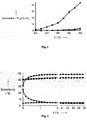
- Figure 1 shows that this catalyst has a low, but appreciable activity with a 100 % selectivity towards CHCl 3 (not shown).
- LaOCl with a relatively high surface area (20-30 m 2 /g) was used as a precursor and was chlorinated with HCl. This resulted only in a slight increase in catalytic conversion, as shown in Figure 1 .
- the higher surface area of the LaOCl precursor is most likely lost by the chlorination pre-treatment with HCl.
- the selectivity to CHCl 3 remains constant.
- a possible explanation for the induction period is that Ni remaining from the CNF growth catalyzes the conversion of CCl 4 into coke. CNF are grown on a Ni/SiO 2 catalyst. After CNF have been grown Ni and SiO 2 are removed by washing steps. However, a trace amount of Ni is encapsulated in the CNF and can therefore not be removed by washing. During the metathesis experiments it may become accessible as a result of thermal expansion and the severe chlorination treatment needed for the synthesis of LaCl 3 . In that case, the induction period is a result of the Ni catalyzed dissociation of the reactants. Especially CCl 4 is dissociating during this period as shown in Figure 2 .
- reaction is preferably carried out at a temperature between 200 and 600°C, depending on the nature of the actual chlorinated hydrocarbons to be converted. Reaction time and pressure can easily be determined by the skilled person on the basis of the actual circumstances (reaction type, reactants and the like).
- the present invention is further directed to the novel catalyst that is suitable for use in the above reaction and which catalyst comprises at least one halogenide of a lanthanide, present on carbon as support, more preferably LaCl 3 on carbon nano fibres.
- LaCl 3 -based catalyst materials Three LaCl 3 -based catalyst materials were investigated; two bulk catalysts and one supported on carbon nanofibres (CNF).
- the precursors used for the bulk materials were synthesized LaOCl and commercial LaClg ⁇ 7H 2 O (1 m 2 /g.
- the carbon supported catalyst was synthesized by the incipient wetness impregnation method making use of an aqueous LaCl 3 solution on synthesized CNF. In this manner, 20 wt% LaCl 3 was loaded on the CNF material.
- CNF were grown as described by Toebes et al ( M. L. Toebes, J. M. P. van Heeswijk, J. H. Bitter, A. J. van Dillen, K. P. de Jong, Carbon 2004, 42, 307-315 ).
- Supported Ni/SiO 2 catalyst with a metal loading of 5 wt% was used to grow low density CNF (140 m 2 /g), prepared by homogeneous deposition precipitation. After impregnation the catalyst was dried at 120 °C overnight. Before chlorination, all catalysts were heated at 500 °C in He for 6 h. Next, the precursors were chlorinated; LaCI 3 • 7H 2 O was chlorinated with CCl 4 for 30 h at 460°C. LaOCl and the CNF-supported catalyst were chlorinated with HCl at 460 °C for 20 and 4 h, respectively.
- the reactor temperature was raised from 300 to 460 °C in steps of 20 °C, and the effluent was continuously analyzed by GC.
- the metathesis of CCl 4 /CH 2 Cl 2 was performed over the CNF supported catalyst at 400 °C as a function of time.
Landscapes
- Chemical & Material Sciences (AREA)
- Organic Chemistry (AREA)
- Engineering & Computer Science (AREA)
- Materials Engineering (AREA)
- Nanotechnology (AREA)
- Chemical Kinetics & Catalysis (AREA)
- Physics & Mathematics (AREA)
- Composite Materials (AREA)
- Condensed Matter Physics & Semiconductors (AREA)
- General Physics & Mathematics (AREA)
- Crystallography & Structural Chemistry (AREA)
- Organic Low-Molecular-Weight Compounds And Preparation Thereof (AREA)
- Catalysts (AREA)
Priority Applications (2)
| Application Number | Priority Date | Filing Date | Title |
|---|---|---|---|
| EP07110077A EP2014362A1 (de) | 2007-06-12 | 2007-06-12 | Metathese von chlorinierten Abfallverbindungen |
| PCT/NL2008/050372 WO2008153390A1 (en) | 2007-06-12 | 2008-06-12 | Metathesis of chlorinated wadte compounds |
Applications Claiming Priority (1)
| Application Number | Priority Date | Filing Date | Title |
|---|---|---|---|
| EP07110077A EP2014362A1 (de) | 2007-06-12 | 2007-06-12 | Metathese von chlorinierten Abfallverbindungen |
Publications (1)
| Publication Number | Publication Date |
|---|---|
| EP2014362A1 true EP2014362A1 (de) | 2009-01-14 |
Family
ID=38819768
Family Applications (1)
| Application Number | Title | Priority Date | Filing Date |
|---|---|---|---|
| EP07110077A Withdrawn EP2014362A1 (de) | 2007-06-12 | 2007-06-12 | Metathese von chlorinierten Abfallverbindungen |
Country Status (2)
| Country | Link |
|---|---|
| EP (1) | EP2014362A1 (de) |
| WO (1) | WO2008153390A1 (de) |
Citations (4)
| Publication number | Priority date | Publication date | Assignee | Title |
|---|---|---|---|---|
| US2446123A (en) * | 1944-06-21 | 1948-07-27 | Monsanto Chemicals | Preparation of vinyl chloride |
| US5302765A (en) * | 1992-05-29 | 1994-04-12 | E. I. Du Pont De Nemours And Company | Catalytic process for producing CF3 CHClF |
| US5426253A (en) * | 1988-06-21 | 1995-06-20 | Asahi Glass Company Ltd. | Process for producing 1,1,1,2-tetrafluoroethane |
| US20040213906A1 (en) * | 2003-04-22 | 2004-10-28 | Goodrich Corporation | Oxidation inhibition of carbon-carbon composites |
-
2007
- 2007-06-12 EP EP07110077A patent/EP2014362A1/de not_active Withdrawn
-
2008
- 2008-06-12 WO PCT/NL2008/050372 patent/WO2008153390A1/en not_active Ceased
Patent Citations (4)
| Publication number | Priority date | Publication date | Assignee | Title |
|---|---|---|---|---|
| US2446123A (en) * | 1944-06-21 | 1948-07-27 | Monsanto Chemicals | Preparation of vinyl chloride |
| US5426253A (en) * | 1988-06-21 | 1995-06-20 | Asahi Glass Company Ltd. | Process for producing 1,1,1,2-tetrafluoroethane |
| US5302765A (en) * | 1992-05-29 | 1994-04-12 | E. I. Du Pont De Nemours And Company | Catalytic process for producing CF3 CHClF |
| US20040213906A1 (en) * | 2003-04-22 | 2004-10-28 | Goodrich Corporation | Oxidation inhibition of carbon-carbon composites |
Non-Patent Citations (3)
| Title |
|---|
| FRIEDRICHS S ET AL: "1-DIMENSIONAL LANTHANIDE HALIDE CRYSTALS ENCAPSULATED WITHIN SINGLE-WALLED CARBON NANOTUBES - A BRIEF REVIEW", ZEITSCHRIFT FUR METALLKUNDE, CARL HANSER, MUNICH, DE, vol. 96, no. 5, May 2005 (2005-05-01), pages 419 - 426, XP001228203, ISSN: 0044-3093 * |
| PIETER VAN DER AVERT AND BERT M. WECKHUYSEN: "Low-temperature catalytic destruction of CCl4, CHCl3 and CH2Cl2 over basic oxides", PHYS. CHEM. CHEM. PHYS., vol. 6, 2004, pages 5256 - 5262, XP002463100 * |
| VON M. BANNERT ET AL: "Reaktion von Lanthanfluorid mit Halogenalkanen", Z. ANORG. ALLG. CHEM., vol. 421, 1976, pages 135 - 142, XP002463101 * |
Also Published As
| Publication number | Publication date |
|---|---|
| WO2008153390A1 (en) | 2008-12-18 |
Similar Documents
| Publication | Publication Date | Title |
|---|---|---|
| JP5231991B2 (ja) | アセチレンのエチレンへの選択的水素化方法 | |
| RU2486008C2 (ru) | Способ регенерации содержащего рутений или соединения рутения катализатора, отравленного серой в виде сернистых соединений | |
| CA2249561C (en) | Process for the manufacture of halogenated propanes containing end-carbon fluorine | |
| WO2020041654A1 (en) | Processes for producing trifluoroiodomethane and trifluoroacetyl iodide | |
| JP6392777B2 (ja) | 1,3,3,3−テトラフルオロプロペンの製法 | |
| JP6245013B2 (ja) | 1,2−ジクロロ−3,3,3−トリフルオロプロペンの製造方法 | |
| JP6358324B2 (ja) | トリフルオロエチレンの製造方法 | |
| TWI292722B (en) | Ethylene oxide catalyst | |
| EP2773604A1 (de) | Verfahren zur herstellung von 2-chlor-3,3,3-trifluorpropen | |
| US10414704B2 (en) | Process for the manufacture of 2-chloro-3,3,3-trifluoropropene by gas phase fluorination of pentachloropropane | |
| KR101950409B1 (ko) | 히드로클로로플루오로카본의 촉매적 탈염화수소화 | |
| US20070299286A1 (en) | High pressure catalyst activation method and catalyst produced thereby | |
| JP2007511343A (ja) | 触媒及び該触媒を用いる気相方法 | |
| WO2020132534A1 (en) | Catalysts and integrated processes for producing trifluoroiodomethane | |
| JP4271415B2 (ja) | 1,3,3,3−テトラフルオロプロペンの製造方法 | |
| US6291729B1 (en) | Halofluorocarbon hydrogenolysis | |
| WO2017216653A1 (en) | Mixed cerium-lanthanum oxide catalysts and systems for oxidative halogenation of an alkane | |
| TW593229B (en) | Process for preparing 6-aminocaproamide | |
| WO2008153390A1 (en) | Metathesis of chlorinated wadte compounds | |
| WO2000009473A1 (en) | Amine production | |
| JP2009107969A (ja) | 塩化ビニルの製造方法 | |
| JP4257424B2 (ja) | フッ素化反応用触媒 | |
| US4436942A (en) | Process for the catalyzed fluorination of haloalkyl aromatic compounds | |
| JPH0617203B2 (ja) | 塩素の製造方法 | |
| KR102773697B1 (ko) | 염화메탄 탈염소화 반응용 티타늄-알루미네이트 혼합 산화물 촉매 및 이를 이용한 탈염소화 된 염화메탄 제조방법 |
Legal Events
| Date | Code | Title | Description |
|---|---|---|---|
| PUAI | Public reference made under article 153(3) epc to a published international application that has entered the european phase |
Free format text: ORIGINAL CODE: 0009012 |
|
| PUAI | Public reference made under article 153(3) epc to a published international application that has entered the european phase |
Free format text: ORIGINAL CODE: 0009012 |
|
| AK | Designated contracting states |
Kind code of ref document: A1 Designated state(s): AT BE BG CH CY CZ DE DK EE ES FI FR GB GR HU IE IS IT LI LT LU LV MC MT NL PL PT RO SE SI SK TR |
|
| AX | Request for extension of the european patent |
Extension state: AL BA HR MK RS |
|
| AKX | Designation fees paid | ||
| REG | Reference to a national code |
Ref country code: DE Ref legal event code: 8566 |
|
| STAA | Information on the status of an ep patent application or granted ep patent |
Free format text: STATUS: THE APPLICATION IS DEEMED TO BE WITHDRAWN |
|
| 18D | Application deemed to be withdrawn |
Effective date: 20090715 |