EP2014458A1 - Herstellungsverfahren eines Paneels mit Honigwabenstruktur, Anlage für dessen Einbau und so erhaltenes Paneel - Google Patents
Herstellungsverfahren eines Paneels mit Honigwabenstruktur, Anlage für dessen Einbau und so erhaltenes Paneel Download PDFInfo
- Publication number
- EP2014458A1 EP2014458A1 EP08305396A EP08305396A EP2014458A1 EP 2014458 A1 EP2014458 A1 EP 2014458A1 EP 08305396 A EP08305396 A EP 08305396A EP 08305396 A EP08305396 A EP 08305396A EP 2014458 A1 EP2014458 A1 EP 2014458A1
- Authority
- EP
- European Patent Office
- Prior art keywords
- panel
- core
- cells
- central core
- hot
- Prior art date
- Legal status (The legal status is an assumption and is not a legal conclusion. Google has not performed a legal analysis and makes no representation as to the accuracy of the status listed.)
- Withdrawn
Links
- 238000000034 method Methods 0.000 title claims abstract description 31
- 238000009434 installation Methods 0.000 title claims abstract description 6
- 238000004519 manufacturing process Methods 0.000 title description 12
- 238000004891 communication Methods 0.000 claims abstract description 7
- 230000004927 fusion Effects 0.000 claims abstract description 6
- 239000003292 glue Substances 0.000 claims description 13
- 238000007789 sealing Methods 0.000 claims description 10
- 230000002093 peripheral effect Effects 0.000 claims description 8
- 238000007731 hot pressing Methods 0.000 claims description 7
- 229920001169 thermoplastic Polymers 0.000 claims description 7
- 239000004416 thermosoftening plastic Substances 0.000 claims description 7
- 238000010438 heat treatment Methods 0.000 claims description 6
- 230000001413 cellular effect Effects 0.000 claims description 4
- 230000000994 depressogenic effect Effects 0.000 claims description 4
- 239000012943 hotmelt Substances 0.000 claims description 3
- 238000005304 joining Methods 0.000 claims description 2
- 239000002313 adhesive film Substances 0.000 abstract description 3
- 210000003456 pulmonary alveoli Anatomy 0.000 abstract 2
- 239000011162 core material Substances 0.000 description 33
- 238000001816 cooling Methods 0.000 description 12
- 238000003825 pressing Methods 0.000 description 9
- 239000000853 adhesive Substances 0.000 description 5
- 230000001070 adhesive effect Effects 0.000 description 5
- 229910052782 aluminium Inorganic materials 0.000 description 4
- XAGFODPZIPBFFR-UHFFFAOYSA-N aluminium Chemical compound [Al] XAGFODPZIPBFFR-UHFFFAOYSA-N 0.000 description 4
- 238000012360 testing method Methods 0.000 description 4
- 229920001187 thermosetting polymer Polymers 0.000 description 4
- 230000001066 destructive effect Effects 0.000 description 3
- 229940082150 encore Drugs 0.000 description 3
- 229910052751 metal Inorganic materials 0.000 description 3
- 239000002184 metal Substances 0.000 description 3
- 239000004831 Hot glue Substances 0.000 description 2
- 229910000831 Steel Inorganic materials 0.000 description 2
- 238000004026 adhesive bonding Methods 0.000 description 2
- 239000002131 composite material Substances 0.000 description 2
- 238000003754 machining Methods 0.000 description 2
- 238000012423 maintenance Methods 0.000 description 2
- 238000007747 plating Methods 0.000 description 2
- 238000002360 preparation method Methods 0.000 description 2
- 230000004224 protection Effects 0.000 description 2
- 239000002904 solvent Substances 0.000 description 2
- 239000010959 steel Substances 0.000 description 2
- 238000003860 storage Methods 0.000 description 2
- 241000256815 Apocrita Species 0.000 description 1
- 239000004593 Epoxy Substances 0.000 description 1
- CERQOIWHTDAKMF-UHFFFAOYSA-M Methacrylate Chemical compound CC(=C)C([O-])=O CERQOIWHTDAKMF-UHFFFAOYSA-M 0.000 description 1
- 241001417494 Sciaenidae Species 0.000 description 1
- 208000029152 Small face Diseases 0.000 description 1
- 240000008042 Zea mays Species 0.000 description 1
- 239000002390 adhesive tape Substances 0.000 description 1
- 238000004140 cleaning Methods 0.000 description 1
- 230000001143 conditioned effect Effects 0.000 description 1
- 238000010276 construction Methods 0.000 description 1
- 238000007796 conventional method Methods 0.000 description 1
- 238000005520 cutting process Methods 0.000 description 1
- 238000005553 drilling Methods 0.000 description 1
- 230000000694 effects Effects 0.000 description 1
- 239000006260 foam Substances 0.000 description 1
- 239000011888 foil Substances 0.000 description 1
- 239000002648 laminated material Substances 0.000 description 1
- 229920001684 low density polyethylene Polymers 0.000 description 1
- 239000004702 low-density polyethylene Substances 0.000 description 1
- 239000000463 material Substances 0.000 description 1
- 230000005499 meniscus Effects 0.000 description 1
- 238000003801 milling Methods 0.000 description 1
- 238000005457 optimization Methods 0.000 description 1
- 238000005192 partition Methods 0.000 description 1
- 239000004033 plastic Substances 0.000 description 1
- 229920003023 plastic Polymers 0.000 description 1
- 239000004848 polyfunctional curative Substances 0.000 description 1
- 238000006116 polymerization reaction Methods 0.000 description 1
- 229920002635 polyurethane Polymers 0.000 description 1
- 239000004814 polyurethane Substances 0.000 description 1
- 238000004321 preservation Methods 0.000 description 1
- 238000007639 printing Methods 0.000 description 1
- KCTAWXVAICEBSD-UHFFFAOYSA-N prop-2-enoyloxy prop-2-eneperoxoate Chemical group C=CC(=O)OOOC(=O)C=C KCTAWXVAICEBSD-UHFFFAOYSA-N 0.000 description 1
- 238000004064 recycling Methods 0.000 description 1
- 230000000717 retained effect Effects 0.000 description 1
- 238000005070 sampling Methods 0.000 description 1
- 238000010186 staining Methods 0.000 description 1
- 239000012815 thermoplastic material Substances 0.000 description 1
- 238000012546 transfer Methods 0.000 description 1
- 238000011144 upstream manufacturing Methods 0.000 description 1
- 239000002699 waste material Substances 0.000 description 1
- 230000004584 weight gain Effects 0.000 description 1
- 235000019786 weight gain Nutrition 0.000 description 1
Images

Classifications
-
- B—PERFORMING OPERATIONS; TRANSPORTING
- B31—MAKING ARTICLES OF PAPER, CARDBOARD OR MATERIAL WORKED IN A MANNER ANALOGOUS TO PAPER; WORKING PAPER, CARDBOARD OR MATERIAL WORKED IN A MANNER ANALOGOUS TO PAPER
- B31D—MAKING ARTICLES OF PAPER, CARDBOARD OR MATERIAL WORKED IN A MANNER ANALOGOUS TO PAPER, NOT PROVIDED FOR IN SUBCLASSES B31B OR B31C
- B31D3/00—Making articles of cellular structure, e.g. insulating board
- B31D3/02—Making articles of cellular structure, e.g. insulating board honeycombed structures, i.e. the cells having an essentially hexagonal section
- B31D3/0284—Laminating honeycomb cores; applying cover sheets to core edges; working core edges
Definitions
- the present invention relates to the general field of sandwich panels of honeycomb type, consisting of a tubular cellular core core whose two faces are covered by outer skins; it relates more particularly to a method of manufacturing such a panel, an installation for carrying out this method, and the sandwich panel obtained.
- Honeycomb panels are widely used in many industries, especially for the construction of walls, partitions, floors, ceilings, doors, tables, etc.
- These panels comprise a central core (made of metal or other, for example aluminum) very generally formed of a juxtaposition of "tubular” cells with polygonal (especially hexagonal), circular or ovoidal, delimited by lateral walls which extend on a constant height.
- the two "main” faces facing this central core receive cover plates, called “external skins", secured by gluing, the nature (aluminum, steel, composite, high pressure decorative laminate) is suitable for the intended application .
- thermosetting glue of the two-component type (base + hardener), based on polyurethane, epoxy or methacrylate, in combination with a pressing operation at temperatures ranging from ambient temperature up to 130 ° C.
- the present invention proposes a new process and a new installation for manufacturing sandwich panels of honeycomb type which, while implementing relatively simple means, allow gains in particular in terms of productivity and improve the quality of the panels obtained.
- the draining properties of the honeycomb core material are therefore used to maintain the pressure on the panel during the cooling phase.
- the panel obtained from the press is removed to achieve cooling, while maintaining its depression. internal.
- the panel is applied to a temperature of between 160 and 200 ° C. for a time of between 10 and 30 minutes (preferably a temperature in the region of 180 is applied). ° C, for 20 minutes).
- the vacuum operation is carried out at a value between -0.3 and -1 bar (more preferably between -0.5 and -0.8 bar).
- the invention also relates to the honeycomb panel obtained by the process defined above, this panel comprising a central alveolar core on both sides facing which are glued outer skin, at least some of the cells of this central core (and preferably all or substantially all) having orifices provided at one of the ends of their side walls. These orifices are arranged, in number, in size and in location, so as to effect an effective communication of the internal volume of the different cells, to allow optimum drainage of the air within the central core and obtain a internal depression pushed.
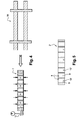
- FIG. 1 to 4 schematically illustrate the four main steps of the process according to the present invention, for manufacturing a honeycomb core sandwich panel coated with externally bonded skins.
- the central core 2 very generally flat and of constant thickness e , is illustrated here in cross section; its two faces 3 and 4, called “main” correspond to its large faces whose contours define the general shape of the panel, by comparison with its small faces 7 periphery (which correspond to the edges of the panel).
- This central core 2 may have any general shape, for example square, rectangular, circular or other, and its thickness e is generally between 5 and 50 mm. It is formed of a juxtaposition of "tubular" cells 8 which open at the level of said main faces 3 and 4 and which are delimited by side walls 9 giving them a circular polygonal constant cross section or ovoid.
- This type of central core 2 can be obtained from metal, in particular aluminum, by a conventional technique of expansion of laminated strips.
- orifices 10 formed in the walls 9 of the cells 8. These orifices 10 put in communication at least some of the cells 8 juxtaposed. Preferably, the vast majority of the cells 8 of the core 2 (and preferably all the cells 8) are thus placed in communication.
- the orifices 10 have a generally circular shape with a diameter of a few millimeters (for example 3 mm), and they are formed in the middle part of the walls 9. If the technique is used mentioned above for forming the core 2 (expansion of laminated strips), they can be obtained by perforation or drilling strips before expansion.
- the corresponding drainage can also be obtained by means of a plurality of very small perforations formed in the walls of each cell 8, made in number and in suitable dimensions. It may for example be "microperforations" made in a conventional manner during the manufacture of the core 2 to obtain a pressure equalization within the final panel, possibly associated with additional orifices of larger diameter, regularly distributed and in adapted number.
- the hot-melt adhesive films 5 have a general shape which corresponds to that of the contour of the cellular core 2 to cover all of its main faces 3 and 4.
- These films 5 are advantageously made of thermoplastic material, for example thermoplastic copolymer based on modified low density polyethylene (type LLBPE).
- Their thickness (for example between 200 microns and 300 microns) is adapted in particular according to the nature of the core 2 and the two outer skins 6 that it is desired to join.
- These outer skins 6 also have a general shape that corresponds to that of the contour of the alveolar core 2 to cover all of its main faces 3 and 4 and thus seal the end openings of the cells 8. They generally have a thickness between 0.4 and 3 mm; they can be made of metal (steel, aluminum), plastic, composite, or high pressure decorative laminate material.
- air sealing of its peripheral edge is effected by any appropriate means 11 positioned against the small peripheral faces 7 of the central core 2 and interposed between the two edges facing each other. outside skins 6.
- These sealing means 11 may for example consist of a high performance adhesive tape structure, a foam seal structure, suitable folds extending the outer skins 6, reported profiles, or any combination of these sealing solutions.
- the alveolar interior volume of the multilayer assembly 1 is connected to a vacuum network via at least one vacuum tap 12.
- the multilayer assembly 1 thus prepared ( figure 2 ) is then ready to undergo a hot pressing operation by means of a conventional heating press 14. At the time of printing, the interior volume of the multilayer assembly 1 does not need to be depressed.
- the pressing operation ( figure 3 ) is made so as to compress the outer skins 6 against the main faces 3 and 4 of the central core 2 and this under high temperature, so as to achieve the fusion of the adhesive films 5.
- the interior volume of the multilayer assembly 1 is depressed. This depressurization generates a plating force of the outer skins 6 against the central core 2 which makes it possible to dispense with the action of the press 14.
- the multilayer assembly 1 can be removed from the press 14 ( figure 4 ) and be stored for its cooling phase, said press 14 then being released and ready to be used for a new cycle.
- the internal volume of the multilayer assembly 1 is kept under vacuum throughout the cooling phase, as long as the glue is not able to fulfill its role properly.
- the depression is stopped and the peripheral sealing means 11 can be removed (in some cases and for some applications, depending on their nature, these sealing means 11 may be retained).
- the pressing operation is carried out for a period of between 10 and 30 minutes, at a temperature of between 160 and 200 ° C. (preferably for a time of about 20 minutes, at a temperature of about 180 ° C).
- the applied pressing force conventional, is between 0.2 and 0.5 bar.
- attractive tensile / plating forces are obtained by an internal negative pressure between -0.5 bar and -0.8 bar.
- a central core variant 2 ' may be used in the context of the method according to the present invention.
- the drainage of the honeycomb is achieved by grooves 10 'made on one side of the cells 8, in particular on the side of the least exposed face (for example, in the case of a floor, the grooves are positioned on the underside).
- These end grooves 10 ' can be made very easily by sawing or milling before the expansion of the strip assembly, during the manufacture of the core 2.
- This technique can also be used for the manufacture of curved panels on conformers.
- the panel is left on the shaper for the duration of the cycle which immobilizes the tool and brakes production rates.
- the present technique allows to remove the curved panel of the shaper before the end of the cycle, because of the preservation of the curve of the panel by maintaining its evacuation.
- the corresponding principle using an internal depression of the panel, can also be implemented with paste thermosetting glues, in association with a heating press or not.
Landscapes
- Laminated Bodies (AREA)
Applications Claiming Priority (1)
| Application Number | Priority Date | Filing Date | Title |
|---|---|---|---|
| FR0705016A FR2918597B1 (fr) | 2007-07-11 | 2007-07-11 | Procede de fabrication d'un panneau de type nid d'abeille, installation pour sa mise en oeuvre et le panneau obtenu. |
Publications (1)
| Publication Number | Publication Date |
|---|---|
| EP2014458A1 true EP2014458A1 (de) | 2009-01-14 |
Family
ID=39016267
Family Applications (1)
| Application Number | Title | Priority Date | Filing Date |
|---|---|---|---|
| EP08305396A Withdrawn EP2014458A1 (de) | 2007-07-11 | 2008-07-11 | Herstellungsverfahren eines Paneels mit Honigwabenstruktur, Anlage für dessen Einbau und so erhaltenes Paneel |
Country Status (2)
| Country | Link |
|---|---|
| EP (1) | EP2014458A1 (de) |
| FR (1) | FR2918597B1 (de) |
Citations (3)
| Publication number | Priority date | Publication date | Assignee | Title |
|---|---|---|---|---|
| FR2063085A1 (de) * | 1969-09-30 | 1971-07-02 | Cellu Prod Co | |
| FR2568514A1 (fr) * | 1984-07-31 | 1986-02-07 | Hexagone | Procede de surfacage de bandes de papier a reseau interieur alveolaire et machine pour sa mise en oeuvre |
| EP0543636A1 (de) * | 1991-11-21 | 1993-05-26 | Hitachi, Ltd. | Plattenstruktur und Verfahren zur dessen Herstellung |
-
2007
- 2007-07-11 FR FR0705016A patent/FR2918597B1/fr not_active Expired - Fee Related
-
2008
- 2008-07-11 EP EP08305396A patent/EP2014458A1/de not_active Withdrawn
Patent Citations (3)
| Publication number | Priority date | Publication date | Assignee | Title |
|---|---|---|---|---|
| FR2063085A1 (de) * | 1969-09-30 | 1971-07-02 | Cellu Prod Co | |
| FR2568514A1 (fr) * | 1984-07-31 | 1986-02-07 | Hexagone | Procede de surfacage de bandes de papier a reseau interieur alveolaire et machine pour sa mise en oeuvre |
| EP0543636A1 (de) * | 1991-11-21 | 1993-05-26 | Hitachi, Ltd. | Plattenstruktur und Verfahren zur dessen Herstellung |
Also Published As
| Publication number | Publication date |
|---|---|
| FR2918597A1 (fr) | 2009-01-16 |
| FR2918597B1 (fr) | 2011-01-14 |
Similar Documents
| Publication | Publication Date | Title |
|---|---|---|
| EP2265435B1 (de) | Verfahren zur herstellung einer zellähnlichen struktur und entsprechende ausrüstung | |
| EP3094486B1 (de) | Verfahren zur herstellung einer kernschicht eines polymerischen strukturellen sandwichmateriales, diese kernschicht und dieses material. | |
| WO2017085017A1 (fr) | Module photovoltaïque léger comportant une couche avant en verre ou polymère et une couche arrière alvéolaire | |
| CN105957911A (zh) | 太阳能组件胶带封边层压工艺及其胶带封边工具 | |
| CA2835518A1 (fr) | Panneau composite et son procede de realisation | |
| EP3378102A1 (de) | Leichtes fotovoltaikmodul mit einer vorderschicht aus glas oder polymer und einer hinterschicht mit erhöhten abschnitten | |
| WO2017212194A1 (fr) | Procede de fabrication d'un module photovoltaïque | |
| EP1651424A1 (de) | Verfahren zum montieren von elementen einer einen wabenkern umfassenden konstruktion | |
| TW201405177A (zh) | 多層反射器的複合式邊緣密封與邊緣保護 | |
| FR2686043A1 (fr) | Procede de realisation d'un panneau structurel du type sandwich et panneau ainsi obtenu. | |
| EP2014458A1 (de) | Herstellungsverfahren eines Paneels mit Honigwabenstruktur, Anlage für dessen Einbau und so erhaltenes Paneel | |
| EP2519596B1 (de) | Anordnung von zwei mit einem flexiblen polymer gebondeten substraten, sowie montage- und zerlegungsverfahren mittels migration dieser gebondeten anordnung | |
| EP1333222B1 (de) | Verfahren zur Herstellung einer dünnen Vakuum-Isolationsverbundplatte mit hochsteifen Verkleidungen | |
| WO2006084117A3 (en) | Method for forming and bonding thermoformable composites | |
| WO2013092326A1 (fr) | Pneumatique et procede de fabrication d'une ceinture de triangulation de pneumatique | |
| EP3155943A1 (de) | Verfahren zur herstellung einer duschwanne aus einer verbundplatte | |
| FR3024863A1 (fr) | Procede de realisation d'un element de garnissage comprenant une couche d'aspect comprenant des bandes de materiau ligneux | |
| WO2006134079A1 (fr) | Piece composite telle qu'un panneau, comportant une structure alveolaire a nids d'abeille | |
| SE536128C2 (sv) | Förfarande för tillverkning av skivformat sandwichmaterial med wellpappkärna och ytskikt av härdad spånmatta | |
| FR2912445A1 (fr) | Profile extrude pour des revetements en ceramique a appliquer en correspondance de l'arrete exterieure d'une paroi et methode de production y relative | |
| FR2591147A1 (fr) | Nouveau materiau composite stratifie rigide | |
| EP3960538B1 (de) | Karosseriemodul für ein kühlfahrzeug mit vakuum-isolierpaneel und entsprechendes herstellungsverfahren | |
| FR2970729A1 (fr) | Volet stratifie et son procede de fabrication | |
| EP3275653B1 (de) | Kontinuierliches herstellungsverfahren eines bodenbelags | |
| FR3122353A1 (fr) | Structure alvéolaire à base de liège, procédé de fabrication de panneaux incorporant ladite structure, et leurs utilisations |
Legal Events
| Date | Code | Title | Description |
|---|---|---|---|
| PUAI | Public reference made under article 153(3) epc to a published international application that has entered the european phase |
Free format text: ORIGINAL CODE: 0009012 |
|
| AK | Designated contracting states |
Kind code of ref document: A1 Designated state(s): AT BE BG CH CY CZ DE DK EE ES FI FR GB GR HR HU IE IS IT LI LT LU LV MC MT NL NO PL PT RO SE SI SK TR |
|
| AX | Request for extension of the european patent |
Extension state: AL BA MK RS |
|
| AKX | Designation fees paid | ||
| REG | Reference to a national code |
Ref country code: DE Ref legal event code: 8566 |
|
| STAA | Information on the status of an ep patent application or granted ep patent |
Free format text: STATUS: THE APPLICATION IS DEEMED TO BE WITHDRAWN |
|
| 18D | Application deemed to be withdrawn |
Effective date: 20090715 |