EP2014460A2 - Verfahren zum Oberflächenschutz eines Substrats aus intermetallischer Verbindung auf Basis von Titan-Aluminid gegen Korrosion - Google Patents
Verfahren zum Oberflächenschutz eines Substrats aus intermetallischer Verbindung auf Basis von Titan-Aluminid gegen Korrosion Download PDFInfo
- Publication number
- EP2014460A2 EP2014460A2 EP08290647A EP08290647A EP2014460A2 EP 2014460 A2 EP2014460 A2 EP 2014460A2 EP 08290647 A EP08290647 A EP 08290647A EP 08290647 A EP08290647 A EP 08290647A EP 2014460 A2 EP2014460 A2 EP 2014460A2
- Authority
- EP
- European Patent Office
- Prior art keywords
- gold
- process according
- corrosion
- substrate
- coating
- Prior art date
- Legal status (The legal status is an assumption and is not a legal conclusion. Google has not performed a legal analysis and makes no representation as to the accuracy of the status listed.)
- Granted
Links
Images

Classifications
-
- C—CHEMISTRY; METALLURGY
- C25—ELECTROLYTIC OR ELECTROPHORETIC PROCESSES; APPARATUS THEREFOR
- C25D—PROCESSES FOR THE ELECTROLYTIC OR ELECTROPHORETIC PRODUCTION OF COATINGS; ELECTROFORMING; APPARATUS THEREFOR
- C25D3/00—Electroplating: Baths therefor
- C25D3/02—Electroplating: Baths therefor from solutions
- C25D3/48—Electroplating: Baths therefor from solutions of gold
-
- B—PERFORMING OPERATIONS; TRANSPORTING
- B32—LAYERED PRODUCTS
- B32B—LAYERED PRODUCTS, i.e. PRODUCTS BUILT-UP OF STRATA OF FLAT OR NON-FLAT, e.g. CELLULAR OR HONEYCOMB, FORM
- B32B15/00—Layered products comprising a layer of metal
- B32B15/01—Layered products comprising a layer of metal all layers being exclusively metallic
- B32B15/018—Layered products comprising a layer of metal all layers being exclusively metallic one layer being formed of a noble metal or a noble metal alloy
-
- C—CHEMISTRY; METALLURGY
- C25—ELECTROLYTIC OR ELECTROPHORETIC PROCESSES; APPARATUS THEREFOR
- C25D—PROCESSES FOR THE ELECTROLYTIC OR ELECTROPHORETIC PRODUCTION OF COATINGS; ELECTROFORMING; APPARATUS THEREFOR
- C25D5/00—Electroplating characterised by the process; Pretreatment or after-treatment of workpieces
- C25D5/48—After-treatment of electroplated surfaces
- C25D5/50—After-treatment of electroplated surfaces by heat-treatment
-
- Y—GENERAL TAGGING OF NEW TECHNOLOGICAL DEVELOPMENTS; GENERAL TAGGING OF CROSS-SECTIONAL TECHNOLOGIES SPANNING OVER SEVERAL SECTIONS OF THE IPC; TECHNICAL SUBJECTS COVERED BY FORMER USPC CROSS-REFERENCE ART COLLECTIONS [XRACs] AND DIGESTS
- Y10—TECHNICAL SUBJECTS COVERED BY FORMER USPC
- Y10T—TECHNICAL SUBJECTS COVERED BY FORMER US CLASSIFICATION
- Y10T428/00—Stock material or miscellaneous articles
- Y10T428/12—All metal or with adjacent metals
- Y10T428/12493—Composite; i.e., plural, adjacent, spatially distinct metal components [e.g., layers, joint, etc.]
- Y10T428/12771—Transition metal-base component
- Y10T428/12806—Refractory [Group IVB, VB, or VIB] metal-base component
Definitions
- the invention relates to a method for protecting the surface of a titanium aluminide based intermetallic alloy substrate against corrosion by oxygen, sulfur compounds and halogenated compounds. It also relates to the protected parts thus obtained.
- titanium aluminides are potential candidates for high and medium temperature applications, such as on-board and off-gas turbines, particularly aircraft engine parts. Examples are free turbine blades (maximum operating temperature of 800 ° C) and turbomachine diffusers (maximum operating temperature of 600 ° C).
- Free turbine blades must be essentially resistant to oxidation and a corroding environment consisting of oxygen, sodium sulphate (Na 2 SO 4 ) and a small percentage of sodium chloride (NaCl).
- the alloys intended for this application by the engine manufacturers are foundry alloys or alloys with high lamellar fraction and high intrinsic resistance to TiAl G4 type oxidation (developed by the Applicant) or an alloy with a high Niobium content ( "High content Niobium”), also developed by the applicant.
- the alloy retained is a conventional Ti-48Al-2Cr-2Nb alloy (atomic%), also called TiAl 48-2-2, which is a substantially gamma alloy.
- the oxidation resistance of titanium aluminides is poor from 700 ° C, because during oxidation, these materials do not develop a stable and sealed layer of alumina.
- the formed oxide layer is complex and composed of several layers: a surface layer of non-stoichiometric titanium oxide, an intermediate layer of alumina and an inner layer composed of a mixture of alumina and titanium oxide. Under this last complex layer, there is a depleted sub-layer of aluminum and sometimes titanium nitrides.
- titanium aluminide is meant a defined compound based on aluminum and titanium forming an intermediate phase which exists only in the ordered state.
- alloys based on ⁇ -TiAl are industrially usable: alloys based on ⁇ -TiAl and those based on the ⁇ 2-Ti 3 Al compound. that this invention is applicable.
- the titanium aluminide alloys according to the invention may therefore contain, in addition to aluminum and alumina, other metal components, for example chromium, niobium, rhenium, etc., in order to improve their properties.
- the applicant has proposed to protect such an intermetallic alloy by depositing a metallic element which, by diffusion, is capable of modifying the chemical composition of the TiAl intermetallic alloy to a small thickness and thus to form on its surface a protective coating.
- Gold is also used as solder.
- a sheet (or a deposit) of gold having a thickness of between 0.02 and 0.1 mm is inserted between two parts to be assembled and the assembly is brought to the temperature of approximately 1400 ° C., which allows to obtain a eutectic melting of the compound Au 16 Ti 84 whose melting point is 1367 ° C. ( US5,318,214 ).
- the preferred noble metal is a platinum alloy with 20% rhodium. It is obvious, although not claimed, that the noble alloy diffuses during service in the ductile alloy layer. The thickness ratio between the two layers of the coating (ie titanium alloy ductile + noble metal) indicates that no particular protective phase is sought.
- the reading of the gold - titanium binary diagram shows that the noble metal can be dissolved in a titanium matrix up to 25% atomic concentration, ie 60% by mass. Beyond this limit, defined compounds such as Ti 3 Au, TiAu, TiAu 3 and TiAu 4 are formed. This is to say that if a gold deposit was applied on a TA6V type low alloy alloy, there would be, in use, interdiffusion between the substrate and the coating, so that the protective effect searched could not be obtained.
- Such a coating based on gold has the advantage of being easily deposited by conventional techniques, particularly electrolytically. However, other deposition techniques are possible, such as vapor phase deposition, painting, sheet bonding, etc. In addition, diffusion annealing makes it possible to obtain on the surface a composition highly enriched in gold, of TiAlAu 3 composition, the subsequent diffusion with the TiAl intermetallic alloy being limited and controlled.
- step I the best known, is an oxidation which is done in four stages, I, II, III and IV.
- steps I and II the observed kinetics follows a linear law. This law is generally attributed to the formation of a non-protective and discontinuous oxide film so that oxygen passes through it.
- step III a characteristic parabolic law of a thin, continuous and protective oxide film is observed whose growth is governed by mechanisms of diffusion of the metal or oxygen through the oxide. The reaction rate decreases as the oxide layer formed increases, but does not cancel.
- step IV called breakage or "break away" corresponds to a rupture of this continuous film leading quickly to the deterioration of the material.
- the second mode of degradation is sulphide corrosion.
- this corrosion occurs only downstream of the combustion chamber where the sodium sulphate is formed by combining the sodium chloride of the atmosphere with the sulfur dioxide formed by oxidation of the sulfur compounds contained in the kerosene.
- This corrosion occurs above 700 ° C to become extremely harmful when the condensed phase (sodium sulfate and potassium) becomes liquid.
- a protective coating must make it possible to fight against these three types of degradation.
- the coating, once created, must remain on the surface and not diffuse in the substrate and conversely, the substrate must spread as little as possible in the coating.
- the items in column IB of the periodic table of elements are poorly soluble in titanium aluminides.
- copper and silver are not very protective against elements such as oxygen, sulfur and halogens, gold is known for its great passivity vis-à-vis these elements.
- the metal or alloy candidate for the role of coating will oxidation or not to form oxides between room temperature and 800 ° C, maximum temperature of use of titanium aluminides or to form very stable.
- the candidate metal or alloy In hot corrosion in the presence of condensed phases, the candidate metal or alloy must not form sulphides or hyposulphites or sulphites or sulphates.
- the metal or alloy should not form volatile or unstable salts. Therefore, this definition can only be applied to a noble metal such as platinum, iridium, gold, and to a lesser extent, rhodium and palladium.
- a last condition will be required of the metal or the alloy candidate: interdiffuser as little as possible with the substrate on the one hand so as not to weaken its mechanical properties and, on the other hand, to maintain the initial chemical composition of the coating.
- the preparation operation a) is preferably carried out according to techniques known per se. It advantageously comprises a pretreatment of the surface to be protected by sandblasting, then treatment, at least one acid attack, followed by rinsing.
- the deposition operation b) is carried out electrolytically from a browning bath.
- a gilding bath comprising a sodium sulfite solution containing metallic gold.
- Deposition can be envisaged: vapor phase deposition, painting, sheet gluing, etc.
- This deposition operation b) is carried out under conditions such that the gold coating has a thickness of at least 2.5 ⁇ m, preferably between 20 and 40 ⁇ m. There is no decisive upper limit for the thickness of the gold deposit, if not for reasons of cost.
- the annealing operation c) is preferably carried out at high temperature and under reduced pressure to form TiAlAu3, TiAlAu2 and TiAlAu phases.
- the annealing operation c) is carried out at a temperature between 850 and 1050 ° C, preferably about 900 ° C and under a vacuum better than 10 -3 Pa.
- This other material may be a metal such as pure gold or another metal not forming oxides, or sulphides or halides, such as platinum, palladium, osmium, rhodium, iridium and ruthenium.
- This other material may also be a ceramic based on oxides, carbides, or nitrides, as is well known to those skilled in the art.
- the method of the invention may include a subsequent operation of performing a new vacuum anneal to regenerate the gold coating in case of halogenated corrosion.
- This halogenated corrosion results in depletion by elimination of volatile halides such as AlCl 3 or AlF 3 , TiCl 4 or TiF 4 .
- the invention in another aspect, relates to a part comprising a substrate of titanium aluminide based intermetallic alloy whose surface has been protected against corrosion by a method as defined above.
- a part is intended primarily for a gas turbine, particularly an aircraft engine.
- a substrate 1 formed of a TiAl-based intermetallic alloy is provided with a coating of gold 2, a deposition coating, with a regular thickness of 20 ⁇ m.
- This gold deposit was made by electrolysis of a solution of this metal.
- a nickel coating 3 electrolytically, only to facilitate observation of the sample electron microscope. In this particular case the sample did not undergo annealing.
- a gold coating 2 with a thickness of 40 ⁇ m was deposited on the substrate 1 and an annealing was then carried out at 900 ° C. in an oven under a vacuum better than 10 -3 Pa.
- a nickel coating 3 was performed to facilitate observation.
- the sample shown at figure 2 presents a microstructure with three successive phases: TiAlAu, TiAlAu 2 and TiAlAu 3 , starting from the surface of the substrate towards the nickel coating.
- This microstructure is interesting because it shows a certain similarity with the ternary TiAl (Ni, Cu) diagram where the TiAlAu 3 phases would be the equivalent of the ⁇ 4 phase, TiAlAu 2 of the ⁇ 3 phase and TiAlAu of the ⁇ 2 phase, thus confirming the low solubility of gold in titanium aluminide as has been demonstrated by the applicant in FR 2,857,892 .
- the coating has shown good properties in both oxidation and sulfur or chlorine corrosion.
- the preparation or processing operations that precede the depositing operation are conventional. They have for the purpose of preparing the surface of the substrate for browning. Sandblasting is carried out in a humid environment to facilitate the removal of sand and limit the abrasion of the surface. Acid attacks are also classic. Wood's nickel application avoids passivation of the substrate.
- This commercial reference bath E-55 was supplied by the company Metalor Technologies, and its yield is close to 100%.
- This coated alloy and a bare control are oxidized at 800 ° C., corroded in the presence of condensed phases and, finally, corroded in the presence of halogenated substance (sodium chloride).
- the coating significantly improves the environmental properties of the alloy in high temperature oxidation and hot corrosion. By cons, failing to improve the behavior in halogenated corrosion, it does not deteriorate.
- the post mortem metallographic examinations show that in fact the coating remains intact regardless of the type of aggression to which it is subjected.
- halogenated corrosion there is even a gold enrichment of the outer layer, meaning that only the titanium and aluminum elements of the TiAlAu 3 phase are removed in the form of volatile halides.
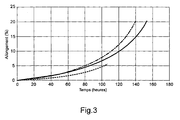
- the figure 3 compares the mechanical creep properties of TiAl 48Al-2Cr-2Nb at 300 MPa at 700 ° C in three states: machining gross (solid line), coating gross (dashed and dotted line) and after 5 major salt corrosion cycles ( dotted line). It is found that if the gold coating decreases a little the mechanical properties of the intermetallic alloy it allows, in return, to best preserve when the alloy is exposed to operating conditions. In addition, it is important to note that only the duration of tertiary creep is modified according to the state of the material. Indeed, under this constraint, the duration of the secondary creep (about 23 hours) remains unchanged whatever the state of the material (raw, protected or protected / corroded).
- Example I The procedure is as in Example I but the Ti-48Al-2Cr-2Nb substrate has undergone a special heat treatment modifying its microstructure to make it completely lamellar. This microstructure makes it possible to improve the mechanical properties of this alloy.
Landscapes
- Chemical & Material Sciences (AREA)
- Engineering & Computer Science (AREA)
- Chemical Kinetics & Catalysis (AREA)
- Electrochemistry (AREA)
- Materials Engineering (AREA)
- Metallurgy (AREA)
- Organic Chemistry (AREA)
- Other Surface Treatments For Metallic Materials (AREA)
- Solid-Phase Diffusion Into Metallic Material Surfaces (AREA)
- Electroplating Methods And Accessories (AREA)
Applications Claiming Priority (1)
| Application Number | Priority Date | Filing Date | Title |
|---|---|---|---|
| FR0704957A FR2918672B1 (fr) | 2007-07-09 | 2007-07-09 | Procede pour proteger la surface d'un substrat en alliage intermetallique a base d'aluminiure de titane contre la corrosion. |
Publications (3)
| Publication Number | Publication Date |
|---|---|
| EP2014460A2 true EP2014460A2 (de) | 2009-01-14 |
| EP2014460A3 EP2014460A3 (de) | 2009-02-18 |
| EP2014460B1 EP2014460B1 (de) | 2010-02-17 |
Family
ID=38943821
Family Applications (1)
| Application Number | Title | Priority Date | Filing Date |
|---|---|---|---|
| EP08290647A Active EP2014460B1 (de) | 2007-07-09 | 2008-07-01 | Verfahren zum Oberflächenschutz eines Substrats aus intermetallischer Verbindung auf Basis von Titan-Aluminid gegen Korrosion |
Country Status (5)
| Country | Link |
|---|---|
| US (1) | US8617323B2 (de) |
| EP (1) | EP2014460B1 (de) |
| JP (1) | JP5645353B2 (de) |
| DE (1) | DE602008000652D1 (de) |
| FR (1) | FR2918672B1 (de) |
Cited By (4)
| Publication number | Priority date | Publication date | Assignee | Title |
|---|---|---|---|---|
| DE102008056741A1 (de) * | 2008-11-11 | 2010-05-12 | Mtu Aero Engines Gmbh | Verschleissschutzschicht für Tial |
| WO2014022081A1 (en) * | 2012-08-03 | 2014-02-06 | General Electric Company | Reinforced articles and methods of making the same |
| CN109306417A (zh) * | 2017-07-27 | 2019-02-05 | 苹果公司 | 具有用于消除丝状腐蚀的合金元素的阳极化铝合金 |
| CN112007837A (zh) * | 2020-08-27 | 2020-12-01 | 济南东方结晶器有限公司 | 一种电镀钴镍铼所用的不溶性阳极活性涂层及其制作方法 |
Families Citing this family (1)
| Publication number | Priority date | Publication date | Assignee | Title |
|---|---|---|---|---|
| CN104149410B (zh) * | 2014-07-08 | 2016-03-02 | 中国人民解放军国防科学技术大学 | 无机耐高温低红外发射率复合涂层及其制备方法 |
Family Cites Families (12)
| Publication number | Priority date | Publication date | Assignee | Title |
|---|---|---|---|---|
| US4181590A (en) * | 1977-08-16 | 1980-01-01 | The United States Of America As Represented By The Secretary Of The Air Force | Method of ion plating titanium and titanium alloys with noble metals and their alloys |
| US4137370A (en) * | 1977-08-16 | 1979-01-30 | The United States Of America As Represented By The Secretary Of The Air Force | Titanium and titanium alloys ion plated with noble metals and their alloys |
| CH632533A5 (fr) * | 1979-06-14 | 1982-10-15 | Aliprandini P | Procede pour le depot galvanoplastique d'un alliage d'or. |
| US5318214A (en) * | 1987-11-18 | 1994-06-07 | The United States Of America As Represented By The Secretary Of The Air Force | Activated brazing system for joining titanium aluminide |
| US5326525A (en) * | 1988-07-11 | 1994-07-05 | Rockwell International Corporation | Consolidation of fiber materials with particulate metal aluminide alloys |
| US5129574A (en) * | 1991-02-19 | 1992-07-14 | Grumman Aerospace Corporation | Braze bonding of oxidation-resistant foils |
| US5149497A (en) * | 1991-06-12 | 1992-09-22 | General Electric Company | Oxidation resistant coatings of gamma titanium aluminum alloys modified by chromium and tantalum |
| JP3320760B2 (ja) * | 1991-12-06 | 2002-09-03 | 大陽工業株式会社 | チタニウム・アルミニウム合金 |
| US5368660A (en) * | 1992-10-30 | 1994-11-29 | New Mexico Tech Research Foundation | High temperature TiAl2 -based ternary alloys |
| US5879760A (en) * | 1992-11-05 | 1999-03-09 | The United States Of America As Represented By The Secretary Of The Air Force | Titanium aluminide articles having improved high temperature resistance |
| JP3247517B2 (ja) * | 1993-09-13 | 2002-01-15 | 株式会社豊田中央研究所 | チタン材料のめっき方法 |
| FR2857892B1 (fr) * | 2003-07-25 | 2005-10-21 | Onera (Off Nat Aerospatiale) | Procede de brasage d'un alliage ti-al |
-
2007
- 2007-07-09 FR FR0704957A patent/FR2918672B1/fr not_active Expired - Fee Related
-
2008
- 2008-07-01 EP EP08290647A patent/EP2014460B1/de active Active
- 2008-07-01 DE DE602008000652T patent/DE602008000652D1/de active Active
- 2008-07-08 JP JP2008177712A patent/JP5645353B2/ja active Active
- 2008-07-08 US US12/169,581 patent/US8617323B2/en active Active
Cited By (4)
| Publication number | Priority date | Publication date | Assignee | Title |
|---|---|---|---|---|
| DE102008056741A1 (de) * | 2008-11-11 | 2010-05-12 | Mtu Aero Engines Gmbh | Verschleissschutzschicht für Tial |
| WO2014022081A1 (en) * | 2012-08-03 | 2014-02-06 | General Electric Company | Reinforced articles and methods of making the same |
| CN109306417A (zh) * | 2017-07-27 | 2019-02-05 | 苹果公司 | 具有用于消除丝状腐蚀的合金元素的阳极化铝合金 |
| CN112007837A (zh) * | 2020-08-27 | 2020-12-01 | 济南东方结晶器有限公司 | 一种电镀钴镍铼所用的不溶性阳极活性涂层及其制作方法 |
Also Published As
| Publication number | Publication date |
|---|---|
| JP2009013500A (ja) | 2009-01-22 |
| FR2918672A1 (fr) | 2009-01-16 |
| DE602008000652D1 (de) | 2010-04-01 |
| EP2014460B1 (de) | 2010-02-17 |
| US20090017329A1 (en) | 2009-01-15 |
| FR2918672B1 (fr) | 2009-10-09 |
| JP5645353B2 (ja) | 2014-12-24 |
| US8617323B2 (en) | 2013-12-31 |
| EP2014460A3 (de) | 2009-02-18 |
Similar Documents
| Publication | Publication Date | Title |
|---|---|---|
| EP1191125B1 (de) | Verfahren zum Herstellen einer Wärmedämmschicht | |
| EP2014460B1 (de) | Verfahren zum Oberflächenschutz eines Substrats aus intermetallischer Verbindung auf Basis von Titan-Aluminid gegen Korrosion | |
| EP1528118A2 (de) | Gasturbinenbauteil mit einer Schutzschicht und Verfahren zu seiner Herstellung | |
| CA2868953C (fr) | Procede d'obtention d'un revetement d'aluminiure de nickel de type .beta.-nia1 sur un substrat metallique, et piece munie d'un tel revetement | |
| EP0884403A1 (de) | Mehrschichtenmaterial mit Erosions-Verschleiss-Korrosionsschutzschicht auf einem Substrat aus Aluminium, Magnesium und deren Legierungen | |
| CA2249073C (fr) | Procede pour ameliorer la resistance a l'oxydation et a la corrosion d'une piece en superalliage et piece en superalliage obtenue par ce procede | |
| EP3899083B1 (de) | Turbinenteil aus rhenium- und/oder rutheniumhaltiger superlegierung und zugehöriges herstellungsverfahren | |
| EP3732352A1 (de) | Mit einer zusammensetzung zum schutz gegen cmas mit kontrollierter rissbildung beschichtetes teil und entsprechendes behandlungsverfahren | |
| FR2645072A1 (fr) | Structure composite ayant une grande resistance mecanique aux temperatures elevees | |
| EP3601634B1 (de) | Turbinenkomponente aus superlegierung und zugehöriges herstellungsverfahren | |
| EP3685018B1 (de) | Turbinenteil aus einer superlegierung mit rhenium und/oder ruthenium und zugehöriges herstellungsverfahren | |
| JPH02504289A (ja) | 被覆した近αチタン品物 | |
| EP3976847A1 (de) | Verfahren zum schutz gegen korrosion | |
| EP0638652B1 (de) | Verfahren zum Härten von metallischen Gegenstanden | |
| EP4041930B1 (de) | Luftfahrtteil aus rhenium- und/oder rutheniumhaltiger superlegierung und zugehöriges herstellungsverfahren | |
| EP3698020A1 (de) | Turbinenbauteil aus superlegierung mit rhenium und zugehöriges herstellungsverfahren | |
| EP3036059B1 (de) | Verfahren zur montage zweier schaufeln einer turbomaschinendüse | |
| CA1045916A (fr) | Procede de protection de pieces metalliques refractaires contre la corrosion | |
| EP4306678A1 (de) | Verfahren zur herstellung eines schwarzen und selbstheilenden erscheinungsbildes mit edelmetallsubstrat und so hergestelltes teil | |
| JPH09104987A (ja) | 耐熱部材およびその製造方法 | |
| FR2559508A1 (fr) | Procede de protection des alliages resistant a chaud notamment a base de nickel | |
| BE821701A (fr) | Revetements de surface anticorrosion pour objets en metaux ferreux a joint brases. |
Legal Events
| Date | Code | Title | Description |
|---|---|---|---|
| PUAI | Public reference made under article 153(3) epc to a published international application that has entered the european phase |
Free format text: ORIGINAL CODE: 0009012 |
|
| AK | Designated contracting states |
Kind code of ref document: A2 Designated state(s): AT BE BG CH CY CZ DE DK EE ES FI FR GB GR HR HU IE IS IT LI LT LU LV MC MT NL NO PL PT RO SE SI SK TR |
|
| AX | Request for extension of the european patent |
Extension state: AL BA MK RS |
|
| PUAL | Search report despatched |
Free format text: ORIGINAL CODE: 0009013 |
|
| AK | Designated contracting states |
Kind code of ref document: A3 Designated state(s): AT BE BG CH CY CZ DE DK EE ES FI FR GB GR HR HU IE IS IT LI LT LU LV MC MT NL NO PL PT RO SE SI SK TR |
|
| AX | Request for extension of the european patent |
Extension state: AL BA MK RS |
|
| 17P | Request for examination filed |
Effective date: 20090311 |
|
| GRAP | Despatch of communication of intention to grant a patent |
Free format text: ORIGINAL CODE: EPIDOSNIGR1 |
|
| GRAS | Grant fee paid |
Free format text: ORIGINAL CODE: EPIDOSNIGR3 |
|
| AKX | Designation fees paid |
Designated state(s): DE FR GB IT SE |
|
| GRAA | (expected) grant |
Free format text: ORIGINAL CODE: 0009210 |
|
| AK | Designated contracting states |
Kind code of ref document: B1 Designated state(s): DE FR GB IT SE |
|
| REG | Reference to a national code |
Ref country code: GB Ref legal event code: FG4D Free format text: NOT ENGLISH |
|
| REF | Corresponds to: |
Ref document number: 602008000652 Country of ref document: DE Date of ref document: 20100401 Kind code of ref document: P |
|
| REG | Reference to a national code |
Ref country code: SE Ref legal event code: TRGR |
|
| PLBE | No opposition filed within time limit |
Free format text: ORIGINAL CODE: 0009261 |
|
| STAA | Information on the status of an ep patent application or granted ep patent |
Free format text: STATUS: NO OPPOSITION FILED WITHIN TIME LIMIT |
|
| 26N | No opposition filed |
Effective date: 20101118 |
|
| REG | Reference to a national code |
Ref country code: FR Ref legal event code: PLFP Year of fee payment: 9 |
|
| REG | Reference to a national code |
Ref country code: FR Ref legal event code: PLFP Year of fee payment: 10 |
|
| REG | Reference to a national code |
Ref country code: FR Ref legal event code: PLFP Year of fee payment: 11 |
|
| PGFP | Annual fee paid to national office [announced via postgrant information from national office to epo] |
Ref country code: DE Payment date: 20250825 Year of fee payment: 18 |
|
| PGFP | Annual fee paid to national office [announced via postgrant information from national office to epo] |
Ref country code: IT Payment date: 20250725 Year of fee payment: 18 |
|
| PGFP | Annual fee paid to national office [announced via postgrant information from national office to epo] |
Ref country code: GB Payment date: 20250729 Year of fee payment: 18 |
|
| PGFP | Annual fee paid to national office [announced via postgrant information from national office to epo] |
Ref country code: FR Payment date: 20250729 Year of fee payment: 18 |
|
| PGFP | Annual fee paid to national office [announced via postgrant information from national office to epo] |
Ref country code: SE Payment date: 20250728 Year of fee payment: 18 |