EP2014655B1 - Dérivés de l'etnangien et leur application comme antibiotiques - Google Patents
Dérivés de l'etnangien et leur application comme antibiotiques Download PDFInfo
- Publication number
- EP2014655B1 EP2014655B1 EP07108744A EP07108744A EP2014655B1 EP 2014655 B1 EP2014655 B1 EP 2014655B1 EP 07108744 A EP07108744 A EP 07108744A EP 07108744 A EP07108744 A EP 07108744A EP 2014655 B1 EP2014655 B1 EP 2014655B1
- Authority
- EP
- European Patent Office
- Prior art keywords
- etnangien
- organic solvent
- extract
- group
- process according
- Prior art date
- Legal status (The legal status is an assumption and is not a legal conclusion. Google has not performed a legal analysis and makes no representation as to the accuracy of the status listed.)
- Not-in-force
Links
Images

Classifications
-
- C—CHEMISTRY; METALLURGY
- C07—ORGANIC CHEMISTRY
- C07D—HETEROCYCLIC COMPOUNDS
- C07D313/00—Heterocyclic compounds containing rings of more than six members having one oxygen atom as the only ring hetero atom
-
- A—HUMAN NECESSITIES
- A61—MEDICAL OR VETERINARY SCIENCE; HYGIENE
- A61P—SPECIFIC THERAPEUTIC ACTIVITY OF CHEMICAL COMPOUNDS OR MEDICINAL PREPARATIONS
- A61P31/00—Antiinfectives, i.e. antibiotics, antiseptics, chemotherapeutics
Definitions
- the present invention relates to novel compounds having antibiotic activity, which compounds can be used as a component of pharmaceutical compositions for use as an antibiotic and/or as an antiviral agent. Accordingly, the present invention provides the use of the novel compound for the production of a pharmaceutical composition for use as an antibiotic and/or as an antiviral agent.
- the present invention provides a production process including an isolation method for separating the novel compound from an aqueous mixture, e.g. from a fermentation broth.
- Etnangien an antibiotic compound termed Etnangien, which is obtained by fermentation of Sorangium cellulosum (DSM 11028), adsorbed to Amberlite XAD adsorber resin and eluted from the adsorber resin using methanol.
- the methanol eluate can further be purified by extraction with acetic acid ester, dissolving in diethylether, extracting with aqueous sodium hydrogencarbonate, acidifying, and extracting with dichloromethane. After removal of dichloromethane, the residue can be purified by reverse phase chromatography using methanol/water as the eluent, extracting the aqueous phase with acetic acid ester, and drying.
- a further object of the invention is to provide a production process, especially a simplified isolation and synthesis procedure, for isolating the novel compound from an aqueous composition, e.g. starting from a fermentation broth.
- the present invention attains the above-mentioned objects by providing compounds 2 according to formula I, respectively. wherein R is an ester forming group linked to C-1, respectively.
- R is an ester forming group linked to C-1, respectively.
- the core structure of the compounds according to the present invention differs in a hydroxyl group at C-38 instead of the methoxy group at C-38 in the compound according to DE 19630980 A1 , compounds according to the present invention are presently termed Etnangien and Etnangien ester, respectively.
- the ester forming group can be selected from C1 to C12 alkylene oxy, aryl oxy arylalkyloxy, aryloxy and aromatic groups, e.g. benzoxy or phenolate.
- the ester is an alkylester, e.g. the methylester, ethylester, n-propylester, isopropylester, n-butylester, isobutylester, n-heptylester, n-isoheptylester, n-pentyl- or isopentylester, n-hexylester, isohexylester or a C7 to C12 linear, branched or cyclic alkylester.
- Etnangien esters according to the present invention can be obtained essentially in a quantitative manner from a reaction mixture comprising an extract of cell mass and/or, preferably combined with, adsorber resin contained in the cultivation medium of a fermentation broth from Sorangium cellulosum.
- the Etnangien esters 2 of the invention have a significantly increased stability in comparison to Etnangien 1, e.g. in aqueous and/or alcoholic compositions at about neutral pH, e.g. in a range of pH 5 to 8.
- the Etnangien esters 2 can be stored as dry matter or in solution, preferably in alcoholic solution, at room temperature without degradation for several months, e.g. in methanol, ethanol or a mixture thereof.
- Etnangien 1 produced by fermentation is preferably isolated in the presence of a stabiliser, e.g. 4-tert.-butyl-o-dihydroxybenzene to avoid degradation.
- a stabiliser e.g. 4-tert.-butyl-o-dihydroxybenzene to avoid degradation.
- a production process comprising the cultivation of a producer micro-organism, e.g. Sorangium cellulosum, optionally in the presence of an adsorber resin, isolation of cell mass and of the optional adsorber resin, extraction of Etnangien 1 from cell mass and/or of the adsorber resin.
- a producer micro-organism e.g. Sorangium cellulosum
- an adsorber resin e.g. Sorangium cellulosum
- an adsorber resin having aromatic side chains e.g. a divinylbenzene copolymer
- the adsorber resin is preferably isolated from the fermentation broth and transferred to a chromatography column, e.g. an open or expanded bed column.
- the resin is preferably washed with water to remove adherent cells.
- Etnangien 1 the resin is preferably extracted with an alcohol, e.g. methanol.
- the alcoholic extract is buffered with aqueous ammonium acetate and concentrated, e.g. by removal of the alcohol.
- the residue is extracted with an organic solvent, e.g.
- EtOAc ethyl acetate
- This first residue can be redissolved in the organic solvent and extracted with an aqueous carbonate solution, e.g. sodium hydrogen carbonate.
- the aqueous phase is acidified, e.g. to pH 5, and extracted with an organic solvent, e.g. EtOAc.
- the organic phase is preferably partitioned with aqueous buffer solution, e.g. ammonium acetate to shift the pH to a range of 6.5. to 7.3, preferably to pH 6.8 before removal of the organic solvent, e.g. by evaporation to obtain a second residue.
- evaporation is performed in the presence of toluene.
- the second residue contains Etnangien 1 and can be purified further, e.g. by reverse phase chromatography.
- Etnangien 1 it is preferred to isolate Etnangien 1 at temperatures below 10 °C, more preferred below 5 °C, most preferred at about 0 °C. Further, it is generally preferred to add 1,2-dihydroxy-4-tert.-butylbenzene to Etnangien 1 containing preparations for enhanced stability. For storage, an alcoholic solution of Etnangien 1, e.g. in methanol, is preferred.
- Etnangien acid 1 which is a preferred intermediary product in the production of derivatives of Etnangien acid 1, e.g. for the production of Etnangien esters 2
- Sorangium cellulosum strain DSM 11028 was cultivated at 30 °C in an agitated bio-reactor (280 L fermentation batch) under aerobic conditions in the presence of 1% v/v Amberlite XAD 16 adsorber resin (a divinylbenzene copolymer) at 30 °C in a medium containing 0.25% soluble starch, 0.25% insoluble starch (Cerestar), 0.3% peptone from soy meal, 0.05% defatted soy meal, 8 mg/L CaCl 2 x 2H 2 O 0.1% Na-Fe-EDTA. Before autoclaving, the pH was adjusted to 7.6. Glucose and magnesium sulfate were autoclaved separately and added to a final content of 0.3% and 0.1%, respectively. Inoculum cultures contained HEPES-
- the stirring rate was set at 80 rpm, the aeration at 0.5 L/L medium and minute.
- the pH was kept between 7.0 and 7.8.
- the dissolved oxygen tension decreased from 100% to 10% over the first 7 days of cultivation; on day 8, when starch and glucose were completely metabolized, the fermentation was ended by recovering XAD resin and cell mass from the fermenter broth.
- Wet cell mass and adsorber resin (a total of 2.8 kg) was rinsed with water to remove adherent cells from the adsorber resin, which was then transferred to an open chromatography column (10 x 30 cm).
- Negative FABMS of Etnangien 1 gave a molecular ion [M-H] - at m / z 839 and high-resolution FABMS revealed the molecular formula as C 49 H 76 O 11 in accordance with the 13 C-NMR and DEPT spectra.
- the structure implied 12 double bond equivalents, which in combination with the yellow colour and the UV spectrum showing four bands at 323 to 376 nm suggested a hexaene structural element for Etnangien 1.
- the structure was analysed using well resolved NMR spectra in acetone-d 6 .
- section B When tracing the correlation signals from methylene H 2 -41 at ⁇ H 2.4, a continuous sequence of signals could be followed to a group of three aliphatic methylene groups around ⁇ H 1,31 to 1,46 (C-25 to C-27) within the section of the molecule spanning C-1 to C-12, which section is termed section B, with section A of the molecule spanning C-44 to C-42. As their overlapping multiplets only showed one single further correlation, section A could be assigned to a further extended region, following the direct correlations of H-24 to H-19, and finally onward via a COSY long-range correlation to the methyl group H 3 -44.
- Molecule section B was identified in the opposite direction through observation of strong vicinal COSY correlation signals from H-5 to the AB system of two olefin protons, H-10 and H-11 ( ⁇ H 6.24 and 6.25), exhibiting no other distinct COSY-correlations besides signals overlapping with the remaining multiplet of six olefin carbons (C-12* to C-17* around ⁇ H 6.35).
- the configuration of double bonds could in part be derived from coupling constants, with E configuration indicating vicinal coupling constants of about 15 Hz being observed for J 8,9 and J 32,33 .
- 4-tert.-butyl-1,2-dihydroxybenzene was present in all compositions comprising Etnangien to act as a stabiliser before esterification.
- Etnangien 1 i.e. the non-derivatised precursor
- reversed phase chromatography using methanol/ammonium acetate buffer eluents could be used on the product obtainable according to Example 1.
- diazoalkanes are preferred reagents for the introduction of the alkyl to generate the alkyl ester.
- diazomethane is contacted with the crude oil containing Etnangien 1.
- diazoalkanes essentially no isomerisation of the polyene side chain of Etnangien 1 was observed.
- the alkylation agent is prepared freshly as a reagent solution, which is washed prior to use with a buffer at pH 9.
- the esterification of Etnangien 1 occurs to a much larger extent than the esterification of another major metabolite, e.g. icumazol, by the alkylation agent, resulting in nor or insignificant contamination of esterification product of Etnangien 1 by derivatives of icumazol.
- This combined extraction process of the original Etnangien and the esterification in a mixture with the residual crude oil from the concentration of the extract of adsorber resin and/or Soragium cellulosum cell mass, e.g. the alkylation using alkylating agent, has the advantage of circumventing laborious isolation protocols that were hitherto necessary to purify Etnangien.
- the esterification, e.g. alkylation, of Etnangien in the concentrated methanol extract of wet cell mass and adsorber resin can be performed without presence of added stabilisers and without separation of Etnangien from other components of the residual crude oil, allowing the intermediary extraction and concentration of Etnangien and its esterification, e.g. alkylation, to the Etnangien ester to proceed in the absence of added stabilizers and without laborious isolation of the intermediary Etnangien.
- Antibiotic activity which is assumed to be based on the inhibition of the RNA polymerase, was tested against several gram-positive and gram-negative bacteria and Saccharomyces cerevisiae, including a Rifampicin resistant Staphylococcus aureus clinical isolate.
- the minimal inhibitory concentrations are shown in following table 2 and demonstrate that the Etnangien ester has an antibiotic activity comparable to that of the non-derivatized Etnangien.
- the microorganisms tested were grown on 1% peptone, 0.1% meat extract, 0.1% yeast extract medium containing 1.5% agar at pH 7.0. MIC values were determined by serial dilution.
- Table 2 Antimicrobial activity of Etnangien methylester in comparison to Etnangien acid 1 Test organism MIC ( ⁇ g/mL) Etnangien methylester MIC ( ⁇ g/mL) Etnangien Staphylococcus aureus 2.5 1.0 S.
- the compounds of the invention have antibacterial activity against a large variety of species, especially against Staphylococcus, e.g. S. aureus, Mycobacterium spp. and Nocardia.
- Staphylococcus e.g. S. aureus
- Mycobacterium spp. e.g. S. aureus
- Nocardia e.g. S. aureus
- the IC 50 against cultivated cells indicates that these compounds are suitable for medical use.
- Etnangien 1 is a potent inhibitor of viral reverse transcriptase, exemplified by HIV and Moloney murine leukemia virus reverse transcriptases, the latter being inhibited completely at concentrations of 5 ⁇ g/mL Etnangien 1. Similar antiviral activity is found for the Etnangien esters according to the invention.
- Etnangien 1 Due to the low cytotoxic effect of Etnangien 1, Etnangien and its derivatives, especially its esters, are preferred compounds for use as antiviral agents, and for use in the production of pharmaceutical compositions having antiviral activity.
- the antiviral activity is directed against retrovirus, e.g. against HIV.
Landscapes
- Chemical & Material Sciences (AREA)
- Organic Chemistry (AREA)
- Health & Medical Sciences (AREA)
- Communicable Diseases (AREA)
- Oncology (AREA)
- Chemical Kinetics & Catalysis (AREA)
- General Chemical & Material Sciences (AREA)
- Medicinal Chemistry (AREA)
- Nuclear Medicine, Radiotherapy & Molecular Imaging (AREA)
- Pharmacology & Pharmacy (AREA)
- Life Sciences & Earth Sciences (AREA)
- Animal Behavior & Ethology (AREA)
- General Health & Medical Sciences (AREA)
- Public Health (AREA)
- Veterinary Medicine (AREA)
- Pharmaceuticals Containing Other Organic And Inorganic Compounds (AREA)
- Saccharide Compounds (AREA)
- Preparation Of Compounds By Using Micro-Organisms (AREA)
Claims (14)
- Composé comprenant une structure selon la formule I

- Composé selon la revendication 1, caractérisé par le fait que le groupe formant l'ester est sélectionné à partir du groupe comprenant les alkylène-oxy C1 à C12, les groupes aryle- oxy- arylalkyloxy- aryloxy-, benzoxy- ou phénolate, méthyle, éthyle, n-propyle, isopropyle, n-butyle, isobutyle, n-heptyle, n-isoheptyle, n-pentyle- ou isopentyle, n-hexyle, isohexyle ou un alkyle C7 à C12 linéaire, branché ou cyclique.
- Composé selon la revendication 3, caractérisé par le fait que le groupe formant l'ester est un groupe méthyle.
- Utilisation d'un composé selon une des revendications précédentes comprenant une structure selon la formule I
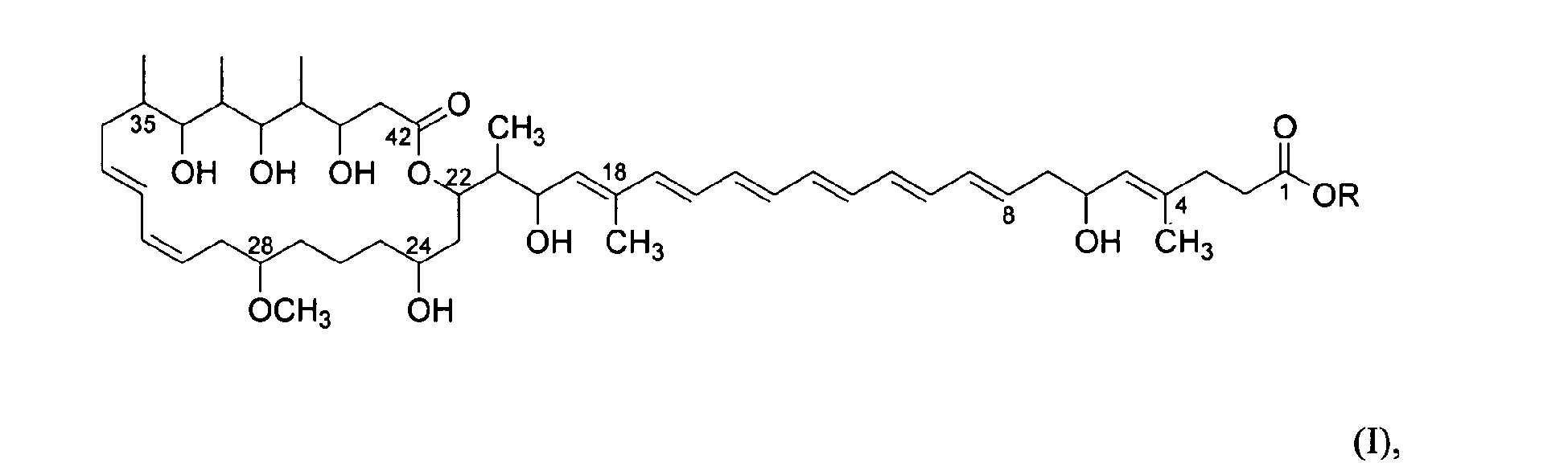
- Utilisation d'un composé selon la revendication 4, caractérisé par le fait que le groupe formant un ester est sélectionné à partir du groupe comprenant l'alkylène-oxy C1 à C12, les groupes aryle- oxy- arylalkyloxy- aryloxy-, benzoxy- ou phénolate, méthyle, éthyle, n-propyle, isopropyle, n-butyle, isobutyle, n-heptyle, n-isoheptyle, n-pentyle- ou isopentyle, n-hexyle, isohexyle ou un alkyle C7 à C12 linéaire, branché ou cyclique.
- Utilisation selon la revendication 5, caractérisé par le fait que la composition pharmaceutique a une activité antibactérienne, antivirale et/ou antirétrovirale.
- Processus destiné à la production d'un composé comprenant une structure selon la formule I

collection de la masse de la cellule,
extraction de la masse de la cellule,
concentration de l'extrait, caractérisée par la
formation d'un groupe d'ester à C1. - Processus selon la revendication 7, dans lequel l'extraction de la masse de la cellule est faite en recourant au méthanol, la concentration de l'extrait se faisant par évaporation du méthanol.
- Processus selon une des revendications 7 à 8, caractérisé par le fait que la culture se fait en présence d'une résine, la résine étant sujette à la collecte et à l'extraction en mélange ayant reçu l'ajout de la masse de la cellule.
- Processus selon une des revendications 7 à 9, caractérisé par le fait que la culture se fait en présence d'une résine, ou dans laquelle une résine est contactée avec le bouillon de fermentation suivant la culture, la résine étant séparée du bouillon de fermentation et extraite avec de l'alcool, et séparée de l'extrait alcoolique, opération suivie du retrait de l'alcool de l'extrait alcoolique afin de produire un premier résidu, et de l'extraction du résidu avec un solvant organique, en partageant l'extrait du solvant organique avec une solution tampon aqueuse jusqu'à déplacer le pH de l'extrait du solvant organique de pH 6,5 à 7,3, et en enlevant le solvant organique afin de produire un second résidu contenant de l'etnangien (1).
- Processus selon la revendication 10, caractérisé par le fait que l'alcool est du méthanol, le solvant organique étant de l'acétate d'éthyle, et l'enlèvement du solvant organique se faisant en présence de toluène.
- Processus selon une des revendications 7 à 11, caractérisé par le fait que la formation du groupe d'ester se fait en contactant un agent alkylant avec un pétrole brut résiduel obtenu à partir de l'acidification de l'extrait concentré, extraction de l'extrait acidifié avec un solvant organique, séparation de la phase de solvant organique et enlèvement du solvant.
- Processus selon la revendication 12, caractérisé par le fait que le solvant organique est de l'acétate d'éthyle.
- Processus selon une des revendications 7 à 13, caractérisé par le fait que l'agent alkylant est sélectionné à partir d'un diazoalkyle C1- à C12-.
Priority Applications (4)
| Application Number | Priority Date | Filing Date | Title |
|---|---|---|---|
| EP07108744A EP2014655B1 (fr) | 2007-05-23 | 2007-05-23 | Dérivés de l'etnangien et leur application comme antibiotiques |
| DE602007002190T DE602007002190D1 (de) | 2007-05-23 | 2007-05-23 | Etnangien-Derivate und Verwendung als Antibiotika |
| AT07108744T ATE440830T1 (de) | 2007-05-23 | 2007-05-23 | Etnangien-derivate und verwendung als antibiotika |
| PCT/EP2008/056109 WO2008142046A1 (fr) | 2007-05-23 | 2008-05-19 | Antibiotique |
Applications Claiming Priority (1)
| Application Number | Priority Date | Filing Date | Title |
|---|---|---|---|
| EP07108744A EP2014655B1 (fr) | 2007-05-23 | 2007-05-23 | Dérivés de l'etnangien et leur application comme antibiotiques |
Publications (3)
| Publication Number | Publication Date |
|---|---|
| EP2014655A2 EP2014655A2 (fr) | 2009-01-14 |
| EP2014655A3 EP2014655A3 (fr) | 2009-02-11 |
| EP2014655B1 true EP2014655B1 (fr) | 2009-08-26 |
Family
ID=38255139
Family Applications (1)
| Application Number | Title | Priority Date | Filing Date |
|---|---|---|---|
| EP07108744A Not-in-force EP2014655B1 (fr) | 2007-05-23 | 2007-05-23 | Dérivés de l'etnangien et leur application comme antibiotiques |
Country Status (4)
| Country | Link |
|---|---|
| EP (1) | EP2014655B1 (fr) |
| AT (1) | ATE440830T1 (fr) |
| DE (1) | DE602007002190D1 (fr) |
| WO (1) | WO2008142046A1 (fr) |
Families Citing this family (1)
| Publication number | Priority date | Publication date | Assignee | Title |
|---|---|---|---|---|
| GB201405361D0 (en) * | 2014-03-25 | 2014-05-07 | Univ Warwick | Compounds |
Family Cites Families (2)
| Publication number | Priority date | Publication date | Assignee | Title |
|---|---|---|---|---|
| DE19630980B4 (de) * | 1996-07-31 | 2007-04-19 | GESELLSCHAFT FüR BIOTECHNOLOGISCHE FORSCHUNG MBH (GBF) | Etnangien, Herstellung, Verwendung und Produktionsstamm sorangium cellulosum DSM 11 028 |
| EP1568781B1 (fr) * | 2004-02-25 | 2010-01-13 | Brain Ag | Macrolides qui modulent la mélanogénèse évalués sur un test d'activité sur de cellules de mammifères |
-
2007
- 2007-05-23 DE DE602007002190T patent/DE602007002190D1/de active Active
- 2007-05-23 EP EP07108744A patent/EP2014655B1/fr not_active Not-in-force
- 2007-05-23 AT AT07108744T patent/ATE440830T1/de not_active IP Right Cessation
-
2008
- 2008-05-19 WO PCT/EP2008/056109 patent/WO2008142046A1/fr not_active Ceased
Also Published As
| Publication number | Publication date |
|---|---|
| EP2014655A2 (fr) | 2009-01-14 |
| EP2014655A3 (fr) | 2009-02-11 |
| DE602007002190D1 (de) | 2009-10-08 |
| WO2008142046A1 (fr) | 2008-11-27 |
| ATE440830T1 (de) | 2009-09-15 |
Similar Documents
| Publication | Publication Date | Title |
|---|---|---|
| US4918174A (en) | Tiacumicin compounds | |
| Yazawa et al. | Inactivation of rifampin by Nocardia brasiliensis | |
| US4465674A (en) | Azahomoerythromycin D derivative and intermediates therefor | |
| EP0339681B1 (fr) | Substance antibiotique antitumorale | |
| US3853842A (en) | Esters of antibiotics b-5050 and tetrahydro-b-5050 | |
| KR850001666B1 (ko) | 마크로라이드 항생물질의 제조방법 | |
| EP2014655B1 (fr) | Dérivés de l'etnangien et leur application comme antibiotiques | |
| CS228517B2 (en) | Method for the production of macrolide | |
| US4277478A (en) | Antibiotic and use thereof | |
| CN112830949B (zh) | 海洋曲霉菌产生的抗真菌化合物及其制备方法 | |
| Kinoshita et al. | MYCINAMICINS, NEW MACROLIDE ANTIBIOTICS XIII. ISOLATION AND STRUCTURES OF NOVEL FERMENTATION PRODUCTS FROM Micromonospora griseorubida (FERM BP-705) | |
| EP0245012B1 (fr) | Méthode pour la préparation du 14-hydroxy-6-0-méthyl-érythromycine | |
| Tohyama et al. | Genome-inspired search for new antibiotics. Isolation and structure determination of new 28-membered polyketide macrolactones, halstoctacosanolides A and B, from Streptomyces halstedii HC34 | |
| KR100623405B1 (ko) | 반코레스마이신, 이의 제조방법 및 이를 포함하는 약제학적 조성물 | |
| US3988314A (en) | Compound U-50,228, derivatives thereof, and processes for preparation | |
| GB2079279A (en) | Process for preparing a macrolide | |
| EP0033433A1 (fr) | Macrolides antibiotiques, procédé pour leur préparation entre autres par fermentation, et compositions pharmaceutiques les contenant | |
| EP0046641B1 (fr) | Antibiotiques, préparation microbiologique d'antibiotiques et un micro-organisme | |
| EP0096900A1 (fr) | Dérivés d'antibiotiques macrolides | |
| EP0045157B1 (fr) | Antibiotiques macrolides, leur préparation et compositions vétérinaires les contenant | |
| Ruanglek et al. | Menisporopsin B, a new polyester from the seed fungus Menisporopsis theobromae BCC 4162 | |
| US4861775A (en) | Pharmacological use of phenoxazinones | |
| Kirst et al. | Preparation and evaluation of 3, 4"-ester derivatives of 16-membered macrolide antibiotics related to tylosin | |
| US6642391B2 (en) | Amycomycin, a process for its production and its use as a pharmaceutical | |
| EP0045205B1 (fr) | Macrolides |
Legal Events
| Date | Code | Title | Description |
|---|---|---|---|
| PUAI | Public reference made under article 153(3) epc to a published international application that has entered the european phase |
Free format text: ORIGINAL CODE: 0009012 |
|
| PUAI | Public reference made under article 153(3) epc to a published international application that has entered the european phase |
Free format text: ORIGINAL CODE: 0009012 |
|
| PUAL | Search report despatched |
Free format text: ORIGINAL CODE: 0009013 |
|
| 17P | Request for examination filed |
Effective date: 20070831 |
|
| AK | Designated contracting states |
Kind code of ref document: A2 Designated state(s): AT BE BG CH CY CZ DE DK EE ES FI FR GB GR HU IE IS IT LI LT LU LV MC MT NL PL PT RO SE SI SK TR |
|
| GRAP | Despatch of communication of intention to grant a patent |
Free format text: ORIGINAL CODE: EPIDOSNIGR1 |
|
| AK | Designated contracting states |
Kind code of ref document: A3 Designated state(s): AT BE BG CH CY CZ DE DK EE ES FI FR GB GR HU IE IS IT LI LT LU LV MC MT NL PL PT RO SE SI SK TR |
|
| GRAS | Grant fee paid |
Free format text: ORIGINAL CODE: EPIDOSNIGR3 |
|
| GRAA | (expected) grant |
Free format text: ORIGINAL CODE: 0009210 |
|
| AK | Designated contracting states |
Kind code of ref document: B1 Designated state(s): AT BE BG CH CY CZ DE DK EE ES FI FR GB GR HU IE IS IT LI LT LU LV MC MT NL PL PT RO SE SI SK TR |
|
| REG | Reference to a national code |
Ref country code: CH Ref legal event code: EP |
|
| REG | Reference to a national code |
Ref country code: IE Ref legal event code: FG4D |
|
| REF | Corresponds to: |
Ref document number: 602007002190 Country of ref document: DE Date of ref document: 20091008 Kind code of ref document: P |
|
| AKX | Designation fees paid |
Designated state(s): AT BE BG CH CY CZ DE DK EE ES FI FR GB GR HU IE IS IT LI LT LU LV MC MT NL PL PT RO SE SI SK TR |
|
| REG | Reference to a national code |
Ref country code: SE Ref legal event code: TRGR |
|
| LTIE | Lt: invalidation of european patent or patent extension |
Effective date: 20090826 |
|
| PG25 | Lapsed in a contracting state [announced via postgrant information from national office to epo] |
Ref country code: FI Free format text: LAPSE BECAUSE OF FAILURE TO SUBMIT A TRANSLATION OF THE DESCRIPTION OR TO PAY THE FEE WITHIN THE PRESCRIBED TIME-LIMIT Effective date: 20090826 Ref country code: IS Free format text: LAPSE BECAUSE OF FAILURE TO SUBMIT A TRANSLATION OF THE DESCRIPTION OR TO PAY THE FEE WITHIN THE PRESCRIBED TIME-LIMIT Effective date: 20091226 Ref country code: AT Free format text: LAPSE BECAUSE OF FAILURE TO SUBMIT A TRANSLATION OF THE DESCRIPTION OR TO PAY THE FEE WITHIN THE PRESCRIBED TIME-LIMIT Effective date: 20090826 Ref country code: LT Free format text: LAPSE BECAUSE OF FAILURE TO SUBMIT A TRANSLATION OF THE DESCRIPTION OR TO PAY THE FEE WITHIN THE PRESCRIBED TIME-LIMIT Effective date: 20090826 |
|
| NLV1 | Nl: lapsed or annulled due to failure to fulfill the requirements of art. 29p and 29m of the patents act | ||
| PG25 | Lapsed in a contracting state [announced via postgrant information from national office to epo] |
Ref country code: NL Free format text: LAPSE BECAUSE OF FAILURE TO SUBMIT A TRANSLATION OF THE DESCRIPTION OR TO PAY THE FEE WITHIN THE PRESCRIBED TIME-LIMIT Effective date: 20090826 Ref country code: PL Free format text: LAPSE BECAUSE OF FAILURE TO SUBMIT A TRANSLATION OF THE DESCRIPTION OR TO PAY THE FEE WITHIN THE PRESCRIBED TIME-LIMIT Effective date: 20090826 Ref country code: LV Free format text: LAPSE BECAUSE OF FAILURE TO SUBMIT A TRANSLATION OF THE DESCRIPTION OR TO PAY THE FEE WITHIN THE PRESCRIBED TIME-LIMIT Effective date: 20090826 Ref country code: SI Free format text: LAPSE BECAUSE OF FAILURE TO SUBMIT A TRANSLATION OF THE DESCRIPTION OR TO PAY THE FEE WITHIN THE PRESCRIBED TIME-LIMIT Effective date: 20090826 |
|
| PG25 | Lapsed in a contracting state [announced via postgrant information from national office to epo] |
Ref country code: PT Free format text: LAPSE BECAUSE OF FAILURE TO SUBMIT A TRANSLATION OF THE DESCRIPTION OR TO PAY THE FEE WITHIN THE PRESCRIBED TIME-LIMIT Effective date: 20091228 Ref country code: BG Free format text: LAPSE BECAUSE OF FAILURE TO SUBMIT A TRANSLATION OF THE DESCRIPTION OR TO PAY THE FEE WITHIN THE PRESCRIBED TIME-LIMIT Effective date: 20091126 Ref country code: CY Free format text: LAPSE BECAUSE OF FAILURE TO SUBMIT A TRANSLATION OF THE DESCRIPTION OR TO PAY THE FEE WITHIN THE PRESCRIBED TIME-LIMIT Effective date: 20090826 |
|
| PG25 | Lapsed in a contracting state [announced via postgrant information from national office to epo] |
Ref country code: DK Free format text: LAPSE BECAUSE OF FAILURE TO SUBMIT A TRANSLATION OF THE DESCRIPTION OR TO PAY THE FEE WITHIN THE PRESCRIBED TIME-LIMIT Effective date: 20090826 Ref country code: CZ Free format text: LAPSE BECAUSE OF FAILURE TO SUBMIT A TRANSLATION OF THE DESCRIPTION OR TO PAY THE FEE WITHIN THE PRESCRIBED TIME-LIMIT Effective date: 20090826 Ref country code: RO Free format text: LAPSE BECAUSE OF FAILURE TO SUBMIT A TRANSLATION OF THE DESCRIPTION OR TO PAY THE FEE WITHIN THE PRESCRIBED TIME-LIMIT Effective date: 20090826 Ref country code: EE Free format text: LAPSE BECAUSE OF FAILURE TO SUBMIT A TRANSLATION OF THE DESCRIPTION OR TO PAY THE FEE WITHIN THE PRESCRIBED TIME-LIMIT Effective date: 20090826 Ref country code: ES Free format text: LAPSE BECAUSE OF FAILURE TO SUBMIT A TRANSLATION OF THE DESCRIPTION OR TO PAY THE FEE WITHIN THE PRESCRIBED TIME-LIMIT Effective date: 20091207 |
|
| PG25 | Lapsed in a contracting state [announced via postgrant information from national office to epo] |
Ref country code: SK Free format text: LAPSE BECAUSE OF FAILURE TO SUBMIT A TRANSLATION OF THE DESCRIPTION OR TO PAY THE FEE WITHIN THE PRESCRIBED TIME-LIMIT Effective date: 20090826 |
|
| PG25 | Lapsed in a contracting state [announced via postgrant information from national office to epo] |
Ref country code: BE Free format text: LAPSE BECAUSE OF FAILURE TO SUBMIT A TRANSLATION OF THE DESCRIPTION OR TO PAY THE FEE WITHIN THE PRESCRIBED TIME-LIMIT Effective date: 20090826 |
|
| PG25 | Lapsed in a contracting state [announced via postgrant information from national office to epo] |
Ref country code: GR Free format text: LAPSE BECAUSE OF FAILURE TO SUBMIT A TRANSLATION OF THE DESCRIPTION OR TO PAY THE FEE WITHIN THE PRESCRIBED TIME-LIMIT Effective date: 20091127 |
|
| PLBE | No opposition filed within time limit |
Free format text: ORIGINAL CODE: 0009261 |
|
| STAA | Information on the status of an ep patent application or granted ep patent |
Free format text: STATUS: NO OPPOSITION FILED WITHIN TIME LIMIT |
|
| PG25 | Lapsed in a contracting state [announced via postgrant information from national office to epo] |
Ref country code: MC Free format text: LAPSE BECAUSE OF NON-PAYMENT OF DUE FEES Effective date: 20100531 |
|
| 26N | No opposition filed |
Effective date: 20100527 |
|
| PG25 | Lapsed in a contracting state [announced via postgrant information from national office to epo] |
Ref country code: IT Free format text: LAPSE BECAUSE OF FAILURE TO SUBMIT A TRANSLATION OF THE DESCRIPTION OR TO PAY THE FEE WITHIN THE PRESCRIBED TIME-LIMIT Effective date: 20090826 |
|
| PG25 | Lapsed in a contracting state [announced via postgrant information from national office to epo] |
Ref country code: IE Free format text: LAPSE BECAUSE OF NON-PAYMENT OF DUE FEES Effective date: 20100523 Ref country code: MT Free format text: LAPSE BECAUSE OF FAILURE TO SUBMIT A TRANSLATION OF THE DESCRIPTION OR TO PAY THE FEE WITHIN THE PRESCRIBED TIME-LIMIT Effective date: 20090826 |
|
| PG25 | Lapsed in a contracting state [announced via postgrant information from national office to epo] |
Ref country code: LU Free format text: LAPSE BECAUSE OF NON-PAYMENT OF DUE FEES Effective date: 20100523 Ref country code: HU Free format text: LAPSE BECAUSE OF FAILURE TO SUBMIT A TRANSLATION OF THE DESCRIPTION OR TO PAY THE FEE WITHIN THE PRESCRIBED TIME-LIMIT Effective date: 20100227 |
|
| PG25 | Lapsed in a contracting state [announced via postgrant information from national office to epo] |
Ref country code: TR Free format text: LAPSE BECAUSE OF FAILURE TO SUBMIT A TRANSLATION OF THE DESCRIPTION OR TO PAY THE FEE WITHIN THE PRESCRIBED TIME-LIMIT Effective date: 20090826 |
|
| PGFP | Annual fee paid to national office [announced via postgrant information from national office to epo] |
Ref country code: GB Payment date: 20140520 Year of fee payment: 8 |
|
| PGFP | Annual fee paid to national office [announced via postgrant information from national office to epo] |
Ref country code: SE Payment date: 20140520 Year of fee payment: 8 Ref country code: CH Payment date: 20140522 Year of fee payment: 8 Ref country code: DE Payment date: 20140520 Year of fee payment: 8 |
|
| REG | Reference to a national code |
Ref country code: FR Ref legal event code: PLFP Year of fee payment: 9 |
|
| PGFP | Annual fee paid to national office [announced via postgrant information from national office to epo] |
Ref country code: FR Payment date: 20150519 Year of fee payment: 9 |
|
| REG | Reference to a national code |
Ref country code: DE Ref legal event code: R119 Ref document number: 602007002190 Country of ref document: DE |
|
| REG | Reference to a national code |
Ref country code: CH Ref legal event code: PL |
|
| GBPC | Gb: european patent ceased through non-payment of renewal fee |
Effective date: 20150523 |
|
| PG25 | Lapsed in a contracting state [announced via postgrant information from national office to epo] |
Ref country code: CH Free format text: LAPSE BECAUSE OF NON-PAYMENT OF DUE FEES Effective date: 20150531 Ref country code: LI Free format text: LAPSE BECAUSE OF NON-PAYMENT OF DUE FEES Effective date: 20150531 |
|
| PG25 | Lapsed in a contracting state [announced via postgrant information from national office to epo] |
Ref country code: SE Free format text: LAPSE BECAUSE OF NON-PAYMENT OF DUE FEES Effective date: 20150524 |
|
| PG25 | Lapsed in a contracting state [announced via postgrant information from national office to epo] |
Ref country code: DE Free format text: LAPSE BECAUSE OF NON-PAYMENT OF DUE FEES Effective date: 20151201 Ref country code: GB Free format text: LAPSE BECAUSE OF NON-PAYMENT OF DUE FEES Effective date: 20150523 |
|
| REG | Reference to a national code |
Ref country code: FR Ref legal event code: ST Effective date: 20170131 |
|
| PG25 | Lapsed in a contracting state [announced via postgrant information from national office to epo] |
Ref country code: FR Free format text: LAPSE BECAUSE OF NON-PAYMENT OF DUE FEES Effective date: 20160531 |