EP2014727B1 - Revêtement hydrophile - Google Patents
Revêtement hydrophile Download PDFInfo
- Publication number
- EP2014727B1 EP2014727B1 EP08157390A EP08157390A EP2014727B1 EP 2014727 B1 EP2014727 B1 EP 2014727B1 EP 08157390 A EP08157390 A EP 08157390A EP 08157390 A EP08157390 A EP 08157390A EP 2014727 B1 EP2014727 B1 EP 2014727B1
- Authority
- EP
- European Patent Office
- Prior art keywords
- coating
- coating lacquer
- lacquer according
- channel
- surface tension
- Prior art date
- Legal status (The legal status is an assumption and is not a legal conclusion. Google has not performed a legal analysis and makes no representation as to the accuracy of the status listed.)
- Revoked
Links
- 238000000576 coating method Methods 0.000 title claims abstract description 132
- 239000011248 coating agent Substances 0.000 title claims abstract description 123
- 239000007788 liquid Substances 0.000 claims abstract description 49
- 238000012360 testing method Methods 0.000 claims abstract description 40
- 239000004094 surface-active agent Substances 0.000 claims abstract description 34
- XLYOFNOQVPJJNP-UHFFFAOYSA-N water Substances O XLYOFNOQVPJJNP-UHFFFAOYSA-N 0.000 claims abstract description 27
- 239000011230 binding agent Substances 0.000 claims abstract description 16
- 238000001035 drying Methods 0.000 claims abstract description 14
- 239000002904 solvent Substances 0.000 claims abstract description 11
- 239000007864 aqueous solution Substances 0.000 claims abstract description 10
- 239000000654 additive Substances 0.000 claims abstract description 6
- 239000008367 deionised water Substances 0.000 claims abstract description 6
- 229910021641 deionized water Inorganic materials 0.000 claims abstract description 6
- PYUYQYBDJFMFTH-WMMMYUQOSA-N naphthol red Chemical compound CCOC1=CC=CC=C1NC(=O)C(C1=O)=CC2=CC=CC=C2\C1=N\NC1=CC=C(C(N)=O)C=C1 PYUYQYBDJFMFTH-WMMMYUQOSA-N 0.000 claims abstract description 5
- 239000004922 lacquer Substances 0.000 claims description 59
- 238000007639 printing Methods 0.000 claims description 31
- 238000000034 method Methods 0.000 claims description 19
- 229920002451 polyvinyl alcohol Polymers 0.000 claims description 15
- LFQSCWFLJHTTHZ-UHFFFAOYSA-N Ethanol Chemical compound CCO LFQSCWFLJHTTHZ-UHFFFAOYSA-N 0.000 claims description 13
- 238000003860 storage Methods 0.000 claims description 11
- 239000000463 material Substances 0.000 claims description 10
- 229920000642 polymer Polymers 0.000 claims description 10
- 230000008569 process Effects 0.000 claims description 10
- 238000006243 chemical reaction Methods 0.000 claims description 9
- 239000000126 substance Substances 0.000 claims description 9
- 239000004372 Polyvinyl alcohol Substances 0.000 claims description 7
- 229920001577 copolymer Polymers 0.000 claims description 6
- 229920002037 poly(vinyl butyral) polymer Polymers 0.000 claims description 6
- 238000004458 analytical method Methods 0.000 claims description 5
- 150000001412 amines Chemical class 0.000 claims description 4
- 239000003945 anionic surfactant Substances 0.000 claims description 4
- 239000000758 substrate Substances 0.000 claims description 4
- 239000001913 cellulose Substances 0.000 claims description 3
- 229920002678 cellulose Polymers 0.000 claims description 3
- 229920001225 polyester resin Polymers 0.000 claims description 3
- 239000004645 polyester resin Substances 0.000 claims description 3
- 229920005989 resin Polymers 0.000 claims description 3
- 239000011347 resin Substances 0.000 claims description 3
- QGZKDVFQNNGYKY-UHFFFAOYSA-O Ammonium Chemical compound [NH4+] QGZKDVFQNNGYKY-UHFFFAOYSA-O 0.000 claims description 2
- 125000003158 alcohol group Chemical group 0.000 claims description 2
- 150000001408 amides Chemical class 0.000 claims description 2
- 229920003169 water-soluble polymer Polymers 0.000 claims description 2
- MUBZPKHOEPUJKR-UHFFFAOYSA-N Oxalic acid Chemical compound OC(=O)C(O)=O MUBZPKHOEPUJKR-UHFFFAOYSA-N 0.000 claims 1
- VZCYOOQTPOCHFL-UPHRSURJSA-N maleic acid Chemical compound OC(=O)\C=C/C(O)=O VZCYOOQTPOCHFL-UPHRSURJSA-N 0.000 claims 1
- 239000002798 polar solvent Substances 0.000 claims 1
- 150000003839 salts Chemical class 0.000 claims 1
- VZCYOOQTPOCHFL-UHFFFAOYSA-N trans-butenedioic acid Natural products OC(=O)C=CC(O)=O VZCYOOQTPOCHFL-UHFFFAOYSA-N 0.000 claims 1
- 239000000693 micelle Substances 0.000 abstract description 5
- 239000003973 paint Substances 0.000 abstract 3
- 239000010408 film Substances 0.000 description 17
- 238000009736 wetting Methods 0.000 description 16
- 239000007787 solid Substances 0.000 description 14
- 229920002799 BoPET Polymers 0.000 description 12
- 238000004873 anchoring Methods 0.000 description 10
- 239000013060 biological fluid Substances 0.000 description 10
- 239000003795 chemical substances by application Substances 0.000 description 10
- 239000002966 varnish Substances 0.000 description 10
- 229920006267 polyester film Polymers 0.000 description 9
- 239000012530 fluid Substances 0.000 description 8
- -1 for example Substances 0.000 description 8
- 235000019422 polyvinyl alcohol Nutrition 0.000 description 8
- 230000032683 aging Effects 0.000 description 7
- 239000000243 solution Substances 0.000 description 7
- OKTJSMMVPCPJKN-UHFFFAOYSA-N Carbon Chemical compound [C] OKTJSMMVPCPJKN-UHFFFAOYSA-N 0.000 description 6
- YXFVVABEGXRONW-UHFFFAOYSA-N Toluene Chemical compound CC1=CC=CC=C1 YXFVVABEGXRONW-UHFFFAOYSA-N 0.000 description 6
- 150000001298 alcohols Chemical class 0.000 description 6
- 238000007641 inkjet printing Methods 0.000 description 6
- 238000005259 measurement Methods 0.000 description 6
- 238000003756 stirring Methods 0.000 description 6
- 230000015572 biosynthetic process Effects 0.000 description 5
- 239000008280 blood Substances 0.000 description 5
- 210000004369 blood Anatomy 0.000 description 5
- 230000002209 hydrophobic effect Effects 0.000 description 5
- 229920000139 polyethylene terephthalate Polymers 0.000 description 5
- 239000005020 polyethylene terephthalate Substances 0.000 description 5
- LRHPLDYGYMQRHN-UHFFFAOYSA-N N-Butanol Chemical compound CCCCO LRHPLDYGYMQRHN-UHFFFAOYSA-N 0.000 description 4
- 239000000853 adhesive Substances 0.000 description 4
- 230000001070 adhesive effect Effects 0.000 description 4
- 239000002390 adhesive tape Substances 0.000 description 4
- 125000000217 alkyl group Chemical group 0.000 description 4
- 238000001514 detection method Methods 0.000 description 4
- 230000000694 effects Effects 0.000 description 4
- 230000007062 hydrolysis Effects 0.000 description 4
- 238000006460 hydrolysis reaction Methods 0.000 description 4
- 229920000036 polyvinylpyrrolidone Polymers 0.000 description 4
- 239000001267 polyvinylpyrrolidone Substances 0.000 description 4
- 235000013855 polyvinylpyrrolidone Nutrition 0.000 description 4
- 239000002994 raw material Substances 0.000 description 4
- 238000011282 treatment Methods 0.000 description 4
- 102000004190 Enzymes Human genes 0.000 description 3
- 108090000790 Enzymes Proteins 0.000 description 3
- XEKOWRVHYACXOJ-UHFFFAOYSA-N Ethyl acetate Chemical compound CCOC(C)=O XEKOWRVHYACXOJ-UHFFFAOYSA-N 0.000 description 3
- KWYUFKZDYYNOTN-UHFFFAOYSA-M Potassium hydroxide Chemical compound [OH-].[K+] KWYUFKZDYYNOTN-UHFFFAOYSA-M 0.000 description 3
- 239000004820 Pressure-sensitive adhesive Substances 0.000 description 3
- XTXRWKRVRITETP-UHFFFAOYSA-N Vinyl acetate Chemical compound CC(=O)OC=C XTXRWKRVRITETP-UHFFFAOYSA-N 0.000 description 3
- 125000000129 anionic group Chemical group 0.000 description 3
- 238000005530 etching Methods 0.000 description 3
- 239000007789 gas Substances 0.000 description 3
- VLKZOEOYAKHREP-UHFFFAOYSA-N n-Hexane Chemical compound CCCCCC VLKZOEOYAKHREP-UHFFFAOYSA-N 0.000 description 3
- 229920000728 polyester Polymers 0.000 description 3
- 229920000151 polyglycol Polymers 0.000 description 3
- 239000010695 polyglycol Substances 0.000 description 3
- 239000004814 polyurethane Substances 0.000 description 3
- 229920002689 polyvinyl acetate Polymers 0.000 description 3
- 239000011118 polyvinyl acetate Substances 0.000 description 3
- 239000004800 polyvinyl chloride Substances 0.000 description 3
- 229920000915 polyvinyl chloride Polymers 0.000 description 3
- 230000009467 reduction Effects 0.000 description 3
- 238000007650 screen-printing Methods 0.000 description 3
- ZWEHNKRNPOVVGH-UHFFFAOYSA-N 2-Butanone Chemical compound CCC(C)=O ZWEHNKRNPOVVGH-UHFFFAOYSA-N 0.000 description 2
- ZTQSAGDEMFDKMZ-UHFFFAOYSA-N Butyraldehyde Chemical compound CCCC=O ZTQSAGDEMFDKMZ-UHFFFAOYSA-N 0.000 description 2
- WQZGKKKJIJFFOK-GASJEMHNSA-N Glucose Natural products OC[C@H]1OC(O)[C@H](O)[C@@H](O)[C@@H]1O WQZGKKKJIJFFOK-GASJEMHNSA-N 0.000 description 2
- KFZMGEQAYNKOFK-UHFFFAOYSA-N Isopropanol Chemical compound CC(C)O KFZMGEQAYNKOFK-UHFFFAOYSA-N 0.000 description 2
- 229920002845 Poly(methacrylic acid) Polymers 0.000 description 2
- 239000002202 Polyethylene glycol Substances 0.000 description 2
- 239000004743 Polypropylene Substances 0.000 description 2
- ULUAUXLGCMPNKK-UHFFFAOYSA-N Sulfobutanedioic acid Chemical compound OC(=O)CC(C(O)=O)S(O)(=O)=O ULUAUXLGCMPNKK-UHFFFAOYSA-N 0.000 description 2
- QAOWNCQODCNURD-UHFFFAOYSA-N Sulfuric acid Chemical compound OS(O)(=O)=O QAOWNCQODCNURD-UHFFFAOYSA-N 0.000 description 2
- 229920004482 WACKER® Polymers 0.000 description 2
- 230000001133 acceleration Effects 0.000 description 2
- DHKHKXVYLBGOIT-UHFFFAOYSA-N acetaldehyde Diethyl Acetal Natural products CCOC(C)OCC DHKHKXVYLBGOIT-UHFFFAOYSA-N 0.000 description 2
- 239000002253 acid Substances 0.000 description 2
- 239000000443 aerosol Substances 0.000 description 2
- 125000006177 alkyl benzyl group Chemical group 0.000 description 2
- 125000003178 carboxy group Chemical group [H]OC(*)=O 0.000 description 2
- 150000001735 carboxylic acids Chemical class 0.000 description 2
- 125000002091 cationic group Chemical group 0.000 description 2
- HVYWMOMLDIMFJA-DPAQBDIFSA-N cholesterol Chemical compound C1C=C2C[C@@H](O)CC[C@]2(C)[C@@H]2[C@@H]1[C@@H]1CC[C@H]([C@H](C)CCCC(C)C)[C@@]1(C)CC2 HVYWMOMLDIMFJA-DPAQBDIFSA-N 0.000 description 2
- 239000013039 cover film Substances 0.000 description 2
- 230000001419 dependent effect Effects 0.000 description 2
- 238000011161 development Methods 0.000 description 2
- 230000018109 developmental process Effects 0.000 description 2
- 238000002405 diagnostic procedure Methods 0.000 description 2
- 239000006185 dispersion Substances 0.000 description 2
- 238000004049 embossing Methods 0.000 description 2
- 238000005516 engineering process Methods 0.000 description 2
- 150000002148 esters Chemical class 0.000 description 2
- 150000002170 ethers Chemical class 0.000 description 2
- 239000000945 filler Substances 0.000 description 2
- 239000008103 glucose Substances 0.000 description 2
- 230000005484 gravity Effects 0.000 description 2
- 229920001600 hydrophobic polymer Polymers 0.000 description 2
- 239000000976 ink Substances 0.000 description 2
- 230000003993 interaction Effects 0.000 description 2
- 150000002576 ketones Chemical class 0.000 description 2
- 239000010410 layer Substances 0.000 description 2
- 239000012528 membrane Substances 0.000 description 2
- 238000012986 modification Methods 0.000 description 2
- 230000004048 modification Effects 0.000 description 2
- 239000002736 nonionic surfactant Substances 0.000 description 2
- 150000003009 phosphonic acids Chemical class 0.000 description 2
- 235000011007 phosphoric acid Nutrition 0.000 description 2
- 150000003016 phosphoric acids Chemical class 0.000 description 2
- 229920003023 plastic Polymers 0.000 description 2
- 239000004033 plastic Substances 0.000 description 2
- 229920000768 polyamine Polymers 0.000 description 2
- 229920001223 polyethylene glycol Polymers 0.000 description 2
- 229920001522 polyglycol ester Polymers 0.000 description 2
- 229920001155 polypropylene Polymers 0.000 description 2
- 229920002635 polyurethane Polymers 0.000 description 2
- 238000004904 shortening Methods 0.000 description 2
- 125000005373 siloxane group Chemical group [SiH2](O*)* 0.000 description 2
- 238000005507 spraying Methods 0.000 description 2
- 238000010561 standard procedure Methods 0.000 description 2
- 230000003068 static effect Effects 0.000 description 2
- 150000003460 sulfonic acids Chemical class 0.000 description 2
- 150000003467 sulfuric acid derivatives Chemical class 0.000 description 2
- 238000010998 test method Methods 0.000 description 2
- GPRLSGONYQIRFK-MNYXATJNSA-N triton Chemical compound [3H+] GPRLSGONYQIRFK-MNYXATJNSA-N 0.000 description 2
- 229920002554 vinyl polymer Polymers 0.000 description 2
- ODIGIKRIUKFKHP-UHFFFAOYSA-N (n-propan-2-yloxycarbonylanilino) acetate Chemical compound CC(C)OC(=O)N(OC(C)=O)C1=CC=CC=C1 ODIGIKRIUKFKHP-UHFFFAOYSA-N 0.000 description 1
- ZNQVEEAIQZEUHB-UHFFFAOYSA-N 2-ethoxyethanol Chemical compound CCOCCO ZNQVEEAIQZEUHB-UHFFFAOYSA-N 0.000 description 1
- QTBSBXVTEAMEQO-UHFFFAOYSA-N Acetic acid Chemical group CC(O)=O QTBSBXVTEAMEQO-UHFFFAOYSA-N 0.000 description 1
- HRPVXLWXLXDGHG-UHFFFAOYSA-N Acrylamide Chemical class NC(=O)C=C HRPVXLWXLXDGHG-UHFFFAOYSA-N 0.000 description 1
- NLXLAEXVIDQMFP-UHFFFAOYSA-N Ammonium chloride Substances [NH4+].[Cl-] NLXLAEXVIDQMFP-UHFFFAOYSA-N 0.000 description 1
- VHUUQVKOLVNVRT-UHFFFAOYSA-N Ammonium hydroxide Chemical compound [NH4+].[OH-] VHUUQVKOLVNVRT-UHFFFAOYSA-N 0.000 description 1
- 238000012935 Averaging Methods 0.000 description 1
- 229920002134 Carboxymethyl cellulose Polymers 0.000 description 1
- 238000000018 DNA microarray Methods 0.000 description 1
- IMROMDMJAWUWLK-UHFFFAOYSA-N Ethenol Chemical compound OC=C IMROMDMJAWUWLK-UHFFFAOYSA-N 0.000 description 1
- PXGOKWXKJXAPGV-UHFFFAOYSA-N Fluorine Chemical compound FF PXGOKWXKJXAPGV-UHFFFAOYSA-N 0.000 description 1
- COLNVLDHVKWLRT-QMMMGPOBSA-N L-phenylalanine Chemical compound OC(=O)[C@@H](N)CC1=CC=CC=C1 COLNVLDHVKWLRT-QMMMGPOBSA-N 0.000 description 1
- 229920002292 Nylon 6 Polymers 0.000 description 1
- 239000004952 Polyamide Chemical class 0.000 description 1
- 239000004698 Polyethylene Substances 0.000 description 1
- 229920001328 Polyvinylidene chloride Polymers 0.000 description 1
- 238000006359 acetalization reaction Methods 0.000 description 1
- 150000007513 acids Chemical class 0.000 description 1
- 239000003522 acrylic cement Substances 0.000 description 1
- 150000001335 aliphatic alkanes Chemical class 0.000 description 1
- XAGFODPZIPBFFR-UHFFFAOYSA-N aluminium Chemical compound [Al] XAGFODPZIPBFFR-UHFFFAOYSA-N 0.000 description 1
- 229910052782 aluminium Inorganic materials 0.000 description 1
- 235000011114 ammonium hydroxide Nutrition 0.000 description 1
- 150000003863 ammonium salts Chemical class 0.000 description 1
- 239000002280 amphoteric surfactant Substances 0.000 description 1
- 238000007774 anilox coating Methods 0.000 description 1
- 239000003963 antioxidant agent Substances 0.000 description 1
- WQZGKKKJIJFFOK-VFUOTHLCSA-N beta-D-glucose Chemical compound OC[C@H]1O[C@@H](O)[C@H](O)[C@@H](O)[C@@H]1O WQZGKKKJIJFFOK-VFUOTHLCSA-N 0.000 description 1
- 239000011127 biaxially oriented polypropylene Substances 0.000 description 1
- 229920006378 biaxially oriented polypropylene Polymers 0.000 description 1
- 238000009835 boiling Methods 0.000 description 1
- 239000001768 carboxy methyl cellulose Substances 0.000 description 1
- 235000010948 carboxy methyl cellulose Nutrition 0.000 description 1
- 150000007942 carboxylates Chemical class 0.000 description 1
- 239000008112 carboxymethyl-cellulose Substances 0.000 description 1
- 239000012876 carrier material Substances 0.000 description 1
- 239000003093 cationic surfactant Substances 0.000 description 1
- 210000004027 cell Anatomy 0.000 description 1
- 229920002301 cellulose acetate Polymers 0.000 description 1
- 238000007385 chemical modification Methods 0.000 description 1
- 239000003153 chemical reaction reagent Substances 0.000 description 1
- 235000012000 cholesterol Nutrition 0.000 description 1
- KRVSOGSZCMJSLX-UHFFFAOYSA-L chromic acid Substances O[Cr](O)(=O)=O KRVSOGSZCMJSLX-UHFFFAOYSA-L 0.000 description 1
- 239000000084 colloidal system Substances 0.000 description 1
- 239000003086 colorant Substances 0.000 description 1
- 150000001875 compounds Chemical class 0.000 description 1
- 238000009833 condensation Methods 0.000 description 1
- 230000005494 condensation Effects 0.000 description 1
- 239000004020 conductor Substances 0.000 description 1
- 238000010276 construction Methods 0.000 description 1
- 239000012050 conventional carrier Substances 0.000 description 1
- 230000036461 convulsion Effects 0.000 description 1
- NZZFYRREKKOMAT-UHFFFAOYSA-N diiodomethane Chemical compound ICI NZZFYRREKKOMAT-UHFFFAOYSA-N 0.000 description 1
- KPUWHANPEXNPJT-UHFFFAOYSA-N disiloxane Chemical class [SiH3]O[SiH3] KPUWHANPEXNPJT-UHFFFAOYSA-N 0.000 description 1
- 239000000975 dye Substances 0.000 description 1
- 230000032050 esterification Effects 0.000 description 1
- 238000005886 esterification reaction Methods 0.000 description 1
- 238000011156 evaluation Methods 0.000 description 1
- 238000002474 experimental method Methods 0.000 description 1
- 239000004744 fabric Substances 0.000 description 1
- 150000002191 fatty alcohols Chemical class 0.000 description 1
- 238000007647 flexography Methods 0.000 description 1
- 239000007850 fluorescent dye Substances 0.000 description 1
- 229910052731 fluorine Inorganic materials 0.000 description 1
- 239000011737 fluorine Substances 0.000 description 1
- 235000013305 food Nutrition 0.000 description 1
- 125000000524 functional group Chemical group 0.000 description 1
- 238000011990 functional testing Methods 0.000 description 1
- AWJWCTOOIBYHON-UHFFFAOYSA-N furo[3,4-b]pyrazine-5,7-dione Chemical compound C1=CN=C2C(=O)OC(=O)C2=N1 AWJWCTOOIBYHON-UHFFFAOYSA-N 0.000 description 1
- 238000007756 gravure coating Methods 0.000 description 1
- 238000005534 hematocrit Methods 0.000 description 1
- 229920001519 homopolymer Polymers 0.000 description 1
- 229920001477 hydrophilic polymer Polymers 0.000 description 1
- 230000005660 hydrophilic surface Effects 0.000 description 1
- 125000002887 hydroxy group Chemical group [H]O* 0.000 description 1
- 238000003018 immunoassay Methods 0.000 description 1
- 239000003112 inhibitor Substances 0.000 description 1
- 238000001746 injection moulding Methods 0.000 description 1
- 239000001023 inorganic pigment Substances 0.000 description 1
- 238000011835 investigation Methods 0.000 description 1
- 229920000554 ionomer Polymers 0.000 description 1
- 238000002032 lab-on-a-chip Methods 0.000 description 1
- 239000002346 layers by function Substances 0.000 description 1
- 239000011159 matrix material Substances 0.000 description 1
- 239000000203 mixture Substances 0.000 description 1
- 239000004745 nonwoven fabric Substances 0.000 description 1
- 230000003647 oxidation Effects 0.000 description 1
- 238000007254 oxidation reaction Methods 0.000 description 1
- 230000001590 oxidative effect Effects 0.000 description 1
- 238000004806 packaging method and process Methods 0.000 description 1
- 244000052769 pathogen Species 0.000 description 1
- COLNVLDHVKWLRT-UHFFFAOYSA-N phenylalanine Natural products OC(=O)C(N)CC1=CC=CC=C1 COLNVLDHVKWLRT-UHFFFAOYSA-N 0.000 description 1
- 238000009832 plasma treatment Methods 0.000 description 1
- 239000003495 polar organic solvent Substances 0.000 description 1
- 229920006112 polar polymer Polymers 0.000 description 1
- 229920000058 polyacrylate Polymers 0.000 description 1
- 229920002647 polyamide Chemical class 0.000 description 1
- 239000004417 polycarbonate Substances 0.000 description 1
- 229920000515 polycarbonate Polymers 0.000 description 1
- 229920000573 polyethylene Polymers 0.000 description 1
- 229920001451 polypropylene glycol Chemical class 0.000 description 1
- 229920001296 polysiloxane Polymers 0.000 description 1
- 239000005033 polyvinylidene chloride Substances 0.000 description 1
- 239000012286 potassium permanganate Substances 0.000 description 1
- 102000004169 proteins and genes Human genes 0.000 description 1
- 108090000623 proteins and genes Proteins 0.000 description 1
- 238000011160 research Methods 0.000 description 1
- 230000004044 response Effects 0.000 description 1
- 238000007761 roller coating Methods 0.000 description 1
- 210000003296 saliva Anatomy 0.000 description 1
- 238000005488 sandblasting Methods 0.000 description 1
- 229920005573 silicon-containing polymer Polymers 0.000 description 1
- 230000007480 spreading Effects 0.000 description 1
- 238000003892 spreading Methods 0.000 description 1
- 239000003381 stabilizer Substances 0.000 description 1
- 239000010421 standard material Substances 0.000 description 1
- 238000004381 surface treatment Methods 0.000 description 1
- 229920001169 thermoplastic Polymers 0.000 description 1
- 239000004416 thermosoftening plastic Substances 0.000 description 1
- YNJBWRMUSHSURL-UHFFFAOYSA-N trichloroacetic acid Chemical compound OC(=O)C(Cl)(Cl)Cl YNJBWRMUSHSURL-UHFFFAOYSA-N 0.000 description 1
- 210000002700 urine Anatomy 0.000 description 1
- 238000007740 vapor deposition Methods 0.000 description 1
Images

Classifications
-
- G—PHYSICS
- G01—MEASURING; TESTING
- G01N—INVESTIGATING OR ANALYSING MATERIALS BY DETERMINING THEIR CHEMICAL OR PHYSICAL PROPERTIES
- G01N33/00—Investigating or analysing materials by specific methods not covered by groups G01N1/00 - G01N31/00
- G01N33/48—Biological material, e.g. blood, urine; Haemocytometers
- G01N33/50—Chemical analysis of biological material, e.g. blood, urine; Testing involving biospecific ligand binding methods; Immunological testing
- G01N33/53—Immunoassay; Biospecific binding assay; Materials therefor
- G01N33/543—Immunoassay; Biospecific binding assay; Materials therefor with an insoluble carrier for immobilising immunochemicals
- G01N33/54393—Improving reaction conditions or stability, e.g. by coating or irradiation of surface, by reduction of non-specific binding, by promotion of specific binding
-
- C—CHEMISTRY; METALLURGY
- C09—DYES; PAINTS; POLISHES; NATURAL RESINS; ADHESIVES; COMPOSITIONS NOT OTHERWISE PROVIDED FOR; APPLICATIONS OF MATERIALS NOT OTHERWISE PROVIDED FOR
- C09D—COATING COMPOSITIONS, e.g. PAINTS, VARNISHES OR LACQUERS; FILLING PASTES; CHEMICAL PAINT OR INK REMOVERS; INKS; CORRECTING FLUIDS; WOODSTAINS; PASTES OR SOLIDS FOR COLOURING OR PRINTING; USE OF MATERIALS THEREFOR
- C09D7/00—Features of coating compositions, not provided for in group C09D5/00; Processes for incorporating ingredients in coating compositions
- C09D7/40—Additives
- C09D7/47—Levelling agents
-
- C—CHEMISTRY; METALLURGY
- C08—ORGANIC MACROMOLECULAR COMPOUNDS; THEIR PREPARATION OR CHEMICAL WORKING-UP; COMPOSITIONS BASED THEREON
- C08K—Use of inorganic or non-macromolecular organic substances as compounding ingredients
- C08K5/00—Use of organic ingredients
- C08K5/36—Sulfur-, selenium-, or tellurium-containing compounds
- C08K5/41—Compounds containing sulfur bound to oxygen
- C08K5/42—Sulfonic acids; Derivatives thereof
Definitions
- the present invention relates to a hydrophilic coating varnish which, after drying, enables a permanent rapid spreading or a permanent, rapid transport of biological fluids such as, for example, blood, urine, saliva or cell fluid in biosensors or analytical test strips and which is preferably applied in a printing process.
- biological fluids such as, for example, blood, urine, saliva or cell fluid in biosensors or analytical test strips and which is preferably applied in a printing process.
- biosensors In modern medical diagnostics, an increasing number of analytical test strips, so-called diagnostic test strips, and biosensors are used. These include so-called microfluidic devices and lab-on-a-chip applications. With the help of biosensors, for example, biological fluids can be examined for pathogens, incompatibilities, DNA or enzyme activity and for the content of glucose, cholesterol, proteins, ketones, phenylalanine or enzymes.
- Detection reactions or reaction cascades take place on the biosensors or test strips.
- the biological test fluid must be transported to the reaction site or different reaction sites.
- the modern biosensors and test strips therefore consist of at least one microchannel or a microchannel system through which the test fluid is transported.
- the microchannels typically have a height and width of 5 to 1500 ⁇ m. Transport within the channels is by capillary or centrifugal forces.
- the results of the detection reactions are usually read optically or electrochemically.
- Typical applications include microfluidic devices (for example US 2002/0112961 A1 . US 6,601,613 B2 . US 7,125,711 B2 . EP 1 525 916 A1 ), Biosensors (for example DE 102 34 564 A1 . US 5,759,364 A1 ) and blood glucose test strips (for example WO 2005/033698 A1 . US 5,997,817 A1 ) mentioned.
- Other exemplary applications are DNA microarrays and immunoassays.
- FIG. 1 a illustrates Equation 1.
- FIG. 1b illustrates Equation 1.
- Equations 1 and 2 show that the capillary forces increase with smaller capillary diameter or plate spacing. A reduction in the flow rate in a capillary can therefore be achieved by increasing the cross section of a microchannel. Another important parameter in influencing the flow rate of a given liquid is the surface tension of the channel inside, whereas for a given liquid the viscosity as a parameter can not be varied.
- a capillary ascension that is, the liquid rises in the capillary.
- the fluid is forced out of the capillary ( W. Bohl "Technical Fluid Mechanics", 13th, revised and expanded edition, Vogel Verlag, June 2005, ISBN: 3834330299, page 37f ).
- surfactants are molecules or polymers consisting of a non-polar / hydrophobic part (tail) and a polar / hydrophilic group (head).
- tail non-polar / hydrophobic part
- head polar / hydrophilic group
- the surfactants are added to the aqueous liquid.
- the surfactant causes a lowering of the surface tension of the aqueous liquid at the interfaces (liquid-solid and liquid-gaseous). This effect of improving the wettability of the surfaces is measurable in a reduction of the contact angle and in the reduction of the surface tension of the liquid.
- anionic, cationic, amphoteric and nonionic surfactants are molecules or polymers consisting of a non-polar / hydrophobic part (tail) and a polar / hydrophilic group (head).
- the hydrophobic tail of surfactants may consist of linear or branched alkyl, alkylbenzyl, perfluorinated alkyl or siloxane groups.
- Possible hydrophilic head groups are anionic salts of carboxylic acids, phosphoric acids, phosphonic acids, sulfates, sulfonic acids or succinic esters, cationic Ammonium salts or nonionic polyglycosides, polyamines, polyglycol esters, polyglycol ethers, polyglycolamines, polyfunctional alcohols or alcohol ethoxylates (see also Ullmann's Encyclopedia of Industrial Chemistry, Vol. A25, 1994, page 747 ).
- an increase in the surface tension or a better wettability of the inside of the microchannels can lead to an increase in the transport speed of the biological fluid within the microchannels.
- hydrophilic coatings with polar polymers such as polyvinylpyrrolidone, polycaprolactam, polyethylene glycol, poly (meth) acrylic acid or polyvinyl alcohol or copolymers with corresponding polar functional groups said increase in surface tension and thus better wettability can be achieved.
- the wettability or hydrophilicity of these coatings is often insufficient for the rapid transport of biological fluids in the microchannels.
- Standard methods for this are corona and flame treatment. These treatments are not stable over time.
- Chemical modification can be achieved by etching the surface with a strong acid.
- oxidizing acids such as chromic acid or potassium permanganate are used in conjunction with sulfuric acid.
- Polyester films (PET) are usually hydrolyzed in the art by chemical treatment with, for example, trichloroacetic acid or potassium hydroxide on the surface, as described in U.S. Pat WO2005 / 11160 A1 is disclosed. In these methods, the wettability or the surface tension are stable even after storage. However, the wetting properties over the surface are inhomogeneous.
- the surface may be further modified by a plasma treatment.
- the surface is treated in vacuo with a plasma.
- the surface properties can be adjusted specifically.
- both hydrophilic and hydrophobic layers can be produced on the surface.
- WO 01/02093 A2 describes the use of a film with a microstructured surface to control liquid transport.
- DE 102 34 564 A1 describes a biosensor consisting of a planar sensor or test strip and a compartmentalized reaction and measuring chamber attachment made by embossing a PVC film.
- the sample collection channel and the measuring chamber are equipped with a hydrophilic tissue or a surfactant for transporting the biological fluid.
- a very similar electrochemical sensor is used in US 5,759,364 A1 described.
- the sensor consists of a printed base plate and an embossed cover film made of PET or polycarbonate.
- the measuring room is here coated with a polyurethane ionomer for accelerated liquid transport.
- hydrophilic materials such as tissues ( DE 30 21 166 A1 ), Membranes ( DE 198 49 008 A1 ) and slides ( EP 1 358 896 A1 . WO 01/67099 A1 ), but without further characterizing the hydrophilic coatings.
- the capillary-active cover has hydrophilic surface properties, which are achieved by vapor deposition of the cover with aluminum and subsequent oxidation.
- a surface having a hydrophilic coating is disclosed.
- This coating consists of a surfactant, preferably a nonionic alcohol ethoxylate, and a stabilizer, preferably an alkylbenzylsulfonate.
- EP 1 647 568 A1 is a so-called anti-fog coating described.
- This coating is applied to a polyester film and serves to avoid water droplet formation in food packaging.
- the anti-fog coating is a hydrophilic coating of an anionic surfactant, a polyvinyl pyrrolidone as a matrix polymer and water.
- the object of the present invention is to provide a coating lacquer which has hydrophilic properties after removal of the solvent.
- the dried coating lacquer meets the requirements for use in biosensors and diagnostic test strips and is suitable for the construction of the same and, in particular, enables transport of the biological fluid in the measurement channels. In this case, it must also be ensured that the properties and in particular the wetting and transport properties of the after drying the surface of the coating resulting coating are maintained even after a long storage time.
- the surfactant has a critical micelle formation concentration (CMC, 25 ° C) of at most 1.5 g / L and / or a surface tension of 0.1 wt .-% aqueous solution of at most 45 mN / m on.
- CMC critical micelle formation concentration
- surfactants referred to as surfactants by the skilled worker, compounds of linear or branched alkyl, alkylbenzyl, perfluorinated alkyl or siloxane groups having hydrophilic head groups such as anionic salts of carboxylic acids, phosphoric acids, phosphonic acids, sulfates, sulfonic acids or Sulfosuccinic acid such as cationic ammonium salts or nonionic polyglycosides, polyamines, polyglycol esters, polyglycol ethers, polyglycol amines, polyfunctional alcohols or alcohol ethoxylates.
- This selection is an exemplary list and does not limit the inventive idea to the said surfactants.
- a low critical micelle formation concentration (CMC) of at most 2.3 g / L, preferably at most 1.5 g / L and a low surface tension of the 0.1 wt% aqueous solution of not more than 50 mN / m, preferably not more than 45 mN / m is necessary to allow rapid transport of the biological test fluid. Both the CMC and the surface tension are a measure of the activity or effectiveness of surfactants.
- these surfactants are particularly distinguished by their outstanding resistance to aging.
- the coating lacquer according to the invention preferably contains as surface-active substance an anionic surfactant and particularly preferably sulfosuccinic acid salts.
- the coating lacquer according to the invention contains at least one solvent which is removed after the application of the lacquer, so that a solid, dry coating, which is not transferable by contact with solid objects such as, for example, rolls or plastic materials, is produced.
- the solvents used are water, alcohols, ethanol or higher-boiling alcohols such as n-butanol or ethoxyethanol, ketones such as butanone, esters such as ethyl acetate, alkanes such as hexane, toluene or mixtures of the abovementioned solvents.
- polar organic solvents such as, for example, alcohols, and more preferably water.
- the alcohols ethanol, isopropanol or butanol are furthermore preferred.
- the coating lacquer according to the invention contains at least one binder.
- the binder is used to adjust the viscosity of the coating. An adjustment of the viscosity is necessary depending on the coating process used.
- the following table lists exemplary typical viscosities for different coating methods. coating process Required dynamic viscosity of the coating varnish for the respective coating process [MPa.s] blade coating 500 - 40,000 Gravure coating 1 - 5,000 Spray Coating 1 - 100 Mayer bar coating 20 - 1,000 flexography 50 - 500 inkjet printing 1 - 30 screen printing 500 - 50,000 offset 40,000 - 100,000 gravure 50 - 200
- the coating lacquer according to the invention it is possible to use all film-forming binders known from the printing ink industry.
- the binders used are polymers or copolymers having carboxyl, carboxylate, amine, ammonium, amide or alcohol functionalities and particularly preferably corresponding water-soluble polymers or copolymers.
- suitable binders include homopolymers or copolymers such as polyvinylpyrrolidone, polyvinyl butyral, polyesters, polyacrylate, poly (meth) acrylic acid, polyvinyl acetate, partially hydrolyzed polyvinyl acetate, polyvinyl alcohol, poly (meth) acrylamide, polyamide, polyethylene glycol, polypropylene glycol, cellulose derivatives.
- the polymers mentioned can also be used as dispersions.
- a polyvinyl alcohol is used as binder.
- Polyvinyl alcohols are made from polyvinyl acetate by hydrolysis of the acetate functionality.
- the properties of the polyvinyl alcohols can be controlled, on the one hand, via the molecular weight of the polymer and, on the other hand, via the degree of hydrolysis. Preference is given to using a polyvinyl alcohol having a degree of hydrolysis of> 85 mol% and particularly preferably of> 95 mol%.
- this class of polymers are Mowiol® from Kuraray or Polyviol® from Wacker Chemie GmbH.
- a polyvinyl butyral is used as binder.
- Polyvinyl butyral is obtained from polyvinyl alcohol by esterification with n-butyraldehyde. The properties are determined by the molecular weight, the degree of hydrolysis and the degree of acetalization. Preference is given to using a polyvinyl butyral having a vinyl acetal content of> 75% by weight, a vinyl acetate content of ⁇ 5% by weight and a vinyl alcohol content of from 15 to 30% by weight.
- Mowital® from Kuraray or Pioloform® from Wacker Chemie GmbH are mentioned as examples of this class of polymer.
- a polyester resin or a maleic resin with free carboxyl and hydroxyl groups is used as binder.
- the polyester resin is neutralized with an ammonia solution or with an amine.
- examples of such a resin are Rokrapol® 7160 or Erkamar® VP 4760 from Robert Kraemer GmbH.
- a cellulose derivative is used as binder. Particularly suitable here is carboxymethyl cellulose and cellulose acetate used.
- the coating lacquer may also contain organic dyes, fluorescent dyes, inorganic pigments, aging inhibitors and / or fillers (see “ Plastics Additives Handbook “, chapter” Antioxidants “,” Colorants “,” Fillers “, Carl Hanser Verlag, 5th edition ). However, these additives are not absolutely necessary, the coating lacquer according to the invention already fulfills all requirements without further additives.
- the dynamic viscosity of the coating varnish according to the invention before drying is 50 to 500 mPa * s.
- the surface resulting after the drying of the coating lacquer advantageously has a contact angle with water of at most 23 ° and a surface tension of at least 65 mN / m.
- the coating or the coating varnish after drying thereof advantageously has a transport speed of at least 20 mm / s and preferably at least 40 mm / s for aqueous test liquid.
- the coating is characterized by a very good storage stability. This is reflected in the fact that even after storage for 10 weeks at 70 ° C., the transport speed slows down only by a maximum of 20% and advantageously by a maximum of 10% of the original value.
- the coating lacquer according to the invention can be coated over the entire area or partially coated on conventional carrier materials which are familiar to the person skilled in the art, such as films made of polyethylene, polypropylene, polypropylene, polyvinyl chloride, polyester and particularly preferably polyethylene terephthalate (PET). These may be monofilm, coextruded or laminated films that are stretched, monoaxially or biaxially hidden.
- the surface of the films may be microstructured by suitable methods such as embossing, etching or lasing.
- the use of laminates, nonwovens, fabrics or membranes as a carrier is also possible. These lists are exemplary and not exhaustive.
- the support materials may be chemically or physically pretreated for better anchoring of the coating according to the standard methods, by way of example corona or flame treatment may be mentioned.
- a primer of the support material with, for example, PVC, PVDC, thermoplastic polyester copolymers, polyurethanes is possible.
- the anchoring of printing inks is usually checked after an anchoring test as outlined in the test methods.
- the thickness of the support material is 12 to 350 microns and preferably 50 to 150 microns.
- the usual coating methods such as spray coating, anilox roller coating, Mayer bar coating, multi-roll coating or printing method can be used.
- a printing process such as screen printing, flexographic printing, digital printing, ink jet printing or condensation coating.
- the parameters viscosity, printing accuracy, quality of the printing surface and printing speed must be taken into account.
- screen printing, digital printing and inkjet printing mainly separate halftone dots are generated. In this way, the surface tension of the areas can be controlled by the distance and size of the individual grid points.
- the preferred embodiment is in an application as a closed film.
- the application of the coating lacquer according to the invention takes place partially and by means of a printing process, particularly preferably in flexographic printing.
- the dried coating lacquer according to the invention can be used in medical applications, preferably in diagnostic strips, biosensors, point-of-care devices or microfluidic devices, by means of which biological fluids are investigated.
- biosensors or analytical test strips wherein the coating is arranged such that the coated carrier material forms a wall of a transport or reaction channel.
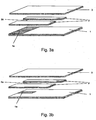
- FIGS. 3a and 3b show an exemplary structure of a diagnostic strip with a micro-channel 2a, in this case by a diecut of a double-sided Pressure-sensitive adhesive tape 2 is formed.
- the microchannel 2a can also be made by other methods such as microembossing, injection molding, laser methods, lithographic methods, or sandblasting.
- the microchannel 2a formed from the pressure-sensitive adhesive tape 2 is adhesively bonded to the base film 3 on one side.
- This base film 3 thus forms a wall of the microchannel and may additionally have functional layers such as, for example, electrical conductors or layers with detection reagents or enzymes.
- the microchannel 2a is closed as a further wall with a film 1 which is at least partially coated with the coating lacquer 1a according to the invention, the coating facing the inside of the microchannel.
- the coating 1a for example, strip-like as in FIG. 3a or partially as in FIG. 3b is applied here is at the opening of the microchannel 2a, to allow the start of liquid transport into the channel.
- the transport of the test liquid surprisingly takes place very effectively and reliably.
- the coating lacquer according to the invention can be significantly accelerated by the coating with the coating lacquer according to the invention.
- the coating is characterized by outstanding aging stability.
- the coating lacquer can be applied precisely to the point at which rapid transport of liquid is required by means of a suitable process such as, for example, a printing process ( FIG. 3b ). It is particularly surprising and unpredictable that the binder used neither reduces the activity of the surfactant nor deteriorates the aging resistance or influences the detection response to the test strip.
- the measurement of the contact angle with water and the surface tension on solid surfaces is carried out according to EN 828: 1997 with a device G2 / G402 from Krüss GmbH.
- the surface tension is determined by the Owens-Wendt-Rabel & Kaeble method after measuring the contact angle with deionized water and diiodomethane. The values result in each case from the averaging of four measured values.
- the surface tension of aqueous liquids is measured according to the ring method (du Nouy) according to DIN EN 14210 with the device Tensiometer K100 from Krüss GmbH at 20 ° C.
- the critical micelle formation concentration (CMC) is determined by the automatic metering of the surfactant by the Tensiometer K100 from Krüss GmbH and subsequent evaluation of the concentration surface behavior (DIN 53914).
- the viscosity measurement of the coating varnish is carried out with a Rheometrix DSR 200N at a shear rate of 10 1 / s with a 50 mm diameter cone and plate system.
- a capillary test is carried out.
- a diecut of a double-sided adhesive tape having a thickness of 80 ⁇ m (tesa® 4980, a double-sided adhesive pressure-sensitive adhesive tape consisting of a double-sided adhesive with an acrylic adhesive (each 34th) is applied to a 100 ⁇ m thick PET film (Hostaphan @ RN 100 from Mitsubishi Polyesterfilm GmbH) g / m 2 ) coated 12 ⁇ m PET carrier film, product thickness 80 ⁇ m).
- the diecut forms a measuring channel with a width of 1 mm and a length of 3 cm. The channel is open on both sides.
- This measuring channel is then covered with the film to be tested, so that the surface to be tested forms a wall of the channel.
- the areas are positioned so that the hydrophilic area at the edge of the Channel is located and the hydrophobic area inside the channel.
- the channel or the capillary have the dimensions height 75 microns and width 1 mm (see FIG. 3a ).
- the test channel is held with the opening, at the end of which the hydrophilic area is positioned, in a test liquid consisting of deionized water and 1% by weight of naphthol red.
- the transport of the test liquid in the hydrophilic area is monitored by means of a video camera and the transport speed is determined.
- the channel test is also carried out after storage at 23 ° C, 40 ° C and 70 ° C of the films or channels to be tested to test aging and storage stability.
- a test liquid also biological fluids such as blood are used, but these are less well suited, since they are subject to property fluctuations.
- the viscosity of blood varies greatly. The viscosity of blood depends on the hematocrit value.
- a single-sided office adhesive tape such as, for example, tesa 4140 (23 g / m 2 acylate dispersion adhesive, 35 ⁇ m BOPP support film) is applied over the coating glued and pressed by hand. The tape is then pulled off with a jerk. It is now judged whether the coating has sufficient anchorage to the substrate or whether the coating with the adhesive tape is partially or completely removed from the substrate.
- the coating lacquer has a viscosity of 130 mPa * s.
- the coating is then printed on a Nilpeter printing machine by flexo printing on a corona-pretreated PET film (Hostaphan® RN 100 from Mitsubishi Polyesterfilm GmbH) and dried by means of IR radiators.
- the coating lacquer can be very well transferred to the PET film in the printing process.
- the coating shows very good wetting properties and a high speed during transport of the aqueous test liquid in the test channel. The Transport speed only slows by 5% after storage of the test strips for 10 weeks at 70 ° C.
- Example 1 The coating varnish from Example 1 is printed on a PET film as in Example 1 and dried.
- the PET film has previously been coated with the primer NeoRez R650.
- the hydrophilic coating shows equally good wetting properties and a high transport speed of the aqueous test liquid in the test channel. This variant is characterized by a very good anchoring of the coating on the PET film.
- the resulting coating lacquer has a viscosity of 27 mPa * s.
- the coating is printed by inkjet printing on a NeoRez R650 coated PET film (Hostaphan® RN 100 from Mitsubishi Polyesterfilm GmbH) and dried by IR irradiation.
- the coating lacquer can be very well applied to the film in ink-jet printing. The wetting properties and transport speed of the coating are very good. After storage, the transport speed value drops back to 65% of the original value.
- the coating lacquer has a viscosity of 180 mPa * s.
- the coating is then printed on a Nilpeter printing machine by flexo printing on a corona-pretreated PET film (Hostaphan® RN 100 from Mitsubishi Polyesterfilm GmbH) and dried by means of IR radiators.
- the coating also shows very good wetting properties and a high transport speed of the aqueous test liquid in the test channel. This variant is characterized by a very good anchoring of the coating on the PET film. The aging resistance of the properties is also good.
- Example 2 Example 3
- Example 4 Contact angle with water ° 20 19 5 23 surface tension mN / m 68 69 71 65 Speed in the channel test mm / s 56 56 58 53 Channel test after mm / s 53 54 32 50 Storage* (-5%) (-4%) (-45%) (-6%) Anchoring the coating O ++ ++ ++ * 10 weeks at 70 ° C; - bad, o mediocre, ++ very good
- the coating lacquer has a viscosity of 130 mPa * s.
- the coating is then printed on a Nilpeter printing machine by flexo printing on a corona-pretreated PET film (Hostaphan® RN 100 from Mitsubishi Polyesterfilm GmbH) and dried by means of IR radiators.
- the coating shows markedly worse wetting and transport properties.
- the channel test shows that the liquid is not transported into the channel.
- the resulting coating lacquer has a viscosity of 1 mPa * s.
- the coating lacquer is attempted to print in flexo printing on a corona-pretreated PET film (Hostaphan® RN 100 from Mitsubishi Polyesterfilm GmbH). The printing is not possible because the viscosity of the solution is too low. Furthermore, it is not possible to obtain a closed film with the coating. No measurements can be made on the coating.
- the coating lacquer has a viscosity of 110 mPa * s.
- the coating is then printed on a Nilpeter printing machine by flexo printing on a corona-pretreated PET film (Hostaphan® RN 100 from Mitsubishi Polyesterfilm GmbH) and dried by means of IR radiators.
- the coating shows markedly worse wetting and transport properties.
- the fluid transport in the channel test is very inhomogeneous and fluctuates over a wide range. In 50% of the experiments no liquid transport takes place.
- Counterexample 1 Counterexample 2
- Counterexample 3 Contact angle with water ° 37 - 33 surface tension mN / m 56 - 59 Speed in the channel test mm / s - - 0-10 Channel test after storage * mm / s - - - Anchoring the coating O - ++ * 10 weeks at 70 ° C; - bad, o mediocre, ++ very good
Landscapes
- Health & Medical Sciences (AREA)
- Chemical & Material Sciences (AREA)
- Life Sciences & Earth Sciences (AREA)
- Engineering & Computer Science (AREA)
- Immunology (AREA)
- Molecular Biology (AREA)
- Biomedical Technology (AREA)
- Urology & Nephrology (AREA)
- Hematology (AREA)
- Food Science & Technology (AREA)
- Physics & Mathematics (AREA)
- Cell Biology (AREA)
- Wood Science & Technology (AREA)
- Microbiology (AREA)
- Materials Engineering (AREA)
- Organic Chemistry (AREA)
- Chemical Kinetics & Catalysis (AREA)
- Medicinal Chemistry (AREA)
- Biotechnology (AREA)
- Analytical Chemistry (AREA)
- Biochemistry (AREA)
- General Health & Medical Sciences (AREA)
- General Physics & Mathematics (AREA)
- Pathology (AREA)
- Application Of Or Painting With Fluid Materials (AREA)
- Paints Or Removers (AREA)
- Organic Insulating Materials (AREA)
- Non-Metallic Protective Coatings For Printed Circuits (AREA)
- Materials For Medical Uses (AREA)
Claims (20)
- Laque de revêtement constituée par
au moins une substance tensioactive présentant- une concentration critique de formation de micelles (CMC, 25°C) d'au plus 2,3 g/l et- une tension superficielle (25°C) de la solution aqueuse à 0,1% en poids d'au plus 50 mN/m,au moins un solvant,
au moins un liant, ainsi que
le cas échéant d'autres additifs,
où la surface obtenue après le séchage de la laque de revêtement présente- un angle de contact avec l'eau d'au plus 30° et- une tension superficielle d'au moins 60 mN/m. - Laque de revêtement selon la revendication 1, caractérisée en ce que la substance tensioactive présente une concentration critique de formation de micelles (CMC, 25°C) d'au plus 1,5 g/l et/ou une tension superficielle de la solution aqueuse à 0,1% en poids d'au plus 45 mN/m.
- Laque de revêtement selon l'une quelconque des revendications 1 ou 2, caractérisée en ce que la substance tensioactive est un agent tensioactif anionique.
- Laque de revêtement selon au moins l'une quelconque des revendications 1 à 3, caractérisée en ce que la substance tensioactive est un agent tensioactif à base d'un sel de l'acide sulfosuccinique.
- Laque de revêtement selon au moins l'une quelconque des revendications précédentes, caractérisée en ce qu'on utilise au moins un solvant polaire comme solvant.
- Laque de revêtement selon au moins l'une quelconque des revendications précédentes, caractérisée en ce qu'on utilise un alcool comme solvant.
- Laque de revêtement selon au moins l'une quelconque des revendications précédentes, caractérisée en ce qu'on utilise de l'eau comme solvant.
- Laque de revêtement selon au moins l'une quelconque des revendications précédentes, caractérisée en ce qu'on utilise comme liant au moins un polymère ou un copolymère présentant des fonctionnalités carboxyle, carboxylate, amine, ammonium, amide ou alcool.
- Laque de revêtement selon au moins l'une quelconque des revendications précédentes, caractérisée en ce qu'on utilise comme liant un polymère soluble dans l'eau ou un copolymère soluble dans l'eau.
- Laque de revêtement selon au moins l'une quelconque des revendications précédentes, caractérisée en ce que le liant est choisi dans le groupe formé par le poly(alcool vinylique), le polyvinylbutyral, la résine de polyester, la résine de maléinate ou un dérivé de cellulose.
- Laque de revêtement selon au moins l'une quelconque des revendications précédentes, caractérisée en ce que la laque de revêtement présente, avant le séchage, une viscosité de 50 à 500 mPa.s.
- Laque de revêtement selon au moins l'une quelconque des revendications précédentes, caractérisée en ce que la surface obtenue après le séchage de la laque de revêtement présente- un angle de contact avec l'eau d'au plus 23° et- une tension superficielle d'au moins 65 mN/m.
- Laque de revêtement selon au moins l'une quelconque des revendications précédentes, caractérisée en ce que la vitesse de transport d'un liquide test aqueux (eau désionisée et 1% en poids d'amarante) dans un canal (75 µm x 1 mm), dans lequel la laque de revêtement séchée forme une paroi du canal, est d'au moins 20 mm/s.
- Laque de revêtement selon au moins l'une quelconque des revendications précédentes, caractérisée en ce que la vitesse de transport d'un liquide test aqueux (eau désionisée et 1% en poids d'amarante) dans un canal (75 µm x 1 mm), dans lequel la laque de revêtement séchée forme une paroi du canal, est d'au moins 40 mm/s.
- Laque de revêtement selon au moins l'une quelconque des revendications précédentes, caractérisée en ce que la vitesse de transport d'un liquide test aqueux (eau désionisée et 1% en poids d'amarante) dans un canal (75 µm x 1 mm), dans lequel la laque de revêtement séchée forme une paroi du canal, est ralentie, après un entreposage de 10 semaines à 70°C, d'au maximum 20% de la valeur de départ.
- Laque de revêtement selon au moins l'une quelconque des revendications précédentes, caractérisée en ce que la laque de revêtement est appliquée au moyen d'un procédé d'impression sur un matériau support.
- Laque de revêtement selon au moins l'une quelconque des revendications précédentes, caractérisée en ce que la laque de revêtement est appliquée au moyen d'un procédé d'impression flexo sur un matériau support.
- Utilisation de la laque de revêtement séchée selon au moins l'une quelconque des revendications précédentes comme revêtement dans des applications médicales.
- Utilisation de la laque de revêtement séchée selon au moins l'une quelconque des revendications précédentes comme revêtement dans des bandelettes diagnostiques, des biocapteurs, des dispositifs de point de soin ou de dispositifs microfluidiques au moyen desquel(le)s des liquides biologiques sont analysés.
- Utilisation de la laque de revêtement séchée selon au moins l'une quelconque des revendications précédentes comme revêtement dans des biocapteurs ou des bandelettes test analytiques, où le matériau est disposé de manière telle que le revêtement forme au moins partiellement au moins une paroi d'un canal de transport ou de réaction.
Applications Claiming Priority (1)
| Application Number | Priority Date | Filing Date | Title |
|---|---|---|---|
| DE102007026998A DE102007026998A1 (de) | 2007-06-07 | 2007-06-07 | Hydrophiler Beschichtungslack |
Publications (2)
| Publication Number | Publication Date |
|---|---|
| EP2014727A1 EP2014727A1 (fr) | 2009-01-14 |
| EP2014727B1 true EP2014727B1 (fr) | 2009-10-14 |
Family
ID=39627397
Family Applications (1)
| Application Number | Title | Priority Date | Filing Date |
|---|---|---|---|
| EP08157390A Revoked EP2014727B1 (fr) | 2007-06-07 | 2008-06-02 | Revêtement hydrophile |
Country Status (6)
| Country | Link |
|---|---|
| US (1) | US20080302274A1 (fr) |
| EP (1) | EP2014727B1 (fr) |
| AT (1) | ATE445678T1 (fr) |
| DE (2) | DE102007026998A1 (fr) |
| TW (1) | TW200904921A (fr) |
| WO (1) | WO2008148723A1 (fr) |
Families Citing this family (4)
| Publication number | Priority date | Publication date | Assignee | Title |
|---|---|---|---|---|
| US20120167410A1 (en) * | 2010-12-21 | 2012-07-05 | Basf Se | Spray drying techniques |
| TWI532468B (zh) | 2011-03-22 | 2016-05-11 | 福 赫夫曼 拉瑞奇股份有限公司 | 具有含矽石結構奈米粒子之親水性塗層的分析輔助器具 |
| JP5845352B2 (ja) * | 2013-05-01 | 2016-01-20 | 積水化学工業株式会社 | ポリビニルアルコール水溶液 |
| DE102014215547A1 (de) * | 2014-08-06 | 2016-02-11 | Airbus Operations Gmbh | Klebehalter zur Befestigung an einer Struktur |
Family Cites Families (27)
| Publication number | Priority date | Publication date | Assignee | Title |
|---|---|---|---|---|
| JPS55164356A (en) | 1979-06-08 | 1980-12-22 | Fuji Photo Film Co Ltd | Multi-layer analysis sheet for liquid sample analysis |
| US4987182A (en) * | 1988-04-25 | 1991-01-22 | Hydromer, Inc. | Hydrophilic polyvinybutyral alloys |
| US5550182A (en) * | 1994-12-22 | 1996-08-27 | Aqua Tec Coatings Corporation | Masking composition for protecting vehicle surface from overspray |
| US5759364A (en) | 1997-05-02 | 1998-06-02 | Bayer Corporation | Electrochemical biosensor |
| US5997817A (en) | 1997-12-05 | 1999-12-07 | Roche Diagnostics Corporation | Electrochemical biosensor test strip |
| EP0930331A3 (fr) * | 1998-01-14 | 2000-05-17 | Degussa-Hüls Aktiengesellschaft | Revêtement bioactif et hydrophile de substrats polymères |
| DE19815684A1 (de) | 1998-04-08 | 1999-10-14 | Roche Diagnostics Gmbh | Verfahren zur Herstellung von analytischen Hilfsmitteln |
| DE19818958A1 (de) * | 1998-04-28 | 1999-11-04 | Degussa | Hämokompatible und bakterienabweisende hydrophile IPN-Beschichtungen |
| US6521182B1 (en) | 1998-07-20 | 2003-02-18 | Lifescan, Inc. | Fluidic device for medical diagnostics |
| US6601613B2 (en) | 1998-10-13 | 2003-08-05 | Biomicro Systems, Inc. | Fluid circuit components based upon passive fluid dynamics |
| DE19849008A1 (de) | 1998-10-23 | 2000-04-27 | Roche Diagnostics Gmbh | Spreitschichten, Netzmittel zu ihrer Herstellung und deren Verwendung in Teststreifen |
| ES2294389T3 (es) | 1999-07-07 | 2008-04-01 | 3M Innovative Properties Company | Articulo microfluidico. |
| EP1244754A1 (fr) * | 1999-11-22 | 2002-10-02 | 3M Innovative Properties Company | Composition de revetement a base d'eau |
| US20020112961A1 (en) | 1999-12-02 | 2002-08-22 | Nanostream, Inc. | Multi-layer microfluidic device fabrication |
| US6733655B1 (en) | 2000-03-08 | 2004-05-11 | Oliver W. H. Davies | Measurement of substances in liquids |
| ATE406571T1 (de) | 2000-03-28 | 2008-09-15 | Diabetes Diagnostics Inc | Zeitmesser mit schnell ansprechenden glucose sensor |
| US6955738B2 (en) | 2002-04-09 | 2005-10-18 | Gyros Ab | Microfluidic devices with new inner surfaces |
| US7015262B2 (en) * | 2002-05-01 | 2006-03-21 | Lifescan, Inc. | Hydrophilic coatings for medical implements |
| DE10234564B4 (de) | 2002-07-25 | 2005-06-02 | Senslab-Gesellschaft Zur Entwicklung Und Herstellung Bioelektrochemischer Sensoren Mbh | Biosensor |
| US7125711B2 (en) | 2002-12-19 | 2006-10-24 | Bayer Healthcare Llc | Method and apparatus for splitting of specimens into multiple channels of a microfluidic device |
| US6969166B2 (en) | 2003-05-29 | 2005-11-29 | 3M Innovative Properties Company | Method for modifying the surface of a substrate |
| US20050067277A1 (en) | 2003-09-30 | 2005-03-31 | Pierce Robin D. | Low volume electrochemical biosensor |
| US7378451B2 (en) | 2003-10-17 | 2008-05-27 | 3M Innovative Properties Co | Surfactant composition having stable hydrophilic character |
| EP1525916A1 (fr) | 2003-10-23 | 2005-04-27 | F. Hoffmann-La Roche Ag | Dispositif de déclenchement d'écoulement |
| DE102004024432A1 (de) | 2004-05-14 | 2005-12-08 | Tesa Ag | Verwendung einer Folie mit hydrophiler Oberfläche in medizinischen Diagnosestreifen |
| DE102004049609A1 (de) | 2004-10-12 | 2006-04-13 | Mitsubishi Polyester Film Gmbh | Polyesterfolie mit hydrophiler Beschichtung, Verfahren zu ihrer Herstellung und ihre Verwendung |
| DE102006032667A1 (de) * | 2006-07-13 | 2008-01-17 | Tesa Ag | Bahnförmiges Material mit einer Beschichtung, die ein sehr schnelles Spreiten beziehungsweise einen sehr schnellen Transport von Flüssigkeiten ermöglicht |
-
2007
- 2007-06-07 DE DE102007026998A patent/DE102007026998A1/de not_active Ceased
- 2007-07-06 US US11/774,061 patent/US20080302274A1/en not_active Abandoned
-
2008
- 2008-05-02 TW TW097116151A patent/TW200904921A/zh unknown
- 2008-06-02 AT AT08157390T patent/ATE445678T1/de active
- 2008-06-02 WO PCT/EP2008/056746 patent/WO2008148723A1/fr not_active Ceased
- 2008-06-02 EP EP08157390A patent/EP2014727B1/fr not_active Revoked
- 2008-06-02 DE DE502008000142T patent/DE502008000142D1/de active Active
Also Published As
| Publication number | Publication date |
|---|---|
| DE502008000142D1 (de) | 2009-11-26 |
| DE102007026998A1 (de) | 2008-12-11 |
| EP2014727A1 (fr) | 2009-01-14 |
| US20080302274A1 (en) | 2008-12-11 |
| WO2008148723A1 (fr) | 2008-12-11 |
| TW200904921A (en) | 2009-02-01 |
| ATE445678T1 (de) | 2009-10-15 |
Similar Documents
| Publication | Publication Date | Title |
|---|---|---|
| DE102007018383A1 (de) | Flächenförmiges Material mit hydrophilen und hydrophoben Bereichen und deren Herstellung | |
| EP2359136B1 (fr) | Charges en grains fins pour film réactif de photométrie | |
| EP2238450A1 (fr) | Couche fonctionnelle destinée en particulier à la ventilation de canaux à liquides dans des éléments d'essai analytique | |
| EP2014727B1 (fr) | Revêtement hydrophile | |
| EP1761383B1 (fr) | Biocapteur medical a l'aide duquel des liquides biologiques peuvent etre examines | |
| EP2535389A1 (fr) | Couche de séparation avec coefficient de friction réduit | |
| EP1946850B1 (fr) | Matériau en forme de bande doté d'une laque de revêtement pour un étendre des liquides | |
| EP2898111B1 (fr) | Film hydrophile, procédé pour le préparer et ses applications | |
| EP2177582A2 (fr) | Bande adhésive dotée d'une masse adhésive fonctionnalisée et son utilisation | |
| WO2008006701A1 (fr) | Matériau en forme de bande avec un revêtement qui permet un étalement très rapide, respectivement un transport très rapide, de liquides | |
| EP0546032B1 (fr) | Immobilisation de macromolecules ou de biopolymeres organiques dans une membrane polymere | |
| DE102016118319A1 (de) | Biosensor zum Nachweis von Organophosphor- und Carbamatverbindungen | |
| WO2021013814A1 (fr) | Procédé pour étirer une molécule d'acide nucléique | |
| WO2005111606A2 (fr) | Utilisation d'un film ayant des surfaces hydrophiles dans des bandes de diagnostic medical | |
| EP3186328B1 (fr) | Composition adhésive de contact résistante à l'eau permettant un collage sur des surfaces humide, en particulier dans des applications automobiles | |
| DE102009059112A1 (de) | Eine Vorrichtung zur Bestimmung molekularer Wechselwirkungen, sowie eine Folie zur Herstellung einer solchen | |
| DE69427972T2 (de) | Polymerzusammensetzungen enthaltende streckmittel und ihre verwendung | |
| EP2851404B1 (fr) | Revêtement anti-adhésif dotée d'une structure de surface définie | |
| DE202010003766U1 (de) | Bahnförmiges Material mit hoher Dickenpräzision | |
| EP1380832A2 (fr) | Procédé d'estimation des propriétés d'adhérence de matériaux | |
| DE102012220574A1 (de) | Trennbeschichtung mit verbesserter Fehlererkennung | |
| EP2110423A1 (fr) | Couvercle adhésif hydraulique destiné au recouvrement de dispositifs fluidiques | |
| DE102004058794A1 (de) | Verfahren zur Beschichtung von Membranen |
Legal Events
| Date | Code | Title | Description |
|---|---|---|---|
| PUAI | Public reference made under article 153(3) epc to a published international application that has entered the european phase |
Free format text: ORIGINAL CODE: 0009012 |
|
| PUAI | Public reference made under article 153(3) epc to a published international application that has entered the european phase |
Free format text: ORIGINAL CODE: 0009012 |
|
| 17P | Request for examination filed |
Effective date: 20080811 |
|
| AK | Designated contracting states |
Kind code of ref document: A1 Designated state(s): AT BE BG CH CY CZ DE DK EE ES FI FR GB GR HR HU IE IS IT LI LT LU LV MC MT NL NO PL PT RO SE SI SK TR |
|
| AX | Request for extension of the european patent |
Extension state: AL BA MK RS |
|
| GRAC | Information related to communication of intention to grant a patent modified |
Free format text: ORIGINAL CODE: EPIDOSCIGR1 |
|
| GRAP | Despatch of communication of intention to grant a patent |
Free format text: ORIGINAL CODE: EPIDOSNIGR1 |
|
| RAP1 | Party data changed (applicant data changed or rights of an application transferred) |
Owner name: TESA SE |
|
| GRAS | Grant fee paid |
Free format text: ORIGINAL CODE: EPIDOSNIGR3 |
|
| RIN1 | Information on inventor provided before grant (corrected) |
Inventor name: NEUBERT, DR. INGO Inventor name: KAMPERS, MAREN |
|
| GRAA | (expected) grant |
Free format text: ORIGINAL CODE: 0009210 |
|
| AKX | Designation fees paid |
Designated state(s): AT BE BG CH CY CZ DE DK EE ES FI FR GB GR HR HU IE IS IT LI LT LU LV MC MT NL NO PL PT RO SE SI SK TR |
|
| AK | Designated contracting states |
Kind code of ref document: B1 Designated state(s): AT BE BG CH CY CZ DE DK EE ES FI FR GB GR HR HU IE IS IT LI LT LU LV MC MT NL NO PL PT RO SE SI SK TR |
|
| REG | Reference to a national code |
Ref country code: CH Ref legal event code: EP |
|
| REG | Reference to a national code |
Ref country code: IE Ref legal event code: FG4D |
|
| REF | Corresponds to: |
Ref document number: 502008000142 Country of ref document: DE Date of ref document: 20091126 Kind code of ref document: P |
|
| LTIE | Lt: invalidation of european patent or patent extension |
Effective date: 20091014 |
|
| NLV1 | Nl: lapsed or annulled due to failure to fulfill the requirements of art. 29p and 29m of the patents act | ||
| PG25 | Lapsed in a contracting state [announced via postgrant information from national office to epo] |
Ref country code: ES Free format text: LAPSE BECAUSE OF FAILURE TO SUBMIT A TRANSLATION OF THE DESCRIPTION OR TO PAY THE FEE WITHIN THE PRESCRIBED TIME-LIMIT Effective date: 20100125 Ref country code: LT Free format text: LAPSE BECAUSE OF FAILURE TO SUBMIT A TRANSLATION OF THE DESCRIPTION OR TO PAY THE FEE WITHIN THE PRESCRIBED TIME-LIMIT Effective date: 20091014 Ref country code: IS Free format text: LAPSE BECAUSE OF FAILURE TO SUBMIT A TRANSLATION OF THE DESCRIPTION OR TO PAY THE FEE WITHIN THE PRESCRIBED TIME-LIMIT Effective date: 20100214 Ref country code: NO Free format text: LAPSE BECAUSE OF FAILURE TO SUBMIT A TRANSLATION OF THE DESCRIPTION OR TO PAY THE FEE WITHIN THE PRESCRIBED TIME-LIMIT Effective date: 20100114 Ref country code: SE Free format text: LAPSE BECAUSE OF FAILURE TO SUBMIT A TRANSLATION OF THE DESCRIPTION OR TO PAY THE FEE WITHIN THE PRESCRIBED TIME-LIMIT Effective date: 20091014 Ref country code: FI Free format text: LAPSE BECAUSE OF FAILURE TO SUBMIT A TRANSLATION OF THE DESCRIPTION OR TO PAY THE FEE WITHIN THE PRESCRIBED TIME-LIMIT Effective date: 20091014 |
|
| REG | Reference to a national code |
Ref country code: IE Ref legal event code: FD4D |
|
| PG25 | Lapsed in a contracting state [announced via postgrant information from national office to epo] |
Ref country code: LV Free format text: LAPSE BECAUSE OF FAILURE TO SUBMIT A TRANSLATION OF THE DESCRIPTION OR TO PAY THE FEE WITHIN THE PRESCRIBED TIME-LIMIT Effective date: 20091014 Ref country code: PL Free format text: LAPSE BECAUSE OF FAILURE TO SUBMIT A TRANSLATION OF THE DESCRIPTION OR TO PAY THE FEE WITHIN THE PRESCRIBED TIME-LIMIT Effective date: 20091014 Ref country code: HR Free format text: LAPSE BECAUSE OF FAILURE TO SUBMIT A TRANSLATION OF THE DESCRIPTION OR TO PAY THE FEE WITHIN THE PRESCRIBED TIME-LIMIT Effective date: 20091014 Ref country code: SI Free format text: LAPSE BECAUSE OF FAILURE TO SUBMIT A TRANSLATION OF THE DESCRIPTION OR TO PAY THE FEE WITHIN THE PRESCRIBED TIME-LIMIT Effective date: 20091014 |
|
| PLBI | Opposition filed |
Free format text: ORIGINAL CODE: 0009260 |
|
| PG25 | Lapsed in a contracting state [announced via postgrant information from national office to epo] |
Ref country code: EE Free format text: LAPSE BECAUSE OF FAILURE TO SUBMIT A TRANSLATION OF THE DESCRIPTION OR TO PAY THE FEE WITHIN THE PRESCRIBED TIME-LIMIT Effective date: 20091014 Ref country code: RO Free format text: LAPSE BECAUSE OF FAILURE TO SUBMIT A TRANSLATION OF THE DESCRIPTION OR TO PAY THE FEE WITHIN THE PRESCRIBED TIME-LIMIT Effective date: 20091014 Ref country code: IE Free format text: LAPSE BECAUSE OF FAILURE TO SUBMIT A TRANSLATION OF THE DESCRIPTION OR TO PAY THE FEE WITHIN THE PRESCRIBED TIME-LIMIT Effective date: 20091014 Ref country code: DK Free format text: LAPSE BECAUSE OF FAILURE TO SUBMIT A TRANSLATION OF THE DESCRIPTION OR TO PAY THE FEE WITHIN THE PRESCRIBED TIME-LIMIT Effective date: 20091014 Ref country code: BG Free format text: LAPSE BECAUSE OF FAILURE TO SUBMIT A TRANSLATION OF THE DESCRIPTION OR TO PAY THE FEE WITHIN THE PRESCRIBED TIME-LIMIT Effective date: 20100114 |
|
| PLAX | Notice of opposition and request to file observation + time limit sent |
Free format text: ORIGINAL CODE: EPIDOSNOBS2 |
|
| 26 | Opposition filed |
Opponent name: ROCHE DIAGNOSTICS GMBH Effective date: 20100714 |
|
| PG25 | Lapsed in a contracting state [announced via postgrant information from national office to epo] |
Ref country code: CZ Free format text: LAPSE BECAUSE OF FAILURE TO SUBMIT A TRANSLATION OF THE DESCRIPTION OR TO PAY THE FEE WITHIN THE PRESCRIBED TIME-LIMIT Effective date: 20091014 Ref country code: SK Free format text: LAPSE BECAUSE OF FAILURE TO SUBMIT A TRANSLATION OF THE DESCRIPTION OR TO PAY THE FEE WITHIN THE PRESCRIBED TIME-LIMIT Effective date: 20091014 |
|
| PG25 | Lapsed in a contracting state [announced via postgrant information from national office to epo] |
Ref country code: GR Free format text: LAPSE BECAUSE OF FAILURE TO SUBMIT A TRANSLATION OF THE DESCRIPTION OR TO PAY THE FEE WITHIN THE PRESCRIBED TIME-LIMIT Effective date: 20100115 |
|
| BERE | Be: lapsed |
Owner name: TESA SE Effective date: 20100630 |
|
| PG25 | Lapsed in a contracting state [announced via postgrant information from national office to epo] |
Ref country code: MC Free format text: LAPSE BECAUSE OF NON-PAYMENT OF DUE FEES Effective date: 20100630 |
|
| REG | Reference to a national code |
Ref country code: FR Ref legal event code: ST Effective date: 20110228 |
|
| PG25 | Lapsed in a contracting state [announced via postgrant information from national office to epo] |
Ref country code: IT Free format text: LAPSE BECAUSE OF FAILURE TO SUBMIT A TRANSLATION OF THE DESCRIPTION OR TO PAY THE FEE WITHIN THE PRESCRIBED TIME-LIMIT Effective date: 20091014 |
|
| PLAF | Information modified related to communication of a notice of opposition and request to file observations + time limit |
Free format text: ORIGINAL CODE: EPIDOSCOBS2 |
|
| PG25 | Lapsed in a contracting state [announced via postgrant information from national office to epo] |
Ref country code: MT Free format text: LAPSE BECAUSE OF FAILURE TO SUBMIT A TRANSLATION OF THE DESCRIPTION OR TO PAY THE FEE WITHIN THE PRESCRIBED TIME-LIMIT Effective date: 20091014 |
|
| PLAF | Information modified related to communication of a notice of opposition and request to file observations + time limit |
Free format text: ORIGINAL CODE: EPIDOSCOBS2 |
|
| PG25 | Lapsed in a contracting state [announced via postgrant information from national office to epo] |
Ref country code: FR Free format text: LAPSE BECAUSE OF NON-PAYMENT OF DUE FEES Effective date: 20100630 |
|
| PG25 | Lapsed in a contracting state [announced via postgrant information from national office to epo] |
Ref country code: BE Free format text: LAPSE BECAUSE OF NON-PAYMENT OF DUE FEES Effective date: 20100630 |
|
| PLAF | Information modified related to communication of a notice of opposition and request to file observations + time limit |
Free format text: ORIGINAL CODE: EPIDOSCOBS2 |
|
| PLBB | Reply of patent proprietor to notice(s) of opposition received |
Free format text: ORIGINAL CODE: EPIDOSNOBS3 |
|
| PLAY | Examination report in opposition despatched + time limit |
Free format text: ORIGINAL CODE: EPIDOSNORE2 |
|
| PLBC | Reply to examination report in opposition received |
Free format text: ORIGINAL CODE: EPIDOSNORE3 |
|
| PG25 | Lapsed in a contracting state [announced via postgrant information from national office to epo] |
Ref country code: CY Free format text: LAPSE BECAUSE OF FAILURE TO SUBMIT A TRANSLATION OF THE DESCRIPTION OR TO PAY THE FEE WITHIN THE PRESCRIBED TIME-LIMIT Effective date: 20091014 |
|
| PG25 | Lapsed in a contracting state [announced via postgrant information from national office to epo] |
Ref country code: PT Free format text: LAPSE BECAUSE OF FAILURE TO SUBMIT A TRANSLATION OF THE DESCRIPTION OR TO PAY THE FEE WITHIN THE PRESCRIBED TIME-LIMIT Effective date: 20100314 Ref country code: LU Free format text: LAPSE BECAUSE OF NON-PAYMENT OF DUE FEES Effective date: 20100602 Ref country code: NL Free format text: LAPSE BECAUSE OF FAILURE TO SUBMIT A TRANSLATION OF THE DESCRIPTION OR TO PAY THE FEE WITHIN THE PRESCRIBED TIME-LIMIT Effective date: 20091014 Ref country code: HU Free format text: LAPSE BECAUSE OF FAILURE TO SUBMIT A TRANSLATION OF THE DESCRIPTION OR TO PAY THE FEE WITHIN THE PRESCRIBED TIME-LIMIT Effective date: 20100415 |
|
| PG25 | Lapsed in a contracting state [announced via postgrant information from national office to epo] |
Ref country code: TR Free format text: LAPSE BECAUSE OF FAILURE TO SUBMIT A TRANSLATION OF THE DESCRIPTION OR TO PAY THE FEE WITHIN THE PRESCRIBED TIME-LIMIT Effective date: 20091014 |
|
| REG | Reference to a national code |
Ref country code: CH Ref legal event code: PL |
|
| REG | Reference to a national code |
Ref country code: CH Ref legal event code: PL |
|
| PG25 | Lapsed in a contracting state [announced via postgrant information from national office to epo] |
Ref country code: CH Free format text: LAPSE BECAUSE OF NON-PAYMENT OF DUE FEES Effective date: 20120630 Ref country code: LI Free format text: LAPSE BECAUSE OF NON-PAYMENT OF DUE FEES Effective date: 20120630 |
|
| RDAF | Communication despatched that patent is revoked |
Free format text: ORIGINAL CODE: EPIDOSNREV1 |
|
| APBM | Appeal reference recorded |
Free format text: ORIGINAL CODE: EPIDOSNREFNO |
|
| APBP | Date of receipt of notice of appeal recorded |
Free format text: ORIGINAL CODE: EPIDOSNNOA2O |
|
| APAH | Appeal reference modified |
Free format text: ORIGINAL CODE: EPIDOSCREFNO |
|
| APBQ | Date of receipt of statement of grounds of appeal recorded |
Free format text: ORIGINAL CODE: EPIDOSNNOA3O |
|
| PGFP | Annual fee paid to national office [announced via postgrant information from national office to epo] |
Ref country code: GB Payment date: 20140618 Year of fee payment: 7 |
|
| REG | Reference to a national code |
Ref country code: AT Ref legal event code: MM01 Ref document number: 445678 Country of ref document: AT Kind code of ref document: T Effective date: 20130602 |
|
| PG25 | Lapsed in a contracting state [announced via postgrant information from national office to epo] |
Ref country code: AT Free format text: LAPSE BECAUSE OF NON-PAYMENT OF DUE FEES Effective date: 20130602 |
|
| REG | Reference to a national code |
Ref country code: DE Ref legal event code: R103 Ref document number: 502008000142 Country of ref document: DE Ref country code: DE Ref legal event code: R064 Ref document number: 502008000142 Country of ref document: DE |
|
| APBU | Appeal procedure closed |
Free format text: ORIGINAL CODE: EPIDOSNNOA9O |
|
| APAN | Information on closure of appeal procedure modified |
Free format text: ORIGINAL CODE: EPIDOSCNOA9O |
|
| RDAG | Patent revoked |
Free format text: ORIGINAL CODE: 0009271 |
|
| STAA | Information on the status of an ep patent application or granted ep patent |
Free format text: STATUS: PATENT REVOKED |
|
| 27W | Patent revoked |
Effective date: 20150115 |
|
| GBPR | Gb: patent revoked under art. 102 of the ep convention designating the uk as contracting state |
Effective date: 20150115 |
|
| PGFP | Annual fee paid to national office [announced via postgrant information from national office to epo] |
Ref country code: DE Payment date: 20150630 Year of fee payment: 8 |
|
| REG | Reference to a national code |
Ref country code: DE Ref legal event code: R107 Ref document number: 502008000142 Country of ref document: DE |
|
| REG | Reference to a national code |
Ref country code: AT Ref legal event code: MA03 Ref document number: 445678 Country of ref document: AT Kind code of ref document: T Effective date: 20150115 |