EP2014946A2 - Verfahren zur Tastpunktermittlung einer automatisierten Kupplung - Google Patents
Verfahren zur Tastpunktermittlung einer automatisierten Kupplung Download PDFInfo
- Publication number
- EP2014946A2 EP2014946A2 EP08011556A EP08011556A EP2014946A2 EP 2014946 A2 EP2014946 A2 EP 2014946A2 EP 08011556 A EP08011556 A EP 08011556A EP 08011556 A EP08011556 A EP 08011556A EP 2014946 A2 EP2014946 A2 EP 2014946A2
- Authority
- EP
- European Patent Office
- Prior art keywords
- clutch
- torque
- electric machine
- signal response
- touch point
- Prior art date
- Legal status (The legal status is an assumption and is not a legal conclusion. Google has not performed a legal analysis and makes no representation as to the accuracy of the status listed.)
- Granted
Links
Images
Classifications
-
- B—PERFORMING OPERATIONS; TRANSPORTING
- B60—VEHICLES IN GENERAL
- B60W—CONJOINT CONTROL OF VEHICLE SUB-UNITS OF DIFFERENT TYPE OR DIFFERENT FUNCTION; CONTROL SYSTEMS SPECIALLY ADAPTED FOR HYBRID VEHICLES; ROAD VEHICLE DRIVE CONTROL SYSTEMS FOR PURPOSES NOT RELATED TO THE CONTROL OF A PARTICULAR SUB-UNIT
- B60W20/00—Control systems specially adapted for hybrid vehicles
- B60W20/10—Controlling the power contribution of each of the prime movers to meet required power demand
- B60W20/15—Control strategies specially adapted for achieving a particular effect
-
- B—PERFORMING OPERATIONS; TRANSPORTING
- B60—VEHICLES IN GENERAL
- B60K—ARRANGEMENT OR MOUNTING OF PROPULSION UNITS OR OF TRANSMISSIONS IN VEHICLES; ARRANGEMENT OR MOUNTING OF PLURAL DIVERSE PRIME-MOVERS IN VEHICLES; AUXILIARY DRIVES FOR VEHICLES; INSTRUMENTATION OR DASHBOARDS FOR VEHICLES; ARRANGEMENTS IN CONNECTION WITH COOLING, AIR INTAKE, GAS EXHAUST OR FUEL SUPPLY OF PROPULSION UNITS IN VEHICLES
- B60K6/00—Arrangement or mounting of plural diverse prime-movers for mutual or common propulsion, e.g. hybrid propulsion systems comprising electric motors and internal combustion engines
- B60K6/20—Arrangement or mounting of plural diverse prime-movers for mutual or common propulsion, e.g. hybrid propulsion systems comprising electric motors and internal combustion engines the prime-movers consisting of electric motors and internal combustion engines, e.g. HEVs
- B60K6/22—Arrangement or mounting of plural diverse prime-movers for mutual or common propulsion, e.g. hybrid propulsion systems comprising electric motors and internal combustion engines the prime-movers consisting of electric motors and internal combustion engines, e.g. HEVs characterised by apparatus, components or means specially adapted for HEVs
- B60K6/36—Arrangement or mounting of plural diverse prime-movers for mutual or common propulsion, e.g. hybrid propulsion systems comprising electric motors and internal combustion engines the prime-movers consisting of electric motors and internal combustion engines, e.g. HEVs characterised by apparatus, components or means specially adapted for HEVs characterised by the transmission gearings
- B60K6/365—Arrangement or mounting of plural diverse prime-movers for mutual or common propulsion, e.g. hybrid propulsion systems comprising electric motors and internal combustion engines the prime-movers consisting of electric motors and internal combustion engines, e.g. HEVs characterised by apparatus, components or means specially adapted for HEVs characterised by the transmission gearings with the gears having orbital motion
-
- B—PERFORMING OPERATIONS; TRANSPORTING
- B60—VEHICLES IN GENERAL
- B60K—ARRANGEMENT OR MOUNTING OF PROPULSION UNITS OR OF TRANSMISSIONS IN VEHICLES; ARRANGEMENT OR MOUNTING OF PLURAL DIVERSE PRIME-MOVERS IN VEHICLES; AUXILIARY DRIVES FOR VEHICLES; INSTRUMENTATION OR DASHBOARDS FOR VEHICLES; ARRANGEMENTS IN CONNECTION WITH COOLING, AIR INTAKE, GAS EXHAUST OR FUEL SUPPLY OF PROPULSION UNITS IN VEHICLES
- B60K6/00—Arrangement or mounting of plural diverse prime-movers for mutual or common propulsion, e.g. hybrid propulsion systems comprising electric motors and internal combustion engines
- B60K6/20—Arrangement or mounting of plural diverse prime-movers for mutual or common propulsion, e.g. hybrid propulsion systems comprising electric motors and internal combustion engines the prime-movers consisting of electric motors and internal combustion engines, e.g. HEVs
- B60K6/42—Arrangement or mounting of plural diverse prime-movers for mutual or common propulsion, e.g. hybrid propulsion systems comprising electric motors and internal combustion engines the prime-movers consisting of electric motors and internal combustion engines, e.g. HEVs characterised by the architecture of the hybrid electric vehicle
- B60K6/48—Parallel type
-
- B—PERFORMING OPERATIONS; TRANSPORTING
- B60—VEHICLES IN GENERAL
- B60K—ARRANGEMENT OR MOUNTING OF PROPULSION UNITS OR OF TRANSMISSIONS IN VEHICLES; ARRANGEMENT OR MOUNTING OF PLURAL DIVERSE PRIME-MOVERS IN VEHICLES; AUXILIARY DRIVES FOR VEHICLES; INSTRUMENTATION OR DASHBOARDS FOR VEHICLES; ARRANGEMENTS IN CONNECTION WITH COOLING, AIR INTAKE, GAS EXHAUST OR FUEL SUPPLY OF PROPULSION UNITS IN VEHICLES
- B60K6/00—Arrangement or mounting of plural diverse prime-movers for mutual or common propulsion, e.g. hybrid propulsion systems comprising electric motors and internal combustion engines
- B60K6/20—Arrangement or mounting of plural diverse prime-movers for mutual or common propulsion, e.g. hybrid propulsion systems comprising electric motors and internal combustion engines the prime-movers consisting of electric motors and internal combustion engines, e.g. HEVs
- B60K6/50—Architecture of the driveline characterised by arrangement or kind of transmission units
- B60K6/54—Transmission for changing ratio
- B60K6/547—Transmission for changing ratio the transmission being a stepped gearing
-
- B—PERFORMING OPERATIONS; TRANSPORTING
- B60—VEHICLES IN GENERAL
- B60W—CONJOINT CONTROL OF VEHICLE SUB-UNITS OF DIFFERENT TYPE OR DIFFERENT FUNCTION; CONTROL SYSTEMS SPECIALLY ADAPTED FOR HYBRID VEHICLES; ROAD VEHICLE DRIVE CONTROL SYSTEMS FOR PURPOSES NOT RELATED TO THE CONTROL OF A PARTICULAR SUB-UNIT
- B60W10/00—Conjoint control of vehicle sub-units of different type or different function
- B60W10/02—Conjoint control of vehicle sub-units of different type or different function including control of driveline clutches
-
- B—PERFORMING OPERATIONS; TRANSPORTING
- B60—VEHICLES IN GENERAL
- B60W—CONJOINT CONTROL OF VEHICLE SUB-UNITS OF DIFFERENT TYPE OR DIFFERENT FUNCTION; CONTROL SYSTEMS SPECIALLY ADAPTED FOR HYBRID VEHICLES; ROAD VEHICLE DRIVE CONTROL SYSTEMS FOR PURPOSES NOT RELATED TO THE CONTROL OF A PARTICULAR SUB-UNIT
- B60W10/00—Conjoint control of vehicle sub-units of different type or different function
- B60W10/02—Conjoint control of vehicle sub-units of different type or different function including control of driveline clutches
- B60W10/023—Fluid clutches
-
- B—PERFORMING OPERATIONS; TRANSPORTING
- B60—VEHICLES IN GENERAL
- B60W—CONJOINT CONTROL OF VEHICLE SUB-UNITS OF DIFFERENT TYPE OR DIFFERENT FUNCTION; CONTROL SYSTEMS SPECIALLY ADAPTED FOR HYBRID VEHICLES; ROAD VEHICLE DRIVE CONTROL SYSTEMS FOR PURPOSES NOT RELATED TO THE CONTROL OF A PARTICULAR SUB-UNIT
- B60W10/00—Conjoint control of vehicle sub-units of different type or different function
- B60W10/04—Conjoint control of vehicle sub-units of different type or different function including control of propulsion units
- B60W10/08—Conjoint control of vehicle sub-units of different type or different function including control of propulsion units including control of electric propulsion units, e.g. motors or generators
-
- F—MECHANICAL ENGINEERING; LIGHTING; HEATING; WEAPONS; BLASTING
- F16—ENGINEERING ELEMENTS AND UNITS; GENERAL MEASURES FOR PRODUCING AND MAINTAINING EFFECTIVE FUNCTIONING OF MACHINES OR INSTALLATIONS; THERMAL INSULATION IN GENERAL
- F16D—COUPLINGS FOR TRANSMITTING ROTATION; CLUTCHES; BRAKES
- F16D48/00—External control of clutches
- F16D48/06—Control by electric or electronic means, e.g. of fluid pressure
-
- B—PERFORMING OPERATIONS; TRANSPORTING
- B60—VEHICLES IN GENERAL
- B60W—CONJOINT CONTROL OF VEHICLE SUB-UNITS OF DIFFERENT TYPE OR DIFFERENT FUNCTION; CONTROL SYSTEMS SPECIALLY ADAPTED FOR HYBRID VEHICLES; ROAD VEHICLE DRIVE CONTROL SYSTEMS FOR PURPOSES NOT RELATED TO THE CONTROL OF A PARTICULAR SUB-UNIT
- B60W20/00—Control systems specially adapted for hybrid vehicles
-
- B—PERFORMING OPERATIONS; TRANSPORTING
- B60—VEHICLES IN GENERAL
- B60W—CONJOINT CONTROL OF VEHICLE SUB-UNITS OF DIFFERENT TYPE OR DIFFERENT FUNCTION; CONTROL SYSTEMS SPECIALLY ADAPTED FOR HYBRID VEHICLES; ROAD VEHICLE DRIVE CONTROL SYSTEMS FOR PURPOSES NOT RELATED TO THE CONTROL OF A PARTICULAR SUB-UNIT
- B60W2510/00—Input parameters relating to a particular sub-units
- B60W2510/02—Clutches
- B60W2510/0208—Clutch engagement state, e.g. engaged or disengaged
- B60W2510/0225—Clutch actuator position
-
- F—MECHANICAL ENGINEERING; LIGHTING; HEATING; WEAPONS; BLASTING
- F16—ENGINEERING ELEMENTS AND UNITS; GENERAL MEASURES FOR PRODUCING AND MAINTAINING EFFECTIVE FUNCTIONING OF MACHINES OR INSTALLATIONS; THERMAL INSULATION IN GENERAL
- F16D—COUPLINGS FOR TRANSMITTING ROTATION; CLUTCHES; BRAKES
- F16D2500/00—External control of clutches by electric or electronic means
- F16D2500/10—System to be controlled
- F16D2500/106—Engine
- F16D2500/1066—Hybrid
-
- F—MECHANICAL ENGINEERING; LIGHTING; HEATING; WEAPONS; BLASTING
- F16—ENGINEERING ELEMENTS AND UNITS; GENERAL MEASURES FOR PRODUCING AND MAINTAINING EFFECTIVE FUNCTIONING OF MACHINES OR INSTALLATIONS; THERMAL INSULATION IN GENERAL
- F16D—COUPLINGS FOR TRANSMITTING ROTATION; CLUTCHES; BRAKES
- F16D2500/00—External control of clutches by electric or electronic means
- F16D2500/30—Signal inputs
- F16D2500/302—Signal inputs from the actuator
- F16D2500/3026—Stroke
-
- F—MECHANICAL ENGINEERING; LIGHTING; HEATING; WEAPONS; BLASTING
- F16—ENGINEERING ELEMENTS AND UNITS; GENERAL MEASURES FOR PRODUCING AND MAINTAINING EFFECTIVE FUNCTIONING OF MACHINES OR INSTALLATIONS; THERMAL INSULATION IN GENERAL
- F16D—COUPLINGS FOR TRANSMITTING ROTATION; CLUTCHES; BRAKES
- F16D2500/00—External control of clutches by electric or electronic means
- F16D2500/50—Problem to be solved by the control system
- F16D2500/502—Relating the clutch
- F16D2500/50245—Calibration or recalibration of the clutch touch-point
- F16D2500/50251—During operation
-
- F—MECHANICAL ENGINEERING; LIGHTING; HEATING; WEAPONS; BLASTING
- F16—ENGINEERING ELEMENTS AND UNITS; GENERAL MEASURES FOR PRODUCING AND MAINTAINING EFFECTIVE FUNCTIONING OF MACHINES OR INSTALLATIONS; THERMAL INSULATION IN GENERAL
- F16D—COUPLINGS FOR TRANSMITTING ROTATION; CLUTCHES; BRAKES
- F16D2500/00—External control of clutches by electric or electronic means
- F16D2500/50—Problem to be solved by the control system
- F16D2500/502—Relating the clutch
- F16D2500/50245—Calibration or recalibration of the clutch touch-point
- F16D2500/50266—Way of detection
- F16D2500/50272—Gearing speed
-
- F—MECHANICAL ENGINEERING; LIGHTING; HEATING; WEAPONS; BLASTING
- F16—ENGINEERING ELEMENTS AND UNITS; GENERAL MEASURES FOR PRODUCING AND MAINTAINING EFFECTIVE FUNCTIONING OF MACHINES OR INSTALLATIONS; THERMAL INSULATION IN GENERAL
- F16D—COUPLINGS FOR TRANSMITTING ROTATION; CLUTCHES; BRAKES
- F16D2500/00—External control of clutches by electric or electronic means
- F16D2500/50—Problem to be solved by the control system
- F16D2500/502—Relating the clutch
- F16D2500/50245—Calibration or recalibration of the clutch touch-point
- F16D2500/50266—Way of detection
- F16D2500/50281—Transmitted torque
-
- F—MECHANICAL ENGINEERING; LIGHTING; HEATING; WEAPONS; BLASTING
- F16—ENGINEERING ELEMENTS AND UNITS; GENERAL MEASURES FOR PRODUCING AND MAINTAINING EFFECTIVE FUNCTIONING OF MACHINES OR INSTALLATIONS; THERMAL INSULATION IN GENERAL
- F16D—COUPLINGS FOR TRANSMITTING ROTATION; CLUTCHES; BRAKES
- F16D2500/00—External control of clutches by electric or electronic means
- F16D2500/70—Details about the implementation of the control system
- F16D2500/702—Look-up tables
- F16D2500/70252—Clutch torque
- F16D2500/70264—Stroke
-
- F—MECHANICAL ENGINEERING; LIGHTING; HEATING; WEAPONS; BLASTING
- F16—ENGINEERING ELEMENTS AND UNITS; GENERAL MEASURES FOR PRODUCING AND MAINTAINING EFFECTIVE FUNCTIONING OF MACHINES OR INSTALLATIONS; THERMAL INSULATION IN GENERAL
- F16D—COUPLINGS FOR TRANSMITTING ROTATION; CLUTCHES; BRAKES
- F16D2500/00—External control of clutches by electric or electronic means
- F16D2500/70—Details about the implementation of the control system
- F16D2500/706—Strategy of control
- F16D2500/70605—Adaptive correction; Modifying control system parameters, e.g. gains, constants, look-up tables
-
- F—MECHANICAL ENGINEERING; LIGHTING; HEATING; WEAPONS; BLASTING
- F16—ENGINEERING ELEMENTS AND UNITS; GENERAL MEASURES FOR PRODUCING AND MAINTAINING EFFECTIVE FUNCTIONING OF MACHINES OR INSTALLATIONS; THERMAL INSULATION IN GENERAL
- F16D—COUPLINGS FOR TRANSMITTING ROTATION; CLUTCHES; BRAKES
- F16D2500/00—External control of clutches by electric or electronic means
- F16D2500/70—Details about the implementation of the control system
- F16D2500/71—Actions
- F16D2500/7107—Others
- F16D2500/7109—Pulsed signal; Generating or processing pulsed signals; PWM, width modulation, frequency or amplitude modulation
-
- Y—GENERAL TAGGING OF NEW TECHNOLOGICAL DEVELOPMENTS; GENERAL TAGGING OF CROSS-SECTIONAL TECHNOLOGIES SPANNING OVER SEVERAL SECTIONS OF THE IPC; TECHNICAL SUBJECTS COVERED BY FORMER USPC CROSS-REFERENCE ART COLLECTIONS [XRACs] AND DIGESTS
- Y02—TECHNOLOGIES OR APPLICATIONS FOR MITIGATION OR ADAPTATION AGAINST CLIMATE CHANGE
- Y02T—CLIMATE CHANGE MITIGATION TECHNOLOGIES RELATED TO TRANSPORTATION
- Y02T10/00—Road transport of goods or passengers
- Y02T10/60—Other road transportation technologies with climate change mitigation effect
- Y02T10/62—Hybrid vehicles
Definitions
- the invention relates to a method for controlling a clutch in a hybrid drive train of a motor vehicle with an internal combustion engine and an electric machine and a, between them effectively, arranged clutch.
- Hybrid powertrains with an internal combustion engine and an electric machine that can be connected by means of an automated clutch are known.
- the clutch can be closed or slipping operated during the start of the internal combustion engine or during a booster operation with a driving combustion and electric machine.
- the electric machine can drive the vehicle alone or recuperate during a coasting phase.
- the clutch can perform further functions for the separation and connection of the internal combustion engine with the drive train and / or the electric machine.
- an automated clutch for example by means of an electric, hydraulic, pneumatic clutch actuator, which may also have these types of functions in combined form, set an operating variable on the clutch, which transmits a desired torque via the clutch. Accordingly, to control the clutch to the clutch actuator, a signal is applied which corresponds to the corresponding torque to be transmitted.
- the assignment of these signals to the actuating signals of the clutch is usually carried out by means of correlation factors, which are calculated in the form of an equation or stored as characteristic values in a map and the current state of the clutch and clutch actuator, for example, as a function of short-term fluctuations in temperature changes and / or by changing over the life of the clutch factors such as wear, can be adjusted.
- correlation factors which are calculated in the form of an equation or stored as characteristic values in a map and the current state of the clutch and clutch actuator, for example, as a function of short-term fluctuations in temperature changes and / or by changing over the life of the clutch factors such as wear, can be adjusted.
- touch point in which the friction surfaces of the input and output part of
- the clutch is closed until a moment is transmitted via the clutch when the vehicle is stationary and at idle speed operated engine, which must be compensated by the engine control, for example, by an idle speed control the idle speed readjusted or determines a torque determination of the internal combustion engine, a load in the amount of a predetermined value.
- the object of the invention is an extension of the possibilities of Tastretebetician on hybrid powertrains.
- the object is achieved by a method for controlling an automated clutch in the drive train of a hybrid vehicle with an internal combustion engine, an electric machine and an effective between them automated clutch, wherein a touch point of the clutch, in which transmit only a negligible torque via the clutch due to a predetermined clutch desired torque is determined by an evaluated from the electric machine, the clutch desired torque assignable signal response is evaluated.
- Such a method allows a determination of the touch point when the internal combustion engine. This operating condition is particularly common in hybrid powertrains, as usually the engine is stopped when stopping the vehicle, especially for economic reasons.
- the proposed method therefore offers the advantage that, alternatively or in addition to the methods described in the prior art for determining the touch point, the clutch can be checked more frequently and corresponding characteristic fields or characteristic curves can be adapted to the instantaneous operating state of the clutch and its clutch actuator.
- the ride comfort can be increased and the wear of the clutch can be reduced.
- rapid adjustments of the touch point to changing temperatures in the clutch bell for example, when changing from cold temperatures to operating temperature in winter, when driving uphill and / or trailer etc. are beneficial.
- the proposed method can be applied to all clutches in hybrid powertrains in which the input or output part is connected to an electric machine and the clutch is opened.
- the electric machine can be provided serially in the hybrid drive train, the clutch separating, for example, the internal combustion engine from the electric machine and from the following transmission, or in parallel, wherein the clutch connects the electric machine to the drive train and / or the internal combustion engine.
- the clutch can separate both internal combustion engine and electric machine from the transmission. It is understood that the aforementioned arrangements and other configurations of the hybrid powertrain does not limit the proposed process.
- the electric machine may be arranged concentrically around the crankshaft or a transmission input shaft or parallel to one of these shafts.
- the clutch actuator can be operated electro-hydraulically by an electric motor, for example by means of an eccentric actuates a master cylinder, which exerts pressure on a slave cylinder via a hydraulic path, which in turn actuates the clutch.
- the assignment of the clutch desired torque to be transmitted for example, by means of a travel control of the master cylinder piston or an incremental displacement sensor, which may be provided in the electric motor, take place.
- the desired clutch torque may be adjusted by other combination sizes, such as pneumatically or hydraulically operated clutches by means of applied pressure or electromagnetically actuated clutches by means of the applied voltage, current or other electromagnetic quantities.
- a clutch desired torque applied to the clutch is advantageously increasingly increased until a signal response attributable to the desired clutch torque can be detected at the electric machine.
- the clutch is closed until the frictional engagement surfaces of input and output part of the clutch come into frictional contact and a minimum torque is transmitted to the electric machine, which can be detected by a corresponding reaction of the electric machine.
- the clutch desired torque is modulated during the adjustment process. In this way, as a signal response also a modulated signal response can be evaluated, which can be determined less susceptible to interference and more sensitive.
- Such patterns of modulated desired clutch torque may be, for example, rectangles, ramps or sinusoidal patterns or the like. It may be advantageous if fixed frequencies are selected for the modulated pattern of the desired clutch torque, which are provided in a region in which no natural frequency of the vehicle is excited.
- the signal response is advantageously checked for correlation with the modulated nominal clutch torque, wherein a torque change at the electric machine can be evaluated as the signal response.
- a currently existing tactile point can be approached and at this point a modulation of the nominal clutch torque can take place.
- the actual moments can be closed to the position of the touch point. If the amplitudes of the setpoint and actual torque are identical within a tolerance, the current sensing point is still correct. If deviations occur in the amplitudes of the desired clutch torque and the actual torque, the touch point must be corrected according to the deviations by correcting the clutch travel accordingly to achieve the desired setpoint torque.
- the imprinting of a modulation of the clutch is advantageous in that correlation methods can be used which can eliminate high noise components or disturbances in the signal response.
- corresponding advantageous measuring and / or evaluation methods for example so-called lock-in methods or the like, can be used.
- a Tast Vietnamesebeige can be performed at variable speed electric machine, for example, in operating conditions in which downhill is driven with the cruise control function, when operating the vehicle only with the electric machine, in Rekuperationsphasen and the like.
- the detection and adaptation of the touch point are performed at higher speeds, since the reaction of the impressed modulation on the drive train is particularly low.
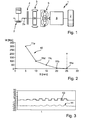
- FIG. 1 shows an embodiment of a hybrid powertrain 1 with an internal combustion engine 2 with a crankshaft 2a, an electric machine 3 with a rotor 3a and an effective between the engine 2 and the electric machine 3 clutch 4.
- Another clutch which is designed as a torque converter 5 in the embodiment shown , which may additionally have a lockup clutch, is disposed between the transmission 6 and the electric machine 3.
- the transmission 6 transmits the driving torque individually or jointly generated by the drive units in the form of the internal combustion engine 2 and the electric motor 3 to the drive wheels 7. If the internal combustion engine 2 exclusively transmits torque when the clutch 4 is closed, the electric machine 3 is de-energized and the rotor 3a is used as a flywheel.
- both drive units transmit torque to the transmission 6. If only the electric machine 3 is to be driven, the clutch 4 is opened. If it is to be braked by means of the electric machine 3, the clutch 4 is opened and the electric machine 4 operated as a generator.
- the drag torque of the internal combustion engine 2 can be used by closing the starting clutch 4 to achieve a greater delay effect.
- the clutch 4 is actuated by means of a clutch actuator, not shown, which in turn is controlled by a control unit.
- the control unit outputs a control signal to the clutch actuator according to a desired clutch torque determined by the control unit.
- the correlation between the path set by the clutch actuator on the clutch 4 and the desired clutch torque takes place in the embodiment shown on the basis of the clutch characteristic curve. Under the way is to understand the on the clutch, which must be applied to operate the clutch 4.
- the traversed by the actuator such as slave cylinder piston, release lever and the like, on the plate spring tongues or a lever transmitting way serves the friction engagement surfaces of the friction partners, namely a rotationally fixed for example arranged on the transmission input shaft friction disc with friction linings and the friction surfaces of the crankshaft side recorded clutch cover approach each other, wherein a distance measurement can be arranged at any point taking into account the leverage ratios effective in the actuation path. It is understood that the proposed method can be applied advantageously both for forcibly compressed and forced open couplings.
- FIG. 2 shows an embodiment of an assignment of the torque to be transmitted via the clutch M via the path s in the form of a characteristic curve 10, which is spanned by the support points 11a, 11b, 11, c, 11d, 11e, 11f.
- the number of support points 11b, 11, c, 11d, 11e, 11f is in principle arbitrary, but is optimized depending on the required accuracy of the presentation and the necessary effort.
- 10 5 support points 11b, 11, c, 11d, 11e, 11f were chosen to display the characteristic curve.
- the characteristic curve 10 is designed for a maximum transmission capacity of the clutch of approx. 300 Nm.
- empirically determined support points 11b, 11, c, 11d, 11e, 11f are used to represent the clutch characteristic to the existing conditions of the clutch, which are adapted several times in the course of operation of the vehicle.
- the support point 11a corresponds to the touch point T at which the clutch begins to transmit torque.
- the determination of the touch point T is simpler than a determination of the support points 11b, 11c, 11d, 11e. It may therefore be advantageous to shift the characteristic curve 10, that is to say the support values 11 b, 11 c, 11 d, 11 e, by the amount which has changed at the touch point T when the touch point T changes.
- FIG. 3 shows an embodiment of the curve 13 of a clutch desired torque over time t during a Tastpunkadaption according to the proposed method.
- the nominal clutch torque is modulated in its height in rectangular form over time. This modulated nominal clutch torque is followed by corresponding movements of the clutch impressed on the clutch actuator.
- the clutch travel is adjusted so that the clutch is close to the touch point. For example, the value of the touch point to be adapted can be set.
- the course 14 shows the signal response to the electric machine as detected actual torque.
- the course 14 shows the raw signal, which can be filtered and smoothed by means of phase-selective methods such as Fast Fourier Transform Analyzes (FFT) or because of its lower computational complexity in vehicles preferred lock-in method.
- FFT Fast Fourier Transform Analyzes
- the beginning of the torque transmission of the clutch is first determined with small increasing amplitudes of the nominal clutch torque and then determined at an amplitude in which a reliable quantitative determination of the actual torque is possible with smaller deviations from this the actual torque. If a torque is already transmitted via the clutch at a preset sensing point, the clutch is returned to a torque-free state and the measurement is restarted.
- a correction variable for the touch point T is advantageously formed from the ratio or the difference between the amplitudes of the nominal clutch torque, in particular from the amplitudes applied for the qualitative determination and the amplitudes of the actual torques detected at the electric machine and corresponding to the corresponding amplitudes of the desired clutch moments.
- the characteristic curve 10 (FIG. FIG. 2 ) around one of the thus determined Difference between the clutch desired torque and actual torque corresponding path s are corrected. It goes without saying that corresponding correction quantities such as factors or offsets can be used here.
- Hybrid powertrain 11b base 2 Internal combustion engine 11c base 2a crankshaft 11d base 3 electric machine 11e base 3a rotor 13 course 4 clutch 14 course 5 torque converter M moment 6 transmission s path 7 drive wheel T touch point 10 curve t Time 11a base
Landscapes
- Engineering & Computer Science (AREA)
- Mechanical Engineering (AREA)
- Chemical & Material Sciences (AREA)
- Combustion & Propulsion (AREA)
- Transportation (AREA)
- General Engineering & Computer Science (AREA)
- Physics & Mathematics (AREA)
- Fluid Mechanics (AREA)
- Automation & Control Theory (AREA)
- Hydraulic Clutches, Magnetic Clutches, Fluid Clutches, And Fluid Joints (AREA)
- Control Of Driving Devices And Active Controlling Of Vehicle (AREA)
- Hybrid Electric Vehicles (AREA)
Abstract
Description
- Die Erfindung betrifft ein Verfahren zur Steuerung einer Kupplung in einem Hybridantriebsstrang eines Kraftfahrzeugs mit einer Brennkraftmaschine und einer Elektromaschine sowie einer, zwischen diesen wirksam, angeordneten Kupplung.
- Hybridantriebsstränge mit einer Brennkraftmaschine und einer Elektromaschine, die mittels einer automatisierten Kupplung verbindbar sind, sind bekannt. Dabei kann die Kupplung während des Starts der Brennkraftmaschine oder während eines Boosterbetriebs mit antreibender Brenn- und Elektromaschine geschlossen oder schlupfend betrieben werden. Bei offener Kupplung kann die Elektromaschine das Fahrzeug allein antreiben oder während einer Schubphase rekuperieren. Je nach Ausgestaltung des Antriebsstranges kann die Kupplung weitere Funktionen zur Trennung und Verbindung der Brennkraftmaschine mit dem Antriebsstrang und/oder der Elektromaschine ausüben.
- Bei einer automatisierten Kupplung kann beispielsweise mittels eines elektrischen, hydraulischen, pneumatischen Kupplungsaktors, der diese Funktionsarten auch in kombinierter Form aufweisen kann, eine Betätigungsgröße an der Kupplung eingestellt, die ein gewünschtes Moment über die Kupplung überträgt. Dementsprechend wird zur Regelung beziehungsweise Steuerung der Kupplung an den Kupplungsaktor ein Signal, angelegt, das dem entsprechenden zu übertragenden Moment entspricht. Die Zuordnung dieser Signale zu den Stellsignalen der Kupplung erfolgt in der Regel mittels Korrelationsfaktoren, die in Form einer Gleichung berechnet oder als Kennwerte in einem Kennfeld abgelegt sind und an den aktuellen Zustand der Kupplung samt Kupplungsaktor, beispielsweise in Abhängigkeit von kurzzeitigen Schwankungen bei Temperaturänderungen und/oder von sich über die Lebensdauer der Kupplung ändernden Faktoren wie Verschleiß, angepasst werden können. Von Bedeutung ist hierbei der so genannte Tastpunkt, bei dem die Reibflächen des Ein- und Ausgangsteils der Kupplung in Reibkontakt zueinander treten.
- Aus dem Stand der Technik sind verschiedene Möglichkeiten bekannt, beispielsweise wird die Kupplung soweit zugefahren, bis bei stehendem Fahrzeug und bei Leerlaufdrehzahl betriebener Brennkraftmaschine ein Moment über die Kupplung übertragen wird, das von der Motorsteuerung ausgeregelt werden muss, indem beispielsweise ein Leerlaufregler die Leerlaufdrehzahl nachregelt oder eine Momentenbestimmung der Brennkraftmaschine eine Last in Höhe eines vorgegebenen Werts ermittelt.
- Aufgabe der Erfindung ist eine Erweiterung der Möglichkeiten der Tastpunktbestimmung auf Hybridantriebsstränge.
- Die Aufgabe wird durch ein Verfahren zur Steuerung einer automatisierten Kupplung im Antriebsstrang eines Hybridfahrzeuges mit einer Brennkraftmaschine, einer Elektromaschine und einer zwischen diesen wirksamen automatisierten Kupplung gelöst, wobei ein Tastpunkt der Kupplung, bei dem aufgrund eines vorgegebenen Kupplungssollmoments lediglich ein vernachlässigbares Moment über die Kupplung übertragen wird, bestimmt wird, indem eine aus der Elektromaschine gewonnene, dem Kupplungssollmoment zuordenbare Signalantwort ausgewertet wird.
- Ein derartiges Verfahren erlaubt eine Bestimmung des Tastpunktes bei stillgelegter Brennkraftmaschine. Dieser Betriebszustand tritt bei Hybridantriebssträngen besonders gehäuft auf, da in der Regel die Brennkraftmaschine beim Anhalten des Fahrzeuges insbesondere aus ökonomischen Gründen stillgesetzt wird. Das vorgeschlagene Verfahren bietet daher den Vorteil, dass alternativ oder zusätzlich zu den im Stand der Technik beschriebenen Verfahren zur Tastpunktbestimmung die Kupplung häufiger überprüft werden kann und entsprechende Kennfelder beziehungsweise Kennlinien an den momentanen Betriebszustand der Kupplung und deren Kupplungsaktor adaptiert werden können. Durch dieses Verfahren kann der Fahrkomfort gesteigert und der Verschleiß der Kupplung vermindert werden. Insbesondere sind schnelle Anpassungen des Tastpunktes an wechselnde Temperaturen in der Kupplungsglocke, beispielsweise beim Wechsel von kalten Temperaturen auf Betriebstemperatur im Winterbetrieb, bei Bergfahrten und/oder Anhängerbetrieb etc. von Vorteil.
- Das vorgeschlagene Verfahren kann auf alle Kupplungen in Hybridantriebssträngen angewendet werden, bei denen das Eingangs- oder Ausgangsteil mit einer Elektromaschine verbunden ist und die Kupplung geöffnet ist. Dabei kann die Elektromaschine seriell im Hybridantriebsstrang, wobei die Kupplung beispielsweise die Brennkraftmaschine von der Elektromaschine und vom nachfolgenden Getriebe trennt, oder parallel, wobei die Kupplung die Elektromaschine dem Antriebsstrang und/oder der Brennkraftmaschine zuschaltet, vorgesehen sein. Weiterhin kann die Kupplung sowohl Brennkraftmaschine als auch Elektromaschine vom Getriebe trennen. Es versteht sich, dass die vorgenannten Anordnungen und weitere Konfigurationen des Hybridantriebsstranges das vorgeschlagene Verfahren nicht einschränken. Die Elektromaschine kann konzentrisch um die Kurbelwelle oder eine Getriebeeingangswelle oder parallel zu einer dieser Wellen angeordnet sein.
- Der Kupplungsaktor kann elektrohydraulisch betrieben sein, indem ein Elektromotor, beispielsweise mittels eines Exzenters einen Geberzylinder betätigt, der über eine hydraulische Strecke Druck auf einen Nehmerzylinder ausübt, der wiederum die Kupplung betätigt. In diesem Falle kann die Zuordnung des zu übertragenden Kupplungssollmoments beispielsweise mittels einer Wegsteuerung des Geberzylinderkolbens oder einer inkrementellen Wegsensorik, die auch im Elektromotor vorgesehen sein kann, erfolgen. Für andere Kupplungsaktoren kann das Kupplungssollmoment mittels anderer Zuordnungsgrößen eingestellt werden, beispielsweise bei pneumatisch oder hydraulisch betätigten Kupplungen mittels des anliegenden Drucks oder bei elektromagnetisch betätigten Kupplungen mittels der angelegten Spannung, des Stroms oder der anderer elektromagnetischer Größen.
- Zur Ermittlung des Tastpunktes wird in vorteilhafter Weise ein an die Kupplung angelegtes Kupplungssollmoment zunehmend vergrößert, bis an der Elektromaschine eine dem Kupplungssollmoment zuordenbare Signalantwort erfassbar ist. Es wird also die Kupplung zugefahren, bis die Reibeingriffsflächen von Ein- und Ausgangsteil der Kupplung in Reibkontakt treten und ein minimales Moment auf die Elektromaschine übertragen wird, das durch eine entsprechende Reaktion der Elektromaschine erfassbar ist. Dabei hat es sich als vorteilhaft erwiesen, wenn das Kupplungssollmoment während des Verstellvorgangs moduliert wird. Auf diese Weise kann als Signalantwort ebenfalls eine modulierte Signalantwort ausgewertet werden, die weniger störungsanfällig und sensibler ermittelt werden kann. Derartige Muster des modulierten Kupplungssollmoments können beispielsweise Rechtecke, Rampen oder sinusförmige Muster oder dergleichen sein. Dabei kann es vorteilhaft sein, wenn für die modulierten Muster des Kupplungssollmoments feste Frequenzen gewählt werden, die in einem Bereich vorgesehen werden, in dem keine Eigenfrequenz des Fahrzeugs angeregt wird.
- Die Signalantwort wird vorteilhafterweise auf eine Korrelation mit dem modulierten Kupplungssollmoment überprüft, wobei bei als Signalantwort eine Momentenänderung an der Elektromaschine ausgewertet werden kann. In einer vorteilhaften Ausgestaltung kann ein aktuell vorhandener Tastpunkt angefahren und an diesem Punkt eine Modulation des Kupplungssollmomentes erfolgen. Aus dem Vergleich zwischen den Amplituden der Kupplungssollmomente und den als Signalantworten an der Elektromaschine anliegenden Amplituden der Istmomente kann auf die Lage des Tastpunktes geschlossen werden. Sind die Amplituden von Soll- und Istmoment innerhalb einer Toleranz identisch, stimmt der aktuelle Tastpunkt noch. Treten Abweichungen in den Amplituden von Kupplungssollmoment und Istmoment auf, muss der Tastpunkt entsprechend den Abweichungen korrigiert werden, indem zur Erreichung des gewünschten Sollmoments der Kupplungsweg entsprechend korrigiert wird. In ähnlicher Weise kann es vorteilhaft sein, anstatt der Erfassung von Momenten eine Änderung der Drehzahlen der Elektromaschine oder eines Kompensationsstroms oder einer Kompensationsspannung bei vorgegebener, geregelter Drehzahl der Elektromaschine zu ermitteln und bei einer entsprechenden Änderung dieser Größe darauf zu schließen, dass der Tastpunkt erreicht ist. Die Aufprägung einer Modulation der Kupplung, beispielsweise in Form des Kupplungssollmomentes ist in der Weise vorteilhaft, dass Korrelationsverfahren angewendet werden könne, die hohe Rauschanteile beziehungsweise Störungen in der Signalantwort eliminieren können. Dabei können entsprechende vorteilhafte Mess- und/oder Auswertemethoden, beispielsweise so genannte Lock-in-Verfahren oder ähnliche angewendet werden.
- Mit dem vorgeschlagenen Verfahren kann eine Tastpunktbestimmung bei drehzahlgeregelter Elektromaschine durchgeführt werden, beispielsweise bei Betriebszuständen, bei denen bergab mit der Tempomatfunktion gefahren wird, bei Betrieb des Fahrzeug nur mit der Elektromaschine, in Rekuperationsphasen und dergleichen. Vorzugsweise werden die Ermittlung und Adaption des Tastpunktes bei höheren Gängen durchgeführt, da die Rückwirkung der aufgeprägten Modulation auf den Antriebsstrang besonders gering ist.
- Die Erfindung wird anhand der
Figuren 1 bis 3 näher erläutert. Dabei zeigen: -
Figur 1 ein Ausführungsbeispiel eines Hybridantriebsstranges, -
Figur 2 eine typische Kupplungskennlinie
und -
Figur 3 ein Ausführungsbeispiel der Momentführung einer modulierten Tastpunkadaption. -
Figur 1 zeigt ein Ausführungsbeispiel eines Hybridantriebsstrangs 1 mit einer Brennkraftmaschine 2 mit einer Kurbelwelle 2a, einer Elektromaschine 3 mit einem Rotor 3a und einer zwischen der Brennkraftmaschine 2 und der Elektromaschine 3 wirksamen Kupplung 4. Eine weitere Kupplung, die in dem gezeigten Ausführungsbeispiel als Drehmomentwandler 5 ausgeführt ist, der zusätzlich über eine Wandlerüberbrückungskupplung verfügen kann, ist zwischen dem Getriebe 6 und der Elektromaschine 3 angeordnet. Das Getriebe 6 überträgt das von den Antriebseinheiten in Form der Brennkraftmaschine 2 und der Elektromaschine 3 einzeln oder gemeinsam generierte Antriebsmoment an die Antriebsräder 7. Soll die Brennkraftmaschine 2 bei geschlossener Kupplung 4 ausschließlich Moment übertragen, wird die Elektromaschine 3 stromlos geschaltet, der Rotor 3a dient dabei als Schwungmasse. Bei Bestromung der Elektromaschine 3 und geschlossener Kupplung 4 übertragen beide Antriebseinheiten Moment auf das Getriebe 6. Soll nur die Elektromaschine 3 antreiben, wird die Kupplung 4 geöffnet. Soll mittels der Elektromaschine 3 abgebremst werden, wird die Kupplung 4 geöffnet und die Elektromaschine 4 als Generator betrieben. Zusätzlich kann zur Erzielung eines größeren Verzögerungseffektes das Schleppmoment der Brennkraftmaschine 2 durch Schließen der Startkupplung 4 genutzt werden. - Die Kupplung 4 wird mittels eines nicht dargestellten Kupplungsaktors betätigt, der wiederum von einem Steuergerät gesteuert wird. Das Steuergerät gibt gemäß einem von dem Steuergerät bestimmten Kupplungssollmoment ein Steuersignal an den Kupplungsaktor aus. Die Korrelation zwischen dem vom Kupplungsaktor an der Kupplung 4 eingestellten Weg und dem Kupplungssollmoment erfolgt im gezeigten Ausführungsbeispiel anhand der Kupplungskennlinie. Unter dem Weg ist der an der Kupplung zu verstehen, der aufgebracht werden muss um die Kupplung 4 zu betätigen. Der von dem Betätigungselement wie Nehmerzylinderkolben, Ausrückhebel und dergleichen zurückgelegte, auf die Tellerfederzungen oder einem Hebel übertragende Weg dient dazu, die Reibeingriffsflächen der Reibpartner, nämlich einer beispielsweise drehfest an der Getriebeeingangswelle angeordneten Reibscheibe mit Reibbelägen und die Reibflächen des kurbelwellenseitig aufgenommenen Kupplungsdeckels einander zu nähern, wobei eine Wegmessung unter Berücksichtigung der im Betätigungsweg wirksamen Hebelverhältnisse an beliebiger Stelle angeordnet sein kann. Es versteht sich, dass das vorgeschlagene Verfahren sowohl für zwangsweise zugedrückte und zwangsweise geöffnete Kupplungen in vorteilhafter Weise angewendet werden kann.
-
Figur 2 zeigt ein Ausführungsbeispiel einer Zuordnung des über die Kupplung zu übertragenden Moments M über den Weg s in Form einer Kennlinie 10, die durch die Stützstellen 11a, 11b, 11, c, 11d, 11e, 11f aufgespannt wird. Die Anzahl der Stützstellen 11b, 11, c, 11d, 11e, 11f ist prinzipiell beliebig, wird aber in Abhängigkeit von der nötigen Genauigkeit der Darstellung und dem nötigen Aufwand optimiert. Im gezeigten Beispiel wurden zur Darstellung der Kennlinie 10 5 Stützstellen 11b, 11, c, 11d, 11e, 11f gewählt. Die Kennlinie 10 ist auf eine maximale Übertragungskapazität der Kupplung von ca. 300 Nm ausgelegt. Zur Darstellung der Kupplungskennlinie an die bestehenden Verhältnisse der Kupplung werden beispielsweise empirisch bestimmte Stützstellen 11b, 11, c, 11d, 11e, 11f verwendet, die im Laufe des Betriebs des Fahrzeugs mehrfach adaptiert werden. Die Stützstelle 11a entspricht dem Tastpunkt T, bei dem die Kupplung beginnt, Moment zu übertragen. In der Regel ist die Bestimmung des Tastpunktes T einfacher als eine Bestimmung der Stützpunkte 11 b, 11 c, 11 d, 11 e. Es kann daher vorteilhaft sein, bei sich änderndem Tastpunkt T die Kennlinie 10, also die Stützwerte 11 b, 11c, 11 d, 11 e um den Betrag, der sich am Tastpunkt T geändert hat, zu verschieben. -
Figur 3 zeigt ein Ausführungsbeispiel für den Verlauf 13 eines Kupplungssollmoments über die Zeit t während einer Tastpunkadaption gemäß des vorgeschlagenen Verfahrens. Das Kupplungssollmoment wird in seiner Höhe in Rechteckform über die Zeit moduliert. Diesem modulierten Kupplungssollmoment folgen entsprechende dem Kupplungsaktor aufgeprägte Wegbewegungen an der Kupplung. Der Kupplungsweg wird dabei so eingestellt, dass sich die Kupplung in der Nähe des Tastpunktes befindet. Beispielsweise kann der zu adaptierende Wert des Tastpunktes eingestellt werden. Der Verlauf 14 zeigt die Signalantwort an der Elektromaschine als erfasstes Istmoment. Der Verlauf 14 zeigt das Rohsignal, das mittels phasenselektiver Verfahren wie Fast-Fourier-Transform-Analysen (FFT) oder wegen seines geringeren Rechenaufwands in Fahrzeugen bevorzugten Lock-In-Verfahrens gefiltert und geglättet werden kann. In vorteilhafter Weise wird zuerst mit kleinen ansteigenden Amplituden des Kupplungssollmoments der Beginn der Momentenübertragung der Kupplung bestimmt und dann bei einer Amplitude, in der eine sichere quantitative Bestimmung des Istmoments möglich ist, mit kleineren Abweichungen von dieser das Istmoment bestimmt. Sollte bei einem voreingestellten Tastpunkt bereits ein Moment über die Kupplung übertragen werden, wird die Kupplung in einen momentenfreien Zustand zurück gefahren und die Messung erneut begonnen. - Eine Korrekturgröße für den Tastpunkt T wird in vorteilhafter Weise aus dem Verhältnis oder der Differenz der Amplituden des Kupplungssollmoments, insbesondere aus den für die qualitative Bestimmung aufgebrachten Amplituden und den an der Elektromaschine erfassten, zu den entsprechenden Amplituden der Kupplungssollmomente korrespondierenden Amplituden der Istmomente, gebildet. Beispielsweise kann die Kennlinie 10 (
Figur 2 ) um einen der so ermittelten Differenz zwischen Kupplungssollmoment und Istmoment entsprechenden Weg s korrigiert werden. Es versteht sich, dass hierbei entsprechende Korrekturgrößen wie Faktoren oder Offsets Anwendung finden können. -
1 Hybridantriebstrang 11b Stützpunkt 2 Brennkraftmaschine 11c Stützpunkt 2a Kurbelwelle 11d Stützpunkt 3 Elektromaschine 11e Stützpunkt 3a Rotor 13 Verlauf 4 Kupplung 14 Verlauf 5 Drehmomentwandler M Moment 6 Getriebe s Weg 7 Antriebsrad T Tastpunkt 10 Kennlinie t Zeit 11a Stützpunkt
Claims (10)
- Verfahren zur Steuerung einer automatisierten Kupplung (4) im Antriebsstrang (1) eines Hybridfahrzeuges mit einer Brennkraftmaschine (2), einer Elektromaschine (3) und der zwischen diesen wirksamen automatisierten Kupplung (4), dadurch gekennzeichnet, dass ein Tastpunkt (T) der Kupplung (4), bei dem aufgrund eines vorgegebenen Kupplungssollmoments lediglich ein vernachlässigbares Moment über die Kupplung (4) übertragen wird, bestimmt wird, indem eine aus der Elektromaschine (3) gewonnene, dem Kupplungssollmoment zuordenbare Signalantwort ausgewertet wird.
- Verfahren nach Anspruch 1, dadurch gekennzeichnet, dass ein an die Kupplung (4) angelegtes Kupplungssollmoment zunehmend vergrößert wird, bis an der Elektromaschine (3) eine dem Kupplungssollmoment zuordenbare Signalantwort erfassbar ist.
- Verfahren nach Anspruch 2, dadurch gekennzeichnet, dass das Kupplungssollmoment moduliert wird.
- Verfahren nach Anspruch 3, dadurch gekennzeichnet, dass die Signalantwort auf eine Korrelation mit dem modulierten Kupplungssollmoment überprüft wird.
- Verfahren nach einem der Ansprüche 1 bis 4, dadurch gekennzeichnet, dass als Signalantwort eine Momentenänderung an der Elektromaschine (3) ausgewertet wird.
- Verfahren nach einem der Ansprüche 1 bis 5, dadurch gekennzeichnet, dass als Signalantwort eine Drehzahländerung der Elektromaschine (3) ausgewertet wird.
- Verfahren nach einem der Ansprüche 1 bis 5, dadurch gekennzeichnet, dass als Signalantwort bei einem Betrieb der Elektromaschine (3) bei vorgegebener Drehzahl eine elektrische Größe ausgewertet wird.
- Verfahren nach einem der Ansprüche 4 und 5, dadurch gekennzeichnet, dass das Kupplungssollmoment rechteckförmig moduliert wird.
- Verfahren nach Anspruch 8, dadurch gekennzeichnet, dass zuerst Kupplungssollmomente mit steigenden und anschließend alternierenden Amplituden übertragen werden.
- Verfahren nach einem der Ansprüche 4, 5, 8 oder 9, dadurch gekennzeichnet, dass eine Korrekturgröße für den Tastpunkt (T) aus dem Verhältnis zwischen den Amplituden des Kupplungssollmoments und den korrespondierenden, an der Elektromaschine erfassten Istmomenten gebildet wird.
Applications Claiming Priority (1)
| Application Number | Priority Date | Filing Date | Title |
|---|---|---|---|
| DE102007032487 | 2007-07-12 |
Publications (3)
| Publication Number | Publication Date |
|---|---|
| EP2014946A2 true EP2014946A2 (de) | 2009-01-14 |
| EP2014946A3 EP2014946A3 (de) | 2010-01-13 |
| EP2014946B1 EP2014946B1 (de) | 2011-10-26 |
Family
ID=39829102
Family Applications (1)
| Application Number | Title | Priority Date | Filing Date |
|---|---|---|---|
| EP08011556A Not-in-force EP2014946B1 (de) | 2007-07-12 | 2008-06-26 | Verfahren zur Tastpunktermittlung einer automatisierten Kupplung |
Country Status (3)
| Country | Link |
|---|---|
| EP (1) | EP2014946B1 (de) |
| AT (1) | ATE530791T1 (de) |
| DE (1) | DE102008030473A1 (de) |
Cited By (14)
| Publication number | Priority date | Publication date | Assignee | Title |
|---|---|---|---|---|
| WO2010040621A1 (de) * | 2008-10-08 | 2010-04-15 | Robert Bosch Gmbh | Verfahren zum adaptieren einer trennkupplung in einer triebstranganordnung eines fahrzeugs und triebstranganordnung |
| FR2950303A1 (fr) * | 2009-09-24 | 2011-03-25 | Peugeot Citroen Automobiles Sa | Procede d'apprentisage du point de lechage d'un embrayage par la courbe caracteristique de l'embrayage pour un vehicule hybride |
| DE102009053885A1 (de) * | 2009-11-20 | 2011-05-26 | Getrag Getriebe- Und Zahnradfabrik Hermann Hagenmeyer Gmbh & Cie Kg | Verfahren zur Kisspointadaption |
| WO2011117108A1 (de) * | 2010-03-24 | 2011-09-29 | Robert Bosch Gmbh | Verfahren zum prüfen der funktionalität eines abgasrückführventils einer brennkraftmaschine |
| EP2468597A1 (de) * | 2010-12-21 | 2012-06-27 | Saab Automobile AB | Anpassung einer Kraft-Drehmoment-Kennlinie für eine Anfahrkupplung |
| DE102013103878A1 (de) * | 2013-04-17 | 2014-10-23 | Dr. Ing. H.C. F. Porsche Aktiengesellschaft | Verfahren und Steuereinrichtung zur Adaption einer Kennlinie einer zwischen einem Verbrennungsmotor und einem Elektromotor vorgesehenen Trennkupplung |
| WO2015120850A1 (de) * | 2014-02-14 | 2015-08-20 | Schaeffler Technologies AG & Co. KG | Verfahren zur bestimmung einer kennlinie einer kupplung eines kupplungsbetätigungssystems in einem antriebsstrang, insbesondere eines kraftfahrzeuges |
| WO2016058735A1 (de) * | 2014-10-13 | 2016-04-21 | Getrag Getriebe- Und Zahnradfabrik Hermann Hagenmeyer Gmbh & Cie Kg | Hydraulikanordnung für einen kraftfahrzeug-antriebsstrang |
| US9415760B2 (en) | 2014-04-02 | 2016-08-16 | Ford Global Technologies, Llc | Clutch calibration for a hybrid electric powertrain |
| CN106043273A (zh) * | 2016-05-31 | 2016-10-26 | 北京理工大学 | 一种混合动力汽车的离合器自标定方法及其应用 |
| CN106662176A (zh) * | 2014-07-18 | 2017-05-10 | 舍弗勒技术股份两合公司 | 用于确定混合动力车辆的混合分离离合器的触点变化的且用于适配其摩擦系数的方法 |
| WO2017148728A1 (de) * | 2016-03-02 | 2017-09-08 | Audi Ag | Verfahren zur adaption eines greifpunkts einer trennkupplung für ein fahrzeug |
| WO2018103782A1 (de) * | 2016-12-09 | 2018-06-14 | Schaeffler Technologies AG & Co. KG | Verfahren zum betätigen einer kupplung eines hybridantriebsstranges sowie antriebsstrang mit kupplung |
| CN117553855A (zh) * | 2023-11-21 | 2024-02-13 | 苏州市润凯汽车配件制造有限公司 | 一种离合器接合点检测方法及系统 |
Families Citing this family (22)
| Publication number | Priority date | Publication date | Assignee | Title |
|---|---|---|---|---|
| DE102008044016B4 (de) | 2008-11-24 | 2025-07-31 | Robert Bosch Gmbh | Verfahren zum Erfassen eines sich einstellenden Drehmomentes für einen Hybridantrieb |
| CN102859224B (zh) * | 2010-04-26 | 2015-06-17 | 舍弗勒技术股份两合公司 | 用于适配汽车动力传动系中离合器的接触点的方法 |
| DE102011085751A1 (de) | 2010-11-25 | 2012-05-31 | Schaeffler Technologies Gmbh & Co. Kg | Verfahren zur Ermittlung von Kupplungsreibwerten sowie Verfahren zur Ermittlung von Kupplungstastpunkten |
| DE102012102276A1 (de) * | 2012-03-19 | 2013-09-19 | Dr. Ing. H.C. F. Porsche Aktiengesellschaft | Verfahren zur Adaption einer Trennkupplung |
| DE102013104747A1 (de) * | 2013-05-08 | 2014-11-13 | Dr. Ing. H.C. F. Porsche Aktiengesellschaft | Verfahren und Steuereinrichtung zur Adaption einer Kennlinie einer zwischen einem Verbrennungsmotor und einem Elektromotor vorgesehenen Trennkupplung |
| DE102014201771A1 (de) | 2014-01-31 | 2015-08-20 | Zf Friedrichshafen Ag | Verfahren zur Bestimmung eines Status einer automatisierten Anfahrkupplung |
| DE102014211381A1 (de) | 2014-06-13 | 2015-12-17 | Schaeffler Technologies AG & Co. KG | Verfahren und Vorrichtung zur Ermittlung eines Tastpunktes einer Hybridtrennkupplung eines Hybridfahrzeuges |
| DE102014211669A1 (de) | 2014-06-18 | 2015-12-24 | Schaeffler Technologies AG & Co. KG | Verfahren zur Ermittlung einer Tastpunktänderung einer Hybridtrennkupplung eines Hybridfahrzeuges |
| DE102015213317A1 (de) | 2014-08-13 | 2016-02-18 | Schaeffler Technologies AG & Co. KG | Verfahren zur Ermittlung eines Tastpunktes einer Hybridtrennkupplung eines Hybridfahrzeuges |
| DE102015221031B4 (de) | 2014-11-07 | 2022-01-13 | Schaeffler Technologies AG & Co. KG | Verfahren zur Ermittlung eines Tastpunktes und eines Reibwertes einer Hybridtrennkupplung eines Hybridfahrzeuges |
| CN107208717B (zh) * | 2015-01-08 | 2019-07-23 | 舍弗勒技术股份两合公司 | 用于确定混合动力车辆的混合动力分离离合器的半接合点的方法 |
| US10399560B2 (en) | 2015-02-04 | 2019-09-03 | Schaeffler Technologies AG & Co. KG | Method for determining a characteristic curve of a hybrid separating clutch of a hybrid vehicle without a test stand |
| KR102532027B1 (ko) | 2015-02-11 | 2023-05-12 | 섀플러 테크놀로지스 아게 운트 코. 카게 | 하이브리드 차량의 하이브리드 클러치의 물림점을 결정하는 방법 |
| DE112016003333B4 (de) | 2015-07-23 | 2023-02-02 | Schaeffler Technologies AG & Co. KG | Verfahren zur steuerung einer automatisierten reibungskupplung |
| DE112016003830A5 (de) | 2015-08-25 | 2018-05-24 | Schaeffler Technologies AG & Co. KG | Verfahren zur plausibilisierung eines drehmomentverlaufs zur ermittlung eines tastpunktes einer hybridtrennkupplung im antriebsstrang eines hybridfahrzeuges |
| DE102016215855B4 (de) | 2015-08-26 | 2023-10-19 | Schaeffler Technologies AG & Co. KG | Verfahren zur Bestimmung eines Tastpunktes einer Hybridtrennkupplung eines Hybridfahrzeuges |
| DE102016219359A1 (de) | 2015-10-08 | 2017-04-13 | Schaeffler Technologies AG & Co. KG | Verfahren zur Verhinderung einer fehlerhaften Tastpunktadaption einer Kupplung eines Fahrzeuges, vorzugsweise eines Hybridfahrzeuges |
| DE102016208035A1 (de) | 2016-05-10 | 2017-11-16 | Schaeffler Technologies AG & Co. KG | Verfahren zur Steuerung einer Trennkupplung in einem hybridischen Antriebsstrang |
| DE102016215597A1 (de) | 2016-08-19 | 2018-02-22 | Schaeffler Technologies AG & Co. KG | Verfahren zur Ermittlung eines sicherheitsrelevanten Kupplungszustands einer Trennkupplung eines hybridischen Antriebsstrangs |
| DE102017106596A1 (de) | 2017-03-28 | 2018-10-04 | Schaeffler Technologies AG & Co. KG | Verfahren und Vorrichtung zur Ermittlung eines Tastpunktes und zur Korrektur einer Kupplungskennlinie einer Reibkupplung, Computerprogramm und Reibkupplungseinrichtung |
| DE102018117310A1 (de) | 2018-07-18 | 2020-01-23 | Schaeffler Technologies AG & Co. KG | Verfahren zur Verbesserung der Genauigkeit bei einer Tastpunktermittlung einer automatisierten Kupplung in einem Kraftfahrzeug mit einem Verbrennungsmotor |
| DE102018130679A1 (de) | 2018-12-03 | 2020-06-04 | Schaeffler Technologies AG & Co. KG | Verfahren zur Bestimmung eines Tastpunktes einer Hybridtrennkupplung eines Hybridfahrzeuges |
Citations (1)
| Publication number | Priority date | Publication date | Assignee | Title |
|---|---|---|---|---|
| WO2003006841A2 (de) | 2001-07-12 | 2003-01-23 | Luk Lamellen Und Kupplungsbau Beteiligungs Kg | Verfahren zum adaptieren der einstellung einer kupplung in einem unkonventionellen antriebsstrang eines fahrzeugs |
Family Cites Families (1)
| Publication number | Priority date | Publication date | Assignee | Title |
|---|---|---|---|---|
| DE19540921A1 (de) * | 1995-11-03 | 1997-05-07 | Bosch Gmbh Robert | System zur Steuerung einer Servokupplung |
-
2008
- 2008-06-26 DE DE102008030473A patent/DE102008030473A1/de not_active Ceased
- 2008-06-26 AT AT08011556T patent/ATE530791T1/de active
- 2008-06-26 EP EP08011556A patent/EP2014946B1/de not_active Not-in-force
Patent Citations (1)
| Publication number | Priority date | Publication date | Assignee | Title |
|---|---|---|---|---|
| WO2003006841A2 (de) | 2001-07-12 | 2003-01-23 | Luk Lamellen Und Kupplungsbau Beteiligungs Kg | Verfahren zum adaptieren der einstellung einer kupplung in einem unkonventionellen antriebsstrang eines fahrzeugs |
Cited By (28)
| Publication number | Priority date | Publication date | Assignee | Title |
|---|---|---|---|---|
| US9341218B2 (en) | 2008-10-08 | 2016-05-17 | Robert Bosch Gmbh | Method for adapting a separating clutch in a drive train system of a vehicle and drive train system |
| WO2010040621A1 (de) * | 2008-10-08 | 2010-04-15 | Robert Bosch Gmbh | Verfahren zum adaptieren einer trennkupplung in einer triebstranganordnung eines fahrzeugs und triebstranganordnung |
| FR2950303A1 (fr) * | 2009-09-24 | 2011-03-25 | Peugeot Citroen Automobiles Sa | Procede d'apprentisage du point de lechage d'un embrayage par la courbe caracteristique de l'embrayage pour un vehicule hybride |
| WO2011036393A1 (fr) * | 2009-09-24 | 2011-03-31 | Peugeot Citroën Automobiles SA | Procede d'apprentisage du point de lechage d'un embrayage par la courbe caracteristique de l'embrayage pour un vehicule hybride |
| DE102009053885A1 (de) * | 2009-11-20 | 2011-05-26 | Getrag Getriebe- Und Zahnradfabrik Hermann Hagenmeyer Gmbh & Cie Kg | Verfahren zur Kisspointadaption |
| US8577573B2 (en) | 2009-11-20 | 2013-11-05 | Getrag Getriebe- Und Zahnradfabrik Hermann Hagenmeyer Gmbh & Cie Kg | Method for adapting the kiss point |
| DE102009053885B4 (de) * | 2009-11-20 | 2015-10-29 | Getrag Getriebe- Und Zahnradfabrik Hermann Hagenmeyer Gmbh & Cie Kg | Verfahren zur Kisspointadaption |
| WO2011117108A1 (de) * | 2010-03-24 | 2011-09-29 | Robert Bosch Gmbh | Verfahren zum prüfen der funktionalität eines abgasrückführventils einer brennkraftmaschine |
| EP2468597A1 (de) * | 2010-12-21 | 2012-06-27 | Saab Automobile AB | Anpassung einer Kraft-Drehmoment-Kennlinie für eine Anfahrkupplung |
| DE102013103878A1 (de) * | 2013-04-17 | 2014-10-23 | Dr. Ing. H.C. F. Porsche Aktiengesellschaft | Verfahren und Steuereinrichtung zur Adaption einer Kennlinie einer zwischen einem Verbrennungsmotor und einem Elektromotor vorgesehenen Trennkupplung |
| DE102013103878B4 (de) * | 2013-04-17 | 2021-06-17 | Dr. Ing. H.C. F. Porsche Aktiengesellschaft | Verfahren und Steuereinrichtung zur Adaption einer Kennlinie einer zwischen einem Verbrennungsmotor und einem Elektromotor vorgesehenen Trennkupplung |
| WO2015120850A1 (de) * | 2014-02-14 | 2015-08-20 | Schaeffler Technologies AG & Co. KG | Verfahren zur bestimmung einer kennlinie einer kupplung eines kupplungsbetätigungssystems in einem antriebsstrang, insbesondere eines kraftfahrzeuges |
| CN105980728A (zh) * | 2014-02-14 | 2016-09-28 | 舍弗勒技术股份两合公司 | 用于确定尤其是机动车的传动系内的离合器操作系统的离合器的特性曲线的方法 |
| CN105980728B (zh) * | 2014-02-14 | 2019-08-16 | 舍弗勒技术股份两合公司 | 用于确定尤其是机动车的传动系内的离合器操作系统的离合器的特性曲线的方法 |
| US10024374B2 (en) | 2014-02-14 | 2018-07-17 | Schaeffler Technologies AG & Co. KG | Method for determining a characteristic curve of a clutch of a clutch activation system in a drivetrain, in particular of a motor vehicle |
| US9415760B2 (en) | 2014-04-02 | 2016-08-16 | Ford Global Technologies, Llc | Clutch calibration for a hybrid electric powertrain |
| CN106662176B (zh) * | 2014-07-18 | 2019-03-08 | 舍弗勒技术股份两合公司 | 用于确定混合动力车辆的混合分离离合器的触点变化的且用于适配其摩擦系数的方法 |
| CN106662176A (zh) * | 2014-07-18 | 2017-05-10 | 舍弗勒技术股份两合公司 | 用于确定混合动力车辆的混合分离离合器的触点变化的且用于适配其摩擦系数的方法 |
| WO2016058735A1 (de) * | 2014-10-13 | 2016-04-21 | Getrag Getriebe- Und Zahnradfabrik Hermann Hagenmeyer Gmbh & Cie Kg | Hydraulikanordnung für einen kraftfahrzeug-antriebsstrang |
| WO2017148728A1 (de) * | 2016-03-02 | 2017-09-08 | Audi Ag | Verfahren zur adaption eines greifpunkts einer trennkupplung für ein fahrzeug |
| CN108779817A (zh) * | 2016-03-02 | 2018-11-09 | 奥迪股份公司 | 用于对车辆的分离离合器的接合点进行适配的方法 |
| US11041533B1 (en) | 2016-03-02 | 2021-06-22 | Audi Ag | Method for adapting an engagement point of a vehicle clutch |
| CN106043273B (zh) * | 2016-05-31 | 2018-07-24 | 北京理工大学 | 一种混合动力汽车的离合器自标定方法及其应用 |
| CN106043273A (zh) * | 2016-05-31 | 2016-10-26 | 北京理工大学 | 一种混合动力汽车的离合器自标定方法及其应用 |
| WO2018103782A1 (de) * | 2016-12-09 | 2018-06-14 | Schaeffler Technologies AG & Co. KG | Verfahren zum betätigen einer kupplung eines hybridantriebsstranges sowie antriebsstrang mit kupplung |
| CN110036218A (zh) * | 2016-12-09 | 2019-07-19 | 舍弗勒技术股份两合公司 | 用于操纵混合动力传动系的离合器的方法以及具有离合器的动力传动系 |
| CN117553855A (zh) * | 2023-11-21 | 2024-02-13 | 苏州市润凯汽车配件制造有限公司 | 一种离合器接合点检测方法及系统 |
| CN117553855B (zh) * | 2023-11-21 | 2024-05-14 | 苏州市润凯汽车配件制造有限公司 | 一种离合器接合点检测方法及系统 |
Also Published As
| Publication number | Publication date |
|---|---|
| EP2014946A3 (de) | 2010-01-13 |
| DE102008030473A1 (de) | 2009-01-15 |
| ATE530791T1 (de) | 2011-11-15 |
| EP2014946B1 (de) | 2011-10-26 |
Similar Documents
| Publication | Publication Date | Title |
|---|---|---|
| EP2014946B1 (de) | Verfahren zur Tastpunktermittlung einer automatisierten Kupplung | |
| DE19652244B4 (de) | Verfahren zur Adaption des Greifpunktes eines Kupplungsystems | |
| DE69524165T2 (de) | Wiedereinkupplungssteuerung | |
| DE69407243T2 (de) | Berührpunkt-Erkennungsverfahren einer Kupplung | |
| EP2268522B1 (de) | Schlupfbetrieb einer kupplung bei hybridantriebsvorrichtungen | |
| DE10237793A1 (de) | Verfahren und System zur Steuerung einer zwischen einem Motor und einem Getriebe eines Kraftfahrzeuges angeordneten, automatisierten Reibungskupplung | |
| DE102014206183A1 (de) | Verfahren zur Verminderung von Rupfschwingungen einer Reibungskupplung in einem Antriebsstrang eines Kraftfahrzeugs | |
| DE19721034A1 (de) | Kraftfahrzeug | |
| WO2013152922A1 (de) | Verfahren zur verminderung von rupfschwingungen | |
| DE112015004996B4 (de) | Verfahren zur Ermittlung eines Übertragungsverhaltens einer Reibungskupplung in einem Antriebsstrang | |
| WO2000075536A1 (de) | Verfahren zum betreiben einer betätigungseinrichtung eines automatisierten schaltgetriebes | |
| DE102007006803B4 (de) | Verfahren und Vorrichtung zum Vermindern von Rupfschwingungen in einem Kraftfahrzeugantriebsstrang | |
| DE102014204343B4 (de) | Verfahren und Vorrichtung zur Steuerung einer automatisierten Reibungskupplung | |
| DE19824772A1 (de) | Vorrichtung zur Steuerung eines Einrückzustandes | |
| DE10347114A1 (de) | Verfahren, Vorrichtung und deren Verwendung zum Betrieb eines Kraftfahrzeuges | |
| DE102014113475B4 (de) | Verfahren zum steuern eines trocken-1doppelkupplungsgetriebes eines fahrzeugs und trocken-doppelkupplungsgetriebe-baugruppe | |
| DE102016201104A1 (de) | Verfahren zur prüfstandsfreien Bestimmung einer Kennlinie einer Hybridtrennkupplung eines Hybridfahrzeuges | |
| DE102018205710A1 (de) | Verfahren und Steuerungseinrichtung zum Betreiben eines Antriebsstrangs | |
| DE10192541B4 (de) | Vorrichtung zum Kompensieren des Einflusses der Drehzahl auf die Kennlinie einer Kupplung | |
| DE10150597A1 (de) | Verfahren zum Betrieb eines eine Kupplungseinrichtung, ggf. Mehrfach-Kupplungseinrichtung, und ein Getriebe mit ggf. wenigstens zwei Getriebeeingangswellen aufweisenden Antriebsstrangs und derartiger Antriebsstrang mit entsprechender Steuereinheit | |
| DE102015211588A1 (de) | Verfahren zur Regelung einer automatisierten Reibungskupplung | |
| DE102012218227A1 (de) | Verfahren zur Steuerung einer Reibungskupplung | |
| DE102004002057A1 (de) | Verfahren und Vorrichtung zur Vorgabe der Anpresskraft zwischen zwei reibschlüssig Drehmoment übertragenden Bauteilen eines Antriebssystems | |
| DE102008046843B4 (de) | Verfahren zur Steuerung eines Verbrennungsmotors in Verbindung mit einer automatisierten Reibungskuppelung als Anfahrelement | |
| DE102015226692A1 (de) | Verfahren und Vorrichtung zum Bereitstellen einer Bremsverzögerung eines Kraftfahrzeugs |
Legal Events
| Date | Code | Title | Description |
|---|---|---|---|
| PUAI | Public reference made under article 153(3) epc to a published international application that has entered the european phase |
Free format text: ORIGINAL CODE: 0009012 |
|
| AK | Designated contracting states |
Kind code of ref document: A2 Designated state(s): AT BE BG CH CY CZ DE DK EE ES FI FR GB GR HR HU IE IS IT LI LT LU LV MC MT NL NO PL PT RO SE SI SK TR |
|
| AX | Request for extension of the european patent |
Extension state: AL BA MK RS |
|
| PUAL | Search report despatched |
Free format text: ORIGINAL CODE: 0009013 |
|
| AK | Designated contracting states |
Kind code of ref document: A3 Designated state(s): AT BE BG CH CY CZ DE DK EE ES FI FR GB GR HR HU IE IS IT LI LT LU LV MC MT NL NO PL PT RO SE SI SK TR |
|
| AX | Request for extension of the european patent |
Extension state: AL BA MK RS |
|
| 17P | Request for examination filed |
Effective date: 20100713 |
|
| 17Q | First examination report despatched |
Effective date: 20100805 |
|
| AKX | Designation fees paid |
Designated state(s): AT BE BG CH CY CZ DE DK EE ES FI FR GB GR HR HU IE IS IT LI LT LU LV MC MT NL NO PL PT RO SE SI SK TR |
|
| RAP1 | Party data changed (applicant data changed or rights of an application transferred) |
Owner name: SCHAEFFLER TECHNOLOGIES GMBH & CO. KG |
|
| GRAP | Despatch of communication of intention to grant a patent |
Free format text: ORIGINAL CODE: EPIDOSNIGR1 |
|
| RIC1 | Information provided on ipc code assigned before grant |
Ipc: F16D 48/06 20060101AFI20110629BHEP |
|
| GRAS | Grant fee paid |
Free format text: ORIGINAL CODE: EPIDOSNIGR3 |
|
| GRAA | (expected) grant |
Free format text: ORIGINAL CODE: 0009210 |
|
| AK | Designated contracting states |
Kind code of ref document: B1 Designated state(s): AT BE BG CH CY CZ DE DK EE ES FI FR GB GR HR HU IE IS IT LI LT LU LV MC MT NL NO PL PT RO SE SI SK TR |
|
| REG | Reference to a national code |
Ref country code: GB Ref legal event code: FG4D Free format text: NOT ENGLISH |
|
| REG | Reference to a national code |
Ref country code: CH Ref legal event code: EP |
|
| REG | Reference to a national code |
Ref country code: IE Ref legal event code: FG4D |
|
| REG | Reference to a national code |
Ref country code: DE Ref legal event code: R096 Ref document number: 502008005319 Country of ref document: DE Effective date: 20111222 |
|
| REG | Reference to a national code |
Ref country code: NL Ref legal event code: VDEP Effective date: 20111026 |
|
| RAP2 | Party data changed (patent owner data changed or rights of a patent transferred) |
Owner name: SCHAEFFLER TECHNOLOGIES AG & CO. KG |
|
| REG | Reference to a national code |
Ref country code: CH Ref legal event code: PFA Owner name: SCHAEFFLER TECHNOLOGIES AG & CO. KG Free format text: SCHAEFFLER TECHNOLOGIES GMBH & CO. KG#INDUSTRIESTRASSE 1-3#91074 HERZOGENAURACH (DE) -TRANSFER TO- SCHAEFFLER TECHNOLOGIES AG & CO. KG#INDUSTRIESTRASSE 1-3#91074 HERZOGENAURACH (DE) |
|
| LTIE | Lt: invalidation of european patent or patent extension |
Effective date: 20111026 |
|
| PG25 | Lapsed in a contracting state [announced via postgrant information from national office to epo] |
Ref country code: LT Free format text: LAPSE BECAUSE OF FAILURE TO SUBMIT A TRANSLATION OF THE DESCRIPTION OR TO PAY THE FEE WITHIN THE PRESCRIBED TIME-LIMIT Effective date: 20111026 Ref country code: NO Free format text: LAPSE BECAUSE OF FAILURE TO SUBMIT A TRANSLATION OF THE DESCRIPTION OR TO PAY THE FEE WITHIN THE PRESCRIBED TIME-LIMIT Effective date: 20120126 Ref country code: IS Free format text: LAPSE BECAUSE OF FAILURE TO SUBMIT A TRANSLATION OF THE DESCRIPTION OR TO PAY THE FEE WITHIN THE PRESCRIBED TIME-LIMIT Effective date: 20120226 |
|
| PG25 | Lapsed in a contracting state [announced via postgrant information from national office to epo] |
Ref country code: HR Free format text: LAPSE BECAUSE OF FAILURE TO SUBMIT A TRANSLATION OF THE DESCRIPTION OR TO PAY THE FEE WITHIN THE PRESCRIBED TIME-LIMIT Effective date: 20111026 Ref country code: LV Free format text: LAPSE BECAUSE OF FAILURE TO SUBMIT A TRANSLATION OF THE DESCRIPTION OR TO PAY THE FEE WITHIN THE PRESCRIBED TIME-LIMIT Effective date: 20111026 Ref country code: PT Free format text: LAPSE BECAUSE OF FAILURE TO SUBMIT A TRANSLATION OF THE DESCRIPTION OR TO PAY THE FEE WITHIN THE PRESCRIBED TIME-LIMIT Effective date: 20120227 Ref country code: GR Free format text: LAPSE BECAUSE OF FAILURE TO SUBMIT A TRANSLATION OF THE DESCRIPTION OR TO PAY THE FEE WITHIN THE PRESCRIBED TIME-LIMIT Effective date: 20120127 Ref country code: SE Free format text: LAPSE BECAUSE OF FAILURE TO SUBMIT A TRANSLATION OF THE DESCRIPTION OR TO PAY THE FEE WITHIN THE PRESCRIBED TIME-LIMIT Effective date: 20111026 Ref country code: NL Free format text: LAPSE BECAUSE OF FAILURE TO SUBMIT A TRANSLATION OF THE DESCRIPTION OR TO PAY THE FEE WITHIN THE PRESCRIBED TIME-LIMIT Effective date: 20111026 Ref country code: SI Free format text: LAPSE BECAUSE OF FAILURE TO SUBMIT A TRANSLATION OF THE DESCRIPTION OR TO PAY THE FEE WITHIN THE PRESCRIBED TIME-LIMIT Effective date: 20111026 Ref country code: PL Free format text: LAPSE BECAUSE OF FAILURE TO SUBMIT A TRANSLATION OF THE DESCRIPTION OR TO PAY THE FEE WITHIN THE PRESCRIBED TIME-LIMIT Effective date: 20111026 |
|
| REG | Reference to a national code |
Ref country code: IE Ref legal event code: FD4D |
|
| PG25 | Lapsed in a contracting state [announced via postgrant information from national office to epo] |
Ref country code: CY Free format text: LAPSE BECAUSE OF FAILURE TO SUBMIT A TRANSLATION OF THE DESCRIPTION OR TO PAY THE FEE WITHIN THE PRESCRIBED TIME-LIMIT Effective date: 20111026 |
|
| REG | Reference to a national code |
Ref country code: DE Ref legal event code: R097 Ref document number: 502008005319 Country of ref document: DE |
|
| PG25 | Lapsed in a contracting state [announced via postgrant information from national office to epo] |
Ref country code: SK Free format text: LAPSE BECAUSE OF FAILURE TO SUBMIT A TRANSLATION OF THE DESCRIPTION OR TO PAY THE FEE WITHIN THE PRESCRIBED TIME-LIMIT Effective date: 20111026 Ref country code: EE Free format text: LAPSE BECAUSE OF FAILURE TO SUBMIT A TRANSLATION OF THE DESCRIPTION OR TO PAY THE FEE WITHIN THE PRESCRIBED TIME-LIMIT Effective date: 20111026 Ref country code: CZ Free format text: LAPSE BECAUSE OF FAILURE TO SUBMIT A TRANSLATION OF THE DESCRIPTION OR TO PAY THE FEE WITHIN THE PRESCRIBED TIME-LIMIT Effective date: 20111026 Ref country code: DK Free format text: LAPSE BECAUSE OF FAILURE TO SUBMIT A TRANSLATION OF THE DESCRIPTION OR TO PAY THE FEE WITHIN THE PRESCRIBED TIME-LIMIT Effective date: 20111026 Ref country code: IE Free format text: LAPSE BECAUSE OF FAILURE TO SUBMIT A TRANSLATION OF THE DESCRIPTION OR TO PAY THE FEE WITHIN THE PRESCRIBED TIME-LIMIT Effective date: 20111026 Ref country code: BG Free format text: LAPSE BECAUSE OF FAILURE TO SUBMIT A TRANSLATION OF THE DESCRIPTION OR TO PAY THE FEE WITHIN THE PRESCRIBED TIME-LIMIT Effective date: 20120126 |
|
| PG25 | Lapsed in a contracting state [announced via postgrant information from national office to epo] |
Ref country code: IT Free format text: LAPSE BECAUSE OF FAILURE TO SUBMIT A TRANSLATION OF THE DESCRIPTION OR TO PAY THE FEE WITHIN THE PRESCRIBED TIME-LIMIT Effective date: 20111026 Ref country code: RO Free format text: LAPSE BECAUSE OF FAILURE TO SUBMIT A TRANSLATION OF THE DESCRIPTION OR TO PAY THE FEE WITHIN THE PRESCRIBED TIME-LIMIT Effective date: 20111026 |
|
| PLBE | No opposition filed within time limit |
Free format text: ORIGINAL CODE: 0009261 |
|
| STAA | Information on the status of an ep patent application or granted ep patent |
Free format text: STATUS: NO OPPOSITION FILED WITHIN TIME LIMIT |
|
| 26N | No opposition filed |
Effective date: 20120727 |
|
| REG | Reference to a national code |
Ref country code: DE Ref legal event code: R081 Ref document number: 502008005319 Country of ref document: DE Owner name: SCHAEFFLER TECHNOLOGIES AG & CO. KG, DE Free format text: FORMER OWNER: SCHAEFFLER TECHNOLOGIES GMBH & CO. KG, 91074 HERZOGENAURACH, DE Effective date: 20120828 Ref country code: DE Ref legal event code: R081 Ref document number: 502008005319 Country of ref document: DE Owner name: SCHAEFFLER TECHNOLOGIES GMBH & CO. KG, DE Free format text: FORMER OWNER: SCHAEFFLER TECHNOLOGIES GMBH & CO. KG, 91074 HERZOGENAURACH, DE Effective date: 20120828 |
|
| REG | Reference to a national code |
Ref country code: DE Ref legal event code: R097 Ref document number: 502008005319 Country of ref document: DE Effective date: 20120727 |
|
| BERE | Be: lapsed |
Owner name: SCHAEFFLER TECHNOLOGIES G.M.B.H. & CO. KG Effective date: 20120630 |
|
| PG25 | Lapsed in a contracting state [announced via postgrant information from national office to epo] |
Ref country code: MC Free format text: LAPSE BECAUSE OF NON-PAYMENT OF DUE FEES Effective date: 20120630 |
|
| REG | Reference to a national code |
Ref country code: CH Ref legal event code: PL |
|
| REG | Reference to a national code |
Ref country code: CH Ref legal event code: PL |
|
| GBPC | Gb: european patent ceased through non-payment of renewal fee |
Effective date: 20120626 |
|
| PG25 | Lapsed in a contracting state [announced via postgrant information from national office to epo] |
Ref country code: GB Free format text: LAPSE BECAUSE OF NON-PAYMENT OF DUE FEES Effective date: 20120626 Ref country code: LI Free format text: LAPSE BECAUSE OF NON-PAYMENT OF DUE FEES Effective date: 20120630 Ref country code: ES Free format text: LAPSE BECAUSE OF FAILURE TO SUBMIT A TRANSLATION OF THE DESCRIPTION OR TO PAY THE FEE WITHIN THE PRESCRIBED TIME-LIMIT Effective date: 20120206 Ref country code: CH Free format text: LAPSE BECAUSE OF NON-PAYMENT OF DUE FEES Effective date: 20120630 Ref country code: BE Free format text: LAPSE BECAUSE OF NON-PAYMENT OF DUE FEES Effective date: 20120630 |
|
| PG25 | Lapsed in a contracting state [announced via postgrant information from national office to epo] |
Ref country code: FI Free format text: LAPSE BECAUSE OF FAILURE TO SUBMIT A TRANSLATION OF THE DESCRIPTION OR TO PAY THE FEE WITHIN THE PRESCRIBED TIME-LIMIT Effective date: 20111026 |
|
| PG25 | Lapsed in a contracting state [announced via postgrant information from national office to epo] |
Ref country code: MT Free format text: LAPSE BECAUSE OF FAILURE TO SUBMIT A TRANSLATION OF THE DESCRIPTION OR TO PAY THE FEE WITHIN THE PRESCRIBED TIME-LIMIT Effective date: 20111026 |
|
| REG | Reference to a national code |
Ref country code: DE Ref legal event code: R081 Ref document number: 502008005319 Country of ref document: DE Owner name: SCHAEFFLER TECHNOLOGIES AG CO. KG, DE Free format text: FORMER OWNER: SCHAEFFLER TECHNOLOGIES AG CO. KG, 91074 HERZOGENAURACH, DE Effective date: 20140214 Ref country code: DE Ref legal event code: R081 Ref document number: 502008005319 Country of ref document: DE Owner name: SCHAEFFLER TECHNOLOGIES AG & CO. KG, DE Free format text: FORMER OWNER: SCHAEFFLER TECHNOLOGIES AG & CO. KG, 91074 HERZOGENAURACH, DE Effective date: 20140214 Ref country code: DE Ref legal event code: R081 Ref document number: 502008005319 Country of ref document: DE Owner name: SCHAEFFLER TECHNOLOGIES GMBH & CO. KG, DE Free format text: FORMER OWNER: SCHAEFFLER TECHNOLOGIES AG & CO. KG, 91074 HERZOGENAURACH, DE Effective date: 20140214 |
|
| PG25 | Lapsed in a contracting state [announced via postgrant information from national office to epo] |
Ref country code: TR Free format text: LAPSE BECAUSE OF FAILURE TO SUBMIT A TRANSLATION OF THE DESCRIPTION OR TO PAY THE FEE WITHIN THE PRESCRIBED TIME-LIMIT Effective date: 20111026 |
|
| PG25 | Lapsed in a contracting state [announced via postgrant information from national office to epo] |
Ref country code: LU Free format text: LAPSE BECAUSE OF NON-PAYMENT OF DUE FEES Effective date: 20120626 |
|
| PG25 | Lapsed in a contracting state [announced via postgrant information from national office to epo] |
Ref country code: HU Free format text: LAPSE BECAUSE OF FAILURE TO SUBMIT A TRANSLATION OF THE DESCRIPTION OR TO PAY THE FEE WITHIN THE PRESCRIBED TIME-LIMIT Effective date: 20080626 |
|
| REG | Reference to a national code |
Ref country code: AT Ref legal event code: MM01 Ref document number: 530791 Country of ref document: AT Kind code of ref document: T Effective date: 20130626 |
|
| PG25 | Lapsed in a contracting state [announced via postgrant information from national office to epo] |
Ref country code: AT Free format text: LAPSE BECAUSE OF NON-PAYMENT OF DUE FEES Effective date: 20130626 |
|
| REG | Reference to a national code |
Ref country code: DE Ref legal event code: R081 Ref document number: 502008005319 Country of ref document: DE Owner name: SCHAEFFLER TECHNOLOGIES AG & CO. KG, DE Free format text: FORMER OWNER: SCHAEFFLER TECHNOLOGIES GMBH & CO. KG, 91074 HERZOGENAURACH, DE Effective date: 20150223 |
|
| REG | Reference to a national code |
Ref country code: FR Ref legal event code: PLFP Year of fee payment: 8 |
|
| REG | Reference to a national code |
Ref country code: FR Ref legal event code: PLFP Year of fee payment: 9 |
|
| REG | Reference to a national code |
Ref country code: FR Ref legal event code: PLFP Year of fee payment: 10 |
|
| REG | Reference to a national code |
Ref country code: FR Ref legal event code: PLFP Year of fee payment: 11 |
|
| PGFP | Annual fee paid to national office [announced via postgrant information from national office to epo] |
Ref country code: FR Payment date: 20180629 Year of fee payment: 11 |
|
| PGFP | Annual fee paid to national office [announced via postgrant information from national office to epo] |
Ref country code: DE Payment date: 20180831 Year of fee payment: 11 |
|
| REG | Reference to a national code |
Ref country code: DE Ref legal event code: R119 Ref document number: 502008005319 Country of ref document: DE |
|
| PG25 | Lapsed in a contracting state [announced via postgrant information from national office to epo] |
Ref country code: DE Free format text: LAPSE BECAUSE OF NON-PAYMENT OF DUE FEES Effective date: 20200101 |
|
| PG25 | Lapsed in a contracting state [announced via postgrant information from national office to epo] |
Ref country code: FR Free format text: LAPSE BECAUSE OF NON-PAYMENT OF DUE FEES Effective date: 20190630 |
|
| P01 | Opt-out of the competence of the unified patent court (upc) registered |
Effective date: 20230524 |