EP2015045A2 - Procédé de fixation hermétique amélioré pour capteurs de pression - Google Patents
Procédé de fixation hermétique amélioré pour capteurs de pression Download PDFInfo
- Publication number
- EP2015045A2 EP2015045A2 EP08160150A EP08160150A EP2015045A2 EP 2015045 A2 EP2015045 A2 EP 2015045A2 EP 08160150 A EP08160150 A EP 08160150A EP 08160150 A EP08160150 A EP 08160150A EP 2015045 A2 EP2015045 A2 EP 2015045A2
- Authority
- EP
- European Patent Office
- Prior art keywords
- pressure
- perimeter
- support tube
- pressure sensor
- glass support
- Prior art date
- Legal status (The legal status is an assumption and is not a legal conclusion. Google has not performed a legal analysis and makes no representation as to the accuracy of the status listed.)
- Withdrawn
Links
- 238000000034 method Methods 0.000 title claims description 8
- 239000011521 glass Substances 0.000 claims abstract description 67
- 239000000463 material Substances 0.000 claims abstract description 15
- 239000000853 adhesive Substances 0.000 claims abstract description 13
- 230000001070 adhesive effect Effects 0.000 claims abstract description 13
- 229910000679 solder Inorganic materials 0.000 claims abstract description 13
- 230000006835 compression Effects 0.000 claims abstract description 9
- 238000007906 compression Methods 0.000 claims abstract description 9
- 230000000295 complement effect Effects 0.000 claims abstract description 4
- 238000003825 pressing Methods 0.000 claims description 4
- 238000004806 packaging method and process Methods 0.000 claims description 3
- 239000012530 fluid Substances 0.000 claims description 2
- 239000007769 metal material Substances 0.000 claims 2
- 210000001503 joint Anatomy 0.000 description 5
- 229910052751 metal Inorganic materials 0.000 description 5
- 239000002184 metal Substances 0.000 description 5
- 229920000052 poly(p-xylylene) Polymers 0.000 description 4
- 229920001296 polysiloxane Polymers 0.000 description 4
- 238000011109 contamination Methods 0.000 description 3
- PXHVJJICTQNCMI-UHFFFAOYSA-N Nickel Chemical compound [Ni] PXHVJJICTQNCMI-UHFFFAOYSA-N 0.000 description 2
- XOJVVFBFDXDTEG-UHFFFAOYSA-N Norphytane Natural products CC(C)CCCC(C)CCCC(C)CCCC(C)C XOJVVFBFDXDTEG-UHFFFAOYSA-N 0.000 description 2
- XUIMIQQOPSSXEZ-UHFFFAOYSA-N Silicon Chemical compound [Si] XUIMIQQOPSSXEZ-UHFFFAOYSA-N 0.000 description 2
- 230000004888 barrier function Effects 0.000 description 2
- 230000015556 catabolic process Effects 0.000 description 2
- 239000011248 coating agent Substances 0.000 description 2
- 238000000576 coating method Methods 0.000 description 2
- 239000000356 contaminant Substances 0.000 description 2
- 238000006731 degradation reaction Methods 0.000 description 2
- 238000010586 diagram Methods 0.000 description 2
- 230000007613 environmental effect Effects 0.000 description 2
- 238000005259 measurement Methods 0.000 description 2
- 229910052710 silicon Inorganic materials 0.000 description 2
- 239000010703 silicon Substances 0.000 description 2
- RZVAJINKPMORJF-UHFFFAOYSA-N Acetaminophen Chemical compound CC(=O)NC1=CC=C(O)C=C1 RZVAJINKPMORJF-UHFFFAOYSA-N 0.000 description 1
- CBENFWSGALASAD-UHFFFAOYSA-N Ozone Chemical compound [O-][O+]=O CBENFWSGALASAD-UHFFFAOYSA-N 0.000 description 1
- RTAQQCXQSZGOHL-UHFFFAOYSA-N Titanium Chemical compound [Ti] RTAQQCXQSZGOHL-UHFFFAOYSA-N 0.000 description 1
- QVGXLLKOCUKJST-UHFFFAOYSA-N atomic oxygen Chemical compound [O] QVGXLLKOCUKJST-UHFFFAOYSA-N 0.000 description 1
- 238000005452 bending Methods 0.000 description 1
- 239000000428 dust Substances 0.000 description 1
- PCHJSUWPFVWCPO-UHFFFAOYSA-N gold Chemical compound [Au] PCHJSUWPFVWCPO-UHFFFAOYSA-N 0.000 description 1
- 239000010931 gold Substances 0.000 description 1
- 229910052737 gold Inorganic materials 0.000 description 1
- 229910000833 kovar Inorganic materials 0.000 description 1
- 229910001092 metal group alloy Inorganic materials 0.000 description 1
- -1 moisture Substances 0.000 description 1
- 229910052759 nickel Inorganic materials 0.000 description 1
- 229910052760 oxygen Inorganic materials 0.000 description 1
- 239000001301 oxygen Substances 0.000 description 1
- 239000005022 packaging material Substances 0.000 description 1
- 238000007747 plating Methods 0.000 description 1
- GNLCAVBZUNZENF-UHFFFAOYSA-N platinum silver Chemical compound [Ag].[Ag].[Ag].[Pt] GNLCAVBZUNZENF-UHFFFAOYSA-N 0.000 description 1
- 239000005297 pyrex Substances 0.000 description 1
- 230000035945 sensitivity Effects 0.000 description 1
- 229910052719 titanium Inorganic materials 0.000 description 1
- 239000010936 titanium Substances 0.000 description 1
- WFKWXMTUELFFGS-UHFFFAOYSA-N tungsten Chemical compound [W] WFKWXMTUELFFGS-UHFFFAOYSA-N 0.000 description 1
- 229910052721 tungsten Inorganic materials 0.000 description 1
- 239000010937 tungsten Substances 0.000 description 1
- XLYOFNOQVPJJNP-UHFFFAOYSA-N water Substances O XLYOFNOQVPJJNP-UHFFFAOYSA-N 0.000 description 1
Images


Classifications
-
- G—PHYSICS
- G01—MEASURING; TESTING
- G01L—MEASURING FORCE, STRESS, TORQUE, WORK, MECHANICAL POWER, MECHANICAL EFFICIENCY, OR FLUID PRESSURE
- G01L19/00—Details of, or accessories for, apparatus for measuring steady or quasi-steady pressure of a fluent medium insofar as such details or accessories are not special to particular types of pressure gauges
- G01L19/14—Housings
- G01L19/147—Details about the mounting of the sensor to support or covering means
Definitions
- pressure sensors or transducers such as micro-machined silicon pressure sensors, that require high reliability and stable performance for long periods of time are "absolute" pressure sensors that measure applied pressure relative to an integral reference vacuum reference chamber.
- Many are typically sealed within a hermetic hollow, outer body within which the reference vacuum resides.
- a conventional high pressure silicon pressure sensor requires a hermetic attachment interface that connects an outer packaging element with an inner tube that supports the pressure sensing integrated circuit (IC) (i.e., pressure sensor "die”).
- IC integrated circuit
- the hermetic attachment interface includes solder or other adhesive material and takes the form of either a “butt” or a “sleeve” joint, as explained in greater detail below.
- FIGURE 1 shows a conventional absolute pressure sensor 100 having a sensor die 102 coupled to a glass support member 104. As illustrated, the glass support member 104 is adhered with an adhesive 106 to the package header 124.
- a package cover 108 includes a pressure inlet port 110.
- the sensor die 102 includes a sensor diaphragm 112 located between the pressure inlet port 110 and a vacuum reference chamber 114.
- the sensor die in this typical embodiment includes an active side 116 that faces away from the vacuum reference chamber 114. Electrical connections to and from the sensor die 102 are typically provided via bond wires 118 or an equivalent "lead frame" coupled to electrical interconnect pins 120.
- the pins 120 are positioned within insulated seals 122 that extend through a header portion 124 of the package cover 108.
- the packaging material may be either metal or plastic since the only requirement for near-perfect hermeticity is for the seal between the sensor die 112 and the glass support member 104. That is required to maintain the integrity and hence stability of the reference vacuum.
- This configuration suffers mainly from the exposure of the active side (side with circuitry and interconnects on it) of the sensor IC die to atmospheric contaminants such as moisture, dust, and other fluidic and particulate contaminants, many of which are conductive to some extent.
- Such conductive contamination bridging between the electrical interconnects on the surface of the die and the pins and the package induces stray conduction paths that cause errors in the measurement.
- many sensors use a flexible silicone gel or parylene overcoat 125 as a barrier to contamination.
- the silicone gel approach has several disadvantages, for example: 1) It mass-loads the top of the diaphragm causing increased sensitivity to G forces; 2) the gel is hygroscopic and slowly absorbs water over time thereby negating its potential benefit; 3) the gel deteriorates with time and environmental exposure, thereby changing its physical characteristics; and 4) the gel adds extreme thermal and pressure hysteresis to the measurement, thereby limiting its use for precision applications.
- Parylene being a gaseous-deposition ultra-thin coating performs orders of magnitude better in regard to most of the errors it induces relative to the silicone gel, however, it still suffers the following drawbacks: 1) It has limited environmental compatibility vs. time, temperature, and compatibility with the pressure media, especially oxygen and ozone; and 2) the parylene film deposited over the sensor diaphragm creates both thermal and pressure hysteresis due to the mismatch of the thermal coefficient of expansion between materials.
- FIGURE 2 shows a conventional differential pressure sensor 200 having a sensor die 202 coupled to a perforated glass support member 204.
- the perforated glass support member 204 is adhered with an adhesive 206 to a package 208.
- the package 208 includes a first pressure port 210 and a second pressure port 212 configured to permit a sensor diaphragm 214 to be displaced by the differential pressure acting on the diaphragm 214.
- Electrical connections to and from the sensor die 102 are provided via bond wires 218 coupled to electrical interconnect pins 220.
- the pins 220 are positioned within insulated seals 222 that extend through the header portion 224 of the package 208.
- a flexible silicone gel or parylene overcoat 225 operates as a barrier to contamination.
- FIGURE 3 schematically shows a portion of a pressure sensor 300 that alleviates at least some of the previously discussed problems since the pressure sensing die 302 is not coated with any material that would affect its performance and it also resides within a pristine vacuum environment 303.
- the sensor die 302 is coupled to an inner glass support tube 304.
- An adhesive or soldered "butt” joint 306 hermetically attaches the inner glass support tube 304 to a metallic package 308.
- the inner glass support tube 304 includes a passageway 310 where a pressurized media "P" loads the sensor die 302 when the sensor 300 is in operation. Loading the sensor die 302 with a positive pressure places the butt joint 306 in tension.
- torsional or bending loads applied to the sensor die 302 may tend to induce shear loads across the interface between the sensor die 302 and the inner glass support tube 304, for example the shear loads would be along lateral or radial axes as defined by the inner glass support tube 304.
- FIGURE 4 schematically shows a portion of an improved pressure sensor configuration 400 having a sensor die 402 coupled to an inner glass support tube 404.
- a soldered "sleeve" joint 406 attaches the inner glass support tube 404 to an intermediate metallic sleeve 408 as described in U.S. Patent No. 4,509,880 and is further located within a pristine vacuum environment 403.
- the inner glass support tube 404 includes a passageway 410 where a pressurized media "P" loads the sensor die 402 when the sensor 400 is in operation. Loading the sensor die 402 with a positive pressure (up the tube) places the sleeve joint 406 in shear and tension.
- the sleeve joint 406 is stronger than the above-described butt joint in both vibration and pressure environments due to the increased support area of the joint, with resulting reliability improvements.
- the joint may include a metallic layer 412 to help the inner glass support tube 404 bond to the metallic sleeve 408.
- one drawback of the sleeve joint 406 is that it is still loaded in shear, which limits the amount of pressure up-the-tube to applications of 1000 psi or less.
- the present invention provides a more robust attachment between the sensor's IC's mounting tube and a hermetic package, which addresses the above-mentioned problem by placing at least a portion of the attachment joint in compression to substantially reduce, if not eliminate, the potential failure modes in traditional butt and sleeve joint types of pressure sensors or transducers.
- a pressure sensor in one aspect of the invention, includes a sensor die; a glass support tube having an expanded or portion and a narrow or necked-down portion.
- the expanded portion is distally located from the sensor die.
- the perimeter of the expanded portion is significantly larger than the perimeter of the necked-down portion.
- a glass support tube is located within the intermediate sleeve and includes an expanded perimeter portion and a reduced perimeter portion.
- the expanded perimeter portion is sized to be closely received by the expanded portion of the intermediate sleeve the reduced perimeter portion is sized to be closely received by the necked-down portion of the intermediate sleeve.
- the glass support tube further includes a bore for receiving a pressurized fluid and a contoured surface that is substantially complementary to a corresponding inner surface of the intermediate sleeve.
- An attachment joint typically taking the form of a solder based material, is located between the glass support tube and the intermediate sleeve to attach the two components together.
- the attachment is configured such that when pressure is applied through the tube to the sensor die, at least a portion of the attachment is placed in compression.
- a method of reacting applied pressure in a pressure sensor includes applying pressure to a pressure sensor die mounted on a first end of an inner glass tube (commonly referred to as a "chip tube").
- the glass tube includes a expanded distal end portion.
- the applied pressure generates strain on the solder-based attachment of the inner glass tube relative to the metallic intermediate sleeve.
- that strain is reacted through converting the strain at the attachment due to high applied pressure primarily into a compressive strain in lieu of the weaker tension and shear strain of the prior configuration shown in Figure 4 .
- the sensor configuration shown in Figure 5 still utilizes the shear stress of the sleeve joint to rigidly captivate the glass tube during vibration, thus providing a substantially more robust assembly.
- FIGURE 1 is a schematic diagram of a conventional, prior art absolute pressure sensor having one pressure inlet port;
- FIGURE 2 is a schematic diagram of a conventional, prior art differential pressure sensor having two, opposing pressure inlet ports;
- FIGURE 3 is a schematic, cross-sectional view of a portion of a prior art pressure sensor having a hermetic glass-to-metal butt joint;
- FIGURE 4 is a schematic, cross-sectional view of a portion of a prior art pressure sensor having a hermetic glass-to-metal intermediate sleeve joint;
- FIGURE 5 is a schematic, cross-sectional view of a pressure sensor having a glass-to-metal hermetic seal that is arranged to be in compression during operation of the pressure sensor according to the embodiment of the invention.
- the following description is generally directed to an attachment joint for a pressure sensor where at least a portion of the joint is under compression during operation.
- the pressure sensor includes a bulbous or expanded end portion sized and contoured to place at least a portion of solder material or adhesive located in the joint into compression when pressure is applied to the pressure sensor.
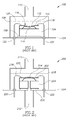
- FIGURE 5 schematically shows a cross-sectional view of a portion of a pressure sensor 500 having a sensor die 502 coupled to a glass support tube 504.
- a solder or adhesive 506 attaches the glass support tube 504 to an intermediate sleeve 508.
- the function of this intermediate sleeve is described in U.S. Patent No. 4,509,880 .
- the glass support tube 504 includes a bore or passageway 510 through which the pressure media "P" loads the sensor die 502.
- the intermediate sleeve 508 includes a first portion 512 with a first perimeter 514 extending into and coupled to a second portion 516 with a second perimeter 518.
- the first portion 512 is distally located from the sensor die 502 and the first perimeter 514 is preferably larger than the second perimeter 516.
- the first portion 512 takes the form of an expanded or bulbous end portion and the second portion 516 takes the form of a recessed or necked-down portion.
- first portion 512 is coupled to the recessed portion 516 via a sloped or tapered shoulder 520.
- the first portion 512 and the second portion 516 may be connected by a stepped surface (not shown).
- the intermediate sleeve 508 may made from a KOVAR ® metallic alloy.
- the glass support tube 504 is located within the intermediate sleeve 508 and includes a surface 522 contoured to be closely received by the first and second portions 514, 516 of the intermediate sleeve 508.
- This conformal faying surface 522 of the glass tube is typically plated with metal 538 to enhance attachment with solder when the adhesive is employed.
- the glass support tube 504 includes an expanded perimeter portion 524 having a perimeter 526 sized to be closely received by the first portion 512 of the intermediate sleeve 508.
- the glass support tube 504 includes a necked-down portion 528 having a perimeter 530 sized to be closely received by the second portion 516 of the intermediate sleeve 508.
- the expanded perimeter portion 524 is distally located from the sensor die 502.
- the surface 522 of the glass support tube 504 is complementarily contoured with respect to an inner surface 532 defined by the first and second portions 514, 516 of the intermediate sleeve 508.
- the solder or other adhesive attachment layer 506 is located between the surface 522 of the glass support tube 504 and the inner surface 532 of the intermediate sleeve 508.
- the glass support tube 504 and the intermediate sleeve 508 are coupled together via the attachment layer 506, which, as noted above, is located between the outer surface 522 of the glass support tube 504 and the inner surface 532 of the intermediate sleeve 508. Due to the configuration of the complementary surfaces 522 and 532, applied pressure on the sensor die 502 places at least a portion of the attachment layer 506 in compression.
- the glass support tube 504 is a cylindrically shaped glass support tube 504 where the first portion 512 takes the form of an expanded or bulbous end portion 513.
- the glass support tube 504 may be made of any appropriate glass material.
- the glass support tube 504 is made from PYREX® glass material.
- the glass support tube 504 may have a rounded, flame polished surface 536 at the distal end 537.
- the longitudinal length 538 is longer than the thickness 540 of the expanded or bulbous end portion 513.
- a thin metallic layer 542 may be located on the inner surface 522 of the glass support tube 504 adjacent the attachment layer 506 by plating, coating, or some other equivalent process.
- the metallic layer 542 assists in solder bonding of the glass support tube 504 to the intermediate sleeve 508.
- the metallic layer 542 is a platinum-silver layer having an approximate thickness of about 0.001 inches.
- the metallic layer 542 may include amounts of titanium, tungsten, nickel, gold, or other materials as generally described in U.S. Patent No. 4,509,880 .
Landscapes
- Chemical & Material Sciences (AREA)
- Analytical Chemistry (AREA)
- Physics & Mathematics (AREA)
- General Physics & Mathematics (AREA)
- Measuring Fluid Pressure (AREA)
Applications Claiming Priority (1)
| Application Number | Priority Date | Filing Date | Title |
|---|---|---|---|
| US11/777,737 US7434474B1 (en) | 2007-07-13 | 2007-07-13 | Hermetic attachment method for pressure sensors |
Publications (2)
| Publication Number | Publication Date |
|---|---|
| EP2015045A2 true EP2015045A2 (fr) | 2009-01-14 |
| EP2015045A3 EP2015045A3 (fr) | 2010-09-29 |
Family
ID=39828188
Family Applications (1)
| Application Number | Title | Priority Date | Filing Date |
|---|---|---|---|
| EP08160150A Withdrawn EP2015045A3 (fr) | 2007-07-13 | 2008-07-10 | Procédé de fixation hermétique amélioré pour capteurs de pression |
Country Status (2)
| Country | Link |
|---|---|
| US (1) | US7434474B1 (fr) |
| EP (1) | EP2015045A3 (fr) |
Families Citing this family (12)
| Publication number | Priority date | Publication date | Assignee | Title |
|---|---|---|---|---|
| US7677109B2 (en) * | 2008-02-27 | 2010-03-16 | Honeywell International Inc. | Pressure sense die pad layout and method for direct wire bonding to programmable compensation integrated circuit die |
| US8322225B2 (en) * | 2009-07-10 | 2012-12-04 | Honeywell International Inc. | Sensor package assembly having an unconstrained sense die |
| US8230743B2 (en) | 2010-08-23 | 2012-07-31 | Honeywell International Inc. | Pressure sensor |
| US8590387B2 (en) * | 2011-03-31 | 2013-11-26 | DePuy Synthes Products, LLC | Absolute capacitive micro pressure sensor |
| US8817483B2 (en) | 2011-08-01 | 2014-08-26 | Honeywell International Inc. | Connector assembly for a sensor |
| US8534130B2 (en) | 2011-08-01 | 2013-09-17 | Honeywell International Inc. | Joint between a pressure sensor and a pressure port of a sensor assembly |
| US8934263B2 (en) | 2011-08-01 | 2015-01-13 | Honeywell International Inc. | Protective cover for pressure sensor assemblies |
| US8671753B2 (en) | 2011-08-01 | 2014-03-18 | Honeywell International Inc. | Cable harness for a sensor |
| US8656786B2 (en) | 2011-08-01 | 2014-02-25 | Honeywell International Inc. | Interchangeable pressure sensor assembly and methods of assembly |
| US8459125B2 (en) | 2011-08-01 | 2013-06-11 | Honeywell International Inc. | Pressure sensor assembly |
| US11225409B2 (en) | 2018-09-17 | 2022-01-18 | Invensense, Inc. | Sensor with integrated heater |
| CN116951104A (zh) * | 2023-07-11 | 2023-10-27 | 无锡芯智感科技有限公司 | 一种密封敏感压力传感器芯体及其密封方法 |
Citations (1)
| Publication number | Priority date | Publication date | Assignee | Title |
|---|---|---|---|---|
| US4509880A (en) | 1981-03-30 | 1985-04-09 | Honeywell Inc. | Very high hermeticity glass to metal seal |
Family Cites Families (5)
| Publication number | Priority date | Publication date | Assignee | Title |
|---|---|---|---|---|
| IL106790A (en) * | 1992-09-01 | 1996-08-04 | Rosemount Inc | A capacitive pressure sensation consisting of the bracket and the process of creating it |
| JP3331782B2 (ja) * | 1994-10-24 | 2002-10-07 | 松下電工株式会社 | 半導体圧力センサの製造方法 |
| US6091022A (en) * | 1998-12-17 | 2000-07-18 | Honeywell Inc. | High pressure header for a semiconductor pressure transducer |
| WO2003008921A1 (fr) * | 2001-07-17 | 2003-01-30 | Measurement Specialties, Inc. | Technique d'isolation pour structure de détection de pression |
| US20070013014A1 (en) * | 2005-05-03 | 2007-01-18 | Shuwen Guo | High temperature resistant solid state pressure sensor |
-
2007
- 2007-07-13 US US11/777,737 patent/US7434474B1/en not_active Expired - Fee Related
-
2008
- 2008-07-10 EP EP08160150A patent/EP2015045A3/fr not_active Withdrawn
Patent Citations (1)
| Publication number | Priority date | Publication date | Assignee | Title |
|---|---|---|---|---|
| US4509880A (en) | 1981-03-30 | 1985-04-09 | Honeywell Inc. | Very high hermeticity glass to metal seal |
Also Published As
| Publication number | Publication date |
|---|---|
| EP2015045A3 (fr) | 2010-09-29 |
| US7434474B1 (en) | 2008-10-14 |
Similar Documents
| Publication | Publication Date | Title |
|---|---|---|
| US7434474B1 (en) | Hermetic attachment method for pressure sensors | |
| US6351996B1 (en) | Hermetic packaging for semiconductor pressure sensors | |
| US6550337B1 (en) | Isolation technique for pressure sensing structure | |
| US8230745B2 (en) | Wet/wet differential pressure sensor based on microelectronic packaging process | |
| US20030167851A1 (en) | Absolute micromachined silicon pressure sensor with backside hermetic cover and method of making the same | |
| JP5746187B2 (ja) | 圧力センサマウントを備えた圧力トランスミッタ | |
| JP4815350B2 (ja) | 圧力センサカプセル | |
| US20020029639A1 (en) | Isolation technique for pressure sensing structure | |
| EP2388566B1 (fr) | Capteur à pression modulaire | |
| US20250116540A1 (en) | Temperature-pressure sensor | |
| US7930944B2 (en) | ASIC compensated pressure sensor with soldered sense die attach | |
| US10837855B2 (en) | Pressure measuring system | |
| JPS60167385A (ja) | トランスジユ−サ素子とその製造方法及びトランスジユ−サ素子を組み込んだ圧力トランスジユ−サ | |
| JP6895549B2 (ja) | 圧力センサアセンブリ | |
| JP2006266818A (ja) | 圧力センサ装置 | |
| US8770032B2 (en) | Relative pressure sensor | |
| EP3205998B1 (fr) | Capteur de pression à membrane ouverte pour milieu agressif | |
| JPH08247873A (ja) | 圧力センサ | |
| US6591686B1 (en) | Oil filled pressure transducer | |
| US20180086626A1 (en) | Method of manufacturing a sensor | |
| JPH01169333A (ja) | 半導体圧力変換器 | |
| US20040261535A1 (en) | Apparatus and method for interconnecting leads in a high temperature pressure transducer | |
| CN112262303A (zh) | 压力测量装置及其生产方法 | |
| JP2003042883A (ja) | 液封型圧力センサ | |
| JPH01432A (ja) | 半導体圧力変換器 |
Legal Events
| Date | Code | Title | Description |
|---|---|---|---|
| PUAI | Public reference made under article 153(3) epc to a published international application that has entered the european phase |
Free format text: ORIGINAL CODE: 0009012 |
|
| 17P | Request for examination filed |
Effective date: 20080710 |
|
| AK | Designated contracting states |
Kind code of ref document: A2 Designated state(s): AT BE BG CH CY CZ DE DK EE ES FI FR GB GR HR HU IE IS IT LI LT LU LV MC MT NL NO PL PT RO SE SI SK TR |
|
| AX | Request for extension of the european patent |
Extension state: AL BA MK RS |
|
| PUAL | Search report despatched |
Free format text: ORIGINAL CODE: 0009013 |
|
| AK | Designated contracting states |
Kind code of ref document: A3 Designated state(s): AT BE BG CH CY CZ DE DK EE ES FI FR GB GR HR HU IE IS IT LI LT LU LV MC MT NL NO PL PT RO SE SI SK TR |
|
| AX | Request for extension of the european patent |
Extension state: AL BA MK RS |
|
| 17Q | First examination report despatched |
Effective date: 20101005 |
|
| AKX | Designation fees paid |
Designated state(s): DE FR GB |
|
| RAP1 | Party data changed (applicant data changed or rights of an application transferred) |
Owner name: HONEYWELL INTERNATIONAL INC. |
|
| STAA | Information on the status of an ep patent application or granted ep patent |
Free format text: STATUS: THE APPLICATION IS DEEMED TO BE WITHDRAWN |
|
| 18D | Application deemed to be withdrawn |
Effective date: 20160202 |